
Circle of Transmission: The Living Loom
Jacob Boehme: DIVINE LINGUISTICS
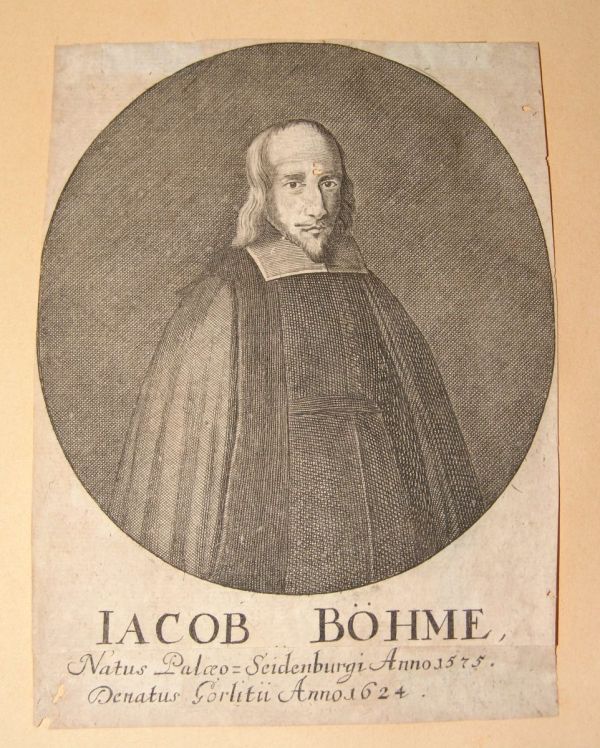
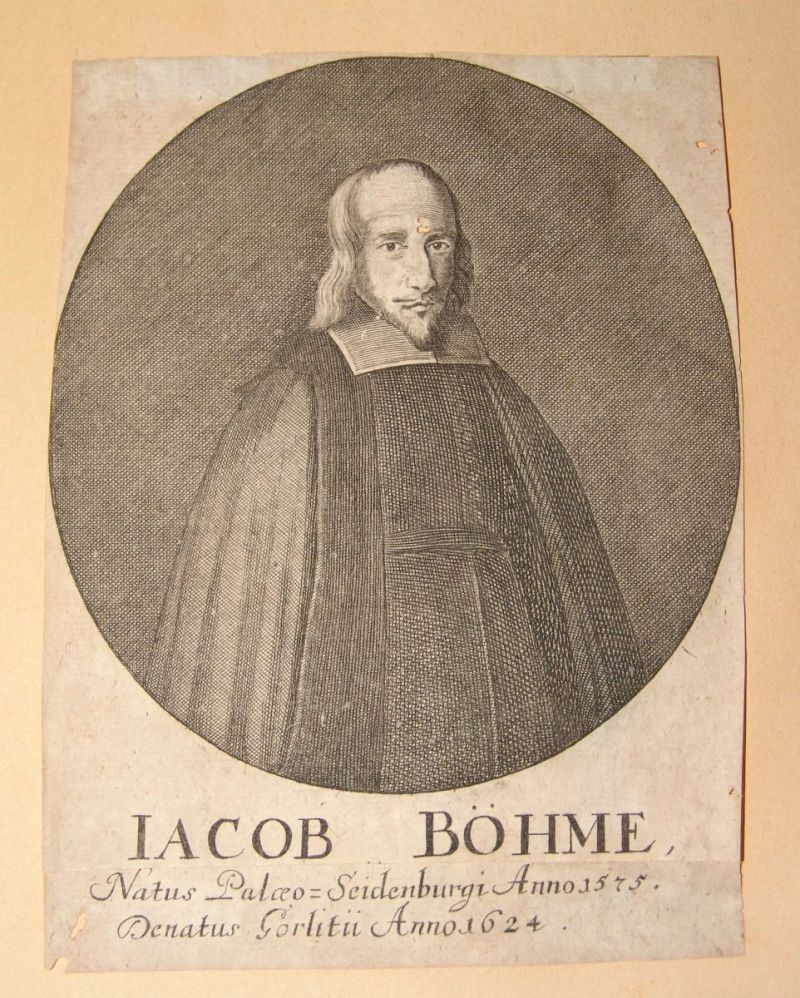
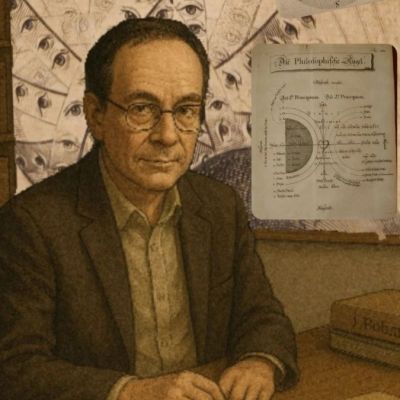
A rare portrait of Jacob Boehme,
coming from the library of the late Charles Muses
at the Jacob Boehme Society.
*
Today’s sharing from the Blue House of Via-HYGEIA
are two impressive extracts from the Collected Works of Jacob Boehme:
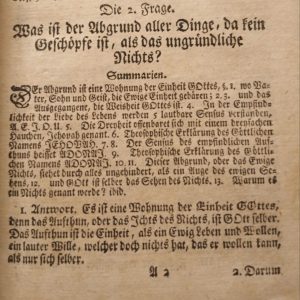
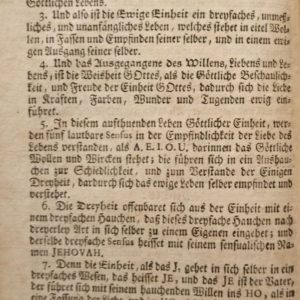
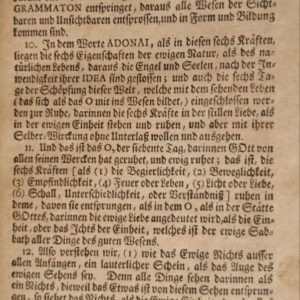
Extract 1 is taken from the ‘177 Theosophical Questions‘(of which he answered only 14 before his passing into the Eternal Present). We present here ‘Question 2’ and his answer in which the play with God ‘s name JEHOVAH and the letter Cabala is fascinating. This excerpt is taken from the 1730 Gichtel Amsterdam edition of Jacob Boehme’s Collected Works, in which it is treatise XVIII (here XIIX) and runs from page 3-4-5. This text is a magnificent example of Boehme’s attempt to map the inner life of God as a dynamic, creative process, using language and divine names as his primary tools.
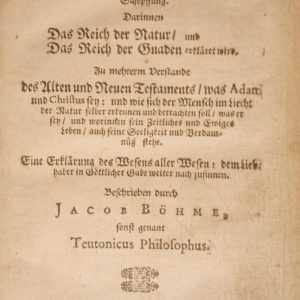
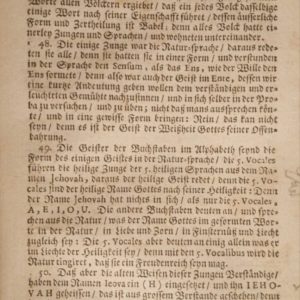
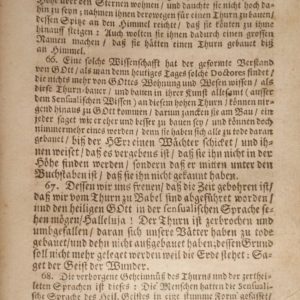
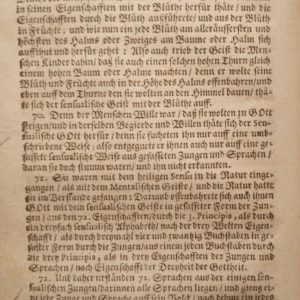
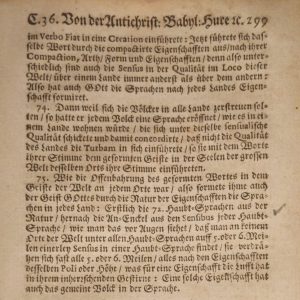
Extract 2 is taken from the heart of Jacob Boehme’s monumental commentary on Genesis, ‘Mysterium Magnum‘, here the chapter 35-paragraphs 49 to 75 in its 1682 Gichtel Amsterdam edition, in which he delineates and structures his mystical theology of language. In these paragraphs, which deals with the dispersion of Noah’s descendants and the Tower of Babel, Boehme moves beyond a literal historical account to reveal what he sees as the divine drama of human perception, expression, and fall.
**
Extract 1
The 2nd Question
‘What is the Abyss of all things, where there is no substance,
but only the ungrounded Nothingness?’
*
Summary
This Abyss is a Dwelling of the Unity of God, § 1, where Father, Son, and Spirit give birth to the Threefold Unity; §§ 2-3 and that which has proceeded forth is the Wisdom of God. §4 In the sensibility of the Love of Life, five audible Senses are understood, A. E. I. O. U. § 5 The Trinity reveals itself with a threefold Breath, called Jehovah. § 6 Theological explanation of the Divine Name JEHOVAH. §§ 7-8 The Genius of the sensible Source is called ADONAI. § 9 Theological explanation of the Divine Name ADONAI. §§ 10-11 This Abyss, or the Ungrounded Nothing, flows through all things unhindered, as an Eye of eternal Seeing, 12. and God Himself is the Seeing of the Nothing. §13 Why is it called a Nothing? ibid.
1. Answer: It is a Dwelling of the Unity of God, for the Unground, or the I-ness of the Nothing, is God Himself. The Unground is the Unity, as an eternal Living and Ruling, a pure Will which yet has nothing that it can will, except only itself.
2. Therefore, the Will is a desiring, willing Love-Lust, as an emergence of itself for its own sensibility. The Will is (1) the one Father of the Ground; and the sensibility of the Love is (2) the one Son, whom the Will generates within itself into a sensible Love-Power; and the proceeding forth of the willing, sensible Love is (3) the Spirit of the Divine Life.
3. And thus the one Unity is a threefold, unsearchable, and unbeginning Life, which exists in pure Willing, in Feeling and Sensing of itself, and in an eternal proceeding forth of itself.
4. And that which has proceeded forth from the Willing, Loving, and Living, is the Virtue (4) thereof, as the Divine Vitality, and Joy of the Unity (5) thereof, through which the Love introduces itself in powers, colours, wonders, and virtues.
5. In this revealing Life of the Divine Unity, five audible Senses in the sensibility of the Love of Life are understood, as A. E. I. O. U., wherein the Divine Willing and Working exists; these lead themselves into an out-breathing for distinctness, and for the understanding of the single Trinity, through which the one Life feels and understands itself.
6. The Trinity reveals itself out of the Unity with a threefold Breath, and this threefold Breath, according to its property, introduces itself into one unique Name; and this beloved threefold Sense is called in its sounding Name JEHOVAH.
7. For the Unity, as the J, goes in itself into a threefold Aspiration, that is called JE, and the JE is the Father; He leads Himself with His breathing Will into HO, as into a forming of Love, and in the HO the Word of all powers is understood, for it makes a Circumference or turning-in upon itself, as the one Something, or I-ness, from which the Love-Lust proceeds forth; which proceeding forth is the Spirit, who sounds and forms Himself into VA. For the V is the Spirit, as the proceeding forth, and the A is the Wisdom, wherein the Spirit sounds Himself into an effective Life.
8. Thus this threefold breathing Life in itself is then called O. JAH. For the in-breathed Air is the O. as a Bearing (or Womb) of the only Seeing, a pure Seeing; and the JAH is the threefold Entrance into itself, as into the sensibility of the Willing, which eternally sustains itself through the eternal Breathing.
9. The Unground, as the Quality in the Sense of the sensible Unground, is called ADONAI, and there are six Powers, from which the Mysterium Magnum, as the high Name TETRAGRAMMATON, springs forth, from which all beings of the visible and invisible have sprouted forth, and have come into form and formation.
10. In the Word ADONAI, as in these six Powers, lie the six Qualities of the eternal Nature, as of the natural life, from which the angels and souls, according to the modality of their IDEA, have been flowed forth; and also the six Days of the creation of this world, which (with the living Life, which forms itself as the O into Being) are enclosed for the Rest, wherein the six Powers in the virgin Love, as in the eternal Unity, stand and rest, and yet with their self-operation go forth and will without ceasing.
11. And that is the O, the seventh Day, wherein God has rested from all His works, and rests eternally; that is, the six Powers [as (1) the Desirefulness, (2) the Mobility, (3) the Sensibility, (4) the Fire or Life, (5) the Light or Love, (6) the Sound, Understandability, or Comprehension] rest in that from which they spring, as in the O, as in the Place of God, wherein the eternal Love is signified, as the Unity, or the I-ness of the Unity, which is the eternal Sea of all things of good Being.
12. Thus we understand, (1) how the Eternal Nothing, outside all circumferences, is a pure Shining, as the Eye of the eternal Seeing itself. For all things live therein as a Nothing, until the Something has sprung forth from this Seeing; thus the Nothing, as the Eternal Unity, flows through all things unhindered.
13. And we understand (2) further, that God Himself is the Seeing and Sensing of the Nothing, and it is called a Nothing (even though it is God Himself) because it is incomprehensible and ineffable.
*
Notes about key terms
- The Unground (Der Ungrund): The absolute, primal Godhead beyond all distinction, even beyond the Trinity. It is a Nothing not because it doesn’t exist, but because it is no thing, no object. It is pure, unqualified potential and will.
- The Nothing (Das Nichts): Synonymous with the Unground. It is the divine essence prior to self-revelation. It is an Eye because it is pure, non-dual awareness and the source of all perception.
- Letter Cabala: Boehme isn’t using traditional Hebrew Kabbalah but creating a Christian theosophical equivalent. He breaks down JEHOVAH (J-E-HO-V-A) and ADONAI to describe the process where the undifferentiated Unity (J) becomes the Father (JE), who forms the womb of creation (HO), from which the Spirit (V) proceeds into manifest Wisdom (A). The vowels A.E.I.O.U represent the five divine senses or powers of perception within the Godhead.
- ADONAI and the Six Powers: For Boehme, ADONAI is the name for the Unground as it enters into the six qualities or powers of eternal nature (a concept central to his other works). These six powers, energized by the seventh (the O, the Sabbath Rest), are the foundation of all created beings, angels, and the world itself. The Tetragrammaton (YHWH) is seen as springing from this more primal, qualitative name.
*
Source
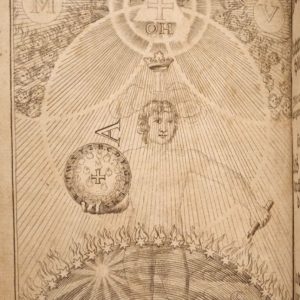
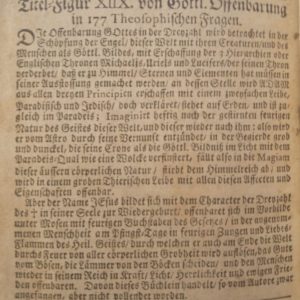
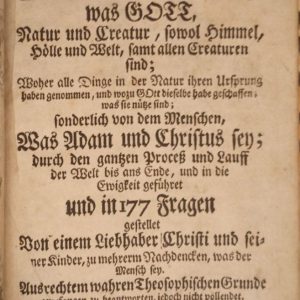
Engraving explanation
by Johann Gichtel himself:
Title Figure XIIX.
Of the Divine Revelation
in the ‘177 Theosophical Questions‘:
‘The revelation of God in the Trinity is considered in the creation of the angels, of this world with its creatures, and of the human being as the divine image; together with the creation of the three hierarchies or angelic thrones—Michael, Uriel, and Lucifer—of whom the latter corrupted his own throne, and therefore had to be expelled into heaven, stars, and elements in his casting out.
In his place, Adam was created out of all three principles, with a twofold body—paradisiacal and earthly—yet transfigured; he stood upon the earth and yet was at the same time in Paradise. He imagined strongly according to the stirred, fiery nature of the spirit of this world, and this world again according to him. Thus he again ignited the astrum through his reason; in desire, coarse and dark, his crown—namely the divine image in the light with paradisiacal quality—was darkened like a cloud.
Thus he fell into the magic of this external corporeal nature, died to the Kingdom of Heaven, and became manifest in a coarse, bestial body with all these affects and properties.
But the name Jesus forms itself in the character of the Trinity through the † (cross) in his soul unto regeneration; it reveals itself in the archetype among the roses with fiery letters of the Law; in the assumed humanity on the day of Pentecost in fiery tongues and flames of love of the Holy Spirit—through which He will also at the end reveal the world, when through fire all corporeal coarseness is dissolved, the good separated from the evil, the lambs from the goats, and the human being again revealed in His kingdom in power, light, glory, and eternal peace.
Of this, this little book treats, as far as the author has begun it, but not completed it’.
*
Extract 2
Mysterium Magnum,
Chapter 35, paragraphs 49 to 75
48. The unique language was the language of nature. Through it, the Ens spoke when they were still in one form, and in that language they understood the meaning, the Ens itself, as the Ens formed the wise man. For thus was also the Spirit in the Ens, of which we will give a brief indication for the understanding and illuminated mind to follow, and to test and practice within itself in the proof; not that one could express it and bring it into a certain form: No, that cannot be, for it is the Spirit of God’s wisdom in His revelation.
49. The spirits of the letters in the Alphabet are the form of the one Spirit in the language of nature. The 5 Vowels bring forth the holy language of the 5 holy speeches from the Name Jehovah, through which the Holy Spirit speaks. For the 5 Vowels are the holy Name of God according to His holiness: For the Name Jehovah has nothing in itself but the 5 Vowels A, E, I, O, U. The other letters signify and express nature: what the Name of God in the formed Word is in nature, in Love and Wrath, in Darkness and Light simultaneously. The 5 Vowels, however, signify solely what He is in the Light of holiness, for with the 5 Vowels nature is tuned so that it may be a kingdom of joy.
50. But that the ancient wise men, who had understanding of this language, inserted an (H) before the name and called it JEHOVAH, that happened from great understanding. For the (H) makes the holy Name with the 5 Vowels manifest in the aroused nature. It shows how the holy Name of God breathes itself forth and reveals itself in the creature; the 5 Vowels are the hidden Name of God, which dwells alone in itself; But the (H) signifies the Divine Breath or Wisdom, how the Divine Breath exhaled from itself.
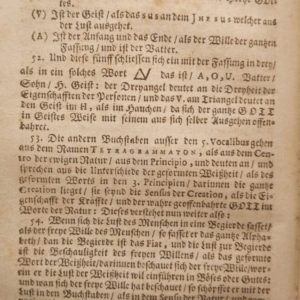
51. The inner meaning in the five VOWELS is this:
(I) Is the name JESUS.
(E) Is the name of the Angel.
(O) Is the formed Wisdom or Breath of the (E), which is JESUS, and is the centre or heart of GOD the Son.
(U) Is the Spirit, as the SUS in JESUS, which breathes out from the Breath.
(A) Is the Beginning and the End, as the Will of the whole formation, and is the Father.
52. And these five unite with the formation into three, as into such a Word: that is, A, O, U. Father, Son, H. Spirit: The Triangle signifies the Trinity of the properties of the Persons, and the U in the Triangle signifies the Spirit in the H, as in the breathing, where the whole GOD in a spiritual manner reveals Himself with His going forth from Himself.
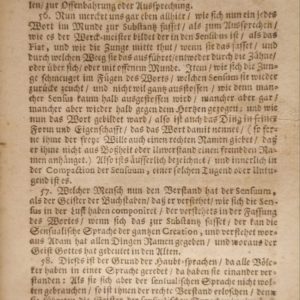
53. The other letters besides the 5 Vowels proceed from the Name TETRAGRAMMATON, as from the centre of eternal nature, from the Principium, and they signify and express the senses of the formed Wisdom, as of the formed Word in the 3 Principia, wherein the whole Creation lies; they are the Sensus of the Creation, as the property of the powers, and the true revealed GOD in the Word of nature: This is now further understood thus:
54. When the breath of man casts itself into a desire (as the free will of man), then it forms the whole Alphabet. For the desire is the Fiat, and the breath to the desire is the palpability of the free will, as the formed Word of Wisdom, wherein the free will palpably feels itself, before it fully introduces the breath of Wisdom into Evil or Good; and when the free will has felt itself, then it creates with the breath in the letters, as in the Sensus of nature, and composes the Sensus of the letters together, and casts the breath into a Word, which lies in an internal form, as in a conceived thought.
55. Then the free will takes the H, as the Spirit of the outbreathing, and leads the formed thought before the gate of the five senses, which feel the conceived Word and try it, whether it be good or not. If it then pleases them, the H, as the breathing Spirit, takes the Word and leads it upon the tongue in the mouth. Thus, the working-measurer is as the Fiat, which is the Divine work-master, and it configures the senses of the properties from the letters, as the free will has composed them into a substance for sounding or resonating, for revelation or utterance.
56. Now mark very precisely: how each word in the mouth is led into substance, as into utterance; how the working-measurer, who is in the senses, as the Fiat, forms it; and what the tongue does when it takes it, and through which path it executes it—either through the teeth, or over them, or with open mouth. Note how the tongue twists in the joining of the word, which sense it drives back, and does not willingly help out; how indeed many a sense is barely half expelled, yet often wanders about, however is again half drawn back towards the heart. And as the word was thus formed, so also is the thing in a form and property which the word names with it (if only the free will also gives it a right name, and does not attach a foreign name to it out of ignorance or lack of understanding). Thus it is outwardly designated, and inwardly in the compaction of the senses; it is of such a kind or sort.
57. Whatever man has the understanding of the senses, as of the spirits of the letters, so that he understands how the senses have composed themselves in the breath, he understands in the formation of the word, when it is led into substance; he knows the sensual language of the whole Creation, and understands from what source Adam gave names to all things, and from what source the Spirit of God has prophesied in the Prophets.
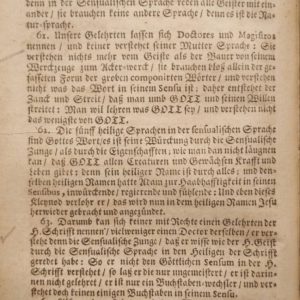
58. This is the ground of the main languages, where all peoples spoke in one language, there they understood one another. But when they did not wish to use the sensual language, the right understanding was extinguished in them. For they led the spirits of the sensual speeches into an external coarse form, and led the subtle spirit of understanding into a coarse form, and learned to speak from the form, as indeed all peoples today speak only from the form of their colored sensual languages.
59. No people understands the sensual language anymore, and the birds in their cages and the minstrels in their prophesying do so according to their property.
60. Therefore man may know therefrom what he has lost, and what he shall regain in the rebirth, although not here on earth, yet in the angelic world; for in the sensual language all spirits speak with one another, they use no other language, for it is the nature-language.
61. Our scholars let themselves be called Doctors and Masters, and none understands his mother-tongue: They understand nothing more of the spirit than the farmer of his draft-horse for field-work. They use merely the drawn form of the coarse composed figures, and do not understand what the word is in its sense; from this arises the quarrel and strife, that one disputes about GOD and His will: One wants to teach what GOD is, and understands not the least about GOD.
62. The five holy speeches in the sensual language are God’s Word; it is His operation through the sensual language, as through the properties; as one then cannot deny that GOD gives power and life to all creatures and growths, for His holy Name is through all; and this same holy Name Adam had for rulership in his senses, understanding, ruling, and feeling. And this very jewel he lost, which is now in the holy Name of Jesus brought forth again and restored.
63. Therefore, no one can rightly call himself a scholar of Holy Scripture, much less a Doctor of the same, unless he understands the sensual language—so that he might know how the Holy Spirit has spoken through the sensual language in the Saints of Scripture. If he does not understand the divine Sensus in Holy Scripture, then let him read it only uncommented; he is not learned therein, he is only a letter-exchanger, and yet understands not a single letter in its true sense.
64. Thus understand us also in this concerning the children of Noah, as Japheth’s, Shem’s, and Ham’s, and their children and children’s children: They had lost the sensual language, and had made themselves a formed one, and spoke thus in a formed language which they themselves did not understand in its sense. Therefore GOD was hidden from them, for they no longer understood the voice of the Holy Spirit in their speech until finally the human tongue of the 5 Vowels thought that He must also be something formed and external.
65. And because they might understand nothing of GOD on earth—what or where He was—and yet had heard so much of GOD from their forefathers, they thought He must dwell on high above the stars, and they were not worthy to be so high; they therefore resolved to build a tower whose peak reached to heaven, so that He might come down to them. They also wanted to make a great name for themselves thereby, that they had built a tower up to heaven.
66. Such a knowledge has the formed understanding of GOD, as one finds such Doctors today who know no more of GOD’s dwelling and being than these tower-builders, and build in their art solely (upon sensual knowledge) on this high tower, and can by no means come to GOD; therefore they quarrel at the building, each says how he thinks and means to build, and yet can never become one, for they have all built themselves to death, until the Lord sends a confusion and shows them that it is in vain, that they will not find Him on high, but that He is amidst the confusion of tongues, whom they have not known.
67. Of this we rejoice, that the time has come that we have been led away from the tower of Babel and may see the holy GOD in the sensual language, Hallelujah. The tower is broken and fallen down, on which our fathers built themselves to death, and which they did not build up; its foundation shall be laid no more forever. Says the Spirit of Wonders.
68. The hidden mystery of the tower and the divided languages is this: The humans had led the sensual language of the Holy Spirit into a mute form, and used the formed word of human understanding only in a form as in a model; they spoke only with the model, and did not understand the Word of God in their own sensual tongues, that GOD was indeed in the speaking Word of the understanding, as also still happens today.
69. GOD had incorporated Himself with His Word into the human image at the beginning of Creation, as into the properties of the senses, and did not want to be mute or formed in a single dead model. But because all things in the powers, seed, and harvest draw, so now was the time of the blossoming of the human tree, when the Spirit of the senses in its properties would come forth with the blossom, and lead the properties through the blossom, and from the blossom into fruits. And as now each blossom at the outermost and highest of the stalk or branch on tree or stalk raises itself and goes forth, so also the Spirit drove the children of men to make such a high tower like a high tree or stalk. For He wanted to reveal His blossom and fruits also in the height of the stalk, and even on the tower which they wanted to build to heaven, the sensual Spirit with the blossom would reveal itself.
70. For the will of men was that they wanted to ascend to GOD, and in that same desire and manner the sensual GOD came forth, for they sought Him only in an uncomprehended manner; thus He also met them only in a counted, sensual manner in formed languages and speeches, upon which they were nevertheless mute and did not recognize Him.
71. They had entered with the holy Sensus into nature, as with the human spirit, and nature had captured them in understanding. Therefore GOD also revealed Himself to them with the sensual spirit in a formed form of languages, out of the 72 properties, through the 3 Principia, as through a threefold sensual Alphabet, according to the property of the three worlds, as through three times four and twenty letters in a formed form through the languages; from each letter through the three Principia, as in three properties of languages and speeches, according to the property of the Trinity of the Godhead.
72. And thence arose 72 languages from the one sensual language, wherein all languages lie, and He gave to each its language and speech for its people, according to which each lineage was of one property from the stem of the human tree out of the formed Word. Such a language also arose from them, from their Sensus, as from the same property of the formed Word.
73. For the Sensus of human speech, that he can speak, originated from the essential Word, which introduced itself in the Verbum Fiat into a Creation. Now the same Word led itself forth through the compacted properties, according to their compaction, essence, form, and properties. For thus also the senses are unceasingly different in quality in the locus of this world: over one land always otherwise than over the other. Thus also God has formed the languages according to each land’s property.
74. For because the peoples should disperse into all lands, He had ordained for each people a language, as it would dwell in a land, which fitted itself under and concorded with the same sensual quality of that land. This was so that the quality of the land would not introduce a turba into them, if they with the word of their voice introduced their voice into the formed spirit in the soul of the great world of the same kind.
75. As the nourishment of the formed Word in the spirit of the world was in each place, so also the Spirit of the World formed the languages for each land through the nature of the properties: First the 72 main languages from nature, thereafter the grandchildren from the sensus of each main language. As one sees before one’s eyes that in no place of the world, among all main languages, does one find the same sensus in a main language for 5 or 6 miles; they change themselves almost all 5 or 6 miles, all according to the properties of the same latitude or elevation, whatever property the air has in its prevailing constellation. Such a property the common people also have in their language. (The end of chapter 35).
Notes
1. 5 or 6 ‘Silesian meilen‘ are about 23-28 modern miles, or 37-44.5 km. This geographical scale underscores Boehme’s observation that even within a single ‘main language’, the living sensus or dialect could shift noticeably across a relatively short distance—a phenomenon he attributes not to chance, but to the changing spiritual-physical ‘properties‘ (Eigenschaften) of each locality.
2. In referencing 72 languages, Jacob Boehme is indeed drawing upon—and profoundly reinterpreting within his Christian theosophical framework—the Jewish esoteric tradition of the Shem ha-Mephorash (השם המפורש), the ‘Explained Name’ or ‘Explicit Name’ of God.
Here is an elaboration of the concept and how Boehme utilizes it:
a. The Kabbalistic Source: The 72-Fold Name. In Jewish mysticism (Kabbalah), the Shem ha-Mephorash is derived from Exodus 14:19-21. Each of these three verses contains 72 letters in the Hebrew original. By writing the verses one above the other and combining letters vertically, 72 three-letter names of God are formed. This 72-fold Name is considered the fullest expansion of God’s power and creative word (the Tetragrammaton – YHWH). It is associated with the highest understanding of divine immanence in creation, angelic realms (the 72 angels of the Shem ha-Mephorash), and the structurings of reality.
b. Boehme’s Theosophical Adaptation: Boehme, who had some exposure to Kabbalistic ideas (likely through Christian Kabbalists like Paracelsus and others), integrates this schema into his own cosmology: From Divine Properties to Human Languages: For Boehme, the 72 properties (Eigenschaften) are the foundational qualities or powers that emanate from God’s eternal nature and constitute the fabric of creation. They are the “sensual” alphabet of God’s speech.
The ‘Sensual Language’ Fragmented: The one, pure sensual language (the direct expression of these properties, known to Adam) is shattered at Babel. It does not simply break into random tongues. Instead, it fragments according to the divine template itself—into 72 primary forms.
A Divine, Not Arbitrary, Dispersion: Thus, the proliferation of languages is not a mere punishment but a cosmic-linguistic law. Each of the 72 main languages encapsulates a specific configuration or perspective of the divine properties. As he states in §§ 71-72, they arise ‘out of the 72 properties, through the 3 Principia‘.
c. The Connection to Geography and ‘Quality’: This is where Boehme’s theory becomes remarkably concrete. He links this linguistic metaphysics to terrestrial geography and climate (§§ 73-75): Each of the 72 languages is ordained for a specific people in a specific land. The language ‘concords’ with the sensual quality (die sensualische Qualität) of that land—its spiritual-physical ‘property’ shaped by factors like air, stars, and elevation. This explains for Boehme why dialects change every 5-6 German meilen (23-28 modern miles or 37-44.5 km). The local Qualität imprints itself on the Sensus of the speech. Language is thus a living mirror of the divine properties manifest in a locale.
d. The Christological Restoration: Crucially, Boehme sees this fragmentation as part of a divine process. The loss of the unified sensual language is part of humanity’s fall into a “formed,” external understanding. However, in his Christology, Jesus Christ is the restoration of the lost ‘Name‘ and the key to understanding.
As noted earlier (§ 64), the ‘jewel‘ Adam lost in his Sensus ‘is now in the holy Name of Jesus brought forth again and restored‘. Christ is the living Logos, the perfect divine Word in which all properties are harmonized. Through spiritual rebirth in Christ, one can begin to recover the inner Sensus—the understanding of the divine language—even while living amidst the Babel of external tongues.
Boehme’s Synthesis: Boehme uses the 72 languages as a powerful symbol to express: The Divine Plenitude: God’s creative wisdom is infinitely rich, expressed in 72 properties.
The Human Fall: Humanity’s turn toward external “form” shatters its unified perception of this divine language. A Structured Cosmos: The resulting diversity (of languages, peoples, and lands) is not chaos but a lawful, if fragmented, reflection of the divine order.
A Path to Return: The way back to understanding lies not in building towers of human reason (scholasticism) but through the inner revelation of Christ, who restores the ‘Name’ and opens the Sensus to the language of nature and spirit.
Thus, the 72 languages are far more than a number; they are Boehme’s code for the total structure of manifested reality, seen through the prism of a divine linguistics that was shattered at Babel and awaits reintegration at the end of spiritual time.
*
Further notes
upon vocabulary
-
Sensualisch: Translated as ‘sensual‘, referring to the direct, experiential language of nature and divine perception, not to bodily pleasure.
-
Principia/Principium: Latin terms left untranslated, referring to Boehme’s three foundational cosmic principles (dark, light, and the temporal world).
-
Ens: Latin for ‘being’ or ‘entity’, a philosophical term for fundamental reality.
-
Fiat: Latin for ‘Let there be’, the creative divine command.
-
Sensus: Latin for ‘sense’, ‘meaning’, or ‘faculty of perception’, central to Boehme’s theory of language.
-
Qualität: ‘Quality’, but in Boehme’s usage, it implies a dynamic, active property or force.
-
Turba: Latin for ‘turmoil’ or ‘confusion’, a term for chaotic, wrathful forces in nature.
*
Final Commentary
The core argument of this excerpt is the distinction between two fundamental modes of language:
1. The Sensual Language of Nature (die sensualische Sprache): This is the primal, holy, and unified language. It is not a human invention but the direct expression of God’s creative Word (Verbum) and Wisdom within all creation. Boehme describes it as a language of pure Sensus (sense/meaning), where the spiritual properties (Eigenschaften) of things are directly perceived and named. This language was known to Adam and the earliest humans, allowing them to understand the essence of creatures and commune directly with God’s spirit. It is the ‘nature-language‘ in which all angels and spirits communicate.
2. All the formed, external languages (geformte Sprachen): These are the fragmented, ‘coarse’ languages of historical humanity after the Fall and, decisively, after Babel. They are mere ‘forms’ or dead models, severed from the living Sensus. People use these languages ‘from the form’, like reading script without understanding, leading to empty disputation and the inability to grasp divine truth.
Key Themes Highlighted
–The Alphabet as Divine Cosmology: Boehme presents a mystical interpretation of the alphabet. The five vowels (A, E, I, O, U) are the holy, hidden Name of God (Jehovah), the essence of divine revelation in light. The consonants proceed from the Tetragrammaton and express God’s manifestation in nature, with its dynamic interplay of love and wrath, darkness and light. Human speech itself, through the act of the will, breath, and senses, mimics this divine process of formation.
–The Tower of Babel as Spiritual Catastrophe: For Boehme, the confusion of tongues is not merely a punitive miracle but the external consequence of an internal, prior loss. Humanity had already abandoned the living sensualische Sprache for a ‘mute form‘. The tower symbolizes the ultimate product of this ‘formed understanding‘—a rational, prideful attempt to reach God through external, human construction (both architectural and theological), which is doomed to failure and confusion.
–A Scathing Critique of Scholasticism: Boehme directly attacks the learned ‘Doctors and Masters’ of his day. He argues that without understanding the sensual language—the key to the Spirit’s voice in Scripture—they are merely ‘letter-exchangers’, building their own ‘high tower’ of sophisticated but empty disputation. True knowledge of God, he insists, is not intellectual abstraction but an understanding born of divine Sensus.
–The Hope of Restoration: The text is not solely a lament. Boehme sees the post-Babel confusion as a necessary scattering that will ultimately allow for a new revelation. He rejoices that his own time is one of being led away from the ‘tower’, suggesting that through the holy Name of Jesus and the rebirth of the individual, access to the true, sensual understanding of God can be restored.
Conclusion
This passage is a quintessential example of Boehme’s method: seeing in Biblical narrative an allegory of the soul’s relationship with the divine. It articulates a profound theory that language, in its deepest sense, is not a social convention but a reflection of cosmic and spiritual reality. Its critique of dry intellectualism in favor of experiential, spiritual wisdom, and its vision of a lost, perfect communion between word and meaning, have resonated through later thinkers in theology, philosophy, and Romanticism. To study this text is to engage with a radical and imaginative attempt to recover the voice of God in a world perceived as fragmented and silenced.
*
Source
*
More Jacob Boehme texts
@ Via-Hygeia Bibliotherapy
***
Related Articles


Leave a Reply