
Circle of Transmission: The Living Loom
A Little Samuel Richter (Sincerus Renatus) Sampler – Part 1: Upon Divine Vowels

Samuel Richter, a.k.a. Sincerus Renatus,
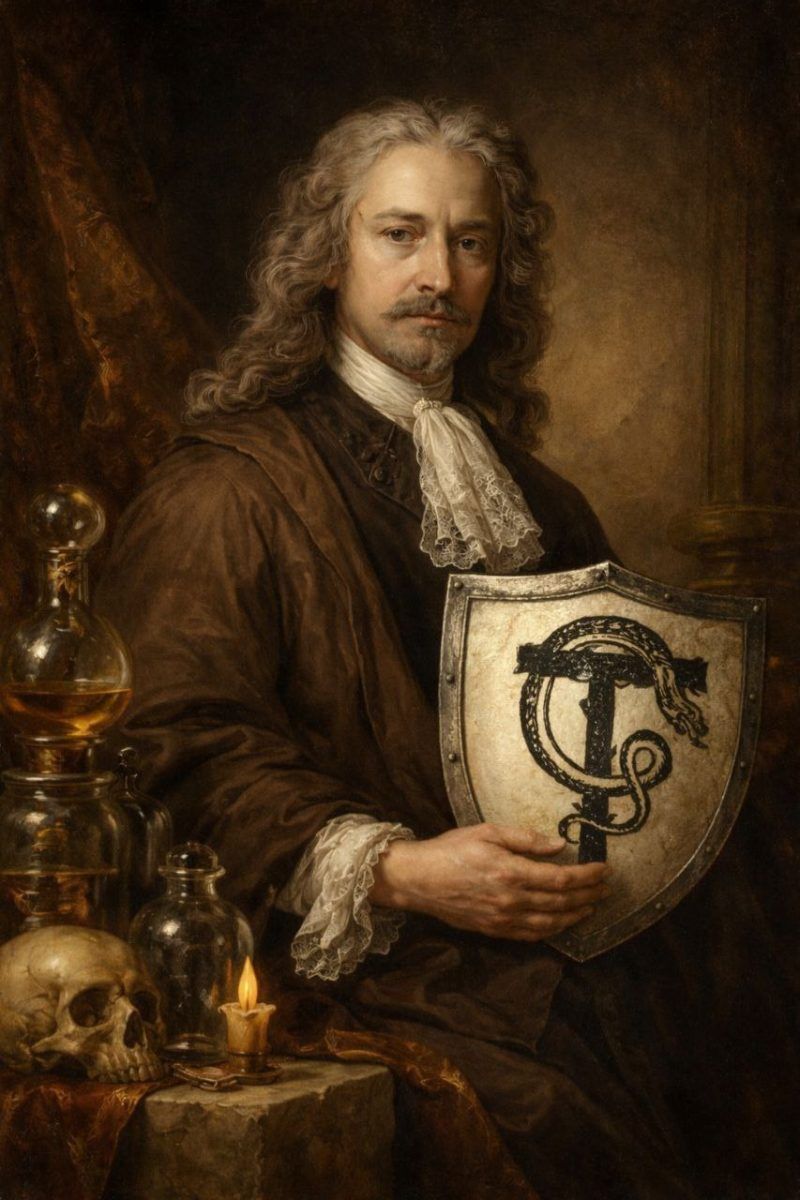
A symbolic portrait.
*
Today’s sharing from the Blue House of Via-HYGEIA is part 1 of a planned few devoted to the memory of Samuel Richter (born circa 1660–died around 1722), who wrote under the nomen mysticum ‘Sincerus Renatus’ (The sincere reborn), who stands as a pivotal and enigmatic figure in the late 17th and early 18th-century German esoteric movement, particularly within its Rosicrucian manifestation.
Active in the aftermath of the Thirty Years’ War and during the twilight of the original ‘Rosicrucian furor‘, Richter sought to synthesize the radical Christian theosophy of Jacob Boehme with practical Paracelsian alchemy within a structured secret society model.
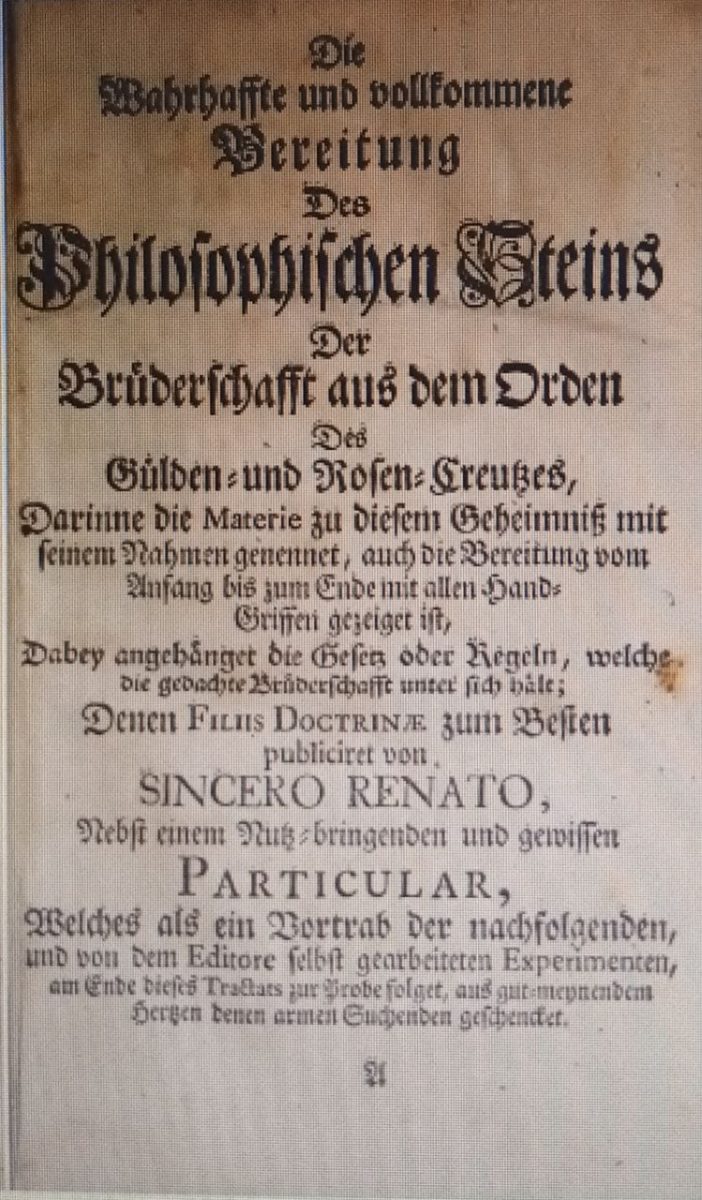
His focus was on inner spiritual regeneration (Renatus) as the absolute prerequisite for alchemical and magical efficacy, grounding all practices in a Lutheran and Pietist mystical framework. His seminal work, ‘Die warhaffte und vollkommene Bereitung des Philosophischen Steins der Brüderschaft aus dem Orden des Gülden-und Rosen Kreutzes’ (1710), is not only a crucial alchemical text but also a foundational document for the early Gold-und-Rosenkreuz order, outlining statutes, initiation rites, and a complex hierarchy.
In both literature and art, Richter’s legacy is characterized by a blend of profound Boehmian cosmology—exploring the divine Ungrund, the two centers, and the Trinity—with detailed, symbolic instructions for laboratory work and spiritual ascent, often encoded in the intricate emblematic engravings typical of the era’s alchemical manuscripts. Thus, he serves as a critical bridge between the speculative mysticism of the early 1600s and the more formalized, ritual-based esoteric societies that would flourish in the 18th century.
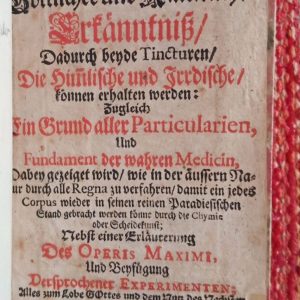
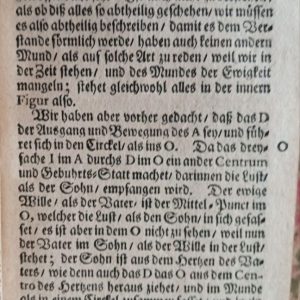
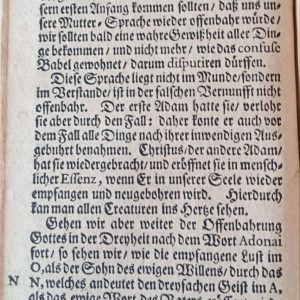
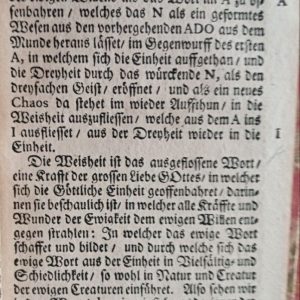
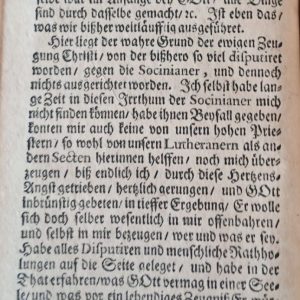
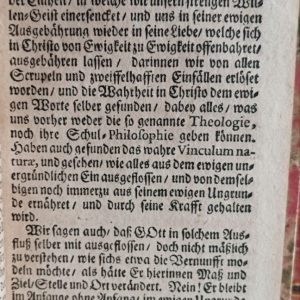
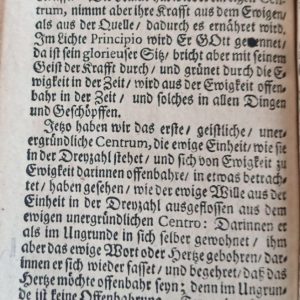
Our excerpt is taken from the ‘Theo-philosophia theoretico-practica oder Der wahre Grund goettlicher und natuerlicher Erkaenntniss, dadurch beyde Tincturen, die him[m]lische und irrdische, koennen erhalten werden‘ printed in Breslau in 1711. Our copy was in the late Charles Muses’ library at the Jacob Boehme Society and is now part of our Via-HYGEIA archive and study library. From page 8 to 17.
Coming soon, sampler – part 2 will be the complete ‘Capitulatio‘ chapter: ‘Regul oder Statuta, welche die Brüderschaft des goldnen Kreuzes observieren müssen, nachdem sie die Profession getan haben; wie solches bei uns noch heut zu Tage üblich‘, (Rules or statutes which the Brotherhood of the Golden Cross must observe after they have made their profession, as is still customary among us today), excerpted from the above mentioned Breslau 1710, ”The true and perfect preparation of the Philosophical Stone of the Brotherhood of the Order of the Golden and Rose Cross’.
**
The First Divine Beginning, Revelation,
and Foundation of the Two Centers.
The First Center,
Which is the ONE outside of all Nature and Essence
*
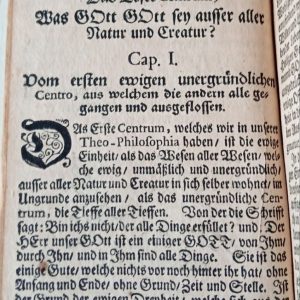
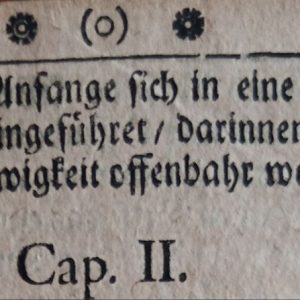
Chapter I.
On the first divine, unfathomable Centre,
from which all the others have proceeded and flowed out
The First Center, which we have in our Theo-Philosophy, is the Divine Unity, as the Being of all beings—which is singular, immeasurable, and unfathomable, outside of all nature and essence—dwelling in itself, to be regarded as the unfathomable Centre, the Light of all lights. Of which Scripture says: ‘Am I not He who fills all things?‘ and ‘The Lord our God is a single LORD; from Him, through Him, and in Him are all things‘. It is the singular Good, which has nothing before or after it, without beginning and end, without ground, time, or place. It is the ground of the singular Trinity, which reveals itself out of the Unity itself, where this single LORD is called in Scripture: A single, threefold Being, having three distinctions, and yet only One a singular Being.
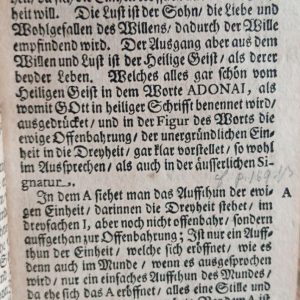
We shall discuss the revelation of the eternal Unity, as it leads itself into a Fulfillment, Delight, and Emanation: The Fulfillment is the Father, or the movement of the Unity, wherein the Unity opens itself and wills to enter into the Trinity. The Delight is the Son, the love and good pleasure of the Will, whereby the Will becomes sentient. The Emanation, however, from the Will and Delight is the Holy Spirit, as the life of both. All of this is most beautifully expressed by the Holy Spirit in the word ADONAI, with which God is named in Holy Scripture, and in the figure of this word the eternal revelation of the unfathomable Unity into the Trinity is very clearly presented, both in its utterance and in its external signature…
In the A one sees the rising up of the eternal Unity, within which the Trinity stands, in the threefold I, but not yet revealed, rather opened up for revelation; it is only an uprising of the Unity, which opens itself, just as also in the mouth, when it is spoken, it is only a simple rising up of the mouth, for before the A opens, all is a stillness and now makes the first movement; before the A there is no letter; it is the first, which opens the beginning of speech. Before the movement, it lies hidden in the love of the heart, and would not be revealed if such an uprising did not precede it. Externally, in the signature, the A has 3 equal strokes without a curve, indicating how the up-rising Unity contains within itself a threefold essence in the Trinity, not revealed before the willing, but presents itself in the movement of willing. It stands there as a single, pointed, unfathomable Centre, but not yet a true movement, until the A goes into D.
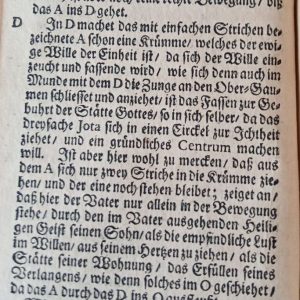
Now the A, designated with simple strokes, makes a curve, which is the eternal Will of the Unity, wherein the Will draws itself in and becomes desiring, just as in the mouth with the D the tongue closes against the upper palate and begins the descent for the confirmation of the Throne of God, within itself, as the threefold Iota draws itself into a point for selfhood, and wills to make a grounded Centre. But here it must be noted that from the A only two strokes draw into the curve, and the third remains standing; this shows that here the Father stands alone in the movement, through the Holy Spirit proceeding from the Father to draw forth His Son, as the sentient Delight in the Will, from His heart, as the Throne of His dwelling, the fulfillment of His longing, as indeed such happens in O, where the A through the D extends into O.
But we protest against Reason, which might slander us, as if we taught that God took a beginning in such a way, which is not our meaning; rather we say: That God, without all dimension, all in all, unfathomable, the Eternity and everything, yet introduces Himself in such a way into a ground for self-revelation, so that He might be revealed in the Trinity. It is also not to be understood as if all this happened materially; we must conceive of it materially only so that it might become comprehensible to the senses, for we have no other mouth with which to speak of such things, because we stand in time and lack the mouth of Eternity; yet everything in the inner figure is indeed so.
We have considered before that the D is the emanation and movement of the A, and it leads itself into the vessel as into O. Where the threefold I in the A, through the D in the O, makes another Centre and birthplace wherein the Delight, as the Son, is conceived. The original Will, as the Father, is the middle point in the O, which has taken the Delight, as the Son, into itself; but it is not to be seen in the O, because now the Father is in the Son, as the Will in the Delight. The Son is from the heart of the Father, just as the D draws the O forth from the centre of the heart and, in the mouth as in a vessel, gathers it together and forms it into one essence, which afterwards expresses itself in I through N, all according to the model of how the original, invisible God Himself has expressed Himself from Unity into the Trinity, by the Word with which God names all things according to the property of the invisible God, brought from the invisible heart through the mouth into the visible, just as every word is formed in the mouth according to how the thing itself which it signifies has been brought forth. If only we would follow again in our simple faith, so that our mother, Language, would be revealed to us again, we should soon obtain a true certainty of all things and no longer need to dispute, as is the custom in this same Babel.
Language does not lie in the mouth, but in the Understanding; it is just not revealed in false reason. The first Man had it, but lost it through the Fall; therefore he could also, before the Fall, name all things according to their inner, essential property. The Holy Spirit reawakens it and opens it into many a noble essence when He is received and born anew in our soul. Through this, one can see into the heart of all men.
But if we follow further the revelation of God in the Trinity, the word Adonai, we see how the received Delight in the O, as the Son of the eternal Will, is revealed through the N, which denotes the threefold Spirit in the A, as the eternal Word of the Father. The N, which is formed in the full mouth when it follows the O, carries forth the drawn-in spiritual substance—though here it is not properly to be called substance, but rather for the Understanding as an invisible, loving breath to be contemplated, which proceeds from the eternal out-breathing and is drawn together, to be distinguished from one another, and to reveal the received Delight of the eternal Will as the Word in A. This N, as a formed essence, leads forth from the preceding ADO out of the mouth, in counter-image to the first A, in which the Unity opened up and the Trinity through the generating N, as the threefold Spirit, is revealed, and stands there as a new Chaos in the rising-up again, to flow out into the Wisdom, which flows from the A into I, from the Trinity back into Unity.
Wisdom is the outpoured Word, a power of the great Love of God, in which the Divine Unity reveals itself, in which it contemplates itself, in which all powers and wonders of Eternity radiate towards the eternal Will; in which the eternal Word creates and forms, and through which the eternal Word introduces itself from Unity into multiplicity and differentiation, both in Nature and in the essence of eternal essences. Thus we see in the word ADONAI how the eternal ONE reveals Himself to us therein, what He is in His inner Nature and essence.
The eternal Unity, whose revelation into the Trinity we have seen and considered thus far, is now the First, initial, invisible essential Centre, from which the singular Word is poured out, concerning which singular Word, sprung from the heart of the Father, John the Evangelist speaks: ‘In the beginning was the Word, and the Word was with God, and the Word was God. The same was in the beginning with God. All things were made by it‘, etc. It is precisely that which we have extensively elaborated thus far.
Herein lies the true ground of the singular generation of the Son, about which so much has been disputed hitherto against the Socinians, and yet nothing has been explained. I myself have long been unable to find my way in this error of the Socinians; I have given them credence, and none of the high priests below, whether our Lutherans or other souls, could help me therein or convince me, until at last, driven by this anguish of heart, I sincerely repented and humbly besought God, in deep earnestness, that He would indeed reveal Himself essentially within me, and Himself bear witness in me who and what He is. I laid aside all disputation and human reasoning, and have learned in the School of the Father what God can accomplish in a soul, and what a living testimony He can bring forth.
For when we seek Him, the one God, as the Being of all beings, as He has revealed Himself to us in His Word, with earnest striving and knocking, according to the guidance of Holy Scripture within us, we have beheld Him in the unfathomable Beginning, out of which He from Eternity ever reveals Himself in the Trinity, and have found there the Centre standing open, the eternal Love of the Unity, into which we have plunged our stubborn will and spirit, and have let ourselves be poured out again into His Love—which reveals itself in Christ from Eternity to Eternity—within His eternal outpouring.
Therein we have been delivered from all scruples and doubtful thoughts and have found the truth in Christ, the eternal Word Himself, beside which everything that the so-called Theology or its Scholastic Philosophy could give us before is nothing. We have also found the true Vinculum Naturae (Chain/Bond of Nature), and have seen how everything is created from the eternal, unfathomable One, and is still ever nourished from the same out of its eternal Unground, and held by its power.
We also say that God in such an outflow is Himself poured out with it, yet not to be understood materially, as Reason might model it, as if He had changed measure and limit, place and location therein. No! He remains in the Beginning without beginning, in the eternal Unground, yet standing movably towards the ground, and goes nevertheless through all essential outpouring, is the great Centre of the circle of Time and Eternity, is yet through the whole Circumference the Life and Motion of all things, revealed through the movement in all creatures; there is no life and motion outside of Him. World and Nature are not to be separated.
Though also in Nature He is not called God according to the outer signature, nor according to the inner, but His Power. Nature has again its own centre, but takes its power from the Divine as from the source, whereby it is nourished. In the Light Principio He is gladly called God; there is no wrathful fire; yet He breaks through with His Spirit of Power, and grows green through Eternity in Time, is revealed from Eternity in Time, and such in all things and creatures.
Now we have considered in some measure the first, essential, invisible Centre, the singular Unity, as it stands in the Threefold Number and reveals itself therein from Eternity to Eternity; we have seen how the singular Will flowed out from the Unity in the Trinity from the singular, unfathomable Centre: wherein He as in the Unground has dwelt in Himself, yet has borne the singular Word or Heart, wherein He again beholds and desires Himself, desiring that the Heart might be revealed, for in the Unground there is no revelation. Furthermore, He desired to behold Himself revealed in the Light of Majesty from His own ground. Here opens the other essential Centre, that of the Word, in which the singular Will is generated, and in the other eternal Beginning has introduced itself into a Nature for revelation, wherein again the 2 Principles of Eternity are revealed.
(To be continued)
*
Source
*
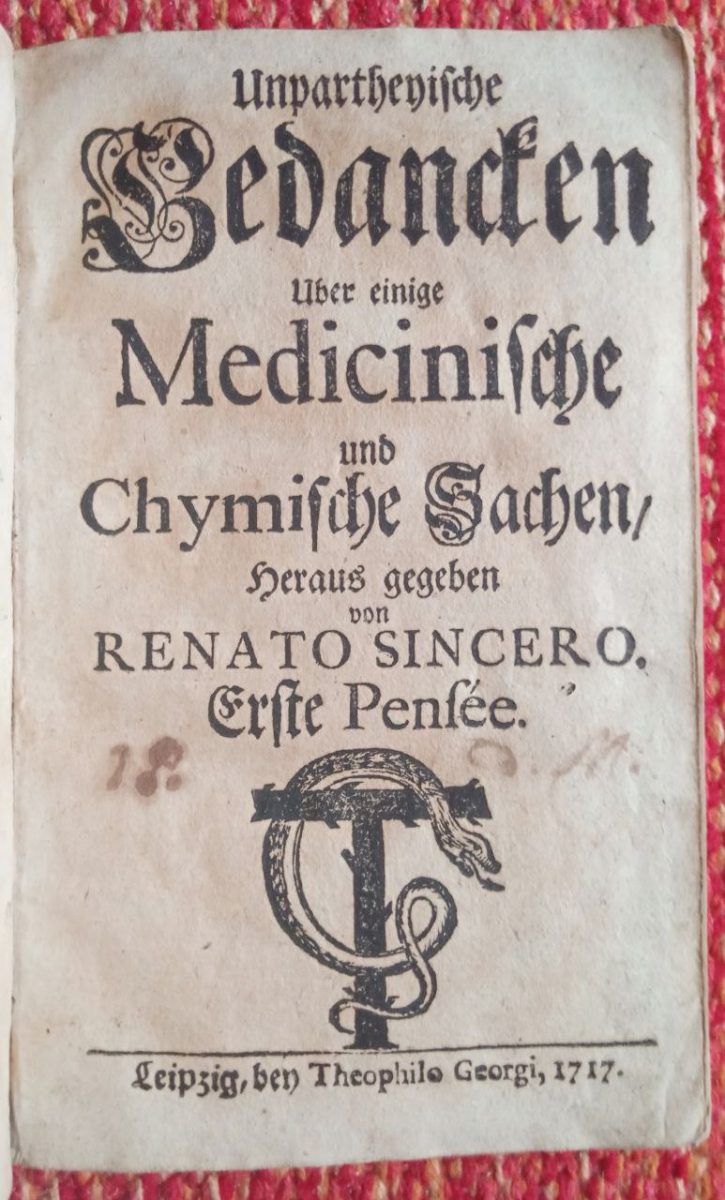
Origin of the symbol
in the symbolic portrait’s crest
*
Coming soon
A Little Samuel Richter (Sincerus Renatus) Sampler – Part 2:
The complete ‘Capitulatio‘ chapter: ‘Regul oder Statuta, welche die Brüderschaft des goldnen Kreuzes observieren müssen, nachdem sie die Profession getan haben; wie solches bei uns noch heut zu Tage üblich‘ (Rules or statutes which the Brotherhood of the Golden Cross must observe after they have made their profession, as is still customary among us today), excerpted from the above mentioned Breslau 1710, ‘The true and perfect preparation of the Philosophical Stone of the Brotherhood of the Order of the Golden and Rose Cross‘.
***
Related Articles

Leave a Reply