
Circle of Transmission: The Living Loom
A Via-Hygeia Bibliotherapy-Book Review of ‘Ritual & Epiphany in the Mysteries of Mithras’ by Peter Mark Adams
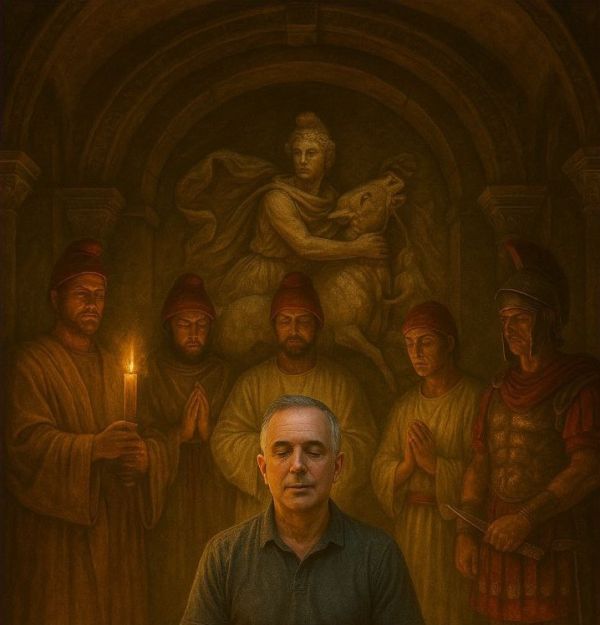
Peter Mark Adams
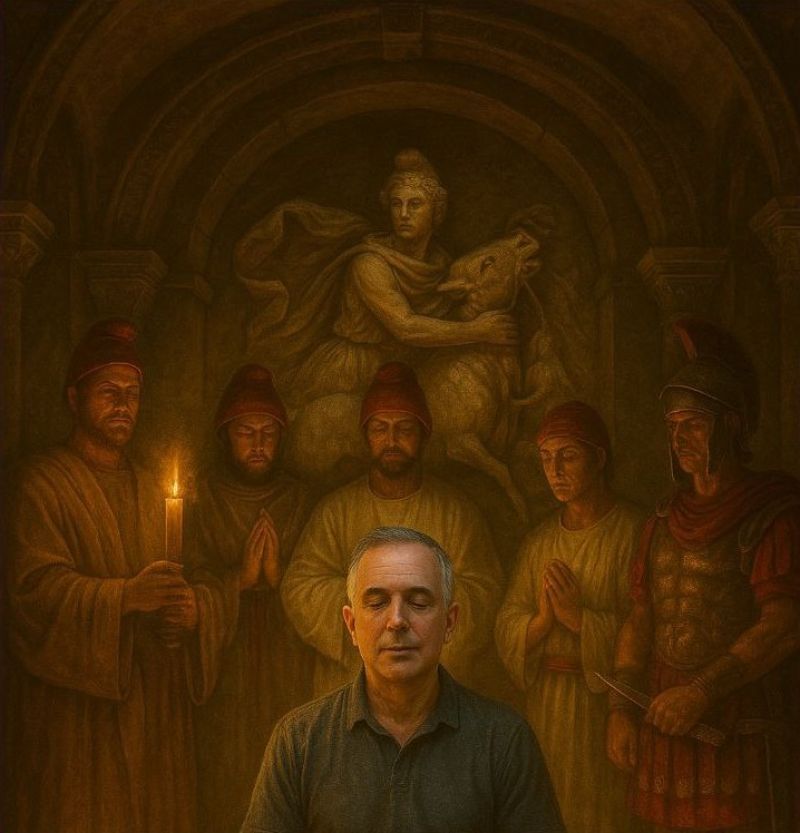
in a Mithraic temple.
A symbolic portrait.
*
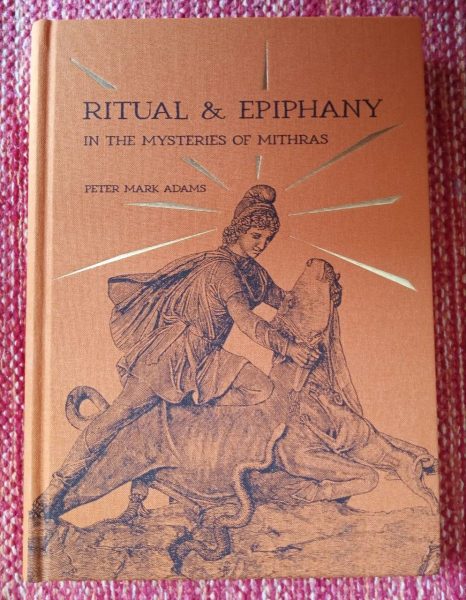
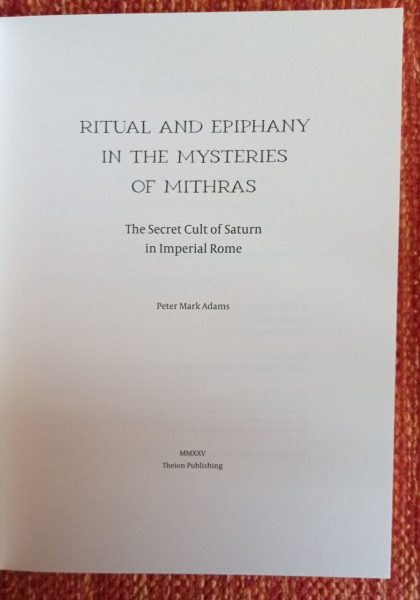
Another sharing for today from the Blue House of Via-HYGEIA is our review of Peter Mark Adams’s ‘Ritual & Epiphany in the Mysteries of Mithras‘ published in 2025 by Theion Publishing (an exemplary venture by David Beth and Jessica Grote offering books that distillate both essence and beauty). This timely scholarly publication is an in-depth survey of Mithraism, as it was practiced within the Roman Empire.
**
Intro
Peter Mark Adams (bellow called P.M.A.) has published up to now 4 books, ‘The Game of Saturn‘ published in 2017, then ‘Mystai‘ in 2019, then ‘Hagia Sophia, Sanctum of Chronos’ published in February 2023, followed later in 2023 by ‘Two esoteric Tarots‘ with Christophe Poncet & Cesar Pedreros: All published by Alkistis Dimech and Peter Grey at Scarlet Imprint. Finally the latest, his fifth: ‘Ritual & Epiphany in the Mysteries of Mithras‘, published by Theion Publishing on June 12, 2025, hence achieving his first publication pentagram!
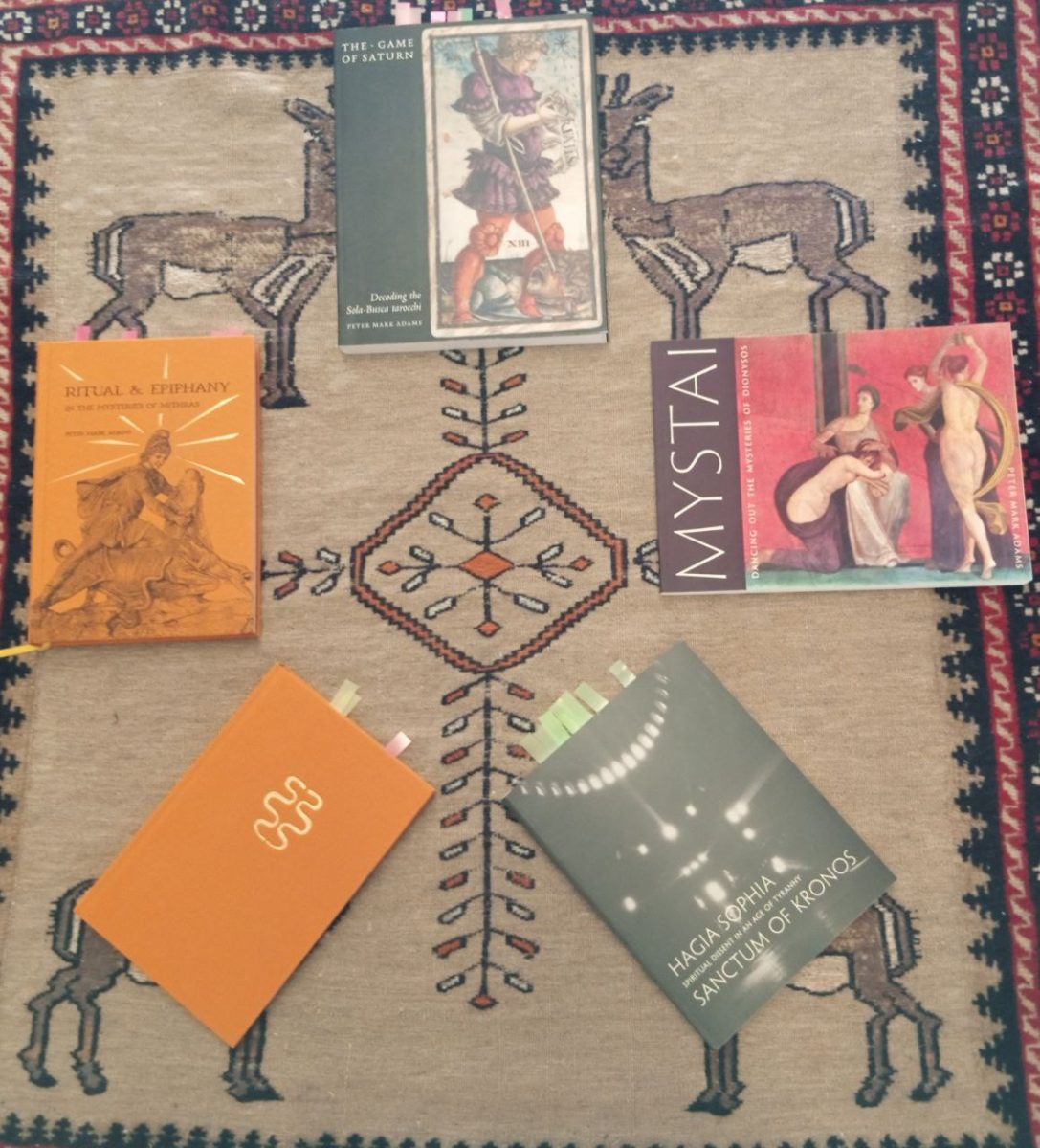
The book is very appealing, its design, the abundant iconography, all supporting the text in a very efficient way. It is more about creating a multi-level, multi-media impression of what was going-on in the Mithraic Mysteries, rather than giving to the academic text its usual leadership & weight. Again, this is the mark of this new generation of scholars & publishers, P.M.A., Scarlet Imprint and here Theion Publishing exemplify.
P.M.A. offers us a clear and substantiated ‘state of the union‘ of the Mithraic research. We have moved quite far from the time of the likes of a Franz Cumont, the creative architect of early 20th-century religious studies, whose interpretive models favoring a Persian root of Mithraism have been revised many times since.
Contemporary scholarships of the last ten years were focused on the mystery of Mithraism’s origin, either as a Zoroastrian avatar or a complete Roman invention, while others championed Mithraism as an astro-theurgical religion.
Research has now moved away from single-cause explanations: researchers now emphasize a plural set of processes such as local innovation in the Roman world, selective borrowing from Iranian & Anatolian traditions, strong astrological & astral elements in some interpretations, and the key importance of social function. Recent archaeological finds and careful re-reading of iconography have emphasized strong regional variations & transformations of the Mithraea (underground sanctuaries) over time.
All of this you will find it in P.M.A.’s book, but it is not offering us another theory about Mithraism’s origins. What this book tells us about is the astute adoption, in an Hellenistic context, of the Mithraic cult by the Roman elite, and its re-purposing by the Roman hegemonic machine to ‘grease‘ its ratchets wheels, the real movers of the Empire.
This book may look surprisingly simple for this subject, with its short chapters and the abundance of iconography. But, be not mistaken, as it has, in fact, a very dense content. P.M.A. is at the peak of his narrative powers and is in full control of his subject: its originality resides on the how they were expressing their devotion through rituals and brotherly bondage, unlike many other scholars focusing into what the Mithraic cultists thought & believed. If you keep this in mind, the reading of this book will astonish you!
*
1. The Occult Belly of the Roman Empire
P.M.A. walks with us through Imperial Rome and describes its powerful belly that remarkably digests dissimilar influences from all around its regions of the empire and especially highlights the integration and re-invention of oriental cults; some even became occult drivers of its vitality & hegemony!
Unlike earlier scholar, aedile & praetor Neo-Pythagorician Publius Nigidus Figulus and his secretive late Republic elite group who gathered into a sort of underground basilica to celebrate their version of a Pythagorean-influenced worship and later collided with Octavian busy becoming Augustus, the Mithraic cult rooted in Hellenistic traditions was adopted by Roman elite after 66 CE, it was composed of key pillars of the Roman Empire, the military, free slaves, merchants and the poly-morphic bureaucrats; it had spread to all outposts and corners of its dominion, but Rome counted more than 600 Mithraea!
The Roman psyche was more in the moment than the Classical Greek psyche, being practical & individualist, less interested in theoretical systems; they were more fond of ethics, self-control & emotional regulation; also more concerned with how psychological knowledge could be applied to everyday life, politics, and personal conduct. Roman Mysteries were mostly eclectic imports, often of a more hierarchical or emotional nature, promising personal salvation and divine protection alongside or beyond the formal state cult.
Whereas the Greeks were more inclined into the why humans think, feel & act as they do, and their Mysteries were ancient, agrarian, and centered on mythic drama about death & rebirth within a civic-religious context.
This is why the Mysteries of Mithra had everything to attract all those who were stoically building, forging & maintaining the Roman Empire.
*
2. ‘Ritual & Epiphany’
is a Companion book to ‘Mystai’
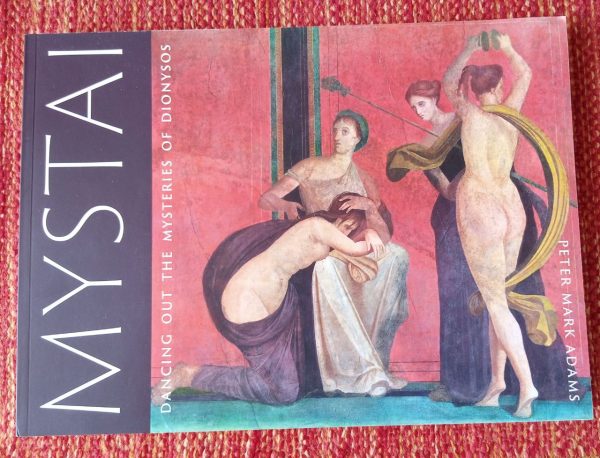
Mithraism under the Roman Empire was an expression of an Hellenistic context, in which ‘oriental mysteries’-such as the cult of Isis, of Cybele and Serapis, Dionysus and Orpheus-were participating to the knitting of a collective unity and diversity, as the Republic and then the Empire hosted many citizens that were not natives but were the participating agents of the ‘Pax Romana’ and were the individualistic, and often discreet, if not secretive experiential response to the state official pumps, rituals & pageants glorifying a common hegemonic vision.
It is symptomatic of P.M.A. to have written two books about experiential mystery cults: one with ‘Mystai‘, and the other with ‘Ritual & Epiphany‘.
‘Mystai‘ is set within the comfortable confidentiality of Roman matrons’ villas, such as the one immortalized by the Eruption of Mount Vesuvius at Pompeii, the so-called ‘Villa of the Mysteries’, while ‘Ritual & Epiphany‘ explores men’s Mithraic initiatic life, expressed in their diversity throughout the whole Empire.
We believe that, if we pay sufficient attention, both books may provide clear and foundational information for the seeker of ritual (if not theurgical) experiences dwelling within a Hellenistic & Roman context.
They both tell us of an effective art of immediacy, essential presence & personal salvation through divine epiphany, all through the use of art: such as architecture, mosaic & painting, music & sacred theatre, singing & dancing, frankincense & other ritual fumigations, etc…Both books are treasure troves of how Art was applied to support ritual workings. Both are true companion books!
*
3. The Mithraic Experience
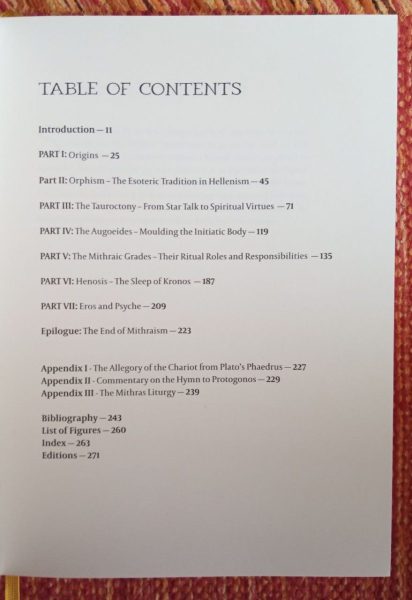
The cult is best understood as part of a wider Orphic and Hellenistic esoteric tradition. Ritual, not doctrine, formed the heart of Mithraism and Epiphany (divine manifestation) was the central aim of the cult. P.M.A. presents, at the heart of his work, the seven ritual grades, forming a peculiar ‘stairway to Heaven‘:
1. Corvus 2. Nymphus. 3. Miles. 4. Leones. 5. Perses. 6. Heliodromus & 7. Pater.
There is here a point P.M. A. emphasizes is that the three first were the real working grades, while the following four were of a sacerdotal and administrative nature and not the essential steps every one were aspiring to.
Their sequence delineates a clear path for spiritual progression. The initiation rituals for each grade were arduous and involved tests, trials & symbolic acts. This process was meant to ‘kill the old self‘ and be re-born into a new, higher state of being. The entire system was deeply astro-cosmological. The journey through the grades mirrored the soul’s descent into a body at birth (passing through the planetary spheres) and its subsequent ascent back to the divine realm after death. By successfully navigating the grades, the initiate was preparing his soul for his final journey.
These grades were not just titles but a effective map of the soul’s journey from earthly bondage to celestial participation; they provided a deep understanding of ancient cosmology, astrology and the elusive nature of divinity.
P.M.A. demonstrates, by skillfully using the very rich iconography provided, ‘how it was done‘, walking with us throughout the whole process unfolding before us, and finally rests his case with the clear conscience of having laid some serious foundations for future research into ritual iconography within mysteries cults.
Finally, we found particularly surprising & seminal two chapters: one devoted to the ‘Petrogenia‘ (the stone-birth), and the other to the ‘Sleep of Chronos‘. They both have provided us with some sleepless nights running down a few rabbit-holes connecting dots!
*
Conclusion
Mithraism, as experienced in the Roman Empire, should be understood as a ritual-based path to divine encounter, centered on ritual transformation, epiphany and union with the divine.
Its essence lays in what initiates did: ritual banquets, symbolic acts, initiation grades & visionary experiences through the catalyzing use of Art, rather than in what they believed.
We are grateful to Peter Mark Adams for having focused on this very specific aspect of the Mithraic Mysteries with such an essential simplicity!
*
Source
*
*
*

***


Related Articles


Leave a Reply