
Circle of Transmission: The Living Loom
Fakhr Al-Din Al-Rāzī: From ‘al-Muhassal’ – On the Temporal Origination of the World: A Classification of Philosophical Positions
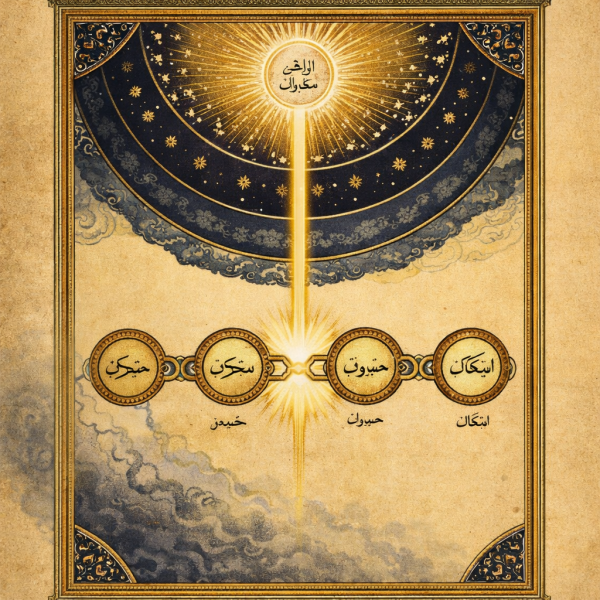
Diagram Illustrating the Termination
of Infinite Regress in Kalām Cosmology
(after Fakhr al-Dīn al-Rāzī)
A manuscript-style rendering of the conceptual chain — motion (ḥaraka), rest (sukūn), origination (ḥudūth), and possibility (imkān) — interrupted by the descent of the Necessary Existent (al-wājib bi-dhātihi — that whose existence is necessary by its own essence). The vertical axis signifies the metaphysical principle that halts infinite causal regress and grounds the contingency of the cosmos. The following diagram offers a visual synthesis of the argument presented by Fakhr al-Dīn al-Rāzī, rendering in geometric form the metaphysical structure underlying his analysis of motion, origination, and necessary being.
Note: This diagram is a modern visual interpretation of al-Rāzī’s metaphysical argument, not a historical manuscript illustration.
*
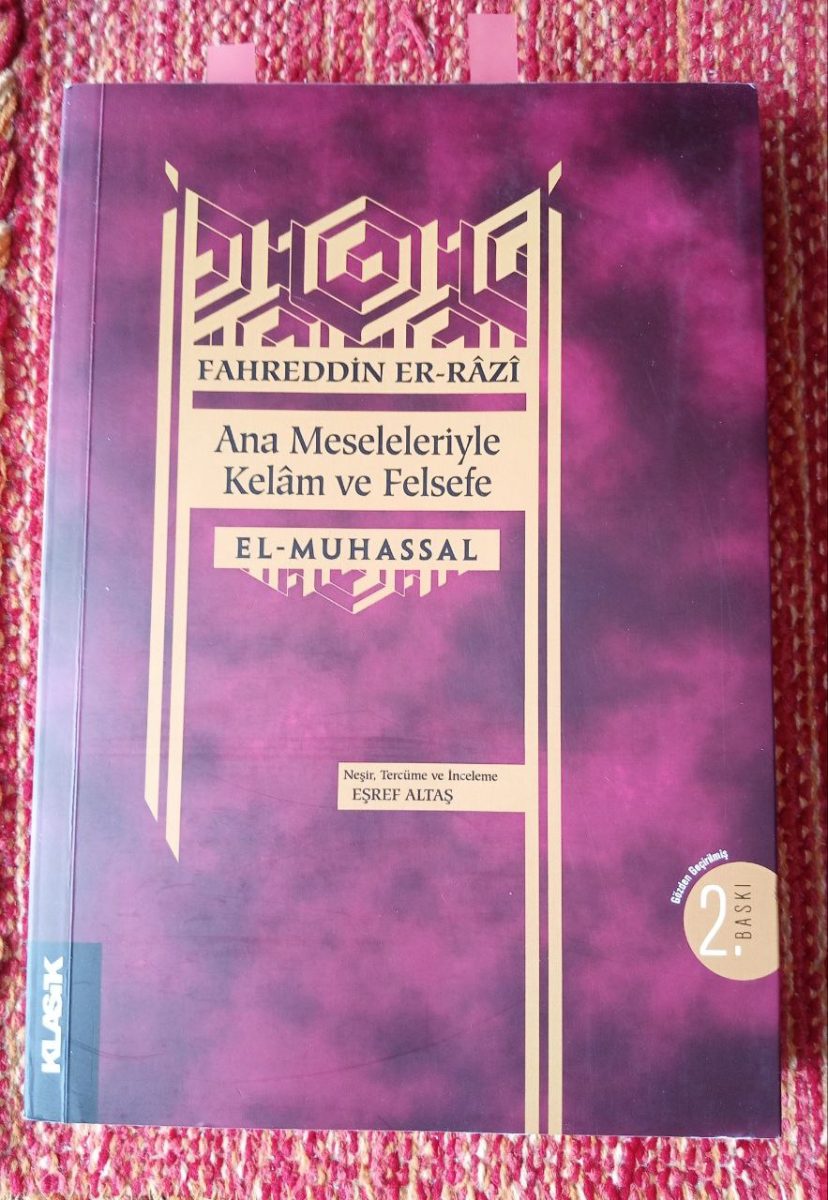
Today’s sharing from the Blue House of Via-HYGEIA is an excerpt from Fakhr al-Dīn al-Rāzī’s ‘al-Muhassal’, translated into English from its 2019 Turkish edition published by KLASIK Yayinlari in Istanbul (pages 100–104), itself a translation from the Arabic by Professor Eşref Altaş.
This text represents a sophisticated engagement with ancient Greek philosophy (including the Pre-Socratics, Aristotle, and Neoplatonism) and early Islamic theology, using logical argumentation (taḥqīq) to establish the world’s temporal origination — a central concern of classical Islamic kalām.
**
A Contextual Introduction
This passage from Fakhr al-Dīn al-Rāzī’s ‘al-Muhassal’ (The Summary/Compendium) presents a systematic investigation into one of the most contested questions in medieval philosophy and theology: Is the world eternal or temporally originated? Written in the late 12th century, this text exemplifies al-Rāzī’s characteristic method of taḥqīq — rigorous critical examination of competing arguments through logical analysis.
The excerpt surveys four major positions on the ontological status of the cosmos:
1. The creationist view shared by Abrahamic faiths.
2. The Aristotelian-Avicennan eternalism of celestial motion.
3. The diverse theories of Pre-Socratic and Hellenistic philosophers (including the material monism of Thales and Anaximenes, the atomism of Democritus, the dualism of the Harranians, and the mathematical ontology of Pythagoras).
4. The untenable hybrid of eternal attributes with originated essence.
Al-Rāzī’s ultimate aim is to demonstrate the logical incoherence of eternalism through a sophisticated critique of motion and rest. Drawing on Aristotelian physics and Neoplatonic metaphysics while subjecting them to kalām-style disputation, he argues that both eternal motion and eternal rest lead to contradictions — thereby establishing the necessity of a temporally originated universe requiring a voluntary Creator.
This text illustrates the cosmopolitan intellectual world of medieval Islamic philosophy, where Greek, Persian, and Islamic thought intersect, and where philosophical argumentation serves theological ends without abandoning logical rigor.
*
The Text:
Second Investigation: Concerning Accidents
[1.] Problem: [The Disagreement Concerning the Temporal Origination (Ḥudūth) of Bodies]
People have adopted different views regarding the temporal origination of bodies. The possible positions on this matter are no more than four:
[1] either both essence and attributes are originated (muḥdath),
[2] or both essence and attributes are eternal (qadīm),
[3] or the essence is eternal while the attributes are originated,
[4] or the opposite of this.
*
[1] The First: This is the view of the community of Muslims, Christians, Jews, and Zoroastrians.
*
[2] The Second: This is the view of Aristotle, Theophrastus, Themistius, Proclus, and later figures such as Abū Naṣr al-Fārābī and Abū ʿAlī b. Sīnā (Avicenna). According to them, the heavens are eternal in their essence and specific attributes. However, motions and positions are not like this. Each of the motions and positions is originated (ḥādith), with one preceding another without beginning. As for the elements, matter is eternal in its individual identity (shakhṣ), corporeality is eternal in its genus, and other types of forms are eternal in their species. That is, before every form, there is another form extending infinitely.
*
[3] The Third: This is the view of philosophers chronologically prior to Aristotle, such as Thales, Anaxagoras, Pythagoras, and Socrates. Likewise, the view of all the Stoics (Maniyya), Deists (Deysāniyya), Platonists (Merkūniyya), and Pythagoreans (Māhāniyya) is of this kind. These are then divided into two groups:
[3a] First Group: These are those who claim that the prime matter is a body. Thales held that it was water, on the grounds that water admits all forms. Moreover, when water freezes it becomes earth, and when it becomes subtle (laṭīf) it becomes air. From the purity of air, fire comes into being. From smoke, the heavens come into being. It is said: This is taken from the Torah. For in the First Book of the Torah it is stated:
‘God Most High created a substance (jawhar). When He looked upon it with His majesty, its parts melted and turned into water. Then vapor rose from the water like smoke, and God created the heavens from it. Foam appeared on the water. God created earth/land from it. Then He placed mountains there’.
Anaximenes held that the primary matter is air, that fire comes from the subtlety of air, and water and earth come from its density. Heraclitus maintained that the primary matter is fire, and that things come into being from the condensation of fire.
Others said that this matter is earth, and that things come into being through the subtlety of earth. Others said that the prime matter is vapor, and that air and fire come from the subtlety of vapor, while water and earth come from its condensation.
From Anaxagoras, the following is reported: The prime matter is a mixture without end. The mixture consists of infinite bodies [i.e., seeds], and in it are small particles of every kind. For example, some of these are particles with the nature of flesh, some are particles with the nature of bread, etc. Now, when many of these particles come together in a way that can be perceived and seen, it is imagined that [the thing] comes into being from them. Anaxagoras grounded this view in the denial of qualitative change, and he accepted the view of concealment and manifestation (kitmān and ẓuhūr). Some of them also claim that this mixture was at rest from eternity, then God Most High set it in motion, and thus the world came into being from it.
Democritus claimed that the essence of the world consists of the smallest particles, which are always in motion by themselves, accepting only imaginary division, not actual division in the form of fragmentation. Then when these particles collide with each other in a particular random manner, from their collision in this way, this world comes into being in this manner; then the heavens and elements come into being. Then from the celestial motions, the mixtures of these elements come into being, and from these, compounds come into being.
Xenophanes claimed that the essence of the world is light and darkness.
*
[3b] Second Group: These are those who defend that the essence of the world is not a body. These too are of two factions:
[3bi] First Faction: The Harranians. They held that there are five eternal entities: God Most High, soul, matter, time (dahr), and void. They said: The knowledge and wisdom of God Most High is complete; no error or heedlessness affects Him. From Him, intellect emanates, as light radiates from the sun. God Most High knows everything completely. From the soul, life emanates, as light radiates from the sun. But the soul is ignorant; it cannot know anything without experience.
However, God Most High knew that the soul would incline toward matter, become attached to it, desire physical pleasure, and forget its own essence. One of the works of God Most High was that, since He knew that the soul’s inclination toward matter was complete wisdom, after the soul’s inclination toward matter, He directed it toward matter and composed it in various forms like the heavens and elements. He also composed the bodies of living beings in the most excellent manner. However, the corruption in them remained because its elimination was impossible. Then God Most High gave the soul intellect and perception. This enabled the soul to recall its true origin and to know that as long as it remains in the physical world, it cannot be saved from pains. When the soul learns this and learns that there are pleasures far from pains for it in its own world, it longs for that world; after being separated [from matter], it ascends to [that world] and remains there in utmost joy and happiness.
The Harranians said: In this way, the doubts that persist between those who defend eternity and those who defend temporal origination are removed. For the proponents of eternity say: If the world were originated, why did God create the world at a specific time and not before or after? And if the Creator of the world is wise, why did He fill the world with afflictions? On the other hand, the proponents of temporal origination say: If the world were eternal, it would not need an agent, and this is certainly invalid; for we see the works of wisdom in the world clearly. Thus, we see that both factions fall into perplexity regarding this matter. (As Harranians,) according to our path, these kinds of problems are removed. For we undoubtedly accept a wise Creator, yet we say the world is originated. When it is asked why this world was created at this time, we say: Because the soul’s connection with matter was only at this time, and God Most High knew that this connection was the cause of its corruption. However, after the realization of this corruption, God Most High transformed it into the most excellent manner possible. As for the remaining evils, they remained in this form because it was impossible for this mixture to be purified from them.
Here two questions remain:
First, it may be said: The soul was not connected with matter; why then did it later become connected with it? For if this connection came about without cause, it would seem possible that the whole world came about without cause.
Second, it may be said: Could not God Most High have forbidden the soul from being connected with matter?
The Harranians answered the first question as follows: This question is not accepted by the theologians (mutakallimūn). For they say that the Omnipotent with free will can choose one of two things subject to His power without any reason for preference. So why should they not accept this regarding the soul as well?! This question is also not accepted by the philosophers. For they see it as possible that the cause of what comes first prepares what comes after. So why should it not be said: The soul is eternal, it has infinite renewed imaginations that require this connection. Every precedent imagination continues to have its effect until the cause of what comes after comes into being.
They answered the second question as follows: God Most High knew that it would be more appropriate for the soul to be in a state of knowing the harms of this connection in order to protect itself from this mixture. Moreover, through its mixture with matter, the soul acquires intellectual virtues that it did not previously possess in itself. It is for these two purposes (qaraḍ) that God Most High did not forbid the soul from being connected with matter.
*
[3bii] Second Faction: The Pythagoreans. These are those who hold that principles are numbers derived from units. They said: For compounds to remain stable is [due to] simple things. Simple things are those whose essence is unity. Then these things either have essences beyond their being units, or they do not. If the first, then they are compound. For that essence comes into being there together with the said unity. But our statement is not about compounds, but rather about their principles. If the second, then they are mere units. They must be independent in themselves. Otherwise, they would need something else. Thus that other thing would be prior to them.
However, our statement is about absolute principles, and this is contradictory. In this case, units are things that subsist by themselves. When position is added to the unit, a point comes into being. If two points come together, a line comes into being. If two lines come together, a surface comes into being. If two surfaces come together, a body comes into being. Thus, the principles of bodies are shown to be units.
*
[4] The Fourth: It may be said as follows: The attributes of the world are eternal, its essence is originated. This is a position no reasonable person would adopt.
Galen, however, remained undecided among all views.
Our Proof that the Essence and Attributes of the World are Originated (muḥdath)
If bodies were eternal, they would be either in motion or at rest from eternity. Both options are invalid. Therefore, the eternity of bodies is invalid.
Explanation of the Rational Limitation in the Proof
A body is at rest if it remains stable in a single place for a period longer than two moments. If this is not the case, it is in motion.
We argue that it is impossible for a body to be in eternal motion, for two reasons:
First: Motion, by its nature, involves the emergence of one state after the cessation of another. Therefore, motion requires that it be preceded by something else. The nature of eternity, however, requires that it not be preceded by something else. These two are mutually contradictory.
Second: Each motion is originated (muḥdath). What is originated needs a bringer into existence (mūjid). In this case, each of them needs a bringer into existence. In this situation, every motion has a voluntary free agent as its cause. Every voluntary agent that is the cause of something must have a beginning for its action. Consequently, every motion has a beginning. This is the desired conclusion.
We also argue that bodies are not at rest from eternity, for two reasons:
First: If bodies were at rest from eternity, either motion would be possible for them or it would not. The first is impossible, because the possibility of motion for bodies depends on the possibility of motion’s existence in itself. We had previously proven the impossibility of eternal motion. This impossibility, if it is a requirement of the nature of the body, must certainly not cease to exist. Therefore, motion must now be impossible for bodies. This is contradictory. If it is not from the requirements of the nature of the body, then its ceasing to exist is possible. In this case, eternal motion is possible for the body, and we have shown the invalidity of this.
Second: Rest, as we have shown, is a privative state (sulbī). Accordingly, we say: If this rest were eternal, its ceasing to exist would be impossible. But rest ceases to exist. Therefore, this rest is not eternal. Necessity does not imply that if an essence is necessarily eternal, its non-existence is impossible. If the essence is not necessarily eternal, it needs a cause. As will come below, to terminate the infinite regress (tasalsul) at this cause, one must finally find in this cause an essence that is necessarily eternal. This [cause] is either voluntary or necessitating. It cannot be voluntary. For the action of a voluntary agent, due to the impossibility of bringing the existent into existence, is originated. [In this case], the supposed eternal rest is not [a rest] belonging to a voluntary agent.
Thus, it has become clear that the cause which terminates the infinite regress must be necessitating. If the necessitating cause’s effect on the thing does not depend on a condition, then the effect must be necessitated by this cause. If it depends on a condition, then if this condition is possible, the division in possibility [returns to the beginning]. If the condition is necessitated, then from the necessity of the cause and the condition, the impossibility of the elimination of this supposed eternal [rest] is required. As for the possibility of the elimination of rest, this is observed in the celestial spheres and elements. From the opponent’s perspective, there is no body besides these two. Whoever wishes to generalize the proof must explain that bodies are homogeneous.
Once the impossibility of a body’s being eternally in motion or at rest is established, the impossibility of its eternal existence follows.
*
Source
al-Muhassal by Fakhr al-Dīn al-Rāzī (d. 606/1209).
Turkish translation by Eşref Altaş (Istanbul: KLASIK Yayinlari, 2019).
English translation by Via-HYGEIA 2026.
*
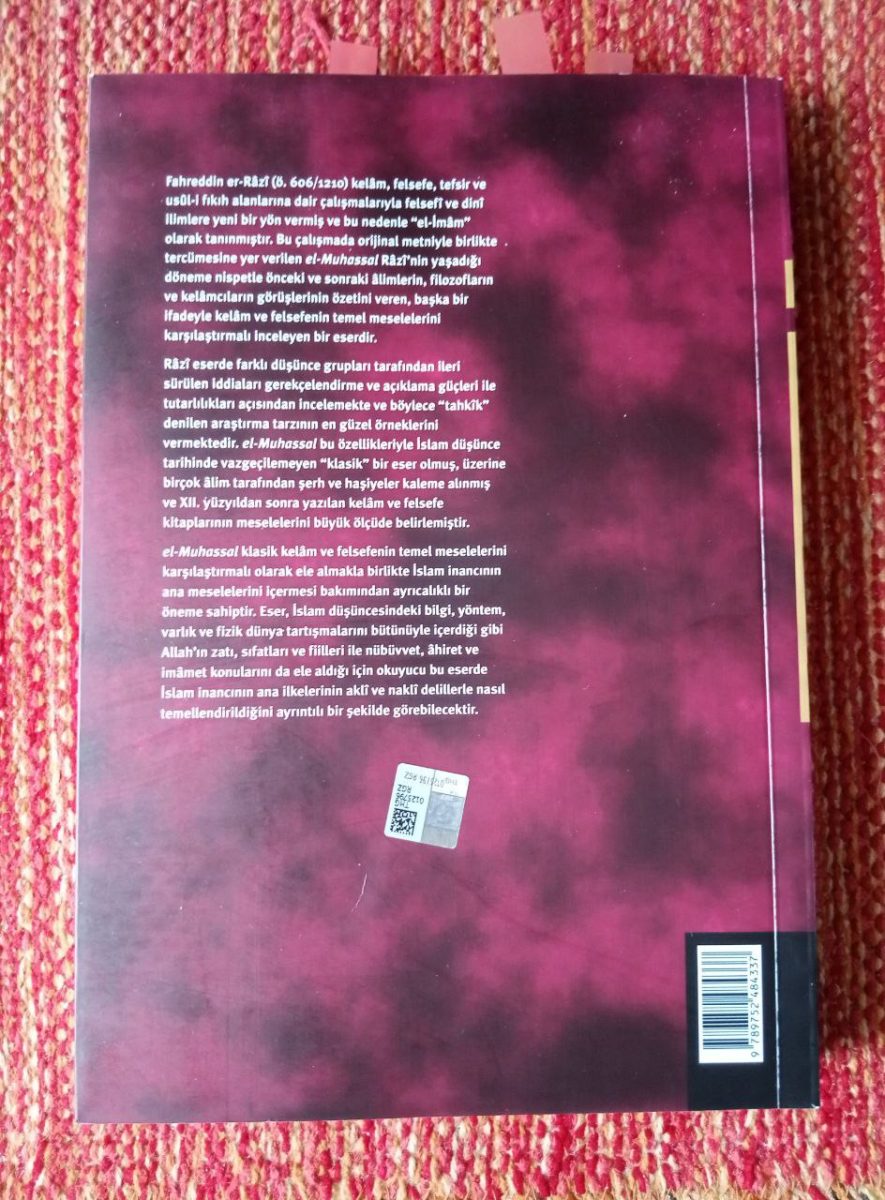
The back cover reads like this:
Fakhr al-Din al-Rāzī (d. 606/1210) opened a new direction in the sciences of kalām (Islamic theology), philosophy, Qur’anic exegesis (tafsir), and the principles of jurisprudence (uṣūl al-fiqh), and for this reason he became known as ‘al-Imām‘ (the Leader). This study presents the original text together with its translation. ‘al-Muhassal‘ is a work that summarizes the views of previous and subsequent scholars, philosophers, and theologians relative to the period in which al-Rāzī lived, and examines the fundamental issues of kalām and philosophy in a comparative manner.
In this work, al-Rāzī examines the claims put forward by different thought groups in terms of their justifications, explanatory powers, and consistency, thereby providing the finest examples of the research method called ‘taḥqīq‘ (critical investigation). With these characteristics, ‘al-Muhassal‘ became an ‘indispensable classic‘ in the history of Islamic thought. Many scholars wrote commentaries and glosses on it, and it largely determined the issues of kalām and philosophy books written after the 12th century.
While ‘al-Muhassal‘ addresses the fundamental issues of classical kalām and philosophy comparatively, it also holds special importance because it contains the main issues of Islamic belief. Since the work includes detailed discussions of knowledge, methodology, existence, the physical world, as well as topics such as the essence, attributes, and actions of God, prophethood, the afterlife, and imamate, the reader will be able to see in detail how the main principles of Islamic belief are grounded in rational and transmitted proofs.
*
Glossary of Key Terms
(From Fakhr al-Dīn al-Rāzī’s ‘al-Muhassal’
on the Temporal Origination of the World)
al-wājib bi-dhātihi
(الواجب بذاته)
The Necessary Existent — That whose existence is necessary by its own essence; it cannot not exist. In kalām, this refers to God as the uncaused First Cause who terminates infinite regress.
muḥdath
(محدث)
Originated / Temporally originated — Something that comes into being at a point in time, requiring a cause. Opposed to qadīm. In kalām, the universe is muḥdath — it had a beginning.
qadīm
(قديم)
Eternal / Pre-eternal — That which has no beginning in time. In kalām, only God is qadīm; all else is muḥdath.
ḥudūth
(حدوث)
Origination / Temporal beginning — The state of coming into existence at a point in time. Central to kalām cosmology: the world’s ḥudūth proves it needs a Creator.
taḥqīq
(تحقيق)
Critical investigation / Logical verification — Al-Rāzī’s method: rigorous examination of opposing views through dialectic, logic, and conceptual analysis — not dogma.
sulbī
(سلبي)
Privative / Negative state — A state defined by the absence of something (e.g., rest is the absence of motion). In kalām, rest is sulbī — not a positive entity, but the lack of motion.
ḥaraka
(حركة)
Motion — In Aristotelian-kalām physics, motion is change from potentiality to actuality. Al-Rāzī argues eternal motion is impossible — it must have a beginning.
sukūn
(سكون)
Rest — The state of not moving. Al-Rāzī shows eternal rest is also impossible — it cannot be eternal if motion is possible, and motion is observed.
imkān
(إمكان)
Possibility — The capacity to exist or not exist. In metaphysics, contingent beings (mumkināt) depend on a Necessary Being (wājib) for their existence.
kitmān wa ẓuhūr
(كمان و ظهور)
Concealment and manifestation — Anaxagoras’ theory: all things exist in a primordial mixture; they “manifest” when conditions allow, without true creation or destruction.
dahr
(دهر)
Time / Eternity — In Harranian cosmology, dahr is an eternal, uncreated principle — alongside God, soul, matter, and void.
mutakallimūn
(متكلمون)
Theologians (of kalām) — Scholars who use reason and logic to defend Islamic doctrine. Al-Rāzī was one of the greatest mutakallimūn.
tasalsul
(تسلسل)
Infinite regress — A chain of causes extending infinitely backward. Kalām denies it: every contingent effect requires a first, uncaused cause — God.
jawhar
(جוהר)
Substance / Essence — In Aristotelian metaphysics, the underlying reality that persists through change. In kalām, it’s often contrasted with ‘araḍ (accident).
shakhṣ
(شخص)
Individual identity / particular — In Avicennan metaphysics, matter retains its shakhṣ (individuality) even as its forms change.
qaraḍ
(قصد)
Purpose / Intention — In the Harranian argument, God’s qaraḍ in allowing soul-matter union is to enable the soul’s moral and intellectual growth.
laṭīf
(لطيف)
Subtle / fine — Used to describe states of matter (e.g., air is laṭīf compared to earth). In alchemy and physics, it denotes refinement or rarefaction.
manīyya / deysāniyya / merkūniyya / māhāniyya
(مانيّة / ديسانيّة / مركونيّة / ماهانيّة)
Historical philosophical groups — Labels for pre-Islamic schools: Stoics, Deists, Platonists, Pythagoreans — referenced by al-Rāzī to classify ancient views on cosmology.
*
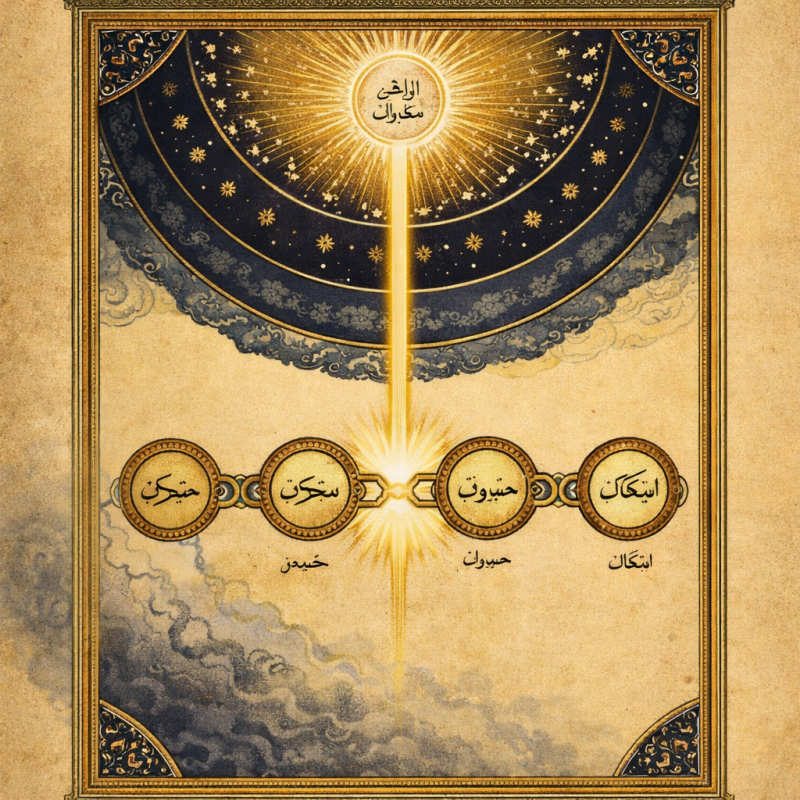
A calligraphic tribute
to Fakhr al-Din al-Rāzī


Related Articles


Leave a Reply