
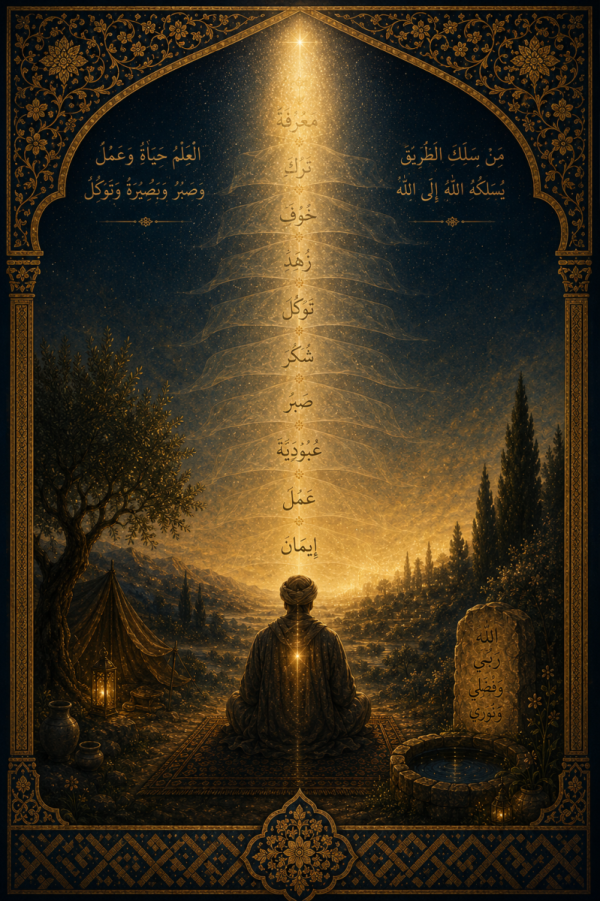
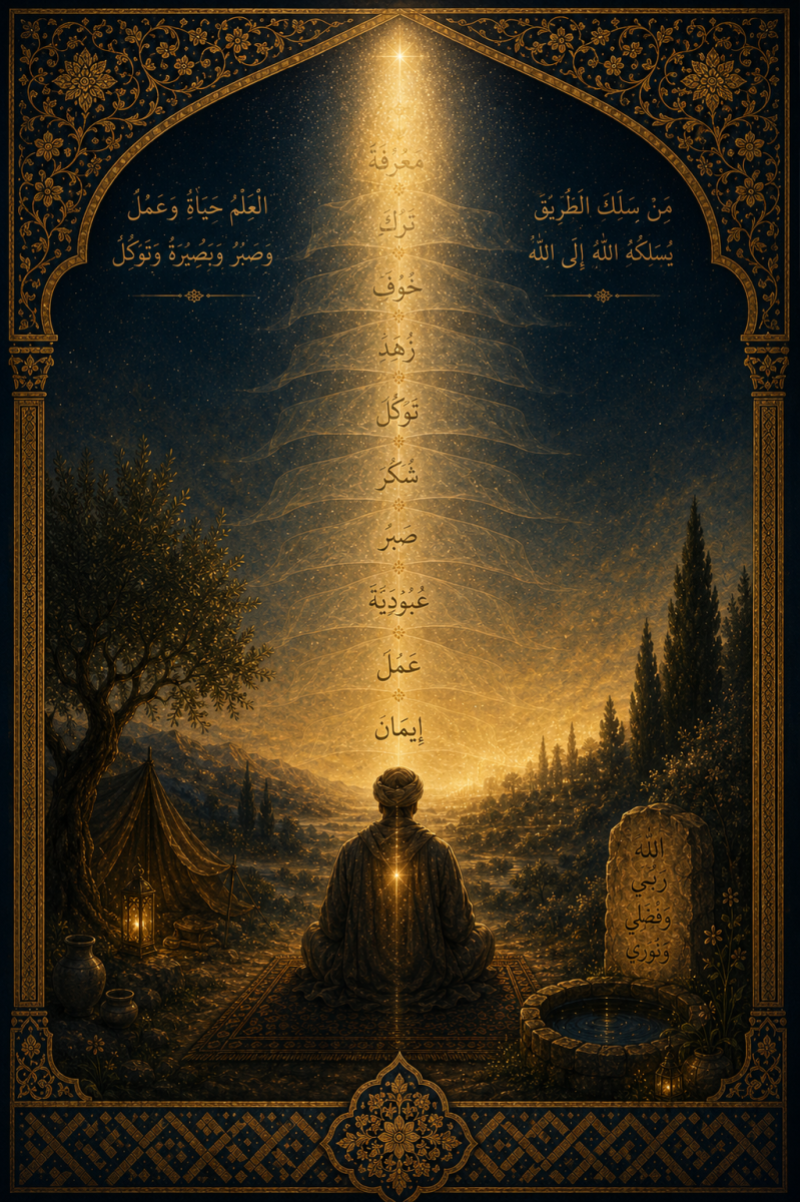
Legend for the Featured Illustration: The Degrees of Faith and the Saints. In this vision inspired by Ibn Masarra’s El-Müntekâ min Kelâmi Ehli’t-Tûkâ, the spiritual path is revealed not as a journey through places but as a gradual unveiling of the heart. Faith, righteous action, servanthood, patience, gratitude, trust, renunciation, holy fear, detachment, and finally maʿrifa (direct knowledge of God) appear as translucent veils through which the seeker passes rather than steps to be conquered. The descending ray signifies divine guidance, while the silent traveller embodies every soul called to the inward ascent. As the veils become ever more transparent, forms dissolve into light, suggesting Ibn Masarra’s central insight: the highest knowledge is not the accumulation of spiritual attainments, but the progressive disappearance of everything that obscures the Presence of the Real.
*
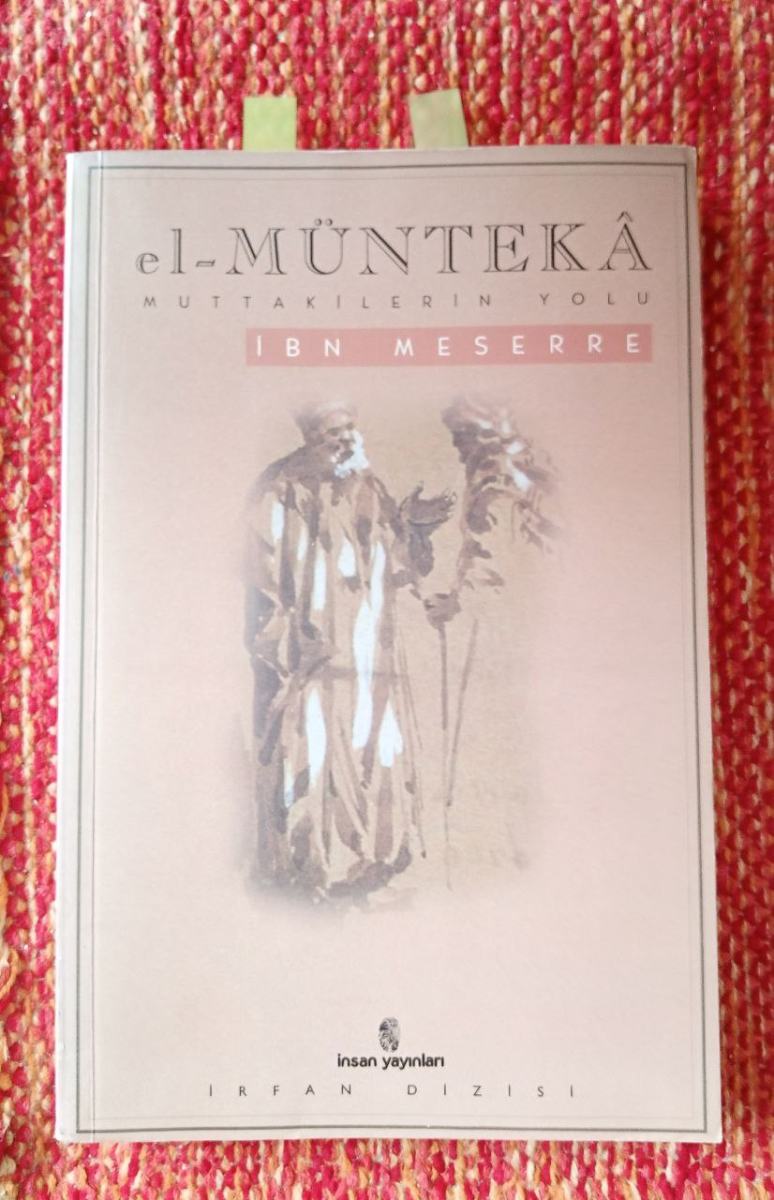
Today’s sharing from the Blue House of Via-HYGEIA presents “The Degrees of People and the Saints” – “İnsanların Dereceleri ve Velîler” from Ibn Masarra’s El-Müntekâ Min Kelâmi Ehli’t-Tûka. İnsan Yayınları, 1999, edited by Professor Mehmet Necmettin Bardakçı, pages 283–294.
What separates the believer who merely confesses from the saint who has become a mirror? In this chapter from the Andalusian mystic Ibn Masarra (883–931 CE), transmitted by Muḥammad ibn Ḥāmis, we encounter a graduated cartography of the heart—faith, action, servitude, patience, gratitude, trust, and self-sacrifice analyzed through ascending triads and quaternities that map the soul’s purification.
The text traces four stations of fear (khawf) and four of abandonment (terk), culminating in the servant from whose heart God has lifted the veil. Hunger is named the hidden gate; the “bitterness of abandonment” becomes the taste of knowledge itself.
The Prophet’s daily repentance is reinterpreted not as sin but as the perpetual momentum of ascent through inexhaustible divine stations—a model for the awliyā’ who “take without asking, abandon without abandoning.” Caprice (hawā) remains the persistent adversary; watchfulness (murāqaba), the secret thread binding every station.
Dense, lapidary, and luminous: a window into early Andalusian Sufi psychology before the institutional ṭarīqa, before al-Ghazālī’s synthesis, when the path was still spoken mountain-to-mountain, heart-to-heart.
Coming soon, the next instalment: Varlıkların Yaratılma Sebebi (The Reason for the Creation of Beings) – Andalusian Wisdom from Ibn Masarra.
**
A Contextual Introduction:
The Degrees of Faith in Ibn Masarra’s El-Müntekâ
The Author and His Moment
Ibn Masarra al-Jabali (883–931 CE) stands at a pivotal threshold: the first identifiable mystical thinker of al-Andalus, writing at a time when the Islamic West was still forging its intellectual identity in conversation with the East. Born near Córdoba to a father who had studied in the Orient, Ibn Masarra inherited a dual transmission—Baghdadi Sufi discourse and the indigenous asceticism of the Iberian muwalladūn. His retreat to the mountains outside Córdoba, his small circle of disciples, and his eventual return to the city to teach publicly sketch the biography of a figure who lived the tension between withdrawal and engagement that his texts theorize.
The work from which this chapter is drawn, El-Müntekâ Min Kelâmi Ehli’t-Tûkâ (Selections from the Words of the People of Piety), survives only through a later recension transmitted by Muḥammad ibn Ḥāmis. This chain of transmission is significant: Ibn Masarra’s teachings reached us not as systematic treatise but as testimony—words preserved by disciples, filtered through memory and devotion. The text thus carries the texture of oral instruction: repetitive, circling back upon itself, building its architecture through accretion rather than linear argument.
The Chapter’s Architecture
“The Degrees of People and the Saints” operates through a structural principle that might be called ascending triads and quaternities. The text moves through a series of human capacities—faith, action, servitude, patience, gratitude, trust, self-sacrifice—each analyzed according to a hierarchy of three or four degrees. This is not mere taxonomy. The numerical framework (so characteristic of early Sufi pedagogy, from Dhū al-Nūn al-Miṣrī to Junayd) serves as a spiritual cartography: the reader is invited to locate themselves within it, to recognize their own station, and to perceive the path ahead.
The chapter’s true center of gravity, however, lies in its latter half: the four stations of khawf (fear/awe) and the four stations of terk (abandonment/renunciation). Here the text shifts from external behavior to inward transformation. The first station of fear belongs to the penitent awakening from heedlessness; the fourth, to the servant from whose heart God has “lifted the veil.” The progression traces nothing less than the dissolution of the ego-bound self and its reconstitution in divine proximity.
Key Themes
1. Epistemological Hierarchy: From Report to Witnessing A governing concern throughout Ibn Masarra’s corpus—and sharply present here—is the distinction between naql (transmitted knowledge) and ʿiyān or mushāhada (direct witnessing). The opening lines establish the fundamental crisis: one may be “believer with heart and tongue” yet remain “negligent in deeds,” or perform obligations “without knowing God as He ought to be known.”
This is not merely moral exhortation. It is an epistemological claim with radical implications. The “tongue’s report” (khabar al-lisān) can veil as much as reveal; it adorns without transforming. True knowledge is the “heart’s inward gaze” (naẓar al-qalb) that perceives God’s governance (tadbīr) directly. The text thus participates in a broader early Sufi critique of scholastic theology (kalām): rational demonstration and scriptural citation prepare the ground, but they cannot substitute for the taste (dhawq) of direct experience.
The culmination of this theme appears in the chapter’s closing lines: “No one can know maʿrifa in all its aspects… until he sees his Lord with his heart in this world.” The beatific vision is displaced from the eschatological future into the present moment of mystical consciousness.
2. The Paradox of Proximity: Faqr, Terk, and Murāqaba Three interwoven concepts structure the saint’s path:
- Faqr (poverty/need): Not material destitution but ontological emptiness before God. The saint “thanks Him by worshiping Him with poverty”—a striking formulation that inverts economic logic. Gratitude becomes not repayment but acknowledgment of radical dependence.
- Terk (abandonment): The four stations trace an intensification that culminates in the servant who “does not incline to [the world] or see it as evil”—not because he is indifferent, but because his perception has been restructured. The world is not rejected but transcended in place.
- Murāqaba (watchfulness): The “constant watchfulness” mentioned in your earlier post appears here as the secret thread binding all stations. The saint is “with God, his eye dazed”—a state of suspended attention that is neither active concentration nor passive reception, but being-with in the mode of radical openness.
3. The Renarration of Repentance: One of the chapter’s most distinctive moves is its reinterpretation of the Prophet’s daily repentance. The text states: “The Prophet’s daily repentance is reinterpreted not as sin but as the necessary sign of perpetual ascent through divine stations.” This transforms tawba from retrospective moral repair into prospective spiritual momentum. Each station reached reveals a higher station; each unveiling discloses a deeper veil. Repentance becomes the very engine of ascent—not because the saint has sinned, but because the structure of divine reality is inexhaustible.
This connects to the hadith cited near the chapter’s end: “My maʿrifa is to be gained between the hands; I have not yet cut it off”—words attributed to Isa (Jesus). The eschatological is folded into the present; the “cutting off” that might signal completion is perpetually deferred.
4. The Aesthetics of Hunger: The sensory imagery of this text deserves particular attention. Hunger (jūʿ), thirst (ʿaṭash), the “washing” of the world from the heart, the “burning” of the heart with love—these are not metaphors in the weak sense but operative images that structure the saint’s somatic transformation. “Preserve well the state of hunger,” the text urges, for hunger is “the cutting off of the causes that invite the lower self to pleasures and lusts.”
This is an ascetic epistemology: the body is not rejected but reeducated. The fasted body becomes a finer instrument of perception. The “bitterness of abandonment” is tasted; the “taste of service” is savored. Knowledge is literally incorporated.
5. The Saint’s Invisibility: A remarkable theme threading through the latter pages is the hiddenness of the saint. The one “to whom lights and miraculous graces are shown… has turned his face away from them.” The one in whom “this state does not appear” may be superior to the one in whom it does. The saint is sometimes seen “as if he were one of the people, with the common folk, hidden in created things.”
This is not mere humility but a theology of concealment. God’s mercy operates through veiling as much as unveiling. The saint’s invisibility to the world mirrors God’s own hiddenness (bāṭin). The text thus constructs an economy of the unseen: what is visible is suspect; what is hidden is precious.
Relation to the Preceding Chapter
Our earlier post presented “The Science of the Outward and of the Inward” (Zâhir ve Batın İlmi), which established the foundational distinction between two modes of knowing. The present chapter might be read as the practical unfolding of that epistemological framework. Where the earlier text mapped the structure of knowledge, this one traces the dynamics of transformation—the stages by which the heart’s inward gaze is progressively purified until it becomes a stable mode of being.
The two chapters together present a complete arc: from the diagnosis of outward religiosity’s limitations to the detailed topography of the path beyond it. Caprice (hawā), named in the earlier chapter as “the sole barrier between servant and Lord,” reappears here as the persistent adversary against which the saint must remain watchful at every station.
Stylistic and Linguistic Notes
The Turkish translation preserves—and your rendering should respect—several features of the original Arabic discourse:
- The vocative “Ey kardeş!” (O brother!): A hallmark of Sufi epistolary and homiletic style, creating intimacy and urgency. It appears at crucial transitions, marking moments when the text shifts from description to exhortation.
- The technical vocabulary of stations (maqāmāt) and states (aḥwāl): Though the text uses these somewhat interchangeably, the underlying Sufi distinction—stations are acquired through effort, states are divine gifts—hovers beneath the surface.
- The use of Qur’anic citation as argumentative pivot: Verses are not merely proof-texts but generative moments that restructure the discourse. The verse on patience (2:153) does not illustrate patience but transforms the concept by introducing divine assistance as its necessary condition.
- The lapidary density: Sentences are often paratactic, clauses accumulating without subordination. The effect is cumulative, almost incantatory—appropriate to a text meant for recitation and meditation as much as analysis.
Significance
This chapter offers a precious window into early Andalusian Sufism before al-Ghazālī’s synthesis, before the institutionalization of the ṭarīqa, before the great flowering of Iberian mystical poetry. It is a text of the desert—not the physical desert of the East, but the interior desert of a culture still negotiating its relationship to its own Islamicate identity.
What emerges is a spirituality of radical interiority that nevertheless remains anchored in Qur’anic language and prophetic practice. Ibn Masarra does not reject the law (sharīʿa) but reinterprets its fulfillment: the saint fulfills the law not by external compliance but by the transformation of consciousness that makes external compliance spontaneous and transparent.
The chapter’s final image—the servant who “is with God, his eye dazed, who has no answer until God answers”—encapsulates this spirituality. It is a state beyond achievement, beyond even the desire for achievement, suspended in the radical passivity of one who has become, in the deepest sense, pure reception.
*
And Now The Text:
The Degrees of People and the Saints
From Ibn Masarra’s El-Müntekâ Min Kelâmi Ehli’t-Tûkâ
People are of varying degrees with respect to faith. Some among them are believers with heart and tongue, yet negligent in deeds. This is the state that many hope to die in. Another group has believed with heart and tongue, and has performed the obligatory duties without knowing God as He ought to be known in order to render His due. This is what most of the people of khawf (fearful awe) hope for.
Even though one may not possess verified faith (tahkīk), many a person desires this rank. Some are believers inwardly and outwardly. After striving to know his Lord, he has confessed his faults. This is as far as the superiority of one who recognizes his Lord, the measure of his taking the Lord as Lord, and his losing himself in servanthood (ʿubūdiyya) earn him the right to wilāya (saintship). Such a person distances himself from the states of ordinary people through the many graces and gifts bestowed upon him.
People are of varying degrees with respect to action. The first of these are those who act with knowledge, observing His right through God’s aid, His increase of grace, and His guidance. In this matter, they are of two kinds: those who act with desire and longing, seeking His pleasure; and those who act with fear, driven by the desire for forgiveness. The second are those who act with knowledge upon maʿrifa (gnosis). These belong to the khawāṣṣ (the elect). The third are those who act knowingly upon what wilāya requires of proximity.
People are also of layered ranks with respect to servitude (ʿubūdiyya): One group are those who strive out of fear of death and destitution. Their sign is fleeing from their comfortable homeland and abandoning sufficient provision. Another group are those who strive to get ahead. Their sign is preferring the presence of delight. Yet another group are those who strive in submission (taslīm). These perform their duties in every state as seeking God’s pleasure.
People are also of various kinds with respect to patience: One is he who is patient with his allotted portion. His sign is enduring the abandonment of complaints. Another is he who is patient with tribulation. His sign is remaining calm in the hour of calamities’ agitation. Another is he who is patient with fate, overflowing with God’s own patience. This state is explained in the verse: “Be patient! Your patience is only through God’s help.” (Q 2:153).
This is the patience of the saints who have chosen the homeland [of the spirit], found the ease of lightness, distanced themselves from people, chosen what God is pleased with for the virtuous ones (ahl-i ṣafvet), and are grateful in every state for the blessing that bestows bounty. For them, praise and blame, prohibition and permission, abundance and hardship are one and the same. These are the signs and proofs of the people of wilāya.
People are of ascending ranks with respect to gratitude: The first are those who are grateful for present blessings. God the Exalted has guaranteed the increase of this blessing through the verse: “If you are grateful, I will surely increase you.” (Q 14:7) The second are those who are grateful to the Bestower of blessings because of the blessings. They desire that God the Exalted increase His guidance. The third are those who are grateful because of the signs of wilāya.
The trust (tawakkul) of people is according to the measure of their realization of proximity. Those who trust can be considered in several categories: Those who trust in God with patience at the moment of finding and losing causes; those who trust in God calmly while causes are unfolding in their proper times; and those who are freed from waiting for times and causes, who trust in God beyond causes and beyond time, with the Creator of time. Only the saints can reach this last state.
People are of layered ranks with respect to self-sacrifice (iṣār). These are: those who sacrifice by persisting in labor for His purpose and His will; those who sacrifice what they have found by trusting in their Lord; and those who sacrifice their lower self (nafs) upon their lower self, and sacrifice their lower self for their Lord.
People are of various kinds with respect to receiving causes: Those who receive causes out of fear of missing out on worldly pleasures—these are the children of will. Those who receive causes with consent and submission—these are the scholars and the gnostics (ʿārifūn). Those who receive them with joy and expansiveness, finding the presence of understanding within themselves—these too are the saints.
God has made the paths leading to Him more numerous than the breaths of created beings. For every creature, He has appointed particular paths and states according to which they are tested in their times, transferred from one state to another, and elevated from station to station.
The end of God’s command cannot be comprehended by the intellect. Those among His saints and His elect who are brought to stations through it—the person who trusts in Him on His path is among them. The person who is torn from a station and warned from a state, yet still turns back from the path, is also among them. He is higher than the first. Yet God, out of mercy toward him, has not disclosed his superiority. Their signs are such that their purity is not diminished by one to whom He has shown Himself without the person having sought it, nor is it diminished by one who is tested and tried through it. The one who is veiled from it while it is desired is among them. The one who is shown gentleness and forbearance through good tidings is among them. The one who is occupied with his lower self, thus veiled from observing them, or who is occupied with God and thus veiled from his lower self, is among them. The one to whom lights and miraculous graces (keramet) are shown is among them—yet he has turned his face away from them. The one who is veiled from this and whose station is weakness is among them. His veils are due to God’s mercy toward him. The one in whom this state does not appear, if he knows God and recognizes His command, is superior to the one in whom this state appears. The one who is permitted, with the attributes of knowledge and the sciences of proximity, to arrange the states and the indications of worship is among them. The one from whom this is withheld while knowledge circulates in his breast unwritten and unspoken is among them. The one who, when he finds the delight of proximity (qurb), the lights of knowledge, the benefits of obedience, and the shame before his Lord, is withheld from the love of life, is among them. The one who fears corruption and dissension, or who loves death out of longing for his Lord and desire to meet Him after friendship, is among them. The one who surrenders his affair to God and loves only what God loves is among them.
For God’s saints, it is forbidden to fear other than God, to hope in other than God, to attach to other than God, or to venerate other than God. When the people of pure friendship (ṣafā) and the just imams are lost, people fall into savagery, weary of life, and speech becomes burdensome to them. They are sated with life, they see remaining in the world as evil, they love to meet God through great longing for the hereafter, they distance themselves from the world and its people, and they act for the hereafter to which death will convey them.
This—when they present loftiness and baseness, wealth and poverty to God, and inform Him of the realities of maʿrifa, and see with the light of proximity, and cross beyond the Ṣirāṭ to enter Paradise or Hell. Whoever opens the eye of his heart to this, his compassion increases according to the increase of his action, and his awe (haybet) is adorned by the increase of his knowledge. This too is the sign of the ṣiddīqūn (the veracious ones).
God opens the gate of understanding and intelligence only for the wise. Only the people of sincerity (ikhlāṣ) attain taqwā. Only the people of awe reach the blessing of knowledge. Forbearance (ḥilm) is bestowed only upon the patient and merciful. Maʿrifa is realized only by those who show consent through trust. Those who worship only God, through constant watchfulness (murāqaba), are graced with proximity.
No one has been given in this world anything more virtuous than intellect, higher than taqwā, more elevated than knowledge, more beautiful than forbearance, more sublime than maʿrifa, more exalted than proximity, or better than asceticism (zuhd). These seven things are the meanings apportioned to the saints.
God’s chosen saints have been granted the knowledge of recognizing His blessings and graces. They thank Him by worshiping Him with poverty (faqr), and they know proximity according to the measure of their spiritual discipline. By magnifying God’s right and exalting Him, they are solitary in obedience. This is a proof for them of the increase of maʿrifa, and God’s helping them by opening to them what He desires of miraculous grace.
The majority of the people of the age have gone astray either through the anxiety of the lower self on the path of knowledge, or through pretensions in the matter of action. All of this is due to the scarcity of maʿrifa and the weakness of intellect. For you, the Book and the Sunna, the adab of the Companions and the pleasure of the Successors suffice. God does not make you needy there of the worldly causes that are necessary for you. Receive it with gratitude and distance yourself from it with patience.
The state of those who are exemplary in the matter of causes was thus: They acted calmly upon the root of their faith, content with their Lord, without desiring power or superiority, without deviating right or left; or they acted upon the foundation of the Sunna, taking the lawful as lawful and the forbidden as forbidden, concealing their piety and hiding their gift, moving with knowledge. You—keep far from the conversation of the people of idle talk who perish through the gaze of lower selves and the tricks of the enemy.
The sincerity of intention, the maʿrifa of the virtue through which God distinguishes His saints, and the conformity of knowledge that leads to the Sunna—these are of the highest degrees. Your duty is to attest, to turn toward truthfulness, to abandon pretension, and to present your need to God to the extent that you conform to the methods of the people of past realities.
One who takes the world from those who love it and then abandons it is greatly admired. One who desires virtues while harboring doubts, calling people to find it not in God’s word but in the words of created beings, is a cause for astonishment. If they were to strive to discipline their lower selves and be content with God, they would possess understanding and see the path of salvation. But God has sealed their hearts. One who presents his caprice (hawā) between the hands of the power of the Real (Ḥaqq)—God has made it necessary for his lower self not to see such a servant.
In this time, one who sacrifices his lower self with patience and hunger, who kills it with humiliation and poverty, who isolates it with remembrance and knowledge, who washes the world away with proximity and asceticism, who makes the hereafter with maʿrifa and obedience—outside of such a person, no one reaches reality. God has a reason for opening the paths of the hereafter to him in this world, for making the world small to him, for humbling his lower self, for removing whisperings from his heart, and for cutting off his inclinations. Whoever knows this and acts upon it finds it, and God increases His gift to him. He too is hungry. If you desire the hereafter, God’s reward for the ṣiddīqūn, and His favor to the disciples whom He alone loves—then preserve well the state of hunger.
God distinguishes His saints from ordinary people by a meaning of His provision, separates them from people, and makes them unique. For them, He increases trials in proportion to their feeding upon God’s beauty and their recognizing Him. Their love for Him and their contentment with Him increase their poverty. An example is given of this: God looked at one of His saints while he was in prostration and sent an angel to him. The angel said to him: “Ask of your Lord. For He, if you ask for the forgiveness of all people on earth, will forgive them.” The saint answered: “I swear by Your might, I worshiped Him only for Himself. I asked nothing of Him beyond Him. If after this friendship of mine He imprisons me in Hell, my patience will not be diminished by anything.” Thereupon God commanded His angels: “Is there among you one who speaks a word like this servant of Mine?” The angels said: “How exalted is Your glory! We cannot reach Your punishment.” God then declared: “I swear by My might and My majesty, he is truly ṣadīq (veracious). He can only reach this through Me and through My maʿrifa.” This was one of the saints of the Children of Israel. The saint of this community is superior to that saint in virtue, maʿrifa, and proximity.
Whoever desires the exaltation of his rank in the sight of God, the love of His prophets and angels for him, and His guardians, proofs, and messengers on earth—let him not incline toward the apparent opposition of the evil one, let him not attach to him, let him not speak a word related to the good quality that he opposes in deed. If word and deed agree, the heart is cleansed and whisperings decrease. When a person sees the light of God’s existence with himself, and God manifests a hidden good deed of His faithful servant outwardly, the angels are astonished at it.
There are servants of God whose love for Him does not change even if He casts them into fire; even if the fire does not burn them. If they were to desire that the seas and mountains disappear from their places, it would be a gift to them; they would cause the seas and mountains to vanish. They know the hidden things of the world. If they desired, with the elevation of their ranks and stations in the presence of God, beyond sufficient provision, that would be the highest degree of opposing Him in love, or if they desired the world—which is something He does not love or hates—God would protect them from this. They too desire nothing except what God loves and is pleased with.
Whoever gives the most precious things of the world cannot reach the degree of honor and respect shown to one who is content with his Lord. No! By God, if all those who remember Him were to enter Paradise, their degrees would not be equal. How can the station of one who sits with his allotted portion be equal to the station of one who is content with his Lord? But just as the name of faith has gathered them in this world, so the name of Paradise gathers them in the hereafter. Just as their states and stations differ in this world, so they are separated in Paradise according to the degrees of proximity. This is the degree of purity of the āṣifiyya and the saints.
Repentance is obligatory for every believer. Its beginning is regret for evil deeds and resolve not to return to what one has left; binding the heart to this. Not wronging others, avoiding forbidden things, expiating for backbiting, changing evil companions, making one’s states moderate, submitting to the Real and turning away from caprice (hawā), sitting with and rising with the people of wisdom, recognizing the necessity of unity, reading the Qur’an, remembering past faults and correcting them, and being clean of sin.
For the place of provision in worship is like the place of the head in the body. These are the attributes of sincere repentance. The sign of repentance upon the penitent person is abandoning the superfluous things of the world—gain, food, drink, and clothing—through which he is occupied with other than his Lord. When the things that occupy hearts are many, they distance them from obedience to their Lord.
The heart’s receiving necessary judgments leaves the ear continuously inheriting sorrows. For the brightness and polish of hearts, I have found nothing stronger than the intense thirst of fasting. For hunger is the cutting off of the causes that invite the lower self to pleasures and lusts.
The sign of sincerity in the repentance of the penitent is his sincerity in supplicating to God, pouring out his sins between tears, prolonging the standing [in prayer], fasting, worshiping at night instead of sleeping, weeping instead of laughing, sorrowing instead of rejoicing, fear instead of security in God’s punishment, patience instead of despair, consent instead of anger and envy, remembrance instead of heedlessness, restraint instead of excess and incapacity, health instead of opposition.
The penitent person carefully considers every state he does not know, replacing its opposite with it. When he does this, God finds in his heart the light of knowledge, expansiveness in his understanding, and strength in his proximity. After blindness, he sees; after heedlessness, he awakens; after weakness, he is strengthened. After separation, he reaches union. After doubt, he arrives at certain knowledge; he reaches the paths of uprightness and the frontiers of salvation.
O brother! Beware of being one who works for his lower self with the outward of knowledge while losing his inward and his heart. You cannot obtain beneficial wisdom by abandoning sincerity and uprightness in the matter of asceticism. It is reported in the ḥadīth: “Whoever is sincere for forty days, springs of wisdom flow from his tongue.”
If you act toward the Beloved with a true intention, together with the movement of your limbs, your intellect is purified, your heart is cleansed, and you reach the exalted stations of your Lord. You see the sublime miraculous graces that God has made specific to His saints, and the purity from the sorrows of the world.
They consider him superior secretly and openly, they remain attached to him, and they make a pact secretly and openly to abandon ease when they meet those outside him, and to spend effort while not rejoicing, until they reach the inward of knowledge. They do not show the way through outward interpretation, nor do they find tranquility. They hold fast to His firm rope, they take from His bright light, they are watchful against their caprices, and they do not obey their lower selves.
It is reported that God’s Messenger (peace and blessings upon him) said: “There is no ease for the believer except in meeting his Lord.” Yet this excludes their working with compassion, mercy, tranquility, and peace. For He is the Grateful, the One who does not nullify the reward of the one who acts beautifully. If your work is thus, the unseen becomes manifest. You know excess and deficiency, and with it the station becomes beautiful. If you incline toward other than Him, the distance, baseness, and poverty in your heart suffice you.
O brother, be one who continues in His conversation, who hopes in Him, who loves Him, who takes Him as friend—so that He may show you at the moment you turn to Him the things that benefit you. He may reveal secrets to you, show you the stations of the fearful, guide you, and grant you opening. If you act for God with resolve and as one who has lost what the believer has lost, who has silenced himself and his people for the wisdom he desires, who rides the mount of fear, who strikes with the whip of awe, who takes provision of taqwā, who enters the path of guidance, so that you may join the fearful in the abode of security, leave sorrow and ill-fortune behind, and reach what the abandoners have reached.
Fear and abandonment have stations that must be known. The stations of fear are four:
The first is the station of the servant who has risen from heedlessness and awakened from sleep, who regrets what he has advanced toward and wasted of his life for his lower self without acquiring a share of the hereafter, who strives and exerts himself to correct what he has corrupted, who fears the approach of death, who cannot reach the ultimate goal he desires, who washes the filth of the world from between himself and his caprice—except for inclining toward the lawful—who acts like a slave who has no agreement with his master. For he gathers little, and quiets himself by reflecting upon his lower self. He is far from obtaining the rules of knowledge, and is prevented from receiving the light of understanding.
The second is the station of the servant who prefers the hereafter to the world. He performs the action that elevates him to success and sublime stations. He looks and reflects, takes warning and admonition, sees the greatness of the reward God has prepared and the severity of His punishment, and looks with the eye of dread at the taking of his light of understanding.
He prepares with all exertion for the salvation of his lower self. He fears the decrease of his allotted share of provision. He is anxious and sorrowful, cautious of the narrowness of his vision, concerned, restrained, hoping, fearful, preparing and waiting, desiring, asking for healing, and seeking refuge. This is a servant who is like a slave who has made an agreement with his master. He acts in order to end the servitude of freedom.
The third is the station of the servant who exalts his Master (Mawlā) by preferring Him to others in an extreme manner. Alongside what is obligatory upon him, he forgets the desire for allotted provision for his lower self. He gains a pure and sound thought. As long as he is in heedlessness in the station of God’s remembrance, he leaves behind his thought about what God shows him.
Alongside this, he fears angering Him, flees from Him, and distances himself from Him. With this comes shame, abasement, fear, and sorrow. His heart is broken, his grief and sadness intensify, his anguish and sorrow multiply manifold. Joy becomes misery and ill-fortune, and his life becomes difficult. Be careful! He looks, waiting for a mercy from his Lord that sometimes comes to him. In one respect, he is free and unbound, striving to loosen his rope and bond, running toward complete freedom.
The fourth is the station of the servant from whose heart God has lifted the veil. He tears the veils of desire and natural disposition. With the maʿrifa of his intellect and the purity of his proximity, he looks upon certain things brought forth by the veiled knowledge. God shows him the greatness of His power, His might, His majesty, and His dominion, the permanence of His eternity, the unity of His singularity in His kingdom. He reflects upon what he sees, takes admonition from his reflection, and runs to the greatest knowledge; with the penetration of his gaze, he opens what distracts his attention from what his intellect has grasped, and he reflects upon it. His lower self is occupied with His essence.
He looks at the Throne, the Footstool, the seven heavens and the earth, and what is between them, to the creatures in God’s dominion. An atom, nay less than an atom, or rather it is as if it were nothing. For after the totality of things created by the greatness of God’s power and the sublimity of His magnificence, their state after existence is as their state before existence (el-ān kemā kāne). When this knowledge is given to this servant, he does not desire the imaginary world or a share of the hereafter. His reflection is filled with the entrances and exits of the inward sciences. He makes him a saint, guides him, and bestows upon him.
If his intellect and knowledge were gathered for himself, it would be said to him: “Do not be ungrateful, I have given you what you desired.” He says: “My desire is to die and not be revived, and to be among the forgotten.” God the Exalted does not consider it appropriate for his lower self to turn toward Him and present himself to Him, to be aware of what is between the hands of the power, while he is blameworthy in the world, astonished, and abandoned. To magnify his Lord, to be occupied with His remembrance, has prevented him from mentioning his lower self and all that is remembered in the world of vain things.
After this, God transfers from His servants whom He wills to tranquility, pleasant and beautiful maʿrifa, the realities of good opinion of God, and the truthfulness of effort in that matter. His heart finds guidance, his lower self is calmed, he is content with hope. He continues in glorification, praise, exaltation, magnification, gratitude, and thanks. This is the station reached by those whom God has made successful.
The Four Stations of Abandonment (Terk) are also four:
The first is the station of the servant who cannot find the lawful or who is too weak to ask for it. Until he finds purity, he takes only the amount of his provision necessary for survival. This kind of abandonment is obligatory upon all creatures.
The second is the station of the servant who finds something good and beautiful for himself, takes it, yet abandons it out of fear of standing for questioning and reckoning. For he has occupied his lower self with God’s remembrance and what is necessary to reach His mercy, and has abandoned this. He has taken enough provision to sustain him until he departs the world, and continues thus until he leaves it.
The third is the station of the servant who directs his lower self toward the hereafter and the hereafter’s dominion, and strives to obtain his blessings with it, yet his lower self cannot be directed to this. The lower self remembers Him out of the constriction and fears of this station’s length. In reality, it does not desire or want Him. It is not hostile to Him. The servant separates the beauty of the life he loves with his lower self and the delight of blessings; he tastes in it the bitterness of abandonment. Until he obeys and goes straight, he opposes his lower self in what it loves, whether it wills or not.
The fourth is the station of the servant who knows that God has condemned the world, cut off friendship with it, hated it and been angered by it, turned His face from it, who is not pleased that the world be a place of blessing and ease for His saints, who is content with God in abandoning it, who turns his face from the world as God has turned His face from it, and who does not incline to it or see it as evil. This servant is not pleased to see that his Beloved (Mawlā) has pursued what He hates, and obeys Him without fear of his Master, doing what is required. He works like a slave who finds his Master’s requests agreeable. If he were neither worshiping nor hoping, he could not do what he desires, nor be grateful, nor find what he desires in return. This is the best of those who abandon, the most perfect of those who act.
When one reaches this station and settles in it, God praises this action of his, and taking him from this place, He settles him in a degree where the taste of service is tasted, where intimate supplication is made. He elevates him to the subtle degrees of knowledge, hastens him toward good things, makes him compete for forgiveness through righteous deeds. Occupation with reflecting upon his lower self becomes for him a deceiver, a destroyer, a loss, a cutter and distancer, and an occupier. When God looks upon him in this manner—occupied with no cause, giving no importance to any thought—He provides for all his needs.
It is reported that God, mighty and majestic, said: “When My servant is occupied with My obedience, I provide for him before he asks of Me, I answer him before he supplicates to Me, and I fulfill all his material needs.”
From here he takes the message, and God elevates him step by step, through proper method, to the station of love and intimacy with Him, until he is at peace through His proximity, enters the protection of His goodness, and forgets his lower self’s share in the world. He takes without asking, abandons without abandoning. Because of the excess of his love for his Beloved, he has no preference in matters. If God’s mercy were not upon him, and if He did not show him the error of mentioning his lower self, he would obtain nothing and could not look upon Him. But He makes him calm and tranquil until he reaches the allotted provision.
The attribute of the disciple who flees from God’s punishment and desires His reward is to increase sorrow and weeping, and to be cautious of what inevitably must be cut off. The attribute of one who turns to asceticism (zāhid) is that when his lower self avoids desiring the hereafter, he watches himself, restrains the narrowing of his breast, strikes it with the whip of proper conduct, and keeps it from the lovely things of life and what is endeared to it. The attribute of one who serves his Beloved is that if blessings prevent him, he brings forth love, burns his heart with intense love for Him through His remembrance. The attribute of one who has a known love for his Lord in his heart is to forget his worldly and otherworldly share and provision, to abandon thought and precaution for his lower self.
The attribute of one who has settled at the door of his Lord and knows Him is that he sometimes sees himself as ruined, with no connection, seeing that there is no one higher than his Master. Sometimes you see him as if he were one of the people, with the common folk, hidden in created things. Yet his agitation has subsided, his place is united with resolution and determination. If he were in a situation where he was with created beings, and his hidden intimate supplications to Him were opened to them, they would look in astonishment.
Sometimes you see him as one who has abandoned the world, having made asceticism in it. In his view, there is no superiority in obtaining anything from the world or in distancing anything from it. Sometimes you see him as one who desires life in order to remember God and be blessed by His remembrance, who loves to remain in the world.
Sometimes, if he had his lower self in his hand, he would send it to meet Him for its rejoicing. Sometimes you see him in a terrifying and astonishing constriction. In this state, there is nothing superior to remembering God, or more virtuous than service and supplication to Him. He is with God, his eye dazed. He has no answer until God answers.
O brother! Knowing God (marifatullah) is of degrees. Its first degree is knowing the heart’s maʿrifa of Lordship and Messengership. One who does not know this with his heart cannot enter any of the stations of faith. When this is settled in your heart, you reach the first station. Above you are degrees like the degrees of Paradise, degrees of maʿrifa. You approach your Lord according to the measure of your elevation there. According to the measure of your proximity to your Lord, you receive from His light. You see His light, His majesty, His justice, His virtue, His sublime proofs, and His manifest verses.
You receive awe (heybet) and reverence (haşyet) according to the measure of what you see of these. When you are elevated to sublime and exalted degrees, your inward is filled with the unseen of the kingdom for which you have been waiting. The unseen of the kingdom is only seen by the sacred light by which the hearts of the gnostics are veiled. Then you see with your eye the light of proximity, the proofs of proximity, what the elect have obtained from God’s reward and punishment. Because you see the greatness of the reward, you increase your inclination; because you see the severity of the punishment, you increase your guidance. Desire the lasting good things, fear, be in awe, be in reverence, and run; abandon the ephemeral lusts.




Leave a Reply