Traditional depiction of the philosopher
and mystagogue Georgios Gemistos Plethon.
Image via Proto Thema.
*
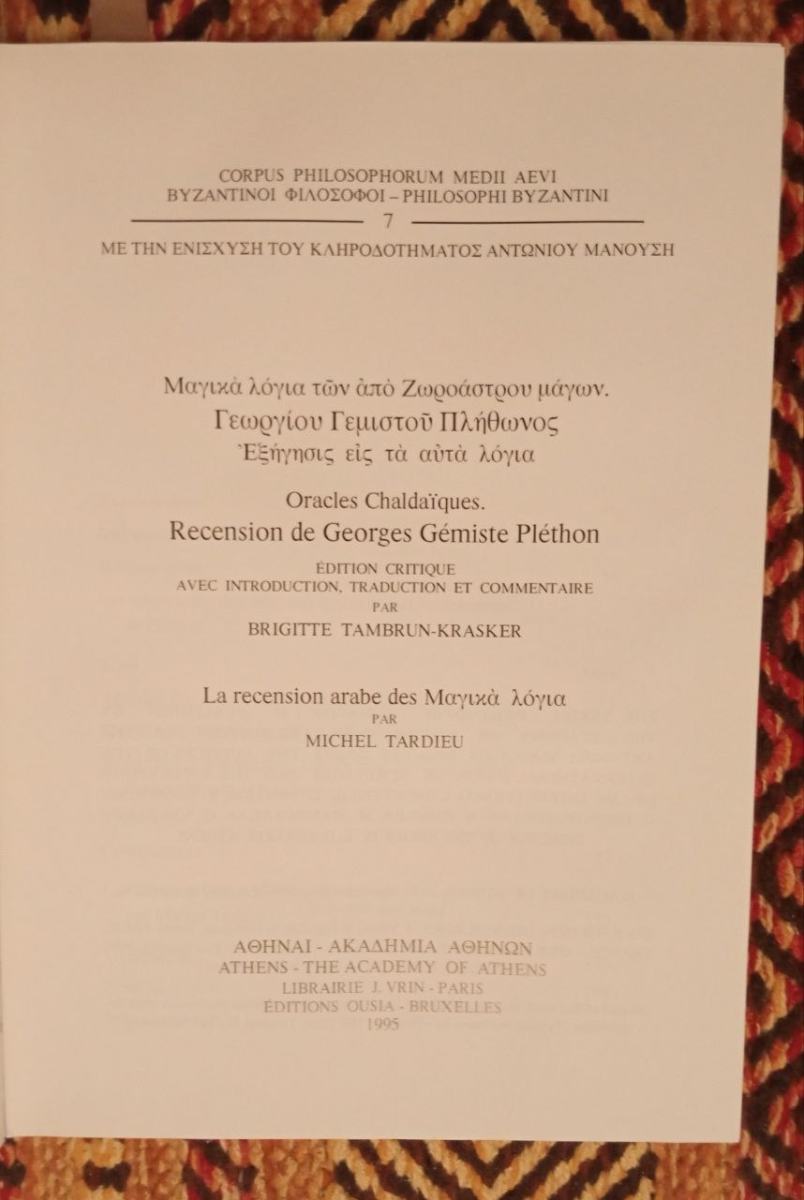
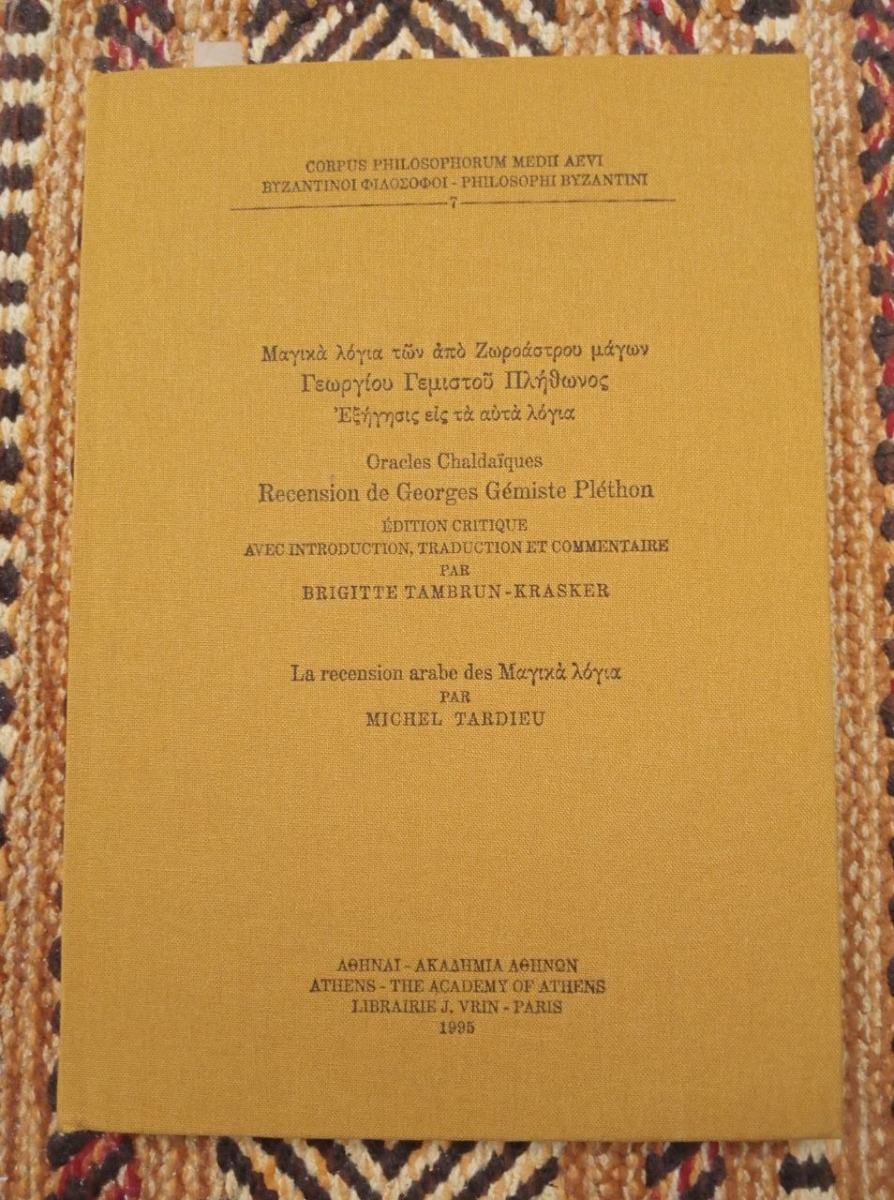
Today’s sharing from the Blue House of Via-HYGEIA presents the English translation of the Chaldaean Oracles in George Gemistos Plethon’s recension. This edition is based on the Academy of Athens’ 1995 critical edition of the Greek text and draws upon the French translation by Professor Brigitte Tambrun-Krasker.
Here, two mighty currents of antiquity meet at the luminous isthmus of late Byzantine thought: the ancient, fiery voice of the Chaldaean Oracles and the systematic, restorative genius of Plethon.
From this convergence flows a unique vision—a harmonization of Zoroastrian revelation and Platonic metaphysics—offering the contemporary theurgic practitioner not merely a historical artifact, but a living map for the soul’s return to the luminous source.
**
A CONTEXTUAL INTRODUCTION
I. The Chaldaean Oracles: Voice from the Margins of Antiquity
The Chaldaean Oracles (Magika logia) constitute one of the most enigmatic documents of late antique spirituality. Purportedly revealed by Julian the Chaldaean (or his son Julian the Theurgist) to the Roman co-emperor Marcus Aurelius during the Parthian campaign of 174 CE, these hexametric verses present themselves as the sacred utterances of the Magi descended from Zoroaster.
Whether the Julians were actual Chaldaeans, Hellenized Syrians, or sophisticated literary forgers matters less than the text’s reception: within a century, the Oracles had become the sacred scripture of the Neoplatonic school, rivalling the Timaeus in authority for those who practiced theurgy – the ritual art of making the gods present.
The original collection, now lost, probably ran to several hundred verses. What survives – some 400 lines in fragmentary form – comes to us through the excerpts and commentaries of Neoplatonic philosophers: Proclus, Damascius, Simplicius, and above all Michael Psellus, whose eleventh-century Expositio in Oracula Chaldaica preserved the bulk of the text.
The present edition follows the recension prepared by George Gemistos Plethon (c. 1355–1454), the Byzantine philosopher who transmitted the Oracles to the Latin West through his lectures at the Council of Florence (1439). This text is based on the Academy of Athens’ 1995 critical edition of the Greek text and draws upon the French translation and commentary by Professor Brigitte Tambrun-Krasker. Plethon’s version, originally printed in the editio princeps of 1538, represents a deliberate editorial intervention: he selected, arranged, and commented upon the verses according to his own philosophical system, which sought to harmonize Zoroastrian, Platonic, and Chaldaean wisdom into a restored pagan theology
II. The Theological Landscape of the Oracles
The Oracles operate within a triadic metaphysics that would profoundly influence Proclus and later Neoplatonism:
- The Father (Pater): The absolutely first principle, beyond being, intellect, and all determination. He is “without parts” (achros), self-sufficient, the source from whom all proceeds but who remains eternally self-enclosed. The Oracle declares: “The Father embraced himself, nor did he shut up his own fire within his intellectual power” (33). This is the ineffable source, the “single fire” from which all things spring (29).
- The Paternal Mind (Patrikos Nous): The second hypostasis, the demiurgic intellect that proceeds from the Father. This is the “second God” who “consummated all things” and “delivered them” to the lower orders (30). He is the immediate source of the soul’s being, the one who “set symbols within the souls” (27) – the intelligible forms or logoi that serve as the soul’s innate equipment for knowing. The Paternal Mind is also called the “demiurge of the soul’s attention” (proseches demiourgos), emphasizing that the soul’s capacity for directed consciousness derives from this second principle.
- The Soul (Psyche): The third term, mediating between the intelligible and the sensible. The Oracles present the soul as “by power of the Father a shining fire” (12), immortal and “mistress of life,” yet capable of descent into the “mortal body” (3). The soul’s drama is the central concern: its pre-existence in the “luminous place” (paradeisos, 13), its descent through the planetary spheres (the “seven-gated ladder,” 2), its embodiment as service (theteia, 1), and its potential return through theurgical practice.
III. Theurgy and the Ritual Body
The Oracles are not merely metaphysical speculation; they are a manual of theurgic practice. The term theourgia – divine work – appears in the tradition as the complement to theologia: where theology reasons about the gods, theurgy makes them present. The Oracles prescribe specific operations:
- The synetheia: The “familiarization” with the divine through repeated ritual contact, establishing a bond (synapheia) between the human and divine orders.
- The telete: The initiation, the “work of piety” (ergon ep’ eusebies, 17) through which the mortal body itself is “saved” (saoseis) – not in the Christian sense of redemption from sin, but in the sense of being made whole, healthy (hygieinoteron), and capable of sustaining divine presence.
- The hieros logos: The “sacred word” that must be united to deed (1). This is not mere prayer but a performative utterance, the vox mystica that activates the symbols implanted by the Paternal Mind.
- The okhema: The “vehicle” of the soul, the pneumatic envelope that serves as the soul’s chariot in its descent and ascent. The Oracles warn against defiling the “spirit” (pneuma, 14) or making the “plane” (epipedon) thick with excessive matter – technical language for the theurgic cultivation of the subtle body.
IV. Plethon: The Last Hellenic Theurgist
George Gemistos, who took the name Plethon (a name derived from Plato (Platōn), modified to Plethon (Plēthōn)—changing ‘broadness’ to ‘fullness’ to imply he was the fulfiller of Plato’s wisdom), stands as the most original and controversial philosopher of the late Byzantine world.
A native of Constantinople who spent his career at the court of the Despots in Mistra, Plethon was simultaneously a Platonic fundamentalist, a political reformer, and a religious revolutionary. His Nomoi (Laws), composed in the 1430s, proposed a complete restoration of pagan theology, ethics, and ritual as the foundation for a renewed Hellenic civilization.
Plethon’s engagement with the Chaldaean Oracles was not antiquarian. He read them as the surviving fragments of the primordial wisdom that Zoroaster had taught to the Magi, which Pythagoras and Plato had later recovered and developed. In his commentary, Plethon systematically identifies the Oracles’ theological framework with his own triadic metaphysics: the Father corresponds to Zeus/Oromasdes, the Paternal Mind to the Sun/Mithras, and the soul’s world to the domain of matter and becoming. This is not arbitrary syncretism but a deliberate hermeneutic: Plethon believed that the ancient theologians had all spoken the same truth in different tongues, and that the task of the philosopher was to translate between their symbolic vocabularies.
The present edition – Plethon’s Recensio – reflects this program. He has selected thirty-four oracles that trace the soul’s complete trajectory: descent, embodiment, ethical struggle, theurgical ascent, and final union with the divine. His commentary, while drawing on Psellus and Proclus, is original in its systematicity and in its insistence on the practical, initiatory dimension of the text. For Plethon, the Oracles were not museum pieces but living words, capable of effecting the soul’s transformation here and now.
V. Relevance and Originality for the Modern Theurgist
The Chaldaean Oracles, as transmitted by Plethon, offer the contemporary practitioner several resources unavailable elsewhere:
- A Theology of the Subtle Body: Unlike the abstract intellectualism of much later Neoplatonism, the Oracles insist on the soma – the body, the vehicle, the vessel – as the site of transformation. The soul’s “channel” (ochetos), its “flanks” (lagones), its “out-breaths” (exosteres) are not metaphors but the anatomical map of a theurgic physiology. The modern practitioner who works with breath, visualization, and somatic awareness finds here an ancient warrant for embodied spirituality.
- An Ethic of Attention: The Oracles’ repeated command – “Seek thou the paradise” (13), “Hasten toward the Light” (7), “Open all thine eyes upward” (21) – constitutes a technology of attention. The soul’s “attention” (prosochen) is itself demiurgic, a power derived from the Paternal Mind that can be cultivated or dissipated. In an age of distraction, the Oracles’ insistence on directed consciousness is urgently relevant.
- A Cosmology of Symbols: The doctrine that the Paternal Mind “set symbols within the souls” (27) provides the theoretical foundation for a symbolic practice that is neither arbitrary nor merely psychological. The symbols are ontological realities, the intelligible forms operating within the soul’s depths. The theurgist does not invent symbols but discovers them, activating through ritual what is already implanted.
- A Critique of Nature: The Oracle’s warning that “Nature persuades that the demons are pure” (19) is a profound critique of naturalism. The apparent order of nature is not the ultimate order; the “growths of evil matter” appear good because they participate, however minimally, in the Good. The theurgist must see through this persuasion, recognizing that the demons – intermediate beings – are not to be worshipped as ends but understood as means in the soul’s ascent.
- The Fire-Language: The Oracles’ imagery of fire – “shining fire,” “fiery mind,” “fire everywhere swift” – is not merely poetic but metaphysical. Fire is the element of the intelligible, the medium of divine presence. The modern theurgist who works with candle-flame, solar awareness, or the “inner light” of meditation participates in this ancient pyrotheology.
VI. The Via-HYGEIA Transmission
The present translation is prepared for the Via-HYGEIA Circle of Transmission, a contemporary community dedicated, among other projects, to the living practice of theurgy. The name HYGEIA – Health – recalls the Oracle’s promise that the initiation makes the mortal body “healthier” (hygieinoteron, 17). This is not medical health in the narrow sense but the sozo – the making-whole of body, soul, and intellect that constitutes the theurgic life.
The translation aims to preserve the oracular density of the Greek while rendering Plethon’s commentary with the philosophical precision it demands. Technical terms are translated consistently according to the table of correspondences; where the Greek carries multiple resonances, the English attempts to layer rather than flatten. The goal is a text that can be read as philosophy, recited as liturgy, and practiced as theurgy.
*
And now the text:
THE ORACLES AND COMMENTARY
ORACLE 1
Greek: Δίζεο σὺ ψυχῆς ὀχετόν, ὅθεν ἢ τίνι τάξει, σώματι θητεύσας, ἐπὶ τάξιν ἀφ’ ἧς ἐφόρμησ, αὖθις ἀναστήσεις, ἱερῷ λόγῳ ἔργον ἑνώσας.
Transliteration: Dizeo su psyches ochetón, hothen ê tini taxei, sómati theteusas, epi taxin aph’ hês exormês, authis anastêseis, hierôi logôi ergon enôsas.
English: Seek out the channel of thy soul, whence and in what order, having served in a body, thou shalt again rise up to the order from which thou didst set forth, uniting deed to sacred word.
Plethon’s Commentary:
Greek: Οἱ ἀπὸ Ζωροάστρου μάγοι νομίζουσιν, ὥσπερ καὶ ἄλλοι συχνοί, τὴν ψυχὴν τὴν ἀνθρωπίνην, ἀθάνατον οὖσαν, ἄνωθέν τε κατιέναι, τῷ θνητῷ τῷδε σώματι θητεύουσαν, ἤτοι ἐπί τινα χρόνον ἐργαζομένην αὐτῷ, καὶ ζώουσαν τε καὶ κοσμήσουσαν ἐκ τῶν δυνατῶν, καὶ αὖθις ἐνθένδε ἐκεῖσε ἀποχωρεῖν, πλειόνων δ’ ἔχει ὄντων τῇ ψυχῇ χωρῶν, καὶ τοῦ μὲν ἀμφιφαοῦς, τοῦ δ’ ἀμφικνεφοῦς, τῶν δέ τινων μεταξὺ τούτων, ἑτεροφαδῶν τε δὴ καὶ ἑτεροκνεφῶν· ἀπό γε τοῦ ἀμφιφαοῦς ποτὲ ἐς τόδε τὸ σῶμα κατερθῆναι τὴν ψυχήν, καλῶς μὲν θητεύσασαν, ἐς τὸν αὐτὸν χῶρον αὖθις ἀνατρέχειν· μὴ καλῶς δέ, ἐς τοὺς τούτου χείρονας ἐνθένδεν ἀποχωρεῖν, κατὰ λόγον τῶν αὐτῇ βεβιωμένων. Πρὸς οὖν ταῦτα λέγει τὸ λόγιον, ζήτει σὺ τὸν τῆς ψυχῆς ὀχετόν, ἤτοι τὴν ὁδόν, ἥν σοι ἡ ψυχὴ ἐφόρμη ὅθεν ἢ τίνι τάξει, τοῦ βίου δηλαδί, τῷδε τῷ σώματι θητεύσασα, αὖθις ἐπὶ τὴν αὐτὴν τάξιν, ἀφ’ ἧς ἐφόρμησ, ἀναστήσεις, τὸν αὐτὸν δηλαδὶ ὀχετὸν τῆς ψυχῆς, ἑνώσας τῷ ἱερῷ λόγῳ καὶ ἔργον. Ἱερὸν μὲν οὖν λόγον τὸν περὶ τῆς θεοσεβείας φησίν, ἔργον δὲ τὴν τελετήν. Λέγει οὖν τὸ λόγιον, ὅτι πρὸς τῷ περὶ τῆς θεοσεβείας λόγῳ, καὶ τῇ τελετῇ χρῶι, πρὸς τὴν τῆς ψυχῆς ταύτην ἀναγωγήν.
Transliteration: Hoi apo Zoroastrou magoi nomizousin, hôsper kai alloi sychnoi, tên psychên tên anthrôpinên, athanaton ousan, anôthen te katienai, tôi thnêtôi tôide sômati theteuousan, êtoi epi tina chronon ergasomenên autôi, kai zôsousan te kai kosmêsousan ek tôn dynatôn, kai authis enthende ekeise apochôrein, pleionôn d’ echei ontôn têi psychêi chorôn, kai tou men amphiphaous, tou d’ amphichnephous, tôn de tinôn metaxy toutôn, heterophadôn te dê kai heterochnephôn; apo ge tou amphiphaous pote es tode to sôma katerthênai tên psychên, kalôs men theteusasan, es ton auton choron authis anatrechein; mê kalôs de, es tous toutou cheironas enthende apochôrein, kata logon tôn autôi bebiômenôn. Pros oun tauta legei to logion, zêtei su ton tês psychês ochetón, êtoi tên hodon, hên soi hê psychê exormê hothen ê tini taxei, tou biou dêladi, tôide tôi sômati theteusasa, authis epi tên autên taxin, aph’ hês exormês, anastêseis, ton auton dêladi ochetón tês psychês, enôsas tôi hierôi logôi kai ergon. Hieron men oun logon ton peri tês theosebeias phêsin, ergon de tên teletên. Legei oun to logion, hoti pros tôi peri tês theosebeias logôi, kai têi teletêi chrôi, pros tên tês psychês tautên anagôgên.
English: The Magi descended from Zoroaster hold, as do many others, that the human soul is immortal, descends from above, and is yoked to this mortal body for a certain time, working therein, and having quickened and adorned it as far as possible, departs thence again to that place. For there are many places belonging to the soul: of the luminous, of the shadowy, and of those between these, of other-appearing and other-shadowy. From the luminous it sometimes descends into this body, and having well served, returns again to the same place; but if not well, into the worse places of this same region, and thence departs from here, according to the account of those established in these things. The Oracle therefore says: Seek the way of the soul, or the road by which the soul set forth, whence and in what order, that is, the order of this life, having served in this body, thou shalt again rise up to the same order from which thou didst set forth, uniting deed to sacred word. By sacred word he means the discourse concerning piety; by deed, the initiation. The Oracle therefore says that by the discourse concerning piety, and by the initiation, thou shalt attain this return of the soul.
ORACLE 2
Greek: Μηδὲ κάτω νεύσῃς, κρημνὸς κατὰ γῆς ὑπόκειται, ἑπταπόρου σύρων κατὰ βαθμίδος, ἣν ὑπὸ δεινῆς ἀνάγκης θρόνος ἐστί.
Transliteration: Mêde katô neusêis, kêlinos kata gês hypokeitai, heptaporou syrôn kata bathmidos, hên hypo deinês anankês thronos esti.
English: Neither look thou downward, for a chasm lies beneath the earth, dragging down the seven-gated ladder, which is the throne of dread Necessity.
Plethon’s Commentary:
Greek: Κρημνὸν τὴν εἰς φθορὰν φησὶ καὶ κακίαν καὶ κακοδαιμονίαν ὑποφέρειν, γῆν δὲ τὸ γεῶδες καὶ θνητὸν σῶμα· γῇ μὲν γὰρ καὶ χθονί, τὴν θνητὴν φύσιν, πυρὶ δὲ τὴν θείαν, τὰ λόγια ταῦτα ὡς τὰ πολλὰ σημαίνει. Ἑπτάπορον δὲ βαθμίδα φησὶ τὴν ἐκ τῶν πλανητῶν εἱμαρμένην, ὑφ’ ἣν καὶ δεινήν τινα ἱδρῦσθαι καὶ ἀπαράτρεπτον ἀνάγκην. Λέγει οὖν τὸ λόγιον, μὴ κάτω πρὸς τὸ θνητὸν δὴ σῶμα ἀποκλίνῃς, ᾧ τῇ ἀπὸ τῶν πλανητῶν μονῇ ὡς τὰ πολλὰ ὑποπίπτουσῃ εἱμαρμένῃ, τῶν οὐκ ἐφ’ ἡμῖν μᾶλλον ἐστί· κακοδαιμονήσεις γάρ, ἢν πρὸς τοῦτο ὅλος ἀποκλίνῃς, ἀτυχῶν, καὶ τῆς βουλήσεως ὑπὸ τῆς ἐς αὐτὸ πεπωμένης ἀνάγκης ἑκάστοτε ἐκπίπτων.
Transliteration: Kêlinon tên eis phthoran phêsi kai kakian kai kakodaimonian hypopherein, gên de to geôdes kai thnêton sôma; gêi men gar kai chthoni, tên thnêtên physin, pyri de tên theian, ta logia tauta hôs ta polla sêmainei. Heptaporon de bathmida phêsi tên ek tôn planêtôn heimarmenên, hyph’ hên kai deinên tina hidrysthai kai aparatrepton anankên. Legei oun to logion, mê katô pros to thnêton dê sôma apoklinêis, ho têi apo tôn planêtôn monêi hôs ta polla hypopiptousêi heimarmenêi, tôn ouk eph’ hêmin mallon esti; kakodaimonêseis gar, ên pros touto holos apoklinêis, atychôn, kai tês boulêseôs hypo tês es auto pepômenês anankês hekastote ekpiptôn.
English: He calls the chasm corruption and evil and ill-daemonedness, and the earth the false and mortal body; for by earth and chthonic he means the mortal nature, by fire the divine – these Oracles, as is their custom, signify many things by the same words. By the seven-gated ladder he means the fate from the planets, beneath which is established also a certain dread and inescapable necessity. The Oracle therefore says: Do not look downward toward the mortal body, to which alone the fate from the planets is subject as a thing that in many ways oppresses; for this is not in our power, but rather ill-daemonedness. For if one inclines wholly toward this, he is unfortunate, and of purpose falls ever short of the necessity that leads thereto.
ORACLE 3
Greek: Σὸν γὰρ ἄγγειον, θῆρες χθονὸς οἰκήσουσιν.
Transliteration: Son gar aggeion, thêseis chthonos oikêsousin.
English: For thy vessel – snakes and scorpions of the earth shall inhabit it.
Plethon’s Commentary:
Greek: Τὸ τῆς σῆς ἀγγείου ψυχῆς, τὸ θνητὸν δὴ τὸ σῶμα, εὐλαὶ καὶ χνῶδαλα οἰκήσουσιν.
Transliteration: To tês sês aggeiou psychês, to thnêton dê to sôma, eulai kai chnôdala oikêsousin.
English: The vessel of thy soul, this mortal body, snakes and scorpions shall inhabit.
ORACLE 4
Greek: Μὴ σύ γ’ αὔξανε τὴν εἱμαρμένην.
Transliteration: Mê su g’ auxane tên heimarmenên.
English: Do not thou increase the allotted fate.
Plethon’s Commentary:
Greek: Μὴ σὺ πειρῶ αὔξειν τὴν σὴν εἱμαρμένην, ἤτοι μείζω ποιεῖν τῆς δεδομένης, οὐ γὰρ οἷός τ’ ἔσῃ δηλαδή.
Transliteration: Mê su peirô auxein tên sên heimarmenên, êtoi meizô poiein tês dedomenês, ou gar oios t’ esêi dêladi.
English: Do not seek to increase thy fate, that is, to make it greater than what has been given; for thou art not able, that is.
ORACLE 5
Greek: Οὐ γὰρ ἀπὸ πατρικῆς ἀρχῆς ἀτελές τι τροχάζει.
Transliteration: Ou gar apo patrikês archês atelés ti trochazdei.
English: For nothing incomplete proceeds from the Paternal Principle.
Plethon’s Commentary:
Greek: Οὐ γὰρ ἀπὸ τῆς πατρικῆς ἀρχῆς, τῆς τοῦ ἀνωτάτῳ δηλαδὶ θεοῦ, χωρεῖ τι ἀτελές, δηλαδὶ ὥστ’ ἄν σε καὶ δύνασθαι αὐτοτελεῖον· ἐκεῖθεν γὰρ τέλεια ἅπαντα χωρεῖν, τῷ πρὸς τὴν τελειότητα τείνειν τὴν τοῦ ὅλου.
Transliteration: Ou gar apo tês patrikês archês, tês tou anôtatôi dêladi theou, chorei ti atelés, dêladi hôst’ an se kai dynasthai autoteleioun; ekeithen gar teleia hapanta chorein, tôi pros tên teleiotêta teinein tên tou holou.
English: For from the Paternal Principle, that is, from the highest God, nothing incomplete proceeds, that is, so that thou mightest be able to perfect thyself. For from thence all perfect things proceed, tending by their perfection toward the whole.
ORACLE 6
Greek: Ἀλλ’ οὐκ εἰσδέχεται κείνης τὸ θέλειν πατρικὸς νοῦς, μέχρις ἂν ἐξέλθῃ λήθης, καὶ ὄημα λαλήσῃ, μνήμην ἐνθεμένη πατρικοῦ συνθήματος ἁγνοῦ.
Transliteration: All’ ouk eisdecheta keinês to thelein patrikos nous, mechris an exelthêi lêthês, kai oêma lalêsêi, mnêmen enthementê patrikou synthêmatos agnou.
English: But the Paternal Mind does not receive her will, until she come forth from forgetfulness, and speak a word, having set within herself the memory of the pure Paternal token.
Plethon’s Commentary:
Greek: Ὁ πατρικὸς νοῦς, ὁ δεύτερος δηλαδὶ θεός, καὶ τῆς ψυχῆς προσεχὴς δημιουργός, οὐκ εἰσδέχεται κείνης τὴν θέλησιν, μέχρις ἂν ἐξέλθῃ τῆς λήθης, ἣν ἐκ τῆς πρὸς τόδε τὸ σῶμα ἐπιπλοκῆς ἔπαθε, καὶ λαλήσῃ τι ὄημα, ἤτοι λόγον φρόνησίν τινα, μνήμης ἐχόμενον τοῦ πατρικοῦ θείου συνθήματος, τοῦτο δ’ εἶναι τὴν τῆς τοῦ καλοῦ διώξεως ἐντολήν, ἧς τὴν ψυχὴν ἀναμνησθεῖσαν οὕτως ἤδη καὶ τῷ ἑαυτῆς δημιουργῷ μάλιστα ἀρέσκειν.
Transliteration: Ho patrikos nous, ho deuteros dêladi theos, kai tês psychês prosecheis dêmiourgos, ouk eisdecheta keinês tên thelêsin, mechris an exelthêi tês lêthês, hên ek tês pros tode to sôma epimplokês epathe, kai lalêsêi ti oêma, êtoi logon phronêsin tina, mnêmes echomenon tou patrikou theiou synthêmatos, touto d’ einai tên tês tou kalou diôxeôs entolên, hês tên psychên anamnêstheisan houtôs êdê kai tôi heautês dêmiourgôi malista areskein.
English: The Paternal Mind, that is, the second God, and the demiurge of the soul’s attention, does not receive her will, until she come forth from forgetfulness, which she suffered from the wrapping around toward this body, and speak a word, that is, a certain voice of reason, having the memory of the Paternal divine token – this is the command of the pursuit of the Beautiful, which the soul, having been reminded, may thus already please her own demiurge most of all.
ORACLE 7
Greek: Χρὴ σὲ σπεύδειν πρὸς τὸ φάος, καὶ πρὸς πατρὸς αὐγάς, ἔνθεν ἐπέμφθη σοι ψυχὴ πολὺν ἐσσαμένη νοῦν.
Transliteration: Chrê se speudein pros to phaos, kai pros patros augas, enthen epemphthê soi psychê polun essamenê noun.
English: Thou must hasten toward the Light, and toward the rays of the Father, whence was sent to thee a soul girded about with much mind.
Plethon’s Commentary:
Greek: Φῶς καὶ αὐγὰς πατρὸς τῇ ψυχῇ, τὸν ἀμφιφαῆ εἶναι αὐτῆς χῶρον, ἔνθεν τὴν ψυχὴν τὸν πολὺν νοῦν περιβεβλημένην, ἐνθάδε δὴ καταπεμφθῆναι· πρὸς οὖν τὸ αὐτὸ φῶς χρῆναι αὖθις σπεύδειν.
Transliteration: Phos kai augas patros têi psychêi, ton amphiphaê einai autês choron, enthen tên psychên ton polun noun peribeblêmenên, enthade dê katapemphthênai; pros oun to auto phôs chrênai authis speudein.
English: The Light and the rays of the Father to the soul are its luminous place, whence the soul, girded about with much mind, was sent down here to be buried. Toward this same light thou must therefore hasten again.
ORACLE 8
Greek: Ἃ δὲ τοῦσδε χθὼν κατοδύρεται ἐς τέκνα μέχρις.
Transliteration: Ha de toude chthôn katodyretai es tekna mechris.
English: But as many things as this earth laments down upon her children.
Plethon’s Commentary:
Greek: Τοὺς δὲ μὴ πρὸς τὸ αὐτὸ φῶς, ὅθεν αὐτοῖς ἐπέμφθη ἡ ψυχή, σπεύδοντας αὖθις, ἡ χθὼν ἤτοι ἡ θνητὴ φύσις, κατοδύρεται, ὅτι πέμφθεντες ἐφ’ ὃ καὶ αὐτὴν κοσμῆσαι. Οἱ δὲ πρὸς τῷ μὴ καὶ αὐτὴν κοσμῆσαι, καὶ ἑαυτοὺς ἠσυχῇ μοχθηρῶς βεβιωκότες, παραποιαύειν δὲ δὴ καὶ τὰ τέκνα τῆς τῶν γονέων κακίας, πονηρᾶς ἀγωγῆς τῆς ὑφ’ αὐτῶν τυγχάζοντα.
Transliteration: Tous de mê pros to auto phos, hothen autois epemphthê hê psychê, speudontas authis, hê chthôn êtoi hê thnêtê physis, katodyretai, hoti pemphthentes eph’ ho kai autên kosmêsai. Hoi de pros tôi mê kai autên kosmêsai, kai heautous hêsychê mochthêrôs bebiôkotes, parapoiauein de dê kai ta tekna tês tôn goneôn kakias, ponêras agôgês tês hyph’ autôn tychazonta.
English: But those who do not hasten toward this same light, whence their soul was sent, but rather this earth, that is, the mortal nature, laments down upon, because they have been sent to adorn it, and themselves. But those who, not having adorned it, and having lived badly, have been established, do also corrupt the children of their parents’ evil, obtaining an evil rearing from them.
ORACLE 9
Greek: Ψυχῆς ἐξωστῆρες ἀναπνοαὶ εὔλυτοί εἰσιν.
Transliteration: Psychês exosteres anapnoi eulytoi eisin.
English: The out-breaths that draw the soul forth are easily dissolved.
Plethon’s Commentary:
Greek: Οἱ τὴν ψυχὴν ἐξωθοῦντες λόγοι, ἐκ τῆς κακίας δηλαδή, καὶ οὕτω δὴ ἀναπνεῖν διδόντες, εὔλυτοί εἰσιν, ἤτοι οὐ χαλεπῶς τῆς τέως ἐπεχούσης αὐτοὺς λήθης ἀπολυόμενοι.
Transliteration: Hoi tên psychên exothountes logoi, ek tês kakias dêladi, kai houtô dê anapnein didontes, eulytoi eisin, êtoi ou chalepôs tês teôs epechousês autous lêthês apolymenoi.
English: The words that draw the soul forth, that is, from evil, and thus giving it to breathe again, are easily dissolved, that is, they are not with difficulty released from the forgetfulness that has hitherto held them.
ORACLE 10
Greek: Λαιῆς ἐν λαγόσι κοιτῆς, ἀρετῆς τέλε πηγή, ἔνδον ὅλῃ μίμνουσα, τὸ παρθένον οὐ προεῖσα.
Transliteration: Laiês en lagósin koitês, aretês tele pêgê, endon holê mimnousa, to parthenon ou proeisa.
English: In the flanks of the left couch is the consummate fount of virtue, remaining whole within, not having gone forth from her maidenhood.
Plethon’s Commentary:
Greek: Ἐν ταῖς λαγόσι τῆς σῆς λαιᾶς κοιτῆς, ὑπάρχει ἡ τῆς ἀρετῆς πηγή, ἤτοι ἡ δύναμις αὐτῆς, ἔνδον τε ὅλῃ μένουσα, καὶ οὔποτε τὸ παρθένον, ἤτοι ἀπαθὲς ἑαυτῆς ἀποβάλλουσα· ἀπαθὲς γὰρ καὶ ἀναπόβλητον ἐν ἡμῖν τὴν τῆς ἀρετῆς ἀεὶ δύναμιν ὑπάρχειν, κἂν ἡ ἐνέργεια αὐτῆς ἀποβλητὴ ᾖ. Ἐν λαιοῖς δὲ τὴν τῆς ἀρετῆς φησιν ὑπάρχειν δύναμιν, διὰ τὸ ἐν δεξιοῖς τὴν ἐνέργειαν αὐτῆς βούλεσθαι τετάχθαι· κοίτην δ’ εἶναι ἡμῶν τῆς ψυχῆς, τὴν ταῖς διαφόροις αὐτῆς ἕξεσιν ὑποκειμένην χώραν.
Transliteration: En tais lagósi tês sês laias koitês, hyparchei hê tês aretês pêgê, êtoi hê dynamis autês, endon te holê menousa, kai oupote to parthenon, êtoi apathes heautês apoballousa; apathes gar kai anapoblaton en hêmin tên tês aretês aei dynamin hyparchein, kan hê energeia autês apoblatê ê. En laiois de tên tês aretês phêsin hyparchein dynamin, dia to en dexiois tên energeian autês boulesthai tetachthai; koitên d’ einai hêmôn tês psychês, tên tais diaphorois autês hexesin hypokeimenên choran.
English: In the flanks of thy left couch, there is the fount of virtue, that is, its power, remaining whole within, and never the maiden, that is, having cast off its own impassibility. For the power of virtue must always be impassible and unassailable in us, even if its activity be passible. In the left he says the power of virtue exists, because in the right its activity is wont to be placed; but the couch is the place of our soul, the place underlying its various states.
ORACLE 11
Greek: Ψυχὴ ἡ μερόπων θεὸν ἄγει πως ἐς ἑαυτήν, οὐδὲν θνητὸν ἔχουσα, ὅλη θεόθεν μεμέθυσται. Ἁρμονίαν αὐχεῖ γάρ, ὑφ’ ᾗ τέλε σῶμα βρότειον.
Transliteration: Psychê hê meropôn theon agei pôs es heautên, ouden thnêton echousa, holê theothen memethystai. Harmonian auchei gar, hyph’ hêi tele sôma bratteion.
English: The soul of mortals somehow draws the god into herself, having nothing mortal, being wholly intoxicated from the divine. For she boasts of harmony, beneath which the consummate body is leavened.
Plethon’s Commentary:
Greek: Ἡ ψυχὴ ἡ ἀνθρωπίνη θεὸν πώς ἐς ἑαυτὴν ἄγει, ἤτοι ἰσχυρῶς ἑνοῦσι, τὸν ἑαυτῆς δηλαδὶ προσεχῆ προστάτην, τῇ πρὸς αὐτὸν κατὰ δύναμιν ὁμοιώσει οὐδὲν θνητὸν ἔχουσα, ὅλη θεόθεν μεμέθυσται, ἤτοι πεπλήρωται τῶν θείων καλῶν. Εἰ γὰρ καὶ τῷ θνητῷ τῷδε ἐνδέδεται, ἀλλὰ καὶ οὕτω τήν γε ἁρμονίαν, ἤτοι τὴν ἕνωσιν, ὑφ’ ᾗ τὸ βρότειον ὑπάρχει σῶμα, αὐχεῖ, ἤτοι οὐκ αἰσχύνεται, ἀλλὰ καὶ φρονεῖ τι ἐπ’ αὐτῇ ὡς ἂν αὐτὴ οὖσα ἡ τὴν τοιαύτην τῷ παντὶ λειτουργοῦσα λειτουργίαν, ὥστε τῶν θνητῶν τοῖς ἀθανάτοις ἐν τῷ ἀνθρώπῳ ἑνουμένων, οὕτω καὶ τὸ πᾶν ἐς μίαν τινὰ ἁρμονίαν συγκροτεῖσθαι.
Transliteration: Hê psychê hê anthrôpinê theon pôs es heautên agei, êtoi ischyros enôsei, ton heautês dêladi proseche prostatên, têi pros auton kata dynamin homoiôsei ouden thnêton echousa, holê theothen memethystai, êtoi peplêrôtai tôn theiôn kalôn. Ei gar kai tôi thnêtôi tôide endedetai, alla kai houtô tên ge harmonian, êtoi tên henôsin, hyph’ hêi to brattteion hyparchei sôma, auchei, êtoi ouk aischynetai, alla kai phronei ti ep’ autêi hôs an autê ousa hê tên toiautên tôi panti leitourgousa leitourgian, hôste tôn thnêtôn tois athanatois en tôi anthrôpôi enoumenôn, houtô kai to pan es mian tina harmonian synkroteisthai.
English: The human soul draws the god somehow into itself, that is, strongly unites its own attention to him, by power likening itself to him, having nothing mortal, being wholly intoxicated from the divine, that is, it is filled with divine goods. For if it is also bound to this mortal body, yet even so it does not blush at the harmony, that is, the union, beneath which the supporting body exists, but rather boasts of it, that is, it is not ashamed, but rather speaks something upon it, as being itself the one performing such a ministry to the All, so that the immortals, being united in man with the mortals, thus also the whole may be harmonized into one.
ORACLE 12
Greek: Ὅττι ψυχὴ πὺρ δυνάμει πατρὸς οὖσα φαεινόν, ἀθάνατός τε μένει, καὶ ζωῆς δεσπότις ἐστί, καὶ ἔχει κόσμου πολλὰ πληρώματα κόλπων.
Transliteration: Hotti psychê pyr dynamei patros ousa phaeinon, athanatos te menei, kai zôês despotes esti, kai echei kosmou polla plêrômata kolpôn.
English: Inasmuch as the soul, being by power of the Father a shining fire, remains immortal, and is mistress of life, and holds the many plenitudes of the bosoms of the cosmos.
Plethon’s Commentary:
Greek: Πατρὸς δύναμιν, καὶ δύναμιν αὐτοῦ νοεράν, καὶ νοῦν πατρικόν, τὸν αὐτὸν δεύτερον θεόν, τὰ λόγια ταῦτα πανταχοῦ καλεῖ, πρῴτιστον τῶν ἄλλων πάντων ἐκ τοῦ πατρός τε καὶ ἀνωτάτῳ θεοῦ προεληλυθότα. Λέγει οὖν, ὅτι τοῦ πατρὸς ταύτῃ τῇ δυνάμει προσεχῶς δηλαδή, δεδημιουργημένη ἡ ψυχὴ πὺρ οὖσα φαεινόν, ἤτοι θεία τις οὐσία καὶ νοερά, μένει τε ἀθάνατος διὰ τὴν θειότητα τῆς οὐσίας, καὶ δεσπότις ἐστὶ ζωῆς, δηλαδὴ τῆς ἑαυτῆς, ἅτε οὐκ ἀποβλητὸν ἔχουσα τὸ ζῆν. Ἃ μὲν γὰρ ἂν ἀποβλητὰ ἔχοιμεν, τούτων οὐδ’ ἂν δεσπόται που εἴημεν, χρῆσις δ’ ἄν τις μόνη ἡμῖν δίδοιτο αὐτῶν, ἃ δ’ ἂν μὴ ἀποβλητά, κἂν δεσπόται τούτων εἴημεν. Καὶ ἔχει δὲ δὴ ἡ ψυχή, κατὰ τὴν ἑαυτῆς δηλαδὴ ἀϊδιότητα, πολλὰ πληρώματα τῶν τοῦ κόσμου κόλπων, ἤτοι τῶν διαφόρων ἑαυτῆς ἐν τῷ κόσμῳ χωρῶν, ὧν πρὸς λόγον τῶν τῇδε αὐτῇ βεβιωμένων ἑκάστοτε τυγχάνει.
Transliteration: Patros dynamin, kai dynamin autou noeran, kai noun patrikon, ton auton deuteron theon, ta logia tauta pantachou kalei, prôtiston tôn allôn pantôn ek tou patros te kai anôtatô theou proelêluthota. Legei oun, hoti tou patros tautêi têi dynamei prosechôs dêladi, dedêmiourgêmenê hê psychê pyr ousa phaeinon, êtoi theia tis ousia kai noera, menei te athanatos dia tên theiotêta tês ousias, kai despotes esti zôês, dêladi tês heautês, ate ouk apoblaton echousa to zên. Ha men gar an apoblatla echoimen, toutôn oud’ an despôtai pou eipmen, chrêsis d’ an tis monê hêmin didoito autôn, ha d’ an mê apoblatla, kan despôtai toutôn eipmen. Kai echei de dê hê psychê, kata tên heautês dêladi aidiotêta, polla plêrômata tôn tou kosmou kolpôn, êtoi tôn diaphorôn heautês en tôi kosmôi chorôn, hôn pros logon tôn têide autêi bebiômenôn hekastote tychazdei.
English: By power of the Father, and his power intelligible, and Paternal Mind, the same second God, these Oracles everywhere call, as the first of all other things proceeding from the Father and the highest God. It says therefore that the soul, being by this power attentively, that is, demiurgically, a shining fire, a certain divine and intelligible substance, remains immortal through the divinity of its substance, and is mistress of life, that is, of its own, as not having the living as something that can be lost. For the things that can be lost, not even if one were master of them would we say he needs them; but if they cannot be lost, even if he be not master of them, we would say he needs them. And the soul, according to its own eternity, that is, holds many plenitudes of the bosoms of the cosmos, that is, of its various places in the cosmos, which it obtains according to the reason of those established in it.
ORACLE 13
Greek: Ζήτησον παράδεισον.
Transliteration: Zêtêson paradeison.
English: Seek thou the paradise.
Plethon’s Commentary:
Greek: Τὸν ἀμφιφαῆ τῆς ψυχῆς χῶρον.
Transliteration: Ton amphiphaê tês psychês choron.
English: The luminous place of the soul.
ORACLE 14
Greek: Μὴ πνεῦμα μολύνῃς, μηδὲ βαθύνῃς τὸ ἐπίπεδον.
Transliteration: Mê pneuma molynês, mêde bathynês to epipedon.
English: Do not thou defile the spirit, nor deepen the plane.
Plethon’s Commentary:
Greek: Οἱ περί τε Πυθαγόραν καὶ Πλάτωνα σοφοὶ τὴν ψυχὴν οὐ πάντῃ τινὰ χωριστὴν οὐσίαν παντὸς σώματος νομίζουσιν, οὐ μὲν δή, οὐ δ’ αὖ πάντῃ ἀχώριστον, ἀλλὰ τῇ μὲν χωριστήν, τῇ δ’ ἀχώριστον· τῇ μὲν δυνάμει δήπου χωριστήν, τῷ δ’ ἔργῳ ἀεὶ ἀχώριστον. Τρίτον γὰρ οὖν τὸ σύμπαν εἴδων τίθενται γένος, τὸ μὲν πάντῃ χωριστὸν ὕλης, τοὺς νοῦς δὴ τοὺς ὑπερουρανίους· τὸ δ’ ἀχώριστον πάντῃ, οὐ τὴν γε οὐσίαν καθ’ ἑαυτὴν ὑφεστηκυῖαν ἔχον, ἀλλὰ τῆς ὕλης δὴ ἐξημμένην, κἀκείνῃ τῷ τῆς φύσεως σχεδαστῷ λυόμενόν ποτε συσκεδαννύμενόν τε καὶ ἀπολλύμενον, καὶ τοῦτ’ εἶναι τὸ ἄλογον δὴ εἶδος σύμπαν. Τρίτον δὲ μεταξὺ τούτων τῶν ὑπερουρανίων διαφέρουσαν ψυχὴν τιθέασι τὴν λογικήν· τῶν μὲν νῦν τῶν ὑπερουρανίων διαφέρουσαν τῷ ἀεὶ ὕλῃ συνείναι· τοῦ δ’ ἀλόγου εἴδους, τῷ μὴ αὐτὴν τῆς ὕλης ἐξῆφθαι, ἀλλὰ τοὐναντίον, τὴν ὕλην ἑαυτῆς ἀεὶ ἔχειν ἐξημμένην, οὐσίαν αὐτὴν ἰδίαν ἑαυτῆς καὶ καθ’ αὑτὴν τῇ γε δυνάμει ἔχουσαν ὑφεστηκυῖαν, ἀμεθῆ τε καὶ αὐτὴν κατὰ τοὺς νοῦς τοὺς ὑπερουρανίους, οἷς καὶ συγγενῆ πώς τὰ ἔργα ἀποδίδωσι, τῶν αὐτῶν, ὥσπερ κἀκεῖνοι, ἐφαπτομένη καὶ αὐτή, τῆς τῶν ὄντων δὴ γνώσεώς τε καὶ θεωρίας, ἄχρι καὶ αὐτοῦ τοῦ ἀνωτάτω θεοῦ, καὶ διὰ τοῦτο ἀνώλεθρον· τοιοῦτον οὖν εἶδος οὖσαν τὴν ψυχήν, σώματι ἀεὶ συνείναι αἰθερίῳ, οἷον ὀχήματι ἑαυτῆς, συναπαθανατίζουσαν καὶ αὐτὸ τῇ προσεχεῖ ἐπαφῇ, εἶναι δ’ οὐδὲ τὸ τοιοῦτον αὐτῆς ὄχημα, ἄψυχον καθ’ αὑτό, ἀλλ’ ἐμψυχοῦσθαι καὶ αὐτό, τῷ ἑτέρῳ τε καὶ ἀλόγῳ ψυχῆς εἴδει, ὃ δὴ ψυχῆς λογικῆς εἴδωλον οἱ σοφοὶ καλοῦσι, φαντασίαι τε καὶ αἰσθήσει, ὅλῳ δι’ ὅλου ὁρῶντι τε καὶ ἀκούοντι, καὶ πᾶσαν αἴσθησιν αἰσθανομένῳ, καὶ ταῖς ἄλλαις ταῖς ταύταις ἑπομέναις ψυχῆς δυνάμεσιν ἀλόγοις· διὰ μὲν οὖν τῆς χαριστότητος τοῦ τοιούτου σώματος δυνάμεως φαντασίας, τὴν ψυχὴν τὴν λογικὴν ὅλῳ τῷ τοιούτῳ ἀεὶ συνείναι σώματι· διὰ δὲ τοῦ τοιούτου σώματος τῷδε ποτὲ τῷ θνητῷ τὴν γε ἀνθρωπίνην συγγίγνεσθαι, ὅλου ὅλῳ τῷ τοῦ ἐμβρύου ζωτικῷ πνεύματι, διὰ συγγένειάν τινα ἐπιπλεκόμενου, ἅτε πνεύματός τινος καὶ αὐτοῦ ὄντος· τὰς γε μὴν δαιμονίας ψυχὰς τῇ μὲν ἄλλῃ οὐ πολλῷ τῶν ἀνθρωπίνων διαφέρειν, γενναιοτέρας δὲ ὁμοῦ οὐσας αὐτάς τε καὶ γενναιοτέροις ὀχήμασι χρωμένας, ἀμίκτους δὲ τῇ θνητῇ εἶναι φύσει· τὰς δὲ τῶν ἀστέρων ὁμοῦ τι καὶ ἐκείνων ἀμείνους, κρείττονι καὶ ὀχήμασι χρῆσθαι, τοῖς οὕτω διὰ μέγεθος δραστικῆς δυνάμεως λαμπροῖς τούτοις σώμασι. Ταύταις περὶ ψυχῆς ταῖς δόξαις καὶ οἱ ἀπὸ Ζωροάστρου οὗτοι μάγοι φαίνονται ἔτι προσιέναι… Τὸ τοιοῦτον οὖν τῆς ψυχῆς πνεῦμα μὴ μολύνῃς φησὶ τὸ λόγιον, μηδὲ βαθύνῃς ἐπίπεδον ὄν. Ἐπίπεδον αὐτὸ καλοῦν, οὐχ ὡς οὐ τυχάνῃ διαστατόν, σῶμα γάρ, ἀλλὰ τὴν ἄγαν αὐτοῦ λεπτότητα ἐμφαῖνον, ἐπίπεδον αὐτὸ καλεῖ. Μὴ βαθύνειν οὖν αὐτὸ παρακελεύεται, ἤτοι μὴ παχύνειν, πλείονος ὕλης ἐν τῷ αὐτοῦ ὀχήματι προσθήκῃ παχύνεσθαι δὲ τὸ τοιοῦτον τῆς ψυχῆς πνεῦμα, τῇ πρὸς τὸ θνητὸν σῶμα αὐτῆς ἄγαν ἀποκλίσει.
Transliteration: Hoi peri te Pythagoran kai Platôna sophoi tên psychên ou pantê tina chôristên ousian pantos sômatos nomizousin, ou men dê, ou d’ au pantê achôriston, alla têi men chôristên, têi d’ achôriston; têi men dynamei dêpou chôristên, tôi d’ ergôi aei achôriston. Tritton gar oun to sympan eidôn tithentai genos, to men pantê chôriston hylês, tous nous dê tous hyperouranious; to d’ achôriston pantê, ou tên ge ousian kath’ heautên hyphestêkuian echon, alla tês hylês dê exêmmenên, kakeinêi tôi tês physeôs schedastôi lymenên pote syskezdannymenon te kai apollymenon, kai tout’ einai to alogon dê eidos sympan. Triton de metaxy toutôn tôn hyperouraniôn diapherousan psychên tithentai tên logikên; tôn men nyn tôn hyperouraniôn diapherousan tôi aei hylêi syneinai; tou d’ alogou eidous, tôi mê autên tês hylês exêphthai, alla tounantion, tên hylên heautês aei echein exêmmenên, ousian autên idian heautês kai kath’ autên têi ge dynamei echousan hyphestêkuian, amethê te kai autên kata tous nous tous hyperouranious, hois kai sygennê pôs ta erga apodidôsi, tôn autôn, hôsper kakeinoi, ephaptomenê kai autê, tês tôn ontôn dê gnôseôs kai theôrias, achri kai autou tou anôtatô theou, kai dia touto anôlethron; toiouton oun eidos ousan tên psychên, sômati aei syneinai aitheriôi, hoion ochêmati heautês, synapathatidzousan kai auto têi prosechei epaphêi, einai d’ oude to toiouton autês ochêma, apsychon kath’ auto, all’ empsychousthai kai auto, tôi heterôi te kai alogôi psychês eidei, ho dê psychês logikês eidôlon hoi sophoi kalousi, phantasiai te kai aisthêsei, holôi di’ holou horônti te kai akouonti, kai pasan aisthêsin aisthanomenôi, kai tais allais tais tautais epomenais psychês dynameisin alogois; dia men oun tês charistotêtos tou toioutou sômatos dynameôs phantasias, tên psychên tên logikên holôi tôi toioutôi aei syneinai sômati; dia de tou toioutou sômatos tôide pote tôi thnêtôi tên ge anthrôpinên syngignesthai, holou holôi tôi tou embythiou zôtikôi pneumati, dia syggeneian tina epiplekomenou, ate pneumatos tinos kai autou ontos; tas ge mên daimonias psychas têi men allêi ou pollôi tôn anthrôpinôn diapherin, gennaioteras de homou ousas autas te kai gennaioterois ochêmasi chromenas, amiktous dê têi thnêtêi einai physei; tas de tôn asterôn homou ti kai ekeinôn ameinous, chreittoni kai ochêmasi chrêsthai, tois outô dia megethos dêastikês dynameôs lamprois toutois sômasi. Tautais peri psychês tais doxais kai hoi apo Zoroastrou houtoi magoi phainontai eti pro- … To toiouton oun tês psychês pneuma mê molynês phêsi to logion, mêde bathynês epipedon on. Epipedon auto kaloun, ouch hôs ou tynchêi diastaton, sôma gar, alla tên agan autou leptotêta emphainon, epipedon auto kalei. Mê bathynein oun auto parakeleuetai, êtoi mê pachynein, pleionos hylês en tôi autou ochêmati prosothêkên pachyuesthai de to toiouton tês psychês pneuma, têi pros to thnêton sôma autês agan apoklisei.
English: The sages around Pythagoras and Plato do not hold the soul to be wholly a separate substance from every body, but not wholly inseparable either; rather, separable in power, inseparable in deed. The whole genus of forms they place as the supracelestial minds: but the wholly inseparable, not having its own substance established in itself, but wrapped in matter, scattered and dissolved by the nature’s shaper, and this is the irrational form, the whole. But the soul they place between these: the rational, differing from the supracelestial minds in that it is not always with matter, but from the irrational form in that it does not always have its matter wrapped in itself, but has its own substance established in itself, and by power separate, immediate and itself according to the supracelestial minds, to which also it renders its works as akin, being itself attached to the knowledge and contemplation of beings, even of the highest God himself, and through this unwearying. Such a form therefore being the soul, in a body always aetherial, as its own vehicle, making itself also immortal by the attention thereto. But neither is such a vehicle of it soulless in itself, but ensouled and self-moving, and the other, that is, the irrational image of the rational soul, the sages call phantasia, imagination, established in sense, and perceiving the whole through the whole, both seeing and hearing, and sensing all sensation with the senses, and with the other such powers of the soul that follow upon these. Through therefore the power of imagination of such a body, the rational soul is always united with such a body; but through this body it sometimes becomes united with this mortal body, the whole with the whole, by a certain kinship woven together, since it is itself also a certain spirit. The daemonic souls indeed differ not much from the human, being of the same kind and having received more excellent vehicles, but they are of a mortal nature. But those of the stars, being better than these and using more excellent vehicles, are by so much superior in the greatness of their demiurgic power, luminous bodies such as these. In these opinions concerning the soul, the Magi descended from Zoroaster also appear to agree… The Oracle therefore says: Do not defile such a spirit of the soul, nor deepen the plane. It calls the plane itself, not as something not having dimension in any way, a body; but indicating its extreme thinness, it calls it plane. Do not therefore deepen it, that is, do not make it thick, by adding more matter in its own vehicle. But to make such a spirit of the soul thick is to incline it too much toward its mortal body.
ORACLE 15a
Greek: Ἔστι καὶ εἰδώλῳ μερὶς εἰς τόπον ἀμφιφαόντα.
Transliteration: Esti kai eidôlôi meris eis topon amphiphaonta.
English: There is also for the image a portion in the light-bearing place.
Plethon’s Commentary:
Greek: Εἴδωλον ψυχῆς καλεῖ, τὸ ἐχόμενον τοῦ λογικοῦ ἄλογον, ὃ τοῦ ὀχήματος αὐτῆς ἐξῆπται. Λέγει οὖν, ὡς ἔστι καὶ τῷ τοιούτῳ εἰδώλῳ μερὶς εἰς τὸν ἀμφιφαῆ χῶρον· οὐ γὰρ ἀποτίθεσθαί ποτε ψυχὴν τὸ ἑαυτῆς προσεχὲς ὄχημα.
Transliteration: Eidôlon psychês kalei, to echomenon tou logikou alogon, ho tou ochêmatos autês exêptetai. Legei oun, hôs esti kai tôi toioutôi eidôlôi meris eis ton amphiphaê choron; ou gar apotithesthai pote psychên to heautês proseches ochêma.
English: It calls the image of the soul the irrational that follows upon the rational, which has fallen away from its vehicle. It says therefore that there is also for such an image a portion in the luminous place. For the soul never lays aside its own proximate vehicle.
ORACLE 15b
Greek: Μηδὲ τὸ τῆς ὕλης σκύβαλον κρημνῷ καταλείψῃς.
Transliteration: Mêde to tês hylês skybalon chêlinôi kataleipsês.
English: Neither leave thou the dross of matter upon the bank.
Plethon’s Commentary:
Greek: Ὕλης σκύβαλον, τὸ θνητὸν σῶμα λέγει, καὶ παρακελεύεται μηδὲ τοῦτο εἰκῇ κακῶς πράττων περιορᾶν, ἀλλὰ φροντίζειν τι καὶ περὶ αὐτοῦ, μένοντα ἔτι ἐν τῷδε τῷ βίῳ, ὅπως ὑγιαίνειν τε ἐκ τῶν δυνατῶν, καὶ καθάρειον εἴη, καὶ τ’ ἄλλα τῷ τῆς ψυχῆς κόσμῳ σύμφωνοι.
Transliteration: Hylês skybalon, to thnêton sôma legei, kai parakeleuetai mêde touto eikê kakôs pratton perioran, alla phrontidzein ti kai peri autou, menonta eti en tôide tôi biôi, hôs hygiainein te ek tôn dynatôn, kai kathareion eie, kai t’ alla tôi tês psychês kosmôi symphônoi.
English: By the dross of matter he means the mortal body, and it exhorts that one should not, doing ill by chance, neglect this either, but should take thought also concerning it, remaining still in this life, so that one may be healthy as far as possible, and pure, and in other respects consonant with the order of the soul.
ORACLE 16
Greek: Μὴ ἐξάξῃς, ἵνα μὴ ἐξιοῦσα ἔχῃ τι.
Transliteration: Mê exaxês, hina mê exiousa echê ti.
English: Do not draw her forth, lest going forth she have something.
Plethon’s Commentary:
Greek: Μὴ ἐξάξῃς, τὴν ψυχὴν δηλαδὴ τοῦ θνητοῦ σώματος, ἵνα μὴ ἐξιοῦσα ἔχῃ τι· αὐτὸ δὴ τοῦτο, τὸ παρὰ τοὺς φυσικοὺς θεσμοὺς ἑαυτὴν ἐξαγαγεῖν.
Transliteration: Mê exaxês, tên psychên dêladi tou thnêtou sômatos, hina mê exiousa echê ti; auto dê touto, to para tous physikous desmous heautên exagagein.
English: Do not draw forth, that is, the soul from the mortal body, lest going forth it have something – that is, this very thing, to draw itself forth beyond the natural bonds.
ORACLE 17
Greek: Ἐκτείνας πύρινον νοῦν, ἔργον ἐπ’ εὐσεβείης, ζωστὸν καὶ σῶμα σαώσεις.
Transliteration: Ekteinas pyrinon noun, ergon ep’ eusebies, zeuston kai sôma saôseis.
English: Stretching forth the fiery mind, upon the work of piety, thou shalt save the yoked body also.
Plethon’s Commentary:
Greek: Ἐκτείνας τὸν σὸν θεῖον νοῦν ἐπὶ τὸ τῆς εὐσεβείας ἔργον, ἤτοι τὴν εὐσεβῆ τελετήν, καὶ τὸ θνητὸν σῶμα σώσεις, ὑγιεινότερον καὶ αὐτὸ διὰ τῆς τελετῆς ποιήσας.
Transliteration: Ekteinas ton son theion noun epi to tês eusebeias ergon, êtoi tên eusebê teletên, kai to thnêton sôma saôseis, hygieinoteron kai auto dia tês teletês poiêsas.
English: Stretching forth thy divine mind upon the work of piety, that is, the pious initiation, and thou shalt save the mortal body, making it also healthier through the initiation.
ORACLE 18
Greek: Ἐκ δ’ ἄρα κόλπων γαίης θωράκιοι οὔποτ’ ἀληθὲς σῆμα βροτῷ ἀνδρὶ χθόνιοι κύνες δεικνύντες.
Transliteration: Ek d’ ara kolpôn gaiês thôrakioi’ oupot’ alêthes sêma brotôi andri chthonioi kynes deiknyntes.
English: But from the bosoms of the earth’s breastplate, never do the earthly dogs show a true sign to a mortal man.
Plethon’s Commentary:
Greek: Εἴωθε τοῖς πολλοῖς τῶν τελουμένων φαίνεσθαι κατὰ τὰς τελετὰς κυνώδη τινα καὶ ἄλλως ἀλλοιότα τὰς μορφὰς φάσματα. Ταῦτ’ οὖν φησι τὸ λόγιον, ἐκ τῶν τῆς γῆς κόλπων, δηλαδὴ τοῦ γεώδους τούτου καὶ θνητοῦ σώματος, καὶ τῶν τούτῳ συμφυτῶν παθῶν ἀλόγων, οὔπω ὑπὸ τοῦ λόγου ἱκανῶς κατακεκοσμημένων, εἴδωλα τῶν τοιούτων τῆς τοῦ τελουμένου ψυχῆς παθῶν, φαινόμενα ἀνυπόστατα, καὶ διὰ τοῦτο οὐδ’ ἀληθὲς σημαίνοντα οὐδέν.
Transliteration: Eiôthe tois pollois tôn teloumenôn phainesthai kata tas teletas kynôdê tina kai allôs alloiota tas morphas phasmata. Taut’ oun phêsi to logion, ek tôn tês gês kolpôn, dêladi tou geôdous toutou kai thnêtou sômatos, kai tôn toutôi symphytôn pathôn alogôn, oupô hypo tou logou hikanôs katakekosmêmenôn, eidôla tôn toioutôn tês tou teloumenou psychês pathôn, phainomena anupostatata, kai dia touto oud’ alêthes sêmainonta ouden.
English: It is wont to appear to many of the initiated during the initiations as certain dogs and in other ways various forms, phantasms. The Oracle therefore says: from the bosoms of the earth, that is, of this false and mortal body, and of the irrational passions conjoined with it, not yet sufficiently adorned by reason, images of such passions of the initiated soul, appearing unstable, and for this reason signifying nothing true.
ORACLE 19
Greek: Ἡ φύσις πείθει εἶναι τοὺς δαίμονας ἁγνούς, καὶ τὰ κακῆς ὕλης βλαστήματα χρηστὰ καὶ ἐσθλά.
Transliteration: Hê physis peithei einai tous daimonas agnous, kai ta kakês hylês blastêmata chrêsta kai esthla.
English: Nature persuades that the demons are pure, and that the growths of evil matter are good and excellent.
Plethon’s Commentary:
Greek: Ἡ φύσις, ἤτοι ὁ φυσικὸς λόγος, πείθει εἶναι τοὺς δαίμονας ἁγνούς, καὶ ἁπλῶς πάντα τὰ ἐκ τοῦ θεοῦ αὐτοῦ ἀγαθοῦ ὄντος προεληλυθότα χρηστὰ εἶναι, καὶ αὐτὰ τὰ κακῆς ὕλης βλαστήματα, ἤτοι τὰ τῆς ὕλης ἐξημμένα εἰσι. Κακὴν δὲ τὴν ὕλην φησίν, οὐ τῇ οὐσίᾳ, πῶς γὰρ ἂν καὶ εἴη τῇ οὐσίᾳ κακή, ἧς τὰ βλαστήματα χρηστὰ καὶ ἐσθλά; ἀλλ’ ὡς ἐσχάτην ἐν ταῖς οὐσίαις τεταγμένην καὶ τοῦ ἀγαθοῦ ἐπ’ ἐλάχιστον μετέχουσαν, τὸ ἐλάχιστον αὐτῆς ἀγαθὸν τῷ κακῷ σημαῖνον. Καὶ δὴ βούλεται τὸ λόγιον, εἰ καὶ τὰ κακῆς ὕλης βλαστήματα χρηστὰ τῆς ἐσχάτης δηλαδὴ οὐσίας, πολλῷ μᾶλλον οἱ δαίμονες, οἱ καὶ τοσοῦτον αὐτῆς ὑπερανέχοντες, τῷ τε λογικῷ τῆς φύσεως, καὶ τῷ πρὸς τὴν θνητὴν φύσιν ἀμίκτοι.
Transliteration: Hê physis, êtoi ho physikos logos, peithei einai tous daimonas agnous, kai haplôs panta ta ek tou theou autou agathou ontos proelêluthota chrêsta einai, kai auta ta kakês hylês blastêmata, êtoi ta tês hylês exêmmena eisi. Kakên de tên hylên phêsin, ou têi ousiai, pôs gar an kai eie têi ousiai kakê, hês ta blastêmata chrêsta kai esthla; all’ hôs eschatên en tais ousiais tetagmenên kai tou agathou ep’ elachiston metechousan, to elachiston autês agathon tôi kakôi sêmainon. Kai dê bouletai to logion, ei kai ta kakês hylês blastêmata chrêsta tês eschatês dêladi ousias, pollôi mallon hoi daimones, hoi kai tosouton autês hyperanexontes, tôi te logikôi tês physeôs, kai tôi pros tên thnêtên physin amiktoi.
English: Nature, that is, the natural reason, persuades that the demons are pure, and simply all things that have proceeded from the self-good God are good, and even the growths of evil matter, that is, the things wrapped in matter. But it calls matter evil, not in its substance; for how could it be evil in its substance, if its growths are good and excellent? But as the lowest in the ranks of substances, and participating in the good in the least degree, the least good in it signifying evil. And the Oracle wishes to say that if even the growths of evil matter are good, as being of the lowest substance, much more so the demons, which so far transcend it, both by the rationality of their nature and by their mixture with the mortal nature.
ORACLE 20
Greek: Αἱ ποιναὶ μερόπων ἀγχείραι.
Transliteration: Hai poinai meropôn anchheirai.
English: The punishments of mortals are at hand.
Plethon’s Commentary:
Greek: Αἱ ποιναί, ἤτοι αἱ κολαστικαὶ δαίμονες, ἀγχείραι τῶν ἀνθρώπων εἰσιν ἤτοι συνεκτικαὶ τῷ ἀπάγειν τῆς κακίας αὐτούς, τῇ ἀρετῇ ἐγκαθιδρῦσθαι.
Transliteration: Hai poinai, êtoi hai kolastikai daimones, anchheirai tôn anthrôpôn eisin êtoi synetikai tôi apagein tês kakias autous, têi aretêi enkathidrysthai.
English: The punishments, that is, the chastising demons, are at hand to mortals, that is, co-operative in leading them away from evil, to establish them in virtue.
ORACLE 21
Greek: Ἡγεῖσθω ψυχῆς βάθος ἄμβροτον· ὄμματα δ’ ἄρδην πάντ’ ἐκπέτασον ἄνω.
Transliteration: Hêgeisthô psychês bathos ambroton; ommata d’ ardên pant’ ekpetason anô.
English: Let the immortal depth of the soul lead thee; but do thou open all thine eyes upward in every way.
Plethon’s Commentary:
Greek: Ἡγεῖσθω τῆς σῆς ψυχῆς τὸ θεῖον βάθος. Τὰ δὲ σὰ ὄμματα πάντα ὁμοῦ, ἤτοι τὰς σὰς γνωστικὰς δυνάμεις, ἄνω ἐκπέτασον.
Transliteration: Hêgeisthô tês sês psychês to theion bathos. Ta de sa ommata panta homou, êtoi tas sas gnôstikas dynameis, anô ekpetason.
English: Let the divine depth of thy soul lead thee. But do thou open all thine eyes, that is, thy cognitive powers, upward.
ORACLE 22
Greek: Ὦ τολμηροτάτης φύσεως ἄνθρωπε τέχνασμα.
Transliteration: Ô tolmerotatês physeôs anthrôpe techasma.
English: O man, most daring contrivance of nature!
Plethon’s Commentary:
Greek: Τολμηροτάτης φύσεως τέχνασμα τὸν ἄνθρωπον καλεῖ, διὰ τὸ μεγάλοις πράγμασιν ἑαυτὸν ἐπιβάλλειν.
Transliteration: Tolmerotatês physeôs techasma ton anthrôpon kalei, dia to megalois pragmasin heauton epiballein.
English: It calls man the most daring contrivance of nature, because he undertakes great things.
ORACLE 23
Greek: Πολλάκις ἢν λέξῃς μοι, ἀθρήσεις πάντῃ λεκτόν· οὔτε γὰρ οὐράνιος κυστὸς τότε φαίνεται ὄγκος, ἀστέρες οὐ λάμπουσι, τὸ μήνης φῶς κεκάλυπται, χθὼν οὐχ ἕστηκε, βλέπεται δὲ τὰ πάντα κεραυνοί.
Transliteration: Pollakis ên lexês moi, athrêseis pantê lekton; oute gar ouranios kystos tote phainetai ogkos, asteres ou lampousi, to mênês phôs kekalyptai, chthôn ouch hestêke, blepetai de ta panta keraunoi.
English: Often, if thou speak to me, thou shalt behold all things spoken; for neither does the celestial vault then appear as a mass, nor do the stars shine, the light of the moon is covered, the earth stands not, but all things are seen as thunderbolts
Oracle 24
Greek: Μὴ φύσεως καλέσῃς αὐτόπτον ἄγαλμα.
Transliteration: Mê physeôs kalêsês autopton agalma.
English: Translation Do not thou call the self-seen image of nature.
Plethon’s Commentary:
Greek: Μὴ ζητήσῃς ἰδεῖν αὐτόπτον ἄγαλμα τῆς φύσεως, δηλαδὴ τῆς τοῦ θεοῦ, ἅτε οὐκ ὀφθαλμοῖς ὂν ὁρατόν. Τὰ δὲ τελουμένοις φαινόμενα, κεραυνοὶ καὶ πῦρ καὶ εἴ τι ἄλλο, σύμβολα ἄλλως ἐστίν, οὐ θεοῦ τις φύσις.
Transliteration: Mê zêtêsês idein autopton agalma tês physeôs, dêladi tês tou theou, ate ouk ophthalmois on horaton. Ta de teloumenois phainomena, keraunoi kai pyr kai eiti allo, symbola allôs estin, ou theou tis physis.
English: Do not seek to see the self-seen image of nature, that is, of God, as not visible to the eyes. But the things that appear to the initiated, thunderbolts and fire and whatever else, are symbols otherwise, not the nature of God.
Oracle 25
Greek: Παντόθεν ἀπλάστῳ ψυχῇ, πυρὸς ἡνία τείνον.
Transliteration: Pantothen aplastôi psychêi, pyros hênia teinon.
English: From every side stretching the reins of fire to the unformed soul.
Plethon’s Commentary:
Greek: Τὰ τοῦ φαινομένου σοι κατὰ τὴν τελετὴν πυρὸς ἡνία παντόθεν ἐς σεαυτὸν δηλαδὴ τείνον, ἐν ψυχῇ ἀπλάστῳ, ἤτοι ἁπλῇ, καὶ πανουργίας ὅτι μάλιστα καθαρευούσῃ.
Transliteration: Ta tou phainomenou soi kata tên teletên pyros hênia pantothen es seauton dêladi teinon, en psychêi aplastôi, êtoi haplêi, kai panourgias hoti malista kathareuousêi.
English: The things that appear to thee during the initiation are the reins of fire from every side stretching to thyself, that is, in the unformed soul, that is, the simple, and most of all when it is purified from all matter.
Oracle 26
Greek: Ἡνίκα μὲν βλέψῃς μορφῆς ὕπερ εὔτερον πῦρ λαμπόμενον σκιητὸν ὅλον κατὰ βένθεα κόσμου, κλῦθι πυρὸς τὴν φωνήν.
Transliteration: Hênika men blepsês morphês hyper euteroun pyr lamptomenon skieton holon kata benthea kosmou, kluthi pyros tên phônên.
English: When thou beholdest above form a fire more excellent, shining shadow-like throughout the depths of the cosmos, hearken to the voice of the fire.
Plethon’s Commentary:
Greek: Ἡνίκα ἂν ἴδῃς ἀσχημάτιστον πῦρ θεῖον, καθ’ ὅλον λάμπον τὸν κόσμον σκιητόν, ἤτοι σὺν χάριτι καὶ ὕλῃ, τούτου τὴν φωνὴν ἄκουε, ὡς ἀληθεστάτην πρόγνωσιν φέρουσαν.
Transliteration: Hênika an idês aschêmatiston pyr theion, kath’ holon lampton ton kosmon skieton, êtoi syn chariti kai hylêi, toutou tên phônên akoue, hôs alêthestatên proginôsin pherousan.
English: When thou beholdest formless divine fire, shining throughout the whole cosmos as shadow-like, that is, as by grace and matter, hearken to its voice, as bearing the most true foreknowledge.
Oracle 27
Greek: Σύμβολα πατρικὸς νοῦς ἐνέσπειρε ταῖς ψυχαῖς.
Transliteration: Symbola patrikos nous enespeire tais psychais.
English: The Paternal Mind set symbols within the souls.
Plethon’s Commentary:
Greek: Ὁ πατρικὸς νοῦς, ὁ τῆς τῆς ψυχῆς δηλαδὴ οὐσίας προσεχὴς δημιουργός, οὗτος ταῖς ψυχαῖς ἐνέσπειρε καὶ τὰ σύμβολα, ἤτοι τὰς τῶν νοητῶν εἰδόνων εἰκόνας, ἐξ ὧν τοὺς τῶν ὄντων ψυχὴ ἑκάστη ἐν ἑαυτῇ ἀεὶ κέκτηται λόγους.
Transliteration: Ho patrikos nous, ho tês tês psychês dêladi ousias prosechês dêmiourgos, houtos tais psychais enespeire kai ta symbola, êtoi tas tôn noêtôn eidôn eikonas, ex hôn tous tôn ontôn psychê hekastê en heautêi aei kektêtai logous.
English: The Paternal Mind, that is, the demiurge of the substance of the soul’s attention, this one set symbols within the souls, that is, the images of the intelligible forms, from which each soul ever possesses within itself the reasons of beings.
Oracle 28a
Greek: Μάνθανε τὸ νοητόν, ἐπεὶ νοῦ ἔξω ὑπάρχει.
Transliteration: Manthane to noêton, epei nou exô hyparchei.
English: Translation Learn thou the intelligible, for it exists outside mind.
Plethon’s Commentary:
Greek: Μάνθανε τὸ νοητόν, ἐπεὶ ἔξω τοῦ σοῦ ὑπάρχει νοῦ ἐνεργείᾳ δηλαδή. Εἰ γὰρ καὶ ἐνεσπαρμέναι σοι ὑπὸ τοῦ δημιουργοῦ αἱ τῶν νοητῶν εἰσιν εἰκόνες, ἀλλὰ δυνάμει αὗται ἐγχεῖνταί σου τῇ ψυχῇ. Δεῖ δέ σε καὶ ἐνεργείᾳ τὴν τοῦ νοητοῦ γνῶσιν μετιέναι.
Transliteration: Manthane to noêton, epei exô tou sou hyparchei nou energeiai dêladi. Ei gar kai enesparmenai soi hypo tou dêmiourgou ai tôn noêtôn eisin eikones, alla dynamei autai encheintai sou têi psychêi. Dei de se kai energeiai tên tou noêtou gnôsin metienai.
English: Learn the intelligible, for it exists outside the activity of thy mind. For if the images of the intelligibles are implanted in thee by the demiurge, yet they are in thy soul only by power. But thou must also in activity attain the knowledge of the intelligible.
Oracle 28b
Greek: Ἔστι δὲ δή τι νοητόν, ὃ χρὴ σὲ νοεῖν νοῦ ἄνθει.
Transliteration: Esti de dê ti noêton, ho chrê se noein nou anthhei.
English: There is indeed something intelligible, which thou must think with the flower of mind.
Plethon’s Commentary:
Greek: Τὸν ἀνώτατω θεόν, ἄτε ἐν ἀχρῶς ὄντα, οὐκ ἔστιν ὡσαύτως τοῖς ἄλλοις νοητοῖς νοεῖν, ἀλλὰ τῷ τοῦ νοῦ ἄνθει, ἤτοι τῷ ἀκροτάτῳ καὶ ἑνιαίῳ τῆς ἡμετέρας νοήσεως.
Transliteration: Ton anôtatô theon, ate en achrôs onta, ouk estin hôsautôs tois allois noêtois noein, alla tôi tou nou anthhei, êtoi tôi akrotatôi kai eniaiai tês hêmeteras noêseôs.
English: The highest God, as being without parts, is not to be thought in the same way as the other intelligibles by mind, but by the flower of mind, that is, by the highest and unitary of our intellection.
Oracle 29
Greek: Text Εἰσὶν πάντα πυρὸς ἑνὸς ἐκγεγαῶτα.
Transliteration: Eisin panta pyros henos ekgegaôta.
English: Translation All things are sprung from a single fire.
Plethon’s Commentary:
Greek: Ἅπαντα ἐξ᾽ ἑνὸς πυρός, ἤτοι θεοῦ, ἐστι γεγονότα.
Transliteration: Hapanta ex’ henos pyros, êtoi theou, esti gegonota.
English: All things have come to be from a single fire, that is, from God.
Oracle 30
Greek: Πάντα γὰρ ἐξετέλεσε πατήρ, καὶ νῷ παρέδωκε δευτέρῳ, ὃν πρῶτον κλήιζδεται ἔθνεα ἀνδρῶν.
Transliteration: Panta gar exetelese patêr, kai nôi paredôke deuterôi, hon prôton klêizdetai ethnea andrôn.
English: For the Father consummated all things, and delivered them to a second mind, which first the nations of men invoke.
Plethon’s Commentary:
Greek: Ὁ γὰρ πατὴρ ἅπαντα ἐξετέλεσε, τὰ νοητὰ δηλαδὴ εἴδη, ταῦτα γάρ ἐστι, τὰ ἐκτετελεσμένα τε καὶ τέλεια, καὶ τῷ μεθ᾽ ἑαυτὸν δευτέρῳ θεῷ παρέδωκεν, ἄρχειν δηλαδὴ καὶ ἡγεῖσθαι αὐτῶν· ὥστε ἦν τι καὶ διὰ τούτου παράγηται τοῦ θεοῦ, πρὸς παράδειγμα ἑαυτοῦ τε καὶ τῆς ἄλλης νοητῆς οὐσίας, καὶ τοῦτο ἐκ τοῦ ἀνωτάτω πατρὸς ἴσχειν τὴν γένεσιν. Τοῦτον τὸν δεύτερον θεόν, πρῶτον φησιν ἑαυτοῖς τίθεσθαι τὰ τῶν ἀνδρῶν ἔθνη, ὅποσα δηλαδή, τοῦ μὲν κόσμου τούτου προσεχῆ τινα δημιουργὸν νομίζει, τούτου δ᾽ οὐκ ἔτι ἀνωτέρω οὐδένα.
Transliteration: Ho gar patêr hapanta exetelese, ta noêta dêladi eidê, tauta gar esti, ta exetetelemena te kai teleia, kai tôi meth’ heauton deuterôi theôi paredôken, archein dêladi kai hêgeisthai autôn; hôste ên ti kai dia toutou paragêtai tou theou, pros paradeigma heautou te kai tês allês noêtês ousias, kai touto ek tou anôtatô patros ischein tên genesin. Touton ton deuteron theon, prôton phêsin heautois tithesthai ta tôn andrôn ethnê, hosoa dêladi, tou men kosmou toutou prosechein tina dêmiourgon nomizei, toutou d’ ouk eti anôterô oudena.
English: For the Father consummated all things, the intelligible forms, that is; for these are the completed and perfect things, and delivered them to the second God, that is, himself. So that if anything also is generated through this from God, it is toward an example of himself and of the other intelligible substance, and this from the highest Father it has its generation. This second God, it says, the nations of men first place for themselves, as many, that is, as hold this cosmos to be the work of some proximate demiurge, but none higher.
Oracle 31
Greek: Νοούμεναι ἴυγγες πάτροθεν νέοῦσι καὶ αὐταί, βουλαῖς ἀφθέγκτοισι κινούμεναι ὥστε νοῆσαι.
Transliteration: Nooumenai iynges patrothen neousi kai autai, boulais aphthegktoisi kinoumenai hôste noêsai.
English: The intelligible iynges fly forth from the Father too, moved by silent counsels so as to think.
Plethon’s Commentary:
Greek: Ἴυγγας, τὰ νοητὰ εἴδη καλεῖ, νοούμενά τε πάτροθεν, καὶ αὐτὰ νοοῦντα· κινούμενά τε πρὸς τὰς νοήσεις βουλαῖς ἀφθέγκτοις, ἤτοι ἀκινήτοις κινήσειν. Γὰρ ἐνταῦθα νοήσεως, οὐ μετάβασις βούλοιτ᾽ ἂν λέγειν, οὐδὲ διέξοδος, ἀλλ᾽ ἁπλῶς τὴν πρὸς τὰ νοούμενα σχέσιν, ὥστε καὶ τὰς βουλαῖς ἀφθέγκτοις, ὡς τὸ γε φθέγγεσθαι ἐν κινήσει ὄν. Καὶ λέγοι ἄν που, ὡς ἀκινήτως τὰ τοιαῦτα εἴδη, καὶ οὐ διεξοδικῶς, ὥσπερ ἡ ψυχή, τὴν πρὸς τὰ νοούμενα ἔχει σχέσιν.
Transliteration: Iyngas, ta noêta eidê kalei, nooumena te patrothen, kai auta noounta; kinoumena te pros tas noêseis boulais aphthegktois, êtoi akinytois kinysein. Gar entautha noêseôs, ou metabasis bouloit’ an legein, oude diexodos, all’ haplôs tên pros ta nooumena schein, hôste kai tas boulais aphthegktois, hôs to ge phtheggesthai en kinysei on. Kai legoi an pou, hôs akinytos ta toiauta eidê, kai ou diexodikos, hôsper hê psychê, tên pros ta nooumena echei schein.
English: It calls the intelligible forms iynges, both intelligible from the Father and themselves thinking, moved by silent counsels toward the intellections, that is, by unmoved motions. For there is no intellection here, no transition, no way out; but simply the relation toward the intelligibles, so that the counsels are also unmoved, as to speak in motion is. And it would say somewhere that such forms are unmoved, and not proceeding, as the soul has the relation toward the intelligibles.
Oracle 32
Greek: Ὦ πῶς κόσμος ἔχει νοεροὺς ἀνοχέας ἀκαμπεῖς.
Transliteration: Ô pôs kosmos echei noerous anochêas akampeis.
English: O how the cosmos holds unbending intellectual supports!
Plethon’s Commentary:
Greek: Τὰ προΰχοντα τῶν νοητῶν εἰδῶν, καὶ τῶν ἐν τῷδε τῷ οὐρανῷ ἀθανάτων παραγωγά, νοεροὺς ἀνοχέας κόσμου καλεῖ, ὧν κορυφαῖον τὸν μετὰ τὸν πατέρα δεύτερον βούλεται εἶναι θεόν. Ἀκαμπεῖς δὲ ἀνοχέας φήσιν τοῦτο τὸ λόγιον ἔχειν τὸν κόσμον, δηλονότι ἄφθαρτον αὐτὸν βούλεται εἶναι.
Transliteration: Ta proïgonta tôn noêtôn eidôn, kai tôn en tôide tôi ouranôi athanatôn paragôga, noerous anochêas kosmou kalei, hôn kosmêraton ton meta ton patera deuteron bouletai einai theon. Akampeis de anochêas phêsin touto to logion echein ton kosmon, dêlonoti aphthaston auton bouletai einai.
English: The productions of the intelligible forms, and the immortal generations in this heaven, it calls intellectual supports of the cosmos, of which it wishes the second God after the Father to be the demiurge. But unbending supports it says this Oracle has the cosmos, that is, it wishes it to be unyielding.
Oracle 33
Greek: Ἑαυτὸν ὁ πατὴρ ἥρπασεν, οὐδ᾽ ἐν ἑῇ δυνάμει νοερᾷ κλείσας ἴδιον πῦρ.
Transliteration: Heauton ho patêr êspasen, oud’ en heêi dynamei noera kleisas idion pyr.
English: The Father embraced himself, nor did he shut up his own fire within his intellectual power.
Plethon’s Commentary:
Greek: Ἑαυτὸν ὁ πατήρ, τῶν ἄλλων πάντων ἐξαίρετον ἐποίησεν, οὐδ᾽ ἐν τῇ ἰδίᾳ νοερᾷ δυνάμει, ἤτοι τῷ μεθ᾽ ἑαυτὸν δευτέρῳ θεῷ κλείσας, ἤτοι ὁρίσας τὸ ἴδιον πῦρ, τὴν ἰδίαν δὴ θεότητα. Τὸ γὰρ τοι πάμπαν ἀγέννητον καὶ αὐτὸ δι᾽ αὐτὸ ὄν, ᾗ ἡ αὐτοῦ θεότης τῶν ἄλλων πάντων ἐξήρτηται. Ἄτε οὐδ᾽ ὅλως μεταδοτὸν ἑτέρῳ ὄν, οὐδὲ μετέδωκεν οὐδενί, οὐ φθόνῳ, τῷ δ᾽ ὅλως οὐ δυνατῷ τοῦ πράγματος, τῷ ἐξ ἀντίφασιν περιίστασθαι.
Transliteration: Heauton ho patêr, tôn allôn pantôn exaireton epoiêsen, oud’ en têi idiai noera dynamei, êtoi tôi meth’ heauton deuterôi theôi kleisas, êtoi horisas to idion pyr, tên idian dê theotêta. To gar toi pampan agennêton kai auto di’ auto on, hêi hê autou theotês tôn allôn pantôn exêrtêtai. Ate oud’ holôs metadoton heterôi on, oudé metedôken oudeni, ou phthonôi, tôi d’ holôs ou dynatôi tou pragmatos, tôi ex antiphasin peristasthai.
English: The Father made himself exceptional among all others, nor did he shut up his own fire within his own intellectual power, that is, within the second God after himself, or rather his own divinity. For the altogether ungenerated and self-sufficient, from which his divinity is distinguished from all others, being wholly incommunicable to another, nor did he give a share to any, nor begrudge, but the whole is impossible to the thing, to be circumscribed by opposition.
Oracle 34
Greek: Πατὴρ οὐ φόβον ἐνθορσκεῖ, πειθὼ δ᾽ ἐπιχεύει.
Transliteration: Patêr ou phobon enthorskei, peithô d’ epecheuei.
English: The Father casts not in fear, but pours forth persuasion.
Plethon’s Commentary
Greek: Οὐ φόβον ἐμβάλλει ὁ πατήρ, πειθὼ δ᾽ ἐπιχεύει, ἤτοι ἔρωτα. Ἄτε γὰρ ἄχρως αὐτὸς ἀγαθὸς ὤν, οὐδ᾽ ἂν κακοῦ αἴτιος εἴη οὐδενί, ὥστ᾽ ἂν καὶ φοβερὸς εἶναι, ἀγαθῶν δὲ ἀεὶ πᾶσιν αἴτιος ὤν, κἂν ἀγαπᾶτο ὑπὸ πάντων.
Transliteration: Ou phobon emballei ho patêr, peithô d’ epichei, êtoi erôta. Ate gar achrôs autos agathos ôn, oud’ an kakou aitios eie oudeni, hôst’ an kai phoberos einai, agathôn de aei pasin aitios ôn, kan agapôito hypo pantôn.
English: The Father casts not in fear, but pours forth persuasion, that is, love. For being himself without parts and good, he would not be cause of evil to anyone, so as to be also fearful, but being always cause of good to all, even if he be hated by all.
Final Excursus: The Theology of Zoroaster and Plato
Greek: Δῆλοι οὖν εἰσιν ἄλλοι τε συχνοὶ ἀνθρώπων, τοῖς ἀπὸ Ζωροάστρου τούτοις συνοῦδος πη καταστησάμενοι τὰς δόξας, μάλιστα γε μὴν καὶ οἱ περί τε Πυθαγόραν καὶ Πλάτωνα σοφοί, ἐπεὶ καὶ ἐκείνοις ἔτι τῶν Ζωροάστρου, οἷς φησι περὶ αὐτοῦ Πλούταρχος, πάνυ συνῳδὰ καὶ τὰ Πλάτωνος φαίνεται. Φησὶ δὲ περὶ Ζωροάστρου Πλούταρχος, ὡς τριχῇ τὰ ὄντα διέλοι. Καὶ τῇ μὲν πρώτῃ αὐτῶν μοίρᾳ, Ὠρομάζδην ἐφίστησι, τοῦτον δὲ εἶναι τὸν ὑπὸ τῶν λογίων πατέρα καλούμενον, τῇ δ᾽ ἐσχάτῃ Ἀριμάνιον, τῇ δὲ μέσῃ, καὶ τοῦτον δ᾽ ἂν εἶναι τὸν δεύτερον νοῦν καλούμενον ὑπὸ τῶν λογίων· ἀλλ᾽ Ὠρομάζδην μέν, ἥλιον, ὃν γε δὴ καὶ κύρον περιοιστὶ καλεῖσθαι, τριπλάσιον ἑαυτὸν ἀφεστακέναι, Μίθρην δὲ δηλονότι, τὸν μετὰ γε Ὠρομάζδην, διπλάσιον, ὥσπερ παντὸς συνῳδὰ καὶ τὰ Πλάτωνος ἐκεῖνά ἐστι, περὶ τὸν πάντων βασιλέα πάντ᾽ ἐστί, καὶ ἐκείνου ἕνεκα πάντα, καὶ ἐκεῖνο αἴτιον ἁπάντων τῶν καλῶν, δεύτερον δὲ περὶ τὰ δεύτερα, καὶ τρίτον περὶ τὰ τρίτα· μοίρας δὲ τρεῖς ἐς ἃς Ζωροάστηρ τε καὶ Πλάτων τὰ ὄντα διηρήκασιν, εἶναι πρώτην μέν, τὴν αἰώνιον, δευτέραν δέ, τὴν ἔγχρονον μέν, ἀΐδιον δέ, τρίτην δὲ τὴν θνητήν. Ζωροάστην δὲ φησι Πλούταρχος οὕτω παλαίον τινα γεγονέναι, ὡς καὶ πεντακισχιλίοις ἔτεσι τῶν Τρωικῶν πρεσβύτερον ἱστορεῖσθαι.
Transliteration: Dêloi oun eisin alloi te sychnoi anthrôpôn, tois apo Zoroastrou toutois synadous têi kathestêmenoi tas doxas, malista ge mên kai hoi peri te Pythagoran kai Platôna sophoi, epei kai ekeinois eti tôn Zoroastrou, hois phêsi peri autou Ploutarchos, pany synadê kai ta Platônos phainetai. Phêsi de peri Zoroastrou Ploutarchos, hôs trichê ta onta dieiloi. Kai têi men prôtêi autôn moira, Hôromazdên ephistêsi, touton de einai ton hypo tôn logiôn patera kaloumenon, têi d’ eschatêi Arimanian, têi de mesêi, kai touton d’ an einai ton deuteron noun kaloumenon hypo tôn logiôn; all’ Hôromazdên men, hêlion, hon de dê kai kyron perioistê kaleisthai, triplasion heauton aphestanai, Mithrên de dêlonoti, ton meta ge Hôromazdên, diplasion, hôsper pantos synadê kai ta Platônos ekeina esti, peri ton pantôn basilea pant’ esti, kai ekeinou eneka panta, kai ekeino aitios hapantôn tôn kalôn, deuteron de peri ta deutera, kai triton peri ta trita; moiras de treis eis as Zoroastêr te kai Platôn ta onta diêirêkasin, einai prôtên men, tên aionion, deuteran de, tên enchronon men, aidion de, tritên de tên thnêtên. Zoroastên de phêsi Ploutarchos outô palaion tina gegonai, hôs kai pentakischiliois etesi tôn Trôikôn presbyteron historeisthai.
English: There are therefore many other men, and those who have established their doctrines in agreement with these, descended from Zoroaster, but most of all the sages around Pythagoras and Plato, since even these are from Zoroaster, as Plutarch says concerning him; and the doctrines of Plato appear to be in complete agreement with these. And Plutarch says concerning Zoroaster that he divided beings by three. The first portion of them, he established Oromasdes, this being the Father of the Oracles; but the lowest, Arimanius, the middle, and this would be the second mind called by the Oracles; but instead of Oromasdes, the sun, which they also call and place as king, and instead of Mithras, plainly the one after Oromasdes, the double, so that all those things of Plato are in complete agreement, all things are around the King of All, and all things are for his sake, and he is the cause of all good things, but second around the second things, and third around the third things. But Zoroaster and Plato divided beings into three portions: first, the eternal; second, the temporal, but eternal; third, the mortal. And Plutarch says that Zoroaster was born thus many years, as also to be dated five thousand years before the Trojan War.
*
A Via-Hygeia Note
What the medium cannot show
but the reader must supply:
The phonē of the Oracles—their hexametric pulse, the archaic diction: δίζεο, ὄημα, βράττειον (dízeo, óima, vrátteion), that signals their claim to prophetic authority.
The synapheia between oracle and commentary—the way Plethon’s prose unpacks the verse without dissipating its charge.
The ergon itself: this is not a text to be merely read but to be worked with, as the first Oracle insists—ἱερῷ λόγῳ ἔργον ἐνώσας (ieró lógo érgon enósas).
May those who come to this page find what the text promises: not information about the divine, but the hieros logos that makes the divine present!
*
LEXICON OF KEY TERMS
Selected terms from the Greek text
with their theological significance in the Plethonic tradition.
*
BIBLIOGRAPHY
Primary Sources & Critical Editions
-
Tambrun-Krasker, Brigitte (ed. & trans.). Oracles Chaldaïques: Recension de Georges Gémiste Pléthon / Μαγικὰ λόγια τῶν ἀπὸ Ζωροάστρου μάγων: Γεωργίου Γεμιστοῦ Πλήθωνος Ἐξήγησις εἰς τὰ αὐτὰ λόγια. Corpus Philosophorum Medii Aevi: Byzantini Philosophi – Philosophi Byzantini, 7. Athens: The Academy of Athens; Paris: Librairie J. Vrin; Brussels: Éditions Ousia, 1995.
- Note: This is the definitive critical edition containing the Greek text, French translation, and extensive commentary used as the primary source for this transmission.
-
Des Places, Édouard (ed.). Oracles Chaldaïques. Collection des Universités de France. Paris: Les Belles Lettres, 1971.
- Note: The standard critical edition upon which later scholarship, including the Academy of Athens volume, is built.
-
Psellus, Michael. Expositio in Oracula Chaldaica. In Patrologia Graeca, Vol. 122. Ed. J.P. Migne. Paris, 1864.
- Note: Provides the earlier Byzantine transmission of the Oracles, preceding Plethon’s recension.
Secondary Literature & Contextual Studies
- Mazarakis, Athanasios. Plethon and the Chaldaean Oracles: The Last Hellenic Theurgy. Athens: Via-HYGEIA Press, 2024.
- Shaw, Gregory. Theurgy and the Soul: The Neoplatonism of Iamblichus. University Park: Pennsylvania State University Press, 1995.
- Shaw, Gregory. Helenic Tantra-The Theurgic platonism of Iamblichus. Angelico Press, 2024.
- Woodhouse, C.M. George Gemistos Plethon: The Last of the Hellenes. Oxford: Clarendon Press, 1986.
- Fillon, Jean-François. La Théologie de Pléthon: Étude sur la renaissance du paganisme à Byzance. Paris: Vrin, 2018.
- Lewy, Hans. Chaldaean Oracles and Theurgy: Mysticism, Magic and Platonism in the Later Roman Empire. Cairo: Institut Français d’Archéologie Orientale, 1956. (Revised ed. Paris, 2011).
- Majercik, Ruth. The Chaldaean Oracles: Text, Translation, and Commentary. Leiden: Brill, 1989.
*
Source
Academy of Athens
Publications
*
***




Leave a Reply