
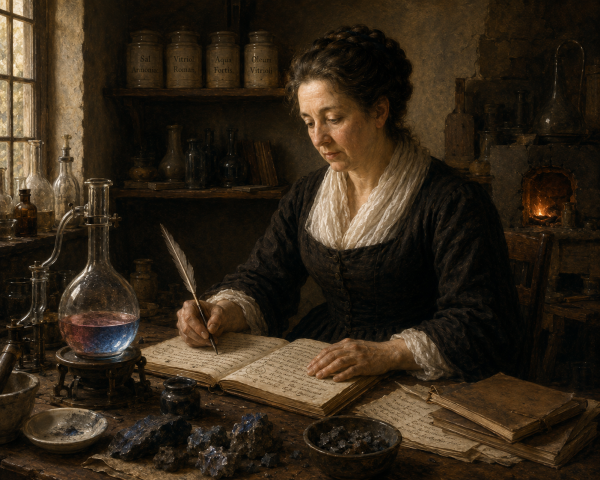
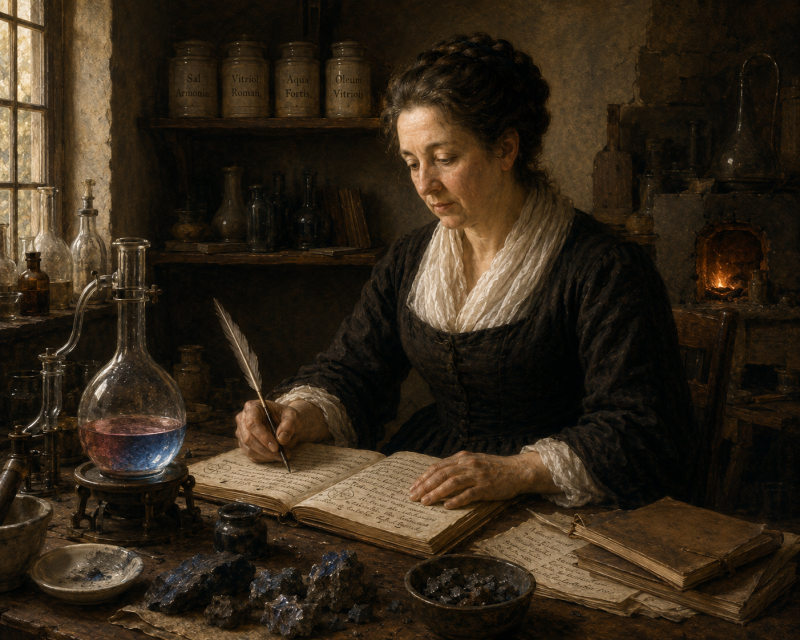
Featured Illustration: Dorothea Juliana Wallich (1657–1725), imagined in her laboratory at Arnstadt, c. 1706. One of the most accomplished female chymists of early modern Europe, Wallich united practical laboratory experience with a profound Böhmian vision of nature. Owner of a cobalt-silver mine in the Ore Mountains and author of three substantial alchemical treatises, she pursued the Universal Tincture through experiment, observation, and prayer.
Although her quest for the Philosopher’s Stone ended in obscurity and poverty, her careful descriptions of cobalt compounds contain the earliest recorded observation of the thermochromic behaviour of cobalt chloride.
This symbolic portrait is an editorial reconstruction inspired by the archival research of Alexander Kraft and the historical context of Pathways to the Universal Tincture (Rubedo Press, 2025).
*
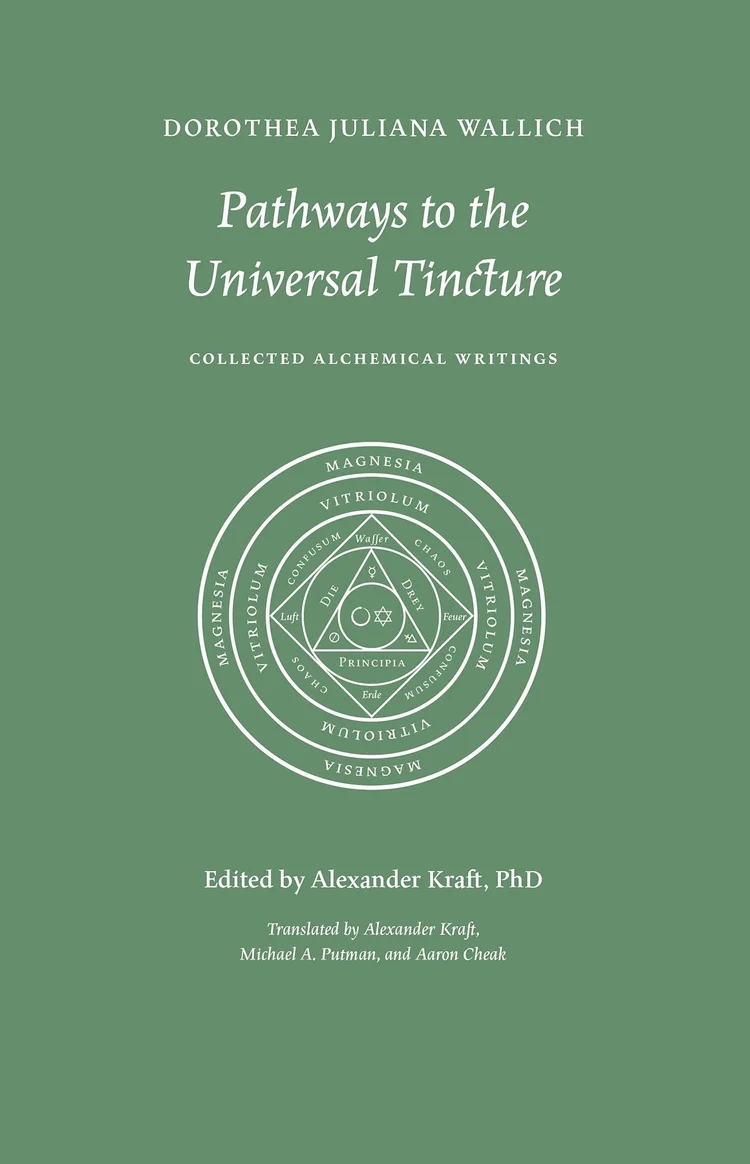
Today’s sharing from the Blue House of Via-HYGEIA is our review of a new 704-page dual-language edition from Rubedo Press—Pathways to the Universal Tincture, translated and edited by Alexander Kraft with scholarly commentary by Kraft, Michael A. Putman, and Aaron Cheak.
This landmark volume is devoted to Dorothea Juliana Wallich (1657–1725), who stands as one of the most extensively documented female alchemists of early modern Europe.
This new edition brings her three alchemical treatises into English for the first time, on the 300th anniversary of her death. Our article blends a review of that publication with the biographical and technical reconstruction made possible by a decade of Kraft’s archival research in the Thuringian State Archives.
Wallich was not merely a literary alchemist: she owned a cobalt-silver mine in the Ore Mountains, discovered the ligand-exchange thermochromism of cobalt chloride, operated laboratories at three German princely courts (Arnstadt, Düsseldorf, Coburg), and maintained a documented friendship with Georg Ernst Stahl.
Her life traces the arc from provincial privilege through experimental ambition to impoverished obscurity—a trajectory that illuminates both the possibilities and the perilous limits of female scientific agency in the German Baroque.
The three treatises themselves constitute a deliberate curriculum: the first a workshop manual, the second a theological cosmology, the third a catechetical key. Together they form one of the most complete, coherent, and openly written alchemical systems in the German tradition—and, inadvertently, the first recorded scientific observation of cobalt thermochromism.
To honor this rediscovery, we offer below a retelling of her life in her own voice, reconstructed from her writings and the archives.
*
A First-Person Retelling
by Dorothea Juliana Wallich
I died on a cold February morning in 1725. The church register in Arnstadt recorded my passing with a brutal, clerical brevity: “Eine arme Frau, Dorothea Wallichin, eine Secret. Wittwe ist frühe hinaus getragen worden”—a poor woman, a secretary’s widow, was carried out early. The church demanded no payment for my burial, “weil nichts da war”—because there was nothing.
Nothing. After everything I had been.
I was sixty-seven years old. I had boiled mixtures until my hands were scarred, inhaled corrosive fumes that left me bedridden and convulsing for fourteen days, and spent the last of my fortune on furnaces, glass vessels, and the fleeting promises of princes. I died in impoverished obscurity, my reputation in tatters, my marriage broken, my life’s work dismissed by the learned men of my age as the delusions of a misguided woman.
For three hundred years, I slept in the dust of the Thuringian archives. I was a footnote, a myth, a ghost. The learned men of the 18th century could not reconcile a woman’s name with such complex chemistry, so they invented a “Baronesse von Clermont” to claim my work. They preferred a fictional noblewoman to a real one with soot on her hands. But this is my story. And I have been rediscovered.
I. The Architecture of a Soul
I was born Dorothea Juliana Fischer, baptized in the Stadtkirche of Weimar on August 6, 1657 (Old Style). My father, Heinrich Fischer, was a senior tax collector to the ducal court; my mother, Anna-Catharina, was the daughter of a Lutheran theologian. I was raised in the small, courtly world of Thuringia, but my mind was not meant for the quiet confines of a woman’s station.
I read voraciously. I devoured the Bible, the mystics, and the dense, shadowed texts of the alchemists. I studied the visions of Jakob Boehme until his tripartite universe—the Outer Dark, the Light of Paradise, and the English Heavenly World—became the very architecture of my soul.
At sixteen, I married Johann Wallich, a court secretary thirty-four years of age. We had no children. In the quiet spaces of my marriage, I turned to the fire. But here lay the great contradiction of my life: My mind could traverse the three worlds of Jakob Boehme, yet my hand could not hold a quill to bind a contract without a man’s permission. I would spend my life relying on proxies—first my husband, then the young Johann Ernst Heubel—to be my legal voice. I was a master of the fire, but a minor in the eyes of the law. This was not incidental to my story; it was the wall against which I constantly broke.
II. The Black Iron Man
By the mid-1680s, we had moved to Schneeberg in the Ore Mountains, the heartland of Saxon mining. There, we operated a small cobalt-silver mine called the Dorotheenzeche. It was here, in the place “wo der schwartze eißen mann bricht”—where the black iron man breaks—that my true life began.
I was not a passive investor watching from a parlor. I was in the laboratory. I sought to extract silver from the stubborn, refractory cobalt ores. It was grueling, dangerous work. In this crucible of necessity, I made my first great discovery, though I did not know its true name at the time.
I was working with my bewussten Minera—the mineral I believed held the secret of the Universal Tincture. I dissolved it in aqua fortis, and the solution bloomed into a beautiful rose color. When I added common salt and applied heat, I watched in awe as the liquid shifted: from rose, to sky-blue, to grass-green as the fire intensified. When it cooled, it returned.
I believed the active agent was bismuth. I was wrong. Centuries later, your modern chemists would call it the ligand-exchange thermochromism of cobalt chloride. I had captured the breathing, color-shifting soul of cobalt. I had recorded the first scientific observation of this phenomenon in history, hidden inside a book about the philosopher’s stone.
III. The Three Books
I knew the darkness of alchemical literature. I knew the frustration of reading texts that hid their truths behind endless, deceptive allegories. Driven by a deep compassion for those who would come after me, I resolved to write clearly. I would not take my keys to the grave.
Between 1705 and 1706, under the initials D.I.W., I published my trilogy at Leipzig. I built a curriculum for the diligent seeker:
1. The Workshop: In The Mineral Double Serpent-Staff, I laid out the practical work. I revealed the Long Way of twenty-one operations, and the Short Way of a single month. I warned them away from common mercury and common gold, pointing them to the true matter, the Electrum minerale immaturum. I gave them my most concrete recipe for transmutation, and honestly admitted where the fire bites—where experiments failed to yield gold.
2. The Cathedral: In The Philosophical Pearl-Tree, I mapped the laboratory onto the cosmos. I showed how the alchemical work recapitulates the fall of Lucifer and the redemption of humanity. The roots of the Pearl-Tree are in the dark, bitter mineral world; its blossoms open in the purified, vegetable light of Paradise; its fruits ripen in the heavenly, spiritual realm—the “English World,” which I must clarify for you is not the island of England, but the Engelswelt, the Angel-World of divine light. Without this theology, alchemy is mere chemistry. With it, it is a sacred science.
3. The Treasury: In the Key to the Cabinet of the Secret Treasure-Chamber of Nature, written as over two hundred questions and answers, I left no stone unturned. I gave them the pharmacopoeia for dropsy, epilepsy, and the plague. I gave them the safety warnings born of my own poisoned blood: “These spirits cause convulsions, cold tongue, loose teeth, heart pain…”
“No one before me has written so clearly, openly, and completely,” I declared. And I believed it.
IV. The Courts of Men
But clarity does not guarantee success in the world of men. Together with my proxy Heubel, I carried my particular processes—the partial transmutation of silver into gold—to the courts of princes.
In Arnstadt: To Graf Anton Günther II. The furnaces were unsuitable, the aqua fortis too sharp, and I failed to produce the required gold.
In Düsseldorf: To the Elector Johann Wilhelm. I demanded a massive fee and half the profits. The project collapsed, and I bitterly complained that false spirits and false prophets had led the Elector astray.
In Coburg: To Duke Ernst Ludwig I. At his hunting lodge, Lauterburg, the preliminary demonstration was a triumph! The observers were completely satisfied; we produced even more gold than I had promised. The Duke financed a grand laboratory, his eyes bright with the vision of endless wealth.
But when the time came for the large-scale run, the fire failed. I watched the great furnace cool, the crucible yielding nothing but slag and silence. The air in the hall grew heavy, not with the smell of sulfur, but with the scent of ruined pride. Suspicion poisoned the room instantly. Whispers spread that I, a woman, had secretly planted gold in the small crucible to cheat a Duke. Even my proxy, Heubel, lost faith. The Duke kept the affair quiet to save his own reputation, fearing he had been “von einem Weibe aufsetzen lassen”—taken in by a woman. My sex was the solvent in which my failure dissolved; had I been a man, it would have been a technical error. As a woman, it was a deception.
The great Georg Ernst Stahl, who had known me since Weimar—who had stood by me as I was godmother to his daughter—later wrote of me. He praised my empirical skill, saying I possessed more experience in chymical matters than a great number of profound men. But he was blunt about my ultimate failure: “Mit der Alchymia adepta ist sie gewiß nicht zu Rande gekommen.” I certainly never achieved the alchemical adepta. I never made the Universal Tincture.
V. The Redemption of Memory
After 1710, I was destitute. I sold processes to a dwindling clientele. I died a pauper. Or so the world thought.
I was forgotten by the men who built the institutions of modern chemistry, but I was not forgotten by the earth, nor by the ink on my pages.
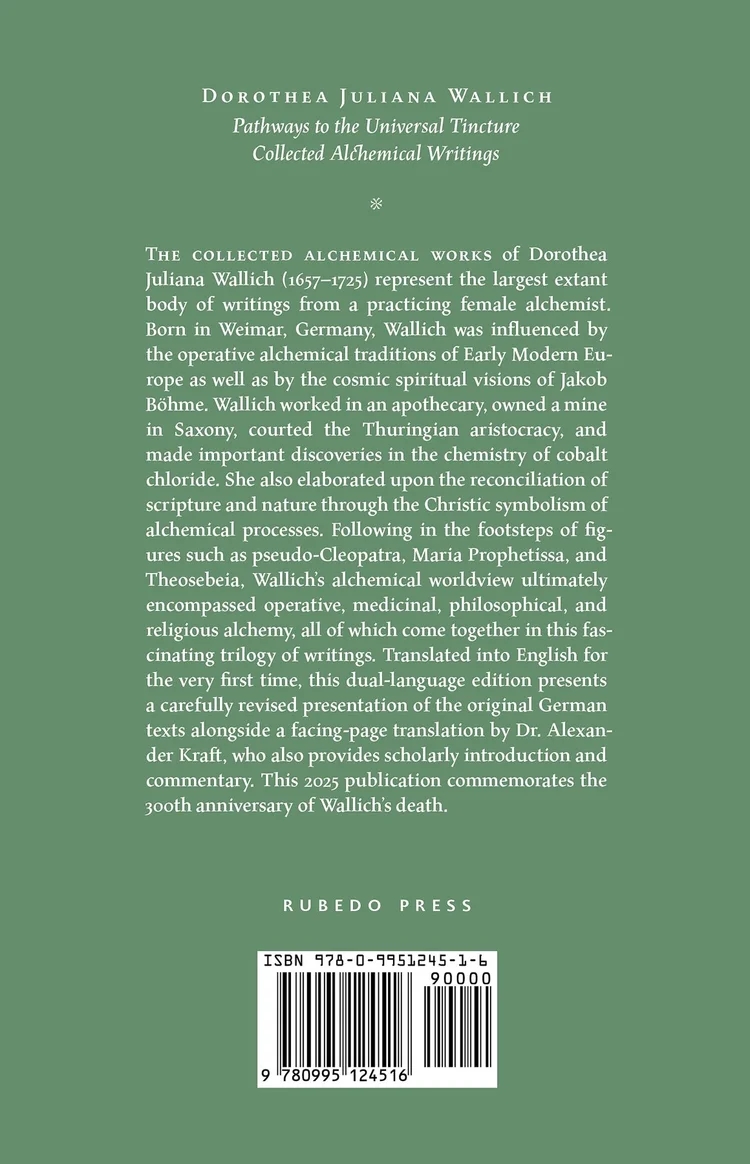
Three centuries later, a scholar named Alexander Kraft descended into the Thuringian State Archives. He dug through the contracts, the letters, the church registers. He reconstructed my life. He proved that I was not a myth, but a woman of flesh, fire, and intellect. He translated my words into English, and in 2025, the Rubedo Press—named for the ultimate reddening of the alchemical work—published Pathways to the Universal Tincture.
Kraft and his colleagues revealed to the modern world what I had always known: my pathways to the Universal Tincture were illusory, but the pathways to cobalt chemistry I inadvertently opened were real. My observations of thermochromism would go on to shape moisture indicators, porcelain chemistry, and modern analytical science. My books were alchemical in intent, but chemical in content.
I sought the redemption of metals, but I achieved the redemption of my own memory.
I was a woman who bled, burned, and poisoned herself in the laboratory. I was a woman who was broken by the courts of men and buried without a coin to her name. But I wrote out of compassion, so that my diligent co-workers might reach the place they had long wished to go.
Now, my voice cries out loudly at last. I speak to you from the other side of the centuries, from the ashes of the Arnstadt poorhouse to the vivid reality of the printed page.
“Be silent, little book, against the unworthy; but cry out loudly against all who are worthy! Yes, proclaim with trumpets: Whoever understands me will be Plato and Aesculapius.”
I am Dorothea Juliana Wallich.
I have returned.
And the fire is still burning.
*
Praise For The Rubedo Press Edition:
Scholarly Apparatus & Translation
Pathways to the Universal Tincture is a landmark publication. The dual-language format presents a carefully revised presentation of the original German texts alongside a facing-page translation by Dr. Alexander Kraft, who also provides scholarly introduction and commentary. Kraft is a chemist and historian of chemistry from Germany, holding a doctorate from Humboldt University in Berlin—a perfect combination of scientific and historical expertise for this project.
Rubedo Press itself is aptly named. RUBEDO, “red, reddening,” is the ultimate stage of the alchemical process; the culminating chromatic shift that marks the visible realisation of primordial flawlessness. The press is “consecrated to works that unfold in this spirit; works that crystallise the invisible into vivid realities.” This edition embodies that mission: bringing Wallich’s invisible legacy into vivid reality for English-speaking readers.
The volume is substantial—704 pages—and meticulously produced. It includes scholarly introduction and commentary by Kraft, Michael A. Putman, and Aaron Cheak, making Wallich’s texts accessible not only to practitioners but also to historians of science, esotericism, and gender studies.
The editorial apparatus is particularly valuable for decoding Wallich’s decknamen (code names), identifying her biblical and Boehmian allusions, and reconstructing the chemical processes embedded in her allegorical prose.
For the historian, the archival appendices—transcriptions of contracts, letters, and Stahl’s correspondence—allow the reader to trace where text and historical event diverge.
*
Bibliography
Primary Sources
- Wallich, D.I.W. Das Mineralische Gluten, Doppelter Schlangen-Stab, Mercurius Philosophorum, Langer und kurtzer Weg zur Universal-Tinctur. Leipzig: Magdalena Heinich, 1705.
- ———. Der Philosophische Perl-Baum. Das Gewächse der drey Principien, zu Deutlicher Erklärung des Steins der Weisen. Leipzig: Magdalena Heinich, 1705.
- ———. Schlüssel zu dem Cabinet der geheimen Schatz-Kammer der Natur, zur Such und Findung des Steins der Weisen, durch Fragen und Antworten gestellet. Leipzig: Magdalena Heinich, 1706.
- Stahl, Georg Ernst. Zufällige Gedanken und nützliche Bedencken über den Streit, von dem sogenannten Sulphure. Halle/Saale, 1718.
- Stahl, Georg Ernst. Letter to Johann Friedrich Henckel, 27 November 1728. In: Mineralogische, Chemische und Alchymistische Briefe von reisenden und anderen Gelehrten an den ehemaligen Chursächsischen Bergrath J.F. Henckel, Dritter Theil. Dresden, 1795. Pp. 99–100.
- Gesner, Johann Albrecht. Historia cadmiae fossilis metallicae sive cobalti et ex illo praeparatorum. Berlin, 1744.
- Hellot, Jean. “Sur une nouvelle encre simpatique.” Histoire de l’Académie Royale des Sciences 39 (1737): 54–58.
- Teichmeyer, Hermann Friedrich. “Jena.” Neue Zeitungen von Gelehrten Sachen, Leipzig, 28 March 1737, pp. 217–218.
Archival Sources
- Landesarchiv Thüringen – Staatsarchiv Gotha: GhA E XI Nr. 94, 95, 96; GhA XV B 21/2.
- Landesarchiv Thüringen – Staatsarchiv Meiningen: GhA XV B 21/2, Bl. 19.
- Landesarchiv Thüringen – Staatsarchiv Rudolstadt: 5-33-2230, 046, 1. Mappe.
- Kirchenbuch Weimarer Stadtkirche: Taufeintrag, August 1657; Trauung, 1 March 1674; Taufeintrag Susanna Dorothea Stahl, August 1690.
- Kirchenbuch Arnstadt Stadtkirche: Beerdigungen 1704–1748, p. 478 (25 February 1725).
- Bayerische Staatsbibliothek München: Signatur Alch. 114.
- Wellcome Collection, London: Archives and manuscripts under “Wallich, Dorothea Juliana” and “D.I.W., von Weimar aus Thüringen.”
Secondary Sources
- Anders, Jette. “D.I.W. – Dorothea Juliana Wallich (17.–18. Jahrhundert).” In 33 Alchemistinnen. Die verborgene Seite einer alten Wissenschaft, edited by Jette Anders, 182–188. Berlin, 2016.
- Kraft, Alexander. “Dorothea Juliana Wallich, geb. Fischer (1657–1725), eine Alchemistin aus Thüringen.” Deutsche Zeitschrift für Familienkunde 66 (2017): 539–555.
- Kraft, Alexander. “Maria Rosina Hilgund (1663–1691) aus Jena, die erste Ehefrau des Arztes und Chemikers Georg Ernst Stahl (1659–1734).” Zeitschrift für Mitteldeutsche Familiengeschichte 59 (2018): 291–302.
- Kraft, Alexander. “Dorothea Juliana Wallich (1657–1725) and Her Contributions to the Chymical Knowledge about the Element Cobalt.” In Women in Their Element, edited by Annette Lykknes and Brigitte van Tiggelen, 57–69. Singapore: World Scientific, 2019.
- Kraft, Alexander. “Die Alchemistin Dorothea Juliana Wallich in Schneeberg.” ResearchGate, 2020.
- Kraft, Alexander. “‘Ich weiß, daß ihrer sehr viele durch Lesen und Arbeiten meiner Schriften glückselig werden, und, wenn ich lange verfaulet, mich erst rühmen und loben werden.’ Dorothea Juliana Wallich (1657–1725), eine Alchemistin aus Thüringen.” Mitteilungen der Fachgruppe Geschichte der Chemie der GDCh 27 (2023): 3–21.
- Kraft, Alexander, ed. and trans. Pathways to the Universal Tincture: Collected Alchemical Writings by Dorothea Juliana Wallich. Rubedo Press, 2025.
- Mönnich, Ulrike. Frauenschutz vor riskanten Geschäften. Interzessionsverbote nach dem Velleianischen Senatsbeschluss. Cologne, 1999.
*
Source
*
Dorotha Juliana Wallich’s
Original Trilogy:
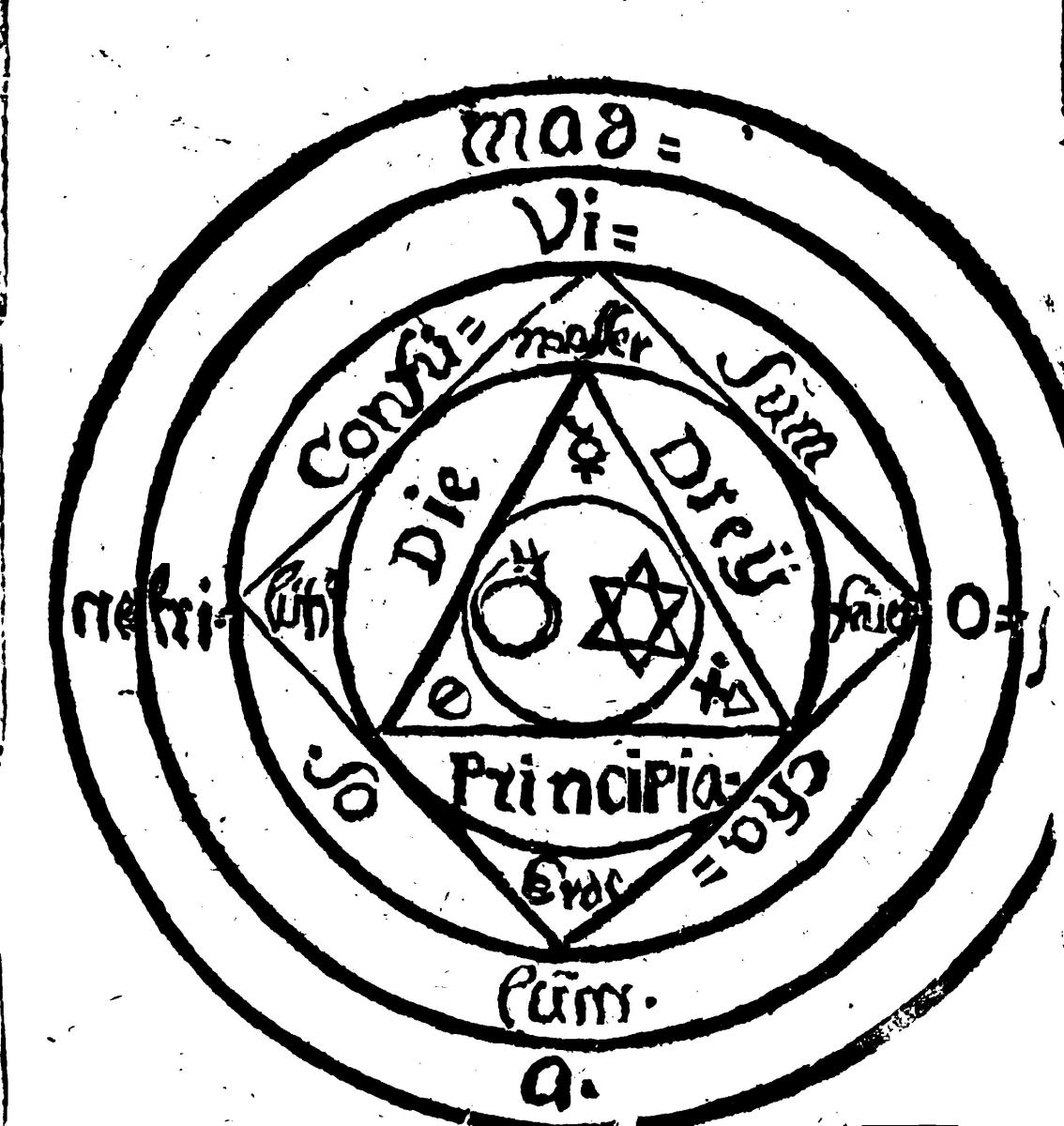
- Das mineralische Gluten, doppelter Schlangen-Stab, Mercurius Philosophorum (The mineral gluten, double serpent staff, Mercurius Philosophorum) (1705)
- Der Philosophische Perl-Baum: das Gewächse der drey Prinzipien (The Philosophical Pearl Tree: the plant of the three principles) (1722)
- Schlüssel zu dem Cabinet der geheimen Schatz-Cammer der Natur (Key to the cabinet of the secret treasure chamber of nature) (1722)
*
APPENDIX
Alchemists Whose Chemical Discoveries
Survived Their Alchemical Quest
The boundary between alchemy and chemistry is not a line but a gradient. The figures gathered here all pursued the philosopher’s stone, the elixir of life, or the transmutation of base metals into gold—and failed in those quests. Yet in the furnace-smoke of their laboratories, they stumbled upon genuine chemical facts, processes, or substances that entered the permanent record of science. They are remembered not for the gold they never made, but for the chemistry they inadvertently revealed. This catalogue is arranged by the magnitude of their chemical legacy, then by chronology and cultural sphere.
*
I. The Ur-Examples: Discoveries of
Elements and Fundamental Processes
1. Jabir ibn Hayyan (Geber) — c. 721–815
Alchemical Quest: The philosopher’s stone; transmutation of metals; the elixir of life.
Chemical Legacy:Sulfuric acid, nitric acid, aqua regia, hydrochloric acid, crystallization, distillation (the alembic), sublimation, calcination, evaporation, filtration, oxidation, reduction, amalgamation, the systematic classification of chemical substances, and the sulfur-mercury theory of metals.
Jabir (or the Jabirian school that wrote under his name) is the foundational figure. The corpus attributed to him contains the oldest known systematic classification of chemical substances and the oldest instructions for deriving an inorganic compound (sal ammoniac) from organic matter. He devised the alembic and established the experimental methodology that would define chemistry for a millennium. His sulfur-mercury theory of metals dominated metallurgical thought until the 18th century. The word “gibberish” may derive from his name, so cryptic were his alchemical writings—yet his chemical procedures were lucid and reproducible. He is remembered as the “Father of Arab Chemistry” and, by extension, one of the fathers of chemistry itself. Sources: Kitab al-Kimya, Kitab al-Sabe’en, Kutub al-Mawazin, the Corpus Jabirianum.
2. Hennig Brand — c. 1630–c. 1692/1710
Alchemical Quest: The philosopher’s stone; transmutation of base metals into gold.
Chemical Legacy: The first recorded isolation of a chemical element not known to the ancients: phosphorus (P, 1669).
Brand, a German alchemist and former military officer in Hamburg, spent his fortune on the search for gold. Acting on the belief that human urine—”the golden stream”—might contain the concentrated essence of gold, he boiled down 1,500 gallons of urine into a thick paste, heated it with sand in a retort, and obtained instead a white, waxy substance that glowed pale green in the dark and burst into flame on contact with air. He named it phosphorus (Greek: phosphoros, “light-bearer”). He kept the process secret for six years, then sold it. His discovery was independently replicated by Johann Kunckel and Robert Boyle. Brand never found the philosopher’s stone, but he opened the field of phosphorus chemistry—essential to life (DNA, RNA, ATP), agriculture, and industry. Sources: Documentation by Johann Daniel Kraft, Ambrose Godfrey-Hanckwitz, and Robert Boyle.
3. Johann Kunckel — 1630–1703
Alchemical Quest: The philosopher’s stone; transmutation; gold-making.
Chemical Legacy: Independent rediscovery of phosphorus (1678); invention of ruby glass (gold-ruby glass, Rubinglas); development of phosphorus-based theatrical effects and medicinal preparations.
Kunckel, a German glassmaker and alchemist, replicated Brand’s phosphorus process independently. He also discovered that colloidal gold, when incorporated into glass, produced a brilliant ruby colour—a technique that became the foundation of the Bohemian and Saxon glass industries. His Ars Vitraria Experimentalis (1679) is a classic of early chemical technology. Like Brand, he died without achieving the stone, but his phosphorus and glass chemistry survived him.
4. Johann Friedrich Böttger — 1682–1719
Alchemical Quest: Transmutation of base metals into gold for Augustus the Strong, Elector of Saxony.
Chemical Legacy:The invention of European hard-paste porcelain (1708–1709)—the “white gold” of the Baroque.
Böttger was an apothecary’s apprentice who claimed to have discovered the philosopher’s stone. Imprisoned by Augustus the Strong to produce gold, he instead—under the supervision of Ehrenfried Walther von Tschirnhaus—developed a formula for kaolin-based hard-paste porcelain that rivalled Chinese imports. The Meissen manufactory (established 1710) became the first European porcelain factory. Böttger never made gold, but he made “white gold,” establishing a ceramic chemistry that transformed European material culture.
5. Albertus Magnus — c. 1200–1280
Alchemical Quest: The philosopher’s stone; transmutation; occult properties of stones and minerals.
Chemical Legacy: Credited with the isolation of the element arsenic (As); experimentation with photosensitive silver salts (silver nitrate); systematic mineralogy.
The Dominican friar and bishop of Regensburg wrote the De Mineralibus. While many alchemical texts were falsely attributed to him after his death, his authentic work includes empirical observations on minerals and metals. He is credited with isolating arsenic as a distinct element and with early experiments on the light-sensitivity of silver compounds—foreshadowing photography by seven centuries. He is remembered as a saint, a scholastic philosopher, and a pioneer of chemical mineralogy.
*
II. The Theorists: Frameworks
That Outlived Their Foundations
6. Georg Ernst Stahl — 1659–1734
Alchemical Quest: A practising alchemist who corresponded with miners, assayers, and transmutational experimenters; godfather to Dorothea Juliana Wallich’s alchemical ambitions.
Chemical Legacy: The phlogiston theory (1703–1731)—the dominant explanatory framework of 18th-century chemistry.
Stahl, personal physician to the Duke of Weimar, was deeply embedded in the alchemical economy of the German Baroque. He knew Wallich, praised her empirical skill, and dismissed her transmutational hopes. Yet his own theoretical contribution—the phlogiston theory, which held that all combustible materials contained a fire-like element released during burning—structured chemical inquiry for nearly a century. Though wrong, it was productive: it organized the data of combustion and calcination until Lavoisier’s oxygen theory superseded it. Stahl is remembered as a chemist and the founder of German medical chemistry. Sources: Zufällige Gedanken (1718); Fundamenta Chymiae (1723).
7. Jan Baptist van Helmont — 1579–1644
Alchemical Quest: The philosopher’s stone; the alchemical elixir; transmutation.
Chemical Legacy: Coined the term “gas” (from chaos); identified carbon dioxide (gas sylvestre) as a distinct substance; pioneered quantitative experimental methods in chemistry.
The Flemish physician and alchemist conducted meticulous quantitative experiments, demonstrating that the mass increase in growing plants came from water, not soil. He produced and collected gases from fermentation and combustion, recognizing them as distinct from air. His Ortus Medicinae (1648) is a founding text of iatrochemistry and pneumatic chemistry. He is remembered as a physiologist and chemist, not as a gold-maker.
8. Robert Boyle — 1627–1691
Alchemical Quest: Deeply committed alchemist who sought the philosopher’s stone; wrote more on alchemy than on the gas law.
Chemical Legacy: Boyle’s Law (PV = constant, 1662); the vacuum pump; systematic chemical analysis; The Sceptical Chymist (1661), which redefined “element” as a substance that cannot be decomposed by chemical means.
Boyle is the paradigmatic case of the alchemist-chemist. He was taught chemistry specifically to pursue the stone and believed in the possibility of metallic growth. Yet his rigorous experimental method, his definition of the chemical element, and his law of gas pressure are the foundations of modern chemistry. He is remembered as the “father of modern chemistry” and the founder of the scientific method in chemical inquiry. Sources: The Sceptical Chymist (1661); Alchemical notebooks (Principe & Newman, 2002).
*
III. The Precursors:
Oxygen, Chlorine, and the Invisible Elements
9. Michael Sendivogius (Michał Sędziwój) — 1566–1636
Alchemical Quest: The philosopher’s stone; transmutation; the alchemical elixir.
Chemical Legacy:Credited with the first laboratory isolation of oxygen (c. 1600), decades before Priestley and Scheele.
The Polish alchemist described a “nourishing spirit of the air” (spiritus vitae) essential for combustion and respiration. His Novum Lumen Chymicum (1604) contains descriptions of what modern historians identify as oxygen. He is remembered as a pioneer of pneumatic chemistry.
10. John Mayow — 1641–1679
Alchemical Quest: Worked within the chymical tradition; sought the secrets of respiration and combustion.
Chemical Legacy: Identified a component of air (“nitro-aerial spirit”) essential for combustion and respiration—an oxygen precursor; established the connection between respiration and combustion.
The English physician conducted experiments showing that both candles and mice consume the same “nitro-aerial spirit” in a closed container. His Tractatus Quinque Medico-Physici (1674) is a founding text of respiratory physiology.
11. Carl Wilhelm Scheele — 1742–1786
Alchemical Quest:Trained as an apothecary; worked within the chymical tradition; believed in phlogiston.
Chemical Legacy:Discovered oxygen (independently, 1771–1772); chlorine (1774); manganese, barium, molybdenum, tungsten; hydrogen fluoride; numerous organic acids.
Scheele, a Swedish-German pharmaceutical chemist, made more independent chemical discoveries than any other single individual in history. He discovered oxygen (“fire air”) two years before Priestley but published after him. Though he worked within the phlogiston tradition, his empirical discoveries are the bedrock of modern inorganic and organic chemistry. He is remembered as one of the greatest experimental chemists of all time.
*
IV. The Compounds and Processes:
Salts, Acids, and Apparatus
12. Johann Rudolf Glauber — 1604–1670
Alchemical Quest: The philosopher’s stone; transmutation; the elixir of life.
Chemical Legacy:Discovered Glauber’s salt (sodium sulfate decahydrate); developed large-scale chemical manufacturing processes; pioneered the use of mineral acids in industrial chemistry.
The German-Dutch alchemist operated one of the first chemical manufacturing plants in Europe. His Furni Novi Philosophici (1646–1648) describes the construction of furnaces and the large-scale production of chemicals. Glauber’s salt is still used in medicine and industry. He is remembered as an industrial chemist and the father of chemical manufacturing.
13. Basil Valentine (prob. Johann Thölde, c. 1565–1624)
Alchemical Quest: The philosopher’s stone; transmutation; the alchemical elixir.
Chemical Legacy: The Currus Triumphalis Antimonii (1604) established antimony and its compounds as major subjects of chemical and medical inquiry; described the preparation of antimony trichloride (butter of antimony); pioneered the use of antimony in medicine.
Whether a real monk or a pseudonym, the impact is the same: the systematic chemical and medical study of antimony. His work inspired generations of iatrochemists. He is remembered as the “father of antimony chemistry.”
14. Johann Conrad Dippel — 1673–1734
Alchemical Quest: The philosopher’s stone; transmutation; the elixir of life; the homunculus.
Chemical Legacy: Dippel’s oil (bone oil, from destructive distillation of animal bones—a precursor to modern organic chemistry); Prussian blue (ferric ferrocyanide, discovered accidentally in 1706); the first isolation of a nitrogen-containing organic compound from animal matter.
Dippel, a notorious figure of the alchemical underground, worked at Castle Frankenstein. Yet his bone oil became an important industrial chemical, and his accidental role in the discovery of Prussian blue—the first modern synthetic pigment—established the field of coordination chemistry. He is remembered as a chemist and a colourful charlatan.
15. Paracelsus (Theophrastus von Hohenheim) — 1493–1541
Alchemical Quest: The philosopher’s stone; the alchemical elixir; transmutation.
Chemical Legacy: Founded iatrochemistry (chemical medicine); introduced laudanum (tincture of opium); systematic use of mineral remedies; toxicology (“the dose makes the poison”); the Three Principles (Salt, Sulphur, Mercury) as a chemical framework.
The Swiss-German physician revolutionized medicine by shifting it from herbal Galenism to chemical pharmacology. He is remembered as the father of toxicology and iatrochemistry.
16. Al-Razi (Rhazes) — c. 865–925
Alchemical Quest: The philosopher’s stone; transmutation; the elixir of life.
Chemical Legacy:Kitab al-Asrar (The Book of Secrets)—a systematic, practical laboratory manual describing chemical apparatus, reagents, and procedures; classified chemical substances by their properties; described the preparation of sal ammoniac, alum, caustic soda.
The Persian physician directed the Baghdad hospital and wrote over 200 books. His Book of Secrets is a proto-laboratory manual: clear, systematic, and focused on reproducible chemical operations. He is remembered as one of the greatest physicians of the Islamic Golden Age and a pioneer of empirical chemistry.
*
V. The Apparatus and Techniques:
Methods That Outlived Their Masters
17. Maria Prophetissa (Maria the Jewess) — 1st–3rd century CE
Alchemical Quest:The philosopher’s stone; the alchemical elixir.
Chemical Legacy:Invented the bain-marie (double boiler, balneum Mariae); invented the tribikos (three-armed distillation apparatus); described the kerotakis (apparatus for heating substances in closed vessels).
The legendary female alchemist of Hellenistic Egypt is credited with the invention of the most fundamental laboratory apparatus still in use today. The bain-marie is standard equipment in every kitchen and chemical laboratory. She is remembered as the inventor of chemical apparatus. Sources: Zosimos of Panopolis, The Treatise of Instruments and Furnaces (c. 300 CE).
18. Zosimos of Panopolis — c. 300 CE
Alchemical Quest:The philosopher’s stone; the alchemical elixir; spiritual purification through chemical operations.
Chemical Legacy: The earliest systematic descriptions of chemical apparatus and processes: distillation, sublimation, filtration, calcination, cohobation; the first known use of the water bath; the earliest alchemical/chemical drawings of apparatus.
The Greco-Egyptian alchemist is the earliest historical figure to whom alchemical writings are attributed. His methods are the foundation of chemical technology. He is remembered as the first systematic chemical technologist.
19. Pseudo-Geber (probably Paul of Taranto, 13th century)
Alchemical Quest: The philosopher’s stone; transmutation; perfection of metals.
Chemical Legacy: Summa Perfectionis — the most influential alchemical textbook of the Middle Ages; the corpuscular theory of matter; the sulfur-mercury theory of metals in its most systematic form; detailed descriptions of fractional distillation, alloying, and metal purification.
His Summa Perfectionis was the “bible of alchemy” for three centuries. Yet its value lies in its practical chemistry: the clearest medieval descriptions of distillation and the corpuscular theory that foreshadowed modern atomic theory. He is remembered as a systematic chemical writer.
*
VI. The Eastern Tradition: Chinese Alchemists
and the Chemistry of Immortality
20. Wei Boyang — 2nd century CE
Alchemical Quest: The elixir of life; immortality; transmutation of cinnabar into gold.
Chemical Legacy: Zhouyi cantong qi (The Kinship of the Three) — the earliest systematic Chinese alchemical text, documenting chemical reactions, the preparation of mercury and lead compounds, and the behavior of metals and minerals under heat.
The legendary Chinese alchemist is credited with the earliest systematic documentation of chemical reactions in the Chinese tradition. He is remembered as the father of Chinese alchemy.
21. Ge Hong (Ko Hung) — 283–343 CE
Alchemical Quest:The elixir of life; immortality; transmutation.
Chemical Legacy: Baopuzi (The Master Who Embraces Simplicity) — the most comprehensive record of early Chinese chemical practice: the preparation of cinnabar, mercury, gold, silver, and lead compounds; the sublimation of arsenic; the earliest known documentation of chemical reactions involving arsenic and mercury.
The Jin Dynasty alchemist and physician documented hundreds of chemical preparations. His work is the primary source for the chemical knowledge of early medieval China. He is remembered as a physician, naturalist, and chemical documentarian.
22. The Anonymous Gunpowder Alchemists — 9th century CE
Alchemical Quest: The elixir of life; immortality.
Chemical Legacy: The accidental discovery of gunpowder (saltpetre, sulfur, charcoal) during experiments to combine sulfur and saltpetre for medicinal elixirs.
The Zhenyuan miaodao yaolüe (c. 850 CE) warns that mixing sulfur, saltpetre, and honey can cause fires and burns—documenting the earliest known gunpowder accidents. These anonymous Tang Dynasty alchemists, seeking immortality, discovered instead the chemistry of combustion that would transform warfare and mining. They are remembered as the inventors of gunpowder.
*
VII. The Borderline Cases:
Chemists Who Were Once Alchemists
23. Isaac Newton — 1643–1727
Alchemical Quest: Devoted more time to alchemy than to physics or mathematics combined; wrote over one million words on alchemical subjects; sought the philosopher’s stone and the “vegetative spirit” of metals.
Chemical Legacy:Extensive alchemical experimentation: the “Tree of Diana” (silver-mercury dendrites), metallic growth patterns, and alloy analysis. While he made no named “discoveries” in the modern sense, his notebooks reveal a sophisticated experimentalist.
Newton is included here as a cautionary example. His chemical work was real and voluminous but is overshadowed by his physics. He is the inverse of the others: remembered for the laws of motion and calculus, not for the alchemy to which he devoted his life. Sources: Alchemical notebooks (decoded by Dobbs and Principe).
24. Dorothea Juliana Wallich — 1657–1725
Alchemical Quest: The Universal Tincture; transmutation of silver into gold; the philosopher’s stone.
Chemical Legacy: The first recorded observation of ligand-exchange thermochromism of cobalt chloride (1706); the identification of cobalt-bismuth-arsenic ores as a distinct chemical system; contributions to the chemistry of cobalt solutions that became foundational for porcelain manufacture (Meissen, 1731), analytical chemistry (Gesner, 1744), and modern dynamic glazing.
Wallich fits the pattern perfectly: three failed princely contracts for gold-making, one genuine chemical observation that entered the scientific literature through Hellot, Teichmeyer, and Gesner. Her legacy was secured in 2025 with the Rubedo Press edition of Pathways to the Universal Tincture. She is remembered as a pioneer of cobalt chemistry, not as a maker of gold.
*
VIII. Summary Table
| Alchemist | Dates | Alchemical Quest |
Chemical Discovery |
Survival |
| Jabir ibn Hayyan | c. 721–815 | Philosopher’s stone | Sulfuric acid, nitric acid, aqua regia, distillation, crystallization, systematic classification | Fundamental to all subsequent chemistry |
| Hennig Brand | c. 1630–c. 1692 | Philosopher’s stone | Phosphorus (P, 1669) | Essential to life, agriculture, industry |
| Johann Kunckel | 1630–1703 | Philosopher’s stone | Phosphorus (independent, 1678); ruby glass | Glass industry, phosphorus chemistry |
| Johann F. Böttger | 1682–1719 | Gold for Augustus | European hard-paste porcelain (1708–1709) | Ceramic chemistry, material culture |
| Albertus Magnus | c. 1200–1280 | Philosopher’s stone | Arsenic (As); photosensitive silver salts | Toxicology, mineralogy, photography (precursor) |
| Georg Ernst Stahl | 1659–1734 | Transmutation | Phlogiston theory (1703–1731) | Organized 18th-century chemistry |
| Jan B. van Helmont | 1579–1644 | Philosopher’s stone | Gas (term); CO₂; quantitative methods | Pneumatic chemistry, plant physiology |
| Robert Boyle | 1627–1691 | Philosopher’s stone | Boyle’s Law; vacuum pump; element definition | Foundation of modern chemistry |
| Michael Sendivogius | 1566–1636 | Philosopher’s stone | Oxygen precursor (c. 1600) | Respiration, combustion chemistry |
| John Mayow | 1641–1679 | Chymical secrets | Oxygen precursor (nitro-aerial spirit, 1674) | Respiratory physiology |
| C.W. Scheele | 1742–1786 | Phlogiston, elixir | Oxygen, chlorine, manganese, barium, etc. | Modern inorganic/organic chemistry |
| J.R. Glauber | 1604–1670 | Philosopher’s stone | Glauber’s salt (Na₂SO₄·10H₂O); industrial chemistry | Chemical manufacturing, detergents, medicine |
| Basil Valentine | c. 1565–1624 | Philosopher’s stone | Antimony chemistry; butter of antimony | Pharmaceutical chemistry |
| J.C. Dippel | 1673–1734 | Philosopher’s stone, homunculus | Dippel’s oil; Prussian blue (precursor) | Organic chemistry, pigment industry |
| Paracelsus | 1493–1541 | Philosopher’s stone | Iatrochemistry, laudanum, toxicology | Medical chemistry, pharmacology |
| Al-Razi (Rhazes) | c. 865–925 | Philosopher’s stone | Kitab al-Asrar; systematic chemical operations | Empirical chemistry, laboratory manual |
| Maria Prophetissa | 1st–3rd c. | Philosopher’s stone | Bain-marie, tribikos | Standard laboratory apparatus |
| Zosimos | c. 300 CE | Spiritual alchemy | Systematic chemical apparatus descriptions | Chemical technology |
| Pseudo-Geber | 13th c. | Philosopher’s stone | Summa Perfectionis; corpuscular theory | Medieval chemical technology, atomic precursor |
| Wei Boyang | 2nd c. CE | Elixir of life | Zhouyi cantong qi; documented chemical reactions | Chinese chemical documentation |
| Ge Hong | 283–343 | Elixir of life | Baopuzi; mercury, arsenic, cinnabar chemistry | Chinese medicine and chemistry |
| Gunpowder Alchemists | 9th c. | Elixir of life | Gunpowder (accidental, c. 850) | Explosives, mining, warfare |
| Isaac Newton | 1643–1727 | Philosopher’s stone | Alchemical notebooks; alloy analysis | Physics, calculus (chemistry overshadowed) |
| D.J. Wallich | 1657–1725 | Universal Tincture | Cobalt thermochromism (1706) | Porcelain, analytical chemistry, glazing |
*
IX. CONCLUSION:
The Pattern
The pattern is consistent across cultures and centuries. The alchemist seeks gold and finds phosphorus. Seeks immortality and finds gunpowder. Seeks the stone and finds the gas laws. Seeks transmutation and finds porcelain.
The alchemical quest was impossible; the chemical quest was inevitable. These figures are the bridge between the impossible and the inevitable—remembered not for the dreams that drove them, but for the facts they left behind.
-Sources include the Oxford Dictionary of National Biography, the Dictionary of Scientific Biography, William R. Newman and Lawrence M. Principe’s Alchemy Tried in the Fire (2002), Alexander Kraft’s research on Dorothea Juliana Wallich (2017–2025), and the primary alchemical texts cited above-
***
Leave a Reply