
Circle of Transmission: The Living Loom
Return to the Root: An Annotated Reading of the Xiuzhen Baochuan
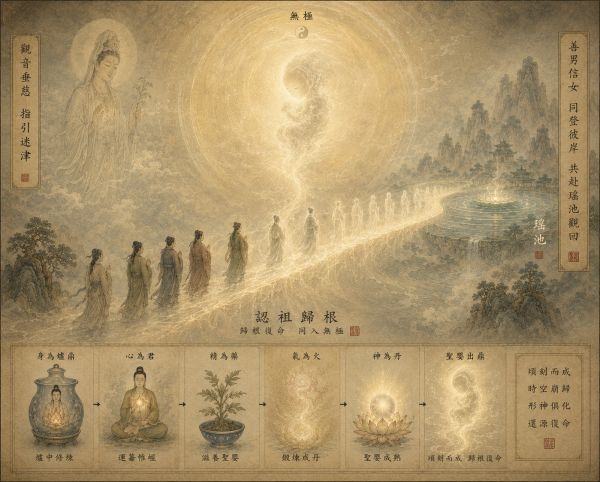
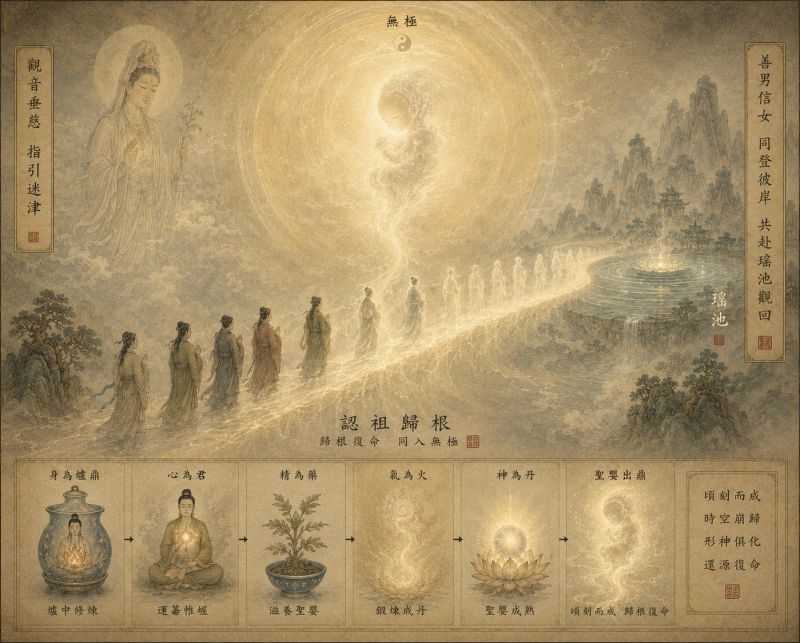
Featured illustration: The Return to the Root (歸根). At the culmination of the Xiuzhen Baochuan‘s inner alchemical journey, the Holy Infant (Shengying 聖嬰)—conceived within the crucible of the body, nourished by Essence, refined by Qi, and perfected as Shen—steps free of the vessel. Yet this is not a departure but a recognition: the recovered primordial spirit remembers its own origin and returns to the Limitless (Wuji 無極) from which it has never truly been separate. The luminous bridge is the Heavenly Bridge (Tianqiao 天橋), built by “turning the light back” (huiguang fanzhao 回光返照), while the faithful advance together toward the Jasper Pool (Yaochi 瑤池), the abode of the Golden Mother. The Holy Infant gradually dissolves into the boundless radiance, revealing that the Great Return is neither a voyage through space nor a reward after death, but the quiet recovery of the Original Nature—the moment when the cosmos remembers its own Source through the awakened heart.
*
Today’s sharing from the Blue House of Via-HYGEIA presents the seventh installment of our annotated reading of the Xiuzhen Baochuan (Precious Transmission of Cultivating Reality), a late imperial Chinese spiritual text of the neidan (internal alchemy) tradition.
Our focus is the theme of ‘Return to the Root’ (gui gen 歸根), naturally extending our previous publications on Stillness, the body as Alchemical Vessel, the Heart-Mind as Monarch, Essence as Medicinal Herb, Qi as Fire, and Shen as the Elixir. This issue opens new avenues for investigating the text’s synthesis of Buddhist and Daoist technologies of the self at the moment of climax.
We examine the pivotal instant wherein the Holy Infant (shengying 聖嬰)—gestated in the crucible of the body and nurtured by the fire-timing of the heart-mind—steps free of the vessel. We trace the recognition of the Ancestor, the construction and crossing of the heavenly bridge, and the collective ascent of the faithful to the Jasper Pool. This is the collapse of time, the shattering of the vessel, and the emergence of the immortal body.
In our next issue, we will explore ‘Uniting with the Dao and Returning to the Mother’ (he dao gui mu 合道歸母), investigating the final dissolution of the Holy Infant into the Limitless Womb (Wuji), where the individual spirit merges eternally with the Golden Mother, completing the cosmic cycle.
**
Introduction
to the Seventh Installment
In our previous six installments, we traced the alchemical arc from its foundations to its culmination:
- Stillness — The preparatory foundation
- Body as Alchemical Vessel — The crucible
- Heart-Mind as Monarch — The directing intent
- Essence as Medicinal Herb — The raw material
- Qi as Fire — The transformative agent
- Shen as Elixir — The refined product
We now arrive at the pivotal moment of transcendence itself—the instant when the Holy Infant, having been gestated in the crucible of the body and nurtured through the fire-timing of the heart-mind, steps free of the vessel. This is the Return to the Root (gui gen 歸根): the recognition of the Ancestor, the crossing of the heavenly bridge, and the ascent to the other shore.
The Xiuzhen Baochuan presents this moment not as a gradual achievement but as an instantaneous breakthrough (qingke er cheng 頃刻而成)—the collapse of time, the shattering of the vessel, and the emergence of the immortal body. The following four selections trace this climactic event from its preparation through its consummation.
THE FOUR SELECTIONS
Excerpt 1:
The Recognition of the Ancestor and the Ascent
Location: Page 8, right half, lines 7–12 (within Guanyin’s speech to Liu Suzhen)
Original Text: 認祖歸根。善男信女。同登彼岸。共赴瑤池觀回。
Pinyin: Rèn zǔ guī gēn. Shàn nán xìn nǚ. Tóng dēng bǐ àn. Gòng fù yáo chí guān huí.
Translation: Recognize the Ancestor and return to the Root. Good men and faithful women together ascend to the other shore. Together they journey to the Jasper Pool to see the return.
Critical Apparatus: This passage appears in the middle of the right-hand page, within a speech attributed to Guanyin. The text is clean, with no significant corruption. The four-phrase structure is metrically regular and thematically complete.
Exegesis: This is the summary verse of the entire Xiuzhen Baochuan’s soteriological program. The four phrases move from internal recognition to communal destiny to final absorption.
“Recognize the Ancestor and return to the Root” (ren zu gui gen 認祖歸根) is the concise formulation of the entire alchemical project. “Recognizing the Ancestor” is not an external act of worship but an inner recognition: the practitioner realizes that the Holy Infant born from the crucible is not a new acquisition but the original face (benlai mianmu 本來面目)—the prenatal spirit (yuanshen 元神) that existed before the descent into the red dust. “Returning to the Root” is the reversal of the cosmogonic process: the scattered spirit gathered back into unity, the postnatal consciousness dissolved into the prenatal source.
The “Ancestor” (zu 祖) is not a historical figure but the primordial source of all beings—the Wuji from which all manifestation arises. In the Xiuzhen Baochuan, the Ancestor is synonymous with the Limitless, the Dao, and the original nature of the self. To recognize the Ancestor is to realize one’s own nature as the Dao.
“Good men and faithful women” (shan nan xin nü 善男信女) is the baojuan’s universal address. Unlike some esoteric traditions that restrict the highest teachings to monastics or males, the Xiuzhen Baochuan explicitly includes women as full participants in the alchemical work. The “faithful” (xin 信) are those who have received the transmission and kept the precepts. This is the community of the elect, the spiritual roots that have been gathered in the final harvest.
“Together ascend to the other shore” (tong deng bi an 同登彼岸) borrows the Buddhist metaphor for nirvana and applies it to the alchemical ascent. The “other shore” is the state of liberation—the end of the cycle of birth and death. In alchemical terms, it is the dissolution of the body and the abiding in the unconditioned Wuji. The phrase “together” (tong 同) emphasizes the communal nature of the salvation—the final harvest is not a solitary achievement but a collective return.
“Together journey to the Jasper Pool to see the return” (gong fu yao chi guan hui 共赴瑤池觀回) is the final destination. The Jasper Pool is the residence of the Golden Mother, the primordial feminine source. “To see the return” (guan hui 觀回) is to witness the completion of the cosmic cycle—the moment when the scattered spiritual roots are gathered back, the Holy Infant is absorbed into the Mother, and the Wuji is restored.
Intertextual Parallel: The Amitabha Sutra: The “other shore” (bi’an 彼岸) and the Western Pure Land are direct antecedents of the Xiuzhen Baochuan’s eschatological geography, with the Jasper Pool substituting for Sukhavati and the Golden Mother substituting for Amitabha. The “recognition of the Ancestor” parallels the Pure Land practice of “mindfulness of the Buddha” (nianfo 念佛), here transformed into an alchemical recognition of the inner source.
*
Excerpt 2:
The Methodological Aphorism of the Heavenly Bridge
Location: Page 20, lines 1–4 (within the section on the Holy Infant’s maturation)
Original Text: 回光返照搭天橋
Pinyin: Huí guāng fǎn zhào dā tiān qiáo.
Translation: Turn the light back and shine within, construct the heavenly bridge.
Critical Apparatus: This line appears in the woodblock as a standalone aphorism, visually isolated from the surrounding narrative prose. This formatting is a deliberate convention in late imperial baojuan to highlight key alchemical instructions for memorization and liturgical recitation. While the surrounding text elaborates on the process, this single seven-character line functions as the doctrinal summary of the entire “crossing” phase. The text is clean, with no significant corruption.
Exegesis: Though brief, this aphorism carries the structural weight of a full stanza by compressing the entire Small Heavenly Cycle (xiao zhou tian 小周天) into a single imperative. It links the primary psychological method directly to its physiological consequence.
The first half, “Turn the light back and shine within” (huiguang fanzhao 回光返照), is the central alchemical technique of the Xiuzhen Baochuan. It describes the reversal of the senses: instead of the spirit (shen) scattering outward through the eyes and ears into the “red dust” of the mundane world, it is gathered back (hui) and illuminated (zhao) within the heart-mind. This introversion is the prerequisite for all subsequent alchemical work; without this gathering, the elixir cannot form.
The second half, “construct the heavenly bridge” (da tian qiao 搭天橋), describes the immediate result of this introversion. The “heavenly bridge” is the functional connection between the upper dantian (the Niwan Palace, or upper sea of the brain) and the lower dantian (the field of elixir). In normal physiology, this channel is broken or blocked by discursive thought. By “turning the light back,” the practitioner generates the pressure and clarity necessary to forge this connection, allowing the refined energy to ascend the spinal column and descend the front channel, completing the circuit.
Thus, the line is not merely a description but an instruction: if you turn the light, then the bridge is built. It marks the precise moment when internal cultivation transitions from preparation to active transcendence, allowing the Holy Infant to cross from the mortal vessel to the immortal realm.
Intertextual Parallel: The Secret of the Golden Flower (Taiyi jinhuazong zhi): This text is entirely devoted to the practice of huiguang fanzhao. The Xiuzhen Baochuan adapts this technique but adds the specific imagery of “constructing the bridge” (da tian qiao), emphasizing the structural, architectural nature of the alchemical body over the purely meditative focus of the Golden Flower. This reflects the baojuan’s tendency to visualize salvation as a journey across a constructed path.
*
Excerpt 3:
The Journey of the Return
Location: Page 63, lines 1–6 (within the discourse on cause and effect and the path of return)
Original Text: 一刀斬斷若私塵。福如拾得寶和珍。從今立願修性命。一刀斬斷若私塵。
Pinyin: Yī dāo zhǎn duàn ruò sī chén. Fú rú shí dé bǎo hé zhēn. Cóng jīn lì yuàn xiū xìng mìng. Yī dāo zhǎn duàn ruò sī chén.
Translation: With one knife, cut off the dust of selfhood. Fortune is like picking up treasures and jewels. From now on, establish the vow to cultivate nature and life. With one knife, cut off the dust of selfhood.
Critical Apparatus: This passage appears in the right half, within the speech to the practitioner about the path of return. The repetition of the first line at the end suggests a refrain or couplet structure. In baojuan performance literature, such repetition serves a mnemotechnical function: the reiterated line functions as an auditory anchor, embedding the core instruction in the memory of both reciter and audience. The “one knife” (一刀) that cuts off the dust of selfhood is thus not merely restated but inscribed through rhythmic recurrence, transforming doctrinal assertion into liturgical memory.
Exegesis: This passage describes the decisive act of renunciation that accompanies the return to the Root. The “one knife” (yi dao 一刀) is the sword of wisdom (prajña-khadga) that cuts through all attachments. In Buddhist iconography, this is the sword of Manjusri, the bodhisattva of wisdom, which cuts through ignorance and delusion.
The “dust of selfhood” (si chen 私塵) refers to the “private dust” of personal desire, the individual entanglements that bind the spirit to the red dust. They include fame, profit, love, and all the phenomena that scatter the spiritual root. To cut them off “with one knife” is to sever all bonds in a single, decisive act—the moment of transcendence when the Holy Infant steps free of the crucible and leaves behind all worldly ties.
“Fortune is like picking up treasures and jewels” (fu ru shi de bao he zhen 福如拾得寶和珍) describes the reward of the return. The treasures and jewels are the elixir itself, the accumulated merit of the alchemical work, and the celestial rank granted by the Mother. The simile “like picking up” (ru shi de 如拾得) suggests that the reward is effortless once the attachments have been cut off. The return is not a struggle but a natural consequence of the cultivation.
“From now on, establish the vow to cultivate nature and life” (cong jin li yuan xiu xing ming 從今立願修性命) marks the turning point. Having recognized the Ancestor and returned to the Root, the practitioner establishes a new vow: to cultivate not merely the physical life (ming 命) but the original nature (xing 性). This is the union of nature and life (xingming shuangxiu 性命雙修)—the integration of the prenatal and postnatal, the spirit and the body, the individual and the universal.
Intertextual Parallel: The Heart Sutra: The “one knife” that cuts through all attachments parallels the wisdom (prajña) that “sees all five aggregates as empty.” The vow to cultivate nature and life recalls the neidan integration of nature and life, articulated in texts such as the Wuzhen pian.
*
Excerpt 4:
The Transcendence of the Elixir and the Abiding in the Wuji
Location: Page 66, left half, lines 1–4 (within the section on the Holy Infant’s final state)
Original Text: 從今看破虛花景。消箱針。用火焚了。
Pinyin: Cóng jīn kàn pò xū huā jǐng. Xiāo xiāng zhēn. Yòng huǒ fén le.
Translation: From now on, see through the false flowers and empty scenes. [The dust in the box is] melted; burned away by fire.
-
消箱塵 (xiao xiang chen, “the dust in the box is melted”) — Given the context of “dust” (chen 塵) in previous stanzas (私塵, the dust of selfhood), this emendation is philologically probable. The “box” (xiang 箱) is the crucible-body; the “dust” is the residual selfhood that must be dissolved.
-
消詳真 (xiao xiang zhen, “the truth is carefully examined and dissolved”) — A semantic reading where 詳 (xiang, to examine in detail) replaces 箱. This yields a more abstract, gnoseological sense: the truth itself is dissolved upon examination.
-
銷針 (xiao zhen, “the needle is melted”) — Taking 消 as equivalent to 銷 (xiao, to melt, fuse, or refine by fire), and preserving 針 (zhen, needle). In neidan physiology, the “needle” is a standard metaphor for the concentrated spirit (shen), sharp and pointed, which must be melted back into the universal qi from which it was refined. The Cantong qi tradition speaks of “refining the needle” (lian zhen 煉針) as the final operation before the elixir leaves the vessel. This reading preserves the woodblock character 針 rather than emending it away, and aligns with the immediate context of “burned away by fire” (yong huo fen le 用火焚了).
Exegesis: This passage describes the final state of the practitioner who has achieved the return. Having recognized the Ancestor and crossed the heavenly bridge, the practitioner now “sees through” (kan po 看破) the false flowers and empty scenes of the red dust.
The “false flowers” (xu hua 虛花) and “empty scenes” (jing 景) are the phenomena of the mundane world—the fame, profit, love, and attachment that once ensnared the spiritual root. Now, having returned to the Root, the practitioner sees these phenomena for what they are: empty illusions, flowers that bloom and fade, scenes that have no substance. This is the state of liberation—the freedom from the red dust.
The “[dust] in the box” (xiang chen 箱塵) is a metaphor for the individual spirit that has been stored in the box of the body. The “box” is the crucible, the vessel in which the elixir was refined. The “dust” (or needle) is the spirit, sharp and pointed, that has now been melted and burned away. The “fire” is the alchemical fire that has completed its work—the fire-timing that refined the essence, transformed the energy, and condensed the spirit.
To melt the dust is to dissolve the individual spirit into the universal. The Holy Infant, having stepped free of the crucible, does not remain a separate entity but dissolves into the Wuji. This is the final stage of the return: the disappearance of the individual into the source from which it came.
The phrase “burned away by fire” (yong huo fen le 用火焚了) is the final image of the alchemical process. The fire that once cooked the elixir now consumes the vessel itself. The crucible is shattered, the dust is melted, and the spirit abides in the unconditioned Wuji. This is the completion of the Great Work—the Holy Infant has returned to the Root, the elixir has left the vessel, and the practitioner has recognized the Ancestor to ascend to the other shore.
Intertextual Parallel: The Zhouyi cantong qi: The final stage of the alchemical work is described as the “shattering of the furnace” (po lu 破爐)—the moment when the elixir is complete and the vessel is destroyed. The Xiuzhen Baochuan’s image of the dust melted in the box parallels this classical motif.
*
LEXICON OF KEY CONCEPTS AND WORDS
A. Core Soteriological Terms
| Term | Chinese | Pinyin | Definition |
|---|---|---|---|
| Return to the Root | 歸根 | guī gēn | The reversal of the cosmogonic descent; the gathering of the dispersed spiritual root (linggen) back to its primordial source (Wuji). Soteriologically, it marks the moment the Holy Infant steps free of the crucible and the practitioner recognizes the Ancestor. |
| Recognition of the Ancestor | 認祖 | rèn zǔ | The realization that the Holy Infant is not a new acquisition but the original face (benlai mianmu)—the prenatal spirit existing prior to descent into the red dust. The Ancestor denotes the primordial source (Wuji/Dao) inherent within the self. |
| Holy Infant | 聖嬰 | shèng yīng | The perfected elixir; the embodied spirit that emerges from the crucible at the moment of final transcendence. It is the personification of the recovered prenatal spirit (yuanshen). |
| Heavenly Bridge | 天橋 | tiān qiáo | The passageway connecting the mortal realm to the immortal abode. Physiologically, the channel between dantians; symbolically, the threshold crossed by the Holy Infant to ascend to the other shore. |
| Other Shore | 彼岸 | bǐ àn | A Buddhist metaphor for nirvana adopted as the destination of the alchemical voyage. It denotes the state of liberation and the end of the cycle of birth and death, equated with abiding in the unconditioned Wuji. |
| Crucible | 爐鼎 | lú dǐng | The alchemical vessel, identified as the physical body. It is the site where the Holy Infant is gestated and from which it eventually steps free. |
| Fire | 火 | huǒ | The transformative agent of alchemy. It refines essence, transforms energy, and condenses spirit. In the final stage, it consumes the crucible itself to effect the return. |
B. Alchemical and Physiological Terms
| Term | Chinese | Pinyin | Definition |
|---|---|---|---|
| Turning the Light Back | 回光返照 | huí guāng fǎn zhào | The central alchemical method of introverting awareness; withdrawing spirit from external objects to focus it within the body, thereby constructing the heavenly bridge. |
| Prenatal Spirit | 元神 | yuán shén | The original spirit existing before birth and descent into the red dust. The Holy Infant is the recovery and personification of this spirit. |
| Postnatal Consciousness | 識神 | shí shén | The conditioned, thinking consciousness arising after birth. It must be dissolved or subordinated during the alchemical work to allow the prenatal spirit to emerge. |
| Nature and Life | 性命 | xìng mìng | The dual aspects of cultivation: original nature (xing) and physical life (ming). The return to the Root necessitates their integrated cultivation (xingming shuangxiu). |
| Limitless | 無極 | wú jí | The primordial, undifferentiated source from which all manifestation arises. It is the final destination of the alchemical return, into which the Holy Infant dissolves. |
C. Compassionate and Salvific Terms
| Term | Chinese | Pinyin | Definition |
|---|---|---|---|
| Good Men and Faithful Women | 善男信女 | shàn nán xìn nǚ | The baojuan’s universal address to all practitioners, regardless of gender or monastic status. The “faithful” are those who have received transmission and kept precepts. |
| Jasper Pool | 瑤池 | yáo chí | The celestial residence of the Golden Mother. It serves as the final destination where practitioners journey to witness the completion of the cosmic cycle. |
| Golden Mother | 金母 | jīn mǔ | The Queen Mother of the West; the primordial feminine source presiding over the Jasper Pool who grants rank to practitioners achieving the return. |
| One Knife | 一刀 | yī dāo | The decisive act of cutting off the “dust of selfhood” (si chen). It represents the sword of wisdom severing bonds to the red dust, allowing the Holy Infant to emerge. |
D. Temporal and Transformative Terms
| Term | Chinese | Pinyin | Definition |
|---|---|---|---|
| False Flowers and Empty Scenes | 虛花景 | xū huā jǐng | The phenomena of the mundane world (fame, profit, love) perceived as empty illusions by the practitioner who has achieved the return. |
| Melted and Burned Away | 消焚 | xiāo fén | The final dissolution of the individual spirit into the universal Wuji. The Holy Infant, having stepped free, dissolves into the source from which it came. |
*
BIBLIOGRAPHY
Primary Sources
- Xiuzhen Baochuan (修真寶傳). Late Imperial (Qing dynasty). Unpublished woodblock edition; digitized holdings, East Asian Library collections. The source text. A syncretic neidan manual integrating Daoist alchemical physiology with Buddhist devotional frameworks and millenarian eschatology.
- Zhouyi cantong qi (周易參同契 / Kinship of the Three). 2nd c. CE. Trans. Fabrizio Pregadio, The Seal of the Unity of the Three. Mountain View: Golden Elixir Press, 2011. Foundational text of neidan alchemy; central motifs include fire-timing (huohou) and the shattering of the furnace (po lu).
- Taiyi jinhuazong zhi (太乙金華宗旨 / Secret of the Golden Flower). 17th–18th c. Trans. Richard Wilhelm, with C.G. Jung. London: Routledge, 1962. Central source for the technique of huiguang fanzhao (turning the light around), directly cited in the Xiuzhen Baochuan’s construction of the heavenly bridge.
- Wuzhen pian (悟真篇 / Understanding Reality). 1075. Trans. Thomas Cleary, Understanding Reality. Honolulu: University of Hawai’i Press, 1987. Foundational neidan text establishing the tripartite refinement of Jing-Qi-Shen and the metaphor of the Holy Infant.
- Amitabha Sutra (阿彌陀經). 1st–2nd c. CE. Trans. Buddhist Text Translation Society, The Buddha Speaks of Amitabha Sutra. Burlingame: Buddhist Text Translation Society, 1974. Source of the “other shore” (bi’an) imagery, adopted in the Xiuzhen Baochuan as the destination of the alchemical voyage.
- Heart Sutra (心經). 4th–5th c. CE. Trans. Thich Nhat Hanh, The Heart of Understanding. Berkeley: Parallax Press, 1988. Source of the wisdom that “cuts through” attachments, paralleling the “one knife” of the Xiuzhen Baochuan.
Secondary Scholarship
- Robinet, Isabelle. Taoist Meditation: The Mao-shan Tradition of Great Purity. Trans. Julian F. Pas and Norman J. Girardot. Albany: SUNY Press, 1993. Definitive study of the visualization and incubation of inner deities/infants in medieval Shangqing Daoism, the theological precursor to the Xiuzhen Baochuan’s Holy Infant.
- Komjathy, Louis. The Way of Complete Perfection: A Quanzhen Daoist Anthology. Albany: SUNY Press, 2013. Contextualizes late imperial neidan syncretism; the Xiuzhen Baochuan’s integration of Buddhist bodhisattva devotion with alchemical practice reflects broader Quanzhen and post-Quanzhen developments.
- Pregadio, Fabrizio. The Encyclopedia of Taoism. London: Routledge, 2008. Essential reference for technical terms (huohou, xuanguan, hundun, shengying) with entries situating the Xiuzhen Baochuan within broader alchemical history.
- Despeux, Catherine. Taoïsme et corps humain: Le Xiuzhen tu. Paris: Guy Trédaniel, 1994. Comparative analysis of alchemical body charts; illuminates the visual and spatial imagination underlying the Xiuzhen Baochuan’s textual descriptions.
- Schipper, Kristofer. The Taoist Body. Trans. Karen C. Duval. Berkeley: University of California Press, 1993. Foundational study of Daoist somatic cosmology; provides framework for understanding the body-as-vessel and the infant-as-elixir as lived, ritualized experiences.
- Valussi, Elena. “Women’s Alchemy: New and Old Models in Late Imperial China.” In Daoism in History, edited by Benjamin Penny, 167–192. London: Routledge, 2006. Critical analysis of female participation in alchemical traditions, supporting the Xiuzhen Baochuan’s inclusive address to “good men and faithful women” and the role of the Golden Mother.
- Esposito, Monica. “The Different Versions of the Secret of the Golden Flower and Their Relationship with the Daozang.” In Daoism in History, edited by Benjamin Penny, 81–100. London: Routledge, 2013. Text-critical study of the huiguang fanzhao tradition; clarifies how the Xiuzhen Baochuan adapts and sectarianizes earlier techniques.
*
NOTES ON THE LAYOUT
The book uses traditional thread-bound (xianzhuang 線裝) formatting: each PDF page (except the cover) shows an opening—two facing pages bound at the fold.
- Page 8 contains Guanyin’s speech to Liu Suzhen. Excerpt 1 sits in the right half, lines 7–12, within the discourse on the final harvest and the journey to the Jasper Pool.
- Page 20 contains the section on the Holy Infant’s maturation. Excerpt 2 sits in lines 1–4. It is formatted in the woodblock as a standalone aphorism, isolated from the surrounding narrative to emphasize its function as the key methodological instruction for constructing the heavenly bridge.
- Page 63 contains the discourse on cause and effect and the path of return. Excerpt 3 sits in the right half, lines 1–6, within the speech to the practitioner about the decisive act of cutting attachments.
- Page 66 contains the section on the Holy Infant’s final state. Excerpt 4 sits in the left half, lines 1–4, describing the dissolution of the individual spirit into the Wuji.
This concludes the seventh installment
of our annotated reading of the Xiuzhen Baochuan.
*
Source
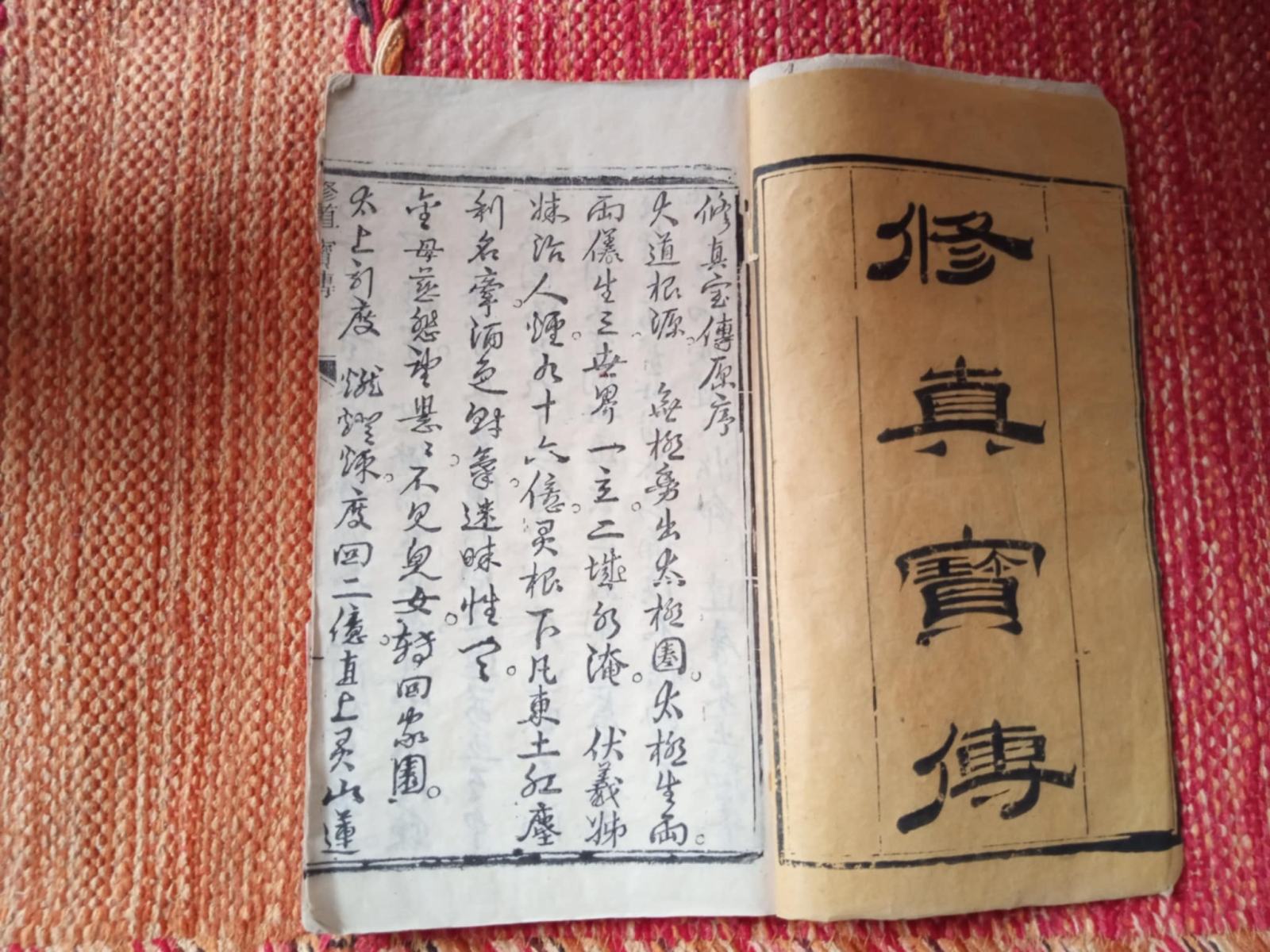
Xiuzhen Baochuan (修真寶傳)
***

Related Articles


Leave a Reply