
Circle of Transmission: The Living Loom
The Trace of a Living Hand: Honoring a Friend’s Father and his Calligraphy
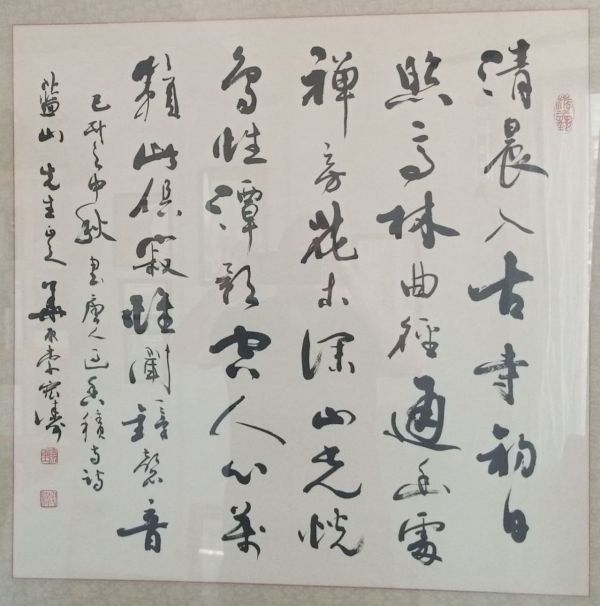
Featured Calligraphy:
- Title: 题破山寺后禅院 · Inscription on the Rear Courtyard of Poshan (Broken Mountain) Temple
- Poet: Chang Jian (常建, c. 708–765), Tang Dynasty
- Calligrapher: Li Hongtao (李宏涛)
- Date: 己卯年 (Jimao year, 1999), autumn
- Medium: Ink on xuan paper, running script (行书).
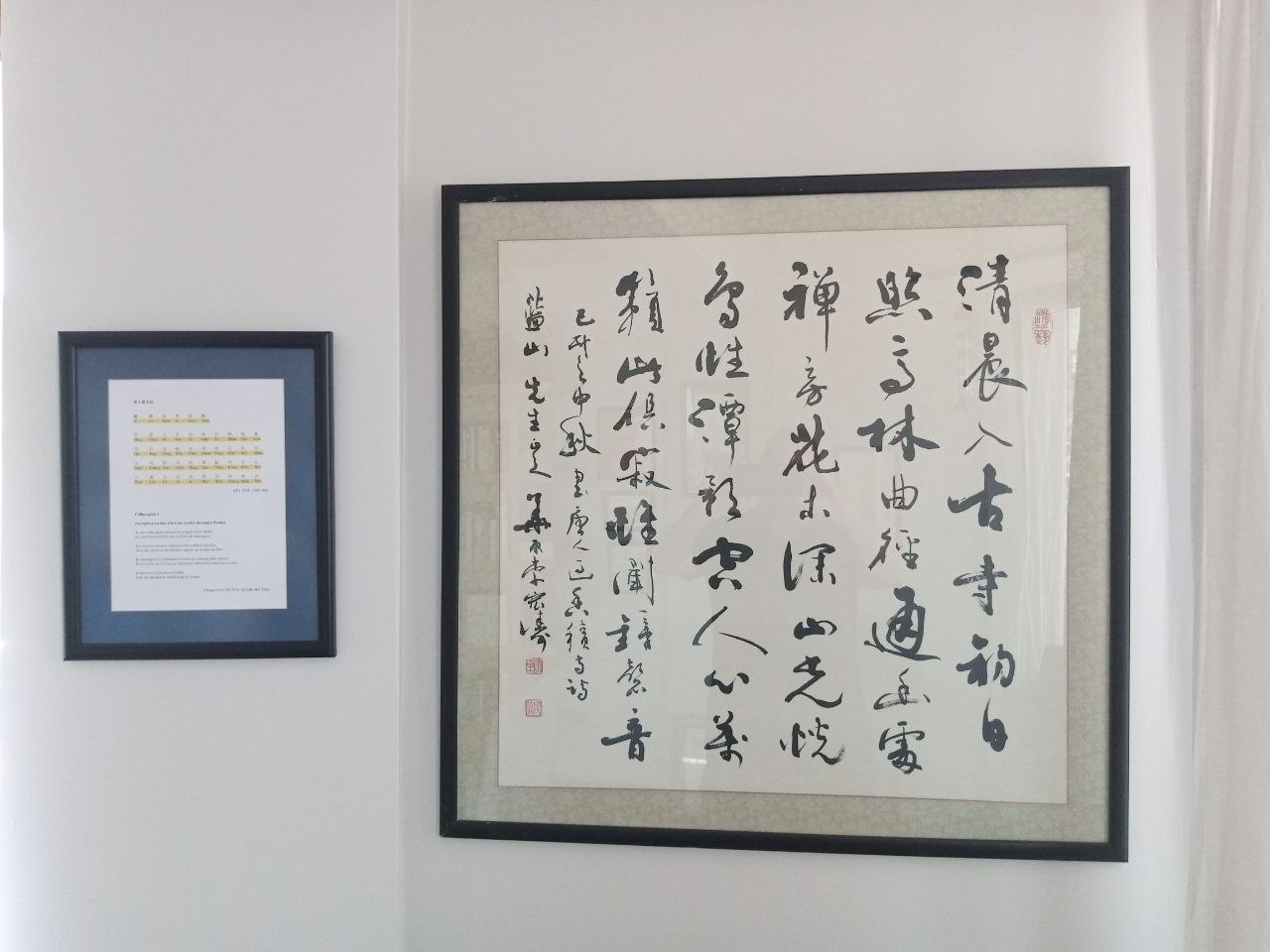
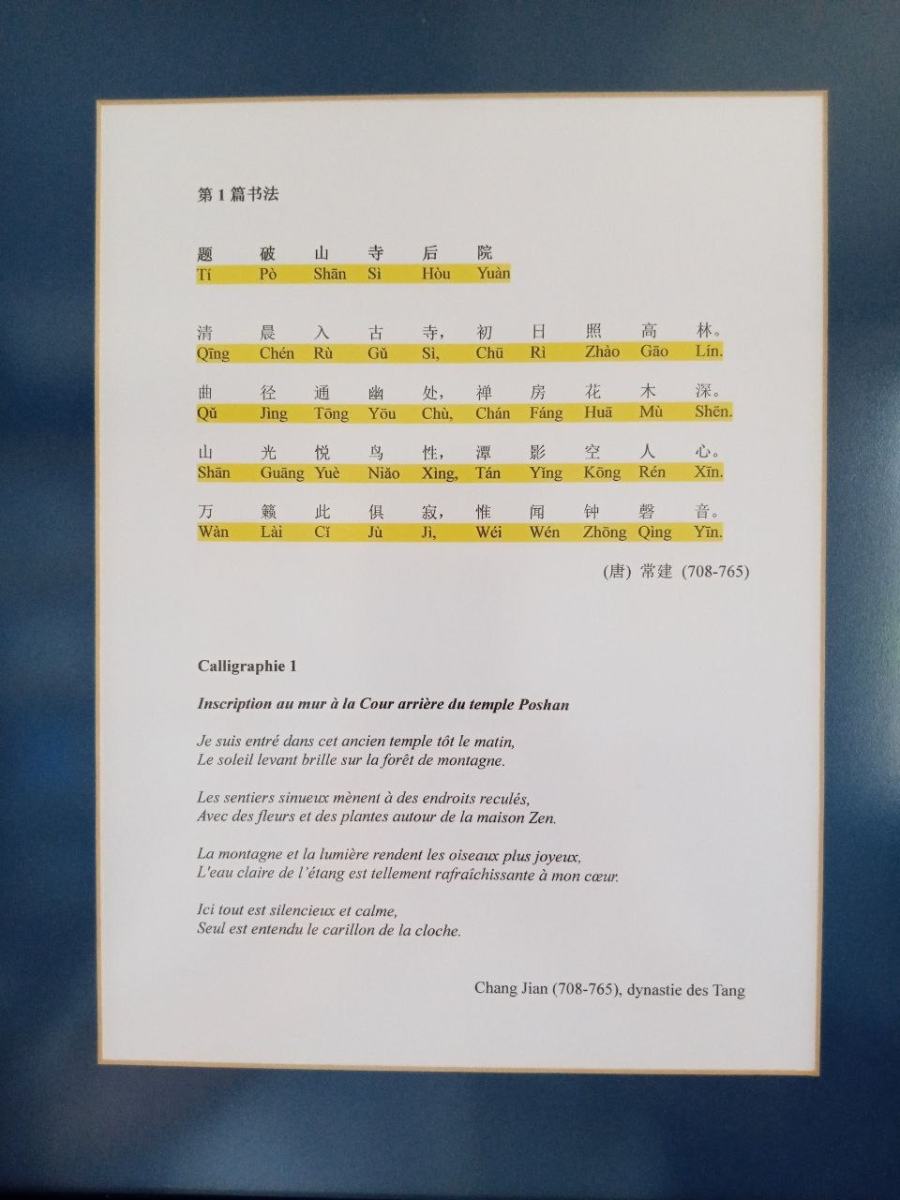
Today’s Sharing from the Blue House of Via-HYGEIA is about honoring a friend’s father and his art. One day in the autumn of 1999 in Beijing, my friend Patrick Li Feng came to our house with his father, Li Hongtao, expressing a wish to gift us a calligraphy. Patrick had even prepared a companion document, a printed guide with the poem’s characters, Pinyin, and a French translation, ensuring we could appreciate not only the beauty of the brushwork but also the depth of the words themselves.
After preparing tea, we watched as Li Feng’s father prepared the large dining table, laying out his paper, brushes, and ink stone. When he felt ready, we witnessed ink and brush engage in a spontaneous dance, Chinese characters beginning to inhabit the white paper before our eyes.
The poem he chose was Inscription on the Rear Courtyard of Poshan Temple by the Tang poet Chang Jian—an eighth-century meditation on entering an ancient temple at dawn, following a winding path to a hidden meditation hall, and finding, in the silence that follows, only the sound of bell and chime. It is a poem about journeying inward, about the landscape emptying the heart, about the ten thousand sounds of the world falling away until only essence remains.
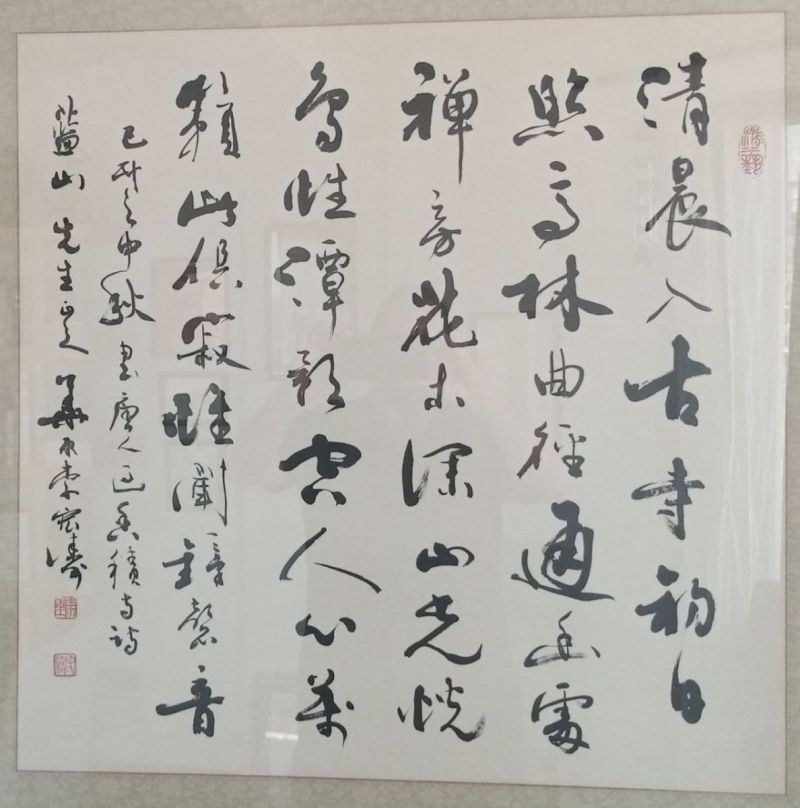
The running-script calligraphy of Chang Jian’s poem, executed in the spontaneous manner of the literati tradition, embodies the very qualities the poem celebrates: fluidity without haste, discipline without rigidity, the trace of a living hand upon paper. The brush moves with the poem’s own rhythm—from the broad morning light of the opening lines through the winding path’s tightening energy, to the final stillness where only the bell tone remains.
The dedication in smaller script to the left, the date and circumstance of creation, and the red seals that punctuate the composition all follow the classical kuànbié (款识) convention, binding the work to a specific moment, a specific relationship, and a specific life. It was born in a room that smelled of ink and tea, with dumplings cooking in the nearby kitchen. It is the trace of a living hand, a moment made permanent, a gift from one home to another.
Tang Dynasty · Five-character regulated verse (五言律诗)
Chinese
「清晨入古寺, 初日照高林。 曲径通幽处, 禅房花木深。 山光悦鸟性, 潭影空人心。 万籁此俱寂, 惟闻钟磬音。」
Pinyin
‘Qīngchén rù gǔsì, chū rì zhào gāolín. Qū jìng tōng yōu chù, chánfáng huāmù shēn. Shān guāng yuè niǎo xìng, tán yǐng kōng rénxīn. Wàn lài cǐ jù jì, wéi wén zhōng qìng yīn’.
English Translation
‘At dawn I enter the ancient temple; the rising sun shines on the tall forest. A winding path leads to a secluded place; the meditation hall lies deep in flowers and trees. The mountain light delights the birds’ nature; the pool’s reflection empties the human heart. Here all ten thousand sounds fall silent; only the tones of bell and chime remain’.
*
Commentary:
The Architecture of Silence
Chang Jian’s poem is a masterwork of what Chinese literary criticism calls “scene and feeling in mutual birth” (情景交融)—where the external landscape and the poet’s inner spiritual state become indistinguishable. While the poem records a dawn visit to Xingfu Temple (兴福寺) on Poshan (“Broken Mountain”) near present-day Changshu, Jiangsu, its true subject is the journey from worldly consciousness to Zen illumination.
The poem’s eight lines trace a precise physical and spiritual itinerary:
The Threshold
The first couplet establishes the setting. Qīngchén (清晨, “clear morning”) is not merely a time of day but a state of mind—unclouded and expectant. The gǔsì (古寺, “ancient temple”) represents the eternal, while the chū rì (初日, “first sun”) on the gāolín (高林, “tall forest”) suggests the meeting of the temporal and the sacred. (Note: Gāolín also puns on sēnglín, “monastic community”.)
The Journey
The second couplet contains the poem’s most celebrated lines. Qūjìng tōng yōu chù (曲径通幽处, “winding path leads to secluded place”) has entered Chinese as an idiom for any indirect approach to profound truth. The chánfáng (禅房, “meditation hall”) lying huāmù shēn (花木深, “deep in flowers and trees”) creates a spatial paradox: the spiritual center is hidden, not displayed, accessible only through patient traversal of nature’s embrace. Song dynasty critic Ouyang Xiu confessed he spent years attempting to imitate this couplet and failed, concluding that “crafting the conception is the difficult part to master.”
The Emptying
The third couplet effects the poem’s philosophical turn. Shān guāng yuè niǎo xìng (山光悦鸟性) uses yuè (悦) in the causative: the mountain light makes joyful the birds’ nature. This is not anthropomorphic projection but recognition of a shared xìng (性, “nature/essence”) between landscape and creature. More radically, tán yǐng kōng rénxīn (潭影空人心) employs kōng (空) as a causative verb: the pool’s reflection empties the human heart. This is the Buddhist śūnyatā (emptiness) made visceral—not an abstract doctrine but an experience of self-dissolution before clear water.
The Transfiguration
The final couplet completes the cycle. Wàn lài (万籁, “ten thousand sounds”) refers to the Zhuangzi concept of the “music of earth”—all sounds produced by wind through hollows. Their jù jì (俱寂, “all silent”) is not dead silence but pregnant stillness. What remains—wéi wén zhōng qìng yīn (惟闻钟磬音, “only heard bell and chime tones”)—are the ritual sounds of Buddhist practice, themselves pointers beyond sound to the gate of emptiness. The poem thus enacts what it describes: the reader, like the visitor, is gradually stripped of worldly noise until only the pure tone remains.
Literary Distinction
Critics have noted that despite being a regulated verse (lǜshī), the poem’s tone resembles ancient-style poetry (gǔshī)—plain in diction, flexible in prosody, with the first couplet employing “flowing-water antithesis” where meaning flows across the parallel structure rather than being contained within it. Tang critic Yin Fan described Chang Jian’s art as “setting out from a broad highway, then seeking a wild path; only after a hundred li does it return to the main road”—a poetics of indirection that makes the familiar strange and the simple profound.
*
Coda
The calligraphy still hangs in our home. The ink has aged to a softer black, the xuan paper to a warm ivory. The red seals remain vivid—two from the artist’s hand, one from a collector who recognized what passed between friends that autumn afternoon. When the light is right, late in the day, I can still see where the brush hesitated on 幽 (secluded) and where it flew on 寂 (silent). Li Hongtao is no longer with us, but the hand remains. The bell still rings.
Related Articles


Leave a Reply