
Circle of Transmission: The Living Loom
A Little Guillaume Postel Sampler: Part 6 – A French Renaissance Commentary Upon Virgil’s ‘Prophetic’ Fourth Eclogue
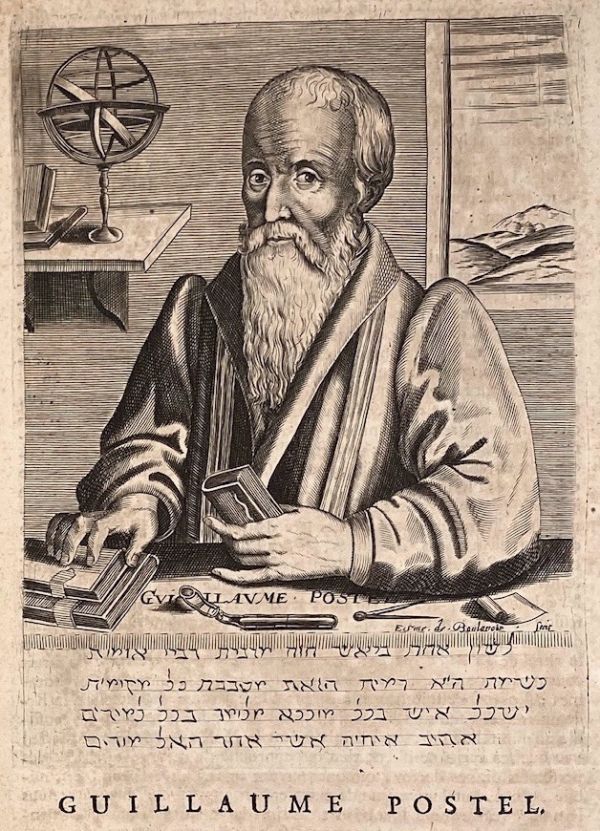
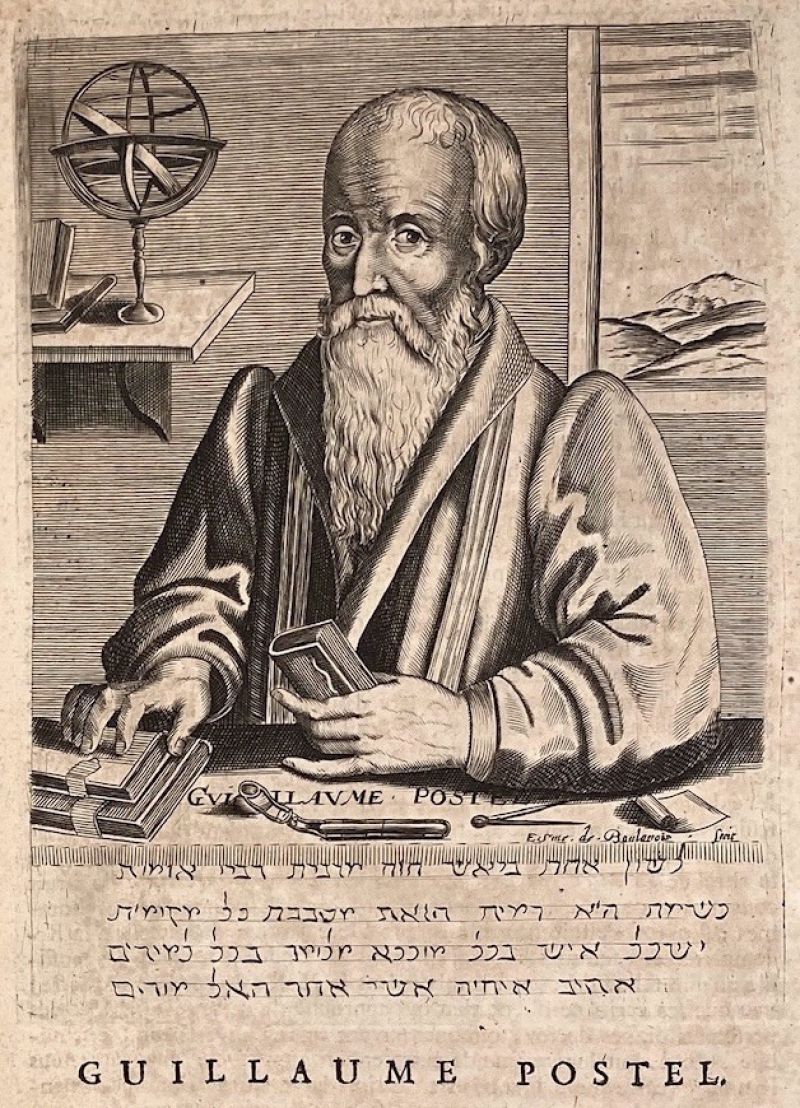
Sitting portrait of Guillaume Postel, French linguist, astronomer, Cabbalist, diplomat, professor, and religious universalist, engraved on a copperplate by Esme de Boulonois; from the book ‘Académie Des Sciences Et Des Arts’ by Isaac Bullart, published in Amsterdam by Elzevier in 1682.
(for translation of the legend, see part 4)
*
Today’s sharing from the Blue House of Via-HYGEIA is a little treatise by Guillaume Postel, ‘The Fourth Eclogue of P. Virgilius Maro, compiled from the opinions of the Cumaean Sibyl, with the annotations of Guillaume Postel, restorer of the most ancient theology of the Gentiles (which in its principles, as prescribed by Noah, is most true)‘, published in Paris in 1553 by the printing house of Jean Gueullart, at the sign of the Phoenix, opposite the Collège de Reims, rue des Sept-Voies au Mont Saint-Hilaire.
Our sharing sole aim is to share with you a text that would have remained ‘un-known‘ to the main public, without any legitimate justification. It is an impressive work of scholarship & exegesis by an emblematical French Renaissance Luminary, but unfortunately, it still hadn’t been the subject of a proper scholarly edition and presentation. We do not pretend that this is a perfect translation, far from it, as it is Virgil’s Latin and Postel idiosyncratic Latin! But, at least, we provide an overview of what Postel’s fascinating commentary is about and place him back in good company within the ‘Fourth Eclogue League of Those Who Claim It Prophesize The Birth of Christ‘.
Postel follows the earlier Christian tradition of Constantine the Great, Lactantius, Eusebius, St. Augustine, & Dante Alighieri to quote a few, and his core argument is that Virgil’s Eclogue, via the Sibyls, contains a ‘Gentile Theology‘ that perfectly prefigures Christian doctrine—the Virgin Birth, the divine nature of Christ, his redemptive power over sin and death, the establishment of a peaceful kingdom, and the restoration of a golden age—proving that divine truth was available to all humanity, not just the Hebrews.
Postel starts by acknowledging that his project might seem insignificant or lowly, but only if one misinterprets Virgil’s poem as being merely about a Roman senator’s son. He immediately counters this by stating his true thesis: the poem is a divinely inspired Sibylline prophecy.
He argues that the Fourth Eclogue is, in fact, the most worthy subject in all of classical literature because it contains the ‘most Divine breath of the Holy‘ and prophesies the ‘Celestial King‘ (Christ).
Postel claims that a true theology about Christ’s coming was known to the whole world before Abraham and was handed down by Janus (whom he identifies as a primordial archetypal figure) through the line of Japheth (one of Noah’s sons, traditionally seen as the ancestor of Europeans, a.k.a. Gentiles).
He flatters his patron, Bishop Guillaume du Prat, by linking this ‘Gentile Theology‘ to France. He uses a complex wordplay on appellare (to call upon, appeal to), suggesting that France is the nation destined to foster the knowledge of this ‘King-to-be-Appealed-to‘ (Christ) and spread it globally (‘filling all the Indies with the Gospel‘).
His final, explosive claim is that the prophecies preserved by the Japhethites (the Gentiles, i.e., Europeans) were once clearer than the Canonical scriptures of the Hebrews. This turns traditional Christian thought on its head, elevating ‘Pagan‘ prophecy to a status equal to, or even initially superior to, Hebrew prophecy.
This dedication sets the stage perfectly for the detailed commentary that follows, revealing Postel not just as a scholar, but as a visionary with a unique and radical theological mission.
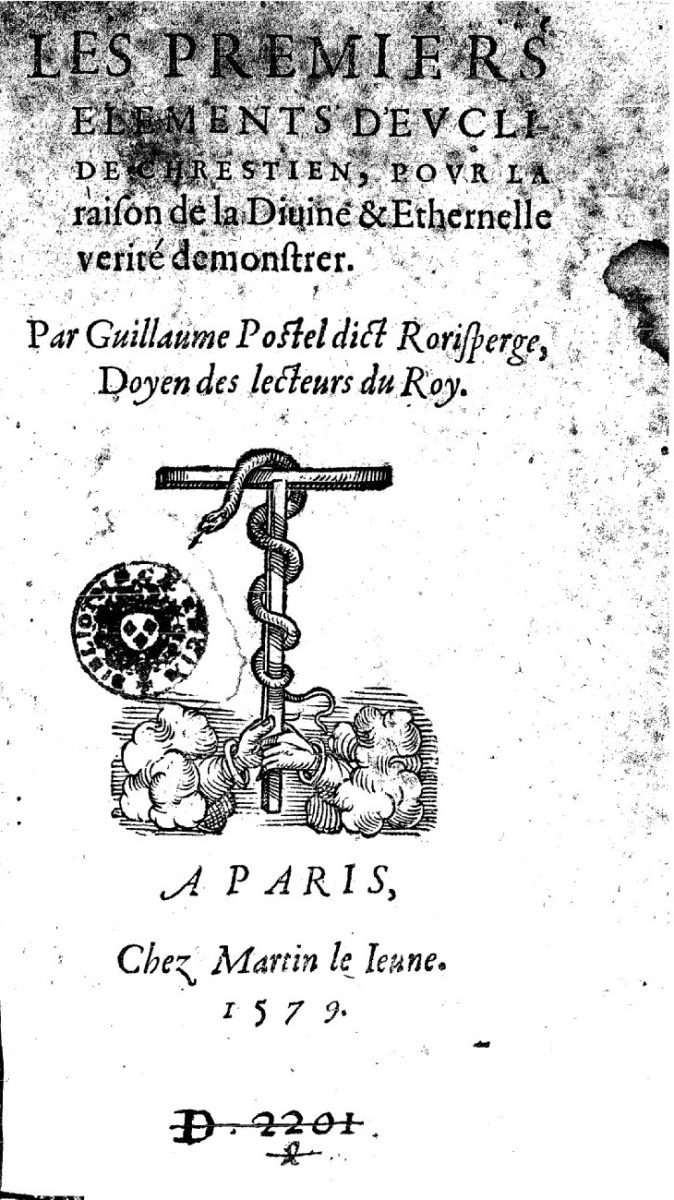
Finally, a forthcoming Sampler- Part 7, will be devoted to an emblematic little treatise by Guillaume Postel: ‘Christian Euclid’s First Elements: Demonstrating the Rationale of Divine & Eternal Truth’ published in 1579 in Paris.
**
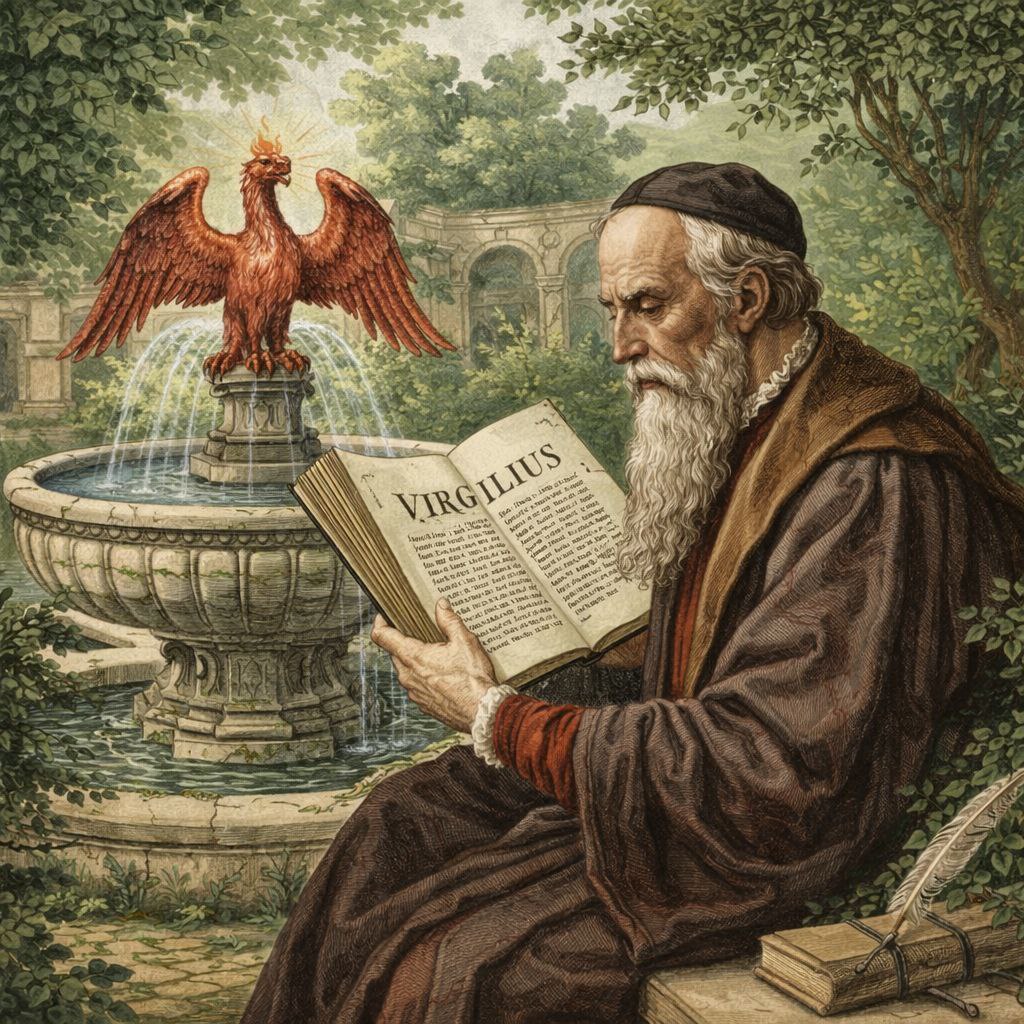
Virgil’s ‘Fourth Eclogue’
with Guillaume Postel’s
Annotations & Commentary
*
The Dedication
TO THE REVEREND FATHER IN CHRIST AND LORD, LORD GUILLAUME DU PRAT, BY THE GRACE OF GOD BISHOP OF CLERMONT, GUILLAUME POSTEL [SENDS] GREETINGS AND [A WISH] TO ENJOY THE FRUIT OF TRUTH.
This ‘Explanation of the Sibylline Verses of Virgil’s Eclogue‘ might hold a place of lesser importance, or perhaps even be considered a trifle, in the entire Republic of Letters—or rather, it might be seen as evidence that its Author is rather lowly (for even Virgil himself relegated poems of this name among the common sort)—if it is judged by that superficial argument by which it was inscribed to the abortive son of a Roman Senator, a boy who died before the poet had finished a prophecy most fittingly adapted, or rather, most impiously distorted.
But if it is weighed according to the majesty of its argument and the primary intention of its very Sibylline inspiration—that is, according to the most Divine breath of the Holy Spirit—then truly there is no subject in the entire furniture of the Latin, or Italian, or Greek encyclopedia more worthy, and no subject in which the inhabitants of the whole Roman world, let alone one Bishop or some prince, ought to have been more engaged in pondering.
I have therefore decided to bring forth this compendium, which I have appended, of that Theology which the whole world once knew: concerning the advent of the Celestial King (long before Abraham), promised to Eve herself, and to Noah, that He might take away the Malediction inflicted upon the earth. This theology Janus himself had handed down especially through the sons of Japheth.
It seemed right to unearth it and inscribe it to you, not so much by right of friendship, but because you were the first in our France to begin fostering that comfort which, having arisen in France, is thus designated by the proper name of the very King-to-be-Appealed-to [‘Appellandi‘]; and which, now filling all the Indies with the Gospel, is laying the foundations of an eternal legacy for the future under another name.
I do this also so that, under your auspices, the Christian world may begin to recognize: that the most sacred predictions were with the Japhethites, far clearer than the Canonical ones, just as among the Semites or the sons of Shem, the most Holy Prophecy and the corpus of the Hebrew Sacred Texts was sacred after 1000 years according to the Greeks, or after 360 years according to the Hebrews.
Farewell, and continue to encourage the other Archimandrites
by the fragrance and example of your alms.
On the Nones of January 4th, 1553. In the natural year.
Perpende finem. (Consider the end).
*
Virgil’s text
P. V. B. VIRG. MARONIS ECLOGA QUARTA EX CUMAEAE SYBILLAE SENTENTIIS CONFLATA, CUM ANNOTATIONIBUS GUILELMI POSTELLI ET VETUSTISSIMAE GENTILIUM THEOLOGIAE (QUAE IN SUIS PRINCIPIIS A NOACHO PRAESCRIPTIS EST VERISSIMA) INSTAURATORIS.
The Fourth Eclogue of P. Virgilius Maro, compiled from the opinions of the Cumaean Sibyl, with the annotations of Guillaume Postel, restorer of the most ancient theology of the Gentiles (which in its principles, as prescribed by Noah, is most true).
| Line | Latin Text | English Translation |
|---|---|---|
| 1 | Sicelides Musae, paulo majora canamus. | Muses of Sicily, let us sing of somewhat greater things. |
| 2 | Non omnis arbusta iuvant, humilesque Myricae. | Not all are pleased by shrubberies and lowly Tamarisks. |
| 3 | Si canimus sylvas, sylvae sint Consule dignae. | If we sing of the woods, let the woods be worthy of a Consul. |
| 4 | Ultima Cumaei venit iam carminis aetas. | The final age of the Cumaean song has now arrived. |
| 5 | Magnus ab integro saeclorum nascitur ordo. | The great line of the centuries is born anew. |
| 6 | Iam redit et Virgo, redeunt Saturnia regna. | Now the Virgin returns, the reign of Saturn returns. |
| 7 | Iam nova progenies caelo demittitur alto. | Now a new progeny is sent down from high heaven. |
| 8 | Tu modo nascenti puero, quo ferrea primum | Only do thou, chaste Lucina, smile on the boy being born, |
| 9 | Desinet, ac toto surget gens aurea mundo. | Under whom the iron race shall first cease, |
| 10 | Casta fave Lucina: tuus iam regnat Apollo. | And a golden race shall arise throughout the world. |
| Line | Latin Text | English Translation |
|---|---|---|
| 11 | Teque adeo decus hoc aevi, te Consule, inibit, | And for you, under your consulship, O Pollio, this glorious age will commence, |
| 12 | Pollio: et incipient magni procedere menses. | And the great months will begin to advance. |
| 13 | Te duce, si qua manent sceleris vestigia nostri, | Under your leadership, any traces of our guilt that remain, |
| 14 | Irrita perpetua solvent formidine terras. | Shall be rendered void and release the lands from everlasting fear. |
| 15 | Ille deum vitam accipiet, divisque videbit | He shall receive the life of gods, and he shall see |
| 16 | Permixtos heroas, et ipse videbitur illis. | Heroes mingled with gods, and he himself shall be seen by them. |
| 17 | Pacatumque reget patriis virtutibus orbem. | And he shall rule a world pacified by his father’s virtues. |
| 18 | At tibi prima, puer, nullo munuscula cultu | But for you, child, the earth, without being tilled, |
| 19 | Errantes hederas passim cum baccare tellus, | Will freely scatter its first little gifts: wandering ivy and foxglove everywhere, |
| 20 | Mixtaque ridenti colocasia fundet acantho. | And Egyptian lilies blended with the smiling acanthus. |
| 21 | Ipse laete domum referent distenta capellae | Of their own accord, the she-goats will bring home their udders distended with milk, |
| 22 | Ubera, nec magnos metuent armenta leones. | And the herds will not fear great lions. |
| 23 | Ipsa tibi blandos fundent cunabula flores. | Your very cradle will pour forth charming flowers. |
| 24 | Occidet et serpens, et fallax herba veneni | The serpent, too, will perish, and the deceptive poison-plant will perish, |
| 25 | Occidet, Assyriumque vulgo nascetur amomum. | And Assyrian spice will spring up freely everywhere. |
| 26 | At simul heroum laudes, et facta parentis | But as soon as you are able to read of the praises of heroes and the deeds of your father, |
| 27 | Iam legere, et quae sit, poteris cognoscere, virtus. | And to know what virtue is, |
| 28 | Molli paulatim flavescet campus arista, | The plain will gradually grow yellow with soft ears of grain, |
| 29 | Incultisque rubens pendebit sentibus uva. | And the reddening grape will hang from the uncultivated bramble, |
| 30 | Et durae quercus sudabunt roscida mella. | And the hard oaks will exude dewy honey. |
| 31 | Pauca tamen suberunt priscae vestigia fraudis. | Yet a few traces of ancient deceit will remain, |
| 32 | Quae tentare Thetim ratibus, quae cingere muris | Which will urge men to tempt Thetis with ships, to encircle towns with walls, |
| 33 | Oppida, quae iubeant telluri infindere sulcos. | And to cut furrows in the earth. |
| 34 | Alter erit tum Tiphys, et altera quae vehat Argo | There will be another Tiphys then, and another Argo to carry |
| 35 | Delectos heroas. Erunt etiam altera bella. | Chosen heroes. There will also be other wars, |
| 36 | Atque iterum ad Troiam magnus mittetur Achilles. | And great Achilles will be sent again to Troy. |
| 37 | Hinc ubi tam firmata virum te fecerit aetas. | Thereafter, when now strengthened time has made you a man, |
| 38 | Cedet et ipse mari vector, nec nautica pinus | The trader himself will leave the sea, nor will the nautical pine |
| Line | Latin Text | English Translation |
|---|---|---|
| 39 | Mutabit merces: omnis feret omnia tellus. | Barter goods: every land will produce all things. |
| 40 | Non rastros patietur humus, non vinea falcem. | The soil will not endure the hoe, nor the vine the pruning-hook. |
| 41 | Robustus quoque iam tauris iuga solvet arator. | The sturdy plowman, too, will now free the oxen from their yokes. |
| 42 | Nec varios discet mentiri lana colores. | Nor will wool learn to counterfeit various colors. |
| 43 | Ipse sed in pratis aries iam suave rubenti | But the ram himself in the meadows will now change his fleece, |
| 44 | Murice, iam croceo mutabit vellera luto. | To a sweetly blushing purple, now to a saffron yellow. |
| 45 | Sponte sua sandyx pascentes vestiet agnos. | Of its own accord, scarlet will clothe the grazing lambs. |
| 46 | Talia saecla suis dixerunt, currite, fusis. | “Ages such as these, run!” they said to their spindles, |
| 47 | Concordes stabili fatorum numine Parcae. | The Parcae [Fates], in harmony with the steadfast divine will. |
| 48 | Aggredere o magnos (aderit iam tempus) honores. | Go forth, O dear offspring of the gods, great increment of Jove! |
| 49 | Cara deum suboles, magnum Iovis incrementum. | Approach the great honors (the time will soon be here). |
| 50 | Aspice convexo nutantem pondere mundum. | Behold the world, swaying with its vaulted mass, |
| 51 | Terrasque, tractusque maris, caelumque profundum. | The lands and the expanses of the sea, and the deep sky; |
| 52 | Aspice, venturo laetentur ut omnia saeclo. | Behold, how all things rejoice in the age to come. |
| 53 | O mihi tam longae maneat pars ultima vitae. | O, may the last part of a long life remain for me, |
| 54 | Spiritus et quantum sat erit tua dicere facta. | And breath enough to tell of your deeds. |
| 55 | Non me carminibus vincet nec Thracius Orpheus. | Neither Thracian Orpheus will surpass me in song, |
| 56 | Nec Linus: huic mater quamvis, atque huic pater adsit. | Nor Linus: though to this one his mother, to that one his father be present— |
| 57 | Orphei Callopeia, Lino formosus Apollo. | Calliope to Orpheus, handsome Apollo to Linus. |
| 58 | Pan etiam Arcadia mecum si iudice certet. | Even Pan, if he were to compete with me with Arcadia as judge, |
| 59 | Pan etiam Arcadia dicat se iudice victum. | Even Pan would say, with Arcadia as judge, that he was defeated. |
| 60 | Incipe, parve puer, risu cognoscere matrem. | Begin, little boy, to recognize your mother with a smile; |
| 61 | Cui non risere parentes. | He on whom his parents have not smiled, |
| 62 | Nec deus hunc mensa, dea nec dignata cubili est. | No god has deemed worthy of his table, nor a goddess of her bed. |
*
The Main Commentary
The poet aims to recommend the pastoral treatment in Theocritus of Sicily, the rustic Georgics in Hesiod, the Aeneid in Homer. However, providence has preserved this for us among the opinions of the common people, so that what Virgil was accustomed to place among the common discourses, because he judged that they were best preserved by religious observances (which the great men, on the contrary, greatly abuse for tyranny), today that seems a work of the utmost worth.
For nothing more effective could be opposed to this sink of lost and impious men with which the world teems, than that the very same truth, which has been received by the consensus of the Semitic Church, is shown to have been far more manifest among the disciples of the Japhethite congregation. It is most certain from histories that there was a universal Flood.
Similarly, after the Flood itself, under Janus & Saturn, there was a Golden Age, in which, guided by right reason, although they were otherwise most skilled and knowledgeable in all the sciences and delights of the world, which before the Flood were in the highest flower and vigor, they nevertheless lived most justly (which, being most difficult in the knowledge of evil, is also most praiseworthy), because Holy Men were in control of the affairs of a Holy Empire.
For God had so ordained that their leader and parent of the universe, Janus, lived most holily for 600 years before the Flood, and was a disciple of those who had been nurtured for 900 years in all disciplines, whence, being most skilled and learned beyond what can now be believed, both in Theological and Astronomical and Astrological matters, he handed down the precepts of the Divine Law to posterity, guided by Reason, from whose prognostic precepts the Sibyls and the Holy men of the Gentiles (such as Job) transcribed them in a continuous series of ages, and in ever-progressing ages so increased them, that the Sibyls, disciples of the doctrines of Janus, were held at Rome as the highest authorities of religious law.
Therefore, the so-called Sibyls, because they showed the ways of life, under the guidance of religion, now from the times of Nimrod right up to Augustus, for a full two thousand years, as Varro notes, brought their doctrine to its culmination at Cumae. Whence the ‘final age of the Cumaean song‘ is posited for the restoration of the golden age, which all antiquity expected to come. Just as it was also predicted under the highest decree of the Semitic Fates, under CHRIST.
For it was necessary that Providence should have provided for the house and family of the holy Japhethites, among whom was the Temporal Magistracy and the administration of the world, just as it provided for the sons of Shem themselves. Whence the sacred rites of the Gentiles were instituted before those of the Hebrews.
The scope, therefore, of the Cumaean song is this: to persuade the whole world, guided by Reason, that a King born of Heavenly seed would be born, under whom that Golden Age which had long since been destroyed by the evils of the Saturnians would be wholly restored.
Indeed, it is necessary that God, Nature, and heaven were so constituted, that among the Gentile ‘Plutoi‘ (Pagan) or disciples of the kingdom of the Underworld (Hades-Saturn) or the West, a King born from Heaven would be manifested, under whom human felicity would be confirmed, which Janus had most especially instituted in Italy before Italy, or Atalia, was called Latium from the reception of Saturn-Cham. With these things known and supposed, it seemed to me to unravel and explain the whole Eclogue most clearly in an Ecphrasis.
(A Via-Hygeia Note: Ekphrasis or Ecphrasis (from the Greek) is a rhetorical device indicating the written description of a work of art. It is a vivid, often dramatic, verbal description of a visual work of art, either real or imagined. Thus, ‘an ekphrastic poem is a vivid description of a scene or, more commonly, a work of art‘. In ancient times, it might refer more broadly to a description of any thing, person, or experience. The word comes from the Greek ἐκ ek and φράσις phrásis, ‘out‘ and ‘speak‘ respectively, and the verb ἐκφράζειν ekphrázein, ‘to proclaim or call an inanimate object by name‘ (Source: Wikipedia).
*
(Postel begins his line-by-line commentary on the Eclogue,
interpreting it as a Sibylline-Christian prophecy).
-
Line 1: ‘Muse of Sicily‘… that is, ‘You, investigations of Theocritus of Sicily, first most clearly explained and imitated by me, or Bucolic Eclogues in the pastoral manner, turn to weightier matters, and…‘ ‘let us sing of somewhat greater things‘ (than the Bucolics).
-
Line 2: ‘Shrubberies‘ (the lower trees) and ‘lowly Tamarisks‘ (very thin shrubs, so that writings about them are pastoral)… ‘not all are pleased‘ (Hence, among bucolic and pastoral songs, there are greater subjects to be treated).
-
Line 3: ‘If we sing of the woods‘ (If we proceed to describe woods and pastures), ‘let the woods be‘ (those which we will treat) ‘worthy of a Consul‘ (Asinius Pollio, now victor at Salona in Illyria)… (so that his son Saloninus, whose name was given from the conquered place, may applaud our song. For I decided to interpret the Sibylline verses concerning the King-to-be-invoked among the Bucolics in his grace).
-
Line 4: ‘The final goal‘ (that is, the end and scope toward which it tended) ‘of the Cumaean song‘ (the verses of the Cumaean Sibyl, who, after writing many things about the King-to-be-invoked, had sold one of the three surviving books to Tarquin in the Roman Republic, having been born at Italian Cumae) ‘has now arrived‘ (it has come to our age, in which divine honors are to be given to the boy King of kings).
-
Line 5: ‘The great line of the centuries‘ (The first series of things divinely instituted by Divine Religion is born anew from the beginning) (Just as from the beginning Providence had instituted that all things would one day be born and Restored).
-
Line 6: ‘Now the Virgin returns‘ (That Virgin of virgins, who, remaining a Virgin forever, is to embrace a Man within herself… Therefore she is called by the name Astraea, because she is endowed with a heavenly body, She who had flown away now returns and is restored). ‘The reign of Saturn returns‘. (For indeed Janus, the first God or Divus of Italy, was called Saturn, and he instituted the golden age of the three sons of Jove, that is of Shem, Neptune (that is of Ham), and Pluto (that is of Japheth the Ancient, who is the father of Prometheus, that is Gomer), before the Sabbath-keeping Sage, who is also the second Saturn, arrived, under whom the golden age began to be corrupted due to the stain of the father’s curse. Therefore, the golden kingdoms of the first Saturn are returning, wholly to be Restored).
-
Line 7: ‘Now a new progeny‘ (a new and heavenly kind of seed, proper only to the King of kings) ‘is sent down from high heaven‘ (so that on earth he may be made God-man in the highest manner. For otherwise a separable and heavenly body in the seed comes extrinsically to any man.)
-
Line 8-10: ‘Only do thou, chaste Lucina‘ (The virtue accustomed to be prayed to in childbirth, which takes its name from ‘helping’), ‘smile‘ (so that he may be born most fortunate, who ought to be born under the highest star) ‘on the boy being born‘ (who is the highest and a boy) ‘under whom‘ (by the omnipotent author and one superior to all the powers of the world) ‘the iron race shall first cease’ (this iron and most lost age shall be destroyed) ‘and throughout the world a golden race shall arise‘ (more powerful, therefore, than all the kings of the world, not merely than Pollio’s little son, for this deed must happen in the whole world. Thus it was in the oracles that one would someday be able to achieve so much). ‘Now thy Apollo reigns’.
-
Line 10 (cont.): ‘Now reigns Apollo‘. (That Divine Virtue Hapoel, or the agent moving all things to their end by its divine rays, now reigns, because it has adapted for itself a human body by which it may also reign in the lower world).
-
Line 11-12: ‘And for you… Pollio, under your consulship this glory will commence‘ (You, I say, surviving and as Consul, will enter upon this highest glory of our age… for while his parent was still alive, the King-to-be-invoked, whom Cicero mentions, was to possess the kingdom of the universe, which alone the King of the Jews did through the death of the cross, with his mother present) ‘and the great months will begin to advance’ (not because the seasons or months change, but because the times of the greatest deeds were under him).
-
Line 13-14: ‘Under your leadership‘ (O boy of heavenly origin) ‘any traces of our guilt that remain‘ (which were to be acknowledged by all in corrupt nature, because they saw the better and approved it, yet followed the worse) ‘if any remain’ (if any survive, as they do) ‘shall release the lands‘ (will liberate the universe), ‘rendered void‘ (destroyed) ‘from everlasting fear‘ (For the maleficent power of nature, which some call demons, others cacodemons, oppressed by everlasting fear and frustrated by an invalid effort, will be bound by the boy expressed in the Sibylline verses, or the perpetual fears which have lasted to this day will be released, rendered void and powerless, from the lands and races of the world).
-
Line 15-17: ‘He‘ (who ought to be born from Heaven) ‘shall receive the life of gods‘ (he will be immortal, indeed he alone will have immortality) ‘and he shall see heroes mingled with gods‘ (he will see men made immortal, sanctified by a heavenly body. For heroes are gods made from men, whose life he is the origin, whence both gods and heroes will live from him). ‘And he himself shall be seen by them‘ (he will be seen by them, in which vision their highest happiness will consist). ‘And he shall rule a pacified world with his father’s virtues‘ (that is, he will govern the world, established in peace, with the infinite virtues of the heavenly and eternal Father, which is impossible for mortals).
-
Line 18-20: ‘But for you, child… the earth‘ (the earth mother, in whose cave and not in golden or gemmed beds you are to be born) ‘will scatter its first little gifts‘ (will offer its first gifts as if pouring them from its bosom) ‘everywhere‘ (abundantly and everywhere) ‘wandering‘ (spreading widely and luxuriantly) ‘ivy and with foxglove‘ (with a yellow or heavenly colored flowering herb) ‘and will pour forth Egyptian lilies blended with the smiling acanthus‘ (joyfully smiling with the leaf of the acanthus, suitable for its supreme greenness among the kinds of plants with very broad leaves, and which are accustomed to grow from the stems of the Colocasia; in Syria-Phoenicia alone, and never at Rome, though formerly in Egypt, whence it is transplanted everywhere under the equator).
-
Line 21-23: ‘Of their own accord, the she-goats will bring home their udders distended with milk‘ (Because the region of Syria and Phoenicia, more than others, flows with milk and honey, where the base of the Kingdom of the King-to-be-invoked is). ‘Nor will the herds‘ (of goats or cattle) ‘fear great‘ (and even horrible, regardless of size) ‘lions‘ (Because then that omnipotent one will bring it about that the wolf will dwell with the lamb, and the serpent with the boy). ‘Your very cradle will pour forth for you charming flowers‘ (For miraculously, all things ought to have smiled supernaturally upon that universal King about to subdue all things).
-
Line 24-25: ‘The serpent will perish‘ (that spiritual one, detected from afar in a bodily form, who also increases poison in bodily serpents, will be killed and cast out) ‘and the deceptive poison-plant will perish‘ (that is, all things poisonous, as well as all hypocrisy and dissimulation, will perish among the just servants of his king. For if they drink something deadly it will not harm them). ‘Assyrian spice‘ (an herb of singular virtue, odor, and appearance) ‘will spring up freely everywhere‘ (wherever Nature & Grace are restored).
-
Line 26-27: ‘But as soon as… you will be able to recognize what virtue is‘ (Because before him, truly no one had known what true virtue was, and all who before him were worshipped under the title of virtue were thieves and robbers of divine honor. For true virtue is situated in undergoing Poverty, Sorrow, and Disgrace for God’s sake, which he himself was to be the first to teach).
-
Line 28-31: ‘And now you will be able to read‘ (and ponder) ‘the deeds of your father‘ (of the eternal God who created heaven and earth. Moreover, this son alone is he who reveals and manifests the previously unknown parent to the world. For it is the part of parents to manifest their children, and not the contrary. But he also at the same time will make it so that you can read) ‘the praises of heroes‘ (of those greatest men and Prophet-parents of the very body of his King, I say of the preceding and subsequent parents, who alone are truly Heroes, and immortal in body, and the knowledge of whom depends on his birth). ‘The plain will gradually grow yellow with soft ears of grain‘ (The earth, born of its own accord without cultivation, will spontaneously make enough for food). ‘And the reddening grape will hang from the uncultivated brambles‘ (Because with all things restored through him, the earth will spontaneously give fruits, because calamities of fruits happen on account of crimes which must be gradually destroyed) ‘And the hard oaks will exude dewy honey‘ (which, like dew or manna, will drip, as seems to be done abundantly in Syria alone and in the property of the King-to-be-worshipped).
-
Line 31-33: ‘(Yet a few traces… will remain) of ancient crime‘ (of sins contracted as much from the very origin as in act). ‘Which will urge‘ (the traces, that is, the wicked) ‘to tempt Thetis with ships‘ (to sail), ‘to encircle towns with walls‘ (on account of their tyrannies and evil-conscious mind. For the good have no need of a wall) ‘and to cut furrows in the earth‘ (to plow and sow not only from necessity but for luxury and avarice).
-
Line 34-36: ‘There will be another Tiphys then‘ [This refers to the Argonauts and a palingenesis (rebirth) that is wholly to be brought back.] ‘and another Argo to carry chosen Heroes‘ [As we see the desire for navigation has so returned that today the circle of the lands is often sailed around, so it is necessary that art and virtue of every kind be fulfilled or condemned, men returning to complete their functions which were previously of the time, lest God be cheated of his intention in anyone.] ‘There will also be other wars‘ [for it is wholly necessary that Satan be loosed again, but for a short time, until at last he is bound and cast into the deep.]
-
Line 36: ‘And great Achilles will be sent again to Troy’.’ [For it is necessary, in the name of all those who were damned before they were born, that Crowns be restored, so that all Crowns which those for whom they were destined did not receive, may be received by others. This is the all-creating wisdom of the Sacred Writings, the Sibyls, Abrahams, Platonists, Pythagoreans, hearers of Moses, and of Reason and Restitution, which he explains in the sixth book of the Aeneid under the allegory of the Trojan war.]
-
Line 37-39: ‘Thereafter, when now strengthened time has made you a man‘ (Here, when now the body, not the dying, abortive one of Saloninus, but of the King-to-be-worshipped himself, shall have reached its perfect, complete manhood and its members for the Restoration of all things). ‘The trader himself will leave the sea‘ (The ship-captain and sailor, or the nautical art, because the land everywhere will be able to be traversed in Concord with its own resources). ‘Nor will the nautical pine barter goods‘ (nor will merchant ships roam the sea for the sake of curiosity and luxury).
-
Line 39: ‘Every land will produce all things’. (We see pepper already being grown in Japhethite Europe, and the pious abstaining from foreign things. Therefore, every or any land produces all necessary things for them with its own resources).
-
Line 40: ‘The soil will not endure the hoe” (This will also be true literally after the Restoration of all things, because for the Saints all things will succeed according to their wish). ‘Nor the vine the pruning-hook‘ (the luxuriant vine will also bear grapes, as we see everywhere in the new world and among the Japanese).
-
Line 41: ‘The sturdy plowman… will free the oxen from their yokes’.
-
Line 42: ‘Nor will wool learn to counterfeit various colors’ (In place of the dyer, God and nature, content with their own resources, will function).
-
Line 43-45: ‘But the ram himself in the meadows will change his fleece‘ (and any wool-bearing flock or thing) ‘now to a saffron yellow, now to a sweetly blushing purple’. ‘Scarlet will of its own accord clothe the grazing lambs’.
-
Line 46-47: ‘The Parcae… in harmony with the steadfast divine will‘ (Clotho, Lachesis, Atropos, driven into concord, and no longer conflicting) ‘said‘ (this) ‘to their spindles: run!‘ (by spinning, weaving, and assiduously creating) ‘such ages‘ (so blessed ages, ordained that they may be. For nothing is in this life which was not first in the fates of the Divine decree and providence, that is, in the disposition of the general intellect.)
-
Line 48-52: ‘Go forth, O dear offspring of the gods’ (son of God), ‘great increment of Jove!‘ (who expound and amplify the supreme glory of the most high God the Father) ‘the great honors’ (that is, the Divine ones, which will be given to you by the whole world) ‘the time will soon be here‘ (now, now!). ‘Behold the world, swaying with its vaulted mass‘ (plainly, without you as a mediator in heaven, it would collapse). ‘Behold the lands and the expanses of the sea, and the deep sky‘ (so that all things, being born for you, may applaud and celebrate). ‘Behold how all things rejoice in the age to come‘ (Because you, in the world to come after death, will seem more powerful than in life, contrary to human custom).
-
Line 53-62: The rest which are at the end pertain to the Poet, who wishes to see him; whom under the false image of an abortive child he depicts, he describes him from the fates. It is enough that the Poet himself offers to be informed by a false argument, when he writes: ‘Begin, little boy, he on whom his parents have not smiled, No god has deemed worthy of his table, nor a goddess of her bed.’ [For he (Saloninus) was quickly extinguished, so that it might be seen how falsely those things which are owed only to the King-to-be-invoked and universal savior were ascribed to the son of a doomed man.]
-
Moreover, Cicero, in the second book On the Nature of the Gods, mentions this King-to-be-worshipped and Invoked, who was to be approved both by word and heart and assent, whose honors the Romans wanted to give to Augustus, who greatly refused them, and did not wish to hear the name ‘Lord‘ from his slaves and domestics on account of a vision in the sky of a heavenly bow, with the figure of the Virgin and of the King-to-be-invoked himself, whose interpretation the Tiburtine Sibyl had taught him.
-
There is also the evidence of the acrostic, which Augustine and Eusebius mention… Lactantius in Chapter 24 of Book 7 teaches the same from the Sibyl. The whole and final resolution of the Fates is in the same opinion, for the affirmation of which God, along with his former interpreters, has preserved the Jews.”
The Conclusions
CONCLUSIONS, CONFORMING TO OUR [CHRISTIAN] BELIEF, POSITED AND PROVEN FROM THE GENTILES’ OWN SIBYLLINE THEOLOGY, SO THAT THEY WOULD SOMETIME BELIEVE IN THE FUTURE AND OPENLY ASSERT IT.
-
That the life of the golden age is destined to be someday under one omnipotent Monarch, in which men will live so justly, as it was ordained under Janus-Saturn. (From the first 9 verses.)
-
That there is to be one Virgin, both in individuality and in the unity of the Republic, under whose auspices the highest justice will flourish and the golden age will flower as under Saturn, that is, [she is] the depository of the first [man] in the sepulchral ark. (From the 6th verse.)
-
That the memory of the highest felicity depends on Saturn, who was received by Janus into a kingdom already claimed beforehand. This, moreover, is from the time of 2000 years before Hirius and Pāsam Cols. (From the same.)
-
That the traces of ancient sin must be blotted out in the world by one man born from Heaven, and that there is sin everywhere which must be abolished, is clear from verses 13-14.
-
That his manner of living, and that of his followers, would be clearly divine and not human, and previously unheard-of, so that their life would be heroic. *(15-16.)*
-
That he must restore peace to the whole orb of the lands. (17.)
-
That he was to be of heavenly and divine origin, and on this matter, the heavenly one and the human are one. (From verse 7.)
-
That he ought to be born among the ornaments of raw nature, and not in luxuries, verses 18, 19, 20 indicate.
-
That he was to restrain the ferocity of animals (which only the Creator can do), and above all, lions and all pride. (Verse 22.)
-
The deadly power of the serpent and of every poison was to perish under his strength. (V. 24.)
-
To destroy the power of poisons even for the poisoned themselves. (24.) Under him, the greatest abundance of the nature of things was to be present at his nod, so that all things would succeed for his followers according to their wish. (29, 30, 31.)
-
Under him, as if under an immortal and eternal one, all past ages must revolve, so that all things are Restored under his very long life, up to verse 37.
-
When he will have grown into a perfect man, with the formation, namely, of his most perfect Republicly Body, then all vain pursuits of the world’s superfluous desires will cease, so that just as God is all in all, so the earth will be all in all, that is, every land will produce all things, which is impossible to be brought about by any other than a God-man. (27 and following.)
-
Moreover, this is the decree of the Fates and destinies, that by the thread of Divine ordination such a one of supreme Power should come forth into the world, that is, an eternal Pontiff and Emperor, who would put an end to this Babylonian disorder, known to and hated by all mortals. Nor is it possible that any mere man, let alone that abortive Saloninus, could fulfill any of these axioms. Whence Paul aptly said that God manifested to the Gentiles themselves through the qualities and acts of the person the very truth for knowing God, if they had applied their mind. For thus it is necessary both for Japheth to dwell in the tents of Shem, although he is the Father of the Gentiles, and for Esau to loosen the yoke of his brother Jacob from his own neck, so that, guided by Reason, the same things may be known among the Gentiles which are known by perfect faith among the Faithful.
F I N I S
*
Source
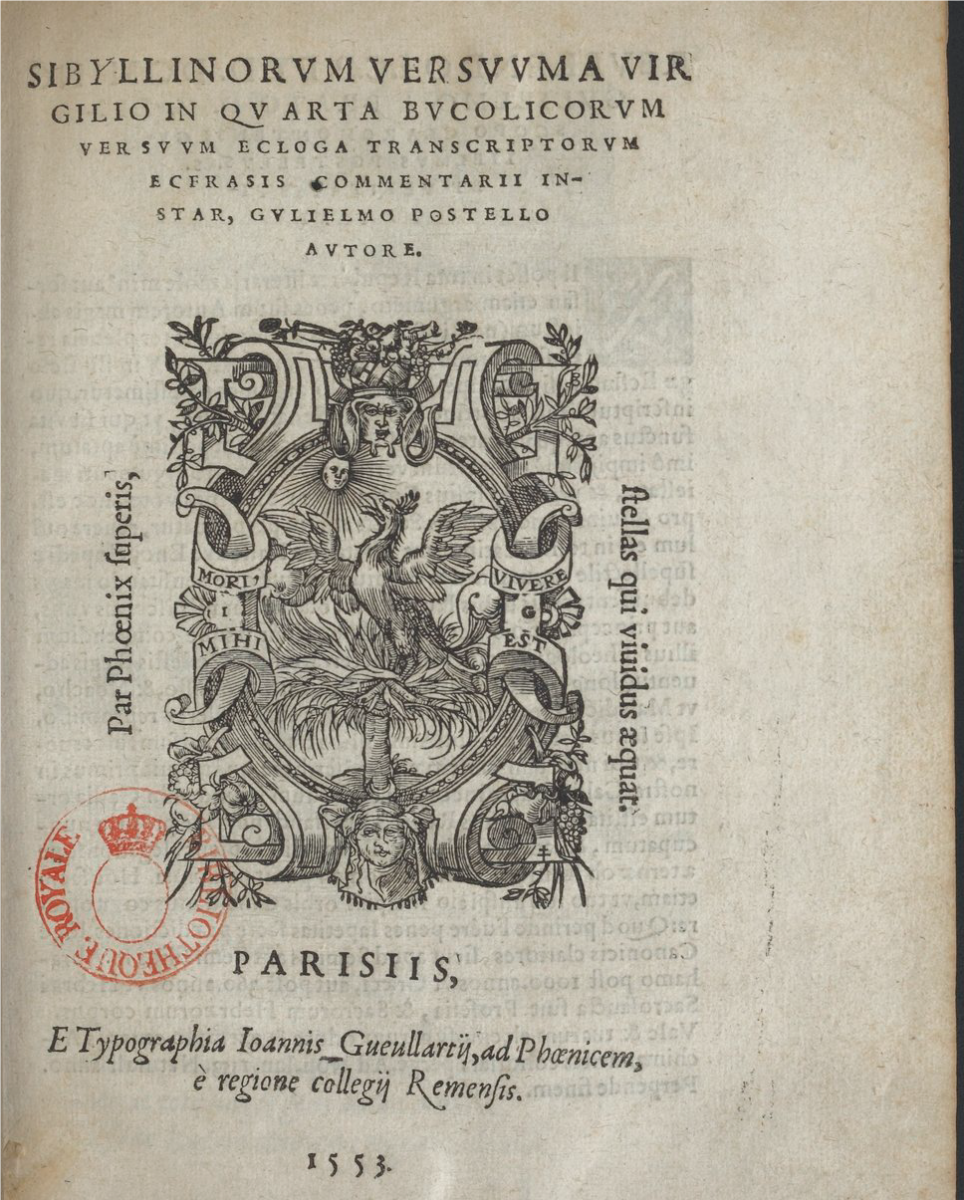
Original Latin here
*
Coming soon
A Little Guillaume Postel Sampler- Part 7:
‘Christian Euclid’s First Elements:
Demonstrating the Rationale of Divine & Eternal Truth’.
***

Related Articles


Leave a Reply