
Circle of Transmission: The Living Loom
A Little Jean-Albert Clergue-Vila Sampler – Part 1: A Contextual Introduction, followed by ‘In Quest Of Henry Corbin, The Chivalric Freemason’
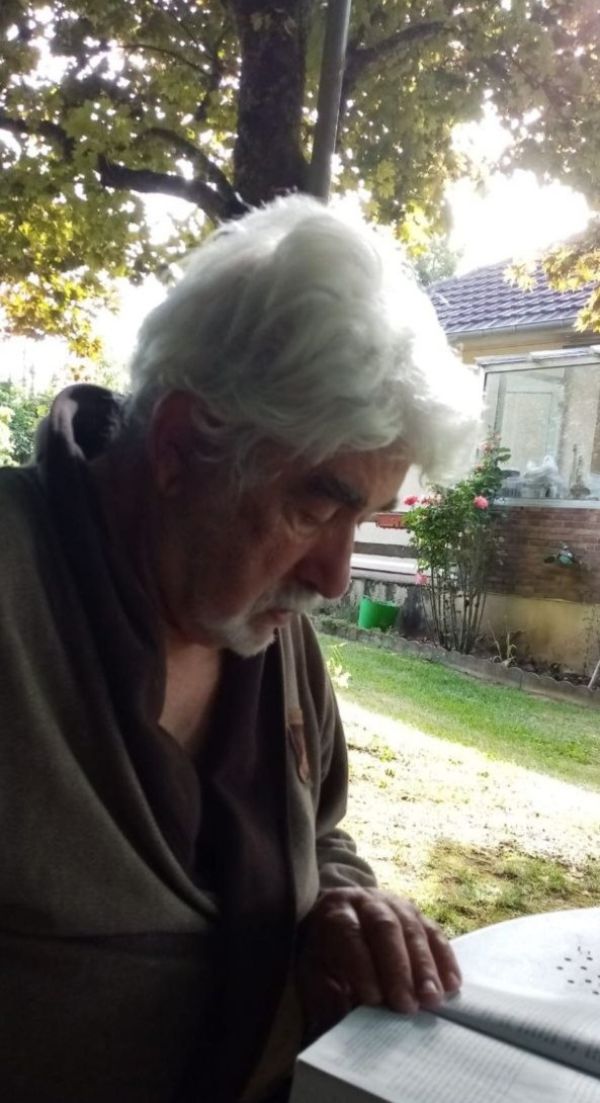
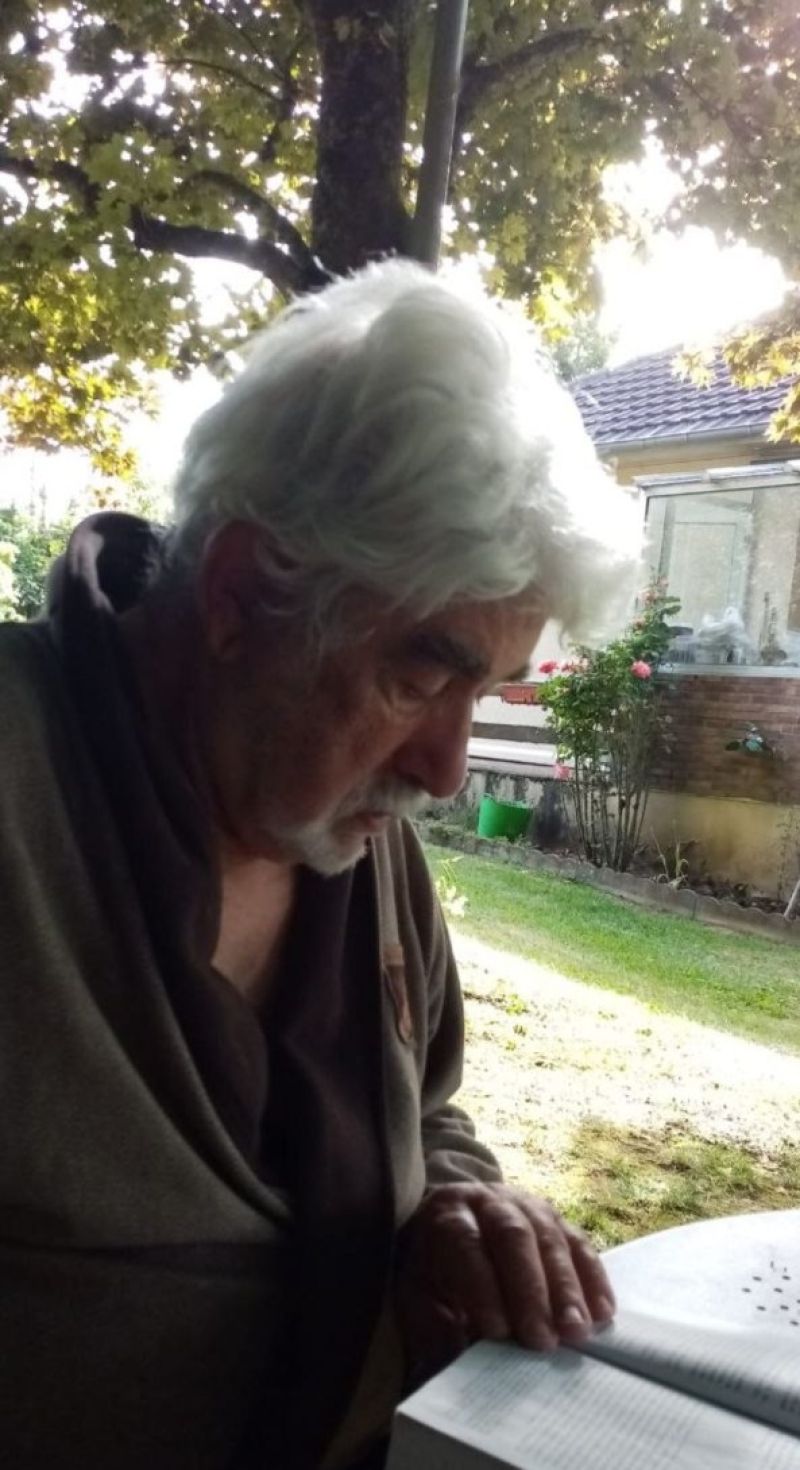
Jean-Albert Clergue-Vila
(December 29- January 1st 2026),
Photo used with kind permission
by his family.
*
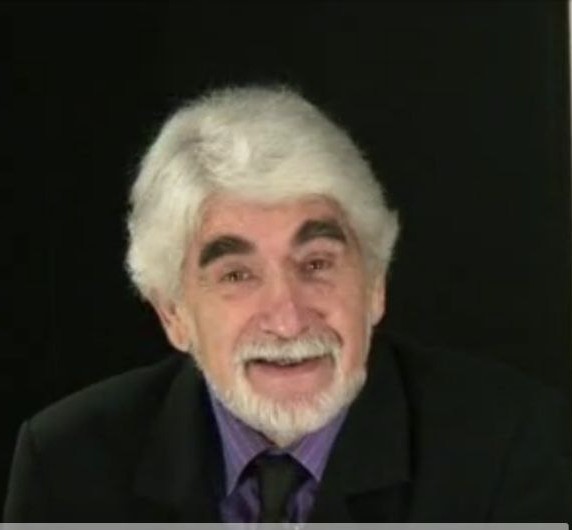
Today’s sharing from the Blue House of Via-HYGEIA is part 1 of a tribute sampler devoted to the memory of Jean-Albert Clergue-Vila who left us on January first 2026. After a remembrance introduction, we share the English translation of one of his major conferences given with BaglisTV in 2011, ‘In Quest of Henry Corbin, the Chivalric Freemason‘. We here express gratitude to the channel’s director, Mister Franck Agier, for his kind help. With part 2 & up, we will be publishing the English translations of his many articles, mostly grouped around the concept of ‘Chivalry’, written mainly in the notorious revue, L’Initiation’. We also want to thank his family for their support and for giving their green light with this tribute series.
**
Contextual Introduction
A Tribute to Jean-Albert Clergue-Vila
Jean-Albert Clergue-Vila (December 29, 1938 – January 1, 2026) was a French independent scholar whose intellectual journey uniquely bridged technical, artistic, and esoteric disciplines. Trained as an engineer for the French Navy, he also pursued studies in art history as an independent auditor at the prestigious École du Louvre. Passionate with traveling and discovering countries, he took his family in memorable camping-car road journeys, in Turkey, Egypt, Irak, the Sahara desert…
His professional background was complemented by a deep and lifelong engagement with symbolism, sacred geometry, and alchemy. These interests converged in his later decades as a meticulous researcher into the intersection of spirituality, history, and secret societies. He is best known in academic and esoteric circles for his groundbreaking investigative work on the philosopher Henry Corbin’s previously unexplored involvement in chivalric and masonic orders during the final years of his life. Jean-Albert Clergue-Vila’s research, drawing on archival discoveries and firsthand testimonies, shed crucial light on Corbin’s attempts to realize his concepts of “hiero-history” and “universal spiritual chivalry” through practical, initiatic channels.
Alongside this work, he maintained a decades-long passion for the Isenheim Altarpiece by Matthias Grünewald, on which he lectured and wrote extensively, offering what he described as a “symbolist, novel, and coherent” interpretation of the masterpiece.
An active Freemason himself, Jean-Albert Clergue-Vila brought an insider’s understanding to his historical studies. He passed away on January 1, 2026, at the age of 87. He will be missed by all those who were touched by his human qualities, his memorable kindness and his addictive sense of humor. As we say in Freemasonry:
“We mourn! We mourn! We mourn! Yet let us hope!”
*
*
‘In Quest Of Henry Corbin,
The Chivalric Freemason’-
A BaglisTV 2011 Conference
Ladies and gentlemen, first of all, I would like to thank our chairman, Mr. Daniel Gastambide, and Professor Pierre Lory for inviting me to this podium and before such an erudite audience.
It was by chance that I came across and began to research the extra-academic path of a certain Henry Corbin during the last ten years of his life. It must be said that what is rather astonishing is that the hefty ‘Cahiers de l’Herne‘ volume was dedicated to Corbin. It contains six pages of biography, and nowhere is there any mention of a possible involvement of Corbin in Freemasonry or in chivalric orders. And you can search everywhere, even on the internet; aside from a few allusions by Gilbert Durand, there is nothing. Within Masonry itself, there is not much. Hence the curiosity that leads me to be before you today.
Well then, if it was chance that made me cross and research Corbin’s extra-academic path, this chance goes by the name of Freemasonry, for it happens that I have been a Freemason for many years, and I see this announcement does not make the walls of this temple of knowledge tremble. It was while frequenting a lodge in Saint-Germain-en-Laye that I learned Henry Corbin had been a member. This presence dated back more than twenty years, and few remember it. My reaction, knowing Corbin’s work a little, was: what was this honorable professor doing in such a dubious affair? Later, in November 2008, on the occasion of the 30th anniversary of his ‘return to the angels’, according to Mircea Eliade’s expression, it was in my own lodge that I wished to pay tribute to our brother Corbin. I wanted to gather a bit of documentation and, as I told you, I did not find much.
Except, however, in the said ‘Cahier de l’Herne‘, there is a biographical postscript to a philosophical interview, written by Corbin’s own hand, which followed an interview he had on France Culture with Mr. Nemo. He says one thing about the University of Saint-Jean de Jérusalem to explain the emergence of this enterprise: ‘about which I cannot say here all that could be said’. Well, that was enough to trigger my curiosity and to know indeed what there was to say. Although their website makes no mention of this mysterious genesis, I approached the Association des Amis de Henry et Stella Corbin, which brings us together here. Our hosts granted me access to the archives of the Corbin collection held at the library of the École Pratique des Hautes Études, and I publicly thank them for it here. Professor Pierre Lory informed me that this part of the collection had not been truly studied, but that it contained elements relating to Henry Corbin and Freemasonry.
In fact, I found myself facing a veritable imbroglio where very atypical chivalric and masonic paths gradually appeared. This from the years 1966 until the end in 1978. A dozen years during which Henry Corbin attempted to give life and substance to his concepts of hierohistory and universal spiritual chivalry. My wish for a modest tribute turned into a year-long research endeavor. So, the sources were essentially the Henry Corbin collection at the École Pratique des Hautes Études: three binders containing dozens of letters, including drafts or copies in Henry Corbin’s hand, and multiple other documents. However, part of this correspondence seems to have been sorted and removed. Two witnesses to the transfer of the archives are in this room, and they can confirm that this sorting was not their doing.
Professor Antoine Faivre kindly opened his very well-organized personal archives as well as his journal for the cited years to me; may he be warmly thanked here. This allowed me to reconstruct the elements missing at the EPHE. As another source, I accessed the files of several masonic obediences: the Grande Loge Nationale Française, the Grand Orient de France, the Grande Loge Traditionnelle et Symbolique Opéra, the Grand Prieuré des Gaules, for which I thank their archivists. Other documents were given to me by brother masons from dormant or defunct lodges.
But to complete and confirm my sources, it was important to find and exchange with about a dozen witnesses, almost all Freemasons, who participated in Henry Corbin’s actions and adventures in chivalric and masonic circles. I must also give special mention to a young doctoral student, Manuel Quino, who, working on a related subject, helped me decipher and digitize the ‘fly’s feet‘ handwriting of Corbin, especially in his drafts. The results of this research were published in 2009 in two articles in the journal L‘Initiation, a subscription-based journal, whose publisher kindly gave me, at a friendly price, the last remaining copies he had. So I will have them available for interested persons.
So, in summary, here is what can be retained of the Corbinian peregrinations. On one hand, in the years around 1966, a rapprochement with the resurgence of an Order of Saint-Jean de Jérusalem, called OSJJ. On the other hand, from 1972 to 1974, an experience in Freemasonry within the Grande Loge Nationale Française, Opéra branch. 1974, a change of masonic obedience to join the Grande Loge Nationale Française known as Bineau, of English regularity. Also in 1974, a return to the Johannite chivalry but within the framework of a dissident group called the Ordre Souverain de Saint-Jean de Jérusalem, intended to lead to the university, the colloquia, and the journals of the same name. So, four segments of extra-academic paths but always along two axes: a path of traditional chivalry and a path of a masonic nature.
But where does this complexity come from? What was Henry Corbin seeking, what did he want? Why and how? Part of the answers is concentrated in the address that the very new brother Corbin gave in October 1972 before the members of the lodge La France in Tehran. I quote:
‘Our predecessors have left us many signs. I think of those of our philosophers who identified the 12th Imam with the Paraclete announced in the Gospel of John. I think of all that the idea of the cycle of Walâyat holds in reserve for us to tear us away from the routines of our modern philosophies of history. We still have much to deepen on this path. I aim not so much for new historical research as for the work we must carry out today together as Templars of the West and Templars of Iran. What the Templars of yesteryear perhaps did, we, today’s Templars, must undoubtedly accomplish further.
But there is more. It has been said that the ethics of ancient Zoroastrian Iran resulted in something like an order of chivalry. We can say that a similar ethic is felt in the spirituality of Shiite Iran. The entire spiritual history of Iran vibrates with a chivalric ideal expressed first in the heroic epic, then in the mystical epic. Furthermore, our Templar epic in the West underwent the same metamorphosis. The warlike and military chivalry was succeeded by the Templars of the Grail of Wolfram von Eschenbach. And in the 18th century, we witness the resurgence of the spirituality of the Temple in the mystical chivalry of our Templar masonry.
You see, we truly have a great work to undertake together. That will be our reconstruction of the Temple. And if I have been permitted to tell you this tonight, it is at the end of a long spiritual itinerary where I was guided by great Iranian masters‘.
So here is the extra-academic program to which Henry Corbin would devote himself during the last twelve years of his life. One could describe this project as an attempt—I had written an ‘extension’ of hiero-history—and to live it as a reality. But it would be more accurate, since hiero-history has no extension, to speak of an integration into the cycle of hiero-history, but on a present-day plane.
So to approach these different points, we can first consider the chivalric ideal. It dates back far: as early as 1929, when he was 26, a still-student Corbin expressed to his friend Robert de Chateaubriant that only through the paths of a spiritual elite, a true chivalry of the spirit, could the evolution of the soul occur in a world as ruined as ours of its ancient metaphysical vitalities. And he added that upon the ruins of the old society, a spiritual chivalry must be built, the appearance of which he awaited impatiently. Reading the letters of a Henry Corbin who had reached the age of 65, one feels intact his aspiration for an ideal spiritual chivalry, the archetype of which would be in the image of his cult opera, Richard Wagner’s Parsifal.
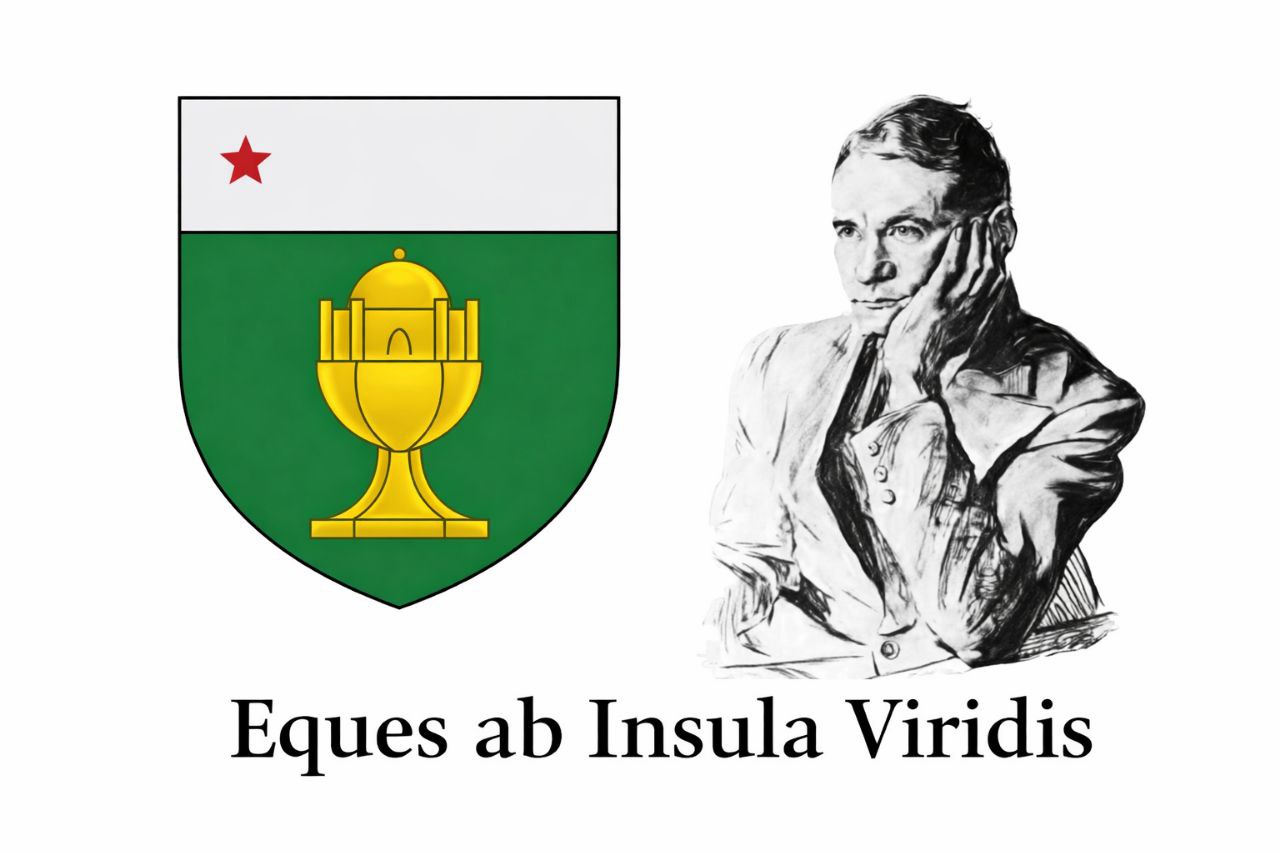
Then Corbin had heard of a group of mystics gathered in Strasbourg around 1350 around a former banker, Rulman Merswin. The latter was illuminated by messages received from a ‘Friend of God from the Upper Land‘. To house his community, Merswin had bought an old Benedictine convent, the management of which he entrusted in 1371 to Knights Hospitaller of Saint John, who established a commandery there. It so happened the place was called l’Île Verte (the Green Island). Here is a trait of Henry Corbin’s character: his mental lightning, his erudition, his capacity for enthusiasm led him to perceive a link between medieval lay mystics, visionaries and Friends of God in a place named the Green Island, just like that Green Island on the white sea of Shiite mysticism, the secret residence of the 12th Imam and his companions, in a Johannite commandery sheltering a studious and mystical spiritual chivalry.
Henry Corbin’s faith in these near-certainties and in this sort of mission he would invest in was such that his traveling companion, Professor Gilbert Durand, went so far as to write in the preface to a re-edition of Temple and Contemplation: Sohrawardî had been the spiritual guide for a whole part of Henry Corbin’s life, Rulman Merswin was going to be the second guide, or rather the extension and western resurgence of the first rector. So when one knows the part the discovery of Sohrawardî played for Corbin and that Durand writes this putting them almost on an equal footing, one sees the importance this could have, and this has not always been emphasized. So this will explain and justify all the extra-academic actions of a Professor Corbin totally invested in an almost messianic role of a resurgence of western spiritual chivalry as a living extension of a hiero-history, or integration into a hiero-history.
Served by chance in 1967-1968 at the EPHE, Professor Corbin became friends with a researcher in Zoroastrianism, Paul Jouveau-Dubreuil, whose father happened to be at the head of a para-chivalric organization, the Ordre Souverain de Saint-Jean de Jérusalem. The very erudite professor took an interest, became excited, inflamed, and joined this neo-chivalric order. What is most astonishing is that Professor Corbin dragged with him many of his colleagues or students from the EPHE or the university. A group formed where we find the names of Gilbert Durand, Richard Stauffer, Antoine Faivre, Frédéric Tristan, Jean-Claude Frère, etc. But according to what arguments and on what basis were they convinced? Apparently, and from reading many letters, the group’s members were to be a sort of missionary bringing to a traditional chivalric order the spiritual seeding that had been lost over time and which it lacked.
Now, lacking the time here to evoke the avatars encountered in this first attempt—a veritable entryism practiced by the group of academics into this very traditional, somewhat old-France, somewhat reactionary, somewhat nostalgic for the Action Française or even Vichy, and above all profoundly anti-masonic milieu—it was on this last point that a rupture occurred in 1972, because half of the EPHE group was also engaged in Freemasonry, and this had not escaped the head of the Order of Saint-Jean de Jérusalem. The rupture was illustrated in a rather sharp letter from Gilbert Durand: ‘One does not put new wine into old wineskins‘. Thus, the group had lost a certain audience, a bit of media action, and above all the traditional structure that seemed indispensable to Henry Corbin to graft his action onto a historical continuity—that is, a somewhat Guénonian vision.
We must now speak of a certain Freemasonry. In January 1970, Henry Corbin received a revelation upon receiving and reading a work published at the initiative of Professor Antoine Faivre. It was La Franc-maçonnerie occultiste et templière au XVIIIe siècle written by essayist René Le Forestier between 1928 and 1950. Corbin became passionate about this text where he discovered the existence of a form of masonic spiritual quest imbued with Christian sensibility, a quest prolonged in an inner order of a chivalric nature. This was the Rectified Scottish Rite conceived by the very erudite Lyon-based Freemason Jean-Baptiste Willermoz in the 1780s. This rite had resurfaced in France in 1910, then within the framework of the Grande Loge Nationale Française (GLNF), but here enfeebled, and a number of lodges practicing this rite decided in 1958 to regroup to give birth to a new GLNF known as Opéra. I cannot elaborate here, but on this rite, called RER (Rectified Scottish Regime), a ‘Que sais-je?‘ volume has just been published opportunely, giving a very serious overview. Quickly sold out, it is being reprinted.
So, his group of academics having just been dismissed from the Order of Saint-Jean de Jérusalem, Henry Corbin sought to regraft it onto another tradition. This Christian Freemasonry seemed an opportunity to him, especially since all his later life he dreamed of a link existing between Freemasonry and the defunct Order of the Temple. It is a constant thesis in which masonry bathed throughout the 19th, even a bit before, and the 20th century. Today, it has been demonstrated that this was not the case. Now, it so happened that Henry Corbin’s traveling companions, already engaged in Freemasonry, practiced this Rectified Scottish Rite, within the Grande Loge Nationale Française, Opéra branch. So in May 1972, Corbin solicited his pupils and collaborators at the EPHE to introduce him into this form of Freemasonry. I will not hide from you that I have heard testimonies from that time, and the pupils in question, who had a quasi-adoration for their master, were troubled by this very humble request.
So, for this, it could not be done normally. A lodge, ‘Les Compagnons du Temple de Saint-Jean‘, was then created, specially intended to quickly initiate Henry Corbin and Gilbert Durand to the first three masonic degrees, then a month later to a 4th degree specific to so-called rectified masonry. But Corbin was a man in a hurry, eager to access this inner order and its class of Chevalier Bienfaisant de la Cité Sainte (Beneficent Knight of the Holy City), which, in principle, is no longer masonic at all. Why such breaches of usually more settled usages? Certainly, Brother Corbin was in a hurry, but his lodge and EPHE companions were too. They hoped from their master that his erudition and his flashes of insight would bring new perspectives to a spiritual and chivalric Freemasonry.
Originating from an 18th century where it was natural to be Christian and baptized, the Rectified Scottish Rite had not opened to Judaism or Islam. Now, through a practiced esotericism, our adventurers of the spirit glimpsed the possibility of this Abrahamic spiritual chivalry dear to Brother Corbin’s heart. But for this, it was necessary to climb even higher and resurrect an Order of Prophets and Grand Prophets that had become somewhat mythical in so-called rectified masonry, as a sort of unknown superiors. The documents of the Corbin collection at the EPHE are quite complete regarding the phases of elaboration of this process. However, this was to be interrupted by a schismatic event occurring during a convent (a sort of general assembly) in January 1974, during which two contenders for the grand mastership of the GLNF Opéra disputed.
Brother Jean Moreau, who had piloted the Corbin operation, could not accede to the supreme function, although he nurtured great projects for the methodological and spiritual renewal of a renewed Freemasonry. And in this there was indeed an impulse from Corbin and this whole question of universal spiritual chivalry. Well, I believe the project, if it could have taken shape, might have changed many things. But one cannot remake history. The fact remains that at this convent, there was a scandal. Moreau and his lodges slammed the door of the convent and the obedience. The entire Corbinian movement found itself excluded from official Freemasonry, including a Brother Corbin who was staying in Tehran at the time.
Other perspectives then had to be considered. After this new stage, not to say this new failure, Brother Corbin stepped back and contacted various relations, including René Guilly, whom he had known in lodge. The latter would be the renovator of a Freemasonry founded on solid bases and issuing from fundamental historical research. René Guilly is the founder in 1969 of the Loge Nationale Française, the one to which I belong. He conversed with a somewhat distraught Brother Corbin, but before his hieroric views, more phantasmagoric than historicizing, he advised him to join the GLNF Bineau of English regularity, which was consummated on June 11, 1974.
I will not have the fraternal ferocity here to state that by this affiliation, Brother Corbin was going to experience the announcement that Dante inscribes on the front of the gates of hell: ‘Abandon all hope, ye who enter here‘. But it was somewhat of the same nature. Although showered with multiple honors, Professor Corbin found himself drowned in an enormous structure where relational worship often took precedence over worship pure and simple, and in any case over fundamental research. No more question of elaborating Abrahamic or hiero-historic perspectives within the framework of a Rectified Scottish Rite practiced in his new lodge named Centre des Amis No. 1. Although also affiliated with the lodge Villard de Honnecourt, Brother Corbin left no trace of particular works there, except that the publication of his academic works led to reviews in the journals published by this so-called research lodge. Thus can be summarized the singular masonic itinerary of Brother Corbin.
But Professor Henry Corbin kept a second iron in the fire. And that is why he accepted to live under the extinguisher. In 1971, he had reconnected with his friend from oriental language studies, Robert de Chateaubriant, lost sight of it seems since 1929. As if by chance, this friend had joined another branch of an Order of Saint-Jean de Jérusalem. And here we are before a sort of stutter of history. Thus, as in 1968, Corbin mounted his hierohistoric and Abrahamic hobbyhorses. He joined this somewhat wobbly order where he was received as a Knight of Grace in 1974. This took place in the ruins of an old Cistercian abbey in Cambrésis at Vaucelles near Cambrai. Henry Corbin thought he had finally found the prestigious place, charged with history, where, like the Strasbourgeois Rulman Merswin, he could anchor his community of researchers in Abrahamic esotericism. Thus, Corbin gathered his whole group again and impelled this University of Saint-Jean de Jérusalem, its annual colloquia, and its famous journals. These elements being much better known, here ends for me the account of the various Corbinian trajectories in his end-of-life period.
So, from all this, can we conclude and possibly draw a lesson, even a contemporary relevance? If we recall Henry Corbin’s sibylline phrase about what he could not say concerning the origin of his University of Saint-Jean de Jérusalem, we can now consider that the principal stages of this journey are now fairly well defined. I have not gone into the details here, but you must have felt, or at least I hope I have made you feel, the rather chaotic aspects of the path. My articles published in the journal L’Initiation reflect an environment even more agitated, whether in chivalric or masonic circles. Despite themselves, Henry Corbin and his friends had to discover dark dealings in the entourage of the Johannite chivalry. A real atmosphere of a detective novel between Simenon and Dan Brown’s Da Vinci Code. The same for a Freemasonry in the midst of petty wars of chiefs and influence.
It took Henry Corbin great faith, beautiful constancy, and a communicative enthusiasm to achieve his ends. At each stage, he polished a text to adapt it to circumstances, to refine and present his concepts. Certainly in terms less scholarly than those used in this venue, but these documents nonetheless constitute a body synthesizing his thought well, not to say his intimate conviction. The whole has remained unpublished to this day, and the principal texts are: on May 23, 1970, a document on the three vows of the Johannite knight within the OSJJ; on September 18, 1972, a lodge work on the theme ‘Willermozian Masonry and the Spirituality of the Temple‘; in October 1972, his address in lodge in Tehran, from which I evoked a few passages; on March 31, 1973, a lodge work on the theme of ‘The State of Spiritual Knight‘. It was reproduced in the journal Acta Resurrecta, the liaison organ of the rectified lodges of the GLNF Opéra, a text to which are added various internal group documents relating to the elaboration of elements of a state of Prophet and Grand Prophet in a perspective enlarged to Abrahamic esotericisms.
During my research, some had suggested to me that I was going to investigate very private domains, even of the order of the intimate life of a great scholar. I hope to have demonstrated to you that this was not the case and that Henry Corbin had done everything to make known and prosper his hopes in chivalric or masonic actions. He wanted to integrate these entities only as vectors capable of developing his concepts, among others that of spiritual chivalry. And here, we must remember the 1929 testimony, on a station platform, to his friend Robert de Chateaubriant. It was a Henry Corbin affirming that upon the ruins of the old society, a spiritual chivalry must be built, the appearance of which he awaited impatiently. Well, 35 years later, and tired of waiting for this spiritual chivalry that did not appear, Henry Corbin decided to revive it and manifest it. So if there was an intimate journey, it was to make it public and to seek companions desirous to travel this celestial road.
In 1990, a work by a close associate of the master, Dariush Shayegan, was published under the title ‘Henry Corbin: La topographie spirituelle de l’islam iranien‘ (‘The spiritual topography of Iranian Islam’). The author entitled his conclusion ‘The Contemporary Relevance of Henry Corbin’s Thought‘. We were in 1990. He envisaged—I am speaking of the author Dariush Shayegan—a gap between history and spirit, between historicity and historiality as his master had defined them. And Dariush Shayegan wished to situate himself in this gap to shelter himself from a double peril: the reduction of hierohistory to history and, inversely, the reduction of history to hierohistory. This dilemma between hierohistory in the sense of sacred history and historicity is the one generally experienced by Freemasonry, and in particular its most advanced historicizing branch.
During the 19th and 20th centuries, Freemasonry accumulated a culture of myths, mythologies, and sometimes the most far-fetched legends, under the cover of esoteric and symbolic approaches. The creation in 1968 of the 5th section of religious sciences at the EPHE greatly contributed to the formation in historical methodology of many brother masons. The group surrounding Henry Corbin is proof that there could even be interaction. Under the guidance of the already cited René Guilly, a sort of internal school of the history of Freemasonry was constituted starting in 1970. And it has participated in the fact that today we know ten times more about our origins than 50 years ago.
But how far can we go on this path without concerning ourselves with that part of hiero-history that must continue to envelop us? I will not hide from you that this preoccupation is perhaps not yet very pressing in our historicizing masonic universe, but for me, it is, and it is particularly since I conducted the present research; this has led me to a new state of consciousness. This small work had its share of historicity with the quest for documents and still-living witnesses. But at the same time, it made me penetrate and deepen the spiritual domains of concepts little referenced in Freemasonry. I became aware that as a member of this movement, the present research positioned me in the gap mentioned by Dariush Shayegan: I was indeed situated between historicity and sacred history. I have only shared the first with you, the second being much more familiar to you. Thus, I better understood the attempt of a Brother Corbin to want to graft onto aging trunks branches that are always green, though among the most ancient. But 40 years ago, Corbin was too early. Masonry was not ready.
Therefore, at the dawn of this third millennium, I would wish that the present day be opportune to exchange on this, that it also be opportune to launch a sort of appeal from this 6th Corbin Day so that the ideals of our brother and master Henry Corbin be given life, force, and vigor again, and in particular that of a spiritual chivalry which, in the particularly spiritually delicate times we live in, could concern us all fully. In this hope, and voluntarily committing a slip of the tongue that sometimes escapes us in public, I have said: Worshipful Master… pardon, Mr. Chairman!
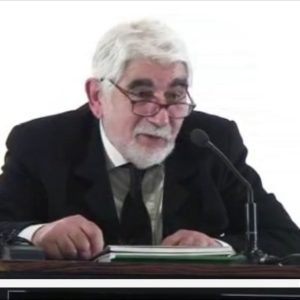

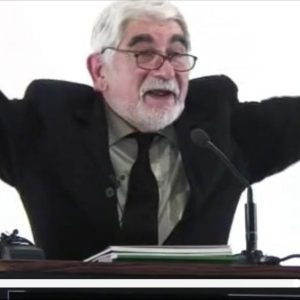
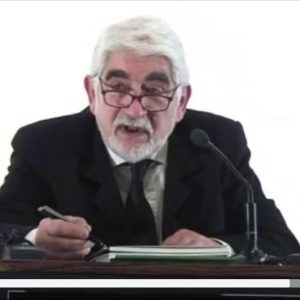
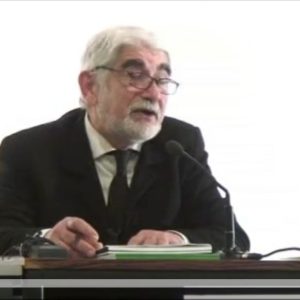
Jean-Albert Clergue-Vila,
‘In Quest Of Henry Corbin, The Chivalric Freemason’,
a BaglisTV 2011 Conference.
*
Coming soon
A Little Jean-Albert Clergue-Vila Sampler – Part 2:
‘In Quest of a Spirit of Chivalry’.
***
Leave a Reply