
Circle of Transmission: The Living Loom
Echoes of the Southern Court: A New Edition & Companion Guide to Jiang Baishi’s Seventeen Notated Ci
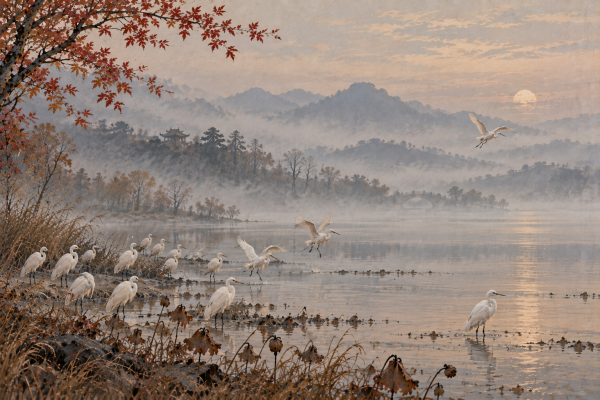
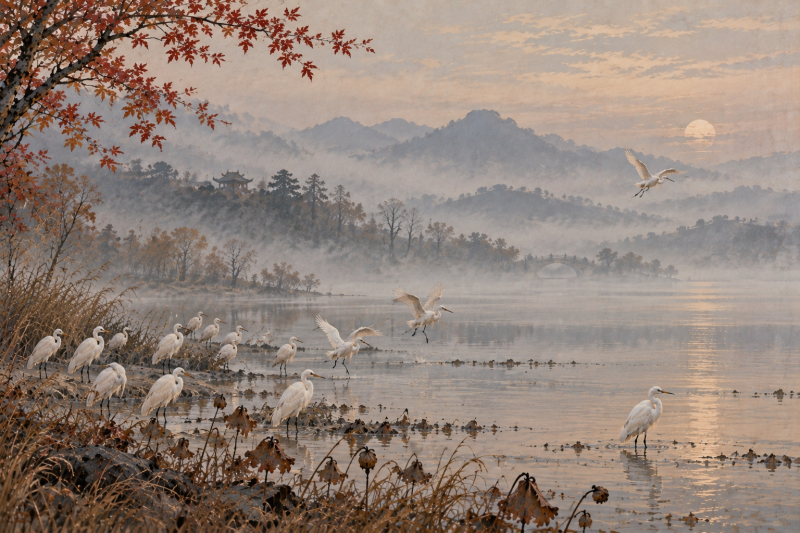
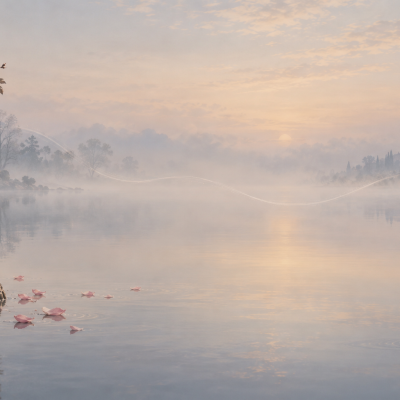
Featured Illustration Legend: Echoes of the Southern Court. The Eighteen Who Prepare to Depart, Seventeen CI (songs, melodies), and the poet who gave them voice.
In the autumn stillness of a remembered Southern Song landscape, eighteen white egrets gather upon the water. Seventeen evoke the surviving gongche-notated songs of Jiang Baishi; the solitary bird standing apart evokes the poet himself. Some remain upon the fading lotus waters, some prepare to rise, and one has already entered the open sky: a quiet image of Jiang Kui’s recurring world of departure, wandering, memory, and the impossibility of return.
Mist, distant mountains, the half-hidden pavilion and bridge, withered lotus and autumn leaves gather the landscapes of his poetry into a single remembered place. The vast interval of water is deliberate: it is the qingkong, the ‘clear and empty‘ space through which Jiang’s poetry allows grief to be perceived through absence, silence and suggestion. The birds are not leaving yet. They are preparing to leave. Between presence and disappearance, the seventeen songs—and the poet who composed them—remain suspended for one last moment in the landscape.
**
A Contextual Introduction
Jiang Kui (姜夔, c. 1155–c. 1221), courtesy name Yaozhang and widely known by his Daoist art name Baishi Daoren (“Master of the White Stone”), stands as one of the most singular figures in the history of Chinese literature and music. Living during the Southern Song dynasty, Jiang witnessed an era of profound cultural refinement shadowed by the trauma of the Jingkang Incident (1127), which forced the Song court to flee south of the Yangtze River, leaving the northern heartland under the control of the Jin dynasty.
Orphaned at a young age, Jiang never passed the imperial examinations, nor did he hold official office. Instead, he lived as an itinerant scholar, sustained largely through friendships and the patronage of prominent literati and officials such as Xiao Defu, Fan Chengda, and Zhang Zi. This life of itinerant scholarship, combined with his acute sensitivity to the fractured state of the empire, imbued his work with a pervasive, refined melancholy.
Jiang Kui’s significance extends beyond his poetry. He was a master calligrapher, a music theorist, and a composer. His collection, Baishi Daoren Gequ (Songs of Master of the White Stone), is a historical treasure: it is the only surviving Song dynasty collection of ci (lyric poetry) that includes original gongche musical notation. Of the seventeen notated pieces in this collection, the traditional classification identifies fourteen as ziduqu (self-composed songs where Jiang wrote both the melody and the lyrics) and three as works based on pre-existing melodies.
More recent scholarship has questioned this binary classification, particularly concerning Xinghua tianying (杏花天影) and Gexi meiling (鬲溪梅令), and proposes a broader distinction between twelve self-composed pieces and five works adapted from earlier musical materials. This edition acknowledges both positions while following the traditional ordering of the corpus.
Stylistically, Jiang’s ci poetry is celebrated for its qingkong (“clear and empty”) aesthetic. Unlike the dense, ornate style of some of his contemporaries, Jiang’s verse is characterized by ethereal elegance, restrained emotion, and a deliberate, almost haunting subtlety. As later critics noted, reading his work is “like viewing flowers through mist”—the imagery is vivid, yet the emotional turns are elusive, demanding deep engagement from the reader.
In 1957, the eminent musicologist Yang Yinliu, in collaboration with Professor Yin Falu, successfully transcribed Jiang’s gongche notation into modern staff notation. This monumental achievement allowed the modern world to hear, however approximately, the melodies that once accompanied these exquisite lyrics.
The present edition moves between three historical layers: the surviving Song texts and notation; their twentieth-century scholarly reconstruction, particularly the work of Yang Yinliu and Yin Falu; and the 1986 China Record Company vocal realization preserved on cassette. These layers should not be treated as identical: the modern transcription and recording are reconstructions and interpretations of the surviving medieval evidence.
This new edition and companion guide is eager to present the seventeen notated songs in a standardized textual form, ordered according to the 1986 China Record cassette sequence, which aligns with the foundational Yang-Yin scholarly transcription. Each entry provides the original Chinese text, a standardized Hanyu Pinyin transcription, a poetic English translation, and a detailed exegesis and literary-musical commentary.
*
1. 鬲溪梅令 (Géxī Méilìng) – The Plum Tune of Ge Creek
also recorded in some sources as 高溪梅令
Composed: 1196 CE | Form:Ziduqu
Original Text: 好花不与啼香人,浪粼粼。又恐春风归去绿成阴,玉钿何处寻?木兰双桨梦中云,水横陈。漫向孤山山下觅盈盈,翠禽啼一春。
Pinyin: Hǎo huā bù yǔ tí xiāng rén, làng lín lín. Yòu kǒng chūn fēng guī qù lǜ chéng yīn, yù diàn hé chù xún? Mùlán shuāng jiǎng mèng zhōng yún, shuǐ héng chén. Màn xiàng Gū shān shān xià mì yíng yíng, cuì qín tí yī chūn.
Translation: Lovely flowers do not grace the one who lingers for their fragrance; they fade and fall in the rippling waves. I fear the spring wind will return, turning the green to deep shade; where, then, shall the jade hairpins be sought? Magnolia oars row through the clouds of a dream, the water lying across the scene. Vainly I seek her graceful form at the foot of Solitary Hill; the emerald birds cry through all of spring.
Exegesis: “Ti” (啼) means to linger or be deeply attached. “Solitary Hill” (Gushan) is associated with the recluse Lin Bu. The poem captures the agony of seeking beauty that has already vanished, a quintessential qingkong moment. The textual variant 水横陈 (“water lying across”) is confirmed by the Yuding Cipu and other witnesses; the reading 小横陈 found in some modern editions is not supported by the standard textual tradition.
🎧[Listen to Recording: Track 1]
*
2. 杏花天影 (Xìnghuā Tiānyǐng) – Apricot Blossoms in Sky-shadow
Composed: 1187 CE (preface dated 1186–1187) | Form:Ziduqu
Original Text: 绿丝低拂鸳鸯浦,想桃叶、当时唤渡。又将愁眼与春风,待去;倚兰桡,更少驻。金陵路、莺吟燕舞。算潮水、知人最苦。满汀芳草不成归,日暮;更移舟,向甚处?
Pinyin: Lǜ sī dī fú yuān yāng pǔ, xiǎng Táo yè, dāng shí huàn dù. Yòu jiāng chóu yǎn yǔ chūn fēng, dài qù; yǐ lán ráo, gèng shǎo zhù. Jīn líng lù, yīng yín yàn wǔ. Suàn cháo shuǐ, zhī rén zuì kǔ. Mǎn tīng fāng cǎo bù chéng guī, rì mù; gèng yí zhōu, xiàng shèn chù?
Translation: Green silk threads hang low, brushing the Mandarin-Duck ford; I think of Peach Leaf, calling for the ferry in those days. Once again I lend my sorrow-laden eyes to the spring breeze, about to depart; leaning on the orchid oar, I linger a moment more. On the road to Jinling, orioles sing and swallows dance. I reckon the tidal waters know a man’s bitterness best. The fragrant grass covers the islet, preventing my return; dusk falls; I move my boat again—but to where?
Exegesis: “Peach Leaf” alludes to a Jin dynasty romance. The “fragrant grass” symbolizes lingering attachment trapping him in exile, ending in profound existential disorientation.
🎧[Listen to Recording: Track 2]
*
3. 醉吟商小品 (Zuì Yínshāng Xiǎopǐn) – Drinking and Singing: A Little Piece
Composed: 1191 CE | Form: Adaptation / transcription of an older melody
Original Text: 又正是春归,细柳暗黄千缕。暮鸦啼处,梦逐金鞍去。一点芳心休诉,琵琶解语。
Pinyin: Yòu zhèng shì chūn guī, xì liǔ àn huáng qiān lǚ. Mù yā tí chù, mèng zhú jīn ān qù. Yī diǎn fāng xīn xiū sù, pí pá jiě yǔ.
Translation: And just as spring returns again, the slender willows show a thousand threads of dark yellow. Where the evening crows call, in dream I follow the golden saddle and go. A little heart of fragrance—do not tell it; the pipa understands and speaks for me.
Exegesis: Jiang Kui’s own preface explains that he encountered a pipa player who knew the melody Zui Yinshang Hu Weizhou, obtained the pinxian method, and “translated” it into his notation. The surviving evidence is therefore more precise than “a Tang pipa melody”: Jiang encountered the melody in pipa performance and adapted/transcribed it into his own notational system. A gem of brevity (43 characters). The “fragrant heart” is a tender feeling too painful to speak aloud, entrusted instead to the pipa, highlighting Jiang’s belief in music expressing what language cannot.
🎧[Listen to Recording: Track 3]
*
4. 玉梅令 (Yùméi Lìng) – Jade Plum Tune
Composed: c. 1183 CE | Form: Lyrics by Jiang Kui; Music by Fan Chengda
Original Text: 疏疏雪片,散入溪南苑。春寒锁、旧家亭馆。有玉梅几树,背立怨东风,高花未吐,暗香已远。公来领略,梅花能劝。花长好、愿公更健。便揉春为酒,剪雪作新诗,拼一日、绕花千转。
Pinyin: Shū shū xuě piàn, sàn rù xī nán yuàn. Chūn hán suǒ, jiù jiā tíng guǎn. Yǒu yù méi jǐ shù, bèi lì yuàn dōng fēng, gāo huā wèi tǔ, àn xiāng yǐ yuǎn. Gōng lái lǐng lüè, méi huā néng quàn. Huā cháng hǎo, yuàn gōng gèng jiàn. Biàn róu chūn wéi jiǔ, jiǎn xuě zuò xīn shī, pīn yī rì, rào huā qiān zhuǎn.
Translation: Sparse, sparse snowflakes scatter into the southern garden stream; spring’s chill locks the old home’s pavilions and halls. There stand a few trees of jade plum, their backs turned, resentful of the east wind; the high blossoms have not yet opened, yet their hidden fragrance already reaches far. When you come, sir, to appreciate them, the plum blossoms themselves will persuade you to stay. May the flowers ever be fair, and may you, sir, grow healthier still. Then I will brew spring into wine, and cut snow into new verses, and pledge, for one whole day, to circle the flowers a thousand times.
Exegesis: A rare glimpse of warmth. “Brew spring into wine, and cut snow into new verses” is a masterpiece of poetic alchemy, celebrating friendship and winter plum blossoms.
🎧[Listen to Recording: Track 4]
*
5. 霓裳中序第一 (Níshāng Zhōngxù Dìyī) – The First Movement of the Rainbow-Garment Suite
Composed: c. 1186 CE | Form: Adaptation (Tang melody)
Original Text: 亭皋正望极,乱落江莲归未得。多病却无气力,况纨扇渐疏,罗衣初索。流光过隙,叹杏梁双燕如客。人何在?一帘淡月,仿佛照颜色。幽寂,乱蛩吟壁,动庚信清愁如织。沉思年少浪迹,笛里关山,柳下坊陌。坠红无信息,漫暗水、涓涓溜碧。漂零久,而今何意?醉卧酒垆侧。
Pinyin: Tíng gāo zhèng wàng jí, luàn luò jiāng lián guī wèi dé. Duō bìng què wú qì lì, kuàng wán shàn jiàn shū, luó yī chū suǒ. Liú guāng guò xì, tàn xìng liáng shuāng yàn rú kè. Rén hé zài? Yī lián dàn yuè, fǎng fú zhào yán sè. Yōu jì, luàn qióng yín bì, dòng Yǔ Xìn qīng chóu rú zhī. Chén sī nián shào làng jì, dí lǐ guān shān, liǔ xià fāng mò. Zhuì hóng wú xìn xī, màn àn shuǐ, juān juān liū bì. Piāo líng jiǔ, ér jīn hé yì? Zuì wò jiǔ lú cè.
Translation: From the waterside pavilion, I gaze to the farthest limit; scattered river lotuses fall, and I cannot return. Sickly and weak, with no strength left, and now the silk fan is gradually put aside, the thin gauze robe is first sought again. Time slips through a crack; I sigh that the paired swallows under the apricot beam are like visitors. Where is the one I seek? A curtain of pale moonlight seems to show her color, faintly. Deeply silent; crickets chant chaotically in the walls, stirring Yu Xin’s clear sorrow, woven like fabric. I muse on my wild wanderings in youth—the mountain passes in the flute’s notes, the lanes and streets beneath the willows. The fallen red blossoms bring no tidings; they vainly wash the floating green in the dark water. Long a drifter—what is my purpose now? Drunk, I lie by the wine-shop hearth.
Exegesis: Yu Xin was a 6th-century poet trapped in the north, the ultimate symbol of exile. Jiang bridges the cultural rupture of the Tang-Song transition, blending Tang musical grandeur with Southern Song intimate decay.
🎧[Listen to Recording: Track 5]
*
6. 扬州慢 (Yángzhōu Màn) – The Slow Tune of Yangzhou
Composed: 1176 CE | Form:Ziduqu
Original Text: 淮左名都,竹西佳处,解鞍少驻初程。过春风十里,尽荠麦青青。自胡马窥江去后,废池乔木,犹厌言兵。渐黄昏,清角吹寒,都在空城。杜郎俊赏,算而今重到须惊。纵豆蔻词工,青楼梦好,难赋深情。二十四桥仍在,波心荡、冷月无声。念桥边红药,年年知为谁生?
Pinyin: Huái zuǒ míng dū, Zhú xī jiā chù, jiě ān shāo zhù chū chéng. Guò chūn fēng shí lǐ, jìn jì mài qīng qīng. Zì Hú mǎ kuī jiāng qù hòu, fèi chí qiáo mù, yóu yàn yán bīng. Jiàn huáng hūn, qīng jiāo chuī hán, dōu zài kōng chéng. Dù láng jùn shǎng, suàn ér jīn chóng dào xū jīng. Zòng dòu kòu cí gōng, qīng lóu mèng hǎo, nán fù shēn qíng. Èr shí sì qiáo réng zài, bō xīn dàng, lěng yuè wú shēng. Niàn qiáo biān hóng yào, nián nián zhī wèi shuí shēng?
Translation: The famed capital of the Huai’s left, the lovely spot of Zhuxi, I slacken my saddle, pausing briefly at the journey’s start. Passing through ten li of spring breeze, all is overgrown with wild shepherd’s purse and green wheat. Since the barbarian horses gazed upon the river and withdrew, the abandoned moats and ancient trees still loathe to speak of war. As dusk draws near, a clear horn blows its chill, echoing through the empty city. Scholar Du, with his refined appreciation, were he to revisit this place today, would surely be startled. Even with his masterful “cardamom” verses, and his lovely dreams of green mansions, he could not now express such profound grief. The Twenty-Four Bridges still remain, but in the water’s heart, the cold moon sways in silence. I think of the red peonies blooming by the bridge—year after year, for whom do they grow?
Exegesis: “Hu ma” (barbarian horses) refers to the Jin cavalry. The personification of moats and trees loathing war projects human trauma onto the landscape. The final image of peonies blooming for no one highlights nature’s tragic indifference.
🎧[Listen to Recording: Track 6]
*
7. 长亭怨慢 (Chángtíng Yuàn Màn) – The Slow Lament of the Long Pavilion
Composed: c. 1191 CE | Form:Ziduqu
Original Text: 渐吹尽、枝头香絮,是处人家,绿深门户。远浦萦回,暮帆零乱向何许?阅人多矣,谁得似、长亭树。树若有情时,不会得、青青如此!日暮,望高城不见,只见乱山无数。韦郎去也,怎忘得、玉环分付。第一是早早归来,怕红萼、无人为主。算空有并刀,难剪离愁千缕。
Pinyin: Jiàn chuī jìn, zhī tóu xiāng xù, shì chù rén jiā, lǜ shēn mén hù. Yuǎn pǔ yíng huí, mù fān líng luàn xiàng hé xǔ? Yuè rén duō yǐ, shuí dé sì, cháng tíng shù. Shù ruò yǒu qíng shí, bù huì dé, qīng qīng rú cǐ! Rì mù, wàng gāo chéng bù jiàn, zhǐ jiàn luàn shān wú shù. Wéi láng qù yě, zěn wàng dé, yù huán fēn fù. Dì yī shì zǎo zǎo guī lái, pà hóng è, wú rén wéi zhǔ. Suàn kōng yǒu bīng dāo, nán jiǎn lí chóu qiān lǚ.
Translation: Gradually, the fragrant catkins are blown from the branch-tips; around the houses here, the willows grow deep green at the gates. The distant shore winds and turns; where do the scattered evening sails head in the dusk? It has seen many people depart, but who can compare to the trees of the Long Pavilion? If trees had feelings, they could not remain so lush and green! At sunset, I gaze toward the high city but cannot see it; I see only countless chaotic mountains. Scholar Wei is leaving now—how can I forget the command of the jade ring? “First and foremost, return early; I fear that for the red calyxes, there will be no one to care for them.” I reckon that even with the sharp Bingzhou blade, it is hard to cut these thousand strands of parting sorrow.
Exegesis: “If trees had feelings, they could not remain so lush and green!” is a cruel paradox: the trees are lush precisely because they are indifferent to human sorrow. A masterpiece of philosophical observation on parting.
🎧[Listen to Recording: Track 7]
*
8. 淡黄柳 (Dànhuáng Liǔ) – Pale Yellow Willow
Composed: 1191 CE | Form:Ziduqu
Original Text: 空城晓角,吹入垂杨陌。马上单衣寒侧侧。看尽鹅黄嫩绿,都是江南旧相识。正岑寂,明朝又寒食。强携酒、小桥宅。怕梨花落尽成秋色。燕燕飞来,问春何在,唯有池塘自碧。
Pinyin: Kōng chéng xiǎo jiǎo, chuī rù chuí yáng mò. Mǎ shàng dān yī hán cè cè. Kàn jìn é huáng nèn lǜ, dōu shì jiāng nán jiù xiāng shí. Zhèng cén jì, míng zhāo yòu hán shí. Qiáng xié jiǔ, xiǎo qiáo zhái. Pà lí huā luò jìn chéng qiū sè. Yàn yàn fēi lái, wèn chūn hé zài, wéi yǒu chí táng zì bì.
Translation: In the empty city, the morning horn blows into the lanes of weeping willows. On horseback, my single garment feels bitterly cold. Having seen all the goose-yellow and tender green, they are all old acquaintances from the south of the river. In this deep silence, tomorrow is again the Cold Food Festival. Forcing myself to carry wine to a small bridge residence. I fear the pear blossoms will fall completely, turning into autumn colors. The swallows fly in, asking where spring has gone; there is only the pond, green all by itself.
Exegesis: The empty city and morning horn evoke the frontier atmosphere of the Jianghuai region, while the “old acquaintances” of Jiangnan turn the spring landscape into an image of remembered belonging. The pond remaining “green all by itself” (zi bi) is a classic qingkong moment of nature’s indifferent persistence.
🎧[Listen to Recording: Track 8]
*
9. 石湖仙 (Shíhú Xiān) – Stone Lake Immortal
Composed: 1187 CE | Form: Lyrics by Jiang Kui; Music by Fan Chengda
Original Text: 松江烟浦,是千古三高,游衍佳处。须信石湖仙,似鸥夷、翩然引去。浮云安在?我自爱、绿香红舞。容与,看世间、几度今古?卢沟旧曾驻马,为黄花、闲吟秀句。见说胡儿,也学纶巾歌雨。玉友金蕉,玉人金缕,缓移筝柱。闻好语,明年定在槐府。
Pinyin: Sōng jiāng yān pǔ, shì qiān gǔ sān gāo, yóu yǎn jiā chù. Xū xìn Shí hú xiān, sì Chī yí, piān rán yǐn qù. Fú yún ān zài? Wǒ zì ài, lǜ xiāng hóng wǔ. Róng yǔ, kàn shì jiān, jǐ dù jīn gǔ? Lú gōu jiù céng zhù mǎ, wèi huáng huā, xián yín xiù jù. Jiàn shuō Hú ér, yě xué guān jīn qí yǔ. Yù yǒu jīn jiāo, yù rén jīn lǚ, huǎn yí zhēng zhù. Wén hǎo yǔ, míng nián dìng zài huái fǔ.
Translation: On the misty banks of the Pine River, there dwelt of old the Three Lofty Ones, a fine place to wander at ease. You must believe the Stone Lake Immortal, like Fan Li of old, has gracefully withdrawn from the world. Where are the floating clouds now? I myself love the green fragrance and red dance. Leisurely and at ease, I watch how many times the world has turned from ancient to modern! By the Lugou River, I once reined in my horse, for the yellow chrysanthemums, idly chanting elegant verses. I have heard it said that even the barbarian children now learn to wear the silk headscarf, tilted in the rain. Jade friends and golden goblets, a jade-like person with golden threads, slowly moving the zither’s bridges. Hearing good words, next year, you will surely be at the Huai court.
Exegesis: Fan Li (Chiyi Zipi) withdrew from politics to avoid execution. The “silk headscarf” detail suggests the cultural assimilation of the northern invaders. The final line expresses hope for Fan Chengda’s return to office, though the exact reference of 槐府 (“Huai court”) remains debated; the translation keeps close to the Chinese rather than imposing a specific institutional identification.
🎧[Listen to Recording: Track 9]
*
10. 暗香 (Ànxiāng) – Dark Fragrance
Composed: 1191 CE | Form:Ziduqu
Original Text: 旧时月色,算几番照我,梅边吹笛。唤起玉人,不管清寒与攀摘。何逊而今渐老,都忘却、春风词笔。但怪得、竹外疏花,香冷入瑶席。江国,正寂寂,叹寄与路遥,夜雪初积。翠尊易泣,红萼无言耿相忆。长记曾携手处,千树压、西湖寒碧。又片片、吹尽也,几时见得?
Pinyin: Jiù shí yuè sè, suàn jǐ fān zhào wǒ, méi biān chuī dí. Huàn qǐ yù rén, bù guǎn qīng hán yǔ pān zhāi. Hé Xùn ér jīn jiàn lǎo, dōu wàng què, chūn fēng cí bǐ. Dàn guài dé, zhú wài shū huā, xiāng lěng rù yáo xí. Jiāng guó, zhèng jì jì, tàn jì yǔ lù yáo, yè xuě chū jī. Cuì zūn yì qì, hóng è wú yán gěng xiāng yì. Cháng jì céng xié shǒu chù, qiān shù yā, Xī hú hán bì. Yòu piàn piàn, chuī jìn yě, jǐ shí jiàn dé?
Translation: The moonlight of old—how many times has it shone upon me, playing my flute beside the plum blossoms? It called forth the jade-like lady, who, heedless of the clear cold, plucked the blooms with me. He Xun now grows old; I have quite forgotten the poetic brush of spring winds. Yet I marvel at the sparse flowers beyond the bamboo, their cold fragrance drifting into my jade-inlaid mat. The river land is deeply silent; I sigh that the road to send them is far, and the night snow has just begun to pile. The emerald cup easily brings tears; the red calyxes, wordless, stubbornly recall the past. I long remember the place where we once held hands—a thousand trees pressing down upon the cold green of West Lake. Now petal after petal is blown away—when shall I see them again?
Exegesis: “Cold fragrance” is a synesthetic masterpiece. “A thousand trees pressing down upon the cold green of West Lake” is a visually overwhelming image of past beauty. The “dark fragrance” is the scent of memory itself.
🎧[Listen to Recording: Track 10]
*
11. 疏影 (Shūyǐng) – Sparse Shadows
Composed: 1191 CE | Form:Ziduqu
Original Text: 苔枝缀玉,有翠禽小小,枝上同宿。客里相逢,篱角黄昏,无言自倚修竹。昭君不惯胡沙远,但暗忆、江南江北。想佩环月夜归来,化作此花幽独。犹记深宫旧事,那人正睡里,飞近蛾绿。莫似春风,不管盈盈,早与安排金屋。还教一片随波去,又却怨玉龙哀曲。等恁时、重觅幽香,已入小窗横幅。
Pinyin: Tái zhī zhuì yù, yǒu cuì qín xiǎo xiǎo, zhī shàng tóng sù. Kè lǐ xiāng féng, lí jiǎo huáng hūn, wú yán zì yǐ xiū zhú. Zhāo Jūn bù guàn Hú shā yuǎn, dàn àn yì, Jiāng nán Jiāng běi. Xiǎng pèi huán yuè yè guī lái, huà zuò cǐ huā yōu dú. Yóu jì shēn gōng jiù shì, nà rén zhèng shuì lǐ, fēi jìn é lǜ. Mò sì chūn fēng, bù guǎn yíng yíng, zǎo yǔ ān pái jīn wū. Háo jiào yī piàn suí bō qù, yòu què yuàn Yù lóng āi qǔ. Děng nèn shí, chóng mì yōu xiāng, yǐ rù xiǎo chuāng héng fú.
Translation: Mossy branches adorned with jade; tiny emerald birds roost together upon them. Meeting you here, a stranger, at the corner of the fence in the dusk, you stand silently, leaning against the tall bamboo. Zhaojun, unaccustomed to the distant sands of the Hu, secretly remembers the rivers south and north. I fancy her jade pendants returning in the moonlit night, transformed into this flower, so lonely and pure. I still remember the old affairs of the deep palace: while that lady was sleeping, it flew near her moth-green eyebrows. Do not be like the spring wind, heedless of her delicate grace; early on, arrange a golden chamber for her. Yet it lets a single petal drift away with the waves, and then resents the mournful tune of the Jade Dragon. When that time comes, and you seek the hidden fragrance again, it will have already entered the painted scroll across the small window.
Exegesis: The poem layers several traditions of female beauty, exile, transformation, and remembrance: Wang Zhaojun’s homesickness for Jiangnan, the palace legend of Princess Shouyang and the plum blossom, and the image of the flower itself becoming a vessel of memory. Beauty is repeatedly threatened by distance, political displacement, and the passage of time. The “green bird spirit” (翠禽) evokes the legendary birds of the immortals, while the “Jade Dragon” (玉龙) is a flute tune associated with plum blossoms.
🎧[Listen to Recording: Track 11]
*
12. 惜红衣 (Xīhóngyī) – Cherishing the Red Garment
Composed: 1187 CE | Form:Ziduqu
Original Text: 枕簟邀凉,琴书换日,睡余无力。细洒冰泉,并刀破甘碧。墙头唤酒,谁问讯、城南诗客?岑寂,高柳晚蝉,说西风消息。虹梁水陌,鱼浪吹香,红衣半狼藉。维舟试望,故国渺天北。可惜渚边沙外,不共美人游历。问甚时同赋,三十六陂秋色?
Pinyin: Zhěn diàn yāo liáng, qín shū huàn rì, shuì yú wú lì. Xì sǎ bīng quán, bìng dāo pò gān bì. Qiáng tóu huàn jiǔ, shuí wèn xùn, chéng nán shī kè? Cén jì, gāo liǔ wǎn chán, shuō xī fēng xiāo xī. Hóng liáng shuǐ mò, yú làng chuī xiāng, hóng yī bàn láng jí. Wéi zhōu shì wàng, gù guó miǎo tiān běi. Kě xī zhǔ biān shā wài, bù gòng měi rén yóu lì. Wèn shèn shí tóng fù, sān shí liù bēi qiū sè?
Translation: On a bamboo mat, I invite the cool; trading zither and books to pass the day, I am weak after sleep. Finely sprinkling ice-cold spring water, with a Bingzhou knife, I slice the sweet green lotus. Calling for wine from the wall-top, who comes to inquire after the poet south of the city? In this deep silence, high willows and evening cicadas speak news of the west wind. Rainbow bridges and water paths, fish-waves blow fragrance, the red garments [lotus petals] lie half in disarray. Mooring my boat, I gaze afar—my homeland is distant, far in the northern sky. Alas, beyond the islet’s sands, I cannot wander with my fair one. I ask: when shall we together compose verses on the autumn colors of the Thirty-Six Ponds?
Exegesis: The “Bingzhou knife” is from the north, subtly bridging the geographical divide. “Guguo” (old homeland) refers to the lost northern territories. The “red garment” becomes a multivalent symbol: the lotus, a lost lover, and the lost northern homeland.
🎧[Listen to Recording: Track 12]
*
13. 角招 (Jiǎozhāo) – The Horn Call
Composed: 1194 CE | Form:Ziduqu
Original Text: 为春瘦,何堪更、绕西湖尽是垂柳。自看烟外岫,记得与君,湖上携手。君归未久,早乱落、香红千亩。一叶凌波缥缈,过三十六离宫,遣游人回首。犹有,画船障袖,青楼倚扇,相映人争秀。翠翘光欲溜,爱著宫黄,而今时候。伤春似旧,荡一点、春心如酒。写入吴丝自奏,问谁识、曲中心?花前友。
Pinyin: Wèi chūn shòu, hé kān gèng, rào Xī hú jìn shì chuí liǔ. Zì kàn yān wài xiù, jì dé yǔ jūn, hú shàng xié shǒu. Jūn guī wèi jiǔ, zǎo luàn luò, xiāng hóng qiān mǔ. Yī yè líng bō piāo miǎo, guò sān shí liù lí gōng, qiǎn yóu rén huí shǒu. Yóu yǒu, huà chuán zhàng xiù, qīng lóu yǐ shàn, xiāng yìng rén zhēng xiù. Cuì qiào guāng yù liù, ài zhe gōng huáng, ér jīn shí hòu. Shāng chūn sì jiù, dàng yī diǎn, chūn xīn rú jiǔ. Xiě rù Wú sī zì zòu, wèn shuí shí, qǔ zhōng xīn? Huā qián yǒu.
Translation: For the spring I grow thin; how can I bear it, when all around West Lake there is nothing but weeping willows? I gaze alone at the peaks beyond the mist, remembering how I held hands with you, my friend, upon the lake. You have not been gone long, yet already a thousand acres of fragrant red have fallen in chaos. A single leaf skims the waves, ethereal and distant, passing the Thirty-Six Detached Palaces, making the wanderer turn his head. Still there are painted boats hiding sleeves, and green towers where women lean on fans, reflecting each other, competing in beauty. Their kingfisher-feather hairpins are about to slip with brilliance; they love to wear the palace-yellow makeup—such is the fashion of this time. My sorrow for spring is as it was of old; stirring a single drop of spring-heart, intoxicating as wine. I write it into the Wu silk strings and play it for myself; I ask: who understands the heart within the tune? Only the friend before the flowers.
Exegesis: A beautiful exploration of male friendship and shared aesthetic sensibility. The vibrant, superficial beauty of the capital’s fashionable women serves as a foil to the deep, quiet sorrow shared between the two friends.
🎧[Listen to Recording: Track 13]
*
14. 徵招 (Zhǐzhāo) – The Call to Respond
Composed: c. 1201 CE | Form:Ziduqu
Original Text: 潮回却过西陵浦,扁舟仅容居士。去得几何时?黍离离如此。客途今倦矣,漫赢得、一襟诗思。记忆江南,落帆沙际,此行还是。迤逦,刘中山,重相见、依依故人情味。似怨不来游,拥愁鬓十二。一丘聊复尔,也孤负、幼舆高志。水荭晚,漠漠摇烟,奈未成归计。
Pinyin: Cháo huí què guò Xī líng pǔ, piān zhōu jǐn róng jū shì. Qù dé jǐ hé shí? Shǔ lí lí rú cǐ. Kè tú jīn juàn yǐ, màn yíng dé, yī jīn shī sī. Jì yì jiāng nán, luò fān shā jì, cǐ xíng hái shì. Yǐ lǐ, Liú Zhōng shān, chóng xiāng jiàn, yī yī gù rén qíng wèi. Sì yuàn bù lái yóu, yǒng chóu huán shí èr. Yī qiū liáo fù ěr, yě gū fù, Yòu yú gāo zhì. Shuǐ hóng wǎn, mò mò yáo yān, nài wèi chéng guī jì.
Translation: The tide turns back, passing once more the West Ling ford; a flat boat, barely large enough to hold a recluse. How long has it been since I left? The millet grows so lush and wild. I am weary of the traveler’s road now; all I have vainly gained is a breast full of poetic thought. I remember the south of the river, lowering the sail by the sandy shore—this journey is still the same. Winding on, the mountains of Shan; meeting them again, I feel the lingering affection of an old friend. They seem to resent that I do not come to wander among them, embracing their twelve sorrowful, cloud-like hair-buns. To occupy a single hill is but a temporary measure; yet I have also failed the lofty aspirations of Youyu. The water hibiscus is late; in the vast, misty distance, it sways in the smoke. Alas, I have not yet formed a plan to return.
Exegesis: “Shu li” alludes to the Book of Songs lamenting a ruined capital. “Youyu” (Xie Kun) was a scholar who loved mountains. Jiang confronts the paradox of his life: he writes beautifully about reclusion, yet remains a rootless wanderer. The dating of this piece to c. 1201 follows recent scholarship; the year 1194 belongs to Jiaozhao (No. 13).
🎧[Listen to Recording: Track 14]
*
15. 秋宵吟 (Qiūxiāo Yín) – Autumn Night Chant
Composed: c. 1191 CE | Form:Ziduqu
Original Text: 古帘空,坠月皎。坐久西窗人悄,蛩吟苦,渐漏水丁丁,箭壶催晓。引凉飔、动翠葆,露脚斜飞云表。因嗟念,似去国情怀,暮帆烟草。带眼销磨,为近日愁多顿老。卫娘何在?宋玉归来,两地暗萦绕。摇落江枫早,嫩约无凭,幽梦又杳。但盈盈、泪洒单衣,今夕何夕恨未了。
Pinyin: Gǔ lián kōng, zhuì yuè jiǎo. Zuò jiǔ xī chuāng rén qiāo, qióng yín kǔ, jiàn lòu shuǐ dīng dīng, jiàn hú cuī xiǎo. Yǐn liáng sī, dòng cuì bǎo, lù jiǎo xié fēi yún biǎo. Yīn jiē niàn, sì qù guó qíng huái, mù fān yān cǎo. Dài yǎn xiāo mó, wèi jìn rì chóu duō dùn lǎo. Wèi niáng hé zài? Sòng Yù guī lái, liǎng dì àn yíng rào. Yáo luò jiāng fēng zǎo, nèn yuē wú píng, yōu mèng yòu yǎo. Dàn yíng yíng, lèi sǎ dān yī, jīn xī hé xī hèn wèi liǎo.
Translation: The ancient curtain is empty; the fallen moon is bright. Long I sit by the west window, and all is silent. The crickets chant bitterly; gradually the water-clock drips ding-ding, and the clepsydra arrow urges the dawn. I draw in the cool breeze; the emerald canopies stir; dew-drops slant, flying beyond the clouds. Because of this, I sigh with thoughts like the feelings of one who has left his country, an evening sail in misty grass. My belt notch wears away, for recent sorrows have made me age suddenly. Where is Lady Wei? When Song Yu returns, the two places are secretly entwined in thought. The river maples fall early; the tender promise has no proof, and the hidden dream is once again distant. Only with brimming tears do I wet my single robe—tonight, what night is this, that my regret knows no end?
Exegesis: The mechanical dripping of the water-clock emphasizes the agonizing slowness of a sleepless night. “Belt notch wears away” signifies physical wasting from grief. A profound meditation on how personal heartbreak and national displacement become indistinguishable.
🎧[Listen to Recording: Track 15]
*
16. 凄凉犯 (Qīliáng Fàn) – The Desolate Melody
Composed: c. 1191 CE | Form:Ziduqu
Context: Written in Hefei, a militarized border city. Contrasts the bleak frontier with peaceful memories of West Lake in Hangzhou.
Original Text: 绿杨巷陌,秋风起、边城一片离索。马嘶渐远,人归甚处?戍楼吹角。情怀正恶,更衰草寒烟淡薄。似当年、将军部曲,迤逦度沙漠。追念西湖上,小舫携歌,晚花行乐。旧游在否?想如今、翠凋红落。漫写羊裙,等新雁来时系著。怕匆匆、不肯寄与,误后约。
Pinyin: Lǜ yáng xiàng mò, qiū fēng qǐ, biān chéng yī piàn lí suǒ. Mǎ sī jiàn yuǎn, rén guī shèn chù? Shù lóu chuī jiǎo. Qíng huái zhèng è, gèng shuāi cǎo hán yān dàn bó. Sì dāng nián, jiāng jūn bù qǔ, yǐ lǐ dù shā mò. Zhuī niàn Xī hú shàng, xiǎo fǎng xié gē, wǎn huā xíng lè. Jiù yóu zài fǒu? Xiǎng rú jīn, cuì diāo hóng luò. Màn xiě yáng qún, děng xīn yàn lái shí xì zhe. Pà cōng cōng, bù kěn jì yǔ, wù hòu yuē.
Translation: Green poplar lanes and streets; the autumn wind rises—the border city is a scene of utter desolation. The horse’s neigh fades into the distance; where does the man return to? From the garrison tower, the horn blows. My mood is deeply grim, heightened by the withered grass and the thin, cold mist. It is like the troops of the general in days of old, winding their long way across the desert sands. I look back in memory to West Lake: in a small boat, carrying songs, enjoying the late flowers. Are those old excursions still there? I imagine that now, the emerald has withered and the red has fallen. I idly compose a letter, waiting to tie it to the migrating wild geese when they arrive. But I fear that in their haste, they will refuse to carry it, and so my future promise will be broken.
Exegesis & Commentary: Captures the psychological state of the Southern Song literati: living in anxious proximity to a hostile frontier, while the cultural heart remains trapped in a fragile paradise to the south. The “Desolate Melody” is the sound of the border wind itself. The phrase 写羊裙 (xiě yáng qún) is an allusive reference to writing a letter or message, traditionally associated with the practice of inscribing text on cloth; the translation renders it as “compose a letter” to convey the intended meaning.
Performance Note: The standard scholarly text begins with 绿杨 (Lǜ yáng, “green poplar/willow”). However, the 1986 vocal recording features the synonymous variant 杨柳 (Yáng liǔ, “willow/poplar”). This slight alteration was likely made by the arranger or vocalist to better suit the melodic phrasing or vocal resonance, serving as a prime example of how living performance naturally interacts with fixed textual traditions.
🎧[Listen to Recording: Track 16]
*
17. 翠楼吟 (Cuìlóu Yín) – Chant of the Emerald Tower
Composed: 1186 CE | Form:Ziduqu
Original Text: 月冷龙沙,尘清虎落,今年汉初赐。新翻胡部曲,听毡幕元戎歌吹。层楼高峙,看槛曲萦红,檐牙飞翠。人姝丽,粉香吹下,夜寒风细。此地宜有词仙,拥素云黄鹤,与君游戏。玉梯凝望久,叹芳草蔓千里。天涯情味,仗酒披清愁,花销英气。西山外,晚来还卷、一帘秋霁。
Pinyin: Yuè lěng lóng shā, chén qīng hǔ luò, jīn nián Hàn pǔ chū cì. Xīn fān Hú bù qǔ, tīng zhān mù yuán róng gē chuī. Céng lóu gāo zhì, kàn jiàn qū yíng hóng, yán yá fēi cuì. Rén shū lì, fěn xiāng chuī xià, yè hán fēng xì. Cǐ dì yí yǒu cí xiān, yōng sù yún huáng hè, yǔ jūn yóu xì. Yù tī níng wàng jiǔ, tàn fāng cǎo qí qí qiān lǐ. Tiān yá qíng wèi, zhàng jiǔ fú qīng chóu, huā xiāo yīng qì. Xī shān wài, wǎn lái hái juǎn, yī lián qiū jì.
Translation: The moon chills the dragon sands, dust settles on the tiger moats; this year, the Han imperial banquet is first bestowed. Newly arranged are the tunes of the Hu region, I hear the singing and piping from the felt tents of the commander. The storied tower soars high; I gaze at the railings, curved and crimson, and the eaves’ teeth, flying emerald. The people are surpassingly fair; powder-fragrance drifts down in the cold, fine night wind. This place is fitting for an immortal of ci, embracing white clouds and the yellow crane, to wander and play with you, sir. Long I gaze from the jade stairs, sighing at the fragrant grass, lush and stretching a thousand li. The mood of the world’s end—I rely on wine to exorcise this clear sorrow, and flowers to dissolve my heroic spirit. Beyond the western hills, as evening comes, the clouds roll back, revealing a curtain of autumn clearing.
Exegesis: “Dragon sands” and “tiger moats” establish a martial, borderland atmosphere. The final image of the “autumn clearing” resolves the tension not with a conclusion, but with a lingering, sublime silence.
🎧[Listen to Recording: Track 17]
*
Conclusion
The seventeen gongche-notated songs of Jiang Baishi represent a singular apex in the history of Chinese literature and music. They are not merely poems set to music; they are unified works of art where text and melody were conceived in profound symbiosis.
Through this present edition & companion guide, several defining characteristics of Jiang’s genius become clear:
-
The Qingkong (Clear and Empty) Aesthetic: Jiang consistently avoids dense, ornate, or overtly political declarations. Instead, he relies on suggestion, negative space, and the personification of nature. His sorrow is never shouted; it is heard in the “dripping water-clock,” seen in the “broken willows dancing unevenly,” and felt in the “cold fragrance” of the plum blossom.
-
The Architecture of Memory: Jiang’s poems are deeply temporal. He constantly juxtaposes the vibrant, romanticized past (the Tang dynasty, the prosperous Yangzhou, youthful love) with the desolate, fragmented present of the Southern Song. This creates a pervasive, elegant melancholy that resonates with the historical trauma of his era.
-
The Musicality of Language: Even without the original gongche scores, the phonetic and rhythmic structure of Jiang’s ci is meticulously crafted. His use of tonal contrast, lingering vowels, and carefully paced caesuras contributes to a textual musicality that can still be felt even without hearing the original melodies.
Thanks to the pioneering transcription work of Yang Yinliu and Yin Falu in 1957, the modern world can begin to hear the echoes of these melodies. Yet, as this guided edition demonstrates, the preservation of Jiang Baishi’s work is an ongoing, living process.
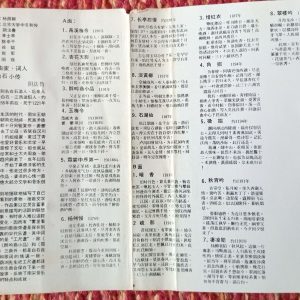
The physical survival of the 1986 China Record Company cassette provides a valuable auditory witness to the twentieth-century reception of these songs and documents the exact sequence in which the seventeen pieces were recorded.
Together, the ancient manuscripts and the modern recordings stand as a monumental testament to the power of art to preserve beauty, memory, and the human spirit in the face of historical collapse.
*
Appendix:
The 1986 Recording as Primary Source
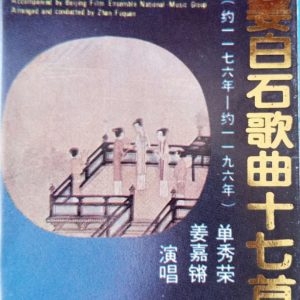
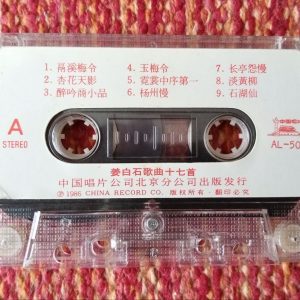
The auditory realization of these seventeen songs on the 1986 cassette release (China Record Company, Beijing Branch, Catalog AL-50) represents a significant collaboration between vocal artistry and orchestral arrangement. This physical artifact serves as the definitive primary source for the recording sequence analyzed in this edition.
Note on Formats: Scholars should note that while a widely circulated 1986 LP (Catalog DL-0253) features a purely instrumental arrangement of these songs, the cassette version (AL-50) is explicitly a vocal recording.
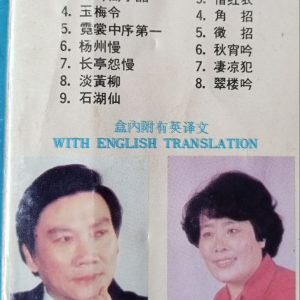
The cassette features two vocalists: Jiang Jiaqiang, tenor, and Shan Xiurong, soprano. Their voices are accompanied by the Beijing Film Ensemble National Music Group, with arrangements and conducting by Zhang Fuquan. Recorded by Xu Tao, the production balances the grandeur of the orchestral backing with the intimate, melancholic nuance of the lyrics.
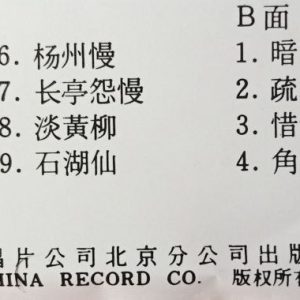
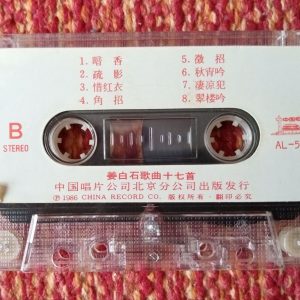
Verification of the Corpus: The printed tracklist on the physical cassette sleeve proved invaluable in correcting three major textual discrepancies found in secondary modern enumerations:
-
It confirmed the first track as 《鬲溪梅令》(Géxī Méilìng), correcting the common misreading of 《高溪梅令》(Gāoxī Méilìng).
-
It confirmed the fourteenth track as 《徵招》(Zhǐzhāo), correcting the misreading of 《微招》(Wēizhāo).
-
It confirmed the inclusion of 《淡黄柳》(Dànhuáng Liǔ) as the eighth track, proving that 《点绛唇》(Diǎnjiàng Chún) is not part of this specific seventeen-song gongche corpus.
Definitive Tracklist (Catalog AL-50):
Side A:
-
鬲溪梅令 (Géxī Méilìng)
-
杏花天影 (Xìnghuā Tiānyǐng)
-
醉吟商小品 (Zuì Yínshāng Xiǎopǐn)
-
玉梅令 (Yùméi Lìng)
-
霓裳中序第一 (Níshāng Zhōngxù Dìyī)
-
扬州慢 (Yángzhōu Màn)
-
长亭怨慢 (Chángtíng Yuàn Màn)
-
淡黄柳 (Dànhuáng Liǔ)
-
石湖仙 (Shíhú Xiān)
Side B:
-
暗香 (Ànxiāng)
-
疏影 (Shūyǐng)
-
惜红衣 (Xīhóngyī)
-
角招 (Jiǎozhāo)
-
徵招 (Zhǐzhāo)
-
秋宵吟 (Qiūxiāo Yín)
-
凄凉犯 (Qīliáng Fàn)
-
翠楼吟 (Cuìlóu Yín)
*
Discography
Jiang Jiaqiang (tenor) and Shan Xiurong (soprano). Seventeen Songs by Jiang Baishi [宋姜白石歌曲十七首]. Arranged and conducted by Zhang Fuquan. Performed by the Beijing Film Ensemble National Music Group. Transcribed by Yang Yinliu; literary advisor Yin Falu; English translation by Li Shiting; edited by Chen Xingping; recorded by Xu Tao. China Record Company, Beijing Branch, AL-50, 1986. Cassette.
*
Bibliography
Primary Sources
Jiang, Kui 姜夔. Jiang Baishi Ji 姜白石集 [Collected Works of Jiang Baishi]. Edited by Xia Chengtao 夏承焘. Beijing: Zhonghua Shuju, 1981.
——. Baishi Daoren Gequ 白石道人歌曲 [Songs of Master of the White Stone]. Sibu Congkan edition. Shanghai: Commercial Press, 1929.
Musicological Studies and Transcriptions
Qiu, Qionsun 丘琼荪. Baishi Daoren Gequ Tongkao 白石道人歌曲通考 [Comprehensive Study of the Songs of Master of the White Stone]. Beijing: Renmin Yinyue Chubanshe [People’s Music Publishing House], 1959.
Thrasher, Alan R. “Jiang Kui.” In Grove Music Online. Oxford University Press. Accessed September 24, 2026.
Yang, Yinliu 杨荫浏, and Yin Falu 阴法鲁. Song Jiang Baishi Chuangzuo Gegu Yanjiu 宋姜白石创作歌曲研究 [Studies of the Songs Composed by Jiang Baishi of the Song Dynasty]. Beijing: Yinyue Chubanshe [People’s Music Publishing House], 1957.
Literary and Historical Context
Xia, Chengtao 夏承焘. Jiang Baishi Ci Bianian Jianjiao 姜白石词编年笺校 [Chronological Annotations of Jiang Baishi’s Ci]. Beijing: Zhonghua Shuju, 1961.
Yin, Falu 阴法鲁. Yin Falu Xueshu Lunwen Ji 阴法鲁学术论文集 [Collected Academic Papers of Yin Falu]. Beijing: Zhonghua Shuju, 2008.
*
Editorial Note
This present edition & companion guide follows the 1986 China Record Company cassette sequence (AL-50) as its ordering principle, which aligns with the foundational Yang-Yin transcription of 1957. The Chinese text is standardized according to the Sibu Congkan edition of Baishi Daoren Gequ and Xia Chengtao’s 1961 critical edition, with significant variants noted in the exegesis where relevant. The Pinyin follows the standard Hanyu Pinyin system with tone marks.
The translations aim for fidelity to the Chinese while maintaining poetic readability; interpretive expansions are confined to the exegesis. The classification of the seventeen pieces follows the traditional division of fourteen ziduqu and three adaptations, with the scholarly dispute over Xinghua tianying and Gexi meiling acknowledged in the introduction.
Finally, our present endeavour is offered not as a definitive critical text—which would require a full apparatus collating all surviving witnesses—but as a standardized, annotated guided presentation of the seventeen songs for scholars, performers, and general readers. It is hoped that this work will contribute to the ongoing appreciation and study of Jiang Kui’s extraordinary legacy.
*
Source
***
Related Articles


Leave a Reply