
Circle of Transmission: The Living Loom
Wittgenstein And Bergson At The Café: A Via-HYGEIA Bibliotherapy-Book Review of Michael Robert Osborne’s ‘The Rosicrucian Death’
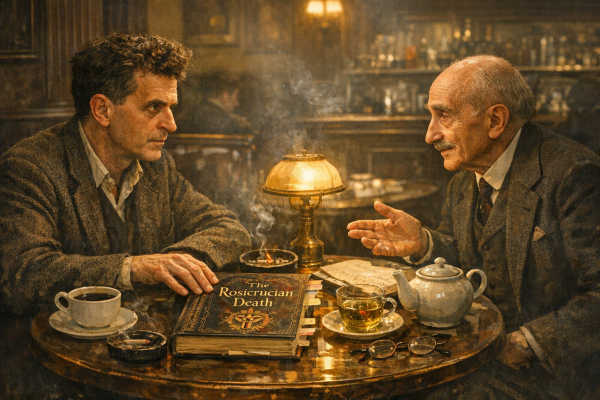
Wittgenstein and Bergson at the café,
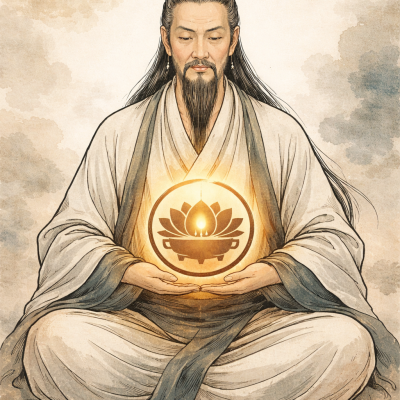
a symbolic representation
*
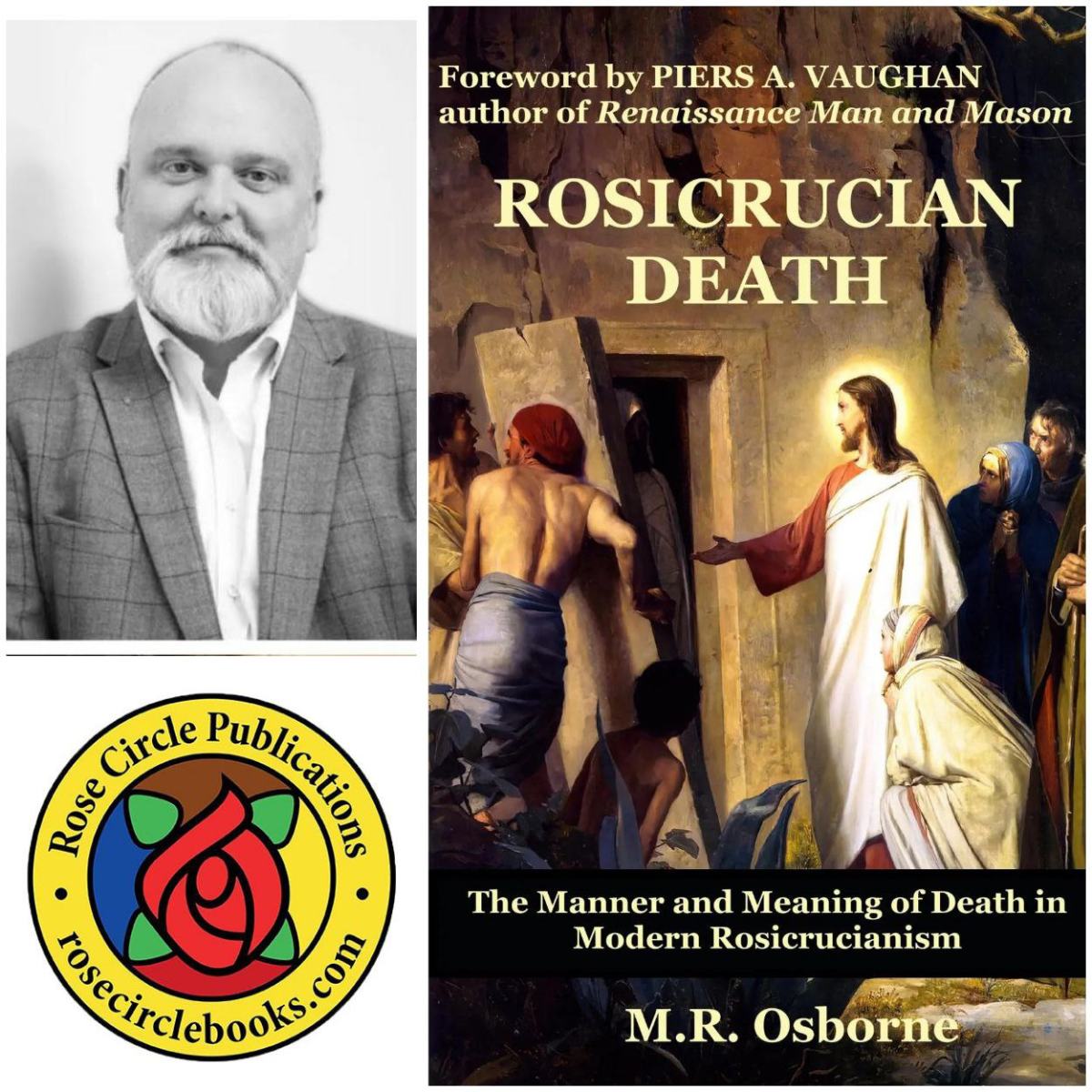
Today’s sharing from the Blue House of Via-HYGEIA is our review of Michael Robert Osborne’s ‘The Rosicrucian Death: The Manner and Meaning of Death in Modern Rosicrucianism‘, published in 2025 by Rose Circle Publications—a treasure trove of Piers A. Vaughan.
Vaughan’s foreword and Osborne’s own chapters provide a solid, accessible introduction to Rosicrucianism: its key manifestos (Fama, Confessio, Chymical Wedding) and influential figures—Christian Rosenkreutz, Jacob Boehme, Martinez de Pasqually, and many others. It serves as a good primer for those new to the subject.
To serve our purpose, we propose an unexpected pairing, some may say, but which illuminates Osborne’s book’s tensions beautifully: a dialogue between Ludwig Wittgenstein and Henri Bergson. Their philosophical opposition creates productive friction: Wittgenstein the linguistic skeptic, Bergson the intuitive vitalist. And now, let us travel to Vienna, where in a café, they are about to begin…
**
‘The Rosicrucian Death’:
A Philosophical Dialogue
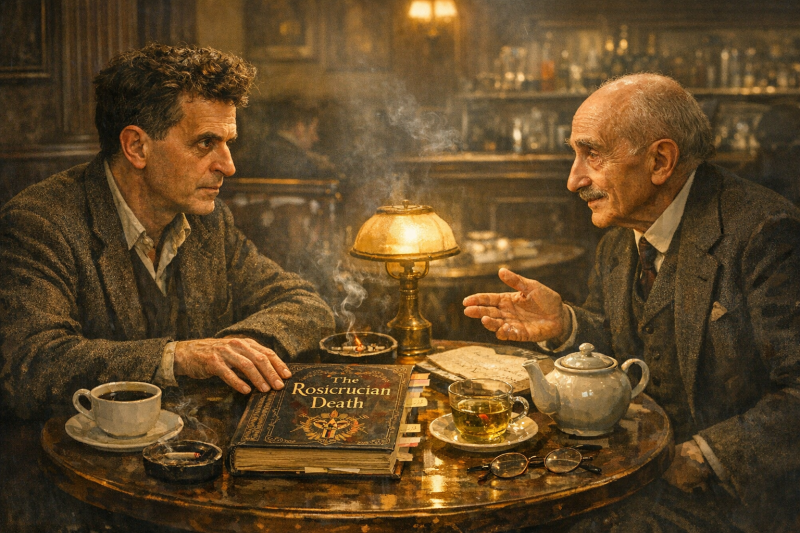
Setting: A timeless dimly lit Viennese café. Wittgenstein nurses black coffee; Bergson, herbal tea. Between them lies Osborne’s book, pages marked, margins disputed.
WITTGENSTEIN (tapping the cover): ‘The manner and meaning of death’. Already we stumble. What manner? What meaning? These words wear disguises. We think we speak of death, yet we speak only of how the living arrange their pictures of death. The book is rich with pictures—alchemical colors, Kabbalistic trees, vaults and resurrections. But I ask: do these illuminate, or do they merely decorate our terror?
BERGSON (smiling): You would dissolve death into grammar, Ludwig. Yet Osborne’s ‘manner‘ is precisely what your analysis misses—the durée, the lived flow of transformation. Death as nigredo, as albedo—this is not taxonomy but intuition. The alchemist felt the blackening in his bones, not in his definitions. The book succeeds when it abandons your ‘language games‘ and dwells in the élan vital of grief itself. The author weeping for his father-in-law—there, meaning lives.
WITTGENSTEIN: The weeping I grant you. The tears are real; the interpretation is construction. ‘Ray’s death was an alchemical dissolution‘—this is a move in a language game, not a discovery. Osborne plays multiple games simultaneously: Christian mysticism, quantum physics, parapsychology. But games have rules. When he says Korotkov’s Kirlian photography ‘proves‘ the subtle body, he confuses grammar. ‘Proof‘ in physics and ‘proof‘ in spiritual discourse—the family resemblance is thin.
BERGSON: You mistake metaphor for failed literalism. The Kirlian image is not evidence in your sense but symbol—a point of convergence between the measurable and the ineffable. Osborne’s daring lies here: he refuses your rigid borders between science and mysticism. Duration flows beneath both. The ‘resurrection body’ is not a hypothesis to be verified but a direction of spiritual becoming. Your ‘Tractatus’—’whereof one cannot speak, thereof one must be silent‘—Osborne answers: one must sing, one must weep, one must transform.
WITTGENSTEIN (leaning forward): And yet he does speak. Endlessly. The vault of Christian Rosenkreutz, the sephirotic ascent, dark matter as divine imprint. Where is the silence that would respect the mystery? Your élan vital risks becoming mere verbosity dressed as intuition. When Osborne writes that death is ‘the ultimate Magnum Opus‘, what is this but a comforting picture? I do not say false. I say: what work does this picture do? For whom? The grieving find structure, yes—but structure is not truth.
BERGSON: Structure is truth when truth is process! The Kabbalistic Tree is not a map of heaven but a technique of transformation. Osborne’s ‘Middle Way‘—between dogma and materialism—this is the creative evolution of consciousness itself. Your later philosophy, your ‘forms of life‘, admits as much: meaning arises in practice, in the doing. The Rosicrucian practices dying. The alchemy is the activity, not the ontology.
WITTGENSTEIN: Praxis, then. I accept this shift. The book as manual, not metaphysics. The ‘alchemy of grief’ as method for the bereaved—this I can endorse without endorsing the cosmology. But Osborne wants both. He wants to say that consciousness survives, not merely that the belief consoles. Here he overreaches. ‘Where is the evidence?‘ the skeptic asks. ‘In the NDEs, the DMT visions, the quantum vacuum‘, he replies. But this is not evidence; this is analogy masquerading as argument.
BERGSON: Your skepticism is itself a form of life, Ludwig—a rather austere one. Osborne’s analogies work. They transform. The reader who emerges from his chapters on the ‘void‘ of grief has undergone something. Your ‘picture theory‘ cannot account for this becoming. The resurrection body is not a prediction but a telos—the direction of creative duration toward greater complexity, greater love. Even your ‘language games‘ evolve, do they not?
WITTGENSTEIN (quietly): They evolve, yes. And I confess: the book’s personal thread—Ray’s dying, the author’s vigil—this moves me where the symbolism does not. Here language strains against its limits and something genuine emerges. ‘The alchemy of grief‘—as description of lived experience, not metaphysical claim—I can almost accept.
BERGSON: Almost! You are too cautious, my friend. Osborne’s integration of science and mysticism is not confusion but courage. The quantum physicist and the Kabbalist both point toward a reality that exceeds mechanical description. Your silence is reverent, yes, but also sterile. The mystic speaks because silence alone is insufficient for transformation.
WITTGENSTEIN: And the mystic’s speech—does it communicate or merely express? Osborne’s book expresses beautifully. Whether it communicates truth about death—that which, by definition, none have returned to report—this I doubt. But I will say: for those who share his form of life, his ‘showing‘ may suffice where ‘saying‘ fails. The book is not philosophy. It is therapy for a particular spiritual condition.
BERGSON: Therapy, poetry, mystical exercise—call it what you will. The ‘Rosicrucian Death‘ succeeds as duration made text. It asks not ‘what is death?‘ but ‘how might we die well?‘ In this, Osborne honors the deepest vocation of philosophy—not analysis but wisdom.
WITTENSTEIN (rising): Wisdom! You are generous, Henri. I leave you with this: the book is a ladder. For some, it leads upward. For others, it is beautiful woodwork. The wise reader knows when to throw it away.
BERGSON: And the wiser reader knows that some ladders are worth climbing, even—especially—when the top rung dissolves into light.
[They depart. The book remains, pages fluttering.]
*
A Closing Note:
The Tension as Testament
The dialogue between Wittgenstein and Bergson, staged across a Viennese café table, is not merely a critical device—it is the book’s own secret structure made audible. ‘Rosicrucian Death‘ lives precisely in the friction between these two imperatives: the mystical hunger to speak the unspeakable, and the philosophical duty to know the limits of speech.
Michael Robert Osborne’s balancing act is everywhere visible. When he writes of the ‘resurrection body‘, he reaches toward Wittgenstein’s ladder—yet constructs it with Bergsonian care, rung by rung, through alchemical color and Kabbalistic ascent. When he cites Korotkov’s Kirlian photography, he courts the danger both philosophers warned against: the confusion of analogy with evidence, of metaphor with mechanics. Yet even here, there is honesty in the overreach. The book does not disguise its longing. It wants desperately to believe that science and mysticism converge, that quantum non-locality rhymes with divine omnipresence, that the ‘subtle body‘ leaves traces in photographic emulsion. This wanting is itself a manner of death—the death of pure skepticism, the death of the merely material.
Wittgenstein would insist: whereof one cannot speak, thereof one must be silent. Osborne answers, in effect: whereof one cannot speak, thereof one must transform. The silence is not empty; it is the alchemical vessel, the vas hermeticum, in which grief becomes gold. Bergson would recognize this immediately. The élan vital does not pause for verification. It flows through the book’s most personal passages—Ray’s dying, the author’s vigil, the ‘shape of absence‘—carrying meaning not as proposition but as duration, as lived time thick with significance.
What emerges from this tension is not resolution but practice. The book is finally a manual for the bereaved, a techne of transformation. Its value lies not in what it proves but in what it performs: the alchemical operation upon the reader’s own fear of annihilation. Wittgenstein’s later philosophy, with its ‘forms of life‘ and ‘language games‘, might finally accommodate this—if we understand Rosicrucianism not as failed science but as living grammar, a way of going on in the face of death.
Osborne walks his rope suspended between two abysses: the silence of the mystic and the chatter of the charlatan. That he remains upright—that the book achieves moments of genuine poise and beauty—is testament to the seriousness of his intent. The rope is frayed in places; the wind of scientific skepticism blows hard. Yet the walker persists, arms outstretched, toward a light he cannot fully describe but refuses to abandon.
In the end, ‘Rosicrucian Death‘ asks to be read not as philosophy nor as science, but as invocation. It calls upon the dead and the living to recognize their continuity. Whether this call is ‘true‘ in any verifiable sense may be the wrong question—perhaps Wittgenstein’s question. Whether it transforms, whether it opens the heart to its own alchemical fire—this is Bergson’s question, and Osborne’s own.
The book stands, finally, as a ladder that wants to be climbed. For those who share Osborne’s form of life, his spiritual grammar, the ascent yields genuine insight. For others, it offers at minimum a respectful portrait of how humans have always faced the ultimate threshold: not with knowledge, but with symbol, with ritual, with love. Wittgenstein would throw the ladder away at the top; Bergson would build another, and another, into infinite duration. Osborne does both, simultaneously. This is his courage, and his limitation.
We close where we began: with death itself, that which no review, no dialogue, no book can finally capture. Yet in the attempting—in the beautiful, flawed, human attempt—something is won. Not certainty. Not proof. But manner. The manner of dying well. The manner of grieving well. The manner of speaking where silence threatens, and falling silent where words betray.
This is the Rosicrucian gift, and Michael Robert Osborne has transmitted it, however imperfectly, however personally, with genuine care. The vault remains sealed. The light within still burns. Whether we enter is, finally, our own initiation.
Memento mori.
Memento transformari…
*
Source
***
Related Articles


Leave a Reply