
Circle of Transmission: The Living Loom
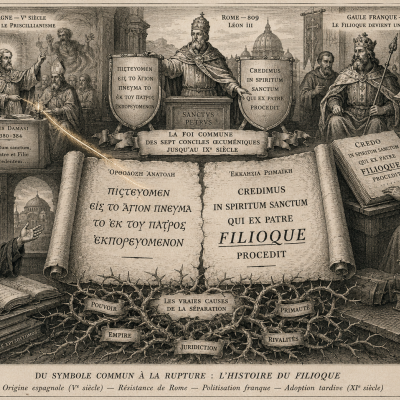
Two Christian Shields of Faith: Logic, Mystery, and the Trinitarian Divide – A sequel to the history of the Filioque controversy.
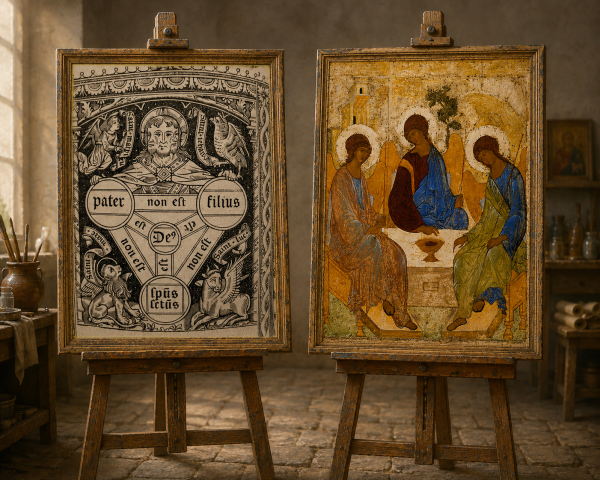
Figure: The two Shields of Faith together, these images illustrate the great divergence of the Christian East and West. The Western Shield seeks to define the mystery to protect the doctrine (Orthodoxy as right belief). The Eastern Icon seeks to reveal the mystery to transform the believer (Orthopraxy as right worship). One is a closed logical loop; the other is an open circle of love.
*
Today’s sharing from the Blue House of Via-Hygeia is a sequel to the history of the Filioque controversy we have just published. If yesterday’s text traced the words that divided Christendom, today’s images reveal the worldviews that shaped them. We present a side-by-side encounter between the Western Scutum Fidei and Andrei Rublev’s Trinity: the importance of visual communication serving different aims, coming from two different ontological visions.
On one side, the Scholastic mind of the medieval West uses the diagram as a logical fortress. Here, visual communication serves the aim of definition. It seeks to arrest heresy by mapping the boundaries of truth, turning theology into a precise science where God is understood through essence and law. It is a shield that protects the intellect by saying, “This is what you must believe.”
On the other, the Hesychast heart of the Orthodox East uses the icon as a mystical window. Here, visual communication serves the aim of communion. It seeks to heal the soul by inviting the viewer into the mystery, turning theology into a lived experience where God is known through relationship and love. It is a shield that protects the spirit by whispering, “This is how you must live.”
Together, they remind us that how we choose to see God often reveals more about our deepest values than how we choose to define Him. One defends the truth of the doctrine; the other defends the life of the believer. Both are essential, yet their divergence explains why the same faith could build both the university and the monastery, both the legal contract and the open table.
**
The Two Shields of Faith:
Logic, Mystery, and the Trinitarian Divide
In the aftermath of the Great Schism of 1054, as the theological rift between Rome and Constantinople deepened over the Filioque clause, the two halves of Christendom developed distinct visual languages to defend the same mystery: the Holy Trinity. While the West forged a shield of logic and definition, the East raised a shield of mystery and communion. These two traditions are best embodied by the medieval Scutum Fidei (Shield of the Trinity) and Andrei Rublev’s iconic Trinity. Though separated by centuries and culture, both images serve as ‘shields of faith‘ (scutum fidei, referencing Ephesians 6:16), yet they protect the doctrine in fundamentally different ways—one by defining the boundaries of truth, the other by inviting the believer into its heart.
*
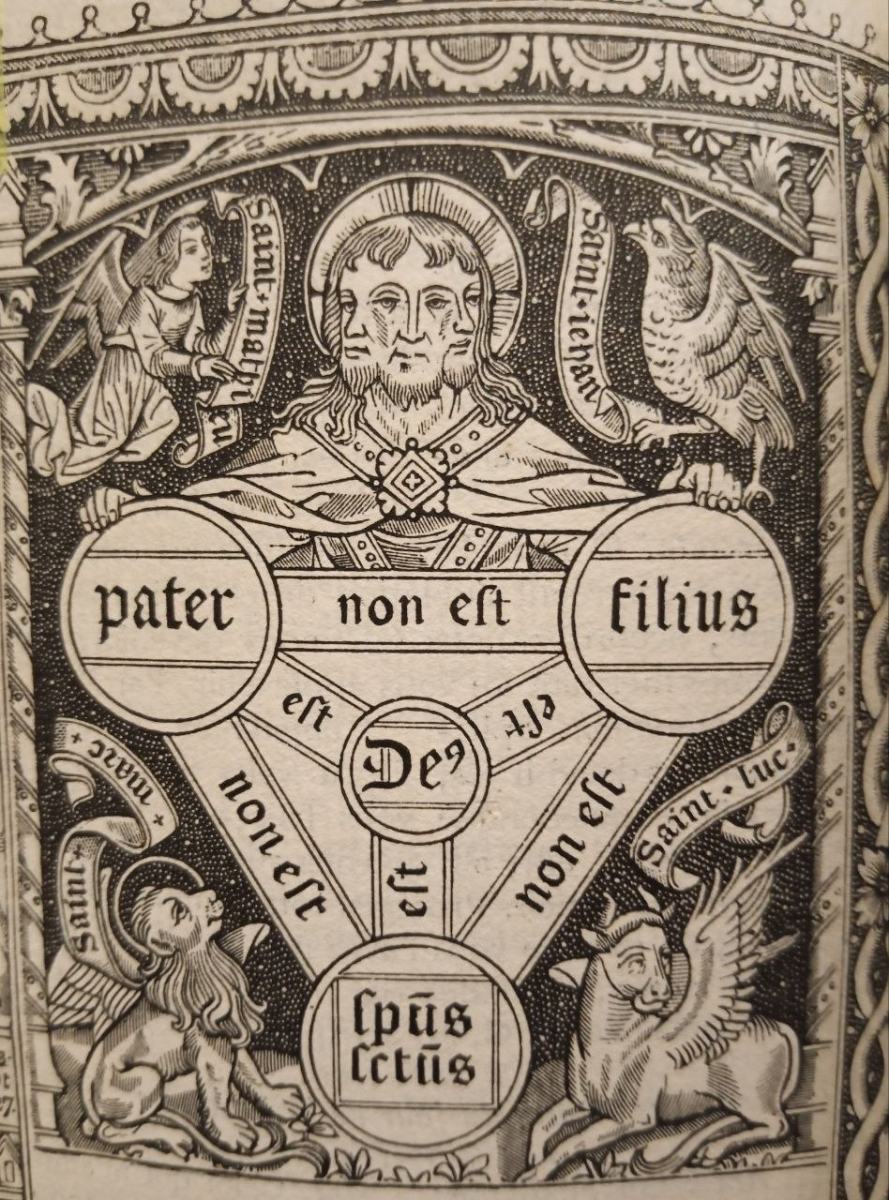
1. The Western Shield: A Logical Fortress
Context: The University, the Scholastic Mind, and the Defense of Definition (c. 1200–1400)
The Scutum Fidei did not emerge in a vacuum; it was born in the bustling lecture halls of the emerging universities of Paris and Oxford. The 13th century was the age of Scholasticism, a movement that sought to reconcile faith with reason, believing that the logical structures of the human mind could reflect the logical order of God’s creation. In this intellectual climate, theology was not merely a matter of prayerful contemplation but a rigorous science (scientia divina). The Church faced persistent theological challenges: Arianism (which denied the full divinity of Christ), Modalism (which claimed the Father, Son, and Spirit were just different ‘masks‘ of one person), and Tritheism (the belief in three separate gods). The faithful needed a tool that was not just beautiful, but airtight.
The Mechanics of the Diagram: The genius of the Scutum Fidei lies in its reduction of complex metaphysics to a binary logical code. It functions as a visual syllogism:
- The Center (Deus): Represents the Ousia (Essence). In Western thought, following Augustine, the unity of God is the primary truth. The center is the anchor; without it, the persons float in isolation.
- The Radiating Lines (Est): These lines assert identity. ‘The Father is God’. This is an ontological claim: the Person possesses the fullness of the Divine Essence. There is no hierarchy of being here; the Father is not ‘more God‘ than the Son.
- The Peripheral Lines (Non Est): These lines assert distinction. ‘The Father is not the Son’. This guards against Modalism. It creates a boundary, a ‘fence‘ around each person.
This structure creates a closed logical loop. Every possible relationship is accounted for. There is no ambiguity, no gray area. For the medieval student, memorizing this diagram was akin to memorizing a legal contract; it defined the exact boundaries of orthodoxy. To step outside the lines was heresy.
The Theological Bias: Essence over Person While the diagram successfully defends against heresy, its structure reveals a distinct Western theological priority: Essence precedes Person.
- The Central ‘Deus’: By placing ‘God‘ (the Essence) in the center, the diagram visually suggests that the ‘God-ness‘ is the core reality, and the Persons are relations within that reality.
- Symmetry and the Filioque: The diagram is perfectly symmetrical. The Father, Son, and Spirit are equidistant from the center and from each other. This visual equality supports the Latin doctrine of the Filioque. If the Son is fully God (connected to the center) and the Spirit is fully God, and they are co-equal, then logically, the Spirit’s procession must involve the Son just as much as the Father. The symmetry implies that the Father and Son act as a single principle (una principium) in the spiration of the Spirit.
- The Risk of Abstraction: Critics, particularly from the East, argue that this central circle risks becoming a “fourth thing”—an abstract divine substance that exists behind or above the three persons. It turns the Trinity into a mathematical equation of 1+1+1=1, rather than a living family.
A Fortress for the Mind: Ultimately, the Scutum Fidei is a fortress. It is static, defensive, and intellectual. It was often found in the margins of legal texts, on stained glass windows (like a coat of arms), and in catechisms. Its purpose was to exclude error. It tells the believer: “If you believe these twelve propositions, you are safe; if you deny one, you are outside the walls.” It reflects a Christianity that values correct doctrine (orthodoxy in the sense of right opinion) as the primary path to salvation. It is a shield that protects the mind from confusion, ensuring that the concept of God remains pure, even if the mystery itself remains distant.
*
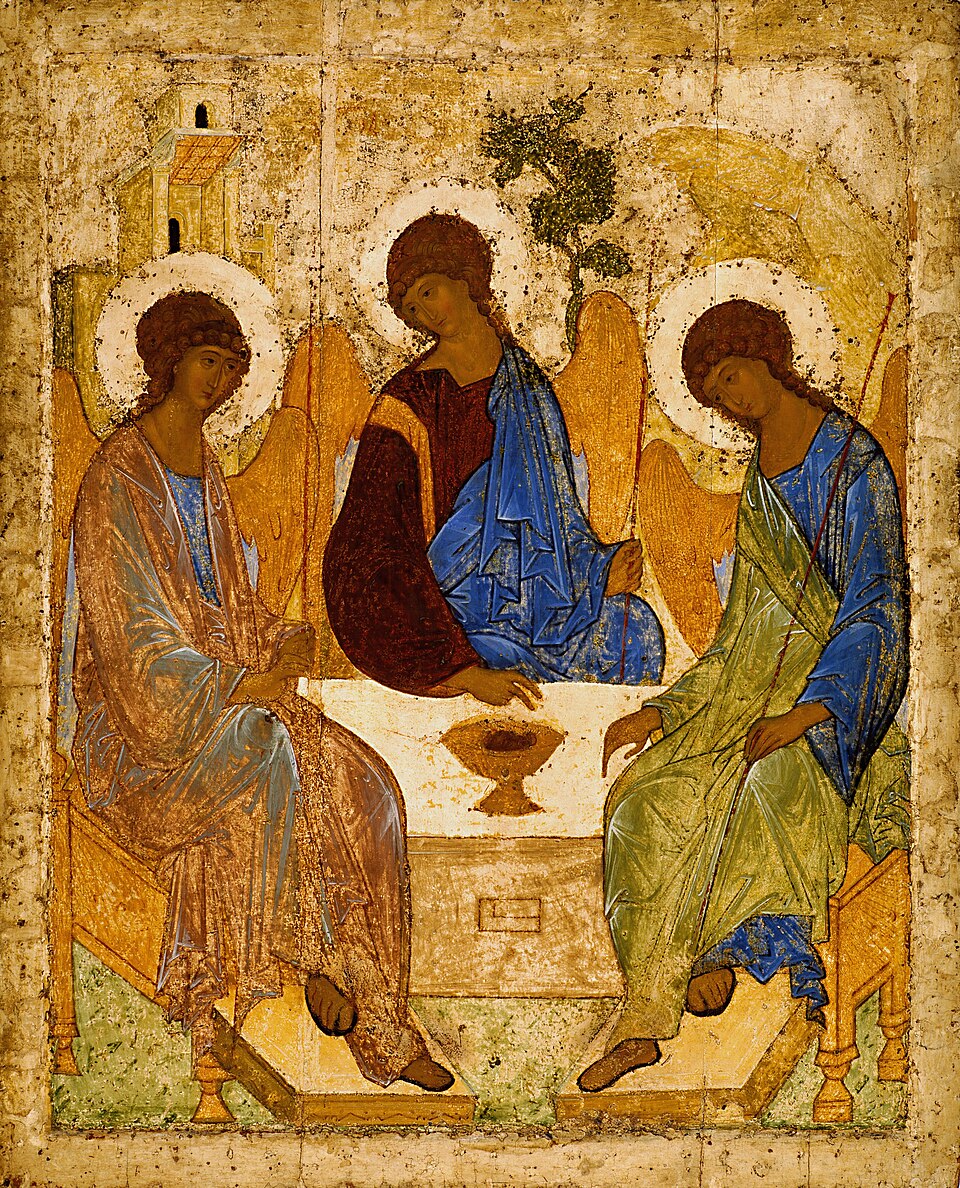
2. The Eastern Shield: A Window into Communion
Context: The Monastery, the Hesychast Heart, and the Healing of History (c. 1411)
In stark contrast to the bustling universities of the West, Andrei Rublev painted his Trinity in the stillness of the Trinity-St. Sergius Lavra, a monastery north of Moscow. The early 15th century in Russia was a time of immense suffering: the land was fractured by civil war among Russian princes and devastated by the raids of the Tatar Khanate. In this context, theology was not an academic exercise but a matter of survival and healing. St. Sergius of Radonezh, the spiritual father of Russia, had taught that the Trinity was the antidote to the world’s hatred and division. Rublev’s icon was commissioned not to define God, but to manifest God’s presence as a source of peace in a broken world.
The Mechanics of the Icon: Rublev’s masterpiece operates on the principles of inverse perspective and symbolic color, designed to draw the viewer into a spiritual reality rather than depict a physical one.
-
The Circle of Perichoresis: The three angels are arranged in a subtle circle, created by the inclination of their heads and the lines of their bodies. This is not a static geometric shape but a dynamic movement. They lean into one another, embodying perichoresis (mutual indwelling). They are distinct, yet their boundaries seem to dissolve into a unified motion of love.
-
The Absence of a Center: Unlike the Western diagram, there is no central circle labeled ‘God‘. The center of the composition is the chalice containing the sacrificial lamb. This shifts the focus from what God is (Essence) to what God does (Love/Sacrifice). The ‘essence‘ of God is revealed only in the self-giving love between the persons.
-
The Asymmetry of Love: The figures are not symmetrical.
- The Father (Left): Dressed in shimmering, uncreated light (gold/purple), he blesses the cup. He is the source, the Arché.
- The Son (Center): Dressed in earth (red) and heaven (blue), he inclines his head to the Father in obedience, accepting the cup. His finger points to the cup, indicating his role as the one who accomplishes salvation.
- The Spirit (Right): Dressed in the color of life (green) and heaven (blue), he rests his hand on the table, completing the circle. He proceeds from the Father, bringing life to the world.
This asymmetry visually affirms the Monarchy of the Father: the Father is the sole source, yet the three are perfectly united in will and action. There is no Filioque here; the Spirit’s relation to the Son is one of harmony, not origin.
The Empty Space: An Invitation to Theosis The most radical element of Rublev’s icon is the empty space at the front of the table. The table is open toward the viewer.
- The Fourth Seat: In the Western diagram, the viewer stands outside the shield, looking in. In Rublev’s icon, the viewer is invited to sit. The circle is incomplete without humanity. This reflects the Orthodox doctrine of Theosis: salvation is not just believing correct things about God, but entering into the life of the Trinity.
- Historical Healing: Painted during a time of civil war, this open table was a prophetic statement. Just as the Trinity is a unity of distinct persons, so too must fractured Russia become one. The icon was a ‘shield‘ not by keeping enemies out, but by transforming the hearts of those who gazed upon it. It offered a vision of kenotic love (self-emptying love) as the only true defense against violence.
A Window for the Heart: Rublev’s Trinity is a window. It is dynamic, inviting, and experiential. It was placed on the iconostasis (the screen of icons in church), where it served as a meeting point between heaven and earth during the liturgy. Its purpose was not to exclude error through definition, but to include the believer through transformation. It reflects a Christianity that values right worship (orthopraxy) and mystical union as the primary path to truth. It is a shield that protects the soul from despair, offering a vision of divine love that is strong enough to heal the deepest wounds of history. Where the Western shield says, “Believe this and be safe,” the Eastern icon whispers, “Enter here and live.”
*
3. The Divergence of Mentalities: Essence vs. Person
When placed side by side, these two ‘shields‘ reveal the depth of the schism that the Filioque controversy both caused and symbolized. This visual divergence points to a deeper theological starting point.
The Western diagram begins with the One Essence (the central Deus), from which the three persons derive their equality. This logical priority of ‘Essence‘ naturally leads to the Filioque: if the Son shares the exact same essence as the Father, He must logically share the Father’s role as the source of the Spirit. The diagram risks, as Orthodox critics note, turning ‘Divine Essence‘ into a fourth, abstract entity—a container behind the persons—rather than recognizing the persons as the only reality.
Rublev’s icon, however, begins with the Person of the Father. In the icon, there is no abstract ‘Essence‘ floating in the center; God exists only as Father, Son, and Spirit in relationship. For the Orthodox, the Western diagram’s focus on abstract unity obscures the hypostatic (personal) reality of God. The East insists that the Father is the sole source (arche), and any diagram that implies a symmetrical equality of origin distorts the Trinity’s inner life.
*
Conclusion
Ultimately, both images are faithful attempts to grapple with the ineffable. The Scutum Fidei defends the truth of the Trinity, ensuring that the mind does not err in its concepts. Rublev’s Trinity defends the life of the Trinity, ensuring that the heart does not stray from communion. The tragedy of the schism is that the Church eventually treated these shields as mutually exclusive, forgetting that the mystery of God is vast enough to be both defined by logic and experienced by love. In re-examining them together, we see that the fullness of the Christian faith requires both: the clarity of the diagram to keep our thinking straight, and the beauty of the icon to keep our souls alive.
*
Glossary of Key Concepts
To fully appreciate the theological depth of these two images, the following terms are essential:
- Apophatic Theology: A theological approach (prominent in the East) that describes God by negation—stating what God is not—rather than by positive definitions. It emphasizes mystery and the limits of human reason, contrasting with the Western cataphatic (positive) approach seen in the Scutum Fidei.
- Athanasian Creed (Quicunque Vult): A Latin statement of faith from the 5th/6th century that rigorously defines the Trinity and the Incarnation. It is the textual basis for the Scutum Fidei and explicitly includes the Filioque clause. It is accepted in the West but not used in the Orthodox Church.
- Essence (Ousia): The fundamental nature or substance of God. In Western theology (and the Scutum Fidei), the unity of ousia is often the starting point. The diagram’s central ‘Deus‘ represents this shared essence.
- Filioque: Latin for ‘and the Son’. A clause added to the Nicene Creed in the West, stating that the Holy Spirit proceeds from the Father and the Son. This addition was a primary cause of the Great Schism, as the East maintains the Spirit proceeds from the Father alone.
- Hypostasis (pl. Hypostases): Often translated as ‘Person‘. In Trinitarian theology, it refers to the distinct reality of the Father, Son, and Holy Spirit. Eastern theology emphasizes the hypostases as the primary reality, whereas Western theology often starts with the ousia (essence).
- Monarchy of the Father: The Orthodox doctrine that the Father is the sole source (arche) or origin of the Son and the Holy Spirit. This preserves the distinctiveness of the persons and rejects the idea of two sources (Father and Son) for the Spirit.
- Perichoresis: A Greek term meaning ‘mutual indwelling‘ or ‘interpenetration‘. It describes how the three persons of the Trinity dwell in one another without confusion. Rublev’s icon visually depicts this through the circular composition and the inclined heads of the angels.
- Scutum Fidei: Latin for ‘Shield of Faith‘. Originally a biblical metaphor (Ephesians 6:16), it became the name of the medieval Trinitarian diagram used in the West to defend orthodoxy against heresy.
- Theosis: The Orthodox concept of salvation as ‘deification‘ or becoming partakers of the divine nature. It is not just legal forgiveness but a transformative union with God, which is the ultimate goal of contemplating Rublev’s Trinity.
- Trinitarianism: The central Christian doctrine that God exists as three persons (Father, Son, Holy Spirit) but is one being. Both the Scutum Fidei and Rublev’s Trinity are attempts to visualize this mystery, though they prioritize different aspects (logical unity vs. relational communion).
*
Selected Bibliography & Further Reading
I. Primary Sources & Historical Texts
- The Athanasian Creed (Quicunque Vult). The direct textual source for the Scutum Fidei. Available in Creeds of Christendom by Philip Schaff.
- Peter of Poitiers. Compendium Historiae in Genealogia Christi (c. 1208–1216). The manuscript containing the earliest known attestation of the Shield of the Trinity.
- The Nicene-Constantinopolitan Creed (381 AD). The original creed without the Filioque, essential for understanding the ‘Monarchy of the Father’.
II. On the Scutum Fidei (The Western Shield)
- Coulton, G. G. Art and the Reformation. Cambridge University Press, 1928. (Classic text on medieval didactic diagrams).
- Pastoureau, Michel. Figures et Couleurs: Étude sur la symbolique et la sensibilité médiévales. Le Léopard d’Or, 1986. (Explains the Western turn to geometric/heraldic forms).
- ‘Shield of the Trinity’. Wikipedia / The Full Wiki. (Excellent summary of manuscript attestations and heraldic use).
III. On Rublev’s Trinity (The Eastern Shield)
- Ouspensky, Leonid. Theology of the Icon. Vol. 1 & 2. St. Vladimir’s Seminary Press, 1992. (Definitive Orthodox framework on icons as ‘windows‘).
- Florensky, Pavel. Iconostasis. St. Vladimir’s Seminary Press, 1996. (Analysis of ‘reverse perspective‘ and spatial theology).
- Hennessy, Martin. Andrei Rublev: The Artist and His World. Thames & Hudson, 2023. (Historical context on the Tatar invasions and St. Sergius).
- Mathews, Thomas F. The Clash of Gods: A Reinterpretation of Early Christian Art. Princeton University Press, 1993.
IV. Comparative Theology & The Filioque
- Ware, Kallistos (Timothy). The Orthodox Church. Penguin Books, 1997. (Clear explanation of the Schism and Filioque).
- Lossky, Vladimir. In the Image and Likeness of God. St. Vladimir’s Seminary Press, 1974. (Key distinction between Scholastic and Mystical theology).
- Meyendorff, John. Byzantine Theology: Historical Trends and Doctrinal Themes. Fordham University Press, 1974.
- Pelikan, Jaroslav. The Christian Tradition: A History of the Development of Doctrine. Vol. 2 & 3. University of Chicago Press, 1974–1989. (Balanced historical overview).
- Zizioulas, John D. Being as Communion: Studies in Personhood and the Church. St. Vladimir’s Seminary Press, 1985. (Advanced reading on Person vs. Essence).
***
Leave a Reply