The Spanish Origin of the Filioque
by Eugène Mangenot
[Page 1]
One of the most serious reproaches that the Greek Orthodox Church still makes today against the Roman Church is the dogma of the procession of the Holy Spirit ex utroque (from both) and the insertion of the word Filioque after “procedentem ex Patre” in the Niceno-Constantinopolitan Creed. Recently (1895), Patriarch Anthimus, in his synodal letter responding to Pope Leo XIII’s encyclical Præclara (20 June 1891), opposed on this point the faith of the Church of the seven ecumenical councils to the belief of the “Papist Church.” Mgr Duchesne, member of the Institut, replied to the synodal letter of the Patriarch of Constantinople.¹ His Beatitude had to acknowledge that the Roman Church had not introduced this addition itself. Indeed, the insertion of the Filioque into the Creed occurred in Spain around the 6th century; it was accepted in Gaul and sung at Mass under Charlemagne. However, Rome refrained. The procession of the Holy Spirit ex Filio is not affirmed² in the profession of faith of Pope Pelagius I (555–561). Although it is expressly taught³ by St. Gregory the Great (590–601),
Footnotes: ¹ Églises séparées, Paris, 1896, p. 73–87. ² Pat. Lat., t. LXIX, col. 409; Hahn, Bibliothek der Symbole, 3rd ed., Breslau, 1894, p. 331; Monumenta Germaniæ, Epist. Merovingici et Karolini ævi, Berlin, 1892, t. III, p. 78. ³ Moralia in Job, l. I, n. 30, Pat. Lat., t. LXXV, col. 511; l. V, n. 65, col. 715; Homil., XXVI, in Evangel., n. 2, Pat. Lat., t. LXXVI, col. 1198. Cf. Pat. Lat., t. LXXVII, col. 145.
[Page 2]
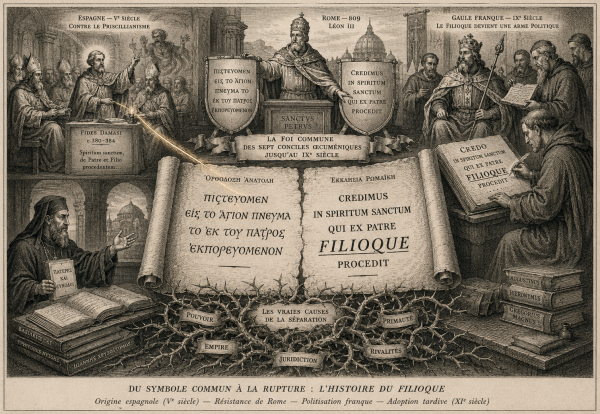
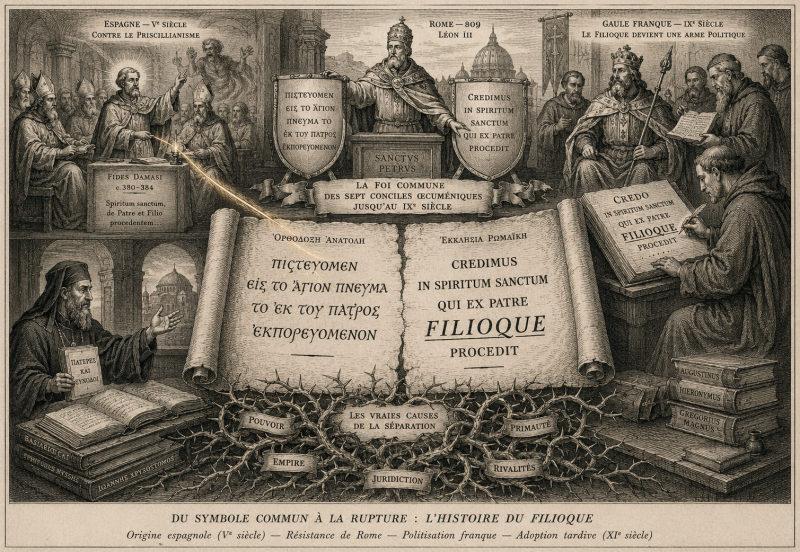
the formula is deliberately omitted from the profession of faith issued by Pope Agatho in 680.¹ During the conflict stirred up in Jerusalem between the indigenous monks and the Frankish religious concerning the Filioque, Pope Leo III (795–816) sent to the monks, in 809, the authentic formula of the Roman Church, which did not yet contain the Filioque, since it was apparently conformed to that contained in the Gelasian Sacramentary;² a few months later, he declared to Charlemagne’s missi dominici that he regretted the insertion of the Filioque into the Creed, and he advised gradually abandoning the custom of singing the Creed at Mass. The text he had posted, in Greek and Latin, at the confession of St. Peter’s in Rome, preserved the wording common to Rome and the Greek Church.³ The custom of singing the Creed at Mass was not introduced in Rome until the 11th century. The insertion of the Filioque, first tolerated in Spain and Gaul, thus ended up being accepted in Rome.
However, the doctrine of the procession of the Holy Spirit ex utroque was explicitly taught by the Latin Fathers of the 4th century, and notably by St. Augustine.⁴ As for the oldest explicit formula of the procession ex Patre et Filio, it was found until now in a profession of faith drawn up by a Spanish synod of the 5th century. The collections of the councils of Spain attributed it to the First Council of Toledo, held in 400.⁵ But for a long time it has been noted that this attribution raised serious difficulties. The introduction of the document declares that this rule of faith was made by the bishops of four ecclesiastical provinces of Spain and sent by them, along with an order from Pope St. Leo, to Balconius, bishop of Galicia. Now St. Leo did not ascend the Chair of St. Peter until 440. The Spanish bishops, gathered in council in 400, could not therefore have sent to their colleague Balconius a writing from this pope.
Footnotes: ¹ Pat. Lat., t. LXXXVII, col. 1165. ² Muratori, Liturgia romana vetus, t. I, p. 540; reproduced by Migne, Pat. Lat., t. LXXIV, col. 1089–1090. ³ Mgr Duchesne, Le Liber pontificalis, Paris, 1892, t. II, p. 46, note 110. Cf. Hergenröther, Theologische Quartalschrift, 1858, p. 606, 611. See however Pat. Lat., t. CII, col. 1031. ⁴ Franzelin, Tractatus de Deo trino secundum personas, th. XXXV, 3rd ed., Rome, 1881, p. 493–509; A. Harnack, Dogmengeschichte, 2nd ed., Leipzig, 1888, t. II, p. 294 sq. ⁵ Mansi, Concil., t. III, col. 1003. It was formerly attributed to St. Augustine. See Serm., CCXXXIII, Pat. Lat., t. XXXIX, col. 2175–2176.
[Page 3]
Baronius conjectured that this rule of faith was only drafted at the Council of Toledo in 447. Quesnell demonstrated this. Pagi and Mansi recognized it. Dom Ceillier¹ explicitly attributes it to him. The Ballerini brothers supposed that in 400 it did not contain the Filioque, which was only added in 447 due to the fifteenth letter of St. Leo to Turibius, bishop of Astorga, in which the procession ex utroque was formally affirmed.² Quesnell had already made this hypothesis. Hefele³ categorically assigned this rule of faith to the Second Council of Toledo (447). But Dom Gams⁴ found no historical trace of this council, which he definitively erased from the list of Spanish synods. Rösler⁵ maintained the date of 400. Since he noted that earlier the poet Prudentius had affirmed in his verses the procession ex utroque, he concluded that this doctrine was current in Spain at that time, and that consequently, the bishops gathered in 400 could well have formulated it in their profession of faith. But Prudentius⁶ does not explicitly use the term procedens. Thus Merkle⁷ vigorously maintained the attribution of the confession of faith to the synod of 447. Dom Morin⁸ arrived at quite different results. According to him, this profession of faith is neither from the synod of 400 nor from that of 447. Far from being an official rule of faith, it is merely the private work of Pastor, bishop of Galicia in 433. Thus the existence of the plenary Council of Toledo in 447 can be legitimately contested.
Footnotes: ¹ Histoire générale des auteurs sacrés et ecclésiastiques, Paris, 1747, t. XIV, p. 625. ² Pat. Lat., t. LIV, col. 681. Mgr Macaire, bishop of Vinnitza and rector of the Ecclesiastical Academy of St. Petersburg, Théologie dogmatique orthodoxe, trans. French, Paris, 1860, claimed that the Filioque was interpolated later in the rule of faith of the Council of Toledo of 447. Cf. Franzelin, Examen doctrinæ Macarii Bulgakow… de processione Spiritus sancti, Rome, 1876, p. 81. ³ Conciliengeschichte, 2nd ed., Freiburg-im-Breisgau, 1875, t. II, p. 78, 306–307. Cf. Denzinger, Enchiridion, n. 113; Franzelin, Tractatus de Deo trino, 3rd ed., Rome, 1881, p. 511. ⁴ Kirchengeschichte Spaniens, Regensburg, 1864, t. IIa, p. 475 sq. ⁵ Der katholische Dichter Aurelius Prudentius Clemens, Freiburg-im-Breisgau, 1886, p. 366 sq. ⁶ Cathimeron, IV, 14, 15; VI, 4–8, Pat. Lat., t. LIX, col. 812, 831–832. ⁷ “Das Filioque auf dem Tolelanum 447,” in Theologische Quartalschrift, Tübingen, 1893, p. 408–429. ⁸ “Pastor et Syagrius, deux écrivains perdus du Ve siècle,” in Revue bénédictine, 1893, t. X, p. 385–390.
[Page 4]
Mr. Karl Künstle, professor of theology at the University of Freiburg-im-Breisgau, taking up and confirming all the old doubts, has just demonstrated that this synod did not take place.¹ A contemporary bishop, Hydatius Lemicus (427–468), in his Chronicle,² does not speak of this council. Merkle has indeed tried to explain this gap by the chronicler’s silence on other councils of the era. His silence is explained by his purpose, which was not to write a universal and complete church history. But writing the ecclesiastical history of Spain, he could not remain silent about a council that would have taken place in Toledo in 447 against the Priscillianists. He notes for that year a Council of Rome, whose decrees were brought to Spain by Pervincus, deacon of Astorga. Moreover, the fifteenth letter of St. Leo to Turibius of Astorga, which orders the holding of a council, is not authentic. It was fabricated by a Spanish cleric after the Council of Braga in 563, in which Bishop Lucretius, 120 years after the event, affirmed the existence of an anti-Priscillianist rule of faith, drafted in Toledo and sent to Balconius, bishop of Braga. This baseless affirmation would also have incited the compiler of the councils of Spain to attribute to the synod of 400 the profession of faith drafted by Bishop Pastor. Not all of Mr. Künstle’s arguments against the existence of the council of 447 are irrefutable, and his critique made Father d’Alès dizzy, who raised serious objections against him.³ It remains proven, however, that the regula fidei, which was attributed to this council and which contained, it was believed until now, the first attestation of the Filioque, is the private work of Pastor, bishop of Galicia. The famous formula: “a Patre Filioque procedens” would therefore nevertheless be of Spanish provenance.
But Mr. Künstle, whose critique is not exclusively negative, has shown that the Libellus in modum symboli of Pastor was not the oldest testimony of this formula. He found the procession of the Holy Spirit a Patre et Filio attested by a series of Spanish and anti-Priscillianist documents, some of which predate the rule of faith of the bishop of Galicia. We will list them in chronological order of their publication.
Footnotes: ¹ Antipriscilliana, Freiburg-im-Breisgau, 1905, p. 30–35. ² Monumenta Germaniæ, Auctores antiquissimi, Berlin, 1894, t. XI, p. 24. ³ d’Alès, Études, 5 February 1906, p. 407.
[Page 5]
One of the oldest is the Fides Damasi.¹ We read there: “Credimus… Spiritum sanctum, non genitum neque ingenitum, non creatum neque factum, sed de Patre et Filio procedentem, Patri et Filio coæternum et coæqualem et cooperatorem.” This document has not yet been thoroughly studied. Comparing it with other Spanish documents from the 5th century, Mr. Künstle very clearly shows its anti-Priscillianist scope; it resembles them in ideas and expressions. Like them, it is of Spanish origin. The title is not false, however: it correctly links this profession of faith to Pope St. Damasus. Not, undoubtedly, that this pontiff is its author; but it is legitimate to think that the Synod of Saragossa in 380 had sent this formula, which condemned the errors of Priscillian, to Rome. The pope approved it and added the conclusion: “Hæc lege, hæc retine, huic fidei animam tuam subjuga. A Christo domino et vitam consequeris et præmium.” Thus it dates back to the interval from 380 to 384.
If one compares the Fides Damasi with the Damasene formulas or the Fides Romanorum I and II, with the Fides Phœbadii, with the Libellus fidei ad Theophilum found in the pseudo-Vigilius, De Trinitate, IX—documents which are almost textually identical—one notes that it served as the source for all of them. It is original and has a particular stamp. The other documents depend on it and seek to reproduce the same order of ideas in a much more popular form and to conform the Fides Damasi to the Apostles’ Creed and that of Nicaea. Burn and Kattenbusch think that the bishop of Agen is truly the author of the Fides which bears his name. In 392, Phoebadius was still alive, but old and decrepit. If, at the end of his life, this ardent adversary of Arianism had drafted a profession of faith, it would have been anti-Arian. Now the Fides Phœbadii is anti-Priscillianist. The author is therefore rather an anti-Priscillianist.
Footnotes: ¹ Edited for the first time by Burn, An Introduction to the Creeds, London, 1898, p. 215, then by Mr. Künstle himself, Eine Bibliothek der Symbole, Mainz, 1900, p. 10, and Antipriscilliana, p. 47–49. The codex Augiensis XVIII entitles it: Fides beati Hieronymi presbyteri.
[Page 6]
Although related to the Fides Damasi, these latter documents did not reproduce the words concerning the procession of the Holy Spirit ex utroque, although they imply the doctrine. It is the same with the profession of faith of the Spanish monk Bachiarius, from the beginning of the 5th century, and with that attributed to Pelagius which depends on the preceding one. Although favorable to the procession ex utroque, they do not contain the Filioque. The consubstantiality of the Holy Spirit with the Father and the Son is also affirmed in a rule of faith attributed to St. Lucifer;¹ its author is unknown, but he is an adversary of the Priscillianists. It was used by Faustinus.²
Following the chronological order established by Mr. Künstle, the Quicumque Creed, attributed to St. Athanasius and commonly known as the Athanasian Creed, must be placed here. One of the most curious results of the work of the Freiburg professor is the fixing of the character and date of this creed. The Quicumque could not have been drawn up from the 7th to the 9th century, for it does not bear comparison with the creeds of that era. Its commentaries are later than the 6th century; some come from a Spanish milieu or contain no trace of Carolingian theology; three may well be the work of theologians from the 8th century, but these are reworkings of earlier works. All seem to belong to the school of St. Isidore of Seville, for they are filled with etymological explanations. They presuppose the liturgical use of the Quicumque, a use which began in the 7th century. Most are Spanish, and all are attached to Spaniards. On the other hand, the so-called Athanasian Creed resembles the anti-Priscillianist documents; it is itself an Expositio fidei anti-Priscillianist, and notably it insists on the distinction of the persons of the Holy Trinity as opposed to Unionism. Now it explicitly teaches the procession of the Holy Spirit a Patre et Filio. Finally, it is necessarily placed between the Fides Damasi, which it shares and which dates from the end of the 4th century, and the profession of faith attributed to the Fourth Council of Toledo (633), but which is from the 5th century and which textually borrows phrases from the Quicumque.
Footnotes: ¹ Pat. Lat., t. XIII, col. 1049. ² Fides Theodosio Imperatori oblata, ibid., col. 79–80, and col. 1050.
[Page 7]
This latter profession of faith¹ cannot be considered as the original work of the Fourth Council of Toledo, held in 633; the Priscillianism it combats had officially ceased to exist since 563. This council reproduced an earlier formula which Mr. Künstle dates to the year 400. It depends, in fact, on the Fides Damasi in its primitive tenor, and not in the revised form used by the author of the Fides Phœbadii. Its brevity, moreover, connects it to the oldest Spanish creeds. It made textual borrowings from the Athanasianum, and it explicitly professes the procession of the Holy Spirit ex Patre et Filio.
The Sixth Council of Toledo (638) is also borrowed from an earlier source. The reasons for asserting this are the same as for the synod of 633; but it is not possible to fix the date of this source. Originally, it was not an official document; like the Quicumque, it was a Sermo fidei by an unknown 5th-century Spanish theologian. The author still knew the Fides Damasi, and he professes the procession ex utroque.
Part of its text passed into the Eleventh Council of Toledo (675).² Quiricius, metropolitan of Toledo, or the author of the introduction, noted this. But a council at the end of the 7th century cannot be as anti-Priscillianist in Trinitarian and Christological matters as this profession of faith is. In this period of decadence, one was no longer capable of drafting such a beautiful formula. The profession of faith is therefore not from this council, which, moreover, according to its acts, only took disciplinary decisions of no importance. It is rather an Expositio fidei by a 5th-century Spanish theologian which was adopted by the council of 675 and thus became official. It sets forth at length the procession of the Holy Spirit ex utroque.
Other anti-Priscillianist and Spanish professions of faith from the 5th century formally express belief in the procession of the Holy Spirit. We will content ourselves with noting them.
Footnotes: ¹ Hahn, Bibliothek, p. 235. ² Mansi, t. XI, col. 132; Hahn, p. 212; Denzinger, document XXVI, n. 222 sq.
[Page 8]
The formula edited by Jacobi¹ and assigned by him to the second half of the 6th century and perhaps to the 9th century, is certainly not from the 9th century; it belongs rather to the Spanish and anti-Priscillianist theology of the 5th century. The Expositio fidei catholicæ, dated from the 5th or 6th century,² is also anti-Priscillianist and Spanish. Dom Morin pointed out the resemblances of expression it presents with the Liber fidei de sancta Trinitate⁴ of the converted Jew Isaac and reported that Dom Amelli attributes this Expositio fidei to the Jew himself. But Mr. Künstle considers this Liber as an anti-Priscillianist writing consistent with the Regulæ definitionum of Syagrius, a Spanish bishop, which will be discussed shortly. Although the agreement between the Liber and the Expositio fidei is more considerable than Dom Morin stated, Isaac is not the author of the Expositio. It cites, in fact, the verse of the three heavenly witnesses which Isaac does not know. As for their resemblance, it would be explained by the fact that Isaac, having returned to the synagogue, was banished to Spain, his probable homeland, and that he had composed his Liber in Spain before leaving for Rome. Now he expresses very clearly, like the Expositio, the procession of the Holy Spirit ex Patre et Filio. The profession of faith of Pseudo-Gennadius,⁵ which is drafted according to the Dogmata ecclesiastica of Gennadius, is related to the Spanish formulas; it reproduces the same ideas as the ancient creeds of Spain and its author is a theologian from Spain or southern Gaul who lived in the second half of the 5th century. He says that the Holy Spirit proceeds ex Patre et Filio æqualiter. The Adoptianism he targets is that of the Bonosians from the end of the 4th century. The profession of faith drawn up by the African bishops under the Vandal domination in 484⁶ falls into the same order of ideas. It has connections with the Quicumque and the Toledan creeds, although it is written in African Latin. Its author is perhaps Vigilius of Thapsus, who had been exiled in Spain and had known Spanish theology. It believes in the procession of the Holy Spirit ex Patre et Filio.
Footnotes: ¹ Zeitschrift für Kirchengeschichte, t. VI, p. 282 sq.; Hahn, Bibliothek, p. 349; Kattenbusch, Das apostolische Symbol, Leipzig, 1897, t. II, p. 182–183. ² Caspari, Kirchenhistorische Anecdota, Christiania, 1890, t. I, p. 304–308; Hahn, p. 331. ³ [Translator’s note: The original text jumps from footnote 2 to footnote 4; footnote 3 appears to be missing in the source. The numbering is preserved as in the original French.] ⁴ Pat. Gr., t. XXXIII, col. 1541–1546. ⁵ Caspari, op. cit., t. I, p. 301–304; Jüngmann, Quæstiones Gennadianæ, Leipzig, 1880, p. 23–25; Hahn, p. 353–355; Burn, The Athanasian Creed, Cambridge, 1896, p. 64–65; Kattenbusch, op. cit., t. II, p. 430. ⁶ Mansi, Concil., t. VII, col. 1143 sq.; Hahn, p. 218; Franzelin, op. cit., p. 510–511.
[Page 9]
The profession of faith of St. Gregory the Great,¹ which is not authentic, is also an anti-Priscillianist and Spanish document. It is not surprising, therefore, that it teaches the procession of the Holy Spirit ex Patre et Filio. If one accepts Mr. Künstle’s conclusions, one should place here the fifteenth letter of St. Leo,² which would be the work of a Spanish theologian from the end of the 6th century.
A final, at least indirect, Spanish testimony from the 5th century in favor of the procession of the Holy Spirit is provided by the Regulæ definitionum of Syagrius, published in their entirety for the first time. Dom Morin³ had demonstrated that this Spanish bishop, mentioned by Gennadius,⁴ was the author of these Regulæ, a fragment of which Cardinal Mai had published.⁵ Mr. Künstle, for his part, has proven that this writing has a very marked anti-Priscillianist character and that it suits a Spanish author from the middle of the 5th century. Syagrius sets forth at length the distinction of the divine persons and their consubstantiality. He does not, it is true, have the formula “a Patre et Filio procedens,” and he speaks explicitly only of the procession “ex Patre”; but he equivalently sets forth the doctrine of the procession “ex utroque.”
Let us finally note that the Sententiæ defloratæ de diversis causis, published by Schmitz from a 9th-century manuscript,⁶ distinguish the Holy Spirit from the Father and the Son in these terms: “Spiritus sanctus nec natus nec factus, sed ex Patre Filioque procedens est.” They are from the 7th or 8th century.
Footnotes: ¹ Pat. Lat., t. LXXVII, col. 1327. ² Pat. Lat., t. LIV, col. 681. See ibid., col. 1323 sq., the notes of Quesnell, completed by the Ballerini brothers, and t. LV, col. 1036 sq., those of Fr. Cacciari. Cf. Denzinger, document XIV, n. 98. However, Mr. Künstle acknowledges that St. Leo professes the procession of the Holy Spirit ex utroque in his two sermons on Pentecost, Pat. Lat., t. LIV, col. 400–411. ³ “Pastor et Syagrius, deux écrivains perdus du Ve siècle,” in Revue bénédictine, 1893, t. X, p. 390–394. ⁴ De viris illustribus, c. LXV. Pat. Lat., t. LVIII, col. 1098. ⁵ Scriptorum veterum nova collectio, t. III, p. 249–251. ⁶ Miscellanea Tironiana, Leipzig, 1896, p. 39.
[Page 10]
The manuscript which contains them belongs to a Frankish monastery in southern Gaul. The author used St. Isidore of Seville; his doctrine is related to the Toletanum XI and other Spanish creeds. He is himself either from Spain or from southern Gaul, and he reproduces earlier formulas current in the milieu where he lived.
All these Spanish documents, which expressly affirm the procession of the Holy Spirit ex Patre et Filio, certainly confirm the Spanish provenance of this famous formula.¹ If Mr. Künstle’s conclusions are founded, they even push its origin from the middle of the 5th century back to the end of the 4th. This interesting result deserved to be highlighted.
Father Eugène Mangenot.
Footnotes: ¹ See also the profession of faith of the Sixteenth Council of Toledo (693), Denzinger, n. 242.
*
Index of Names & Concepts
A
Agatho, Pope (r. 678–681): His profession of faith deliberately omitted the Filioque, demonstrating Rome’s early reserve regarding the insertion.
Anthimus, Patriarch of Constantinople (r. 1895–1897): In his 1895 synodal letter, he opposed the Filioque as a Roman innovation, contrasting it with the faith of the seven ecumenical councils.
Anti-Priscillianism: The driving force behind early Spanish formulations of the Filioque. Many Spanish creeds were composed specifically to combat Priscillianist errors (e.g., confusing the divine persons or denying the Spirit’s consubstantiality).
Athanasian Creed (Quicumque): Traditionally attributed to St. Athanasius, but the article argues it is a later (5th–7th century) anti-Priscillianist document of Spanish origin. It explicitly teaches the Spirit’s procession from the Father and the Son.
Augustine of Hippo, St. (354–430): Latin Father who explicitly taught the procession of the Holy Spirit from the Father and the Son. His authority later supported the Filioque doctrine in the West, though he did not insert it into the Creed.
B
Bachiarius (early 5th century): Spanish monk; his profession of faith implies the double procession but does not yet contain the word Filioque.
Balconius, Bishop of Galicia (5th century): Recipient of a supposed papal letter (via a fabricated council) regarding an anti-Priscillianist rule of faith.
Ballerini brothers (18th-century scholars): Proposed that the Filioque was added in 447 to a Toledo creed, but was not present in the 400 version.
Baronius, Caesar (16th-century historian): Conjectured that the regula fidei attributed to the Council of 400 was actually drafted at the Council of Toledo in 447.
C
Ceillier, Dom (18th-century Benedictine): Attributed the anti-Priscillianist rule of faith to the Second Council of Toledo (447).
Charlemagne (r. 768–814): His court theologians promoted the Filioque as a political tool against Byzantium, pressuring Rome to adopt it despite papal reluctance.
Councils of Toledo:
I. Toledo (400): Formerly thought to have produced a creed with Filioque; the article disputes this attribution.
II. Toledo (447): Its existence is rejected by Künstle; the creed attributed to it is the private work of Pastor.
III. Toledo (633): Its creed borrows from the Athanasian Creed and professes the double procession, but depends on earlier 5th-century sources.
IV. Toledo (638) & V. Toledo (675): Their creeds also teach the double procession but are compilations of earlier Spanish theology.
D
D’Alès, Father (early 20th-century theologian): Raised serious objections to Künstle’s hyper-critical dismissal of the 447 council.
Damasus, Pope St. (r. 366–384): Linked to the Fides Damasi, an anti-Priscillianist creed approved by Rome (c. 380–384). Contains the phrase de Patre et Filio procedentem.
Duchesne, Louis (French church historian, member of the Institut): Replied to Patriarch Anthimus, noting that Rome did not invent the Filioque; it originated in Spain.
F
Fides Damasi (The Creed of Damasus): One of the earliest Spanish anti-Priscillianist documents (c. 380–384). Explicitly states the Spirit proceeds from the Father and the Son. Served as a source for later Spanish creeds.
Fides Phœbadii (Creed of Phoebadius): Related to Fides Damasi but omits the explicit Filioque wording while implying the doctrine. Anti-Priscillianist, not anti-Arian.
Filioque clause (“and from the Son”): The addition to the Niceno-Constantinopolitan Creed that became a major point of contention between Eastern and Western churches. The article traces its first appearances to late 4th-/early 5th-century Spain, in anti-Priscillianist contexts.
G
Gams, Dom (19th-century church historian): Found no historical trace of the Second Council of Toledo (447) and erased it from the list of Spanish synods.
Gelasian Sacramentary: A Roman liturgical book from the 7th–8th century that contained a creed without the Filioque, confirming Rome’s early abstinence.
Gennadius of Massilia (late 5th century): His Dogmata ecclesiastica influenced the pseudo-Gennadian creed, which teaches the Spirit proceeds ex Patre et Filio æqualiter.
Gregory the Great, Pope St. (r. 590–601): Taught the double procession but deliberately omitted the Filioque from his profession of faith, showing Roman caution.
H
Hefele, Karl Josef von (19th-century church historian): Assigned the anti-Priscillianist rule of faith to the Second Council of Toledo (447).
Hydatius Lemicus (5th-century Spanish bishop, chronicler): His Chronicle does not mention a Council of Toledo in 447, casting doubt on its existence.
I
Isaac the Converted Jew (late 4th/early 5th century): Author of Liber fidei de sancta Trinitate. Expresses the double procession. Possibly wrote in Spain.
K
Künstle, Karl (early 20th-century theologian, University of Freiburg): Central figure in the article. He systematically argued that:
1. The Council of Toledo (447) never took place.
2. The regula fidei attributed to it is actually the private work of Bishop Pastor (c. 433).
3. The earliest Filioque testimonies are found in a series of Spanish anti-Priscillianist documents, starting with the Fides Damasi (380–384).
L
Leo I, Pope St. (the Great) (r. 440–461): His supposed fifteenth letter to Turibius of Astorga (affirming procession ex utroque) is argued to be a later Spanish fabrication.
Leo III, Pope (r. 795–816): Regretted the insertion of the Filioque into the Creed, advised against singing the Creed at Mass, and displayed the original text (without Filioque) at St. Peter’s in both Greek and Latin.
M
Mangenot, Eugène (early 20th-century theologian): Author of the article; synthesized Künstle’s findings to argue for the Spanish origin of the Filioque.
Merkle, Sebastian (early 20th-century historian): Defended the attribution of the anti-Priscillianist creed to the 447 synod, explaining Hydatius’ silence as selective.
Morin, Dom Germain (Benedictine scholar): Argued that the famous regula fidei was not from a council but the private work of Pastor, bishop of Galicia (433). Also studied Isaac and Syagrius.
P
Pastor, Bishop of Galicia (mid-5th century): Author of the Libellus in modum symboli – a private rule of faith later mistaken for an official conciliar creed. His work contained the formula a Patre Filioque procedens.
Pelagius I, Pope (r. 555–561): His profession of faith does not affirm the Filioque, indicating Rome’s continued restraint.
Phoebadius of Agen (4th-century bishop): Author of an anti-Arian work; the Fides Phœbadii (anti-Priscillianist) was wrongly attributed to him. The article clarifies that the real author was an unknown anti-Priscillianist.
Priscillianism: A 4th–5th century heresy (from Priscillian of Avila) that confused the Trinity, denied the full divinity of the Spirit, or blurred personal distinctions. Spanish councils and creeds repeatedly opposed it, and in doing so they formulated the Filioque as a safeguard.
Prudentius (4th–5th century Spanish poet): His verses imply the double procession but do not use the explicit word procedens.
Q
Quicumque: See Athanasian Creed.
Quesnell, Pasquier (17th–18th century theologian): Demonstrated that the anti-Priscillianist rule of faith was drafted at the Council of Toledo in 447, not 400.
R
Regula fidei (rule of faith): A concise statement of doctrine. The article examines several Spanish regulæ composed against Priscillianism, many of which include the Filioque.
Rösler (19th-century scholar): Maintained the date of 400 for the Spanish creed, arguing that Prudentius already taught the double procession, so the 400 bishops could have formulated it.
S
Schmitz (Scholar): Published the Sententiæ defloratæ from a 9th-century manuscript.
Syagrius, Bishop (mid-5th century Spain): Author of Regulæ definitionum. Although he does not explicitly write Patre et Filio procedens, his exposition of consubstantiality and distinction of persons equivalently teaches the double procession.
T
Turibius of Astorga (5th-century bishop): Corresponded with Pope Leo I. The pseudonymous “Letter XV” to him (affirming ex utroque) is argued to be a later Spanish forgery.
V
Vigilius of Thapsus (5th-century African bishop): Exiled in Spain; may have written or influenced anti-Priscillianist creeds that teach the double procession. The De Trinitate under his name (pseudo-Vigilius) contains the Filioque.
*
Key Concepts
Double Procession: The doctrine that the Holy Spirit proceeds from the Father and the Son (ex Patre Filioque). The article traces its earliest explicit creedal appearances to anti-Priscillianist Spain, not to Rome.
Ecumenical Councils (Seven): The Greek Orthodox appeal to the first seven councils (which did not include the Filioque) as the standard of faith.
Liturgical Use of the Creed: The custom of singing the Creed at Mass began in Spain and Gaul, then spread. Rome resisted it until the 11th century, and Leo III advised abandoning it.
Procession (processio): The eternal origin of the Holy Spirit within the Trinity. The Latins distinguished it from “generation” (of the Son). The Greeks traditionally said the Spirit proceeds from the Father alone (ek tou Patros).
Priscillianism: The heretical movement that, in reaction to Monarchianism, sometimes blurred the personal distinction between Father, Son, and Spirit. Anti-Priscillianist writers emphasized the Spirit’s distinct person and His consubstantiality with the Father and the Son, which led them to affirm procession from both.
*
Original French
FILIOQUE
*
Source

Leave a Reply