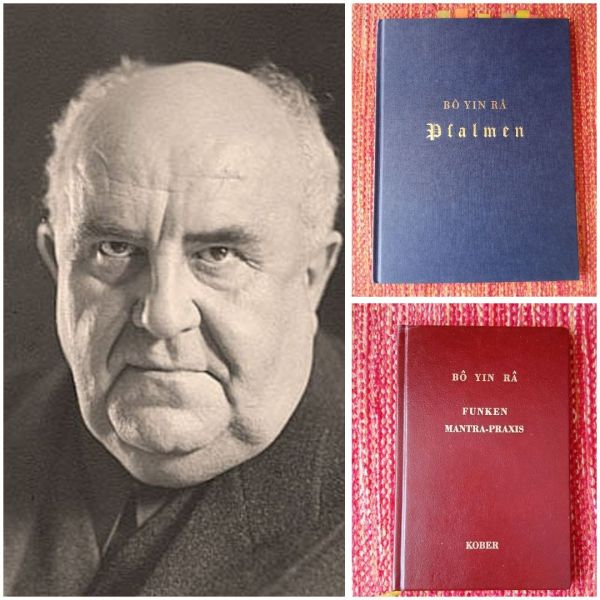
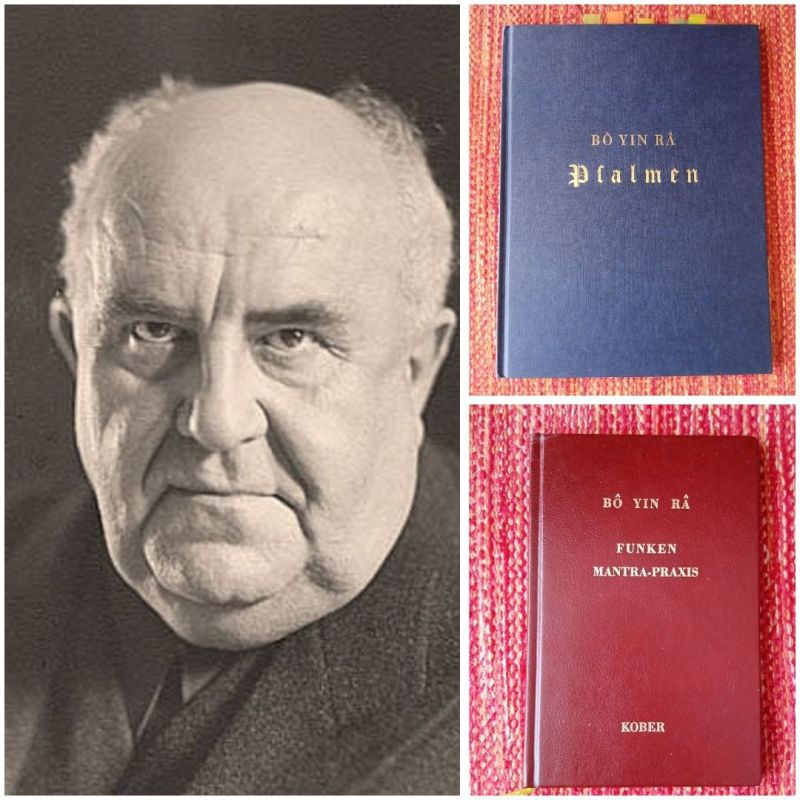
Joseph Anton Schneiderfranken; pseudonym: Bô Yin Râ.
(25 November 1876 -14 February 1943).
German-Swiss writer, painter and philosopher.
*
Today’s sharing from the Blue House of Via-HYGEIA is ‘The Inner Word and the Ethics of Transmission: Bô Yin Râ’s Psalmen and Funken’.
How can a spiritual teaching cross cultural boundaries without becoming a mere reproduction of foreign forms? Through Psalmen and Funken, Bô Yin Râ offers a remarkable answer: transmission begins not with technique, but with Love; not with the forcing of sound, but with the inwardly received Word.
This study explores the relation between Bô Yin Râ’s Christian-esoteric vision of Love, his conception of the geistige Klangform (spiritual sound-form), the carefully safeguarded practice of the Funken, and his transformation of Hermetic and Vedantic elements into a distinctly German spiritual language.
At its heart lies a simple movement: Love → Reception → Transformation → Action → Transmission
A reflection on the inner Word, cross-traditional indigenization, and the responsibility involved whenever a spiritual practice is carried from one cultural world into another.
**
A Contextual Introduction:
The Postwar Crucible and the Diptych of Transmission
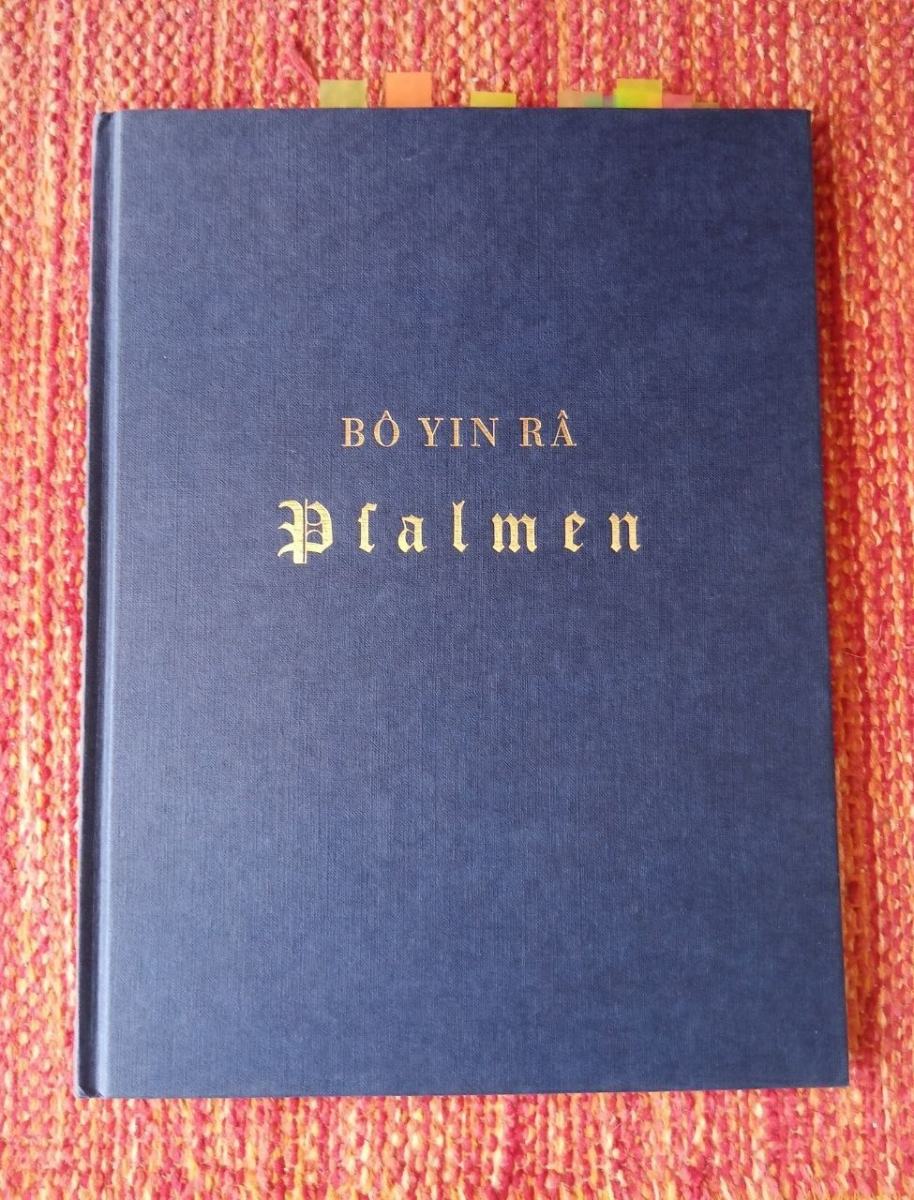
The year 1924 places Joseph Anton Schneiderfranken (1876–1943), writing under the name Bô Yin Râ, within a crowded postwar field of competing Western esoteric attempts to formulate spiritual practice. In the aftermath of the First World War, the German-speaking world saw a proliferation of occult movements, theosophical schisms, and anthroposophical institutional developments, all vying to address a profound crisis of meaning. It was within this environment that Bô Yin Râ published two foundational texts through the Verlag der Weißen Bücher in Munich: Psalmen and Funken.
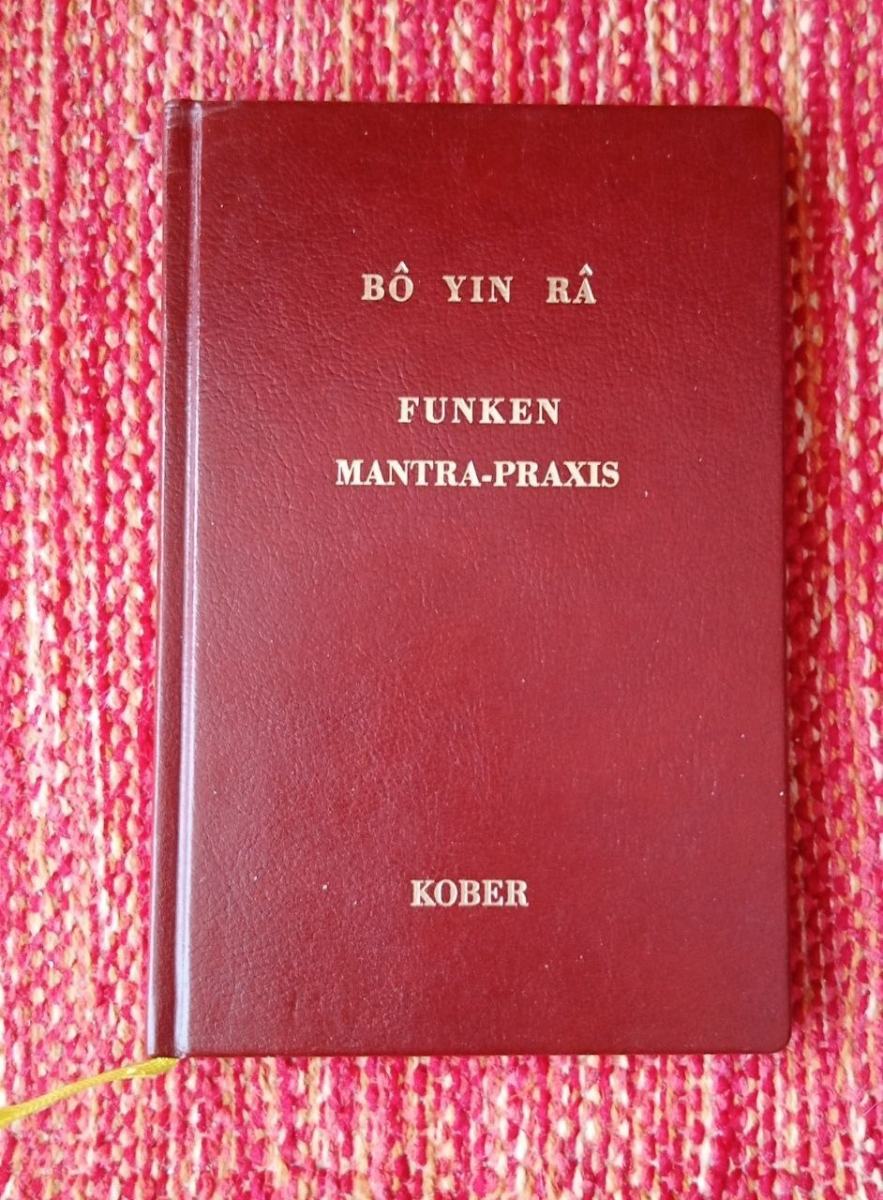
For the modern student of esoteric transmission, these texts constitute a masterclass in what we might term the ethics of transmission. Bô Yin Râ constructed a unified, self-contained system of spiritual formation. Psalmen provides the theological ‘map‘—a Christian-esoteric narrative of the soul’s redemption through the ontological principle of Love. Funken (accompanied by his crucial essay Mantra-Praxis) provides the operative method—a carefully safeguarded discipline of the ‘inner word‘.
The result is an unusually explicit attempt, for its period, to articulate conditions under which a cross-traditional spiritual practice could be undertaken without mechanically reproducing the techniques from which it had been borrowed.
This article examines how Bô Yin Râ’s process of cross-traditional indigenization offers a vital historical model for understanding how esoteric knowledge can be transmitted across cultural boundaries while respecting the recipient’s psychophysical constitution.
*
Part I: The Map — Psalmen and the Christian-Esoteric Conception of Gnosis
To understand Psalmen, one must recognize it as a direct polemic against what Bô Yin Râ terms „liebeleeres Erkennen” (loveless knowing). He viewed the dominant esoteric currents of his time—particularly the overly intellectualized ‘cosmic cataloguing‘ of certain Theosophical circles—as sterile pursuits that divorced hidden knowledge from the transformative power of the heart.
Structured as a six-part mystery script (Inferno, Erlösung, Erkenntnis, Verheißung, Befreiung, Erfüllung), the text mimics the biblical Psalter but subverts it into a modern Christian-esoteric form of gnosis. The seeker begins in absolute existential despair, cursing the very concept of Light, only to be interrupted by an inner voice that dismantles his intellectual pride. The pivotal realization of the text is stated with axiomatic force:
„Aller Lichterkenntnis Mutter ist die Liebe!” (The mother of all knowledge of light is Love!)
This is not sentimental affection, but an active, cosmic principle. The text argues that truth cannot be grasped by the intellect alone; it must be lived and embodied. Bô Yin Râ’s insistence that the true „Heiligtum” (sanctuary) is located entirely within the innermost being of the individual represents a radical bypass of both the institutional church and the occult academy alike.
This bypass is mediated through the figure of the Guide (Führer). The Guide is not presented merely as an external institutional authority, but neither is the figure reducible to an autonomous inner voice.
The Guide is a divinely sent mediator of living knowledge: encountered in the innermost life of the seeker, yet experienced as one whose guidance must be trusted and followed. Bô Yin Râ’s path is radically interior, but it is not radically autonomous.
Crucially, this inner realization is not an endpoint of passive contemplation. Psalmen insists that Love demands „Tat und Wirken” (deed and action). The practitioner is not supposed merely to experience Love but to become an agent of it.
The text explicitly states that what one receives must be passed onward; retaining it exclusively for oneself results in losing it. This establishes a living economy of transmission: Love → reception → transformation → transmission → further reception.
*
Part II: The Problem of Mechanical Transmission (The Conceptual Contrast)
To fully appreciate the ethical necessity of Bô Yin Râ’s safeguards, we must contrast his approach with the dominant ‘letter magic‘ and mantra traditions of his era. The conceptual distinction at stake is not merely a matter of personal biography, but a fundamental divergence in esoteric methodology: mechanically reproduced vocal-physical technique versus the inwardly realized word.
The archetype of the mechanical approach is found in the lineage of J.B. Kerning and, subsequently, Rudolf von Sebottendorff’s 1924 manual, Die Praxis der alten türkischen Freimaurerei. Sebottendorff’s system treats the human body as an alchemical laboratory to be forced into transmutation through specific physical triggers.
The practitioner is instructed to audibly pronounce formulas combined with physical ‘grips‘—such as pressing the angled hand to the neck so that the thumb touches the carotid artery and the index finger lies on the larynx—to mechanically force ‘rarified forces‘ into the body. The goal is the rapid production of physical and etheric phenomena: the finger becoming warm, smelling a ‘sulfurous acridity‘, or hallucinating colored visions.
The dangers of this mechanical approach are not merely theoretical; they are also documented in the lived experience of Bô Yin Râ’s contemporary, the Austrian expressionist and esotericist Gustav Meyrink. In a letter dated June 20, 1917, Meyrink described J. B. Kerning’s letter exercises as harmful, writing that he had practiced them for years and had “brushed against catastrophe” (j’ai frôlé la catastrophe), explicitly attributing to them an episode of tuberculosis of the spinal cord, which was subsequently cured (Meyrink, letter of 20.06.1917, cited in de Dánann, Un Envoyé de la Loge Blanche, pp. 215–216). He subsequently rejected these exercises. His testimony provides a striking contemporary context for understanding Bô Yin Râ’s warnings against mechanically forcing occult effects.
*
Part III: The Compass and the Safeguards — Funken and the Inner Word
Bô Yin Râ’s Mantra-Praxis reads as a direct methodological refutation of this type of practice. He draws a sharp distinction between ‘physical-fluidic vocalization‘ and ‘inner speech‘ (das innerlich gesprochene Wort). He observes that while trained Eastern practitioners might possess the generational conditioning to navigate both, the Western practitioner does not.
Attempting audible mantra practice in the West, he warns, risks „schwere Schädigungen in dem feinstofflichen Teil seines physischen Körpers” (severe damage to the fine-substantial part of his physical body). Chasing physical sensations does not yield higher insight; rather, it makes the practitioner an unwitting „Mithelfer aller dem Menschen feindlichen Kräfte” (helper of all forces hostile to man), resulting in nothing but „selbsterzeugte, der Wirklichkeit ferne Phantasmagorien” (self-generated phantasmagorias far from reality).
Therefore, his Funken (Sparks) are deliberately designed as an ethical corrective. They are to be spoken silently, inwardly, and without any lip movement.
It is vital to note that Bô Yin Râ does not oppose ‘sound‘ to ‘meaning‘. Rather, he distinguishes physical, audible sound from an inward, inaudible ‘spiritual sound-form‘. The formative principle of the Funken is an inwardly received sound-form opposed to mechanically produced physical sound.
Bô Yin Râ asks the practitioner to hear the words inwardly as a „geistige Klangform” (spiritual sound-form), without analyzing their conceptual meaning or deliberately producing an audible vibration. The meaning is not to be forced; it is expected to unfold gradually through repeated inward reception.
Furthermore, Bô Yin Râ presents the Funken as deliberately safeguarded against physical or psychic harm even in cases of misuse. As he writes in Mantra-Praxis:
„…daß es sich hier um Laut- und Wortfolgen handelt, die mit aller Absicht so geformt sind, daß selbst ihre mißbräuchliche Benutzung zu lediglich physikalisch hörbarer Lauteinwirkung keinerlei Schädigung bringen könnte…” (“…that here we are dealing with sequences of sounds and words which are deliberately formed in such a way that even their misuse, resulting in merely physically audible sound, could cause no harm whatsoever…”)
This reflects a profound ethical responsibility toward the reader, prioritizing spiritual safety over mystical sensationalism.
*
Part IV: Cross-Traditional Indigenization (The Core Scholarly Contribution)
This is where Bô Yin Râ engages in what we might call cross-traditional indigenization: the controlled translation of spiritual practice from one cultural environment into another. Bô Yin Râ’s adaptation is not merely semantic translation. It is an attempt to recreate an inwardly operative word-form in another linguistic medium. This helps explain why the German poems are so strange, compressed, rhythmic, and syntactically fractured.
The twenty-two Funken are rich with cross-traditional echoes—the Hermetic I.A.O., the Vedantic Tat tvam asi and Aham brahma asmi, the Sanskrit Aum and Jîvâtmâ—but each is re-articulated in German syntax and within Bô Yin Râ’s own Christian-esoteric symbolic vocabulary.
Consider Spark IX, which integrates the Hermetic/Alchemical formula I.A.O.:
„I: spaltet! / A: breitet! / O: rundet! / Eines in Allem: I. A. O.” (“I: splits! / A: spreads! / O: rounds! / One in All: I. A. O.”)
The form is not merely conveying an abstract proposition. The language itself is doing something: splitting, expanding, rounding. In Bô Yin Râ’s treatment, I.A.O. is not presented primarily as an operative theurgic formula for influencing spiritual forces. It is transformed into a contemplative sequence designed to unfold in the soul’s formative space through silent contemplation, which Bô Yin Râ presents as avoiding the psychophysical dangers associated with mechanically produced vocal effects.
Similarly, Spark XIV integrates the Vedantic mahavakya Tat tvam asi:
„«Verstehend» nicht, nicht «erkennend», — / Will ich, / Und fühle: / Mich selbst. / … / Allwissender Weisheit / Wissen: «Tat twam asi»!” (“Not ‘understanding’, not ‘knowing’, — / I will, / And feel: / Myself. / … / All-knowing Wisdom’s / Knowing: ‘That art thou’!”)
Here, Bô Yin Râ explicitly resists reducing the experience to intellectual Erkennen. The practitioner is not asked to analyze the proposition intellectually, but to allow the word to become an inwardly experienced reality.
This establishes a precise three-level structure in Bô Yin Râ’s praxis: word → inward sound-form → gradually unfolding knowledge. The efficacy of the practice does not depend upon intellectual analysis of its meaning; what matters is the inward assimilation of the word as a formative spiritual reality.
*
Part V: Synthesis — Hermetic Depths, Polar Anthropology, and the Living Transmission
The diptych of Psalmen and Funken also invites reflection on several broader dimensions of Bô Yin Râ’s system.
The Hermetic Dimension: Bô Yin Râ’s integration of the I.A.O. formula places him within a long Hermetic tradition. However, his treatment of this formula represents a significant shift within his own practice: from theurgic Hermeticism, which seeks to command spiritual forces, to a mystical Hermeticism that uses the formula as a map for inner contemplative alignment.
Polar Anthropology: In Psalmen (p. 35), Bô Yin Râ describes the Urlicht (primal light) as both „Mann” und „Weib” (male and female), and extends this dual-gendered nature to the „Ewige Mensch” (Eternal Man). This formulation engages with the esoteric tradition of polar anthropology and the coniunctio oppositorum (the union of opposites). The divine ground of being is presented as encompassing and transcending gender polarity, reflecting a primordial unity and the integration of differentiated forces within the soul.
Comparative Context. Bô Yin Râ’s Funken are not the only Western mantra system of the early twentieth century. Rudolf Steiner’s Mantram und Meditation and the Masonic tradition of the ‘Lost Word‘ (a motif later deeply integrated into Rosicrucian thought as the search for the recovered divine Logos) represent parallel attempts to create functional Western equivalents of Eastern mantra practice. However, Bô Yin Râ’s system is distinguished by its explicit, detailed safeguards and its frank acknowledgment of the dangers of cross-traditional borrowing without proper adaptation.
*
Conclusion:
A Compass for the Modern Seeker
In the closing pages of Psalmen, the Guide instructs the awakened seeker: „Schaffe Zuwachs dem Lichte in der Finsternis! Vermehre seine Kraft durch Tat und Wirken aus der Liebe!” (Create increase for the Light in the darkness! Multiply its power through deed and action born of Love!).
The twenty-two Funken provide the corresponding disciplined practice through which this ‘deed and action‘ can be inwardly prepared. For Via Hygeia- Circle of Transmission, the diptych of Psalmen and Funken offers vital insights into the mechanics of authentic spiritual transmission across cultural boundaries. It demonstrates that true transmission requires both a map and a method, and that a theology of Love must be paired with a practical discipline of inner alignment that respects the recipient’s psychophysical constitution.
In an era where spiritual practices are frequently commodified, decontextualized, and stripped of their traditional safeguards—where the modern seeker is often tempted by the shortcut of forcing energy and chasing phenomena—Bô Yin Râ’s insistence on inner silence, non-striving, and the primacy of Love provides a distinctive counterpoint to approaches that emphasize technique, intensity, or the pursuit of extraordinary phenomena.
He provides not a toolkit for magical power, but a compass for inner alignment. By framing the spiritual path not as an alchemical forcing but as a gentle communion with the ‘Inner Word‘, Bô Yin Râ seeks to ensure that the transmission of the divine spark remains, above all else, a path of healing, wholeness, and Love.
*
Bibliography of Works Cited & Further Reading
Primary Sources:
Bô Yin Râ. Psalmen. München: Verlag der Weißen Bücher, 1924.
Sebottendorff, Rudolf von. Die Praxis der alten türkischen Freimaurerei: Der Schlüssel zum Verständnis der Alchimie. Leipzig: Theosophisches Verlagshaus, 1924. English translation: Secret Practices of the Sufi Freemasons. Trans. Stephen E. Flowers. Rochester, VT: Inner Traditions, 2013.
Secondary Sources:
de Dánann, Alexandre. Un Envoyé de la Loge Blanche: Bô Yin Râ — De la Taychou Marou au Grand Orient de Patmos. Milano: Archè, 2004.
Goodrick-Clarke, Nicholas. The Occult Roots of Nazism: The Aryan Secret Cults and Their Influence on Nazi Ideology. Wellingborough: Aquarian, 1985.
Hakl, Hans Thomas. Der vergessene Meister: Joseph Anton Schneiderfranken (Bô Yin Râ). Vienna: Löcker, 2001.
Hakl, Hans Thomas. “Bô Yin Râ.” In Dictionary of Gnosis and Western Esotericism, ed. Wouter J. Hanegraaff et al. Leiden: Brill, 2006.
Mitchell, Mike. Gustav Meyrink: A Biography. Oxford: Tartarus Press, 2009.
Steiner, Rudolf. Mantram und Meditation. Dornach: Rudolf Steiner Verlag, 1998. (Gesamtausgabe GA 135).
Webb, James. The Occult Establishment. La Salle, IL: Open Court, 1976.
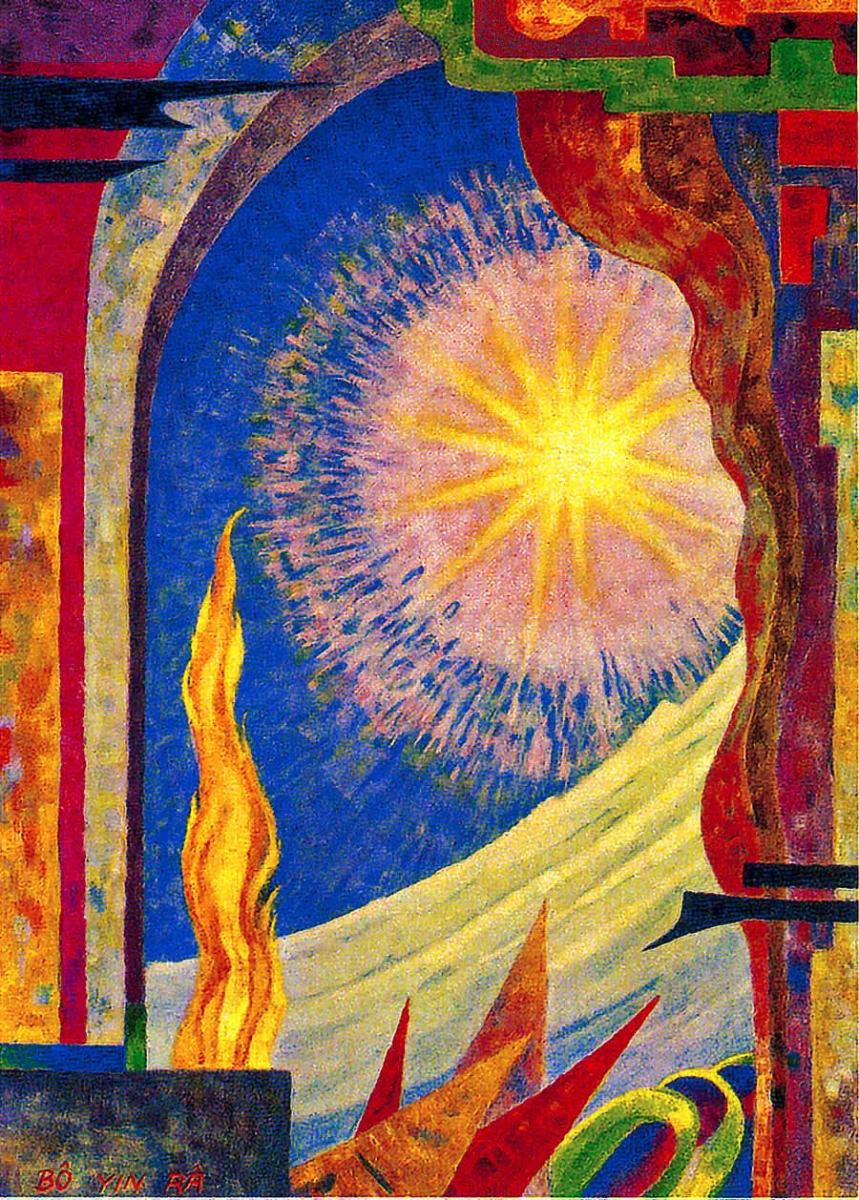
‘Begegnung Im Licht’, painting by Bô Yin Râ (Joseph Anton Schneiderfranken).
***
More about Bo Yin Ra: https://www.boyinra.org 🌿 And: https://www.bo-yin-ra-stiftung.de/en-gb🌿And: http://www.kober.com



Leave a Reply