
Circle of Transmission: The Living Loom
Architectures of Experience: Form and Participation in the Work of Peter Deunov
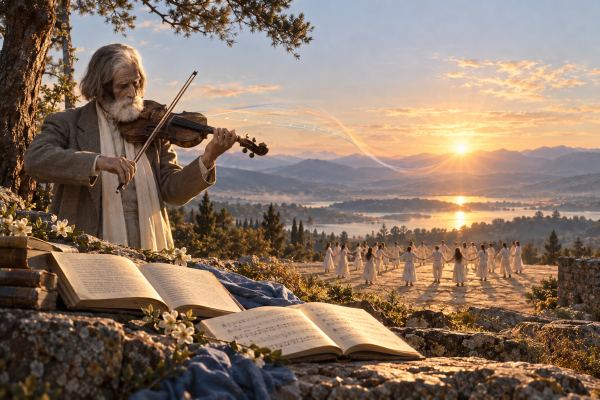
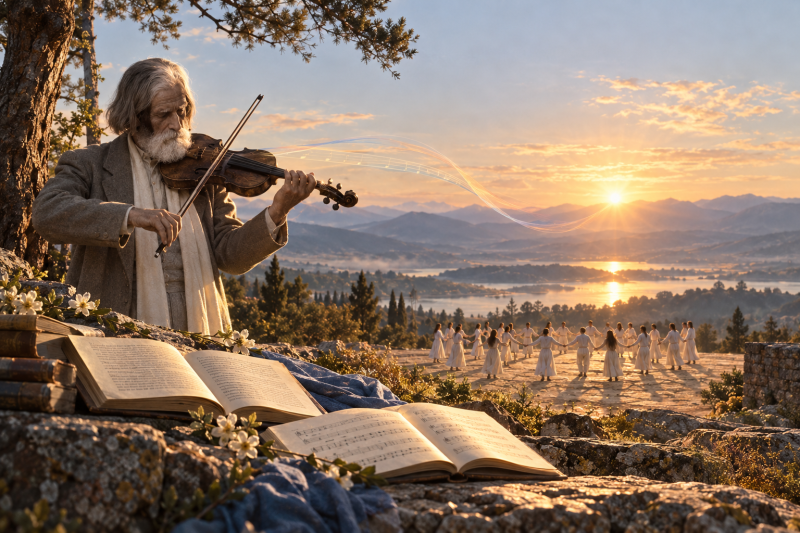
Featured illustration legend: Peter Deunov-Music, Movement, and the Architecture of Experience. An elderly musician plays the violin above a landscape at sunrise, while, in the distance, a circle of participants enters the rhythm of Paneurhythmy. Open books and musical scores rest among the stones, joining Scripture and sound within the same field of practice.
The delicate musical current extending from the violin toward the dawn suggests not a hidden code, but a movement from form toward participation—from word and sound, through the body and breath, toward attention and awareness.
The image evokes the article’s central proposition: a structure is given, and becomes meaningful when it is entered and lived.
*
Today’s sharing from the Blue House of Via-HYGEIA is: ‘Architectures of Experience: Form and Participation in the Work of Peter Deunov‘.
It is a reflection on Scripture, music, movement and correspondence—and on the moment when a form ceases to be something we merely understand, and becomes something we enter, inhabit and experience.
From meaning to participation. From participation to awareness.
**
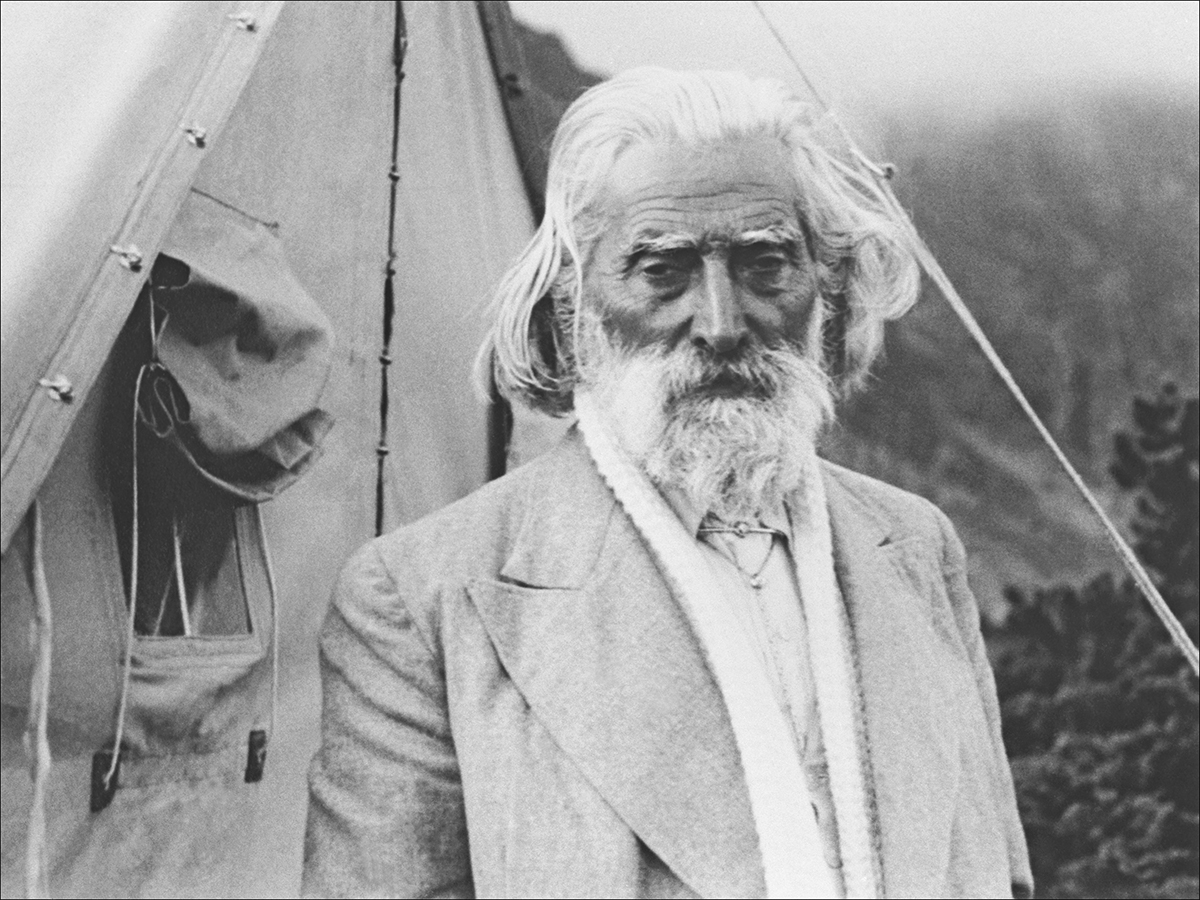
A Contextual Introduction
There are two bodies of work in Peter Deunov’s spiritual teaching that, at first sight, seem to belong to quite different worlds.
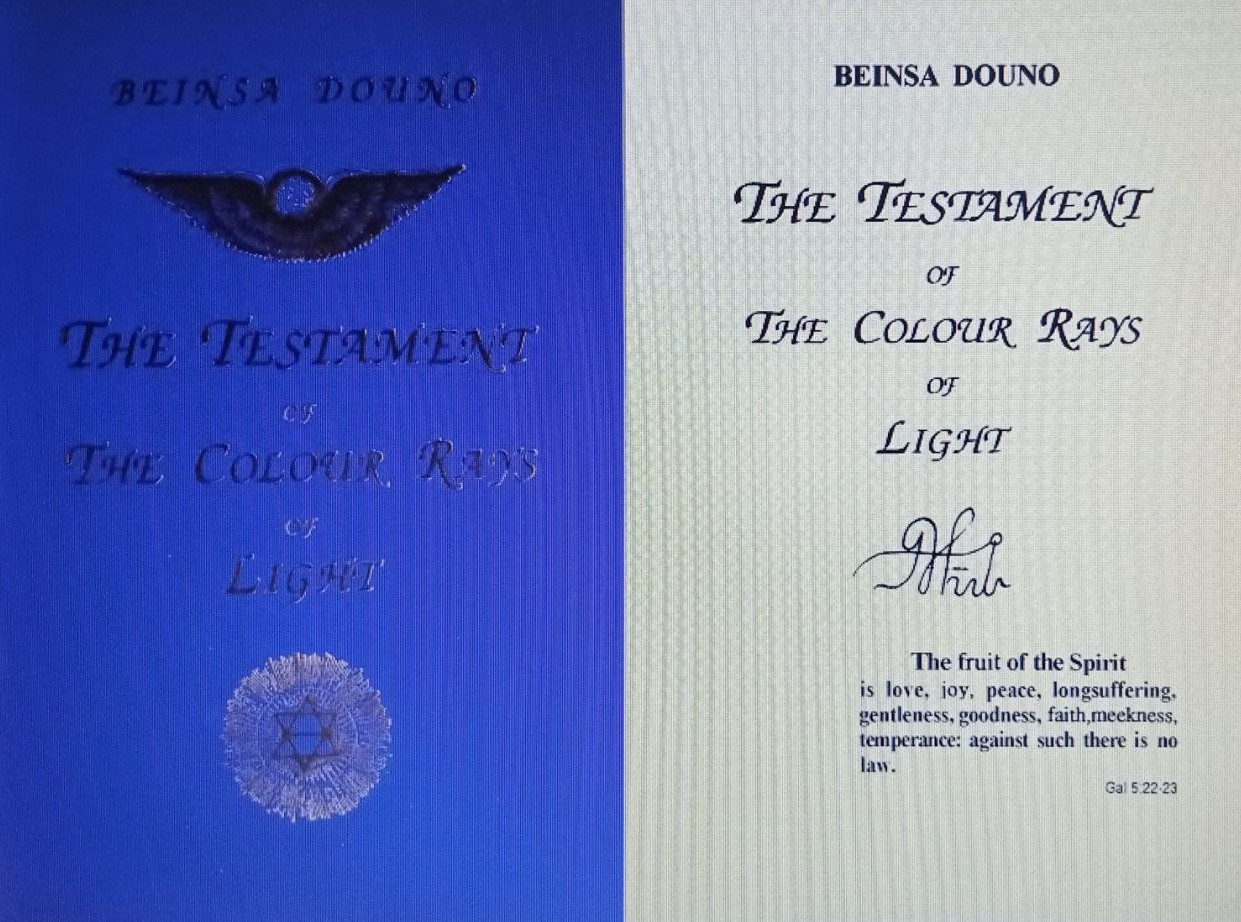
One is The Testament of the Colour Rays of Light, a book of scriptural passages arranged according to colours, virtues and spiritual qualities.
The other is the musical and movement practice known as Paneurhythmy: music, words, rhythm, gesture and collective movement organized into a sequence of exercises.
One belongs primarily to the domain of Scripture and contemplation. The other belongs to sound and movement. Yet when we look more closely at how each is actually used, an unexpected relationship begins to appear.
The relationship is not that a particular colour corresponds secretly to a particular musical note, nor that a melody contains a hidden theological code.
The evidence does not require such a correspondence. Something more elementary—and perhaps more profound—is taking place. In both cases, a form is given so that it can be entered.
A scriptural passage is selected, contemplated and used in relation to a colour and a spiritual need. A musical form is heard, repeated, sung, moved and eventually embodied. Meaning is therefore not left at the level of interpretation. It is placed into a procedure.
This suggests that Deunov’s work may be approached as an architecture of experience: a way of organizing symbolic material so that perception, participation and attention gradually become conscious of themselves.
The proposition is interpretive, not doctrinal. It must therefore be allowed to emerge from the evidence. The guiding method throughout is simple: Fact → Pattern → Interpretation.
What is documented comes first. What recurs comes next. Only then may we ask what the recurrence might mean. Where the evidence suggests a trajectory but does not yet prove a universal rule, this article will explicitly identify the observation as a hypothesis, allowing the reader to distinguish between established pattern and interpretive projection.
*
From Scripture to Experience
The Testament of the Colour Rays of Light is easily approached as a collection of biblical passages associated with colours and virtues. But its own instructions reveal something more structured.
The material is presented as something to be used. The explanations associated with the Testament describe the verses as arranged according to the colours and qualities they are intended to evoke, and explicitly speak of “working” with them.
The practitioner is instructed to select material according to a particular need or condition, to contemplate the corresponding colour, to read the associated passages and to bring the process to a prescribed conclusion. Source: The Testament of the Colour Rays of Light, Explanations and Directions for the Use of the Book.
The architecture can therefore be represented approximately as: Need → Symbolic Selection → Colour → Visualization → Scriptural Reading → Contemplation → Practice.
The important point is methodological. The colour is not merely an illustration placed beside a text. The text is not merely information about a spiritual quality. Together they form a procedure.
The instructions even give concrete examples. The material associated with a given colour is to be employed according to the practitioner’s need; the orange colour, for instance, is explicitly associated in the instructions with illness, while other colours are associated with other conditions and qualities. Source: The Testament of the Colour Rays of Light, Explanations and Directions for the Use of the Book.
Whatever one makes of the metaphysical claims surrounding this practice, its formal character is clear: symbolic material has been organized for enactment. This is why “performative architecture” is a useful description.
The Testament asks the reader not simply to understand a symbolic correspondence, but to enter into it. That observation gives us a precise question with which to approach the music: What happens when this scriptural architecture is placed beside Deunov’s musical architecture?
*
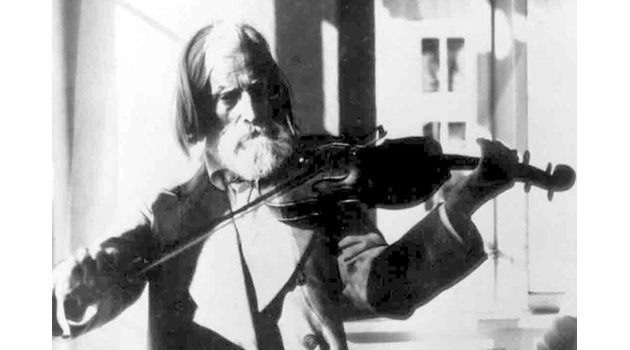
A Musical Laboratory
(Note: The distinction regarding “The First Day of Spring” cycle versus the full 28 exercises is detailed in Appendix A to maintain the flow of the main argument.)
The titles themselves already suggest a remarkable range of human and natural processes:
Awakening. Reconciliation. Giving. Ascending. Elevation. Opening. Liberation. Clapping. Purifying. Flying. Jumping. Weaving. Think. AUM. Sunrise. Square. Beauty. Agility. Conquering. Joy of the Earth. Acquaintance. Beautiful Day. How Happy We Are. Step by Step. Early in the Morning. Breathing. The Blessing. Source: Paneurhythmy, Part I, “The 28 Exercises,” 2015 Edition (Byalo Bratstvo Publishing).
The titles invite interpretation. But titles alone are not evidence of musical meaning. The more interesting question is what happens when the scores themselves are compared. Here the first important phenomenon appears: recurrence.
Among the scores examined, several exercises display strikingly similar or essentially identical musical constructions despite having different titles.
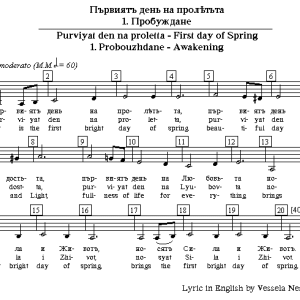
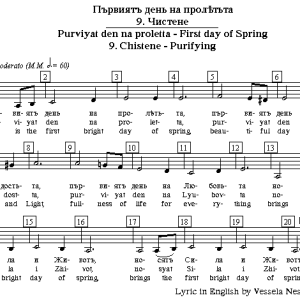
Nos. 1 and 9, Awakening and Purifying,share essentially the same musical construction.
*
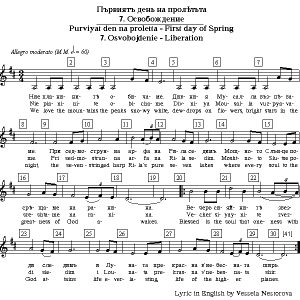
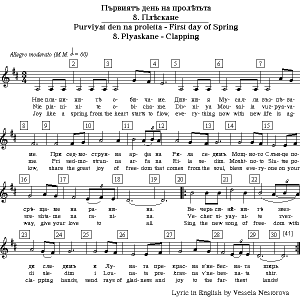
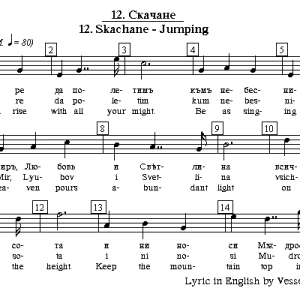
Nos. 7 and 8, Liberation and Clapping, likewise share a musical construction, with No. 12, Jumping, belonging to the same family of musical organization.
*
Nos. 18 and 19, Beauty and Agility, have been identified as essentially identical in musical construction.
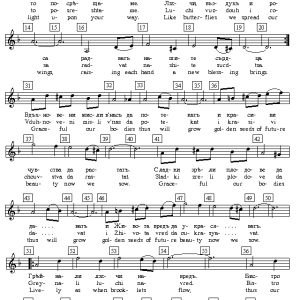
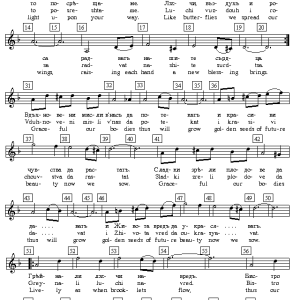
These observations are more important than they may initially appear. They change the question. Instead of asking: “What does this melody symbolize?” we can ask: What happens when the same musical structure is placed under different experiential names?
This is what may properly be called recontextualization. The title does not necessarily describe the musical form in a one-to-one manner. The same form can become the vehicle for different intentions, gestures or modes of experience.
That possibility is particularly significant in the light of the Testament. There too, the important question is not merely what a symbol ‘means’. It is what happens when the symbol is activated through a prescribed practice. The parallel is therefore not symbolic equivalence. It is functional.
*
Recontextualization: One Form, More Than One Experience
The recurrence of musical constructions suggests that Deunov’s relationship to form may be more flexible than a conventional programmatic reading would imply. If Beauty and Agility employ essentially the same musical construction, then the music cannot be understood simply as a sonic portrait of one title.
The musical structure has a certain identity of its own. The experiential identity is then modified by its context. This is a subtle but important distinction. A melody may remain materially the same while its place within a practice changes. The phenomenon invites a broader proposition:
A musical form can function as a vessel for experience rather than as a fixed representation of experience.
This is an interpretation directly prompted by the recurrence itself. And it gives us another way of understanding Deunov’s titles.They need not be read as labels attached to already finished musical objects. They may instead indicate ways in which a given form is to be entered.
Awakening and Purifying may therefore share a musical structure without being identical as practices. Liberation and Clapping may share a musical structure while asking the body to inhabit that structure differently. Beauty and Agility may share the same musical material while opening different experiential contexts. The form remains. The mode of participation changes.
*
Repetition: When Form Becomes Practice
The second major feature is repetition. Repetition is of course fundamental to music. But here it is particularly interesting because repetition is frequently connected to the practical organization of the exercises.
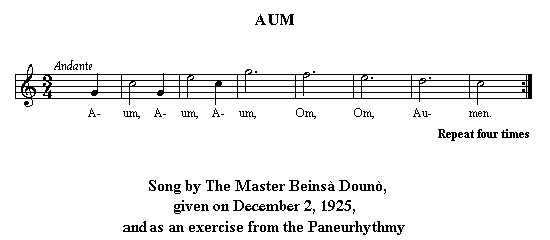
The scores contain repeated sections and explicit return indications. AUM is repeated in its exercise. Other exercises employ recurring musical phrases as part of their performance structure. Source: Paneurhythmy, 2015 Edition, musical scores and performance instructions.
The question is not whether repetition exists. The question is: What does repetition do when the music is not merely listened to, but performed? A listener may hear repetition as recurrence. A participant must inhabit it.
The repeated passage becomes something through which the body learns where it is, when it moves, when it breathes, when it returns and when it begins again. At that point repetition may cease to be merely a compositional device and become a method of attention. It also allows us to avoid an unnecessary temptation: numerology.
There is no need to claim that the number of repetitions encodes a hidden numerical doctrine. In particular, the fourfold repetition associated with AUM should not be converted into an unsupported chain of numerical correspondences. Source: Paneurhythmy, 2015 Edition, Exercise “AUM”.
The more immediate fact is sufficient: The form is deliberately repeated, and repetition makes participation possible. The important transition is therefore not: one → two → three → four but: hearing → returning → remembering → inhabiting.
*
The Body as the Missing Middle Term
At this point, a third element becomes impossible to ignore. The architecture is not simply: word → music It increasingly becomes: word → sound → body → attention
Several of the exercises make this explicit through their very names. Clapping places percussion directly into the body. Jumping turns musical rhythm into vertical movement. Weaving organizes the body spatially. Step by Step makes locomotion itself part of the form. And Breathing brings the musical process into the physiology of respiration. This is not incidental.
Deunov’s own explanations repeatedly insist that Paneurhythmy is not merely a sequence of physical movements. He describes relationships among music, movement, thought, feeling and consciousness, and insists that tone and movement are inseparable. Source: Beinsa Douno (Peter Deunov), quoted in Paneurhythmy, 2015 Edition.
One formulation attributed to him is particularly revealing: “Every tone has a movement.” Source: Beinsa Douno (Peter Deunov), quoted in Paneurhythmy, 2015 Edition.
The statement should not be expanded into a speculative universal theory of music. But within Paneurhythmy it establishes something precise: sound and movement are not independent layers. They belong to a designed correspondence.
Another statement makes the principle even clearer: when music, movement and inner life are present together, “the entire human being is participating.” Source: Beinsa Douno (Peter Deunov), quoted in Paneurhythmy, 2015 Edition. The body is therefore not an accessory to the music. It is the missing middle term between musical form and lived experience.
*
Breathing: When Music Enters Physiology
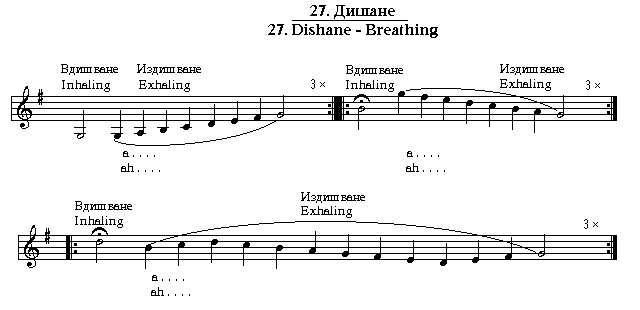
The importance of No. 27, Breathing, becomes apparent here. It is not simply another song placed at the end of a sequence. The musical material is connected with breathing exercises in which respiration, vocalization, movement and music are coordinated.
The 2015 Paneurhythmy material describes musical breathing exercises performed after the movement sequence, with the participants singing together. Source: Paneurhythmy, 2015 Edition, Exercise 27 ‘Breathing‘ and accompanying instructions.
This changes the status of music. Music is no longer merely something produced by the body. It becomes a means of organizing what the body does. The progression can now be stated more precisely: sound → movement → respiration → attention.
This is one of the strongest reasons for treating Deunov’s music as an experiential system rather than merely a collection of compositions. The music is repeatedly placed in situations where the participant must coordinate perception and action. And coordination demands attention.
*
AUM: The Portable Form
AUM occupies a special position. It appears within the Paneurhythmy corpus and also exists as an independent Deunov work. Its highly condensed character makes it particularly useful for understanding how a musical form can become portable. AUM is not dependent upon a long narrative sequence in order to function. It can be returned to. Repeated. Sung. Practiced.
Its significance therefore lies less in decoding it as a musical symbol than in observing what happens to a musical form when it becomes sufficiently concentrated to function almost as a sonic formula. Source: Paneurhythmy, 2015 Edition; Independent score AUM.
The same principle appears in another way in the relationship between the larger Paneurhythmy cycle and individual exercises. Some forms require extended participation. Others become increasingly compact.
This raises a larger question that remains to be tested: Does Deunov’s musical architecture move, in some places, from extension toward concentration? At this stage, this must remain a hypothesis. But the possibility is suggestive: extended form → recurring form → formula → breath → attenuation → silence.
If the complete corpus supports such a movement, it would offer a powerful interpretation of Deunov’s musical architecture as a gradual passage from articulated form toward concentrated presence. For now, however, the evidence warrants the question rather than the conclusion.
*
From Sound Toward Silence
The independent work The Inner Voice of God — Meditation provides a particularly suggestive case. Its notation includes Lento, p, rallentando, ppp, and a final fermata.
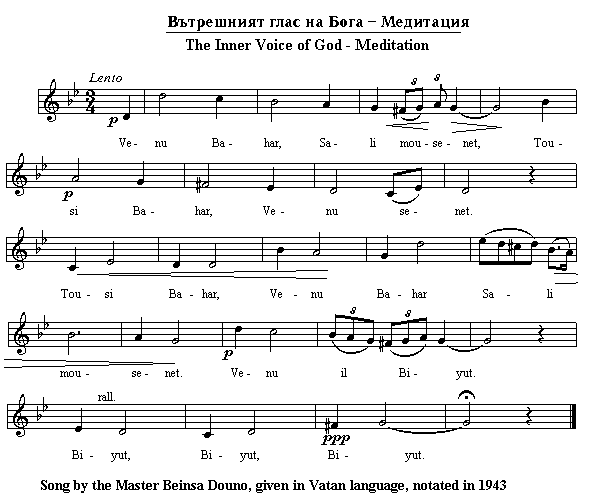
These markings describe a musical trajectory of slowing, diminishing and suspension. Here again we should resist turning one work into a universal law. The score does not prove that all Deunov music moves toward silence. It does, however, provide a concrete example in which musical form progressively reduces its own intensity.The phenomenon is worth placing beside AUM and Breathing. AUM condenses. Breathing coordinates. Meditation attenuates. Taken together, these works suggest that Deunov’s musical world cannot be adequately described only in terms of melodies and songs. It includes procedures of attention.
*
Does the Architecture Travel?
A useful test is to leave the 28-exercise corpus and examine independent works. Five pieces are especially useful as a small comparative corpus:
- Venir Benir
- Fir-fur-fen — Blagoslavy
- AUM
- Kiamet Zenu
- The Inner Voice of God — Meditation
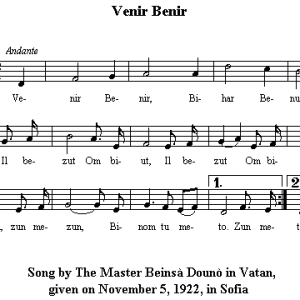
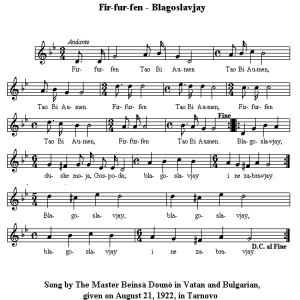
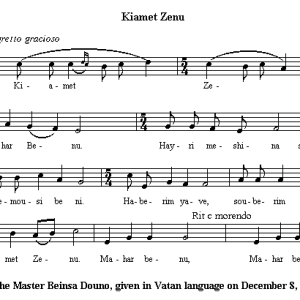
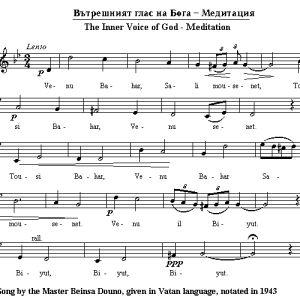
They should not be treated statistically as though they were simply additional members of the 28-exercise corpus.Their value is different. They ask whether the structural tendencies we have noticed elsewhere appear outside the principal sequence.
Fir-fur-fen — Blagoslavy, for example, displays changing metres—3/4, 4/4, 2/4 and 6/4—and a return indication. Kiamet Zenu alternates 6/4 and 2/4 and includes slowing and dying-away gestures. The independent AUM confirms the portability of that sonic formula. Source: Scores of Venir Benir, Fir-fur-fen — Blagoslavy, AUM, Kiamet Zenu, The Inner Voice of God — Meditation.
These examples suggest that several recurring operations may exist: return → transformation → recurrence → attenuation. But again, these are patterns to be demonstrated, not a universal grammar to be imposed.
The most defensible conclusion is modest: The organizational principles observed in Paneurhythmy do not necessarily remain confined to Paneurhythmy. The architecture may travel.
*
Beyond “Musical Geometry”
There is another question that naturally arises from the titles. What should we make of Square, Weaving, Sunrise, Think, and the other titles that appear to invite spatial or structural interpretation?
Earlier attempts to describe the corpus in terms of a comprehensive “musical geometry” moved too quickly. The more rigorous method is the reverse: observable form → recurring morphology → possible geometric analogy → symbolic interpretation.
This distinction matters. If a score genuinely exhibits a symmetrical structure, that is an observation. If the structure resembles a square, that is a formal analogy. If the title Square then makes the analogy meaningful, that is an interpretation. The sequence must not be reversed.
We should therefore not claim, without score-by-score demonstration, that Square necessarily contains a four-bar geometric structure, that Weaving literally imitates a loom, or that Think constitutes a canon simply because its title suggests intellectual or formal organization. Source: Paneurhythmy, 2015 Edition, Exercise titles and scores.
The title may invite the question. The score must answer it. This is precisely where the article’s methodological principle becomes useful: Fact → Pattern → Interpretation.
The mystery does not disappear when the evidence is made more exact. It becomes more interesting.
*
Toward a Law-Governed Music
At this point, another expression can be examined: objective music. It should not be introduced as a conclusion. It is better treated as a question. The evidence assembled so far shows: recurring musical constructions; deliberate repetition; return structures; different experiential titles attached to related musical forms; prescribed relationships between music and movement; breathing integrated with musical practice; independent works displaying related organizational procedures.
This is enough to ask whether Deunov’s music might be understood as a structured experiential system, rather than simply as a collection of devotional compositions. The question then becomes: Could this constitute a form of what might be called objective music?
The word objective needs particular care. It should not mean emotionless, impersonal or detached from human experience, nor should it be confused with Gurdjieffian or other esoteric uses of the term. Indeed, Deunov’s own statements point in almost the opposite direction. The form is intended to be enacted by a living person.
What appears “objective” in the more cautious sense is the relationship among the elements. A movement is not simply invented at the moment of performance. A tone is not merely decorative. The music is conceived as participating in a law-governed correspondence among idea, tone, movement and inner life.
Deunov’s Paneurhythmy material explicitly speaks of a “Law of Correspondence” among ideas, lyrics, musical tones and movements, and states that music is not arbitrary but corresponds both to physical movement and to the ideas associated with it. Source: Paneurhythmy, 2015 Edition, Introduction and explanatory notes on the “Law of Correspondence”.
This gives us a much firmer foundation than the claim that Deunov possessed a hidden universal musical code. We can say something more modest and more interesting: Deunov conceived music as a structured field of correspondences whose forms were intended to be enacted through the body. That is historically and formally more defensible. And it brings us to the concept that may ultimately unite the two architectures.
*
Correspondence: The Missing Concept
The word correspondence has now become central. In the Testament, colours, scriptural passages, virtues and states are placed into ordered relationship. In Paneurhythmy, ideas, lyrics, tones and movements are explicitly described as corresponding.
This does not mean that the two systems can be translated mechanically into one another. It means that both are built upon the conviction that one form can enter into meaningful relationship with another.
The Testament operates through correspondences between: colour → quality → Scripture → contemplation → practice. Paneurhythmy operates through correspondences among:idea → word → tone → movement → inner participation.
The common principle is therefore not equivalence. It is correspondence. And correspondence is what allows form to become practice. This is perhaps the decisive conceptual step.
The question is no longer: “What does this symbol mean?” but: “What does this symbol cause us to do?” And, in the musical field: “What does this form cause us to attend to?”
*
Two Architectures Converging
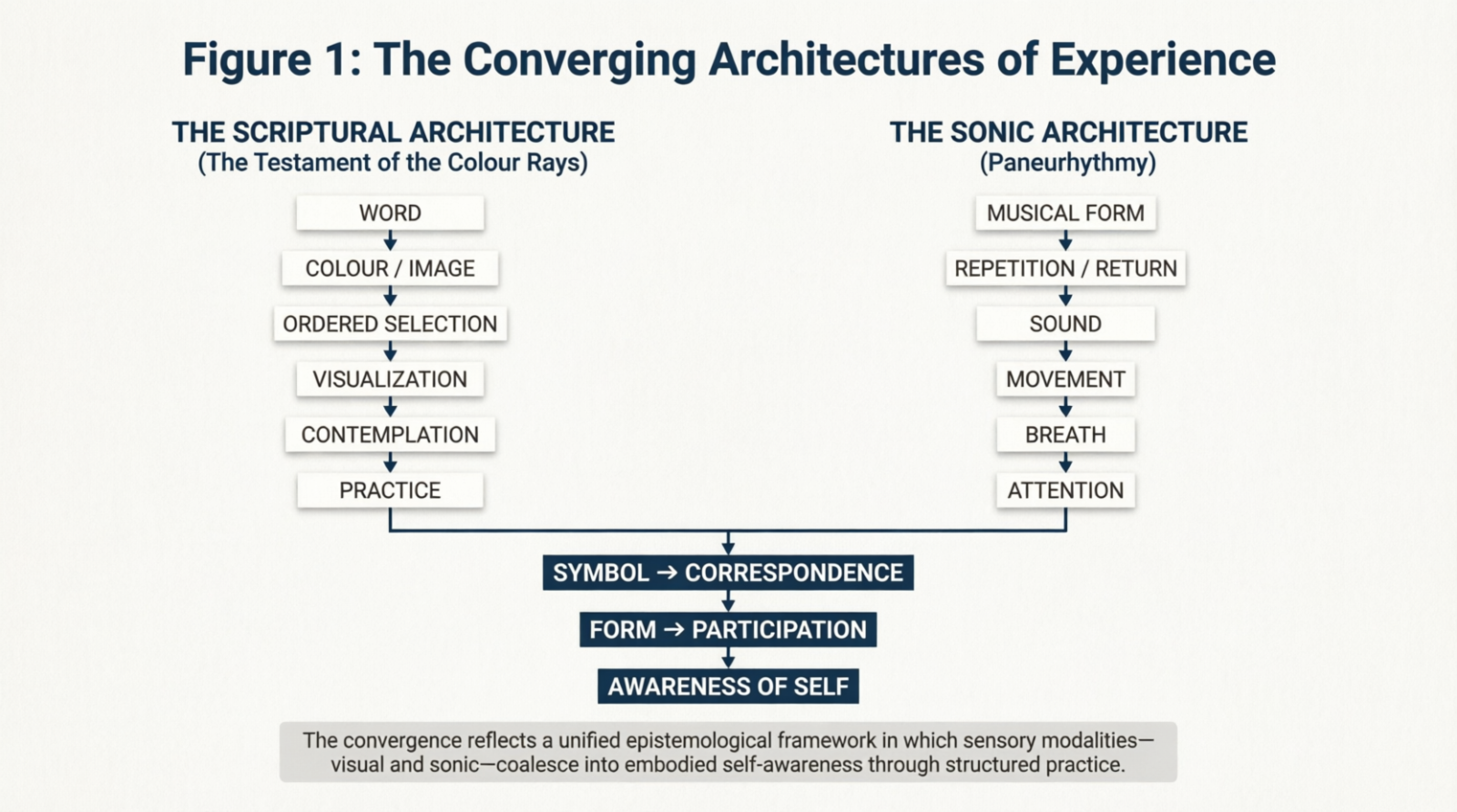
We can now place the two systems beside one another. The visual convergence of these processes illustrates the shared operational logic.
Figure 1:
The Converging Architectures of Experience
*
Toward an Experiential Phenomenology of Being
This is where the word phenomenology can finally be used. Not because Deunov was practicing Husserlian phenomenology. There is no need to make such a historical claim. Phenomenology is useful here as a method of questioning experience. What happens when a symbolic structure is not merely interpreted but repeatedly enacted? What happens when a word is sung? What happens when a rhythm is walked? What happens when a musical phrase is repeated until the body anticipates it? What happens when movement becomes coordinated with breathing? What happens when breathing becomes coordinated with sound? And what happens when sound itself begins to withdraw?
The sequence we have been following can now be expressed: word → sound → repetition → movement → breath → attention → awareness. Or, at a more abstract level: meaning → form → perception → participation → awareness.
This does not describe a metaphysical doctrine. It describes a possible phenomenology of practice. A symbolic form first presents itself to consciousness. It is then repeated. Repetition makes participation possible. Participation recruits the body. The body organizes attention. Attention becomes aware of its own activity. The practitioner is no longer merely looking at the form. The practitioner is inside the form.
This is why the distinction between ‘meaning‘ and ‘practice‘ becomes so important. The Testament does not simply tell the practitioner what a colour means. Paneurhythmy does not simply tell the practitioner what a movement means. In both cases, meaning becomes something that must be entered, repeated and experienced.
*
A Structure to Be Entered
This may also explain why Deunov’s work can resist purely intellectual interpretation. The intellectual reader asks: What does this mean? The practitioner encounters another question: What happens when I do it? The difference is decisive. A doctrine can be explained. A symbol can be decoded. A text can be translated. But a practice must be performed.
The Testament organizes Scripture so that the reader can enter into a symbolic sequence. Paneurhythmy organizes music and movement so that the participant can enter into a rhythmic sequence. The architecture is therefore not primarily one of information. It is one of participation.
This also helps explain why the body cannot be treated as a secondary element. The body is where correspondence becomes visible. A tone becomes a movement. A movement becomes rhythm. Rhythm becomes coordination. Coordination becomes attention. Attention begins to perceive itself.
*
Conclusion:
From Meaning to Awareness
We can now return to the central intuition with which the investigation began. Deunov’s work can be approached neither simply as “spiritual music” nor simply as a symbolic system. Its distinctive feature may lie in the way form is repeatedly converted into experience.
The Testament provides one architecture: symbol → selection → visualization → Scripture → contemplation → practice. Paneurhythmy provides another: form → repetition → sound → movement → breath → attention.
And the concept of correspondence allows us to see why these architectures can be placed beside one another without claiming that their symbols are secretly identical. Both organize meaning so that it can be entered.
The strongest claim we can make at present is therefore not that Deunov encoded a hidden numerical system, nor that every title corresponds geometrically to its score, nor that a universal scientific law of music has been demonstrated. It is simpler. And perhaps more radical. Deunov repeatedly transforms meaning into form, and form into participation.
The participant does not remain outside the structure. The structure becomes something lived. A form is given. The form is enacted. The enactment becomes participation. Participation becomes attention. And attention begins to become aware of its own activity.
Perhaps this is the point at which the two architectures finally meet. Not in a secret code. Not in an equation. Not in an imposed symbolism. But in experience itself. This is sense becoming aware of itself. The phrase should not be understood as a definition of Deunov’s teaching. It is the furthest interpretive point to which the evidence presently allows us to travel.
A structure is given. We enter it. We repeat it. We move through it. We breathe it. And, for a moment, the distinction between perceiving a form and becoming conscious of the act of perception itself begins to soften. That may be the deeper architecture beneath both Scripture and sound: a structure to be entered rather than merely understood.
*
Appendix :
Structural Note on “The First Day of Spring”
Before entering the musical corpus, one distinction is essential regarding the taxonomy of the exercises. The expression The First Day of Spring does not properly designate the entire 28-exercise corpus of Paneurhythmy. Exercises 1–10 form a continuous cycle called The First Day of Spring. The larger Part I contains 28 exercises, ending with The Blessing (Promisal).
The first ten are:
- Awakening
- Reconciliation
- Giving
- Ascending
- Elevation
- Opening
- Liberation
- Clapping
- Purifying
- Flying
They are performed continuously, passing from one exercise into the next. Later exercises form additional groupings within the larger sequence. Source: Daniela Ancheva Pandulcheva, “Study Materials for the Paneurhythmy Workshops”; Paneurhythmy, 2015 Edition (Byalo Bratstvo Publishing).
This distinction matters because it changes the question we are asking. We are not dealing with a single 28-piece ‘album‘ in the modern sense. We are dealing with a larger architecture containing smaller functional groupings, transitions and specialized exercises. The corpus therefore becomes a particularly interesting laboratory for asking how musical form, movement, title and practice interact.
*
Sources & Evidentiary Basis
Deunov, Peter (Beinsa Douno). Paneurhythmy, 2015 Edition. Byalo Bratstvo Publishers, Sofia, Bulgaria. This edition includes the 28-exercise structure, descriptions of exercises, music and movement, and statements attributed to Beinsa Douno concerning the “Law of Correspondence” among ideas, tones, and movements.
Deunov, Peter (Beinsa Douno). Paneurhythmy, Part I, “The 28 Exercises,” including The Blessing (Promisal). Byalo Bratstvo Publishers, Sofia, Bulgaria.
***

Leave a Reply