
Circle of Transmission: The Living Loom
Robert Fludd: From The ‘Utriusque Cosmi Tractatus’ – De Astrologia – Do The Stars Imply Fate?

Robert Fludd,
a portrait by Frans Pourbus the Younger,
in the Welcome Library, London.
Picture at Wikimedia Commons.
*
Today’s sharing from the Blue House of Via-HYGEIA, is another excerpt from Robert Fludd’s ‘De Astrologia’ in his famous ‘Utriusque Cosmi Tractatus’. A Via-HYGEIA English translation from Pierre Piobb’s 1907 French translation of the 1617 original Latin. The excerpt is chapter III from part I, ‘Les astres impliquent-ils la fatalité?’, from page 16 to 22. Chapter IV and V were already translated by us in 2023.
**
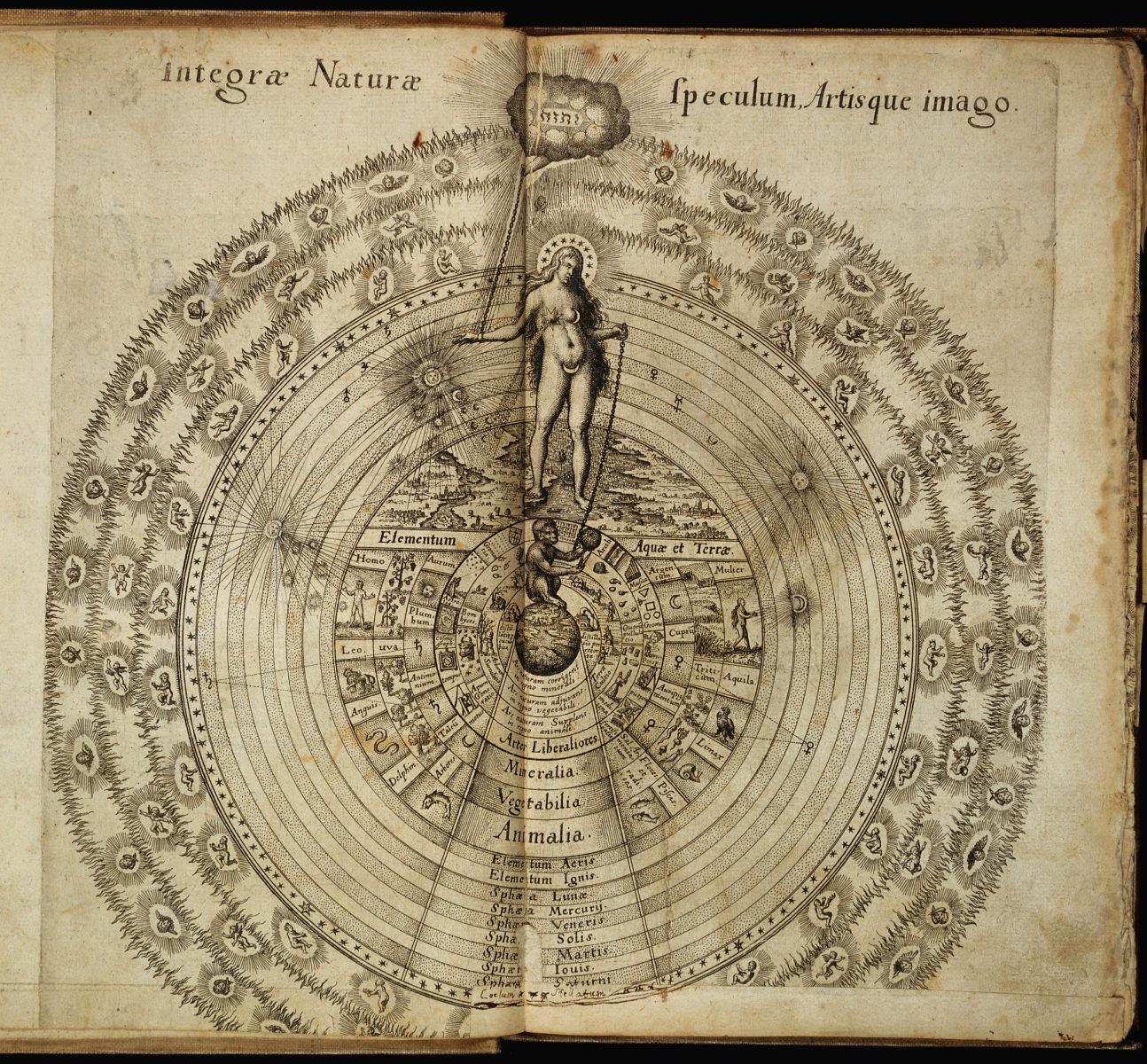
III. — DO THE STARS IMPLY FATALITY?
All authors of Astrology agree on one point: ‘God operates in the lower world through His ordering, and the stars carry it out in execution‘.(1) If this were so, who would dare deny that the Mens of animals, and even more so that of men, is not subject to the divine ordinance? This, however, is not the sense in which I understand that the human Mens is in some way subject to the operation of the Stars, given that its nature is far more divine than that of the Stars. It is possible, however, that the Spiritus, that vehicle upon which (according to Plato) this Mens is transported among the bodies of the Empyrean, participates in celestial changes all the more because it is of an ethereal nature (2); consequently, it commands it, it carries it along, like a chariot carries its passengers, according to the appetites stirred by the action of the Stars, in accordance with the law that decrees the part must suffer the vicissitudes of the whole; and no one possessing a Mens in good condition escapes it.
I shall explain myself more clearly. It is known that, according to the doctrine of Hermes Trismegistus, the freed Spiritus is the receptacle of the Mens, just as Man or rather his Sensitive Soul is the receptacle of the Spiritus; and that this Spiritus, like the middle Heaven, participates in two natures: the supra-celestial and the sub-lunary.
If therefore, say the Platonists, the Spiritus adheres to the Mens, forsakes the pleasures of the flesh, sanctifies itself, exalts its supra-celestial nature, from which it draws its origin, by receiving the good influences of the Stars and carefully avoiding the bad ones, there is a means for it, through this preparation, to obey less all astral actions. But if this Spiritus repels the rays of the Mens and adheres to the Sensitive Soul, it changes from a good Daemon into a bad Daemon, it becomes exposed to all superior actions and principally to the bad ones, because of the body’s inclination toward evil and because the body is commanded by the Sensitive Soul; such that very superior Mens come to depend on the Elements, as perpetual receptacles of celestial influences, and become apt and predisposed to gather and seize avidly all the bad gifts of Heaven, that is to say, pleasure, anger, sadness, misfortune, cruelty, drunkenness, laziness, shamelessness, lust, concupiscence, a chance attraction to one or another vice; while, if a man’s good Spiritus gathers, on the contrary, the best celestial influences, this man will seek praise, military glory, or will show himself intransigent on honor and justice, for example in religious matters, he will be just, pious, amiable, studious, liberal and endowed from his birth with a host of virtues. (This is a subject we examine in the ‘Treatise of the Microcosm‘ where nativities are discussed.)
All this, we say, happens by divine ordinance and by the Stars which necessarily execute it as its ministers; this is why the latter have been called, not without elegance, by some philosophers: the Fingers of Nature, given that, without them, Nature does not act and accomplishes nothing in this lower world.
The human Mens is like a living ray of this God and the celestial ministers have no more action upon it than upon the ordainer himself, that is to say God; consequently, one must always consider that it escapes all influx, all cosmic movement and that it is subject to no passion, that is to say that it acts for the good and is never altered by error. But the Spiritus, its vehicle, is deceived from time to time by the lures of the flesh and the world; with the flesh, it sometimes receives, by celestial influx, the bad passions along with the good ones, while sometimes, truth be told, the Mens finds itself absolutely empty or works very little.
Whence it results that wicked men can produce good effects despite their nature, become rich and be successful in war or in other enterprises, with or without the assistance of the Mens. If, on the other hand, the Spiritus, mobile by essence, adheres to the Sensitive Soul, it is at times good and virtuous, indifferent to the flesh and the world, and at times bad and inclined to all vices. Whence it follows that certain men, whose Spiritus is carnally affected and disobeys the Mens, are driven toward crime and theft, and, what is more, find themselves more disposed to perpetrate their misdeeds at one time than at another—for example if the Stars of the Nature of Mars are very powerful in Heaven, they will incite a Martian thief to crime, more or less, according to their aspect with the other Stars and their position in Heaven, especially if the other celestial significators prevail in their agreement with the Lord of the Seventh House in the horoscope of this man’s nativity. Theft consequently, as well as other vices, is fatally determined by the Stars, because in vicious people the Mens, so to speak unoccupied, lets the Spiritus act according to the depraved fancies of the flesh. Now since the Spiritus holds the second rank in the entity after the Mens, the celestial substance (3) likewise holds the second rank; what therefore prevents the Stars from having less action on this entity than on the other parts analogous to it?(4) And by analogy, if the Stars act principally with unity and good order on the Elementals, what prevents them from acting less on the Spiritus, while the Mens is unoccupied, given that they have as much action on the Elementals as the Elementals have on the Spiritus?
According to this, it is undeniable that if one can know the quality of the Stars, their mutual action and the value of their conjunctions or their aspects, it will not be difficult, according to the nature of the significator star and that of the place in the Zodiac from which one draws this nature, and according to the aspects of the other planets which look exactly upon this place, to determine the stature of a thief, the particularities of his body and to give infallibly his complete description.
As for the prediction of weather and variations of the atmosphere, there is no controversy. We have demonstrated that all the matter of our lower world and each of its parts aims either at generation, or corruption, or alteration, or any other change, by virtue of the influence of the World Soul. This is clearly expounded in the first ‘General Treatise of the Macrocosm‘.(5) It follows that, if the Heavens are powerfully disposed to humidity, the lower world will be of the same nature; if to heat, the elements will be hotter; if to cold, they will be colder; if to agitation, winds and gusts will trouble this same lower world. There is there, certainly, a determinism which derives from the natural position of the Stars, celestial ministers, from their power and their predominance and which is irrefutably proven by animals and even better by inanimate beings. We know, indeed, by their annual repetition, that the seasons, the changes in the appearance of vegetation, the height of the Sun, the heating of the atmosphere and the general renewal which the increase of the latter occasions, are regular phenomena.
The same is true of the increase of the Moon (6) during which the waters rise, bodies gradually become moistened by an invisible contribution of humidity and the humors are secreted; likewise also of the position of Saturn surrounded in Capricorn, its Domicile, by several planets to which it seems to offer a banquet (7)—which occurred in 1608—a phenomenon which provokes frost and cold among the elements and elsewhere.
We conclude therefore that, upon this lower world, Heaven has a virtue and an action so great, it operates there with an effect so certain, that it is not without reason that Hermes Trismegistus, at the head of Book II of the ‘Asclepius’, called it the Sensible God—because it dominates exclusively in a sensible manner, whereas the Intellectual God dominates by his disposition and his ordinance—, or again the Administrator of all bodies—because the growth and decrease of the latter is subject to the variations of the Sun and Moon—, or finally the Governor and the Author of all things in this world.
*
Pierre Piobb’s notes
1. The text says: ‘Deum in hæc inferiora agere per ordinationem stellas verb per executionem’; as Fludd is a pantheist, he never speaks of voluntas divina, but ordinarily of ordinatio Dei; in its thought God can only act through his administration, his good order, his general laws, his ordinance, for God is for him only Nature.
2. Analogous to the ether.
3. The Ether of which the Spiritus is formed.
4. That is to say: since the Spiritus formed of Ether is subject to astral influx, why would everything that is Ether in man not be the same?
5. That is to say: since the Spiritus formed of Ether is subject to astral influx, why would everything that is Ether in man not be the same?
6. The Moon waxes from its conjunction until its opposition with the Sun; it wanes thereafter.
7. When a planet is in its Domicile and conjunct with another, it is said that the first receives the second.
Source
1907 French Edition
Full French text here
*
1617 Latin Edition
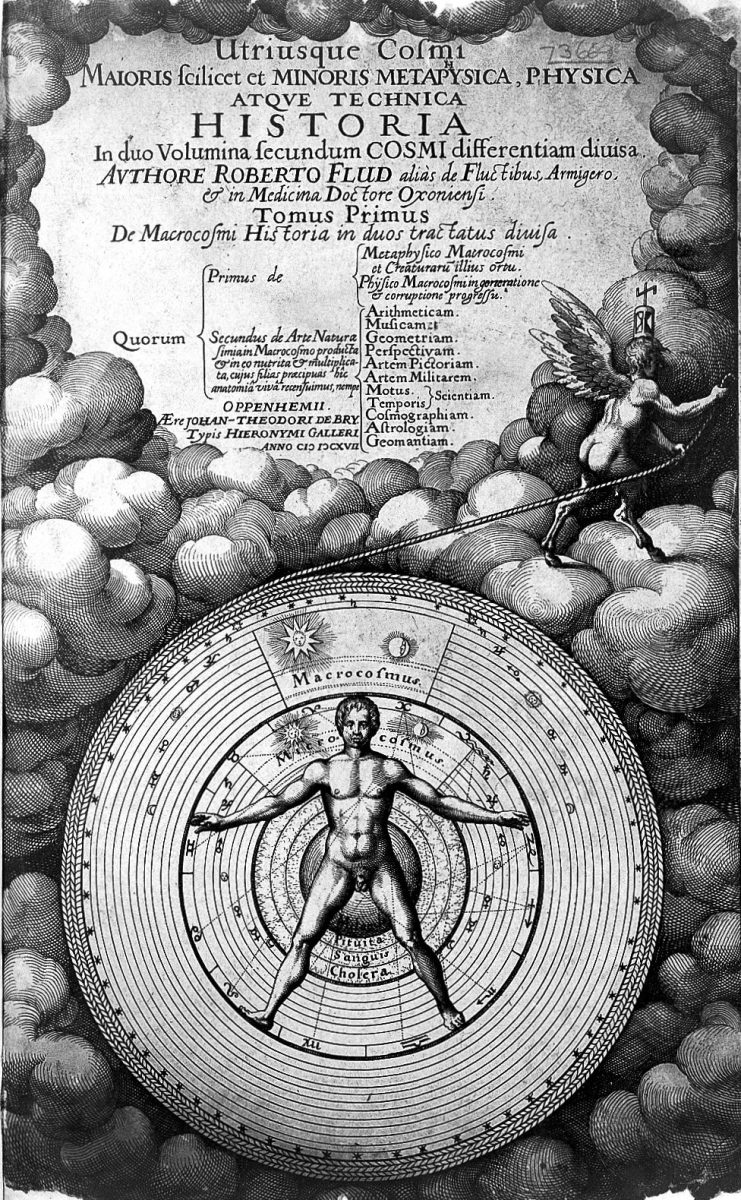
Full original text here
***


Related Articles

Leave a Reply