
Circle of Transmission: The Living Loom
Rabbi Chayyim of Volozhin: From the ‘Nefesh haChayyim’ – ‘Self-Annihilation and Prophetic Dignity’ & ‘In the Intimacy of the En-Sof: The Purity of Prayer and Study’

VOLOZHINER, CHAIM, ‘Nephesh HaChaim’.
First edition. ff. (63), 4to. Vinograd, Vilna.
Vilna & Grodno: Partners Mann & Zimmel 1824.
*
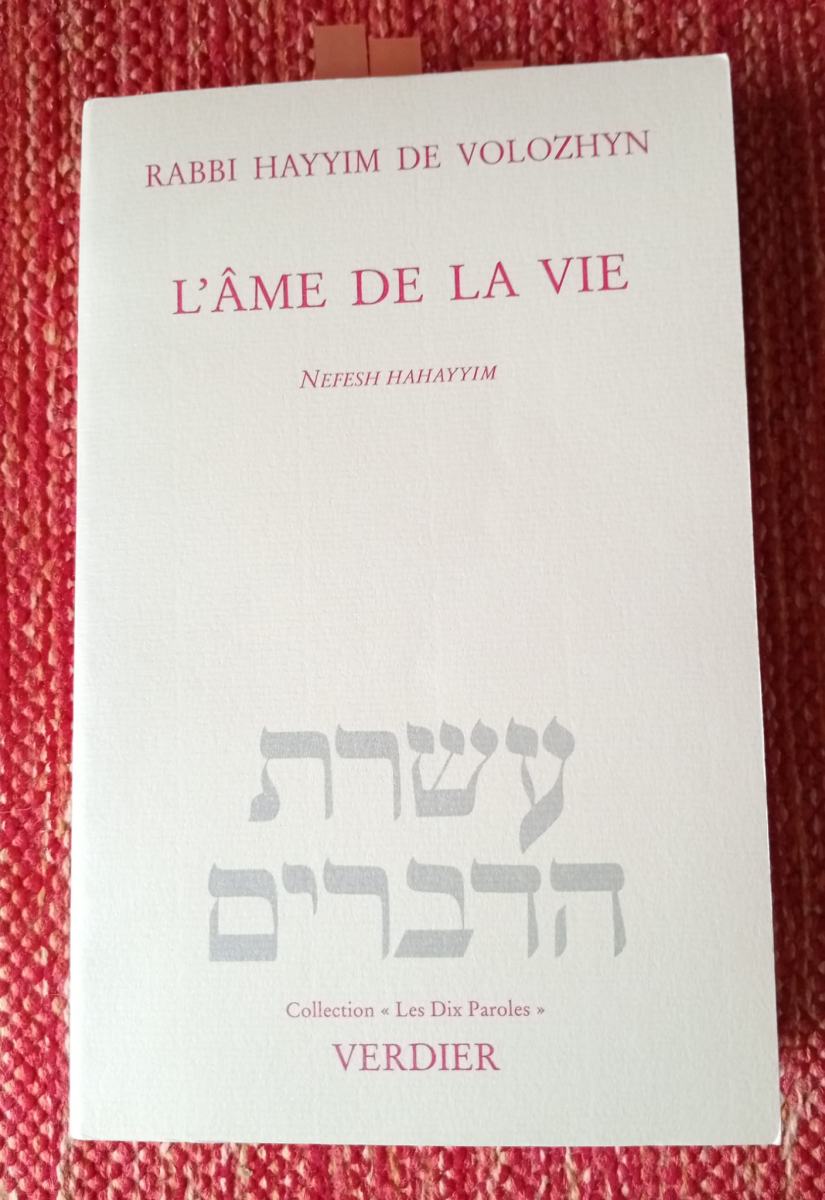
Today’s sharing from the Blue House of Via-HYGEIA, is chapter 13 from the third Gate, ‘Self-Annihilation and Prophetic Dignity’, followed by chapter 14 of the same gate, ‘In the Intimacy of the En-Sof: The Purity of Prayer and Study’, excerpted from ‘Sefer haChayim‘ (The Soul of Life) by Rabbi Chayyim of Volozhin, in its French 1986 edition by Editions Verdier. French translation, presentation and commentary by professor Benjamin Gross (1929-2015), with a foreword by philosopher Emmanuel Levinas (1906 – 1995). From page 149 to 154. A Via-HYGEIA English translation from the French edition.
Coming soon: ‘A Warning, the Dangers of Interiority‘. In this crucial ‘Warning’ between the Third and Fourth Gates of the Nefesh HaChayyim, Rabbi Chayyim of Volozhin exposes the subtle traps awaiting the sincere seeker: how the pursuit of spiritual purity can paradoxically lead to pride, the neglect of practical commandments, and a distorted view of divine service. A vital guide for navigating the path between mystical aspiration and earthly duty.
**
13. Self-Annihilation and Prophetic Dignity
Such was, throughout their entire existence, the substance of the Patriarchs’ worship. Through the high level of their piety and the purity of their hearts’ holiness, they bound their thoughts, constantly and without any interruption, to the Divine Will. Voluntarily, they nullified all the forces of the world and regarded them, as far as they were concerned, as non-existent. Thus, they were the object of wondrous miracles, through the upheaval of the order of constellations and planets. The Divine Name became particularly attached to their persons, and we say: “God of Abraham, God of Isaac…” God Himself speaks of the “God of your fathers” (Exodus 3:13 ff.), and our Sages declare in this sense: “The Patriarchs themselves are the Merkaba⁹⁰.”
This dynamic is illustrated by the episode of the bronze serpent: “Whoever is bitten, when he looks at it, shall live” (Numbers 21:8). The Mishna asks: “Does the serpent kill, or does it give life? Rather, when Israel turned their eyes upward and submitted their hearts to their Father in Heaven, they were healed; if not, they perished” (Mishna Rosh Hashanah 3:8). It must be understood that when they looked upward, examined the concept of the fiery serpent and its evil power, and simultaneously suppressed it mentally, paying no further attention to its formidable force, but truly submitted their hearts solely to their Father in Heaven, they were healed. This is the true way to transmute the forces of evil at their root. This is clear to one who understands the matter.
Our master Moses attained an even higher degree⁹¹, as testified by the Torah: “There has not arisen a prophet in Israel like Moses, whom the Lord knew face to face” (Deuteronomy 34:10). God Himself insists on the difference between the prophetic dignity of Moses and that of the Patriarchs: “And He said to him: I am the Lord! I appeared to Abraham, to Isaac, and to Jacob as El Shaddai, but by My name, the Lord (YHVH), I did not make Myself known to them” (Exodus 6:2-3). We find here the same difference—which we explained above—between the Name Elohim and that of the Tetragrammaton. Generally, the level attained by the Patriarchs is linked in the texts to the name Elohim: “The God before whom my fathers Abraham and Isaac walked, the God who has been my shepherd all my life long to this day” (Genesis 48:15). Likewise, we designate Him, blessed be He, as the God of Abraham, the God of Isaac⁹².
This gives us an indication of the level of their holiness: they attached no importance to any of the various forces of the world. However, their degree of prophecy did not entail the absolute nullification of the reality of these forces. Scripture tells us this in an allusive manner: “I appeared to Abraham… under the name of El Shaddai.” This Name is identical to Elohim; it signifies: I am the Master of the ensemble of forces, and I can, at will and at any moment, overturn the arrangement established at the time of Creation. This is the meaning of El Shaddai, God Almighty. But, at the level of their prophetic degree, “I did not make Myself known to them by My name, YHVH” (in the sense that we explained in chapter 11).
Moses, on the other hand, saw his level of prophecy correspond to the particular Name, the Tetragrammaton: no force created a screen between him and the light of his prophecy. Likewise, all could realize, through the miracles of which he was the instrument, the total nullification, for him, of all forces—there was literally nothing else for Moses but Him, blessed be He. “To you it was shown that you might know that the Lord is God; there is no other besides Him” (Deuteronomy 4:35). This is the meaning of YHVH, the sense of the Tetragrammaton.
Scripture expresses itself consequently with great precision. “God spoke to Moses, and said to him: I am the Lord” (Exodus 6:2). God thus informed him of the modality of his degree of prophecy. For him, Moses, Elohim is perceived under the aspect of YHVH, as it is said: “The Lord is God; there is no other besides Him” (Deuteronomy 4:35). Henceforth, God’s discourse to Moses would be introduced only by: “The Lord said”—“The Lord spoke.” This is the meaning of the testimony of Scripture: “There has not arisen a prophet in Israel like Moses, whom the Lord knew face to face” (Deuteronomy 34:10). The Tiquney Zohar likewise declares: “He appeared to the Patriarchs only through screens, whereas to Moses He appeared without a veil; this is the profound meaning of the text: I appeared to Abraham⁹³…”
It is in this line of thought that we must understand the remark of our Sages: “Moses and Aaron went beyond Abraham. Abraham said: ‘I am but dust and ashes’ (Genesis 18:27), whereas Moses and Aaron declare: ‘What are we?’ (Exodus 16:7)⁹⁴.” Dust and ashes still appeared to them as possessing a certain reality ᵍ, whereas Moses, by declaring “What are we?”, annihilated himself totally. (He includes Aaron in his declaration, since our Sages say: Moses and Aaron went beyond…, because the murmurs of the people were directed against both. He answers in the plural, but this exceptional level was attained only by him.)
The Midrash expresses a similar idea. “Isaac said to Moses: I am superior to you, for I stretched out my neck… and I saw the face of the Shekhina! — Moses replied to him: It is I who have attained a superior level, for you saw the face of the Shekhina, but your eyes were weakened by it, whereas I conversed with the Shekhina face to face, and my eyes were not weakened by it”—which is clear to one who understands the subject⁹⁵. See the commentary of R. Hayyim Vital in Sefer haGilgulim on a remark of our Sages. “Abraham, Abraham!”, there is a pause between the two names; likewise for “Jacob, Jacob!”, whereas there is no pause for: “Moses, Moses!” This is an allusion to a material screen [which existed between God and the Patriarchs, but not between God and Moses]. ⁹⁶
14. In the Intimacy of the En-Sof: The Purity of Prayer and Study
For all these reasons, Moses was ready at any instant to receive prophecy, as clearly emerges from his response: “Wait, and I will hear what the Lord will command concerning you” (Numbers 9:8), in the sense understood by our Sages⁹⁷ʰ. Likewise, he perceived prophecy in every place, in any location, indifferently without any distinction. See Exodus Rabbah 2; Numbers Rabbah 2. Midrash Hazita on Song of Songs 3: Regarding the verse: “Its posts made of silver…” (3:10). “Why did the Holy One, blessed be He, speak to Moses from the bush? To teach you that there is no place in the world empty, void of Divine presence; He spoke to him from a simple bush.” This text indeed confirms the exceptional degree of prophecy to which Moses had attained.
His pressing request: “Show me, I pray, Your glory” (Exodus 33:18) bears precisely on the essence of this phenomenon; he desired to see how He, blessed be He, filled the whole earth with His glory, to the point that no corner was void of His presence. This was not granted to him, and God replied to him: “You cannot see My face, for man shall not see Me and live” (Ibid., v. 20).
Moses ceased not to elevate himself in this path until he attained, before leaving this world, the highest level of perfection to which a man can aspire during his stay on this earth. Thus, we see in Deuteronomy, in the passage “And it shall be, if you listen” (Deuteronomy 11:13), He begins by saying “to love the Lord your God” and passes immediately in the following verse to the first person: “I will give the rain of your land…” in the active form. Moses annihilated himself totally in his own eyes—only the Shekhina speaks through him; thus he can say: I will give. Our Sages effectively say that “The Shekhina spoke through the mouth of Moses”⁹⁸, and Scripture confirms: “With him I speak mouth to mouth” (Numbers 12:8)⁹⁹. It is not said: “I speak to him” but “I speak in him,” through him, truly. Since the sin of Adam, no other human being had attained such a degree of perfection, and none will attain it on this earth before the coming of the Redeemer, may he be revealed soon and in our days. The Torah indeed says: “There has not arisen a prophet in Israel like Moses” (Deuteronomy 34:10). (The verb is in the past, but as the Torah is eternal, the testimony applies also to the future, to subsequent generations. After each generation, we can affirm for the one that has just passed, that no prophet of the level of Moses has arisen.)
Thus, our Sages recommended every man to ask himself: “When will my deeds equal those of my ancestors Abraham, Isaac, and Jacob¹⁰⁰?” but they did not say: equal those of our master Moses!
However, he who wishes to be an authentic “God-fearer” must, in his prayer, annul in the purity of his heart, according to his capacities and his level of understanding, all the forces of the universe as well as his own forces, as if there were absolutely no other reality in the world, and commune solely with Him, blessed be He, the Unique Master. At the very least, one must attempt to do so sometimes, for it is true that concerning purity of heart, not all moments are equally favorable. In our era, it is almost impossible to pray permanently at such a high level¹⁰¹. R. Elazar ben Azaria already affirmed: “I could exempt everyone from prayer¹⁰²!” However, he who serves God in purity, he who constantly brings back in the purity of his heart all subjects to a very close intimacy with the will of the Master of All, will succeed in elevating his prayer, at least sometimes, to this level.
We can now grasp the intention of our Sages when they asked those who pray “to direct their heart to the Maqom” and when they recommended: “When you pray, do not make your prayer a fixed thing, but [an appeal for] mercy and supplication before the Maqom¹⁰³.” One must be extremely vigilant during prayer so as not to direct one’s intention, nor any deep tendency, toward one of the Sefirot, even those of Atsilut. Not only must one not direct one’s prayer toward the Sefirot and the supernal forces—which is in fact worshipping a non-true god and cutting the roots of faith—but one must totally annul, by an effort of will, all supernal and lower forces, and even all one’s own forces, as if they did not exist¹⁰⁴. (One must seek this level of purity not only in prayer, but also in the study of the Torah—as our Sages demanded when affirming that “the words of the Torah are preserved only in those who annihilate themselves”¹⁰⁵.)
One must, in prayer, direct and attach the purity of one’s heart solely to the Maqom of the world, the Unique of the world, the En-Sof, who fills this world, as well as all worlds, to the point that no corner of the universe is void of His presence.
See Roqeah, Shoresh Zekhirat Hashem¹⁰⁶: “When one recites the blessing: Blessed are You, Eternal…”, one must not think of the Glory that appears in the heart of the prophets, nor of the vision of the Throne, but of YHVH who is the Elohim in the heavens and on the earth, in the airs and in the seas, as well as in the whole universe, who was also the Elohim of the Patriarchs. Understand this.
*
Consolidated Footnotes
*
A. Numbered Notes
(From End of Chapter, pp. 326–327):
90. Genesis Rabbah 82; Zohar I, 213 and passim. The holiness of the Patriarchs rose to the level of that of the Merkaba. Cf. First Gate, chap. 6.
91. Moses surpassed the level of holiness attained by the Patriarchs. The latter attained perfect recognition of God within Creation (“from our side”): the world still had for them a certain reality. For Moses, it had none. He had totally annihilated his personality before the Infinite: the En-Sof spoke through his mouth.
92. In the daily prayer.
93. Tiquney Zohar, Tiqun 26.
94. Hulin 89a.
95. Exodus Rabbah 11.
96. Allusion to Genesis 3:21. See Genesis Rabbah 20. Before the sin, man was enveloped in light (’or), whereas after the fault God clothed him in “garments of skin” (’or). ’Alef: unity, spiritual clarity. ’Ayin: multiplicity, material opacity. Cf. R. Y. Loeb of Gur, Sefat ’Emet on Genesis, 3:21.
97. Sifré, section Beha’alotkha. See Maimonides, Code, Hilkhot Yessodey haTorah, 7, 6.
98. Zohar III, 232a; Zohar, 306b. This affirmation is found neither in the Talmud nor in the Midrash.
99. Generally translated as: “I speak to him mouth to mouth.” R. Hayyim proposes the literal translation.
100. Tana Debey Eliyahu, chap. 28.
101. This requirement has without contest a mystical resonance which contrasts with the general line of the work. One should not, however, exaggerate its importance. The author specifies that only Moses attained this level and that until the coming of the Redeemer, no one else will attain it. It therefore remains the general case which does not go beyond the reach of God within the framework of Tsimtsum. The requirement of total self-annihilation of the person, which has as a consequence the effacement in consciousness of the difference between “from our side” and “from His side,” is above all a call to purity of intention, to a spiritualism that never renounces the hierarchy of worlds and to the patient effort of work according to the Law, which allows us to climb the rungs. See infra, note 104.
102. ’Erubin 65a. Because prayer only has meaning when it is performed without a mixture of selfish motivations. This purity requires a renunciation that R. ’El’azar ben ’Azariya estimated to be above the forces of the men of his generation.
103. Berakhot 31b; ’Avot 2, 18. Also see here.
104. See supra, note 101. Prayer, and it seems also the study of the Torah, must tend to attain God “from His side.” Such would be the ultimate meaning of the Talmudic recommendation: “The one praying must direct his heart toward the Maqom,” an “orientation” which is a communion, a spiritual identification. Acts, on the other hand, must be performed solely from the human perspective, “from our side,” in a world considered as really existing, submitted to the exclusive imperative of Halakha. See supra, note 42.
105. Sota 21b.
106. See supra, note 15.
B. Lettered Notes
(From Bottom of Pages 151–152):
g. “Dust and ashes” recalls the intention of the ordinance of the Red Heifer (Numbers 19). The 280 (P R) elements of rigor and evil are unified in the source of their root by the Alef, which is the simple force of all letters (’eFR). The difference between dust (’eFR) and ashes (’eFR) is the same as between ’oR and ’OR.
h. This is also one of the reasons why our ancestor Jacob said the formula: “Blessed be the glory of His kingdom forever and ever,” whereas our master Moses did not say it, as noted by our Sages (Pesachim 56a). This formula of praise indeed implies the real existence of forces and worlds, as I explained above, chapter 11. Jacob, in accordance with his level, could affirm it, whereas the degree and level attained by our master Moses corresponded to the very essence of the word Ehad, from the first verse of the Shema, as emerges from our interpretation. Thus, after the proclamation of Unity, he could not add: “Blessed be…”
*
Source
*
Coming soon:
Rabbi Chayyim of Volozhyn: From the ‘Nefesh haChayyim’-
‘A Warning, the Dangers of Interiority‘.
*
Appendix
The Tombstone
of Rabbi Chayyim of Volozhyn
Summary Translation
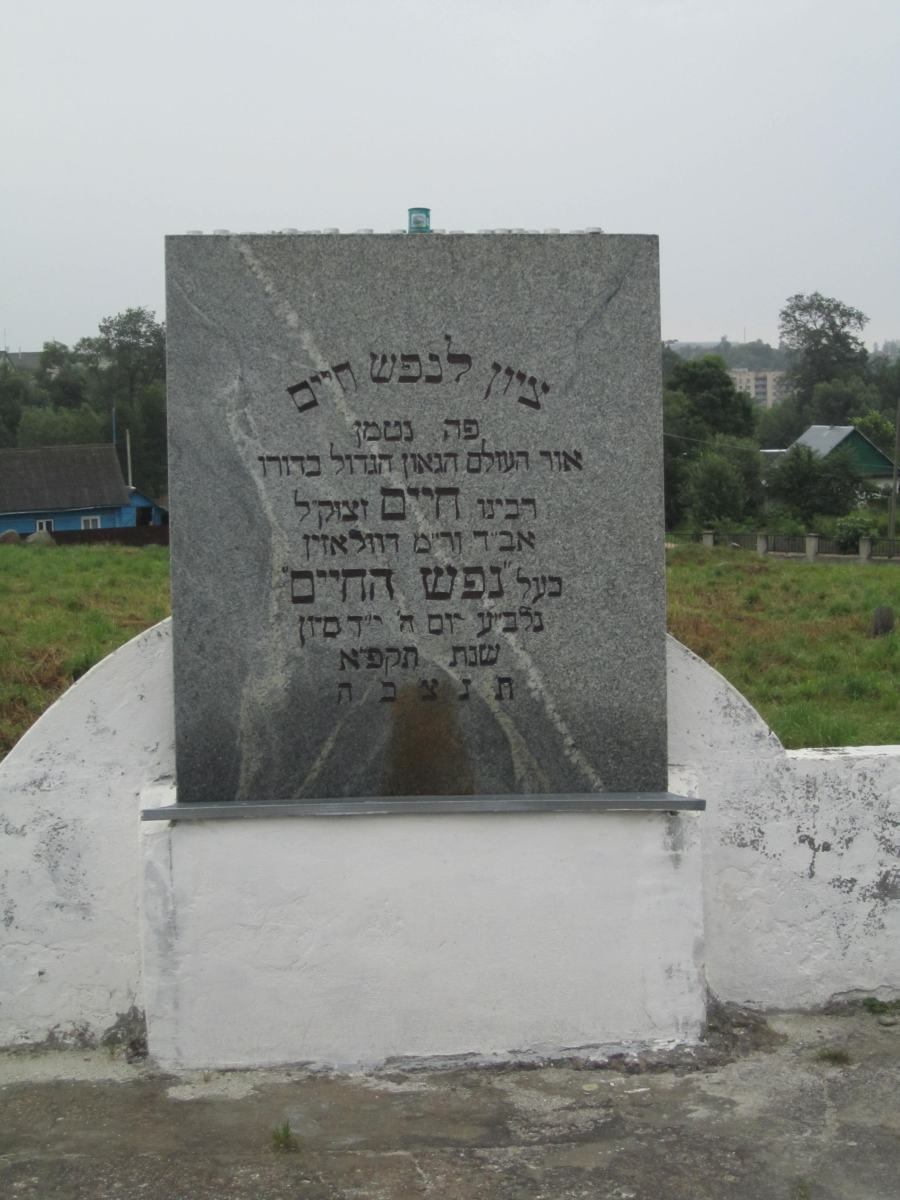
‘A monument for the soul of Chaim. Here is interred the light of the world, the great Gaon of his generation, our teacher Chaim, may his memory be a blessing. Head of the Rabbinical Court and Head of the Yeshiva of Volozhin, author of Nefesh HaChaim. He passed away on Thursday, the 14th of Sivan, in the year 5581 (1821). May his soul be bound up in the bond of eternal life‘.
Here is a line-by-line translation of the Hebrew inscription:
Line 1: ציון לנפש חיים
- Transliteration: Tziyun l’nefesh Chaim
- Translation: A monument for the soul of Chaim.
- Note: “Tziyun” means a marker or monument. “Nefesh Chaim” is also a play on the title of his famous work, Nefesh HaChaim (“The Soul of Life”).
Line 2: פה נטמן
- Transliteration: Poh nitman
- Translation: Here is interred
Line 3: אור העולם הגאון הגדול בדורו
- Transliteration: Or ha’olam, ha’Gaon ha’gadol b’doro
- Translation: The light of the world, the great Gaon of his generation
Line 4: רבינו חיים זצוק”ל
- Transliteration: Rabeinu Chaim, ztzo”kal
- Translation: Our teacher, Chaim, may the memory of the righteous be a blessing.
- Note: “ZTzUK”L” (זצוק”ל) is an acronym for “Zecher Tzadik Livracha,” a standard honorific for a deceased righteous person.
Line 5: אב”ד ור”מ דוולאזין
- Transliteration: A”B”D v’R”M d’Volozhin
- Translation: Av Beit Din (Head of the Rabbinical Court) and Rosh Mesivta (Head of the Yeshiva) of Volozhin.
Line 6: בעל “נפש החיים”
- Transliteration: Ba’al “Nefesh HaChaim”
- Translation: Author of “Nefesh HaChaim”
Line 7: נלב”ע יום ה’ י”ד סיון
- Transliteration: Nivdal mi’chayei olam, yom hei, yud dalet Sivan
- Translation: He passed away on Thursday, the 14th of Sivan.
- Note: “Nifatar” (נפטר) is often used for “passed away.” “Nivdal Mi’chayei Olam” (נלב”ע) is another acronym meaning “was separated from the life of the World [to Come].”
Line 8: שנת תקפ”א
- Transliteration: Shnat Ta”sh Pa”h Alef (Reading the Hebrew letters as numbers: Tav=400, Kuf=100, Peh=80, Alef=1)
- Translation: In the year 5581 (according to the Hebrew calendar).
- Note: This corresponds to the year 1821 in the Gregorian calendar.
Line 9: תנצב”ה
- Transliteration: Tintza”bah
- Translation: May his soul be bound up in the bond of eternal life.
- Note: This is a standard concluding formula from I Samuel 25:29, almost always found on Jewish tombstones. It is an acronym for “Tehi Nishmato Tzerurah Bitzror HaChaim.”
The tomb of Rabbi Chaim of Volozhin, originally marked by a stone structure (ohel) in the town’s old Jewish cemetery, was destroyed during the Nazi occupation in World War II, erasing the physical marker that had stood for over a century. For decades, the site remained in ruins amidst the devastation of the cemetery, which also became the burial ground for 2,000 local Jews murdered in the Holocaust.
However, in 1991, a new granite monument was erected on the exact spot of his burial to restore the site’s sanctity. This modern memorial, which bears the inscription you translated, now stands as both a grave marker for the founder of the Volozhin Yeshiva and a vantage point overlooking the mass graves of the community destroyed in 1942.
Today, the restored cemetery serves as an active pilgrimage site, honoring Rabbi Chaim’s legacy while standing as a solemn testament to the vibrant Jewish life that once thrived in Volozhin.
***

Related Articles


Leave a Reply