
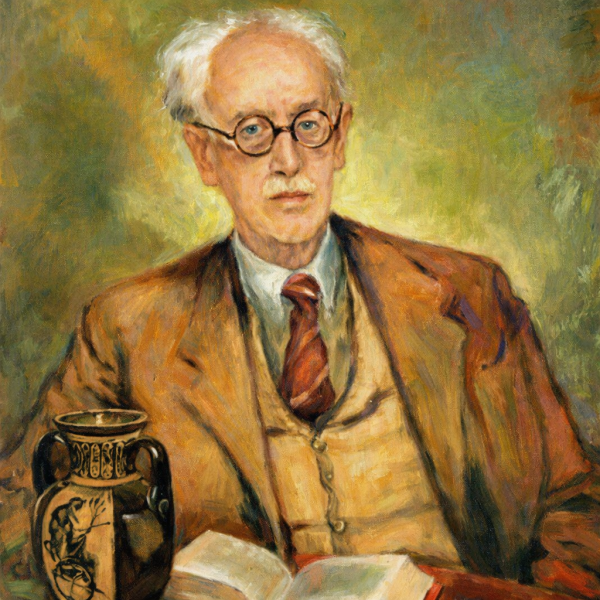
Pythagoreanism, Divination and the Science of Dreams
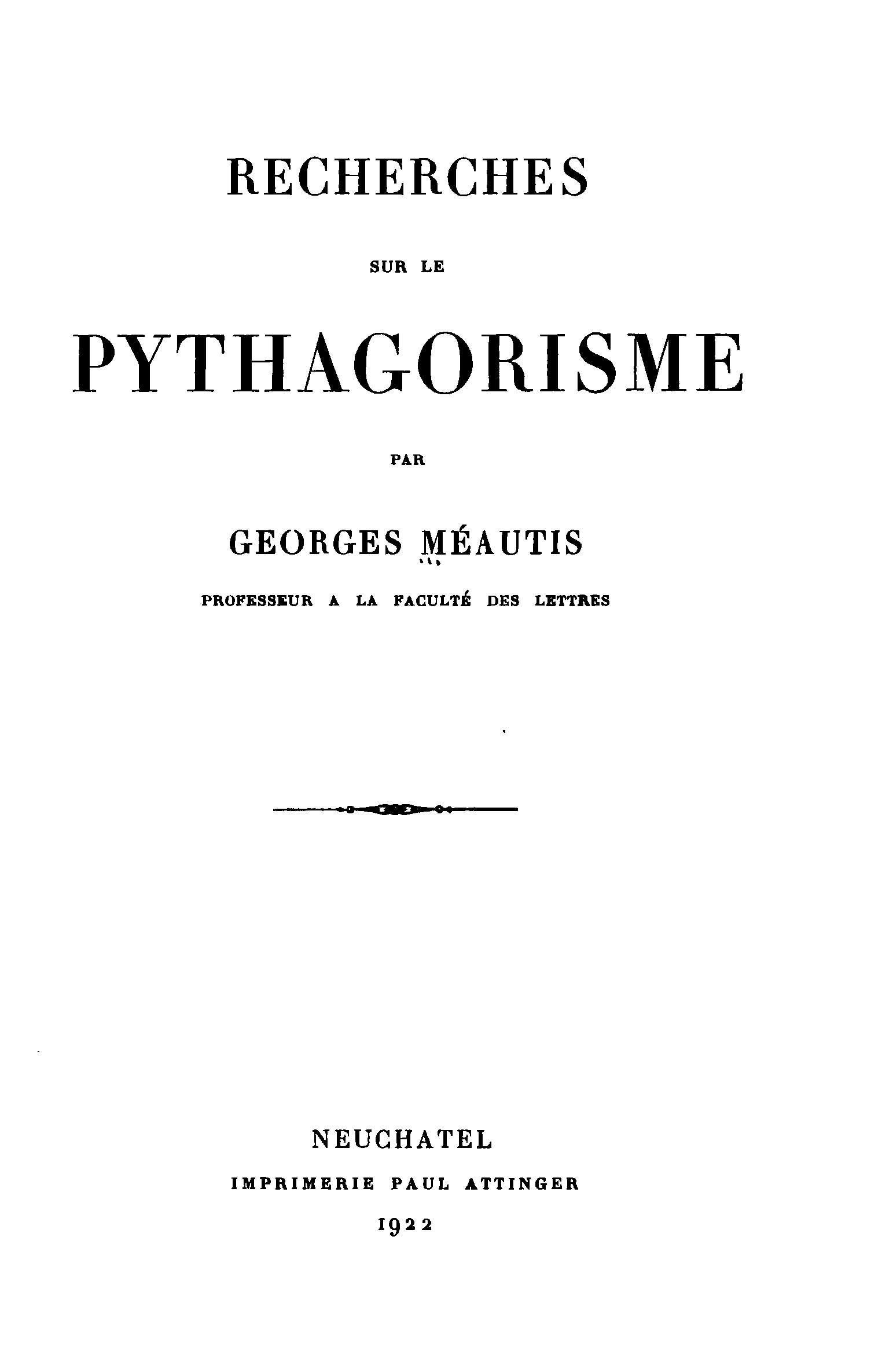
(Excerpt from Georges Méautis, ‘Recherches sur le Pythagorisme’, 1922)
[Page 28] […] If Pythagorean questions are only treated incidentally in the Table Talks and form the subject of only two short dialogues out of the nine books that constitute that work, the same is not true of Plutarch’s De Genio Socratis, which is a veritable mine of valuable information on Pythagoreanism.
The De Genio Socratis is not the work of Plutarch that is best from the point of view of unity of composition. It actually consists of two very different parts: the first includes the account of the deliverance of Thebes from the yoke of the tyrants and the Lacedaemonian garrison in 379 B.C.; the second consists of certain discussions, half-philosophical and half-theological, on the nature of Socrates’ daimonion (δαιμόνιον – divine sign or inner voice).
[Page 29] The Theban conspirators, Plutarch reports, in order to avert all suspicion from themselves, used to meet at the house of Simmias, who, having traveled widely, had a host of interesting details to tell about the foreign peoples he had visited. On the very day fixed for the coup that was to deliver Thebes, while the conspirators were all gathered at Simmias’s house, they were told that a richly dressed stranger followed by a numerous escort was asking to speak to one of them, to Polymnis, the father of Epaminondas. This stranger was a Pythagorean from Croton named Theanor, who had recently arrived in Thebes. The reason for his journey was as follows: at the time of the terrible massacres that almost completely destroyed the Pythagorean communities of Sicily and southern Italy, the Pythagoreans of Metapontum were all gathered together in a house when their enemies surrounded it and set it on fire. All those who were in the house perished except Philolaus and Lysis, who, being younger and stronger, managed to escape the flames. Philolaus took refuge in Lucania, Lysis in Thebes, where he was received by Polymnis, with whom he lived until his death. Theanor’s journey had a double purpose: first, to bring back the body of Lysis to Italy; second, to reward Polymnis worthily for the care and affection he had constantly shown Lysis.
Such is the role that, in the De Genio Socratis, Plutarch gives to a Pythagorean. Now – and it is in this that this role is interesting – Plutarch did not make Theanor a dull and ordinary character; quite the contrary, as we will have occasion to see, he accumulated with extraordinary care and detail all the particulars, all the traits of customs and character, likely to make Theanor the typical Pythagorean, the one who embodies the characteristic features of the sect. That is why the De Genio is of such importance for anyone seeking to represent what Pythagoreanism was at a given moment in history.
[Page 30] Plutarch’s care to give only real and positive information about Pythagorean beliefs in the De Genio Socratis is first shown in what he says about divination.
That the Pythagoreans attached great importance to divination is clear from numerous passages in Iamblichus’s Life of Pythagoras;¹ it was through divination that they could, they said, learn to know the will of the gods,² and the ideal of man, according to them, was above all to learn to conform to the divine will.³ But they did not admit all divinatory procedures indiscriminately. They rejected, for example, divination by sacrifices,⁴ which goes without saying since they did not admit, at least some of them, blood sacrifices. They preferred divination by means of numbers⁵ or that which was done by means of water.⁶ We are very poorly informed about the manner in which they understood these two procedures, which were used much less than a third procedure, divination by dreams, oneiromancy, which even constituted, for the Pythagoreans, according to Nemesius of Emesa,⁷ the only truthful procedure of divination.
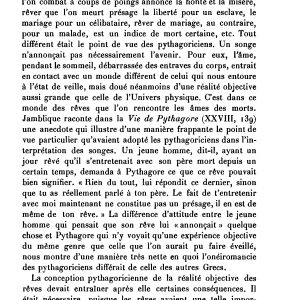
[Page 31]With regard to oneiromancy, it is important to note that the point of view adopted by the Pythagoreans was very different from the point of view generally adopted in Antiquity. Whether one reads Hippocrates’ Peri enypniōn (Περὶ ἐνυπνίων – On Dreams) or Artemidorus of Daldis’s Oneirokritika (Ὀνειροκριτικά – The Interpretation of Dreams), one will see that these two authors give an almost exclusively symbolic interpretation of dreams. If you dream of a stormy sea, it announces a stomach illness; seeing dark, scorched earth indicates a violent and mortal illness; dreaming that you are fighting with fists announces shame and misery; dreaming that you die foretells freedom for a slave, marriage for a bachelor; dreaming of marriage, on the contrary, for a sick person, is a sign of certain death, etc. The point of view of the Pythagoreans was very different. A dream did not necessarily announce the future. For them, the soul, during sleep, freed from the shackles of the body, came into contact with a world different from the one that surrounds us in the waking state, but nevertheless endowed with an objective reality as great as that of the physical universe. It is in this world of dreams that one encounters the souls of the dead. Iamblichus recounts in the Life of Pythagoras (XXVIII, 139) an anecdote that strikingly illustrates the particular point of view that the Pythagoreans had adopted in the interpretation of dreams. A young man, he says, having one day dreamed that he was conversing with his father who had been dead for some time, asked Pythagoras what this dream could possibly mean. “Nothing at all,” the latter replied to him, “except that you really spoke to your father. The fact that you are conversing with me now does not constitute a presage; it is the same with your dream.” The difference in attitude between the young man, who thought that his dream was “announcing” something to him, and Pythagoras, who saw in it only an objective experience of the same kind as one could have while awake, shows us very clearly how the oneiromancy of the Pythagoreans differed from that of other Greeks.
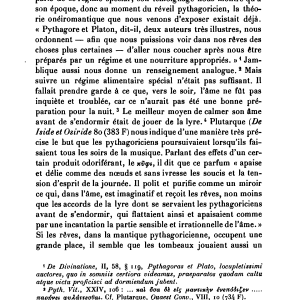
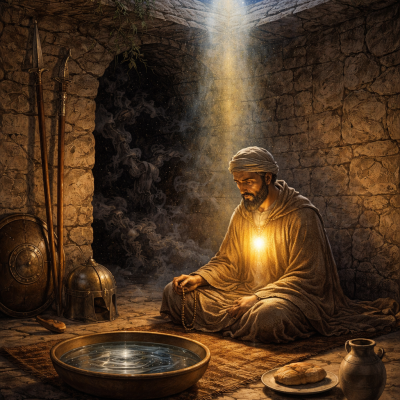
[Page 32] The Pythagorean conception of the objective reality of dreams had certain consequences. Since dreams were so important, it was necessary to succeed in preserving as precise a memory of them as possible. A certain regimen was therefore indispensable; the man who wished to bring back into his waking consciousness the exact memory of what he had done during his sleep must not use the same food as other men. Cicero speaks to us of this special regimen; his testimony shows us that in his time, therefore at the time of the Pythagorean revival, the oneiric theory we have just expounded already existed. “Pythagoras and Plato,” he says, “two very illustrious authors, order us – so that we may see more certain things in our dreams – to go to bed after having prepared ourselves by an appropriate regimen and diet.”¹ Iamblichus also gives us similar information.² But following a special diet was not sufficient. Care had to be taken that, towards evening, the soul was not anxious and troubled, for that would not have been a good preparation for the night.³ The best way to calm one’s soul before falling asleep was to play the lyre.⁴ Plutarch (On Isis and Osiris 80 (383 F)) indicates very precisely the goal that the Pythagoreans pursued when they made music every evening. Speaking of the effects of a certain fragrant product, the kyphi (κύφι – an Egyptian incense blend), he says that this perfume “soothes and loosens like knots, without intoxication, the cares and mental tension of the day. It polishes and purifies like a mirror that in the soul which is imaginative and receives dreams, no less than the strains of the lyre which the Pythagoreans used before sleeping, thus soothing and calming as if by incantation the sensitive and irrational part of the soul.” If dreams occupy a large place in Pythagorean divination, it seems that tombs also played a certain role in their divinatory procedures.
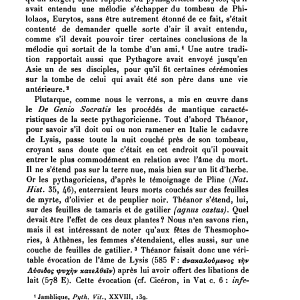
[Page 33]Thus, a shepherd having reported to the Pythagorean Eurytus that he had heard a melody coming from the tomb of Philolaus, Eurytus, without being particularly astonished by this fact, was content to ask what kind of air he had heard, as if he should be able to draw certain conclusions from the melody coming from the tomb of a friend. Another tradition also reported that Pythagoras had sent one of his disciples all the way to Asia to perform certain ceremonies on the tomb of the one who had been his father in a previous life.
Plutarch, as we shall see, employed in the De Genio Socratis the divinatory procedures characteristic of the Pythagorean sect. First of all, Theanor, to know whether or not he should bring the body of Lysis back to Italy, spends the whole night lying near his tomb, doubtless believing that it was in this place that he could most conveniently enter into relation with the soul of the dead man. He does not lie down on the bare ground, but on a bed of herbs. Now the Pythagoreans, according to the testimony of Pliny (Nat. Hist. 35, 46), used to bury their dead lying on leaves of myrtle, olive, and black poplar. Theanor, for his part, lies down on leaves of tamarisk and chaste tree (agnus castus). What was the effect of these two plants? We know nothing of it, but it is interesting to note that at the Thesmophoria festival in Athens, women also lay down on a bed of chaste tree leaves. Theanor was therefore performing a veritable evocation of the soul of Lysis (585 F: ἀνακαλούμενος τὴν Λύσιδος ψυχήν anakaloumenos tēn Lysidos psychēn – “calling up the soul of Lysis”); after having offered him libations of milk (578 E).
[Page 34]This evocation (cf. Cicero, in Vat. c. 6: infelix animas elicere – “to summon forth the souls of the dead”), however, must have constituted only one part of the Pythagorean ritual. Theanor says in so many words (585 E) that there existed a secret ceremony that the Pythagoreans performed on the tomb of their dead. If this ceremony was not performed, it seems, the soul was prevented from reincarnating (585 F).¹ It is impossible not to compare this information with the anecdote related a few pages above where we see Pythagoras sending a disciple all the way to Asia to make a sacrifice on the tomb of the one who was his father.
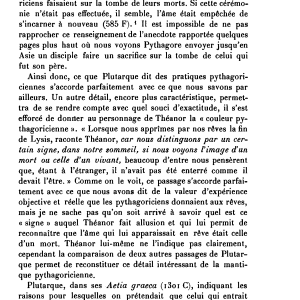
Thus, what Plutarch says about Pythagorean practices agrees perfectly with what we know from elsewhere. Another detail, even more characteristic, will show with what concern for accuracy he strove to give the character of Theanor a “Pythagorean coloring.” “When we learned through our dreams of the end of Lysis,” recounts Theanor, “for we distinguish by a certain sign, in our sleep, whether we see the image of a dead person or that of a living person, many of us thought that, being abroad, he had not been buried as he should be.” As can be seen, this passage agrees perfectly with what we have said about the value of objective and real experience that the Pythagoreans gave to dreams, but I do not know that anyone has succeeded in discovering what this “sign” is to which Theanor alludes and which allowed him to recognize that the soul appearing to him in a dream was that of a dead person. Theanor himself does not indicate it clearly; however, the comparison of two other passages from Plutarch allows us to reconstruct this interesting detail of Pythagorean divination.
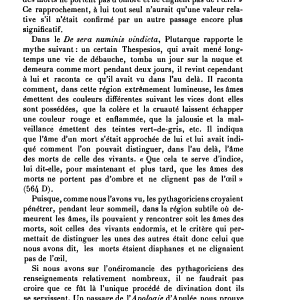
Plutarch, in his Aetia graeca (1301 C), indicating the reasons why it was claimed that he who entered the Lykaion (Λύκαιον) in Arcadia cast no shadow, says among other things: “Is it because he who enters this place is put to death and the Pythagoreans say that the souls of the dead cast no shadow and do not blink?” This comparison alone would have only relative value if it were not confirmed by another even more significant passage.
[Page 35] In the De sera numinis vindicta, Plutarch reports the following myth: a certain Thespesius, who had led a dissolute life for a long time, one day fell on the back of his neck and remained as if dead for two days; he came back to himself, however, and recounted what he had seen in the beyond. He told how, in that extremely luminous region, souls emit different colors according to the vices with which they are possessed; that anger and cruelty emit a red and fiery color; that jealousy and malice emit verdigris hues, etc. He indicated that the soul of a dead man had approached him and told him how one could distinguish, in the beyond, the soul of the dead from that of the living. “Let this serve as a sign for you, now and later,” she said to him, “that the souls of the dead cast no shadow and do not blink” (564 D).
Since, as we have seen, the Pythagoreans believed that they entered, during their sleep, the subtle region where souls dwell, they could meet there either the souls of the dead or those of sleeping living persons, and the criterion that allowed distinguishing between them was therefore that which we have stated: the dead were diaphanous and did not blink.
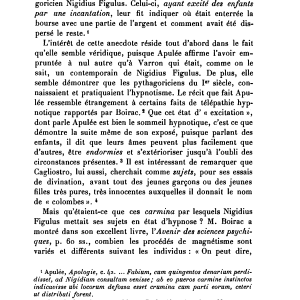
If we have relatively numerous pieces of information on the oneiromancy of the Pythagoreans, we should not believe that this was the only divinatory procedure they used. A passage from Apuleius’s Apology proves that they appealed, when necessary, to the help of children who revealed to them the secrets of the future or the present. One of the Fabii, reports Apuleius, having lost a fairly considerable sum of money, came to ask advice from the Pythagorean Nigidius Figulus. The latter, having excited children by an incantation, made them indicate where the purse was buried with part of the money and how the rest had been dispersed.
[Page 36] The interest of this anecdote lies first of all in the fact that it seems truthful, since Apuleius affirms that he borrowed it from none other than Varro, who was, as we know, a contemporary of Nigidius Figulus.¹ Moreover, it seems to demonstrate that the Pythagoreans of the first century knew and practiced hypnotism. The account given by Apuleius bears a strange resemblance to certain facts of hypnotic telepathy reported by Boirac.² That this state of “excitation,” of which Apuleius speaks, is indeed hypnotic sleep is demonstrated by the very continuation of his exposition, since speaking of the children, he says that their souls can more easily than others be put to sleep and externalized to the point of forgetting present circumstances.³ It is interesting to note that Cagliostro, too, sought as subjects for his divination experiments above all young boys or very pure, very innocent young girls to whom he gave the name “doves.”⁴
But what were these carmina (Latin: “songs, incantations”) by which Nigidius Figulus put his subjects into a hypnotic state? M. Boirac has shown in his excellent book, L’Avenir des sciences psychiques, p. 60 ff., how varied and different the methods of magnetism are according to individuals: “It can be said,” he writes, “that each experimenter has his own habits and preferences which no doubt correspond to his particular aptitudes, natural or acquired, but that he would be wrong to want to impose them on other experimenters by virtue of this sole reasoning: ‘I never use in all my experiments anything but one method (for example, suggestion) and it always succeeds for me; therefore this method alone exists and it is the only one that succeeds.’”
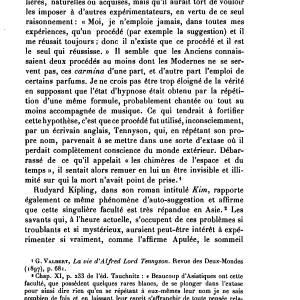
[Page 37]It seems that the Ancients knew at least two methods that the Moderns do not use: these carmina on the one hand, and on the other hand the use of certain perfumes. I do not think I am too far from the truth in supposing that the hypnotic state was obtained by the repetition of the same formula, probably sung or at least accompanied by music. What tends to strengthen this hypothesis is that this method was used, unconsciously, by an English writer, Tennyson, who, by repeating his own name, succeeded in putting himself into a kind of ecstasy in which he completely lost consciousness of the external world. Freed from what he called “the chimeras of space and time,” he then felt an invisible and limitless being stir within him, over which death had no hold.¹
Rudyard Kipling, in his novel entitled Kim, also reports this same phenomenon of auto-suggestion and affirms that this singular faculty is very widespread in Asia.² The scholars who, at present, occupy themselves with these troubling and mysterious problems might perhaps have an interest in experimenting whether, as Apuleius affirms, hypnotic sleep can be obtained by the use of perfumes and music, or at least of certain chanted phrases.
*
Notes
Notes to page 30:
¹ Iamblichus, Pyth. Vit., XXIX. (Refers to Iamblichus’s Life of Pythagoras, chapter 29.)
² Ibid., XXVIII, 138.
³ Ibid., XXVIII, 145.
⁴ Iamblichus, Pyth. Vit., XIX.
⁵ Ibid.
⁶ Augustine, De Civ. Dei, VII, 35.
⁷ Cited by Jäger, Nemesios von Emesa, p. 54.
Notes to page 32:
¹ Cicero, De Divinatione, II, 58, § 119: Pythagoras et Plato, locupletissimi auctores, quo in somniis certiora videamus, praeparatos quodam cultu atque victu proficisci ad dormiendum jubent. (Translation: “Pythagoras and Plato, most authoritative authors, order that we go to sleep prepared by a certain regimen and diet, so that we may see more certain things in dreams.”)
² Iamblichus, Pyth. Vit., XXIV, 106: καὶ ὅσα δὲ εἰς μαντικὴν ἐνεπόδιζεν …. παρῄνει φυλάττεσθαι (kai hosa de eis mantikēn enepodizen … parēnei phylattesthai – “and as many things as hindered divination … he advised to beware of”). Cf. Plutarch, Quaest. Conv., VIII, 10 (734 F).
³ Iamblichus, op. cit., XV, 65: Ἐπί τε ὕπνον ἑσπέρας τρεπομένων τῶν ὁμιλητῶν ἀπήλλαττε μὲν αὐτοὺς τῶν ἡμερινῶν ταραχῶν καὶ ἐνυπνίων, διεκάθαιρέ τε συγκεκλυσμένον τὸ νοητικόν, ἡσύχους τε καὶ εὐονείρους, ἔτι δὲ μαντικοὺς τοὺς ὕπνους αὐτοῖς ἀπειργάζετο. (Epi te hypnon hesperas trepomenōn tōn homilētōn apēllatte men autous tōn hēmerinōn tarachōn kai enypniōn, diekathaire te sygkeklysmenon to noētikon, hēsychous te kai euoneirous, eti de mantikous tous hypnous autois apeirgazeto. – “And when his associates turned to sleep in the evening, he freed them from the day’s disturbances and dreams, and cleansed their intellectual part which had been flooded, and made their sleeps quiet and with good dreams, and moreover prophetic for them.”)
⁴ Ibid., XXV, 114.
Notes to page 33:
¹ Iamblichus, Pyth. Vit., XXVIII, 139.
² Iamblichus, Pyth. Vit., XXVIII, 143. Cf. Phédon Schol., 61 e, which presents more than one point of resemblance with what Plutarch reports of Theanor in the De Genio Socratis.
³ This information has been preserved for us by Aelian, Hist. an., IX, 26. Cf. J. E. Harrison, Prolegomena to the Study of Greek Religion (1903), p. 130.
Notes to page 34:
¹ The importance that the Pythagoreans attached to funeral rites from the time of ancient Pythagoreanism also emerges from what Iamblichus, Pyth. Vit., XVIII, 85, says about the content of the ἀκούσματα (akousmata – lit. “things heard”; the oral teachings or acusmata of the Pythagoreans).
Notes to page 36:
¹ Apuleius, Apology, c. 42: … Fabium, cum quingentos denarium perdidisset, ad Nigidium consultum venisse; ab eo pueros carmine instinctos indicavisse ubi locorum defossa esset crumina cum parti eorum, ceteri ut distributi forent. (Translation: “… that Fabius, when he had lost five hundred denarii, came to Nigidius for advice; and that Nigidius, having stirred up boys by an incantation, made them indicate where the purse was buried with part of the money, and how the rest had been dispersed.”)
² L’avenir des sciences psychiques. Paris, Alcan (1917), p. 238 ff.
³ Apologia, c. 43: Quin et illud mecum reputo posse animum humanum, praesertim puerilem et simplicem seu carminum avocamento sive odorum delenimento soporari et ad oblivionem praesentium externari. (Translation: “Moreover, I consider this as well: that the human mind, especially that of a child and simple, can be put to sleep by the distraction of incantations or the soothing effect of perfumes, and be externalized to the forgetfulness of present circumstances.”)
⁴ V. H. D’Alméras, Cagliostro (Paris 1904), p. 134 and 140.
Notes to page 37:
¹ G. Valbert, La vie d’Alfred Lord Tennyson. Revue des Deux-Mondes (1897), p. 681.
² Chap. XI, p. 233 of the Tauchnitz edition: “Many Asiatics have this faculty, which a few rare whites possess, of plunging into ecstasy so to speak simply by repeating their own name to themselves I don’t know how many times and letting their mind free itself from all thought relating to what is called personal identity. This faculty disappears with age, but as long as it lasts it can come to you at any moment.” The English novelist Blackwood wrote an entire book on this theme: The Human Chord.
*
Index of Important Concepts and Terms
Akousmata (ἀκούσματα) – Oral teachings or “things heard” of the Pythagoreans, including ritual prescriptions (p. 34 n. 1).
Apuleius – Latin author who reports Pythagorean use of hypnotic incantations (p. 36).
Cagliostro– Eighteenth-century mystic who used pure children as divinatory subjects, compared to Pythagorean practice (p. 36).
Carmina– Latin for “songs, incantations”; used by Nigidius Figulus to induce hypnotic states (p. 36).
Daimonion(δαιμόνιον) – Socrates’ divine sign, discussed in Plutarch’s De Genio Socratis (p. 29).
Divination– Central to Pythagorean practice; included oneiromancy, number divination, hydromancy, and necromantic tomb rituals (pp. 30–35).
Dreams (oneiroi) – For Pythagoreans, objective encounters with souls of the dead, not mere symbols (p. 31).
Eurytus – Pythagorean who interpreted a melody from Philolaus’s tomb (p. 33).
Hades (Ἅιδης) – Underworld; Pythagoreans compared transmigration myths to Hades narratives (p. 28).
Hypnotism – Practiced by Pythagoreans via incantations, perfumes, and music; compared to modern experiments (pp. 36–38).
Iamblichus– Neoplatonist author of Life of Pythagoras, key source for Pythagorean divination (p. 30).
Kyphi (κύφι) – Egyptian incense used by Pythagoreans to prepare for dream receptivity (p. 32). Lysis – Pythagorean who fled to Thebes; his tomb and funerary rites are central to Plutarch’s narrative (pp. 29, 33–34).
Lykaion(Λύκαιον) – Sanctuary in Arcadia associated with the belief that entrants cast no shadow (p. 34).
Music (lyre) – Used nightly by Pythagoreans to calm the soul before sleep, enhancing dream recall (p. 32).
Nemesius of Emesa – Source for Pythagorean oneiromancy as the only truthful divination (p. 30). Nigidius
Figulus – First-century BCE Pythagorean who used child hypnosis for divination (p. 36).
Oneiromancy – Dream divination; Pythagorean version treated dreams as real journeys of the soul (pp. 30–35).
Peri enypniōn (Περὶ ἐνυπνίων) – Hippocratic treatise on dreams, representing symbolic dream interpretation (p. 31).
Philolaus– Pythagorean who escaped the Metapontum fire; his tomb emitted a melody (pp. 29, 33).
Plutarch– Author of De Genio Socratis and Table Talks, a key source for late Pythagoreanism (pp. 28–30).
Purifications – Important in Pythagorean asceticism, though rarely mentioned in fragments (p. 28).
Shadow (lack of) – Sign that a soul is dead; the dead cast no shadow and do not blink (p. 35).
Theanor– Typical Pythagorean character in Plutarch; evokes the soul of Lysis by a tomb (pp. 29, 33–34). Thebes – Setting of Plutarch’s De Genio Socratis; Lysis took refuge there (p. 29).
Thesmophoria – Women’s festival where participants lay on chaste tree leaves, paralleling Theanor’s practice (p. 33).
Transmigration (metempsychosis) – Pythagorean belief; funerary rites required for reincarnation (pp. 28, 34).
Zeller, Eduard – Scholar who noted the importance of asceticism in Pythagoreanism (p. 28).
*
Original French
*
Source


Leave a Reply