
Circle of Transmission: The Living Loom
Karl von Eckartshausen – On Music, & The Power Of Harmony On The Soul
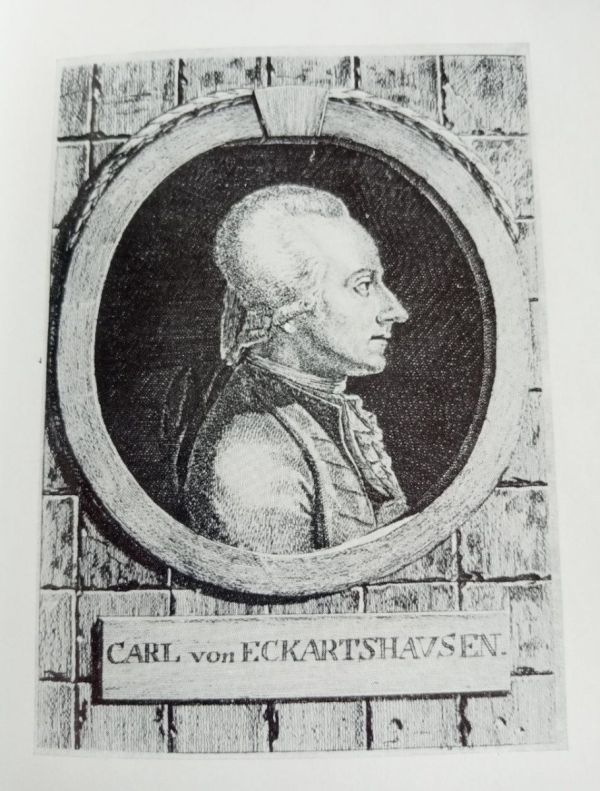
A portrait of Karl von Eckartshausen,
in Antoine Faivre’s trail blazing 1969 ‘Eckartshausen
et la Théosophie Chrétienne’, Klinglisek, Paris.
(portrait number 3).
*
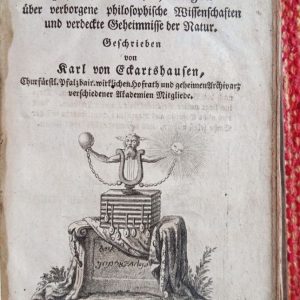
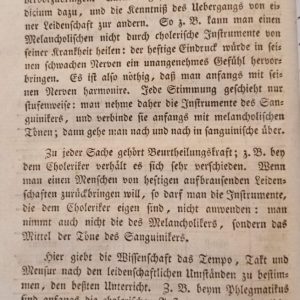
Today’s sharing from the Blue House of Via-HYGEIA is an excerpt from Karl von Eckartshausen’s emblematic ‘Aufschlusse zur Magie‘ (Munich, Joseph Lentner, 1788), ‘On Music, and the Power of Harmony on the Soul‘, from page 380 to page 384 .
This text represents an attempt to systematize music therapy using an early scientific, yet internally coherent, model blending mysticism, physiology, & acoustics. While its humoral framework is outdated, its core insight — that music affects the body and mind through measurable physical mechanisms — remains relevant today in fields such as music therapy, neuroscience, and psychophysiology.
Eckartshausen’s work stands at the intersection of Enlightenment rationalism and Romantic vitalism, offering a bridge between ancient harmonic philosophy and modern therapeutic applications of sound.
**
An Introduction
This passage, drawn from Karl von Eckartshausen’s 18th-century esoteric work ‘Aufschlüsse zur Magie’, explores the physiological and psychological influence of music on the human soul. Written in the context of Enlightenment-era natural philosophy and early Romantic mysticism, Eckartshausen frames music not merely as an art form but as a powerful agent capable of altering the body’s nervous system and emotional states. Drawing on Pythagorean harmonics, Galenic humoral theory, and contemporary physiological ideas, he constructs a systematic correspondence between musical tones, temperaments, and nervous conditions — proposing that music can be used therapeutically to restore harmony within the human organism.
Though rooted in early scientific models (e.g., the four humors), the text anticipates modern psychophysiological insights by treating music as a stimulus that directly affects neural and emotional states. Eckartshausen’s ‘Relationship Table‘ serves as a practical guide for musicians and healers, mapping instruments, tones, and temperaments to specific emotional and physiological effects.
Core Concepts
-
Music as a Physiological Agent
Music is not merely aesthetic — it acts directly upon the nervous system, inducing vibrations that alter the state of the soul. Eckartshausen cites Pythagoras’s use of morning music to awaken mental mobility, suggesting music’s capacity to modulate brain activity. -
Harmony & Emotional Regulation
Music can restore emotional balance by counteracting the ‘disharmony‘ caused by passion. It must be applied gradually, matching the listener’s temperament and emotional state, to avoid shock or imbalance. -
Temperament Theory (Four Humors)
Eckartshausen maps the four classical temperaments — Sanguine, Phlegmatic, Choleric, Melancholic — to elements, colors, passions, bodily humors, and even musical modes and instruments. This system underpins his therapeutic approach to musical prescription. -
The ‘Relationship Table’
A structured matrix correlating temperament with musical parameters:- Instruments (e.g., flute for Sanguine, trumpet for Choleric)
- Tones (e.g., Dorius for Sanguine, Lydius for Melancholic)
- Expression (e.g., Allegretto for Sanguine, Adagio for Melancholic)
This table functions as a diagnostic and therapeutic tool for matching music to emotional and physiological needs.
-
Gradual Transition Principle
Emotional transformation through music must occur stepwise — e.g., from Sanguine tones to Melancholic tones — to avoid overwhelming the nervous system. Abrupt shifts are contraindicated. -
Consonance & Vibration Theory
Eckartshausen includes a table of consonances (intervals) with their mathematical ratios, emphasizing that their power lies not in harmonic beauty per se, but in their physical effect — the ‘measure of vibrations’ corresponding to ‘the measure of nervous tensions’. -
Rejection of Modern Musical Standards
He explicitly warns against interpreting his tables through the lens of contemporary harmony or composition theory, insisting they reflect a physiological, not aesthetic, framework.
*
And now the text:
On Music, & The Power Of Harmony On The Soul
The rapid mobility of the brain is the cause of the extraordinary sensitivity of the spirit. This mobility was awakened in Pythagoras’s students by music in the early morning; and it also seems to rest upon the great sensitivity of the brain, since it is very slight in a dull person and fully developed in a thoughtful state.
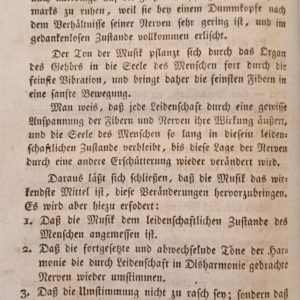
The tone of music penetrates the organ of hearing and reaches the soul of man through the fine vibrations, thereby setting the finest fibers into a gentle motion.
It is known that every passion exerts a certain tension on the fibers and nerves, and the soul of man remains in this passionate state until the condition of the nerves is altered by another agitation.
From this it may be concluded that music is a suitable means to evoke these changes. It is therefore required:
- That music be suited to the passionate states of man.
- That the continued and alternating tones of harmony restore the nerves, which have been thrown into disharmony by passion.
- That the transition not be too abrupt; rather, that the transition from sorrow to comfort, from melancholy to mirth, proceed gradually according to the condition of the tones.
To achieve this art in its fullness, psychological knowledge is required.
The musician must study the nervous system of man. He must observe the passionate states of man. He must know the gradations of these passions. He must know the degree of nervous tension corresponding to the temperament. He must ascertain certain relationships between the tones and the type of nervous tension, and from this derive rules and consequences.
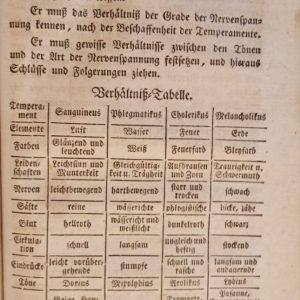
Relationship Table
| Temperament | Sanguineus | Phlegmaticus | Cholericus | Melancholicus |
|---|---|---|---|---|
| Elements | Air | Water | Fire | Earth |
| Colors | Shining and bright | White | Fiery color | Pale |
| Passions | Light-hearted and cheerful | Equanimity and calm | Excitement and zeal | Sadness and melancholy |
| Humors | Red | Watery and weak | Dark red | Black |
| Circulation | Quick | Slow | Uneven and rapid | Long and enduring |
| Tones | Dorius | Mixolydius | Neolitus | Lydius |
| Instruments | Flute, harp, clavier, recorder, mandolin, clarinet | Organ, bassoon, viol, bass, lute | Trumpet, drum, trombone, cymbals, bells | Oboe, trumpet with bassoon, viola, double bass, violoncello |
| Expression of Tone | Allegretto, Andantino, Grazioso | Maestoso, Andantino, Andante | Allegro, Prestissimo, Furioso | Adagio, Largo |
From this table, reliable relationships can be determined. If one studies the passions, the temperaments, and the tones appropriate to each affect, it is not difficult to assign to each tone a different tension of the nerves, and thereby evoke other affects. Also belonging to this is a psychological judgment, and knowledge of the transition from one passion to another. For example, one cannot heal a melancholic through choleric instruments: the harsh impression would evoke an unpleasant feeling in his weak nerves. It is therefore necessary that one begin with sanguine tones. Every transition occurs only gradually: one therefore takes the instruments of the sanguine and combines them with melancholic tones; then one proceeds gradually into the sanguine.
In every case, skill is required: for example, with the choleric, the transition is very different. If one wishes to bring a person back from passionate excitement, one must not use the instruments proper to the choleric; one must also not use those of the melancholic, but rather the means of the sanguine.
Here, science must determine tempo, meter, and measure according to the passionate circumstances—the best instruction. For example, with the phlegmatic, one finds the choleric instruments unsuitable; one must first set his fibers and nerves into motion, so that they become receptive; then one can follow with gentler or quicker tones.
Sound judgment and the artist’s skill must do the most in these cases.
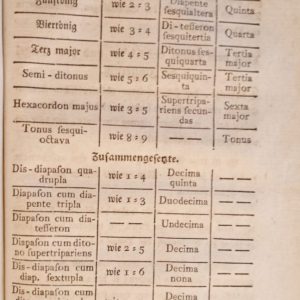
I add here another relationship table of simple consonances and their combinations:
| Simple Consonance | Ratio | Name (Latin) | Name (German) |
|---|---|---|---|
| Unison | 1:1 | Unisonus | — |
| Second | 1:2 | Diapason | Octava |
| Third | 2:3 | Diapente | Quinta |
| Fourth | 3:4 | Ditonus | Quarta |
| Fifth | 4:5 | Tertia major | Tertia major |
| Sixth | 5:6 | Sesquiquinta | Sexta major |
| Seventh | 3:5 | Supertripariens | Sexta major |
| Octave | 8:9 | Tonus | Tonus |
Combined Consonances
| Combination | Ratio | Name (Latin) | Name (German) |
|---|---|---|---|
| Dis-diapason quadrupla | 1:4 | Decima quinta | — |
| Diapason cum diapente tripla | 1:3 | Duodecima | — |
| Diapason cum ditono supertripariens | 2:5 | Decima nona | — |
| Dis-diapason cum diap. sextupla | 1:6 | Decima septima | — |
| Dis-diapason cum ditono quintupla decima septima | 1:5 | Decima septima | — |
According to this table, the ancients determined the movement of the air caused by the instruments, and the movement upon the nerves of man and his passions and affects.
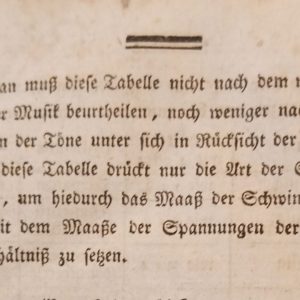
One must not judge this table according to modern music studies, nor even less according to the relationships of tones with regard to harmony; for this table expresses only the nature of vibrations, in order to thereby relate the magnitude of tone vibrations to the magnitude of nervous tensions.
*
Source
*
A Visual illustration
This illustration allegorizes Karl von Eckartshausen’s doctrine of musical influence upon the soul, uniting Pythagorean harmony, physiological vibration, and moral psychology.
At the summit, the teacher of harmony awakens the intellect through ordered sound, while celestial music figures the transmission of subtle vibrations from tone to spirit.
The four temperaments—sanguine, phlegmatic, choleric, and melancholic—are personified below, each governed by its element, color, mode, instrument, and proper tempo, showing how music must accord with nervous tension and passion.
Tables of consonance & proportion recall ancient ratios that regulate the motion of air and nerves alike.
The descending scales & pathways signify the gradual transition of affects, affirming that harmony, wisely administered, restores inner balance by guiding the soul from dissonance to measure.

***

Related Articles


Leave a Reply