
Circle of Transmission: The Living Loom
A Little Sergueï Semionovitch Ouvaroff Sampler – Part 1: Contextual Introduction & About the Three Bacchus
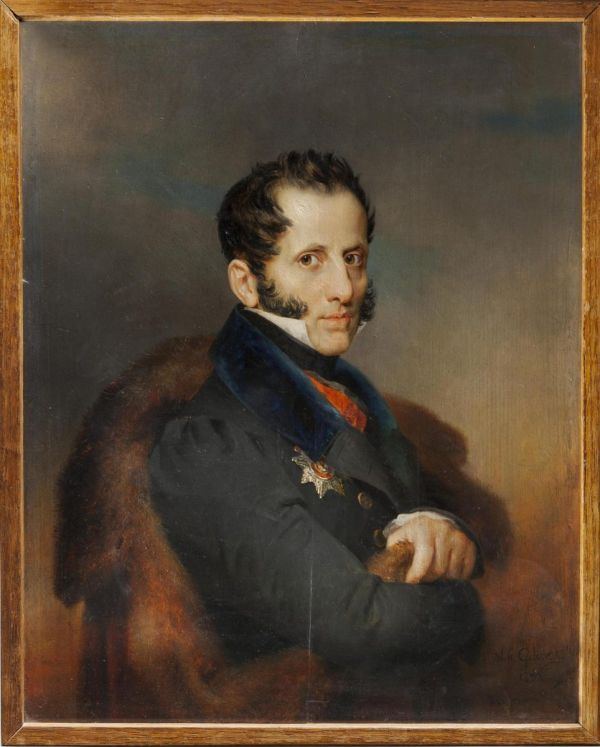
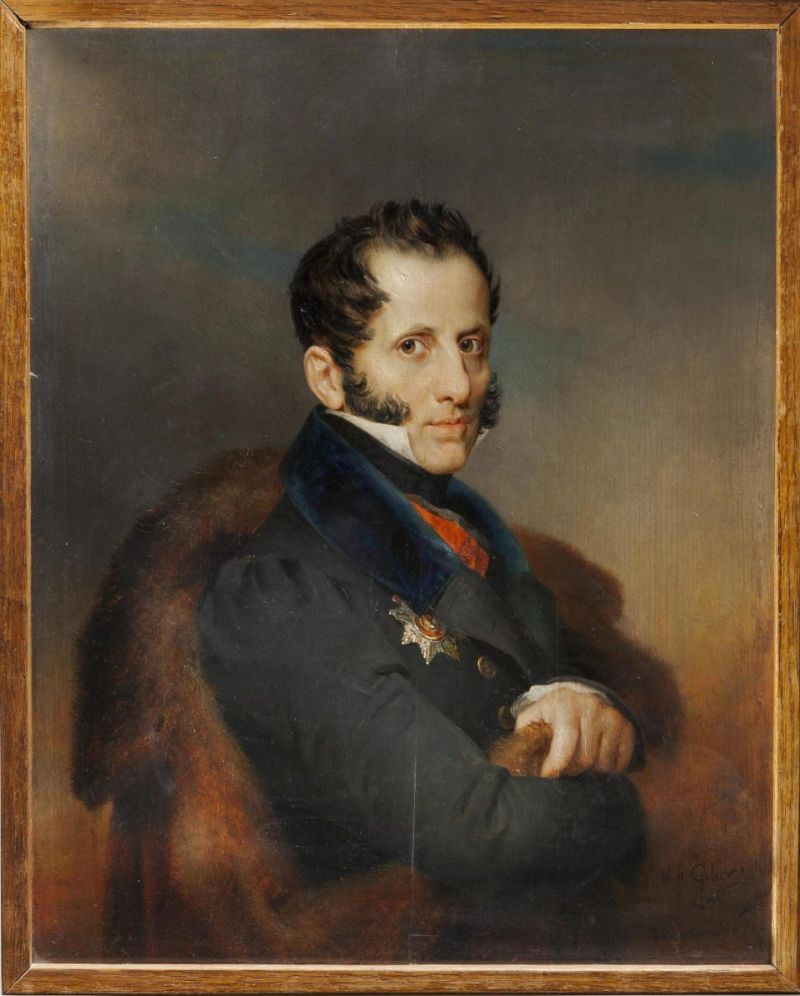
Portrait of Count Sergueï Semionovitch Ouvaroff
(Russian spelling: Uvarov),
painted in 1833 by Golike Vasily.
*
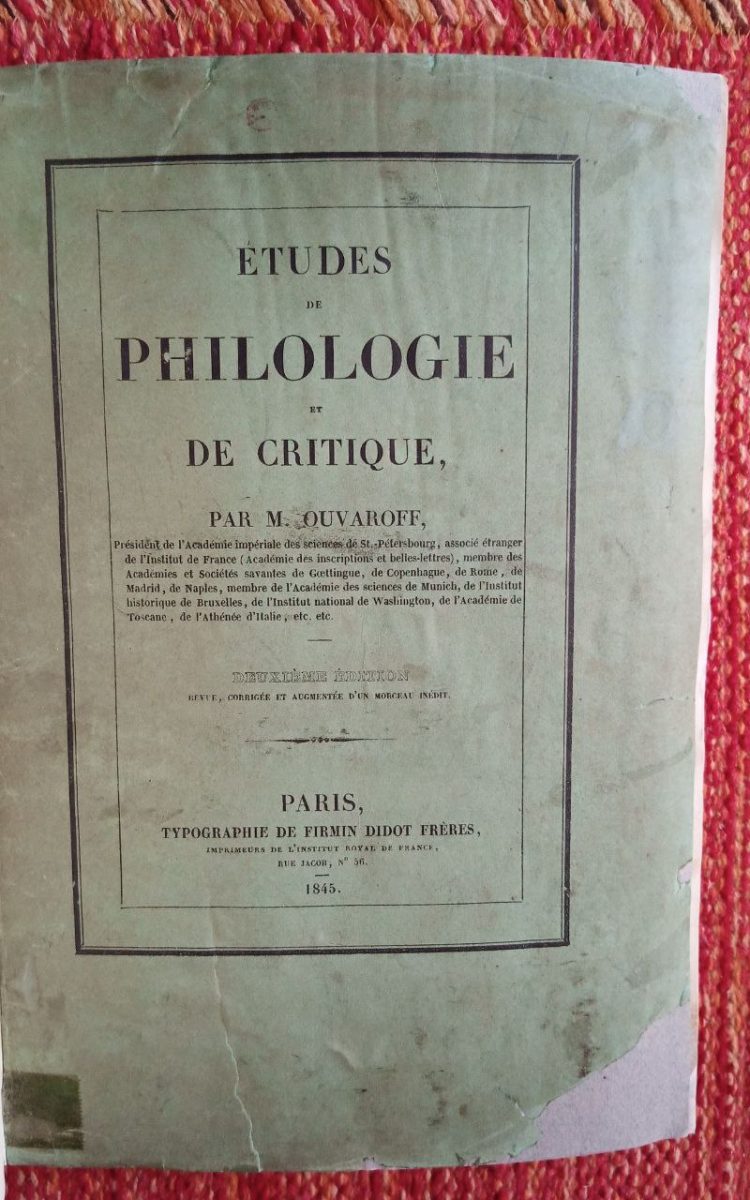
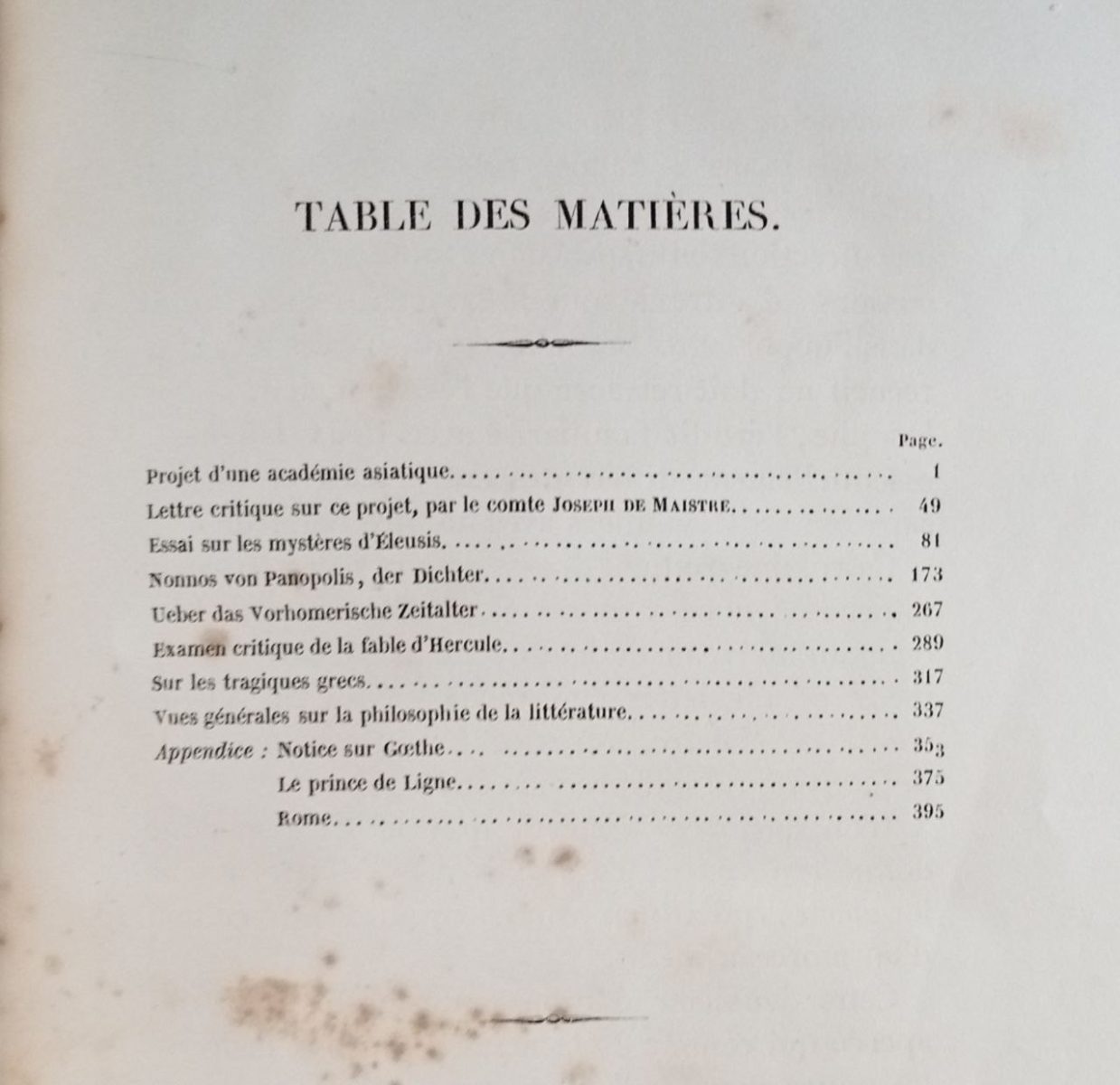
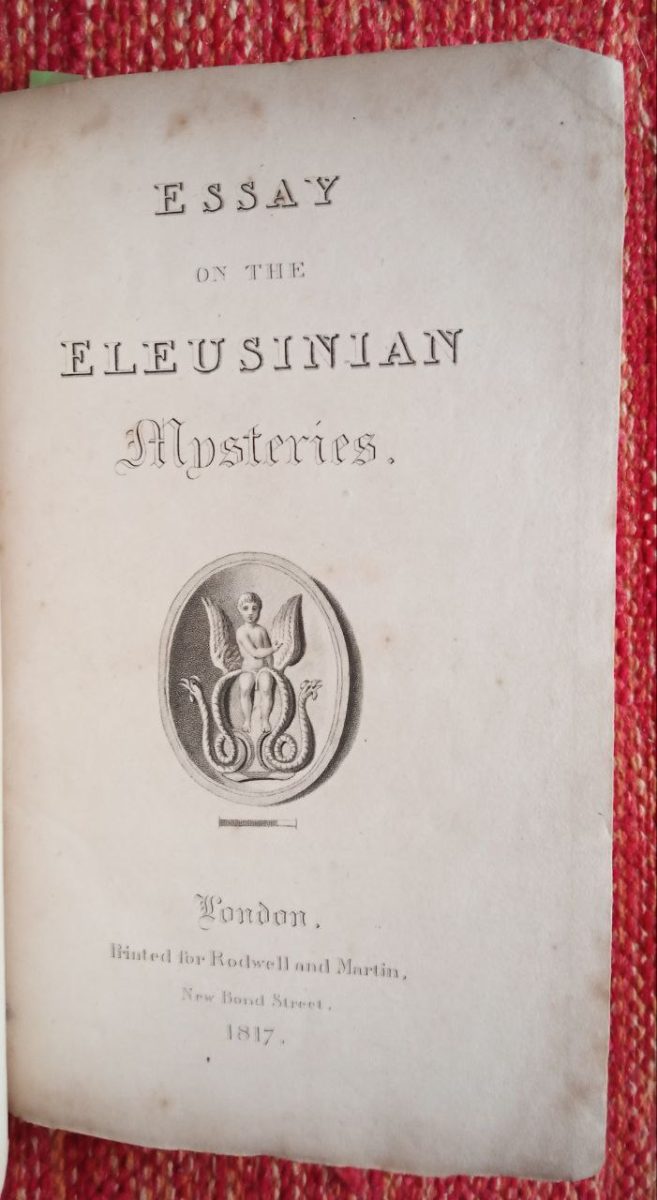
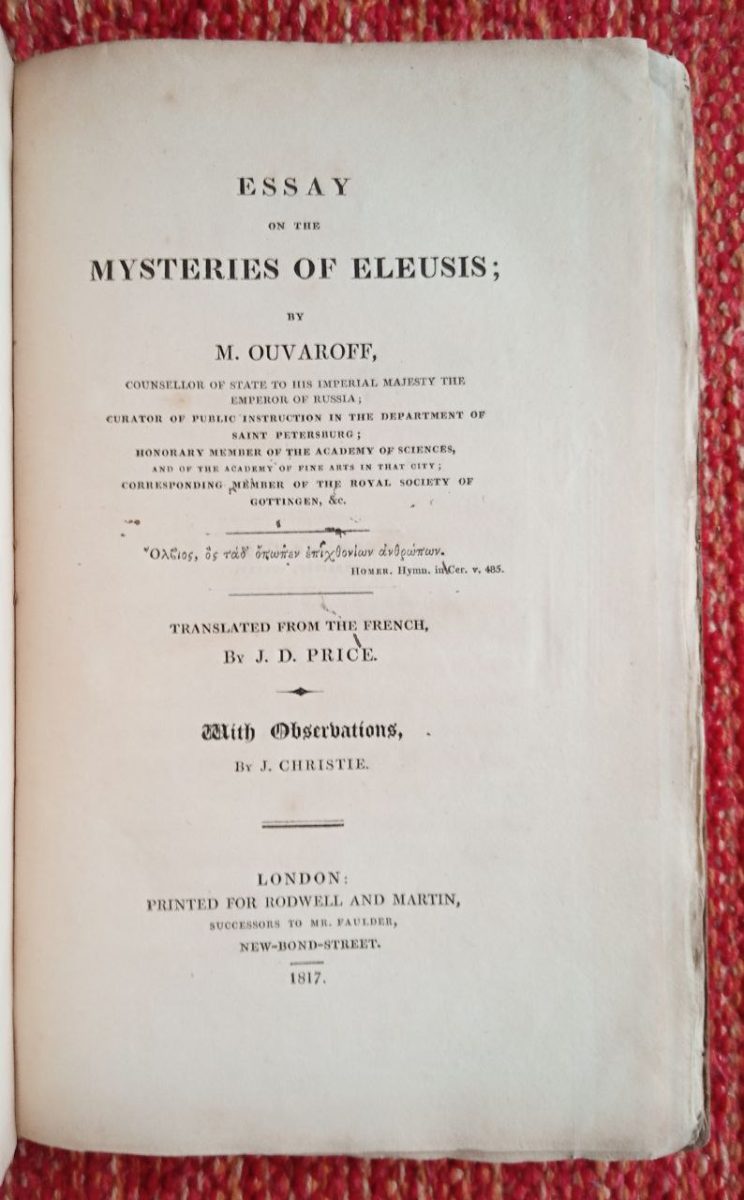
Today’s sharing from the blue house of Via-HYGEIA, is the first of a planned few dedicated to the memory of Count Sergueï Semionovitch Ouvaroff (1786-1855), the first minister of Education in tzarist Russia, who paved the way for the foundation of scientific and academic standards in his country. After publishing his research in many academies’ journals, his articles were gathered in one volume, ‘Etudes de Philologie et de Critique‘, printed in Paris by famous printer Firmin Didot Frères in 1843, edited by philologist and linguist, Antoine Isaac, Baron Sylvestre de Sacy. His ‘Essay upon the Mysteries of Eleusis‘ was translated by John David Price, a year after its 1816 publication and published by Rodwell and Martin in London, with an afterword by James Christie.
After the below contextual introduction, we are sharing Section Six of Ouvaroff’s ‘Essai Sur les Mystères d’Eleusis‘, in which he describes and explains the differences between the 3 known Bacchus. A Via-HYGEIA English translation from the French.
Part 2 will present Ouvaroff’s ‘A Critical Examination of Hercules’ Tale, as Commented par Charles-François Dupuis‘ from its 1845 French edition. Quite a conservative reaction to Dupuys’ philosophy of Enlightenment ambitious project! Ouvaroff, in this essay, is resonating with Joseph de Maistre’s political & spiritual line; De Maistre (1753-1821), a writer, lawyer, and diplomat, had been one of his benevolent elders and friends, and was one of the main intellectual forefathers of modern conservatism, noted for his advocacy of social hierarchy & monarchy in the period immediately following the French Revolution.
**
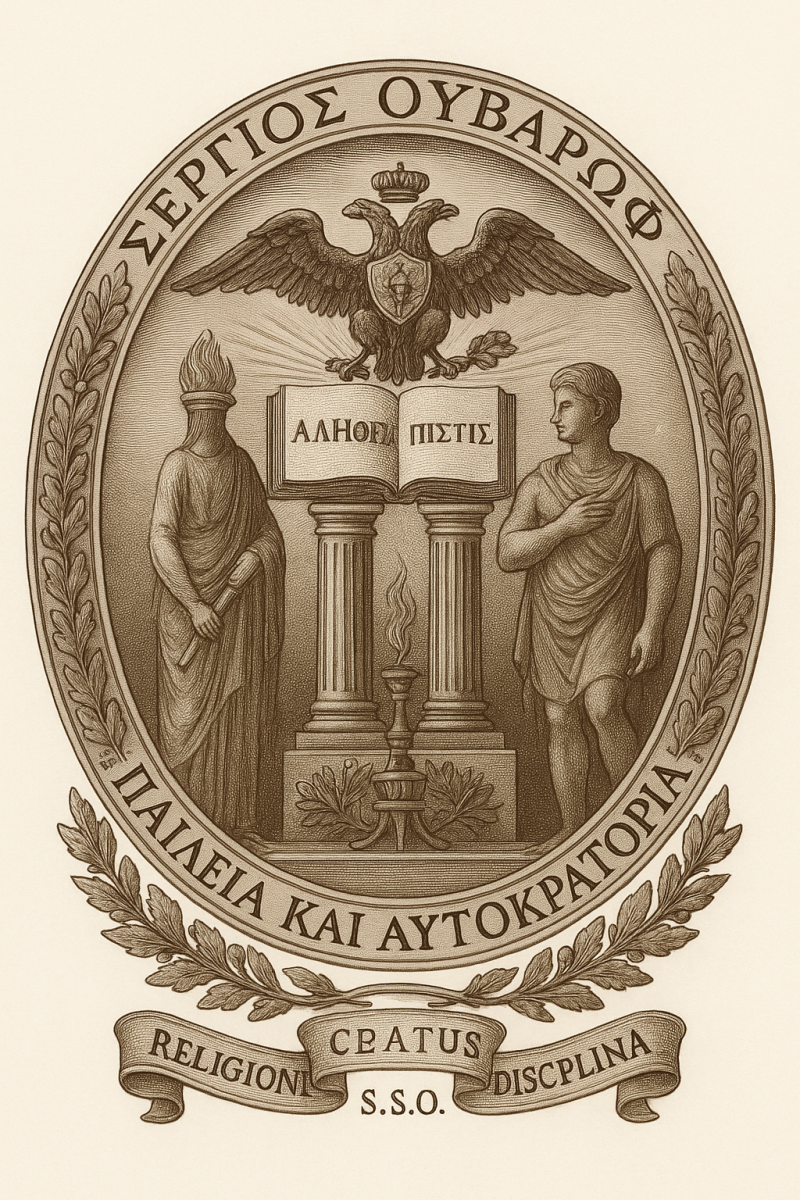
1. A Contextual Introduction
Sergueï Semionovitch Ouvaroff was born on August 25, 1786 and died on September 16, 1855. Trained in the classics at Göttingen’s University, he combined a serious scholarly career with high-level state service: long-time President of the Imperial Academy of Sciences (from 1818) and Imperial Minister of National Education (1833–1849) under Tsar Nicholas I.
Respected as a classical scholar and antiquarian: he published on Greek antiquities, philology & the history of religion. His scholarship won him European recognition and wide correspondence, with among others, Madame de Stael, Joseph de Maistre, Alexander von Humboldt, Johann Wolfgang von Goethe, the Grimm brothers.
Ouvaroff was a Hellenist, in the Romantic and Neo-Humanist tradition that dominated German and Russian academia in the early 19th century. His philology was not merely textual criticism; it was an attempt to understand the Greek Weltanschauung (worldview) through its language, literature, and, crucially, its religious consciousness. He was less interested in dry grammatical analysis and more in using language and texts to reconstruct the ‘Spirit‘ (Geist) of a culture. He saw language as the key to a nation’s soul. His primary lens for understanding antiquity was religious phenomenology. He believed that to understand Greece, one had to understand its gods and its mystery cults.
His work on Eleusis implicitly, and on Nonnos explicitly (a 5th-century AD Greek epic poet from Egypt, author of the ‘Dionysiaca‘-a massive epic on the god Dionysus-and a later ‘Paraphrase of the Gospel of John‘ in Greek hexameter verse), compared pagan and Christian religious concepts, seeing them as part of a broader human quest for the divine. This was influenced by the German Romantics like Friedrich Schlegel and Schelling.
He positioned the Eleusinian Mysteries not as mere superstition, but as the pinnacle of Greek religious and philosophical thought. He saw them as a sophisticated system of symbolic instruction that conveyed profound truths about life, death, and the afterlife—a ‘revealed religion‘ for initiated elite. This was a direct challenge to earlier Enlightenment views that dismissed the mysteries as primitive cults.
By studying Nonnos, he demonstrated a lifelong fascination with the tension and synthesis between paganism and early Christianity. For Ouvaroff, Nonnos represented a critical juncture in cultural history: a pagan poet turning to Christian subject matter, yet expressing it in the forms and language of the classical tradition.
He stood with one foot in the world of Enlightenment erudition & Romantic idealism, and the other in the new world of German scientific scholarship permeating Russia. His philosophy was a quest for the spiritual core of Antiquity. But, later, philologists of the late 19th century-the Altertumswissenschaft school, such as Theodor Mommsen and Ulrich von Wilamowitz-Moellendorff-deemed his work as speculative and too indebted to Romantic idealism and not enough scientifically rigorous.
Ouvaroff built a truly celebrated private library and collection: as a classical scholar, statesman and president of the Academy of Sciences he amassed large holdings of manuscripts, antiquities and rare books—particularly materials on classical and Oriental studies—that attracted the attention of contemporary scholars and later cataloguers.
To conclude, Ouvaroff was a complex and transitional figure. His scholarly reputation was later tarnished by his political career. He developed in his work the intellectual framework he would later apply in a hardened and politicized form, to Russia itself: the idea that a nation’s identity, stability, and greatness are rooted in its unique, organically-developed spiritual and linguistic tradition.
*
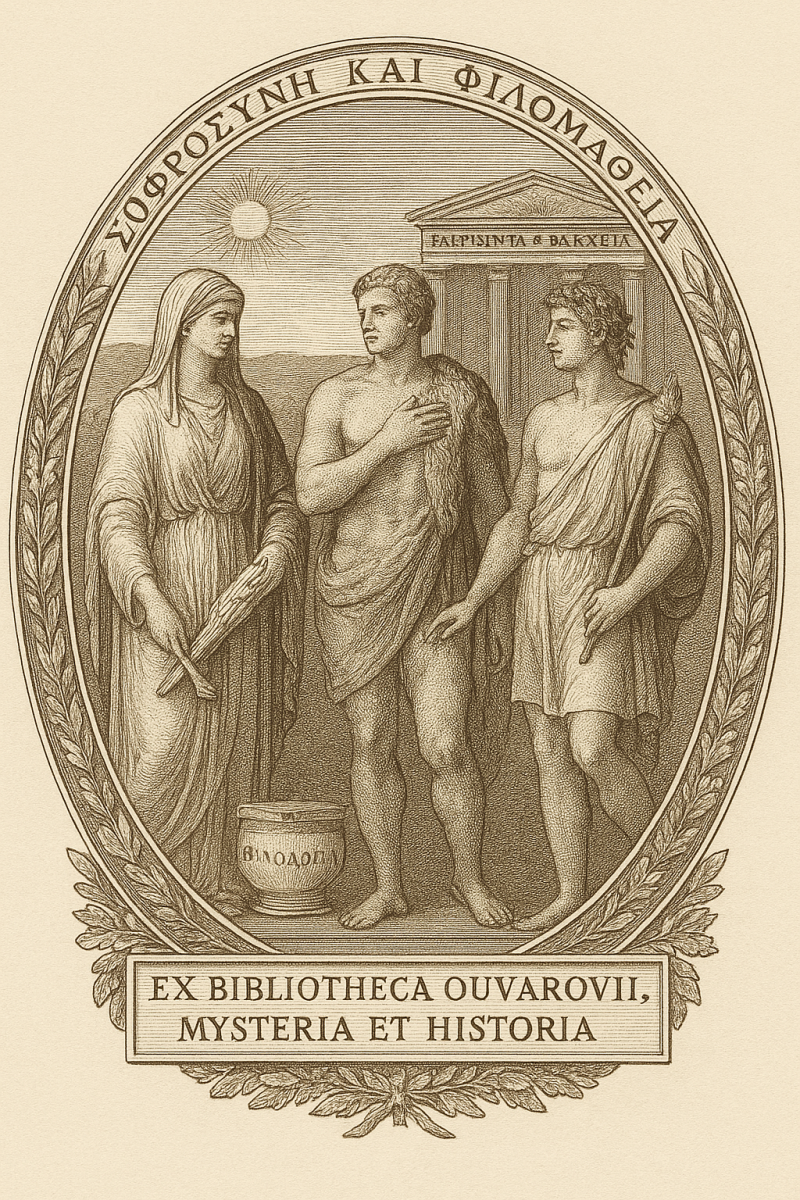
2. ‘About The Existence of 3 Bacchus’,
from ‘Esssai sur les Mystères d’Eleusis’ – Section 6
There is still a point in need of clarification in this panorama of the Mysteries, and perhaps an in-depth study of this particular branch of the Antiquity will allow us to present in this respect sone new results proper to serve as indicators for further and more extended research.
We have said that the Mysteries of Bacchus, very interesting to develop, hold a character that is entirely opposed to those of Eleusis. This opposition is striking at first glance. And what conformities can we expect between the frantic license of the bacchic cult and the severe character and the high purpose of the cult of Ceres?
Nevertheless, after a careful study, we can see that this opposition reside more in the outer form than in the spirit of the two cults; it vanishes even completely when we rise to the mother-idea, to the true type of these two institutions. When we do not perpetuate the folly in recognizing in Ceres and Hercules, two historical figures; when we consider them as two symbols of a random power of the universe, then we see them identify themselves in order that no opposition if left but in the exterior form, which is the part that rely entirely on the human kind, of local circumstances and the political destiny of the people. The cult of Ceres and the cult of Bacchus can only belong to one principle; and this very principle is to be found in the active force of nature, as foreseen in the immense variety of its functions and attributes.
But, the myth of Bacchus as been, on the admission of most of the mythographers, the source of the most fertile incertitude, of contradictions and obscurities. In this state of affairs, the most undisputed point is that of its origin. Herodotus formally asserts that Bacchus came from Egypt, and that he is similar to Osiris. Nicolas Freret, the academician, tells us that in passing from Egypt to Greece, Bacchus lost a great part of his importance. In Egypt, Osiris was the demiurgic power of the universe.
When Melanpus gave him the Greek name of Dionysos and brought him to Greece, at the same time vine were imported there, the function of the god was restricted to its stewardship. This fact does prove us this important truth, that we ought not to constantly seek relationships between the diverse symbols of polytheism: they vary and are divided as they are developing; while the more we journey back to the source, the more the masses are great and imposing.
Nothing is more confused and obscure, as we have said already, than the myth of Bacchus. It is now largely accepted that we can distinguish three Bacchus, considered each distinct. We believe that they are three successive representations of the same idea, that of Osiris.
The ancient and modern mythographers are all contradicting themselves, in regard of the classification of those very three Bacchus!
The ancient poets only indicate but one. The writers of a later time have distributed between the three Bacchus the diverse actions the ancient poets had confusingly accumulated upon one head. Diodorus Siculus recognizes three; but he names among them the Indian Bacchus-ill named-and omits the mystical Iacchus. Finally, Nonnos of Panopolis, who had made a rather in-depth study of the myth of Bacchus, recognizes three too, minus the Indian one.
Examination of all of these varieties would lead us too far and would made us stray from our desired path: we form the project to write a proper study fully devoted to the myth of Bacchus in the near future, but for now, i will only delineate what concerns the classification of the three Bacchus, summing up what we know about them:
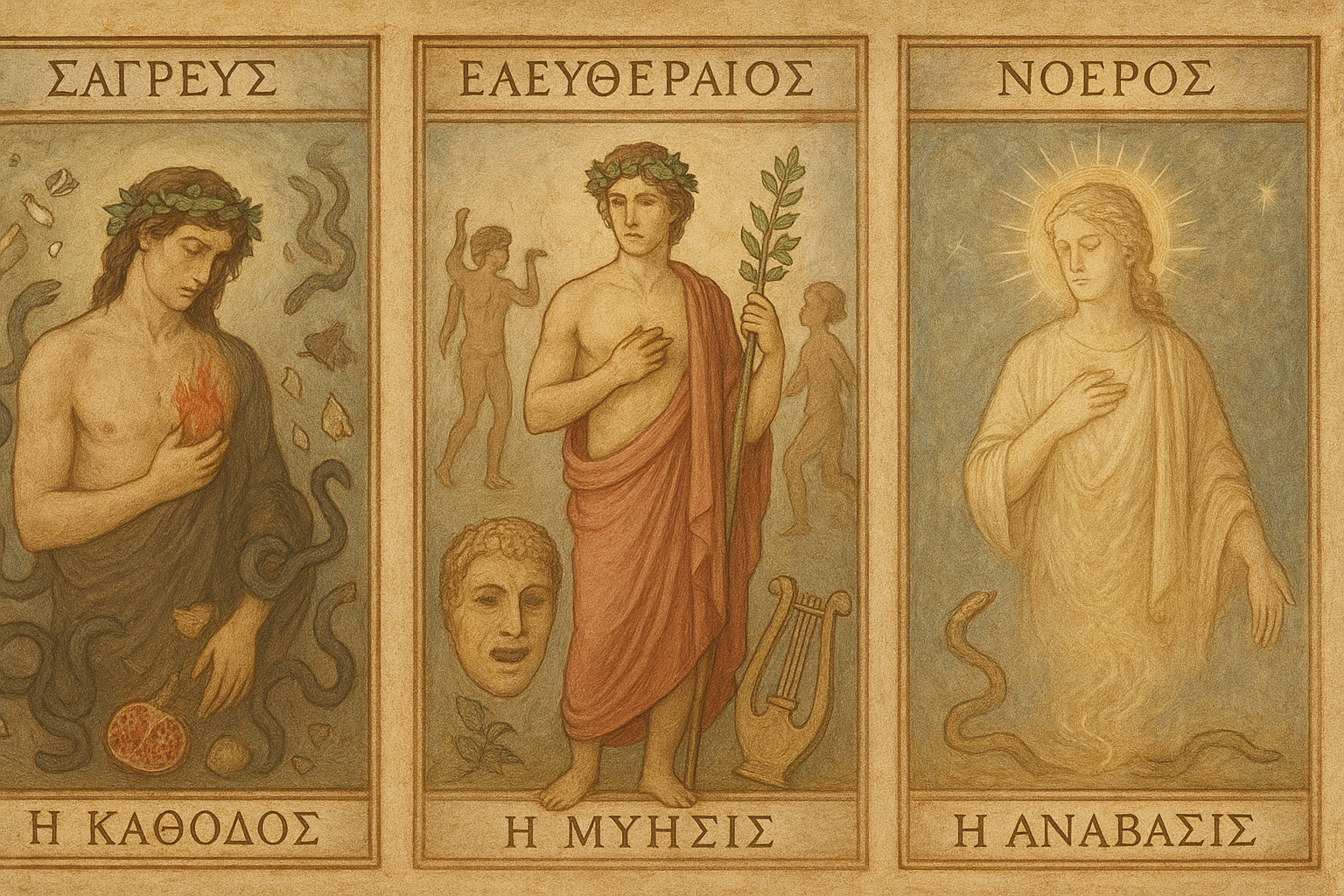
1. The first Bacchus is named Zagreus, whom Jupiter transformed into a dragon, had with Proserpine as told by Pindar in his ‘Isthmian ode‘ (VII-5), and Arrian of Nicomedia in his ‘Anabasis of Alexander‘ (volume 1, book II, chapter 16) though confusing Iacchus with Zagreus. This first copy of Osiris is the closest from the original: the forms of the myth are still stiff and Egyptian. Torn by the Titans, Bacchus-Zagreus corresponds perfectly to Osiris killed by Tiphon/Seth. But the traditions about Zagreus are quite obscure and the confusion extreme. He was presiding over the Dionysia or the Mysteries of Bacchus, and appeared even in the ceremonies devoted to Sabazios. This function suits him well, as he is the most ancient and oriental of the three Bacchus.
2. The second Bacchus is well known: the son Jupiter and Semele; Theban & Conqueror; his forms are now much more Hellenized. He completes, for the Greeks, the representation of the primitive idea, without having much links with the first one. He seems to be succeeding him in the mythological cycle accounts. This second Bacchus has also no connection with Ceres; which shows that the re-union of the mysteries was operated only at a later stage.
3. The third Bacchus is the Iacchus of the Eleusinian Mysteries. It feels that he was imagined to consecrate an alliance between the secret cult of Bacchus with the cult of Ceres towards which all the Mysteries were converging. Iacchus is the symbol of such an association. Because his unique destination was being fulfilled by his birth, the myth has remained imperfect; it is the most vague of all. Nonnos make him the son of the second Bacchus and of the nymph Aura. Others, of Jupiter and Ceres or Prosperpine; which corroborates our hypothesis, but also point towards confusing him with Bacchus-Zagreus. This is the Iacchus appearing on the sixth day of the Eleusinian Mysteries: He is the Διονυσος επι τω μαστω (Dionysus on the breast) Suidas evokes at the word, ‘Ιακχος‘.
We can deduct from all of those premises that the Mysteries of Bacchus were, at an unknown time, con-joined to the mysteries of Ceres, and this hypothesis seems to us sound, as much as we can flatter ourselves to approach truth by an absolutely conjectural method.
Let’s consider first the function of the young Iacchus in the Eleusinian Mysteries: ‘The sixth day, the young Iacchus was ceremoniously carried from the city’s Eleusinium towards the outskirts of Athens to the Outer Kerameikos, close to the temple of Eudenemus and then further on the road leading to the Eleusinian sacred site‘. (Sainte-Croix, ‘Les Mystères du Paganisme‘, page 329-332) Aristophanes, in the “Frogs‘, tells us that the initiates were inviting with their chanting Iacchus to take part to their festivities & dances, and more profoundly to serve as an interpreter to Ceres. The statue, afterwards, was ceremoniously brought back to Athens.
This sixth day, devoted to Iacchus, was the most famous of them; but, with a bit a pondering, we can comprehend that this procession, which later became famous, was but a late addition, foreign to the Mysteries of Ceres, and had no proper connection with them; thus, it tells us clearly it was an aggregation of the secret cult of Bacchus to the Mysteries of Ceres.
The writers who have delt with this subject did not grasp this, only because they did not classify the three Bacchus and they stubbornly refused to recognize them as being three imprints of the same type. Many of the mythographers tried to distinguish Iacchus & Bacchus; but this tentative remained unfruitful. It is obvious that the three Bacchus are successive imitations of the same model, appropriate to the spirit of the time and the local situation in Greece.
The identities of Bacchus and Iacchus once proved, a great clarity spreads upon the relationships of the ancient science of the mystagogs. All the Mysteries of Ancient Greece were converging towards Eleusis, considered as the depositary and the naos of all polytheism’s mysticism; it is therefore clear that intimate relationships must have remained between the secret cults of the main divinities. Alike the cult of Bacchus, which proceeded from the same origin and probably from the same type with the Eleusinian, the Bacchic ceremonies had to con-join with the ceremonies of the cult of Ceres, and this with a great ease. There is in the function of Iacchus-a function distinct from the Eleusinian Mysteries-something that reveals a later aggregation rather than a perfect identity. The idea of Iacchus the ‘Mediator‘, carries all of the characteristics of novelty; the ceremonies in his honor seem themselves a simple extension of the cult of Ceres. Iacchus did not live in Eleusis; which could indicate that he was essentially participating to the secret Eleusinian ceremonies. All of these circumstances gathered attest that the con-joining of the two cults IS symbolized by the admission of Iacchus to the Eleusinian ceremonies.
We have already proved that, of the three Bacchus, Iacchus was the only one that could approach Ceres, without derogate to his function & physiognomy. Also this re-union, once consummated, Iacchus-being useless in the succession of the myths of Bacchus, is lost entirely into the Mysteries of Ceres; it is probable even that the third Bacchus was imagined because the two first one had their character too determined to identify them with the character of another divinity. The first, as we have said earlier was to oriental (or too Egyptian) and the second too Hellenized to be able to get out of the limits of their respective attributions.
A great portion of ancient mythology is founded upon unknown parts of history. Polytheism, alike Corinthian bronze, was composed of thousands of diverse elements, and among these numbers we can find historical traditions; it is obvious that many of these theogonic representations do not represent isolated facts, lost in the night of time. This way of symbolizing remarkable events applies particularly to everything that is connected to secret cults of the diverse divinities. Most of the performed ceremonies, would be connected, either to historical periods, to particular symbols, or to events history did not remember.
Polytheism is divided in two great parts: The exoteric & the esoteric. The esoteric cult, which presented an amount of ramifications that we ignore everything about. The secret history of polytheism is only know to us by guesses; the great half of the religious records of the ancient world is covered with a thick and unfathomable veil. Lets content ourselves to discover here and there some luminous points, less inclined to enlighten our research than to make us see the greatness and importance of objects decidedly inaccessible to our attempts. We can even be sure that the ancients were also lacking some light upon many matters linked to the diverse character of polytheism. At the decisive moment history starts being recorded, the diverse gradation of the ancient mystagogy, poorly nuanced, only appear but as symbols the common people could not understand.
Let’s add to these deductions, that is quite possible that according to the principles of Dionysus, the function of Dionysian Hieroceryx would have been equally fulfilled by the Eleusinian Pontifex Magnus. Also that the Dadochus who attended to the ceremonies of the cult of Ceres, would also attend to the Dionysiac ceremonies. Most scholars agree now about this and it manifests an important fact: the two cults were showing a singular community since their origin.
We will end this article with a quote from Nonnos and his ‘Dionysiaca‘,
which fully record the re-union of the cult of Ceres and Bacchus:
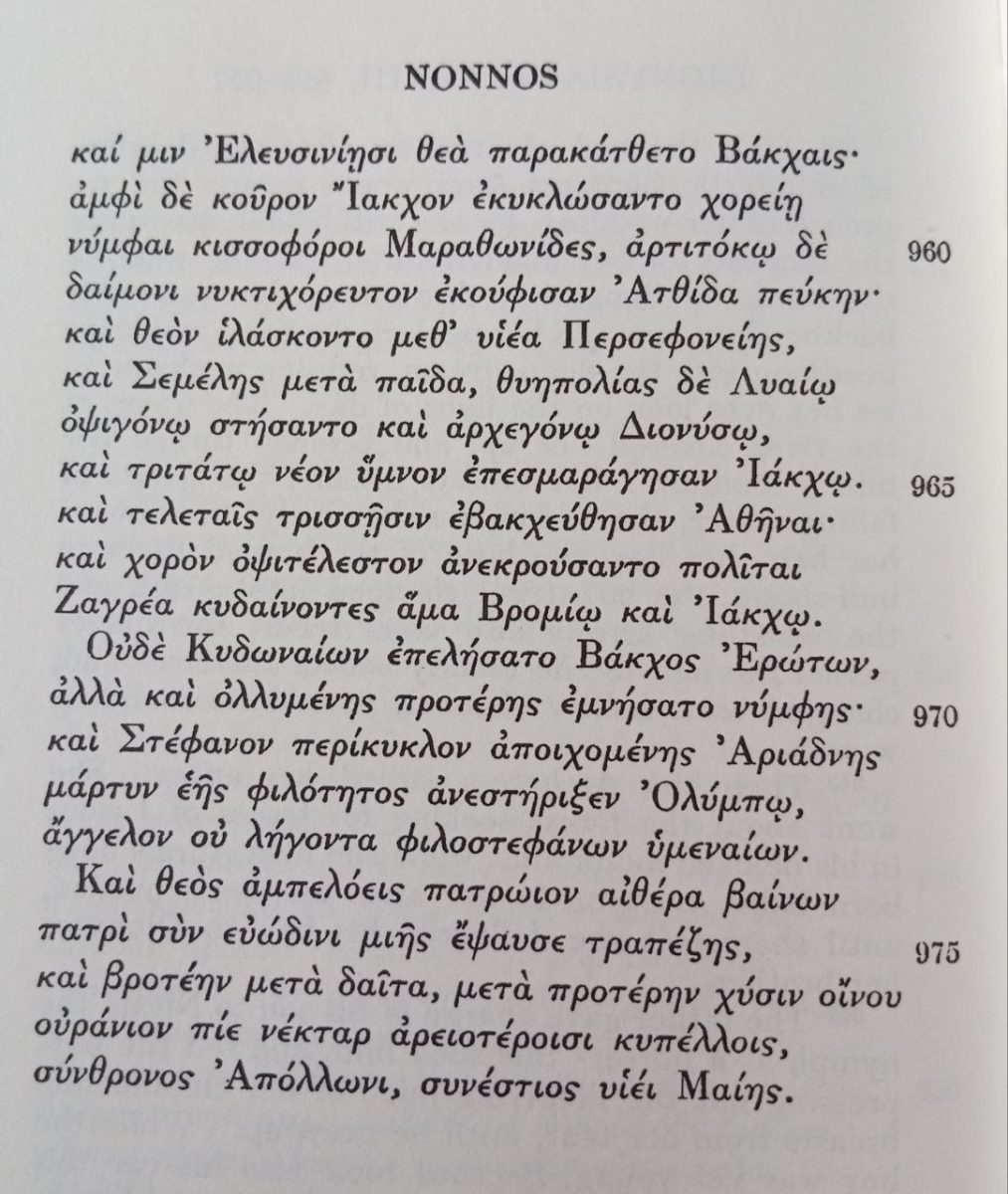
And below the English translation
by William Henry Denham Rouse (1863 –1950),
for the Loeb Classical Library volume dedicated to the ‘Dionysiaca’,
here, in volume III, page 493:
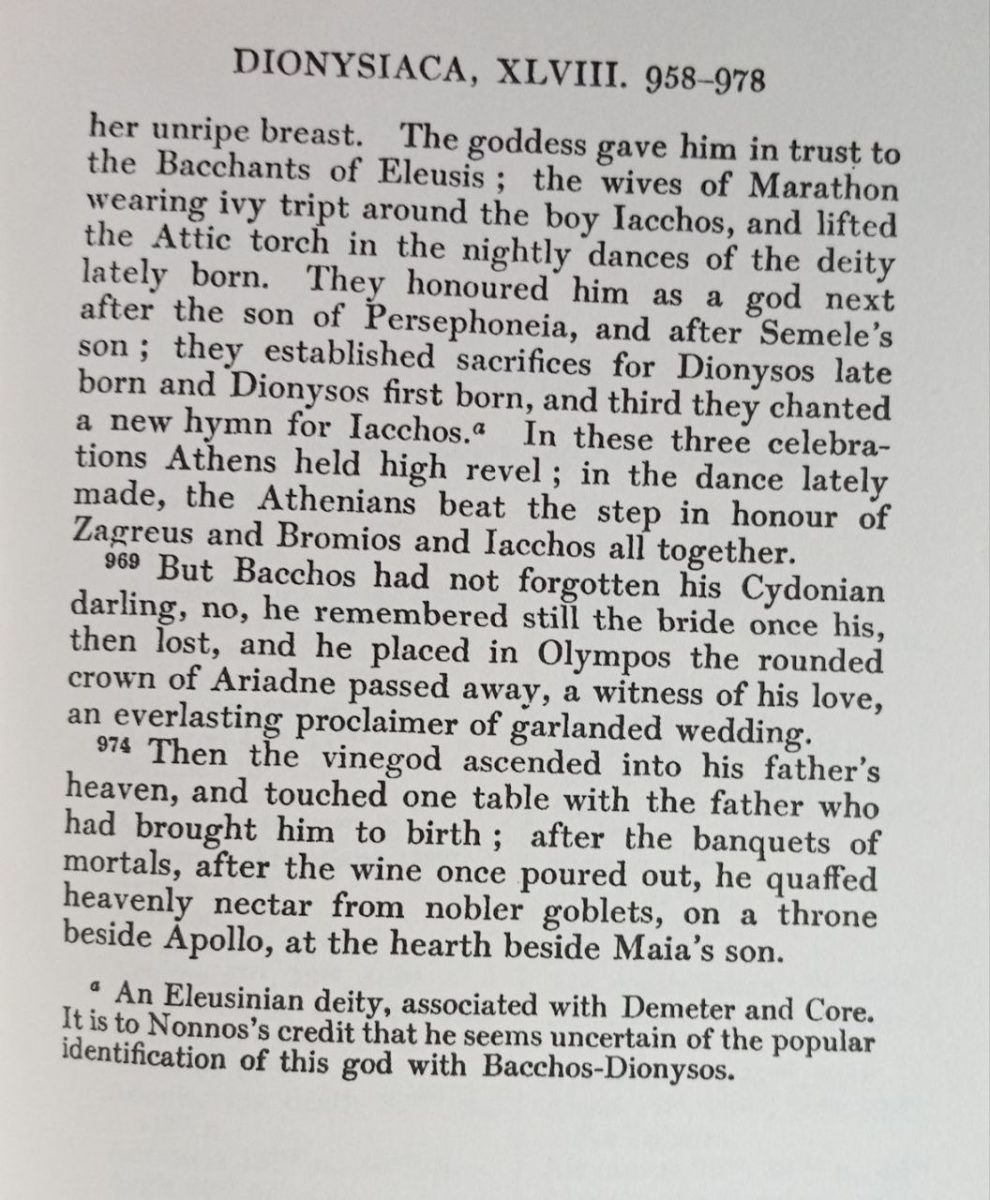
This passage fulfils all of the criteria of authenticity; alone it is enough to give a solid basis to our conjectures. The real connoisseur knows that Nonnos joined to his poetical creativity a serious mythographic knowledge, which focused mainly upon all the nuances of the myth of Bacchus. In studying carefully such a singular prism of the colors of Imagination, we can recognize both historical facts & local traditions that were used as a canvas.
We can, finally, observe that the Goddess mentioned in this quote is Minerva (Pallas-Athena) who leads Iacchus to the Priestesses of Eleusis and embodies probably in the mind of Nonnos, the symbol of the city of Athens. As said above, Iacchus was ceremoniously carried from Athens where is resides to Eleusis, on the sixth day of the Initiations.
Source
*
*
*
*
Coming soon,
A Little Sergueï Semionovitch Ouvaroff Sampler – Part 2:
‘A Critical Examination of Hercules’ Tale,
as Commented par Charles-François Dupuis’.
***

Related Articles


Leave a Reply