
Circle of Transmission: The Living Loom
A Little Louis-Charles-Edouard, Viscount of Lapasse Sampler: Selections from ‘De La Conservation de la Vie’ (1860) – Part 3 – ‘A Panorama of Medicine throughout the Ages’ (Chapter III)
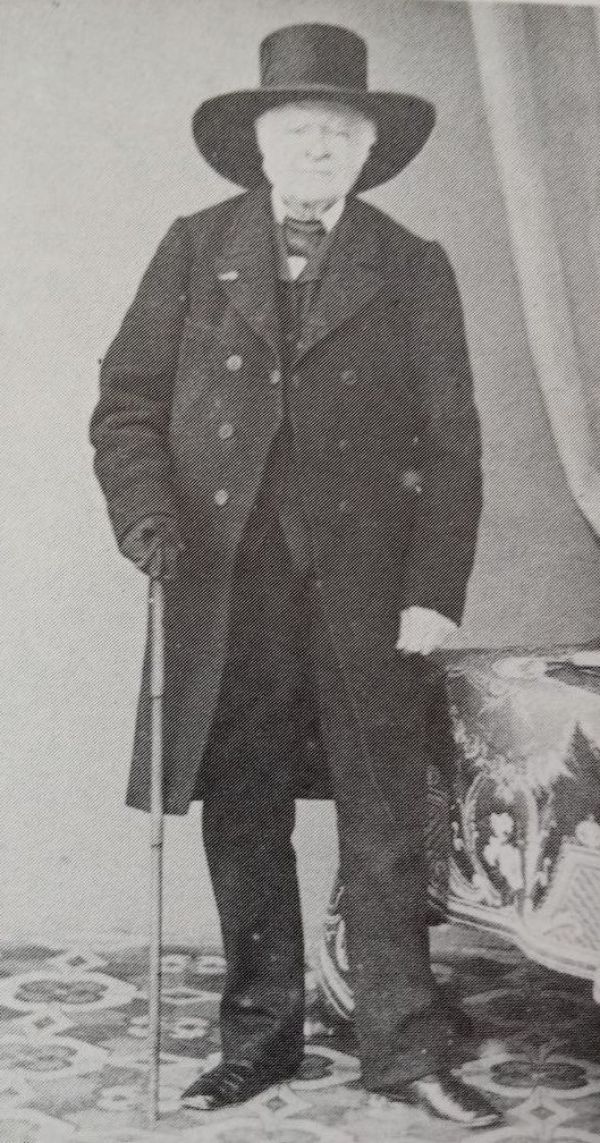
Louis-Charles-Edouard, Viscount de Lapasse.
From the Grenier de Gardenal Archives &
the Gerard Galtier Collection.
*
Another sharing for today from the Blue House of Via-HYGEIA, being Chapter III of Louis-Charles-Édouard de Lapasse’s Considérations sur la durée de la vie humaine, published in Toulouse in 1845. In this remarkable chapter, Lapasse turns toward what he calls a forgotten science, bringing together medicine, vital force, alchemical tradition, magnetism, and the ancient quest for the prolongation and transformation of human life.
Our Circle-of-Transmission edition offers an English translation of the complete chapter, accompanied by historical and editorial notes, contextual appendices, and a careful examination of Lapasse’s place within the nineteenth-century Toulouse Rosicrucian milieu.
The aim is neither to perpetuate later legends nor to dismiss them, but to allow Lapasse’s own text to speak—and to reconsider what may still be living within this neglected chapter of the Hermetic tradition.
**
PART I: INTRODUCTION
Chapter III of Lapasse’s
‘Considérations sur la durée de la vie humaine‘ (1845)
The Man and His Two Worlds
Louis-Charles-Édouard, Viscount de Lapasse (1792–1867), belonged to a generation in which medicine, vitalism, magnetism, chemistry, ancient philosophy and esoteric traditions still occupied overlapping intellectual territories. Born in Toulouse, he studied law, entered military service, and subsequently pursued a diplomatic career that took him across Europe. His later medical and philosophical writings reveal an unusual combination of practical medicine, historical erudition and sustained interest in alchemy and Hermetic thought.
The 1845 Considérations sur la durée de la vie humaine et les moyens de la prolonger already presents the central problem that would occupy him for the remainder of his life: whether the processes of life could be understood sufficiently to permit their preservation, restoration, and perhaps extension. The work was published in Toulouse in 1845; Lapasse died in 1867. tolosana.univ-toulouse.fr
His later reputation acquired an additional Rosicrucian dimension. Lapasse’s writings certainly demonstrate familiarity with Rosicrucian and Hermetic ideas, and later sources associated him with a Toulouse Rose-Croix tradition. Yet the precise historical circumstances of this association require caution. Serge Caillet’s investigation of the Toulouse tradition found no serious documentary evidence establishing a formal initiation of Lapasse into an established Rosicrucian fraternity or a continuous chain reaching back through Cagliostro or Eckartshausen. In his discussion of the evidence, Caillet concludes that there is, in the present state of documentation, nothing serious to substantiate such a hypothesis. He nevertheless leaves the question open as a line of inquiry.¹
This distinction is important. Lapasse’s engagement with Rosicrucian ideas is considerably better established than his precise institutional standing within a Rosicrucian order. Later traditions should therefore be preserved as part of the history of his reception without being converted into documentary fact.
A more cautious possibility, also noted by Caillet, is that an unidentified philosopher encountered by Lapasse in Palermo may have introduced him to the science of Hermes, directed his reading and perhaps brought him into contact with other practitioners. Caillet describes this as a path still worth following. The absence of documentary certainty does not make the encounter uninteresting; it simply means that the historical question remains open.
This is precisely the kind of distinction that should govern the present edition. As Lefteris E. Heretakis has recently argued in a study of Lapasse, Martinism and the Order of the Lily and the Eagle, **“historical contact and doctrinal resemblance must be investigated together while remaining distinct kinds of evidence.”**² A book owned by a later occultist, a remembered affiliation, a doctrinal resemblance, a correspondence, and an initiatic succession are not equivalent forms of evidence.
The historical Lapasse therefore remains more interesting, not less, when the legendary genealogy is left open.
*
The Intellectual Project:
A Synthesis of Science and Tradition
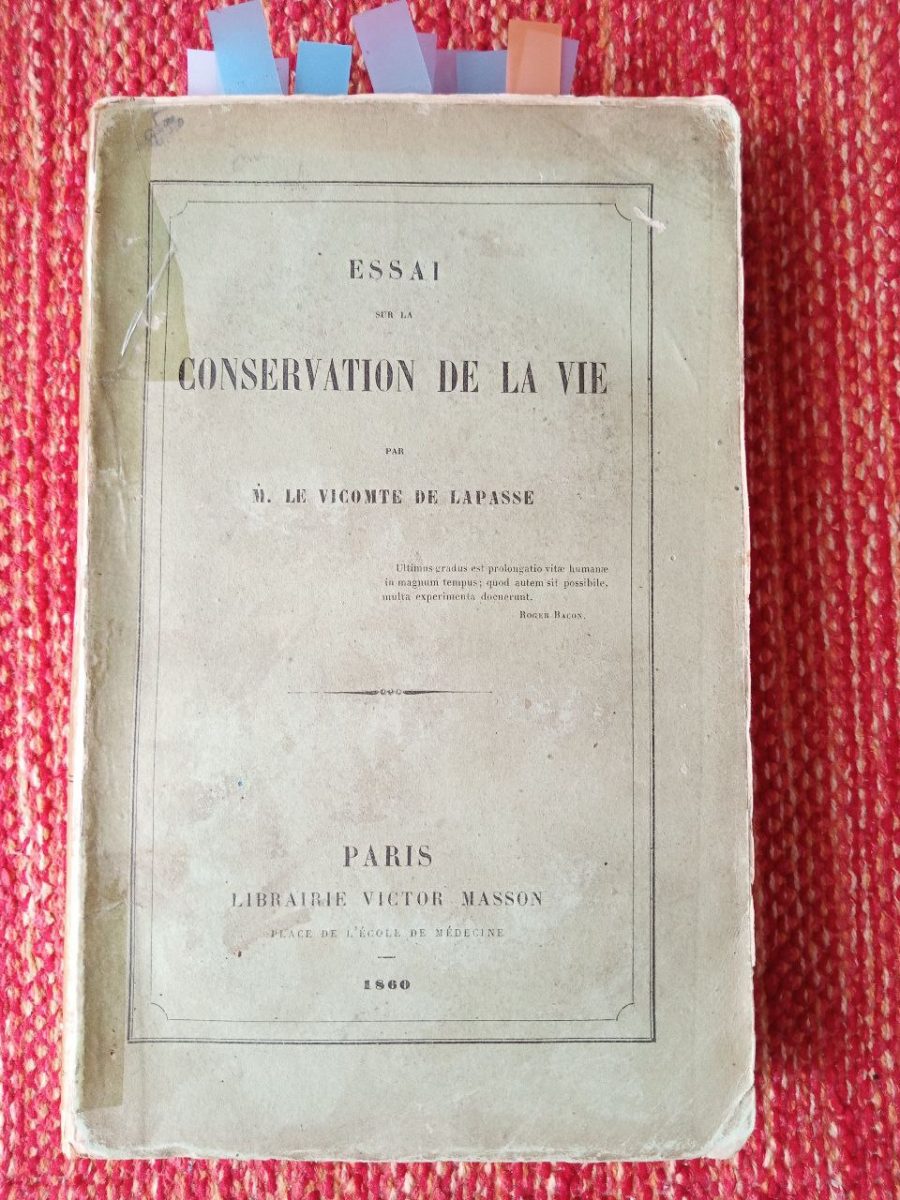
Lapasse’s medical and philosophical project, as outlined in the Foreword to his later and more comprehensive Essai sur la conservation de la vie (1860), was a deliberate attempt to bring modern scientific inquiry into conversation with ancient medical and esoteric traditions.
He was convinced, through what he describes as long meditation and accumulated experience, that many infirmities of age could be prevented or attenuated and that human life might be prolonged beyond its ordinary limits. He was also conscious that his approach differed sharply from the analytical and experimental method dominant in contemporary science.
For Lapasse, the great problem of life demanded synthesis. The forgotten theories of the past had to be reconsidered through induction, analogy and practical experimentation. His interest in alchemy was therefore not antiquarian. He wished to discover whether the language and practices of the old physicians concealed observations that might still possess medical value.
His guiding conception was that life is a force related to the other forces governing terrestrial nature. Human beings participate in those forces, lose them, assimilate them and perhaps recover them. The task was therefore not simply to invent a miraculous substance, but to understand the conditions under which vitality could be maintained.
This distinction will become decisive in Chapter III. Lapasse does not simply endorse every claim made by the alchemists. He attempts to recover what he considers the legitimate question behind their exaggerated solutions.
*
The Project of Chapter III:
A Genealogy of a Forgotten Science
Chapter III, “Origines de la médecine,” is an exercise in what might be called exegetical archaeology. Lapasse searches backwards through Chinese, Hebrew, Greek, Roman, Arabic and alchemical traditions in order to recover what he understands as a forgotten science of life.
The chapter performs several functions simultaneously.
A Genealogical Argument
By tracing medicine to ancient civilizations and by speaking of a primitive or revealed science, Lapasse constructs an intellectual lineage for his own investigation. The art of preserving life is presented not as a modern fantasy but as a problem that occupied earlier civilizations and was subsequently fragmented or forgotten.
A Re-evaluation of Alchemy
The central alchemical argument challenges the modern caricature of the alchemist as a man obsessed with making gold. Lapasse argues that metallic transmutation was secondary to the search for a universal medicine, a beverage of life, and ultimately the quinta essentia.
Yet he does not leave the matter there. Later in the chapter he criticizes the alchemists for believing that the total regeneration of life could be accomplished by a single compound. The historical interest lies precisely in this tension: Lapasse accepts the question posed by alchemy while rejecting some of the absolute forms of its answer.
Medicine as a Compound Reality
His defence of compound medicines likewise reflects a broader anthropology. What appears to be a “simple” natural medicine is itself chemically composite. A living organism is more complex still. The physician must therefore be wary of reducing therapeutic action to isolated substances.
A Plea for the Study of the “Occult”
Lapasse’s discussion of supposedly forgotten inventions makes a further argument: the despised books of earlier centuries should not be dismissed merely because their language is allegorical or their theories outdated. Their observations, he believes, may contain fragments worth recovering through modern chemistry and physiology.
This is not evidence that Lapasse’s medical hypotheses were scientifically correct. It is evidence of his methodological conviction that inherited knowledge should be tested rather than simply discarded.
*
A Note on Historical Attribution
The present edition distinguishes between four levels of evidence:
- Lapasse’s own writings, which establish what he himself claimed or believed.
- Contemporary or near-contemporary testimony, which may provide evidence concerning his life and intellectual environment.
- Later Rosicrucian and Martinist traditions, which preserve claims about lineage and transmission but must be evaluated as historical sources.
- Modern interpretation, which may identify affinities or possible routes of reception without thereby establishing direct influence.
This distinction is especially important concerning the alleged Palermo initiation and the so-called ‘Rose-Croix de Toulouse’.
The later tradition should neither be dismissed merely because it is initiatic nor accepted merely because it is transmitted within an initiatic milieu. As Heretakis observes, internal accounts can preserve genuine documents and memories, but their evidential value depends upon the nature of the material presented and the possibility of independent inspection.²
The present edition therefore uses the language of tradition, testimony, hypothesis, contact, and evidence deliberately. Where the historical record remains incomplete, the uncertainty is part of the record.
*
A Note on Style and Reading
Lapasse writes with the authority of a man who believes that he has rediscovered a forgotten truth. He is by turns ironic, reverent and polemical: he mocks “beardless doctors,” calls Hippocrates the “divine old man,” and defends the supposedly absurd books of the alchemists.
His rhetoric moves freely between medical observation, historical argument and esoteric interpretation. The reader should therefore resist the temptation to separate these categories too sharply. Lapasse himself sees them as parts of one investigation.
For him, the allegorical language of alchemy is not merely ornamental. When the alchemist speaks of “cabbages,” Lapasse tells us, the reader should seek lead; when the alchemist speaks of the philosophical egg, the reader should look beyond the literal object toward the vessel and process of transformation.
For the modern reader, Chapter III is consequently more than a historical curiosity. It opens onto a nineteenth-century intellectual space in which chemistry, vitalism, ancient medicine and Hermetic speculation were still capable of entering into dialogue.
Lapasse should neither be reduced to a charlatan nor retrospectively promoted into a misunderstood modern scientist. He is more interesting than either caricature: a physician and speculative thinker attempting to construct a synthesis between empirical medicine and inherited theories of life.
*
PART II: TRANSLATION
CHAPTER III
Summary of content: Origins of Medicine; Chinese, Hebrews, Hippocrates, Galen; Polypharmacy, Natural Medicines are Compound; Alkaloids, Theriac; Antiquity of Modern Inventions. Preventive Medicines, Alchemy, Its Obscurities, Its Purpose, Potable Gold, Rejuvenation, Universal Panacea, Prolongation of Life.
The history of medicine is a book yet to be written; on this subject there exist only indigestible compilations or overly succinct summaries; but a complete picture of the diverse phases of the medical art, compressed within a philosophical framework, would be as interesting as it is instructive. One would see therein the human mind, enclosed within the narrow circle with which observation surrounds this science, making vain efforts to escape it, and ceaselessly returning to it.
Chinese
The Chinese cite physicians from the origin of their annals, which appear to date back with historical certainty to an epoch roughly contemporary with Noah. Medicine, say their books, was founded by the emperor Xin-Num, who taught the Chinese the art of cultivating the earth and that of healing diseases. An excellent physician who fed his patients!
After him came the great Hoam-Ti, for whom the Chinese have a very particular veneration and to whom they trace several of their institutions. Hoam-Ti was not only a conqueror and legislator; he perfected astronomy, music, and medicine. But what was his therapeutic doctrine? History says only that, in his time, the lives of men were longer.
Hebrews
We have scarcely more detail on the medicine of the early Hebrews: one can be convinced of this by reading the learned dissertation of Dom Calmet on this question. All that one can presume is that they employed simples, oily friction, and applications of balms or resins. Jeremiah says: “Go up to Gilead, daughter of Egypt, and buy resin to heal yourself.” It seems that these remedies were not always very effective, for we read in Ecclesiasticus: “May he who sins against his Creator fall into the hands of physicians.” Indeed, adds a learned commentator naively, the greatest punishment with which God can punish a man is to deliver him to remedies and physicians.
Hippocrates
It was Hippocrates who first wrote, among the Greeks, the principles of the art of healing. Had they come to him by tradition? Were they for him debris escaped from an antediluvian and primitive science, or had his genius divined them in the coarse empiricism of his predecessors, of whom he speaks sometimes and whose authority he seems to respect? This is very difficult and rather unimportant to decide.
It might be more useful to define well the theory of the father of medicine, as he is still called today in the schools; but the divine old man who is so rich in wise precepts, so admirable in his spirit of observation, has he bequeathed to us a true theory, and does one not find approximately whatever one wants in Hippocrates? He has been cited by the partisans of the doctrine contraria, contrariis just as well as by Hahnemann, who maintained that the principle similia, similibus was pure Hippocratism.
Perhaps both sides were right? Perhaps the two systems are identical in their principle, and only separated by the difference between stimulating and counter-stimulating. Would these two modes of action not be attached to one and the same theory, if a more profound knowledge of the laws of life brought us back to unity, that is to say, to movements taking their source in the encephalon? However that may be, Hippocrates traced for his successors paths that are still followed, when he wrote his celebrated aphorism: “Duobus laboribus simul obortis, vehementior obscurat alterum.”
For several centuries medicine was practiced only by disciples of Hippocrates and commentators on the master’s word; finally came Galen, who strove to systematize the science of observations and who sought to explain the causes of diseases.
Galen
Today little account is made of Galen; he is reproached for the absurdity of his theories of the dry and the humid, of his classifications of cold affections and hot affections, combated by hot medicines and cold medicines. Perhaps one would be astonished at the genius of the Roman Hippocrates, if one considered his system as a bold synthesis that sought to anticipate the discoveries of modern analysis. Our theories on the fluids and solids of the human body and on interior caloric are perhaps not very far from those of Galen.
Polypharmacy
One also rises against the barbarism of the compound medicines of his school, preparations that the Arabs were to complicate further. But the moderns who praise the theory of simple medicines, do they really apply it? When you give a patient the simplest medicine, a spoonful of quinquina wine, for example, have you not prescribed for him a composition of water, alcohol, tartaric acid, an unknown essential oil particular to each species of wine, quinine, cinchonine, tannin—in short, all the elements constituting quinquina?
Natural medicines are compound
Is it not today well demonstrated that plants are bodies composed of hydrogen, oxygen, carbon, sometimes a little nitrogen, fibre, chlorophyll, essential oils, various salts, and still other principles that escape analysis? Following the expression of an alchemist physician: ipsa medicina composita est ex naturâ.
And even when today the masters of science prescribe what is called the essential principle of plants, the alkaloids and their combinations, is it not a compound of oxygen, hydrogen, carbon, and nitrogen that they administer?
Who guarantees us that the numerous manipulations to which the plants are subjected, from which one wishes to extract the alkaloid, do not alter their essential properties? How would these substances be in turn combined with the most energetic agents of the laboratory, without retaining some atoms of these elements of decomposition?
Finally, if the alkaloids are, if not simple bodies, at least the principle and the medical essence of the plant, how does it happen that to develop fully their power, one must combine them with an acid?
Medicine quite generally employs the acetates and sulfates of alkaloids; perhaps in many cases it would be fitting to prefer the phosphates?
Perhaps also one has not yet sufficiently studied all the alkaloids? For example, I have strong reasons to think that aloes contains a principle which, combined with phosphorus, could become a precious specific in most gastric affections and especially in the chronic constipations of women and the elderly.
But, returning to the question of simple medicines, nothing, it must be admitted, is less certain than their theoretical composition. As for their effects, they are variable and subject to the laws of observation, just as well as those that were formerly produced with compound medicines. One forgets, in the proud contempt for the science of our ancestors, that mixtures form a new body whose properties are almost always different from the properties of the various substances mixed; I shall refer my readers to a curious treatise by Laurent Majoli, and shall confine myself to saying a word about theriac.
Our fathers had complete confidence in this medicine, to which they attributed almost miraculous virtues; its preparation was surrounded by a sort of solemnity. In Venice, the heads of the Republic attended it. Modern physicians have ceased to prescribe it; one does not quite know why. It has been said that this mixture of more than 140 substances, each of properties either identical or opposed, was absurd, and little was needed for theriac to disappear entirely from our pharmacopoeias. It was spared only as one spares an old ruin, and on condition that it modernize itself. By virtue of this transaction, theriac was reduced, first to thirty substances, a little later, I believe, to sixty; little does it matter.
What happened? The modern theriac, according to old practitioners, no longer has the same effects as formerly. I can, as far as I am concerned, affirm that persons bitten by vipers were, before my eyes, cured in a few days by means of theriac by village physicians. It is true that this was in my youth and before the reform of our pharmacopoeia. Finally the practitioners of Sicily and Calabria continue to employ theriac in fevers rebellious to quinine salts.
It is to be regretted that one has not yet published in modern treatises of therapeutics and materia medica an exact analysis of the true and old theriac of Venice. The chemical formula of the elements of this compound alone could have resolved a question that perhaps has been decided a little too lightly by our French practitioners.
One finds it absurd to mix a very considerable number of substances of analogous or opposed therapeutic effects, and one says that the compound will not produce an effect that can be represented mathematically by the sum of all the effects of the components. These reasonings are not in harmony with the true laws of life. One forgets that mixtures form new bodies whose properties are almost always different from the properties of the various substances mixed. It is therefore not a question of knowing whether the effects of the compound are in relation with those that each of the components would have produced in isolation, but whether the single effect produced by the compound is salutary or harmful. That is the whole question.
Antiquity of modern inventions
One would find, in old books, many things that are believed invented in our days. For example, an ancient author recommends, to combat gout, lapides cancrorum, lynx, lazuli. The moderns are returning to this method.
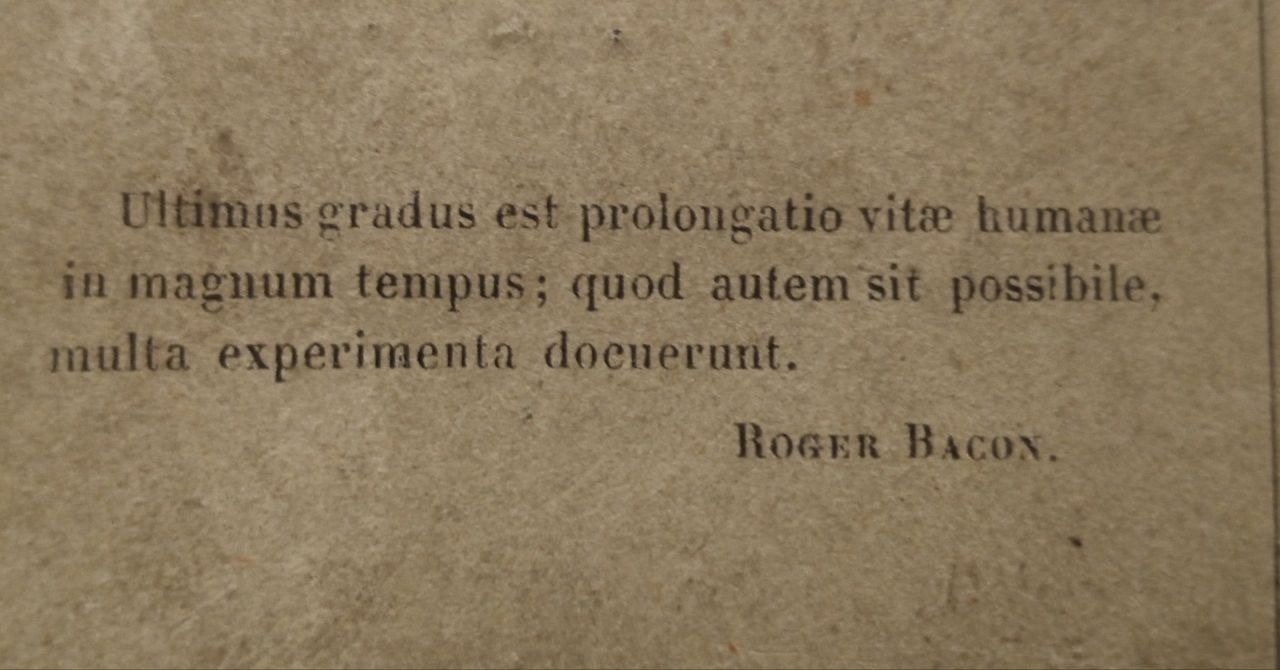
Father François Lana, a Jesuit, indicated how one could manufacture a boat that would sustain itself in the air and move by sails and oars. His principle is at bottom the same as that of the Montgolfier brothers; Roger Bacon had had the same idea long before.
The controversy over the composition of air is not modern; it had already been raised in the Middle Ages. One can be assured of this by perusing a very curious work by Augustin Nifo, who maintains with vivacity, against the opinion of Averroës, that the sky is a simple body. It was not a question of oxygen or nitrogen, but of knowing whether the atmosphere was a mixture of dry and humid, cold and hot, as was said then, or a body sui generis. At bottom, the discussion was approximately identical.
The book that suggests this observation to me is one of the precious editions of the small but very rich library of the monastery of the RR. PP. Benedictines of Cava.
Vickerum teaches us to make the demon speak, “ut diabolus responsum dare videatur.” You manufacture, he says, a statue with horns and claws varnished in black. You place in its hand a gilded iron sceptre, you pose the figure on a polished copper base; and this base, on a glass foundation; then, holding yourself outside the glass, you interrogate the statue with a magnetized iron rod, the sceptre will answer you, says the author. This begins to resemble an electrical machine; let us go further… I have been assured that such a statue was made which held in its hand a golden apple; and, if someone touched this apple, he felt himself immediately struck as if by several darts… Quod cum quisquam tetigisset, statim quasi multis jaculis confossus. This is indeed the electrical machine entire, except for the movement that one may suppose.
Certainly, this passage from an obscure author takes nothing from the glory of modern physicists and chemists, and does not prove that electricity was usefully applied in the Middle Ages; but it appears incontestable that our fathers knew more than we suppose and, perhaps, we would gain by still studying these authors too despised of past centuries. One can find therein forgotten formulas which, stripped of the mystical jargon of the epoch, and prepared with the resources of modern chemistry, will become medicines useful to the conservation of health.
Preventive medicines
Such was the principal goal of the School of the Arabs and of the first school of Salerno. One then practiced preventive medicine even more than curative medicine. For example, several of the elixirs of that epoch are recommended as being able to fortify health and prevent the effect of poisonings.
Some one of our beardless doctors will cry out, and say that each venomous substance has its special action and also its antidote; that one must apply, if one can, this antidote, and that all the rest is illusion.
But is it not evident that preparations whose effect was to increase the vital force could, in many cases, preserve from poisoning by giving the organs enough energy to eliminate the deleterious substance?
Thus one sees the bite of a viper, mortal for a child or a delicate person, produce on a robust man only a more or less grave illness.
One must add further, concerning these mithridatic antidotes of the ancients, that their effect being a superexcitation of the nervous system, of the circulation and of the secretions, they could neutralize most of the poisons used then, which belonged to the class of narcotics.
Today we have less to dread poisonings; but would the habitual use of preparations of a nature to sustain the vital forces not help us to overcome the thousand and one derangements of health occasioned by atmospheric influences, gastric embarrassments, etc., etc.? That is the question.
However that may be, one cannot peruse the old books of medicine and philosophy without finding on each page a distinction between the art of healing and that of making one live. Following the expression of the Tolosan, medicine has as its goal to preserve, conserve, and restore health; the physician arrives only after the physicist. “Triplex medicina” is preservatrix, conservatrix et restauratrix sanitatis: ubi desinet physicus, ibi medicus incipit.
But, we have already said, the adepts went further; they claimed to arrive at discovering the secrets of life, the means of rejuvenating and of conserving existence almost indefinitely.
This study of the great work of the universal panacea, of potable gold, Alchemy in short, occupied, for several centuries, the most beautiful geniuses and the most grave men. Today, alchemist or seeker of the philosopher’s stone are synonymous with insane. But do we really know what was the goal and the theory of the alchemists? I doubt it. And, whatever it may be, a rapid glance cast on this science will not be without interest.
Alchemy — its obscurities
One must first warn that the reading of the alchemists presents some difficulties; their books are not only written in a barbarous Latin; the authors believed themselves obliged to surround themselves with veils and to speak only in allegories. Perhaps they were forced to this reserve to escape the persecutions against magic; perhaps also they were only continuing the traditions of a mysterious science, which would link the studies of that epoch to the sacred sciences of the oldest civilizations, to the philosophy of the Chinese, to the mysticism of the Indians, to the mysteries of the sanctuaries of Egypt.
Alchemy is full of mysteries, says one of its adepts: ars mysteriorum plena; “when I swear to tell the truth,” exclaims another, “believe that the literal sense of my words is a lie, and, if I speak to you of cabbages, seek lead.” Quando tibi dico caules, intelligas plumbum.
When they give precepts, it is always in their allegorical language.
“Recipe unam partem solis et misce simul cum unam partem lunæ, ovum philosophicum divide in quatuor partes, ad cælum philosophorum ascende.” Take a piece of sun, add to it immediately a fragment of moon, divide the philosophical egg into four equal parts, raise your mixture up to the sky of the philosophers.
Such are the curious formulas that the books of the adepts offer us. It appears that it was not only to impose on the vulgar by a mysterious language that they surrounded themselves with veils and allegories. Their books are filled with complaints against false adepts who abused the credulity of the public and, following the expression of an author of that time, gave them the shells instead of the nut. “Insignium medicinarum nomina clangunt, iis ipsis incognitis, et cortices dantur pro nuclei.”
These bizarre forms, this studied obscurity with which the adepts surround themselves, offer doubtless some difficulties to him who, after centuries of oblivion, comes to lift the veil that has been allowed to weigh on this science, whose goal at least was great and generous.
Purpose of alchemy
It is quite generally believed that the alchemists worked to make gold; it is thus that one understands today these words: search for the great work, philosopher’s stone. One believes it was a question of a secret to transform inferior metals into gold. That is an error.
Potable gold
It is true that the adepts loudly proclaimed this goal, in order to obtain the support of the powerful of the earth always avid for gold; it is true also that they considered the transmutation of metals as a necessary consequence of the accomplishment of the great work; but the true object of their labors was the discovery of a universal medicine, of a beverage of life.
Durch Kunst auch heilen alle Qual
Dies ist das Geheim der Alchimy.
To heal by science all ills, such is the secret of alchemy, said an adept of the sixteenth century.
A more ancient author summarized in these few words the science: Omnia chimica secreta ab uno tantum artis centro nimirum cæli philosophorum dependere spiritu videbitis.
All the secrets of chemistry flow from one alone which is the center and the very essence of the art, it is the sky of the philosophers.
If the profane ask what is the sky of the philosophers, one answers them: cælum philosophorum est quinta essentia auri. It is the fifth essence of gold.
The confidence of the adepts in this potable gold, this universal panacea, equals their enthusiasm. Listen to one of the most erudite.
Rejuvenation
Hermes said, if you take of our elixir as big as a grain of mustard for seven days in succession, your white hairs will fall and black ones will replace them, and you will become young and robust.
Et enim Hermes inquit, si nostri elixiri assumpseris quantitatem seminis sinapi septem continuis diebus, tunc cani tui cecidunt et nigri successunt in locum illorum, ut robustus ac juvenilis evadas.
One could multiply the citations and everywhere one would find among the adepts the same enthusiasm for the virtues of the miraculous elixir; but what was its composition?
It appears that each adept, each head of a medical school, had his very complicated formulas which varied according to the necessities of the application; but which all contained or were believed to contain potable gold. It is indubitable that this medicine was frequently administered during the fifteenth and sixteenth centuries. One finds it classified in all the works of therapeutics up to the middle of the last century. There is, so to speak, not a book of medicine of that time that does not speak of it with a sort of respect and admiration; the cures operated are recounted with such details and in a manner so authentic that it is impossible to doubt. Listen, for example, to the Count Pic de la Mirandole.
It is well proven that Antoine, our surgeon, some years ago, cured in a few days a lady of Imola who was dying of the chest and restored her to her former health, only with potable gold.
Cum satis constet Antonium chirurgum nostrum superioribus annis, matronam ex foro Cornelii, phthisi morientem, paucis diebus ab ipsâ tabe liberam, sanitati pristinæ restituisse, solo auro potabili.
The gravity of the character of Pic de la Mirandole, his elevated rank, his position even as the most enlightened scholar of his time, leave no possible doubt.
But here arises a rather curious question.
Of what nature was this solution of gold? We know today only three soluble gold salts which, all three, are more or less pure muriates, and if we open any modern treatise of chemistry whatsoever, we shall see therein that gold can be dissolved only by a mixture of hydrochloric acid and nitric acid (Aqua Regia). All these gold salts are considered violent poisons; some practitioners (among others Doctor Chrestien, of Montpellier) have tried this medicine. But it has been applied, in general, only to the cure of a single disease. In recent times, physicians have returned to gold; but it is tremblingly and always at the most minimal doses; a few milligrams still seem too energetic. Under the reign of alchemy, potable gold was administered at high doses. We have just seen an ancient author who prescribes it in the quantity of a grain of mustard; some others go as far as a gros, and finally a physician permits an ounce per day. … Hoc mirabile potu potest senex manè et sero ad quantitatem semunciæ… tamen cautela est in hoc tempore vino moderatè uti. — De recuperandâ juventute.
Two evident facts seem to me to emerge from these citations.
1° That the moderns know how to dissolve gold only by means of aqua regia, and that this acid is so energetic, so deleterious to the human organism, that in allying itself with gold to form salts, it communicates to the dissolved metal its maleficent qualities.
2° That the ancients who taught us to dissolve gold with aqua regia still knew other preparations of this metal, and made use of them.
Whatever may be the efficacy of potable gold as a medicine, modern science would be wrong to treat lightly the men whose labors have bequeathed to it its principal means of action.
Mercury, the art of distilling, nitric acid, hydrochloric acid, sulfuric acid, alcohol, salts, antimony, emetic
Alchemists are treated as visionaries because they sought a means of prolonging life; let us examine whether their theory was madder than many others that we see every day arriving at the state of system, and let us try to form an idea of their doctrines.
Prolongation of life
Here is the definition given by an adept of the regeneration of the aged.
“I shall call regeneration a new state of the spirit and of the temperament… For the body which previously was lazy, heavy, impure, infirm, and impotent, becomes by regeneration similar to the soul and the spirit.”
“Regeneratio, inquam, est novus spiritualis et temperatus status… nam corpus quod antea segne, crassum, impurum, infimum ac impotens erat, animæ et spiritu per regenerationem simila fit.”
One sees that it was a question of modifying the human matter, in such a way as to exalt all the faculties. There is in these theories nothing absurd, nothing impossible. Modern physiology admits, with the words dynamism, vital principle, something similar; and one approaches it still more when one arrives at meditating on the action of concentrated will upon living matter.
The error of the alchemists was to believe that this result could be obtained by a single compound that would reunite all the forces of matter. They forgot their own axiom: “Natura nihil fixum nec simplex produxit.”
Let us listen to the Latin translator of Paracelsus.
“… Quinta essentia nihil aliud est, quàm bonitas naturæ ità ut tota natura in spagiricam mixturam et temperamentum abeat, in quâ nihil corruptibile, nihilque contrarium fit invenibile.”
“The quintessence is nothing other than the virtue of nature, extracted in such a way that all its principles are reduced into a single tempered mixture, in which one finds nothing more contrary, nothing corruptible.”
A physician of Louis XIV who, writing later, was able to summarize all the doctrines of the alchemists, explains himself even more clearly.
“This pure essence is therefore triple: animal, vegetable, and mineral. In animals, it is very subtle and consequently volatile, combustible, and destructible; in vegetables, it reunites the same attributes and is moreover corruptible; but in minerals, and especially in perfect metals, it is fixed and incorruptible.”
“Itaque triplex est istud purum, animale, vegetabile et minerale… In animalibus quidem est subtilissimum et proinde volatile omnino et ideo combustibile et destructibile, in vegetabilibus istidem et ideo etiam corruptibile. In mineralibus autem, præsertim perfectis metallis, est omnino fixum et incorruptibile.”
Whence it results that for this sect of alchemists, the secret of the great work consisted in extracting the principle of life spread throughout all nature, in borrowing it from the three kingdoms, and then in fixing it into a single essence.
This is what the German translator of the Testament of Hermes Trismegistus rendered in his allegorical language.
“Seine Vater ist die Sonne, und seine Mutter der Mond; die Luft trägt es gleich ab in ihrer Darmutter; seine Sangamme aber ist die Erde.”
Or in Latin:
“Patrem (Q. Essent.) habet solem, matrem lunam; ab aere in utero quasi gestatur, nutritur à terrâ.”
We would say today:
“The principle must be extracted from gold and silver, the gases develop it, and the salts complete it.”
Such was the avowed doctrine of the most skillful chemists of the Middle Ages; but there existed a more mysterious science professed by the Rose-Croix, a secret society of which some adepts still remain in our days. The secret of the Rose-Croix, as far as one can conjecture, was a sort of pantheism that confounded the material element and the intelligent principle, and saw in the laws of life only modifications of matter.
A doctrine false in an absolute sense; but true and useful if one applies it only to matter, and if it helps to demonstrate the unity of creation, as well as the basic identity of all bodies, which vary in their attributes only through the laws of movement. Modern science is beginning to approach these ideas, which alone can throw some light on the mysteries of life and reveal to us those immutable laws that the supreme will imposed on matter on the day of the creation of things.
The classification of Guyton-Morveau and Lavoisier, which was useful in so many respects, has perhaps retarded progress, because superficial minds are prone to envisage nomenclatures as absolute truths, whereas they should be considered only as milestones to facilitate study. One doubts today, and with reason, the existence of fifty-five or fifty-eight simple bodies, and modern science is approaching in its doctrines on the elementary constitution of bodies the system of the Greek philosophers.
There was still another theory that started from this idea: that gold, being the most perfect of metals, must necessarily contain a sort of essence, which the adepts of this school call anima auri. To obtain this essence, they tried two sorts of procedures.
To extract it from the metal itself, and it is thus that they taught us to dissolve gold.
To imitate the procedures of nature in the formation of this metal. Research in this path led to the various preparations of Antimony.
The R. P. Lana proposes, as a universal panacea, an essence composed of potash and antimony and subjected to numerous chemical manipulations. Such preparations can no more be considered a panacea than the powders of James or of Dower; but perhaps physicians have a little too much neglected antimony; the weak salts of this metal, the benzoate, for example, could be useful.
Finally, there existed a third theory of longevity, which one could call official, for it was professed in the schools and which supposed a sort of indefinite rotation between the vital movements and alimentary absorption. The commentators of Aristotle compared the vital fire to a flame that must be ceaselessly fed. Quæritur utrum per consumptionem alimenti possit vita perpetuari in aliquo vivente? Arguitur quod sic, quia sicut de igne videmus quod infinitum duraret, si semper apponerentur combustibilia; ita pari ratione, videtur quod vivens in infinitum deberet durare, si apponeretur conveniens nutrimentum.
Roger Bacon says positively that one can prolong life far beyond a century: per centenarium annorum, vel plures.
These opinions are not supported by rigorous experiments; it is true. But there would still be something to learn in these old books. A modern scholar has said: “if the alchemists had started from better principles, they would have incontestably arrived at prodigious results, which the chemists of today, too pressed to enjoy the present, will probably never attain.”
Perhaps one could add that, if the ancients sometimes posed overly bold syntheses, the moderns, by confining themselves too strictly to analysis, narrow the circle of their researches.
This observation applies especially to the great problem of life and the means of prolonging it. It results from all that has been said thus far that the ancients sought the solution in too absolute a manner, that they approached it without arriving at it; and that the moderns, considering the question insoluble, have disdained to occupy themselves with it.
Medical science can therefore teach us nothing about the great art of prolonging life; there remains only to examine the question in itself and with the sole lights of good sense and experience; this will be the object of the following chapters.
*
PART III: APPARATUS
Notes on Key Words and Concepts
Xin-Num (also Shennong). Legendary Chinese culture hero traditionally associated with agriculture and medicine. Lapasse’s spelling reflects an older European transliteration.
Hoam-Ti (Huangdi). The Yellow Emperor, legendary sovereign associated with the origins of Chinese medicine.
Dom Calmet. Antoine Augustin Calmet (1672–1757), Benedictine monk and biblical scholar whose works included discussions of the longevity of the patriarchs.
Hippocrates. Greek physician traditionally regarded as the father of Western medicine.
Galen. Greek physician and philosopher whose humoral system dominated European medicine for centuries.
Contraria, contrariis. “Contraries are treated by contraries,” conventionally associated with allopathic medicine.
Similia, similibus. “Like is treated by like,” the principle associated with Hahnemann and homeopathy.
Quinquina. Cinchona bark, the source of quinine.
Laurent Majoli. Laurentius Maiolus, sixteenth-century author of Dies caniculares and works concerning natural history and medicine.
Theriac / Thériaque. A celebrated compound medicine originally developed as an antidote to poison and later formulated with a large number of ingredients.
Lapides cancrorum. “Crab stones,” concretions historically employed in medicine.
Lynx / lapis lyncis. The legendary “lynx stone,” traditionally attributed to the bladder of the lynx.
Lazuli. Lapis lazuli, historically employed in various medicinal preparations.
François Lana. Francesco Lana de Terzi (1631–1687), Jesuit polymath associated with a proposed aerial vessel.
Roger Bacon. English Franciscan philosopher and natural philosopher associated with experimental and alchemical studies.
Augustin Nifo. Agostino Nifo (c. 1473–1538), Italian philosopher and commentator on Aristotle and Averroës.
Vicker / Vickerum. The precise identification of Lapasse’s source remains uncertain and should not be stated more confidently than the surviving reference permits.
Triplex medicina. “Triple medicine”: preservatrix, conservatrix et restauratrix sanitatis—preserving, conserving and restoring health.
Cælum philosophorum. “The sky of the philosophers,” an alchemical expression which Lapasse identifies with the quintessence.
Or potable. Potable gold, an alchemical preparation associated with medicinal and rejuvenating claims.
Panacée universelle. Universal panacea.
Pierre philosophale. Philosopher’s stone, associated in alchemical literature with transmutation and the Great Work.
Anima auri. “Soul of gold,” the essence or principle that Lapasse associates with the perfection of the metal.
Quinta essentia. Quintessence, the “fifth essence,” understood in alchemical traditions as a purified or concentrated principle.
Spagyric. An alchemical mode of preparation involving separation, purification and recombination. The term belongs to the Paracelsian vocabulary and should not be reduced simply to modern chemical extraction.
Regeneratio. Regeneration: the renewal or transformation of the human condition, in Lapasse’s discussion extending to bodily, vital and spiritual dimensions.
Natura nihil fixum nec simplex produxit. “Nature has produced nothing fixed or simple.” Lapasse invokes this maxim precisely at the point where he criticizes the idea of a single universal compound.
Aqua regia. A mixture of hydrochloric and nitric acids capable of dissolving gold.
Muriate. An older chemical term for a chloride.
Gros / once. Historical French units of weight.
Dynamism / vital principle. Nineteenth-century physiological concepts invoked by Lapasse in discussing the forces underlying life.
Volonté concentrée. “Concentrated will,” Lapasse’s expression for the possible action of directed will upon living matter.
*
PART IV: APPENDICES
Appendix A:
Biographical Timeline of Lapasse
1792 — Born in Toulouse.
1810s — Studies law and enters military service.
1820s–1830s — Diplomatic career and travel in Europe.
Palermo and the Hermetic tradition — Later Rosicrucian sources associate Lapasse with Prince Balbiani and an initiatic encounter in Palermo. The precise historical status of this account remains uncertain. Serge Caillet found no sufficiently serious documentation establishing the alleged formal lineage.¹
1845 — Publishes Considérations sur la durée de la vie humaine et les moyens de la prolonger in Toulouse. The first edition is independently catalogued as a 198-page work published by Imprimerie de Ve. Dieulafoy. tolosana.univ-toulouse.fr
1848 — A second edition of Considérations is traditionally associated with Toulouse.
1850s — Develops his medical practice and writings on health, longevity and vital forces.
1860 — Publishes Essai sur la conservation de la vie in Paris with Victor Masson. La Fontaine d’Arethuse
1861 — Publishes Hygiène de longévité, described by the BnF as a continuation of the Essai. catalogue.bnf.fr
7 October 1867 — Dies at Lussan, according to the Deutsche Biographie. Deutsche Biographie
*
Appendix B:
Lapasse’s Triple Constitution of the Human Being
Lapasse’s broader medical philosophy distinguishes three levels of human constitution:
1. The Material Body
The physical organism, subject to the laws of matter and chemistry.
2. The Instinctive or Vegetative Principle
The principle of life and movement, which Lapasse associates with vital force and physiological activity.
3. The Intellectual or Spiritual Principle
The immaterial dimension associated with intelligence, will and the specifically human capacity for conscious action.
This threefold structure helps explain why Lapasse resists an exclusively mechanical conception of medicine. His therapeutic thought is concerned not simply with substances but with the interaction of material constitution, vital activity and intelligence.
It should nevertheless be treated as contextual material from Lapasse’s wider system, rather than as a doctrine demonstrated in every detail by Chapter III itself.
Full Chapter XIII here
*
Appendix C:
A Short Alchemical Vocabulary
Grand Œuvre — The Great Work, which Lapasse interprets principally through the search for transformation, universal medicine and regeneration rather than the manufacture of gold alone.
Or potable — Potable gold, an alchemical medicinal preparation associated with rejuvenation and longevity.
Panacée universelle — Universal panacea.
Pierre philosophale — Philosopher’s stone.
Quinta essentia — Quintessence or “fifth essence.”
Spagyrie — The Paracelsian art of separating and recombining substances in order to reveal and employ their active principles.
Anima auri — Soul of gold, the supposed essential principle of the perfected metal.
Cælum philosophorum — “Sky of the philosophers,” identified by Lapasse with the quintessence.
Regeneratio — Regeneration, understood as a renewed state of the human being.
*
Appendix D:
Passages for Further Reflection
The following passages are offered for contemplation and discussion within the Circle of Transmission.
1. On the Perennial Problem of Medicine
“One cannot peruse the old books of medicine and philosophy without finding on each page a distinction between the art of healing and that of making one live.”
2. On Allegorical Language
“Alchemy is full of mysteries.”
3. On the Purpose of Alchemy
“The true object of their labors was the discovery of a universal medicine, of a beverage of life.”
4. On Regeneration
“The body which previously was lazy, heavy, impure, infirm, and impotent, becomes by regeneration similar to the soul and the spirit.”
5. On the Error of the Alchemists
“The error of the alchemists was to believe that this result could be obtained by a single compound that would reunite all the forces of matter.”
6. On Unity
“A doctrine false in an absolute sense; but true and useful if one applies it only to matter, and if it helps to demonstrate the unity of creation.”
7. On Forgotten Knowledge
“One can find therein forgotten formulas which, stripped of the mystical jargon of the epoch, and prepared with the resources of modern chemistry, will become medicines useful to the conservation of health.”
8. On Synthesis
“If the ancients sometimes posed overly bold syntheses, the moderns, by confining themselves too strictly to analysis, narrow the circle of their researches.”
9. On the Great Problem of Life
“Medical science can therefore teach us nothing about the great art of prolonging life.”
10. On the Secret of Alchemy
Durch Kunst auch heilen alle Qual / Dies ist das Geheim der Alchimy.
*
Appendix E:
Intellectual Contexts and Sources Relevant to Chapter III
Directly invoked or discussed by Lapasse
- Hippocrates
- Galen
- Dom Calmet
- Hahnemann
- Laurent Majoli
- Francesco Lana
- Roger Bacon
- Augustin Nifo
- Averroës
- Paracelsus
- Hermes Trismegistus
- Pic de la Mirandole
- Aristotle
- Guyton de Morveau
- Lavoisier
Wider intellectual contexts
Lapasse’s thought belongs to a nineteenth-century environment in which several currents intersected:
- vitalist physiology;
- chemical medicine;
- magnetism and mesmerism;
- Paracelsian and spagyric medicine;
- Hermetic and alchemical literature;
- Rosicrucian traditions and their nineteenth-century reinterpretations;
- historical attempts to recover a primordial or “primitive” science.
These contexts should not automatically be treated as documented influences. They constitute the intellectual environment within which Lapasse’s synthesis becomes intelligible.
*
Appendix F:
Lapasse and the Toulouse Rosicrucian Tradition
Lapasse’s name became associated with a Toulouse Rosicrucian tradition through a succession of later testimonies and reconstructions. The earliest evidence and its later interpretations do not, however, establish a simple institutional genealogy.
Firmin Boissin is an important early witness in this history. Later historians, including Christian Rebisse, cite Boissin’s Visionnaires et illuminés (1869) and Excentriques disparus (1890) in connection with the Palermo initiation narrative. Lefteris Heretakis notes, however, that these works were not directly consulted in his investigation and that the Balbiani evidence therefore remains mediated through later scholarship.²
Serge Caillet’s investigation is especially important. In Les Sârs de la Rose-Croix, he examines the Toulouse tradition and the alleged initiatory connection involving Lapasse, Balbiani, Cagliostro and Eckartshausen. His conclusion is deliberately cautious: the available documentation does not seriously establish a formal initiation or a continuous institutional chain.¹ Caillet nevertheless regards the surviving material as a line of inquiry rather than a closed case.
The distinction is therefore essential:
Lapasse’s engagement with Rosicrucian ideas is historical evidence.
A later tradition concerning his initiation is historical evidence of that tradition.
Neither, by itself, proves a formal Rosicrucian organization founded by Lapasse or an uninterrupted initiatic succession.
The later history of Toulouse Rosicrucianism should therefore be understood as an afterlife of Lapasse’s name and ideas whose precise institutional origins remain partly unresolved.
This conclusion does not diminish the esoteric significance of the tradition. It simply prevents the retrospective construction of a succession chart from being mistaken for documentary history.
*
PART V: EDITORIAL NOTES
Note on the Text
This edition is based on the 1845 Considérations sur la durée de la vie humaine et les moyens de la prolonger, with the later 1860 Essai sur la conservation de la vie consulted as a comparative witness. The 1845 work is independently catalogued as a Toulouse publication of the Imprimerie de Ve. Dieulafoy. A digitized copy of the 1845 edition is available through the Internet Archive.
The 1860 Essai is not treated here as though it were simply a revised edition of Chapter III. It is a later and substantially expanded work that provides useful evidence for the development of Lapasse’s thought. La Fontaine d’Arethuse
The present translation follows the 1845 text. Where the later Essai offers relevant parallels, those should be treated as evidence of intellectual development rather than silently incorporated into the earlier text.
The original text contains typographical and orthographical inconsistencies, particularly in Latin, German and other foreign-language quotations. These have been corrected where the reading is sufficiently clear. Where an uncertain attribution or reading remains, the uncertainty is preserved rather than silently resolved.
*
Note on the Translation
The translation seeks to preserve Lapasse’s period vocabulary, rhetorical movement, imagery and polemical character while remaining readable for a contemporary audience.
Technical terms from medicine, chemistry, alchemy and philosophy have generally been rendered by their standard English equivalents. Latin and German passages have been retained where they form part of Lapasse’s argument, with translations supplied in the body of the text where appropriate.
The aim is not strict word-for-word literalism but historically responsible readability. Where Lapasse’s meaning is clear but his syntax is distinctly nineteenth-century French, the English has occasionally been made more idiomatic without deliberately modernizing his intellectual vocabulary.
No claim is made that the translation settles every philological question in the underlying text.
*
Note on Historical and Esoteric Claims
The reader should distinguish between Lapasse’s own claims and the historical claims made about him by later Rosicrucian traditions.
In particular, references to:
- Prince Balbiani;
- Cagliostro;
- Eckartshausen;
- a formal initiation of Lapasse;
- a Rose-Croix de Toulouse founded by Lapasse;
- and a continuous Toulouse succession
belong to a complex documentary history whose evidence is incomplete.
Serge Caillet’s investigation is particularly important here because it tests the traditional genealogy against available documentary evidence and concludes that the formal initiatory hypothesis cannot presently be established.¹
Likewise, Lefteris Heretakis’s comparative study demonstrates the importance of distinguishing possible routes of reception from demonstrated transmission. His study concludes that the available evidence supports historically situated convergence with identifiable opportunities for exchange, rather than a demonstrated direct lineage.²
The present edition therefore preserves the traditions while refusing to present hypotheses as established fact.
*
Acknowledgments
The editor wishes to thank the Bibliothèque nationale de France and the other repositories whose digitized materials make Lapasse’s work accessible, as well as the Via-HYGEIA editorial team.
Special thanks are due to Serge Caillet, whose patient historical investigation of the Toulouse Rosicrucian tradition has been essential in distinguishing the documentary record from later genealogy, and to Lefteris E. Heretakis, whose comparative study of Lapasse, Martinism and the Order of the Lily and the Eagle has provided a particularly rigorous methodological framework for thinking about contact, reception, resemblance and transmission.
Their approaches are complementary: Caillet reminds us to distinguish the historical Lapasse from the later legend of Lapasse; Heretakis reminds us that even documented contact does not by itself establish doctrinal transmission.
*
BIBLIOGRAPHY
Primary Sources
Lapasse, Louis-Charles-Édouard de. Considérations sur la durée de la vie humaine et les moyens de la prolonger. Toulouse: Imprimerie de Ve. Dieulafoy, 1845. A digitized copy of the 1845 edition is available through the Internet Archive.
Lapasse, Louis-Charles-Édouard de. Essai sur la conservation de la vie. Paris: Librairie Victor Masson, 1860. La Fontaine d’Arethuse
Lapasse, Louis-Charles-Édouard de. Hygiène de longévité: guérison des migraines, maux d’estomac, maux de nerfs et vapeurs. Paris: V. Masson et fils / Garnier frères, 1861. catalogue.bnf.fr
Modern Studies and Contextual Sources
Caillet, Serge. Les Sârs de la Rose-Croix. Les éditions de La Tarente, 2022. 364 pp. Preface by Robert Amadou. ISBN 978-2-916280-87-5. See especially the section “Louis de Lapasse, le Rose-Croix malgré lui,” pp. 45–71, and in particular the discussion of the alleged initiator and the Toulouse tradition, pp. 63–71. Le Philosophe Inconnu And here.
Caillet, Serge. “Le vicomte de Lapasse et les Rose+Croix de Toulouse.” L’Initiation, no. 1, 2001. The article forms an earlier stage of Caillet’s investigation of the Toulouse Rosicrucian tradition. linitiation.eu
Heretakis, Lefteris E. Édouard de Lapasse, Martinism & the Order of the Lily and the Eagle: Historical Contact and the Limits of Doctrinal Transmission. Research essay, manuscript supplied to the editor, 2026. The study examines documentary routes of reception, doctrinal affinities, the Toulouse Rosicrucian tradition, Papus, Sémélas and the Lily and Eagle, while explicitly distinguishing historical contact from demonstrated transmission. Lapasse_Martinism_Lily_and_Eagle_Essay
Rebisse, Christian. “Joséphin Péladan et les Salons de la Rose-Croix.” Rose-Croix.org, 2001. The essay cites Firmin Boissin’s Visionnaires et illuminés (1869) and Excentriques disparus (1890) in relation to Lapasse’s Rosicrucian reputation.
Boissin, Firmin. Visionnaires et illuminés. Paris: Liepmannssohn et Dufour, 1869. Cited through later scholarship where the original edition has not been directly consulted.
Boissin, Firmin [Simon Brugal]. Excentriques disparus. 1890. Cited through later scholarship where the original edition has not been directly consulted.
Institutional and Documentary Sources
Ordre Kabbalistique de la Rose-Croix. “Vicomte de Lapasse.” Institutional historical account. Used here as evidence of the later Rosicrucian tradition concerning Lapasse, not as independent proof of its historical claims. O.K.R+C
*
Notes
1. Serge Caillet, Les Sârs de la Rose-Croix, Les éditions de La Tarente, 2022, especially pp. 63–71. Caillet’s investigation is particularly relevant because it explicitly tests the traditional account of Lapasse’s supposed Rosicrucian initiation against the available documentation. The surviving tradition should therefore be distinguished from the historical evidence. Caillet’s own conclusion is deliberately cautious.
2. Lefteris E. Heretakis, Édouard de Lapasse, Martinism & the Order of the Lily and the Eagle: Historical Contact and the Limits of Doctrinal Transmission, especially the sections “Evidence and historical method” and “Lapasse and the Toulouse Rosicrucian tradition.” Heretakis emphasizes that ownership, contact, correspondence, doctrinal resemblance and succession are distinct kinds of evidence.
3. Heretakis notes that Boissin’s works were not directly collated in his investigation and that the evidence concerning Balbiani is therefore mediated through later scholarship.
4. Lapasse, Essai sur la conservation de la vie, 59–60. Heretakis’s analysis is particularly useful here: Lapasse refers to surviving Rosicrucian adepts but simultaneously qualifies the doctrine he attributes to them, making it unsafe to treat him simply as a spokesman for an undifferentiated Rosicrucian cosmology.
5. Heretakis, “The Great Work as medicine and moral change.” The study notes that Lapasse’s chosen alchemical sources already associate transformation with moral change, complicating any simple historical sequence in which bodily transformation is followed only later by spiritual or ethical transformation.
6. Heretakis observes that Lapasse’s defence of alchemical investigation should not be transformed into evidence that the therapeutic claims of the sources he cites were experimentally established. The historically defensible point is that Lapasse sought a coherent relationship between explanation and intervention.
*
Source
***

Related Articles

Leave a Reply