
On the Preaching of the Ordained One
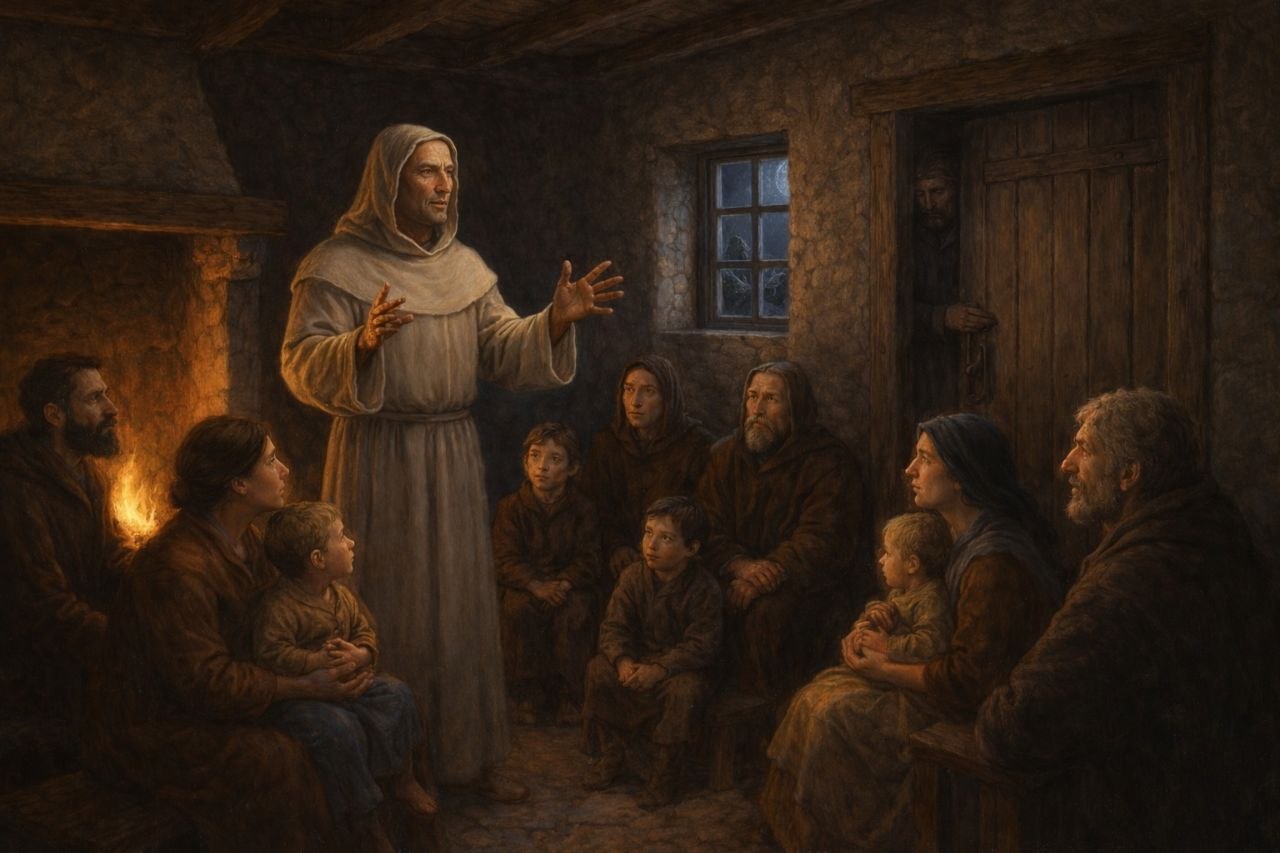
9. Let the Ordained One then begin the preaching in this manner, if it pleases him:
O John, you must understand that at this moment you have come before God and Christ and the Holy Spirit for the second time when you came before the Church of God, as has been shown above by the Scriptures, and you must understand that you are here before the Church of God in order to receive the perdonum of your sins, through the supplications of the good Christians with the imposition of hands. And this is called the spiritual baptism of Jesus Christ and the baptism of the Holy Spirit, as John the Baptist says: ‘I baptize you with water for repentance; but he who is coming after me is mightier than I, whose sandals I am not worthy to bear; he himself will baptize you with the Holy Spirit and fire‘, which means: he himself will wash and purify you in spiritual understanding and in good works. By this baptism we must understand that spiritual rebirth of which Christ said to Nicodemus: ‘Unless someone is born again of water and the Holy Spirit, he cannot enter the kingdom of God‘. Baptism is called a washing or a super-baptism (supertinctio).
Therefore we must understand that Christ did not come to wash the stains of the flesh, but to erase the stains of the souls of God, which were defiled by the contagion of evil spirits. Thus the Lord said to Israel through the prophet Baruch: ‘Hear, Israel, the precepts of life; open your ears to learn prudence. What has happened, Israel, that you are in the land of your enemies, that you have taken root in a foreign land, that you have defiled yourself with the dead, that you have been counted among those who go down to hell? You have abandoned the fountain of life and wisdom. For if you had walked in the way of God, you would have dwelt in eternal peace‘. And David said: ‘O God, the nations have come into your inheritance; they have defiled your holy temple; they have reduced Jerusalem to a hut for storing fruit‘. And thus the people of God have been defiled by association with evil spirits.
That is why it pleased the most holy Father to wash his people from the stains of sins through the baptism of his holy Son Jesus Christ. As the blessed Apostle says to the Ephesians: ‘Husbands, love your wives, just as Christ loved the Church and gave himself up for her, that he might sanctify her, cleansing her by the washing of baptism and by the word of life, so that she might appear before him a glorious Church, without spot or wrinkle or any such thing, but that she might be holy and without blemish‘.
And thus, because of the coming of our Lord Jesus Christ, by the power of the most holy Father, the disciples of Jesus Christ were purified from the stains of their sins by his spiritual baptism. They received strength and power from the Lord Jesus Christ, just as he himself had received them from his most holy Father, so that they too might purify other sinners through the baptism of Jesus Christ. Likewise, we find in the Gospel of the blessed John that after his resurrection the Lord Jesus Christ said to his disciples: ‘As the Father has sent me, so I send you‘.
Having said this, he breathed on them and said: ‘Receive the Holy Spirit; whose sins you forgive, they are forgiven, and whose sins you retain, they are retained‘. In the Gospel of Matthew, Christ says to his disciples: ‘Truly I tell you: whatever you bind on earth will be bound in heaven; and whatever you loose on earth will be loosed in heaven. Again I say to you: if two of you agree on earth about anything they ask, it will be done for them by my Father who is in heaven‘. And again: ‘Who do men say that the Son of man is?‘ They answered: ‘Some say John the Baptist, others Elijah, and others Jeremiah, or one of the prophets’. Jesus said to them: ‘But who do you say that I am?‘ Simon Peter answered: ‘You are the Christ, the Son of the living God‘. And Jesus answered him: ‘Blessed are you, Simon Bar‑Jona, because flesh and blood has not revealed this to you, but my Father who is in heaven. And I tell you, you are Peter, and on this rock I will build my Church, and the gates of hell shall not prevail against it. And I will give you the keys of the kingdom of heaven—to you on behalf of all—and whatever you bind on earth will be bound in heaven, and whatever you loose on earth will be loosed in heaven.” And he said further to his disciples: “Go into all the world, preach the Gospel to every creature‘.
‘He who believes and is baptized will be saved; but he who does not believe will be condemned. And these signs will accompany those who believe: in my name they will cast out demons; they will speak in new tongues; they will pick up serpents; and if they drink any deadly poison, it will not hurt them; they will lay hands on the sick, and they will recover‘. And again: ‘Now the eleven disciples went to Galilee, to the mountain to which Jesus had directed them. And when they saw him they worshipped him, but some doubted. And Jesus came and said to them: ‘All authority in heaven and on earth has been given to me. Go therefore and make disciples of all nations, baptizing them in the name of the Father and of the Son and of the Holy Spirit, teaching them to observe all that I have commanded you. And behold, I am with you always, to the end of the age’ ”.
10. Therefore let no wise person believe that the Church of Jesus Christ can perform this baptism of the imposition of hands without a manifest reason drawn from the Scriptures, nor claim that the Church of God can perform this ordinamentum by the presumption of its disciples, or by a human summons, or by an unknown and invisible inspiration of spirits. But in everyone’s sight the disciples of Jesus Christ went forth and remained with the Lord Jesus Christ; they received from him the power to baptize and to forgive sins, just as today the true Christians, as heirs of the disciples, gradually received from the Church of God the power to perform openly this baptism of the imposition of hands and to forgive sins. Thus it is clearly found in the Scriptures of the New Testament that the disciples of Jesus Christ, after his ascension, exercised this ministry of the imposition of hands in everyone’s sight, as is clearly evident from the Scriptures.
It is written in the ‘Acts of the Apostles’: “Now when the apostles in Jerusalem heard that the Samaritans had accepted the word of God, they sent to them Peter and John; when they arrived, they prayed for them that they might receive the Holy Spirit, for it had not yet fallen on any of them; they had only been baptized in the name of the Lord Jesus. Then they laid their hands on them, and they received the Holy Spirit.” And again: “Now it happened that while Apollos was at Corinth, Paul, having passed through the upper regions, came to Ephesus and found some disciples there. He said to them: ‘Did you receive the Holy Spirit when you believed?’ They answered him: ‘We have not even heard that there is a Holy Spirit.’”
Then he said: ‘Into what then were you baptized?‘ They said: ‘Into John’s baptism’. Paul said: ‘John baptized with a baptism of repentance, telling the people to believe in the one who was to come after him, that is, Jesus‘. When they heard this, they were baptized in the name of our Lord Jesus Christ. And when Paul laid his hands on them, the Holy Spirit came upon them, and they spoke in tongues and prophesied. There were about twelve men in all. And in the same ‘Acts of the Apostles‘ Christ says to Ananias: ‘Rise and go to the street called Straight, and in the house of Judas look for a man named Saul of Tarsus, for he is praying‘. And Saul has seen a man named Ananias coming in and laying his hands on him so that he might regain his sight, etc. So Ananias departed and entered the house, and laying his hands on him he said: ‘Saul, brother, the Lord Jesus who appeared to you on the road by which you came has sent me so that you may see and be filled with the Holy Spirit‘. And immediately something like scales fell from his eyes, and he regained his sight; and he rose and was baptized; and after taking food, he was strengthened. And again: Now it happened that the father of Publius lay sick with fever and dysentery. Paul went in to him and, after praying and laying his hands on him, healed him. And the Apostle says to Timothy: ‘For this reason I remind you to fan into flame the gift of God that is in you through the laying on of my hands’. And again: ‘Do not lay hands on anyone hastily, and do not share in the sins of others’. And the same, addressing the Hebrews, speaks ‘of the doctrine concerning baptism and the laying on of hands‘.
11. And it seems that it is of this baptism that the blessed Peter says in his first Epistle: ‘… in the days of Noah, when the ark was being built, in which a few, that is, eight persons, were saved through water. And this, the water of baptism, now saves you also, not as a removal of filth from the flesh, but as an appeal to God for a good conscience, through the resurrection of Jesus Christ‘. But here we must consider somewhat that those who were saved in Noah’s ark according to the historical account of the Old Testament were not saved as one might expect, for we read that Noah, with his sons, their wives, and the animals, came out of the ark, planted a vineyard, drank pure wine, became drunk, and fell and exposed his shame. He cursed his son Canaan in these words: ‘Cursed be Canaan; he shall be a servant of servants to his brothers‘—he who had been one of the survivors of the ark. We also find in the Old Testament that those who came out of that ark and their heirs committed many sins and very shameful crimes and then fell into very great famine and excessive abjection to the point of killing one another.
Hence it is thought that the blessed Peter was not speaking of this Noah of the Old Testament, nor of that ark, but rather of the ark of the Testament made by the Lord for the salvation of his people, of which the Apostle says to the Hebrews: ‘By faith Noah, being warned about things not yet seen, in reverence built an ark for the salvation of his household; by this he condemned the world and became an heir of the righteousness that comes by faith‘. And Jesus son of Sirach says: ‘Noah was found perfect, and in the time of wrath he became a means of reconciliation. So that a remnant was left on the earth after the flood; everlasting covenants were made with Noah, so that no flesh might be destroyed by a flood‘. And it seems that it is of this Noah that the blessed Peter says in his second Epistle: ‘And God did not spare the ancient world, but preserved Noah, the eighth, a herald of righteousness, when he brought a flood upon the world of the ungodly‘. And this is what is meant when it is recalled that the holy Father in antiquity gave his people a Law and a Testament, and that all who entered that ark—that is, who observed that Testament—were saved, just as all are saved who enter the ark of the New Testament and remain in it.
12. And following this view, the blessed Peter could rightly say: ‘But now baptism makes us saved in a similar way’, as if he were saying: in the same way that they were saved by this ordinamentum [‘by this rite‘], so Christians are now saved by the baptism of Jesus Christ in a similar form. To this agrees what the prophet David says: ‘Indeed, our God exists before the ages; he has wrought salvation in the midst of the earth‘. And Isaiah says: ‘The harvest is past, the summer is ended, and we, we are not saved…‘ And, speaking of Christ, the Apostle says to the Hebrews: ‘For it was fitting for him for whom and by whom all things exist, who was bringing many sons to glory, to perfect through suffering the author of their salvation‘. And the blessed Peter was right to say: ‘It is not the purification of the stains of the flesh that saves us, but the appeal to God for a good conscience‘, in other words: we cannot be saved by the works of the Church without this baptism, namely the appeal for a good conscience addressed to God through the ministers of Christ. As the Apostle says in the first letter to the Corinthians: ‘And I will show you an even better way. If I speak in the tongues of men and of angels but have not charity, I am a noisy gong or a clanging cymbal. And if I have prophetic powers and understand all mysteries and all knowledge, and if I have all faith so as to move mountains, but have not charity, I am nothing. And if I give away all my possessions as food for the poor, and if I deliver my body to be burned, but have not charity, it profits me nothing‘,” which means: without having this baptism of the spirit of charity. That is why true Christians, taught by the primitive Church, openly perform this ministry of the imposition of hands, without which, it is believed, no one can be saved.
*



Leave a Reply