
Circle of Transmission: The Living Loom
A ‘Guldne Vliess’ Sampler – Part 1: Remembering the Geometrical Language of the 1736 ‘Golden Fleece’ Engravings
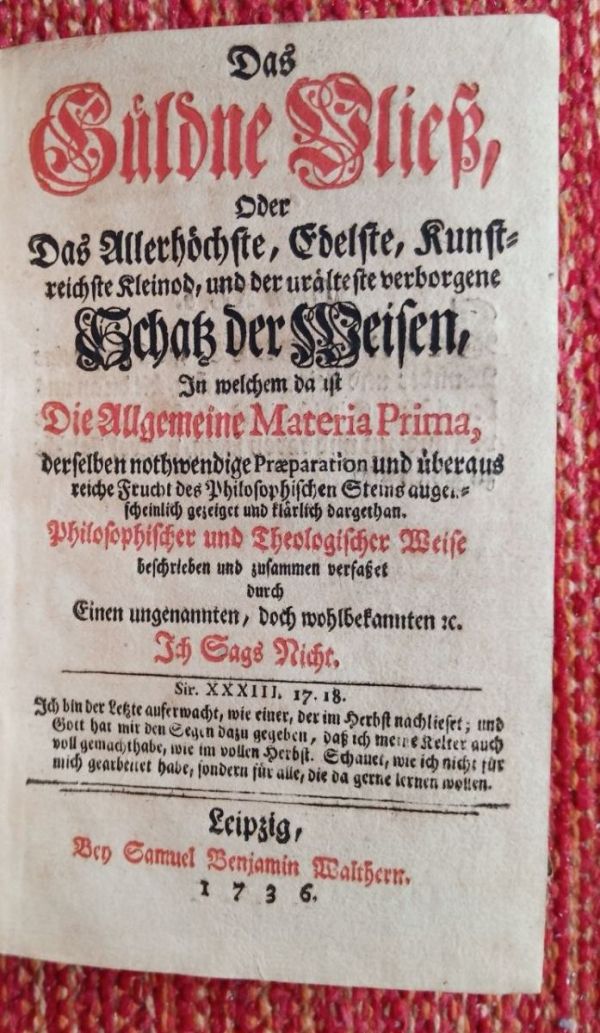
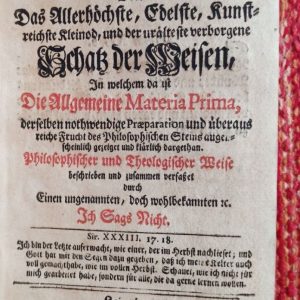
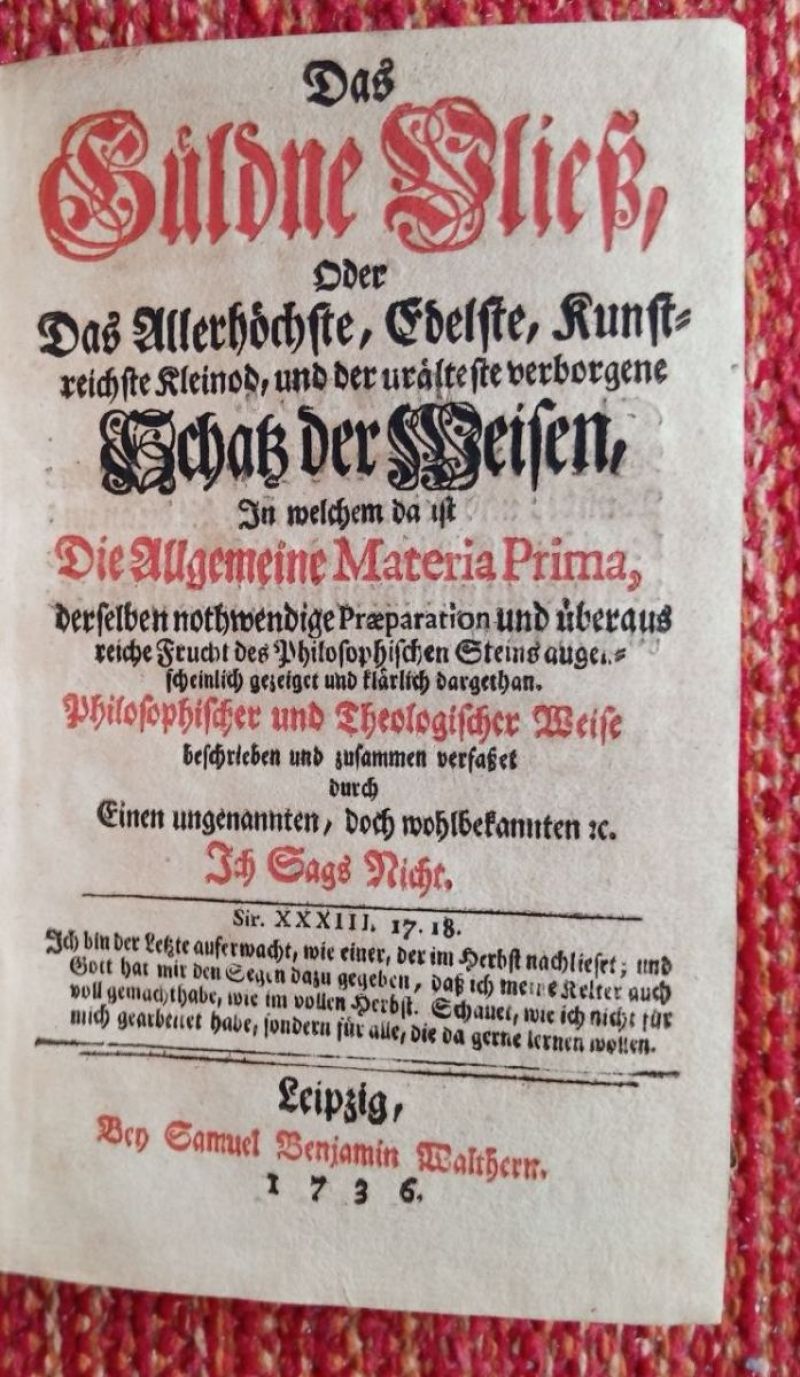
Title page of the 1736 ‘Guldne Fliess‘.
*
Today’s sharing from the Blue House of Via-HYGEIA is Sampler Part 1 of a planned series devoted to the emblematic ‘Das Guldne Vliess’. It comprises a contextual introduction, an exegesis of the engravings, followed by a little didactic catechism embodying the teachings implied by the plates. A forthcoming sampler part 2 will offer selections from the text itself.
In the twilight of the Baroque era, as the rationalist dawn of the Enlightenment began to sever the ties between matter and spirit, a final, luminous testament to united wisdom emerged from Leipzig. Published in 1736 by Samuel Benjamin Walthern, this edition preserves a seminal work first released in 1609.
Modern scholarship, notably by the distinguished scholar Antoine Faivre, attributes the authorship and original engravings to the renowned Nuremberg artist and esoteric compiler Johann Ambrosius Siebmacher (c. 1561–1612). Published under the Rosicrucian veil of anonymity (Ich Sage Nicht — ‘I Say Not’), ‘Das Guldne Vliess’ (The Golden Fleece) stands as a last great fortress of Christian Alchemy, bridging the mystical ferment of the Renaissance with the coming age of reason.
At the heart of this work lie six hermetic plates, engraved in 1736 by C.F. Boëtius (working in the tradition of Siebmacher) with mathematical precision and mystical intent. In this offering, we propose a ‘geometric exegesis‘ that treats these impressive illustrations not as mere decorations, but as operative maps of consciousness.
**
A Contextual Introduction:
The Geometric Theosophy of ‘Das Guldne Vliess’ (1609/1736)
The engravings presented here belong to a work with two birthdays, each marking a distinct epoch in the history of Western esotericism. ‘Das Guldne Vliess’ first appeared in 1609, in the vibrant, turbulent courts of Nuremberg. This was the era of the ‘Fama Fraternitatis’, of Jacob Böhme’s early visions, and of a confident, syncretic magic that believed the secrets of heaven could be drawn, printed, and shared. Yet the edition we study here bears the date 1736. Published in Leipzig, this reprint emerges 127 years later, on the precipice of the Enlightenment. By 1736, the world had changed. Newton’s physics had mechanized the cosmos; Pietism had internalized faith; and the public practice of alchemy was increasingly viewed as superstition or fraud.
Why, then, reprint Siebmacher’s complex, mystical plates in an age of reason? The answer lies in the book’s subtitle: ‘Ich Sage Nicht’. The 1736 edition is not merely a nostalgia piece; it is a deliberate act of preservation. It suggests that while the outer world had turned to mechanism, the inner geometry of the soul remained unchanged. The book serves as a bridge across time: it carries the Hermetic confidence of 1609 into the skeptical, rationalist climate of 1736, offering a ‘fool’s wisdom‘ to those who still knew how to read the silent language of numbers and shapes. It is a message in a bottle, thrown from the Renaissance to the Enlightenment, declaring that the Golden Fleece is not a myth, but a geometric reality hidden in plain sight.
To understand these plates, one must recognize that for Siebmacher and his 1736 successors, geometry was not a human invention but a divine language. Following the Pythagorean maxim that ‘All is Number‘, the engravings are structured as arithmetical prayers. Every line, angle, and polygon corresponds to a specific theological truth, creating a harmonia mundi (harmony of the worlds) on the printed page. This is not the fluid, surreal alchemy of the ‘Mutus Liber’; it is the architectural alchemy of the German tradition, deeply influenced by the Christian Kabbalah and the Neoplatonism of Robert Fludd. The images are operative diagrams: they do not just describe the Work; they perform it through the viewer’s contemplation of their perfect proportions.
The journey begins with the Monad and the Trinity. The first perfect shape, the Triangle (Page 80), represents the Triad, the number of manifestation. Here, it signifies the Trinity (Omnipotentia, Sapientia, Misericordia) descending into matter. The geometric act is one of division: the One becomes Three to create the world. The viewer is invited to trace this descent, moving from the chaotic cloud (the Unlimited) into the fixed triangle (the Limited), mirroring the Incarnation.
From there, the Lapis Theosophorum (Page 209) introduces the Quaternity. The Diamond, a four-sided figure, corresponds to the Four Elements, the Four Evangelists, and the four corners of the divine throne (Vater, Wort, Blut, Wasser). The number 4 represents Stability and the Earth. The alchemical goal is not to escape the four elements, but to square the circle—to bring the divine Trinity into the quaternity of matter. The diamond shape is the ‘squaring of the circle‘ in three dimensions: the spirit doubled and reflected to master the material world.
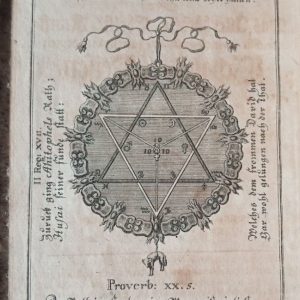
The synthesis arrives with the Hexad and the Harmony of Opposites. The Hexagram (Page 209/210) is formed by two interlaced triangles (3 + 3 = 6). In Pythagoreanism, 6 is the first ‘Perfect Number‘, representing Harmony and Marriage. The Hexagram unites the opposing forces: Fire and Water, Male and Female, Sulfur and Mercury. The center of the star is the void where the Coniunctio occurs. The surrounding wreath of 7 planets adds the dimension of Time, suggesting that this harmony is not static but a dynamic, circulating process—the ‘Golden Chain‘ of Homer. Though less explicit, the entire system aims for the Decad (10), the number of perfection and return.
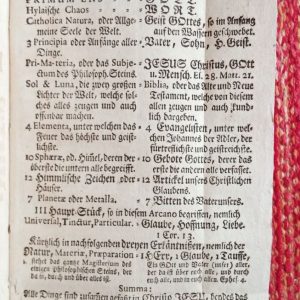
The Comparatio Lapidis table organizes the work into 10 Spheres and 10 Commandments. The hidden geometry reveals that 1 (God) + 2 (Duality) + 3 (Trinity) + 4 (Elements) = 10. The entire book is a mathematical proof that all things are summed up in Christ. The geometric progression leads the eye from the simple triangle to the complex star, and finally back to the Circle, symbolizing the Alpha and Omega—the end returning to the beginning, but now conscious and glorified.
Unlike the cryptic, dream-like images of French alchemy, Siebmacher’s German plates are didactic tools. They are designed for a Pietist audience who valued structured, internal meditation. The Comparatio Table is the key to the cipher, explicitly linking the ‘Book of Nature‘ with the ‘Book of Scripture‘. It teaches the adept that to study geometry is to study God, and to pray is to perform alchemy. The precision of the lines is not artistic vanity; it is theological necessity. A wobbly line would break the geometric spell. ‘Das Guldne Vliess’ occupies a unique space in the bibliographic landscape. It is a Renaissance artifact preserved in an Enlightenment wrapper.
For Siebmacher, it was a bold declaration of a new spiritual reformation. For the 1736 publisher, it was a secret refuge. For us in 2026, it is a Rosetta Stone. These engravings are portals. They invite the viewer to step out of linear time and into geometric time—the Nunc Stans (Eternal Now) where the Triangle, the Star, and the Diamond exist in perfect, unchanging truth. To contemplate them is to join the ‘Company of the Golden Fleece‘, a lineage of seekers who know that the true treasure is not gold, but the geometric perfection of the soul.
*
The Legends of the Six Gates
Legend of the First Gate
Here begins the Great Work, not with a construction, but with an invasion. The geometry of this gate describes the fundamental crisis of creation: how the Monad enters the Dyad to birth the Triad. The engraving depicts a swirling, radiant Cloud, the Hylaean Chaos. But look closer at the Triangle that descends into it. At the top left corner sits the Alpha (Α), and at the top right, the Omega (Ω). This declares that the Work is framed by Eternity; the Divine Attributes of Omnipotentia (Power), Sapientia (Wisdom), and Misericordia (Mercy) are the beginning and the end of all things.
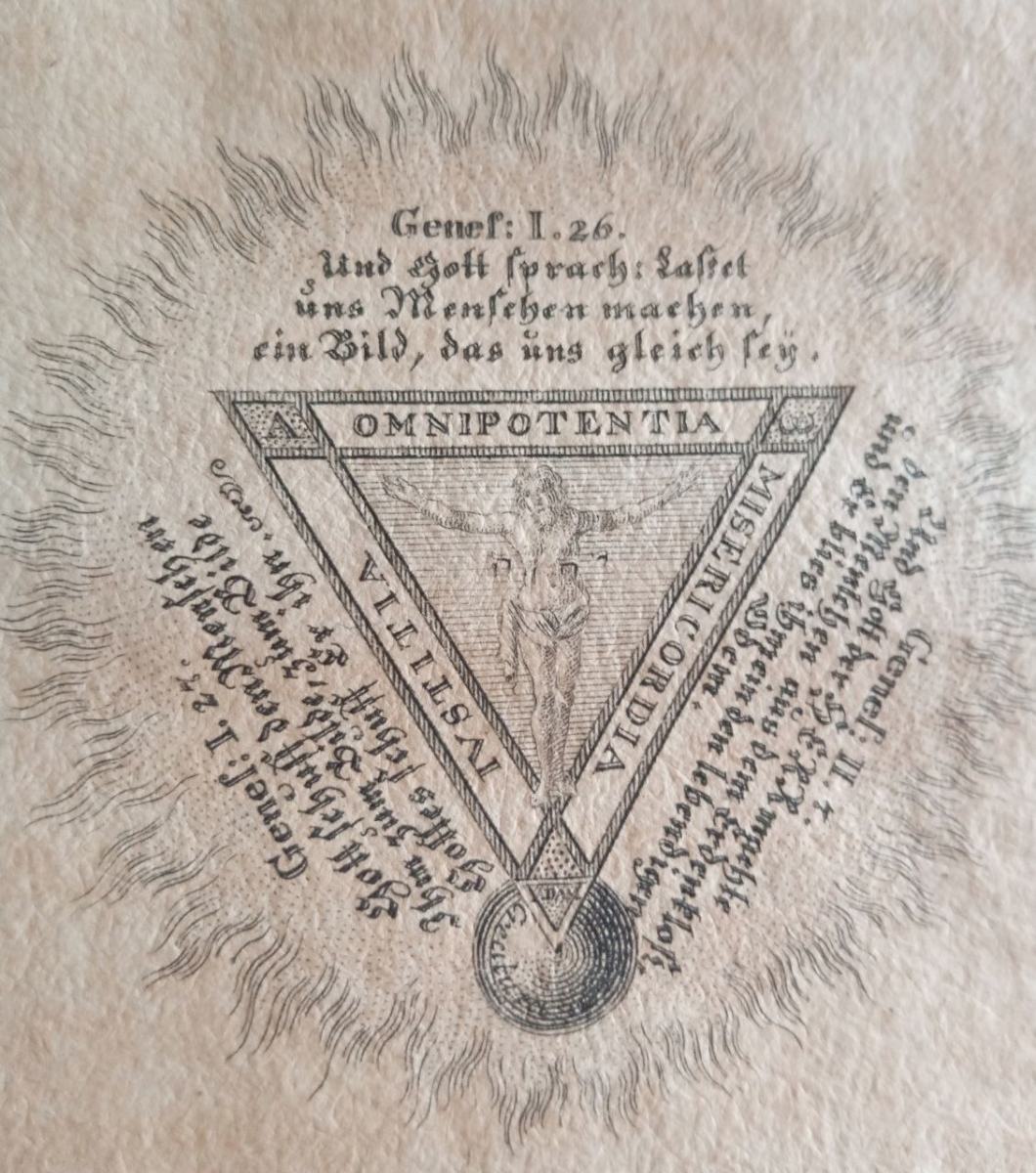
Inside the triangle stands a figure with outstretched arms. Visually, this is Christ Crucified, the Christus Patiens, confirmed by the text below from Hebrews describing Him as the brightness of God’s glory. Yet, at the bottom vertex of the triangle, pointing into the dark sphere, is the label ADAM. This is the theological key: the image presents Christ as the Second Adam. The First Adam fell into the Creatura (the dark, swirling sphere labeled “Creation”), bringing chaos and death. The Second Adam (Christ) descends into that same Creatura to reclaim him. The triangle does not just hover; it pierces the darkness, linking the Eternal (Alpha/Omega) with the Fallen (Adam) through the Person of the Redeemer (Christ).
The text above cites Genesis 1:26: ‘Let us make man in our image’. The image synthesizes this with the Gospel: the original Image of God (Adam) is being restored by the Perfect Image (Christ). The geometric act is one of Incarnation and Reintegration: The Divine Will descends to pull the fallen human nature out of the chaotic Creatura and back into the stability of the Trinity. The Prima Materia of this work is not just ‘stuff‘; it is fallen humanity waiting to be resurrected.
As the Triangle descends, it performs the first alchemical operation: Fixation. It pins the volatile Creatura. It imposes Limit upon the Infinite. This moment is the Nigredo of the mind: the shock of the Finite encountering the Infinite. For the soul, it is the moment of Awakening, realizing that the “Adam” within is being redeemed by the “Christ” above. For the Stone, it is the Embryo hidden in the womb of the waters. The geometry proves the theology: The Triangle must enter the Cloud to become real. Spirit without matter is a ghost; matter without spirit is chaos.
To pass this gate, the adept must surrender the illusion of control. You cannot make the Triangle descend; you can only prepare the Cloud. When the Triangle touches the center of the Creatura, the Chaos becomes a Cosmos. “Let there be Light” is not a command to the sun; it is a command to the Geometry.
Legend of the Second Gate
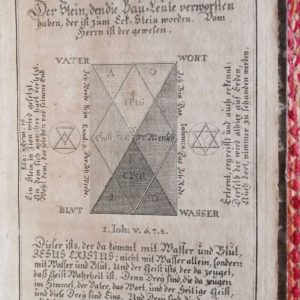
The Cornerstone of the Temple Here stands the Tetrad, the number of stability and earth. The central Diamond fixes the Four Rivers of Paradise: Vater and Wort above; Blut and Wasser below. But this central structure is not static; it is held in tension by two flanking medallions that reveal the secret task and the final completion of the Work. To the left, the first medallion shows a simple Triangle within a Circle. This is the Archetype—the Divine Idea existing in eternity. The text declares: ‘A stone is placed in Zion‘. This is the Task: the descent of the Trinity into the chaos of matter. It is the Alpha, the seed of the work. To the right, the second medallion shows the Hexagram within a Circle. This is the Apocalypse—the revelation of the hidden mystery. The text commands: ‘Know, grasp, and also know‘. This is the Completion: the moment the downward triangle of Grace meets the upward triangle of Human Aspiration to form the Star of Wisdom. The Hexagram is the Omega.
Between these two states lies the central Diamond. This is the Work itself. The Left says: ‘It shall be done‘. The Right says: ‘It is done‘.” The Center says: ‘It is being done in you‘. The monogram IHVS burns at the heart of the Diamond, the Fifth Element that acts as the transmuting fire. Without the Center, the square collapses. With the Center, the Triangle descends, the Quaternity is sanctified, and the Hexagram is born.
This is the Albedo: the washing of the four corners until they become transparent enough to let the light of the Left shine through to the Right. The adept stands in the Diamond, holding the tension between the Command and the Promise, knowing that the Cornerstone is the very act of holding them together in faith.
Legend of the Third Gate
The Circulation of the Golden Chain Now the Work ascends to the Hexad, the first perfect number, where the static geometry begins to breathe. This is not a frozen star; it is a spinning wheel of fire and water. The Hexagram is the engine: the upward triangle and the downward triangle interlock and rotate. This is the Pythagorean Flow: the eternal rhythm of inhalation and exhalation. The engraving reveals a three-stage alchemical circuit. At the center, the two triangles grind against each other, creating the friction necessary for transformation. The six points of the star act as valves, pumping spiritual energy outward. Surrounding the star are the symbols of the Seven Planets. These are the Seven Regents of Time. The pure light of the Hexagram must pass through these seven filters: Saturn calcines, Jupiter expands, Mars cuts, the Sun illuminates, Venus ferments, Mercury volatilizes, and the Moon coagulates. The energy circulates clockwise, picking up the qualities of each stage until it becomes the ‘Golden Chain‘.
Encircling the planets is a wreath of clouds and cherubic faces, representing the Twelve Gates of the City of God. The Zodiac sets the limit of the material world. The Work must encompass all twelve signs, leaving no part of the psyche untouched. Hanging below the entire structure is the Lamb of God. This is the fulcrum of the circulation. Without the Lamb, the spinning star would fly apart into centrifugal chaos. The Lamb represents Sacrifice and Stillness. It anchors the dynamic motion of the Hexad to the earth. It whispers the secret: ‘The circulation only works because the Center is still’. This entire assembly is the Aurea Catena Homeri.
In 1609, Siebmacher drew this as a map of the cosmic soul. In 1736, the Pietist meditated on this as the circulation of grace in the heart. The task for the adept is to visualize this chain spinning within their own body. To become the Living Circulation. This is the Citrinitas: the dawn where the black and white merge into a living, circulating gold. The geometry is no longer just a shape; it is a verb. It is circulating.
Legend of the Fourth Gate
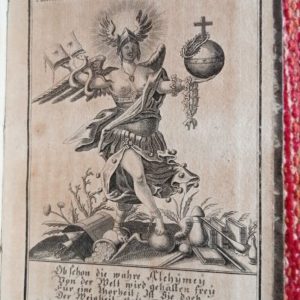
Behold the Ogdoad, the number of regeneration, where the static geometry of the previous gates bursts into living form. Here stands Lady Alchemy herself—the Divina Sophia, the Mother of God’s Wisdom. She is depicted not as a distant goddess, but as a victorious Queen clad in the armor of Athena-Minerva, signifying that Wisdom is a warrior who battles ignorance and chaos. Her bosoms are exposed, echoing the ancient images of Isis, offering the Milk of Gnosis to nourish the seekers. Upon her head rests a winged helmet, and from her back spring great wings, declaring that her wisdom is both grounded in battle and volatile enough to ascend to the heavens. A radiant halo burns behind her head, marking her sanctity.
To understand her victory, we must read the Eight Attributes she bears, for each corresponds to a stage of the perfected Work:
- The Golden Fleece Collar: Draped over her arm, this identifies her as the very prize sought by the spiritual Jason. She is not just the guide; she is the Fleece.
- The Dragon-Snake with Eyes: In her right hand, the caduceus serpent does not merely coil; it stares intently at the open book she holds, a book depicted with eyes on its pages. This is the Agathodaimon guarding the Secret, reminding us that the Book of Nature is alive and watches the reader.
- The Globe with the Crown of Thorns: In her left hand, she holds the Earth, crowned not with gold, but with the Thorns of Jesus. This is the pivotal Christian key: the world is redeemed not by power, but by suffering and sacrifice.
- The Winged Sphere: Hovering behind her is the perfect geometric Stone, given wings. It represents the Volatile Fixed—matter glorified and able to ascend.
- The Golden Chain: A chain connects this Winged Sphere directly to her right leg. This is the mystery of Henosis: the highest heaven is chained to the lowest earth, and the Adept is the living link.
- The Jar of Gold Coins: Beneath her left foot, she crushes a jar of merchant’s gold. She tramples the vulgar desire for wealth, declaring that the true Gold is spiritual, not material.
- The Scattered Tools: The alembics and retorts lie broken at her feet. They are transcended. The external laboratory has served its purpose; the Work has moved inside. She is the Vessel now.
- The Armor: Her battle dress signifies that the path to Wisdom is a struggle against the ‘thistles and thorns‘ of the fallen world.
Behind her grow those very thistles and thorns, the symbols of the Cursed Earth (Genesis 3:18). Lady Alchemy stands before them, shielding the viewer, having turned her back on the curse. She represents Redeemed Nature, the New Eve who reverses the fall not by ignoring the thorns, but by wearing the Crown of Thorns on the globe she holds. She is the Bride born of the Hexad, now perfected in the Ogdoad. The tools lie scattered because she has become the Tool. The geometry is no longer external; it is embodied in her flesh.
The inscription speaks true: “Though the world considers true Alchemy to be nothing but folly…” The world sees a madwoman in armor, standing on money, holding a snake. But the Adept sees the Mother of Divine Wisdom, the Queen who has conquered death, greed, and gravity. This is the Rubedo in its fullest sense: the gold that cannot be destroyed because it is living, breathing, watching, and flying.
The 1609 dream of Siebmacher and the 1736 hope of the Pietists unite here: the earth is not rejected, but married to heaven through the Cross. The Fleece is won not by force, but by the embrace of the Divine Mother who tramples the false gold to give us the true.
Legend of the Fifth Gate
The Tablet of Correspondences Here stands the Decad, the number of return and completion. But this Decad is presented as a Table of Two Columns. This is the final test of the adept: can you see the One Truth hidden behind the Two Faces? The engraving is divided vertically into two distinct pillars. The Left Column is the Lapis Philosophicus, the Book of Nature. It speaks the language of the laboratory: Prima Materia, Chaos, Sulfur, Mercury. The Right Column is the Lapis Theologicus, the Book of Scripture. It speaks the language of the Church: God, Trinity, Christ, Faith.
The magic of this table lies in the invisible horizontal lines connecting them. The engraving asserts that every item on the Left is equal to its counterpart on the Right. Chaos equals the Spirit of God. Three Principles equal the Holy Trinity. Seven Metals equal the Seven Petitions. This is the Great Secret: Nature is Theology made visible; Theology is Nature made intelligible.
The table is structured according to the Pythagorean Tetractys, the sacred triangle of numbers that sums to 10. The rows follow this exact numerical ascent: 1 (God), 2 (Duality), 3 (Trinity), 4 (Elements). The Tetractys is the geometric ladder that climbs from the bottom of the table to the top. When the adept contemplates this table, they are ascending the Tetractys. They move from the multiplicity of the elements back to the unity of God. The task of the adept is to read the table horizontally. When you see Lead in the lab, you must immediately see Melancholy in the soul. When you see Gold, you must see Christ.
This is the Transmutation of Perception. The laboratory bench becomes an altar; the prayer book becomes a recipe. To pass this gate is to lose the ability to see the world as ‘secular‘. Once you see the Tetractys connecting the columns, every rock and every verse becomes a hologram of the Divine. The Stone is found, because you finally realize where it was hidden: in the Equals Sign between Heaven and Earth.
Legend of the Sixth Gate
The Vow of the Anonymous ‘Das Guldne Vliess‘—the prize that spans the centuries, hidden in plain sight. The author signs himself ‘Ich Sage Nicht’. This is not merely a pseudonym; it is a theological statement. The Monad has no name, for to name it is to limit it. The Truth cannot be spoken; it can only be recognized by those who have eyes to see. The vow of silence is the wall that protects the vineyard from the boars of the profane, while leaving the gate open for the Gleaners. The epigraph from Sirach defines the lineage of the adept: ‘I am the last that kept watch, like one that gleaneth after the grape-gatherers; yet God gave me the blessing to fill the winepress‘. The ‘grape-gatherers‘ are the great prophets and master alchemists of the past. We, the readers of 2026, are the Gleaners. We come after the harvest. We walk the fields of history, picking up the ‘fallen grapes‘—the forgotten symbols, the obscure engravings, the silenced voices.
The promise of Sirach is that the Gleaner’s basket shall be fuller than the Harvester’s. Why? Because the Gleaner sees the whole pattern of the field. The ‘latecomer‘ possesses the advantage of retrospective wisdom. We see how 1609 led to 1736, and how both lead to now.
This book is for the ‘Companions of the One‘. In the Islamic tradition, these are the Waliya, the Friends of God. In the Christian tradition, they are the Cloud of Witnesses. What unites them? They all know that Time is a Circle. They know that the Golden Fleece is an Eternal Now to be realized in the present. A Wali recognizes another Wali across centuries. When you read Siebmacher’s words and feel a spark of recognition, you are communing with a Companion.
The vow of silence forces you to look inward. If the author spoke plainly, you would seek the answer in the text. By remaining silent, he forces you to become the text. 1609: The Vision is born. 1736: The Vision is preserved. 2026: The Vision is reborn in you. The circle is complete. The Fleece is yours, not because you conquered it, but because you gleaned it with humility. ‘The Stone which the builders rejected has become the Head of the Corner‘. You are the builder who sees the value in the rejected stone.
*
Catechism of the Theosophical Stone
(A Via-Hygeia proposed contemplation )
Q. What is the First Matter of the Philosophers?
A. It is the Chaos before the Number 1. It is the Catholica Natura, the Spirit of God moving upon the face of the waters. It is formless until the Triangle gives it shape. It is hidden in all things, yet found only by him who seeks it in the proper vessel of the heart.
Q. Wherein lies the proof that this Art is holy and not demonic?
A. In the Pythagorean harmony of the engravings. The Triangle descends into the Quaternity to create the Hexad. Demons bring chaos; God brings geometry. We work with the numbers of creation: 3, 4, 7, and 10. The Stone is baptized in number before it is born in matter.
Q. What form must the Vessel take?
A. It must be shaped like the Hexagram—the union of the upward and downward triangles. It must have four walls to receive the Elements, sealed above and below to contain the Breath. It is a tomb and a womb, for the Stone must die in the number of earth to live in the number of heaven.
Q. What is the Water and what is the Blood?
A. The Water is the Mercury, volatile and lunar; the Blood is the Sulfur, fixed and solar. As the Gospel testifies, these two bear witness in earth, and the Spirit is the Center that unites them. Neither Water alone nor Blood alone suffices; both must flow from the same side to make the Six.
Q. How many Regents guide the Work?
A. Seven, corresponding to the Seven Planets and the Seven Petitions of the Lord’s Prayer. But these Seven dance around the One Center. Saturn calcines; Jupiter expands; Mars rectifies; the Sun conjoins; Venus ferments; Mercury volatilizes; the Moon coagulates. Through these Seven, the matter ascends the Twelve Steps of the Zodiac to reach the Ten.
Q. What is the Fire required?
A. The Fire is not the fire of the kitchen, but the Ignis Naturae—the love of the Spirit for the Body. It is the geometric tension between the opposites. It begins gentle, increases to the heat of noon, and ends in the gentle warmth of the living body. He who burns too fiercely breaks the circle; he who heats too little never forms the triangle.
Q. What colors shall appear in the Work?
A. First the Black, when the matter putrefies. Then the White, when the soul returns purified. Then the Red, when the Spirit and Body are wed. Finally, the Gold, the Fleece, which is the sum of all numbers and no fire can destroy.
Q. Who is the true Artifex?
A. He who is the Last Awakened, like the gleaner in Sirach. He must possess the Three Theological Virtues: Faith, Hope, and Charity. Without these, the vessel cracks, the numbers scatter, and the mercury escapes.
Q. What is the Golden Fleece?
A. It is the Decad perfected—the sum of all the works. It is the Body glorified, the Spirit fixed, the Soul redeemed, all united in the One. It is Christ in the Microcosm, the Living Geometry carried by the Mercurial Messenger.
Q. What is the final use of the Stone?
A. To turn the chaos of the ignorant into the cosmos of the wise—not the metal lead, but the disordered soul; not the metal gold, but the harmonious spirit. To multiply grace as the Stone multiplies gold. To fulfill the promise of the Title Page: that the world and the devil may be deceived—not by fraud, but by the manifestation of a higher Mathematics.
Q. How shall the Adept preserve this Mystery?
A. By the threefold seal of the Comparatio: to know that Nature is Theology, that Matter is Spirit, and that the Laboratory is the Church. To speak in Numbers to the wise; to speak in parables to the profane; to keep silence before the scoffers. For the Fleece is hidden in the field of history, and only he who buys the field with all he has shall possess the Eternal Now.
So be it. In the Name of the One, the Three, the Four, and the Ten; in the Name of the Water, the Blood, and the Witness in Earth. Amen!
*
Colophon: The Seal of the Musing
Thus, with the folding of these pages, the labour of tracing the ‘Guldne Vliess’ draws to its close. What began as a contemplation of Siebmacher’s 1609 vision preserved in the 1736 reprint has been woven into a seamless garment: the context set forth, the Pythagorean gates traced, and the little catechism spoken. The engravings have been given voice; the silent numbers have been translated into a living path. Let this not be received as a definitive treatise, but rather as a companion for the furnace, a mirror for the oratory, and a testament that the true reading of these emblems is—and always was—the work of the patient imagination.
Let the seal upon this musing be drawn from the heart of the Comparatio, wherein the many numbers are gathered into One: ‘All things are gathered together in Christ, both which are in heaven and which are on earth‘. As the master of 1609 concealed his name beneath the vow ‘Ich Sage Nicht’, and as the publisher of 1736 kept the flame alive in the twilight, so this gathering is offered not for glory, but for use. May it serve those who count the steps, those who trace the lines, and those who seek the Fleece hidden in the field of Time and Eternity.
Soli Deo Gloria.
In Geometria Veritas.
Here ends ‘Remembering the Geometrical Language of the 1736 ‘Golden Fleece’ Engravings’, gathered from the Leipzig plates (1609/1736), and set down in the year 2026 for the sake of the seekers.
***
Related Articles


Leave a Reply