
Circle of Transmission: The Living Loom
A STEP INTO ETERNITY- A Long-Lasting Impression of a Pilgrimage to Biyunsi Temple in Xiangshan, Beijing
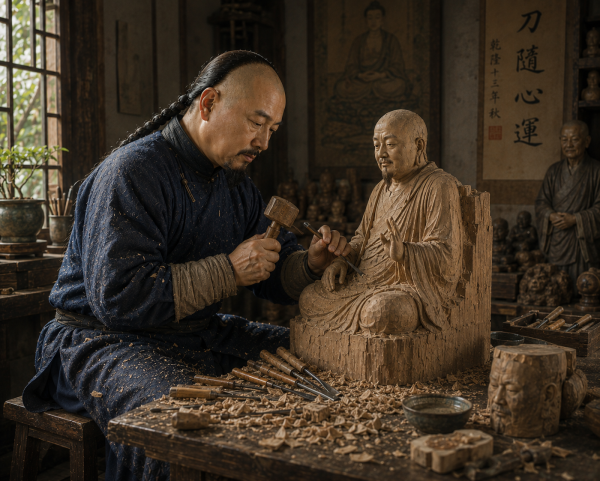
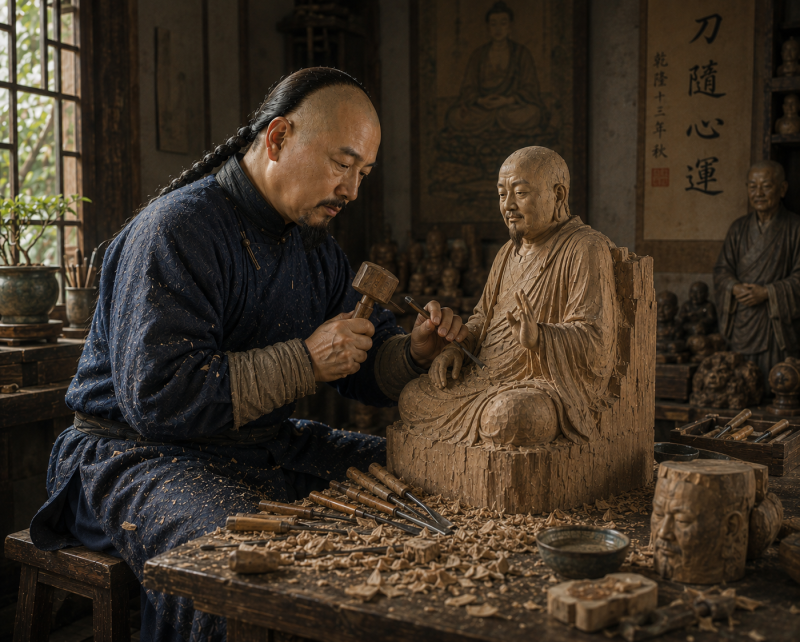
Featured Illustration legend: Emperor Qianlong Carving the 360th Arhat. According to a long-standing tradition associated with the Arhat Hall of Biyunsi (Azure Clouds Temple) in Beijing, the Qianlong Emperor (r. 1735–1796) caused his own likeness to be incorporated among the Five Hundred Arhats, identifying himself with the 360th Luohan, Zhifuduo (直福多羅漢). This illustration imagines the emperor not as a sovereign receiving homage, but as a craftsman quietly carving the image that would unite imperial authority with Buddhist enlightenment. While the scene is an artistic reconstruction rather than a documented historical event, it evokes one of the most intriguing legends of Qing Buddhist patronage and imperial self-representation.
*
Today’s sharing from the Blue House of Via-HYGEIA is a recollection of a singular visit to the Biyunsi Temple in the Fragrant Hills, north of Beijing, during our years living in China. That day, we captured many images of the temple, its stupas, and especially its bas-reliefs.
Though carved nearly three centuries ago, they appear as if sculpted yesterday, and their influence remains vivid within us to this day.
Here is our offering to you, dear readers: an introduction to what Mr. Gurdjieff would call ‘Objective Art.’ This article is dedicated to Qianlong’s Purified Realm and Its Living Stone.
**
PROLOGUE: THE RETURN
The photographs came back to us years later, not as documents but as memories that had been waiting. We had walked through Biyun Temple in Xiangshan on an ordinary day, carrying a camera without a scholar’s checklist, without the names of the Sixteen Arhats, without knowledge of Qianlong’s stele or the Ming eunuchs who had built the temple in corruption and been purged from it in death. We knew only that the place was alive. The stone figures seemed to breathe. The air between them was not empty; it was charged with something that had been waiting centuries to be received.
We understand now what we received. The temple was designed for exactly this: the transformation of consciousness through encounter. Qianlong’s craftsmen did not merely carve figures; they carved modes of address. Each Lohan, each Bodhisattva, each hidden-handed attendant was positioned to speak to the visitor who was ready to hear. We were not ready then. The photographs were the seed. The understanding came much later, like a fruit ripening in its own season.
This is the story of that seed, and that fruit.
Epigraph
朕駐蹕靜宜園,時過此寺,樂觀林壑之美,而念古剎之有待於護持也,爰命重加整葺。喜其滌瑕蕩穢,而復為淨域,因筆之於石,用垂戒焉。
“When I sojourned at the Jingyi Garden, I often passed this temple, delighting in the beauty of its forests and ravines, and reflecting that this ancient monastery was in need of protection and restoration. I therefore ordered a thorough renovation. I rejoice that its stains have been washed away and its filth removed, and that it has been restored as a pure realm. I have therefore recorded this on stone, to serve as an enduring admonition.”
— The Qianlong Emperor, Imperial Inscription on the Renovation of Biyun Temple, 1748
*
I. THE PLACE: A HISTORY IN THREE LAYERS
The temple at Biyunsi — the Temple of Azure Clouds — sits in the Western Hills of Beijing, where the mountains rise like the back of a sleeping dragon and the air carries the scent of pine and centuries. To understand what stands there now, one must read the place as geology reads the earth: in strata, each layer preserving the violence and beauty of its own time.
Layer One: The Ming — Gold and Corruption
The earliest detailed description comes from Liu Tong and Yu Yizheng, who walked these hills in 1635 and recorded what they saw in the Brief Account of the Sights of the Imperial Capital (帝京景物略). Their temple is not Qianlong’s temple. It is older, more opulent, more scandalous:
“The walls scorn painting, yet are raised and hollowed into sculpture; bridge-arches plunge into shadow — celestial beings and spirits have their dwelling-places here.”
Liu Tong describes a temple built by the eunuch Yu Jing in 1516, expanded by the notorious Wei Zhongxian in 1623. The gold was real, the corruption was real, and the “celestial beings” carved into the walls were architectural assertions of a burial plan — Yu Jing intended Biyunsi as his own mausoleum, a temple to secure his passage into the afterlife through the flattery of stone. The temple was beautiful, but it was filthy. The stone knew.
Layer Two: The Qing — Imperial Purification
In 1748, the Qianlong Emperor looked at the temple and saw what Liu Tong had seen — the beauty of the forests and ravines — but he also saw the stain. His response was not merely architectural. It was theological. He would wash the temple clean, restore it as a pure realm (淨域), and record the act on stone so that future generations would remember: purity is not a given; it must be made, and remade, and guarded.
Imperial Inscription on the Renovation of Biyun Temple (Excerpt)
“The Western Hills contain hundreds of Buddhist temples, yet only Biyun is celebrated for its grandeur and splendor… When the Ming government lost its way and eunuchs held tyrannical power, the spirits groaned in resentment; yet these men still sought to flatter the Buddha for protection in the afterlife… But afterward, their crimes overflowed, executions followed one after another, and the filthy traces displayed among the forests and thickets were not eradicated until a change of dynasty… I therefore ordered a thorough renovation. I rejoice that its stains have been washed away and its filth removed, and that it has been restored as a pure realm. I have therefore recorded this on stone, to serve as an enduring admonition.”
Layer Three: The Official Record — The Gazetteer
In 1774, the compilers of the Imperial Gazetteer of the Capital recorded what Qianlong had built. Their entry is precise, documentary, almost dry:
“South of Biyun Temple is the Arhat Hall; behind it is the Scripture Treasury… The Arhat Hall enshrines five hundred Arhats, modeled after the images at Hangzhou Jingci Temple… both inscribed in the Emperor’s own hand.”
The 508 wooden gilt Arhats in the hall — the five hundred plus seven Buddha and Bodhisattva images plus the eccentric monk Ji Gong — were Qianlong’s devotional gift. But the stone figures on the Diamond Throne Pagoda were his architectural gift: sixteen Lohans in bas-relief, four on each of the four small corner pagodas, each flanked by two standing attendants, each carved from white marble in 1748, the same year as the stele. The wooden Arhats were for circumambulation; the stone Lohans were for guardianship. They would not move. They would wait.
*
II. THE PAGODA: A MANDALA IN MARBLE
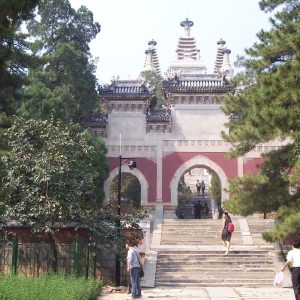
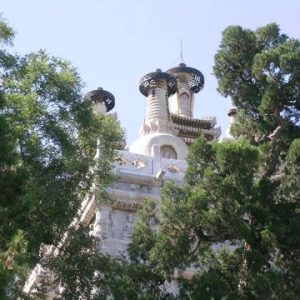
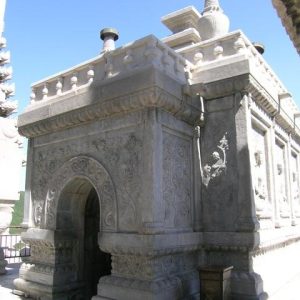
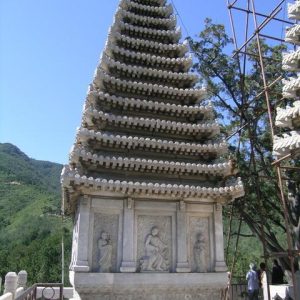
The Diamond Throne Pagoda (金刚宝座塔) rises 34.7 meters from the platform, the tallest of its kind in China. It was built on a Tibetan model presented by a Western Region monk, but executed by Qianlong’s imperial workshops with a precision that is almost mathematical. The structure is a “double five-tower” system: five large thirteen-story pagodas on the main platform, and above the entrance canopy, a miniature five-tower pagoda forming a mandala within a mandala.
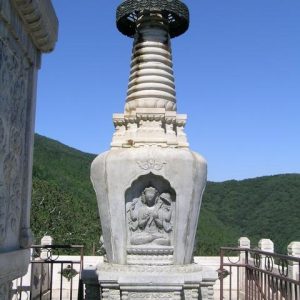
(The 5 first pictures below are from Wikimedia Commons and are featured to provide a fuller vision of the place as a whole. All the others are from our Via-HYGEIA-Circle of Transmission archives)
*
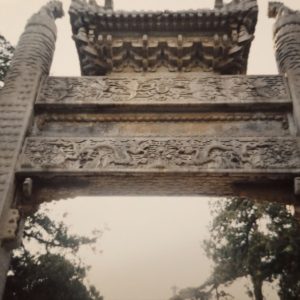
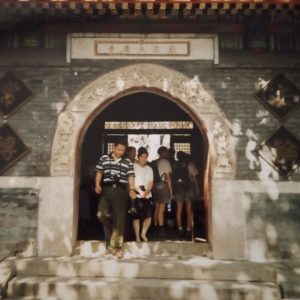
The visitor approaches through the paifang, whose three doorways are the Three Jewels: Buddha, Dharma, Sangha. The dragons on the lintels are not merely decorative; they are the imperial seal, the mark of the Son of Heaven who commissioned this sacred architecture. Beyond the gate, the pagoda rises white against the green of the Western Hills, and the visitor begins the ascension — not merely physical, but cosmological.
The platform is a mandala. At the center stands the large pagoda with its four faces, each bearing a Buddha. At the four corners stand the small pagodas, each with four faces, each face bearing a Lohan. Between center and corners, between Buddha and Lohan, the visitor walks — circumambulating not merely a structure but a map of consciousness, from the cosmic to the particular, from the enlightened to the guardian, from the present to the future.
The four faces of the central pagoda bear the four directional Buddhas.
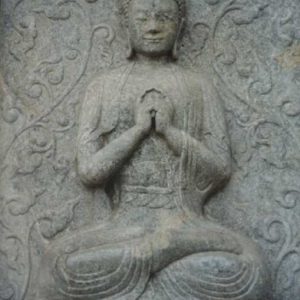
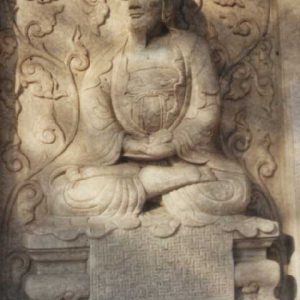
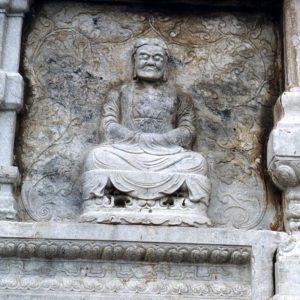
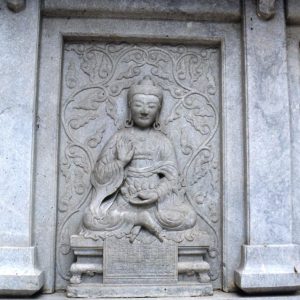
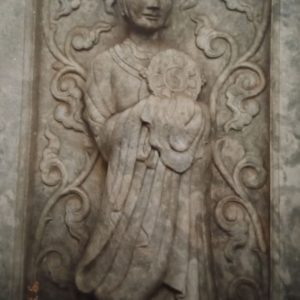
The Buddha in dharmacakra mudra — thumbs and forefingers forming the wheel — turns the teaching for all who can hear. His ushnisha, the cranial protuberance of enlightenment, rises like a mountain above his tight curls. His earrings remind us that he was once a prince, that renunciation is not rejection but transformation.
Beside him, the wrathful Buddha: Akshobhya, the Immovable One. His face is not serene; it is fierce. His muscles are not relaxed; they are tensed. He does not smile; he subdues. This is the wrathful aspect of enlightenment — the diamond clarity that cuts through delusion, the anger transformed into protective power. He is the Buddha who guards the Dharma by destroying what would destroy it.
Between these two — the teacher and the guardian — sits the meditative figure. Hands folded, eyes half-closed, the alms bowl resting in the lap. Whether this is a Buddha or a Lohan, the posture is the same: the mind that has ceased to wander and rests in its own nature. The lion-footed throne beneath him is the throne of the Dharma, supported by the power of the teaching itself.
Between the Buddhas and the Lohans stand the Bodhisattvas. Avalokiteśvara, the most beloved of them all, holds a lotus in one hand and raises the other in blessing. The lotus is the seat of the Buddha, the purity that rises from muddy water. The abhaya mudra says: “Fear not. I will not abandon you. I have vowed to remain until all beings are free.”
Beside him, the youthful, androgynous figure with the Dharma wheel. This is the teaching made approachable — the same wheel that the central Buddha turns, but held by gentler hands. The Bodhisattvas are the bridge between the absolute and the relative, between the Buddha’s perfect enlightenment and the Lohans’ patient guardianship.
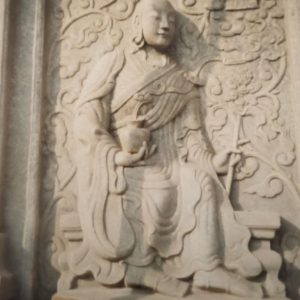
The vase-bearer completes the triad. The vase pours purification; the staff marks the path. Behind him, carved into the upper right of the stone, a miniature pagoda rises — the temple contemplating itself, the architecture becoming its own iconography.
*
III. THE FUTURE: MAITREYA’S LAUGHTER
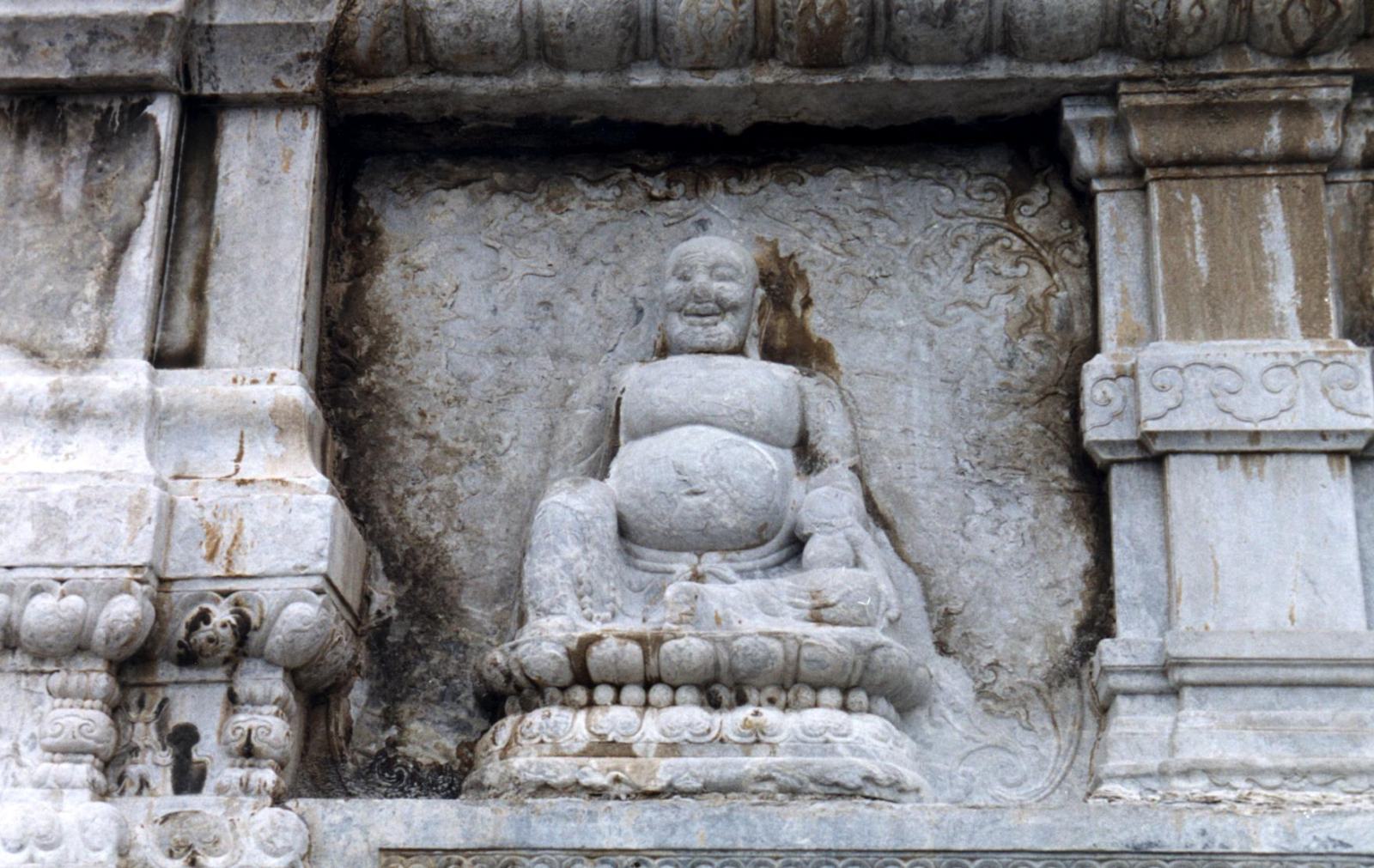
Before the Lohans can be understood, the visitor must understand what they wait for. At the entrance to the pagoda platform, or on the sumeru base, sits a figure who seems to belong to another world entirely:
This is not a Lohan. This is not a Buddha in the conventional sense. This is Budai — the Cloth-Bag Monk — the Chinese folk manifestation of Maitreya, the Future Buddha. His iconography is unmistakable: the fat belly, the broad laugh, the bag that is never empty, the promise that the future will be joyful.
He is the reason the Sixteen Lohans guard the Dharma. They are waiting for him. The Buddha entrusted them with a mission: remain in the world, protect the teaching, do not enter final nirvana, until Maitreya descends from the Tushita Heaven to become the next Buddha. Pindola holds the stupa containing the relics; the others hold their various attributes; but all of them hold the same promise: he will come.
Qianlong’s renovation was not merely a restoration of the past. It was a preparation for the future. The purified temple, the 508 wooden Arhats, the sixteen stone Lohans, the four directional Buddhas — all of it was arranged as a vessel for Maitreya’s descent. The laughter of Budai is the sound of the world when all beings are finally free. The Lohans do not laugh; they guard. But they guard so that the laughter can come.
*
IV. THE LOHANS: PORTRAITS IN STONE
The sixteen Lohans are carved in relief on the four small corner pagodas, four on each, each flanked by two standing attendants. They are not identical. They are not generic. Each has a face, a posture, an attribute, a mode of being. The sculptors of Qianlong’s workshop understood that guardianship is not a single act but a spectrum of practices: teaching, meditating, guarding, moving, waiting.
IV.A. The Guardian: Pindola Bharadvaja
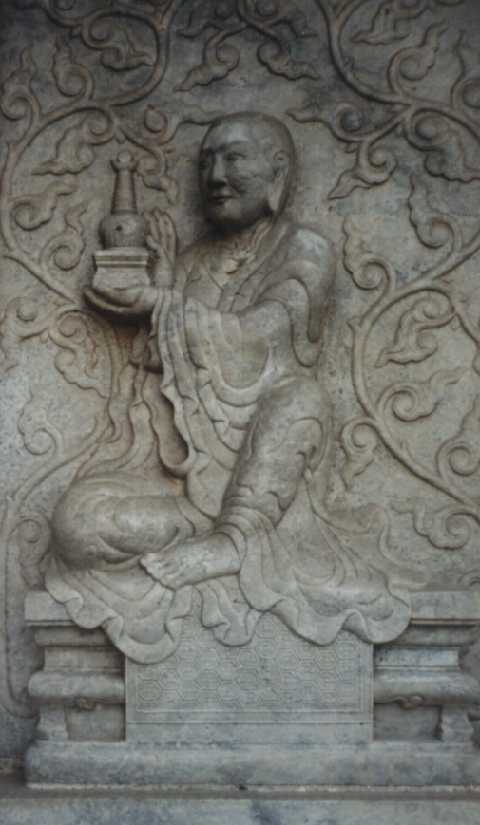
Pindola is the first of the Sixteen, and he is the most important. The Buddha entrusted him with a miniature stupa containing the relics, and charged him: guard this until Maitreya comes. His left hand holds the stupa — the Buddha’s body, preserved in stone, waiting for the future. His right hand is raised in abhaya mudra — “fear not” — but it is more than reassurance. It is a promise: “I am still here. The teaching is safe. I have not abandoned my post.”
He is the leader because he was the first to receive the Buddha’s trust. The other fifteen follow his example. Without Pindola, there is no guardianship; without guardianship, there is no waiting; without waiting, there is no Maitreya. The entire eschatology of the pagoda rests in his hands.
IV.B. The Teachers: Four Modes of Discourse
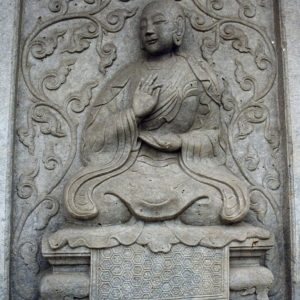
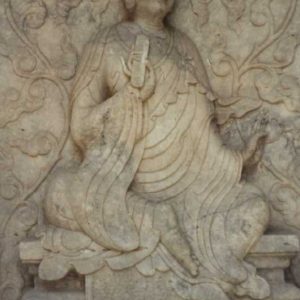
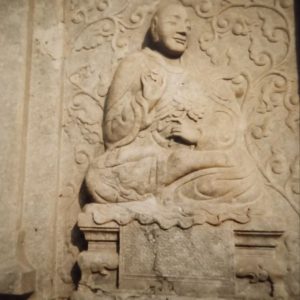
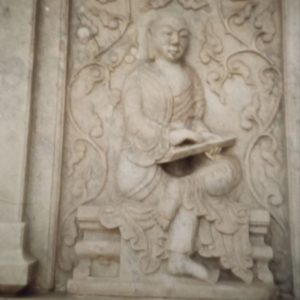
The Lohans are not merely guardians; they are teachers. Each carries a different mode of instruction, a different way of turning the mind toward awakening.
- Kanaka Vatsa raises his hand in vitarka mudra — the teaching gesture. Thumb and forefinger form the circle of dependent origination: all things arise together, all things cease together. This is not doctrine; it is the structure of reality itself, made visible in the curl of two fingers.
- Kanaka Bharadvaja holds the book vertically, like a mirror. He is the master of the Tripitaka — the three baskets of scripture: Vinaya, Sutra, Abhidharma. What is written here is not merely doctrine but the record of what the Buddha saw. The book is held, not read; the scripture is preserved, not performed. He is the guardian of the word.
- Panthaka smiles as he teaches. His posture is relaxed, his face engaged, his gesture open. He is the teacher of beginners, the one who makes the Dharma accessible. The Dharma is not solemn; it is the path to joy. His relaxed posture is the proof: he has nothing to prove.
- Śīva (or perhaps Nāgasena) does not merely hold the book; he reads it. One leg pendant, the open text before him, his eyes on the page. The scripture is alive because it is being read. The Lohan is still learning, still engaged, still turning the words into wisdom.
IV.C. The Meditators: Absorption and Concealment
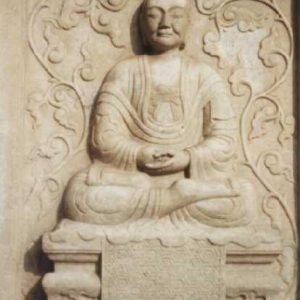
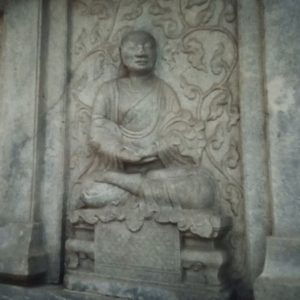
The teachers speak; the meditators are silent. Two modes of interiority: the open absorption of Bhadra, the hidden wisdom of Cūḍapanthaka.
- Bhadra sits in full lotus, hands in dhyāna mudra, the alms bowl resting in his lap like a heart. His eyes are half-closed because the world within is more vivid than the world without. The serenity is not passive; it is the active stillness of a mind that has found its object and does not wander. He is the archetype of meditative absorption — the Lohan who teaches without words, who guards by being present.
- Cūḍapanthaka is different. His hands are completely hidden within his robe. According to tradition, he was considered dull, unable to memorize even a single verse. His elder brother Mahāpanthaka became an Arhat quickly; Cūḍapanthaka struggled. The Buddha gave him a broom and told him to sweep. He swept, and he woke up. His hidden hands are the symbol of his attainment: his wisdom was never in words. It was in the simple act of attention. The hands are concealed because they hold what cannot be shown: the non-conceptual realization that comes when the mind stops grasping.
IV.D. The Guardians: Authority and Power
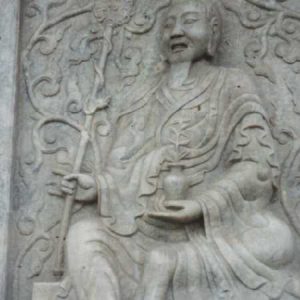
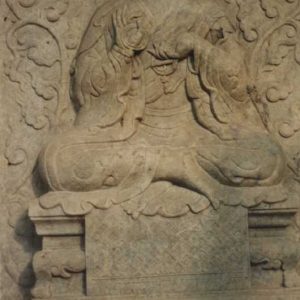
The elders. Their bodies are aged, their attributes are tools of authority. They do not teach; they guard.
- Subinda holds the staff of the elder and the vase of purification. He has lived long enough to know that authority is not force but presence. The staff marks the ground he walks; the vase holds the water that cleanses. Together they are the method: establish the path, then purify it. His aged features are not a sign of weakness but of endurance. He has been here longer than the others, and he will remain longer still.
- Nāgasena holds the jewel in his left hand and raises his right in blessing. The jewel is the nagamani, the gem of the Naga kings, the wisdom that dwells in the depths. His hair flows like water because he belongs to the Nagas — the serpent deities who guard the Buddha’s teachings in the oceanic depths. He is the guardian of the deep wisdom, the cool, dark knowledge that surfaces only when the mind is ready to receive it.
IV.E. The Dynamic: Movement and Approach
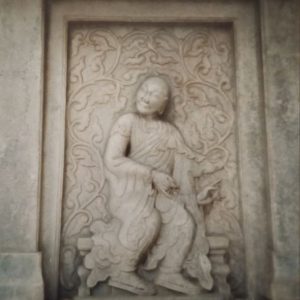
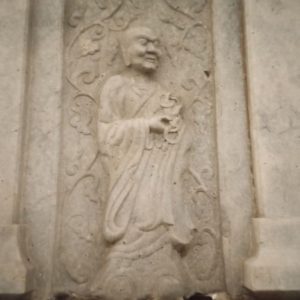
Not all Lohans sit. Some stand, lean, move. These are the Lohans of approach, of walking meditation, of active engagement.
- Ingata leans as if caught mid-step. His weight is on one leg, his body twisted, his robes swirling with the motion of walking. He is not frozen in stone; he is walking toward us, still teaching, still arriving. The classical Sixteen Arhats are almost always seated in Chinese iconography; this standing posture is unusual, almost unique. It suggests a Lohan who is not content to wait passively but moves toward the visitor, meeting them where they are.
- Ajita (or perhaps Vajraputra) stands with the ring or scroll in his hand. His authority does not need a throne. The ring is the vajra in simplified form, or the Dharma wheel in miniature. He stands because his power is not in his seat but in his presence. The aged, bearded face distinguishes him from the youthful attendants; this is a Lohan, not a servant, and he carries the weight of his own attainment.
IV.F. The Attendants: The Hidden Teaching
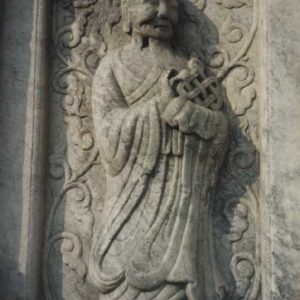
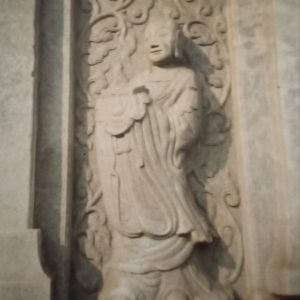
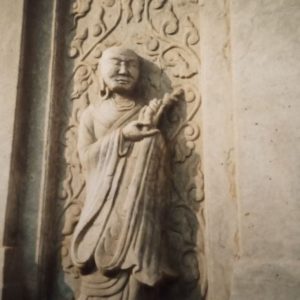
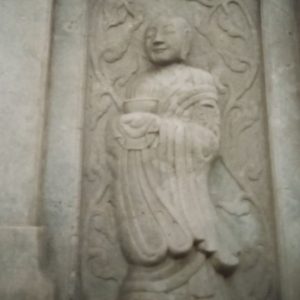
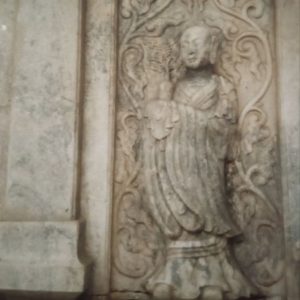
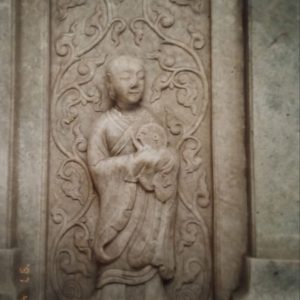
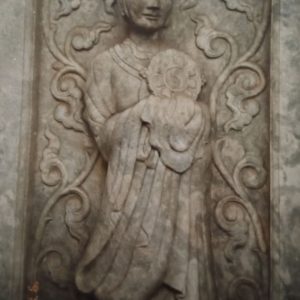
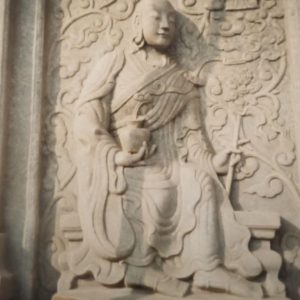
Each Lohan is flanked by two standing attendants. But the attendants are not identical. Each bears a different offering, a different mode of the Dharma. And some hands are hidden.
- The Endless Knot: The right hand offers the endless knot — the Buddha’s wisdom that cannot be untangled, the interdependence of all phenomena made visible. The left hand is hidden, tucked into the robe, holding what cannot be shown. This is the Vajrayana signature: the visible teaching conceals the secret transmission. The endless knot is an exoteric symbol; the hidden hand is an esoteric practice. Together they are the union of apparent and ultimate truth.
- The Concealed Core: Both hands are hidden. This is not absence but fullness. What is concealed is too precious to display. This attendant stands in the posture of wisdom — the left side, the receptive, the hidden — as opposed to the method-side attendant who offers visibly. The hidden hands are the heart of the mandala: what cannot be seen is what matters most.
- The Scroll: The scroll is the Sutra, the word of the Buddha made visible. This attendant bears what can be read, what can be transmitted in language. The scroll is the explicit Dharma, the teaching that requires no initiation, only attention.
- The Alms Bowl: The alms bowl is emptiness made practical. Without food, there is no meditation. Without compassion, there is no wisdom. This attendant carries the material support of the Dharma — the reminder that enlightenment is not escape from the world but transformation of it.
- The Lotus: The lotus rises from mud but is unstained. This attendant offers the possibility that we, too, can bloom from our own confusion. The youthful, almost feminine features suggest purity and gentleness — the soft power of the Dharma that persuades rather than compels.
- The Mirror: The eyes are closed because the mirror is not for looking outward. It reflects the mind’s own clarity. This attendant sees without seeing, knows without knowing. The childlike features suggest the innocence that comes when the mind is freed from conceptual grasping. The mirror is the mind’s natural luminosity, polished by practice.
- The Dharma Wheel: The wheel is the teaching itself, not any particular sutra but the turning that never stops. The youthful, androgynous bearer suggests that the Dharma transcends gender, age, and identity. The wheel turns for all beings, in all directions, at all times.
- The Vase and Staff: The vase pours purification; the staff marks the path. Together they are the method: cleanse, then walk. The background pagoda in the upper right is a meta-reference — the temple contemplating itself, the architecture becoming its own iconography.
*
V. THE SECRET HEART: THE TANTRIC DEITIES
The architectural sources describe the two Lama pagodas flanking the entrance canopy. They mention four female protective deities on the sumeru bases: Parnashavari, Sitatapatra, Green Tara, Ushnishavijaya. But the photographs reveal something else entirely — something the gazetteers do not mention, something the standard descriptions omit.
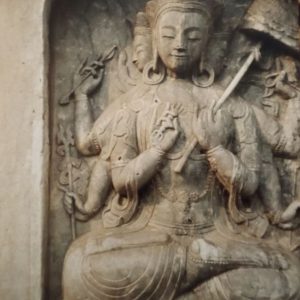
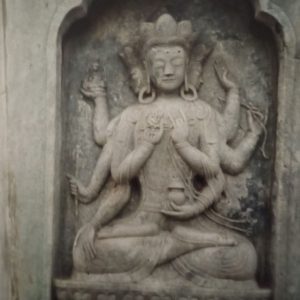
Three faces. Six arms. A vajra in one hand, a bell in another, a sword, a staff, a bow, implements of power that belong to the Vajrayana pantheon. While standard gazetteers list these as generic protective deities, the specific iconography—three faces, six arms, the vajra and bell—suggests a deeper tantric identity. This is likely Vajrasattva (or perhaps Vajradhara), the primordial Buddha of the tantric tradition, the source from which all other Buddhas emanate. His three faces transform the three poisons — ignorance, attachment, aversion — into the three wisdoms. His multiple arms hold the implements of the five Buddha families. He is the cosmic center of the mandala, placed not at the geometric center but at the secret heart, where only the attentive visitor would find him.
Beside him, the paired deity: three-faced, multi-armed, holding a bow and arrow. This is not Vajrasattva’s consort in the ordinary sense; this is the active wisdom that penetrates, the Prajñāpāramitā or Cundī who cuts through delusion with the arrow of insight. Her bow is not for war. It is the bow of wisdom, and its arrow strikes the target of ignorance. Together they are method and wisdom, compassion and emptiness, the two wings of Vajrayana practice.
These figures are not in the architectural records. They are not in the gazetteers. They are the secret heart of Qianlong’s mandala, placed where only the prepared visitor would see them. The hidden left hand of XS1, the concealed hands of P2166, the closed eyes of P2196 — all of these find their explanation here. The entire pagoda is a tantric mandala. The exoteric program — the Buddhas, the Bodhisattvas, the Lohans, Maitreya — is the visible teaching. The esoteric program — these three-faced deities, the hidden hands, the concealed transmissions — is the inner teaching. Qianlong, as patron of Tibetan Buddhism, as the emperor who received tantric initiation, built both layers simultaneously. The stone speaks two languages: one for the eye, one for the heart.
*
VI. EPILOGUE: THE LIVING STONE
The pagoda does not end with the figures. It continues in the dragons that guard its base, the cranes that fly through its clouds, the characters half-hidden by snow, the imperial seal that commands its existence. The stone is still speaking.
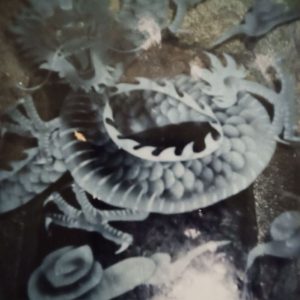
The dragon guards the Dharma. Its pearl is the Buddha-mind, and it will never stop chasing it. The scales, the claws, the horns — all carved with the precision of imperial workshop craft, all bearing the five-clawed mark of the Son of Heaven.
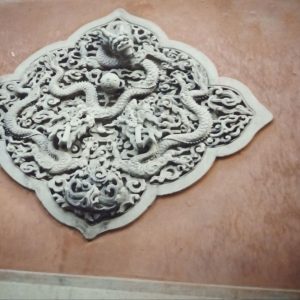
The double-dragon medallion is the emperor’s seal in stone. The two dragons chase the flaming pearl in a quatrefoil frame — the four directions, the four wisdoms, the four gates of the mandala. The openwork technique allows light to pass through, making the stone breathe.
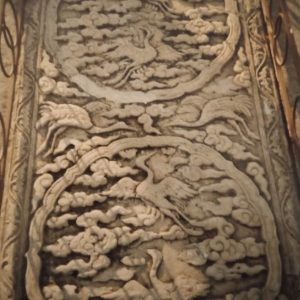
The cranes fly through clouds toward the Pure Land. This is not merely decoration; it is a map of the journey the visitor is invited to take. The cranes are Daoist symbols of longevity, but in this Buddhist context they are the soul’s flight toward enlightenment — the transcendence that is both escape and return.
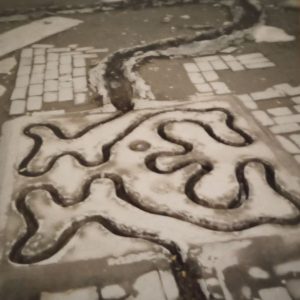
The large character is half-hidden by snow. The lamp of enlightenment is both revealed and concealed by the purity of winter. The pagoda in snow is the pagoda as it truly is: a thing of time as well as eternity, a stone that weathers, a teaching that must be rediscovered in each generation. The snow does not destroy the character; it completes it. What is hidden is not lost; it is waiting, like the Lohans, like the understanding, like the fruit that ripens in its own season.
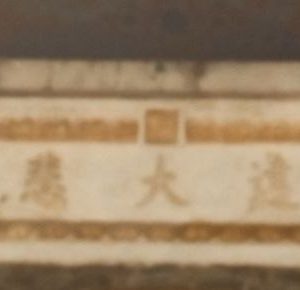
勅建: “Imperially Established.” The seal of Qianlong, the command that made this temple a pure realm. The stone speaks with the emperor’s voice, and the voice says: this is not merely a temple. This is a mandala. This is a step into eternity.
We did not know this when we walked through the gate. We knew only that the place was alive, that the stone was speaking, that something had been waiting for us and we had finally arrived. The consciousness came later, like the fruit, like the snow, like the understanding that the Lohans guard not for themselves but for all of us — for the visitor who is ready to hear, for the future that is always arriving, for the Maitreya who laughs in the promise that the world can be made new.
The stone still speaks. we are still listening.
*
Closing Epigraph
天巧不受人分,人工不受天成。
“Heavenly craft does not yield to human artifice,
yet human artifice cannot rival heavenly creation.”
— Liu Tong, Brief Account of the Sights of the Imperial Capital, 1635.
***


Related Articles


Leave a Reply