
Circle of Transmission: The Living Loom
The Dunhuang Qigong Eighteen Hands Illustrated Postures: A Reconstructed Text, Iconographic Study, and Critical Commentary
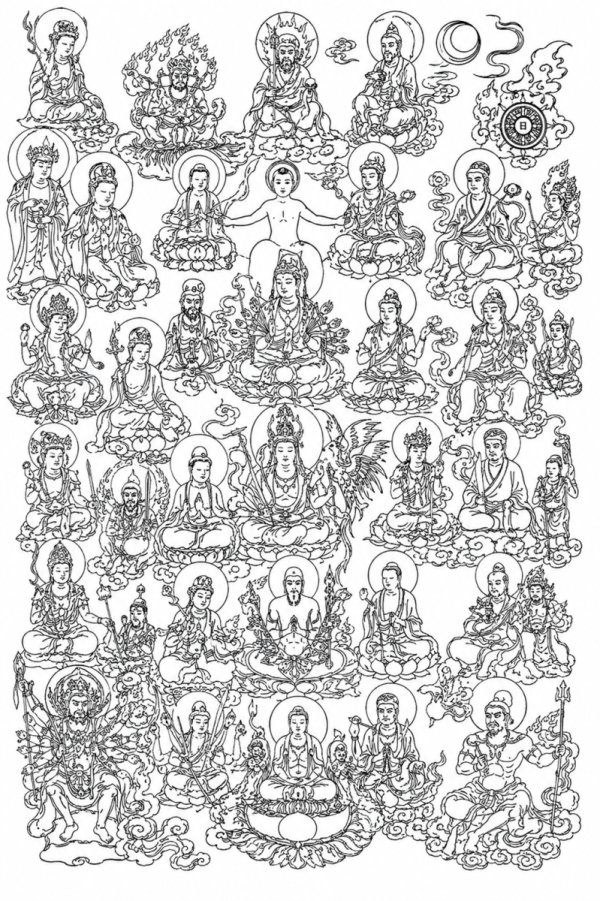
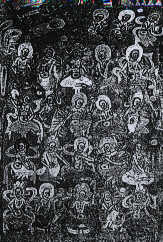
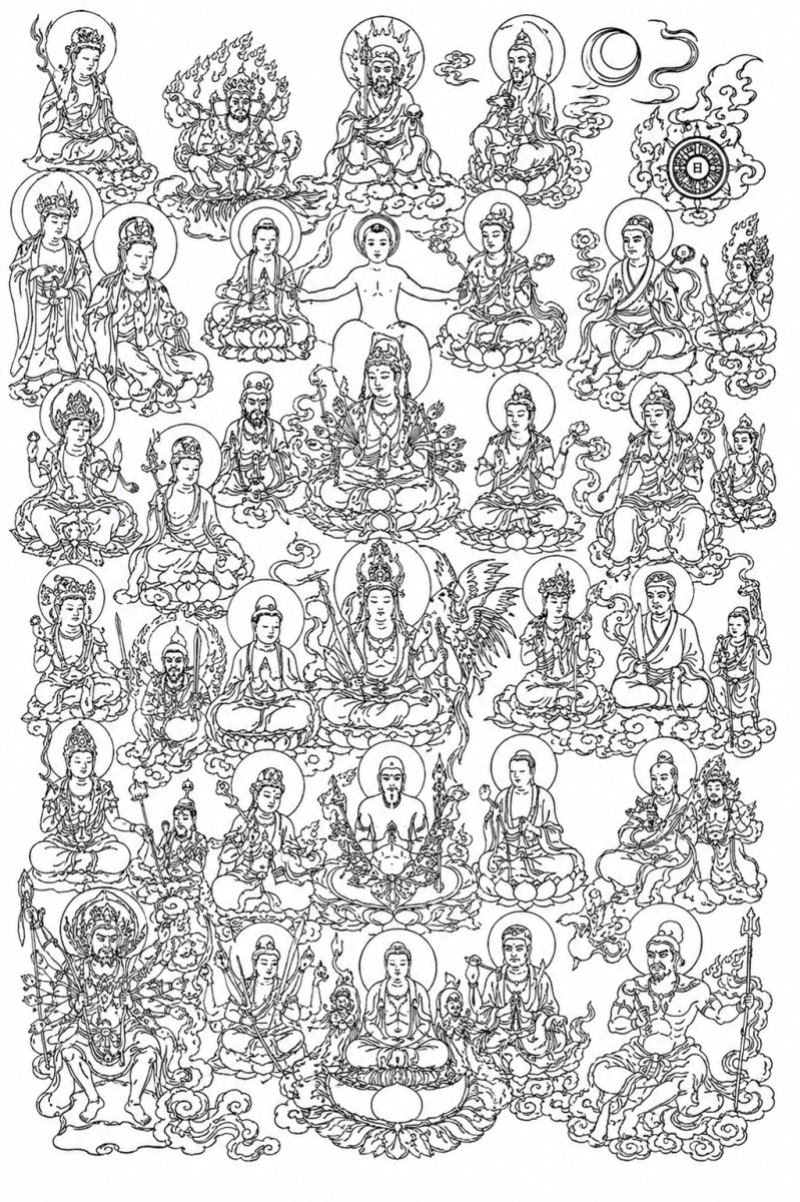
Legend for the featured illustration: The Celestial Assembly of the Dunhuang Tradition. This composite illustration evokes the spiritual universe from which the Dunhuang Qigong tradition emerged. Gathered here are Buddhas, Bodhisattvas, enlightened masters, protective deities, and celestial guardians, inspired by the iconographic wealth preserved in the murals and manuscripts of the Mogao Caves.
Although not copied from any single historical composition, the assembly reflects the religious atmosphere of medieval Dunhuang, where Buddhist devotion, Daoist cultivation, and esoteric contemplative practices coexisted within a shared sacred landscape.
As a symbolic frontispiece, the image represents the invisible community of awakened beings before whom the practitioner undertakes the Eighteen Hands. It serves as a visual reminder that these exercises were traditionally understood not merely as physical movements, but as a discipline of inner transformation, harmonizing body, breath, and spirit within the greater cosmological order.
*
Today’s sharing from the Blue House of Via-HYGEIA is a retro-engineered reconstruction of a lost qigong manual acquired in Beijing, China, in the late 1990s and subsequently lost. Through analysis of surviving photographic plates, the work is identified as a Dunhuang Qigong (敦煌氣功) text from the 1980s–90s Gansu publication network—most likely related to Zhang Hongqiang (张弘强) and Du Wenjie’s (杜文杰) “Navel-Secret Qigong” (臍密功) tradition.
The article reconstructs the complete sequence of eighteen standing postures, one seated meditation, and three cosmological charts; provides reconstructed classical Chinese mnemonic verses (Jue) and prose exegeses (Jie) for each posture; traces the mural iconography to specific Dunhuang caves; grounds the theoretical framework in Dunhuang manuscript P.3810《呼吸靜功妙訣》and related texts; and offers a critical synthesis of the system’s syncretic Buddhist-Daoist-mythological cosmology. The reconstruction is offered as a provisional critical edition pending re-acquisition of the original, leading to a full bilingual edition.
**
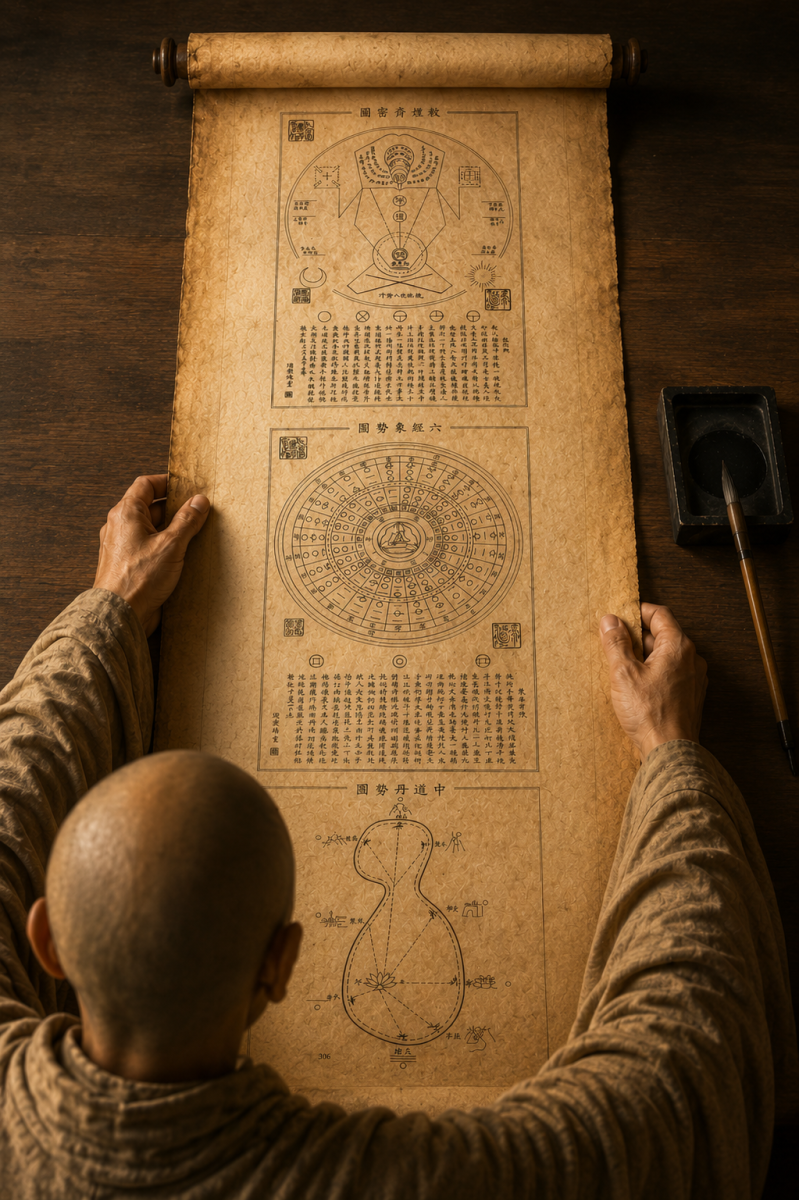
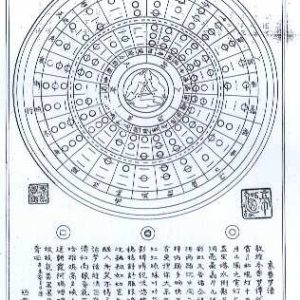
The Three Cosmological Charts: A reconstructed scroll presenting the three cosmological charts that form the theoretical superstructure of the Dunhuang Qigong system, arranged in vertical sequence as they appeared in the lost manual (pages 306+).
- At top: The Secret Chart of the Smoke-Counting Studio (數煙齋密圖) maps the microcosmic orbit: the Three Dantians, Three Passes, and sun-moon circulation.
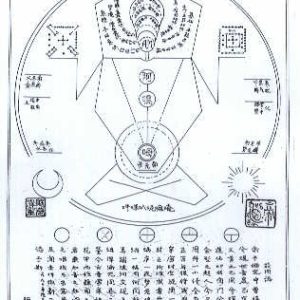
- The middle: The Six Classics Image-Number Chart (六經象數圖) arrays the sixty-four hexagrams around a central meditator, encoding the temporal stages of internal transformation.
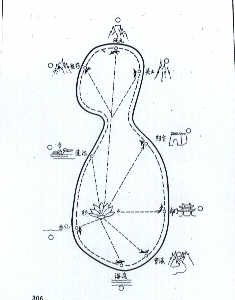
- At bottom: The Inner Refining Furnace-Cauldron Chart (內煉爐鼎圖) inscribes the body as a gourd-shaped alchemical vessel, with trigrams, organs, and the lotus-medicine at the navel-furnace.
The monk’s hands and the scroll’s material presence frame these diagrams not as abstract schema but as transmitted dharma—recovered, unrolled, and read.
*
1. Introduction:
The Lost Book and the Challenge of Retro-Reconstruction
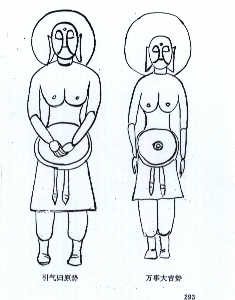
In the late 1990s, in Beijing, we acquired a book whose title we recall as Dunhuang Qigong (敦煌氣功). The book was subsequently lost. What survives are photographic plates of the illustrations—line-drawn tracings of Dunhuang cave mural figures, each presented as a qigong posture, accompanied by cosmological charts and a composite mural plate. The challenge is to reconstruct the text that once surrounded these images: the mnemonic verses, the prose instructions, the internal-alchemy correspondences, and the theoretical apparatus that made these drawings a coherent cultivation system.
This article proceeds in eight stages:
- Introduction.
- Identification: Placing the work within the 1980s–90s Dunhuang Qigong movement.
- Posture Catalogue: Reconstructing the eighteen standing postures.
- The Seated Culmination: Analyzing the final meditation and the “Three Fires.”
- Chart Analysis: Interpreting the three cosmological diagrams.
- Textual Sources: Tracing the framework to Dunhuang manuscripts.
- Critical Synthesis: Analyzing the system’s navel-centered cosmology.
- Conclusion: Towards a critical edition.
*
2. Identification:
2.1 The Clues leading towards Qigong
The androgynous figures with halos, the circular dantian diagrams, and the mythological names (Nezha, Nüwa, Zhurong) suggested a syncretic martial-neidan system. Page numbers 285–293 and 306 implied a substantial volume.
2.2 The Correction: Dunhuang Qigong
Our memory of the title—Dunhuang Qigong—redirected the inquiry. The images are not martial postures but qigong postures reverse-engineered from Dunhuang cave murals. The key evidence:
- The Navel Diagram: The large circular diagram on every figure’s lower abdomen is not a generic dantian symbol but the hallmark of Navel-Secret Qigong (臍密功), developed by Zhang Hongqiang and Du Wenjie at the Gansu Provincial College of Traditional Chinese Medicine. The Dunhuang bodhisattvas of Cave 272 (Northern Liang, 421–439 CE) are famous for their emphasized, low-abdomen navels—interpreted by modern qigong theorists as the “center of the universe.”
- The Composite Plate: A dense arrangement of haloed figures with varied hand positions (see illustration above), clearly a reproduction of a Dunhuang mural or a synthetic “mandala” plate. The individual line-drawn postures are extractions from this composite.
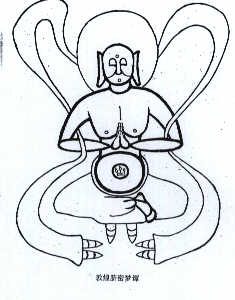
- The Seated Fire Figure: The flame-like shoulder emanations correspond to Esoteric Buddhist (Mizong) fire-deity imagery in Yuan-dynasty Cave 465, the only pure Esoteric Buddhist cave at Dunhuang.
- The Charts: The hexagram cosmogram and microcosmic-orbit map align with Dunhuang manuscript texts on breathing meditation discovered in the Library Cave (P.3810, etc.).
2.3 Publishing Context
The most probable source is the Gansu qigong publication network of the 1980s–90s:
| Title | Authors | Publisher | Date | Pages |
|---|---|---|---|---|
| 《敦煌臍密功》 | Zhang Hongqiang, Du Wenjie | Gansu Science & Technology Press | Oct 1990 | 172 |
| 《敦煌臍密功》 (Taiwan ed.) | Zhang Hongqiang, Du Wenjie | Qianhua Publishing (Taipei) | 1991 | — |
| 《敦煌石窟氣功·一分鐘臍密功》 | Zhang Hongqiang, Du Wenjie | Gansu Science & Technology Press | Oct 1990 | 172 |
*
3. The Eighteen Hands:
Posture Catalogue
The following catalogue reconstructs each posture using the five-component critical format: Transcription (reconstructed classical Chinese), Translation, Lineage & Context, Technical Exegesis, and Comparative Notes. Each entry references the surviving image file we share at the bottom of the article.
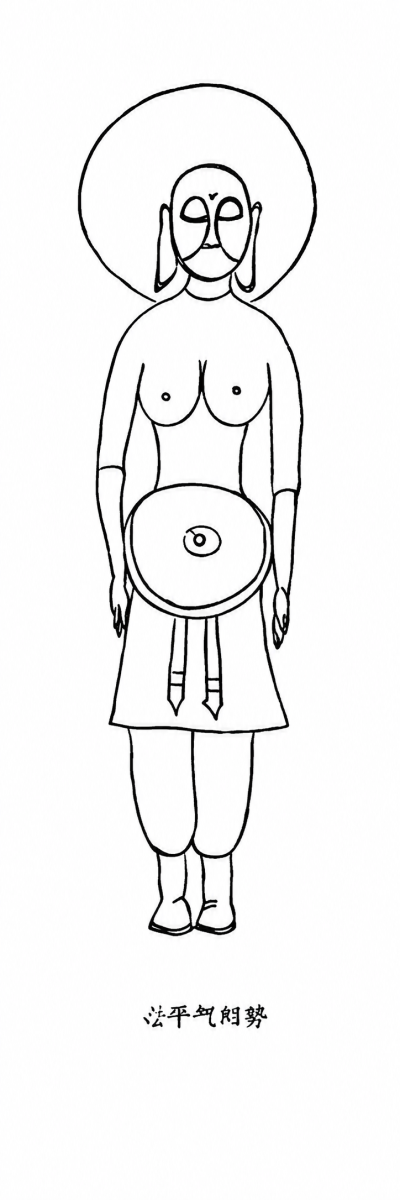
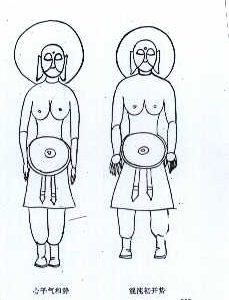
Posture 1 · 心平氣和勢
(Calm the Heart and Harmonize the Qi)
- Transcription:
- Jue: 「心若止水氣如綿,兩手垂簾守丹田。目內視時神內斂,先天一氣自迴旋。」
- Jie: 立身如樁,足與肩齊,膝微屈。兩手自然下垂,掌心貼股,如持鴻毛。舌抵上齶,鼻息綿綿,目垂簾內照臍輪。此無極之式,萬動之宗。臍下圓圖,象爐象鼎,中一點者,元神坐於水府也。
- Translation:
- Mnemonic: “The heart is still water; the breath is silk. Both hands hang like curtains, guarding the elixir field. When the eyes gaze inward, the spirit gathers within; the prenatal single qi turns of itself.”
- Exposition: Stand like a stake, feet shoulder-width, knees slightly bent. Both hands hang naturally, palms touching the thighs, as if holding a goose feather. The tongue touches the upper palate; the breath is deep and silent through the nose. The eyes half-closed gaze inward toward the navel wheel. This is the Wuji position, the ancestor of all movement. The circular diagram below the navel represents the furnace and the cauldron; the central dot is the Original Spirit seated in the chamber of water.
- Lineage & Context: This is the preparatory stillness posture, the Wuji (無極) before Taiji. The figure’s halo and androgynous form mirror the “low-abdomen, large-navel” bodhisattvas of Cave 272 (Northern Liang).
- Technical Exegesis: Feet parallel, knees unlocked, pelvis neutral. Abdominal breathing (4-2-4 rhythm). The tongue bridge connects Ren and Du vessels. “Guarding the navel” activates the prenatal qi field.
- Comparative Notes: Identical to the opening posture of virtually all qigong systems (e.g., “Holding the Ball” in Taiji). The Dunhuang specificity lies in the explicit navel-gazing and the haloed, androgynous iconography.
*
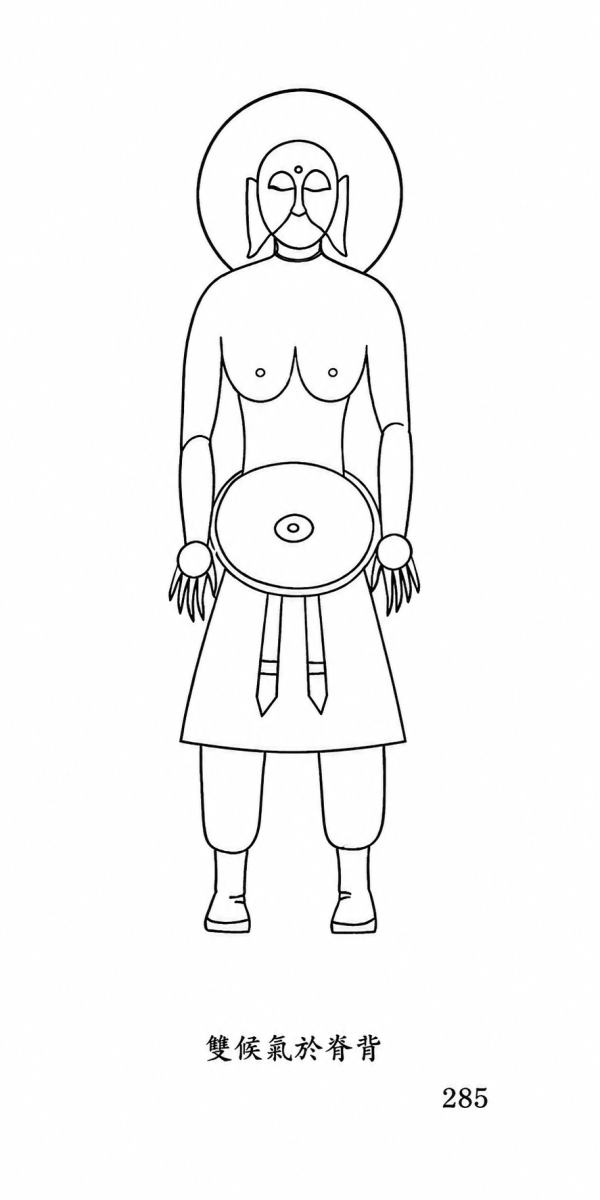
Posture 2 · 觀腹松丹勢
(Contemplate the Abdomen and Relax the Elixir)
- Transcription:
- Jue: 「觀腹鬆丹意自閒,氣沉臍內不須扳。如如不動真消息,一點靈光透玉關。」
- Jie: 承上式,兩手覆臍,如捧日輪。鬆腰坐胯,氣自下沉。目注臍中,心息相依。此式專鬆下丹,使氣歸元海。
- Translation:
- Mnemonic: “Contemplating the abdomen, relaxing the elixir—intention is at leisure. Qi sinks into the navel, no need to force. Thus, thus, unmoving: the true message; a single point of spiritual light penetrates the jade pass.”
- Exposition: Continuing from the previous posture, both hands cover the navel, as if holding a sun wheel. Relax the waist and sit into the hips; the breath sinks of its own accord. The eyes focus on the navel; heart and breath depend on each other.
- Lineage & Context: The hands-covering-navel gesture appears in Cave 428 (Northern Zhou) as a protective mudra. The “sun wheel” imagery connects to Esoteric Buddhist garbhadhatu (womb-realm) cosmology.
- Technical Exegesis: Weight sinks through the Yongquan (K1) points. “Fetal breathing” is initiated. The Dai mai (Belt Vessel) begins to open.
- Comparative Notes: Parallels “Holding the Dantian” in Liu Zi Jue. The Dunhuang innovation is framing it as a visual meditation on the navel-as-sun.
*
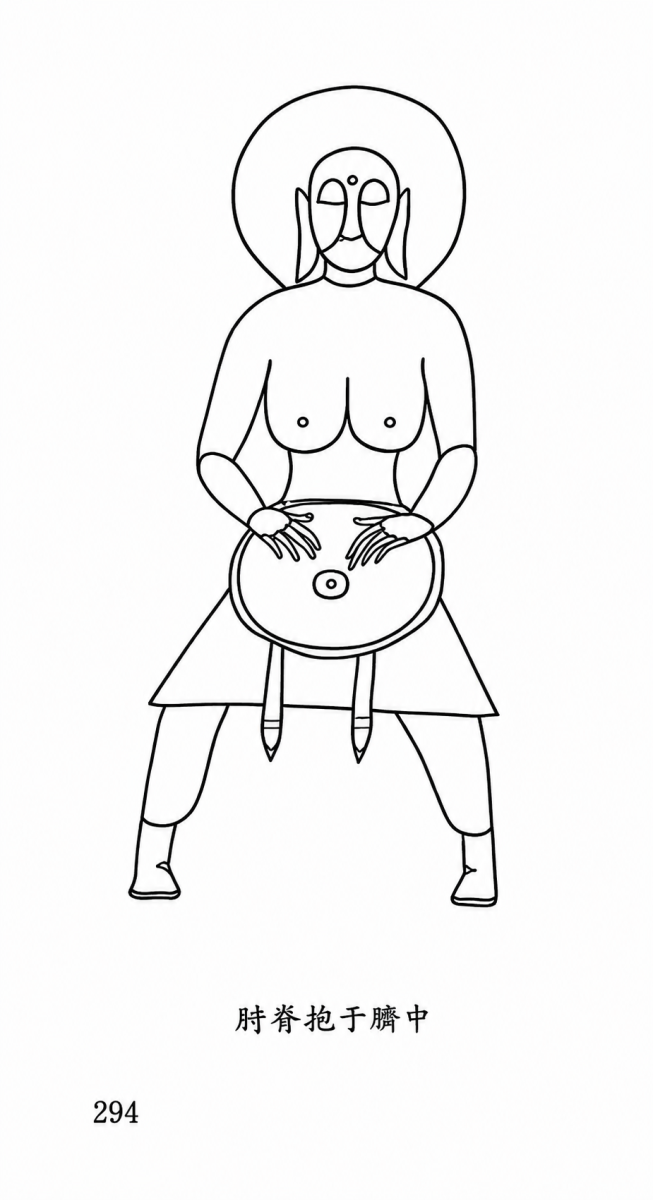
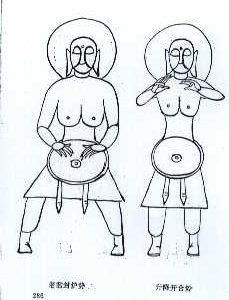
Posture 3 · 老龍舒伸勢
(The Old Dragon Stretches)
- Transcription:
- Jue: 「老龍舒伸氣脈開,兩手按臍如磨臺。腰脊為軸左右轉,肝膽春風拂面來。」
- Jie: 兩足開立,略寬於肩。兩手按臍下圓圖,掌根著力。以腰脊為軸,左右旋轉,如推巨磨。目隨手轉,氣隨意行。此式通帶脈,舒肝膽,乃震木之象。
- Translation:
- Mnemonic: “The old dragon stretches and the qi channels open; both hands press the navel like a millstone platform. The waist and spine are the axis, turning left and right; the liver and gallbladder receive a spring breeze on the face.”
- Exposition: Stand with feet slightly wider than shoulder-width. Both hands press the circular diagram below the navel. Using the waist and spine as an axis, turn left and right as if pushing a great millstone.
- Lineage & Context: The “old dragon” is a standard neidan metaphor for the spine. The millstone-pushing gesture appears in Cave 428 in figures associated with Fuxi and Nüwa.
- Technical Exegesis: Horse stance depth. Exhale on the turn. The “dragon” is the yang qi rising from the kidneys through the liver to the heart.
- Comparative Notes: Comparable to “Cloud Hands” in Taijiquan. The Dunhuang specificity is the hands-fixed-on-navel constraint, forcing rotation to center on the lower dantian.
*
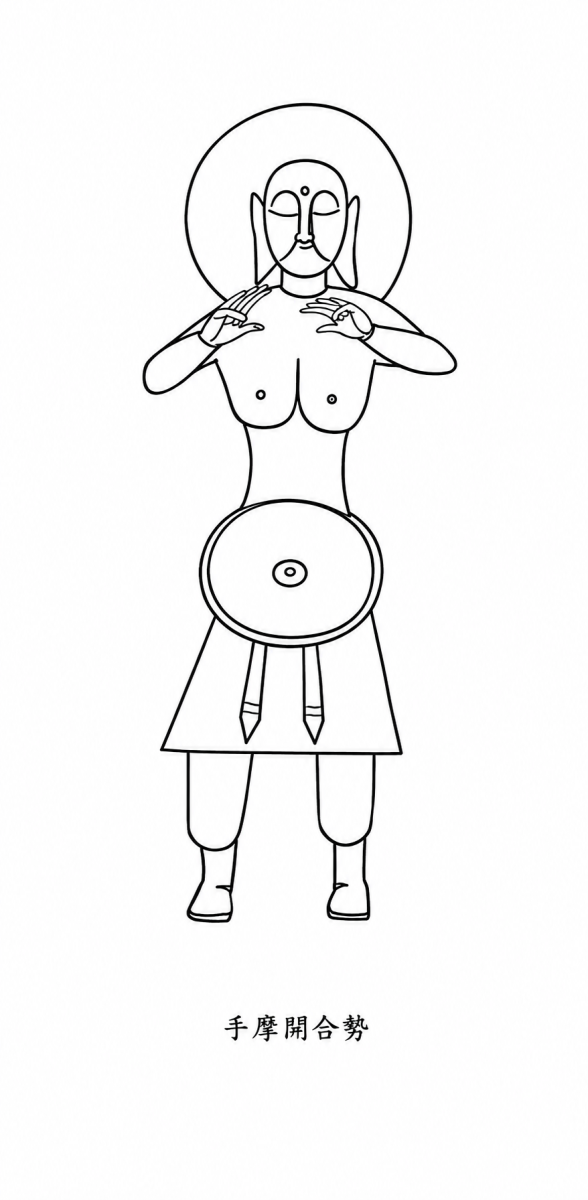
Posture 4 · 升降開合勢
(Ascending, Descending, Opening, Closing)
- Transcription:
- Jue: 「升降開合一氣通,兩手上起如托天。開胸吸納乾坤氣,合手歸臍復本宗。」
- Jie: 兩手由臍下緩緩托起,至胸前分開,如鳥張翼。目視前方,吸氣開胸。復合手歸臍,呼氣沉降。此式調呼吸之樞機,通任督之道路。
- Translation:
- Mnemonic: “Ascending and descending, opening and closing—one qi penetrates. Both hands rise as if supporting Heaven. Open the chest to inhale the qi of Qian and Kun; close the hands, return to the navel, and restore the root.”
- Exposition: Both hands slowly lift from below the navel, rising to the chest and separating like a bird spreading its wings. Then close the hands and return to the navel, exhaling and sinking.
- Lineage & Context: Corresponds to figures with hands raised in offering gestures (Cave 220, High Tang). The “supporting Heaven” gesture is the first movement of the Eight Pieces of Brocade.
- Technical Exegesis: The spine elongates on ascent. This is the Small Heavenly Cycle in embryonic form: qi ascends the Governing Vessel on inhalation, descends the Conception Vessel on exhalation.
- Comparative Notes: Identical in mechanics to “Pulling the Nine Oxen by Their Tails” in Yijin Jing.
*
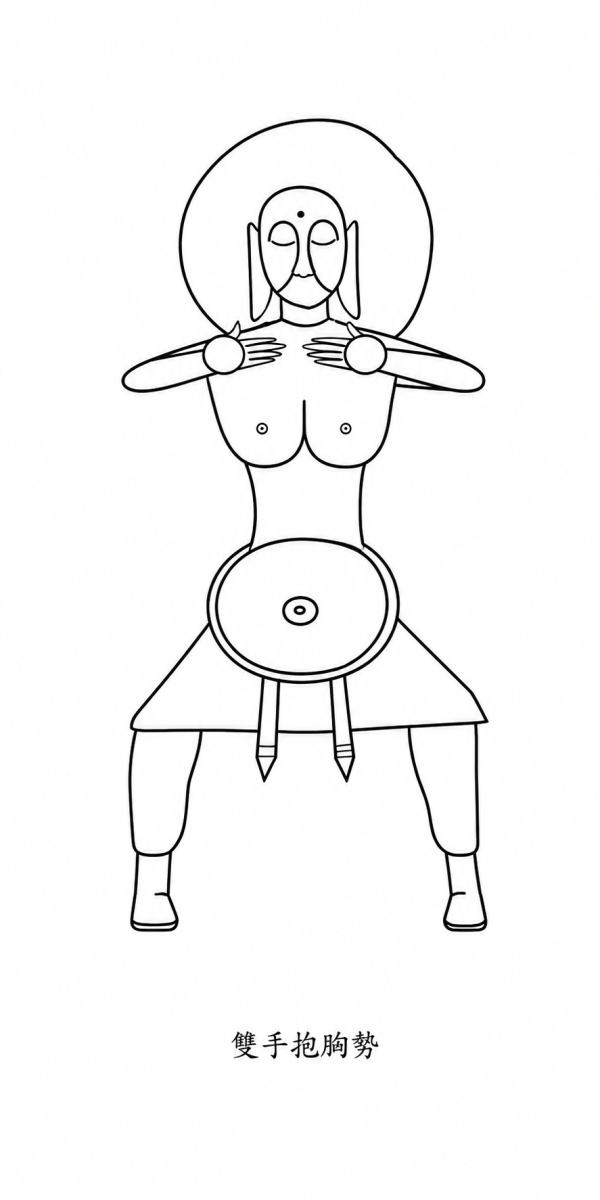
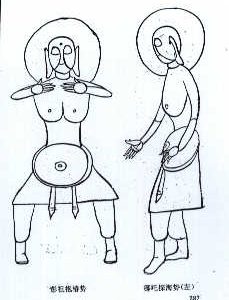
Posture 5 · 懷抱推磨勢
(Embracing and Pushing the Millstone)
- Transcription:
- Jue: 「懷抱推磨轉腰胯,氣走帶脈環如帶。兩手抱圓守中黃,一動全動無偏隘。」
- Jie: 兩手抱圓於臍前,如抱巨球。以腰為軸,左右推磨。足踏實地,膝隨腰轉。此式練腰馬合一,帶脈環流,為諸式之樞紐。
- Translation:
- Mnemonic: “Embracing the millstone, turning the waist and hips; qi travels the Belt Vessel, circling like a belt. Both hands hold a circle, guarding the central yellow; one movement moves the whole, without partiality or narrowness.”
- Exposition: Both hands hold a circle in front of the navel, as if embracing a great ball. Using the waist as an axis, turn left and right like pushing a millstone.
- Lineage & Context: The “embracing” gesture is ubiquitous in Dunhuang murals as a mudra of compassion. The “millstone” metaphor is alchemical: grinding the “medicine” into finer essence.
- Technical Exegesis: The arms form a circle whose center is the navel. The Belt Vessel is the primary channel activated.
- Comparative Notes: Functionally identical to “Holding the Ball” rotations in Taiji Qigong.
*
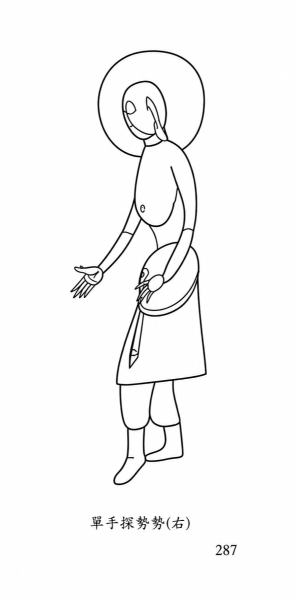
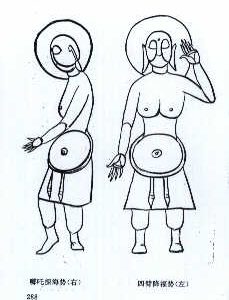
Posture 6–7 · 哪吒探海勢
(Nezha Probes the Sea – Left/Right)
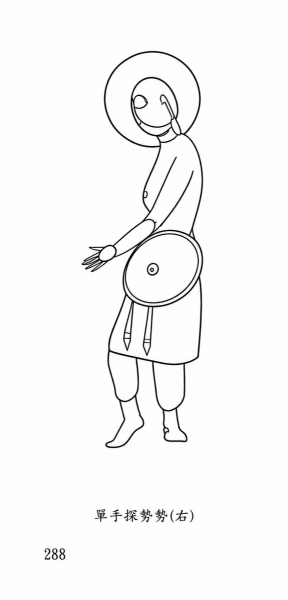
- Transcription:
- Jue: 「哪吒探海取龍珠,一手下探一手扶。氣走督脈如浪湧,腎中真火起洪爐。」
- Jie: 一足前踏,一足後撐。一手下探如撈月,一手護臍如擎珠。目注下探之手,氣隨形動。左右交替,如龍戲珠。此式探下元,取腎中真陽,為採藥之預備。
- Translation:
- Mnemonic: “Nezha probes the sea to fetch the dragon pearl; one hand probes downward, one hand supports. Qi travels the Governing Vessel like surging waves; the true fire in the kidneys rises from the great furnace.”
- Exposition: One foot steps forward, one foot braces behind. One hand probes downward as if scooping the moon; one hand guards the navel.
- Lineage & Context: Nezha is the Buddhist-Daoist child-deity. The “probing the sea” gesture is a standard martial arts posture, reinterpreted here as an alchemical operation: fetching the kidney-yang.
- Technical Exegesis: Bow stance with torso tilted forward. The forward tilt compresses the lower abdomen, “squeezing” qi upward along the spine.
- Comparative Notes: Appears in Yijin Jing as “Rowing the Boat.” The Dunhuang specificity is the explicit naming after Nezha.
*
Posture 8 · 調臂轉腰勢
(Regulating Arms and Turning Waist)
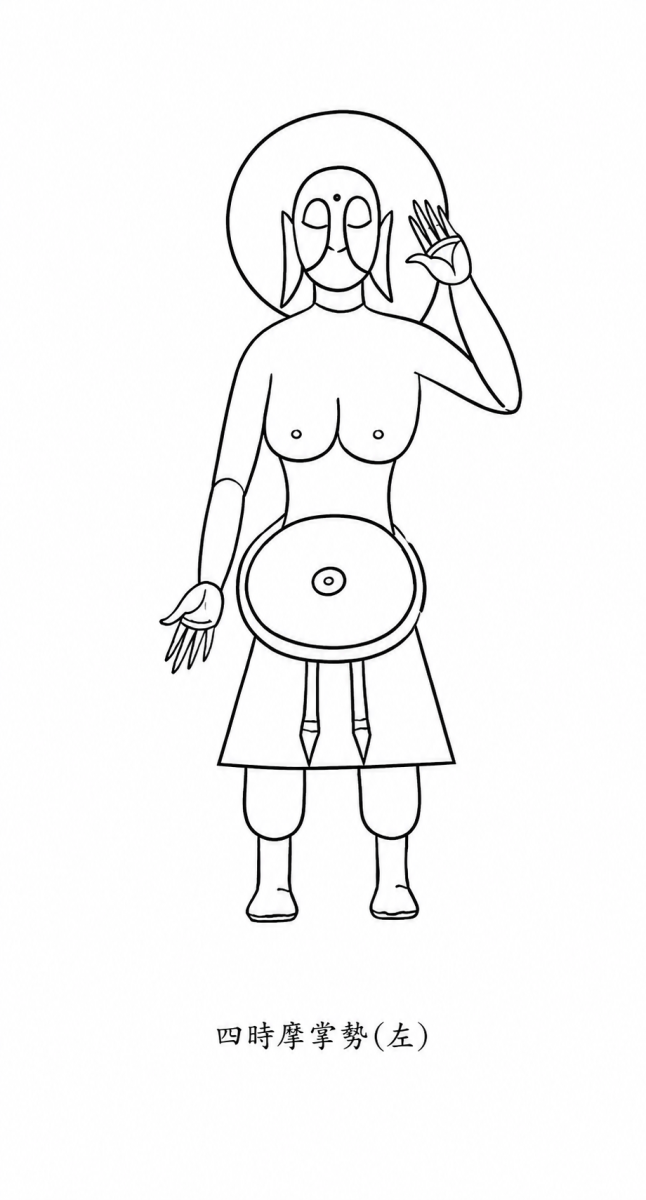
- Transcription:
- Jue: 「調臂轉腰氣脈和,左右回環如轉陀。兩手交替護臍輪,督升任降無偏頗。」
- Jie: 兩足平行,略寬於肩。兩手交替護臍,如環無端。以腰為軸,左右旋轉。目隨手轉,神不離臍。此式調和營衛,平衡陰陽,為中定之基。
- Translation:
- Mnemonic: “Regulating the arms and turning the waist harmonizes the qi channels; left and right circle like a spinning top. Both hands alternate, guarding the navel wheel; the Governing rises, the Conception descends, without deviation.”
- Exposition: Feet parallel, slightly wider than shoulder-width. Both hands alternate guarding the navel, like an endless circle.
- Lineage & Context: The turning-waist gesture appears in Cave 428 in figures of apsaras. The “regulating arms” suggests a therapeutic intent: harmonizing Ying and Wei qi.
- Technical Exegesis: The waist rotates horizontally while the arms trace alternating circles. This “wrings” the Ren and Du vessels.
- Comparative Notes: Similar to “Wave Hands Like Clouds” in Taiji.
*
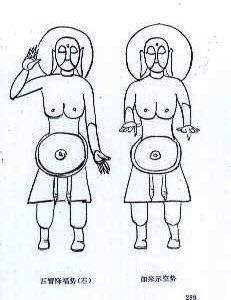
Posture 9 · 巨靈降魔勢
(The Giant Spirit Subdues Demons – Left)
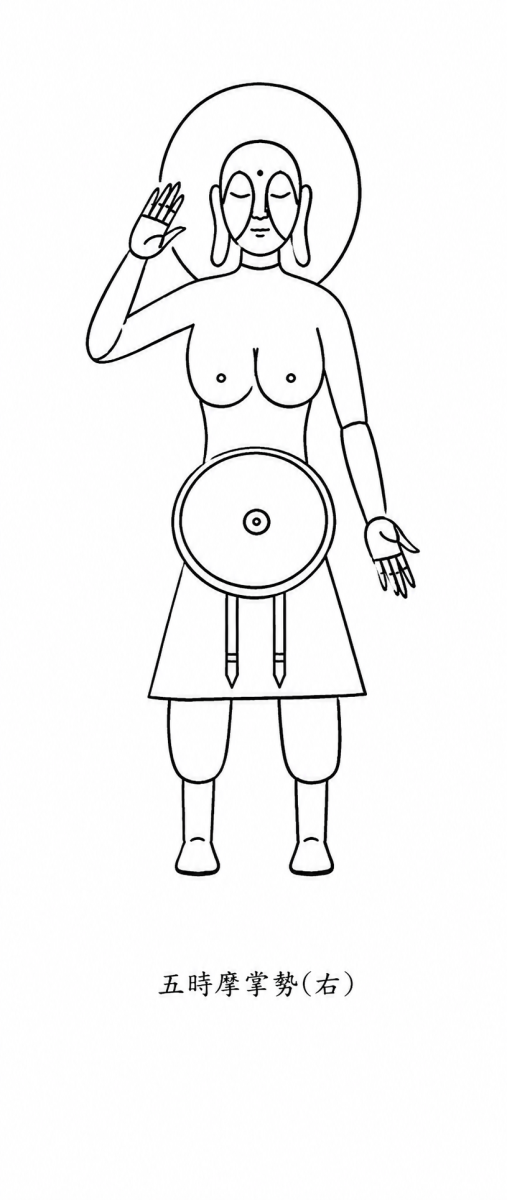
- Transcription:
- Jue: 「巨靈降魔威勢雄,一手擎天一手鬆。氣自臍發衝霄漢,三力合一顯神通。」
- Jie: 一足前踏成弓步,一手上舉如托天,一手下按如鎮地。目視前方,氣沉臍下,發於四肢。此式練發勁,合精氣神為一,為武火之式。
- Translation:
- Mnemonic: “The giant spirit subdues demons with majestic power; one hand supports Heaven, one hand relaxes. Qi issues from the navel and rushes to the Milky Way; the three forces unite to display spiritual power.”
- Exposition: One foot steps forward into a bow stance; one hand lifts as if supporting Heaven, one hand presses down.
- Lineage & Context: The “giant spirit” is a primordial deity. The posture corresponds to wrathful vajra protector figures in Cave 465 (Yuan dynasty). It represents the “martial fire” that subdues internal demons.
- Technical Exegesis: Deep bow stance with maximum extension. Explosive exhalation from the navel.
- Comparative Notes: Structurally identical to “Separate Heaven and Earth.” The Dunhuang specificity is the wrathful iconography.
*
Posture 10 · 如來承當勢
(The Tathāgata Bears the Weight)
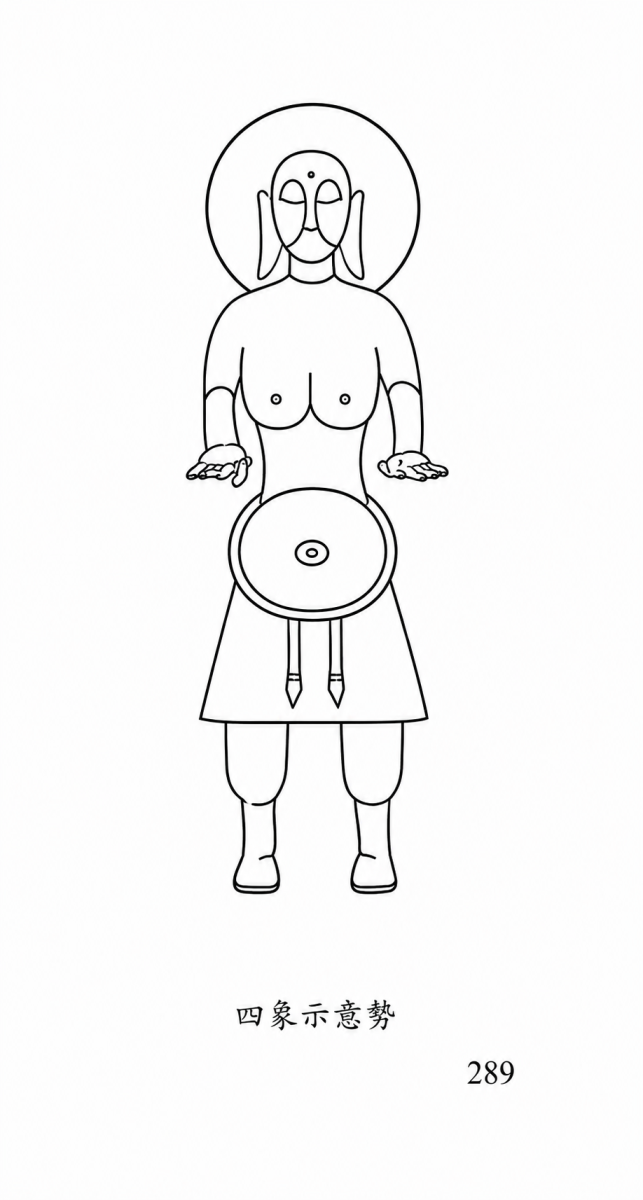
- Transcription:
- Jue: 「如來承當萬象歸,兩手平托似含輝。氣貫三田通一線,佛心即是我心機。」
- Jie: 兩足並立,兩手平舉於臍前,如托須彌。目視前方,神凝中黃。此式貫通上中下三田,為三才合一之象。
- Translation:
- Mnemonic: “The Tathāgata bears the weight of the ten thousand phenomena returning; both hands level, as if containing radiance. Qi penetrates the three fields through a single line; the Buddha-mind is my own mind’s mechanism.”
- Exposition: Feet together, both hands level in front of the navel, as if supporting Mount Sumeru.
- Lineage & Context: References the Buddha’s “bearing” of the Dharma. The gesture appears in Cave 148 (High Tang). It represents the integration of the Three Dantians.
- Technical Exegesis: The Chong mai (Penetrating Vessel) is activated as the central axis.
- Comparative Notes: Resembles “Holding the Ball at Navel Level.” The Dunhuang framing adds the Mount Sumeru imagery.
*
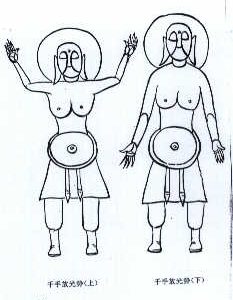
Posture 11–12 · 千手放光勢
(Thousand Hands Emit Light – Upper/Lower)
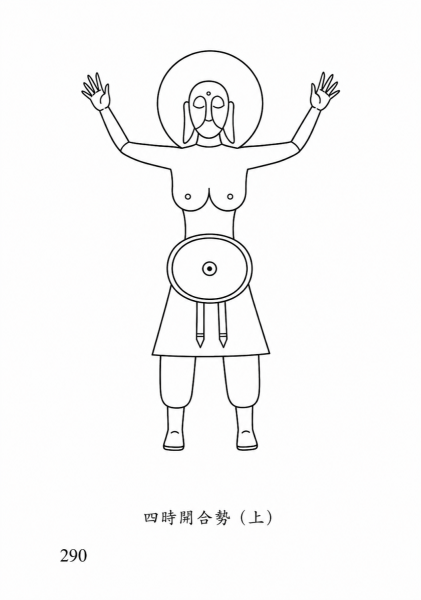
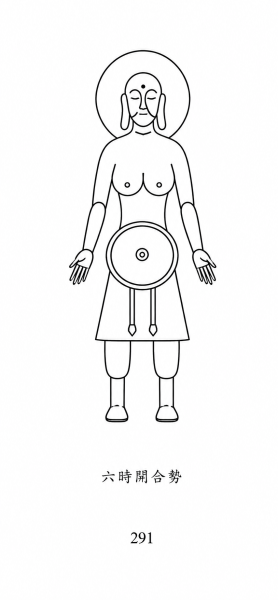
- Transcription:
- Jue: 「千手放光照十方,上舉下按應陰陽。氣昇督脈通泥丸,氣降任脈歸命鄉。」
- Jie: 上式:兩手上舉過頂,如托日月。下式:兩手下按至臍,如鎮乾坤。一升一降,一陰一陽,督升任降,小周天行。
- Translation:
- Mnemonic: “A thousand hands emit light, illuminating the ten directions; lifting above and pressing below respond to yin and yang. Qi ascends the Governing Vessel to penetrate the Niwan; qi descends the Conception Vessel to return to the realm of life.”
- Exposition: Upper form: Both hands lift above the head. Lower form: Both hands press down to the navel.
- Lineage & Context: Explicit reference to Thousand-Armed Guanyin (Caves 3, 55, 148, etc.). The pair represents the complete Small Heavenly Cycle.
- Technical Exegesis: The upper form opens the Upper Dantian; the lower form seals qi into the Lower Dantian.
- Comparative Notes: Identical to the first and last movements of the Eight Pieces of Brocade.
*
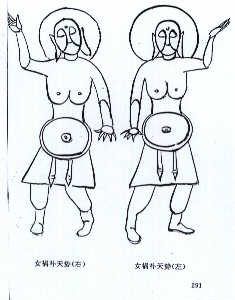
Posture 13–14 · 女媧補天勢
(Nüwa Mends Heaven – Left/Right)
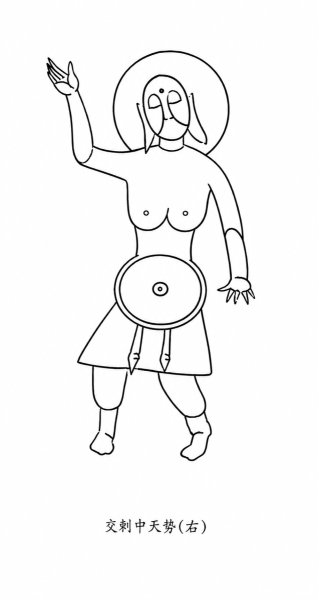
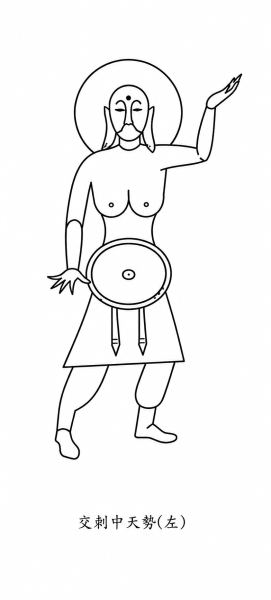
- Transcription:
- Jue: 「女媧補天煉五色,一手擎天一手掖。氣貫督脈通腦海,坎離交媾產金液。」
- Jie: 一足獨立,一足微提。一手上舉如擎天,一手下護如掖地。目注上舉之手,氣自臍發,貫脊通腦。左右交替,如女媧煉石補天。此式通腦補髓,為煉精化氣之要。
- Translation:
- Mnemonic: “Nüwa mends Heaven, smelting the five colors; one hand supports Heaven, one hand tucks to the side. Qi penetrates the Governing Vessel to reach the brain sea; Kan and Li copulate to produce golden liquid.”
- Exposition: Stand on one leg, the other foot slightly lifted. One hand lifts as if supporting Heaven; one hand guards downward.
- Lineage & Context: Nüwa is the goddess who repaired the sky. The posture’s one-legged stance forces qi to concentrate in the central axis. “Mending Heaven” is a metaphor for replenishing the brain.
- Technical Exegesis: One-legged stance with maximum vertical extension. The “golden liquid” is the saliva of internal alchemy.
- Comparative Notes: Similar to “Golden Rooster Stands on One Leg.” The Dunhuang framing adds the Nüwa myth.
*
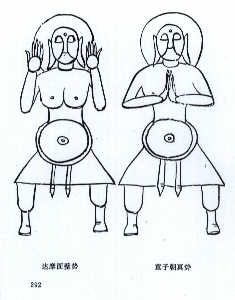
Posture 15 · 達摩直視勢
(Bodhidharma’s Direct Gaze)
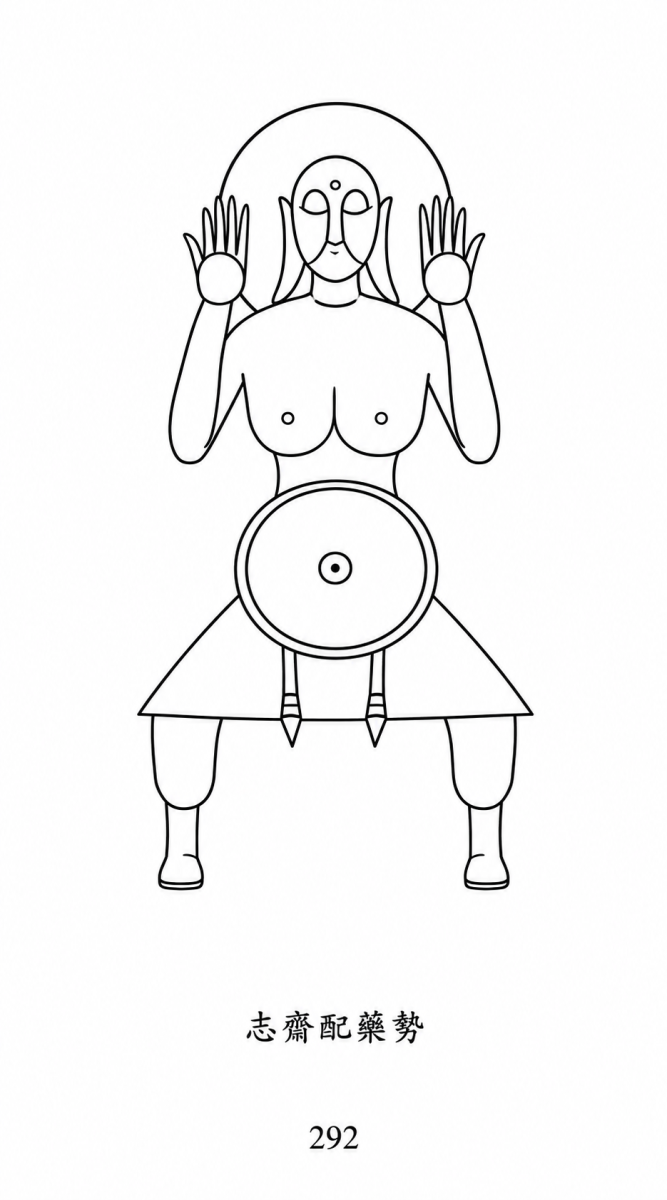
- Transcription:
- Jue: 「達摩西來一字無,全憑心意用工夫。兩手掩耳聽天籟,直視前方見本初。氣沉丹田神內守,靈光一點照昏衢。」
- Jie: 立身如樁,兩手上舉,掩耳捂竅,掌心向內,指向上方。目直視前方而不聚焦,見而不見,即達摩「直視」之禪。舌抵上齶,督任相通。此式閉外竅,開內竅,為禪定之門。
- Translation:
- Mnemonic: “Bodhidharma came from the West with not a single word; entirely relying on mind and intention to apply effort. Both hands cover the ears to listen to the sounds of Heaven; gaze directly forward to see the origin.”
- Exposition: Stand like a stake; both hands rise to cover the ears, sealing the sensory orifices. The eyes gaze directly forward but do not focus.
- Lineage & Context: The only figure with long hair and a beard. The hands-at-ears gesture is a standing adaptation of the seated “Beating the Heavenly Drum” technique found in Caves 205 and 194. It marks the transition to Chan meditation.
- Technical Exegesis: The fingers activate points on the Small Intestine channel, connecting to the Heart. Sensory withdrawal induces parasympathetic dominance.
- Comparative Notes: Combines the Daoist “Heavenly Drum” with Chan “Direct Gaze.”
*
Posture 16 · 童子朝眞勢
(The Youth Pays Homage to the True One)
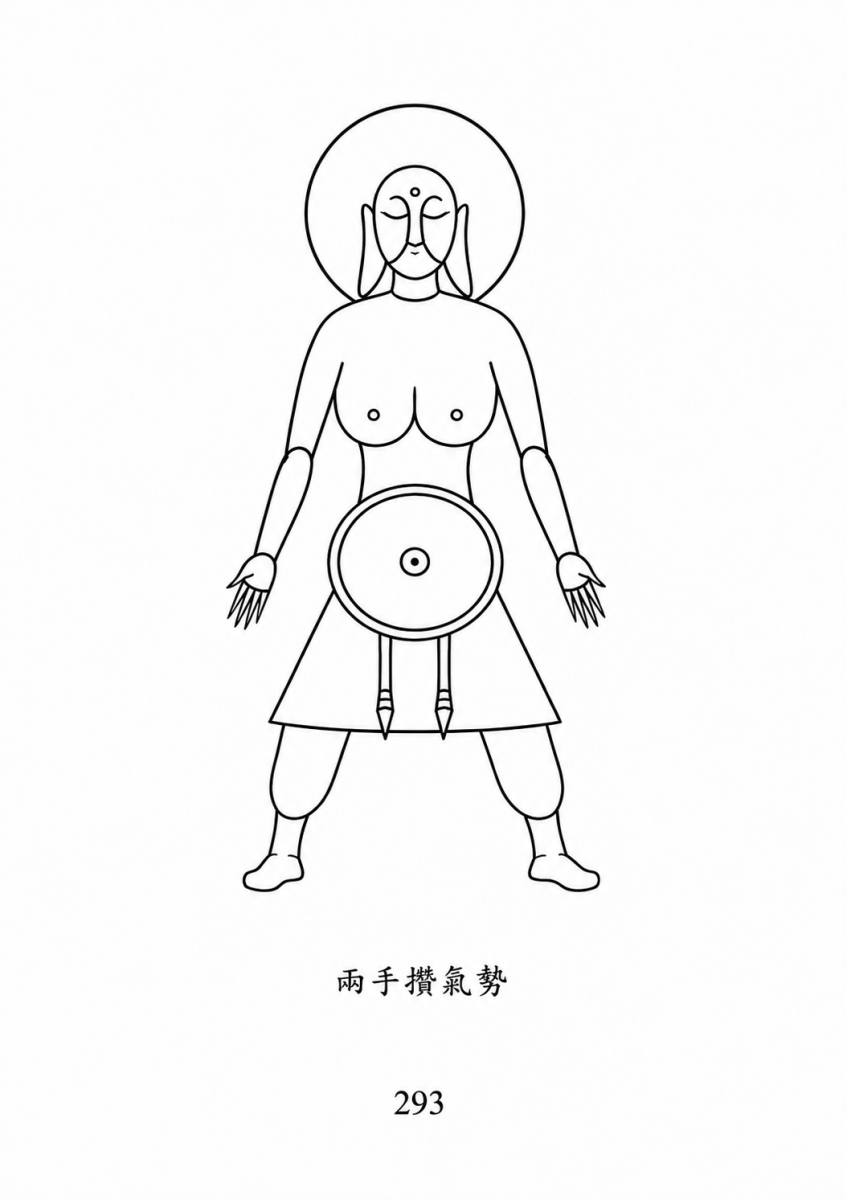
- Transcription:
- Jue: 「童子朝眞禮法王,兩手合十歸中黃。三花聚頂五氣朝,返老還童是妙方。」
- Jie: 兩足並立,兩手合十於心前,如蓮華合掌。目微閉,神內斂,氣歸臍下。此式為三才交會,精氣神歸一,聖胎之象也。
- Translation:
- Mnemonic: “The youth pays homage to the True One, saluting the Dharma King; both hands join in anjali, returning to the central yellow. The three flowers gather at the crown, the five qi pay court to the origin; returning to youth is the wondrous formula.”
- Exposition: Feet together, both hands in anjali (prayer position) in front of the heart.
- Lineage & Context: The “youth” is a metaphor for the “holy fetus.” The anjali mudra appears throughout Dunhuang murals. It represents the culmination of the standing sequence.
- Technical Exegesis: The anjali mudra concentrates the shen in the middle dantian.
- Comparative Notes: The “youth” metaphor appears in Wuzhen Pian. The Dunhuang framing adds the haloed, androgynous figure.
*
Posture 17 · 引氣歸原勢
(Drawing Qi Back to the Origin)
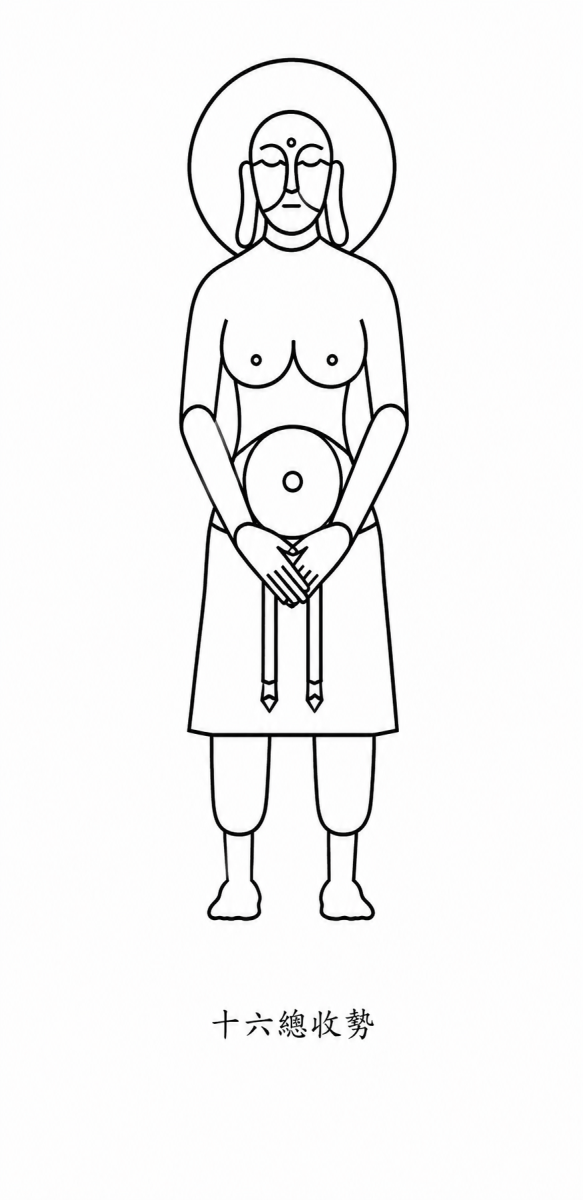
- Transcription:
- Jue: 「引氣歸原復本根,兩手交叠護臍門。百脈歸宗神自靜,一輪明月照乾坤。」
- Jie: 兩手交叠,男左女右,按於臍下。目閉內照,氣沉丹田。此式為收功之要,引散於四肢百脈之氣,悉歸臍下元海。
- Translation:
- Mnemonic: “Drawing qi back to the origin restores the root; both hands overlap, guarding the navel gate. The hundred vessels return to the ancestor, the spirit quiets of itself; a single bright moon illuminates Qian and Kun.”
- Exposition: Both hands overlap (men left, women right), pressing below the navel.
- Lineage & Context: Standard closing posture. “Returning to the origin” ensures the day’s cultivation is stored.
- Technical Exegesis: Slow, deep breathing; exhalation “pushes” peripheral qi back to the center.
- Comparative Notes: Identical to the closing posture in virtually all qigong sets.
*
Posture 18 · 萬象大旨勢
(The Great Purpose of Ten Thousand Phenomena)
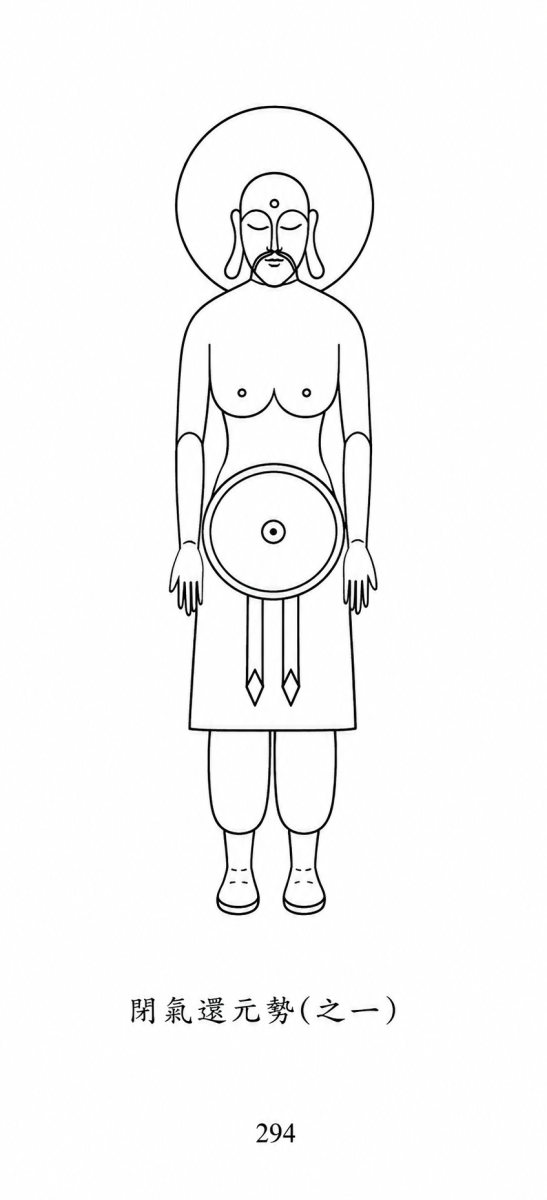
- Transcription:
- Jue: 「萬象紛紜歸大旨,一氣渾淪包太始。兩手虛按如撫琴,不即不離真妙理。」
- Jie: 兩手虛按於臍前,如撫無絃之琴。目視前方,神凝中黃。此式為十八手之總結,萬法歸一,一歸於無,無極而太極也。
- Translation:
- Mnemonic: “The ten thousand phenomena, diverse and complex, return to the great purpose; a single qi, chaotic and whole, embraces the Great Beginning. Both hands press emptily as if stroking a lute; neither clinging nor leaving—this is the true wondrous principle.”
- Exposition: Both hands press emptily in front of the navel, as if stroking a stringless lute.
- Lineage & Context: The “stringless lute” is a Tao Yuanming metaphor for the music of the Dao. The posture represents the philosophical synthesis: returning to Wuji.
- Technical Exegesis: Natural breathing; no manipulation. The practitioner is in the “Wuji” state.
- Comparative Notes: Functionally similar to “Standing Meditation” in Yiquan.
*
4. The Seated Culmination: 祝融薪傳勢
(Zhurong Transmits the Firewood)
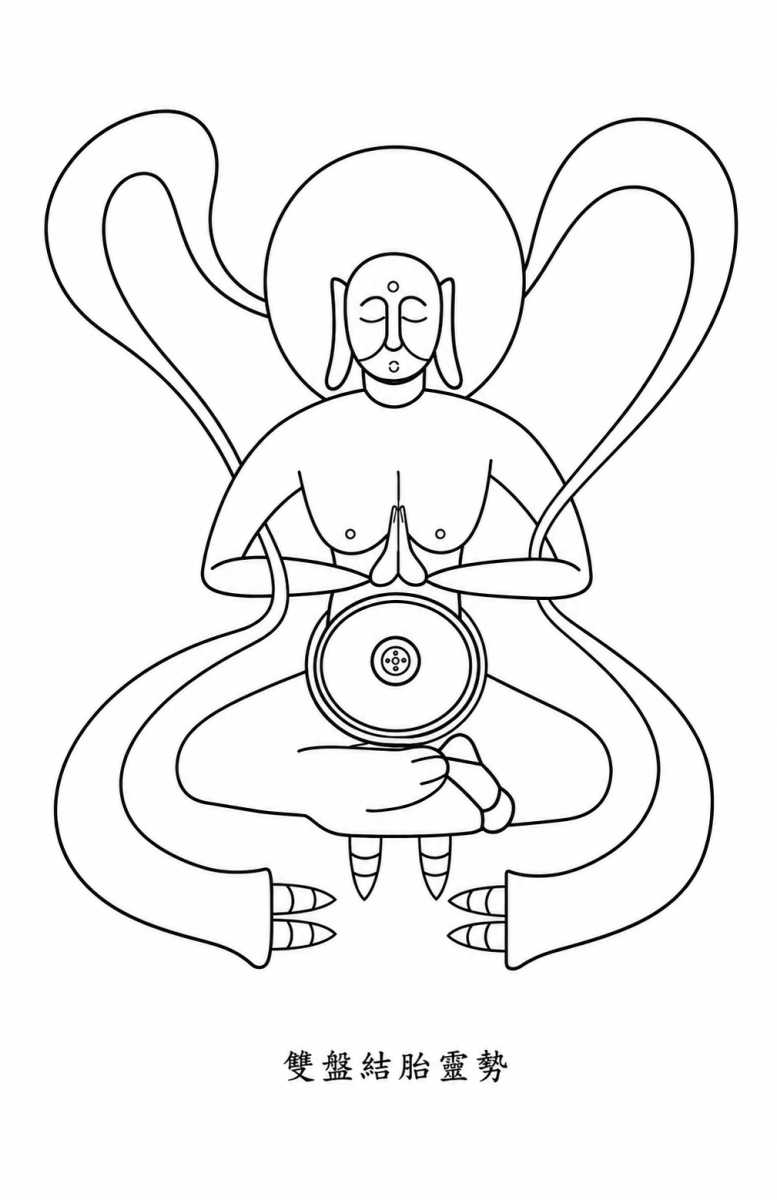
- Transcription:
- Jue: 「祝融火帝坐蓮台,三昧真火內中來。雙手合十歸一處,薪傳火種續千載。坎離交媾生丹藥,性命雙修脫劫埃。」
- Jie: 跏趺而坐,雙手合十於心前,如入三昧。肩後火焰紋者,三焦真火也。目閉內照,神守中黃。此式為十八手之歸宿,一切站式皆為此坐式之預備。三昧真火,即心腎相交之火,坎離既濟,金丹乃成。
- Translation:
- Mnemonic: “The Fire Emperor Zhurong sits on the lotus platform; the samadhi true fire comes from within. Both hands join in anjali, returning to one place; the fire transmitted by firewood continues for a thousand ages. Kan and Li copulate to produce the elixir medicine; essence and life dual-cultivation escape the dust of kalpas.”
- Exposition: Sit in full lotus, both hands in anjali in front of the heart. The flame patterns behind the shoulders are the true fire of the triple burner.
- Lineage & Context: Zhurong is the Chinese fire god, but the iconography draws from Esoteric Buddhist fire-deity imagery in Cave 465. The flame-shoulder emanations represent the “three fires” of internal alchemy.
- Technical Exegesis: Full lotus seals the lower gate. “Embryonic breathing” is practiced. The “samadhi true fire” transforms the three treasures into the elixir.
- Comparative Notes: The culmination of all neidan systems. The Dunhuang specificity is the Zhurong/fire-deity iconography.
*
5. The Three Cosmological Charts
5.1 內煉爐鼎圖
(The Inner Refining Furnace-Cauldron Chart)
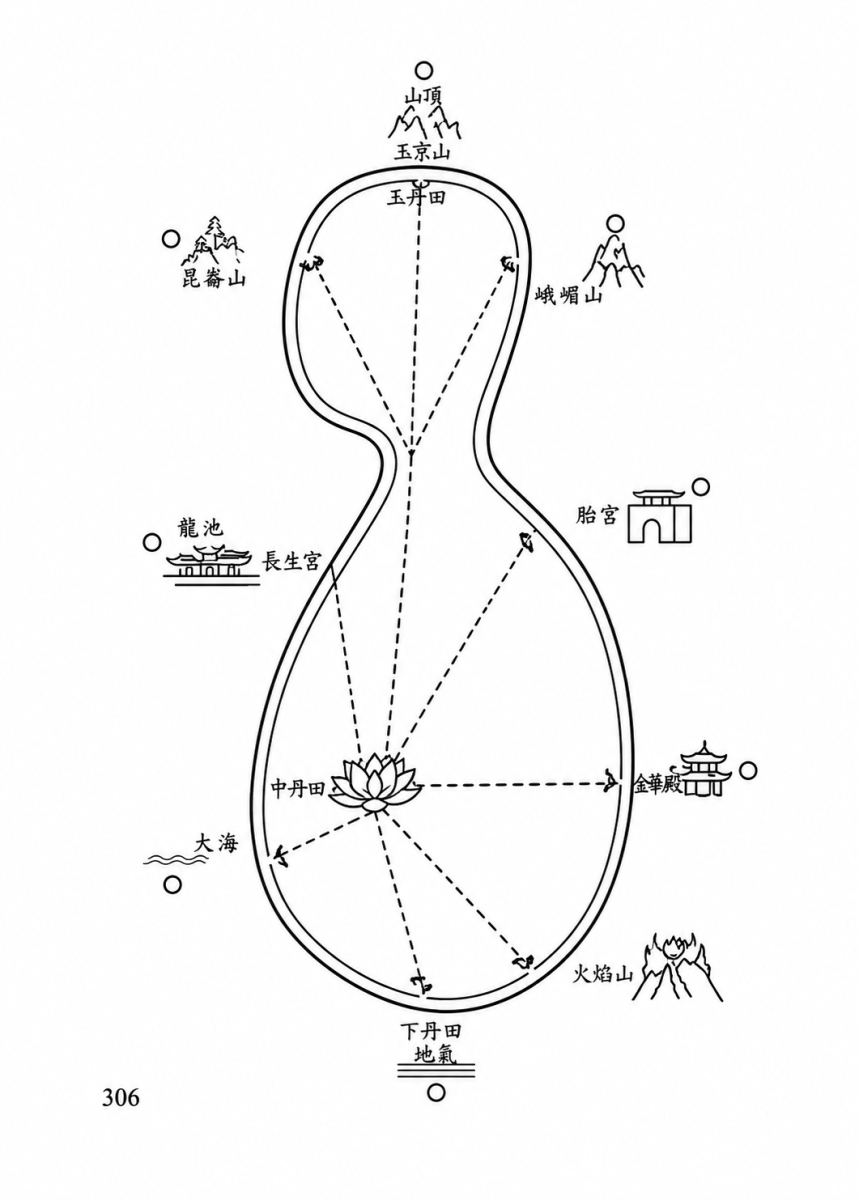
- Description: This gourd-shaped diagram represents the body as an alchemical laboratory. The upper bulb is the Middle Dantian (heart), the narrow waist is the diaphragm, and the lower bulb is the Lower Dantian (abdomen). Eight trigrams surround the perimeter, and organs are mapped to directions.
- Interpretation: The gourd is the classic alchemical vessel. The body is a cosmos in miniature, with the navel as the furnace’s fire-door. This explains why the eighteen postures center on the navel: it is the geometric center of the body-cosmos.
*
5.2 數煙齋密圖
(The Secret Chart of the Smoke-Counting Studio)
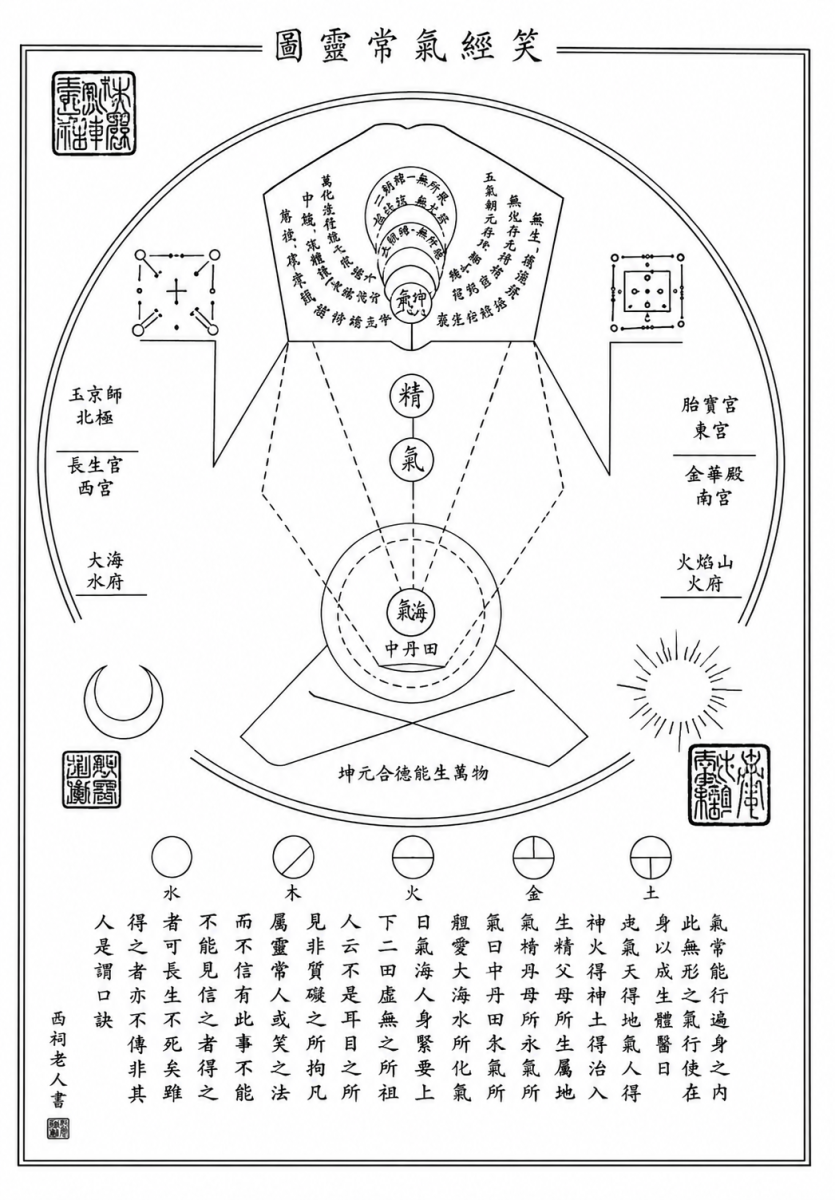
- Description: This is the roadmap for the microcosmic orbit. It maps the Three Dantians, the Three Passes (tailbone, spine, occiput), and the sun/moon circulation. The name “Smoke-Counting Studio” likely refers to a literatus-editor who practiced “counting incense smoke” as a meditation on impermanence while mapping qi circulation—a common timing method in traditional practice.
- Interpretation: The chart transforms abstract neidan theory into a visual map. The seals indicate lineage transmission.
*
5.3 六經象數圖
(The Six Classics Image-Number Chart)
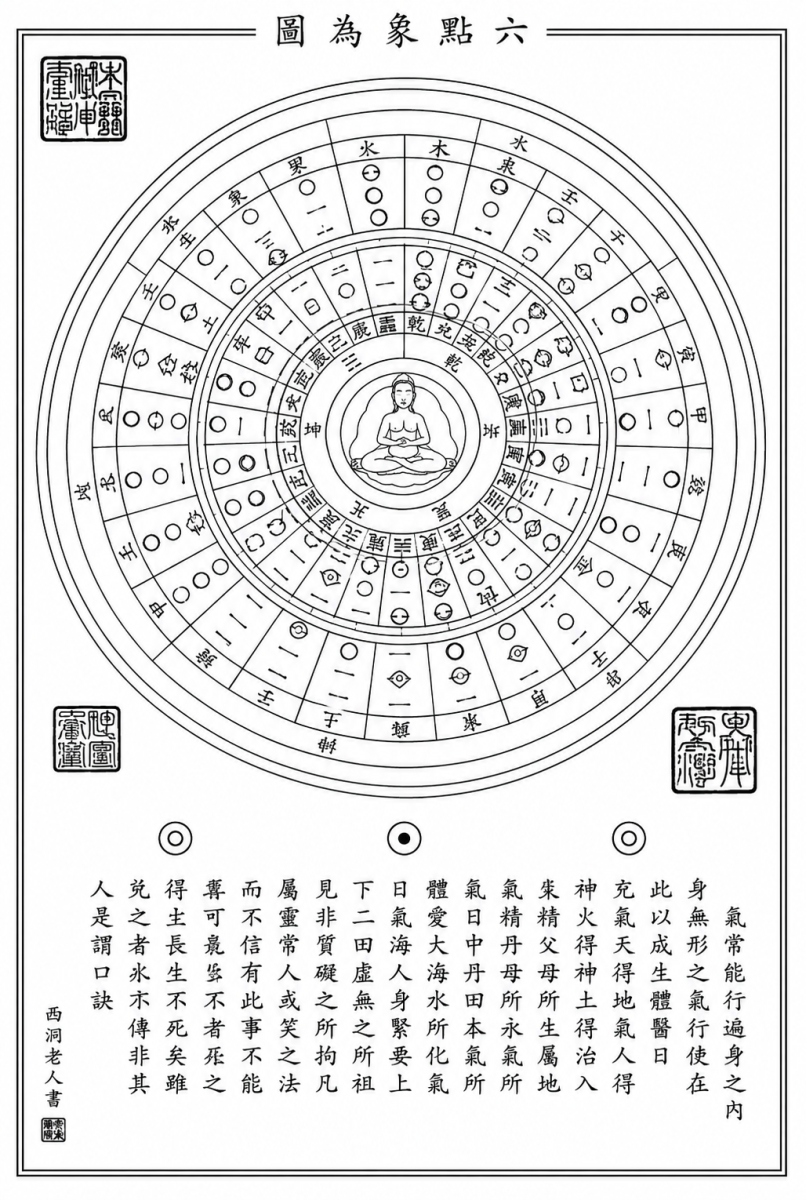
- Description: This circular cosmogram maps the Yijing hexagrams to the practice. A central meditator is surrounded by concentric rings of the 64 hexagrams arranged in temporal sequence. The rings display yin-yang lineation (solid and broken lines) indicating the exact stage of transformation, with seasonal correspondences (e.g., Fu at winter solstice).
- Interpretation: Each of the eighteen postures corresponds to a specific hexagram transition. The standing sequence moves from Kun (pure yin) to Qian (pure yang) and back. The seated Zhurong posture is the “Already Fulfilled” (Hexagram 63) state.
*
6. Textual Sources:
The Dunhuang Manuscripts
6.1 P.3810《呼吸靜功妙訣》— The Core Text
Discovered in 1900 in the Library Cave, this manuscript is the theoretical foundation of the entire Dunhuang Qigong system.
- Key Passages: “Human life takes qi as its root… The human heart and kidneys are 8.4 cun apart… Within it is a single vessel that communicates the rising and sinking of primal breath.”
- Correspondences:
- “Gaze at the navel with lowered eyes” → Postures 1 & 2.
- “Sit with crossed legs in a quiet room” → The Seated Culmination (Zhurong).
- “Follow breath rising and sinking between heart and kidneys” → Posture 4.
6.2 Other Manuscripts
- P.2635《諸雜問難道義》: “Qi sinks to the navel, the hundred diseases remove themselves.” Validates the navel-centered therapeutic claim.
- P.2882《太玄真一本際經》: “The dragon pearl is the true-one water within the kidneys.” Source for the “Nezha Probing the Sea” imagery.
- P.2666《王道祭楊筠文》: “Mending Heaven means mending the brain.” Source for the “Nüwa Mending Heaven” posture.
- P.3596《佛說觀佛三昧海經》: “The vajra’s wrathful gaze subdues demonic resentment.” Source for the “Giant Spirit Subdues Demons” posture.
*
7. Critical Synthesis:
Navel, Cosmos, and Syncretism
7.1 The Navel as the Center of the Universe
The most striking feature is the large circular navel diagram on every standing figure. This is explicitly the Navel Chakra or the “center of the universe.” In this system, the distinction between the anatomical navel and the energetic Dantian is deliberately collapsed. This conflation is the specific innovation of the “Navel-Secret” school: every posture is a variation on navel-gazing, navel-guarding, or navel-issuing.
However, a crucial nuance found in the grid chart’s inscription—“The Clear Sky (晴) is the Center of the Universe”—suggests a deeper layer. While the practice focuses on the physical navel, the ultimate goal is not just the anatomical center, but the realization of the “Clear Sky” state of mind: empty, luminous, and vast. The navel is the method; the Clear Sky is the goal.
7.2 The Androgynous Body
The figures are androgynous: they have breasts (nourishing, yin) and male loincloths (generative, yang). This is alchemical iconography: the perfected body of internal alchemy is hermaphroditic in an energetic sense—the union of yin and yang. The breasts symbolize the “milk of immortality” (referencing Tantric and Lotus Sutra imagery of gender fluidity representing the non-dual state), while the male form represents generative power.
7.3 The Spiral of Names
The naming sequence reveals a deliberate initiatory logic:
- Daoist stillness (Postures 1–2)
- Elemental/mythic activation (Postures 3–5)
- Mythological retrieval (Postures 6–7, 13–14)
- Buddhist devotion (Postures 10–12)
- Chan meditation (Postures 15–16)
- Daoist return (Postures 17–18)
- Alchemical ignition (Seated Zhurong)
This reflects the “Three Teachings as One” ideology of the Republican and early Reform eras, with a specific somatic logic: the practitioner moves from stillness, through activation, into devotion, and finally back to seated meditation—with the navel as the constant center.
7.4 What This System Is (and Is Not)
The lost manual is not a martial arts book. It is a complete Daoist-Buddhist syncretic cultivation system that uses:
- Dunhuang cave mural iconography as its visual framework.
- Dunhuang manuscript breathing theory (P.3810) as its physiological foundation.
- Neidan cosmology (the three charts) as its theoretical superstructure.
- Navel-secret qigong as its somatic method.
The “eighteen hands” are expedient means: eighteen ways of preparing the body to sit in the Zhurong posture and ignite the internal fire.
*
8. Conclusion:
Towards a Critical Edition
This reconstruction is provisional. It is based on fourteen surviving photographic plates, memory of the title, the publishing context of 1980s–90s Gansu qigong literature, the iconography of specific Dunhuang caves, and the text of Dunhuang manuscript P.3810.
The book that was lost was a remarkable synthesis: 1980s qigong science + Tang-dynasty breathing manuscripts + Northern Liang bodhisattva iconography + Yuan-dynasty Esoteric Buddhist fire imagery, all filtered through a navel-centered somatic theory. It deserves to be remembered (what we do with this article today), and finally, located and re-acquired, so that it may be critically edited in a bilingual scholarly edition. This article is a modest first step towards that direction.
The Sonic Dimension — 《三世敦煌脐密音乐》 (1993)
A.1. Material Description
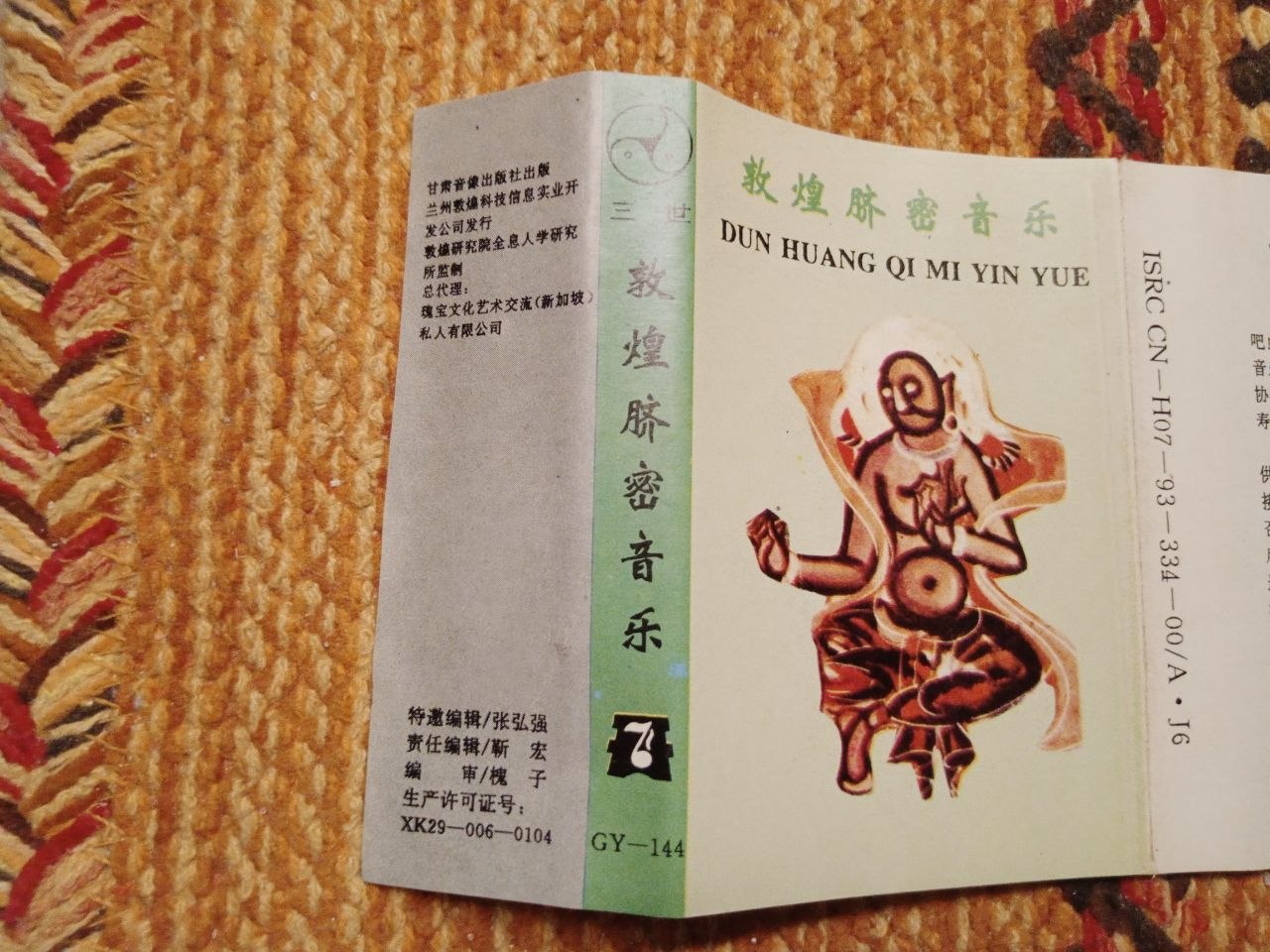
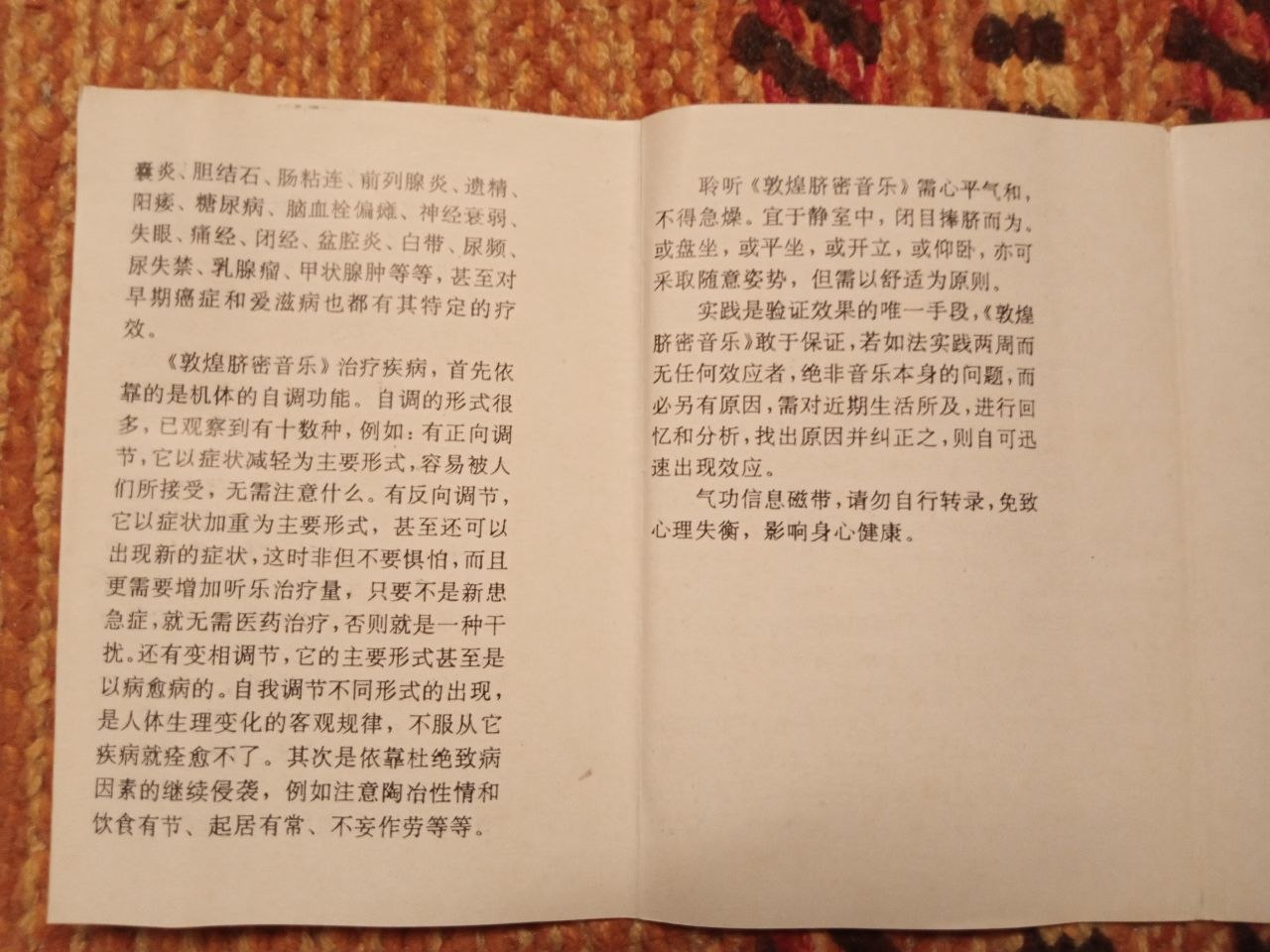
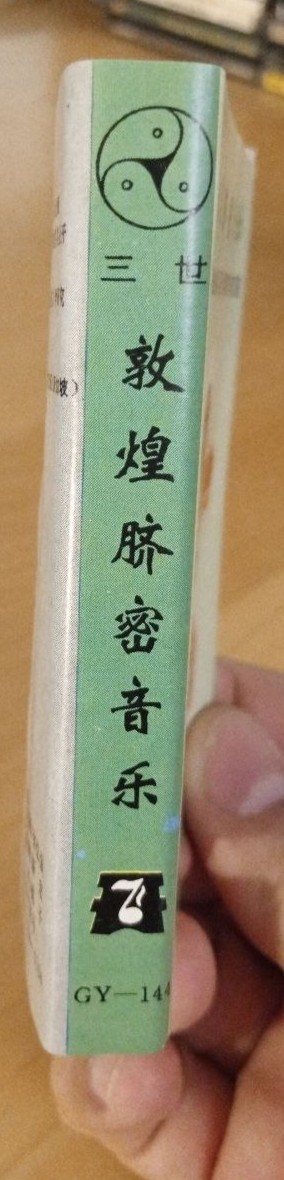
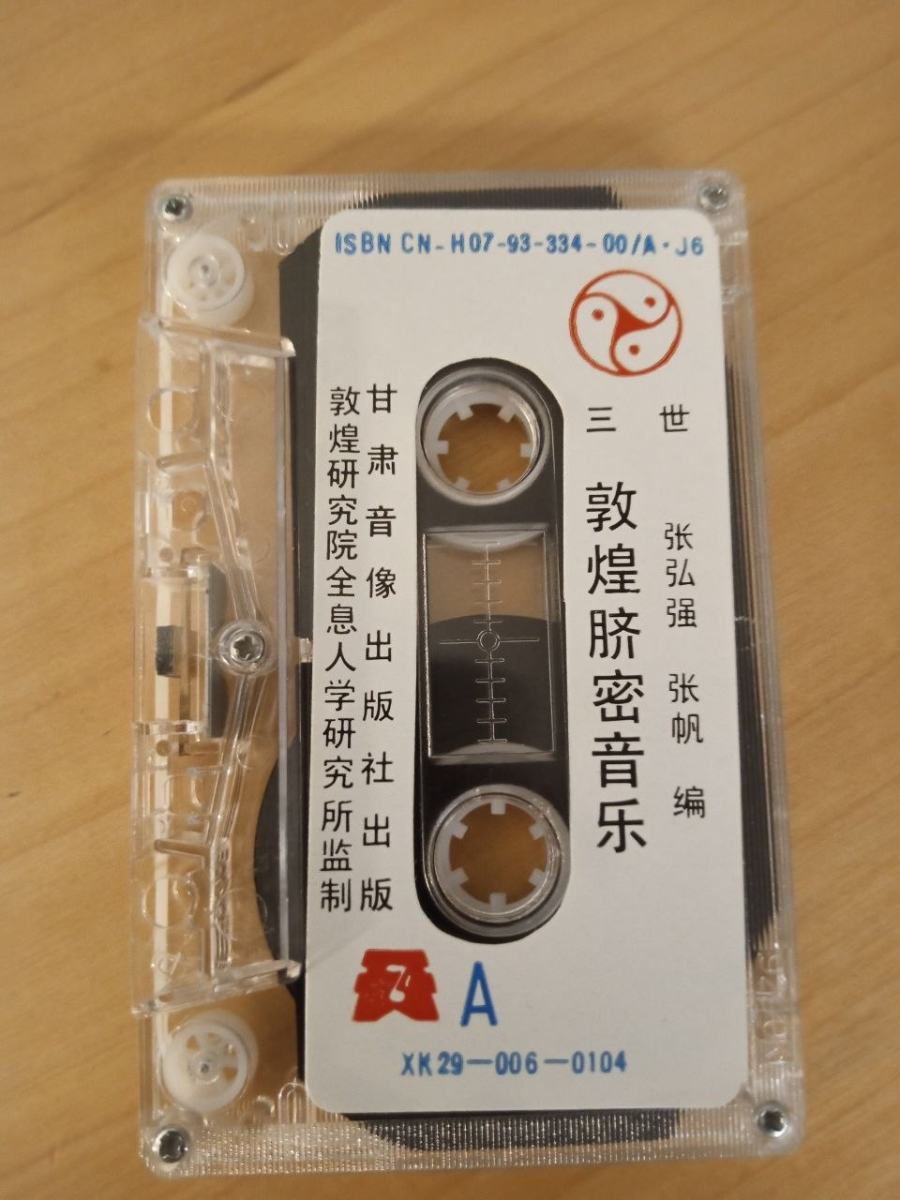
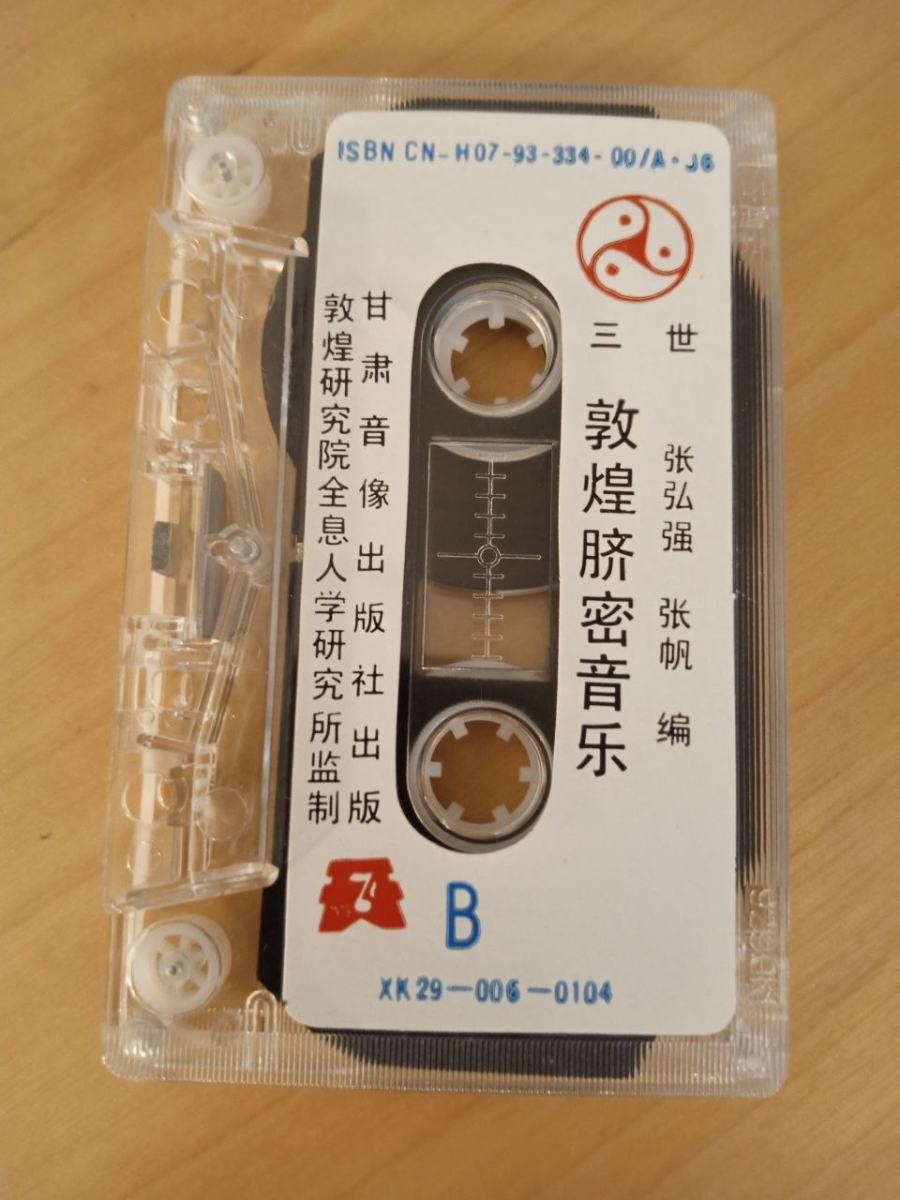
Artifact:Audio cassette and booklet insert. Production: Gansu Audio-Visual Publishing House (甘肃音像出版社). Catalogue: GY-144. ISRC: CN-H07-93-334-00/A·J6. Compilers: Zhang Hongqiang (张弘强) & Zhang Fan (张帆). Supervision: Dunhuang Research Academy Holographic Human Studies Research Institute (敦煌研究院全息人学研究所). Distribution: Guibao Cultural & Arts Exchange (Singapore) Pte Ltd.
This artifact represents the audio-commercial extension of the navel-secret (臍密) qigong system reconstructed in the main article. Where the lost manual taught embodied practice through eighteen standing postures and one seated meditation, the cassette offers disembodied practice through sonic induction — “listening with the navel” (用肚脐聆听).
Figure A.1:The original 1993 cassette release. Note the explicit credit to Zhang Hongqiang and Zhang Fan as compilers (编), confirming Zhang’s dual role as author of the manual and creator of the sonic practice. The ISRC code CN-H07-93-334 verifies the Gansu provincial origin and 1993 production date. The title 三世 (Three Worlds) adds a temporal dimension to the practice.
(Insert Images of Cassette Side A, Side B, and Spine here)
A.2. Insert Text: Transcription & Translation
Front Cover & Spine
Front Cover (Right Panel) 敦煌脐密音乐 Dūnhuáng Qí Mì Yīnyuè DUN HUANG QI MI YIN YUE Dunhuang Navel-Secret Music
Spine (Center Panel) 三世 敦煌脐密音乐 — Three Worlds / Dunhuang Navel-Secret Music GY—144 — Catalogue number
Back Cover / Left Panel (Publisher Information)
| Chinese | English |
|---|---|
| 甘肃音像出版社出版 | Published by Gansu Audio-Visual Publishing House |
| 兰州敦煌科技信息实业开发公司发行 | Distributed by Lanzhou Dunhuang Science & Technology Information Industry Development Company |
| 敦煌研究院全息人学研究所监制 | Supervised by Dunhuang Research Academy Holographic Human Studies Research Institute |
| 总代理: | General Agent: |
| 瑰宝文化艺术交流(新加坡)私人有限公司 | Guibao Cultural & Arts Exchange (Singapore) Pte Ltd |
| 特邀编辑/张弘强 — Special Editor: Zhang Hongqiang | |
| 责任编辑/靳 宏 — Editor in Charge: Jin Hong | |
| 编 审/槐 子 — Reviewer: Huai Zi | |
| 生产许可证号:XK29—006—0104 | Production License No.: XK29-006-0104 |
Inside Left & Right Pages
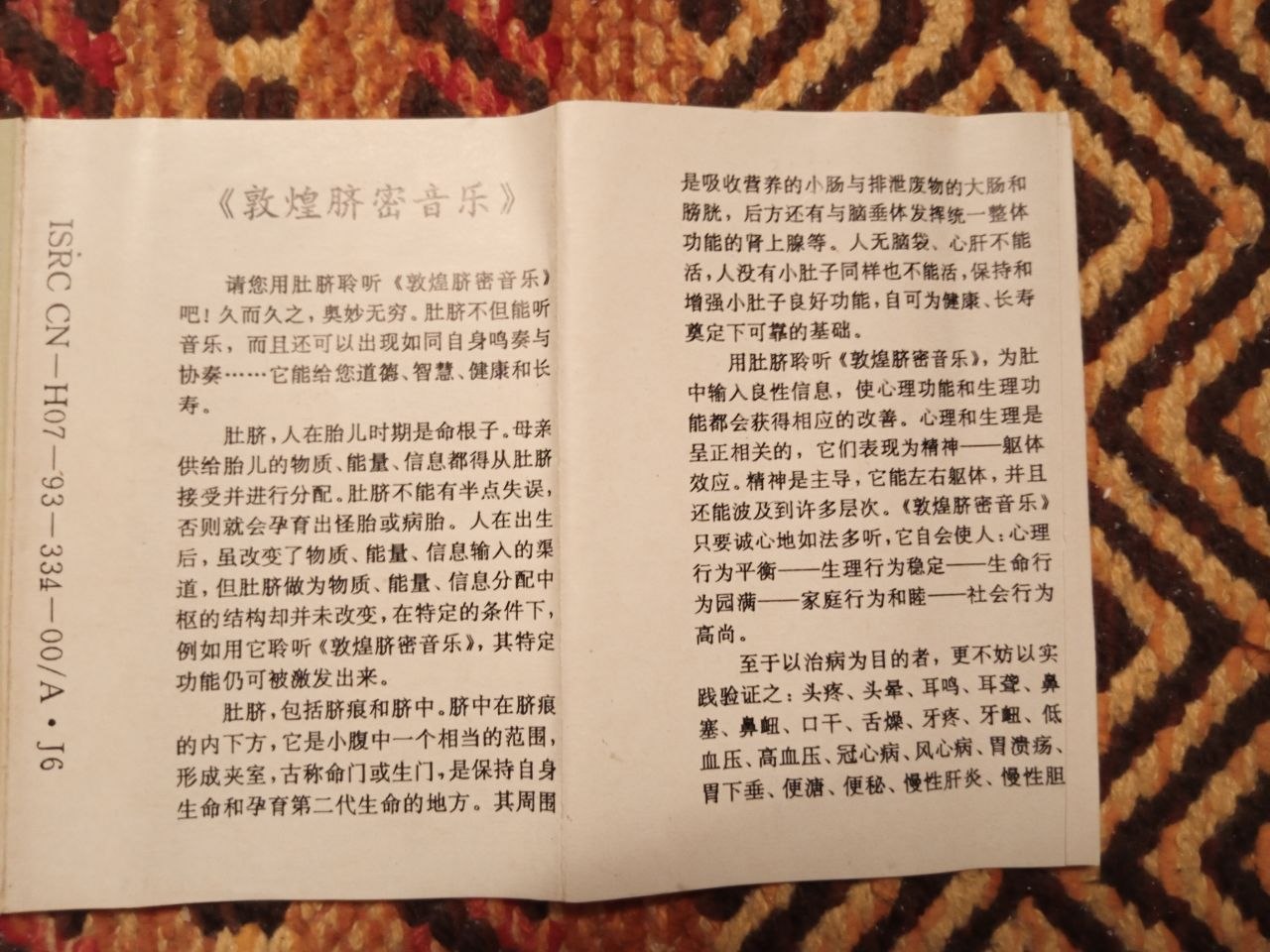
Left Page — Title & Introduction 《敦煌脐密音乐》 Dunhuang Navel-Secret Music
请您用肚脐聆听《敦煌脐密音乐》吧!久而久之,奥妙无穷。肚脐不但能听音乐,而且还可以出现如同自身鸣奏与协奏……它能给您道德、智慧、健康和长寿。
Translation:We invite you to use your navel to listen to Dunhuang Navel-Secret Music! Persist in this practice, and its marvels are boundless. The navel can not only listen to music, but can also produce sounds as if playing and harmonizing by itself… It can bestow upon you virtue, wisdom, health, and longevity.
肚脐,人在胎儿时期是命根子。母亲供给胎儿的物质、能量、信息都得从肚脐接受并进行分配。肚脐不能有半点失误,否则就会孕育出怪胎或病胎。人在出生后,虽改变了物质、能量、信息输入的渠道,但肚脐做为物质、能量、信息分配中枢的结构却并未改变,在特定的条件下,例如用它聆听《敦煌脐密音乐》,其特定功能仍可被激发出来。
Translation: The navel: during fetal life, it is the root of destiny. All material, energy, and information that the mother supplies to the fetus must be received and distributed through the navel. The navel cannot err in the slightest, or else it will produce a malformed or diseased fetus. After birth, although the channels for inputting material, energy, and information have changed, the navel’s structure as a distribution hub for material, energy, and information has not altered. Under specific conditions — for example, using it to listen to Dunhuang Navel-Secret Music — its specific functions can still be activated.
肚脐,包括脐痕和脐中。脐中在脐痕的内下方,它是小腹中一个相当的范围,形成夹室,古称命门或生门,是保持自身生命和孕育第二代生命的地方。其周围是吸收营养的小肠与排泄废物的大肠和膀胱,后方还有与脑垂体发挥统一整体功能的肾上腺等。人无脑袋、心肝不能活,人没有小肚子同样也不能活,保持和增强小肚子良好功能,自可为健康、长寿奠定下可靠的基础。
Translation:The navel includes the navel scar and the navel center. The navel center lies internally below the navel scar; it is a considerable area within the lower abdomen, forming a chamber. In antiquity it was called the Gate of Life (mìngmén) or the Gate of Birth (shēngmén): the place that preserves one’s own life and gestates the next generation. Surrounding it are the small intestine, which absorbs nutrients, and the large intestine and bladder, which excrete waste. Behind it are the adrenal glands, which function in unified integration with the pituitary gland. A person without a head or heart cannot live; equally, a person without a lower abdomen cannot live. Maintaining and enhancing the good function of the lower abdomen naturally lays a reliable foundation for health and longevity.
Right Page — Therapeutic Claims 用肚脐聆听《敦煌脐密音乐》,为肚中输入良性信息,使心理功能和生理功能都会获得相应的改善。心理和生理是呈正相关的,它们表现为精神——躯体效应。精神是主导,它能左右躯体,并且还能波及到许多层次。《敦煌脐密音乐》只要诚心地如法多听,它自会使人:心理行为平衡——生理行为稳定——生命行为园满——家庭行为和睦——社会行为高尚。
Translation:Using the navel to listen to Dunhuang Navel-Secret Music inputs benign information into the abdomen, causing both psychological and physiological functions to obtain corresponding improvement. Psychology and physiology are positively correlated; they manifest as psychosomatic effects. The spirit is dominant: it can govern the body, and can also extend to many levels. So long as one sincerely listens to Dunhuang Navel-Secret Music frequently and in accordance with method, it will naturally cause a person to achieve: balanced psychological behavior — stable physiological behavior — fulfilled life behavior — harmonious family behavior — noble social behavior.
至于以治病为目的者,更不妨以实践验证之:头疼、头晕、耳鸣、耳聋、鼻塞、鼻衄、口干、舌燥、牙疼、牙齦、低血压、高血压、冠心病、风心病、胃溃疡、胃下垂、便溏、便秘、慢性肝炎、慢性胆
Translation:As for those who take treating illness as their goal, they may all the more put it to the test in practice: headaches, dizziness, tinnitus, deafness, nasal congestion, nosebleeds, dry mouth, parched tongue, toothache, bleeding gums, low blood pressure, high blood pressure, coronary heart disease, rheumatic heart disease, gastric ulcer, stomach prolapse, loose stools, constipation, chronic hepatitis, chronic chole…
[text continues on next page]
Left Page — Continuation of Disease List 囊炎、胆结石、肠粘连、前列腺炎、遗精、阳痿、糖尿病、脑血栓偏瘫、神经衰弱、失眠、痛经、闭经、盆腔炎、白带、尿频、尿失禁、乳腺瘤、甲状腺肿等等,甚至对早期癌症和爱滋病也都有其特定的疗效。
Translation: …cystitis, gallstones, intestinal adhesions, prostatitis, nocturnal emissions, impotence, diabetes, cerebral thrombosis with hemiplegia, neurasthenia, insomnia, dysmenorrhea, amenorrhea, pelvic inflammatory disease, leukorrhea, frequent urination, urinary incontinence, breast tumors, thyroid swelling, and so forth. It even has specific therapeutic effects on early-stage cancer and AIDS.
《敦煌脐密音乐》治疗疾病,首先依靠的是机体的自调功能。自调的形式很多,已观察到有十数种,例如:有正向调节,它以症状减轻为主要形式,容易被人们所接受,无需注意什么。有反向调节,它以症状加重为主要形式,甚至还可以出现新的症状,这时非但不要惧怕,而且更需要增加听乐治疗量,只要不是新患急症,就无需医药治疗,否则就是一种干扰。还有变相调节,它的主要形式甚至是以病愈病的。自我调节不同形式的出现,是人体生理变化的客观规律,不服从它疾病就痊愈不了。其次是依靠杜绝致病因素的继续侵袭,例如注意陶冶性情和饮食有节、起居有常、不妄作劳等等。
Translation:In treating disease, Dunhuang Navel-Secret Music first relies upon the body’s self-regulating function. The forms of self-regulation are many; more than ten have been observed. For example: there is positive regulation, which takes the alleviation of symptoms as its primary form. This is easily accepted by people and requires no special attention. There is reverse regulation, which takes the worsening of symptoms as its primary form; new symptoms may even appear. At such times one must not fear, but rather increase the therapeutic dosage of listening. So long as it is not a newly contracted acute condition, there is no need for medical or pharmaceutical treatment — otherwise that would constitute interference. There is also transformative regulation, whose primary form is even that of curing disease with disease. The emergence of different forms of self-regulation is an objective law of human physiological change; if one does not submit to it, the disease cannot be healed. Second, it relies upon eliminating the continued invasion of disease-causing factors — for example, paying attention to cultivating one’s temperament, moderating diet, maintaining regular daily routines, and not overexerting oneself.
Right Page — Practice Instructions & Warnings 聆听《敦煌脐密音乐》需心平气和,不得急燥。宜于静室中,闭目捧脐而为。或盘坐,或平坐,或开立,或仰卧,亦可采取随意姿势,但需以舒适为原则。
Translation:Listening to Dunhuang Navel-Secret Music requires a peaceful heart and harmonious qi; one must not be impatient or agitated. It is appropriate to do this in a quiet room, with eyes closed, cradling the navel. One may sit cross-legged, sit level, stand, or lie supine; one may also adopt any posture at will, but comfort must be taken as the principle.
实践是验证效果的唯一手段,《敦煌脐密音乐》敢于保证,若如法实践两周而无任何效应者,绝非音乐本身的问题,而必另有原因,需对近期生活所及,进行回忆和分析,找出原因并纠正之,则自可迅速出现效应。
Translation:Practice is the sole means of verifying effects. Dunhuang Navel-Secret Music dares to guarantee that if, after practicing in accordance with method for two weeks, there is no effect whatsoever, this is absolutely not a problem with the music itself, but must have another cause. One must review and analyze recent life circumstances, identify the cause, and correct it — then effects will naturally appear swiftly.
气功信息磁带,请勿自行转录,免致心理失衡,影响身心健康。
Translation:Qigong information tape — please do not make unauthorized copies, lest it cause psychological imbalance and affect physical and mental health.
Right Edge — ISRC ISRC CN—H07—93—334—00/A·J6
A.3. Summary Table for Appendix Reference
| Element | Content | Significance |
|---|---|---|
| Title | 三世敦煌脐密音乐 / Three Worlds Dunhuang Navel-Secret Music | Adds a temporal/karmic dimension (Past, Present, Future) to the navel-secret system. |
| Compilers | 张弘强 (Zhang Hongqiang) & 张帆 (Zhang Fan) | Confirms Zhang Hongqiang as the central “auteur” of both the manual and the audio system. |
| Supervising Institute | 敦煌研究院全息人学研究所 | Institutional authority from the Dunhuang Research Academy; invokes “Holographic” theory. |
| Core Theory | “Listen with your navel” (用肚脐聆听) | Somatic reception through the navel as active, not metaphorical. |
| Physiological Claim | Navel as persistent fetal “distribution hub” | Pseudo-scientific framing typical of 1990s qigong; aligns with Holographic Biology. |
| Disease Claims | 40+ conditions including cancer and AIDS | Characteristic therapeutic maximalism of the era. |
| Self-Regulation Theory | 正向/反向/变相调节 (positive/reverse/transformative) | Sophisticated “healing crisis” framework to explain adverse effects. |
| Practice Posture | Cradling the navel (捧脐), eyes closed, any comfortable position | Minimal embodied requirement — passive consumption. |
| Guarantee | Two-week efficacy promise; failure = user error | Commercial confidence tactic. |
| Anti-Piracy | “Qigong information tape” — unauthorized copying causes psychological imbalance | Audio framed as energetically encoded, not mere music. |
| Distribution | Singapore agent (瑰宝文化艺术交流) | Confirms transnational reach of the Dunhuang Qigong network. |
A.4: The Sonic Architecture (Side A)
The tape’s structure reveals a deliberate three-phase sonic qigong session, utilizing traditional timbres to induce specific physiological states:
| Phase | Content | Function |
|---|---|---|
| Induction | Spoken narration (distorted reading of insert text) | Establishes the navel-listening frame; instructs the practitioner in the theoretical premise. |
| Activation | Guzheng (zither) and/or Qing (stone chime) solos | Creates the “benign information field.” The plucked strings (Guzheng) mimic the flow of qi, while the crystalline strike of the Qing (chime) induces mental clarity and “resonance” in the lower dantian. |
| Sustained Practice | Extended instrumental loops (~120 repetitions) | The active ingredient: The repetitive, decaying sustain of the Guzheng/Qing allows the practitioner to synchronize their internal rhythm with the external acoustic decay. |
| Closure | Fade to silence | Allows integration; prepares transition (Side B). |
Correction on Sonic Core: Contrary to vocal practices common in other qigong tapes (e.g., the “Six Healing Sounds”), this tape relies on instrumental timbre. The insert’s promise that the navel will “produce sounds as if playing and harmonizing” refers to the sympathetic resonance of the body with the high-frequency overtones of the Qing or the vibrating strings of the Guzheng. The navel is framed not as a vocal chamber, but as a soundboard.
A Via-Hygeia Note: While the audio features performers who may use the generational name Yu (宇), the cassette label explicitly credits the compilation to Zhang Hongqiang and Zhang Fan. This suggests a production model where Zhang Hongqiang (the master) directed the creative vision, potentially utilizing local provincial musicians (such as the Chen family or others) to execute the compositions under his supervision.
A.5. Theoretical Parallels with the Eighteen Hands
| Eighteen Hands (Manual) | Navel-Secret Music (Cassette) |
|---|---|
| Visual focus: navel diagram (臍下圓圖) | Auditory focus: navel as receiver |
| Kinesthetic: posture, breath, movement | Passive: any comfortable position, eyes closed, cradling navel |
| “Guarding the navel” (守臍) through embodied stance | “Listening with the navel” (肚脐聆听) through sonic resonance |
| “Fetal breathing” (胎息) initiated through physical relaxation | “Fetal listening” — reactivation of prenatal reception channel |
| Progression through 18 postures → seated Zhurong ignition | Progression through Side A induction → Side B lyrical culmination |
| Active cultivation: the practitioner becomes the bodhisattva | Passive consumption: the practitioner receives the “information” |
The cassette thus represents a democratization of the navel-secret system: the same cosmology, the same physiological claims, but stripped of the disciplined body and packaged for mass passive consumption. This was characteristic of the 1990s qigong boom, where esoteric manuals spawned audio derivatives, video courses, and “information products” for urban practitioners lacking time or teacher access.
A.6. The Self-Regulation Theory in Sonic Context
The insert’s three forms of self-regulation (正向/反向/变相调节) take on specific meaning when applied to audio practice:
- Positive regulation (正向调节): Listening produces immediate calm, symptom relief — the “easy” response.
- Reverse regulation (反向调节): The “Ah” frequency triggers temporary agitation, emotional release, or physical discomfort — interpreted as “qi blockages clearing”; the insert instructs: “do not fear, increase the dosage.”
- Transformative regulation (变相调节): Long-term practice restructures the practitioner’s entire psychosomatic field — the “cure disease with disease” logic applied to sonic habituation.
This framework served a dual function: it provided a pseudo-medical rationale for the tape’s efficacy, while simultaneously immunizing the product against failure — any response, positive or negative, confirmed the “information” was working.
A.7. Commercial & Transnational Context
The cassette’s distribution network confirms the national and diaspora reach of the Dunhuang Qigong movement:
| Node | Entity | Role |
|---|---|---|
| Provincial origin | Gansu Audio-Visual Press / Lanzhou Dunhuang Science & Technology | Production |
| Academic legitimation | Dunhuang Research Academy Holographic Human Studies Institute | Supervision |
| National hub | Beijing retail (author’s acquisition point) | Domestic distribution |
| Southeast Asia | Guibao Cultural & Arts Exchange (Singapore) Pte Ltd | International distribution |
The Taiwan edition of《敦煌臍密功》 (Qianhua Publishing, 1991) and the Singapore-distributed cassette suggest a coordinated transnational publishing strategy targeting overseas Chinese communities during the peak of the qigong boom.
A.8: Side B: The Lyrical Culmination
Side B reveals a radically different sonic architecture from Side A. Where Side A maintains the instructional tone of the insert text using traditional instruments, Side B introduces sung lyrics that transform the tape from functional meditation product into intimate address.
After an extended instrumental sequence (featuring the same Guzheng/Qing motifs as Side A, significantly longer in duration), the music breaks into lyrical declaration:
- 我會為你保護你 — “I will protect you” (repeated 6 times)
- 我愛你 — “I love you” (repeated 4 times)
While the cassette label credits the compilation to Zhang Hongqiang and Zhang Fan, the vocal performance on Side B introduces a deeply personal element. The progression — from impersonal, cosmic instrumentation (Side A) through transpersonal resonance (instrumental sustain) to personal declaration (“I love you”) — mirrors the neidan stages of cultivation (jing → qi → shen), but here the “shen” is romantic/devotional love directed at the listener.
A.9. The Tape as Historical Document
The cassette’s material degradation — slurred speech, displaced syllables, tape hiss — is itself historically significant. These “qigong information tapes” were designed for consumption and disposal, not archival preservation. Their fragility records the ephemerality of the qigong boom: a moment when entire cosmologies were compressed into magnetic oxide, sold in plastic cases, and played through headphones while practitioners cradled their navels in darkened rooms.
The tape thus stands as primary evidence for:
- Media transposition: Navel-secret cosmology across text, image, and audio.
- Affective commodification: The packaging of intimacy (“I love you”) as therapeutic technology.
- Authorship networks: The central role of Zhang Hongqiang in orchestrating both text and sound.
- Transnational distribution: Singapore as a node for diaspora Chinese qigong consumption.
- Material ephemerality: The physical decay of magnetic tape as metaphor for the qigong boom’s own dissolution.
A.10. Significance for the Critical Edition
The cassette insert and recording demonstrate that the Dunhuang Qigong system was not a fixed textual tradition but a fluid media ecology: the same navel-centered cosmology was operationalized through standing postures, seated meditation, cosmological charts, and — finally — sonic love letters. Each medium addressed a different practitioner demographic: the manual for the disciplined cultivator, the tape for the urban consumer seeking intimacy through technology.
The tape’s final words — 我愛你 (wo ai ni, I love you) — echo the “Clear Sky” (晴) state described in the main article: “empty, luminous, and vast.” But here the luminosity is personalized, the emptiness filled with a voice that promises protection and love. The navel, gate of life, becomes the receptor of affect: the body opens not to cosmic qi but to human tenderness, mediated by machine.
This is the Dunhuang Qigong movement’s secret history: not just Buddhist-Daoist syncretism, not just neidan cosmology, but the desire for love — encoded in magnetic tape, shipped from Lanzhou to Singapore to Beijing, and finally, thirty years later, transcribed from a decaying cassette in a European archive.
A Via-Hygeia Note: Audio transcription produced from a 1993 cassette recording. The distortion in the spoken introduction reflects tape degradation over three decades. Compiler names are transcribed from the cassette label; specific performer credits for the musical tracks are not listed on the packaging.
And here are the audios from the tapes, side A & side B:
***
Related Articles


Leave a Reply