Circle of Transmission: The Living Loom

A Little Abû Nasr al-Farabî Sampler – Part 3: About Astrology and Alchemy
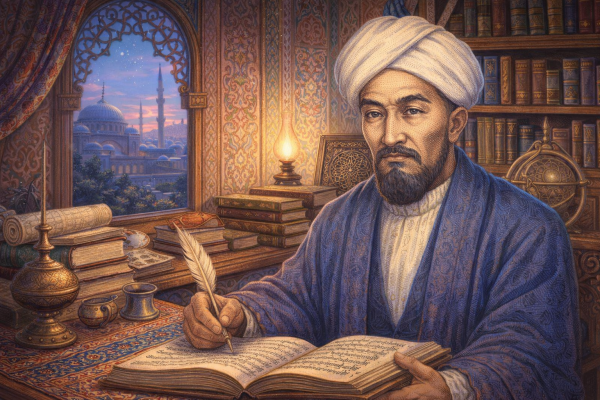
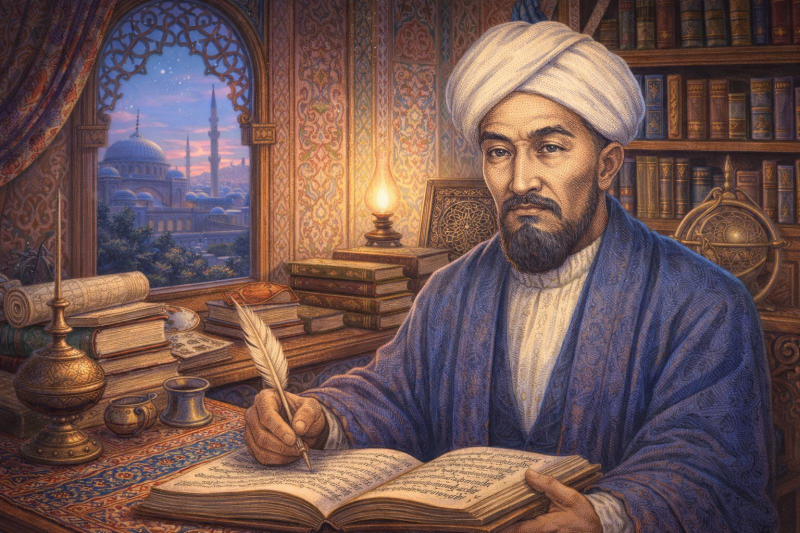
A symbolic portrait of Abu Nasr al-Farabî.

(Born circa 870 CE – Died between 14 December 950 & 12 January 951)

*

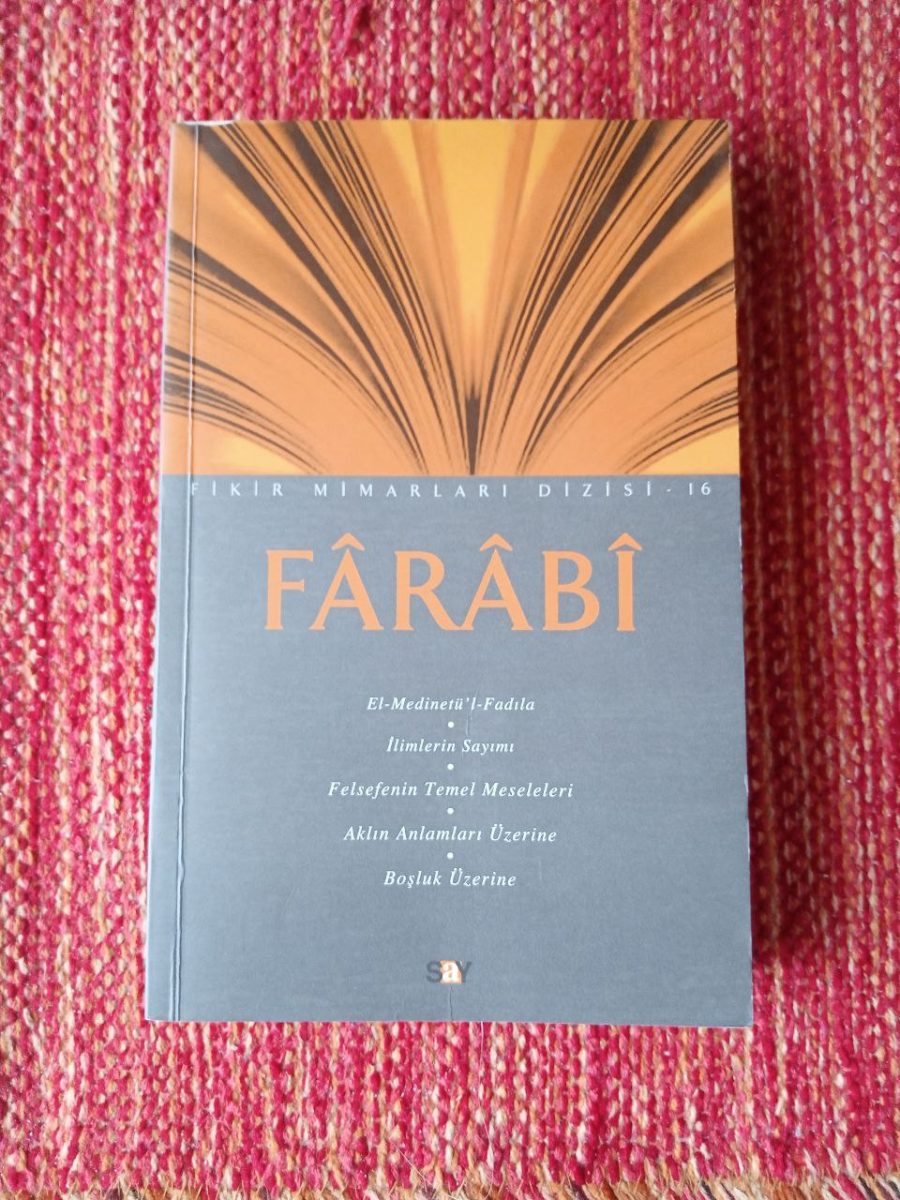
Today’s sharing from the Blue House of Via-HYGEIA is part 3 of our sampler dedicated to the memory of Abu Nasr al-Farabî, comprising two little treatises we have selected due to their impressive clarity, published in 2010 by the SAY publishing company in Turkey. They were added to the anthology that follows the biographical & exegesis parts of the book, and were actually published earlier in 1951 for ‘On the Necessity of the Art of Alchemy‘ and in 2003 for ‘On What is True and What is False in the Judgments of the Stars‘ (Astrology).

These two treatises offer a remarkable insight into the great philosopher’s critical and hierarchical approach to knowledge. In both works, al-Farabî applies rigorous philosophical and logical standards to evaluate disciplines that operated on the border between science, art, and speculation in his time.

Rather than outright dismissing alchemy or astrology, he meticulously delineates their possible boundaries: alchemy is presented as a genuine but exceedingly difficult natural science, accessible only to the philosopher who has mastered logic and the study of minerals, and its methods are deliberately obscured to protect social order.

His astrological treatise, framed as a response to a seeker’s disillusionment, performs a crucial epistemic separation, distinguishing the mathematical certainty of astronomy from the conjectural nature of astrological predictions about human affairs.

Together, these texts reveal al-Farabî’s core belief that true understanding in any field must be grounded in sound methodology, logical proof, and ultimately, the overarching wisdom of philosophy.

**

A Little Contextual Information

Abu Nasr Muhammad ibn Muhammad al-Fārābī, known in the Latin West as Alpharabius, was a luminary of the Islamic Golden Age whose work systematized and advanced the entire field of philosophy. He was born circa 870 CE in Fārāb (in modern-day Kazakhstan) or possibly Wasij, a district of Fārāb, reflecting his Central Asian Turkic origins. His early education occurred in the culturally vibrant cities of Bukhara (in modern Uzbekistan) and Marw (in modern Turkmenistan) before he embarked on a scholarly migration westwards, drawn to the intellectual heart of the Abbasid Caliphate.

His most significant travels led him to Baghdad, the cosmopolitan capital, where he spent decades studying under Christian Aristotelian scholars. He later moved to Damascus and Aleppo in Syria, where he found patronage at the court of the Hamdanid ruler Sayf al-Dawla. He died in Damascus in 950-951 CE.

Al-Farabî:’s life work was monumental in scope, earning him the honorific titles “al-Mu’allim al-Thānī” (The Second Teacher), with Aristotle being the first, and “Virtuous Ruler.” His corpus was a grand synthesis aimed at harmonizing and extending Greek philosophy within an Islamic intellectual framework. His key contributions include:

  1. Philosophy of Logic and Epistemology: He established logic as the essential tool for all scientific inquiry, creating foundational Arabic terminology and commentaries on Aristotle’s Organon.

  2. Political Philosophy: In his most famous work, al-Madīna al-Fāḍila (The Virtuous City), he modeled the ideal state on the cosmos, with a philosopher-prophet as its leader, blending Platonic guardianship with Islamic concepts of prophecy.

  3. Metaphysics and Cosmology: He developed a sophisticated Neoplatonic theory of emanation, explaining how the universe proceeds in hierarchical stages from the One (God), reconciling philosophical necessity with religious creation.

  4. Integration of Sciences: He created detailed classifications of the sciences, providing a coherent map of all knowledge from language and logic to physics, metaphysics, and politics.

Al-Farabî: is considered a supreme luminary within the Islamic world for several reasons:

  • The Great Systematizer: He was the first to fully integrate Platonic and Aristotelian philosophy into a coherent system that could engage with Islamic theology and law, providing a rational foundation for the civilization’s intellectual pursuits.

  • The Bridge-Builder: His work created a viable philosophical language in Arabic, enabling subsequent giants like Ibn Sīnā (Avicenna) and Ibn Rushd (Averroes) to build upon his foundations. He also served as a crucial conduit of Greek thought to both the Islamic world and, later, Medieval Europe.

  • The Philosopher of Society: By focusing on the role of philosophy in guiding the perfect society, he made philosophy socially relevant, addressing core questions of leadership, law, and human happiness within an Islamic context.

  • The Model of the Sage: His persona—ascetic, dedicated solely to contemplation, and seeking harmony between reason and revelation—became the archetype of the philosopher in Islamic culture.

In essence, Farabî laid the indispensable groundwork for Islamic Peripatetic philosophy (falsafa), transforming Hellenistic heritage into a living intellectual tradition that would define centuries of scholarly discourse in the Muslim world and beyond.

*

And now

the two treatises

*

TRUE AND FALSE INFORMATION ABOUT ASTROLOGY

This text, in which al-Fārābī explains his views on astrology, is taken from his article titled ‘Maqālah fī mā Yaṣiḥḥu wa mā lā Yaṣiḥḥu min Aḥkām al-Nujūm’ (On What is True and What is False in the Judgments of the Stars). The article was translated into Turkish by Mahmut Kaya. Philosophical Texts from Islamic Philosophers, Istanbul 2003.

Introduction

Abū Isḥāq Ibrāhīm ibn ‘Abd Allāh al-Baghdādī says: I was very eager to learn about astrology, working hard to learn its practice, constantly reading books written on the subject, and trusting in their correctness. I had no doubt that the errors in astrology stemmed from scholars’ failure to acquire the necessary knowledge on the subject and from their not paying enough attention to calculation, observation, and the instruments used. I believed that once these deficiencies were eliminated, obstacles would be overcome, consensus would be reached on all that was described, the correctness of astrology would be revealed, it would be utilized through prediction, knowledge of future events would be attained, and the unseen would be discovered and secrets unveiled.

My belief had long been in this direction. However, throughout this long period, I was strengthening my mathematical knowledge, continuing my research by making observations with new instruments. But these researches were leading me further away from the goal and driving me to despair; finally, I fell into distress and my confidence in astrology was lost. In hopes of finding a cure to escape my distress, I conducted research on the books written by predecessors on this subject. Eventually, I saw that in the books of the wise and truth-seeking, such knowledge was not found and that they did not deem it important. Thereupon, my certain truths turned to doubt, my belief to conjecture, and my trust to accusation.

Days passed, time advanced, but my troubles persisted. One day I encountered Abū Naṣr Muḥammad ibn Muḥammad al-Fārābī al-Ṭarḥānī and told him of the troubles I was experiencing. With complete sincerity, I told him I wished to learn the true value of this science and to know the truths and falsehoods regarding it. I asked him to reveal to me the truths he knew on this matter and to explain the views of the earlier sages. He responded favorably to my request; he explained the principles and subjects of astrology one by one, down to its essence and reality, and we exchanged our views on the matter.

One day he brought out and gave me a booklet composed of short paragraphs, written in his own hand. As was his habit, it appeared he intended to gather his scattered writings and compile them into a book or treatise at an opportune time. I immediately copied it and began to ponder it. I had now found what I was seeking, was freed from the suspicion I had long been unable to shake off, and my heart was at ease because I had grasped the essence of his aim. He was explaining to me what was possible and impossible in astrology.

If you are interested and wish to ponder it, here is the copy I transcribed for you from that booklet‘.

  1. Abū Naṣr al-Farabî says: The value of sciences and arts is measured by one of three things. These are either the value of its subject, the soundness of its proofs, or the greatness of the benefit it provides, whether now or in the future. Compared to others, the religious sciences and arts, which everyone and every society always needs, are those whose benefit is great. That which derives its value from the soundness of its proofs is geometry. That which is considered valuable in terms of its subject compared to others is astronomy. Sometimes these three or two values are combined in a single science, and that is metaphysics.

  2. Sometimes a person is optimistic about a science, thinking it is more beautiful, more sound, and more clear and distinct. This situation arises either from that person’s inability, due to a defect or deficiency in their nature, to understand the true essence of that science, or from their failure to reach a level of understanding matters contrary to their own knowledge on the subject, or from looking at the virtue of those who produced and adopted that science, or from considering the multitude of those who adopted it, or from thinking that if that science were realized, everyone would benefit from it extensively and thus desiring its realization with great eagerness, or from most of these mentioned reasons being combined in that science.

    Being seized by such a conjecture can lead a person to accept the non-universal as if it were universal, a non-conclusive syllogism as if it were conclusive, and a non-proof as if it were proof.

  3. If two similar things are found in a place, and then a third thing which is the cause of one of these two emerges, the mind similarly judges that this third thing is also the cause of the other; however, this judgment is not valid for both similar things. Because similarity can sometimes arise from an accident as well as from essence (i.e., similarity can be indirect as well as direct).

    According to this description, the syllogism formed in the mind also occurs through the comparison of two things. Example:

    Man is the one who walks.
    Man is an animal.
    Therefore, the one who walks is an animal.

    The horse is similar to man
    Because it also walks.
    Therefore, the horse is also an animal.

    However, this syllogism is not valid everywhere. Example:
    The phoenix is a white animal.
    Lead is also white, but it is not an animal.

  4. Events occurring in the universe are of two kinds. One of them consists of events whose causes of occurrence are known, such as heat arising from fire and the Sun, their heating of nearby and opposite bodies, and other similar events. The other consists of events whose cause is unknown, described as chance, like a person dying or surviving at the time of the Sun’s rising or setting. Every event with a known cause is of the kind that can be known, its rules determined, and research conducted on it. For every event that occurs by chance, there is absolutely no possibility of its being known, its rules being determined, or its being researched. Their causes are not with the celestial bodies, nor are these [events] with the celestial bodies.

  5. If there were no events occurring by chance in the universe, people’s fears and hopes for the future would vanish. If these vanished, no order would remain in human, religious, or political affairs! Because without fear and hope, no one would work for tomorrow; the people would not obey their leaders, leaders would not watch over and protect their people, no one would do good to another, no one would obey God, and goodness would never be shown. For someone who knows that everything that will happen tomorrow will certainly occur exactly as such sees no point in striving or exerting effort to prevent harm. Since effort means enduring the hardship of something, it is considered a loss.

  6. The state of anything that can be known or attained in some way before it exists, due to any obstacle or delay, is like that of existing sciences. However, knowledge of something impossible to know, even by prediction, is only attained after it comes into existence.

  7. Of two equally possible things, one whose existence and non-existence are possible is not superior to the other; therefore, no syllogism is applied to them in any way. Because a syllogism, whether affirmative or negative, yields only a single conclusion. If any syllogistic operation yields two opposite results, that syllogism does not provide knowledge. For a syllogism is needed only to acquire knowledge about whether a thing exists or not. After the syllogism is realized, the mind no longer inclines to both opposites (affirmative and negative) together. Because first and foremost, a person possesses with their own mind some knowledge about the existence and non-existence of a thing; however, they cannot determine one of the two. If any idea or statement does not affirm one of the opposite propositions while not affirming the other, it is absurd and invalid.

  8. Experience is beneficial only if conducted on possible events that occur for the most part; experience conducted on rare events and those with equal probability of occurrence is of no benefit. As for necessities and impossibilities, it is evident that thought, ability, and experience are not used in these matters. As for conjecture, it is used in every possible event that is rare or has an equal probability of occurrence.

  9. Although it is thought that the properties belonging to natural beings, such as the burning quality of fire, the wetness of water, and the coldness of snow, are necessary, this is not the case. These (effects of natural beings) are of the type of possible events that occur for the most part. Because an action is realized only when two conditions are present together; one is the agent’s readiness to affect, and the other is the patient’s readiness to receive. Unless these two conditions come together, neither the action nor its effect is realized. For example, if fire is burning, combustion does not occur unless there is something ready to accept combustion. The situation is similar in other events. If the active and passive are together in a state of complete readiness, the [resulting] action will be at the most perfect level. If there were no resistance from the patient, the effect of natural beings would be necessary.

  10. When events whose realization is possible are unknown, every unknown has been called ‘possible’. However, the situation is not like that at all. Because converting this proposition exactly yields a false result. Yet this is merely a relationship of intension and extension, as in the example: ‘Every possible is unknown, but not every unknown is possible’. It has been said that ‘possible’ has two meanings because the unknown came to mind as being counted among the possible [category]. One of these is possible in essence, the other is possible relative to the ignorant. This difference in meaning has caused great errors and harmful [mental] confusion; indeed, most people cannot distinguish between the possible and the unknown and do not know the essence of the possible.

  11. Many people without experience, when they encounter unknown events, have begun to research them, seek knowledge of them, and examine their causes; upon attaining knowledge of those events, they became optimistic about what is possible in itself and, because they could not understand its cause, thought they did not know it, but believed that through some kind of research, knowledge of it could also be attained. However, these people did not know that the event was impossible in itself, that its knowledge could not be attained in any way, even by prediction. Because the event is possible in itself; what is possible in itself cannot be obtained, and a definitive judgment cannot be made about its existence or non-existence.

  12. Sometimes homonymous (equivocal) names cause great errors. Indeed, because many things share a common name, a judgment that is not true for one thing becomes true for another; astrology is like this. When we say ‘astrology’, this expression includes those that yield certain results like calculation and measurement; possible events that affect quality and occur for the most part; and events related to conjecture, lexical meaning, optimism, and expectation. However, these are different in their essences and are only common in name.

    Now, if a person learns and speaks about some laws concerning the stars and their dimensions, they say that person has made an astronomical judgment. Because this is a judgment of the type of necessary knowledge, and astronomical knowledge is always like this. If another says, “When a star, for example the Sun, is in alignment with any region and there is no obstacle to its heating, it heats that region,” this is also an astronomical judgment; but it is of the type of events that occur for the most part. If yet another says, “When such and such a star approaches or conjoins with such and such a star, it causes some people to become rich or an important event to occur,” this is a judgment based on conjecture, optimism, and wishful thinking. Although their name is the same (astronomy), these judgments differ from each other in terms of their essences.

    This is why, since most people lack experience and training in true sciences based on definitive proof, this subject of astronomy seems confused to them.

    The bright bodies seen in the sky have an effect on the beings on earth, according to their nature. This situation is understood from the heat of the Sun, the eclipses of the Moon and Venus, and the observation of their effects [on earth]. These effects are realized not through anything else, but only through their bright light.

*

ON THE NECESSITY OF ALCHEMY

This text, in which al-Farabî explains his views on alchemy, is taken from his article titled ‘Risālah fī Wujūb Ṣināʿat al-Kīmiyā’ (The Treatise on the Necessity of the Art of Alchemy) by the Verified and Perfect Sage Abū Naṣr al-Farabî. The article was translated into Turkish by Aydın Sayılı. Belleten, Volume 15, Issue 57, Ankara 1951.

Al-Farabî, may God have mercy on him, says: My purpose in writing this treatise is to discuss the necessity of the art of alchemy here, to state to what extent and in which aspects it conforms to reality, its true nature, and the reason for the errors made by those who are curious about this subject and who pass judgment on it.

Those who fall into error on this matter form two separate groups. One of them rejects and disparages alchemy. The other approves of alchemy, claims it is true, and exaggerates their claims by overstepping the limits of what is possible in alchemy. Both of these groups are mistaken in their judgment. As for me, I say that the aim and purpose of those who compile this art and write on this subject is to express matters in obscure parables and to prevent those who are not from the same class of wise people from understanding and learning this art from them. For this reason, in their writings on alchemy, they use literary expressions; some of them express the truth in these words mimetically, that is, symbolically and allegorically, while others write false and erroneous things.

Through their words, it is a very remote possibility to gain knowledge and understanding in the art of alchemy. Because the things they express concerning this art are not, as those ignorant of the matter assume, in their apparent meanings. Writings that are arranged and composed mimetically, symbolically, and allegorically to represent the truth are also, due to the literary expressions, muddled with false words and rendered obscure; the various words and expressions in them do not agree with each other, and for this reason, when these writings are studied, the human mind remains in doubt and difficulty, and one falls into a state of indecision, unable to settle on a specific interpretation for the meaning that should be given to these words.

Even if this kind of discourse is expressed in customary and commonly used forms, they remain completely far from becoming comprehensible. Through symbol, riddle, and enigma, in accordance with the state these authors wish to create, almost none of the examples in these expressions correspond to the meanings they actually represent.

Thus, it is necessarily the case that from writings composed in such a deceptive manner, the art of alchemy cannot be understood or grasped. Because essentially, even when the subject itself is freed from symbols and allegories and expressed clearly in plain words, it is extremely ambiguous. For alchemy is one of the branches of the natural sciences that is inherently difficult to comprehend, and without gaining knowledge in the branch of natural sciences whose subject of investigation is composite bodies with similar parts, namely minerals, it is impossible in alchemy to arrive at definitive judgments, to perform perfect proofs (verification), and to clearly establish concepts and definitions (conception). Knowledge about minerals, however, is only possible after possessing perfect knowledge of logic and after having full understanding in the branch of natural sciences that precedes the science of minerals.

The factor that leads alchemists to use obscure expressions is this: They have discovered the methods and paths used in this art. However, if they did not hide and hoard the benefits obtained through this art by resorting to symbolic expression, the damage that would befall nations and cities due to these discovered alchemical methods would be immense.

Indeed, when this matter is considered from this perspective, it is clearly seen that if the methods and paths in the art of alchemy were publicly known, no human community could achieve complete stability, the gains provided by gold and silver would vanish, and it would be necessary to accept other substances as the basis for commercial transactions. However, it has become evident to the whole world that it is necessary to base commercial transactions on gold and silver, that there is no third mineral to take their place, and that even if such a substance existed, the same considerations and circumstances that apply to gold and silver would apply to this substance as well.

It is for this reason that alchemists do not make explicit declarations in the books they write about the methods used in their art. Essentially, their purpose in composing these books is not to teach their art or to disclose professional secrets. In producing these works, they act solely with the desire to provide encouragement and incentive for human minds on the path of scientific endeavor. For by their very nature, things of this kind are what initially generate a desire for something in a person and thus create an inclination towards acquiring scientific knowledge.

Those possessing superior intelligence, through this path and unknowingly, attain complete scientific comprehension and purification (i.e., spiritual refinement and elevation), and in that case, the feeling of pride (i.e., rightful and justified exultation) they feel due to the things they apprehend through philosophy becomes much greater than the pride that the art of alchemy instills in them. Thus, insignificant things sometimes play the role of the cause for important things in this way.

The conclusion that clearly emerges from what we have said above is this: Success in the art of alchemy is only possible through a sound reasoning ability, which is acquired by possessing understanding in the science of minerals and by obtaining certain and accurate knowledge in this branch of science. Therefore, understanding of alchemy is only possible after learning philosophy.

Consequently, on the one hand, the share a person knowledgeable in alchemy receives from the branches of philosophy increases, and on the other hand, since philosophy represents a perfect wisdom that enables the comprehension of the truths about things, a person equipped with philosophical knowledge can consider alchemy within the scope of this knowledge and understand it more comprehensively.

For this reason, only a person who is a philosopher pays attention to alchemy, and if anyone other than a philosopher learns it, the greatest calamities arise from it.

*

Source

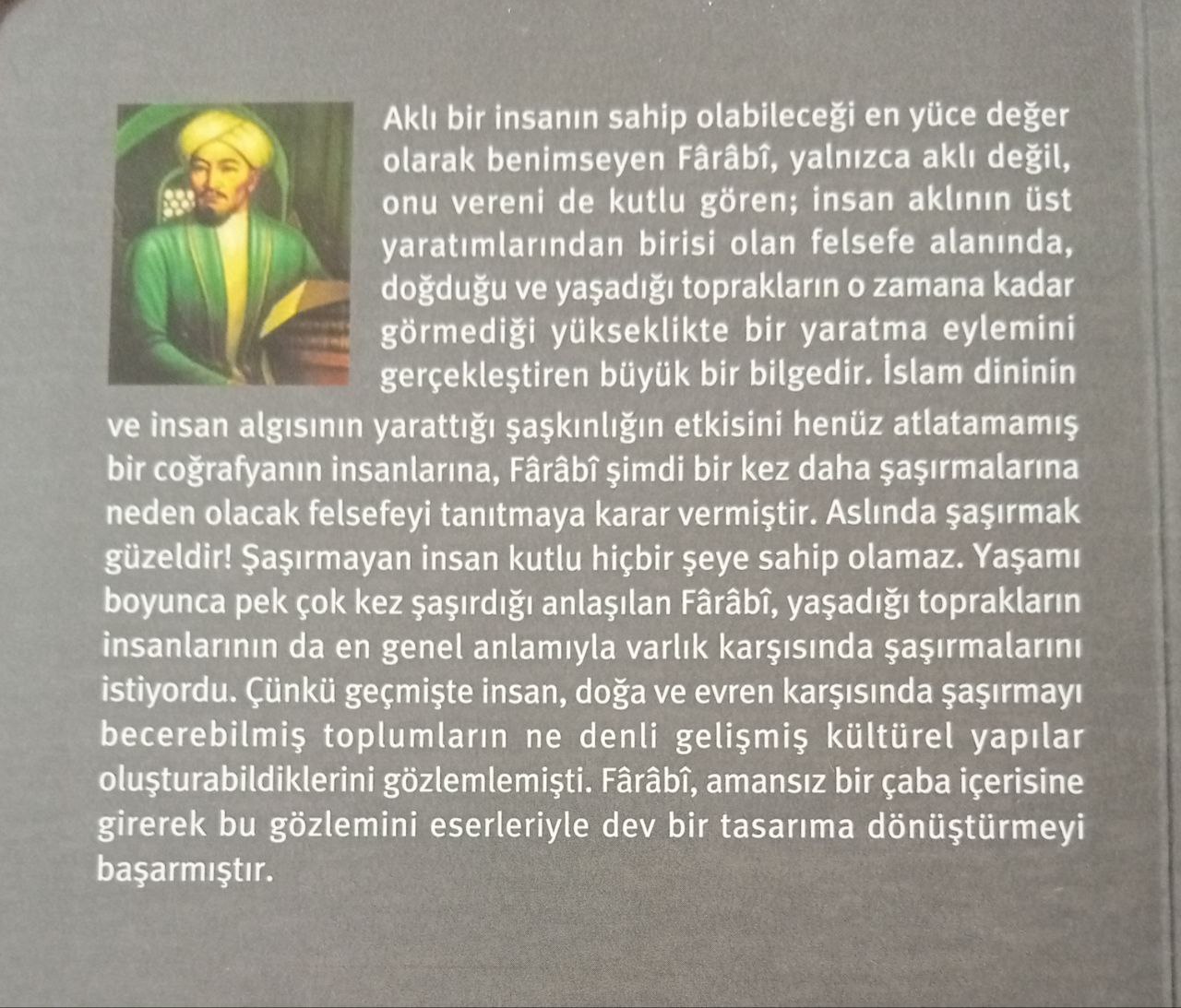
From the back cover: Embracing intellect as the most sublime value a human can possess, al-Farabî is a great sage who not only considered the intellect itself blessed but also its Giver; who, in the field of philosophy—one of the highest creations of the human intellect—achieved an act of creation at a height unseen in the lands where he was born and lived. To the people of a geography still reeling from the impact of the astonishment created by the Islamic religion and human perception, al-Farabî now decided to introduce a philosophy that would cause them to be astonished once again. And in fact, to be astonished is a beautiful thing! A person who is not astonished cannot possess anything blessed. It is clear that al-Farabî, who himself experienced astonishment many times throughout his life, wished for the people of his land to be astonished, in the broadest sense, in the face of existence. For he had observed how societies capable of being astonished by humanity, nature, and the universe in the past were able to form highly developed cultural structures. By embarking on a relentless effort, al-Farabî succeeded in transforming this observation of his into a grand design through his works.

*

***

More about Abu Bakr al-Farabi: https://en.wikipedia.org/wiki/Al-Farabi 🌿 About the publisher and the book:https://saykitap.com/urun/farabi/
A Little Abû Nasr al-Farabî Sampler – Part 3: About Astrology and Alchemy

Leave a Reply

Your email address will not be published. Required fields are marked *

This site is protected by reCAPTCHA and the Google Privacy Policy and Terms of Service apply.

The reCAPTCHA verification period has expired. Please reload the page.

All rights reserved by Via Hygeia 2022.