
Circle of Transmission: The Living Loom
Thomas Bromley: From ‘Ten Little Treatises’- The Tenth- ‘Of the Union and Communion with Spirits on our Way through the Inner to the Eternal’
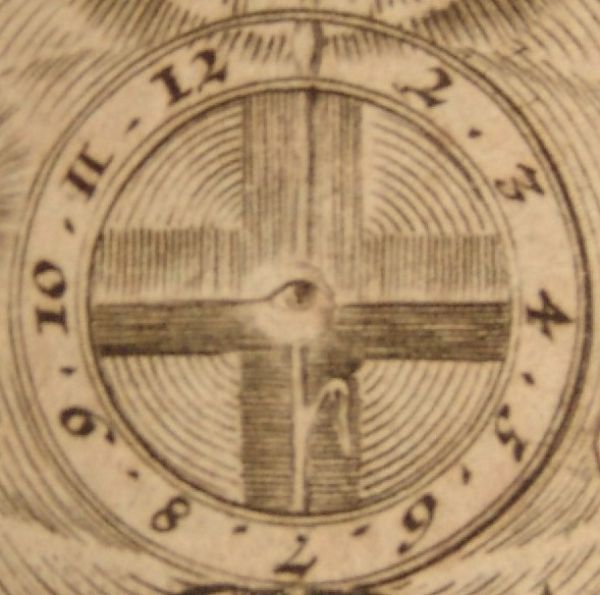
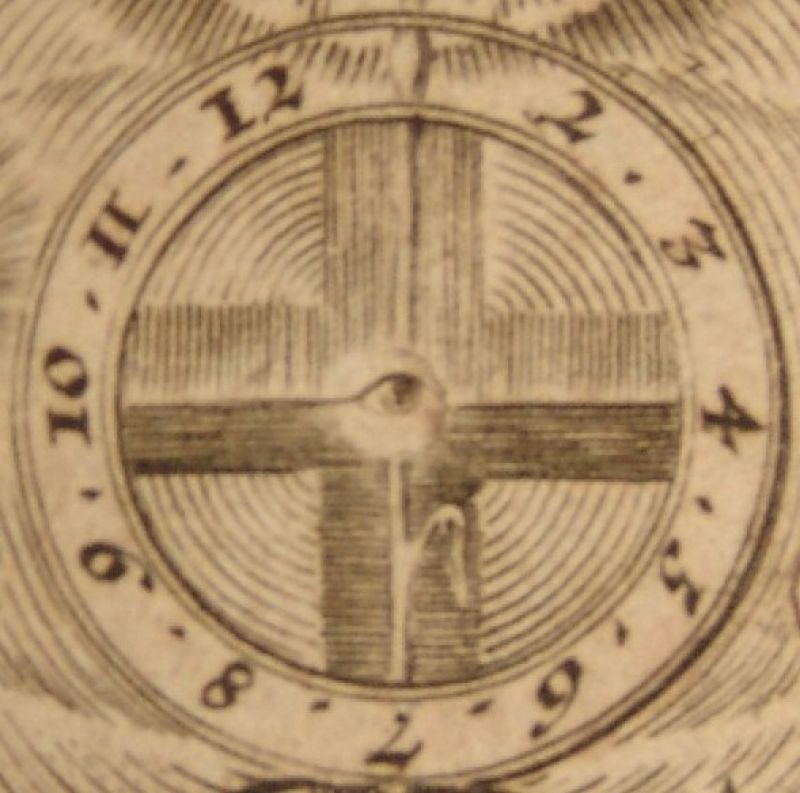
Detail from the frontispiece of the 1709 Amsterdam edition
of Thomas Bromley’s ‘Way to the Sabbath of Rest’.
*
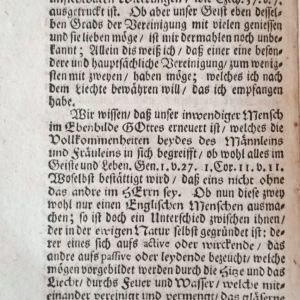
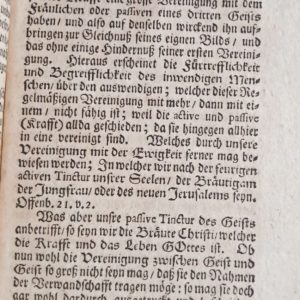
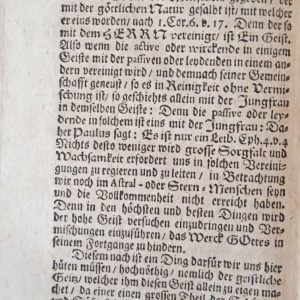
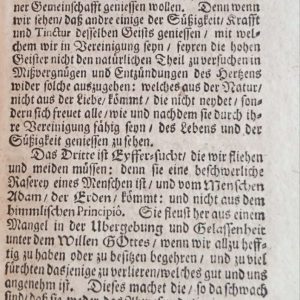
Today’s sharing from the Blue House of Via-HYGEIA is the Tenth Treatise, a gem excerpted from Thomas Bromley’s posthumous 1714 ‘Ten Little Treatises‘ published privately in Amsterdam using Loth Fischer (1640-1705) earlier translation manuscripts. Fischer is the amazing and tireless German translator, who worked with the legendary publisher Heinrich Wettstein and was an active member of the Amsterdam-based network of German mystics (mainly around Gichtel).
Thank to his meticulous and qualitative labor of love, Jane Leade and John Jordage were also translated, thus introducing the English Philadelphians in Germany to an heteroclite population of contemporary Mystics, Pietists, Boehmists, Labadists, Gichtelian, etc…
The beauty and value of translation here meets an odd turn: due to the existence of the German editions, the ‘Bromleyian Corpus‘ could be salvaged from oblivion, because the English originals were a some point ‘lost‘ making it impossible to read any thing else than the earlier published English ‘trilogy’; and if we wanted to read the remnant of Bromley’s impressive work, we can only read it from the German editions, hence their crucial importance.
We call here upon a brave English publishing company to consider editions of the vast corpus of unpublished (in English) works of Thomas Bromley (& John Pordage), to start with.
As for us, at Via-HYGEIA Bibliotherapy, we will continue to herald these essential treatises’ journey back home, by publishing exemplary excerpts from these lengthy German editions.
**
Thomas Bromley (1629 – 1691) -The Tenth Treatise.
(Restored back into its original English)
‘Of the Union and Communion with Spirits
on our Way through the Inner to the Eternal’
In our progression from the Natural into the Spiritual, from the Outward into the Eternal Image, on our way from the Circumference or Outwardness into the Centre or Inwardness, out of Time into Eternity, we encounter many difficulties, great dangers, and strong oppositions before we can reach the end of our pilgrimage. Some find the greater difficulty in overcoming the Dragon, or the soul’s fiery wrath; others, in subduing the Beast, or the spirit of the World; others struggle to wander through the inner Oil-Nature, wherein the pieces of the Tincture present themselves in their beauty and sweetness; and this diversity of states arises from the diversity of the Signatures or designations of the soul-birth, according to how each one was constituted at the time of their conception and birth, or what was standing in the Heaven and had its influence and effect.
We must know that our entire progress or advancement consists in nothing but Life and Death, until Death is swallowed up in victory; and just as we die daily to the first and third Principia-that is, the kingdom of the wrathful quality, or of the fiery Dragon, and the outward kingdom of this World; so is a spirit daily born again in the other Principium, which comprises the Eternal and inward or Paradise for the soul.
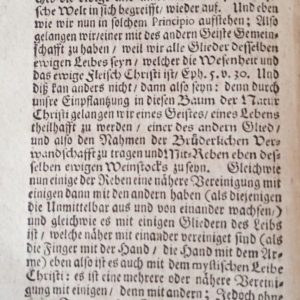
And just as we now arise in this latter Principium, so we attain to have communion with one another’s spirit, because we are all members of the same eternal Body, which is the fullness and the eternal Flesh of Christ, Eph. 5:30. And we find this to be so; for through a single ingrafting into this Tree of the Nature of Christ we become partakers of one Spirit, of one Life, one another’s members, and thus to bear one another’s burdens and to be useful members of the same living Body. Just as in this body one part has a closer union with some than with others (as those which grow immediately out of and from one another), and just as it is with some members of the body which are more closely united with each other (as the fingers with the hand, the hand with the arm), so it is also with the mystical Body of Christ: there is a greater or closer union with some than with others; yet without any division of the Whole. For if it were not so, the Body could not be joined and maintained in due proportion and symmetry, which must flow from Diversity in Unity: for just as Unity is the foundation and pillar of Diversity, so Diversity is the ornament and glory of Unity.
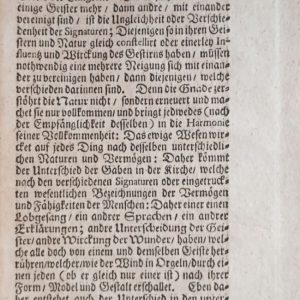
The reason, however, why some spirits are more united with one another than others is the inequality or diversity of their receptivity; those spirits who are alike in joy and nature, who have a simple or uniform imprint and division of the constellation, must of necessity have a greater inclination and propensity to unite with one another than those who are diverse therein. For Grace does not destroy nature, but renews it and makes it perfect, and brings each thing (according to its receptivity) into the harmony of its primal humanity.
The eternal Being impresses itself upon each thing according to its particular, distinctive nature and capacity. Hence arises the diversity of Gifts in the Church, which are according to the diverse Signatures or impressed essential determinations of the faculties and capabilities of men: hence one has a song of praise, another tongues, another interpretations; others the gift of prophecy, another the working of miracles, all of which, however, are from one and the same Spirit who divides severally as He wills, as the wind blows where it lists, through each one (though He is but one) according to their form, model, and configuration.
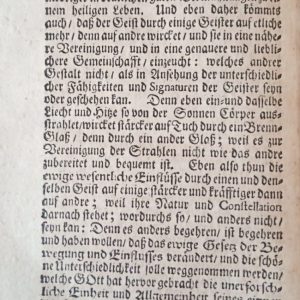
From this very source also arises the diversity in the different writers of the Holy Scriptures. Paul expresses himself in high and elevated words and veiled speeches. Jeremiah and others are in their writing and speech more simple and plain. John is very lofty in the mysteries of Revelation, of divine Love, and unity. James is lower in clear, good admonitions to a holy life. And from this it also comes that the Spirit works through some spirits more powerfully upon some than upon others, and brings them into a closer union, and into a more intimate and loving communion: which cannot be or happen otherwise than in consideration of the diversity of the faculties and Signatures of the souls.
For one and the same sunbeam, radiating from the body of the sun, acts more strongly and burns through one burning-glass than through another glass; because it is not prepared and fitted for the union of the rays like the other. Even so, the eternal divine Effluences work through one and the same Spirit more powerfully and swiftly upon some than upon others; because their nature and constellation are constituted accordingly; whereby it so, and not otherwise, can be.
For to desire it otherwise is to desire and wish to have the one Law of the divine motion and influence changed, and the lovely Diversity to be taken away, which God has brought forth to express the unsearchable loving Unity and Universality of His own Being in particular images.
We do not find that Jonathan and David in Scripture are reproached for their unanimity and upright love; but are rather set forth more as examples to others, who are of a quarrelsome disposition and want to make everything straight and even according to their own head, and gladly create division.
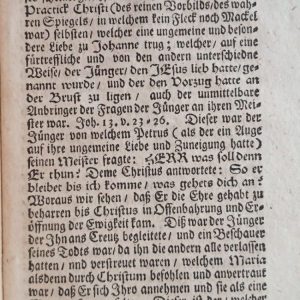
And this is likewise shown very clearly to us from the practice of Christ (the pure Pattern, the true Mirror, in whom was no spot nor blemish) Himself, who bore an uncommon and special love for John; who, in a mysterious and way distinct from the others, was called the disciple ‘whom Jesus loved’, and who had the privilege of lying on His breast, and was also the immediate presenter of the disciples’ questions to their Master. John 21:21-22. This was the disciple of whom Peter (as he had an eye on their uncommon love and affection) asked his Master: ‘LORD, what shall this man do?‘ Christ answered: ‘If I will that he tarry till I come, what is that to thee?‘ From which we see that he had the honor of remaining until Christ came in revelation and opening of Eternity. This was the disciple who accompanied Jesus to the cross, and was a beholder of His death, when all the others had forsaken Him and were scattered, and to whom Mary was then by Christ commanded and entrusted, that he should take her to himself and acknowledge her as a mother.
This is he who (through union with his BRIDEGROOM, and through the love to Him, together with the counter-love from Him) arises to the reality and Purity of this union and communion of spirits, which is mediated through the powers of prayer, which God sends to His own according to the secret counsel of His unsearchable workings, as is expressed in Zech. 3:7. But whether a spirit here below may enjoy and partake the degree of union with many is not yet known to me at present; Only this I know, that one may have a special and principal union, at least with one; which I will confirm according to the light that I have received.
We know that our inner man is renewed in the image of God, which comprises the perfections of both the Male and the Female, albeit all in spirit and life. Gen. 1:27 & 1 Cor. 11:11. Whereby it is confirmed that one is not without the other in the Lord.
Now although these two make but one heavenly man, yet there is a distinction between them, which is grounded in the eternal Nature itself; the one manifesting itself as the active or imparting, the other as the passive or receiving, which may be typified by the Hot and the Cold, by the Fire and the Water, which, united and mingled together, make the glassy Sea, as is expressed in the Revelation.
Now a heavenly spirit, which possesses these two natures or powers in itself, may be passive to one, a general union with the active or fiery power of the same spirit: so that there may be a high and mysterious communion between their two Tinctures. And this same spirit may, through its active or strong power, have a great union with the passive or receptive power of a third spirit, and thus work upon it, raising it up to the likeness of its own image, and that without any prejudice to its first union.
From this arises the greater comprehensibility and perceptibility of the inner man beyond the outer; for the outer man is not capable of this regulated union with more than one; because the active and passive (powers) are there separated; whereas in the inner they are united into one. This can be made known through our union with the Bridegroom; in which we, according to the fiery active Tincture of our soul, are the Bridegroom of the Virgin, or of the new Jerusalem. Hos. 2:19-20.
But as regards our passive Tincture of the spirit, we are the Brides of Christ, who is the Power and the Life of God. Now although the union between spirit and spirit may not be so great as to bear the burden of kinship, yet it may well be expressed and described thereby, because it is a semblance thereof. And since this is pure, it does not bind our union with Christ, or our Virgin.
For when the passive power of one spirit is united with the active of another, so that it gives to it its spiritual love, it is given to Christ or the Son of Man, who is united with the human nature, with which He became one, according to 1 Cor. 6:17. ‘For he who is united with the LORD is One Spirit‘. Thus, when the active or imparting in one spirit is united with the passive or suffering in another, and consequently partakes closely of its communion, if it is in purity without diminution, it happens only with the Virgin in the same spirit: for the passive or suffering in such a one is one with the Virgin: Therefore, Paul says: ‘There is but one Body‘. Eph. 4:4. All the more, great care and diligence is required to govern and direct ourselves in these unions, considering we are still in the Astral- or Star-Body and have not attained perfection. For in the highest and holiest things, the enemy seeks to introduce error and mixtures, to hinder the Work of God in its progress.
Accordingly, one thing we must guard against here is highly important, namely the selfish spirit, which seeks to appropriate this spirit for itself alone, when one sees and recognizes a great ideal of beauty and unity. For although the love which draws one to such a spirit may come from a true ground of union, and thus be good in its origin, yet the desire for exclusiveness, and to keep everything for oneself, does not come from Love, which is a communicative Principium, but from Nature, in its selfish quality.
The second is the envy which the liar works to stir up against those who also have a share in the same spirit and wish to enjoy its communion. For when we see that others enjoy some of the sweetness, power, and Tincture of the spirit with which we are united, the high spirits are not willing to renounce the natural part, to give vent to displeasure and heart-burnings against such; which comes from Nature and not from the Love of Christ, which is not jealous, but rejoices in all, how and insofar as they are capable through their union, to see them enjoy the life and sweetness.
The third is Jealousy, which we must flee and avoid: for it is a special plague of man, and comes from the old Adam, from Nature, Envy, and not from the heavenly Principium. It arises from a lack in surrender and resignation under the Will of God, when we all too eagerly desire to have or to possess, and fear too much to lose that which is good and pleasant to us. This makes those who are so weak that they can neither bear the absence of what they love, nor the presence of those they fear as competitors for what they would gladly enjoy. This is far beneath the state of a perfectly surrendered and resigned soul, which places its confidence in God and knows well that He will distribute His gifts according to His Will and good pleasure, notwithstanding outward things may seem to run directly contrary. Therefore it must be suppressed and cut off; for it cannot enter into the kingdom of Love.
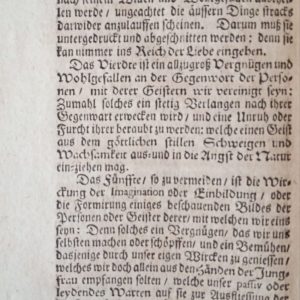
The fourth is an all-too-great pleasure and delight in the presence of the persons with whose spirits we are united: Especially since such will awaken a hasty longing for their presence, and a disquiet or fear of being deprived of them; which may draw a spirit out of the peaceful, still silence and watchfulness and into the anxiety of Nature.
The fifth thing to avoid is the working of the Imagination or fantasy, or the forming of any particular image of the persons or spirits with whom we are united: For such is a pleasure which we make or concoct for ourselves, and a presumption to enjoy through our own working that which we should receive solely from the hands of the Virgin, which requires our passive or receptive waiting upon her for the outpouring of the Tincture, whether it happens mediately or immediately, as she pleases.
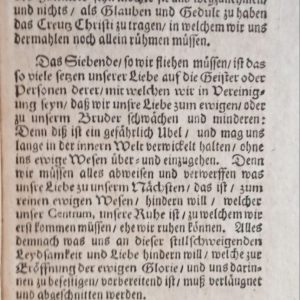
The sixth thing we must guard against is our all-too-great pleasure in these agreeable Tinctures, which we receive from the spirits through thinking much upon them: For such may draw us into a love of sensitive sweetness and a desire for its continual continuance; whereas we should be at peace to be deprived of it at any moment, if it should be the Will of the Godhead to take it from us, and to have nothing but faith and patience to bear the Cross of Christ, in which we must alone glory for the present.
The seventh thing we must flee is the setting of our love so much upon the spirits or persons with whom we are in union, that we postpone and diminish our love to the Eternal, or to our Bridegroom: For this is a dangerous evil, and may keep us long detained in the inner world, without passing over and entering into the Eternal Being. For we must deny and reject everything that would hinder our love to our Beloved, that is, to the one Eternal Being, who is our Centre, our Rest, to whom we must first come, before we can rest. Everything, therefore, that would hinder us in this soul-quickening activity and love, which is preparatory to the partaking of the eternal Glory, and to our being established therein, must be denied and cut off.
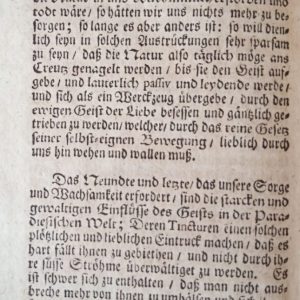
The eighth thing we must guard against is the awakening of Nature, through expressions or outpourings of love, which, though they may be permitted, may yet often be unseasonable, out of caution or fear that they might arouse something from Nature, which might mix itself with the pure outpourings of love that flow from the pure Life in us: Were Nature in us perfectly dead and dying, we would have nothing more to fear; but as long as it is otherwise, we must be very watchful in such expressions, that Nature may thus daily be nailed to the Cross, until it gives up the ghost, and becomes thoroughly passive and suffering, and gives itself over as a victim, to be slain and entirely driven out by the conquering Spirit of Love, which, through the pure glass of its own self-motion, must sweetly weave and flow through us.
The ninth and last thing that requires our care and watchfulness, are the strong and powerful inflows of the Spirit in the Paradisiacal World; whose influx makes such a sweet and lovely feeling, that it is hard to refrain from them, and not to be overwhelmed by their lovely sweetness. It is difficult to contain oneself from embracing them more closely and giving oneself over to them and to the spirits from which they proceed: since yet these whole unions and conjunctions may be transient, and not of long duration, which come from given operations; Whereas those are the abiding and permanent ones, which happen gradually and gradually, or from one degree to another, through the likeness of Signatures, as the spirits rise out of Nature into Eternity, when each one comes to its God, its Sun to its Sun, according to a kind of law of necessity, which no one can hinder.
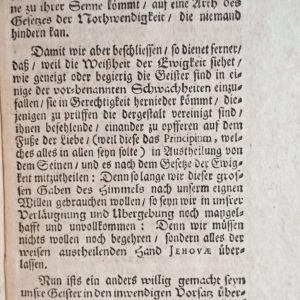
But so that we may be preserved, it further serves that, because the Wisdom of Eternity itself sees how inclined or eager the spirits are to fall into some of the aforementioned weaknesses, it comes down in mercy to test those who are united in such a manner, commanding them to sacrifice one another on the altar of Love, (because this is the Principium which should be all in all) in renunciation of one’s own, and to share it according to the law of Eternity: For as long as we wish to use these great gifts of Heaven according to our own will, so long we are still deficient and imperfect in our self-denial and surrender: For we must will and desire nothing, but leave everything to the wise and all-governing Hand of Jehovah.
Now it is one thing to be fully resolved to surrender our spirits into the inner court of sacrifice, because the commandment of Jehovah is strong upon one; And it is another thing to live in such a practice, so that we acknowledge, desire, and seek nothing as our own, except what the eternal Will voluntarily gives: For this requires the cutting off of all selfishness, desire, lust, dispute, jealousy, anxiety, and everything else that might seek to introduce any disquiet or partiality among the brethren who wish to live together in love and unity, as members of one Body, branches of one Vine-Stock, heirs of one Principium, which is the kingdom of Love, the eternal Essence, without beginning and without End.
*
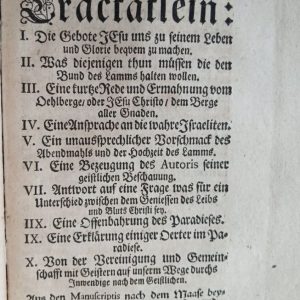
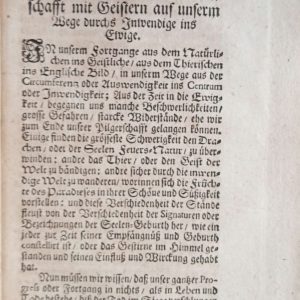
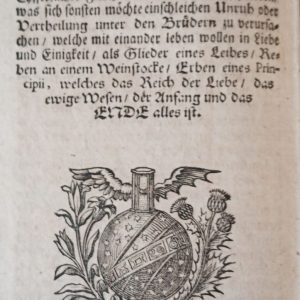
From the 1714
German Edition
*
The full WSOR 1709
German Edition frontispiece
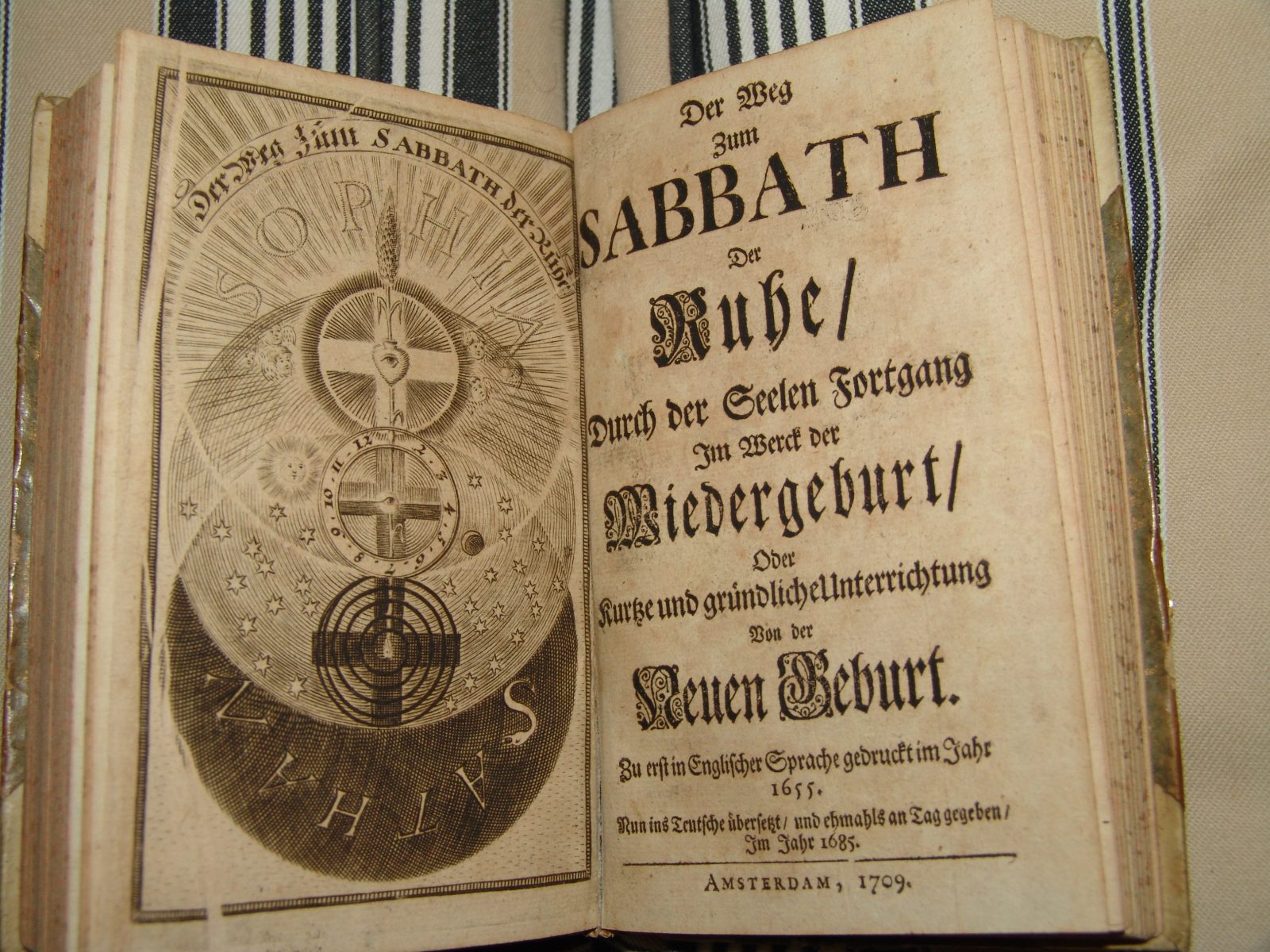
And its explanation
by Thomas Bromley himself
**

Related Articles


Leave a Reply