
Circle of Transmission: The Living Loom
ROSERIUS – Occult Science & The Early Theosophical Society

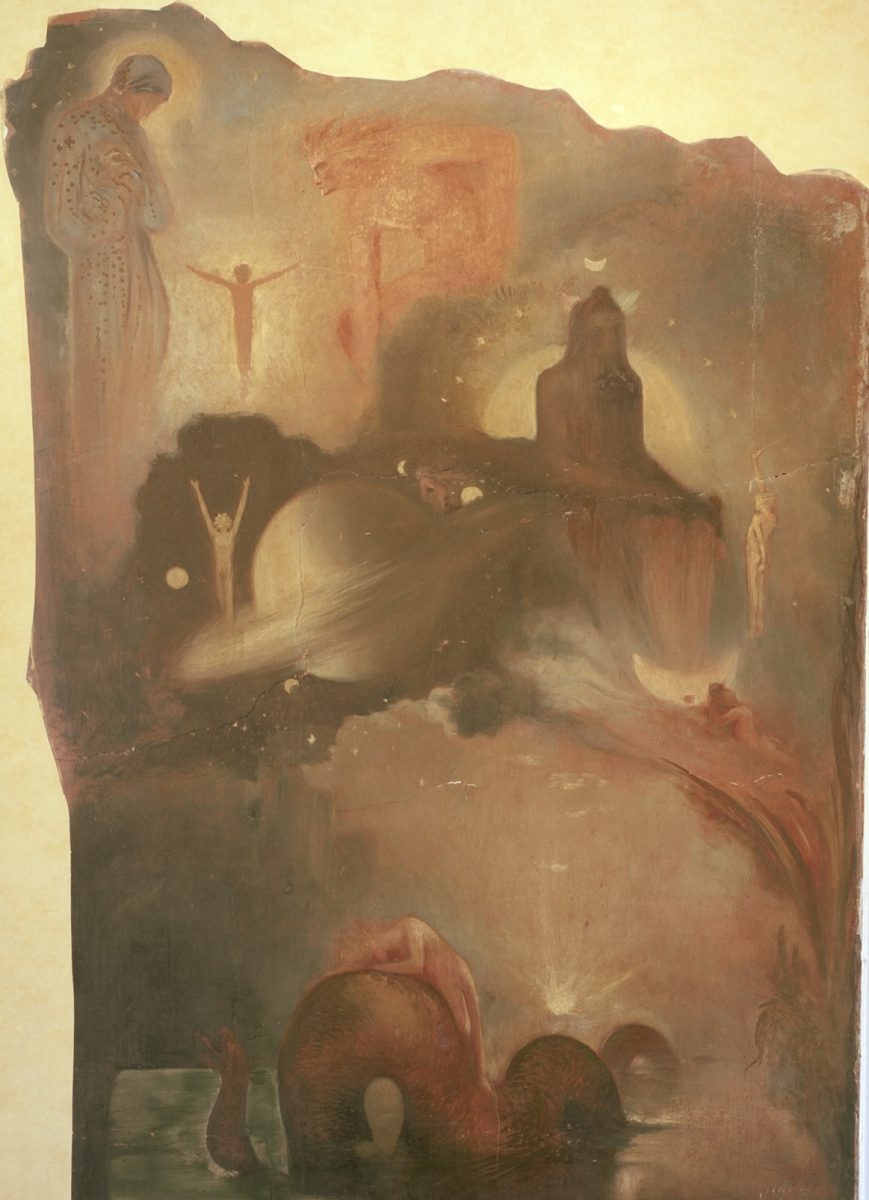
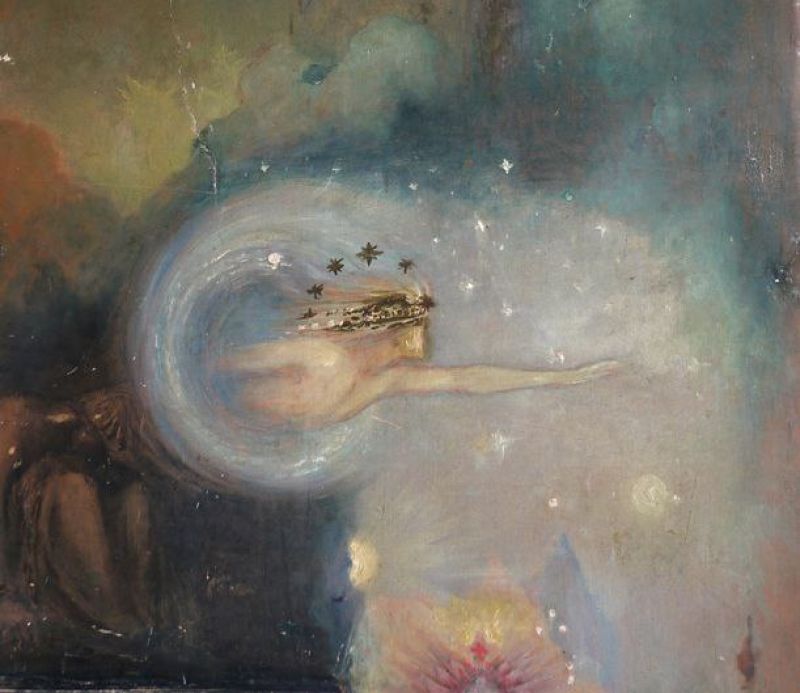
Detail from a mural painting (right part) by W. B. Yeats and George William Russell (Æ), with theosophical themes. In the Drawing Room, at 3 Ely Place Upper, Dublin (former meeting place for the Theosophical Society). Picture by Sally North taken for her book written with James North: ‘A History of Irish Magic’.
*
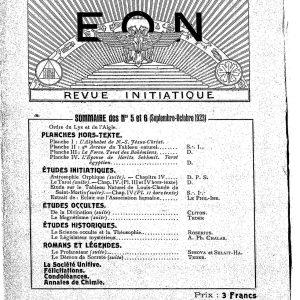
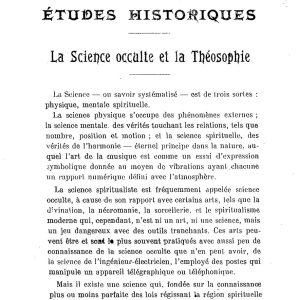
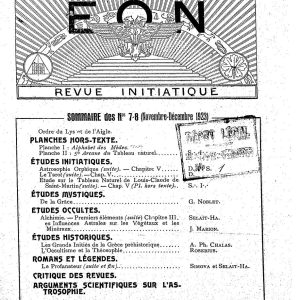
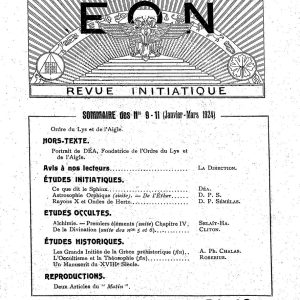
Today’s sharing from the Blue House of Via-HYGEIA is an intriguing article, ‘Occult Science & Theosophy‘, published in three parts in the French magazine Eon from September 1923 to March 1924, under the pseudonym of ‘ROSERIUS’, long after the heyday of Mrs. Blavatsky and during the rise of figures like Annie Besant; the article can be seen as a reactionary text from more traditional, perhaps Esoteric Christian, Rosicrucian or Martinist, circles against the populist, syncretic, and very public success of Theosophy.
In fact, Eon is the banner of the Order of the Lily and the Eagle, of Rosicrucian and Martinist creed & lineage, but this article is the only of its kind in the whole publication story of the magazine, with its polemical tone. It could be a sort of ‘taking with the left hand‘ intervention to answer the confusion and versality of its time.
We leaned towards a circumstantial translation from the English and a re-publication of this older article to bounce upon matters occurred around the time of publication, as we all know the in-fighting common to the occult world…Another element in favor of such possible identification was that it is an Anglo-Saxon world-view throughout the whole article, not French.
A later careful comparison between the article and the publication, ‘The Transcendental Universe, six lectures on occult science, theosophy, and the Catholic faith‘, by Charles George Harrison, Temple Lodge Publications 1895, revealed that ‘ROSERIUS’ is in deed Harrison, as lecture 1 of this book is the entire article. The publishing committee of Eon must have take the decision to publish a French translation of this very chapter in a serial form, as seen below in the source section. The six talks were given in 1893 to the Berean Society (link shared below). Harrison was an English Christian theosophist and occultist.
It seems that the aim was to shatter the foundational myths of the dominant Theosophical movement, to reassert the authority and necessity of secret, traditional fraternities, to warn of the dangers of popularizing occult power, and finally to steer seekers away from Spiritualism and Theosophy and toward a more ‘rigorous’, discreet, and presumably European-centric path of occult science.
It offers a captivating mirror of the early 20th-century occult culture. It is a significant text, its publication today can be a genuine service to scholars and enthusiasts of esoteric history. Its insider approach makes it a thrilling primary source. We here express our gratitude to Helena P. Whitefoot for pointing at us Charles George Harrison’s publication, hence solving the mystery of who was behind the ‘ROSERIUS’ pseudonym.
**
Occult Science & Theosophy
Science—or systematized knowledge—is of three kinds: physical, mental, and spiritual.
Physical science deals with external phenomena; mental science with truths concerning relationships, such as number, position, and motion; and spiritual science with the truths of harmony—an eternal principle in nature, to which the art of music is like an attempt at symbolic expression given through vibrations, each having a definite numerical relationship with the atmosphere.
Spiritualistic science is frequently called occult science, because of its connection with certain arts, such as divination, necromancy, witchcraft, and modern spiritualism—which, however, is neither an art nor a science, but a dangerous game with sharp tools. These arts can be and are most often practiced with as little knowledge of occult science as a postal employee manipulating a telegraph or telephone apparatus has of the science of electrical engineering.
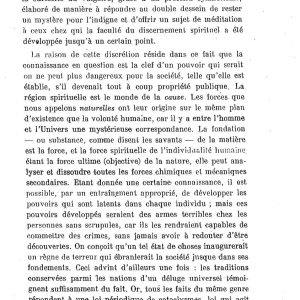
But there exists a science which, founded on the more or less perfect knowledge of the laws governing the realm of spiritual causes, has been transmitted from age to age down to us through an oral tradition, and jealously guarded against the curiosity of the vulgar, thanks to a profound symbolism, elaborated so as to serve the dual purpose of remaining a mystery to the unworthy and offering a subject of meditation to those in whom the faculty of spiritual discernment has been developed to a certain degree.
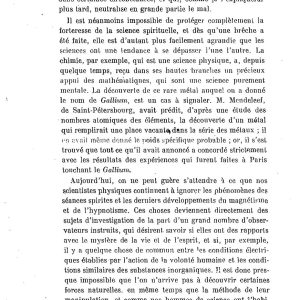
The reason for this discretion lies in the fact that the knowledge in question is the key to a power which would be extremely dangerous for society as it is established, were it to suddenly become public property. The spiritual realm is the world of cause. The forces we call natural originate on the same plane of existence as human will, for there is a mysterious correspondence between man and the Universe. The foundation—or substance, as scientists say—of matter is force, and the spiritual force of human individuality being the ultimate (objective) force of nature, it can analyze and dissolve all secondary chemical and mechanical forces. Given a certain knowledge, it is possible, through appropriate training, to develop the powers latent in every individual; but these developed powers would be terrible weapons in the hands of unscrupulous persons, for they would enable them to commit crimes without ever having to fear being discovered. One can imagine that such a state of affairs would usher in a reign of terror that would shake society to its foundations. This, moreover, happened once: the traditions preserved among nations of a universal flood sufficiently testify to the fact. Now, all facts of the same kind follow a periodic law of cataclysms, a law which acts under certain circumstances, and which, as I will explain later, largely neutralizes the evil.
Nevertheless, it is impossible to completely protect the fortress of spiritual science, and once a breach has been made, it is all the more easily widened as the sciences have a tendency to surpass one another. Chemistry, for example, which is a physical science, has for some time received valuable support in its higher branches from mathematics, which is a purely mental science. The discovery of that rare metal to which the name Gallium was given is a notable case. Mr. Mendeleev of St. Petersburg had predicted, from a study of the atomic numbers of the elements, the discovery of a metal that would fill a vacant place in the series of metals; he had even given its probable specific weight; and it turned out that everything he had announced strictly matched the results of experiments conducted in Paris concerning Gallium.
Today, one can hardly expect our physical scientists to continue ignoring the phenomena of séances and the latest developments of magnetism and hypnotism. These things are becoming direct subjects of investigation by a large number of educated observers, who wish to know if they have connections with the mystery of life and spirit, and if, for example, there is something in common between the electrical conditions established by the action of human will and similar conditions of inorganic substances. It is therefore almost impossible that certain natural forces will not be discovered, along with the method of their manipulation, and as our men of science are accustomed to making a great fuss about their discoveries, this one will be made immediately public.
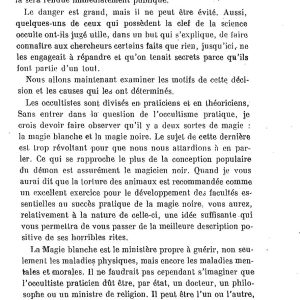
The danger is great, but it cannot be avoided. Therefore, some of those who possess the key to occult science have deemed it useful, for an explainable purpose, to make known to seekers certain facts which, until now, nothing urged them to disseminate and which were kept secret because they are part of a whole.
We shall now examine the motives for this decision and the causes which determined it.
Occultists are divided into practitioners and theorists; without entering into the question of practical occultism, I believe I should point out that there are two kinds of magic: white magic and black magic. The subject of the latter is too revolting for us to dwell on speaking about it. What comes closest to the popular conception of the demon is certainly the black magician. When I tell you that the torture of animals is recommended as an excellent exercise for developing the faculties essential to the practical success of black magic, you will have, regarding its nature, a sufficient idea which will allow you to dispense with the best positive description of its horrible rites.
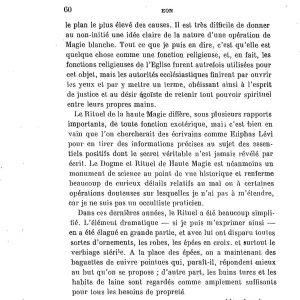
White Magic is the proper ministry for healing not only physical illnesses, but also mental and moral ones. One should not imagine, however, that the practicing occultist must be, by profession, a doctor, a philosopher, or a minister of religion. He may be one or the other, or combine these three qualities in himself, which, moreover, he did combine and monopolize in eras whose memory is not yet lost. In any case, his true work is exercised on the highest plane of causes. It is very difficult to give the uninitiated a clear idea of the nature of a White Magic operation. All I can say is that it is something like a religious function, and, in fact, the religious functions of the Church were once used for this purpose, but the ecclesiastical authorities eventually opened their eyes and put an end to it, obeying thus the spirit of justice and the selfish desire to retain all spiritual power in their own hands.
The Ritual of High Magic differs, in several important respects, from any external function, but it is in vain that one would seek writers like Eliphas Lévi for precise information regarding the positive essentials, the true secret of which is never revealed in writing. ‘Dogme et Rituel de la Haute Magie’ is nevertheless a monument of science from a historical point of view and contains many curious details relating to evil or certain dubious operations on which I do not need to expand, as I am not a practicing occultist.
In recent years, the Ritual has been greatly simplified. The dramatic element—if I may put it that way—has been largely pruned from it, and with it have disappeared all sorts of ornaments, robes, crossed swords, and above all, sterile verbiage. In place of swords, pointed copper rods are now used, which, it seems, better serve the intended purpose; on the other hand, Turkish baths and woolen garments are considered amply sufficient for all cleanliness needs.
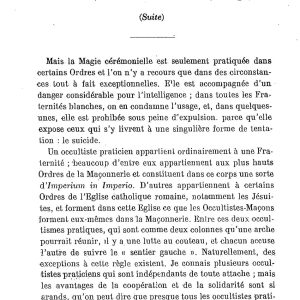
But ceremonial Magic is only practiced in certain Orders and is resorted to only in quite exceptional circumstances. It is accompanied by considerable danger to the intellect; in all White Fraternities, its use is condemned, and in some, it is prohibited under penalty of expulsion, because it exposes those who engage in it to a singular form of temptation: suicide.
A practicing occultist usually belongs to a Fraternity; many of them belong to the highest Orders of Freemasonry and constitute within that body a sort of Imperium in Imperio. Others belong to certain Orders of the Roman Catholic Church, notably the Jesuits, and form within that Church what the Occultist-Masons themselves form within Freemasonry. Between these two practical occultisms, which are like two columns that an arch could unite, there is a knife-fight, and each accuses the other of following the ‘left-hand path’. Naturally, exceptions to this rule exist. I know several practicing occultists who are independent of any attachment; but the advantages of cooperation and solidarity are so great that it can be said that almost all practicing occultists are members of one or another more or less strict Fraternity.
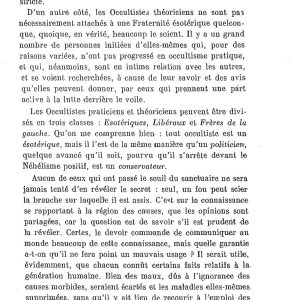
On the other hand, theoretical Occultists are not necessarily attached to any esoteric Fraternity, although, in truth, many are. There are a great number of self-initiated individuals who, for various reasons, have not progressed in practical occultism, and who, nevertheless, are in intimate relation with others, and find themselves sought after, because of their knowledge and the advice they can give, by those who take an active part in the struggle behind the veil.
Practicing and theoretical Occultists can be divided into three classes: Esoterics, Liberals, and Brothers of the Left-Hand Path. Let me be understood clearly: every occultist is an esoteric, but he is so in the same way that a politician, however advanced he may be, provided he stops short of Positive Nihilism, is a conservative.
None of those who have crossed the threshold of the sanctuary will ever be tempted to reveal its secret: only a madman would saw off the branch on which he is sitting. It is concerning the knowledge relating to the realm of causes that opinions are divided, for the question is whether it is prudent to reveal it. Certainly, duty commands that much of this knowledge be communicated to the world, but what guarantee is there that it will not be misused? It would be useful, obviously, for everyone to know certain facts relating to human generation. Many evils, due to ignorance of morbid causes, would be avoided and the diseases themselves suppressed, without any need to resort to the use of drugs. Much time and work could be saved if the ratio of consonant ethereal vibrations were known, and if our experienced mechanics were thus put in a position to make use themselves of the “most subtle” forces of nature.
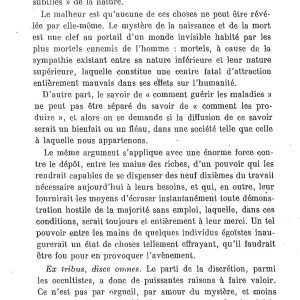
The misfortune is that none of these things can be revealed by itself. The mystery of birth and death is a key to the portal of an invisible world inhabited by man’s deadliest enemies: deadly, because of the sympathy existing between his lower nature and their higher nature, which constitutes a fatal center of attraction entirely evil in its effects on humanity.
On the other hand, the knowledge of ‘how to cure diseases’ cannot be separated from the knowledge of ‘how to produce them’, and so one wonders whether the dissemination of this knowledge would be a blessing or a scourge, in a society such as the one to which we belong.
The same argument applies with enormous force against placing in the hands of the rich a power which would enable them to dispense with nine-tenths of the labor necessary today for their needs, and which, furthermore, would provide them with the means to instantly crush any hostile demonstration by the unemployed majority, which, under these conditions, would be always and entirely at their mercy. Such power in the hands of a few selfish individuals would usher in a state of affairs so terrifying that one would have to be mad to provoke its advent.
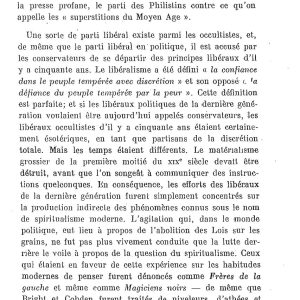
Ex tribus, disce omnes (From three, learn all). The party of discretion among the occultists therefore has powerful reasons to assert. It is not out of pride, love of mystery, and even less out of selfishness that they hold so tenaciously the key to knowledge. However, although I readily acknowledge the validity of discretion in this matter, I do not believe it wise to continue the policy of total silence, or to assist the Jesuitical practice of taking, in the profane press, the side of the Philistines against what are called the ‘superstitions of the Middle Ages’.
A sort of liberal party exists among the occultists, and, just like the liberal party in politics, it is accused by the conservatives of departing from the liberal principles of fifty years ago. Liberalism has been defined as ‘trust in the people tempered with discretion’ and its opposite: ‘distrust of the people tempered by fear’. This definition is perfect; and if the political liberals of the last generation wished to be called conservatives today, the occultist liberals of fifty years ago were certainly esoteric, as advocates of total discretion. But the times were different. The gross materialism of the first half of the 19th century had to be destroyed before one could think of communicating any instructions. Consequently, the efforts of the liberals of the last generation were simply concentrated on the indirect production of the phenomena known as modern spiritualism. The agitation which, in the political world, took place concerning the repeal of the Corn Laws, was not more vigorously conducted than the struggle behind the veil concerning the question of spiritualism. Those who were in favor of this experiment on modern habits of thought were denounced as Brothers of the Left-Hand Path and even as Black Magicians—just as Bright and Cobden were treated as levelers, atheists, and enemies of society in general. I regret to say that, in the occult world and in the political world, the results have not been similar. The esoterics triumphed, and the Society for Psychical Research has lamented the scarcity of phenomena and the rarity of genuine mediums.
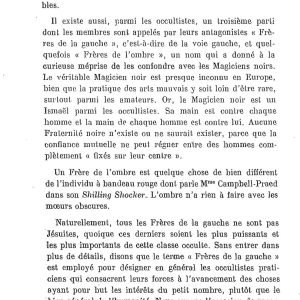
There also exists, among the occultists, a third party whose members are called by their antagonists ‘Brothers of the Left-Hand Path’, that is, of the left-hand way, and sometimes ‘Brothers of the Shadow’, a name which has led to the curious mistake of confusing them with Black Magicians. The true Black Magician is almost unknown in Europe, although the practice of the evil arts is far from rare there, especially among amateurs. Now, the Black Magician is an Ishmael among the occultists. His hand is against every man and every man’s hand is against him. No Black Fraternity exists or could exist, because mutual trust cannot reign among men completely ‘fixed on their own center’.
A Brother of the Shadow is something very different from the red-banded individual spoken of by Mrs. Campbell-Praed in her Shilling Shocker. The shadow has nothing to do with obscene morals.
Naturally, not all Brothers of the Left-Hand Path are Jesuits, although the latter are the most powerful and important in this occult class. Without going into more details, let us say that the term ‘Brothers of the Left-Hand Path’ is used to designate in general the practicing occultists who devote their forces to the advancement of things aimed at the interests of the few, rather than the general good of humanity. We will have occasion to speak again of this sort of Brothers when we deal with the theosophical movement.
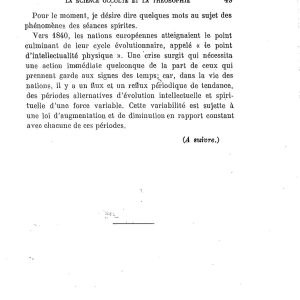
For the moment, I wish to say a few words regarding the phenomena of séances.
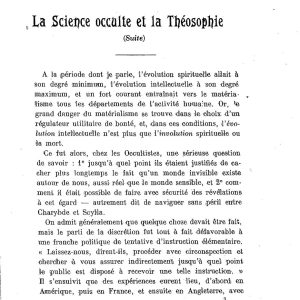
Around 1840, the European nations were reaching the culminating point of their evolutionary cycle, called ‘the point of physical intellectuality’. A crisis arose which necessitated some immediate action on the part of those who heed the signs of the times; for, in the life of nations, there is a periodic ebb and flow of tendency, alternating periods of intellectual and spiritual evolution of variable strength. This variability is subject to a law of increase and decrease in constant relation with each of these periods.
At the period I am speaking of, spiritual evolution was at its minimum degree, intellectual evolution at its maximum, and a strong current was pulling all departments of human activity toward materialism. Now, the great danger of materialism lies in the choice of a utilitarian regulator of goodness, and, under these conditions, intellectual evolution is nothing but spiritual involution or death.
At that time, among the Occultists, there arose a serious question: 1) to what extent were they justified in concealing any longer the fact that an invisible world exists around us, as real as the sensible world, and 2) how it was possible to safely make revelations in this regard—in other words, to navigate without peril between Charybdis and Scylla.
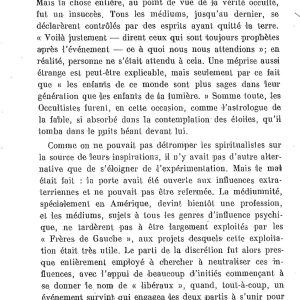
It was generally admitted that something must be done, but the party of discretion was entirely unfavorable to a frank policy of attempting elementary instruction. ‘Let us’, they said, ‘proceed with caution and seek to indirectly ascertain to what extent the public is disposed to receive such instruction’. It followed that experiments took place, first in America, then in France, and later in England, with certain individuals of a particular psychic organization, who were later given the name of mediums. But the whole thing, from the point of view of occult truth, was a failure. All the mediums, without exception, declared themselves controlled by spirits who had left the earth. ‘That is exactly’, said those who are always prophets after the event, ‘what we expected’; in reality, no one had expected that. Such a strange mistake is perhaps explicable, but only by the fact that ‘the children of this world are wiser in their generation than the children of light’. All in all, the Occultists were, on this occasion, like the astrologer of the fable, so absorbed in contemplating the stars that he fell into the well gaping before him.
Since the spiritualists could not be undeceived about the source of their inspirations, there was no other alternative than to withdraw from experimentation. But the damage was done: the door had been opened to extraterrestrial influences and could not be closed again. Mediumship, especially in America, soon became a profession, and the mediums, subject to all kinds of psychic influence, were not long in being widely exploited by the ‘Brothers of the Left-Hand Path’, to whose projects this exploitation was very useful. The party of discretion was then almost entirely employed in seeking to neutralize these influences, with the support of many initiates beginning to call themselves ‘liberals’, when, suddenly, an event occurred that prompted both parties to unite for defense against a common danger. A person, known to exist but not yet discovered, suddenly appeared in Paris, presented herself at an occult Lodge, and solicited her admission into the Fraternity, under certain conditions which were not acceptable. Evicted, she disappeared, and, shortly after, it was learned that a certain Mme. Blavatsky had been expelled from an American Fraternity for an infringement of the United States constitution, and had then gone to British India, where she believed she could carry out a certain threat she had made.
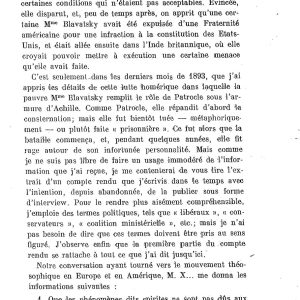
It was only in the last months of 1893 that I learned the details of this Homeric struggle in which poor Mme. Blavatsky played the role of Patroclus in the armor of Achilles. Like Patroclus, she first spread consternation; but she was soon killed—metaphorically—or rather made ‘prisoner’. That is when the battle began, and for some years it raged around her unfortunate personality. But as I am not free to make immoderate use of the information I received, I will content myself with reading you an excerpt from an account I wrote at the time with the since-abandoned idea of publishing it in the form of an interview. To make it more easily understandable, I use political terms, such as ‘liberals’, ‘conservatives’, ‘ministerial coalition’, etc.; but I need not say that these terms must be taken figuratively. I note finally that the first part of the account relates to everything I have said so far.
Our conversation having turned toward the theosophical movement in Europe and America, Mr. X… gave me the following information:
-
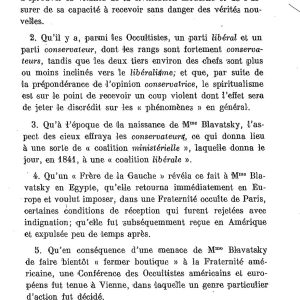
That the so-called spiritualistic phenomena are not due to the spirits of the dead, but of the living; that modern spiritualism is a simple experiment decided, about 50 years ago, by a Federation of Occult Fraternities, with the effect of testing the vitality of modern civilization and ascertaining its capacity to receive new truths without danger.
-
That there is, among the Occultists, a liberal party and a conservative party, whose ranks are strongly conservative, while about two-thirds of the leaders are more or less inclined toward liberalism; and that, due to the preponderance of conservative opinion, spiritualism is about to receive a violent blow whose effect will be to discredit ‘phenomena’ in general.
-
That at the time of Mme. Blavatsky’s birth, the aspect of the heavens frightened the conservatives, which gave rise to a sort of ‘ministerial coalition’, which gave birth, in 1841, to a ‘liberal coalition’.
-
That a ‘Brother of the Left-Hand Path’ revealed this fact to Mme. Blavatsky in Egypt, that she immediately returned to Europe and wanted to impose, in an occult Fraternity in Paris, certain conditions of admission which were rejected with indignation; that she was subsequently admitted in America and expelled shortly after.
-
That as a consequence of a threat by Mme. Blavatsky to soon make the American Fraternity ‘close up shop’, a Conference of American and European Occultists was held in Vienna, in which a particular kind of action was decided.
-
That, during the time when Mme. Blavatsky imagined herself to be in Tibet, she was in reality in Kathmandu, in a state…of occult imprisonment.
-
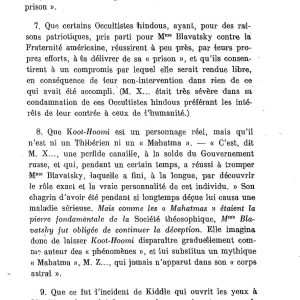
That certain Hindu Occultists, for patriotic reasons, having taken the side of Mme. Blavatsky against the American Fraternity, succeeded more or less, by their own efforts, in delivering her from her ‘prison’, and that they agreed to a compromise by which she would be set free, on condition of their non-intervention in anything that had been accomplished. (Mr. X… was very severe in his condemnation of these Hindu Occultists preferring the interests of their country to those of humanity.)
-
That Koot Hoomi is a real person, but he is neither a Tibetan nor a ‘Mahatma’.—’He is‘, said Mr. X…, ‘a perfidious scoundrel, in the pay of the Russian Government, and who, for a certain time, succeeded in deceiving Mme. Blavatsky, who eventually, in the long run, discovered the exact role and true personality of this individual‘. Her grief at having been so long deceived caused her a serious illness. But as the ‘Mahatmas’ were the cornerstone of the Theosophical Society, Mme. Blavatsky was obliged to continue the deception. She therefore imagined letting Koot Hoomi gradually disappear as the author of the ‘phenomena’, and substituted for him a mythical ‘Mahatma’, Mr. Z…, who never appeared in his ‘astral body’.
-
That it was the Kiddle incident that opened Mme. Blavatsky’s eyes and made her understand, at the same time as the trick of which she was a victim, what had really been done with her.
-
That it was Koot Hoomi who subsequently intrigued with the Coulombs at Adyar, to avenge himself, it is supposed, for the failure of his machinations.
-
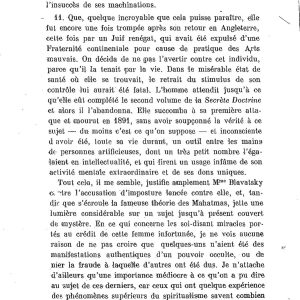
That, incredible as it may seem, she was deceived once more after her return to England, this time by a renegade Jew, who had been expelled from a continental Fraternity for practicing the Evil Arts. It was decided not to warn her against this individual, because he held her by her life. In the wretched state of health she was in, the withdrawal of the stimulus of his control would have been fatal to her. The man waited until she had completed the second volume of ‘The Secret Doctrine’ and then he abandoned her. She succumbed to his first attack and died in 1891, without having suspected the truth in this matter—at least so it is supposed—and unconscious of having been, all her life long, a tool in the hands of crafty persons, of whom a very small number equaled her in intellectuality, and who made infamous use of her extraordinary mental activity and unique gifts.
All this, it seems to me, amply justifies Mme. Blavatsky against the accusation of imposture launched against her, and, while the famous theory of the Mahatmas collapses, throws considerable light on a subject hitherto shrouded in mystery. As for the so-called miracles credited to this unfortunate woman, I see no reason not to believe that some were authentic manifestations of an occult power, or to deny the fraud to which others were due. Moreover, I attach only minor importance to what has been said about the latter, for those who have some experience of the superior phenomena of spiritualism know how difficult it is, in cases of fraud, to establish the portion of blame that falls on the medium or on his control.
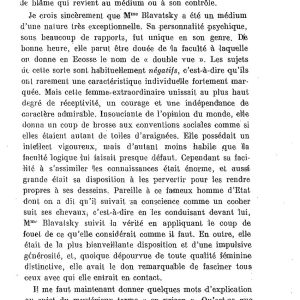
I sincerely believe that Mme. Blavatsky was a medium of a very exceptional nature. Her psychic personality, in many respects, was unique of its kind. Early on, she appeared to be endowed with the faculty to which in Scotland is given the name of ‘second sight’. Subjects of this kind are usually negative, that is, they rarely have a strongly marked individual characteristic. But this extraordinary woman combined the highest degree of receptivity with admirable courage and independence of character. Heedless of the opinion of the world, she brushed aside social conventions as if they were so many cobwebs. She possessed a vigorous intellect, but all the less skillful as the logical faculty was almost lacking in her.
However, her facility for assimilating knowledge was enormous, and as great was her disposition to pervert it to suit her own purposes. Like that famous statesman of whom it was said that he followed his conscience as a coachman follows his horses; that is to say, by driving them before him, Mme. Blavatsky followed the truth by applying the whip of what she considered proper. Furthermore, she was of the most benevolent disposition and of an impulsive generosity, and, although devoid of any distinctive feminine quality, she had the remarkable gift of fascinating all those with whom she came into contact.
I must now give a few words of explanation regarding the mysterious term ‘in prison’. What is occult imprisonment and why was it inflicted on Mme. Blavatsky?
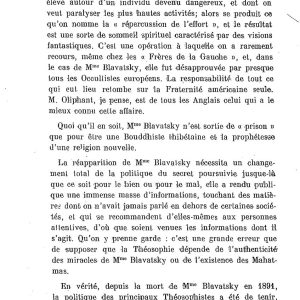
A certain operation of Ceremonial Magic exists, by means of which a wall of psychic influences can be erected around an individual who has become dangerous, and whose highest activities one wishes to paralyze; then occurs what is called the ‘repercussion of the effort’, and the result is a kind of spiritual sleep characterized by fantastic visions. It is an operation to which recourse is rarely had, even among the ‘Brothers of the Left-Hand Path’, and, in the case of Mme. Blavatsky, it was disapproved of by almost all European Occultists. The responsibility for everything that happened falls on the American Fraternity alone. Mr. Oliphant, I think, is of all Englishmen the one who knew this affair best.
Be that as it may, Mme. Blavatsky only emerged from ‘prison’ to become a Tibetan Buddhist and the prophetess of a new religion.
The reappearance of Mrs. Blavatsky necessitated a total change in the policy of secrecy pursued until then. Whether for good or for ill, she has made public an immense mass of information, touching on matters never spoken of outside certain societies, and which recommend themselves to attentive persons, wherever the information in question came from. Let it be noted: it is a great error to suppose that Theosophy depends on the authenticity of Mme. Blavatsky’s miracles or on the existence of the Mahatmas.
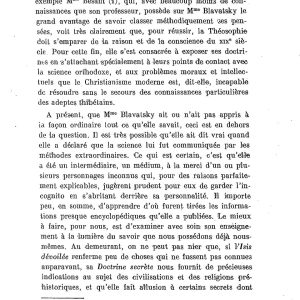
Indeed, since the death of Mme. Blavatsky in 1891, the policy of the principal Theosophists has been to keep, as much as possible, the Mahatmas in the background. For example, Mrs. Besant (1), who, with much less knowledge than her teacher, possesses over Mme. Blavatsky the great advantage of knowing how to methodically classify her thoughts, sees very clearly that, to succeed, Theosophy must seize the reason and conscience of the 19th century. To this end, she has devoted herself to expounding its doctrines, attaching herself especially to their points of contact with orthodox science, and to the moral and intellectual problems that modern Christianity is, she says, incapable of resolving without the aid of the particular knowledge of the Tibetan adepts.
Now, whether Mme. Blavatsky did or did not learn in the ordinary way all that she knew, this is beside the question. It is very possible that she told the truth when she declared that the science was communicated to her by extraordinary methods. What is certain is that she was an intermediary, a medium, at the mercy of one or several unknown persons who, for perfectly explicable reasons, judged it prudent for them to remain incognito by sheltering behind her personality. In short, it matters little to learn from where the almost encyclopedic information she published was drawn. The best thing for us to do is to carefully examine her teaching in the light of the knowledge we ourselves already possess. Moreover, one cannot deny that, if ‘Isis Unveiled’ contains little that was not known before, her Secret Doctrine provides us with valuable indications concerning prehistoric civilizations and religions, and that it alludes to certain secrets whose existence was not suspected, but whose accuracy has been verified by certain occultists who have tested them.
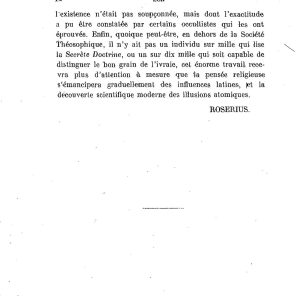
Finally, although perhaps, outside the Theosophical Society, there is not one individual in a thousand who reads ‘The Secret Doctrine’, or one in ten thousand who is capable of distinguishing the wheat from the chaff, this enormous work will receive more attention as religious thought gradually emancipates itself from Latin influences, and modern scientific thought does from the illusions of the atom.
ROSERIUS.
(1) The former pupil of Mr. Bradlaugh.
*
‘The Transcendental Universe,
six lectures on occult science, theosophy, and the Catholic faith‘,
by Charles George Harrison,
Temple Lodge Publications 1895
Full book
*
*
Source
Article published
in the Revue Eon, 1923-1924

***
Leave a Reply