
Circle of Transmission: The Living Loom
Johann Georg Gichtel: The Adeptus and the Putatitius-Attainment, Presumption, and the Reality of the Work

Featured Illustration Legend: At the threshold: Johann Georg Gichtel between the inward reality of the Work and its outward representations. A Contemporary symbolic reconstruction; not a historical portrait.
*
Today’s sharing from the Blue House of Via-HYGEIA is our latest study:
“Johann Georg Gichtel: The Adeptus and the Putatitius—Attainment, Presumption, and the Reality of the Work.”
Beginning with a single enigmatic distinction—Adeptus or Putatitius?—this study follows Gichtel’s correspondence from the testing of attainment by time, through inner transformation, imagined knowledge, humility, Sophia and the Centre, into the deeper alchemical question of what it means for the Work to become real in the human being.
It also turns to a revealing episode preserved in the seventh volume of the Theosophia Practica, where Gichtel is surrounded by the rumor that he is a Goldmacher—a “goldmaker.” Here, the mirror turns outward: just as the Putatitius may mistake the image of attainment for its reality, the world may project an image of attainment onto the Adeptus. Gichtel’s response is not merely to deny a rumor, but to re-establish the distinction between what is inwardly real and what is outwardly imagined or said of a person.
The study thus concludes with a paradox at the heart of Gichtel’s vision: the genuine Adeptus may remain hidden, while the image of attainment may stand openly in his place.
**
A critical study of the Adeptus / Putatitius distinction
in Gichtel’s correspondence, with the established corpus, translations, and exegesis.
*
A Contextual Introduction — The Problem of the Adeptus
Gichtel’s correspondence does not contain a formal treatise entitled “The Adeptus and the Putatitius”. The distinction must instead be reconstructed from dispersed passages in which he judges persons, describes genuine attainment, criticizes presumed knowledge, discusses the alchemical work, and repeatedly returns to the relation between what is outwardly represented and what has become inwardly real. The result is not a scholastic taxonomy, but it is more coherent than an isolated use of two Latin terms might suggest.
The decisive passage occurs in the eleventh letter: “Die Zeit wird wol öffnen, ob dieser euer Freund ein Adeptus oder Putatitius sey.” Gichtel places the distinction under the judgment of time. A title, a claim, or an impressive display cannot finally establish attainment. What matters is whether the reality of the work has actually become operative in the person.
The central opposition is therefore not simply true knowledge versus false knowledge. It is attainment versus presumption, realization versus representation. The Putatitius is not necessarily a conscious impostor. The term points rather toward one who supposes, reckons, or imagines that he possesses an attainment which has not become real. Gichtel’s language of Einbildung, Phantast, self-inflation, and lack of humility makes this mechanism particularly clear.
Conversely, the Adeptus is not defined merely by possession of an esoteric doctrine, a laboratory technique, or a secret vocabulary. The genuine criterion is inward: the Turba must be overcome, the Devil bound, desire reoriented, and the true Philosopher born from the inner Centre. Yet “inner” here must not be reduced to modern psychology. Gichtel’s inner Centre belongs simultaneously to an anthropological, theological, and alchemical order. His inwardization of alchemy does not dissolve alchemy into subjectivity; it situates the work within Christian regeneration.
The present study therefore reconstructs the distinction in four connected dimensions: the diagnostic distinction between attainment and presumption; the epistemological distinction between realized and imagined knowledge; the ethical distinction between humility and self-inflation; and the alchemical-theological distinction between participation in the real work and attachment to its external signs.
*
I. Method and Corpus
The evidence has been graded according to function rather
than treating every occurrence of Adeptus as equally probative.
| Level | Function | Letters | Use |
| A — Explicit terminological | Direct Adeptus / Putatitius opposition or classification | XI, XIII, XXVII; XLIII pending verification | Primary evidence |
| B — Criterion of attainment | Inward transformation, Centre, concealment, realized Philosopher | XI, XVIII, XXVII, XXXIX | Defines positive side |
| C — Strong supporting | Einbildung, desire, alchemical ontology, laboratory critique | XII, XIV, XV, XVI, XXII, XL, XLI | Explains mechanism |
| D — Contextual / auxiliary | Anthropological or outward/inward background | X, XVII, XIX | Background only |
The established corpus is therefore: XI, XIII, XVIII, XXVII, XXXIX, and XLI as the core witnesses; X, XVI, and XL as operational witnesses; XII, XIV, XV, and XXII as supporting witnesses; and XVII and XIX as contextual witnesses. XLIII §21 remains an explicit occurrence identified in the index apparatus but is not used substantively here because its full context has not been verified.
This distinction between evidence levels is important. A passage concerning prima Materia, Tinctur, or Particularia does not by itself define the Adeptus. It becomes significant when it illuminates the alchemical reality within which Gichtel’s terminology operates. Likewise, a passage concerning the true Philosopher should not simply be equated with a formal definition of Adeptus. It provides a positive anthropological criterion that helps interpret the latter.
*
II. Alchemical Concordance
Gichtel’s language of alchemy cannot be separated from his demand for spiritual authenticity. Tinctur, Mercurius, prima Materia, Particulare, Lapis Philosophorum, and the operations associated with them are not merely a technical lexicon describing an external laboratory process. They are continually brought into relation with the transformation of the human being.
This does not mean that Gichtel simply rejects laboratory alchemy. The later letters show the contrary. The problem is rather the relation between an external operation and the inner source from which a genuine operation must proceed. The question is not whether metallic or tinctural operations can be spoken of, but whether the practitioner possesses the reality to which the technical language refers.
This distinction becomes crucial in the opposition between the Adeptus and the Putatitius. A person may possess signs, formulas, figures, terminology, or even some demonstrable operation without thereby possessing the inward reality of the work. Conversely, genuine attainment may remain hidden because it does not depend upon public recognition.
The article should therefore not be read as a psychological reinterpretation of alchemy. Gichtel’s categories remain embedded in his alchemical-theosophical world. What changes is the level at which attainment is judged: technical competence is not sufficient; the work must become real in the person.
*
III. The Corpus: Letter by Letter
The following section deliberately includes every letter retained in the established corpus. The letters are not all of equal evidentiary weight, and their individual status is stated explicitly. This prevents the later synthesis from silently collapsing direct terminology, supporting anthropology, and broader alchemical context into a single undifferentiated proof.
Letter X — Operational Background
Letter X belongs to the operational part of the corpus. It is retained because the earlier concordance work identified it as relevant to the distinction between the external handling of alchemical materials and the spiritual reality of the work. Its importance is therefore methodological rather than terminologically: it helps prevent us from assuming that Gichtel’s critique of presumed attainment is simply a rejection of alchemical practice.
The letter should be read together with the later discussions of Laboriren, Particularia, and Tinctur. The crucial question is whether an operation remains an external manipulation or is grounded in the true source of the work. In this sense Letter X prepares the distinction that becomes explicit in XI and XIII: outward competence can never by itself prove inward attainment.
Because the exact passage from Letter X is not securely preserved among the verified extracts used for this article, no German quotation is supplied here. Letter X is retained only for its established operational function: it helps prevent the critique of presumed attainment from being mistaken for a rejection of alchemical practice.
Letter XI — The Diagnostic Distinction
XI §19 — Adeptus or Putatitius
„Die Zeit wird wol öffnen, ob dieser euer Freund ein Adeptus oder Putatitius sey.“
“Time will surely reveal whether this friend of yours is an Adeptus or a Putatitius.”
This is the fundamental diagnostic statement. Time, rather than title or self-assertion, reveals whether presumed attainment corresponds to actual attainment. The sentence does not define the two terms abstractly; it establishes the principle by which they must be distinguished.
XI §25–26 — Turba and inward attainment
„Darum ist nicht gut ein Adeptus zu seyn, wo man nicht innerlich die Turbam überwunden, und den Teufel gebunden hat.“
“Therefore it is not good to be an Adeptus where one has not inwardly overcome the Turba and bound the Devil.”
The decisive word is innerlich. The Adeptus is not principally a possessor of information. Something has happened within: the Turba has been overcome and the Devil bound. The language is active and transformative. Attainment is not an acquisition added to an otherwise unchanged person.
The surrounding alchemical vocabulary of the letter is equally important. The passage belongs to a world of Tinctura Philosophorum, Turba, Spiritus Mundi, and the struggle between the true work and the disturbances that prevent it. Thus the “inner” criterion is not psychological in the modern sense; it is an inward realization of an objective spiritual-alchemical process.
XI §35 — The good Adepti
„Die guten Adepti müssen flüchtig gehen…“
“The good Adepti must …”
The exact force of flüchtig is not forced into a single English equivalent here. The passage is retained for its association with the recurrent theme of the Adepti’s elusiveness or withdrawal from ordinary recognition. The important point is not that every genuine adept must be socially invisible, but that genuine attainment does not require external recognition in order to be real.
The important point is not that every genuine adept must be socially invisible. Rather, genuine attainment does not require external recognition in order to be real.
*
Letter XII — Phantasie, Figures, and the Danger of Representation
Letter XII is a supporting witness. Gichtel places speculation, Phantasie, and einbildende Gemüter in a critical relation to the true Adepti. The passage should not be read as a rejection of symbolic, numerical, or figurative language as such. The issue is what happens when representation becomes detached from the reality it is supposed to disclose.
This is the epistemological background to the Putatitius. The danger is not merely false information. A figure, symbol, or conceptual system can become so convincing that the subject mistakes the representation for possession of the thing represented. The imagination can therefore become an apparent substitute for realization.
Letter XII thus forms a bridge between the explicit terminology of XI and XIII and the more precise psychology of XIV and XXVII: Phantasie becomes significant when it produces the kind of self-conception later designated as Putatitius.
*
Letter XIII — The Putatitius and Presumed Knowledge
XIII §2 — More Putatitius than Adeptus
„…mehr für einen Putatitium als Adeptum…“
“…more as a Putatitius than an Adeptus…”
This is another explicit diagnostic judgment. The form of the statement is important: Gichtel is not merely describing someone as ignorant. He is weighing the person’s presumed status against what his condition actually warrants.
The wider discussion in XIII makes the matter more precise. The Putatitius is associated with Einbildung — the supposition or imagining of knowledge — while the decisive deficiency is that one may imagine oneself to know something while, realiter, possessing nothing. This is one of the most important developments in the whole corpus.
The distinction is therefore not “knows / does not know.” It is “imagines possession / possesses in reality.” The Latin Putatitius becomes intelligible precisely here: the person reckons or presumes himself to possess what has not become realiter his own.
The technical alchemical vocabulary surrounding XIII — including Hexangulum, Mercurius duplicatus, Tinctur, Paracelsian language, and Tartari — is significant for another reason. Gichtel does not oppose presumed attainment by abandoning alchemy. He judges the practitioner’s relation to alchemical knowledge from within the alchemical tradition itself.
*
Letter XIV — Ein Wissen einbilden: The Image of Knowledge
„der ihm ein Wissen einbilde, und sich damit aufblähe, dieweil keine Demut bey ihm ist…“
“who imagines himself to possess knowledge, and puffs himself up with it, since there is no humility in him…”
This is perhaps the most important supporting passage for the psychology of the Putatitius. The verb einbilden is decisive. Knowledge has become an image or conception within the subject. The problem is not necessarily that the content is wholly false; it is that an imagined conception of knowledge is mistaken for its reality.
The sequence is remarkably exact: ein Wissen einbilden → sich damit aufblähen → keine Demut. Imagined knowledge produces self-inflation; self-inflation reveals the absence of humility; and the absence of humility is symptomatic of the fact that knowledge has not become inward reality.
This gives us a crucial semantic bridge. The Putatitius is not merely a liar. He may sincerely inhabit the image he has constructed. His error is misrecognition: he has mistaken the image of attainment for attainment itself.
The phrase should therefore become central to the article’s vocabulary: the Putatitius possesses an image of the work; the Adeptus participates in its reality.
*
Letter XV — Desire, Gelassenheit, and Christ
Letter XV supplies the positive anatomy of attainment. Gichtel speaks of withdrawing one’s Begierde from created things and turning it toward the one God. Attainment is consequently a transformation of desire, not merely an accumulation of information.
„Am Ende hilft kein Lapis Philosophorum, sondern JESUS CHRISTUS, unser neuer Leib…“
“In the end no Lapis Philosophorum helps, but JESUS CHRIST, our new body…”
This statement prevents a purely psychological reading of the whole study. Gichtel does not simply turn alchemy inward and thereby dissolve it into subjective experience. He places the work within a specifically Christian soteriological framework. The ultimate transformation is inseparable from Christ and the formation of the new human being.
Letter XV also praises Gelassenheit. This provides a useful counter-image to the Aufblähung of XIV. The Putatitius appropriates imagined knowledge and becomes inflated by it; the genuine practitioner relinquishes self-possession and allows the divine work to transform desire.
The contrast can therefore be stated carefully: the Putatitius is characterized by appropriative presumption; the Adeptus by transformed desire and relinquishment. This is an interpretive synthesis, not a direct definition supplied by Gichtel in a single sentence.
*
Letter XVI — The Verum Particulare and the Universal Source
XVI §9 — Alchemical ontology
„Unum est verum Particulare, quod ex Fonte universali oritur…“
“There is one true Particular which arises from the universal Source…”
Letter XVI restores the ontological and alchemical dimension that could otherwise disappear if the distinction were treated as psychology alone. The true Particular arises from the universal Source. It is therefore not simply an idea held by the practitioner.
This passage helps establish the distinction between subjective representation and participation in an order of reality. Genuine attainment is not the construction of a convincing interior narrative. It involves correspondence with a source that precedes the practitioner’s imagination.
The Adeptus / Putatitius distinction therefore remains fully embedded in Gichtel’s alchemical cosmology: Particularia, Mercurius, Tinctur, prima Materia, and the work of transformation are not metaphors retrospectively imposed upon an otherwise psychological doctrine.
*
Letter XVII — Outward Appearance and Inward Power
Letter XVII is auxiliary. Its importance lies in the recurrent Gichtelian opposition between outward appearance and inward power. It supports the methodological principle that the external form of a thing, or the external appearance of attainment, cannot by itself establish its reality.
The letter should therefore be used cautiously. It contributes to the anthropology surrounding the Adeptus but should not be presented as an independent definition of the term. Its value is cumulative: it strengthens the pattern already established explicitly in XI, XIII, XIV, and XVIII.
*
Letter XVIII — The True Philosopher from the Inner Centre
XVIII §9 — The positive anthropology of attainment
„ein wahrer Philosoph von GOtt müßte aus dem innern Centro geboren werden…“
“a true philosopher, of God, must be born from the inner Centre…”
This passage supplies the positive counterpart to XI §26. In XI the Adeptus is described through what has been overcome; in XVIII the true Philosopher is described through what has been born. Attainment is simultaneously an overcoming of obstruction and a birth from the Centre.
The wording must nevertheless be handled precisely. XVIII §9 defines the true Philosopher rather than giving a formal dictionary definition of Adeptus. Its value lies in showing what genuine realization looks like within Gichtel’s anthropology. The relationship is analogical and interpretive, not a claim that the two terms are lexically interchangeable.
The inner Centre should also not be psychologized. It belongs to Gichtel’s theological and cosmological language of the inward source, Sophia, and divine operation. The Adeptus is therefore one whose realization proceeds from a deeper Centre rather than from autonomous reason or self-generated conception.
*
Letter XIX — Auxiliary Anthropology of the Inner Human Being
Letter XIX remains contextual. It contributes to the broader anthropology of inner versus outer reality and helps situate the principal distinction within Gichtel’s conception of the human being. Its evidentiary status is deliberately lower: it supports the framework rather than defining Adeptus or Putatitius directly.
Its importance lies in continuity. The same structural opposition recurs: outward forms may be visible while the inward power that gives them reality remains concealed. This is precisely the condition under which the Putatitius can confuse representation with attainment.
*
Letter XXII — Particularia, Tinctur, Desire, and the Matrix of Reason
Letter XXII is one of the most important supporting witnesses because it shows what the pathology of outward attachment looks like in alchemical language. In §§1–20, Gichtel discusses Particularia, desire, the heavenly Mercurius, Mercurius interior, earthly and heavenly Tinctur, Sophia, and the limits of ordinary reason. The surviving scan breaks at §21, so the exegesis here is restricted to the established portion.
The Particularia can become objects toward which desire is misdirected. The heavenly Mercurius reveals the Mercurius interior, while the heavenly Tinctur belongs to the Sophia dimension rather than to the merely external pursuit of tinctural effects. Gichtel also describes reason as unable to see beyond its own matrix. Particularia can function as Stratagemata, diverting attention toward outer Nature-Tinctur.
This is highly significant for the Putatitius. The Putatitius does not merely “know too little”; he may direct desire toward the wrong object while believing himself to be pursuing the work. The attraction of external Particularia and earthly Tinctur becomes an analogue of the epistemic mistake already seen in XIII and XIV: the outer sign is taken for the inner reality.
XXII therefore connects the earlier categories of Einbildung and Phantast with Gichtel’s alchemical cosmology. The false direction is not arbitrary. It is rooted in desire, Eigenheit, autonomous reason, and attachment to what lies outside the inner object of the work.
The discussion of the three Principia is also important: Love and Light overcome Wrath. The true work is consequently not merely a technical manipulation of substances but a transformation in the governing principles of the human being. This provides a deeper background for XI’s overcoming of Turba and XV’s transformation of Begierde.
*
Letter XXVII — Phantast, Putatitius, and Concealment
XXVII §12 — Why do the Adepti conceal themselves?
„Warum verbergen sich die Adepti…“
“Why do the Adepti conceal themselves…?”
The question makes concealment an explicit feature of the discourse surrounding genuine attainment. Yet concealment should not be turned into a rigid sociological law. Gichtel’s point is better understood as the independence of genuine attainment from public recognition.
XXVII §14 — The strongest negative definition
„…dieser Phantast ein Putatitius und kein Adeptus ist…“
“…that this fantasist is a Putatitius and not an Adeptus…”
This is the sharpest negative definition in the corpus. Phantast, Putatitius, and kein Adeptus converge. The term Phantast supplies the missing bridge between the psychology of XIV and the explicit classification of the person as Putatitius.
We can now reconstruct a semantic sequence: Phantasie and Einbildung can generate an imagined conception of knowledge; that conception can become self-inflating; and the person can thereby become a Putatitius rather than an Adeptus. The Putatitius is thus a person in whom representation has displaced realization.
This is stronger than the simple opposition of true doctrine and false doctrine. The real opposition is realization versus representation.
*
Letter XXXIX — Adepti Philosophi in Rerum Natura
XXXIX §21 — Reality and concealment
„Daß in rerum natura Adepti Philosophi sind… daher stecken sie verborgen.“
“That in rerum natura there are Adepti philosophers… therefore they remain hidden.”
This passage is important because it combines two themes that the earlier letters keep separate: ontological reality and concealment. The Adepti are not merely imagined ideals; they exist in rerum natura. Yet they remain hidden.
The phrase rerum natura is crucial. It prevents the Adeptus from becoming a purely subjective or psychological category. The true adept belongs to the real order of the work. At the same time, the conclusion that they remain verborgen reinforces the independence of genuine attainment from public display.
The proper formulation is therefore not “the true Adeptus must hide,” but rather: the reality of the Adeptus does not depend upon being recognized externally, and Gichtel repeatedly associates genuine attainment with hiddenness.
*
Letter XL — The Laboratory Tinctur and the Sophia Distinction
XL §§7–13 — Laboratory transmutation and its limits
Letter XL is one of the most important operational witnesses because it makes the distinction between technical metallic operation and the deeper work unusually concrete. In §7 Gichtel distinguishes Böhme’s Centra from metallic Handgriffe; in §8 the decisive formula appears: “Sophia, nicht Tinctura Auri.” In §12 he reports the familiar claim of a small grain of Tinctur transmuting two ounces of lead into gold before the Emperor; §13 then connects such operations with Laboriren, Particularia, money, and deception.
„Sophia, nicht Tinctura Auri.“
“Sophia, not Tinctura Auri.”
This is not a rejection of every metallic operation. Rather, Gichtel refuses to identify the possession of a metallic tincture with possession of the deepest reality of the work. The laboratory phenomenon can become precisely the kind of external sign through which a person convinces himself that he possesses attainment.
Letter XL therefore belongs directly beside XIII and XXII. The Putatitius can become fascinated by Particularia, Tinctur, money, or demonstrable effects and mistake these for the inner attainment. The true work, by contrast, belongs to Sophia and the inner Centre.
This also sharpens the meaning of “realiter” in the wider corpus. Real possession is not simply possession of a visible effect. It is possession grounded in the reality of the work. The distinction between metallic Tinctur and Sophia is therefore not a crude laboratory-versus-spiritual opposition; it is a distinction between an external operation considered in isolation and an operation integrated into the divine order of the work.
*
Letter XLI — Prima Materia and the Adepti
XLI §4 — The true Perl-Grund and the Adepti
„den rechten Perl-Grund … subtile Kraft des Wirkens in der Einheit im Centro … von allen Adeptis … als ihre prima Materia“
“the true Perl-Grund … the subtle power of working in unity in the Centre … of all the Adepti … as their prima Materia”
XLI §4 places the Adepti explicitly within the language of prima Materia. The true Perl-Grund and the subtle power of working in unity in the Centre are presented in a way that connects the alchemical substance with the inner source of operation.
The passage also contains a critical distinction concerning Laboranten. Those who seek merely to capitalize on the work, to rest in flesh, or to serve God without the Cross represent precisely the kind of externalization against which the Adeptus / Putatitius distinction has been developing.
The significance of XLI is therefore twofold. First, it confirms that Adeptus remains an alchemical category rather than a merely ethical label. Second, it shows that laboratory work is not intrinsically sinful in Gichtel’s view; the problem is its separation from divine showing, wisdom, the Cross, and the inner Centre. The true Adeptus works from the Centre rather than from autonomous technical ambition.
*
Letter XLIII — Explicit Occurrence, Pending Contextual Verification
The index apparatus records an explicit occurrence of Adeptus at XLIII §21, p. 3348. Because the complete passage has not been verified against the relevant Fraktur page, it is retained here as a documentary witness but excluded from the substantive reconstruction. No interpretive burden is placed upon it.
XLIII §21 therefore remains a lexical witness only in the present study. Its eventual contextual significance cannot responsibly be determined from the evidence presently verified.
*
IV. The Putatitius: Imagined Knowledge and the Displacement of Reality
The letter-by-letter reading allows the Putatitius to be defined more precisely. He is not simply an unsuccessful alchemist, nor necessarily a deliberate fraud. He is the person in whom the representation of attainment has displaced attainment itself.
XIII supplies the explicit diagnostic form: more Putatitius than Adeptus. XIV supplies the mechanism: ein Wissen einbilden, followed by self-inflation and absence of humility. XXVII supplies the sharpest classification: Phantast, Putatitius, kein Adeptus. XXII and XL show how the same error can operate alchemically through attachment to Particularia, earthly Tinctur, external effects, money, and autonomous reason.
The resulting sequence may be reconstructed as follows:
Phantasie / Einbildung → ein Wissen einbilden → self-inflation → outward attachment → presumed possession → Putatitius
This is not a formal scheme that Gichtel himself lays out in these words. It is an exegetical synthesis of the vocabulary distributed across the letters. Its value is that it explains why the Putatitius is more subtle than an ignorant person: he possesses a conception of knowledge, and the conception itself becomes the basis of his claim to attainment.
The Putatitius may therefore be entirely sincere. His error is epistemic and ontological at once: he mistakes an image for its reality. The word “image” is our interpretive formulation, but it is grounded in Gichtel’s use of einbilden and the associated vocabulary of Phantast and Phantasie.
*
V. The Adeptus: Inward Attainment, Centre, and Realiter Possession
The positive side emerges by reversing the previous sequence. XI provides inward overcoming; XVIII provides birth from the inner Centre; XV provides transformed desire and Gelassenheit; XXII and XLI situate this transformation within the alchemical order; XXXIX insists that the Adepti exist in rerum natura even though they remain hidden.
The Adeptus is therefore not simply the person who “knows the right things.” He is the person in whom the work has become realiter operative. This is why the article’s central formulation should be stated as an interpretation rather than as a quotation from Gichtel: in the Adeptus, knowledge has become being.
The distinction between inner and outer must also be carefully handled. “Inner” does not mean a private psychological interior opposed to an external world. Gichtel’s inner Centre is the source from which the true Philosopher is born; it is simultaneously anthropological, theological, and cosmological. The genuine Adeptus participates in a reality that is not generated by his imagination.
The positive sequence may therefore be reconstructed as:
inner Centre → overcoming Turba / Eigenheit → transformed desire → humility / Gelassenheit → realiter possession → hiddenness of genuine attainment
Again, this is a synthesis, not a verbatim Gichtelian taxonomy. Its justification lies in the convergence of the individual witnesses.
*
VI. Concealment and the Problem of Recognition
The concealment passages deserve to be read together rather than treated as a single sociological rule. XI §35, XXVII §12, and XXXIX §21 repeatedly connect the Adepti with hiddenness. The common point is not that the true adept must disappear from society, but that genuine attainment does not depend upon recognition.
This is the precise counter-image to the Putatitius. The Putatitius requires his presumed possession to be represented, recognized, and affirmed; the Adeptus does not require external confirmation. The inward reality of the work can therefore remain hidden without ceasing to be real.
Concealment is thus better understood as a consequence of the economy of genuine attainment than as a rigid criterion by which every person can be classified. This formulation preserves the force of Gichtel’s language without turning it into a sociological law he does not explicitly formulate.
*
VII. Alchemical Reality and Christian Regeneration
The article’s central distinction would be incomplete if it were detached from Gichtel’s Christian alchemy. The terms Lapis Philosophorum, Tinctur, Mercurius, Particularia, and prima Materia belong to a technical and cosmological vocabulary; yet the work repeatedly culminates in the transformation of the human being and, in XV, in Christ as the new body.
This does not mean that Gichtel simply spiritualizes laboratory alchemy. XL shows that he can discuss a reported metallic transmutation; XLI shows that working metals is not intrinsically condemned. What he rejects is the assumption that technical effect equals spiritual attainment. “Sophia, nicht Tinctura Auri” is decisive in this respect.
The deepest opposition is therefore not laboratory versus spirituality. It is externalized operation versus operation grounded in the divine Centre. The Adeptus is not the person who has ceased to care about alchemy; he is the person for whom alchemy, anthropology, theology, and inward transformation remain integrated.
*
VIII. The Negative and Positive Anthropology
The correspondence permits a negative definition of the Putatitius. He is not established by title, intellectual vocabulary, symbolic competence, speculative fantasy, external effect, self-inflation, or public display. These may all become substitutes for attainment.
The Adeptus is positively characterized by inward overcoming, birth from the Centre, transformed desire, humility, Gelassenheit, correspondence with the real work, and independence from recognition. The positive and negative lists should not be read as a rigid checklist. They are recurring indicators distributed across the correspondence.
The central distinction can therefore be summarized in four interlocking oppositions:
1. Attainment versus presumption.
2. Realized knowledge versus imagined knowledge.
3. Inward transformation versus self-inflation.
4. Participation in the real work versus attachment to its external representation.
These are not four independent doctrines imposed upon Gichtel. They are four dimensions of the same distinction as it appears across different letters and different levels of his vocabulary.
*
IX. The Adeptus and the Putatitius
The distinction between the Adeptus and the Putatitius should not be inflated into a rigid two-class system. Gichtel does not present a formal taxonomy in which every individual is permanently assigned to one category. What the correspondence provides is a diagnostic grammar of attainment.
The question is not simply “Does this person know?” but “What has become real in this person?” Time tests the claim. Inner transformation confirms or disproves it. Humility distinguishes realization from self-inflation. The relation to Particularia, Tinctur, Sophia, and the inner Centre reveals whether the practitioner remains attached to external signs or participates in the reality of the work.
The most precise interpretive formulation may therefore be stated as follows:
The Putatitius possesses the image of the work and mistakes the image for its reality; the Adeptus participates in the reality to which the image points.
This is our formulation, not a sentence attributed to Gichtel. It condenses the convergence of einbilden, Phantast, Putatitius, innerlich, Centro, realiter, Sophia, and the hiddenness of the Adepti.
In the same sense, “knowledge has become being” is an interpretive philosophical formulation. It expresses the difference between knowledge represented in consciousness and knowledge embodied as a transformed condition of existence.
*
Conclusion
Taken as a whole, Gichtel’s correspondence presents the Adeptus not as a possessor of privileged information but as a person in whom the reality of the work has become inwardly operative. The Putatitius is not necessarily a conscious impostor; he is the person who mistakes imagined knowledge for attainment.
The distinction is tested by time, disclosed through inward transformation, expressed ethically through humility and Gelassenheit, and situated ontologically within Gichtel’s alchemical and Christian conception of the work. The true Adeptus may remain hidden because attainment does not depend upon recognition. The Putatitius, by contrast, risks mistaking the signs of the work — knowledge, figures, Particularia, tinctures, effects, or reputation — for the reality to which those signs ought to lead.
The central demand of the Theosophia Practica is therefore not merely that the practitioner should know the work, but that the work should actually happen within the human being. The Putatitius possesses the conception of the work; the Adeptus participates in its reality. In the latter, knowledge has become being.
*
Critical Apparatus —
Principal Witnesses
| Witness | Passage / Anchor | Level | Function | Page |
| XI §19 | Adeptus oder Putatitius | A | Explicit distinction; diagnostic test | — |
| XI §26 | innerlich die Turbam überwunden / den Teufel gebunden | B | Inward attainment | 3188 |
| XI §35 | Die guten Adepti … flüchtig | B | Elusiveness / concealment | 3190 |
| XIII §2 | mehr für einen Putatitium als Adeptum | A | Diagnostic judgment | — |
| XIV §1 | ein Wissen einbilde / sich damit aufblähe / keine Demut | C+ | Mechanism of presumed knowledge | — |
| XV | Begierde / Gelassenheit / Lapis Philosophorum | C | Transformation and Christian soteriology | — |
| XVI §9 | verum Particulare / Fonte universali | C | Alchemical ontology | 3211 |
| XVIII §9 | aus dem innern Centro geboren | B | Positive anthropology | 3223 |
| XXII §§1–20 | Particularia / Mercurius interior / Tinctur / Sophia | C | Alchemical psychology of outward attachment | 3247–3250 |
| XXVII §12 | Warum verbergen sich die Adepti | B | Concealment | 3271 |
| XXVII §14 | Putatitius und kein Adeptus / Phantast | A | Strongest negative definition | — |
| XXXIX §21 | Adepti Philosophi / daher … verborgen | B | Reality and concealment | 3329 |
| XL §§7–13 | Sophia, nicht Tinctura Auri / Laboriren / Particularia | C | Laboratory operation versus deeper work | — |
| XLI §4 | Perl-Grund / Centro / Adeptis / prima Materia | C | Alchemical embedding of Adeptus | 3336 |
| XLIII §21 | Adeptus | A — pending | Explicit occurrence; context not yet verified | 3348 |
*
Editorial and Bibliographical Notes
Primary source: Johann Georg Gichtel, Theosophia Practica, 1768 edition, in commission by Arnold Wever, Berlin; digitized by the Niedersächsische Staats- and Universitätsbibliothek Göttingen. The supplied PDF is the fifth volume of the correspondence and reaches Letter XXIII. Later witnesses XXVII, XXXIX, XLI, and XLIII therefore belong to continuation volumes within the larger correspondence tradition.
The present article preserves the established letter and paragraph references and the page references securely established in the working dossier. The German quotations are working transcriptions rather than a new diplomatic edition. Where a reading could not be securely verified, the article says so explicitly rather than silently regularizing or reconstructing the text.
The distinction between textual evidence and interpretation is deliberate. Formulations such as “the Putatitius possesses the image of the work” and “knowledge has become being” synthesize the correspondence; they are not presented as quotations from Gichtel.
*
Evidence Map
Evidence Map: Core — XI, XIII, XVIII, XXVII, XXXIX, XLI. Operational — X, XVI, XL. Supporting — XII, XIV, XV, XXII. Contextual — XVII, XIX. Pending explicit witness — XLIII §21. The core distinction rests primarily on XI §19, XIII §2, and XXVII §14; its positive criteria are supplied chiefly by XI §26 and XVIII §9; its psychological mechanism by XIV; its alchemical ontology by XVI, XXII, XL, and XLI; and its relation to concealment by XI §35, XXVII §12, and XXXIX §21.
*
Bibliography
Primary Sources
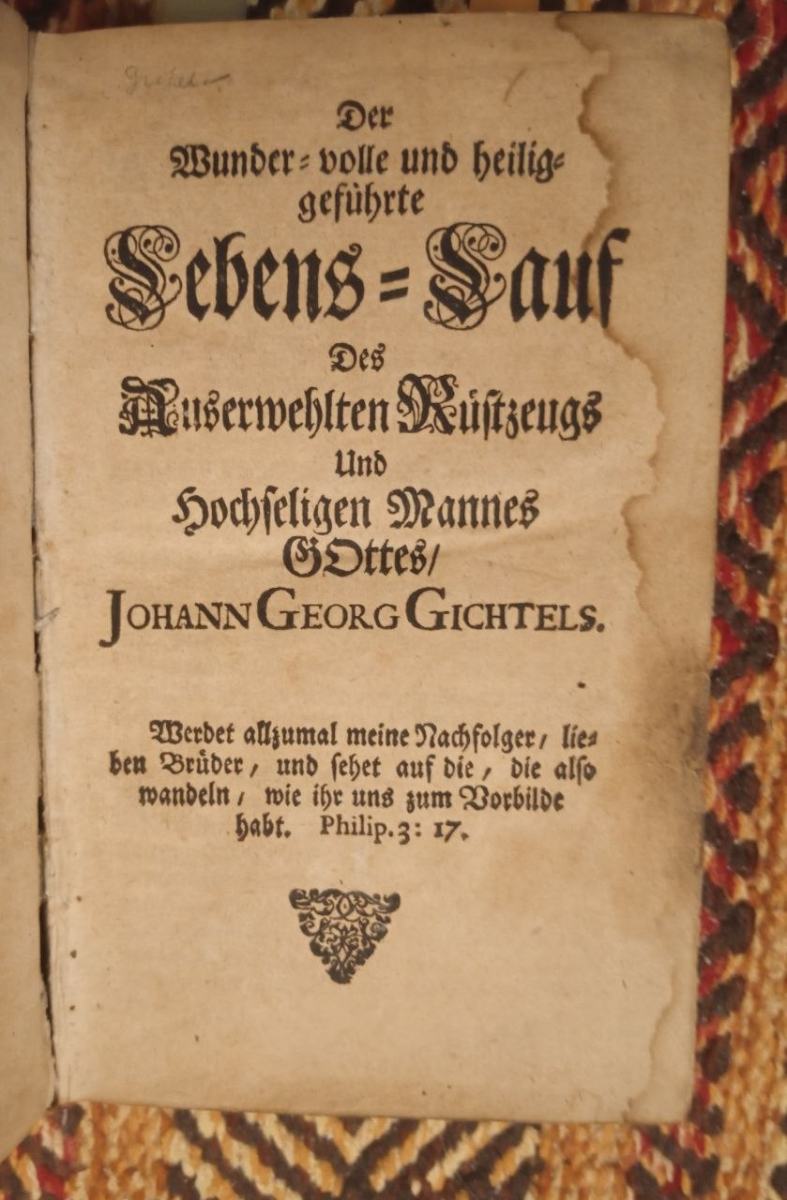
Gichtel, Johann Georg. Theosophia Practica. Halten und Kämpfen ob dem H. Glauben bis ans Ende, durch die drey Alter des Lebens Jesu Christi, nach den dreyen Principien göttliches Wesens … 3rd ed., 7 vols. Leyden, 1722. Edited and expanded by Johann Wilhelm Überfeld. Vol. VII, in particular, for the Wunder-volle und heilige geführte Lebens-Lauf and related biographical material.
Gichtel, Johann Georg. Theosophia Practica. [Berlin]: in Commission bey Arnold Wever, 1768. 7 vols. The present study uses principally vol. V for the correspondence forming the core textual corpus, with later letters consulted in the continuation volumes.
Fassmann, David. Gespräche in dem Reiche derer Todten. Hundert Neun und Sechtzigste Entrevue, zwischen der Heiligen Ehrentraut … und dem berühmten Johann George Gichtel … Leipzig: Wolfgang Deer, 1732; reissued 1733. Engraved frontispiece. VD18 15256367.
*
Secondary and Historical Studies
Dreyfürst, Stephanie. Stimmen aus dem Jenseits: David Fassmanns historisch-politisches Journal “Gespräche in dem Reiche derer Todten” (1718–1740). Berlin/Boston: De Gruyter, 2014.
Gorceix, Bernard. Johann Georg Gichtel: Théosophe d’Amsterdam. Lausanne, 1975.
Harless, Gottlieb Christoph Adolf von. Jakob Böhme und die Alchymisten: Ein Beitrag zum Verständniss J. Böhme’s. Nebst zwei Anhängen: J. G. Gichtel’s Leben und Irrthümer und über ein Rosenkreuzerisches Manuscript. 2nd enlarged ed. Leipzig, 1882.
Poscharsky, Peter. “Gichtel, Johann Georg.” Neue Deutsche Biographie 6 (1964), p. 369.
Versluis, Arthur. Wisdom’s Children: A Christian Esoteric Tradition. Albany: State University of New York Press, 1999. Chap. 19, “Alchemy and Theosophy,” pp. 235–246; notes pp. 345–346. Google Books.
*
Digital and Bibliographical Resources
Deutsche Digitale Bibliothek / VD18. Gichtel, Johann Georg, Theosophia Practica, 1722 edition. Digital copies of the individual volumes.
Deutsche Digitale Bibliothek / VD18. Gichtel, Johann Georg, Theosophia Practica, 1768 edition, digitized by the Niedersächsische Staats- und Universitätsbibliothek Göttingen.
The Online Books Page, University of Pennsylvania. Johann Georg Gichtel, Theosophia Practica, 3rd ed., 7 vols., 1722; digital access to the individual volume images.
Bibliographical note: The bibliography is intentionally selective. It records the primary editions used for the present reconstruction, the 1732 Fassmann source for the newly identified visual witness, and the principal historical studies relevant to the study. It is not intended as a comprehensive bibliography of Gichtel, Behmenism, or early modern alchemy. Arthur Versluis’s Wisdom’s Children is especially important for the present study because its chapter on “Alchemy and Theosophy” treats Gichtel’s alchemical writings directly and cites the same volume/page coordinates that recur in the present corpus.
*
Appendix
‘A Portrait of Gichtel Hidden in Plain Sight‘
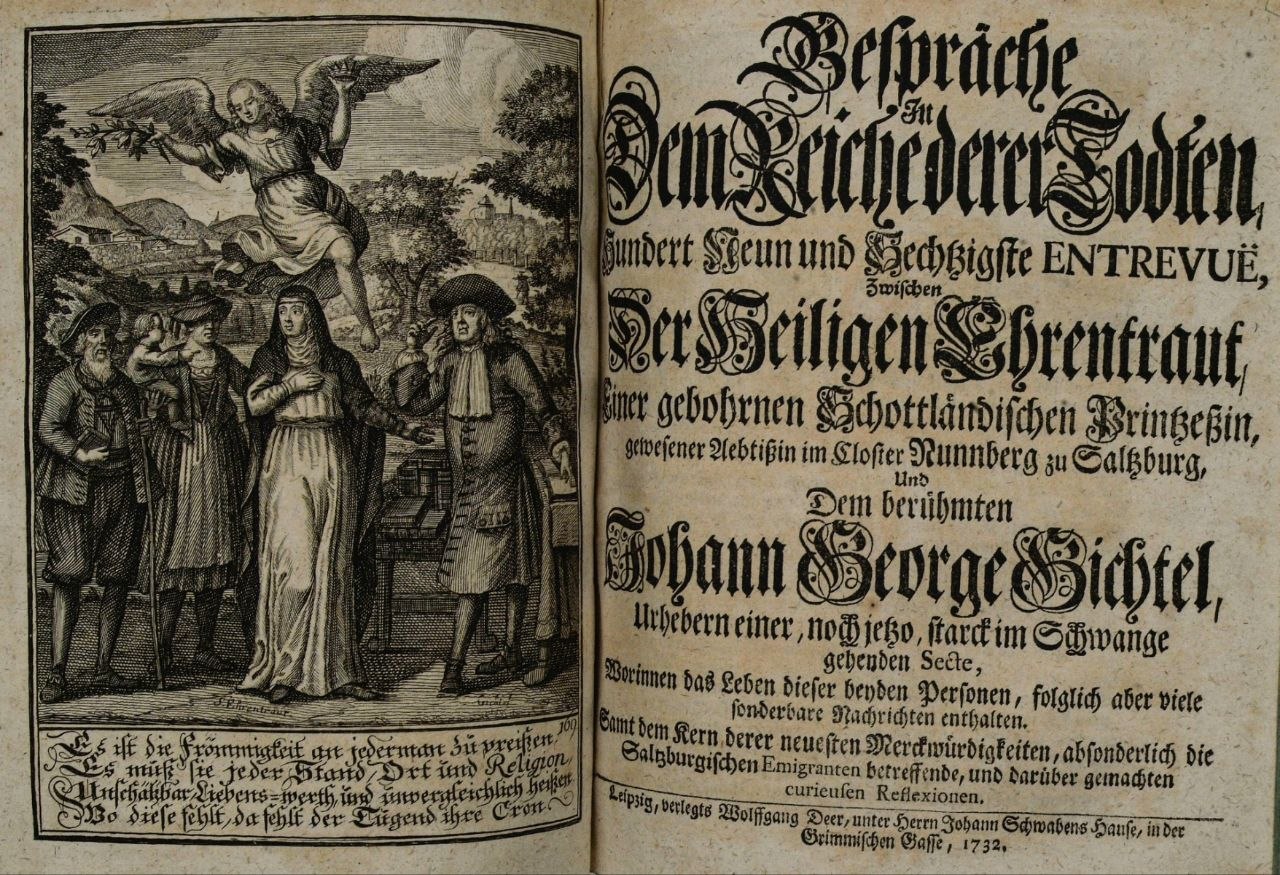
A remarkable visual discovery emerged during the preparation of this study. The featured reconstruction of Johann Georg Gichtel was originally conceived without the benefit of a securely identified early portrait. It can now be anchored in an early eighteenth-century printed representation.
The source is the engraved title-page/frontispiece to David Fassmann’s Gespräche in dem Reiche derer Todten, the 169th Entrevue, published in Leipzig in 1732. The title page explicitly names the celebrated Johann Georg Gichtel as one of the persons represented in the dialogue. More decisively, the small standing male figure at the right of the engraving is itself labelled GICHTEL beneath the feet. The identification is therefore not a modern attribution based merely on physiognomic resemblance: the engraver explicitly identifies the figure as Gichtel.
Engraved title page of David Fassmann, Gespräche in dem Reiche derer Todten, 169th Entrevue, Leipzig, 1732. Gichtel is the standing figure at the right:
*
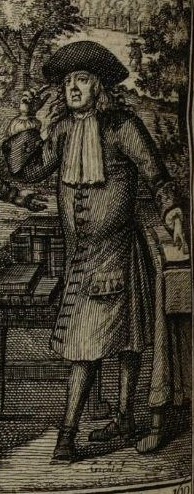
The engraving is, of course, posthumous: Gichtel died in 1710, while this representation dates from 1732. It should therefore not be described as a portrait demonstrably made from life. Its significance lies elsewhere. It is an early, explicitly identified visual representation of Gichtel, produced only a little more than two decades after his death, within a publication devoted specifically to a fictional encounter with the historical Gichtel.
Detail beneath the figure: the engraved inscription “GICHTEL”:
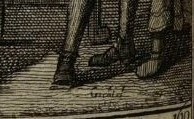
The small inscription transforms what might initially appear to be an intriguing physiognomic resemblance into a substantially firmer documentary witness. The long hair, broad hat, facial structure, clothing, and general bearing can now be studied as features of an early printed representation explicitly identified as Gichtel. The engraving therefore provides a concrete visual anchor for the reconstruction used as the featured illustration of this article.
There is an unexpected resonance between this discovery and one of the principal themes developed above. Gichtel’s correspondence repeatedly distinguishes reality from representation. The Putatitius is associated with Einbildung, Phantasie, and the danger of mistaking an image or conception for the reality to which it should correspond. The genuine Adeptus, by contrast, is associated with an inward reality that does not depend upon external display.
Here, almost playfully, Gichtel’s own image seems to reproduce the same paradox. He was hidden in the obvious.
The figure was present on the printed page, and his name was literally written beneath him. Yet the eye is naturally drawn elsewhere—to the allegorical figure, the surrounding group, and above all the extraordinarily elaborate Baroque typography. Only a closer examination reveals that the inconspicuous standing figure at the margin is not merely another participant in the scene, but Gichtel himself, explicitly named by the engraving.
“The image was already there; what changed was the quality of attention brought to it.”
The discovery is therefore more than an attractive supplement to the article. It changes the evidentiary basis of the featured reconstruction. The illustration remains an artistic interpretation rather than a reproduction of the 1732 plate, but its conception is now informed by an early and explicitly identified representation of Gichtel. We are no longer obliged to construct his appearance entirely from later visual tradition or imaginative convention.
There is consequently a fitting final irony. An article concerned with the distinction between representation and reality, and with the difference between what is merely imagined and what is actually possessed, concludes with the recovery of an image that had itself been hiding in plain sight.
Gichtel was there all along—and his name was written beneath him.
*
Visual Source
David Fassmann, Gespräche in dem Reiche derer Todten, 169th Entrevue, Leipzig, 1732. Title page bearing the dialogue between the named persons and the engraved figure labelled “GICHTEL”. The present note treats the plate as an early posthumous visual representation, not as a demonstrably life-drawn portrait.
*
Apendix II
The Rumor of Gichtel
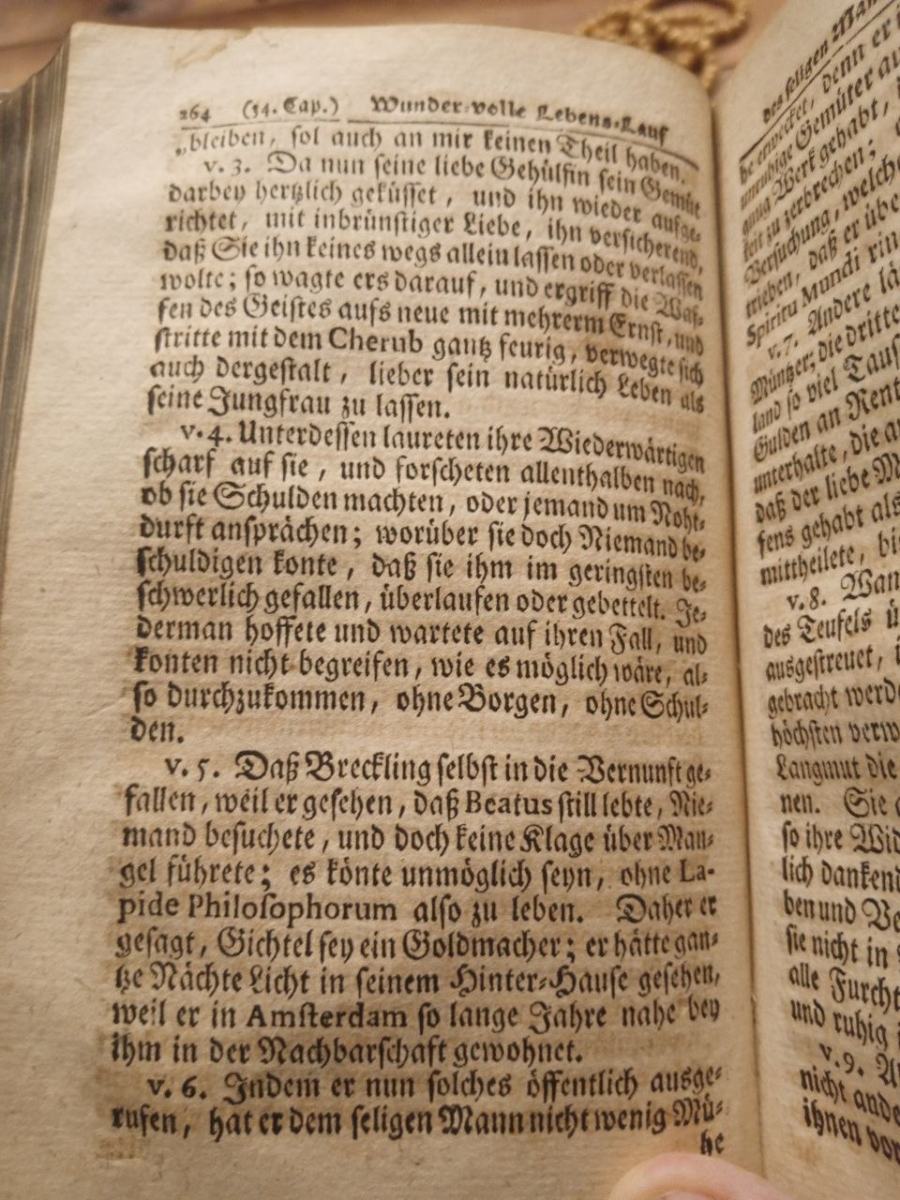
as a Goldmacher §5:
An editorial note:
The distinction between the Adeptus and the Putatitius has another, more unexpected mirror in the biographical material preserved in the seventh volume of the Theosophia Practica. Here the direction of projection is reversed. The problem is no longer someone imagining himself an Adeptus, but the world imagining an Adeptus in someone else. Because Gichtel lived quietly, without visible signs of want, and because light was sometimes seen at night in the back of his house, an observer reasoned that he must possess the Lapis Philosophorum and therefore be a Goldmacher—a maker of gold.
The anecdote is revealing precisely because it shows how quickly an outward sign can be converted into a presumed inner reality: observation becomes inference, inference becomes rumor, and rumor becomes reputation. Read alongside Gichtel’s warnings about the Putatitius, it forms a striking double mirror. The presumed Adeptus may mistake an image of attainment for the reality of the Work; conversely, others may project such an image onto the person who remains silent about his inward life. In both cases, the essential question is the same: what is actually real beneath what is imagined, claimed, or said?
*
***

Related Articles


Leave a Reply