
Circle of Transmission: The Living Loom
Charles Mopsik – Unity of Being, Unity of the World – Part 3/3

Charles Mopsik
Picture by Marc Attali
*
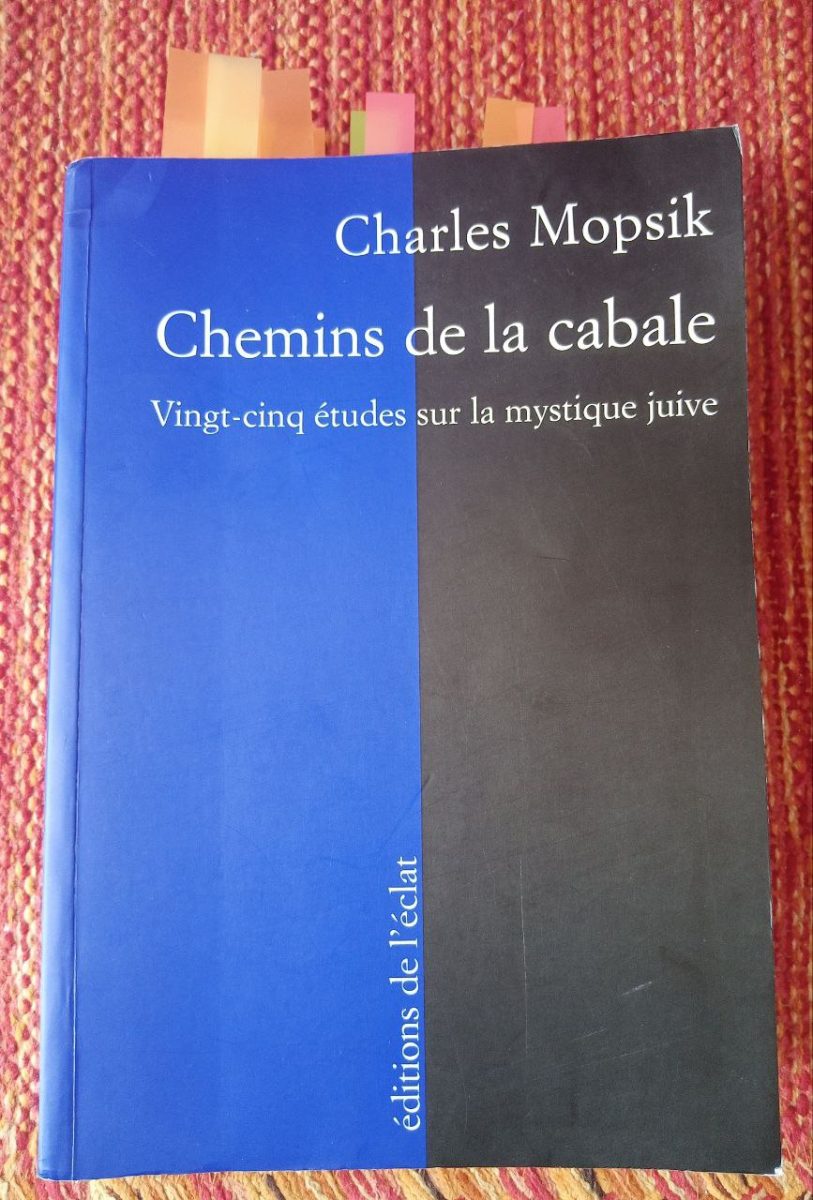
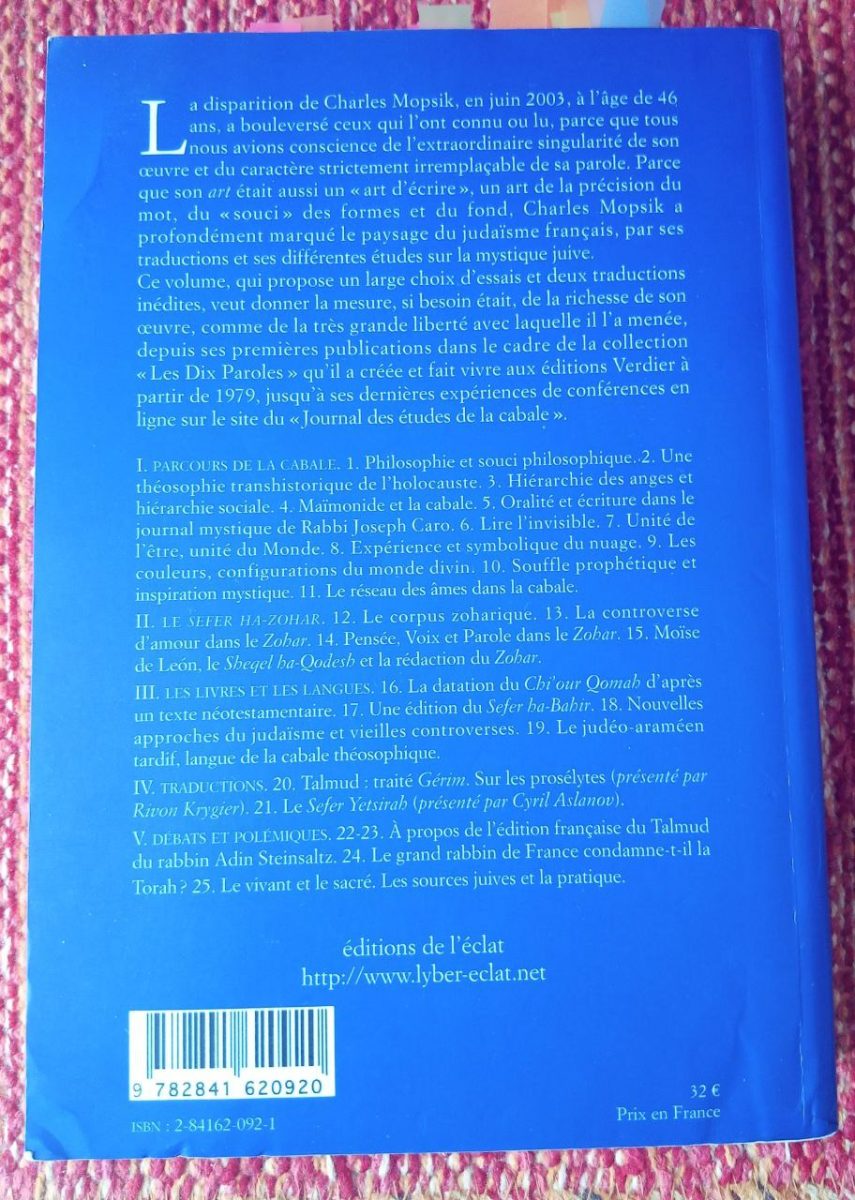
With today’s sharing from the Blue House of Via-HYGEIA, we conclude our perusal of a very substantial study by Charles Mopsik, ‘Unity of Being, Unity of the World‘, excerpted from ‘Chemins de la Cabale, vingt-cinq études sur la mystique Juive’, Editions de l’Eclat in 2004. This concluding part 3 (out of 3), running from page 92 to 103. A Via-HYGEIA English translation from the original French.
**
…Among the many kabbalists who have elaborated visions of the divinity by using images related to marital union, or to procreation, we ought to grant a special place to Rabbi Abraham Halevi ben Eliezer who wrote shortly after the 1492 expulsion from Spain. Among the rare writings that were saved, we find a true masterpiece which deserves to be discussed in a lengthy manner. In one of the early paragraphs, this kabbalist presents the royal couple from Above, and contemplates the couple from below as being forged upon its model:
‘The tenth sephira is the Bride and she is our holy Mother, our ‘Queen in Heaven’, and she is called ‘Kingship’, while our Holy Father is called ‘King’ and the Children of Israel ‘holy seed’, because their souls are holy as they are born from the King and Queen’s embrace (hibour): they are consequently royal children. This is the secret of what our masters said-may their memory be a blessing: all Israelites are children of royalties. Blessed are we that our lot is fair and charming. Hence, when the man and woman from below embrace in holiness, they are at the image of the King and Queen from above. The effusion the King lavishes in the Queen, where did it come from? It proceeds from the Cause of all Causes-may it be blessed. If such is the case, look at this marvel, and see this elevated matter, which is that our souls originate from the highest degree, from the Cause of Causes-may it be blessed- you can consider therefore from this, who is such and such a man, what is his level and his standing rank (his elevation)‘. (Source: ‘Massoret ha-Hokhmah’, published by Gershom Sholem in ‘Kyriat Sefer‘, volume II, 1925-1926, page 128).
Then a panorama of the totality of the sephirot is displayed before us, in which the first of them is described a a mother:
‘The sephirot we have spoken about are her dimensions (middot)-may it be blessed-and through her the world is steered. They are spiritual, subtle, limpid and of saphiric forms. Their levels of spirituality overcome from far those of the angels, to a point difficult to fathom. They are all effects of the Cause of the Causes that dwells upon them. All of their desires converge towards her, because from her they are emanated. The Cause of all Causes is unique, holy and fulfilling itself above them all according to an absolute elevation, such that our mouth cannot describe it and our ears cannot hear from it. All (sephirot) desire reaching it and before her throne they bow. Before that the decision to create the world had reached the Thought, it was alone, may it be blessed-unique and simple, without a second in command. It was known by nobody. When the decision to create the world reached the Thought, it emitted a first stream, and this stream was absolute simplicity, without any composition, subtle, more than subtle, and without any separation from it. In this very stream were the sephirot, the angels, the celestial bodies, the earth and all of its filiations, in a power state (virtual), but not in act (actual). And when it wanted-blessed be it-to expose and manifest its being (or its ‘Truth’) and create the world, it emanated from it a holy and supreme procession, neither separated nor distinct from itself, but it kept being attached to it and this was the crown from above. When the influx of its Breath and its Goodness descended upon the Crown, without any doubt, this influx surged upon her and the Crown became pregnant of this bountiful flux and she gave birth to Wisdom, which is the second sephira: she is the daughter of the Cause of all Causes and of the Crown, because the Crown was an intermediate reality. It was not her who was called ‘daughter’, because Wisdom is called Father and Discernment is called Mother, but I said it was a ‘daughter’ because she proceeds from there, ‘Wisdom exists from the void’ (after Job 28:12). This second sephira did not separate and stayed conjoined and bound. The progressive influx spread like that until the tenth (emanation) and as a result, ten sephirot were emanated from the first Cause and they weaved themselves like a garment, still conjoined to it. Such is the meaning of the word ’emanation’ (atzilut): they stayed close to it (etslo) like a cloth, and they were emanated in the image of someone who lit a flame from another flame. The dimension of the Crown is simpler than all which is below her, because she is the Mother of all living beings, plants and minerals, but she embodies a composition due to her virtuality and due to the will of her Cause’. (Book mentioned right above, from page 128 and 129).
For us, in this text, a few elements seem truly extraordinary. Neo-Platonic motives are articulated to ‘mythical‘ figures of Biblical origin, like the evocation of the ‘Queen of Heaven‘, of rabbinical origin: Thought, solitude before creation, and finally kabbalistic. This articulation reminds us of the style of the last Neo-Platonists of late antiquity: Plotinus, and even more Proclus. Though, it is very unlikely that a direct influence could be invoked. As for this indirect influence, it does not trespass, in the text, the little we know of the impact of pagan Neo-Platonism upon Kabbalah. The originality of this writing lies in his great expressive clarity, while the Zohar, for instance, when it happens-and it is very rare-to deal with emanation from En Sof (here presented as the Cause of all Causes, a. k. a Causa Causarum) uses a voluntary cryptic style and we see often some evanescent images.
Even though this exposition is of a relatively late nature (end of the seventeenth century) we can detect traces that go far beyond, to the dawn of Kabbalah. Hence, the word-play between ‘by his side‘ (etslo) and ‘emanation‘ (atzilut) is the re-use of a theme that we have met in a proto-kabbalistic text, reported by Rabbi Eleazar of Worms. We have here a great statement of the manner in which the ancient image of the relationship between the Creator and his Shekinah, presented as Groom & Bride, has been transposed and placed at the level of the relationship between En Sof-The Cause of all Causes-and the whole group of the sephirot. They have a characteristic feminine position, while the Emanator is presented with a clearly masculine position. In fact, the totality of the sephirot are concentrated into the first of them, Crown, who plays explicitly the role of a Mother for the whole of the emanations. Though, she is said to be emanated from the Cause of all Causes, she is also presented at the same time, as absolutely not separated and not distinct from her Emanator; she truly is the receptacle of the seminal stream of his creative thought. The idea according to which the sephirot previously all included in the Crown is not new. A kabbalist like Chem Tov ben Chem Tov, for instance, does mention it: ‘All the sephirot were hidden in the Crown until came as a surge the desire of the Lord of All, and they all went into action‘. (Quoted by Moshe Idel, in ‘Kabbalistic Material of the school of Rabbi David ben Yehoudah he-Hassid‘, Jerusalem studies on Jewish Thought, 2, 1983, page 190).
Numerous writings testify of the pre-existence beside En Sof, and even ‘in Him‘ of the first sephira. A midrash from the ‘Pirke‘ of Rabbi Eliezer served as a model for speculations that venture into that direction. In chapter 3 of this late midrash, we find this affirmation: ‘Before the HolyOne-Blessed He be-created the world, He was with His name‘. In the article by Mose Idel we have quoted just above, a few writings surface which identify this Name, present before Creation besides the divinity, to the totality of the essences of the sephirot hidden in the very bosom of En Sof. For instance, this text excerpted from the book of Rabbi Abraham Arduriel, ‘Avne Zikaron‘:
‘We read in the ‘Pirke’ of Rabbi Eliezer (chapter 3): ‘Before that the Holy One-Blessed He be-created the world, He and His Name were one’. This is astonishing, because the name refers to the emanation of the names, of which it is said: ‘He marked an end to obscurity (Job 25:5) and give them a measure and a limit…Moreover, a name is made up from letters which manifest measure, while in the Cause of all Causes, no beginning nor end, nor measure, nor dimension whatsoever, is attributed; Far from ! Here is the answer: ‘the word ‘name’ refers to the 10 sephirot, and in the Cause of all Causes, they are hidden and not revealed, and in them they pierce and pierce not.’ (Quoted by Moshe Idel, in ‘Kabbalistic Material of the school of Rabbi David ben Yehoudah he-Hassid‘, Jerusalem studies on Jewish Thought, 2, 1983, page 190).
In Rabbi Abraham ben Eliezer’s text, the movement from the state of occultation of the subtle essences to a state of manifestation is depicted in terms of sexual union & procreation. We already had the opportunity to study a text by Rabbi Ezra from Girona, from the XIIIth century, in which the procession of the sephirot is presented as a flow of seminal flux out from their source, in which they were like subtle traces not distinct yet (See our publication of the ‘Epistle upon Sainthood‘, Verdier, 1993; pages 61 and 72). But, there were no explicit mention of a relationship between the Emanator and the first receptive sephira. Is it legitimate to estimate that Rabbi Abraham’s late conception was already in gestation in the painting of the emanations proposed by Rabbi Ezra? The essences that are in the Crown are described there in these terms: ‘In Him (in the brain= the Crown), subsist in power (virtually) all the generations, and from there, they separate. They are in Him like extremely subtle traces‘. (‘Epistle upon Sainthood‘, Verdier, 1993).
The brain here truly operates as a superior matrix receiving the sephirotic seeds, before they distinguish themselves and spread into the emanating structure. But from where did He receive these seeds or subtle essences, if not from En Sof Himself? The image used by Rabbi Ezra stick to the pattern of the spermatogenesis; it is clear, though, that Rabbi Abraham Halevi had at least a solid pretext to go the extra mile and attribute to the Crown a maternal function & to En Sof a paternal role.
This very conception according to which the Crown is not an ordinary emanation, and even that she is not at all an emanation of En sof, but in fact she is ‘coupling’ with the Emanator, coexisting from all eternity with Him, had at the same time supporters & detractors in the history of Kabbalah. Among its famous supporters , we ought to quote the celebrated Zohar; and among its detractors, the ‘Tikunei haZohar‘. Because these two works are being attributed to the same author, the Tanna (teacher) Rabbi Simeon ben Yohai, we ought not to be surprised of the confusion that has established itself regarding this subject among the kabbalists who have inherited these traditions! It is also useful to quote here a writing from Rabbi Menahem Recanati, condensing these ancient traditions that saw in the first sephira, called ‘primal air‘, a pre-existing entity. The occasion for such a rich development comes from a commentary upon the apparition of Light in the text of the Genesis:
‘Rabbi Berakhia says: What does ‘Let there be Light and there was Light’ (Genesis 1:3) mean? The text does not say: ‘and there has been’. The parable of the King who owned a precious object; he stored it away, until he needed it again and retrieved it. It is what’s written: ‘there was light’. ‘A light that was already’ (Bahir, paragraph 25). The secret of this subject is that, before emanation, primordial air was alone and was not leaning towards any of its effects, and the powers of the Holy One-Blessed He be- were hidden and withdrawn in its bosom, and its glory wasn’t revealed at all. When the will rose before Him, in His primordial and eternal thought, to bring-into-existence His actions, He had the efficiency of the mysteries and of faith in the equality of unity (we cannot fathom their root), and the sephirot emanated attached to Him, alike a flame bound to the brimstone; and they pulled their influx and will from Him-May He be exalted-alike the magnetized stone attracts iron by its property, and as it is said: ‘Then he saw and he told’. Hassid Rabbi Azriel-of blessed memory- explains: ‘ ‘then he saw’: He contemplated the pure thought, alike a man who imagines an action first in his heart, and then starts realizing it, and following his ideas (tsiyourim) which were in her, and gave a form to the principle he emanated from her. ‘And he told’: refers to the three types of books: book, numbers and story; ‘and he arranged it’: means that the essences were not systemized according to the order of the structure of the edifice, and He-May He be exalted-he proceeded these essences and organized them according the order, then he made a unified building with a unified name, after the combination, the weighting and the substitution of the twenty-two letters which are all bound to His companion, and correspond one another. This light already was, because it was not something outside of Him-may He be exalted-and they were hidden and withdrawn until the will rose before Him in order to make Him proceed the mysterious essences, in the manner it is said here: ‘He sent his hand upon the hammer’, and He let each of them his power and action, of which the words: ‘until it leaves Him a Place’, an allusion to the essences’ emanation, and in order to give them life, so that they may fulfil their action, and as this light is not set outside of Him-may he be exalted-He said: ‘A light that already was’, which means that He gave it to Wisdom from which the stream was emanated…‘ (‘Commentary upon the Torah‘, folio 3).
We clearly perceive the efforts of our kabbalist to highlight the eternal pre-existence of the first sephira and the perfect union of her fusion with En Sof. Primordial air remains a necessary mediator between the very En Sof-which is absolutely hidden and inaccessible-and the very rising of the emanations. Likewise, the anonym author of the ‘Sefer ha-Yihoud‘ exposes a similar conception:
‘Before the Thought rose (the decision) to create, primordial air was a root that stood in His divinity and in His Truth; none can fathom how, because the order of the degrees of the ten sephirot, the secret of the great Name, were hidden in the depths of the Void. When rose in the Thought (the decision) to create, a sephira was detached from the Void and ‘being’ was manifested‘. (Ms Paris 799, folio 22b).
Here also, primordial air or Void holds a clearly superior status in regards of the ordinary sephirot. It dwells in the very bosom of the mysterious divinity, concealing within its depths the whole steps of emanation. The ‘great name‘ (YHVH?) designate, it seems, the whole group of the nine superior sephirot, considered as forming a masculine entity per-se, the ‘little name‘ refers, it seems, to the last sephira, the feminine entity, called ‘Lord‘ (ADONAI). It is allowed to consider that the couple which constitute the structure of the emanations is but the replica-more differentiated of the couple formed by En Sof & the Void, being in an extreme degree of undifferentiation. Rabbi Menahem Recanati seems to re-use the gist of this text when he writes, to comment this verse from Genesis, ‘Obscurity upon the face of the abyss‘:
‘Obscurity refers to the primordial air, which is thus named, because it is too obscure to manifest what is in its bosom, because before that rises in the thought the creation of the world, primordial air stood in its essence and in its truth, nobody can fathom how, but all of those hidden essences were withdrawn into the depths of the Void, until all things emanated went into proceed from the marvelous unity. It is allude in the Book of Genesis: ‘Obscurity upon the face of the Abyss’ (1:2), and the word ‘Abyss’ refers to the Shekinah, because She is at the end of the edifice of the emanated sephirot. Also, because the Shekinah rises up to the peak of the heights, which is the place called ‘Elevated Heights’ (See the ‘Sefer Yetzira’), which is meant by: ‘ His end is fixed from its beginning‘. (‘Commentary upon the Torah’, folio 3).
The last lines refer to the scheme in which the feminine dimension is represented as being at the same time the first & the last emanation. We ought to underline, in passing, that the identification of Obscurity and the Void as a radical origin is to be found in the works of the XVIIth century Teutonic Philosopher, Jacob Boehme, who writes: ‘If you are eager to think about God, you ought to represent yourself an obscurity which is not, and an obscurity similar to a void‘. (Quoted by Alexandre Koyré in ‘La Philosophie de Jacob Boehme‘, 1979, page 207). It is interesting that there are many similitudes between Bohme’s conceptions and those of the kabbalists. The text quoted and the preceding one refer, using the same terminology, to the situation of the divine before its manifestation through the ten sephirot. Even, at this stage, En Sof, unnamed, is coupled with the Obscurity, to the Void, in which are withdrawn, like a matrix, all of the indistinct essences of the forms of the manifestations and the divine action. The passage from the ‘Pirke‘ of Rabbi Eliezer, which is the foundation of this conception, was the object of a constant debate between the commentators of the Zoharic literature. What became a true polemic is re-used by Moses Cordovero in the XVIth century. He summed up first the arguments of the supporters of the eternity of the Crown forming a couple with En sof, to better oppose them and severely criticize them later. Here, below, how he presents the first opinion:
‘Many believe & say that the Crown preceded everything, meaning that, even though there were no emanation yet, it was in existence and was the eternal garment (covering, ‘levus’) of the Emanator. Those who hold such statements have shields that protect them, and the essential proof they bring in favor of this idea, is a saying of our masters-may they be blessed-found in the ‘Pirke’ of Rabbi Eliezer: ‘Before the world was born, there was only Him and His name‘-Here is the explanation: ‘Him’ and ‘His Name’, are En Sof & the Crown. From there, they demonstrate that the Crown is eternal, that she is united to the Emanator and that she is a garment (a covering, ‘Levus’) for Him‘. (‘Pardes Rimonim’, 3:1, folio 11b).
The terms used by Moses Cordovero are interesting for our subject: En Sof & The Crown are presented as ‘being united‘ in eternity, when the idea of union implies in the kabbalistic terminology a marital relationship. Furthermore, the vision of the Crown as a ‘garment‘ (levus) of En Sof, is not without evocating the covering and receptive function of the feminine dimension. This pattern, which is originating also in the ‘Pirke‘ of Rabbi Eliezer, has known an important amplification in Lurianic Kabbalah, which describes ‘the covering worlds of En Sof‘. Finally, the simple fact that the Crown is seen as the Name of En Sof argues in favor of its feminine character: the notion of ‘name‘ is often bound to the last sephira, Malkhut, which is the female of the divine world in the Jewish Theosophy. (See Moses Cordovero’s sum up in ‘Pardes Rimonim‘, 2, folio 42b). Further, Moses Cordovero quote a text from Rabbi Chem Tov, in which the idea exposed earlier above is re-used in a different manner:
‘…the opinion of the ancient kabbalists, shared by Rabbi Shem Tov who express it in his ‘Sefer ha-Emounot’, part 4, chapter 1, in which he enumerates the sephirot and declares that the Crown is the first sephira, and in which he further says that the Crown does not belong to the group of the sephirot, to reproduce his own words. To sum up: all the kabbalists agree to count ten sephirot, which are: 1. the Crown. 2. Wisdom. Etc… Though, the elite and those who have deepened this wisdom (of Kabbalah), agree to not include the superior Crown, according to the path of Truth, as belonging to the group of ten (sephirot), because she is alike En Sof, and similarly, because we ought not to count the Cause of all Causes (among the sephirot), it is not then legitimate to count the superior Crown, because in her there is no beginning and no limit, no end, and she is all. Rabbi Simeon ben Yohai claimed it a few times (in the Zohar)’. (‘Pardes Rimonim‘, folio 12a).
Among those ‘ancient kabbalists‘, we ought to count the members of the Iyoun Circle, the kabbalists from Girona & Moses of Leon. At the most intimate level of the understanding of esoteric wisdom, the Crown is neither considered as one of the sephirot, nor even as the first among them, but she is ‘alike‘ En Sof, without beginning nor end: this particular situation is not without evoking the image of an eternal syzygy from where produced, at a certain moment, the whole of the sephirot who are like its births. But Rabbi Moses Cordovero energetically rejects this conception, not only because it is not from the Zohar-actually from the ‘Tiqunei Zohar‘-but also because this supposes a dualism incompatible with the monotheist faith: ‘If you say that she (the Crown) is not emanated, it is impossible to believe in this, only but if we identify her to the Cause of all Causes and to nothing else, therefore there is a dualism (chniyout); may God preserve us from saying that there is a thing outside of the Cause of all Causes, and that it does not emanate from it!’ (‘Pardes Rimonim’, folio 12b).
Only those who share the conviction-also brushed aside by Cordovero- that the Crown is a a denomination of the En Sof, can pretend that she is not an emanation like all the other cases, it is but a dualistic doctrine affirming the co-existence of two distinct divine principles, one does not originate from the other. The serious accusation that Rabbi Moses Cordovero puts hovering over the heads of the many kabbalists-all exhibiting serious proofs to vindicate their thesis-is in itself very instructive of the manner the most daring speculations of the kabbalists was perceived by the exoteric monotheism champions. That a kabbalist such a Rabbi Moses Cordovero, impregnated with Maimonidean Jewish philosophy, prefers to reject-taxing it a dangerous dualism-the opinion of many of his predecessors carrying ancient & authorized traditions, rather than interpret it in such a less heterodox manner, speaks volume about the attraction force this conception exerts. It does shake, more than other conceptions, the most solid foundations of Jewish monotheism: it is not upon the question of the origin of good & evil that the dualistic tension is at its strongest, but upon the very idea of the dyad En Sof & Crown, and its subtler watermark: the conception of an eternal divine couple. It is very likely, nevertheless, that the supporters of this conception would not have accepted the dualistic reprimand which was thrown at them, because, in their mind, En Sof & the Crown are not two drastically distinct entities, and their differentiation is not such as it becomes a duality. For Rabbi Chem Tov, for instance, there is no contradiction to affirm that the Crown is the first emanation and that she is eternally united with En Sof. It is only a more deep manner to apprehend the same reality.
We can judge the importance the later generations of kabbalists have given to this question, by reading the critical dissertation that Rabbi Joseph Ergas devotes to it-and he is merely re-using almost word to word Rabbi Moses Cordovero’s presentation:
‘There is a controversy among the group of the ancient kabbalists-of blessed memory. Many of them have written that the Crown does not have a beginning, but that she is eternal alike the eternity of En Sof, and that she unites to En Sof and that she is its garment, and finally that she is called by the name of En Sof; they back their claims upon what is said in the ‘Pirke’ of Rabbi Eliezer: ‘Before that the world was created, there was Him and ‘His Name’ only’. The explanation: ‘Him’ is En Sof, ‘His Name’, the Crown; you will find this also in the ‘Pardes Rimonim, 3,1‘. (‘Chomer Emounim‘, Jerusalem, 1965, folio 67).
It is certain that we are here at the very heart of a debate which is provoked by the difficulties inherent to the kabbalistic systems and this would be very rewarding to examine in detail. We would only have to look into to the lengthy explanation essays upon the formula coming from the ‘Pirke‘ of Rabbi Eliezer, such as what Rabbi Isaia Horovitz contributed and to the different authorities in the science of Kabbalah we ought to call forwards, to appreciate the challenge hiding behind the discussions-which technicity is only apparent ( See his ‘Chne Louhot ha-Berit‘, I, folio 4b).
If, for instance, Rabbi Joseph Alkastiel (1482) is right to read in this Midrashic formula the idea that ‘His Name is eternal in His Eternity‘, the simplicity of En Sof conceals already in itself the principle of plurality, which leaves the door open to a dualistic interpretation, because this primordial Name does not originate from the One who carries it, but forms an eternal unity with Him. This dualistic interpretation was the haunting fear of numerous kabbalists, like this affirmation from Rabbi Moses ben Jacob of Kiev-and it is not an oratory precaution(!): ‘En Sof, blessed it be, in relationship with his sephirot, unites in perfect union, and there is here no suspect duality‘. (‘Otsar Hachem, a commentary upon the Sefer Yetzira’, republished in Jerusalem in 1965, folio 29a).
If the simple existence of a decade of emanated sephirot besides En Sof already necessitates such warnings-which are not rare-we can easily conceive that the existence besides En Sof, or in Him, of an eternal entity had all the ingredients to alarm even the most easy-going monotheists.
We will, in passing, only comment that the resemblance between the relationship of Crown & En Sof as it is described here, and the relationship between Wisdom & Kingdom (father-daughter) that we have studied at the very beginning of this expose. Here & there, the superior entity gives its name to the one which is subordinated to it, to the point that they form together a unique entity. Without doubt the recurrent usage of parental or marital images in order to apprehend inter-sephirotic relationships and between En Sof & certain sephirot, has allowed some kabbalists to soften or even erase the threat of a radical dualism, nevertheless perceived by the most conscious authors of the necessity to give an acceptable theological form to the speculations & visions of the esoteric tradition.
It is in the Zohar, that to my knowledge, we have the clearest reference to the ‘Pirke‘ of Rabbi Eliezer’s formula, as referring to the male/female couple type. We ought to pay attention to the terms its author chose to express his thought: ‘Before the Holy One-Blessed He be-created the world, His Name was locked-up in Him, Him & His Name make one body. Nothing had consistence, until the moment where in His mind rose the desire to create the world.’ (Zohar I, 29a).
The couple formed by the ‘Holy One-Blessed He be’– and ‘His Name‘ is prior to any emanation and to any unveiling. By ‘Holy One-Blessed He be‘, we ought to understand En Sof, the Infinite, while by ‘His Name‘ designate in these words the divine Void, His eternal partner with which they are One. We cannot consider as an insignificant stylistic term the expression according to which ‘He and His Name make one sole body‘. This very formula comes back in the Zohar to qualify the state of union between Man & Woman. Hence, it is by using the representation of the union between the sexualized Man & Woman that the author of the Zohar thinks the eternal unity of En Sof & the Void, ‘His Name‘ which is also the first of the sephirot, the Crown.
Therefore, the unity of the World and of Being, divine unity, are brought back into a concrete experience-the union of the sexes-which we can actualize and attest in our own lives. The intellectual & experiential plans echo & enlighten each other. The representation of this unity implies the premonition of its actualization through the act of love. We can add here, as an eye-wink, that the kabbalists have long calculated the numerical value of the word ‘One‘ in Hebrew (ehad) and that they discovered that amounting to ’13’ and it was the same as that of the word ‘love‘ (ahavah); As for the divine Name, the Tetragram YHVH, which equals 26, it is nothing other than the sum of that love & that unity.
*
Towards
*
Towards
*
The late Charles Mopsik was truly
one of the jewels of French Kabbalah,
which evolved after the 1970s.
Source
*
***


Related Articles

Leave a Reply