
Mahabharata – The Longest Sanscrit Epic
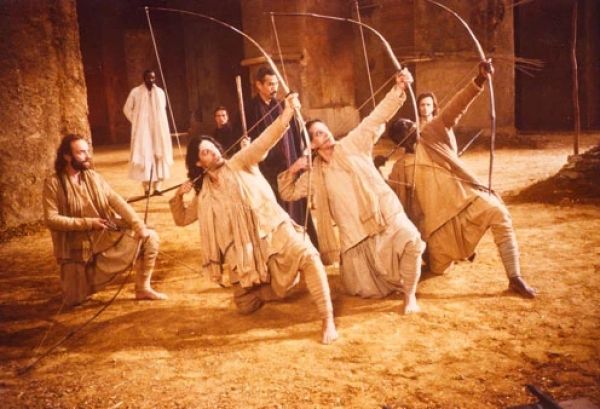
Scene from Peter Brook’s ‘Mahabharata’
*
Some time ago we watched the film “Mahabharata”, directed by Peter Brook. Below you can find a summary of the epic, the film itself contains much more messages, so you have to read between the lines 🙂
*
Mahabharata is the longest Sanskrit epic ever written. It has a collection of more than 74.000 verses, divided into 18 books. The Mahabharata story is much revered in India and basically among the Hindus. The Mahabharata contains the Bhagawad Gita, the famous gospel of duty that was taught to the great warrior, Arjuna by Lord Krishna. The Mahabharata dwells on the aspect of the important goals of a human being in his mortal life. The epic aims at making people realize the relation between the individual and the society and how they both are inter dependent on each other. Read on further a summary of Mahabharata.
The epic revolves around the struggle for the throne of the kingdom of Hastinapura. The struggle is between two branches of the same family, the Kauravas and Pandavas. The Kauravas were collectively the hundred sons of the bling king Dhritarashtra and the Pandavas were the five sons of Pandu, who died of a curse. The five brothers named Yudhisthira (eldest son), Arjuna, Bheema, Nakula and Sahdeva were always obedient and dutiful, which made them the most loved in the kingdom. Each of the Pandavas had a special virtue in them that made them stand apart from the rest of the world. This made the Kauravas hate them and they planned many devious ways to get rid of them.
As time went by, the Pandavas got married and shared a common wife named Draupadi. The Kauravas got even more enraged and challenged the Pandavas to a game of gamble. The Pandavas lost and were banished from the kingdom for an exile of 12 years. There was a condition that if they were recognized by the end of 12 years, they would have to begin from scratch.
One of the most important and dramatic character in this epic is Lord Krishna. He was the sole advisor, guide and true friend of the Pandavas and helped them in each and every difficulty in their exile. He is said to be the incarnation of God, who came to earth in human form to relieve the world of evil people and restore faith in his devotees. During the great battle of Kurukshetra fought between the Kauravas and the Pandavas, Lord Krishna took upon himself the duty of driving Arjuna’s chariot. He imparted the valuable and practical lessons of the Bhagavad Gita, a text of the conversation (read more about the sacred scripture here) between Lord Krishna and Arjuna, where Lord Krishna shows Arjuna a glimpse of his majestic divine form.
The Pandavas won the battle and ruled over Hastinapura for a number of years. It is said that Dhritarashtra and his wife retired into the forest to lead a stress-free life of an ascetic and Krishna left after around thirty six years after the battle took place. When the Pandavas realized that it was time to leave this earth, they all set out on a journey towards the North on foot. It is said, that the gates of heaven opened on the northern horizon. One by one they dropped dead, until Yudhisthira finally reached the gates of heaven to be united one again with his brothers and wife.
*
Trailer for Peter Brook’s movie version
*
Peter Brook,
Stage play version
Peter Brook’s original 1985 stage play “The Mahabharata” was 9 hours long, and toured around the world for four years. In 1989, it was reduced to under 6 hours for television.
The Mahabharata is one of the two major Sanskrit epics of ancient India, the other being the Ramayana. Traditionally, the authorship of the Mahabharata is attributed to Vyasa. Without being directly related to them, the Mahabharata derives many of its philosophical concepts from the Vedas.
(The Mahabharata – Les Productions du 3ème Etage; produced by Michel Propper; directed by Peter Brook – Channel Four Television – the Brooklyn Academy of Music)
***


Leave a Reply