
Epidauros: A Religion of the Patient
Asklepian medicine contained a fundamental principle that was both enlightening and healing. The loss of this healing principle is at the core of our modern crisis in health care and must be restored if true healing is to be available to people who are suffering.
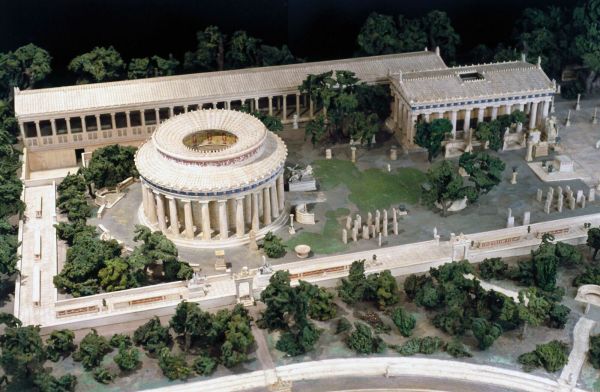
Epidauros was a sacred sanctuary, a place permeated by the spirit of the god. Patients were not “treated” as in the modern sense, and physician-priests were not the principal characters in the drama of healing. Rather, patients were immersed in a complete sacred ecology. Physician-priests guided the process, but the nature of the process itself guaranteed that afflicted people healed themselves through their own hard-won meeting with the god.
As mythologist Carl Kerényi explains:
[A] place for incubation served for the most direct possible method of healing. The patient himself was offered an opportunity to bring about the cure whose elements he bore within himself. To this end an environment was created which, as in modern spas and health resorts, was as far as possible removed from the disturbing and unhealthful elements of the outside world. The religious atmosphere also helped man’s innermost depths to accomplish their curative potentialities. In principle the physician was excluded from the individual mystery of recovery: the patient sought out the deity in a much more personal way than in the great mysteries of the archaic and classical period. It is therefore to be presumed that at Epidauros the physician remained intentionally in the background.
At Epidauros, both priest-physicians and seekers practiced, in Kerényi’s phrase, “a religion of the patient.” The priest-physician was a guide to a process, not an authority figure who instigated the process. The seeker needed to enter and directly experience mythic consciousness in order to achieve that which heals—a meeting with the god.

Leave a Reply