
Circle of Transmission: The Living Loom
A Little Marc Semenoff Sampler-Part 2: Selected Writings
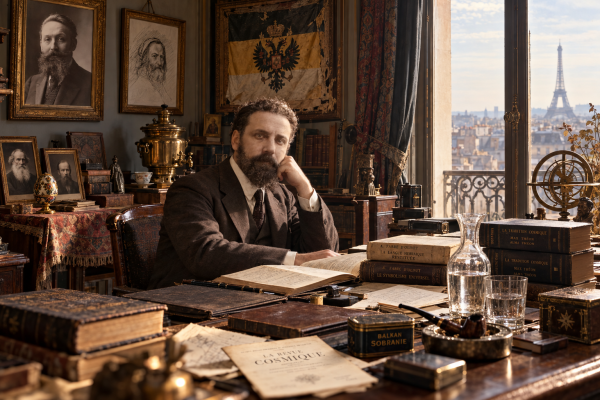
Featured Illustration Legend:This illustration is a symbolic reconstruction and not documentary records of Marc Semenoff’s Paris study, not a historical photograph. It evokes the world of a Russian émigré esotericism in interwar Paris, where the printing workshop, the occult salon, and literary translation belonged to a single social fabric. The volumes on the desk include Fabre d’Olivet’s La Langue Hébraïque Restituée and Max and Alma Théon’s La Tradition Cosmique; the periodical in the foreground is the Revue Cosmique.
*
Today’s sharing from the Blue House of Via-HYGEIA — Circle of Transmission — is: A Little Marc Semenoff Sampler, Part II: Selected Writings. Three documentary and literary glimpses into Marc Semenoff’s engagement with the Cosmic Movement and the teachings of Max Théon. What does it mean to encounter a spiritual tradition through the writings of one of its readers, interpreters and transmitters?
This selection brings us into Marc Semenoff’s world of Cosmic literature: its vision of universal Life, the transformation of human consciousness, the relationship between Intelligence and Matter, and the possibility of individualisation. It also preserves a series of remarkable sayings attributed to Max Théon, offering a more intimate glimpse into the language and spirit of this current.
Moving between exposition, philosophical reflection and transmitted words, the sampler invites us to approach a body of writing in which cosmic principles are inseparable from the work of human becoming. It is a timely invitation to read, reflect and enter into a current of transmission.
**
A Contextual Introduction
This sampler brings together three distinct documentary witnesses to Marc Semenoff’s engagement with the Cosmic Movement and the teachings associated with Max and Alma Théon. It is designed as a reading edition with source references, lexical apparatuses, and interpretative commentaries; it is not a biography or a comprehensive history of the movement.
Part I presents six selected passages from Introduction à la vie secrète (1923). They are Semenoff’s own exposition, selected for the way they address the reading of Cosmic literature, the constitution of the human being, the manifestation of Light, individualisation, and the movements of involution and evolution. Original printed pagination and the section references supplied in the source are retained.
Part II presents Radiations et Mystères de la Vie, published in L’Astrosophie in December 1930. The article brings contemporary scientific discourse into relation with ancient cosmologies and initiatic symbolism. Its lexical apparatus and exegesis are editorial aids; they should not be mistaken for statements made by Semenoff himself.
Part III presents Pensées de Max Théon — Aia-Aziz, published in L’Astrosophie in March 1931. The periodical’s introductory wording attributes the sayings to Max Théon as spoken to Marc Semenoff. The present edition therefore identifies them as sayings attributed to Théon and transmitted by Semenoff, rather than claiming independent verification of the conversation or its circumstances.
A note on ‘L’Astrosophie‘: Founded in March 1929 by Francis Rolt-Wheeler, L’Astrosophie was a French-language monthly review published by the Institut Astrologique de Carthage, in Tunisia. Its subtitle described its field as esoteric and exoteric astrology, psychism and the occult sciences. The journal brought together a broad range of subjects, including astrological research, divination, Tarot, Pythagorean studies, ancient religious traditions, psychical phenomena and occult philosophy. Its stated ambition was international: to present French translations of contributions by English and American astrologers, psychical researchers and occultists, alongside the work of French, Belgian and Swiss specialists.
The Institut Astrologique de Carthage combined publishing with practical and educational activities. According to its own announcements, it provided individual horoscope calculations and interpretations, and offered courses in astrology through personal instruction and correspondence. The Institut also declared an affiliation with the Astrological Institute of London, founded by Alan Leo in 1890. An English-language companion review, The Seer, was published alongside L’Astrosophie for a shorter period. The journal itself continued, with an interruption between 1940 and 1949, until 1960; during its later history it appeared under modified titles, including Nos Pouvoirs — L’Astrosophie.
L’Astrosophie was an independent periodical, with its own institutional identity and editorial direction. It was in no way an official publication or organ of the Cosmic Movement. Its editorial policy explicitly placed responsibility for the ideas expressed in individual articles upon their respective contributors, describing the review’s purpose as offering hospitality to researchers working within its broad domain. This openness helps explain the diversity of authors and subjects represented in its pages.
Marc Semenoff contributed to the review on several occasions. His Mysticisme Russe et Mysticisme Européen, of which the third instalment appeared in May 1930, preceded the two contributions reproduced here: Radiations et Mystères de la Vie (December 1930) and Pensées de Max Théon — Aia-Aziz (March 1931). These publications document Semenoff’s participation in the wider French-language esoteric press of the period. They should be understood as contributions to an independent review, not as evidence of an institutional relationship between L’Astrosophie and the Cosmic Movement.
Francis Rolt-Wheeler (1876–1960): The review’s founder and director, Francis Rolt-Wheeler, was a British-born writer whose career extended from popular English-language literature to astrology, occultism and esoteric philosophy. After spending many years in the United States, where he studied theology and reportedly served as an Anglican hospital chaplain, he established the Institut Astrologique de Carthage in Tunisia in the 1920s. He subsequently transferred his activities to Nice, where he continued his publishing and esoteric work. His substantial bibliography includes both popular historical and adventure literature and later works on astrology and Kabbalah. His career provides an important context for understanding the independent editorial and intellectual world in which L’Astrosophie operated.
Editorial method. The translations preserve Semenoff’s technical vocabulary wherever possible. Unfamiliar expressions have not been silently normalised merely because a more familiar equivalent might be available. The lexical apparatuses explain usage within the immediate texts; the commentaries offer interpretation and are kept distinct from the translated primary material.
*
Part I — Introduction à la vie secrète (1923)
(Six Selected Passages, translated from the French edition,
Paris: André Delpeuch, 1923).
I. The Cosmic Movement and Its Sacred Literature
§§12–13, pp. 39–44.
§12
In our time, initiatic colleges no longer exist, and Initiation—which is the Science and Art of Life, the knowledge of the constant bond between all the manifestations of the innumerable forms of Life, in the visible and invisible, and of the Ethics that must result from this knowledge—is given to Men of Desire through books: La Tradition Cosmique, La Revue Cosmique, and other preparatory works and pamphlets.
These books, published in the name of the Cosmic Movement, represent the greatest, most powerful, and most profound philosophical synthesis ever formulated in writing during modern times.
The visionary of The Thousand and One Nights exclaimed:
“I have seen the beauties gathered in the mosque of Jullog. And upon its walls, the meaning of Beauty is explained. If the people frequent the mosques, tell them that the entrance door is always wide open.”
But we would say: the Temples of Atlantis, Mexico, India, Egypt, Persia, and Greece have disappeared; the prophetic voices of Moses and Socrates are no longer heard. Yet Traditional Truth is always present, for it is eternally within and through Man, within and through the Natural and Divine Forces. This Truth lives in the present as it lived in the most distant past. Its meaning is explained on every page of the Cosmic texts, and all people of good will may, through the Holy Reading of these Scriptures, rediscover it within themselves and around them.
Thousands of pages of Science and Wisdom are offered to us. But before opening them, let the student, the neophyte, understand that the joys he will experience depend solely upon the state of soul, of mind, and of desire with which he approaches this Reading. These spiritual joys have but the highest purpose: his instruction and his evolution.
He enters a Temple; he comes with the desire to learn and to receive. He cannot manifest his personality, his ego—for he does not yet know this ego. Let his attitude therefore be full of humility; let him establish within himself that sacred silence which alone permits him to hear the psychic and mental voices whispering the secrets contained in all sacred matter.
For all these pages are holy: the Chronicles of Chi, the Cosmic Drama, the Cosmic Reviews. They are holy and pure like the depths of the Universal Soul, of which each is a reflection, and like those regions of the most veiled planes of the human Soul which gradually open before the enraptured eyes of the neophyte reading in meditation, then in contemplation, narratives such as The Royal Neophyte, The Royal Initiate, Attanée Oannès, The Four Evocations, Aorah, and The Sapphire of Iran, where the most radiant promises and the most fruitful hopes are offered to beings who wish to become individualities capable of feeling and thinking for themselves.
And, when opening these new Holy Scriptures, one must also, “before meditating, know,” as has been recommended, “which summits or which valley, which hidden spring or which oceans attract us. By concentrating our mind upon a single point, the answer closest to ourselves will be given to us; and if its logic still follows the only right path for some time, the effort made will not have been in vain: through aspiration, it will have brought us closer to the source of knowledge.”
§13
To feel and understand the Truth, of which each page of these books reveals ever-new aspects, unsuspected horizons, and innumerable spheres, it is necessary, as we have said, to receive it and consciously respond to it.
The neophyte enters into communion with the Soul of the Universe in the dense and rarefied states of Substance. Gradually, particular and latent consciousnesses of being awaken to Life, and what had previously escaped the individual’s intelligence in the surrounding Cosmos becomes an intelligible reality.
Why? Because the neophyte has understood that these aspects, horizons, and spheres thus revealed are not merely worlds evolving around him. He has felt them, perhaps even lived them, as distinct souls within his one Soul, as very different selves within his one Self.
The infinite complexity of this human word is revealed to his contemplative spirit with the suddenness of lightning piercing the thick night of atmospheric layers, or it unfolds gradually before his meditating and deepening thought.
Man appears to him as a variety of degrees of being, younger or older, having already clothed themselves more than once in nervo-physical density, incarnating and reincarnating, always towards the supreme goal of unification, harmony, and Restitution.
He conceives the truth of this statement by Pythagoras:
“I was formerly Aethalides, and I was believed to be the son of Mercury. Mercury, having promised to grant me whatever favour I might desire, except immortality, I asked him for the gift of retaining the memory of everything that should happen to me during my life and after my death.”
And indeed Pythagoras had present in his mind everything that had taken place in his different transformations: he had been Aethalides, secondly Euphorbus, thirdly Hermotimus, and fourthly Pythagoras.
Reflecting upon this, the neophyte explains to himself the errors committed by profane antiquity when it makes a single Hercules out of several, or when it sometimes gathers together in the glorious figure of a Prophet, a Son of the Eternal, or a Great Initiate the prodigies and heroic deeds accomplished by several beings incarnated or reincarnated at different periods in the history of our humanity.
*
II. The Contemplative Reading of the Cosmic Texts
§§14–15, pp. 45–50.
§14
While the neophyte is still meditating upon this effort—an effort of which only a few rare Initiates have been capable, namely, to individualise enough nervous, psychic, and mental constituents for them to retain the memory and consciousness of having clothed themselves in different nervo-physical forms—the activity of his thought, concentrated upon a single point, slows down.
The clear feeling he had of things becomes indistinct. It seems to him that every limit to his power of feeling vanishes. A serene and gentle clarity arises within him; the eyes of the Spirit open, and he contemplates.
Students, Men of Desire, cosmophiles: it is most often in this state of contemplation that the pages of the Cosmic texts should be read.
“The troubling problems upon which one fears to meditate, which one does not dare to look in the face, still less to seek their consequences,” sometimes resolve almost of themselves in the state of contemplation.
“What our eyes cannot discern,” it is said in the Revue Cosmique, “what our ears are incapable of grasping, more subtle senses, dormant and latent, make us masters of and conscious of. What serenity, what repose, what marvellous irradiation when we succeed in illuminating with some hopeful glimmer one of the dark recesses of our mind where negations, fears, doubts, and challenges lie hidden like criminals. What were we? What shall we yet become? Where are we going?”
§15
What we are, what we have been, what we can and must become or become again: the texts of the Chronicles of Chi, the Cosmic Drama, and the Cosmic Reviews tell us and teach us, to the extent that we have armed our courage and ploughed ourselves so that our nervous earth may be fertilised by an incessant infusion of psycho-mental forces, and our psychic and mental faculties have taken the reins of the inner government of our being.
For only then will any mist cease to stand between the intelligence and intuition of the reader and the Truth subtly veiled in this modern Bible.
Feelings, memories, and thoughts, desires, evocations, and images—infinite forms that previously seemed to sleep in states of ourselves unconnected with our daily manifestation—touch our nervo-physical vision, move us, exalt us. Our soul takes possession of itself again, completes itself by classifying, ordering, and hierarchising, in nervous, psychic, and mental planes, all the results of intensities that were still occult before this Exchange with the Holy Reality of the Book, but which have now become active forces, like possibilities whose virtual power is transformed into realisation.
The glorious Exchange deepens, and the neophyte experiences those moments of real ecstasy in which the body and spirit of written matter merge in a Sacred Marriage with his own spirit, his own flesh.
The abyss that existed between present and past is filled; invisible links become materialised; the ephemeral is prolonged, the transitory becomes eternal. And this Truth appears, generating the greatest Hope: there is no night, there is no destruction; there is continuity only where individualisation is present, and there is death—or, more exactly, transition—only where ignorance reigns.
That is why ignorance is man’s most formidable enemy. But the Cosmic Books are there, within reach of all Men of Desire, to combat ignorance and illuminate their Self and their surroundings.
Transition reigns only where ignorance reigns. Life is an incessant transformation which man’s knowledge and power can make progressive. For Man, it must be constant perfection.
“From the man of highest dignity to the most humble and obscure,” Confucius said, “the duty is equal for all: to correct and improve one’s person.”
And Saint Francis de Sales writes:
“Devotion must be practised differently by the gentleman, the artisan, the servant, the prince, the widow, the young woman, and the married woman; but the practice of devotion must be adapted to the strength, affairs, and duties of each individual. It is an error, indeed a heresy, to wish to banish the devout life from the company of soldiers, from the workshop of artisans, from the court of princes, or from the household of married people.
“It is true that purely contemplative, monastic, and religious devotion cannot be practised in these occupations; but besides these three kinds of devotion, there are many others suited to perfecting those who live in secular conditions. Abraham, Isaac, and Jacob, David, Job, Sarah, Rebecca, and Judith bear witness to this in the Old Testament. It has even happened that some have lost perfection in solitude, which is nevertheless so desirable for perfection, and have preserved it amid the multitude, which seems so unfavourable to perfection. Wherever we may be, we can and must aspire to the perfect life.”
Men of Desire, therefore perfect yourselves. Your own evolution and individualisation towards immortality depend upon your certainty of your perfectibility, upon the conviction that your necessary transformation depends solely upon the constant care with which you watch over your ever-greater spiritualisation, and upon persevering effort to awaken to consciousness everything within you that can manifest your divine origin.
Your birth into the life of pioneers of Restitution depends not only upon your own evolution, but also, through your example and influence, upon the evolution of your entire environment—human, terrestrial, and cosmic.
There is no limit to the Power that the human-divine being, the evolved Psycho-Intellectual, can acquire.
Men of Desire, develop your secret life—nervous, psychic, mental, sensitive, and intelligent, capable of sentienting in the various degrees of density. Only then will your individuality affirm itself and become impersonalised for the glorious Work to which Initiation calls you: “that of restoring equilibrium through the relation of your mentality with all the more rarefied states of Intelligence, not only upon our Earth, but throughout the entirety of the material spherical Empire which is the inheritance and dwelling-place of collective Humanity.”
*
III. The Four Degrees of Human Existence
Pages 85 and 87.
The elementary rules of hygiene concerning physical exercise, sobriety, and the regular functioning of the human organism successfully combat the physiological disorders that constantly weaken it.
“Those are wise men who devote their intelligence to the study of the physical nature of man. The greatest, because of his greater usefulness, is he who can keep the body intact,” wrote Kelaouchi, an ancient physician-mage.
And we read in the Cosmic Tradition:
“The cause of evolution is self-preservation. No rarefied state can be attained before the denser state has been impaired or disintegrated. The suffering and loss of this latter degree endanger the physical quaternary state.
“The four degrees of being are not clearly distinct; each slides, so to speak, into the next. They pass from one to another through imperceptible nuances, like the colours of the rainbow. From the mental to the nervo-physical, each degree envelops and protects the immediately subtler degree. But the nervo-physical, the densest degree of man at present, has neither envelope nor protection.”
Thus the human being develops, grows, and evolves within a framework of Reality whose limits extend far beyond the narrow boundaries assigned to it by our normal sensitivity.
Red blood, that nourishing liquid and powerful generator of life, is not the only sustaining sap of the body to which we must provide the materials indispensable for its preservation. The bloods of our nervous, psychic, and mental lives likewise need constantly regenerative elements, enabling them to satisfy the vital manifestations of man’s more rarefied degrees.
For the fullness of health, equilibrium must be established. The nervo-physical circulatory system fulfils its entire function when it acquires the power to nourish and protect the subtle ternary system that it envelops.
Many illnesses, and interruptions in the psycho-intellectual evolution of a being, arise from the absence of this indispensable force needed to sustain the forms of intelligence and spirit that the body clothes.
Man must also watch over the health that contributes to the fullest possible development of these noblest elements of his Life. For the well-being of an individual whose gaze and brow bear no reflection of these higher principles living within him would resemble the normal condition of a well-fed animal whose organism functions with almost desperate regularity.
*
IV. The Manifestation of Light
§8, pp. 124–125.
§8
“In the beginning was the Word,” and the Word, Lao-Tseu said, “is the Way followed by beings ascending from Chaos towards Essence.”
Does this very slow ascent, whose stages extend over millennia, not have as its increasingly conscious purpose the realisation, in and through Substance, of the natural Law of Intelligence?
Hindu Initiation considered Nature, in the beginning, to be Darkness, or Tamas. Now, if natural laws are divine forces, Intelligence is that Divine Force which dispels Tamas and enables evolved Man to become conscious of Prakriti, or Universal Material Cause.
In this connection, the Revue Cosmique has written:
“At the Beginning, Equilibrium hovered above the immensity of matter mingled with the materialisms as Intelligence; and, thus hovering, willed that Light or Intelligence should be manifested.
“And as It hovered and thus willed, there arose within the immensity of mingled matter a great swelling or upheaval, because the most evolved matter, and consequently the most responsive, rose to the surface—that is, approached the One with whom it sentiented an affinity through its own inherent forces, namely Light or Intelligence—and, in response, manifested these forces.
“Thus, as it is briefly affirmed in the popularised translation: ‘Let there be Light.’”
*
V. Individualisation and Cosmic Equilibrium
§§18–19, pp. 141–146.
§18
Brothers and Sisters, we thus return to what we were saying about the neophyte’s effort to make the work of Intelligence effective within himself, and to develop, through the Intellectual Faculty, that higher Self which will become his God.
The great work of the mystic is to organise Order within the different planes of his being, so that he may feel and understand the Order according to which the entire organisation of macrocosmic systems and microcosmic kingdoms is built, in the infinitely great as well as in the infinitely small.
The great work is the unification of individuality, consciously submitting itself to the Law of Weight, Number, and Measure, three modes of the Universal Rhythm, in order to intuit, within the Cosmos, the intimate nature and essence of the Movement constituted by Unity dividing itself and Diversity returning to the One Source.
The great work of the neophyte is to become himself, so that, to the fullest extent of every realisable possibility, he may classify within himself mental and psychic phenomena, visions and conceptions; determine their sequence; and bring them into harmony with his deepest tendencies, so as to raise his spirit to immediate knowledge or to a logical understanding of the marvellous Concordance, the Accord between the innumerable modalities and states of being of the infinite and eternal Whole.
But is this not equally the great work of the intellectual?
“Life is sacred because life is the means of the individualisation of Intelligence,” proclaims an axiom of the Base of Cosmic Philosophy.
Life! Through it, upon all the lands of the Cosmos, the universal quaternary Force is manifested. But the Pathétic element, through which Love spreads throughout Substance, is absent wherever the Intellectual Principle has not evolved sufficiently to clothe that element.
“The eye has not seen, nor the ear heard, the things which Intelligence, as the garment of Pathétisme, prepares for psycho-intellectual Man.”
Sublime words and a magnificent promise of the Intellectual and the Mystic, of the Psycho-Intellectual.
In order that his spiritual eyes may contemplate ever more numerous wonders of the infinite world of forms, and that his subtle hearing may vibrate to the revealing sounds of certain attributes of the essence of things, the mystic, like the intellectual, seeks to obey the initiatic rule: “Become yourself; individualise yourself.”
The mystic allows the Forces manifested from the Formless, through their conscious reception, to realise their capacities for perfection after having successively permeated the increasingly dense states of Matter. The intellectual classifies these Forces, hierarchises them, and employs them to form and transform Matter.
And is not the man who has developed within himself both intellectual power and mystical capacity the Psycho-Intellectual, working, through the equilibration of his nervous degree, towards the full flowering of the faculties proper to the psychic and mental degrees that his being may assume within nervo-physical density?
Is he not that Psycho-Intellectual whom the Initiatic Teaching seeks to show:
“That he is of divine origin, that he bears Divinity within himself, that his mission is to manifest it; that, through the direct will of his Divine Formator, his role is to employ the forces of Nature to transform the present condition of his surroundings, in proportion to his own evolution; that he possesses this right and can develop the power to exercise it.”
§19
Become yourself; individualise yourself.
Through Initiatic Teaching, the neophyte learns that the individualisation of every degree, of every state of being, is the condition of its immortality.
Only the mystical and intellectual man, the Psycho-Intellectual, is capable of realising the unification of his Self, the quaternary unity of his Being, and thus conceiving the possibility of integral immortality and working towards that immortality.
Life is sacred. What, then, is our duty, our mission within nervo-physical density? To prolong it, to make it eternal!
This is why we tell you to accept the Law of Initiative of Life and, according to the traditional writing, “to prepare and build its eternal duration.”
Without our cooperation and our tireless effort, we would indeed be, within the Cosmos of Being, no more than a little atomic matter temporarily assuming a fragile form, composed of an agglomeration of more or less intellectualised molecules.
But, having become conscious of our sublime role, awakened through meditation to all the possibilities of our higher Self, we strive to realise the perfection of Life according to the Divine Concept.
This is our right, our magnificent duty.
The darkness is dissipating! At last, we grasp the problem of problems. Here it is:
“You have received Life; work to make it imperishable for ever. It has been given to you mortal for the present so that you may sculpt it immortal. Upon the immortality of Man depends cosmic equilibrium.”
*
VI. The Letter Iod, the Number Ten, and the Universal Movement of Involution and Evolution
§20, pp. 196–198.
The letter iod, which is the first of the four mystical letters forming the Hebrew name of Jehovah, corresponds to the number 10.
Speaking of Evocation and Initiation by Water, a sacred act which certain religions have reduced to the insignificant gesture of baptism, Saint Paul said, as we read in the Revue Cosmique:
“Moses initiated all his people in the clouds and in the sea. When the collectivity of the waters was one and undivided, it was symbolised by the tenth Chaldean character, which is […] that of Perfection. But when, owing to enormous terrestrial upheavals, the collectivity was divided and subdivided, the M — (mem, the letter-number 40) was added as a sign of plurality.”
The Kabbalah teaches that MI corresponds to J, the “upper extremity of Heaven”, just as MA symbolises the “lower extremity of Heaven”, or “Man”. MI tends towards MA, and MA rises towards MI. This is the dual movement of the Universal Movement, involutionary and evolutionary.
Moreover, the mystical root IM contains the idea of “gathering” of Matter, as Fabre d’Olivet teaches us. If the letter wao, number 6, is added to this root, the word IOM is formed, meaning “Day”, or, initiatically, “the gathering of the intelligible element of Substance”, as opposed to “Night”, or, initiatically, “the enveloping of things, their overshadowing in serenity, in passivity”.
We also find in iod the manifested Power extending from the “Head” to the “Feet” of the microcosm and from the “Occult Brain” to the “Feet of the Throne” of the macrocosm, through the ten Sephiroth or Divine Faculties.
The Psycho-Intellectual Terrestrial Being who had evolved these ten Faculties would manifest, as Carlyle says, quoting Saint Chrysostom, the “Ark of the Testimony”; he would be “the visible Revelation of God”.
“The true Shekinah is Man.” The Shekinah, according to the Zohar, represents “the Hand of God”. It is His Formation and His Emanation, and God dwells within it.
Finally, it is known that the tenth zodiacal constellation exercises a powerful and favourable influence upon the fullness of Human Activity. And it is known that Cancer, the fourth zodiacal constellation, is compared to the decapod, symbolising the ten latent senses of Man. Once evolved, these senses will enable the Psycho-Intellectual to conceive to what extent the relationships between the constellations and the Earth depend, for their restoration, upon the atmospheric transformation and restitution of our planet.
*
Part I — Editorial and Lexical Notes
- Men of Desire is retained as a technical designation, not replaced by “seekers”.
- Restitution is retained as a central term of the Cosmic Movement’s vocabulary.
- Nervo-physical is retained rather than simplified to “physical”; it designates a specific degree in Semenoff’s fourfold anthropology.
- Sentienter / sentienting is retained as a specialised verb. Its exact technical meaning requires comparison with the broader Cosmic Movement corpus.
- Pathétisme / Pathétic is retained as a technical term and not reduced to ordinary emotion or sentiment.
- Pythagoras’ remembered incarnations, the quotations attributed to Lao-Tseu, Saint Paul, Saint Francis de Sales, Fabre d’Olivet, Carlyle, and the Zohar are presented as Semenoff transmits them. Their independent textual histories are not established by this selection.
- In §20, the Hebrew transliterations MI, MA, IM, IOM, iod, mem, and wao follow Semenoff’s presentation. The passage’s unusual correspondences are not silently normalised.
Extract V — translator’s note. Base de la Philosophie Cosmique is rendered literally as “Base of Cosmic Philosophy”; “Foundation” would be more idiomatic but is less close to the French title. Pathétisme and Pathétic are retained as technical vocabulary and are not reduced to ordinary emotion. “Law of Initiative of Life” follows the unusual printed phrase loi Initiative de Vie. “According to the traditional writing” likewise preserves the source’s construction, selon l’écrit traditionnel; neither expression is silently emended. The two axioms remain attributed by Semenoff to the Base de la Philosophie Cosmique.
*
A Via-Hygeia-Circle of Transmission
Commentary on Part I
Marc Semenoff’s Introduction à la vie secrète invites us to approach spiritual literature in a particular way: not simply as a body of ideas to be understood, nor as a collection of teachings to be accepted, but as an instrument of inner work. The six passages gathered here form a coherent progression. They begin with the encounter between the reader and the sacred text, move through the awakening and organisation of the human faculties, and culminate in the great movement of individualisation, involution and evolution.
For Semenoff, reading is already a form of initiation. The book becomes a temple, and the reader enters it as a neophyte: with humility, attention, aspiration and a willingness to be changed. Knowledge cannot be received through intellectual activity alone. It requires a corresponding disposition of the soul, a cultivated silence in which less familiar dimensions of perception may become accessible. The text is not merely something placed before us; it becomes a field of encounter in which the reader is called to participate.
This understanding gives particular significance to Semenoff’s distinction between meditation and contemplation. The contemplative state is not presented as an escape from thought, but as a widening and quietening of its activity. It allows the reader to perceive relationships that ordinary habits of thought may obscure. What was previously experienced as distant or external may begin to be recognised as an aspect of one’s own interior constitution. The Cosmos is no longer simply a world surrounding the human being: its different states and degrees may be experienced as corresponding dimensions within the human being itself.
This is one of the most striking propositions in these extracts. Semenoff describes the human being not as a finished and indivisible entity, but as a complex of degrees of existence, with nervous, psychic and mental dimensions that must gradually awaken, become conscious and find their proper relationship. His fourfold anthropology gives this vision a practical orientation. The physical or nervo-physical condition is not to be despised or abandoned in favour of subtler states. It is the present ground of human existence, and its equilibrium is indispensable to the development of the more rarefied degrees.
The emphasis on hygiene, sobriety and the preservation of the body is therefore not incidental. It belongs to a larger conception of spiritual development in which the denser state must be cared for if it is to sustain what is more subtle. Semenoff’s language may be unfamiliar, but the underlying demand is clear: transformation must involve the whole human being. A spirituality that neglects the conditions of embodied life would remain incomplete according to the very principles he is presenting.
The passage on the manifestation of Light extends this anthropology into a cosmological vision. Light is not simply a metaphor for intellectual clarity or religious illumination. In the account Semenoff transmits from the Revue Cosmique, its manifestation is associated with the emergence of the most evolved and responsive matter towards Intelligence. The image is one of affinity and response: what is capable of receiving a higher influence rises towards it and manifests it. The human being, in this perspective, participates in a universal process through the development of receptivity.
This brings us to the central theme of individualisation. Semenoff’s injunction, “Become yourself; individualise yourself,” should not be confused with the assertion of an isolated personality or the cultivation of an enlarged ego. The individualisation he describes is the gradual organisation and unification of the different degrees of being. It requires the intellectual faculty to discern, classify and bring order to experience, while the mystical capacity receives and responds to forces that exceed ordinary consciousness. Their conjunction gives rise to what Semenoff calls the Psycho-Intellectual: a human being in whom understanding and receptivity work together.
The aim is not merely to acquire exceptional experiences or extraordinary powers. It is to become sufficiently integrated to manifest, within the conditions of terrestrial life, what Semenoff understands as the divine origin of the human being. His language of immortality and Restitution belongs to this larger initiatic framework. Life is described as a sacred possibility entrusted to humanity, whose task is to work towards its conscious and enduring manifestation.
The final extract, on the letter Iod and the number ten, places this work within the universal movement of involution and evolution. The descent of spiritual or intelligible forces into increasingly dense states of manifestation is paired with the ascent of matter towards greater receptivity and consciousness. Semenoff reads the Hebrew letters and numerical correspondences as symbolic expressions of this double movement. Whether or not one follows every correspondence in his presentation, its place in the sequence is significant: the human work is situated within a movement that encompasses both the descent of formative powers and the return of manifested life towards its source.
For the Via-HYGEIA — Circle of Transmission, one point deserves particular attention. Semenoff does not confine this work to private interior development. In the second extract, he explicitly connects the evolution of the individual with the evolution of the surrounding human, terrestrial and cosmic environment. The transformation of the person is inseparable from the transformation of the conditions in which that person lives. This is also why the passage from Saint Francis de Sales matters within the argument: the pursuit of a more complete life is not reserved for monastic withdrawal. It must find its expression within the different circumstances, responsibilities and forms of ordinary existence.
The six passages thus leave us with a demanding conception of spiritual practice. To read is to become receptive; to become receptive is to awaken; to awaken is to organise the different dimensions of one’s being; and to organise them is to assume responsibility for the life one manifests and the world one helps to shape.
Semenoff’s vocabulary belongs to a particular initiatic current and should be read within its own doctrinal context. His claims about the structure of the human being, reincarnation and cosmic evolution are presented here as elements of that vision, not as propositions independently established by this selection. Yet the practical question running through the extracts remains open to every reader: how can knowledge become a living capacity, and how can inner transformation acquire a form in the world?
Perhaps this is the enduring invitation of these pages: not simply to seek a hidden life elsewhere, but to discover the possibilities of a more conscious life within the one we are already living.
*
Part II — Radiations et Mystères de la Vie
(Originally published in L’Astrosophie,
vol. IV, no. 4, 21 December 1930, pp. 175–182)
English Translation
Radiations and Mysteries of Life
Any mind without preconception brought into contact with these eternal truths, formulated here according to Traditional Initiatic Knowledge, transmitted since the origin of this Earth from Temple to secret Temple, will understand what we meant by qualifying today’s exoteric religions as “heresy”.
In reality, we repeat, the word “religion” did not exist in the past; there was only “Initiation”, and the religion of our time must be considered as mere “superstition”. Etymologically, in fact, this latter word means “that which survives”. Exoteric Christianity is made only of survivals—misunderstood and misinterpreted—of the immense Initiatic Science of the past. Yet this religion and current science consider as created or manufactured once and for all a mere hundred elements, which modern chemistry knows. Soddy believes they exist because they have survived. All other less stable bodies have been eliminated during the successive classifications and reclassifications of Universal Matter.
[Applying to these chemical elements the verses of Alfred de Vigny:]
Thirty religions had their prophets.
Their martyrs, their battles, their glories, their defeats,
Their time of indifference and their century of oblivion.
The work that models the Universe is linked to permanent, continuous, and irresistible actions, Soddy further proclaims. During the epochs of the cosmic calendar, the transformations are so great, so total, that the present physiognomy of our globe can be regarded as a passing figure on a perpetually changing stage.
It has been calculated, on our planet, a content of two parts of radium per thousand million parts of matter. This quantity of substance would produce, at the end of a hundred million years, a temperature increase equal to 1800 degrees. The earth’s crust yields to internal pressure, the earth returns to the hypothetical initial state of a globe of incandescent gases. “As Joly writes, we do not possess proof that this event has not taken place more than once, nor the assurance that it will not happen again.”
This word of science brings European knowledge closer to ancient initiatic wisdom.
A new hypothesis has recently emerged according to which the “geological phase and the incandescent phase” alternate like day and night. “This hypothesis,” declares Soddy, reveals the evolution of life, from its most modest origins, to its highest expression, as a process destined to restart and periodically complete itself between the end and the beginning of each new cosmic day.
The initiatic method, in the ascent of the gradations from neophyte to Initiate, allows one to perceive this past of the Earth and even that of the Ancestors of our planet. Steiner spoke of the Saturnian, Solar, and Lunar epochs, preceding the incarnation of our Earth. The Cosmic Tradition of Max Théon and his Passive Initiate gives the account of the seventh classification of Materialisms, from beyond the Pole Star to our Earth. Only the restored science of the Aura can restore to man the power of this vision.
“The atmospheric Aura of each sphere is the universal means of sentienting for those who inhabit that sphere. Thus, no man sees the celestial worlds as they are, but as the power of reception and responsion of the Earth’s Atmosphere-Aura presents them—or rather, according to the affinity of their atmospheres with that of the Earth. The Aura, or atmosphere, of each stellar world is the sole medium through which the inhabitants of those worlds can sentient the auras and emanations (radiances) of other worlds.”
And The Cosmic Review evokes all the lost power of the human “eye” and of a certain centre of the retina which, in its more evolved and materialised form, was the means by which the aurisation of objects was visible.
Lakhovsky writes in The Secret of Life:
“Who will give us the eye, the detector of vital and cerebral oscillations? That day we will be masters of these oscillations. Not only from a biological and therapeutic point of view will these radiations, which are the subject of this work, allow us to obtain results and applications unquestionably useful for humanity, but from a social point of view, they will bring about profound modifications. Let us wait with confidence for the day when this eye, when this apparatus will come to reveal to us, in all its complexity and majestic grandeur, this new world whose advancing science is beginning to lift the infinite veils.”
But let us remember “each new cosmic day” foreseen by the ancients. Hindu philosophy teaches that the Universal life current emitted by Brahma divides into periods of Day and Night of Parabrahman. These nights and days succeed one another without interruption.
One day and one night of Parabrahman form 200 yugas of Brahma, each yuga consisting of 12,000 Brahma years. A European scholar, Jones, noted the correspondence of the four yugas of India—Krita, Treta, Dvapara, and Kali—to the four ages of gold, silver, brass, and iron. The periodic returns of these four ages are innumerable.
One year of Brahma is equivalent to three million, one hundred ten billion, four hundred million years. We encounter analogous figures concerning the lifespan of certain radioactive elements.
The day of Brahma equals four billion three hundred twenty million human years of 360 days. And this day of Brahma corresponds to fourteen returns of Manu to the Earth, a cosmic period which takes the name of Kalpa.
These numbers, revealing a grandiose science that Europe ignores, are given in other forms in the true texts of the Judaic and Evangelical Testaments.
Involution: descent of the gods, of immortal spiritual energies towards the Earth; Evolution: ascent of terrestrial life to receive and manifest divine forces. Here is the dual spiral, the double aspect of the incarnations and reincarnations of planets, stars, their inhabitants, of perpetual motion, of Eternal Becoming.
The “Fourteen” returns of Manu, the “thousand” apocalyptic years, the “two hundred” yugas of Brahma, the “reincarnations” of the Lord of the Resurrection, the billions of years during which radioactive elements “survive” more than once—here are the Realities, the Symbols, the Numbers veiling the splendid mystery of the new cosmic days after the total “Resurrection” in three days.
These latter terms signify the Power of man acquired over the “three extensions”, over the nervous, the psychic, the mental of his earthly house.
This would be perfection. But as the Chinese philosopher Tsou Hi wrote:
“The way of authority is progressive modification and transformation; transformation is the perfect accomplishment (or the end) of modification.”
Perfection in itself remains perfectible. Confucius said it: “That which is completely finished cannot last long.”
Perpetual motion accomplishes but does not finish. All is Matter in the indefinite scale that goes from still unreceptive darkness to the most splendidly radiant Conceivable Light, inhabited by the Hierarchy of Free Intelligences and beyond, always beyond.
If Pythagoras repeated that Science and Wisdom belong only to the Divinity and we have the power to know them only according to our degree of receptivity, and if, according to the laws of perpetual motion, from incarnations to reincarnations, the forms and those they clothe must evolve without end, man’s duty towards the Divine is to become increasingly receptive to all feelings, thoughts, and conceptions that can elevate him in the evolutionary scale. In this path, any reconception, any dogma is forbidden.
An initiatic symbol, in the past, illuminated these eternal truths. Ouroboros, the eater of its tail or serpent coiled in a circle, bore this inscription: “The All is One.” In this circle, the ancients drew a square figuring the endless development of matter, endlessly more vitalised, intellectualised, spiritualised, and pathétised thanks to its receptivity to the radiances emanating from the Hierarchical Aura.
It is from Wenwang that all Taoism issues, and Lao Tzu proclaimed it:
“Strong virtue is like indefinite increase. The simple and upright man is as if he were in great number. It is a great square that has no angles. Life bursts forth by its name. He who walks with the Way walks in ‘Almighty Power’.”
This symbol of the square has been popularised in many pages of the Old and New Testaments. Thus, the squaring of the circle is one of the most beautiful images figuring the work of Restitution to which man owes himself.
In The Cosmic Movement, a disciple of Max Théon wrote a study “On the Scale of Chi”, full of revelations. Here is how the elements of the knowledge hidden in the squaring of the circle are specified.
The circle represents the space occupied by the twelve signs. The four angles of the square symbolise:
- Upper right: the South, Water, the nervous region, and the three constellations—Virgo, Libra, Scorpio.
- Upper left: the East, Air, the psychic region, and the three constellations—Sagittarius, Capricorn, Aquarius.
- Lower left: the North, Fire, the mental region, and the three constellations—Pisces, Aries, Taurus.
- Lower right: the West, Earth, the physical region, and the three constellations—Gemini, Cancer, Leo.
The South also represents Life, the East Light, the North Utility, and the West Power.
One of the Returning Christs, in one of his reincarnations, had to descend from the “North”, from the region still called that of the “Occultisms of Mentality”, which is also Love. Perhaps this is the reason why, in a popularised image, one of the Christs was figured as a “Fish”?
It has also been said of the nervous region that there could be no Restitution before man became master of this “nervous”. We read in A Corner of the Veil:
“They rest in the nervous degree, guarded by the duly clothed Free Intelligences. As they rest, their aura radiance extends more and more, until it is like an oasis in the desert, like a coral reef in the restless ocean, and the dual aura is surrounded by Rainbow Light, into which beings who are in affinity with those who rest in the aura silently enter to find peace!”
As the reader must already have understood, the restored man of tomorrow is the one who will be master of the nervous, the psychic, the mental, the physical, of the waters, the airs, the fires, the Earth, as well as of all lands.
In a popularised manner for the masses, on the façade of Bourges Cathedral, we see two angels carrying away the Sun and the Moon, because the light of Christ alone is sufficient to illuminate the Judgement and not the stars which fix the limit of days that no longer have their reason for being: the times are fulfilled. Such is the explanation that the “superstition” religion gives of a so-called event mentioned in the current New Testament.
Initiation knows neither this Christ nor this Judgement. It teaches Restitution, an epoch when the Willed Radiance or Aura of the Earth and of man will be luminous by itself, and as for the stars, their reason for being will be in a new work to be accomplished in the Eternal Hierarchical Aura.
The squaring of the circle! Life, Light, Utility, and Power in the man whose head is crowned with the Radiance of the twelve zodiacal constellations. It is the Initiate of the quaternary who, alone, can ascend the twelve most subtle gradations.
The squaring of the circle is therefore the Science of the New Heavens and the New Earths with restored radiations. It represents the occult work to be de-occulted so that transformed man becomes the Master of his planet transformed with him.
One last time, I quote the words of Soddy:
“The ascent towards physical power rises above man without conceivable limit. It is through this message of hope and this inspiration brought to the human being that radium contributes to the solution of the great problems of existence.”
It is not a promise for another world. Soddy, like Dostoevsky, like Steiner, and especially Max Théon and his Passive Initiate, determines the meaning of terrestrial life according to Initiatic truth: all possibilities are for the glorious physical Earth, and this accomplishment depends exclusively on the effort of the collective brain of humanity.
In a striking image, Isaac Loriat, regarding the initiation of a very great being of the past, makes it understood:
“Abraham first received the psyche, then the mental; he went and departed step by step in the southern region, until he was crowned in the southern region according to his share and his destiny.”
This progress towards the divine Human must rely upon perseverance, desire, intelligence, and love daily realised.
The Promethean act must be forbidden; one cannot tear the veils of the heavens [of the Aura] without being guided in this way exclusively and, more seriously, give the fire of heaven to one who, having neither receptivity, nor responsion, nor power, would not know how to use it for the Good of Man and the Earth.
I have spoken of the meaning of life. From what precedes, has the reader not understood for himself that to live is to awaken to manifestation, to make effective the slightest resources of the being for the continuous enlargement of the Aura, the Willed Radiance?
To live is to open to the influxes of the Universal Light all the physical, nervous, psychic, and mental atoms of our individuality. Not to leave any part of our being in the shadow. To provide our intelligence with the oxygen of blossoming.
To live is to work on the path leading to the Goal of Terrestrial Initiation.
Speaking with simplicity, we will say that this Goal is to make each of us as little a “stranger” as possible to our neighbour. Frontiers are of all kinds and all must be overturned: physically, nervously, psychically, mentally.
Péladan, the man whose noble pen remains almost always haughtily serene and meditative, wrote:
“The stranger is the one who feels differently from those around him! Were you in my village, we would still be strangers to each other.”
Péladan added, to suggest the means of suppressing much of this barrier:
“One must choose between one’s time and Time, between one’s century and the centuries, between one’s country and the Universe, between now and always.”
One may not choose, may not be intellectually ready for the choice.
The Initiate passes, like a meteor; he warns in mentality, without the noise of words, by speaking, by writing, and he says, like Goethe:
“Leave the public; the important thing is that it be written. The world can then do what it wants with it, and draw profit from it, as much as it is capable.”
One must limit oneself to the accessible and, traversing this region in all directions, fortify oneself there, and thus be able to conquer even a small part of the inaccessible.
And this while always remaining ready to admit that we can only approach certain objects at a certain distance and that Nature always keeps behind it a problem that human faculties are not capable of solving.
Willingly or by force, humanity has had to, must, and will have to climb the constraining steps of true evolution. A question of time. What was not accomplished yesterday by Matter will necessarily be accomplished tomorrow.
Successive lives fall under time without time and all the consequences of the evolutionary Law, which knows neither space nor duration.
True evolution is the goal of terrestrial Initiation. What does it represent? Naturally, the greatest development of the four states of matter pertaining to the Earth. The evolution, or goal, of human Initiation on our Earth is quaternary.
1° Evolution of the mental degree: from personal intelligence to intelligence that universalises; from preconception to the conception of the real; from non-love to love—only he who understands loves. Incarnated mental radiances.
2° Evolution of the psychic degree: from unconsciousness to consciousness, from non-receptivity and non-response to the act that receives the Invisible and responds to it. Incarnated psychic radiances.
3° Evolution of the nervous degree: from imbalance to equilibrium, achieved when mental and psychic radiances are duly clothed. The purified nervous Aura of the Earth and of Man is permeated by the psychic and mental Auras.
4° Evolution of the physical degree: from death to immortality through the glorified body, possible only after the purification of the nervous Aura, which thus becomes capable of clothing the psychic and mental bodies.
Diverse sciences and superstition-religions may have used the same terms that Traditional Initiation employs. But one does not deceive the Divine any more than one cheats oneself.
The means is unique; the work remains exclusive; the principle admits no accommodation. Science possesses a unique first law; the proof is made mathematical, dry and glacial like a series of numbers: the Evolution of the Quaternary Aura of Man.
What will our Europe attempt to realise in order to take up the Unique Path again, to finally place itself in the vast, truly evolutionary current that two thousand years of ignorance have interrupted?
Will Europe prove Rabindranath Tagore wrong, who affirms:
“If it is truly given to the West to strive to pull us out of this confusion of low slopes to reach the spiritual summit of humanity, I can only think that it is the special mission of America to fulfil this hope of God and Man. America is the country that hopes, that desires something other than what is. Europe has its subtle habits of mind and its conventions. But America, until now, has reached no conclusion. It is destined to justify Western civilisation in the eyes of the Orient.”
America? Perhaps? Who knows?
However, if certain animals enjoy antennae allowing them to emit and receive radiations travelling very far or coming from kilometres away, there are three regions in Europe where such transmitters and receivers, survivals of distant pasts, exist and could, if recognised, re-instruct Europe in eternal truths.
Russia—but I have spoken of it in other pages. The Breton and Basque lands. A large part of the English land.
If the Pacific coast was torn from a continent—Lemuria—older than the Atlantis of the Welsh and Irish, as the Armorican Celts descend from those Atlanteans who, through the fathers of the Druids, knew “true Evolution”, Initiation, what will these Europeans do to incarnate the “psychic” and the “Mental” anew?
The sciences of balanced radiations, of spiritual “Willed Radiance”, the science of the Aura can and must lead towards the total Resurrection of Initiatic Knowledge.
END
*
Lexical Apparatus
1. Initiation and Traditional Knowledge
Traditional Initiatic Knowledge
The foundational body of knowledge invoked by Semenoff. It is presented not as a doctrine invented at a particular historical moment, but as a transmission reaching back to the origins of the terrestrial world, passing from Temple to secret Temple.
Initiation
For Semenoff, Initiation is not equivalent to institutional religion, nor is it simply the acquisition of occult information. It is a process of transformation through which the human being progressively develops the faculties necessary to receive, understand, and manifest higher forces. Its ultimate field of operation is terrestrial existence itself.
Exoteric religion
The external, public, and institutional form of religion. Semenoff opposes it to Initiation, arguing polemically that religious forms have become survivals of an earlier initiatic knowledge, misunderstood and misinterpreted.
Superstition
Semenoff gives the word an etymological interpretation as “that which survives”. He uses it to describe religious forms that have outlived the knowledge that originally animated them. This is his polemical interpretation, not a neutral definition of religion or a settled etymology.
Initiatic Science
A comprehensive knowledge of the laws governing Matter, Life, Intelligence, and spiritual evolution. Semenoff contrasts it with modern scientific knowledge when the latter treats the presently identified elements of matter as though they were definitive and self-contained.
*
2. Matter, Radiation, and Cosmic Time
Universal Matter
Matter is not a static or finished substance. It is subject to continuous classification, transformation, and reclassification. The visible and presently known forms of matter represent only a temporary state within a much larger process.
Radiations
The article uses radiation in several overlapping senses: physical radiation, vital and cerebral oscillations, and the more subtle radiances associated with the Aura. Semenoff moves between these registers without always distinguishing their respective evidential status.
Aura
The subtle atmospheric medium surrounding and permeating a sphere or individual. It serves as the medium through which beings receive and respond to the conditions of their world.
Atmosphere-Aura
The atmospheric Aura of a sphere determines the conditions under which its inhabitants can perceive other worlds. Semenoff quotes the Revue Cosmique to argue that celestial worlds are not perceived independently of the receptive capacity of the observer and the atmosphere through which perception takes place.
Sentienter — To sentient
A technical verb used in the Cosmic Movement’s vocabulary. It indicates a mode of perception or reception through the sentient faculty, beyond ordinary sensory perception. It should be retained as a specialised term rather than replaced indiscriminately by “feel”, “sense”, or “perceive”.
Reception and responsion
Two complementary capacities. Reception is the ability to receive an influence; responsion is the ability to answer or respond to it. A being does not merely receive higher influences but must gradually acquire the capacity to respond to them.
Aurisation
The visible manifestation of the Aura around objects. Semenoff refers to a lost power of vision associated with a more evolved and materialised form of a centre of the retina.
Cosmic Calendar
The succession of vast cosmic periods during which the Earth and its inhabitants undergo profound transformations. Geological and incandescent phases, cosmic days and nights, and successive manifestations of life are placed within this extended temporal framework.
*
3. Involution, Evolution, and Becoming
Involution
The descent of the gods and of immortal spiritual energies towards the Earth. Involution is the movement by which higher forces enter into material manifestation.
Evolution
The ascent of terrestrial life towards the capacity to receive and manifest divine forces. Evolution is not merely biological development: it is the progressive transformation of Matter and the faculties of the human being.
Dual Spiral
The two movements of involution and evolution considered together. The descent of spiritual forces and the ascent of terrestrial life are complementary aspects of one universal process.
Eternal Becoming
The continuous movement of manifestation and transformation. Nothing is finally fixed or completed. Forms and the beings inhabiting them continue to evolve through successive incarnations and transformations.
Perfectible Perfection
A central paradox in the article. Perfection is not a terminal state beyond which movement ceases. Even what appears complete remains capable of further transformation.
Restitution
The restoration of capacities and conditions that have been lost or obscured. It includes the recovery of human perception, the purification and illumination of the Aura, and the restoration of equilibrium between the different degrees of the human being and the Earth.
Total Resurrection
Not simply an event occurring after physical death, nor a promise of another world. Semenoff interprets Resurrection as the full restoration of human capacities and the transformation of terrestrial existence.
*
4. The Human Constitution
The three extensions
The nervous, psychic, and mental degrees of the human being. Semenoff calls them the three extensions of the earthly house. They are the principal fields of transformation before the final development of the physical degree.
The physical degree
The material and bodily dimension of human existence. Its evolution is described as a passage from mortality towards immortality through the possibility of the glorified body.
The nervous degree
A fundamental intermediary degree. The nervous Aura must be purified and brought into equilibrium so that it can receive and be properly clothed by the psychic and mental radiances.
The psychic degree
The degree of consciousness, receptivity, and responsion to the Invisible. Its evolution is the passage from unconsciousness and non-receptivity to conscious reception and response.
The mental degree
The degree of intelligence. Its evolution proceeds from personal intelligence towards universalised intelligence, from preconception towards the conception of the real, and from the absence of love towards love grounded in understanding.
The Quaternary Aura
The integrated Aura of the four degrees: mental, psychic, nervous, and physical. Its evolution constitutes the central practical and cosmological objective of terrestrial Initiation.
The Restored Human Being
The human being who has recovered mastery over the four degrees of existence and the corresponding elements and forces of the Earth. This is Semenoff’s image of the future human being, whose transformation is inseparable from the transformation of the planet.
Glorified Body
The physical culmination of the initiatic process. It becomes possible only after the purification of the nervous Aura, which must be capable of clothing the psychic and mental bodies.
*
5. Symbolic and Cosmological Vocabulary
Ouroboros
The serpent devouring its own tail, forming a circle and bearing the inscription “The All is One”. It symbolises the unity and continuity of the cosmic process.
Squaring of the Circle
The central symbolic figure of the article. The circle represents the total cosmic space, while the square represents the differentiated development of Matter. Their relationship expresses the work of transformation through which Matter becomes increasingly vitalised, intellectualised, spiritualised, and pathétised.
Scale of Chi
A study cited by Semenoff as having appeared in Le Mouvement Cosmique. It provides the symbolic arrangement of the twelve zodiacal signs within the circle and the four regions of the square.
Quaternary
The fourfold structure of the human being and of terrestrial existence. It corresponds to the four degrees—mental, psychic, nervous, and physical—and, in the symbolic diagram, to the four directions and four elements.
The twelve gradations
The twelve subtle stages that the Initiate of the quaternary is able to ascend. They are associated with the twelve zodiacal constellations and the progressive development of the human being.
Hierarchical Aura
The higher field of radiances from which the forces that vitalise and transform Matter emanate. It is the greater order within which the individual and terrestrial Auras participate.
Pathétised
A specialised term in the Cosmic Movement’s vocabulary. In this passage, Matter is described as becoming progressively vitalised, intellectualised, spiritualised, and pathétised. The word should not be reduced to the ordinary meaning of “emotional”. It designates a further refinement or transformation of Matter through its receptivity to higher radiances.
*
6. The Four Directions and Their Correspondences
Semenoff reproduces the arrangement from the study on the Scale of Chi:
| Direction and position | Element | Human degree | Zodiacal signs | Principle |
| South — upper right | Water | Nervous | Virgo, Libra, Scorpio | Life |
| East — upper left | Air | Psychic | Sagittarius, Capricorn, Aquarius | Light |
| North — lower left | Fire | Mental | Pisces, Aries, Taurus | Utility |
| West — lower right | Earth | Physical | Gemini, Cancer, Leo | Power |
*
7. Important Distinctions for Reading the Article
Physical radiation and spiritual radiance
Semenoff deliberately brings these together, but they are not interchangeable. The physical phenomena discussed through radium and Lakhovsky provide analogies and points of contact; the spiritual radiance of the Aura belongs to his initiatic framework.
Evolution and biological evolution
Evolution in this article is a much broader process than biological adaptation. It encompasses the transformation of matter, the development of consciousness, the restoration of perception, and the progressive manifestation of divine forces.
Resurrection and post-mortem salvation
Semenoff insists that the promise is not for another world. Resurrection is a terrestrial accomplishment, dependent on the transformation of the human being and the collective effort of humanity.
Mystery and secrecy
The occult is not a body of information to be seized indiscriminately. The Promethean act—tearing away the veils of the heavens without preparation—is expressly forbidden. Receptivity, responsion, guidance, and responsibility are indispensable.
*
A Via-Hygeia-Circle
of Transmission Commentary on part II
Marc Semenoff’s Radiations et Mystères de la Vie is an ambitious synthesis in which modern scientific discourse, ancient cosmological systems, the teachings of the Cosmic Movement, and the symbolism of Western and Eastern traditions are brought into a single vision of terrestrial evolution.
Its governing proposition is that Life is not a finished gift but a work to be accomplished. The human being receives life in a mortal and imperfect condition, but possesses the possibility—and the responsibility—of transforming it towards immortality. This transformation is not achieved by withdrawing from the world. It must take place through the gradual restoration of the human being and, ultimately, of the Earth itself.
The article’s central statement is unmistakable:
“You have received Life; work to make it forever imperishable; it has been given to you presently mortal so that you may sculpt it immortal. Upon the immortality of Man depends cosmic equilibrium.”
This sentence gives the whole article its direction. Its cosmology is ultimately anthropological; its anthropology is initiatic; and its Initiation is terrestrial.
*
I. The Recovery of an Ancient Knowledge
Semenoff begins with a sharp distinction between exoteric religion and Initiation. In his account, the religions of the present have retained forms and fragments of a much older knowledge but have lost the living understanding that once animated them. He consequently describes them as survivals, and calls their present condition superstition.
This is a polemical opening, but it serves a definite purpose. Semenoff wishes to establish that the knowledge he is about to present does not originate in contemporary speculation. It belongs to what he calls Traditional Initiatic Knowledge, transmitted through successive secret Temples.
He then makes a striking move: he places the findings of modern science alongside this older knowledge. The work of Soddy, the observations attributed to Joly, and the investigations of radioactivity are introduced as indications that the Earth and its material constitution are not fixed. The elements known to contemporary chemistry are presented as survivors of a much wider process of material transformation.
The scientific references are not incidental ornaments. They are intended to show that modern science, even without adopting the language of Initiation, is beginning to approach a vision of matter as dynamic, unstable, and perpetually transformed.
Semenoff does not, however, demonstrate that the scientific findings prove the initiatic doctrine. His procedure is one of analogy and convergence: scientific observations are made to resonate with a cosmology already established by the Traditional Teaching.
*
II. The Earth as a Living and Transforming Cosmos
The article next expands its field from the material elements to the history of the planet.
The geological and incandescent phases of the Earth are compared to alternating days and nights. This becomes the bridge towards the ancient doctrine of cosmic days and nights, and towards the immense cycles attributed to Brahma and Parabrahman.
The yugas, the returns of Manu, the apocalyptic thousand years, and the cycles of radioactive matter are placed in a common symbolic constellation. Semenoff seeks to show that different traditions preserve, through different numerical expressions, the memory of vast periods of cosmic transformation.
The point is not simply that ancient texts contain large numbers. It is that cosmic time is cyclical, and that the present condition of the Earth is one phase within an uninterrupted succession of transformations.
The article’s movement from radioactivity to Hindu cosmology is therefore purposeful. Both are made to serve the same proposition: the world as we presently know it is neither primordial nor final.
*
III. Involution and Evolution: The Double Movement
Here Semenoff gives the essential formula of his cosmology:
“Involution: descent of the gods, of immortal spiritual energies towards the Earth; Evolution: ascent of terrestrial life to receive and manifest divine forces.”
This is the article’s conceptual hinge.
Involution is the descent of higher forces into manifestation. Evolution is the gradual ascent of manifested life towards the capacity to receive and express those forces. Neither movement is sufficient in isolation. The cosmic process is the interaction of both.
This double movement explains why Semenoff does not regard Matter as something to be escaped or rejected. Matter is the field in which the divine becomes manifest, and in which life progressively develops the capacity to receive it.
The process is without final termination. Even perfection remains perfectible. Semenoff invokes Tsou Hi and Confucius to reinforce the principle that what is entirely completed cannot endure. Perpetual movement accomplishes, but does not bring the process to an absolute end.
This is the meaning of Eternal Becoming: the universe is not a completed creation but an unending work of manifestation and transformation.
*
IV. The Symbol of the Ouroboros and the Squaring of the Circle
The symbolic centre of the article is the relationship between the circle and the square.
The Ouroboros, the serpent devouring its tail, signifies the unity of the Whole. Within this circle, the ancient sages inscribed a square. Semenoff interprets this square as the endless development of Matter through successive degrees of vitalisation, intellectualisation, spiritualisation, and pathétisation.
The circle and the square thus express two complementary aspects of the same cosmic reality:
- The circle represents unity, continuity, and the totality of the cosmic process.
- The square represents differentiated manifestation and the fourfold development of Matter.
The squaring of the circle becomes an image of the work of Restitution. It signifies the task through which the human being participates consciously in the transformation of the material world.
Semenoff then draws upon the study of the Scale of Chi, published in Le Mouvement Cosmique. The circle contains the twelve zodiacal signs; the four angles of the square correspond to the four directions, elements, and degrees of the human constitution.
The resulting arrangement is not merely an astrological diagram. It is a symbolic map of the human being within the cosmos:
- South: water, the nervous degree, and Life.
- East: air, the psychic degree, and Light.
- North: fire, the mental degree, and Utility.
- West: earth, the physical degree, and Power.
The fourfold human constitution is thus situated within a twelvefold cosmic order. The Initiate of the quaternary is able to ascend the twelve subtle gradations because the four degrees of his own being have been progressively developed and harmonised.
The symbolism of the circle and square therefore leads directly to the practical doctrine of human transformation.
*
V. The Aura and the Restoration of Perception
The Aura is the essential medium of this transformation.
Semenoff quotes the Revue Cosmique to explain that the atmospheric Aura of each sphere is the universal means through which its inhabitants perceive and respond to their environment. Human beings do not see celestial worlds exactly as they are in themselves; they perceive them according to the receptive and responsive capacities of the Earth’s Atmosphere-Aura.
This is a significant proposition. Perception is not treated as a passive recording of an external world. It is conditioned by the state of the perceiver and by the medium through which perception occurs.
The reference to the lost capacities of the human eye, and to the aurisation of objects, extends this principle into the domain of physical vision. Semenoff imagines a more evolved form of perception in which the radiance surrounding objects could become visible.
The passage from Lakhovsky on the hoped-for detector of vital and cerebral oscillations serves as a modern analogy. Semenoff sees in the possibility of detecting invisible radiations a sign that science may eventually recover some of the powers described by Initiatic Knowledge.
Here again, the relationship is analogical rather than demonstrative. The physical detector anticipated by Lakhovsky is not shown to be identical with the restored initiatic faculty. Rather, both are made to point towards a future enlargement of human perception.
*
VI. The Fourfold Evolution of the Human Being
The article’s central practical teaching emerges in its final movement, where Semenoff defines the evolution of the four degrees of the human constitution.
1. The mental degree
The movement is from personal intelligence towards universalised intelligence; from preconception towards the conception of the real; and from the absence of love towards love.
The culminating statement is particularly important:
“Only he who understands loves.”
Love is not merely an emotional disposition. It is the fruit of a more universal intelligence, capable of understanding beyond the limitations of the personal self.
2. The psychic degree
The movement is from unconsciousness to consciousness, and from non-receptivity and non-responsion towards the capacity to receive the Invisible and respond to it.
The psychic degree is therefore defined by its relation to the unseen. Its evolution requires both openness and the capacity to answer what has been received.
3. The nervous degree
The movement is from disequilibrium towards equilibrium. This equilibrium becomes possible when the mental and psychic radiances are properly clothed.
The nervous Aura is thus an intermediary field. It must be purified and transformed so that the subtler degrees can become effectively embodied.
4. The physical degree
The movement is from death towards immortality, through the possibility of the glorified body.
This final transformation depends upon the preceding purification of the nervous Aura, which must become capable of clothing the psychic and mental bodies.
The sequence is essential. Semenoff does not present immortality as an isolated physical achievement, nor as a privilege bestowed independently of the human being’s inner development. It is the culmination of a coordinated transformation of all four degrees.
*
VII. Restitution: The Earth and the Human Being
The restored human being is not simply one who has developed exceptional inner faculties. He or she must become master of the nervous, psychic, mental, and physical degrees, as well as of the corresponding elements and forces of the Earth.
The human being and the planet are therefore involved in one and the same work.
Semenoff insists that the promise of Initiation is not for another world. The possibilities belong to the physical Earth, and their realisation depends upon the collective effort of humanity.
This is why he invokes the “collective brain of humanity”. Individual evolution is necessary, but it is not the entire undertaking. The restoration of the Earth requires a collective transformation of human intelligence, perception, and conduct.
The reference to Bourges Cathedral and the two angels carrying away the Sun and Moon is part of Semenoff’s polemic against exoteric religious interpretation. He contrasts the conventional image of a final Judgement with the initiatic doctrine of Restitution: a future condition in which the Aura of the Earth and of humanity will be luminous in itself.
The stars, in this vision, do not disappear into irrelevance. Their purpose is transformed within the greater work of the Eternal Hierarchical Aura.
*
VIII. The Ethical Consequence: Becoming Less a Stranger
The article could have ended with its cosmological and anthropological system. Instead, Semenoff turns towards an ethical conclusion.
The purpose of terrestrial Initiation, he writes, is to make human beings less foreign to one another. The boundaries separating people are not only geographical or national. They are also physical, nervous, psychic, and mental.
His citation of Péladan is decisive:
“The stranger is the one who feels differently from those around him!”
The passage gives the whole initiatic project a social dimension. The restoration of the human being must overcome the different forms of estrangement that prevent genuine communion.
This also explains the significance of Semenoff’s references to sympathy, understanding, and the capacity to receive. The evolution of intelligence must lead towards love; the development of the psychic degree must lead towards receptivity; and the transformation of the human constitution must make possible a deeper relationship between human beings.
The Initiate is not called to impose a doctrine upon the world. He passes like a meteor, leaving a warning or a testimony through speech and writing. He must recognise the limits of what can be known, work within what is accessible, and remain humble before the inexhaustible mystery of Nature.
The article’s final appeal to Europe, Russia, Brittany, the Basque lands, and England returns to the question of lost capacities and forgotten inheritances. Semenoff imagines that certain regions may preserve traces of ancient forms of perception and knowledge. This geographical speculation is part of his vision of a possible reawakening of Europe, but it is not substantiated by evidence within the article itself.
*
IX. The Promethean Warning: Knowledge and Responsibility
One of the most important passages is Semenoff’s warning against the Promethean act.
The veils of the heavens, or of the Aura, must not be torn away without proper guidance. Nor should the fire of heaven be given to someone who lacks receptivity, responsion, and the power to use it for the good of humanity and the Earth.
This warning qualifies the article’s enthusiasm for the restoration of lost powers. Initiatic knowledge is not a matter of acquiring extraordinary capacities as quickly as possible. It requires preparation, equilibrium, and responsibility.
The final ethical principle is therefore inseparable from the cosmological one: the greater the knowledge, the greater the responsibility.
*
Conclusion — Life as the Work of Restitution
The essence of Radiations et Mystères de la Vie can be condensed into three interdependent propositions:
- The cosmos is in perpetual transformation. Involution and evolution are the two movements through which spiritual forces descend into Matter and terrestrial life rises towards their manifestation.
- The human being is a quaternary being whose faculties remain to be restored. Mental, psychic, nervous, and physical evolution must proceed together, until the Aura becomes capable of receiving and manifesting the higher radiances.
- The transformation of humanity is inseparable from the transformation of the Earth. Immortality is not presented as an escape from terrestrial existence, but as the culmination of a collective and initiatic work within it.
The article’s title is therefore exact. Its radiations are not merely physical phenomena, and its mysteries are not secrets to be possessed. They concern the hidden conditions of Life itself: the capacities through which Matter becomes receptive, the human being becomes conscious, and the Earth becomes capable of a new manifestation.
Semenoff’s final definition of living brings the entire argument back to its point of departure:
“To live is to work on the path leading to the Goal of Terrestrial Initiation.”
Life is the work. Restitution is its method. The immortality of the human being is its promise—and the equilibrium of the cosmos its horizon.
*
Editorial and Critical Observations
1. The scientific material should be presented as Semenoff’s argument, not as established scientific proof. His references to radioactivity, radium, Lakhovsky, and geological cycles provide analogies for his initiatic cosmology. They do not demonstrate the existence of the Aura or the fourfold evolution he describes.
2. The article’s most original contribution is its terrestrial emphasis. Its doctrine of immortality is not simply a spiritual escape from material existence. The physical Earth is the field of the work, and human evolution is inseparable from planetary transformation.
3. The quadrature of the circle deserves visual treatment. It is the article’s central symbolic architecture: circle, square, four directions, four elements, four human degrees, and twelve zodiacal gradations. A diagram would materially assist the reader, provided it reproduces Semenoff’s correspondences exactly.
4. The fourfold evolution should remain the backbone of the exegesis. It is the clearest systematic statement in the article and provides the practical meaning of its more expansive cosmological passages.
5. Some terms require comparison with the wider original Cosmic Movement literature. In particular: sentienter, responsion, pathétiser, Aura voulue, and Restitution. The present lexical apparatus explains their function in this article but does not claim to settle their complete technical meaning across the corpus. The quotation from La Revue Cosmique on printed p. 176 has been restored in full from the supplied scan; “Willed Radiance” is used for radiance voulue.
*
Part III — Pensées de Max Théon — Aia-Aziz
Sayings recorded by Marc Semenoff
Published in L’Astrosophie, vol. V, no. 1, 21 March 1931, pp. 37–38.
Editorial Note on the Attribution: Max Théon and Aia-Aziz are names associated with the same person, Maximilien Bimstein. The article’s heading, Pensées de Max Théon — Aia-Aziz, should therefore be retained as printed, not treated as the attribution of two separate authors.
The introductory sentence presents the sayings as words spoken by Max Théon to Marc Semenoff. We have no date, location, or independent record of the conversation in this article. They are therefore presented here as sayings attributed to Théon and transmitted by Semenoff, rather than as an independently authenticated verbatim transcript.
English Translation
Thoughts of Max Théon — Aia-Aziz
One day, Master Max Théon—the author, together with his Royal Passive, of The Cosmic Tradition and the Cosmic Review—spoke thus to your contributor Marc Semenoff:
Joy lies in the accomplishment of things. There is no balance, there is only oscillation. Enthusiasm must be hermetically sealed. One does not sentient; one suspects; there is no certainty, there is suspicion. Nationalities are constellations. Vibration is life.
There is no Self; the Self is compression, personality. Reason can be destructive. In passivity, one expands, one opens, the Self dissolves—this is Impersonality. The foundation of knowledge is simplicity.
Be a transmitter, otherwise you impose your Self upon the sensitive person, and there is clouding, disturbance. You must be passive.
On Duality: the fruit tree bears fruit not to nourish, but through manifestation, life, expansion. There is nothing fixed. Be human before being God. Be the person of opportunity.
To reason? But while I reason, I know nothing anymore… One does not reason while speaking; one expresses what one has “stored up”! Or else inspiration…
We are so diminished that language betrays us. We are to the extent that we assimilate. Those who seek to store up must not express. One must synthesise, not externalise—internalise.
You are touched, therefore you are progressive. Address each person according to their “trade”, and they will open up. Conversation centralises towards Intelligence; Intelligence centralises towards conversation.
One can deny God; one cannot deny Life. We have nothing to lose—life is so petty today—we can risk everything for Immortality.
Too much sensitivity harms sensitiveness; control sensitivity. Say that you suffer with them. Do not brutalise their personality; make them believe they retain the initiative.
Humanity is deceived; it is not guilty, it is a victim. Look within yourself, awaken to conception. We cannot ask too much, we cannot seek too much.
If you ask, and only those who knock are let in, you must obey. No proselytism. Give without influence. Sincerity and humility suffice; they contain everything.
Responsibility begins with knowledge. Wherever there is Life, there is Intelligence; wherever there is Intelligence, there is Evolution.
Cultivate the self-denial of sensitivity. Controlling sensitivity is difficult, but one can, one must train oneself, gradually.
Those who do not manifest do not grow. Give all that you have, then you will be able to receive.
From a certain stage of evolution onward, each breath is a prayer. Natural Laws are divine forces. We are not yet subdued by Intelligence. One manifests only what one possesses.
Desire is the father of Thought. Each heartbeat is an aspiration.
Away with your personality, for in addressing people you will awaken their personality. Union through love, affinity, hierarchy.
Read and you will not question. One is not God’s village constable (regarding affinity).
Do not bring them near the Sun; it would burn them. Life lies in experience. You will win beings through sympathy.
The immortality of the soul? But where is their soul? It is not in the foxtrot.
Where consciousness is not, individualisation is not. What does not violate the law of charity is legitimate.
Union through affinity is the law. Let us not criticise; let us heal evil.
Greatness is what greatness does.
*
Pensées de Max Théon — Aia-Aziz
Lexical and Conceptual Glossary
1. The fundamental vocabulary of being
Joy — Joie
“Joy lies in the accomplishment of things.” Joy is associated with fulfilment through manifestation and action, rather than with the possession of a pleasurable state.
Accomplishment — Accomplissement
The actualisation of what is latent or possible. Accomplishment is not merely the completion of a task; it is the manifestation of a potential through life and activity.
Oscillation — Balancement
“There is no balance, there is only oscillation.” The word suggests movement between poles, rather than a fixed condition of stability. The saying challenges the idea of equilibrium as immobility. Living balance is dynamic, maintained through movement.
Vibration — Vibration
“Vibration is life.” Vibration is presented as a fundamental characteristic of living existence. The statement is deliberately open: it can be read in physical, vital, and metaphysical registers. The text does not define a single technical meaning.
The Self — Le Moi
“There is no Self; the Self is compression, personality.” Here Moi is not necessarily the whole individual being. It denotes the contracted, self-enclosed personality that identifies itself with a limited and separate existence. Its dissolution in passivity is therefore not the destruction of being, but the loosening of this contraction.
Impersonality — Impersonnalité
In passivity, the Self expands and dissolves into impersonality. This is not indifference or the erasure of individuality. It describes a state in which the individual ceases to impose the limitations of the personal ego upon what is received.
Simplicity — Simplicité
“The foundation of knowledge is simplicity.” Simplicity is presented as the ground of genuine knowledge. It contrasts with the complications introduced by excessive reasoning, self-assertion, and intellectual display.
*
2. Passivity, reception, and transmission
Passivity — Passivité
A central term in the sayings. Passivity is the receptive disposition through which the personal Self becomes less contracted and the individual becomes capable of receiving and transmitting influences without distorting them.
It should not be confused with laziness, submission, or inactivity. The text associates passivity with openness, expansion, and disciplined transmission.
Transmitter — Transmetteur
“Be a transmitter.” The transmitter does not impose personal content upon the recipient. The task is to allow something to pass through without adding the distortions of personal desire, personality, or suggestion.
Sensitive person — Sensitif
The person to whom an influence is transmitted or who is capable of receiving subtle impressions. The word may designate a particularly receptive person, but the passage does not establish a more specific technical definition.
To sentient — Sentienter
“One does not sentient; one suspects.” The unusual verb belongs to the specialised vocabulary of the Cosmic Movement. It should not be silently replaced by ordinary “feeling”. The contrast with soupçonner is significant: the saying appears to warn against claiming direct or certain knowledge of what is only intuited or suspected.
Tarnishing or clouding — Ternissement
The loss of clarity or purity caused when the transmitter imposes the personal Self upon the sensitive recipient.
Undulation — Ondulation
A disturbance or irregularity introduced into the transmission. Together, ternissement and ondulation suggest that personal interference does not simply add information: it alters the quality of what is received.
To assimilate — Assimiler
“We are to the extent that we assimilate.” Assimilation is the inward appropriation of knowledge or experience. It is distinguished from the accumulation of information and from the premature expression of what has not yet been inwardly integrated.
To store up — Emmagasiner
To accumulate or retain what one has sought and received. The saying distinguishes the act of storing up from the act of expressing. The seeker must first assimilate and synthesise rather than immediately externalise.
To synthesise — Synthétiser
To bring what has been received into an inwardly integrated whole. Synthesis is opposed to the premature externalisation of fragmented impressions.
To internalise / externalise — Intérioriser / Extérioriser
The contrast expresses a discipline of inward assimilation. One should not hasten to display or communicate what has not yet become part of one’s being.
*
3. Intelligence, speech, and inspiration
To reason — Raisonner
The sayings question the usefulness of discursive reasoning when it becomes an obstacle to direct expression. “While I reason, I know nothing anymore” is not necessarily a rejection of reason as such. It warns against the interference of self-conscious deliberation during spontaneous speech.
Inspiration — Inspiration
The alternative to deliberate reasoning in the moment of expression. Inspiration appears as an immediate source of speech, though the text does not define its origin or mechanism.
Language — Langage
“We are so diminished that language betrays us.” Language is considered an imperfect vehicle for what is inwardly experienced or understood. It can reduce, distort, or betray the reality it seeks to communicate.
Intelligence — Intelligence
A central principle towards which conversation and human exchange should be directed. Intelligence is not simply intellectual cleverness or discursive reasoning. It appears as a higher organising and centralising principle.
Conversation
Conversation is described as a reciprocal movement: it centralises towards Intelligence, and Intelligence centralises towards conversation. This formulation suggests that genuine dialogue is neither mere social exchange nor the display of opinions. It can become a means of bringing people into relation with Intelligence.
*
4. Sensitivity and the discipline of personality
Sensibility — Sensibilité
The capacity to feel and be affected. In the saying “Too much sensitivity harms sensitiveness”, the distinction is deliberate and should be preserved.
Sensitiveness — Sensitivité
A term apparently designating a subtler receptive capacity, distinct from ordinary emotional sensitivity. The saying implies that excessive emotional reactivity may impair the capacity to receive subtle impressions.
The distinction is important, although the text does not supply a formal definition of either term.
Self-denial of sensibility — Abnégation de la sensibilité
The discipline of not allowing personal emotional reactions to dominate one’s relations with others. It is not a call to become insensitive; rather, it concerns the gradual education and control of sensitivity.
Control of sensitivity — Contrôle de la sensibilité
The gradual mastery of emotional reactivity. The text explicitly acknowledges that this control is difficult, but insists that it is possible and necessary.
Personality — Personnalité
The personal identity that may become an obstacle when it imposes itself upon others. The sayings repeatedly warn against awakening or reinforcing the personality of another person through one’s own self-assertion.
Initiative
The other person’s sense of agency and freedom. The advice not to brutalise another’s personality, but to let them believe they retain the initiative, expresses a subtle practical psychology of influence.
Sympathy — Sympathie
The means by which one wins the confidence and openness of others. Sympathy is not presented as sentimentality, but as a practical mode of human connection.
*
5. Affinity, hierarchy, and human relations
Trade, profession, or vocation — Métier
“Address each person according to their métier, and they will open up.” The word may mean profession or practical occupation, but in this context it also suggests the particular activity, interest, or field through which an individual can be approached.
Affinity — Affinité
A principle of union based on correspondence or natural attraction. “Union through affinity is the law.” Affinity is not something to be imposed from outside. It is to be recognised and allowed to operate according to the actual relations between beings.
Hierarchy — Hiérarchie
The sayings place hierarchy alongside love and affinity as a principle of union. The term should not automatically be understood as a social or institutional hierarchy. In the context of the Cosmic Movement, it may also refer to degrees or orders of being.
Union through love, affinity, and hierarchy
A threefold formulation of relational order. Love provides the unifying principle; affinity establishes correspondence; hierarchy recognises differentiated degrees or functions.
Proselytism — Prosélytisme
The attempt to recruit or persuade others into a belief or path. “No proselytism” is an explicit rejection of coercive spiritual influence.
To give without influence
To offer without imposing one’s personality, expectations, or will upon the recipient. Giving must leave the other person free.
Sincerity and humility
The two qualities said to contain everything. They are presented as sufficient foundations for right conduct because they prevent the distortion of transmission by personal vanity or pretension.
Responsibility
“Responsibility begins with knowledge.” Knowledge entails an obligation. The more one knows, the more one becomes responsible for the manner in which that knowledge is used and transmitted.
*
6. Life, evolution, and immortality
Life — Vie
Life is the irreducible reality that cannot be denied, even when God is denied. It is the fundamental field of experience, manifestation, and evolution.
Intelligence
“Wherever there is Life, there is Intelligence; wherever there is Intelligence, there is Evolution.” Intelligence is therefore not restricted to the human intellect. It is presented as a principle present throughout living existence.
Evolution — Évolution
The progressive manifestation and development of Intelligence within Life. The saying makes evolution universal rather than exclusively human.
Manifestation
The expression of what a being possesses or has assimilated. “Those who do not manifest do not grow.” Growth requires that what is inwardly present become active and expressed.
Desire — Désir
“Desire is the father of Thought.” Desire is presented as a generative principle of thought. It precedes and gives impetus to mental activity.
Aspiration
“Each heartbeat is an aspiration.” Aspiration is not confined to conscious prayer or deliberate spiritual practice. It is presented as a rhythm inherent in living existence.
Immortality — Immortalité
The possibility towards which human evolution is directed. It is not treated here as a merely abstract theological promise, but as a risk, an aspiration, and a goal for which one may commit one’s life.
Prayer — Prière
“From a certain stage of evolution onward, each breath is a prayer.” Prayer becomes a condition of being rather than a separate religious activity. The whole rhythm of life can become an expression of aspiration.
Natural Laws — Lois naturelles
The laws governing existence are described as divine forces. Nature is not opposed to the divine; its laws are manifestations of divine power.
*
7. Practical and ethical expressions
The person of opportunity — L’homme de l’opportunité
“Be the person of opportunity.” The expression suggests responsiveness to the actual moment and its possibilities. It counsels against rigid self-assertion and in favour of acting according to the conditions that present themselves.
To suffer with them — Souffrir avec eux
An instruction in compassionate communication. Rather than confronting another person’s distress harshly, one should enter sympathetically into their experience.
Humanity is deceived; it is not guilty; it is a victim
A compassionate diagnosis of the human condition. The saying discourages condemnation and directs attention towards healing and the causes of deception.
God’s village constable — Garde-champêtre de Dieu
A deliberately humorous image. The speaker rejects the idea that one should police or regulate the affinities of others on God’s behalf. Spiritual affinity is not to be enforced by self-appointed guardians.
Do not bring them near the Sun; it would burn them
A metaphor for the danger of exposing someone prematurely to an intensity of truth or spiritual influence for which they are not prepared. It complements the warning against proselytism and the insistence on gradual development.
Foxtrot
The reference to the foxtrot is a pointed, culturally situated example. Théon questions the claim that the soul is immortal by asking where the soul is to be found in a life absorbed by fashionable social dancing. The point is not a systematic condemnation of dancing; it is the contrast between external social activity and conscious individualisation.
Law of Charity — Loi de charité
“What does not violate the law of charity is legitimate.” Charity is the ethical boundary within which action and relationship may be judged. It is a criterion of legitimacy rather than merely an emotional virtue.
To heal evil — Guérir le mal
“Let us not criticise; let us heal evil.” The final ethical injunction replaces condemnation with remedial action. The task is not to display moral superiority but to transform what is harmful.
Greatness is what greatness does
Greatness is measured by manifestation and action, not by titles, reputation, self-image, or claims of spiritual rank. It is the practical expression of a being’s actual quality.
*
A Via-Hygeia-Circle of Transmission
Commentary on part III
(The Art of Becoming a Transparent Instrument)
The Pensées de Max Théon are not presented as a systematic doctrine. They form a succession of brief statements, practical instructions, paradoxes, and observations on the conditions of human development.
Their particular value lies in the fact that they bring the teaching down from the level of cosmological exposition to the level of conduct. They concern the way one speaks, listens, receives, gives, relates to others, controls one’s sensitivity, and participates in the movement of Life.
Read together, the sayings reveal a coherent practical philosophy organised around one central demand: the progressive displacement of the personal Self so that the individual may become a more transparent and responsible instrument of Intelligence.
*
I. The Dynamic Nature of Life
The opening statements establish the fundamental character of existence:
“Joy lies in the accomplishment of things. There is no balance, there is only oscillation. […] Vibration is life.”
Life is not represented as a static condition to be preserved. It is movement, vibration, manifestation, and accomplishment.
The denial of fixed equilibrium is especially significant. It does not necessarily imply that harmony is impossible. Rather, it suggests that harmony must be understood dynamically. The living being is not balanced because it has ceased to move, but because it participates in a movement that remains active.
This is consistent with the broader cosmological language of the Cosmic Movement, in which manifestation and evolution are continuous processes. The sayings, however, do not elaborate that cosmology. They express its practical consequence: one must learn to participate in movement rather than cling to fixed conditions.
“Be human before being God” is an important qualification. Spiritual aspiration must not become an excuse for bypassing ordinary human existence. The human being must first inhabit and accomplish the human condition.
*
II. Passivity and the Dissolution of the Personal Self
The second movement concerns the nature of the Self.
“There is no Self; the Self is compression, personality. […] In passivity, one expands, one opens, the Self dissolves—this is Impersonality.”
The apparent paradox—there is no Self, yet the Self is described—becomes clearer if Moi is understood as the contracted personality rather than the entire individual being.
The problem is not individuality as such. It is the compression of consciousness into a self-enclosed personality that assumes itself to be the centre and measure of everything.
Passivity offers another possibility. By becoming receptive, the individual expands beyond the habitual boundaries of personality. The Self is no longer the exclusive source of action and interpretation.
This is why passivity is associated with impersonality. It is a state of openness in which the individual becomes capable of receiving without immediately appropriating or altering what is received.
The saying does not advocate passivity in the ordinary sense of inactivity. It describes a disciplined receptivity. Its practical counterpart is the ability to act without imposing oneself.
*
III. The Discipline of Transmission
The instruction to “be a transmitter” is perhaps the most revealing statement in the collection.
“Be a transmitter, otherwise you impose your Self upon the sensitive person, and there is clouding, disturbance.”
The transmitter must not confuse the influence being transmitted with personal opinion, desire, or interpretation.
The image suggests that the quality of transmission depends not only on what is received but also on the condition of the instrument. If the transmitter is dominated by personality, the transmission becomes clouded or disturbed.
This provides the key to the sayings about speech and conversation.
The speaker observes that reasoning during speech can interfere with what one knows. One expresses what has already been stored up and assimilated, or else one speaks through inspiration. Language itself is imperfect and may betray what the speaker wishes to communicate.
The instruction is therefore:
“One must synthesise, not externalise—internalise.”
The seeker must first assimilate. The accumulation of information is not yet knowledge, and the rapid expression of impressions is not yet transmission.
The distinction between storing, assimilating, synthesising, and expressing is essential. One must allow what has been received to become part of one’s being before attempting to communicate it.
*
IV. Intelligence and the Art of Conversation
The saying that conversation centralises towards Intelligence, while Intelligence centralises towards conversation, is one of the most enigmatic in the collection.
It presents dialogue as a reciprocal movement. Conversation is not merely an exchange between separate personalities. Properly conducted, it can become a means of gathering and directing human attention towards Intelligence.
This requires the speaker to address each person according to their métier—their occupation, field of interest, or particular way of engaging with life.
The aim is not manipulation. It is to find the point of genuine correspondence through which the other person can open.
The instruction to allow the other person to retain the initiative belongs to the same practical psychology. One must not brutalise personality, nor force a conclusion upon someone. Sympathy and adaptation are more effective than confrontation.
This is a conception of conversation as an art of reception. The speaker must be attentive to the other person’s actual condition, rather than speaking from a fixed position of personal superiority.
*
V. Sensitivity and Sensitiveness
One of the most important distinctions in the text is:
“Too much sensitivity harms sensitiveness; control sensitivity.”
The two terms should not be collapsed into one.
The saying distinguishes ordinary emotional sensitivity from a subtler capacity of reception. Excessive emotional reactivity may interfere with the capacity to receive impressions clearly.
This does not amount to a rejection of feeling. The subsequent instructions are explicitly compassionate:
“Say that you suffer with them. Do not brutalise their personality.”
The point is therefore not to suppress compassion but to educate the conditions under which compassion operates.
Sensitivity must be controlled, not destroyed. The person must learn to remain open to another’s suffering without being overwhelmed by personal emotional reactions.
This discipline is gradual. The text acknowledges its difficulty but insists that it is possible and necessary.
The saying about the self-denial of sensitivity reinforces the point. The individual must learn not to make every encounter revolve around personal feelings and reactions.
*
VI. The Ethics of Affinity and Non-Proselytism
The sayings on human relations form a particularly coherent group:
“No proselytism. Give without influence. Sincerity and humility suffice; they contain everything.”
The spiritual path must not be imposed upon others. One may give, transmit, and assist, but must not attempt to force another person’s development.
The image of God’s village constable is revealing. No one should appoint themselves as the guardian of divine affinity, policing who may approach whom or how relationships should unfold.
Affinity is a law of union, not an institution to be administered by personal authority.
The instruction not to bring people too near the Sun is equally important. Truth and spiritual intensity may become destructive when offered without regard for the recipient’s degree of receptivity.
The task is to recognise the other’s condition and to respect the pace of development.
The threefold formula—
“Union through love, affinity, hierarchy.”
—places human relationship within a differentiated order. Love provides the unifying principle; affinity establishes correspondence; hierarchy recognises differences of degree or function.
The text does not explain the exact meaning of hierarchy here. It should not be reduced automatically to institutional rank or social authority.
*
VII. Knowledge and Responsibility
“Responsibility begins with knowledge.”
This is one of the collection’s clearest ethical principles.
Knowledge is not a possession without consequences. To know is to become responsible for how one acts, speaks, gives, and influences others.
The principle is reinforced by the statement:
“Wherever there is Life, there is Intelligence; wherever there is Intelligence, there is Evolution.”
Life, Intelligence, and Evolution are presented as an inseparable sequence. Intelligence is not confined to the human mind; it is a principle present wherever life manifests.
The human being’s responsibility is therefore to become increasingly responsive to Intelligence and to participate consciously in evolution.
The saying that natural laws are divine forces expresses the same vision in another form. Nature is not a domain separate from the divine. Its laws are manifestations of divine forces.
*
VIII. Manifestation, Desire, and Aspiration
Several sayings describe the relationship between inward potential and outward manifestation:
“Those who do not manifest do not grow.”
“Give all that you have, then you will be able to receive.”
“Desire is the father of Thought.”
“Each heartbeat is an aspiration.”
Together, these statements suggest that development requires movement in both directions. One must give and manifest what has been assimilated, but remain open to further reception.
The individual who only receives becomes stagnant; the individual who only gives without receptivity becomes depleted or self-assertive. Growth depends upon the alternation of reception and manifestation.
Desire is presented as the generative principle of thought. Aspiration, in turn, is not confined to deliberate spiritual exercises. It is present in the very rhythm of life.
The saying that every breath becomes a prayer at a certain stage of evolution describes the transformation of ordinary existence into a continuous expression of aspiration.
Prayer ceases to be an occasional activity and becomes a condition of being.
*
IX. Immortality and Conscious Individualisation
The sayings on immortality are deliberately provocative:
“We have nothing to lose […] we can risk everything for Immortality.”
Yet the text does not define immortality as the mere continuation of an individual personality after death.
The question “Where is their soul? It is not in the foxtrot” introduces a distinction between biological or social existence and conscious individualisation.
The following sentence supplies the principle:
“Where consciousness is not, individualisation is not.”
This is perhaps the most important qualification of the entire collection.
To exist as a person is not necessarily to have achieved conscious individualisation. The development of the individual requires the awakening and manifestation of consciousness.
Immortality is therefore connected to the quality of being, not simply to the continuation of a personal identity.
The foxtrot is used as a deliberately mundane image of social activity without sufficient inward consciousness. The criticism is directed at unconscious existence, not necessarily at the dance itself.
*
X. Charity and the Healing of Evil
The final sayings bring the whole collection to an ethical conclusion:
“What does not violate the law of charity is legitimate. Union through affinity is the law. Let us not criticise; let us heal evil. Greatness is what greatness does.”
The law of charity provides the criterion for legitimate action. Affinity is the principle of union. Criticism is replaced by healing.
The final statement rejects greatness as a matter of reputation, title, or self-description. Greatness is known through what it accomplishes.
The ending therefore returns to the opening statement: joy lies in accomplishment.
The collection begins with the manifestation of life and ends with the manifestation of greatness. Between them lies a practical discipline of passivity, transmission, assimilation, sensitivity, affinity, and responsibility.
Conclusion — The Transparent Instrument
The Pensées de Max Théon may be read as a concise manual of spiritual conduct.
Their central demand is not the acquisition of extraordinary powers, nor the assertion of a superior personality. It is the gradual education of the individual into a condition of receptivity, impersonality, and responsible manifestation.
The individual must learn:
- to receive without appropriating;
- to assimilate before expressing;
- to speak without imposing;
- to sympathise without being overwhelmed;
- to give without influencing;
- to recognise affinity without policing it;
- to act without violating charity;
- and to manifest what has genuinely become part of one’s being.
The transmitter is not the source of what passes through him. His task is to avoid distorting it.
This is the practical meaning of passivity: not withdrawal from life, but a more conscious participation in it.
The final saying provides the measure of the whole:
“Greatness is what greatness does.”
The quality of the individual is revealed through manifestation. What has been inwardly assimilated must become action, relationship, and service. Otherwise, it remains only an unrealised possibility.
The sayings thus offer a portrait of the spiritual life as an art of becoming transparent to Intelligence, while remaining fully engaged in the human world.
*
Concluding Editorial Note
This sampler is intended as a documentary and literary presentation, not as a comprehensive study of Marc Semenoff or of the Cosmic Movement. Its three parts have distinct evidential characters:
- Part I presents Semenoff’s own exposition in Introduction à la vie secrète (1923), through six selected passages, followed by editorial and lexical notes and a commentary.
- Part II presents his independent article Radiations et Mystères de la Vie (1930), followed by a lexical apparatus and a commentary.
- Part III presents sayings attributed to Max Théon, as recorded by Semenoff and published under the heading Pensées de Max Théon — Aia-Aziz (1931), followed by a lexical apparatus and a commentary.
The translations preserve Semenoff’s technical vocabulary wherever possible. Unusual expressions are not silently regularised, and statements attributed to other authors or to the Cosmic Movement’s publications remain identified as such.
*
Bibliography of Primary Sources
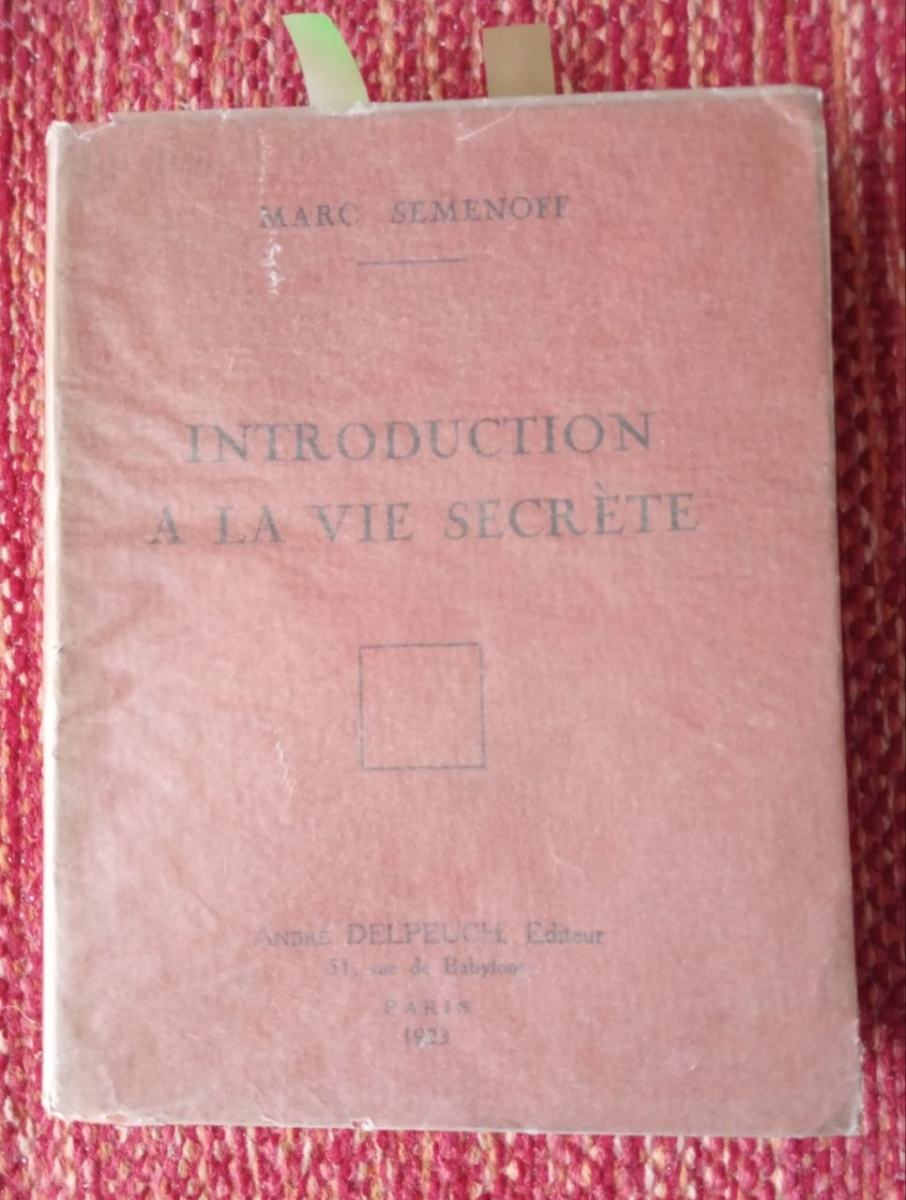
Marc Semenoff-Introduction a la vie secrète-1923
*
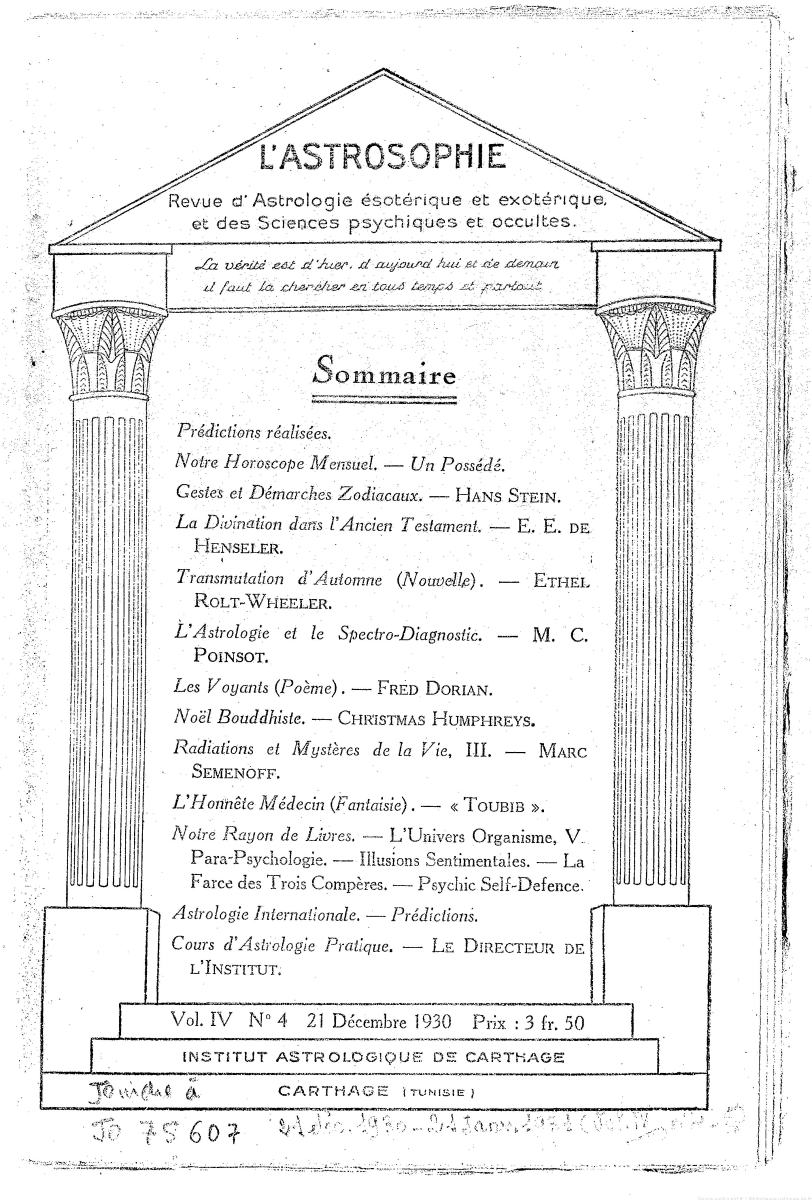
*
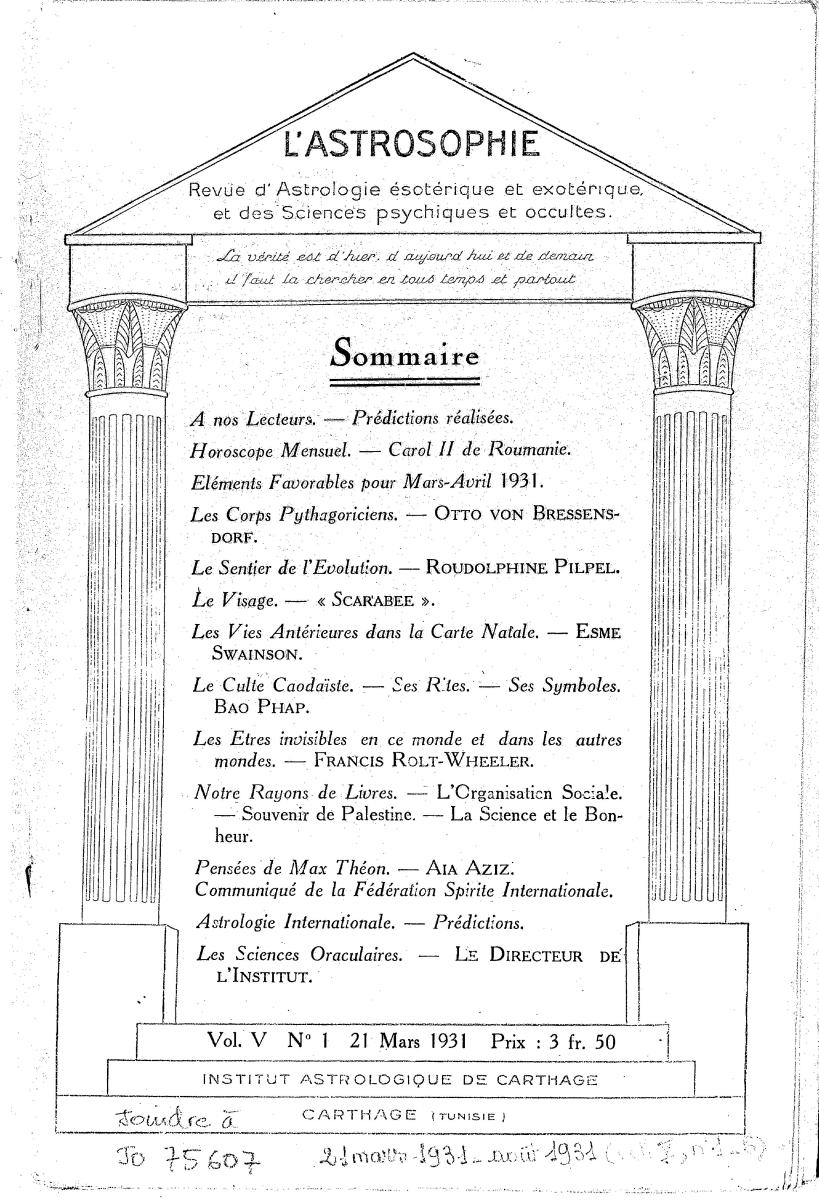
*
Note: A big collection of the periodical
‘l’Astrosophie’ is available here.
We have to salute the vital work the
International Association for the Preservation
of Spiritualist and Occult Periodicals (IAPSOP)
has and is undertaking against neglect and oblivion.
***
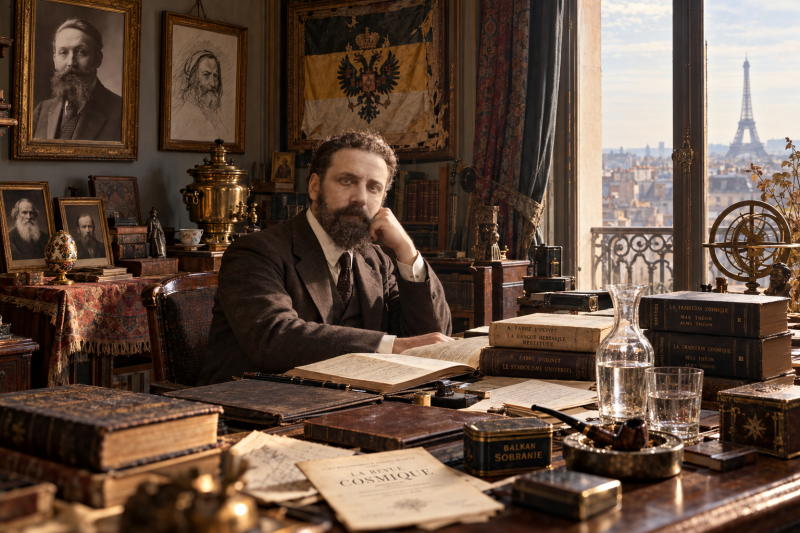
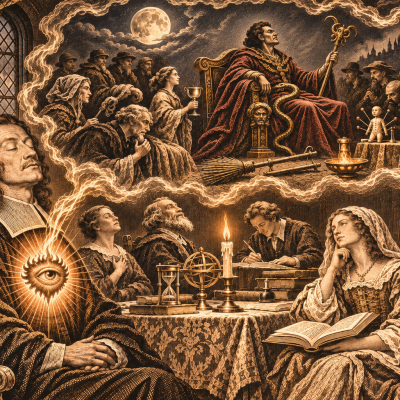
Related Articles

Leave a Reply