
Circle of Transmission: The Living Loom
Johannes de Monte-Snyder: Concerning The Chymical Alphabet
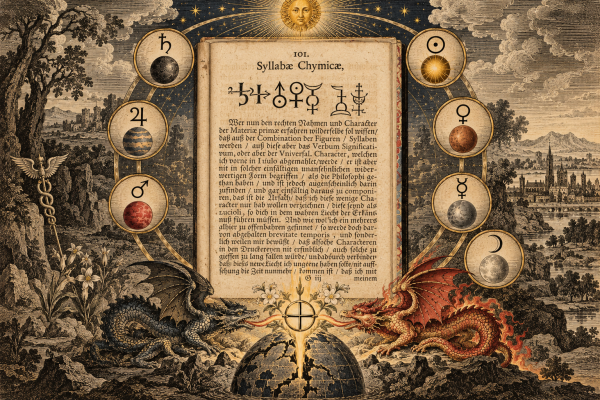
The Riddle
of the Chemical Alphabet
What has seven faces,
yet bears one Name?
What begins as a character,
becomes a syllable,
and finally speaks as a Word?
What is hidden in the metals,
yet belongs to none of them?
What sleeps in the Earth,
yet bears the signature of Heaven?
What is the dark Dragon
that meets its fiery brother,
and what is born when they remember
that they were once one?
What is the Circle
that contains the Cross—
and the Cross
that reveals the Circle?
The page is open.
The signs are given.
The Alphabet is before your eyes.
But can you read the Word
that is hidden in them all?
*
Today’s sharing from the Blue House of Via-HYGEIA is the English translation of Chapter XVIII, Von dem Chymischen Alphabeto (“Concerning the Chemical Alphabet”), from Johannes de Monte-Snyder’s Tractatus de Medicina Universali, based principally on the Latin publication of 1666, which includes the Chymica Vannus, together with the German edition of 1678, while also taking into account the earlier German edition published at Frankfurt in 1662. It is followed by a postscript highlighting Monte-Snyder’s intention in writing this remarkable chapter, the Chemical Alphabet as the operative key to his work, and a Lexikon gathering its principal terms and concepts.
**
English Translation of Chapter XVIII
(Concerning the Chemical Alphabet: Namely, how the characters, signs,
and words of the ancient philosophers are to be understood and applied)
In the previous chapters, I have—as far as God has permitted me—clearly and distinctly written of the First Matter, the Solvent, and the Universal Medicine, as well as the Magical Elements or keys. However, because this same work might seem somewhat difficult to newly arrived novices (tyros),[1] considering that the philosophical style is still unknown to them, and since I intend nothing else but to serve all faithful and pious hearts, I have found it highly necessary to begin from a simpler level of understanding and to include here the Chemical Alphabet, as well as several new characters which truly[2] indicate the nature of the things depicted.
Therefore, the faithful lover of this art should apply particular diligence to the examination of this Alphabet and the attached new characters, for from this the first light arises. The philosophers have compared their matter or solvent to a very sharp vinegar; they have also turned toward vitriol or nitre, for these possess all the qualities that are attributed to the First Matter by the philosophers, because it is found to be wet and dry, cold and hot, light and heavy, according to how one wishes to have it.
Now, Mercury also possesses these properties, and it is clear that the Philosopher’s Stone cannot be made without it; therefore, the wise do no wrong when they call their matter a “Mercury.” However, since many seek it from cold Saturn, because the high work is attributed to him, hoping thereby to obtain their salvation; I leave them to persist in their opinion for as long as it takes until they realize what qualities Saturn possesses within it. The Matter of the Sages is Solar and hot, etc. Saturn, however, is Lunar, as its character indicates, which is a half moon.
The Saturn of the Sages is not entirely correctly drawn by the Philosophers, nor called by its own name; for it should rightfully be drawn with the character of the Sun, because the circle is the most perfect figure of all. And although all metals are born from the First Matter, and therefore it would not have been unfair if the sign were to concord with the character of all metals: yet the Sages, out of special consideration, did not wish to do so, but only partially united it with the signs for Vitriol, Niter, Vinegar, Saturn, or Mercury.
Whoever now knows how to form these into one character according to the Art, so that a harmony is also present during the conjunction, that person has the Matter before his eyes. Therefore, you must betake yourself to the Alphabet of the Sages and see whether you might succeed: But the sign for Vinegar or Azoth must have the priority, which the others—those most closely related and devoted to the Vinegar—shall follow immediately upon its heels; and so henceforth, in this way, a wonderful sign is formed, which encompasses the nature of the aforementioned things in everything, except that common mercury is not clearly visible to the eyes and cannot be recognized by everyone. But I tell you that you should not recognize mercury by its wings alone, but by its fire; and this fire is cold and earthly, like that of the old, frail Saturn. In this way you are assured, especially if you can see a hot, fiery sign in this character;[3] with this fire, the excessive poisonous cold of your matter is tempered, and finally it receives all qualities; from here the Universal Solvent and the King’s Bath are prepared.
Here it is to be noted that by vitriol, the burning sulfur should be understood; this is also sometimes called a fiery dragon. For just as the dragon devours everything, so too does sulfur burn and calcine everything with its fire. But whoever rightly understands my cold dragon, and has found him in the aforementioned figures, needs nothing more than to add a red, fiery, flying dragon to this, its brother; thus he has brought two natures into one nature, both of which were formerly one, and are only distinguished by their qualities; yet both retain a spiritual, mercurial nature.
Without this, the Universal Generalissimum cannot be brought about; it should rightfully be marked with the living Character of the Most High,[4] for the goodness that Almighty God has placed in the whole world is shared with this aforementioned matter alone. And just as all good things come to the human race from the earth, so from this matter sprouts health and wealth; it is compared, as I mentioned before, to the Divine Majesty, in which everything is contained, and which also contains everything.
The divine Character is a round Circle or sphere, cujus centrum ubiquè, circumferentia nusquam terminat [whose center is everywhere and whose circumference is nowhere bounded],[5] According to this divine Character, Almighty God created the heavens and the whole world in a round, perfect, circular form; and the more evenly an Astral Body matches this divine form and Signature, the nobler it should be held; for it carries not only the figure of Him from whom everything originates, but also that of the great elemental soil,[6] or rather of the fixed, indestructible salt, its Savior; for the Philosophers, as I have often explained, sometimes understand Salt by the word “Earth,” etc. In this undertaking of mine, however, it matters nothing whether you keep the globe of this world in mind as a circle, or whether you consider the Salt and Niter.
But one must not, with these, proceed as taught above, but rather you should mix these two well and steep them with their own vinegar, so that the vinegar stands upon the matter in a quantity equal to the matter.[7] This vinegar, however, must be made from the aforementioned salts: Through the diameter of Salt or Vitriol and the perpendicular line of Nitre, the sharpest vinegar is made. By this vinegar, the Azoth or the Cross is understood, and vice versa. By the Cross, the Azoth is once again grasped—namely, the Redeemer, who descended from above into this world and hovers like the Spirit of God upon the waters of the Salt or Vitriol and Nitre,[8] from which it is born and extracted.
In this matter, I could have easily helped you, but it is not permitted for me from above to reveal anything further in writing, for the sake of the tyrants and the unworthy of this world who wander in darkness and refuse to accept the light that has now risen in these final times, which shines both brightly and clearly. For these reasons, Almighty God chastises the world for such gross pride,[9] so that it cannot even recognize itself; for the Mundane Spirit—namely its own evil and good spirit, which is a double spiritual conjunction that kills and makes everything alive—has departed from it.[10] And once a thing has been separated by force or art from its earthly curse, its materia peccandi—which was the womb and dwelling of this evil and good—it can no longer be reassembled, namely with the harmony and under the form it showed before the separation; therefore the world is living-dead and seeing-blind.
Now I have spoken quite simply and traced the A.B.C. with my fingers upon the earth from which you were created, into the dust; and beneath this is but a single thing, which encompasses the power of all planets, and also the properties of all minerals and vegetables. This is the First Matter of our Stone, which is born out of the Alpha and the Omega, the beginning and the end of our work; it is called a double-tailed Saturn.[11] These tails are lunar and, through a special conjunction and heavenly figure at the first and last touch of the Moon, have been formed into such a high virtue and stately Character. This has within itself the entire chemical alphabet, for in it the highest Saturn is the most visible of all. The iron captain is recognized from this Universal Character, but you shall set his helmet upon him, and so Mars offers his services, showing the beginning: the first matter in the earth and in its mountain clearly, for the sketch is already there with it.[12]
Mercury is nothing other than a true Venus who wears a lunar crown; and because she possesses a solar Sulphur, the kind and just Jupiter wishes to raise her to higher honors. Pull the horns out of Mercury—that is, burn off his wings—and he becomes a Venus. Turn her over, and you have a powerful Sulphur, for Vitriol is Sulphur, and Antimony is Mercury. This is the seed and the womb, etc., which are born of the earth and carry an earthly shape and form, and which must again be corporally coagulated and permanently fixed through the help of the earth, through the suitable benefit of Vulcan.
Proud Mercury mocked and trampled underfoot the healing sign which Moses erected in the wilderness with a serpent fastened to it.[13] It is therefore imposed upon him that he must eat the cross, consume it in his stomach, and for a certain time feed and nourish himself upon the cross, just like the proud Nebuchadnezzar; for the proud are humbled through their opposite, and the evil they fear befalls the ungodly first and foremost.[14]
Mercury is the metallic Lucifer, Hesperus, and Vesperus. Rob him of the ornament of his head, and he is a round block, over which Fortune’s wheel runs around until its nourishment, raw and undigested, bursts out above it;[15] then it is thoroughly humbled, just as if you had turned it into a vitriol through its own vinegar, which is subject to it. Whoever knows this rightly and treats it rightly will be healthy and wealthy until their end. Turn Mercury into a crystal, add its Salt to it, and you have it all—namely the Universal.
My intention is not to speak of high things here, but of the A.B.C.s—namely, how syllables and subsequently words are to be formed from them. This A.B.C. consists of the simple characters; the syllables, however, are their conjunction, namely when several characters are contracted into one. These syllables then become words, and these provide understanding and meaning; they also explain the nature and property of the thing drawn and figured. For whatever can be made out of a thing was also previously within it, by reason of its virtue. From one general chemical character, which is assigned to the first matter, there can be made Mercury, Saturn, Salt, Antimony, Vitriol, Niter, Venus, etc.
Therefore, the virtue of all these is naturally and artificially joined together as if in a round sphere, just as its figure shows. And so that I may come to the end, I say to you once more, that you should not undertake anything but the chemical A.B.C. attached here. However, you must first have carefully taken heed of my instruction, for examples show, they do not teach;[16] and what one finds depicted before one’s eyes, the reason grasps much more quickly.
Otherwise, I would not have brought this chemical A.B.C. before your eyes, and through it likewise everything I have previously dealt with—both in the beginning, as well as in the end and in the repetition of the entire little work—repeated anew and, as it were, for the third time. The reason for this, however, is that henceforth I am not inclined to write more clearly or further regarding this matter. In addition, I will—in the shortest possible way—signify the proper character of each of the seven stars, their combination and composition, as well as several semi-metals and what else has been mentioned scattered about, through each one’s own figure and attached name, as follows from the:
Simple Alphabet.
- ♄ Lead; is also called the Black Wolf, Mors (Death), and Gold.
- ♃ Tin; by which sometimes a sublimated Mercury is understood. And Sal ammoniac.
- ♂ Iron.
- ☉ Gold; the King, Red Lion, and Dragon.
- ♀ Copper; Green Woman and Green Lion.
- ☿ Quicksilver. Serpent-bearing Tilbon,[17] Hermes, or interpreter of the Gods. The Serpent. Volatile Salt.
(these make a metallic water in the earth, called the Swan’s Bath, in which the Queen cleanses herself.)
- ☽ Silver; has Saturnian weapons, makes it suitable for the Universal, by reason of its quality, etc.
Metallic Salts and Sulfurs.
- ⦶ Nitre. Stone-snake. Mercury. White Dragon, etc. Eagle, also Saturn.
- ⊖ Salt. The Venusian property. Green Lion: Drink of the Dragon. Bath of Venus. Salt of Metals, etc. Sulfur.
- 🜍 Sulfur: The hellish Cerberus. And fiery dragon. Deluge of fire. Arrow of death. Oil & Spirit of life. Soul giving life, living through itself. Key of the Key. Winged dragon.
- ♁ Under (below) Antimony, Mercury is always understood / called New life. Unknown medicine. Tree of life of the knowledge of good and evil. Arsenic of black death. Do-not-touch-me. Hellish three-headed Cerberus.
SYLLABÆ CHYMICÆ
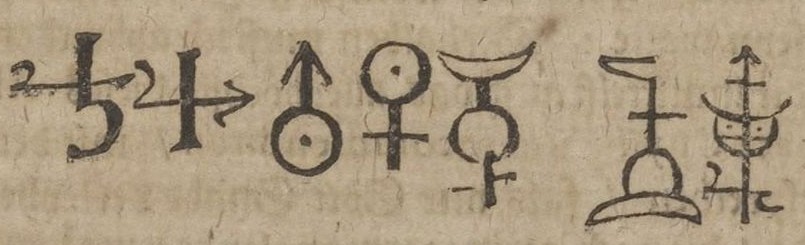
Whoever now wishes to learn the true name and character of the First Matter, the same should know that from the combination of these figures, syllables are formed; from these, however, the Signifying Word, or rather the Universal Character—which I have depicted earlier on the Title Page—is created. It is not, however, contained in such a simple, unsightly, or repellent form as the Philosophers have portrayed it; and yet it is visibly to be found therein, and quite simply composed from it.
This is the reason why I have wished to record only these few characters; these are like Little Lights that must lead you into the true light of knowledge. And although I intended to reveal more here, I am nevertheless held back by the shortness of time, and especially because I am aware that such characters are not to be found in the printing houses, and to cast the metal type for them would take too long, thereby preventing this “New Light” from appearing at this Fair[18]—which I would be loath to see happen, considering that the time has now come for me to use my talent in the few years remaining to me for the benefit of mankind.
Therefore, I must break off here, and in the meantime, most highly recommend to you this Chemical Alphabet, with the promise that, should God grant me grace, I shall provide the few missing new figures at the first opportunity. It is, however—God knows—unnecessary; therefore, for now, be content with what has been communicated to you, those Magical Elements entrusted to you for the salvation of your soul: the twofold fires, along with the Solvent and the threefold Universal Medicine, the First Matter, as well as the reduction of all metals into their three principles, and especially with this Chemical Alphabet, which will serve both the experienced and the novice alike. Therefore, follow my teaching: do not forget God or your needy neighbor, and guard yourself against your inner enemy.
*
POSTSCRIPT TO CHAPTER XVIII
(The Operative Key of the Chemical Alphabet and the Syllabæ Chymicæ)
I. Philological and Textual Remarks
This translation of Chapter XVIII (Von dem Chymischen Alphabeto) rests primarily on the Latin edition of 1666—which includes the Chymica Vannus—and the German edition of 1678. An earlier German version, published in Frankfurt in 1662 under the title Tractatus de Medicina Universali, das ist Von der Universal Medicin, serves as an important textual witness. These early editions have been weighed against later reprints, whose orthographic drift and typographical errors occasionally obscure Monte-Snyder’s original intent. Several critical emendations were therefore necessary to restore the operative sense of the passage:
- veraciter vs. velociter: The correct reading is veraciter (“truly”), not velociter (“quickly”). The characters do not merely indicate the nature of things rapidly; they disclose it truthfully.
- sehen vs. setzen: The alchemist is instructed to “see” (sehen) a hot, fiery sign within the character—not to “place” (setzen) it. Perception precedes operation.
- rohe vs. Ruhe: The humbled Mercury’s nourishment bursts forth “raw and undigested” (rohe und unverdauhet), not in “rest” (Ruhe). This underscores the crude, unassimilated state of the matter prior to coagulation.
- groben vs. grossen: The world is chastised for “gross” or “coarse” pride (groben Hoffahrt), not “great” pride. This aligns with the chapter’s recurring motif: the volatile, proud principle must be humbled and returned to its proper condition.
These are not mere orthographic corrections. In each case, a single letter shifts the operative meaning: truly rather than quickly; see rather than place; raw rather than rest. The Chemical Alphabet hinges on such distinctions, for its characters are signs that reveal the nature and property of what they signify.
*
II. The Alphabet as Generative Grammar
Monte-Snyder explicitly frames his system in linguistic terms: simple characters combine to form “syllables”; syllables combine to form “words”; and these words disclose the nature and property of the thing figured.
This analogy is not decorative. Throughout the chapter, the joining of characters corresponds to the conjunction of the natures they represent. The alchemist is invited not merely to read the alphabet, but to recognize in its combinations the very operations by which volatile and fixed qualities are united.
Thus, the Chemical Alphabet functions as more than a nomenclature of substances. It is a symbolic grammar of conjunction: characters signify natures; their union produces syllables; syllables become words; and the completed Word tends toward the Universal Character.
While one might argue that linguistic syntax is literally identical with laboratory practice, Monte-Snyder stops short of such a claim. Instead, he offers a compelling hermeneutical synthesis: the symbolic language is meant not only to be read, but to disclose relationships enacted in the work itself.
*
III. The ‘Syllabæ Chymicæ‘ as Operative Diagram
The engraving titled Syllabæ Chymicæ (“Chemical Syllables”) is the visual embodiment of this grammar. It is not a static glossary but an operative diagram—perhaps the closest Monte-Snyder comes to conveying the Handgriff, the manual “grasp” or practical knack that defies full verbal expression.
The sequence begins with cross-like figures and arrows tied to the magical elements, the Azoth, and the Cross, followed by the familiar planetary characters: Saturn (♄), Jupiter (♃), Mars (♂), Venus (♀), and Mercury (☿). These represent fundamental natures within the work’s symbolic vocabulary.
The sequence culminates in complex composite figures: one evoking a vessel or furnace surmounted by a cross; another resembling a vertical staff resting upon a crescent. Whether these denote literal apparatus, symbolic combinations, or both remains unstated.
Yet their arrangement implies a dynamic reading. The engraving invites contemplation of how simple characters are joined and transformed—visually enacting the movement from character to syllable, syllable to word, and multiplicity toward the Universal Character.
*
IV. The Theological Alchemy of the Azoth
Chapter XVIII is profoundly syncretic, weaving together chemical imagery, geometric symbolism, planetary correspondences, and Christian mystical language.
The “Vinegar” (Acetum acerrimum) receives a precise geometrical definition: the diameter formed by Salt or Vitriol and the perpendicular line of Niter yields the sharpest Vinegar, whose figure is the Cross within the Circle. Monte-Snyder then identifies this Vinegar with the Azoth, the Cross, and reciprocally, the Redeemer—evoking the Spirit of God moving upon the waters (Genesis 1:2).
The alchemical process thus unfolds in terms reminiscent of the nigredo: proud Mercury—linked to Lucifer, Hesperus, and Vesperus—is humbled, stripped of his wings, and made to “eat the cross,” recalling Nebuchadnezzar’s humiliation. Only through this descent can a new order emerge.
The resulting drama is not merely chemical. Language of death, burial, transformation, and renewed life permeates the description of material operations. The “raw and undigested” earth becomes the site of transfiguration, while the union of opposing dragon-natures leads toward the Universale Generalissimum.
Here, the Chemical Alphabet acts as a cipher: material transformation and theological symbolism become mutually intelligible. Christian and alchemical images are not juxtaposed but fused—the same figures (Cross, Circle, Dragon, Mercury, Salt, Niter, Vinegar) operate simultaneously on multiple levels.
*
V. Conclusion: The Fulcrum of the Treatise
Chapter XVIII serves as the structural and philosophical pivot of the Tractatus de Medicina Universali. Where preceding chapters develop the work’s philosophical and material vocabulary, this chapter provides the key to reading it.
By offering the “Simple Alphabet” and the “Chemical Syllables,” Monte-Snyder shifts from exposition to operative symbolism. The reader encounters not just substances or planetary forces, but the characters through which their relationships may be recognized.
In this sense, the Chemical Alphabet is the treatise’s operative key. It transforms a collection of correspondences into a system of conjunction: characters become syllables, syllables become words, and words disclose the nature of what has been figured.
The chapter also prepares the ground for the Kurtzer Anhang (“Brief Appendix”), where practical questions—including the preparation of Aurum Potabile—take center stage. Within the linguistic symbolism established here, Aurum Potabile may be understood as the culminating expression of the “Word” formed through the transformation of the material alphabet.
Chapter XVIII thus occupies a singular position in Monte-Snyder’s work. It does not merely catalogue alchemical symbols. It teaches the reader how to read them.
*
LEXIKON OF THE CHEMICAL ALPHABET
The following Lexikon gathers the principal technical, symbolic, and theological terms of Chapter XVIII. Rather than functioning as a conventional glossary, it follows Monte-Snyder’s own movement between character, substance, conjunction, and meaning. Latin and German terms are retained where they help preserve the vocabulary of the early texts.
Acetum acerrimum — Sharpest Vinegar
The “sharpest Vinegar” is the philosophical solvent associated with the First Matter. Monte-Snyder defines it geometrically through Salt or Vitriol and Niter: from the diameter of Salt or Vitriol and the perpendicular line of Niter, the sharpest Vinegar is formed. He then identifies this Vinegar with the Azoth or Cross, and reciprocally with the Redeemer.
Azoth
The universal solvent and one of the principal names of the Work’s hidden unity. In Chapter XVIII, Azoth is inseparable from the Cross and from the figure of the Redeemer. It is therefore simultaneously chemical, geometrical, and theological: a solvent, a character, and a figure of redemption.
Character — Character
A character is more than a conventional sign. It indicates the nature and property of the thing represented. The simple characters constitute the Chemical Alphabet; when several characters are conjoined, they form syllables, and from these syllables the Universal Character emerges. Monte-Snyder’s use of Character is therefore central to his entire symbolic grammar.
Chemical Alphabet — Chymisches Alphabeto
The collection of simple characters through which Monte-Snyder presents hidden relationships among substances, planets, principles, and operations. It is not merely a catalogue of symbols. The chapter presents it as a generative grammar, in which characters are joined, contracted, and transformed into larger symbolic units.
Chemical Syllables — Syllabæ Chymicæ / Chymische Syllaben
The combinations of several simple characters contracted into one. Monte-Snyder explicitly compares their formation to syllables in language: characters become syllables; syllables become words; words convey understanding and reveal the nature of the thing figured. The accompanying engraving is therefore the visual counterpart of this symbolic grammar.
Dragon — Drache
One of the principal symbolic figures of the chapter. The cold dragon belongs to the Saturnian, earthly, and poisonous aspect of the Matter; the red, fiery, flying dragon represents its fiery Sulphuric counterpart. Their conjunction brings two natures—which were formerly one—back into one nature, while retaining their mercurial character.
First Matter — Materia Prima
The fundamental Matter of the Stone, described as containing within itself the powers of the planets and the properties of minerals and vegetables. Monte-Snyder associates it with the hidden unity underlying the multiplicity of the Chemical Alphabet. He also associates it with the “double-tailed Saturn,” whose two tails are related to the first and last touch of the Moon.
Generalissimum — Universale Generalissimum
The highest universal result or medicine referred to in the chapter. Monte-Snyder connects it with the union of the two dragon-natures and with the “living Character of the Most High.” The Latin term is retained because the exact technical force of Generalissimum is difficult to reproduce satisfactorily in English.
Mercury — Mercurius / Quecksilber
The most protean of the chapter’s figures. Mercury appears as winged, serpentine, lunar, metallic, and Luciferian, but can also be transformed into Venus and, through further manipulation, into Sulphur. Monte-Snyder therefore uses Mercury as a particularly rich symbolic figure for volatility, transformation, conjunction, and fixation.
Mundane Spirit — Spiritus Mundanus
The spiritual principle belonging to the world, described as a double conjunction of good and evil, capable both of killing and of making alive. Monte-Snyder says that this spirit has departed from the world, leaving it “living-dead and seeing-blind.”
Niter — Nitrum / Salpeter
One of the fundamental characters of the Chemical Alphabet. Together with Salt or Vitriol, Niter participates in the generation of the “sharpest Vinegar.” Its geometric relationship with Salt/Vitriol produces the cross-like figure through which Monte-Snyder understands the Azoth.
Salt — Sal / Saltz
One of the principal substances and characters of the Work. Monte-Snyder sometimes understands Earth through the word Salt and associates Salt with the fixed, indestructible principle of the elemental world. Salt and Niter together participate in the formation of the philosophical Vinegar.
Saturn — Saturnus
The apparently cold, lunar, heavy, and earthy planetary figure. Monte-Snyder distinguishes the Saturn of the Sages from ordinary Saturn and gives particular importance to its hidden solar character. The First Matter is also called “double-tailed Saturn,” referring to the conjunction of the waxing and waning Moon.
Sulphur — Sulphur / Schwefel
The fiery principle associated with Vitriol and represented by the fiery dragon. Sulphur burns and calcines; it is also described through the language of fire, oil, spirit, soul, and life. In the Chemical Alphabet it forms the fiery counterpart to the cold dragon.
Universal Character — Character Universalis
The completed sign toward which the Chemical Alphabet tends. It is formed from the conjunction of simpler characters and is described as a harmonious composition encompassing the natures of the substances represented by those characters. It is therefore not simply one more symbol, but the visible expression of their hidden unity.
Universal Medicine — Medicina Universalis
The principal subject of Monte-Snyder’s treatise. Chapter XVIII does not introduce a separate medicine so much as provide the alphabet through which the preceding account of the Universal Medicine can be read and understood.
Vinegar — Acetum / Essig
The philosophical Vinegar is not ordinary vinegar. Monte-Snyder describes it as the solvent associated with the First Matter and gives it a precise symbolic geometry. In its sharpest form it becomes synonymous with the Azoth and the Cross.
Word — Verbum
The stage beyond the syllable in Monte-Snyder’s linguistic analogy. Several characters form a syllable; syllables become words; and words provide understanding and meaning by explaining the nature and property of what is figured. The analogy culminates in the Universal Character.
*
The Seven Planetary Characters
The “Simple Alphabet” concludes with the seven principal planetary-metallic characters:
| Character | Metal | Principal symbolic associations |
|---|---|---|
| ♄ Saturn | Lead | Black Wolf, Death, Gold |
| ♃ Jupiter | Tin | Sublimated Mercury, Sal ammoniac |
| ♂ Mars | Iron | The Iron Captain |
| ☉ Sun | Gold | King, Red Lion, Dragon |
| ♀ Venus | Copper | Green Woman, Green Lion |
| ☿ Mercury | Quicksilver | Tilbon, Hermes, Serpent, Volatile Salt |
| ☽ Moon | Silver | Saturnian weapons; associated with the Universal |
These are not merely planetary correspondences. Within Monte-Snyder’s system, they constitute the letters of a symbolic language, from which the more complex “syllables” and ultimately the Universal Character are formed.
The Chemical Alphabet is therefore not simply a dictionary of alchemical signs. It is a way of reading the hidden relationships between substance and symbol, multiplicity and unity, character and operation, and finally matter and meaning.
*
Original German & Source:
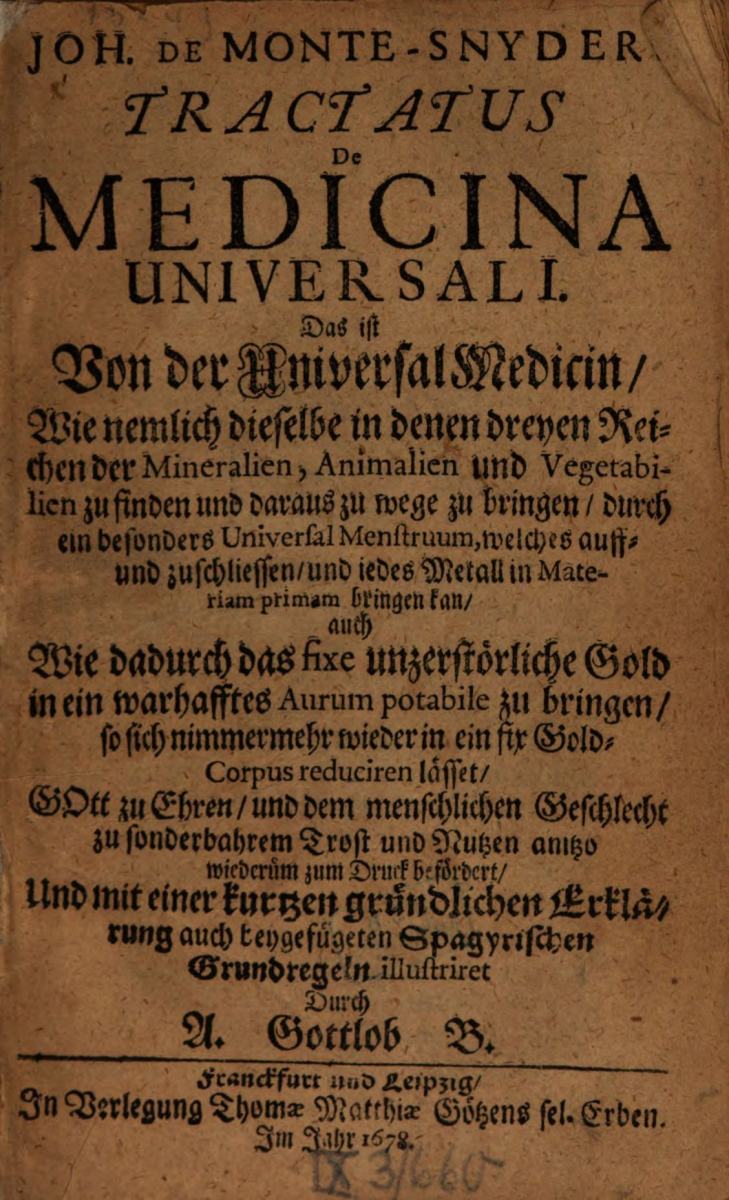
Press here
***

Related Articles


Leave a Reply