
Circle of Transmission: The Living Loom
Georgios Gemistos Plethon – The Treatise on the Virtues
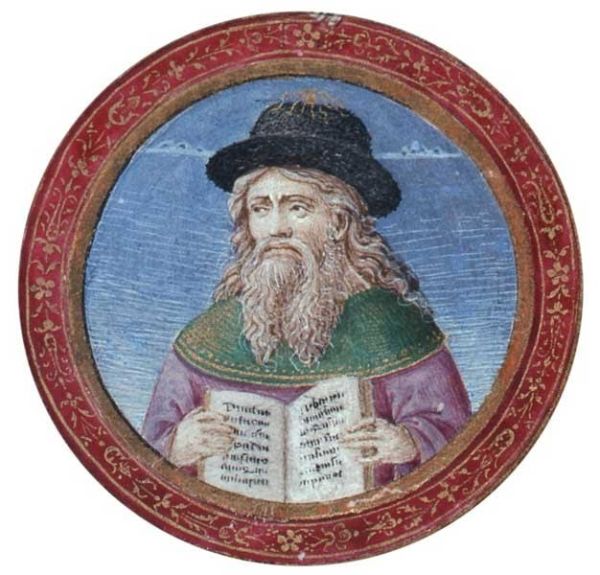
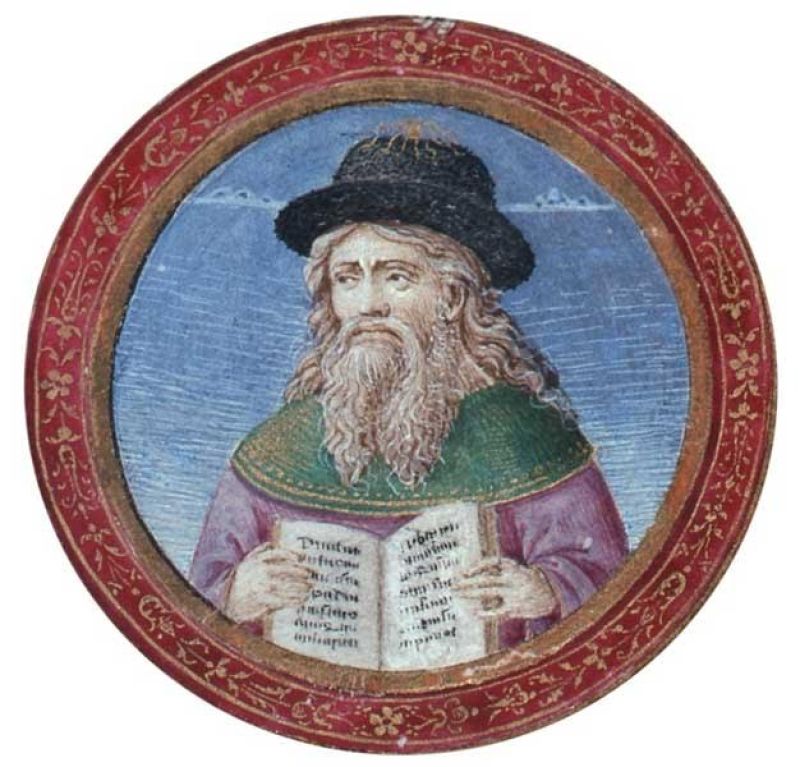
Traditional depiction of the philosopher
and mystagogue Georgios Gemistos Plethon.
Image via Proto Thema.
*
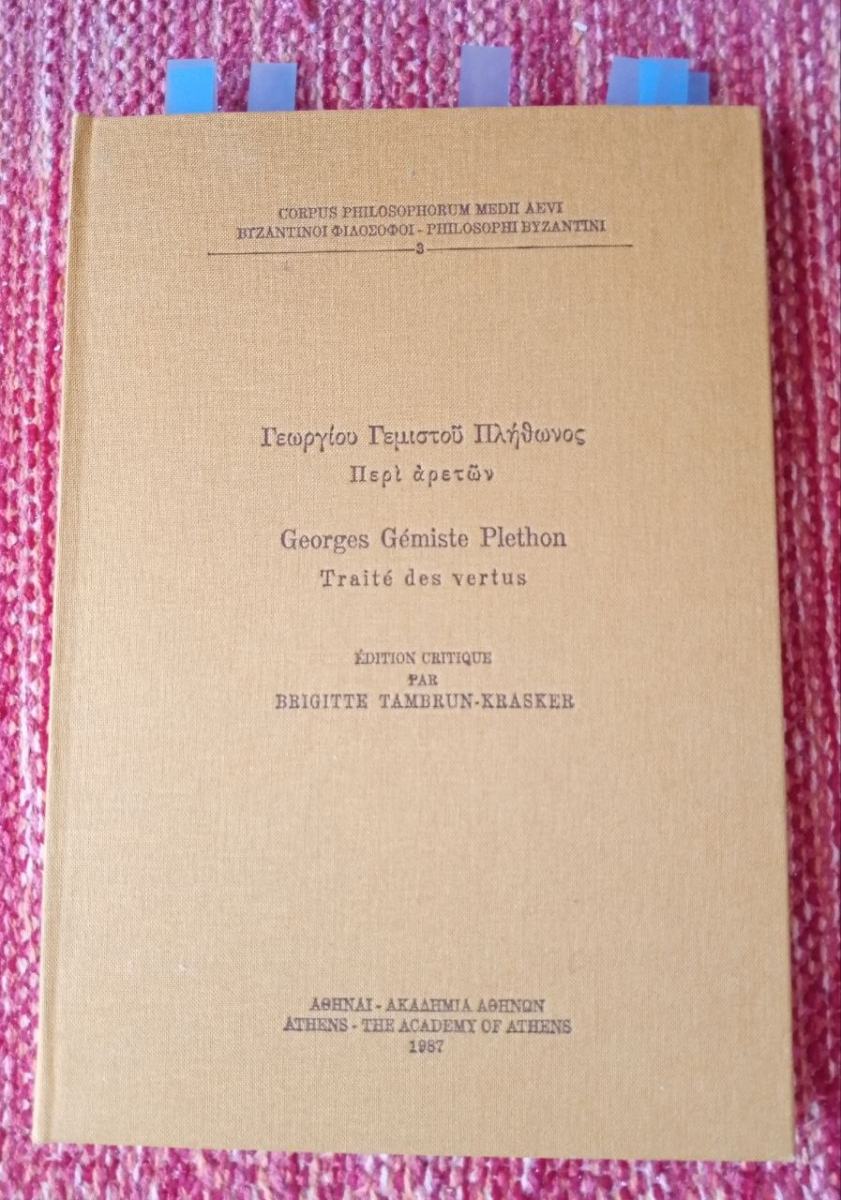
Today’s sharing from the Blue House of Via-HYGEIA presents the English translation of the Treatise on the Virtues by George Gemistos Plethon, based on the Academy of Athens’ 1987 edition of the Greek text and the French translation by professor Brigitte Tambrun-Krasker.
Written in the twilight of the Byzantine Empire, this systematic work expands the four cardinal virtues into a twelve-fold hierarchy, guiding the soul from basic self-discipline to the highest contemplation of the divine. Plethon offers not merely a moral code, but a cosmic architecture where ethics, politics, and theology converge, asserting that true human flourishing arises from aligning one’s life with the rational order of the All.
The following translation is accompanied by a conceptual introduction outlining Plethon’s historical context in Mistra and his unique synthesis of Platonic metaphysics with practical ethics. It concludes with a postface analyzing the treatise’s distinctive ‘ladder of ascent‘, which orders the virtues from the tangible practice of decorum to the intellectual perfection of piety.
Together, these elements reveal Plethon’s enduring vision: that the cultivation of virtue is the very means by which the human soul restores its harmony with the cosmos and participates in the divine nature.
**
A Contextual Introduction:
Plethon’s World and the ‘Treatise on the Virtues’
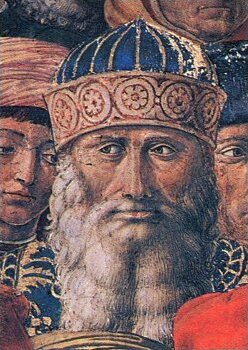
Georgios Gemistos Plethon (c. 1355–1454) wrote this treatise in the twilight of the Byzantine Empire, during the final century before the fall of Constantinople in 1453. He was a product of the Peloponnese, educated in Constantinople, and spent most of his mature life at the court of the Despots of the Morea in Mistra—a flourishing intellectual center where Byzantine humanism encountered the stirrings of Renaissance Italy.
The Treatise on the Virtues belongs to a remarkable burst of philosophical activity in Plethon’s later years, alongside his more famous works: the Laws (Νόμοι), with its bold reconstruction of a pagan Platonic theology, and the Differences (Περὶ ὧν Ἀριστοτέλης πρὸς Πλάτωνα διαφέρεται), which defended Plato against Aristotle on behalf of Gemistos’s patron, the Despot Theodore II.
The present treatise, by contrast, is more restrained in its metaphysical commitments, yet it is unmistakably Plethonic in its systematic rigor and its determination to present ethics as a complete, hierarchical science.
Plethon composed in a Greek that deliberately evoked the classical and Hellenistic philosophical tradition. He wrote not for a narrow circle of clerics but for a cultivated elite—Byzantine aristocrats, Italian humanists, and perhaps the philosophers of a reformed Platonic republic he dreamed of establishing.
The treatise reflects the tension of its age: a civilization aware of its impending catastrophe, yet possessed of an extraordinary confidence in the power of reason to order the soul and the city. Plethon was not merely preserving antiquity; he believed he was restoring its true meaning after centuries of distortion.
*
Assessment of Content and Key Ideas
The Treatise on the Virtues is structured with architectural precision. It moves from definition to division, from analysis to synthesis, culminating in a hierarchical ordering that maps the moral life as a progressive ascent. Several features demand attention:
1. The Definition of Virtue and the Fourfold Structure
Plethon opens with a definition of virtue indebted to Aristotle—’a state by which we are good‘—but immediately subordinates this to a Platonic framework. The four cardinal virtues (temperance, courage, justice, wisdom) are not merely practical excellences but correspond to the structure of human existence: man’s relation to himself, to others, to his own composite nature, and to the cosmos as a whole.
Wisdom (phronēsis) is explicitly identified as the ‘most perfect‘ virtue, a contemplative state that reveals what each thing is. This is not Aristotelian phronesis as practical wisdom alone; it is closer to Platonic noēsis, culminating in the knowledge of God.
2. The Doctrine of Self-Sufficiency and the Imitation of God
The treatise’s ethical ideal is autarkeia—self-sufficiency—not as mere austerity but as approximation to the divine. God is ‘without need‘ (anepideēs); human beings cannot achieve this absolutely, but they can minimize their dependencies. This is not Stoic resignation but active rational selection: the virtuous man chooses what is ‘more easily procured and cheaper‘ not from poverty but from strength. The body and its pleasures are not condemned but placed in their proper subordinate place. Plethon’s temperance is thus a virtue of the free man, not the ascetic.
3. The Expansion of the Cardinal Virtues
Plethon’s most distinctive contribution is his systematic subdivision of each cardinal virtue into three specific virtues, yielding a dodecal structure:
- Prudence→ Piety, Natural Science, Good Counsel
- Justice → Holiness, Civic Virtue, Kindness
- Courage → Good-Spiritedness, Nobility, Gentleness
- Temperance → Moderation, Liberality, Decorum
This is not mere taxonomy. Each subdivision corresponds to a domain of human experience: the divine, the natural, the human; the public, the private, the personal; the chosen, the involuntary, the interpersonal. The result is an ethics of extraordinary comprehensiveness, in which no aspect of life falls outside the scope of virtue.
4. The Priority of Piety and the Hierarchical Ordering
Remarkably, Plethon places piety (theosebeia) as the ‘capstone‘ (kephalaion) of all virtue and the ‘most blessed thing in human life‘. This is not Christian piety—Plethon was a notorious, if discreet, pagan—but what he calls ‘the understanding of God‘ (hē tou theou noēsis), the contemplation of the divine Nous that orders the cosmos. The treatise’s final section provides a precise taxis—an order of acquisition—beginning with decorum and culminating in piety. This is an ethical via ascendens, a ladder of perfection that transforms the soul from its animal beginnings to its divine telos.
5. The Integration of Politics and Cosmology
Unlike modern virtue ethics, which tends to focus on the individual agent, Plethon’s treatise constantly situates the individual within larger wholes: the household, the city, the cosmos, the divine order. Civic virtue (politeia) is not merely one species of justice but the virtue by which man ‘lives for the common good‘ and ‘assimilates himself to his more perfect kinds‘. The good citizen preserves the private by serving the public, for ‘when the common is well established, both it and the private are most naturally preserved‘. This is classical political philosophy restored with systematic clarity.
6. The Attitude toward Fortune
Plethon’s treatment of courage and its species—particularly good-spiritedness (eupsychia) in the face of involuntary suffering—reveals a sophisticated psychology of adversity. The ‘involuntary hardships from the divine‘ are reinterpreted as either ‘education and punishments‘ or ‘prizes and contests‘, depending on the soul’s response. This is not naive optimism but a rational revaluation: the soul is ‘not a leather money-pouch‘ but ‘rational and immortal‘, exposed to no external evil except what it admits through its own opinions. The body and its fortunes are instruments, not identities.
*
Why Plethon Remains Relevant
In an age of fragmentation, Plethon’s systematic vision offers a compelling alternative:
1. Against the Fragmentation of Knowledge: Plethon wrote when the medieval summa was giving way to modern specialization. Today, when ethics, politics, psychology, and cosmology are divided among incommensurable disciplines, Plethon’s treatise demonstrates the possibility of an integrated wisdom. His virtues are not isolated traits but nodes in a single network, each defined by its relation to the whole. The contemporary revival of virtue ethics—MacIntyre, Anscombe, Foot—has largely lacked this systematic ambition; Plethon shows what a fully architectonic virtue ethics might look like.
2. The Recovery of Teleology: Modern ethics, whether utilitarian or deontological, struggles to articulate a coherent human telos. Plethon’s treatise is unabashedly teleological: virtue is defined by what man is (a rational animal) and what he may become (godlike in his understanding). This is not biological reductionism but rational perfectionism. In an era of moral relativism and identity politics, Plethon’s confidence that human nature has a discernible structure and a highest end is both challenging and refreshing.
3. The Ethics of Self-Sufficiency in an Age of Consumption: Plethon’s temperance is a critique of unlimited desire that requires no theological dogma. His ‘self-sufficiency‘ (autarkeia) is a rational economy of need, not austerity for its own sake. In a civilization of manufactured desires and ecological crisis, his distinction between necessary and unnecessary pleasures, and his insistence that the good man ‘rejoice in self-sufficiency rather than in the pleasures of the body‘, speaks directly to contemporary concerns without falling into either hedonism or asceticism.
4. The Political Virtues: Plethon’s civic virtue, his insistence that the common good is the foundation of the private good, offers a corrective to both libertarian individualism and totalitarian collectivism. His claim that ‘when the private is set against the common, both are destroyed‘ is a theorem of political rationality, not an ideological slogan. In an age of polarization and collapsing public trust, his reminder that human beings are ‘somehow akin to all‘ and that the best life is ‘most common and most similar to the better kinds‘ has urgent resonance.
5. The Contemplative Life and the Crisis of Meaning: Plethon’s culminating virtue—the understanding of God, or what we might call contemplative wisdom—addresses the modern crisis of meaning without resorting to either religious fundamentalism or secular nihilism. His ‘piety‘ is the perfection of reason, not its abandonment. For a culture saturated with information yet starved of wisdom, his claim that the most blessed life is one of rational contemplation of the whole offers a demanding but noble ideal.
6. The Example of Philosophical Courage: Finally, Plethon himself remains relevant as a model. He wrote this treatise as his civilization collapsed, without illusion yet without despair. He honored the text and its authors not as antiquarian curiosities but as living voices.
His Treatise on the Virtues is not a museum piece but an exercise in what philosophy once was and might be again: the rational ordering of life in the face of mortality, the patient construction of a soul capable of seeing the whole and finding its place within it.
In honoring Georgios Gemistos Plethon, we honor the conviction that human beings are capable of self-transformation through reason, that the good life is a whole composed of ordered parts, and that the highest human activity is to understand—not to dominate, not to consume, but to contemplate with gratitude the order that encompasses us all.
*
And now the Text:
GEORGIOS GEMISTOS PLETHON
Treatise on the Virtues (Περὶ ἀρετῶν)
Part A: The Definition and Division of Virtue
A 1. Virtue is a state by which we are good. God is good in truth, but we humans become good by following God, so far as is possible for man. Since man is, on the one hand, something in himself by himself, and on the other hand something in relation to another—and this latter either in relation to some other particular being, or in relation to something of his own (I mean the inferior element among things in us), and this again either concerning involuntary affections or voluntary ones: as for what man is in himself by himself, since he is a rational animal, wisdom comes to him as a virtue, rendering the work most proper to such a power.
But what he is in relation to another: in relation to some other particular being, justice renders to each his due, according to what each of us is toward each; and in relation to something of his own, concerning involuntary affections there is courage, and concerning voluntary ones there is temperance, preserving in each of these the worth of the better element in us over the inferior, on every occasion.
A 2. But one must speak again with greater precision about them, beginning from the most imperfect and proceeding by reason to the most perfect according to nature. God, in truth, is without need, being most perfect and as self-sufficient as possible; but for a human being to become altogether without need is impossible. Yet one may find a man needing fewer or more things according to virtue and vice: needing the fewest, he is most like to God and strongest over himself; becoming needy of more, he is most unlike God and in the worst state.
And temperance is, then, this portion of virtue—a self-sufficient state of soul regarding the fewest necessities of life. But the fewest necessities, some in number and some in importance: these would be things that can be obtained without much effort, such as things more easily procured, cheaper, and, in short, which one should choose before things harder to procure, more expensive, and more difficult. For this would belong to the temperate and self-sufficient man.
But indeed God is also unmoved. For a human being to be altogether unmoved toward everything is neither possible nor good; for one must not even be unmoved toward noble things. But to be unmoved by evils, and not to be displaced from one’s established state by the violent passions of life, nor to suffer in one’s inferior element and what encompasses it when struck by various blows, nor to be affected along with it by something worse—this would be strongest and most godlike. And this too is the portion of the virtue of courage: a state of soul unmoved by the violent passions of life.
A 3. Since each of us has come to be, first, as a work of God—not at all alien, but akin and related to him—and then as a part of other, greater parts of this All, which consists of many things, filling some place or other everywhere so as to benefit himself and the whole as much as possible, one must surely not abandon this place which God assigned to each, but remain in it according to one’s capacity, rendering what is fitting to the place, every part agreeing with that of which it is a part and not discordant, thus acting most according to nature and well.
And since each of us is a part, on the one hand, of a household, and on the other of some companionship, city, nation, and indeed of this whole All, rendering what is fitting to each—to parents what befits a child toward parents, to a child what befits parents toward a child, to companions what befits a companion toward companions, to a messmate toward messmates, a neighbor toward neighbors, a fellow-gatherer toward gatherings, a citizen toward the city, and moreover toward God what befits a servant and workman toward a master and maker—thus rendering these things, he will preserve himself in that very thing which he is in relation to each, and will follow God—nay, is ordered thereto—by remaining especially in the assigned place, and will fare best by following what is best. And this would be the portion of the virtue of justice: a state of soul preserving what is fitting for each of us in our relation to each.
Since man has come to be, in himself, as nothing else so much as a rational animal, it is clear that as a kind of spectator, as it were sent into this All in a festival assembly, to examine as far as possible and to contemplate what each of the beings is, and how they stand in relation to one another, and why each of the things that come to be comes to be—this too would be wisdom, the remaining and most perfect portion of virtue, a contemplative state of soul regarding beings, revealing what each thing is. And so there are four greatest parts of virtue: temperance, courage, justice, wisdom.
A 4. Of each of these, in turn, one may see that there are three parts. First, of temperance: since temperance is self-sufficiency regarding the necessities of life, and we need three things for life—pleasures, money, reputation—there would be a portion of temperance in each of these, preserving the self-sufficient and useful element of each: in pleasures, decorum; in money, liberality; in reputation, moderation.
Courage, since it is impassibility in the face of the violent passions of life: of these, some we voluntarily endure for the sake of greater goods, when we choose labors or dangers or something else without which it is impossible to obtain something needful; others are involuntary, and come upon us unbidden. Of these latter, some, simply speaking, come from the divine and from what orders this whole, such as the so-called misfortunes; others come from human beings, such as the difficulties and troubles from some people toward us. And there would be a particular portion of courage in each of these, preserving the unmoved and impassible state in the face of each of the worse things: nobility in the face of chosen hardships; and in the face of involuntary ones, good-spiritedness in the face of things from the divine, and gentleness in the face of things from human beings.
Justice, since it is the preservation of us in that very thing which we are in relation to each: we are, in fact, works and possessions of God, and somehow akin to all human beings, even if we stand in different relations to different people. It must therefore be divided: in relation to the divine, and in relation to human beings—citizenship toward public things, and kindness, in turn, toward private things.
Prudence: one kind concerns the divine and eternal beings; another concerns nature and things that come to be; another concerns our own and human affairs. So there would also be: concerning these human affairs, good counsel; concerning nature, natural science; and concerning the divine, piety. These, then, are the forms of the virtues, and so many as one may reasonably divide them—though it is possible to divide them into more and smaller parts, yet perhaps it suffices to go this far.
*
Part B: The Order and Practice of the Virtues
B 1. Of these, that which is most alien to the others, and from which one might also acquire a fixed standard for each of the remaining virtues, would be decorum. For since the first pleasures that tyrannize over us from youth onward—this virtue most attempts to master, dividing them into necessary and unnecessary; and of the unnecessary, some as lawless and most base, unbecoming to a human being, cutting these out of the soul entirely, both the pleasures themselves and the desires for them; while choosing the necessary ones for the life both of each individual and the common life; but of those that are not necessary yet not base, neglecting them and cutting out the desires for them entirely, so that he may be, as far as possible, without need, rejoicing in self-sufficiency rather than in the pleasures of the body itself.
Immediately, then, this virtue begins to separate us from beasts and worse creatures, distinguishing for us the pleasant from the unpleasant, and defining the choiceworthy and the unchoiceworthy; and it has kinship with the better kinds, imposing order and decorum upon the pleasures themselves, and at the same time rendering us well-equipped and light through self-sufficiency.
This, then, as it were the principle of the others, since the other parts of temperance, and indeed all the parts of courage and justice and wisdom, one must pursue together with this.
B 2. The chief point for all, to which all must be directed, and without which there would be no benefit even from the others, would most of all be piety. For as we share in kind with the better kinds, and differ most from the worse, so too there is nothing else greatest among our possessions than this, namely understanding. And of those who understand, and concerning which understanding is exercised—of all beings—God is the best. Enjoying, through what is best in us, the best of beings, we would live most blessedly, so that the understanding of God would be the most blessed thing in human life, which is also the chief point of piety.
B 3. After decorum, one must pursue nobility. For to endure labors and to choose dangers for oneself—this virtue prepares us for many needful things, renders us most capable of acting, and shows us most sufficient for the other virtues. Yet one must not be ignorant of this either: it is proverbial of the lives of decorous and noble men. For the decorous, compared to those not such, would seem to be no less well off even in pleasures, to those who examine closely; and the noble are not surpassed by the base even in labors. For pleasures seem by nature to leave behind those who are fugitives from labors and lovers of them, enthralled by them, as they become more insensitive through satiety and habit, and quickly rendered mostly incapable toward pleasures, and at the same time making their bodies mostly worse. But for the decorous and noble, at least in choosing what is necessary for life, they meet with more vigorous and harmless things. And labors press heavily upon those who flee them, being lovers of pleasures; but upon those who disregard them and endure them, labors rather flee away, as they do not much feel them through habit, and at the same time acquire stronger bodies through exercise toward them.
B 4. After nobility, good-spiritedness, taking us up when we have already exercised endurance in chosen hardships—in which we may perhaps have some choice, and to what extent we wish to share—would also teach us to bear easily the involuntary hardships from the divine, first teaching this: that we are not a leather money-pouch, nor a container of blood, nor anything else of the sort, but we are rational and immortal souls, exposed to no external evil from outside, except what befalls us according to our own opinions, through vice. But these bodies in which we are enclosed, for as long as God grants them to be used, are not very much our own, nor do they belong to themselves, and much less do the properties and monies of others that come through them. Therefore one must not drag the troubles concerning them onto the soul, nor reckon them as ourselves, but knowing that none of these things concern us, it is reasonable to disregard them.
Then, that nothing would proceed for us into the future time if we are distressed, unless this too disturbs us, by which alone it would be necessary to correct what has stumbled and fallen—I mean the rational element, and to make providence carefully for all our affairs. And one must know at the same time that each of these things is ordered by the divine, and happens accordingly, and is ordered by the Good well and nobly, and it is not possible to speak otherwise, for ourselves advantageously—perhaps also according to some other secret account for us—and no less also in this respect: for such things would be, for some of us, education and punishments for the curing of vice and the correction of life, sent upon our souls like drugs sent into bodies that are sick with external sufferings; but for others, prizes and contests rendering them more illustrious and more manly in their struggles, like exercises for those who train their bodies. Therefore one must not be indignant at such things in either way, but if we are willing to follow that true account, and to rejoice as we are benefited, as is reasonable, we must be grateful to God—not only for the sake of other goods, but also for these very things.
B 5. After pleasures and labors, one must take away, though perhaps more violently, the tyranny over us of reputation and disrepute—more human and not beastly passions, yet nevertheless the soul needs some care of ours concerning them, so that it may deal with them fittingly and not at random. And moderation in these, preserving what is proper and fitting for each, first teaches us to honor ourselves as much as possible in worth, disdaining the base and things unworthy of ourselves, but avoiding things greater than our worth; then, not to be altogether neglectful of the reputation from noble-and-good men and concerning noble things, but to pay no attention to that of base and foolish men concerning empty things.
B 6. Next, liberality would already arise naturally for one who has exercised these virtues. For monies are eagerly sought, some for the acquisition of pleasures, others for the warding off of pains, others for some reputation. But one who has practiced disregarding these would need money less, rendering the necessities of life from what is most easily procured, and with cheapness loving the beautiful from what is available; and in this way choosing the beauty that is kindred to the whole, and not disdaining it, yet taking care not to bestow greater zeal upon it than its worth deserves, lest he render the kinship in the soul more dishonored and baser.
B 7. And indeed, after these, gentleness would be fitting to pursue, for those who have already learned that we ourselves are masters of our own affairs, to arrange our own things according to the opinions present and arising in us, but of other souls we are not at all masters; rather, it is necessary to follow them in what seems good to themselves, and it is impossible to do anything other than the apparent good. We must therefore show to them too that it will be no less advantageous for them also to choose what seems good to us, or as long as we are unable to do this, we must blame ourselves more for not being able to persuade them, rather than blame them for such things, so that for those who have practiced this, it would be well not to be harsh with human beings.
B 8. One who disregards pleasures, disregards labors, empty reputation and money, and has learned to bear easily things divine and easily things human, would reasonably also be more ready to share in human dealings, pursuing kindness, having learned that to do well is much better than to receive well for the one who does well, since he is more godlike; and than to fare ill, to do ill is again much worse, for this is contrary to the better. And one must pursue the one as best, as far as possible, and flee the other by every means, taking care lest one unwittingly acquire the worst of evils. At the same time, he would also render himself harmonious with the preservation of this whole, as being a part of this whole, not choosing the role of a destroyer, but choosing the part of a savior and benefactor; and thus faring well himself too, like a part of a body, he would much more profit by yielding to the whole and agreeing with it, serving the rest and rendering his own work well, rather than resisting and being discordant, and being torn away from the other body.
B 9. Becoming more experienced from human dealings and human affairs, one might then also acquire good counsel, knowing that it makes a great difference whether one acts with knowledge or without knowledge, and with reason managing whatever it may be, rather than opining without reason; so that, at least for doing each of the things in life, it contributes greatly to be precise about human affairs, and at the same time the contemplation of human things is most graceful, since it concerns things most genuine to us.
B 10. After which, one pursuing natural science would bring no small addition to the acquisition of happiness: first, by living with the best element in himself, the rational; then, by using this for the whole All, and contemplating what each thing is and why it comes to be, what is possible according to nature and what impossible, not content with small things, as though defeated by human nature, in diet and enjoyment—which one could not transgress in a matter of such magnitude—but dwelling in this whole All with his soul, and enjoying genuinely, and reaping a life most common and most similar to the better kinds.
B 11. Civic virtue, by caring for the common kindred good, would benefit us most; for it is according to nature that the more serious and more perfect kinds share more with one another than the inferior and baser kinds. For plants or all or any insensible nature would least share with one another; but animals and all things that already partake of sense would most do this, since the sentient and living element in itself shares more with itself than with insensible and soulless things, if indeed the whole sympathizes and shares feeling with its parts when they suffer something, since this is, as it were, a kind of life, a certain communion and sympathy of it with itself and with each of the things that befall it.
And of beasts, those that herd together more are more perfect and somehow closer to us than those that do this less; but a human being differs from all beasts by the commonality of life most of all, and the better kinds would live even more communally than man, as is likely. So the good citizen, caring for this most and living for the common good, would not have accomplished the least things for himself—not only because he lives thus according to nature and in a more human way, but also by assimilating himself as far as possible to his more perfect kinds; and moreover, by thus preserving his private good, choosing the common before the private, but not the private before the common: for when the common is well established, both it and the private are most naturally preserved, but when the private is set against the common, both are destroyed.
B 12. After citizenship, one must next pursue holiness, preparing us well for the service and communion with the divine both in common and in private, not allowing unholiness and superstition into the soul. For concerning prayers, prostrations, hymns, rites, first-fruits, and all such things, the holy man will not hold them in contempt, as bringing things useless to himself, nor will he approach as if the divine needed any of these or would be moved by them—for the divine is most of all unmoved and without need of these—but as one who will benefit himself most greatly: he will abstain from vice, and by the practice of virtue and agreement with the cause of good things for us, and for the sake of these things, offering and dedicating those things.
B 13. Making piety the capstone of holiness and of every virtue, as was said before, and directing all things toward the understanding of God—the most blessed life—so it follows that the noble-and-good man is at once happy and blessed, in this and to the extent that he partakes of virtue; but the base man is wretched, to the extent that he partakes of vice.
Nobility and baseness of birth, and office and private station, reputation and disrepute, wealth and poverty, pleasures and labors, health and diseases, long life and deaths, and all such things—these in themselves are neither good nor bad absolutely; for none of these concern us in ourselves. But the use of whichever of them, when made with what is fitting and with virtue, is established as good and happy for us; but with vice, harmful and miserable. So much can be said, few out of many, about virtue and its parts, having selected almost the very chief points from the accounts concerning each.
B 14. For the acquisition of virtue, one first needs nature and divine destiny, without which it is impossible to obtain any good thing; then reason and knowledge; then practice and exercise. Whoever is deficient in any of these, in this respect and to the extent that he is deficient, will be most imperfect. For how could someone become perfectly noble-and-good, having no account of each virtue—what is possible for man, and in what respect and how it is good? But partaking of reason and knowledge, he will certainly be more perfect; and receiving practice and exercise, and mixing the pleasure that comes from habit with the best, he will declare the same thing to be pleasant and best and blessed.
Nevertheless, in every way one must flee vice and pursue virtue, so that instead of being more wretched, we may become happy and blessed in the present life according to our capacity, and when we die, having received the place fitting and appropriate to the life we have now lived, we may fare much better still.
*
Division of the Virtues
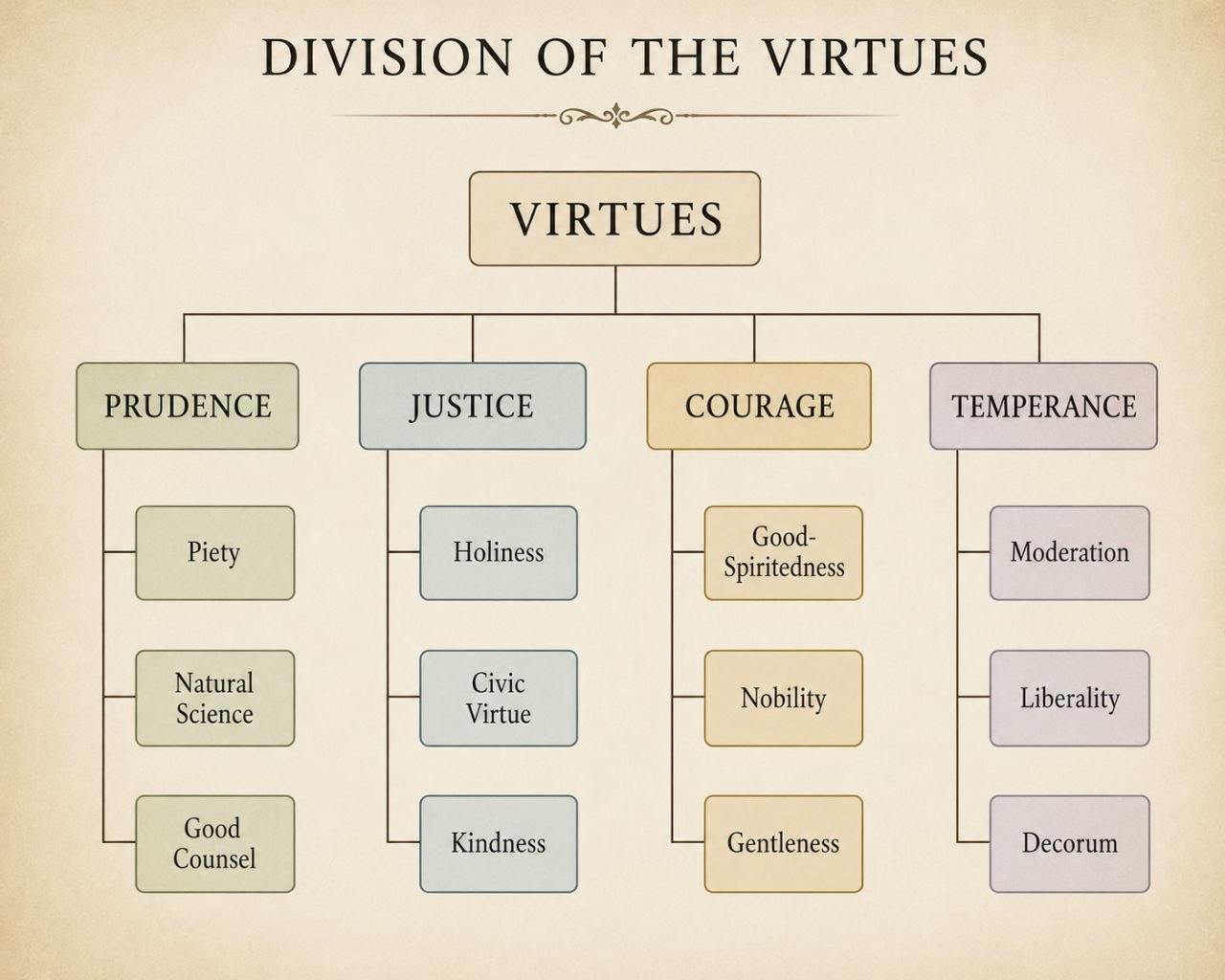
The generic virtues are: Prudence, Justice, Courage, Temperance.
The specific virtues, sub-divided under Prudence: Piety, Natural Science, Good Counsel. Under Justice: Holiness, Civic Virtue, Kindness. Under Courage: Good-Spiritedness, Nobility, Gentleness. Under Temperance: Moderation, Liberality, Decorum.
And Piety concerns the divine; Natural Science concerns natural things; Good Counsel concerns human things. And Holiness is in relation to the divine; Civic Virtue is in relation to public things; Kindness is in relation to private things. And Good-Spiritedness is in involuntary things; Nobility is in chosen things; Gentleness is in relation to human beings. And Moderation concerns reputation; Liberality concerns money; Decorum concerns pleasures.
*
Postface:
Plethon’s Order of the Virtues
The diagram presented in this treatise offers a concise summary of Georgios Gemistos Plethon’s moral philosophy. While it is built upon the classical framework of the four cardinal virtues—Prudence, Justice, Courage, and Temperance—it is not merely a repetition of ancient ethical doctrine. Plethon arranges beneath each cardinal virtue three subsidiary virtues, producing a complete system of twelve qualities through which human excellence is manifested.
At the summit stands Virtue (Aretē) itself, the unified perfection toward which the soul aspires. The four principal virtues are not independent qualities but distinct expressions of a single moral reality.
Prudence (Phronēsis) Prudence governs the intellectual life and the proper use of reason. Its subordinate virtues are:
- Piety (Theosebeia) — reverence toward the divine order.
- Natural Intelligence (Physikē) — understanding of nature and the structure of reality.
- Good Counsel (Euboulia) — the capacity for sound judgment and wise deliberation.
Plethon places piety within prudence rather than treating it as a separate theological virtue. Knowledge of the gods and knowledge of the cosmos belong to the same order of wisdom.
Justice (Dikaiosynē) Justice regulates humanity’s place within society and the sacred order. It includes:
- Holiness (Hosiotēs) — righteousness in relation to divine law.
- Civic Virtue (Politeia) — proper participation in communal and political life.
- Kindness (Chrēstotēs) — benevolence toward others.
Justice thus extends beyond legal equity to encompass both religious duty and social harmony.
Courage (Andreia) Courage concerns the strength and nobility of the soul. It manifests as:
- Good-Spiritedness (Eupsychia) — firmness and elevation of character.
- Nobility of Soul (Gennaiotēs) — magnanimity and greatness of heart.
- Gentleness (Praotēs) — mastery of force through self-control.
Notably, gentleness is here regarded as a form of courage, for true strength does not require harshness.
Temperance (Sōphrosynē) Temperance orders the desires and appetites. Its subordinate virtues are:
- Moderation (Metriotēs) — measure and balance in all things.
- Generosity (Eleutheriotēs) — freedom from attachment to possessions.
- Decorum (Kosmiotēs) — propriety, grace, and harmonious conduct.
Temperance is therefore not mere restraint but the cultivation of beauty and order in one’s manner of life.
The Order of Participation
Beneath the diagram Plethon provides a sequence indicating the degree in which one ought to participate in these virtues:
Decorum, Nobility of Soul, High Spirit, Moderation, Generosity, Gentleness, Kindness, Good Counsel, Natural Intelligence, Civic Virtue, Holiness, and Piety.
This progression appears to move from the more visible and social virtues toward those that are increasingly interior, intellectual, and sacred. The sequence culminates in Piety, suggesting that the highest perfection of the human being lies not merely in ethical conduct but in conscious alignment with the divine order.
Significance of the Scheme
Plethon’s classification reveals a characteristic feature of late Byzantine Platonism: ethics, politics, cosmology, and religion form a single continuum. Virtue is not simply a code of conduct but a process of harmonization.
The individual soul, the civic community, the natural world, and the divine realm all participate in one ordered hierarchy. To cultivate virtue is therefore to restore one’s place within the structure of reality itself.
The diagram may thus be read as a map of ascent: from outward discipline and social conduct to wisdom, holiness, and ultimately reverence for the divine source from which all virtue proceeds.
One small note: the translations of several virtues are not entirely fixed, and different translators might prefer slightly different renderings:
| Greek | Alternative Renderings |
|---|---|
| φρόνησις | Prudence, Practical Wisdom |
| θεοσέβεια | Piety, Reverence toward the Gods |
| φυσική | Natural Knowledge, Understanding of Nature |
| εὐβουλία | Good Counsel, Sound Deliberation |
| ὁσιότης | Holiness, Sanctity |
| πολιτεία | Civic Virtue, Citizenship, Public Spirit |
| χρηστότης | Kindness, Benevolence, Goodness |
| εὐψυχία | High Spirit, Great-heartedness, Fortitude |
| γενναιότης | Nobility of Soul, Magnanimity |
| πραότης | Gentleness, Mildness, Meekness |
| μετριότης | Moderation, Measure |
| ἐλευθεριότης | Liberality, Generosity |
| κοσμιότης | Decorum, Propriety, Orderliness |
For a reader interested in Plethon specifically, we would be inclined to retain Practical Wisdom, Liberality, Magnanimity, and Decorum, because they preserve stronger connections with the Greek philosophical tradition inherited from Plato and Aristotle.
There is also an intriguing structural feature in the diagram. The virtues under Prudence, Justice, Courage, and Temperance correspond respectively to four spheres:
- Knowledge of the divine and the cosmos (Prudence)
- Relations with gods and fellow citizens (Justice)
- Strength of character (Courage)
- Regulation of desires and conduct (Temperance)
This suggests that Plethon is presenting not merely a moral catalogue but a complete anthropology of the human being, integrating intellect, society, character, and appetite into a single hierarchical order. Such a scheme anticipates the moral-cosmic syntheses found elsewhere in his Platonic revival.
*
Bibliography
Primary Source & Translation Basis
- Plethon, Georgios Gemistos. Georges Gémiste Pléthon: Traité des vertus / Γεωργίου Γεμιστοῦ Πλήθωνος: Περὶ ἀρετῶν. Critical edition with introduction, Greek text, and French translation by Brigitte Tambrun-Krasker. Athens: The Academy of Athens, 1987. (This is the definitive source used for this English translation).
- Series: Corpus Philosophorum Medii Aevi: Byzantini Philosophi – Philosopheri Byzantini, Vol. 3.
- Tambrun-Krasker, Brigitte. Georges Gémiste Pléthon: Traité des vertus. Introduction, text, and French translation. Paris: Vrin, 1987.
Scholars Cited in the Introduction (Contemporary Virtue Ethics)
- Anscombe, G. E. M. “Modern Moral Philosophy.” Philosophy 33, no. 124 (1958): 1–19. (The seminal paper that revived interest in virtue ethics).
- Foot, Philippa. Virtues and Vices and Other Essays in Moral Philosophy. Oxford: Blackwell, 1978.
- MacIntyre, Alasdair. After Virtue: A Study in Moral Theory. 3rd ed. Notre Dame, IN: University of Notre Dame Press, 2007. (Key text on the recovery of teleological ethics).
Secondary Literature on Plethon & Byzantine Humanism
- Alexakis, Alexander. “Plethon’s Book of Laws and the Trial of 1460.” In George Gemistos Plethon: The End of Byzantium and the Dawn of the Renaissance, edited by Vassilis Karas and Antonis Liakos. Athens: Nefeli, 2004.
- Keller, A. Panagiotis. “The Ethical System of Gemistos Plethon.” Byzantine Studies 12, no. 2 (1985): 145–162.
- Lagarde, Georges. “La théologie de Pléthon.” Revue des études byzantines 23 (1965): 5–35.
- Masai, François. Pléthon et le platonisme de Mistra. Paris: Les Belles Lettres, 1956. (The classic study on Plethon’s life and the Mistra circle).
- Monfasani, John. George of Trebizond: A Biography and a Study of His Rhetoric and Logic. Leiden: Brill, 1976. (Provides context on the Italian humanist reception of Plethon).
- Tambrun, Brigitte. Pléthon: Le retour de Platon. Paris: Vrin, 2006. (A comprehensive modern biography and analysis of his philosophical project).
- Woodhouse, C. M. George Gemistos Plethon: The Last of the Hellenes. Oxford: Clarendon Press, 1986. (The standard English-language biography).
Historical Context: The Fall of Constantinople & Mistra
- Nicol, Donald M. The Last Centuries of Byzantium, 1261–1453. 2nd ed. Cambridge: Cambridge University Press, 1993.
- Runciman, Steven. The Fall of Constantinople, 1453. Cambridge: Cambridge University Press, 1965.
- Setton, Kenneth M. The Papacy and the Levant, 1204–1571. Vol. 2. Philadelphia: American Philosophical Society, 1978. (Details the diplomatic missions involving Plethon).
*
Source
Academy of Athens
***

Related Articles


Leave a Reply