
Circle of Transmission: The Living Loom
A Little Hans Yohanan Lewy Sampler – Part 4: From ‘Chaldaean Oracles And Theurgy’-The Journey of the Soul
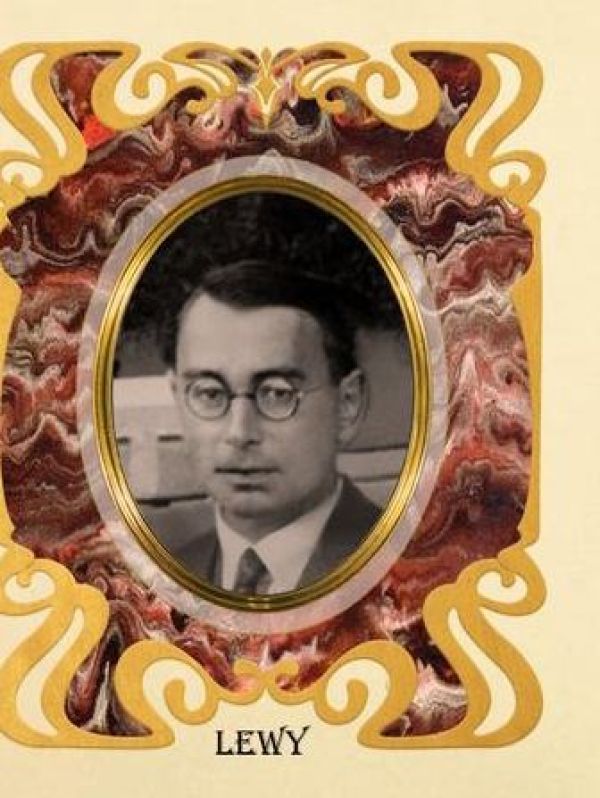
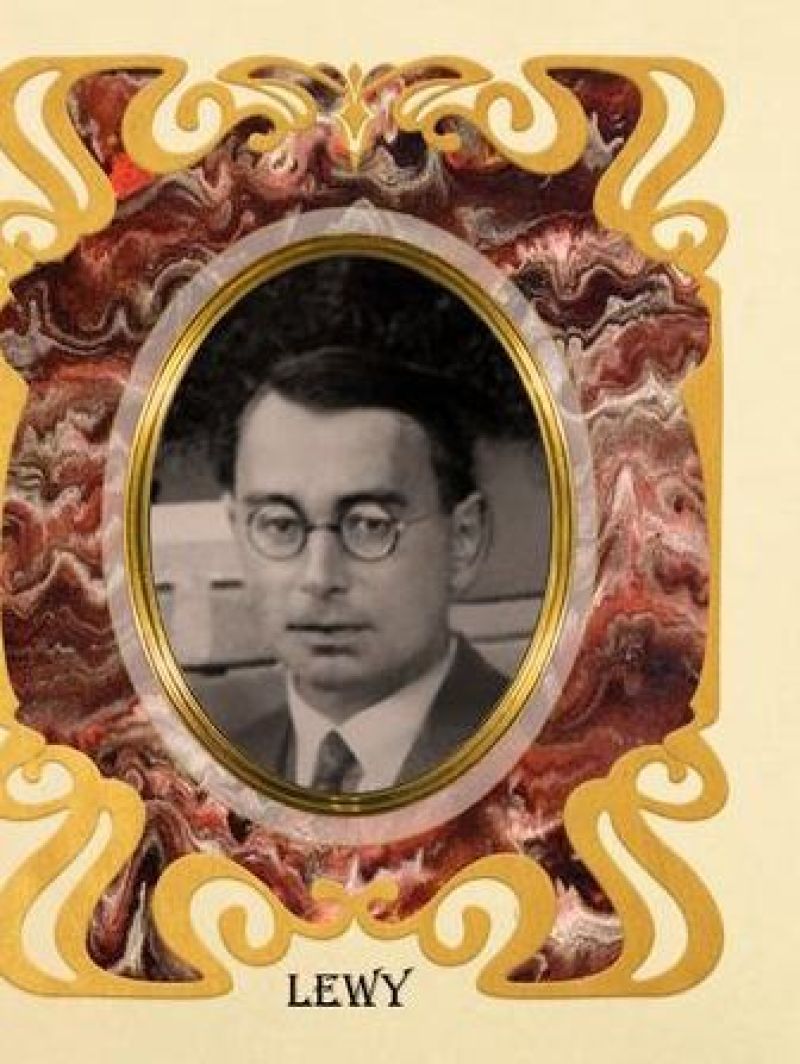
A portrait of professor Hans Lewy
from the 1956 Cairo edition,
used as a frontispiece.
*
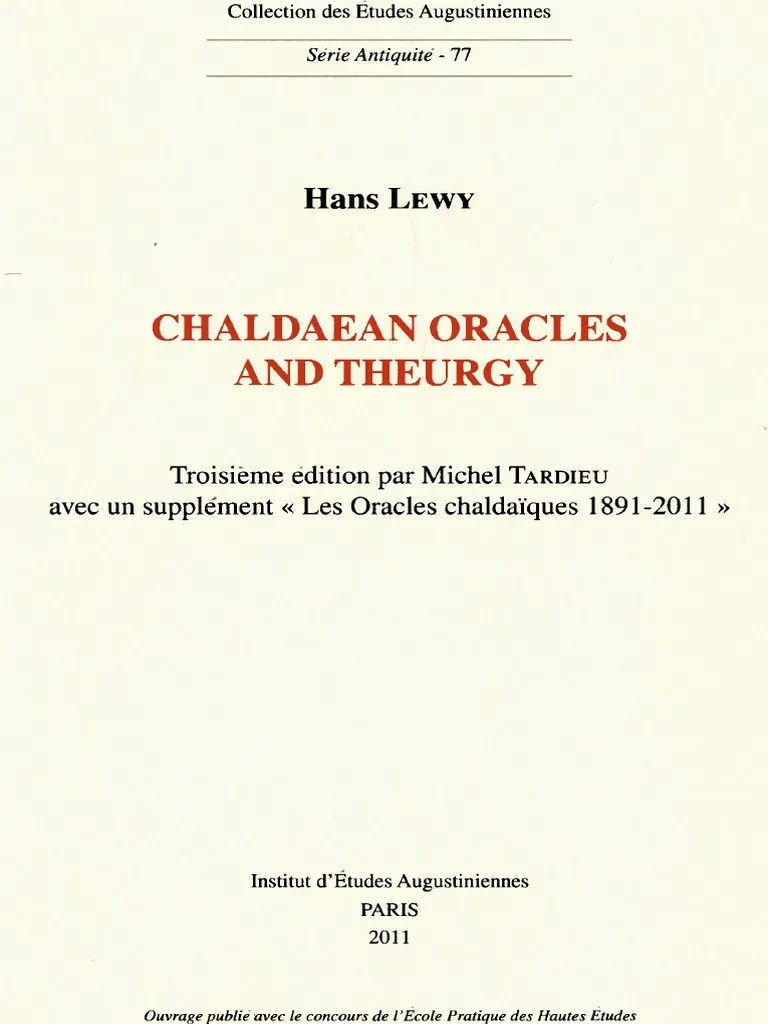
Today’s sharing from the Blue House of Via-HYGEIA is the fourth installment of our sampler devoted to the memory of Professor Hans Yohanan Lewy (1892–1962). This excerpt is drawn from his posthumous masterpiece of classical philology, Chaldaean Oracles And Theurgy: Mystic Magic and Platonism in the Later Roman Empire. First published in Cairo in 1956 by the Institut Français d’Archéologie Orientale and re-published in 2011 by Professor Michel Tardieu at the Institut d’Études Augustiniennes in Paris, this work remains a ‘must-have‘ for any serious student of late antique spirituality. We present now an excerpt from Chapter VII, section 4: ‘The Journey of the Soul‘, running from page 414 to page 417.
In this section, Lewy traces the soul’s celestial ascent (ἀναγωγή, anagogē) from its Babylonian astral roots through the mystery cults of late antiquity. We encounter the Mithraic ladder with its seven doors, the ‘garments‘ of ether and light that the soul dons and doffs as it passes through the planetary spheres, and the crucial Chaldaean modification: a solar theology in which sun and moon are not tyrannical Archons to be compelled by magic, but ‘Rulers of the initiation‘ who purify and assist the ascending soul.
Lewy also turns to the great magical papyrus of Paris, where another type of celestial ascent is described—one accomplished by the separation of soul from body, the inhalation of sunbeams, the vision of God, and the symbolic death and rebirth of the initiate—demonstrating the embeddedness of Chaldaean practice within a broader late antique spiritual ecology. Our forthcoming Sampler Part 5 will be: ‘The Three Rulers of the Chaldaean Initiation‘.
**
A Contextual Introduction
In the previous installments of this sampler, we ascended the steep ladder of Chaldaean theology. Part 1 introduced us to the Caller and the Call, establishing the fundamental theurgic dynamic: the soul’s yearning is not a solitary cry into the void, but a response to a divine summons that precedes human will. We learned that the ritual act is less about invention and more about alignment with a pre-existing cosmic frequency.
Part 2 carried us higher, into the blinding silence of the Supreme Being. There, Lewy dismantled the anthropomorphic projections of later centuries to reveal the ‘Paternal Monad’—a First Principle so transcendent it is ‘everything, but noetically‘. We encountered a God who does not labor, speak, or craft in time, but whose mere nod of Will instantaneously structures reality.
Part 3 brought us to the critical pivot point where the Absolute touches the Relative. If the Father is the silent, undivided Unity, how does the manifold universe emerge without fracturing that Unity? The answer lies in The IDEA. There, Lewy performed a masterful excavation of the Chaldaean doctrine of the Ideas (or Forms), moving beyond static Platonism to reveal a dynamic, living metaphysics. The Ideas are not dead blueprints stored in a heavenly archive; they are ‘multiform‘, ‘rushing forth‘, and ‘flashing like bees‘ from the Paternal Source—active agents of creation, the ‘measuring Triad‘ that imposes order on chaos, and the very thoughts of God actualized through the mediation of the Second Intellect.
Now, in Part 4, we come to the question that gives all this cosmology its urgency: What of the soul? If the Chaldaean cosmos is a hierarchy of noetic triads emanating from the Paternal Monad, the human soul is no mere accident of matter but a traveller exiled from its native realm, now seeking the path of return. The Ideas may be the map of the divine mind, but the journey of the soul is the pilgrimage through that map—an ascent that is at once ritual, cosmological, and soteriological.
In this excerpt, Lewy traces the doctrine of the soul’s celestial voyage (ἀναγωγή) from its Babylonian astral roots through the mystery cults of late antiquity. We encounter the Mithraic ladder with its seven doors, the ‘garments‘ of ether and light that the soul dons and doffs as it passes through the planetary spheres, and the crucial Chaldaean modification: a solar theology in which sun and moon are not tyrannical Archons to be compelled by magic, but ‘Rulers of the initiation‘ who purify and assist the ascending soul. But Lewy does not stop at the boundaries of self-declared Chaldaeanism. He also turns to the great magical papyrus of Paris, where another type of celestial ascent is described—one accomplished by the separation of soul from body, the inhalation of sunbeams, the vision of God, and the symbolic death and rebirth of the initiate.
The agreement between this papyrus and the Chaldaean mysteries is too precise to dismiss: here, too, we find the same four-point structure of ascent, the same solar climax, the same transformation of the self through ritual. Lewy cautions that such a text is a ‘product of contamination‘ that cannot be traced to a single source; yet its concordance with Chaldaean views, already noted by Bousset and Dieterich before the Chaldaean mystery was fully known, proves that these beliefs derive from shared Syro-Iranian religious circles. For Lewy, this is not a weakening of Chaldaean distinctiveness but a confirmation of its embeddedness in a broader late antique spiritual ecology.
This distinction—between the astral fatalism of the Gnostics, who saw the planetary spheres as prisons of a diabolic Heimarmene, and the positive, theurgic relationship to the stars that Lewy identifies in the Chaldaean mysteries—marks one of the most significant divergences in ancient soteriology. The Gnostic religions are the reaction against the sidereal religion which placed human fate under the rule of the planetary gods: they wished to free it from the tyranny of the diabolic ‘Archons‘. The Theurgists, on the contrary, worship sun and moon as purifying the mortals from their stain and aiding them in their mystical ascent.
For the student of Theurgy, this section is indispensable. It reveals that the Chaldaean ascent is not an escape from the cosmos but a reintegration with it, accomplished through the very structures—planetary, solar, noetic—that the soul traversed in its descent. The ‘eighth door‘ beyond the seven spheres is not merely a metaphor for intellectual enlightenment, though it may be that too; it is the threshold of the supramundane elysium, the empyrean destination promised to the highest initiates. To understand this journey is to understand what the Chaldaean theurgist actually did—and what, in the theatre of the mysteries, was acted out as a sacramental re-enactment of the soul’s primordial drama.
As Lewy demonstrates, the Chaldaean Oracles preserve this ‘drama of the soul‘ in fragments that are at once poetic and precise: the history of its supermundane origin, its descent through the spheres, its embodiment and enslavement, its release through the sacrament, and its final reascent.
To read these pages is to stand at the sanctuary door, watching the neophyte pass downward and upward through the sevenfold ladder, stripping away the passions of each planetary sphere until, clothed again in original purity, the soul enters the eighth door and is received into companionship with the divinity.
*
And Now the Text:
Chapter VII, section 4.
‘The journey of the soul through the heavens’
The determination of this connecting factor follows from the inquiry concerning the origin of the beliefs fundamental to the ritual of the Chaldæan mysteries. The principal action of their initiation into immortality was the journey of the soul through the heavens (ἀναγωγή).¹ This ascent formed the content of the holy practices of many Oriental mystery cults of this period. It was celebrated in its most nearly complete form in the mystery of the Mithraists.²
Their initiation consisted of the mimic representation of the descent of the soul from the region of its divine origin, and its reascent after severance from the body. The neophyte had to pass, first downwards and then upwards, through the seven doors—which symbolized the six planetary spheres and the sphere of the fixed stars—of a ladder graphically represented in the sanctuary; and he had finally to enter through the “eighth door” into the supramundane elysium.
This belief in the descent and ascent of the soul through the spheres is, as Cumont and Bousset have shown, a creation of the late Babylonian astral religion, as transformed by Hellenistic cosmological physics.³ It recurs in manifold variations in the eschatological speculation of the theologians of later Antiquity and forms the basis of many Gnostic systems.⁴ The Chaldæan Oracles also retain many evidences of this siderial eschatology.
The “drama of the soul”, the history of its supermundane origin, descent through the spheres, embodiment, enslavement, and release through the sacrament, and final reascent, is one of the chief themes of their doctrine. In the mystery of the Chaldæans itself, however, not the whole history of the soul, but only its “return” was represented, and this also, not to its supramundane termination, but only up to the sun of which the noetic light, directed by Aion, completed its purification.
The solar theology determines the extent and meaning of the journey through the heavens acted out during the Chaldæan mystery. On the other hand, the general descriptions of the journey of the soul given in the Chaldæan Oracles agree with those of the Mithraists. Their “ladder with seven doors” corresponds to the “sevenfold ladder” which the Theurgist had to climb.⁵
Whether the Oracles use this figure only as a metaphorical description of an intellectual ascent to the apprehension of the noetic world, or whether they refer thereby to a specific practice in the celebration of the mystery, which was acted out apart from the “elevation” to the sun, can no longer be known. It is not impossible that the ascent to the supramundane (the “eighth” zone) formed the initiation of the highest class of initiates, to whose souls the final translation into the empyrean was promised.⁶
Another type of mystery dealing with the journey through the heavens is described in the great magical papyrus of Paris. The general agreement between the initiation to immortality there represented and that of the Chaldæan theurgists has been already indicated.⁷
It concerns above all four points: the ascent is accomplished by the separation of the soul from the body and the inhalation of sunbeams; it culminates in the vision of God;⁸ this vision produces immortality; the action as a whole represents the death and rebirth of the initiate. As to the origin of the concepts which appear in this magical papyrus, opinions differ, and in fact, it is impossible to trace such a product of contamination to a single source.⁹
The agreement with the views of the Chaldæans, which already struck Bousset and Dieterich (who were yet without knowledge of the existence of a Chaldæan mystery of immortality)¹⁰ proves that the beliefs mentioned derive from Syro-Iranian religious circles.¹¹
During the passages of the doors of the seven heavens the soul, according to the teachings of the Mithraists, laid off the passions and characteristics which it had taken on as it accomplished its descent to earth, and so received again its original purity which made it worthy of companionship with the divinity.¹²
The notion that the soul descending from heaven takes on the characteristics of the planetary spheres through which it passes, before it enters into corporal existence, and that after death it makes its journey through the heavens in reverse direction and with opposite effect—this derives from the same religious circles as those in which the doctrine of the voyage of the soul through the spheres had developed: the later Babylonian astral theology.¹³
It was widespread and, through association with other systems, assumed diverse forms. It appears again in the mysteries of the Chaldæan theurgists, with, however, material variations. The Oracles teach that the descending soul clothes itself during its passage through the zones of the world, with the “parts” of the ether, the sun, the moon and the air, and then again puts these off during its return.¹⁴ These “garments”, nevertheless, lend no faculties to the soul, but merely serve it as vehicles for the reascent.¹⁵
A further divergence consists of the fact that the Chaldæans replace the astral degrees of the ascent by physical (air and ether) and retain only two of the planetary (moon and sun). This modification is explicable from the character of the astral religion which they had adopted and which we shall soon have to discuss.¹⁶
The absence of a planetary derivation of the “garments of the soul” strengthens the conclusion, already reached from other evidences, that the Chaldæan theurgists were no representatives of the astral fatalism. Their views as to the nature of Destiny (Heimarmene) were connected not with the planets or fixed stars, but with their mover, the Cosmic Soul.¹⁷
They determinedly contested the independent influence of the stars on human life; for them the stars are simple executors of the divine Will, “to Whose nod all is subjected”.¹⁸ Thus their relationship to the stars is not conditioned by any fundamental prejudice, and is, even in part, outspokenly positive.
Whereas, according to the view of the representatives of astral fatalism, the rulers of the spheres (the “Archons”) had to be compelled by magical formulae to give the ascending soul free passage, in the Chaldæan mysteries, on the contrary, the sun and moon function as “Rulers of the initiation”, who assist the ascent of the soul when invoked. In this positive attitude of the gods of the stars appears the principal difference between Chaldæan theurgy and Gnosticism.
The Gnostic religions are the reaction against the siderial religion which placed human fate under the rule of the planetary gods: they wished to free it from the tyranny of the diabolic “Archons”. The Theurgists, on the contrary, worship sun and moon as purifying the mortals from their stain and aiding them in their mystical ascent.
*
Notes
¹ On what follows, see Wendland’s summary (Hellenistisch-römische Kultur, etc., 1912, 170 ff.), based on the researches of Bousset, Die Himmelsreise der Seele, Arch. f. Rel., IV, 1901, 160 ff.; Goett. Gel. Anz., 1905, 707 ff.; Dieterich, Mithrasliturgie, 179 ff.; Cumont, Rel. Orient., 265, 91 and Reitzenstein, Die hellenistischen Mysterienreligionen, passim. The copious use of the name of Posidonius has to be restricted in accordance with the results of Reinhardt’s researches. Jewish Gnosticism provides an interesting example of the development of the doctrine of the ascension of the soul. The relevant texts are interpreted and assigned their place in the history of religion by G. Scholem, Major Trends in Jewish Mysticism, Jerusalem, 1941, 48 ff.
² Cumont, M. M. M., I, 38 f.; 117 f.
³ See Cumont, Rel. Orient., 265, 91; 283, 69 (with bibliography).
⁴ See W. Anz, Zur Frage nach dem Ursprung des Gnostizismus, 1897, which according to him derives from Babylonian mythology, an untenable supposition; cf. H. Jonas, Gnosis und spätantiker Geist, I, 25 f.
⁵ See ch. v, n. 133 and 135. The similarity between the ἑπταπύλος βαθμίς of the Chaldæans and the κλίμαξ ἑπτάπτυλος of the Mithraists (see Orig., C. Cels., VI, 22) was investigated by Anz, op. cit., 87, 2; 89; Cumont, M. M. M., I, 38, 3 and by Bousset, Arch. f. Rel., IV, 264.
⁶ On this class of Chaldæan initiates see ch. III, sect. 6. The fact that the title Heliodromus designated the second and Pater the first grade of the Mithraic initiates (see Cumont, M. M. M., I, 315 f.), may perhaps point to the existence of a supreme Mithraic sacrament similar to the Chaldæan one whose existence is supposed in the text.
⁷ See ch. III, n. 85; 132; 138.
⁸ See note 120.
⁹ Cf. Weinreich’s exposition of the divergent opinions in the third edition of Dieterich’s Mithrasliturgie, p. 234 f.
¹⁰ Bousset, Arch. f. Rel., IV, 264 ff.; Dieterich, op. cit., 205 f.
¹¹ Bousset, op. cit., Dieterich, op. cit., and after them Reitzenstein, Hellenistische Mysterienreligionen, 174 and 387, suppose the influence of Iranian beliefs. This ethnic appellation must be restricted as above. Πρόνοια καὶ Ψυχή invoked by the magician in the beginning of his conjuration are, however, not Iranian terms (Reitzenstein, Hellenistische Mysterienreligionen, 178), but the Stoic designations of the Cosmic Soul representing Destiny (St. V. Fr., II, 110, 613), as are also Φύσις and Πρόνοια invoked by Vettius Valens, p. 293, 25, ed. Kroll (cf. St. V. Fr., I, 176, etc. See also Hymn. Orph., X, 27).
¹² Cumont, M. d. M., 130.
¹³ Cumont, Rel. Orient., 283, 69; Bousset, Hauptprobleme der Gnosis, 361 ff. and Goetting. Gel. Anz., 1914, 732 ff.
¹⁴ See ch. III, n. 26; 34. The extant oracular fragments do not state that the soul in the course of her re-ascent divests herself of these “envelops”, but this opinion seems to be a corollary of the Chaldæan conception of a “vehicle of the soul”.
¹⁵ See ch. III, n. 26.
¹⁶ We do not know for certain the origin of Porphyry’s doctrine (Sent., 29, 2, p. 14, 13 f.; see Dodds, 318) concerning the descent of the soul traversing the ether, the sun and the moon. Contrary to Proclus’ supposition (Tim., III, 234, 26) it does not derive from the Oracles in spite of its affinity with their conception: cf. ch. III, n. 26 fin.
¹⁷ See ch. VI, sect. 9.
¹⁸ See ch. IV, n. 99, v. 3-6; 103.
*
Chaldaean Oracles And Theurgy:
Mystic Magic and Platonism in the Later Roman Empire‘,
published in Cairo in 1956 by the Institut Français d’Archéologie Orientale.
For the 1956 original edition &
photographic portrait
press here
*
To order the book’s
latest edition,
press here
Related Articles


Leave a Reply