
Circle of Transmission: The Living Loom
Esprit Sabbathier: ‘The Ideal Shadow of Universal Wisdom’ – An English Translation and Introduction to Wellcome MS 4328
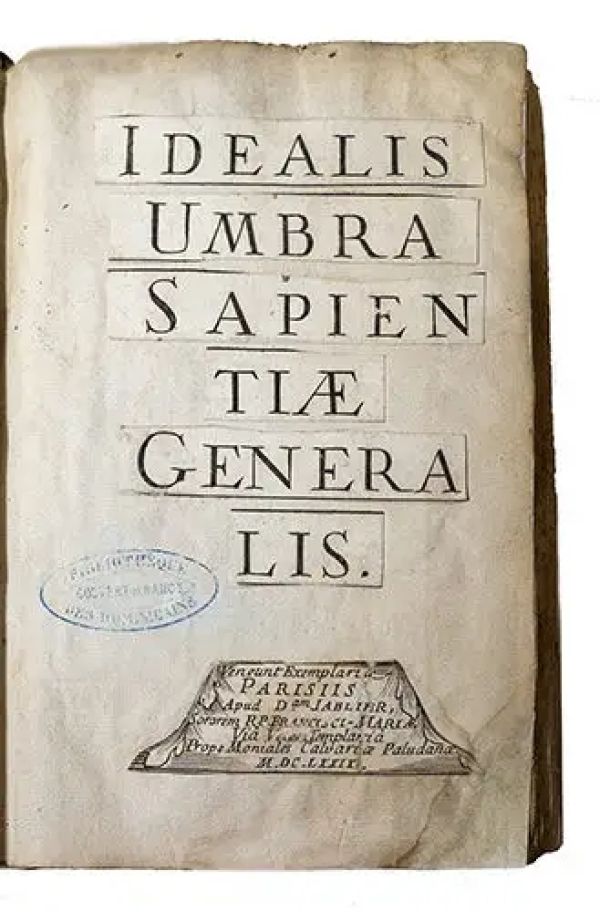
Title page of the 1679 Paris edition of Reverent Esprit Sabbathier’s
‘Idealis Umbra Sapientiae Generalis’.
Picture by Alain Marchiset & l’Intersigne.
*
Marking a significant moment in the study of esotericism, the Blue House of Via-Hygeia shares the first complete English edition of Esprit Sabbathier’s The Ideal Shadow of Universal Wisdom (Wellcome MS 4328). This 17th-century masterpiece of Christian Kabbalah and baroque emblematics boldly synthesizes theology, science, and mysticism into a unified system.
Conscious of our limitations and consistent with our mission, our endeavor is to capture the text’s core essence and offer a coherent interpretation, in the hope that one day a definitive scholarly English edition will reveal its full beauty to the general public.
This edition features a contextual introduction, fresh translations of the original dedications, treatise, and tables, alongside a comprehensive visual guide to Sabbathier’s complex ‘Labyrinth‘.
At the heart of this work lies a rigorous moral architecture: a vast synoptic system mapping the transformation of human nature. Sabbathier delineates a precise alchemy of the soul, tracing the lineage from Defects (the roots of error) through Qualities (the raw potential of character) to Virtues (the perfected state of grace). This intricate taxonomy, woven through every table and diagram, offers not just a catalog of vices and virtues, but a dynamic roadmap for spiritual transmutation.
While focusing on these primary elements, we note that the unique Italian commentary and 47-day prayer cycle found in the Wellcome manuscript will be the subject of a forthcoming article; that future work will offer the first English translation of these texts, demonstrating how Sabbathier intended his system to be used as a lived spiritual discipline.
We dedicate this publication to Vincent Mercier in gratitude for his generous help in the pre-publication research.
**
A Contextual Introduction
*
I. The Work & Its Author
The manuscript that follows is one of the most curious and ambitious products of seventeenth-century French occultism. Composed circa 1675–1677 by Esprit Sabbathier, a Capuchin friar of the province of Berry, it attempts nothing less than to present the whole of created and uncreated reality—natural, moral, and divine—within a single emblematic system.
The title, Idealis Umbra Sapientiae Generalis (The Ideal Shadow of Universal Wisdom), announces its paradoxical ambition: to make visible, through a shadow or reflection, the ideal form of wisdom itself.
Sabbathier remains an obscure figure. The Dictionnaire des philosophes français du XVIIe siècle records his death around 1676 or 1677, which means he likely did not live to see the publication of his work in 1679.
Beyond this, we know only that he was a Capuchin, that he worked within the intellectual orbit of the Paris convent of Saint-Honoré, and that he possessed a remarkable command of Kabbalistic literature, scholastic philosophy, and baroque emblematics.
His obscurity is typical of the period: for every Kircher or Agrippa whose name survived, a hundred Sabbathiers wrote, taught, and were forgotten. Yet his work preserves something of the intellectual ferment of Louis XIV’s Paris—the conviction that all knowledge could be harmonized, that the Christian mystery could be mapped onto the Jewish Kabbalah, and that the universe itself was a book waiting to be read by those with eyes to see.
II. The Capuchin and Kabbalah
The Capuchin order, a reformed branch of the Franciscans established in the sixteenth century, maintained a strong tradition of mystical and esoteric scholarship. The Paris convent on the rue Saint-Honoré, founded by Henri III in 1576, possessed one of the most remarkable libraries in the capital.
By the eve of the Revolution it housed some 24,000 volumes, rich in Hebrew, Kabbalistic, and mystical texts.
It was here that Sabbathier would have encountered the Zohar, the Sefer Yetsirah, and the works of Christian Kabbalists such as Pico della Mirandola, Reuchlin, and Guillaume Postel.
The Christian Kabbalah that Sabbathier inherited was not a single doctrine but a complex of interpretive practices: the reading of Hebrew divine names as emanations of the Godhead, the correlation of the ten Sephiroth with the orders of angels and the spheres of the cosmos, and the conviction that the Old Testament, properly decoded, revealed the mysteries of the Trinity and the Incarnation.
By the mid-seventeenth century, this tradition had been enriched by the publication of Athanasius Kircher’s Oedipus Aegyptiacus (1652–1654) and the first volumes of Christian Knorr von Rosenroth’s Kabbala denudata (1677–1684), which made the Zohar accessible to Latin-reading scholars across Europe.
Sabbathier’s work stands at the intersection of these traditions. It is neither a straightforward Kabbalistic treatise nor a conventional work of Catholic theology. Rather, it is a theosophical summa—an attempt to synthesize all knowledge into a single, visually apprehensible system.
The ‘Ideal Shadow‘ of the title is not merely a metaphor; it is a technical term. For Sabbathier, the material world is a shadow of the ideal world, and the ideal world is itself a shadow of the divine essence. The work is thus a shadow of a shadow—but one that, properly read, can lead the reader back to the light.
III. The Manuscript and the many Printed Editions
The text presented here is based on Wellcome MS 4328, a manuscript now preserved in the Wellcome Collection, London. This manuscript, which dates from approximately 1675–1677, appears to be either the author’s working draft or a presentation copy prepared for a patron.
It contains the full text of the work, including the Proemium, the Praecursoris Isagogicus, the Five Principal Figures, and the extensive tables that correlate the Sephiroth, angelic hierarchies, planets, zodiacal signs, virtues, vices, sacraments, and sciences.
Uniquely, this manuscript also contains an extensive Italian commentary and a 47-day cycle of Latin prayers, transforming the theoretical diagram into a practical spiritual exercise—a feature absent from the known printed editions.
The manuscript was first published in 1679 by Mademoiselle Jablier, sister of the Capuchin Père François-Marie de Paris, a prominent mystic and founder of the Convulsionnaires movement. The edition was issued in two forms: a Latin version (Idealis Umbra Sapientiae Generalis) and a French version (L’Ombre idéale de la Sagesse Universelle). Some copies contain both languages; others, only one.
The entire book was engraved, not printed from type—a remarkable decision that reflects the emblematic nature of the content. The 1679 edition consists of a title page and twenty-four double-page tables, each approximately 298 × 212 mm, pasted onto guards in an octavo volume. The plates were executed by an anonymous engraver in the ornate, densely symbolic style characteristic of baroque occult illustration.
A second edition appeared in 1687, essentially a reissue of the 1679 plates with a new title page.
Following two centuries of relative obscurity, the work experienced a revival in the nineteenth century.
In the 1840s, the French Freemason David Rosenberg (writing under the initials D. R.) produced an adaptation entitled Explication du Tableau Intitulé Sapientia Generalis: D’après le Système du R. P. S. (Paris, 1844). Published at 18 Boulevard Saint-Martin, this work served as a guidebook, offering a systematic method for reading the lithographic diagram and translating its inscriptions for a new generation of seekers.
Later, in 1897, the Parisian esoteric publisher Chamuel issued a facsimile reprint of the original 1679 plates, hosted within René Philipon’s ‘Rosicrucian Library‘, further cementing the work’s place in the fin-de-siècle occult revival.
The original manuscript was acquired by the Wellcome Collection through the Library of the Medical Society of London and has been digitized and made freely available online; additionally, the Embassy of the Free Mind (Bibliotheca Philosophica Hermetica) hosts the 1897 Chamuel edition via SourceLibrary dot org.
IV. The Structure of the Work
The Ideal Shadow is structured as a journey from darkness to light, from confusion to clarity, from the labyrinth of creation to the vision of God. This journey is mapped onto three states of the universe: the Confused (night), the Complicated (dawn), and the Explained (day). These three states correspond to the threefold consideration of the universe: in generality, in Christ, and in light.
The work begins with a Proemium (presented here as ‘A Foreword‘) addressed to the reader, who is imagined as an old man hesitating before the threshold of a secret wisdom. It invokes the Solomonic labyrinth, the Kabbalistic marriage of Light and Shadow, and the Christian mysteries of the Incarnation and the Cross. It establishes the central paradox of the work: that the highest wisdom is to be found not in the light alone, but in the shadow that the light casts.
The Praecursoris Isagogicus (‘A Forerunner’s Introduction’) then lays out the fourfold division of the system: East, West, North, and South. Each direction corresponds to a fundamental principle: Divinity (East), Truth (South), Science (West), and the Church (North).
These four principles are then correlated with the four elements, the four humours, the four seasons, and the four cardinal virtues—a typical baroque procedure of analogical multiplication.
Five Principal Figures form the core of the work. They are:
- The earthy triangle (Hypostatic order): Activity, Passivity, Bond.
- The triple square of air (Seminal order): the four leaders and their retinues.
- The airy dodecagon (Informative order): the twelve signs of the Zodiac.
- The fiery circle (Actual order): essence, existence, substance.
- The celestial region (Stative order): the consistency of all things.
Each figure is accompanied by extensive tables that correlate the principles of the figure with the names of God, the orders of angels, the planets, the zodiacal signs, the virtues and vices, the sacraments, and the sciences. These tables are not mere appendices; they are the work itself, the visual embodiment of the ‘Ideal Shadow‘.
The final sections of the work treat the ascent of the soul to God through the theological virtues, the gifts of the Holy Spirit, the beatitudes, and the seven degrees of contemplation.
The work ends with a Final Exhortation and Three Warnings, in which the author urges the reader to approach the ‘Ideal Shadow‘ with humility, to avoid idolizing the symbols, and to see in it the whole universal wisdom, both natural and supernatural, folded together and unfolded.
V. Political and Religious Context
The Ideal Shadow was composed during the reign of Louis XIV, the ‘Most Christian King’, and dedicated to both the King and Pope Innocent XI. This double dedication is significant. It places the work within the Counter-Reformation project of reconciling Catholic orthodoxy with Jewish mystical tradition—a project that had fascinated French theologians since the days of Pico della Mirandola and Guillaume Postel.
But it also reflects the particular political theology of Louis XIV’s France, in which the King was imagined as the visible head of the Church militant, and France itself as the ‘lily of the Church‘ (lilium Ecclesiae), growing in purity under Christ the King.
The work’s explicit identification of France with the lily, and its dedication to the ‘Most Christian King’, must be read in the context of Louis XIV’s aggressive assertion of Catholic supremacy. The Revocation of the Edict of Nantes (1685), which expelled the Huguenots from France, was only a few years away when Sabbathier composed his work.
The Ideal Shadow is thus not merely a speculative treatise; it is a contribution to the cultural project of Catholic reconquest, a visual and intellectual weapon in the battle against Protestantism, Judaism, and all forms of heterodox thought.
Yet the work is also deeply ecumenical in its own way. By asserting the harmony of Christian and Jewish mysteries, by mapping the Kabbalistic names of God onto the Christian Trinity, by finding Christ in the Sephiroth, Sabbathier offers a vision of universal wisdom that transcends the boundaries of any single confession.
This is the ‘general wisdom‘ (sapientia generalis) of the title: not the wisdom of this or that school, but the wisdom that underlies all schools, all religions, all creation.
VI. Visual Imagination
The most striking feature of the Ideal Shadow is its visual imagination. The work is not merely illustrated; it is constituted by its illustrations. The tables are not decorative additions to a prose argument; they are the argument itself, made visible.
This is a characteristic of the baroque emblem book, which flourished in the sixteenth and seventeenth centuries from the Emblemata of Alciato to the Iconologia of Ripa. But Sabbathier pushes the emblematic form to its limit, creating a system so dense, so all-encompassing, that it threatens to collapse under its own weight.
The reader of the Ideal Shadow is thus not a passive recipient of information but an active participant in a hermeneutic exercise. The tables must be read, decoded, correlated, and internalized. The Hebrew characters, the planetary sigils, the zodiacal signs, the alchemical symbols, and the Christian iconography all demand interpretation.
The work is a labyrinth in the true sense: a structure designed to be traversed, a puzzle designed to be solved, a shadow designed to lead the reader back to the light.
This visual pedagogy has its roots in the medieval tradition of the memory palace, in which knowledge was stored in imagined architectural spaces. But it also reflects the Renaissance and baroque fascination with theatres of memory, mnemonic wheels, and encyclopedic charts—devices for organizing and retrieving vast quantities of information.
Sabbathier’s tables are a kind of memory theatre, but one in which the information to be remembered is nothing less than the whole of Creation!
VII. Language and Style
The Latin of the Ideal Shadow is highly idiosyncratic. It is not the classical Latin of Cicero or the scholastic Latin of Aquinas, but a baroque Latin, full of neologisms, hyperbaton, and alchemical-Kabbalistic jargon. The prose is dense, periodic, and allusive, demanding a reader who can navigate between biblical echoes, Solomonic imagery, and Kabbalistic technical terms.
The English translation presented here attempts to preserve this baroque density while clarifying the syntax for modern readers. It keeps the personifications (Sapientia, Virtus, the Lily of France), the biblical cadences, and the emblematic vocabulary, but untangles the hyperbaton so that the argument can breathe.
The style of the English is deliberately archaic. To modernize the vocabulary entirely—to turn ‘Sapientia‘ into ‘wisdom‘ without capitalization, to render ‘Virtus’ as ‘moral excellence‘ rather than ‘Virtue‘—would be to betray the text’s own self-understanding.
For Sabbathier, these are not abstract concepts but personified powers, active agents in the economy of salvation. The English therefore preserves the capitalizations, the personifications, and the baroque density, while smoothing the syntax so that the reader can follow the argument.
VIII. About The Modern Reader
Why should the modern reader attend to this obscure Capuchin and his labyrinthine tables? The Ideal Shadow is not a work that can be read for practical advice, nor is it a systematic treatise that can be mined for philosophical arguments. It is, rather, a monument to a particular moment in intellectual history: the moment when the baroque imagination, armed with the tools of Renaissance humanism, scholastic philosophy, and Jewish mysticism, attempted to comprehend the whole of reality in a single glance.
For the historian of ideas, the work offers a window into the intellectual world of Louis XIV’s Paris, where Catholic orthodoxy and Kabbalistic speculation could coexist within the same mind. For the student of religion, it offers a case study in the Christianization of Jewish mysticism, the mapping of the Sephiroth onto the Trinity, and the sacralization of natural philosophy.
For the art historian, it offers a specimen of baroque emblematics pushed to its limit, a visual system so dense that it becomes a kind of abstract art avant la lettre. And for the general reader, it offers a strange and beautiful journey through a forgotten world, a labyrinth of light and shadow, of wisdom and its ideal reflection.
The work is also timely. In an age of digital information overload, when knowledge is fragmented into endless databases and search engines, Sabbathier’s vision of a unified wisdom, a single system in which all things cohere, has a peculiar resonance.
His ‘Ideal Shadow‘ is not so different from the visualizations of modern complexity science, the network diagrams of contemporary sociology, or the mandalas of Buddhist meditation.
All are attempts to make the whole visible, to give form to the formless, to find unity in multiplicity. Sabbathier’s method may be baroque, his theology may be orthodox, his politics may be royalist—but his ambition is universal, and his shadow still casts a light.
IX. Notes Upon This Edition
The translation is based directly on Wellcome MS 4328, accessible online via the Wellcome Collection. Where the manuscript presents textual difficulties or ambiguous readings, the English has been rendered to reflect the most probable meaning based on context and parallel passages.
While this edition strives for accuracy, the detailed row-by-row verification of the complex tables and the full critical apparatus of Latin variants remain tasks for future scholarly work. Hebrew characters and planetary symbols have been retained in Unicode to preserve the original’s visual and symbolic integrity.
The 1679 engraved edition is held by the Bibliotheca Philosophica Hermetica (Embassy of the Free Mind), Amsterdam, and may be browsed through their digital collection. The 1897 Chamuel reprint is available through the Bibliothèque inter-universitaire de Santé and the Internet Archive. The 1844 adaptation by D. R. (Explication du Tableau… Sapientia Generalis) is preserved in the Bibliothèque Nationale de France.
This edition focuses on the primary treatise and diagrams; however, the unique Italian commentary and 47-day prayer cycle found in the Wellcome manuscript will be the subject of a forthcoming article, which will offer the first English translation of these texts and demonstrate how Sabbathier intended his system to be used as a lived spiritual discipline.
The editor wishes to acknowledge the assistance of the Wellcome Collection, the Bibliotheca Philosophica Hermetica, and the BIU Santé in making these rare materials accessible to scholars and the public.
*
And Now
the Text:
THREE DEDICATIONS
(From the 1679 Paris Edition, reproduced in the 1897 Chamuel Reprint,
Not in the Wellcome Ms 4328)
*
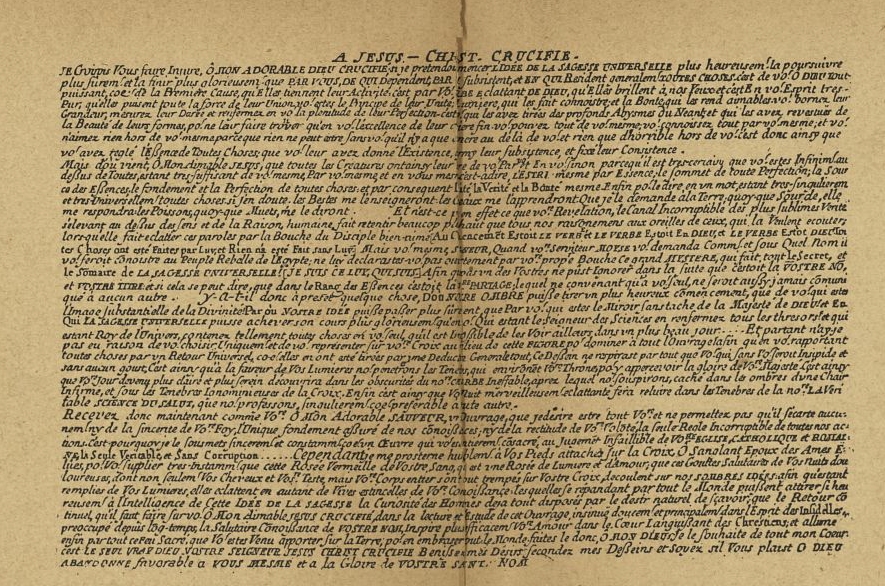
I. TO JESUS CHRIST CRUCIFIED
I would believe I was doing You an injury, O my ADOREABLE GOD CRUCIFIED, if I pretended to begin the IDEA OF UNIVERSAL WISDOM more happily, to pursue it more gloriously, or to finish it more securely than by You, IN WHOM all things subsist, and BY WHOM they generally render their homage. It is by Your dazzling rays that they shine before our eyes; it is in Your Spirit, O very Great God, that they measure their duration; it is in the plenitude of Your Perfection that they find the principle of their Union, the source of their Unity, the Light which makes them known, and the Goodness which makes them lovable.
You have drawn them from the profound Abysses of Nothingness and clothed them with being. You love nothing outside of Yourself, because nothing can exist that does not have its source in You; there is nothing but chimeras beyond Your will, nothing but horror outside of Your being. It is thus that You have filled the void of all things that You have given existence, affirmed their subsistence, and fixed their consistency.
But, O Adorable Jesus, if all creatures sing Your praises, it is in vain that they do so if I do not sing them. For it is very certain that You are infinitely above all things, being very sufficient by Yourself, in Yourself, and for Yourself—that is to say, BEING itself by Essence, the summit of all Perfection, the source of graces, the foundation and perfection of all things, and consequently Unity, Truth, and Goodness itself.
If I doubt this, the Beasts will teach it to me, the Birds will instruct me. If I ask the Earth, though deaf, she will answer me. The Fishes, though mute, will tell it to me. Does not Your Revelation, the incorruptible channel of the most sublime truths, make these words shine forth through the mouth of the Beloved Disciple: “In the beginning was the WORD, and the WORD was in GOD, and the WORD was GOD… All things were made by HIM, and without HIM was not any thing made that was made”?
But, O my God, when Your servant Moses asked You under what name You would make Yourself known to the rebellious people of Egypt, did You not declare to him openly with Your own mouth this great MYSTERY, which is the whole secret and sum of UNIVERSAL WISDOM: “I AM THAT I AM”? This was so that none of Yours could ignore in the future that this was Your proper Name and Title, which, if one may say so, in the Rank of Essences, is Your exclusive PARTAGE (inheritance), which belonging only to You, will never be communicated to any other.
How then could our SHADOW draw a more happy beginning, or a more substantial nourishment from the Divinity, than from You, who are the Faithful Mirror of the Majesty of GOD, by which UNIVERSAL WISDOM can finish its course more gloriously than in You, who, being the Lord of Sciences, enclose all its treasures? You who hold all things in Your hand, so that it is impossible to see them elsewhere in a brighter day.
And thus, have I not had reason to choose You uniquely to represent Yourself on Your Cross in the middle of this FIGURE, to dominate the whole work, so that in reporting all things to You by a Universal Return, just as they were drawn from You by a General Deduction, this Design might breathe nothing but You throughout? Without You, it would be insipid, without taste. It is thus that, by the favor of Your Lights, we penetrate the shadows that surround Your Throne, to perceive the glory of Your Justice. It is thus that the Day, becoming clearer and more serene, will discover in the obscurities of our night the INEFFABLE WORD after whom we sigh, hidden in the shadows of an infirm Flesh and under the ignominious darkness of the Cross.
Finally, it is thus that the Truth, shining marvelously, will make the true SCIENCE OF THE CROSS resplendent in the darkness of our night—a science we profess, singularly preferable to all others.
Receive, then, now, as Your Adorable SPOUSE, this Work which I dare to say is entirely Yours. Do not permit it to become the enemy of the sincerity of Faith (the unique foundation of our knowledge) nor of the rectitude of Your Will (the infallible rule of all our actions). This is why I submit it sincerely and constantly to a Work which is entirely consecrated to You, to the Infallible Judgment of Your CATHOLIC AND ROMAN CHURCH, the Only True and Uncorrupted one.
Meanwhile, I prostrate myself humbly at Your Feet, attached to the Cross, O Bleeding Spouse of Souls. I beg that this Vermilion Dew of Your Blood, which is a Rose of Light and Love, and these salutary Streams of Your Wounds—where not only our horses and our chariots, but our entire bodies are soaked—may flow upon our languages. May they be filled with Your Lights and shine forth as so many living sparks of Your Knowledge, which, spreading throughout the World, may happily attract the curiosity of men (already disposed by the natural desire to know) to the Intelligence of this IDEA OF WISDOM.
May the continual return that must be made to You, O Adorable JESUS CRUCIFIED, in the reading and study of this Work, gently insinuate itself principally into the spirit of the infidels, long preoccupied, to bring them to the Salutary Knowledge of Your NAME. May it inspire more effectively Love in the languishing hearts of Christians. Kindle the Sacred Fire that You came to bring upon the Earth, and set the whole World ablaze. Do it, O God, I beg it with all my heart. ABANDONED to Yourself and to the Glory of Your HOLY NAME, the ONLY TRUE GOD, my LORD JESUS CHRIST CRUCIFIED. Bless my designs, second my efforts, if it pleases You, O GOD.
*
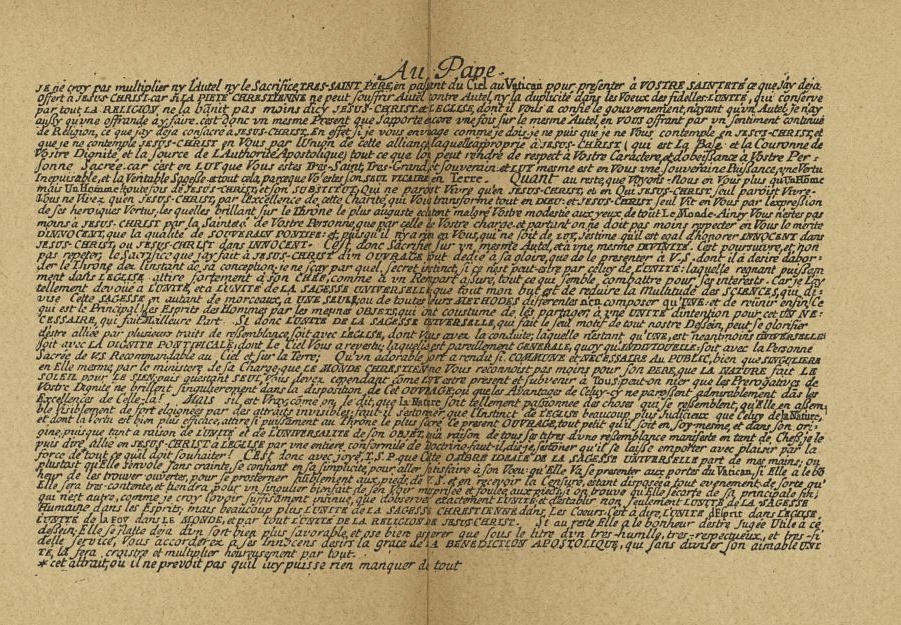
II. TO THE POPE (INNOCENT XI)
I do not think I multiply either the Altar or the most holy Sacrifice in passing from Heaven to the Vatican to present to YOUR HOLINESS what I have already offered to JESUS CHRIST. For CHRISTIAN PIETY cannot suffer Altar against Altar, nor duplicity in the Vows of the Faithful. The UNITY, which preserves Religion, does not banish it from here any more than from there. JESUS CHRIST and THE CHURCH, whose government He has confided to you, have but one Altar. I have not offered to Jesus Christ what I have not also consecrated to Jesus Christ.
In effect, if I regard you as I ought, I cannot contemplate JESUS CHRIST in You except by the Union of that alliance which appropriates to Jesus Christ (who is the Base and Crown of Religion) what I have already consecrated to Jesus Christ. If I regard you as I must, I can see in you only His SOLE VICAR on Earth. It is in HIM that You are Most Holy, Most Great, and Sovereign; and HE Himself is in You a Sovereign Power, a Virtue… [text gap] …but it is Jesus Christ shining on the throne… because you transform everything into GOD; and Jesus Christ alone lives in us by the expression of Jesus Christ, and in us Jesus Christ alone appears.
As for the rest, what do we see in You more than the Heroic Virtues, which, despite Your modesty, shine from Your Person in the eyes of the whole world? Thus, we do not honor Jesus Christ in You for the SOVEREIGN PONTIFF alone, but for that of Your charge; and consequently, one must not esteem it less. I judge that it is equal to honor INNOCENT in JESUS CHRIST, or JESUS CHRIST in INNOCENT. It is, therefore, to sacrifice on the same Altar, and to present it to Your Holiness, from whom it has desired, from the first instant of its conception, I know not by what secret instinct, if it is not perhaps by that of UNITY: which, reigning powerfully in the Church, attracts strongly to its Head, as to a sure Rampart, everything that seems to fight for its interests.
For I have devoted it entirely to UNITY, and to the UNITY OF UNIVERSAL WISDOM, so that all my goal is to reduce the multitude of SCIENCES, which dismember this WISDOM into so many pieces by all their different METHODS, to compose only ONE; and to finally reunite the NECESSARY, which makes the principal part elsewhere, into ONE. If therefore the WORK OF UNIVERSAL WISDOM, which is the sole motive of all our Design, can glorify itself by being allied by several traits of resemblance either with the CHURCH, of which You have the conduct (which, being only ONE, is nevertheless UNIVERSAL); or with the PONTIFICAL DIGNITY with which Heaven has vested You (which is similarly GENERAL, though INDIVIDUAL); or with Your Sacred Person, Recommendable to Heaven and Earth, whom an adorable force has rendered so COMMON and NECESSARY to the PUBLIC, although SINGULAR in Herself by the ministry of Her Charge, that the CHRISTIAN WORLD recognizes You no less as its FATHER than NATURE recognizes the SUN as its own—since, being ALONE, You rise however as a LIGHT present to all and succoring all—can one deny that the Prerogatives of Your Dignity shine singularly in the disposition of this WORK, or that the Advantages of the latter do not appear admirably in the Excellences of the former!
But if it is True, as they say, that Nature is so passionate for things that resemble each other, that she assembles by invisible attractions those even that are very distant—must one be astonished that the instinct of the CHURCH, much more Judicious than that of Nature, and whose Virtue is much more efficacious, attracts so powerfully to the most sacred Throne this present WORK, small as it is in itself and in its origin? Since, as much by reason of the UNITY and UNIVERSALITY of its OBJECT, as by reason of all the titles of a manifest resemblance in so many Heads, I dare say it goes to JESUS CHRIST and THE CHURCH by an entire conformity of Doctrine. Must one be astonished that it lets itself be carried with pleasure by the force of all that it ought to desire!
It is therefore with joy, Most Holy Father, that this IDEAL SHADOW OF UNIVERSAL WISDOM leaves my hands; or rather that it flies without fear, confiding in its simplicity, to go satisfy its Vow, that it may present itself at the gates of the Vatican. If it has the happiness to find them open, to prostrate itself humbly at Your Feet and receive Your Censure, being disposed to any event; so that it will be very content, and will hold for a singular benefit to be despised and trampled underfoot, if one finds that it strays from its principal end; which is no other, as I believe I have sufficiently insinuated, than to observe exactly the UNITY and to establish not only the UNITY OF HUMAN WISDOM in Minds; but much more the UNITY OF CHRISTIAN WISDOM in Hearts. That is to say, the UNITY of Spirit in Essences, the UNITY of Faith in the WORLD, and everywhere the UNITY OF THE RELIGION OF JESUS CHRIST.
If, moreover, it has the happiness to be Judged Useful to this design, it already flatters itself with a much more favorable outcome, and dares to hope that under the title of a very humble, very respectful, and very faithful servant, You will accord to its innocent desires the grace of the APOSTOLIC BLESSING, which, without dividing its amiable UNITY, will cause it to grow and multiply happily everywhere.
*
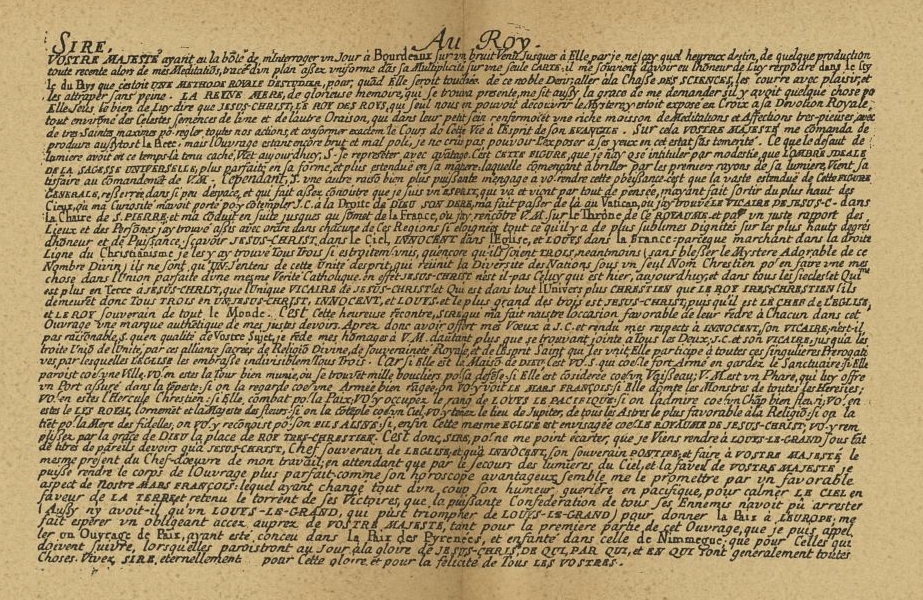
III. TO THE KING (LOUIS XIV)
SIRE,
YOUR MAJESTY having had the goodness to question me one day at Bordeaux concerning a rough draft of this plan, informed me that it would not be displeasing to You, and that You would be pleased to see some production of mine appear in the light of day. It is in obedience to this ROYAL ORDER that I dare, Sire, to present myself before You; it is for a single glance from Your eyes that I have labored day and night to respond to the command You have given me to put this work into print.
The Queen of Sheba came from the ends of the earth to hear the wisdom of Solomon; and Your Majesty, who is the Solomon of our age, has been pleased to discover in this poor work some ray of that celestial wisdom which illuminates the souls of Kings. It is this that emboldens me to offer it to You, not as a tribute worthy of Your greatness, but as a testimony of my profound respect and the ardent zeal with which I pray for the preservation of Your sacred person and the prosperity of Your glorious reign.
But, Sire, there is a higher reason that obliges me to make this offering to Your Majesty: it is the vast extent of Your States, where my curiosity has led me to contemplate, so to speak, the Right Hand of God. It is there that I have found, arranged in perfect order, each of these Regions. It is true that the quality of the most sublime Dignities on Your person, the honor and power that I know JESUS-CHRIST has in Heaven, INNOCENT in the Church, and LOUIS in France: marching in the straight Line of Christianity, I see them so closely united that, although they are THREE, nevertheless (without injuring the adorable Mystery of the Divine Number), they are but ONE. I speak of that unity of spirit which reunites the diversity of nations under a single Christian name to make of them one same thing in the perfect Union of one same Catholic Truth.
In effect, is not JESUS-CHRIST He who is yesterday, today, and in all ages? And who is more on Earth than the UNIQUE VICAR OF JESUS-CHRIST? And who is in the whole Universe more CHRISTIAN than the MOST CHRISTIAN KING? Let us therefore remain ALL THREE IN ONE: JESUS-CHRIST, INNOCENT, and LOUIS. And the greatest of the three is JESUS-CHRIST, since He is the HEAD of the Church, and the KING sovereign of the whole World.
It is this happy encounter, SIRE, which has given me the favorable occasion to render to Each in this Work an authentic mark of my just duties. After having therefore offered my Vows to J.C. and rendered my respects to INNOCENT, His VICAR, is it not reasonable that, in the quality of Your Subject, I should render my homage to YOUR MAJESTY, all the more since, finding Himself joined to Both (J.C. and His VICAR) up to the right hand of the Father by these sacred alliances of Divine Religion, Royal Sovereignty, and the Holy Spirit which unites Them, She participates in all those singular Prerogatives by which They embrace each other indivisibly, All Three.
For if She is the HOUSE OF GOD, it is YOU who are the Strong Armed Man guarding the Sanctuary. If She appears like a CITY, YOU are the well-fortified Place, where a thousand bucklers are found for Her defense. If She is considered as a VESSEL, YOUR MAJESTY is a PHAROS (Lighthouse) which offers Her a sure Port in the tempest. If one regards Her as an ARMY well ranged, one sees There the STARS OF FRANCE. If She tames the Monsters of all Heresies, YOU are the CHRISTIAN HERCULES. If She combats for PEACE, YOU occupy the rank of LOUIS THE PEACEMAKER. If one admires Her as a well-flourished Field, YOU are the ROYAL LILY, the ornament and glory of flowers. If one contemplates Her as a SKY, YOU hold the place of JUPITER, of all the Stars the most favorable to Religion. If one takes Her for the MOTHER of the faithful, one recognizes YOU there as Her ELDEST SON.
Finally, if this same CHURCH is envisaged as the KINGDOM OF JESUS-CHRIST, YOU replace there by the grace of God the place of KING JESUS-CHRIST. It is therefore, SIRE, so as not to stray at all, that I come to render to LOUIS-THE-GREAT today the same title of similar duties as to JESUS-CHRIST, Sovereign Head of the CHURCH, as to INNOCENT His Sovereign PONTIFF, and to make to YOUR MAJESTY the same present of the Masterpiece of my labor; waiting that, by the secours of the lights of Heaven and the favor of YOUR MAJESTY, I may be able to render the body of the Work more perfect—as its advantageous horoscope seems to promise me by a favorable aspect of our MARS FRANÇOIS (French Mars): who, having changed all at once his warlike humor into a pacific one, to calm the HEAVEN in favor of the EARTH, and retained the torrent of his Victories (which the powerful Confederation of all Enemies had not been able to arrest)—also, there was only a LOUIS-THE-GRAND who could triumph over LOUIS-THE-GRAND—to give Peace to EUROPE.
This makes me hope for an obliging access near YOUR MAJESTY, as much for the first part of this Work, which I may call a Work of Peace, having been conceived in the Peace of the Pyrenees, and brought forth in that of Nijmegen, as for those which must follow, when they appear to the Day to the glory of JESUS-CHRIST, OF WHOM, BY WHOM, AND IN WHOM are generally all Things.
Live, SIRE, eternally for this glory, and for the felicity of All YOURS.
*
THE IDEAL SHADOW OF UNIVERSAL WISDOM
Esprit Sabbathier, c. 1679
(English Translation Of Wellcome Ms. 4328)
PROEMIUM
Why do you linger in the Light, O spectator who stands here before this diagram? You who were about to penetrate the very thresholds of a more secret wisdom—why, old man, do you lift your foot so quickly to turn back? Does the unexpected meeting of this Shadow deter you from entering? Or does the unbelievable alliance—of Darkness with Light, of Wisdom with its own Shadow, as the Title reveals—hold your mind in suspense?
Behold: He who pitched His tent in the Sun has also prepared His hiding place in the Darkness. For indeed, from our awareness of our own limited clarity in this great undertaking, we have set the title you see—as if with the pupil of our eye—upon that attempt which we have tried to sketch in such a diagram. Thus we confess, on the very face of it, both the vastness of the subject and the narrowness of our promise.
Is the mind offended by the mixing of Christian Mysteries with Jewish ones under a foreign character? Is there some suspicion? Far from it. There lies a Sacrament, the faith of Religion, by which the sacred tradition of the Jews—no less than their secrets, called Kabbalah—is shown to agree with our mysteries in Christ.
For finally, this medley of figures, icons, and variegation of colours, this tangle of circles and revolving orbs, presents the appearance of a certain inextricable Labyrinth. The errors, windings, and evasions of which are great to behold, and they absorb the labour within; he fears to enter where he finds neither an entrance to penetrate nor an exit to return. Cast off fear: it is but a wall. Look at the Title; look at its Solomonic character. What is there to fear with Wisdom as your guide and Virtue as your companion?
Since Wisdom is one, she can do all things. If that is not enough, behold: united Virtue triumphs over all. For in Wisdom is the Spirit of one Intelligence for living; in Virtue, moreover, the effective Spirit of union for acting. Hence you have set forth, as the Egyptian in Wisdom, so the Palladium in Virtue. You, I say, the renowned firstborn of the Immaculate Pallas of Christ. From all the flowers of the World you have chosen for yourself one Lily as a symbol. But she, the contemplator of the one Truth, has taken the Pomegranate as her hieroglyphic type. And just as here a triad of unities, so there Unity crowns the Triad forever.
Is there, I ask you, any room for fear now? What would you fear beneath such great protections? Invoke Wisdom, invoke Virtue—understand that the Wisdom of God and the Virtue of God is Christ: Wisdom will lead you through pathless wonders; Virtue will form you with the helmet of salvation.
Go forward; against Egypt itself you will defend yourself with the sword of the Word. With Pallas inclined toward you, she herself will protect you with the Shield of Justice. Therefore be of good courage, and taking up spirit and hand, you proceed; do not hesitate to enter our Labyrinth—not with Ariadne, but with the Son of Christ’s Wisdom. He Himself will perfect your steps among His saints, so that your footprints may not be moved. Indeed, you will see and marvel in Him how light shines forth from darkness—not a vain light—and that this light shines along this way more easily and more safely than by many others, which the practised perceive as the path to the knowledge and science of truth.
Now, that we may put the matter to the test and give it credence, let us enter, if you please; and having first set forth my mind to You, and the plan and occasion of the work, with laurelled and swift step—as befits a concise and clear introduction—let us run through it at length, until our inquiring studies may dare a fuller explanation of things. Into the Ideal Shadow.
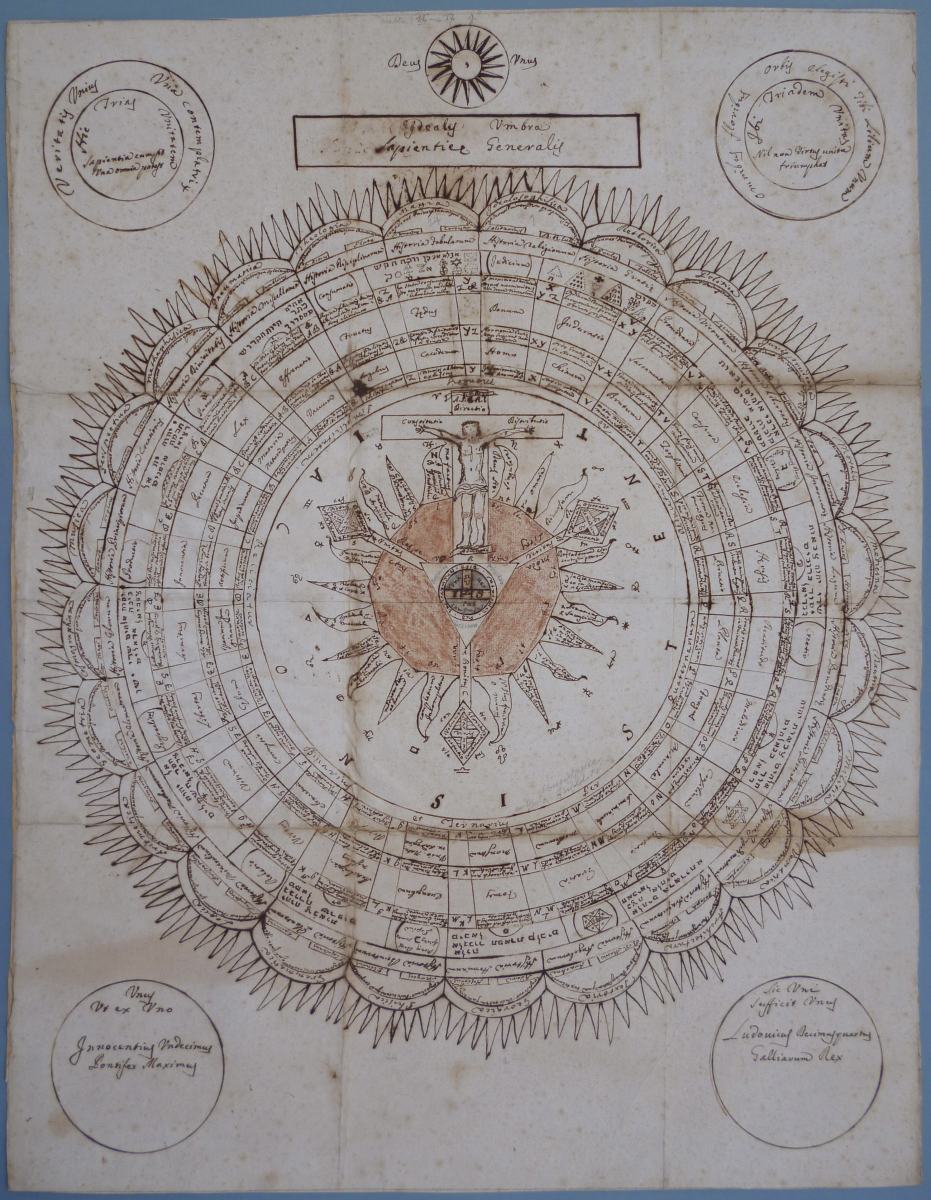
A Via-Hygeia Explanation of the Figure:
This central plate IS the visual summa of Sabbathier’s system. It is designed as a series of concentric rings emanating from a theological core, mapping the journey from Divine Unity (Center) to Created Diversity (Outer Rings).
I. The Four Corner Roundels (The Dedications)
These four circles anchor the diagram in the political and spiritual reality of 1679.
- Top Center: The Divine Sun. Deus Unus (One God). The source of all light and the origin of the system.
- Top Left: The Trinity. Veritas et Unitas (Truth and Unity). The theological foundation: ‘One God, Triune‘.
- Top Right: The Victory of Virtue. Orbis Elegit Triadem (The World Chooses the Trinity). A reference to the triumph of Catholic orthodoxy.
- Bottom Left: The Pope. Innocentius Undecimus Pontifex Maximus (Pope Innocent XI). Represents the Church Militant and spiritual authority.
- Bottom Right: The King. Ludovicus Decimusquartus Galliarum Rex (Louis XIV, King of France). Represents the Earthly Kingdom and temporal authority. The phrase Sic Uni Sufficit Unus (‘Thus One is Enough for One’) links the King directly to God.
II. The Center: The ‘Complicated’ Universe
The heart of the diagram represents the state of Complicata (Enfolded Unity), where all opposites are reconciled in Christ.
- The Crucified Christ: The axis of the universe. His body is divided into four functions:
- Head: Directio (Direction/Divine Will).
- Right Arm: Constitutio (Constitution/Order).
- Left Arm: Distributio (Distribution/Grace).
- Feet: Donatio (Donation/Gift).
- The Red Rose: Behind the cross, symbolizing Wisdom (Sapientia) blooming amidst the thorns of the world.
- The Triangle: The Trinity, grounding the sacrifice in divine nature.
- The Black Globe: Below the cross, labeled Chaos or Nox (Night). This is the Confusa (Confused) state—the primordial matter before illumination.
III. The Inner Rays: The ‘Explained’ Principles
Radiating from the center are rays of light that transition the viewer from the ‘Complicated‘ Christ to the ‘Explained‘ universe.
- The Letters A–M: These correspond to the Unities of Solitude (e.g., A: Immutabilitas, B: Majestas), the primary attributes of God listed in the text.
- The Four Elements: The rays pass through symbols for Fire, Air, Water, and Earth, showing how divine attributes manifest as physical elements.
IV. The Concentric Rings: The Cosmos Unfolded
Moving outward, the rings represent the Explicata (Explained) state—the diverse creation organized into categories.
- Ring 1 (Zodiac): The twelve signs (Aries, Taurus, etc.), representing time and the celestial influence on the sublunar world.
- Ring 2 (Kabbalistic Names): The Hebrew Names of God (e.g., YHWH, Elohim) and the Sephiroth. This layer asserts that the Jewish mystical structure underpins the Christian cosmos.
- Ring 3 (Angelic Hierarchies): The nine choirs of angels (Seraphim, Cherubim, etc.), who act as the governors of the spheres.
- Ring 4 (The Sciences): The outermost ring lists the various branches of human knowledge (Theology, Physics, Ethics, Mechanics), showing that all human study is ultimately part of this divine circle.
V. The Outer Spikes: The Solar Boundary
- The Sunburst Edge: The entire diagram is enclosed in a radiant sunburst. This signifies that the whole system is contained within the Divine Light. Nothing exists outside of God’s illumination.
How to Read the Diagram
Sabbathier intends the viewer to read the diagram in two directions:
- Centrifugal (Outward): From God (Center) → Christ → Elements → Zodiac → Sciences. This is the path of Creation (God unfolding into the world).
- Centripetal (Inward): From Sciences → Zodiac → Christ → God. This is the path of Return (The soul ascending through knowledge back to the Divine).
This visual structure perfectly mirrors the text’s promise: to lead the reader from the ‘Shadow‘ of the outer rings to the ‘Light‘ of the center.
*
A FORERUNNER’S INTRODUCTION
To the centre of the designing of this our general system I call you, O humane spectator; the mind, if you please, must be taken from the very border of the figure itself, with the great weight of its significations.
For nothing of what it contains falls silent therein; rather, everything speaks Kabbalistically—prepared from the beginning into the preface or even unto the end into the epilogue—so that the same hand, summoned with equal ease, may respond to both.
Therefore in this profound border we exhibit it as divided into the four parts of our whole world: namely the East, the West, the South, and the North. In the highest region, however, as if at the very peak of Light in the approach of the South, through the Sun—there is the medium and splendid origin of the simplest letters among the Hebrews, and also of the rest; and therefore a single Kabbalistic Divinity is wisely figured by them as an open symbol of Divinity.
But at the bottom, as in the North (its opposite), under the type of a venerable woman in pontifical vesture, in the midst of worshipping this Divinity, there is designated a single Church of the Trinity.
Then on the right, as if from the East, under the symbolic species of the Sun, the middle leader and one Truth.
Finally on the left, as if from the West, in a mirror grieving and abandoning, the middle image of truth as well—a single Science is represented.
Moreover, each of these four things, as the Prince in its own region and the standard-bearer of a certain kind, is seen surrounded by a retinue of insignia conformable to its own unities.
Divinity itself has some of these on the right and left—namely, Dignities, Prerogatives, etc. The God of Truth and of Science, one in His multiplicity, grants each condition of His celestial prerogatives as befits His unity; and by these all emblems are shadowed forth.
For as God lives and reigns in Unity, So the Celestial spirit carefully turns the universe. And as Truth is perfected in the Unity of Light, So from the unity of Truth a single Science perfectly coalesces.
Now the series of these most illustrious unities has embraced the high light, which in the House of Solitude—from meditative depth, sometimes of the Divine nature, sometimes by the disposition of the Divinity, especially with regard to unity—indeed, in that meditation He prepared for Himself the inaccessibility of His Light at midday—that is, in the highest fullness of His Divinity—the Habitation of the Solitude of Unity, so that, recognizing whatever species of Goods He might possess, He yet claims nothing for Himself except insofar as in Himself and in His Celestial house He dares to sustain anything only under the character of this Dignity. For just as She, although eminently all things, is so ONE by nature that nothing divine is outside Her, devoid of unity.
These Unities of Solitude are enumerated as follows: One Immutability, which is the highest necessity of being, transcending all; One Majesty, which in Conspicuous Glory rules over all; One Empire, which is the supreme Authority prevailing over the universe; One Virtue, which is marvellous omnipotence looking out for each thing; One Vigilance, which is a singular providence sufficing for itself and others; One Plenitude, which is infinity of every kind; One Argument, by which it makes the object adequate and universally presented; One Medium, which is the accurate definition of God to which one may gladly assent; One Disceptatress, which is right reason to be diligently heard; One Preceptor, who is wise in all things and whom the studious one should hold; One Order, which is a uniform method toward which one tends without end; and One Goal, which is the proper end.
From these, indeed—whether of the principal unities of the Universe, or, if you prefer, of the unities of Solitude—both expressed in their own symbols, as we know, they bear the figure of the border on the very edge. For that is how they decided to figure the work, and the occasion immediately—even by the seer himself, and the unknowing one—prefigured on the threshold.
Indeed, the consideration of these things brought it about that what seemed to tend to the greater Glory of Christ, of Students and of studies—by the Author Himself and by Light—might be established as a general specimen, shadowing forth the Ideal, the Sanctification, praise, and compendium of this general Discipline.
However these figures have been attempted, they might happily present the Universe to the eyes as a subject, for a pious, Catholic, and systematic design, as one wishes: and indeed in its threefold consideration, under which it seemed to be offered, namely: In Generality, which is Confused and Night; In Christ, which is Complicated and as it were Dawn; and In Light, which is Explained and Day.
In confusion, indeed, it knows by the inspection of things; there they lie hidden in chaos. In the complicated state, it dawns from our Faith as if the Aurora of knowledge. But in explanation, it produces from reason—which is this day, such as it is, ours.
Now of the Universe: The Confused state is the black globe in the navel of the figure, representing night. The Complicated state is the clear Image of Christ on the Cross, representing dawn. The Explained state is day, from the whole part of the system, representing the singular elements of nature, the other arts, the rules of Heraldry, and so forth.
These are marked with distinct colours, noted in the wind as Oriental (Blue/Black), Meridional (Red/Silver), Diagonal (Green/Gold), and Occidental (Purple). Of these, those that depict Heaven within themselves from the lower figure, but those that shine around from outside everywhere, are to be regarded from its centre, so that they may be distinguished from one another.
In its night, the darkness of the confused Universe must be deeply considered; and it presents nothing but the face of inaccessible darkness from every side. But in the day, by the excessive brilliance of its rays, it flees from mortals, or it dulls the sight of the explained Universe. Nor can eyes just emerging from the darkness of night suddenly bear the force of light unless, gradually accustomed to a gentler and more benign light, they are recreated and strengthened, so that they are able to endure it.
Come then, where is Christ on the Cross to be regarded under this word A.L.E.R.I.? For He is He by whom, through whom, and in whom are all things, even the treasures of wisdom and knowledge. He who holds the key of knowledge, who opens and no one closes; who closes and no one opens. Or rather, when the Universe itself is more attentively perceived in the Crucified Jesus as if in the Dawn of complication, here with His chest everywhere emerging from the middle, and surrounded by four points as if by hinges in the extremities of the same Crucified body, He will appear to promise this disposition, namely: In the Head, Direction; in the Right Hand, Unity Constitution; in the Left Hand, Distribution; and in the Feet, Donation.
Indeed, the Universe is present to the Reader as if in the centre of all complication. Direction is in the head of the Rulers as if in the Air of lights; for it is the true Light that illuminates every man coming into this world. Constitution is in the right hand, as if as many rays as there are fingers might constitute orders of reasons. Distribution is in the left hand, as if as many branches as there are joints, classes of things.
Finally, Donation is in the feet, which are joined by the nail, and the collection of the clearer digits, then by the tenfold type of the Binding of things into the unity of the establishing Prince; by these, when the reasons have slid away into the darkness, and the studious have flown away as far as they were permitted, the night would recede on both sides, and at last some Day of the Universe would shine forth.
And thus, not without reason for the believer in the Faith of Christ, suggesting reason in the investigation of things by its own light, as if by a solicitous Dawn, He made a beginning, so that the process of the Universe might be explored—a Catholic-Christian one—instituted at the four such cardinal points, as if by divine measure, striking as if conceived in the extended Body of Christ, measuring it to be unfolded, the regions of our system everywhere serve.
And itself:
First, Of the Direction of the Universe: Christ, namely the lights of God, Laws.
Second, The very image of suffering Christ, who through Himself is the one reason for the divination of the Universe.
Third, The rays shining forth from the far edge of the figure, in which from the symbols of the Laws, and then the laws or dogmas of Wisdom themselves, are read. But for enumerating these singly, a more convenient place will occur below.
Fourth, The Constitutions of the Universe from these five orders of reasons, namely: Hypostatic, Seminal, Informative, Actuating, Stative.
The following are designated, as many Principal figures.
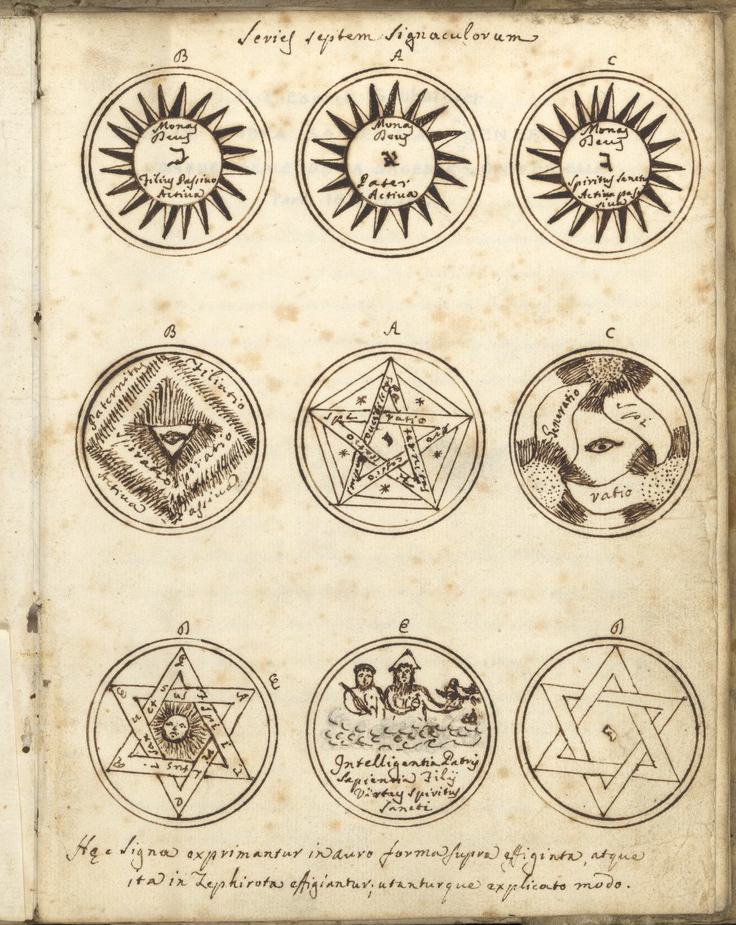
A Via-Hygeia explanation of the plate:
It displays the fundamental symbolic ‘alphabet‘ of Sabbathier’s system. The top two rows correspond to the Series septem Sigillorum (Series of Seven Sigils), representing the divine attributes and intellectual faculties. The bottom row adds specific seals for the Sephiroth and the Trinity.
Top Row: The Divine Triad & Elements
- Left (B): The Trinity in Unity.
- Inscription: Unus Deus | Trinus | Primus Principium (One God | Threefold | The First Beginning).
- Symbol: A sunburst containing the Hebrew letter Yod (י), the first letter of the Tetragrammaton, symbolizing the spark of divine origin.
- Center (A): The Active God.
- Inscription: Unus Deus | Pater | Aeternus (One God | Father | Eternal).
- Symbol: A sunburst containing the Hebrew letter He (ה), representing the breath or spirit of God.
- Right (C): The Holy Spirit.
- Inscription: Unus Deus | Spiritus Sanctus | Actio Prima (One God | Holy Spirit | First Action).
- Symbol: A sunburst containing the Hebrew letter Vav (ו), completing the name YHVH, symbolizing the connecting force.
Middle Row: The Intellectual Faculties
- Left (B): The Eye of Providence (Understanding).
- Inscription: Intellectus | Sapientia | Scientia (Understanding | Wisdom | Knowledge).
- Symbol: An eye within a triangle, surrounded by rays. This represents the divine mind perceiving all things simultaneously. It corresponds to the Sephirah Chokmah (Wisdom).
- Center (A): The Pentagram (Microcosm).
- Inscription: Salus | Lux | Vita (Salvation | Light | Life) – partially obscured.
- Symbol: A five-pointed star within a circle. This represents Man (the Microcosm) and the five wounds of Christ, serving as a protective seal against the ‘four parts of the world‘.
- Right (C): The Serpent of Wisdom (Reason).
- Inscription: Generatio | Filius | Ratio (Generation | Son | Reason).
- Symbol: A serpent biting its tail (Ouroboros) surrounding a face. This symbolizes eternal cyclical time and the divine reason (Logos) that orders the universe.
Bottom Row: The Sephiroth & The Trinity
- Left (D): The Seal of the Sephiroth.
- Symbol: A hexagram (Star of David) containing a sun with a face. The points are labeled with Hebrew letters corresponding to the seven planets and the seven days of creation. This is the operational key for the ‘Perpetual Calendar‘ aspect of the work.
- Center (E): The Seal of the Trinity (Baptismal).
- Inscription: Intelligentia Dei | Sapientia Filii | Spiritus Sanctus (Intelligence of God | Wisdom of the Son | Holy Spirit).
- Symbol: Depicts the Father (as an old man), the Son (as a lamb or child), and the Spirit (as a dove) together. This is the Christian ‘face‘ of the Kabbalistic triad.
- Right (F): The Seal of Unity.
- Symbol: A simple geometric hexagram. This represents the ‘Complicated‘ state—the union of opposites (fire/water, male/female) in perfect equilibrium, mirroring the Rebis of the alchemists.
*
THE FIVE PRINCIPAL FIGURES AND
THE DISTRIBUTION OF THE UNIVERSE
The Constitutions of the Universe arise from these five orders of reasons: Hypostatic, Seminal, Informative, Actuating, and Stative. The following are designated as the Principal Figures:
First, the earthy triangle near the connecting globe, in which the Hypostatic order of constituent reasons—there are three in number, namely: Activity, Passivity, and The Bond. These correspond to Jupiter, Fire, the Rebis, and the Twofold Mercury.
Second, the triple square of air, where the seminal order of constituent reasons resides. Here are four leaders, as it were princes and standard-bearers, and in its square three follow each leader—absolute and as many relative. Thus the square includes from outside an approach to ruin, and the principles of destruction, lying in wait, pursue the constitution.
Of all these reasons, their nature, economy, and order in respect and relation—a twofold series, namely threefold and eightfold—are displayed in the Table of Seminal Reasons. This table enumerates the Initial, Middle, and Final Reasons, ranging from Unity and Truth to Goodness, and extending through Power, Wisdom, Will, Virtue, Operation, and Glory, down to the malefic principles of Excess, Defect, and Contrariety.
Third, the airy dodecagon, in which the instructive order of constituent reasons—twelve intermediate ones, exhibiting the Zodiac, resting as if on two poles—are revolved. This is detailed in the Table of the Zodiacal Order, which aligns the signs from Aries to Pisces with their specific aspects: Light, Origin, Appearance, Matter, Form, End, Quantity, Quality, Time, Place, Modality, and Concord. These correspond to the Species of Logic, Physics, and Metaphysics.
Fourth, the fiery circle, in which the actual order of constituent reasons resides, which are essence, existence, and substance.
Fifth and finally, the Celestial Region, in which the stative order of constituent reasons is expanded into a sphere with a broader character, contained in a single one.
This leads to the Distribution of the Principalities of consistency, covering States, Conditions, Worlds, Histories, Disciplines, and Figures:
I. The circle above the face of the black Abyss, shining white from the shadowy one, where the most general Distribution of the Universe is into three most ample states of things, whatever there is: Being which is Supreme, Jesus Christ the Middle, and Existing thing the Lowest.
II. The sun in its own region of heaven, gilding, which contains in this series the general distribution of the Universe into the principal conditions of those states, deduced and combined from the instructive order of reasons. Indeed, the conditions of Being itself—which is God in His disc—are these: The Abyss of essentiality, Principle, Lord of Lords, Most abstract Spirituality, Most pure Act, Most peaceful Actuality, Infinity of every kind, Identity itself, Most stable Eternity, Immensity everywhere present, Most high Supernaturality, and Most Universal Singularity. These are set forth in the First Table of Conditions.
Second, the conditions of Christ, who is the Catholic Synod of things in the direct rays; and they are these: God made man; Of the Celestial Heaven and of the Earth, earthly; Image of God and Son of the Virgin; Word and Flesh; Existing in the form of God and receiving the form of a servant; Mediator of God and Men; Salvation of souls and the price of Redemption; Prophet of truth and King of Justice; Begotten before the ages and born in time; Manifest in Heaven and hidden in the Sacrament; Priest and Victim; and One and all things. These are detailed in the Second Table of Conditions.
Third, the conditions of being, which are the Creature in the medullary rays; they are these: Animals (Formal), Natural (Artificial), Imaginative (Tracking), Spiritual (Material), Substantial (Accidental), and Complete (Incomplete). These are shown in the Third Table of Conditions.
III. The simple and three-coloured sphere—green, red, and yellow—which presents the special distribution of the Universe: Intelligence in the Natural manner (Physical or Moral), Logical, or Divine Theological.
Of the spheres, the forces of the lowest—with black calyx—serve the principles of the natural world in triangles and outside the figure of all these, either as opposites or as defective; it enumerates. But they are of Nature: Principles and Opposites. The Table of Nature’s Principles lists Matter against Void, Form against Privation, Union against Division, Artifice against Impediment, Heaven against Imaginary space, and so forth through the Mineral, Plant, Animal, Man, and Angel, ending with the Evil demon.
The lower part of this sphere of the Natural World presents an Alphabet, and inscribed on it are physical effects of Nature to be read. The upper part of this sphere of the Moral World presents an Alphabet of moral effects of Customs. The highest part of this sphere of the Divine World presents an Alphabet of theological effects of God. These three parallel alphabets—from the unification of nature, honesty, and divinity, down to the point where, being hindered, they die—are displayed in the Table of the Three Alphabets, showing the perfect correspondence between the Physical, Moral, and Divine realms.
Thus far concerning the general distribution of the Universe, which consists in the three spheres—Natural, Moral, and Divine. Now we must speak of the particular distribution, which concerns the individual sciences and arts.
IV. The Order and Economy of the Principal Sciences, which are by the voice of each condition and species. All sciences are derived from those three spheres, as from three sources, and are distinguished into certain classes, according as they are considered to pertain to Nature, Morals, or Divinity.
*
THE ORDER OF THE SCIENCES
AND THE SOARING OF THE SPIRIT
The Order and Economy of the Principal Sciences are arranged by Voice, Condition, Object, and Species. Theology, with the voice of God and Divine condition, has the Highest Good as its object. Metaphysics, with the voice of Being, treats of Being as being. Physics, with the voice of Nature, treats of the movable body. Ethics, with the voice of Man, treats of the human end. Economics, Politics, Logic, Grammar, Rhetoric, Arithmetic, Music, Geometry, and Astronomy follow in order, each with its specific voice and object, as detailed in the Table of the Principal Sciences.
All these sciences are reduced to the quaternary, like the four parts of the world, the four seasons of the year, the four elements, the four humours, the four cardinal virtues. To this list we add Medicine, Jurisprudence, Chemistry, Mechanics, History, Poetry, Painting, Music (instrumental), and Sculpture. All these sciences and arts are comprehended under one glance in this table, so that the Reader may easily perceive how from one root of Universal Wisdom all branches are derived, and into how many various species they are dispersed.
But lest we dwell too long on each, for the greater compression of the work and the Reader’s utility, we add the following synoptic table, in which all sciences are comprehended under four general voices: GOD (Theology), NATURE (Physics), MAN (Ethics), and ART (Mechanics).
These four voices comprehend the whole circle of the sciences, and can be referred to the four cardinal points of the world, the four elements, the four humours, the four ages of man, the four cardinal virtues. GOD corresponds to the East, Fire, Blood, Childhood, Prudence. NATURE corresponds to the South, Air, Choler, Youth, Fortitude. MAN corresponds to the West, Water, Phlegm, Manhood, Temperance. ART corresponds to the North, Earth, Melancholy, Old Age, Justice. Thus all things in all things, and all things through all things, and all things for the sake of all things, tend to the one end of Universal Wisdom.
The Soaring of the Spirit to Raise Up Creatures
After having discussed the constitution, distribution, and economy of the sciences of the Universe, it remains to say a few words about the final end, which is the elevation of Creatures and their rest in God through Christ. For the ultimate end of all things is the glory of God and the beatitude of man, which consists in the vision and love of God. To this end all things are ordered, and from this end all things are derived.
Now creatures are raised to this end through the theological and moral virtues, which are as it were wings by which the soul is carried to heaven. The Theological Virtues are Faith, Hope, and Charity. The Cardinal Virtues are Prudence, Justice, Fortitude, and Temperance.
These are accompanied by the Seven Gifts of the Holy Spirit: Wisdom, Understanding, Counsel, Fortitude, Knowledge, Piety, and Fear of the Lord. These seven gifts, which the Holy Spirit pours into the souls of the faithful, render the virtuous life more perfect and prepare for divine contemplation.
To these are joined the Beatitudes: Poor in spirit, the meek, those who mourn, those who hunger and thirst for justice, the merciful, the pure of heart, the peacemakers, and those who suffer persecution. Likewise, the Works of Mercy, both corporal (to feed the hungry, to give drink to the thirsty, etc.) and spiritual (to admonish sinners, to instruct the doubtful, etc.), are as it were Jacob’s ladder, by which angels ascend and descend, and by which the soul is raised to heaven.
We must also consider the Capital Vices and their Remedies: Pride is cured by Humility, Avarice by Almsgiving, Lust by Chastity, Anger by Patience, Gluttony by Fasting, Envy by Charity, and Sloth by Diligence.
The ascent of the mind into God occurs through the degrees of contemplation. Just as Jacob saw in his sleep a ladder whose top touched heaven, and upon which the angels of God ascended and descended, so also the faithful soul ascends to God through certain degrees of contemplation.
In the first degree, the soul considers visible creatures. In the second, the providence of God. In the third, the Passion of Christ. In the fourth, sanctifying grace. In the fifth, the Sacraments. In the sixth, Prayer. In the seventh, it finally attains to pure Contemplation, in which it sees God face to face, and is transformed in His love. These stages are outlined in the Table of the Degrees of Contemplation.
Just as the soul ascends to God through contemplation, so also God descends to the soul through grace, and this mutual communication is true and perfect union.
The Seven Gifts of Grace—Sanctifying, Sacramental, Actual, Healing, Medicating, Cooperating, and Consummating grace—are distributed through the Sacraments, perfecting the soul and preparing it for union with God.
For the sacraments are sensible signs of invisible grace, and instruments by which God sanctifies the soul. Mystical union is the ultimate degree of perfection, in which the soul is so united with God that it becomes one spirit with Him.
*
THE MYSTICAL ROSE, THE CROSS, THE THREE KINGDOMS,
AND THE TWOFOLD TESTAMENT
On the Mystical Rose and the Lily of the Valleys
The mystical rose is a symbol of Wisdom, which flourishes among the thorns of the world and spreads a most sweet fragrance. The lily of the valleys is a symbol of purity and innocence, which flourishes in humility. The Red Rose signifies the Passion of Christ; the White Rose, the purity of Mary; the Golden Rose, the glory of the resurrection.
The White Lily signifies the purity of the soul. The Thorns of the rose signify tribulations, and the Sweetness of fragrance signifies spiritual delight.
These symbols frequently occur in our system, and are referred to the threefold consideration of the Universe: to the Confused, which is night and thorns; to the Complicated, which is dawn and the gem; to the Explained, which is day and the full flower.
The Cross is a symbol of passion and humility; the crown is a symbol of glory and victory. He who wishes to attain the crown must first bear the cross.
The image of the Crucified is placed in the middle of our system because Christ is the middle of all things and the end of all things. In His head is Direction, in His right hand Constitution, in His left hand Distribution, in His heart Donation, in His feet Perseverance. The specific virtues associated with each part of the Cross are detailed in the Table of the Symbolism of the Cross.
On the Scepters and Kingdoms
The scepter is a symbol of power and rule, which Christ holds as King of kings and Lord of lords. There are Three Kingdoms: The Kingdom of Heaven, ruled by God the Father with absolute power; The Kingdom of the Church, ruled by Christ the Son with the scepter of the cross; and The Kingdom of Nature, ruled by the Holy Spirit with the scepter of wisdom. In this threefold kingdom all things are contained, and all things are referred to one end, which is the glory of God and the salvation of souls.
On the Law and the Gospel
The old Law is a shadow of things to come; the Gospel is the body and the truth. The Law was given through Moses; grace and truth came through Jesus Christ. The Law is slavery, it fears, it works, it brings death; the Gospel is liberty, it loves, it believes, it brings life.
These comparisons are fully enumerated in the Table of the Comparison of Law and Gospel. These two testaments, the old and the new, constitute two parts in our system: the old pertains to the night of confusion, the new to the day of explanation; the middle is the dawn of the complicated state, in which Christ appeared in the flesh.
On the Prophets and Apostles
The Prophets are the eyes of the Church, who foresee the future; the Apostles are the feet, who ran to the ends of the earth. The Prophets preached Christ to come; the Apostles preached Christ having come. Isaiah predicted the Virgin birth; Peter preached Christ is God. Jeremiah predicted a new covenant; Paul preached Christ for all. And so on through the twelve, as shown in the Table of the Twelve Prophets and Apostles.
On Angels and Men
Angels are pure spirits, who always see the face of the Father. Men are spirits united to a body, who walk by faith and not by sight. The Nine Choirs of Angels are ranked from Seraphim (Divine love) down to Angels (Small messengers), each corresponding to a specific virtue. The Orders of Men range from Bishops (Shepherds) to Widows (Orphans), each with their specific office and virtue. These hierarchies are presented in the Table of Angelic Choirs and Orders of Men.
*
THE AGES OF THE WORLD AND OF MAN, THE ELEMENTS,
HUMOURS, PLANETS, AND ZODIAC
On the Ages of the World and the States of Men
The world has its ages, just as man has his states. The six days of creation signify the six ages of the world. From Adam to Noah is the Infant age; from Noah to Abraham, the Child; from Abraham to David, the Adolescent; from David to the exile, the Young man; from the exile to Christ, the Man; and from Christ to the end of the world, the Old man. Similarly, the ages of man run from Infancy (0–7 years) to Decrepitude (70+), each with its corresponding virtue and vice. These parallels are drawn in the Table of the Ages of the World and Man.
On the Elements and Humours
The four elements are the foundations of the natural world, and the four humours are the foundations of the human body. Earth is cold and dry (Melancholy); Water is cold and moist (Phlegm); Air is hot and moist (Blood); Fire is hot and dry (Choler). These correspond to the seasons: Spring (Air/Blood), Summer (Fire/Choler), Autumn (Earth/Melancholy), and Winter (Water/Phlegm).
The planets are as it were kings of heaven, who walk through the zodiac and send their influences to the earth. Saturn (Lead, Saturday) governs Patience; Jupiter (Tin, Thursday) governs Liberality; Mars (Iron, Tuesday) governs Fortitude; the Sun (Gold, Sunday) governs Brightness; Venus (Copper, Friday) governs Beauty; Mercury (Silver, Wednesday) governs Eloquence; and the Moon (Quicksilver, Monday) governs Changeableness.
The Twelve Signs of the Zodiac, from Aries to Pisces, are each assigned an element, quality, ruling house, virtue, and vice. Furthermore, precious stones and medicinal herbs are ordered under these planets: Sapphire and Mandrake for Saturn; Emerald and Balsam for Jupiter; Diamond and Wormwood for Mars; and so forth. All these cosmic correspondences are compiled in the Table of Cosmic Correspondences.
*
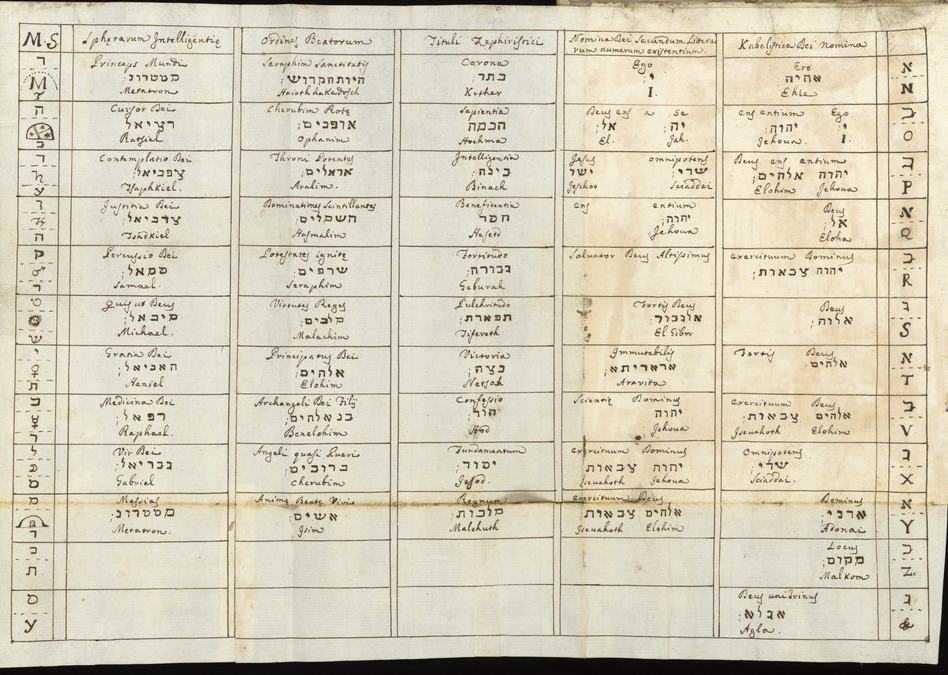
A Via-Hygeia explanation of the Figure: The Kabbalistic Table of the Sephiroth (Wellcome MS 4328)
This manuscript page presents a synoptic table correlating the Ten Sephiroth (divine emanations) with their corresponding Angelic Orders, Divine Names, and Hebrew letters. It serves as the ‘decoder key‘ for the outer rings of the main diagram, demonstrating how Jewish mysticism is mapped onto Christian theology.
The table is read from Top to Bottom, following the descent of divine energy from the highest spiritual realm to the physical world.
Column Headers (Left to Right):
- M.S. (Mundus Sephiraticus / Sephiroth): The number and name of the divine emanation.
- Sphaerarum Intelligentiae (Intelligences of the Spheres): The specific spiritual intelligence or angel associated with that sphere.
- Ordo Beatorum (Order of the Blessed): The corresponding choir of angels (e.g., Seraphim, Cherubim).
- Tituli Sephirotici (Titles of the Sephiroth): The Hebrew name of the emanation (e.g., Kether, Chokmah).
- Nomina Dei (Names of God): The specific name of God associated with that sphere (e.g., Ehyeh, YHWH).
- Kabbalistica Dei Nomina (Kabbalistic Names of God): Additional mystical names or permutations used in prayer and meditation.
The Ten Rows (The Descent of Light):
-
Row 1: Kether (The Crown)
- Attribute: The Primordial Point, the Will of God.
- Angels: Seraphim (The Burning Ones).
- Divine Name: Ehyeh (I Am That I Am).
- Significance: The highest point of the diagram, corresponding to the Primum Mobile (First Mover).
-
Row 2: Chokmah (Wisdom)
- Attribute: The Divine Father, pure creative energy.
- Angels: Cherubim (The Guardians).
- Divine Name: Yah (A shortened form of YHWH).
- Significance: Corresponds to the Zodiac, the realm of fixed stars.
-
Row 3: Binah (Understanding)
- Attribute: The Divine Mother, the womb of form.
- Angels: Thrones (The Seat of Judgment).
- Divine Name: YHWH Elohim (Lord God).
- Significance: Corresponds to Saturn, the limit and structure of time.
-
Row 4: Chesed (Mercy)
- Attribute: Divine Love and Expansion.
- Angels: Dominions (The Rulers).
- Divine Name: El (God).
- Significance: Corresponds to Jupiter, the planet of benevolence.
-
Row 5: Geburah (Severity/Strength)
- Attribute: Divine Justice and Restriction.
- Angels: Powers (The Warriors).
- Divine Name: Elohim Gibor (God the Strong).
- Significance: Corresponds to Mars, the planet of conflict and strength.
-
Row 6: Tiphareth (Beauty)
- Attribute: Harmony, Balance, and the Mediator.
- Angels: Virtues (The Miracle Workers).
- Divine Name: YHWH Eloah Va-Daath.
- Significance: The Center of the Diagram. This corresponds to the Sun and, crucially, to Jesus Christ. In Sabbathier’s system, Tiphareth is the ‘Complicated‘ state where God becomes Man.
-
Row 7: Netzach (Victory)
- Attribute: Endurance and Artistic Expression.
- Angels: Principalities (The Leaders).
- Divine Name: YHWH Tzabaoth (Lord of Hosts).
- Significance: Corresponds to Venus, the planet of love and art.
-
Row 8: Hod (Glory/Splendor)
- Attribute: Intellect and Communication.
- Angels: Archangels (The Messengers).
- Divine Name: Elohim Tzabaoth.
- Significance: Corresponds to Mercury, the planet of communication.
-
Row 9: Yesod (Foundation)
- Attribute: The Subconscious and the Moon.
- Angels: Angels (The Messengers to Earth).
- Divine Name: Shaddai Chai El (Almighty Living God).
- Significance: Corresponds to the Moon, the foundation of the physical world.
-
Row 10: Malkuth (Kingdom)
- Attribute: The Physical Earth, the final manifestation.
- Angels: Ishim (Souls of the Righteous).
- Divine Name: Adonai Melekh (The Lord King).
- Significance: The outermost ring of the diagram, representing the material world we inhabit.
This table is the proof of Sabbathier’s thesis. By aligning the Jewish Sephiroth with Christian Angelic Choirs and Planetary Spheres, he creates a ‘Universal Grammar‘ of spirituality. It allows the reader to look at the main diagram and know exactly which Name of God to invoke for which purpose, turning the abstract chart into a practical tool for prayer and contemplation.
*
NAMES OF GOD, CELESTIAL SPHERES, HELL, PURGATORY,
PARADISE, CHURCH, SACRAMENTS
On the Names of God and the Celestial Spheres
Here follow the Kabbalistic names of God, according to the number of letters, the orders of Angels, and the Spheres over which they preside:
The Tetragrammaton (4 letters) corresponds to the Primum Mobile and the Seraphim. Ehyeh (I AM) signifies Absolute Essence. El (3 letters) corresponds to Saturn and the Cherubim. Elohim (5 letters) to Jupiter and the Thrones. And so on through Adonai, YHWH Tsevaoth, Shaddai, up to the 10-letter name Ehyeh Asher Ehyeh. These are listed in the Table of the Kabbalistic Names of God.
Above the four spheres of the Elements (Fire, Air, Water, Earth) is the Azure Heaven, or the Stative Order, whose single constitutive reason is Consistency.
On Hell, Purgatory, and Paradise
There are three states of souls after death, which we shadow forth in this figure.
Hell is the place of eternal damnation, separated from the sight of God by an abyss, tormented by inextinguishable fire.
Purgatory is the place of expiation, where the souls of the just pass through the fire of testing, aided by the prayers of the faithful.
Paradise, or the Empyrean Heaven, is the place of the beatific vision, where the souls of the saints and the angels see God face to face, disposed in threefold order: Patriarchs, Prophets, Apostles; Martyrs, Confessors, Virgins; and all the elect.
On the Church Militant and Triumphant
The Militant Church is the congregation of the faithful on earth, fighting beneath the banner of the Cross. Its visible head is the Roman Pope.
The Triumphant Church is the congregation of the blessed in heaven, crowned by Christ Himself.
The Suffering Church (in Purgatory) stands midway between the two.
On the Seven Sacraments
The Seven Sacraments are instruments of grace, instituted by Christ our Lord. Baptism (Water) brings Regeneration. Confirmation (Chrism) brings Spiritual fortitude. Eucharist (Bread and Wine) brings Nourishment of the soul.
Penance brings Remission of sins. Extreme Unction brings Spiritual health. Holy Orders brings Ecclesiastical power. Matrimony brings Grace for raising children. Some imprint an indelible character; others do not. These are detailed in the Table of the Seven Sacraments.
*
THE BEATIFIC VISION, THE GIFTS OF THE SPIRIT,
CONTEMPLATION, AND FINAL EXHORTATION
On the Beatific Vision and the Degrees of Glory
After these seven sacraments, the faithful soul is elevated to the beatific vision, which is the ultimate end and beatitude of man. In this vision God is seen not through a mirror nor in an enigma, but face to face. This vision is accompanied by three gifts: Clear vision, Perfect love, and Eternal fruition. Glory, however, is not equal for all, but is distributed according to merit.
For as star differs from star in brightness, so also does the resurrection of the dead. Degrees of glory in the Empyrean Heaven are assigned to Patriarchs (by faith), Prophets (by hope), Apostles (by charity), Martyrs (by fortitude), Confessors (by prudence), Virgins (by temperance), and all saints (by justice).
On the Seven Gifts of the Holy Spirit
These seven gifts—Wisdom, Understanding, Counsel, Fortitude, Knowledge, Piety, and Fear of the Lord—are as it were Jacob’s ladder, by which the soul ascends to divine contemplation. They correspond to the virtues and have specific effects, such as delighting in God, penetrating mysteries, and directing actions rightly.
On the Degrees of Contemplation
Just as Jacob saw a ladder in his sleep, whose top touched heaven, so the faithful soul ascends to God through seven degrees of contemplation: Creation, Providence, Redemption, Justification, Sacraments, Prayer, and finally Contemplation itself. In the first degree the soul sees the traces of God in creatures; in the seventh, it attains to pure contemplation, seeing God face to face, and is transformed in His love.
Final Exhortation to the Reader
Draw near, therefore, O reader, to this Ideal Shadow not with disdain or the curiosity of the eye, but with humility and simplicity of heart.
If anything seems obscure, do not immediately reject it; for often beneath shadows lies the highest light.
Just as God pitched His tabernacle in the sun, so also does He hide Himself in darkness, so that those who seek may find, and to him who knocks it may be opened.
This figure is not a vain labyrinth, but a royal way to truth. Through these complications and explications, through these oppositions and defects, Christ Himself, who is the Wisdom and Virtue of God, will lead you to the Father.
But beware lest you fall into the vice of pride or curiosity. Without faith, prayer, and obedience, you will find nothing here.
Enter with simplicity, and you will see how from one all things, and all things return into one, and how in this system of a few pages the whole universal wisdom, both natural and supernatural, lies folded together and unfolded.
Remember the words of the Master: “Consider the lilies of the field, how they grow.” So also the lily of the Church, which is France, grows through unity under Christ the King, whose shadow is wisdom, and the shadow of wisdom is this ideal figure.
*
The Three Warnings
from The Ideal Shadow of Universal Wisdom
(Extracted from page 67 of Wellcome MS 4328)
(These are the final counsels given by the author
to the reader after completing the entire labyrinth of his system.
They form the concluding spiritual advice)
Warning I
First, take care that you do not take these symbols and figures for the things themselves. For they are shadows and images, not substantial truths. The shadow leads to the sun, but it is not the sun; the image refers to the archetype, but it is not the archetype.
Warning II
Second, do not stick in letters and numbers, but pass through them to the spirit. The letter kills, the spirit gives life. Numbers are a ladder, not the end; a way, not the homeland.
Warning III
Third, refer all things to Christ, who is the end of the law.
*
The Tables from
the Welcome Ms 4328
*
TABLE 1: THE THREEFOLD SERIES OF SEMINAL REASONS
(Corresponding to the ‘Triple Square of Air’ – The Seminal Order)
| 1. Initial Reasons | 2. Middle Reasons | 3. Final Reasons | Category of Objective Reasons |
|---|---|---|---|
| A. Unity (Unitas) | B. Truth (Veritas) | C. Goodness (Bonitas) | Objective |
| D. Power (Potestas) | E. Wisdom (Sapientia) | F. Will (Voluntas) | Potential |
| G. Virtue (Virtus) | H. Operation (Operatio) | I. Glory (Gloria) | Actual |
| K. Magnitude (Magnitudo) | L. Duration (Duratio) | M. Perfection (Perfectio) | Completive |
| N. Difference (Differentia) | O. Equality (Aequalitas) | P. Concord (Concordia) | Stative |
| Q. Principle (Principium) | R. Middle (Medium) | S. End (Finis) | Natural |
| T. Necessity (Necessitas) | U. Order (Ordo) | X. Harmony (Harmonia) | Law |
| Y. Excess (Excessus) | Z. Defect (Defectus) | &. Contrariety (Contrarietas) | Malefic |
*
TABLE 2: THE AIRY DODECAGON (ZODIACAL ORDER)
(Corresponding to the ‘Informative Order’ – The Twelve Signs)
| Sign | Symbol | Aspect | Letter | Type |
|---|---|---|---|---|
| 1. Aries | ♈ | Of Light (Luminis) | A | Hypostasis |
| 2. Taurus | ♉ | Of Origin (Originis) | C | Primitive |
| 3. Gemini | ♊ | Of Appearance (Apparentis) | E | Ideal |
| 4. Cancer | ♋ | Of Matter (Materialis) | G | Of Complexion |
| 5. Leo | ♌ | Of Form (Formalis) | I | Of Quantity |
| 6. Virgo | ♍ | Of End (Finalis) | L | Ultimate |
| 7. Libra | ♎ | Of Quantity (Quantitatis) | N | Continuous |
| 8. Scorpio | ♏ | Of Quality (Qualitatis) | O | Discrete |
| 9. Sagittarius | ♐ | Of Time (Temporalis) | P | Internal |
| 10. Capricorn | ♑ | Of Place (Localis) | Q | Intrinsic |
| 11. Aquarius | ♒ | Of Modality (Modalitatis) | R | Extrinsic |
| 12. Pisces | ♓ | Of Concord (Concordiae) | S | Essential |
(Marginal Note in MS: Species of Logic, Species of Physics, Species of Metaphysics)
*
TABLE 3: THE DISTRIBUTION OF STATES AND CONDITIONS
(The Three Ample States of the Universe)
A. Conditions of Being (God)
| Code | Condition |
|---|---|
| AB | Abyss of Essentiality |
| CD | Principle |
| EF | Lord of Lords |
| GH | Most Abstract Spirituality |
| IK | Most Pure Act |
| LM | Most Peaceful Actuality |
| NO | Infinity of Every Kind |
| PQ | Identity Itself |
| RS | Most Stable Eternity |
| TV | Immensity Everywhere Present |
| XY | Most High Supernaturality |
| Z& | Most Universal Singularity |
B. Conditions of Christ (The Mediator)
| Code | Condition |
|---|---|
| 1. AB | God Made Man |
| 2. CD | Of Celestial Heaven, and of the Earth, Earthly |
| 3. EF | Image of God, and Son of the Virgin |
| 4. GH | Word and Flesh |
| 5. IK | Existing in the Form of God, and Receiving the Form of a Servant |
| 6. LM | Mediator of God and Men |
| 7. NO | Salvation of Souls and the Price of Redemption |
| 8. PQ | Prophet of Truth, and King of Justice |
| 9. RS | Begotten Before the Ages, and Born in Time |
| 10. TV | Manifest in Heaven, and Hidden in the Sacrament |
| 11. XY | Priest and Victim |
| 12. Z& | One and All Things |
C. Conditions of the Creature (Being)
| Code | Pair 1 | Pair 2 |
|---|---|---|
| 1. AB | Animals | Formal |
| 2. CD | Natural | Artificial |
| 3. EF | Imaginative | Tracking |
| 4. GH | Spiritual | Material |
| 5. IK | Substantial | Accidental |
| 6. LM | Complete | Incomplete |
*
TABLE 4: NATURE’S PRINCIPLES AND OPPOSITES
(The Lower Sphere of the Natural World)
| No. | Principle | Opposite | Code |
|---|---|---|---|
| 1 | Matter (Passive Nature) | Void | N |
| 2 | Form (Active Nature) | Privation | O |
| 3 | Union (Nature of the Image) | Division | P |
| 4 | Artifice | Impediment | Q |
| 5 | Heaven | Imaginary Space | R |
| 6 | Element | Monster | S |
| 7 | Meteor | Monster | T |
| 8 | Mineral | Mineral Seed | V |
| 9 | Plant | Fungus | X |
| 10 | Brute Animal | Zoophyte | Y |
| 11 | Man | Chimera | Z |
| 12 | Angel | Evil Demon | & |
*
TABLE 5: THE THREE ALPHABETS (NATURAL, MORAL, DIVINE)
(Parallel Effects inscribed on the Spheres)
| Code | Natural World (Physical Effects) | Moral World (Effects of Customs) | Divine World (Effects of God) |
|---|---|---|---|
| A | Unification of the nature of things | Unification of honesty | Unification of divinity |
| B | Leaves no place to emptiness | Leaves no place to emptiness | Leaves no place to emptiness |
| C | Procures integrity for heaven | Procures integrity for heaven | Procures integrity for heaven |
| D | The power of nature is strong | The power of customs is strong | The power of divinity is strong |
| E | Taught magically, it fascinates | Taught morally, it fascinates | Taught theologically, it fascinates |
| F | Love even unto the Universe | Love even unto Virtue | Love even unto God |
| G | Flourishes with innate virtue | Flourishes with innate virtue | Flourishes with innate virtue |
| H | Knows no idleness at all | Knows no idleness at all | Knows no idleness at all |
| I | Crowns the end with delights | Crowns the end with delights | Crowns the end with delights |
| K | The Creator encompasses the extremity | Morality encompasses the extremity | Divinity encompasses the extremity |
| L | The perpetual unity of eternity | The perpetual unity of eternity | The perpetual unity of eternity |
| M | The order of works of perfection | The order of works of perfection | The order of works of perfection |
| N | In different things (esp. Principles) | In different things (esp. Virtues) | In different things (esp. Attributes) |
| O | Equal to all in small measure | Equal to all in small measure | Equal to all in small measure |
| P | Everywhere conformable to itself | Everywhere conformable to itself | Everywhere conformable to itself |
| Q | Its beginning is affected by darkness | Its beginning is affected by darkness | Its beginning is affected by darkness |
| R | Proceeds from the middle to shorter things | Proceeds from the middle to shorter things | Proceeds from the middle to shorter things |
| S | By propitious winds to the end | By propitious winds to the end | By propitious winds to the end |
| T | By necessary, not violent, motion | By necessary, not violent, motion | By necessary, not violent, motion |
| V | Stands in its own order | Stands in its own order | Stands in its own order |
| X | Begets harmony of lower things | Begets harmony of lower things | Begets harmony of lower things |
| Y | Abhors vicious excesses | Abhors vicious excesses | Abhors vicious excesses |
| Z | Suffers defects in Life | Suffers defects in Life | Suffers defects in Life |
| & | Where hindered, there it dies | Where hindered, there it dies | Where hindered, there it dies |
*
TABLE 6: THE ORDER AND ECONOMY
OF THE PRINCIPAL SCIENCES
(Derived from the Three Spheres: Divine, Natural, Moral)
| Science | Voice | Condition | Object | Species |
|---|---|---|---|---|
| Theology | God | Divine | The Highest Good | Natural, Revealed, Mystical |
| Metaphysics | Being | Transcendental | Being as Being | Ontology, Cosmology, Psychology |
| Physics | Nature | Natural | Movable Body | Astronomy, Astrology, Meteorology, Geology |
| Ethics | Man | Moral | Human End | Virtue, Vice, Passion, Affection |
| Economics | Family | Economic | Domestic Good | Father, Wife, Children, Servants |
| Politics | State | Political | Common Good | Monarchy, Aristocracy, Democracy |
| Logic | Reason | Instrumental | Truth | Dialectics, Analytics, Topics, Sophistics |
| Grammar | Speech | Formal | To Speak Correctly | Orthography, Prosody, Syntax, Etymology |
| Rhetoric | Persuasion | Ornate | To Move | Invention, Disposition, Elocution, Action, Memory |
| Arithmetic | Number | Quantitative | Discrete Quantity | Practical, Theoretical, Speculative |
| Music | Harmony | Proportional | Sound | Harmonics, Rhythmics, Metrics |
| Geometry | Magnitude | Continuous | Figure | Planimetry, Stereometry, Geodesy |
| Astronomy | Sphere | Celestial | Celestial Motion | Theoretical, Practical, Judicial |
(Additional Arts & Sciences) | Medicine | Health | Curative | Human Body | Physiology, Pathology, Therapeutics | | Jurisprudence | Justice | Legal | Common Good | Natural, Civil, Canon, International Law | | Chemistry | Matter | Transmutative | Compound | Spagyric, Iatrochemistry, Alchemy | | Mechanics | Machine | Artificial | Local Motion | Architecture, Military, Naval, Rural | | History | Deed | Narrative | Things Done | Sacred, Profane, Natural, Civil | | Poetry | Fiction | Imitative | Nature of Things | Epic, Lyric, Dramatic, Bucolic | | Painting | Image | Representative | The Visible | Historical, Allegorical, Anagogical | | Sculpture | Form | Plastic | Hard Material | Statuary, Glyptics, Numismatics |
*
TABLE 7: SYNOPSIS OF THE FOUR VOICES
(The Whole Circle of Sciences Reduced to Quaternary)
| General Voice | Science | Object | Condition | Correspondences |
|---|---|---|---|---|
| GOD | Theology | The Highest Good | Divine | East, Fire, Blood, Childhood, Prudence |
| NATURE | Physics | Movable Body | Natural | South, Air, Choler, Youth, Fortitude |
| MAN | Ethics | Human End | Moral | West, Water, Phlegm, Manhood, Temperance |
| ART | Mechanics | Local Motion | Artificial | North, Earth, Melancholy, Old Age, Justice |
*
TABLE 8: VIRTUES, GIFTS,
AND BEATITUDES
(The Ascent of the Spirit)
A. Theological & Cardinal Virtues
| Virtue | Object | Act | Opposite |
|---|---|---|---|
| Faith | First Truth | To Believe | Infidelity, Heresy, Apostasy |
| Hope | Future Good | To Await | Despair, Presumption |
| Charity | God (Highest Good) | To Love | Hatred, Sloth, Envy |
| Prudence | Common Good | To Counsel Rightly | Imprudence, Negligence |
| Justice | The Right of Another | To Render What is Due | Injury, Iniquity |
| Fortitude | Arduous Good | To Face Dangers | Fear, Rashness |
| Temperance | Delights of Touch | To Restrain Concupiscence | Intemperance, Dissoluteness |
B. The Seven Gifts of the Holy Spirit
| Gift | Corresponding Virtue | Effect | Opposite |
|---|---|---|---|
| Wisdom | Charity | To Delight in God | Carnal Foolishness |
| Understanding | Faith | To Understand Mysteries | Blindness of Mind |
| Counsel | Prudence | To Direct Rightly | Inconstancy |
| Fortitude | Fortitude | To Act Constantly | Fear |
| Knowledge | Faith | To Judge Concerning Creatures | Ignorance |
| Piety | Justice | To Love God and Neighbor | Impiety |
| Fear of the Lord | Hope | To Be Humbly Subject | Pride |
C. The Beatitudes
| Beatitude | Promise | Virtue | Gift |
|---|---|---|---|
| Poor in Spirit | Kingdom of Heaven | Humility | Fear of the Lord |
| The Meek | Possess the Earth | Meekness | Piety |
| Those Who Mourn | Shall Be Comforted | Penitence | Knowledge |
| Hunger/Thirst for Justice | Shall Be Filled | Justice | Counsel |
| The Merciful | Shall Obtain Mercy | Mercy | Fortitude |
| Pure of Heart | Shall See God | Chastity | Understanding |
| The Peacemakers | Called Children of God | Peace | Wisdom |
| Persecuted for Justice | Kingdom of Heaven | Patience | Fortitude |
*
TABLE 9: THE DEGREES OF CONTEMPLATION
& GIFTS OF GRACE
(The Ascent and Descent)
A. The Seven Degrees of Contemplation
| Degree | Name | Object | Effect |
|---|---|---|---|
| 1 | Creation | Visible Creatures | Beginning of Wonder |
| 2 | Providence | Governance of Things | Thanksgiving |
| 3 | Redemption | Passion of Christ | Compunction |
| 4 | Justification | Sanctifying Grace | Hope |
| 5 | Sacraments | Means of Grace | Devotion |
| 6 | Prayer | Conversation with God | Affective Union |
| 7 | Contemplation | God in Himself | Transforming Union |
B. The Seven Gifts of Grace (via Sacraments)
| Gift | Effect | Corresponding Sacrament |
|---|---|---|
| Sanctifying Grace | Justification | Baptism |
| Sacramental Grace | Increase of Virtues | Confirmation |
| Actual Grace | Good Work | Eucharist |
| Healing Grace | Remission of Sins | Penance |
| Medicating Grace | Against Remaining Sins | Extreme Unction |
| Cooperating Grace | Good to Be Perfected | Holy Orders |
| Consummating Grace | Final Glory | Matrimony |
*
TABLE 10: SYMBOLISM OF THE ROSE,
LILY, AND CROSS
(The Mystical Figures)
A. The Rose and Lily
| Symbol | Meaning | Virtue | Degree |
|---|---|---|---|
| Red Rose | Passion of Christ | Charity | Perfection |
| White Rose | Purity of Mary | Chastity | Innocence |
| Golden Rose | Glory of Resurrection | Hope | Blessedness |
| White Lily | Purity of the Soul | Humility | Contemplation |
| Thorns of the Rose | Tribulations | Patience | Trials |
| Sweetness of Fragrance | Spiritual Delight | Devotion | Union |
B. The Cross
| Part of Cross | Meaning | Virtue | Opposite |
|---|---|---|---|
| Head | Divine Direction | Prudence | Blindness |
| Right Arm | Good Work | Justice | Iniquity |
| Left Arm | Patience of Evils | Fortitude | Fear |
| Body | Chastity of Heart | Temperance | Lust |
| Feet | Perseverance | Constancy | Sloth |
*
TABLE 11: THE THREE KINGDOMS
& TESTAMENTS
(Political and Covenantal Structure)
A. The Three Kingdoms
| Kingdom | King | Scepter | Subjects |
|---|---|---|---|
| Of Heaven | God the Father | Absolute Power | Angels and the Blessed |
| Of the Church | Christ the Son | Scepter of the Cross | The Faithful and Elect |
| Of Nature | Holy Spirit | Scepter of Wisdom | All Creatures |
B. Comparison of Law and Gospel
| The Old Law | The Gospel |
|---|---|
| Shadow | Body |
| Slavery | Liberty |
| It Fears | It Loves |
| It Works | It Believes |
| One’s Own Righteousness | Another’s Righteousness |
| Curse | Blessing |
| Death | Life |
| The Letter Killing | The Spirit Giving Life |
| Ministry of Death | Ministry of the Spirit |
| Stone Tablets | Law Written on Hearts |
| Aaronitic Priesthood | Priesthood of Christ |
| Sacrifices of Animals | Sacrifice of the Body of Christ |
| Circumcision of Flesh | Circumcision of Heart |
*
TABLE 12: PROPHETS, APOSTLES,
AND ANGELIC CHOIRS
(The Hierarchy of Messengers)
A. The Twelve Prophets and Apostles
| Prophet | Prediction | Apostle | Preaching |
|---|---|---|---|
| Isaiah | A Virgin Shall Bear | Peter | Christ is God |
| Jeremiah | A New Covenant | Paul | Christ for All |
| Ezekiel | The Closed Gate | John | Christ is the Word |
| Daniel | The Son of Man | James | Christ is Justice |
| Hosea | Mercy | Andrew | Christ is the Cross |
| Joel | The Spirit Poured Out | Philip | Christ is Bread |
| Amos | The Burden of the Seer | Bartholomew | Christ is Truth |
| Obadiah | Pride Humbled | Matthew | Christ is the Physician |
| Jonah | Resurrection | Thomas | Christ is Wounds |
| Micah | Bethlehem | Simon | Christ is Zeal |
| Nahum | Vengeance | Jude | Christ is Brother |
| Habakkuk | The Just Shall Live by Faith | Matthias | Christ is the Lot |
B. The Nine Choirs of Angels
| Choir | Office | Corresponding Virtue |
|---|---|---|
| 1. Seraphim | Divine Love | Charity |
| 2. Cherubim | Divine Knowledge | Faith |
| 3. Thrones | Submission | Hope |
| 4. Dominations | Rule | Prudence |
| 5. Powers | Power | Fortitude |
| 6. Virtues | Working of Miracles | Justice |
| 7. Principalities | Leadership | Temperance |
| 8. Archangels | Great Messengers | Humility |
| 9. Angels | Small Messengers | Obedience |
C. The Orders of Men
| Order | Condition | Office | Virtue |
|---|---|---|---|
| Bishops | Shepherds | To Teach and Rule | Prudence |
| Priests | Cooperators | Administer Sacraments | Justice |
| Deacons | Ministers | Serve the Poor | Fortitude |
| Monks | Contemplatives | Pray and Fast | Temperance |
| Laity | Active | Work in the World | Charity |
| Married | Domestic | Educate Children | Hope |
| Widows | Orphans | Suffer Patiently | Faith |
*
TABLE 13: COSMIC CORRESPONDENCES
(AGES, ELEMENTS, PLANETS)
(The Natural World Ordered)
TABLE 13: COSMIC CORRESPONDENCES (AGES, ELEMENTS, PLANETS)
(The Natural World Ordered)
A. Ages of the World and Man
| Age of World | Time | Event | Age of Man | Virtue | Vice |
|---|---|---|---|---|---|
| 1. Adam to Noah | Creation/Sin | Infant | Infancy (0–7) | Innocence | Ignorance |
| 2. Noah to Abraham | Flood/Restoration | Child | Childhood (7–14) | Teachableness | Lightness |
| 3. Abraham to David | Election/Promise | Adolescent | Adolescence (14–21) | Fortitude | Rashness |
| 4. David to Exile | Kingdom/Priesthood | Young Man | Youth (21–35) | Industry | Lust |
| 5. Exile to Christ | Expectation/Silence | Man | Manhood (35–50) | Prudence | Avarice |
| 6. Christ to End | Redemption/Judgment | Old Man | Old Age (50–70) | Wisdom | Sloth |
| Decrepitude (70+) | Patience | Despair |
B. Elements, Humours, and Seasons
| Element | Quality | Humour | Season | Labour | Fruit |
|---|---|---|---|---|---|
| Earth | Cold/Dry | Melancholy | Autumn | To Gather | Thanksgiving |
| Water | Cold/Moist | Phlegm | Winter | To Rest | Compunction |
| Air | Hot/Moist | Blood | Spring | To Sow | Hope |
| Fire | Hot/Dry | Choler | Summer | To Reap | Joy |
C. The Seven Planets
| Planet | Metal | Day | Virtue | Vice |
|---|---|---|---|---|
| Saturn | Lead | Saturday | Patience | Avarice |
| Jupiter | Tin | Thursday | Liberality | Prodigality |
| Mars | Iron | Tuesday | Fortitude | Cruelty |
| Sun | Gold | Sunday | Brightness | Pride |
| Venus | Copper | Friday | Beauty | Lust |
| Mercury | Silver | Wednesday | Eloquence | Fraud |
| Moon | Quicksilver | Monday | Changeableness | Inconstancy |
D. The Zodiac
| Sign | Element | Quality | House | Virtue | Vice |
|---|---|---|---|---|---|
| Aries ♈ | Fire | Cardinal | Mars | Boldness | Rashness |
| Taurus ♉ | Earth | Fixed | Venus | Constancy | Obstinacy |
| Gemini ♊ | Air | Mutable | Mercury | Eloquence | Garrulousness |
| Cancer ♋ | Water | Cardinal | Moon | Imagination | Fear |
| Leo ♌ | Fire | Fixed | Sun | Magnanimity | Pride |
| Virgo ♍ | Earth | Mutable | Mercury | Diligence | Scrupulosity |
| Libra ♎ | Air | Cardinal | Venus | Justice | Partiality |
| Scorpio ♏ | Water | Fixed | Mars | Fortitude | Cruelty |
| Sagittarius ♐ | Fire | Mutable | Jupiter | Liberality | Prodigality |
| Capricorn ♑ | Earth | Cardinal | Saturn | Prudence | Avarice |
| Aquarius ♒ | Air | Fixed | Saturn | Wisdom | Melancholy |
| Pisces ♓ | Water | Mutable | Jupiter | Piety | Credulity |
E. Precious Stones and Herbs
| Planet | Stone | Herb | Virtue |
|---|---|---|---|
| Saturn | Sapphire | Mandrake | Cure Melancholy |
| Jupiter | Emerald | Balsam | Pain of the Liver |
| Mars | Diamond | Wormwood | Burning Fever |
| Sun | Chrysolite | Rosemary | Weakness of Heart |
| Venus | Hyacinth | Violets | Pain of the Head |
| Mercury | Agate | Mercury-herb | Pain of the Limbs |
| Moon | Pearl | Endive | Weakness of Eyes |
*
TABLE 14: NAMES OF GOD
AND SACRAMENTS
(The Divine Names and Instruments of Grace)
A. Kabbalistic Names of God
| Letters | Name of God | Sphere | Choir of Angels | Meaning |
|---|---|---|---|---|
| 4 | YHWH (Tetragrammaton) | Primum Mobile | Seraphim | Absolute Essence |
| 4 | Ehyeh (I AM) | — | — | I Am Who I Am |
| 3 | El | Saturn | Cherubim | Strength |
| 3 | Jah | — | — | Eternity |
| 5 | Elohim | Jupiter | Thrones | Power of Judgment |
| 5 | Adonai | — | — | Lord |
| 6 | YHWH Tsevaoth | Mars | Dominations | Lord of Hosts |
| 6 | Elohi Tsevaoth | Sun | Virtues | God of Hosts |
| 7 | Shaddai | Venus | Powers | Almighty |
| 8 | YHWH Elohim | Mercury | Principalities | Lord God |
| 9 | Tsevaoth [MS incomplete] | Moon | Archangels | Hosts |
| 10 | Ehyeh Asher Ehyeh | — | Angels | I Will Be Who I Will Be |
B. The Seven Sacraments
| Sacrament | Visible Thing | Invisible Grace | Character |
|---|---|---|---|
| Baptism | Water | Regeneration | Indelible Character Imprinted |
| Confirmation | Chrism | Spiritual Fortitude | Indelible Character |
| Eucharist | Bread and Wine | Nourishment of Soul | No Character Imprinted |
| Penance | Contrition/Absolution | Remission of Sins | No Character Imprinted |
| Extreme Unction | Oil of the Sick | Spiritual Health | No Character Imprinted |
| Holy Orders | Imposition of Hands | Ecclesiastical Power | Indelible Character |
| Matrimony | Mutual Consent | Grace for Raising Children | No Character Imprinted |
*
LEXICON OF KEY TERMS
AND CONCEPTS
A Guide to the Vocabulary of Esprit Sabbathier
A.L.E.R.I.: An acronym or mystical word associated with the Crucified Christ in the center of the diagram. It likely stands for the five wounds or the five functions of Christ in the system: Adoratio (Adoration), Lumen (Light), Explicatio (Unfolding), Redemptio (Redemption), Intelligentia (Intelligence). In the text, it marks the point where the universe is perceived in its ‘Complicated‘ (unified) state.
Archetype (Archetypum):The original, perfect model in the mind of God of which all created things are shadows or copies. Sabbathier warns the reader not to mistake the symbols (the shadow) for the Archetype (the reality).
Complicated / Complicata (From Latin cum-plicare, ‘to fold together’.): A central Neoplatonic and Cusanian concept. It refers to the state where all truths, distinctions, and multiplicities are enfolded into a single unity. In Sabbathier’s system, Christ on the Cross represents the ‘Complicated‘ state—the dawn where all opposites are reconciled in one body. It is the middle state between Chaos and Order.
Confused / Confusa: The state of primordial chaos or ‘Night’. It is not ‘confused‘ in the sense of being muddled, but in the sense of being fused together (con-fusa) without distinction. It is the black globe in the center of the diagram, representing the universe before it is illuminated by reason and faith.
Explained / Explicata (From Latin ex-plicare, ‘to unfold’.): The state of ‘Day‘ or full manifestation. It is the process where the unified truths of the ‘Complicated‘ state are unfolded into the diversity of creation: the specific sciences, arts, virtues, and natural phenomena. The outer rings of the diagram represent the ‘Explained‘ universe.
The Four Voices (Quatuor Voces): Sabbathier’s classification of all knowledge into four categories, corresponding to the four cardinal points:
- GOD (Deus): Theology (Divine).
- NATURE (Natura): Physics (Natural).
- MAN (Homo): Ethics (Moral).
- ART (Ars): Mechanics (Artificial).
Ideal Shadow (Idealis Umbra): The title concept. For Sabbathier, the material world is a shadow of the ideal world, and the ideal world is a shadow of God. His diagram is therefore a ‘shadow of a shadow‘—a human attempt to map the divine. It is ‘Ideal’ because it points toward the perfect forms, even if it cannot fully contain them.
Kabbalah (Kabbala): The Jewish mystical tradition of interpreting the Hebrew Scriptures through the hidden meanings of letters and numbers. Sabbathier practices Christian Kabbalah, asserting that the Sephiroth (divine emanations) and the Names of God ultimately reveal the Christian mysteries of the Trinity and the Incarnation.
Labyrinth (Labyrinthus): A metaphor for the work itself and the universe. Unlike the myth of Ariadne (who used a thread to escape), Sabbathier invites the reader to enter the labyrinth with Christ (the Son of Wisdom) as the guide. The goal is not to escape, but to find the center (God) and be transformed.
Names of God (Nomina Dei): The various Hebrew names of God (e.g., YHWH, Elohim, Adonai, Shaddai), each corresponding to a specific attribute, planetary sphere, and angelic choir. In the tables, these names act as ‘keys‘ to access different levels of reality.
Rebis (Latin for ‘Double Thing’.): An alchemical term referring to the union of opposites (Sun/Moon, King/Queen, Male/Female). In Sabbathier’s ‘Earthy Triangle‘, it symbolizes the harmonious bond between Activity and Passivity, ultimately prefiguring the union of Divine and Human natures in Christ.
Seminal Reasons (Rationes Seminales): A Stoic and Scholastic concept referring to the ‘seed-like‘ principles placed by God in creation, which contain the potential for all future development. In Sabbathier’s ‘Triple Square of Air‘, these reasons are the blueprints from which the physical world grows.
Sephiroth (Sephiruth): The ten emanations or attributes through which the Infinite (God) reveals Himself and creates the universe in Kabbalah. Sabbathier correlates these with the Christian hierarchy of angels and the planets (e.g., Kether with the Primum Mobile, Chokmah with the Zodiac).
Three States of the Universe: The tripartite structure of Sabbathier’s system:
- Confused (Night): The chaotic potential of creation.
- Complicated (Dawn): The unifying presence of Christ.
- Explained (Day): The manifested order of nature and science.
Unity of Solitude (Unitas Solitudinis): The absolute, inaccessible oneness of God before creation. It is the ‘House of Solitude‘ where God exists in pure Immutability, Majesty, and Empire, distinct from all created things.
Universal Wisdom (Sapientia Generalis): The ultimate goal of the work: a single, unified knowledge that harmonizes faith and reason, Jewish mysticism and Christian theology, and natural science with divine revelation. It is the ‘One Truth‘ that underlies all diverse fields of study.
Virtue (Virtus): For Sabbathier, Virtue is not just moral goodness but an active power or force. ‘United Virtue triumphs over all‘. It is the companion to Wisdom, enabling the seeker to act upon the knowledge gained, moving from contemplation to transformation.
*
Source
Wellcome Collection, MS 4328
Sabbathier, Esprit-Idealis umbra sapientiae generalis
1. Handwritten Note (Top)
Original Text:
‘From Baron Kirkups books Opera cabalistica intitulata florence Idealis Umbra Sapientiae generalis &c composto da un frate cappuccino nominato fra [illegible] (or possibly Ludovico) nome simile) nativo della…’
Translation:
‘From Baron Kirkup’s books. Cabalistic work entitled Idealis Umbra Sapientiae Generalis &c. Composed by a Capuchin friar named Friar [illegible] (or possibly Ludovico, similar name), a native of the…’
(Note: Seymour de Ricci Kirkup (1830–1902) was a famous British bibliophile and collector of rare books, which explains how this manuscript entered the collection that eventually became the Wellcome Library.)
2. Typed Catalog Card (Bottom)
Original Text:
16. CABALISTIC MS. IDEALIS UMBRA SAPIENTIAE GENERALIS (The ideal shadow of universal wisdom), by the Rev. Father Esprit Sabbatier. MS. in-4, 67 pp. white vellum.
A copy MS. in very fine writing, probably executed at the end of the XVII century, of a work in Latin by the Rev. Father Esprit Sabbatier, Capucine preacher, published in 1678 by the Rev. Father François Marie, of the same Order. Copies have become very uncommon because the work was reproduced in a large sheet, divided into 6 columns, which amateurs then cut off at leisure to give it the appearance of a book. This unusual procedure explains the rarity of the copies which have been handed down.
It is a treatise on mysticism on a very personal note, in advance of St. de Guaita. It is rather a treatise on high Cabalism, adapted to the Christian spirit. Numerous concordances associate it with the doctrine of Hermes, for this science was very well known at the time when this work was composed, by numerous monks who were obliged to borrow the language of the school in order to live in peace with their brothers less advanced in the knowledge of the laws of nature.
This MS. is ornamented with 9 magical seals drawn by the pen, accompanied by numerous synoptic tables.
Insights from the Librarian’s Notes
- Confirmation of Rarity: The librarian explicitly states that copies are ‘very uncommon’. This validates your project as a significant contribution to making a rare text accessible.
- The ‘Large Sheet’ Mystery: The note explains why the 1679 edition is so rare: it was printed as one single large sheet divided into columns, which owners then cut up themselves to bind into a book. This explains why surviving copies are often fragmented or assembled differently.
- Connection to Stanislas de Guaita: The librarian mentions Stanislas de Guaita (1861–1897), the famous French occultist and founder of the Kabbalistic Order of the Rose-Cross. This directly links Sabbathier’s 1679 work to the 19th-century Occult Revival we discussed earlier. The librarian sees Sabbathier as a ‘forerunner’ to Guaita’s school of thought.
- ‘High Cabalism’: The librarian correctly identifies the work not as simple folk magic, but as ‘high Cabalism‘—a sophisticated theological system attempting to merge Jewish mysticism with Christian doctrine.
- The ‘9 Magical Seals’: This confirms the page of sigils we are analyzed below. The librarian recognized them as distinct, important features of the manuscript.
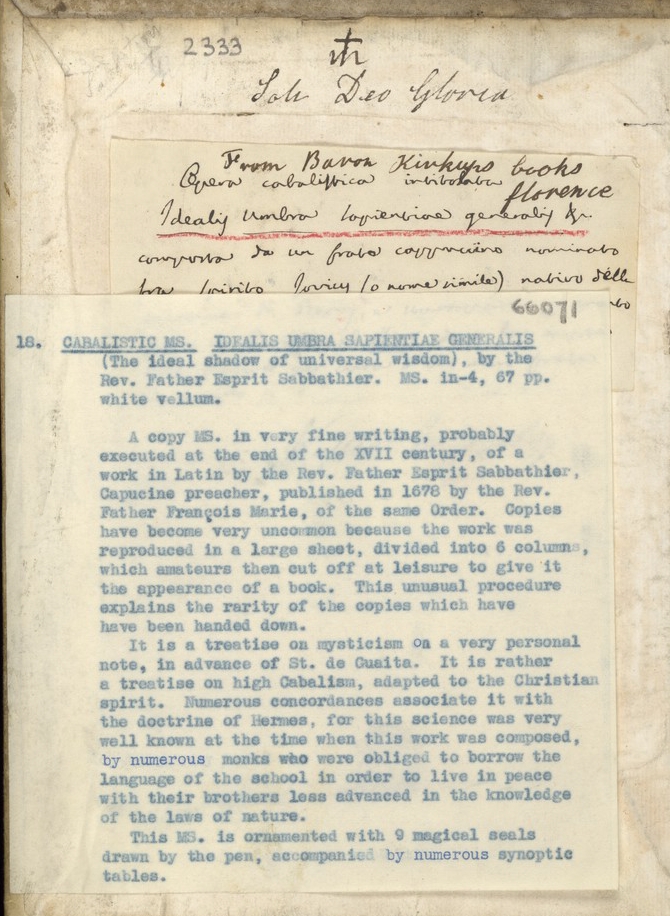
*
The 1897 Chamuel/René Philipon French Edition-
Bibliothèque Rosicrucienne-Série 1-Numero 3–
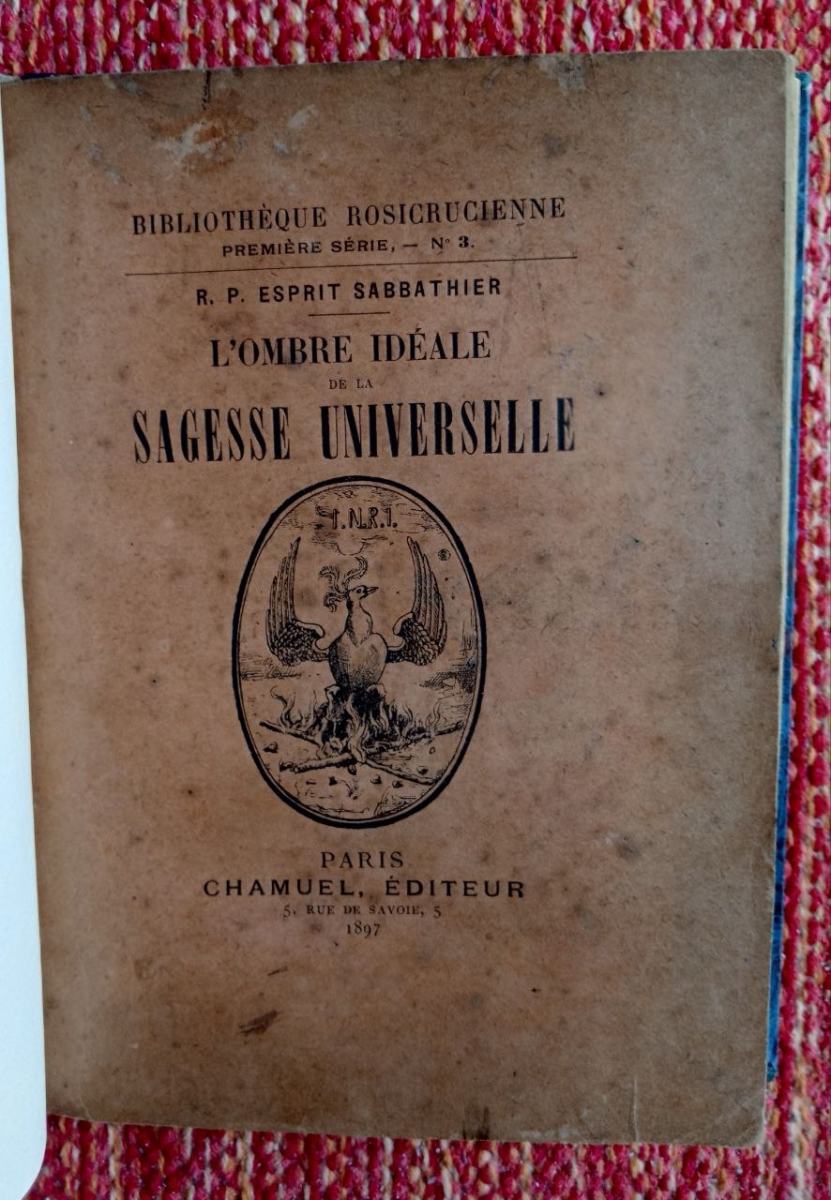
***
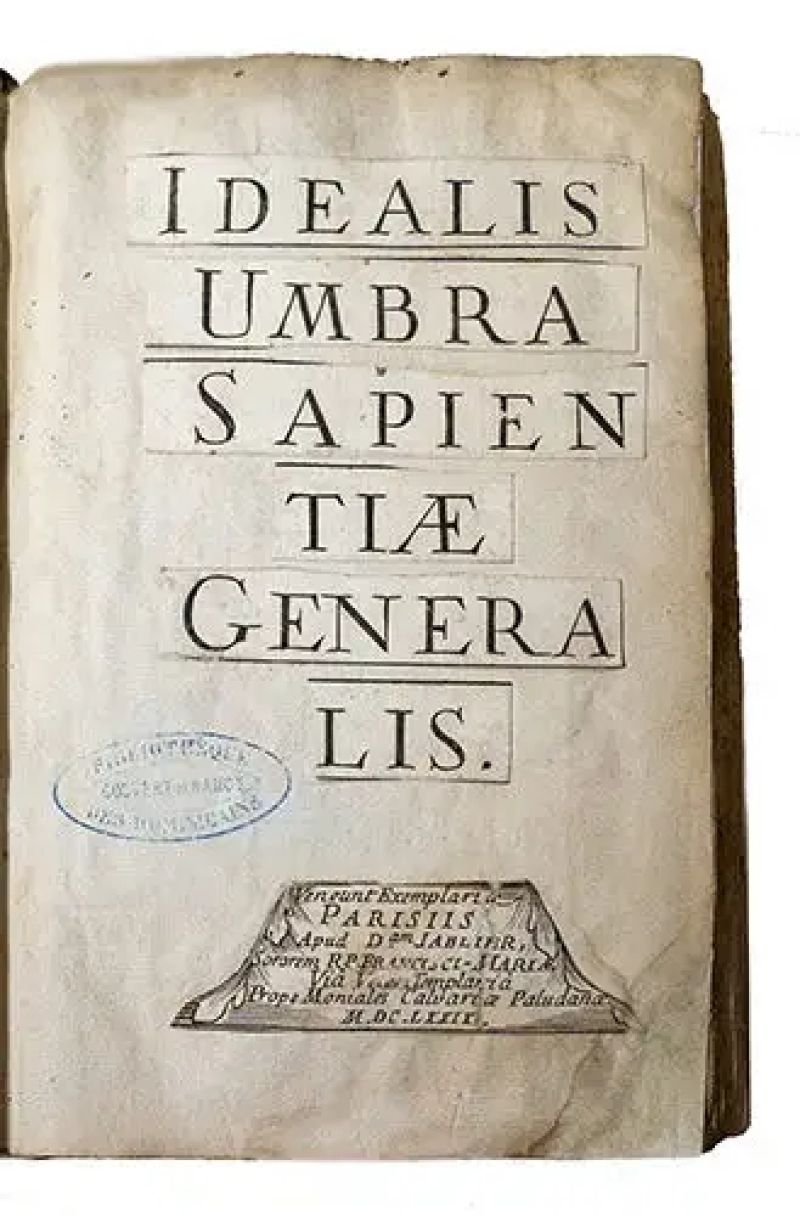
Related Articles


Leave a Reply