
Circle of Transmission: The Living Loom
A Little Pierre Lory Sampler – Part 1: From ‘Alchimie et Mystique en Terre d’Islam’-Jabir Ibn Hayyan and the Science of the Balances
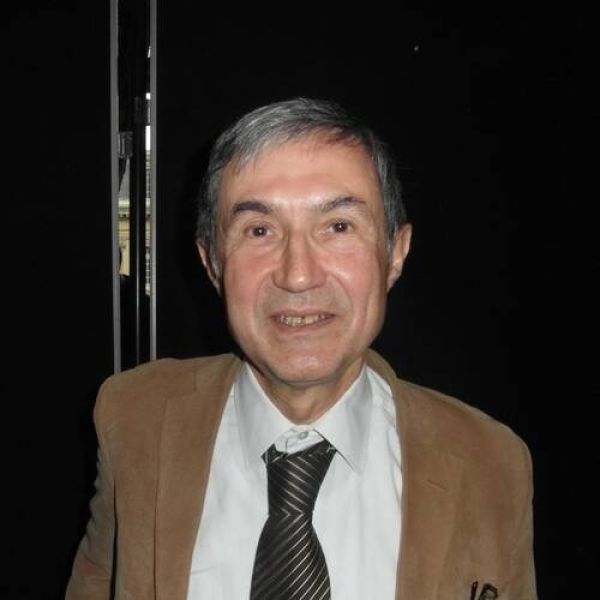
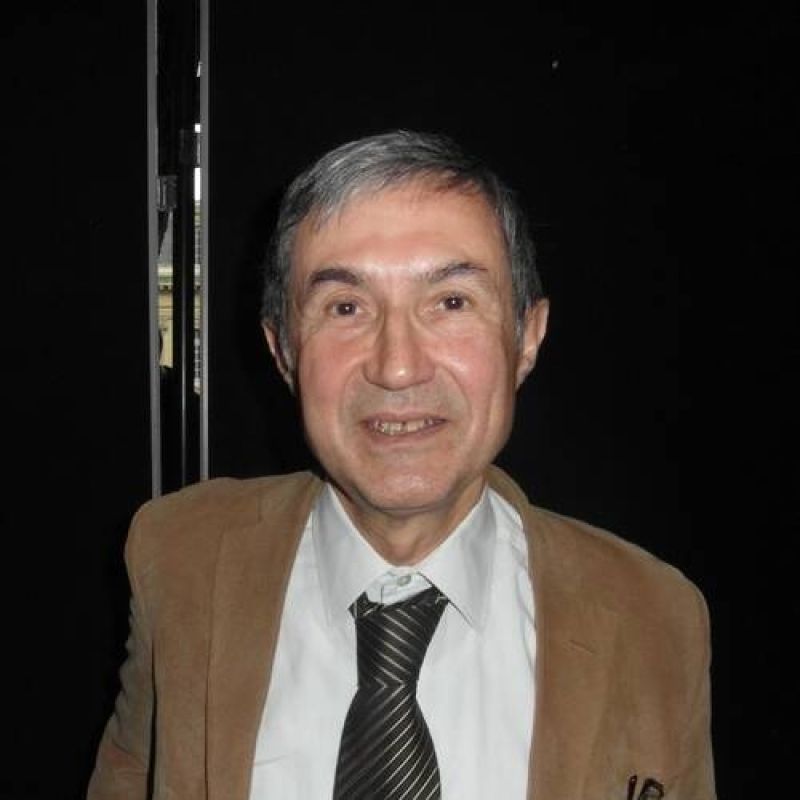
Professor Pierre Lory, picture taken in 2016 in Paris,
during the ’22th Maghreb of books bookfair’.
*
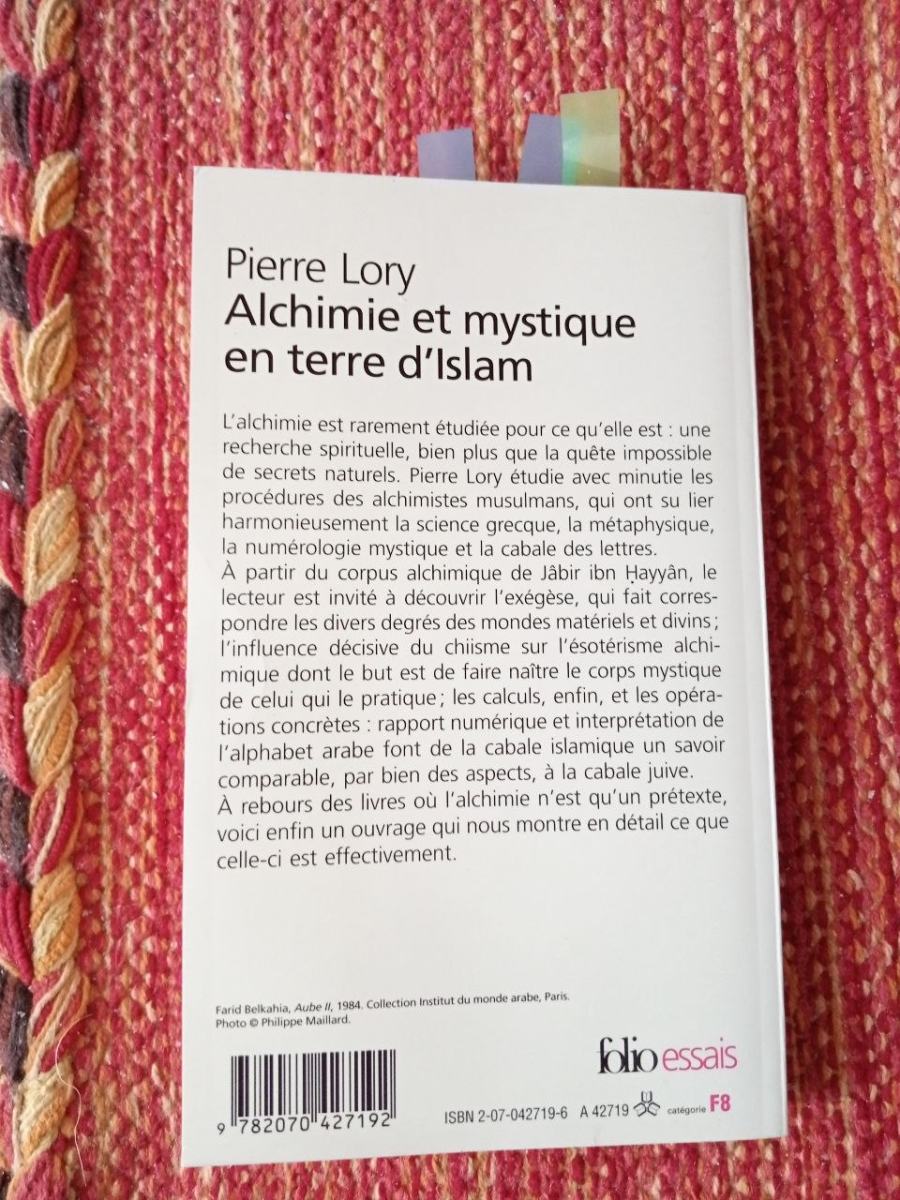
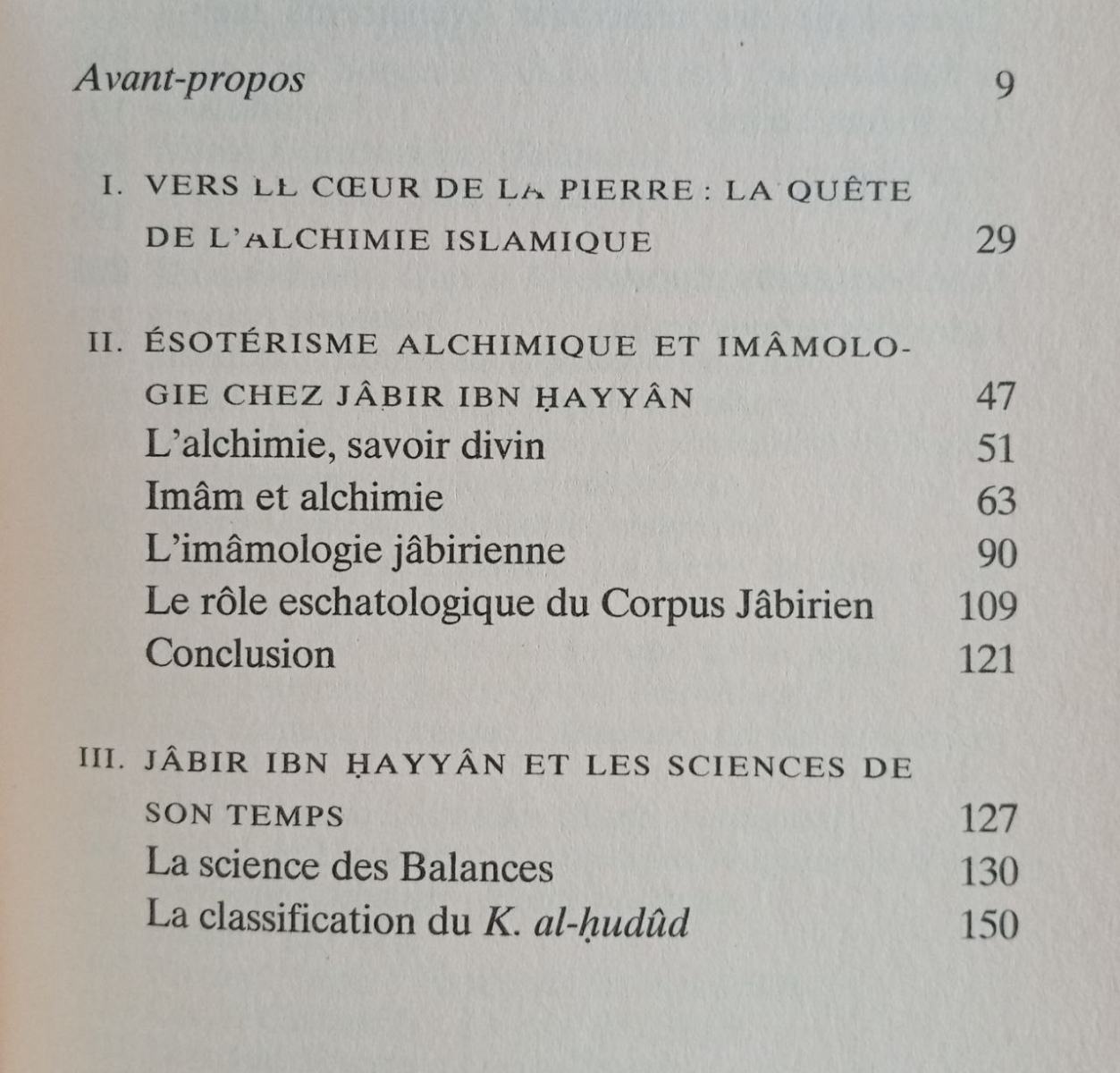
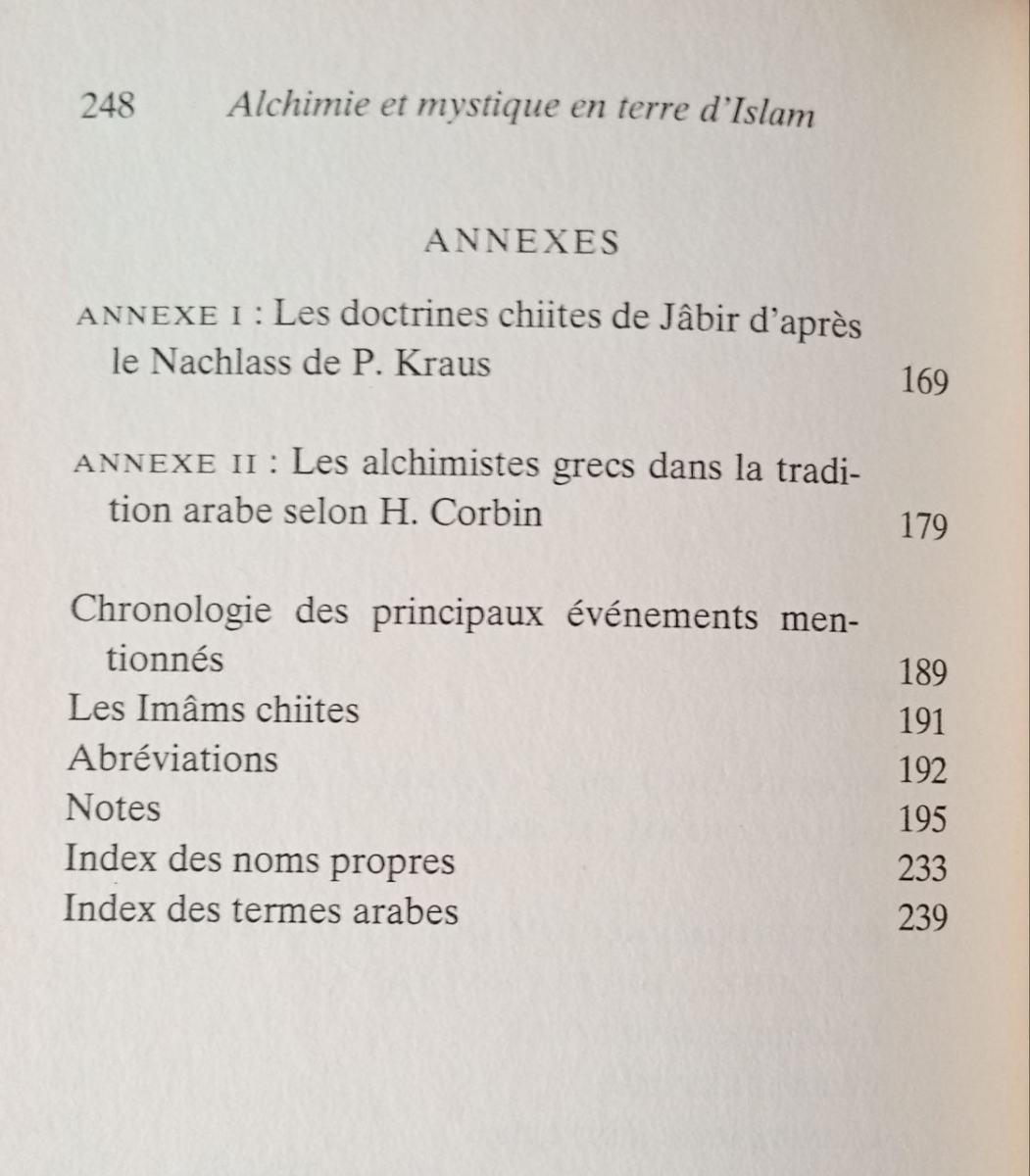
Today’s sharing from the Blue House of Via-HYGEIA is the first part of a sampler devoted to honoring Professor Pierre Lory and his work, with an excerpt from Alchimie et Mystique en Terre d’Islam (Verdier, 1989; Folio Essai/Gallimard, 2003, pp. 130–150).
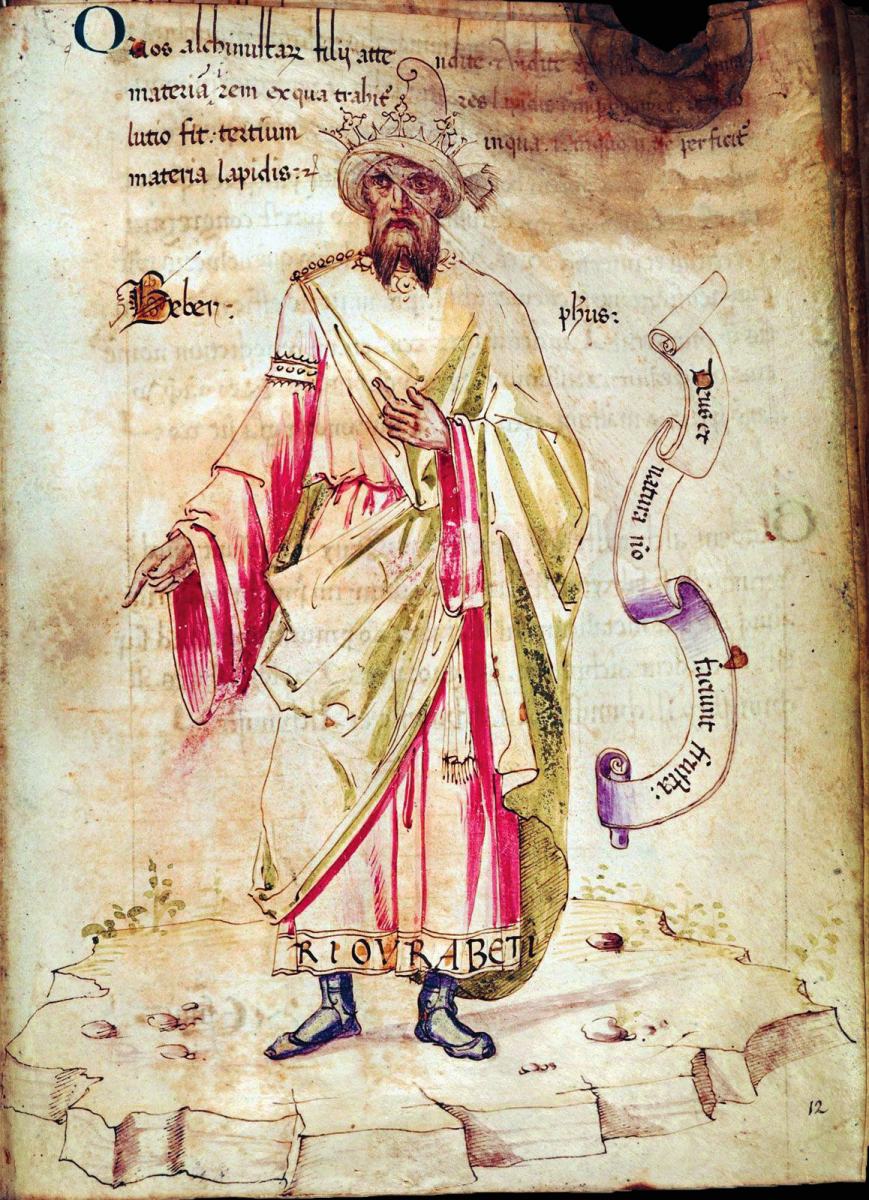
In this excerpt, Professor Pierre Lory explores the foundational doctrine of the ‘science of the Balances’ (mīzān) as articulated by the seminal Arabic alchemist Jâbir ibn Ḥayyân. Lory shows how Jâbir’s system unites cosmology, alchemy, linguistics, and spiritual practice through a universal harmony of measurable proportions.
Central is the ‘Balance of Letters’ (mīzān al-ḥurūf), which treats language not as arbitrary convention but as a natural substance perfectly expressive of the intimate nature of things.
Lory traces how this quantitative method—based on four elementary Qualities (Heat, Cold, Dryness, Moisture) and the ideal proportion 1:3:5:8—governs not only the transformation of metals but also linguistics, medicine, astrology, talismans, and even the mysterious science of artificial generation (ʿilm al-takwīn).
Ultimately, the article reveals that for Jâbir, mastering the natural Balances is a spiritual preparation for the ineffable ‘divine science‘ of the higher worlds—making alchemy a path to wisdom and the ‘second birth‘ of the alchemist himself.
Sampler part 2 will be another excerpt from the same source: ‘Towards the heart of the stone, the Islamic alchemical quest‘.
**
Pierre Lory, A Biographical Sketch
Pierre Lory was born in Paris on April 22, 1952. He initially studied political sciences at the Institut d’Études Politiques de Paris before turning to Arabic language and literature at the Institut National des Langues et Civilisations Orientales (INALCO) and then at the Université Paris III – Sorbonne Nouvelle, where he obtained the agrégation in Arabic in 1977.
Under the supervision of Roger Arnaldez, he specialized in Islamic studies and Muslim mysticism, completing a master’s thesis on mystical exegesis of the Qur’an in 1976. As a research fellow at the Iranian Academy of Philosophy in Tehran during the 1978–1979 academic year—supported by Henry Corbin—he deepened his engagement with esoteric currents.
He then returned to Paris III to write a third-cycle doctoral dissertation on the alchemy of Jābir ibn Ḥayyān, which he defended in 1981 under the direction of Jean Jolivet and Mohammed Arkoun. Appointed maître de conférences in Arabic language and Islamic civilization at the Université Michel de Montaigne – Bordeaux III in 1981, he spent the 1987–1988 academic year as a resident researcher at the Institut Français d’Études Arabes in Damascus.
In 1990 he defended his doctorat d’État in Islamic studies at Bordeaux III, titled Language, temps et espace dans l’ésotérisme islamique (Language, Time and Space in Islamic Esotericism).
The following year, in 1991, he was named directeur d’études at the École Pratique des Hautes Études (EPHE), Section des Sciences Religieuses, where he held the chair of Muslim Mysticism until his emeritus status in 2020.
He served on the Bureau of the Section des Sciences Religieuses (1993–1996, under the presidency of Claude Langlois) and as president of the Société des Amis des Sciences Religieuses (1997–2007).
From 2007 to 2011 he was scientific director of the Department of Arabic, Medieval and Modern Studies at the Institut Français du Proche-Orient (IFPO) in Damascus.
A member of the Laboratoire d’Études des Monothéismes (UMR 8584 CNRS/EPHE), he has also served as secretary of the Association des Amis de Henry et Stella Corbin (which organizes annual study days in Paris since 2005) and as a member of the editorial boards of Arabica, Journal Asiatique, Studia Islamica, and the Bulletin Critique des Annales Islamologiques.
His scholarly output is vast and foundational. His early work included Les commentaires ésotériques du Coran selon ‘Abd al-Razzâq al-Qâshânî (1980), establishing his expertise in mystical exegesis. He revolutionized the study of Islamic alchemy with Dix traités d’alchimie de Jâbir ibn Hayyân (1983) and L’élaboration de l’Elixir Suprême (1988), providing critical editions and translations of the Jābirian corpus.
His seminal synthesis, Alchimie et mystique en terre d’Islam (1989), remains the authoritative reference on the subject. He further explored the intersection of language and mysticism in La science des lettres en islam (2004) and broadened his scope to oneirism with Le rêve et ses interprétations en Islam (2003). His books have been translated into Arabic, Turkish, Persian, and Spanish.
Now directeur d’études émérite (since September 2021), Pierre Lory remains an active figure in French Islamic studies. He is globally recognized for his definitive research on Ḥurūfism (Islamic numerology and letter mysticism), the alchemy of Jābir ibn Ḥayyān, and the science of the Balances, having illuminated the profound connections between alchemy, mysticism, and language in Islamic thought.
*
The Science of the Balances:
A Contextual Introduction
The science of the Balances (mīzān) as articulated by Jābir ibn Ḥayyān is a unifying cosmological and alchemical doctrine according to which everything in the visible and invisible worlds—from the Universal Intellect and Soul down to minerals, plants, animals, and human language—results from measurable proportions, harmonic compositions of motion and rest called taʾlīf ʿaddādī (numerical composition).
At the core lies the Balance of Letters (mīzān al-ḥurūf), which posits that the name of a substance perfectly expresses its intimate nature because language is not a human convention but a natural substance (jawhar) issuing from the same Universal Soul that informs the material world.
By assigning numerical values to the twenty-eight Arabic letters according to their correspondence to the four elementary Qualities (Heat, Cold, Dryness, Moisture) and their position in a word, the alchemist can calculate the exact intensity of each Quality within a substance, then rebalance it by reinforcing the deficient contrary Quality to obtain perfect elixirs.
This system extends beyond alchemy to linguistics (grammar and metrics), medicine, pharmacology, astrology, the science of hidden properties (khawāṣṣ), talismans, theurgy, and even artificial generation (ʿilm al-takwīn)—the supposed ability to produce minerals, plants, animals, and humans by imitating natural laws.
The Balances also integrate grammar (reduced from tripartite to binary division), metrics (classified by syllabic quantity to reveal the key number 17), and music, all seen as expressions of the same universal harmony descending from the Intellect through the Soul to the sublunary world, with the ultimate goal being not mere laboratory success but the Sage’s (ḥakīm) spiritual ascent to divine science (al-ʿilm al-ilāhī), the ineffable knowledge of the supreme Balances.
The science of the Balance is important for several interconnected reasons.
First, it provides Jābir with a rigorous, quantitative, and predictive framework for alchemical practice, moving beyond mere empirical trial-and-error by offering a mathematical method (the proportion 1:3:5:8, derived from the Balance of Letters) to determine the exact composition of any substance and the precise corrections needed for transmutation.
Second, it bridges the physical and the spiritual: the same proportional laws govern celestial spheres, human language, and the alchemist’s crucible, meaning that laboratory work becomes a path to cosmic knowledge and spiritual transformation—a point underscored by Henry Corbin’s interpretation of artificial generation as symbolic of the operator’s ‘second birth‘.
Third, the Balance of Letters advances a profound theory of language as ontologically grounded rather than arbitrary, anticipating later debates in semiotics and the philosophy of language; words are not labels but keys to reality’s inner structure.
Fourth, the system unifies what we would today separate as natural science, occultism, linguistics, and mysticism into a single coherent epistemology, demonstrating how pre-modern Islamic thought could integrate Neoplatonic, Hermetic, and Gnostic heritage without sacrificing practical efficacy.
Finally, for the historian of science and religion, Jābir’s Balances represent a high water-mark of Arabic alchemical theory, influencing later figures such as Abū Bakr al-Rāzī and Mu’ayyad al-Din al-Tughrāʾī, and offering a striking example of how the quest for material transformation (gold from base metals) was inseparable from the quest for spiritual perfection—a hallmark of the ‘alchemical mysticism‘ that Pierre Lory’s work illuminates.
*
And now the text:
THE SCIENCE OF THE BALANCES
(Translated from Pierre Lory, ‘Jâbir ibn Hayyân et les sciences de son temps’)
The vast corpus that Arabic-language alchemy has preserved as the work of Jâbir ibn Ḥayyân is far from representing a systematic and ordered doctrinal exposition. It consists of a mosaic of short treatises of highly different style, content, and scope which, besides their dispersion in relation to one another, sometimes present certain divergences in their exposition of the Great Alchemical Work. Let us leave aside the question of the attribution of these treatises to a plurality of authors mentioned in the introduction of this work⁵; for even if the redaction of the Jābirian Corpus doubtless stems from the work of an entire school carried out over more than two centuries, this does not fundamentally undermine the unity of the overall aim and thought.
From the beginning to the end of the corpus, the numerous cross-references and references to other treatises reveal a doctrine that has remained profoundly unified in its premises and its principal applications. Divergences and contradictions from one treatise to another, we believe, arise much more from questions of level of language and epistemological perspective than from real oppositions on precise points. Very consciously, Jābir indeed refuses to expound his points of view clearly, and disperses, indeed “shatters” their elements into a multitude of allusive, doctrinal, or symbolic facets, leaving it to the reader to strive to discover their synthesis⁶.
The corpus does not treat in detail the question of the relationships and hierarchy of the sciences among themselves. It is therefore necessary to reconstruct here as well a synthesis from several passages and fragments, which in itself could leave room for much arbitrariness and uncertainty. There is, however, one basic idea that possesses a particularly effective unifying function: it is the notion of the Balance (mīzān). At a more abstract level than his theory of the elements, Jābir was persuaded that everything occurring in the visible world and in the invisible, spiritual worlds resulted from a regular ordering, a harmonic composition of motion and rest(7) that is quantitatively variable and measurable—a numerical composition (ta’līf ‘addādī) from which all differentiation and all multiplicity occurring “outside” the unique Primordial Cause originates.
This is what the Book of Morphology⁸ presents in the form of the myth of the Universal Soul which becomes “enamored” with Substance (jawhar), which occupies the sphere immediately below it. The Soul invades and interpenetrates this Substance, then the four spheres that this encompasses: the spheres of Heat, Dryness, Moisture, and Cold. A mixture of these six components takes place, until it reaches the visible world. There, everything that appears differentiates itself and acquires its own qualities according to the proportion of the elements and the intensity of the force of the Soul it represents. It is this system of proportions that is designated by the term “Natural Balances.”
The Balances therefore embrace all things, both sensible and non-sensible⁹, according to indefinitely variable possibilities¹⁰. Jābir only makes passing allusions to the Balances of non-sensible worlds. These doubtless must be conceived according to the Neoplatonic-inspired schema expounded in the Book of Morphology. The worlds of the Universal Intellect and the Universal Soul certainly fall in an eminent way under the principle of the Balance, since it is precisely in them that the “programs” of the Balances of the lower worlds are elaborated.
In this sense, these supreme Balances are of primary importance, and are the object of “divine” science (‘al-ʿilm al-ilāhī)(11), which is, in fact, the ultimate goal of the Sage alchemist (ḥakīm). However, Jābir speaks of them only very briefly; these Balances belong to a spiritual experience that is in many respects ineffable, and their science is acquired only after the learning of the lower Balances. The overwhelming majority of Jābirian writings is devoted to the study of these Natural Balances—which is the science of the Balances stricto sensu, and which represents the immediate object of alchemy.
These Natural Balances are indeed more easily observable. They are constituted, practically, by the combination of the four elementary Qualities interpenetrated by Substance, the passive prime matter of the universe. The Balances of the celestial spheres, the mineral, vegetable, and animal Balances, all obey particular rules and harmonies that Jābir compares to mathematics or music.
The aim of alchemy will not be to disperse its efforts by striving to observe particular effects in each order of phenomena, but to acquire the general science of the Balances concerned, which will dispense with useless experimentation¹² and prepare the intellect for the reception of the sciences of the higher Balances. It is to the exposition of the mechanisms of these Balances that the doctrinal treatises of Jābir that have come down to us are devoted. The branches of knowledge are ordered there according to two perspectives: one practical, based on the requirements of alchemical work, the other theoretical, fitting into a general cosmology.
The general theory of Jābirian alchemy broadly takes up the concepts of physics adopted by the Greek scholars. The ensemble of phenomena occurring in the sublunary world results from variable combinations of the four Elements of the Aristotelian system, or more exactly, from the variable mixture of the four elementary Qualities and cosmic Substance, informed, as we have seen, by the Universal Soul.
Most often, however, one of them dominates: the body is then said to be hot, or moist, etc. The Alchemical Art will therefore consist of knowing the exact proportions at play and applying oneself to rebalancing said bodies by reinforcing the deficient contrary Quality according to what is desired, with the aim of obtaining perfect elixirs¹³.
Among the Greek scholars who theorized the data of traditional medicine, Galen had already proposed a classification of the intensity of elementary Qualities in mineral, vegetable, and animal substances, envisaging for each Quality four possible degrees.
This classification, widely used in Greek medicine, was also taken up by Arab physicians¹⁴. Jābir mentions it¹⁵ and makes use of it when necessary¹⁶. However, he points out, the combinatorial possibilities of Galen’s classification are very few, whereas experience in pharmacopoeia, for example, shows that the power of substances is far greater in number, having very varied effects or producing the same effects, but at very different doses.
Jābir, for his part, adheres to a more differentiated system.
He adds indeed to the four degrees of Galen seven possible subdivisions, which he baptizes, according to a terminology of astronomical origin: degree (martaba), grade (daraja), minute (daqīqa), second (thāniya), tierce (thālitha), quart (rābi’a) and quint (khāmisa). This system therefore comprises (7 × 4) × 4 = 112 possibilities.
But he introduces into it a rule of proportionality, affirming that the ratios of the magnitudes of the same subdivisions of each degree among themselves correspond to the progression 1 : 3 : 5 : 8. Thus, if the tierce of the first degree of heat corresponds to 6, the tierce of the second degree will be 18, that of the third degree 30, that of the fourth degree 48¹⁷.
This classification, which is presented as such as an acquisition of the alchemical tradition, may theoretically seem a progress in precision compared to that of Galen; however, a problem of measuring these degrees will arise. How, starting from a given substance, will one be able to determine which of the twenty-eight possible intensities of Heat or Moisture is present?
Certainly, notes Jābir, one can have recourse to traditional means of identification, by the study of color, odors, sounds, taste, etc., but all these indices are unreliable. For if the color white, for example, reveals Heat, and black reveals Cold, the mixture of elementary qualities often makes the distinction of colors and odors difficult. Moreover, many substances (gold or silver, for example) have neither odor nor taste.
In short, Jābir will prefer to have recourse to a system of identification that he deems more precise and more certain than any other: the Balance of Letters (mīzān al-ḥurūf). He declares that he holds it by tradition, but affirms having practically experienced its truth and efficacy.
It is a science in itself, belonging to the highest degrees of the religious sciences¹⁸. It proceeds from the principle that the name designating a substance perfectly expresses its intimate nature, based on general correspondences in creation between the interior (bāṭin) and the apparent (ẓāhir), between “meanings” (al-maʿānī) and articulated and written language (al-ḥurūf).
Following the ordinary classification in the Orient, he divides the twenty-eight letters of the Arabic alphabet into four groups of seven letters corresponding to the four elementary Qualities and the twenty-eight possible intensities, according to the table below¹⁹:
| Heat | Cold | Dryness | Moisture | |
|---|---|---|---|---|
| degrees | ʾ | B | J | D |
| grades | Ḥ | W | Z | Ḥ |
| minutes | Ṭ | Y | K | L |
| seconds | M | N | S | ʿ |
| thirds | F | Ṣ | Q | R |
| fourths | SH | T | TH | KH |
| fifths | DH | Ḍ | Ẓ | GH |
To this table, Jābir makes correspond a grid of numerical values of the four degrees of intensity of the elementary Qualities, given here in dānaq (= 1/6 of a dirham). It obeys the proportion 1 : 3 : 5 : 8, the most balanced according to him:
| 1st degree | 2nd degree | 3rd degree | 4th degree | |
|---|---|---|---|---|
| degrees | 7 | 21 | 35 | 56 |
| grades | 3 | 9 | 15 | 24 |
| minutes | 2.5 | 7.5 | 12.5 | 20 |
| seconds | 2 | 6 | 10 | 16 |
| thirds | 1.5 | 4.5 | 7.5 | 12 |
| fourths | 1 | 3 | 5 | 8 |
| fifths | 0.5 | 1.5 | 2.5 | 4 |
The search for the intensity of each elementary Quality is done according to the place of the letter in the word.
Thus, the analysis of the term ‘usrub, composed of the four letters ʾ, s, r, b, gives the following result: the hamza corresponds to a martaba (rank) of Heat.
As it is the first letter of the word, it will be of the first degree, i.e., 7 dānaq. The šīn, which corresponds to a second of Dryness, of the second degree, being in second place, will be worth one dirham, i.e., 6 dānaq.
The rāʾ, which is of the level of a third of Moisture of the third degree, will be counted as 7.5 dānaq. Finally, the bāʾ will be worth 56 dānaq of Cold, corresponding to a martaba of the fourth degree of this Quality.
If the analysis of letters here corresponds to a particularly clear and balanced result, Jābir will often encounter major application problems. First, many words contain more than four letters, for example for yellow arsenic (zirnīkh aṣfar…). Jābir groups the letters together in fours to obtain the desired degrees²⁰.
But, on the other hand, it frequently happens that the computation of letters gives quantities for only two or three elementary Qualities, either because the word contains fewer than four letters (dhahab, fiḍḍa), or because several letters belong to the same elementary Quality.
Finally and above all, whereas Jābir had postulated that the overall distribution of the four elementary Qualities necessarily corresponded to the progression 1 : 3 : 5 : 8²¹, the total sums of the intensities of the Qualities obtained by letter calculation obviously never equal such a proportion.
Jābir then introduces the theory of the double distribution of elements. The elementary Qualities calculated by the value of the letters are those that appear at the periphery (muḥīṭ) of the substance.
But to these exterior Qualities correspond interior Qualities, situated at the center (markaz); these, according to Jābir, are distributed in inverse proportion to the exterior Qualities, such that the total corresponds to seventeen parts, distributed among the elementary Qualities according to a gradation of 1 : 3 : 5 : 8²².
By calculations of extreme complexity (aggravated by the poor state of the manuscripts), Jābir thus gives results for the principal substances known at the time, in accordance with his arithmological principles²³.
All these accounts are obviously not without arbitrariness. Perhaps they should be related to another passage from Jābir affirming that this calculation based on letters is a mnemonic means for fixing the intimate nature of each substance²⁴.
But whatever the case, Jābir accords a quite eminent place to the Balance of Letters, of which he makes the cornerstone of his system of scientific investigation. This perspective rests on a general conception of human language that it is important to delineate before examining the other Balances mentioned in the corpus, and which depend on it for a large part.
Language, from Jābir’s perspective, does not result from mere chance, from a convention established between individuals of the same social group; rather, it is, in a natural way, homogeneous with the object it evokes. Thus, as we have seen, each term designating a substance perfectly expresses its nature. Of course, this conviction encounters numerous objections, which Jābir himself raises: if perceived objects are identical for all subjects, idioms are nonetheless different across the whole earth.
Moreover, within the same language, phenomena of synonymy and homonymy seem to oppose the idea of the adequacy of the term to its signified²⁵. Without responding perfectly clearly to these objections, Jābir opposes to them a general theory of language, which can be grouped into a few major ideas:
— Language is in itself analogous to alchemy. Just as several letters are necessary for a word (lafẓ) to exist, and the elaboration of a coherent and useful utterance requires a precise combination of lexical elements, so mixtures of elementary Qualities form simple substances, and combinations of these engender elixirs.
Alchemical science corresponds very exactly to a morphology (declension-conjugation) of the elements (tašrīf al-ʿanāṣir)²⁶; and, one might add without risk of anachronism, the true science of language is properly “the alchemy of the verb.”
— But this rapprochement between language and the Alchemical Art corresponds not only for Jābir to a simple external analogy. Language, for our disciple of Jaʿfar al-Ṣādiq, is linked to the most intimate structure of the object under consideration, and expresses its essence. Not only are languages not human conventions, but they are, so to speak, psychic substances, which integrate into a whole ontology.
“The affirmation that [language] is due to institution and convention, that it is an accident, is an error. For language is a substance [jawhar], it is of natural origin [ṭabʿ] and does not derive from an institution [waḍʿ], but from an intention in the soul. For the acts of the soul are all substantial… the letters that form the matter (hayālā) of discourse are a creation of the soul (ibtidāʿ nafsānī)²⁷.”
This affirmation is not without obscurities and imprecisions. At the very least, one can draw out its essential tenets. For if it is the same Universal Soul that informs the world of phenomena and, indirectly, gives rise to language among men, one can infer a correspondence between these two orders of reality²⁸.
In this sense, all human languages can be used in alchemy for the Balance of Letters, and Jābir occasionally gives examples from Persian, Greek, or other more hypothetical languages—Alexandrian, Himyarite²⁹. However, considering Arabic as the most appropriate language for this usage, it is to it that he will resort the rest of the time³⁰.
Moreover, he will engage in the study of all possible permutations within words, being convinced that to these theoretical elaborations a reality should correspond, even if the lexicon did not account for it³¹. He even pushed these considerations as far as speaking of a purified artificial language, where each word would correspond perfectly to the essence designated³², without specifying how this idea of an artificial language reconciles with his previously stated theory on the origin of language.
This general conception of language will have repercussions on the way of envisaging the structure and function of several ancillary sciences. Concerning grammar, for example, Jābir will distance himself from the tripartite classification of the lexicon of the great Arab grammarians into ism, fiʿl, and ḥarf³³ to advocate a binary division into ism and kalima. Thus, the structure of language will better correspond to this “arithmetical composition,” taʾlīf ʿaddādī, resulting from the alternation of motion and rest.
Similarly, Jābir will integrate metrics into his general theory of language. This science, which corresponds in an eminent way, like music, to the definition of taʾlīf ʿaddādī, will be highlighted as reflecting this total harmony issuing from the Universal Soul, and becoming particularized in the human soul.
Here again, Jābir will break with traditional classification; he will take up the feet of Arabic ʿarūḍ to classify them according to their syllabic quantities: on one side, five-letter feet (faʿālūn, faʿilūn), on the other, seven-letter feet (mafaʿlūn, faʿilātun, mustafʿilūn, mutafāʿilūn, mufāʿalatun and, curiously, mafʿalātun)³⁴.
Paul Kraus sees in this an adaptation of Greek metrics; but above all it is important to note that Jābir can thus find, in metrics, the number 17, keystone of his system of Balances, and therefore, here again, the composition of language with the harmonies used in alchemical work³⁵.
In the entirety of the corpus attributed to him, Jābir obviously deals essentially with practical alchemy. However, thanks to multiple allusions and digressions, one can form a certain idea of the way in which he integrated the other sciences, profane or occult, into his theoretical cosmological system.
Jābir, as we have said, treats the Balances of the spiritual worlds rather little; they are not his subject. At least we learn incidentally that the “Philosopher” who, through extreme purification of his spirit, learns to know these celestial harmonies (Balances of the Intellect, of the Soul), acquires universal knowledge and immense power. This is, however, an illuminative knowledge, obtained by the infusion of the Universal Intellect into the particular intellect³⁶, which thus distances us from the classification of merely natural sciences.
At an immediately lower level, a certain number of “poetic” sciences, in the Aristotelian sense of the term, express in the purest way this harmony that Jābir places at the base of his theories. Thus music, which is cited with metrics: “Metrics, the composition of melodies, rhythm—that is the soul itself (hiya al-nafs), and this because they issue from the soul and exert influence only on what is endowed with a soul³⁷.”
That music is a primary science emerges from the fact that the movements of the celestial spheres governing the sublunary world are themselves determined by musical relationships. Jābir moreover treats of Arabic musical science, in parallel with the commentaries he had made on metrics³⁸.
Astrology integrates itself naturally into the system of Balances. The stars are the principal relay by which the Universal Soul impresses its order upon the sublunary world. The movement of the stars, by its purity, its perfection manifested by its accordance with celestial music, therefore corresponds to Balances of great harmony. In turn, these movements influence living beings, notably their growth, their affectivity, their passions.
But this perfect relationship degrades as it permeates a coarser and denser substance. The Balances of the sublunary world will therefore be less harmonious than the celestial Balances. It seems that the famous ratio 1 : 3 : 5 : 8 is considered by Jābir as the degradation of the more perfect harmony 6 : 8 : 9 : 12, according to a schema probably inspired by the Timaeus, notes Paul Kraus³⁹.
At this still lower level of harmony, Jābir therefore places the sciences founded on the application of the principles of permutation of the four elementary Qualities to the substances of the sublunary world.
In the Book of the Passage from Potentiality to Actuality (K. ikhrāj mā fī al-quwwa ilā al-fiʿl), he gives, following the discourse on astrology, an exposition of the “septenary” of sciences subject to the Natural Balances, namely, in order: medicine, alchemy, science of properties (khawāṣṣ), talismanic science, utilization of celestial entities, science of nature (science of Balances), artificial generation⁴⁰. Should we see here, as certain scholars have affirmed⁴¹, a classification of the sciences in order of decreasing or increasing importance?
We do not believe, to tell the truth, that the succession itself of medicine, followed by alchemy, etc., actually covers an intention of hierarchy of knowledge. Jābir nowhere mentions such an order of precedence. Moreover, the entirety of the Jābirian vision opposes such a distribution: alchemy is always cited as the most perfect of all disciplines.
We have seen elsewhere that it is the science of Balances, classified here in sixth position, which encompasses all the others. This present enumeration seems rather to correspond to didactic motives: it is applied to medicine that the rule of permutation of Natures is clearer to the mind, and likewise in alchemical processes.
Clearly more abstract and esoteric, on the other hand, are the domains of properties (al-khawāṣṣ), talismans, and artificial generation.
Moreover, it is not strictly speaking a “classification of the sciences” that is proposed here, but the exposition of the various fields of application of the principle of Balances in the sublunary world. It is only of greater interest for the domain that concerns us at present. Medicine (including pharmacy) is a favored field of application of Balances to mineral and especially organic substances of the sublunary world. Jābir was himself a pharmacist and physician.
If the Book of Poisons (K. al-sumūm) is the only medical work that has been preserved from him, multiple passages of the corpus, including that of the K. al-ikhrāj which concerns us here, allude to the essential work of therapeutic action: determining the excesses and deficiencies in the four elementary Qualities that cause the affection or lesion, and elaborating, based on this diagnosis, a drug whose intensity in these Qualities will allow exactly compensating for the imbalance in question⁴². This double operation of course requires a precise knowledge of the Balances concerned; but here again, we see, Jābir does not innovate fundamentally with respect to the Greek heritage, to which he himself abundantly refers elsewhere.
The rubric ‘alchemy‘ contains only the exposition of general principles on the nature of metals, ‘spirits‘, tinctures, and on the various operations of the Work. The rest of the corpus, however, abundantly emphasizes that this knowledge, more than the others, leads the scholar to total science, and therefore deserves the title of ‘summit of Wisdom‘⁴³.
Finally, the Balances explain and allow the application of most of the so-called occult sciences: the science of properties, which uses a series of non-visible relationships between things and living beings, according to their essence (jawhar) as well as their structure and their intensity in elementary Qualities; the science of talismans, which adds, together with the use of properties, that of the influence of astral entities and the efficacy of forms; the science of the utilization of astral entities as such, finally.
According to Jābir, all these sciences relate to perfectly natural phenomena explicable by the rules of the Balances of the four elementary Qualities. He affirms insistently that the efficacy of magic and all analogous practices is real. Most people do not believe in it, he continues, whereas these are simple processes belonging to nature (ṭabīʿa), but whose causes are unknown, because they are not perceptible.
Yet, for whoever attains knowledge of the Balances governing the intimate being of things and conferring upon them their hidden properties (khawāṣṣ), the manipulation of these “magical” relations becomes possible. However, Jābir does not hide how difficult the acquisition of such sciences is, requiring both innate predispositions and the guidance of a true master⁴⁴.
This mastery of the hidden forces of the substances of the sublunary world culminates in Jābir in the science of artificial generation (ʿilm al-takwīn). The operator who fully masters his art can produce according to him not only mineral substances, which corresponds to alchemy proper, but also vegetables, animals, and even humans, by an exact imitation of natural laws.
The alchemist (ṣāniʿ) can indeed imitate the Demiurge (Bāriʿ) to the point of producing such performances⁴⁵. “If you understand [my words],” affirms our author, “you will become repairer (jābir) and all-powerful (jabbār)!”
The theory of artificial generation, where ancient pagan theories—Chaldean, Egyptian, Greek—are visible in transparency, is one of the strangest chapters of the Jābirian corpus. Giving life to statues, attaining the degree of the angels indeed evokes ancient conceptions concerning the cult of “living” idol-statues by magical action, and the “ensoulment” of ancient mystagogues. It appears particularly clearly at this point how much the Jābirian theory of Balances—which he himself attributes to Apollonius of Tyana—is inspired by ancient occult sciences fairly rapidly Islamized, notably in marginal Shiite circles.
Can we now summarize the preceding considerations in a structured ensemble? Jābir himself did not formulate it, but it is nonetheless possible to establish a schematic table of the generation, by the Balances of the Intellect informing those of the Soul, of the Balances of Letters which in turn have repercussions on the three worlds: the macrocosm, the mesocosm (= alchemical work), and the human microcosm.
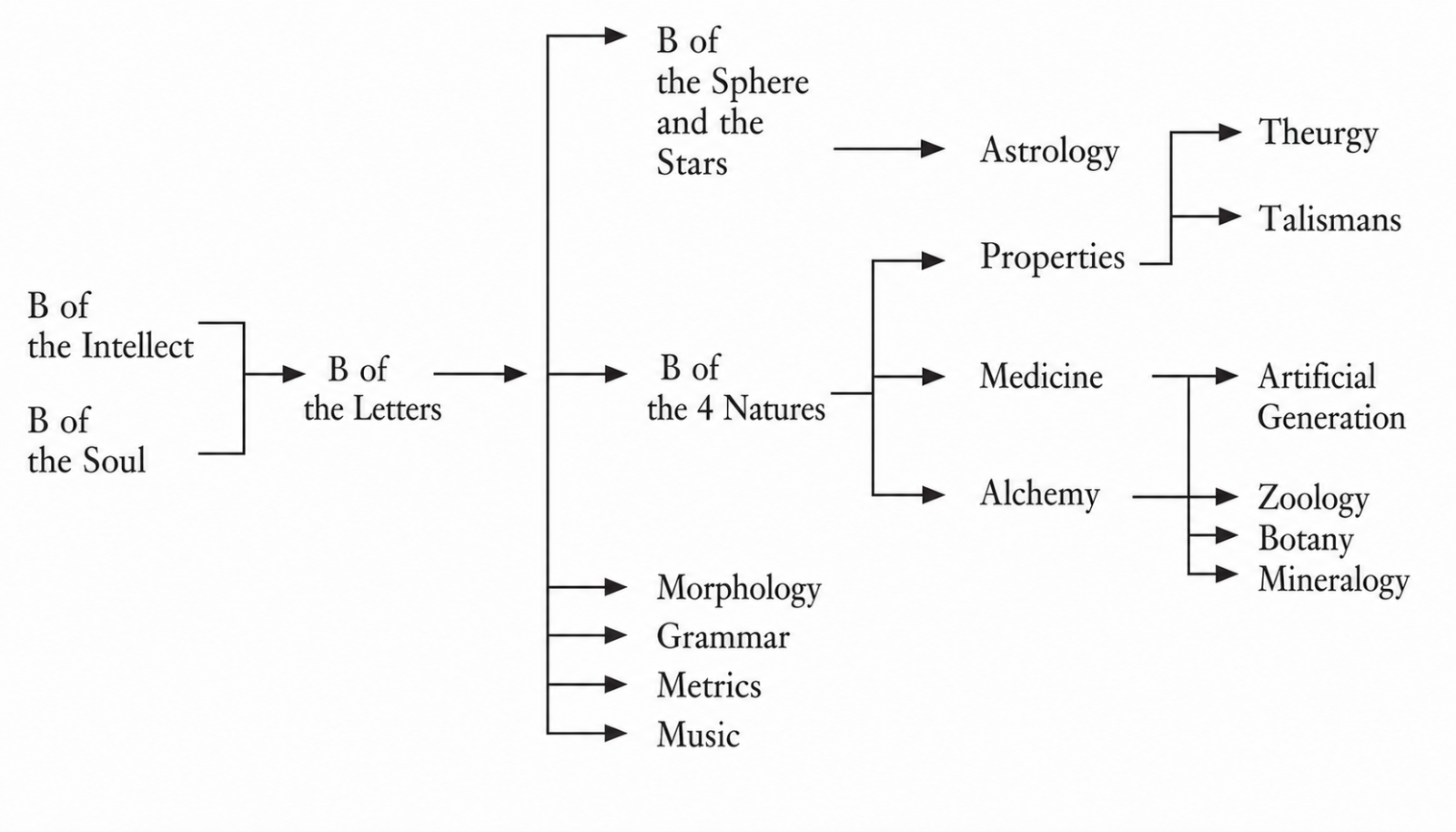
From this general description of Jābir’s vision of the sciences, what first implications may be drawn? His cosmology, which corresponds to the synthesis of Neoplatonism, Hermeticism, and Gnosticism that is the common foundation of many philosophical systems of the era, does not present fundamentally original traits, nor consequently does the classification of the sciences that would result from it. More worthy of remark, on the contrary, is Jābir’s initial practical démarche, and the articulation that results from it between alchemy and language.
The fundamental ambition of alchemy is not indeed to elaborate a complete system of theoretical cosmology, but to illuminate and facilitate laboratory work, in which higher truths will be elucidated. The concordance between the semantics of human language and that of natural phenomena, so characteristic of Jābirian thought, here corresponds in some way to a concern for practical efficacy.
Let us note next that the Jābirian system of Balances denotes a profound confidence in the capacity of the human spirit to understand and transform reality. Nature is not for him an unseizable Heraclitean flux, and the underlying Platonism (46) of his doctrine gives him faith in the rigor of universal laws without curbing his enthusiasm to work on the sensible and the particular.
At this first level, Jābir’s cosmology, the system of the Balances, contains few elements that would be suspect in the eyes of a monotheistic orthodoxy, whether Islamic or Roman Christian⁴⁷. An ancient heritage, the doctrine of correspondences and universal harmony was taken up by many orthodox thinkers and theologians. Certainly, Sunni theology will insist more on divine intervention⁴⁸ and refute belief in a purely mechanical organization of the universe, launched by a distant and indifferent Demiurge.
But Jābir in any case hardly expresses any theological opinions on this subject. On the other hand, the apparent audacity of his approach manifests itself in his theory of artificial generation. The idea that a man might succeed in shaping an animated being would already be quite surprising and shocking from the perspective of a strict Quranic ideology. But that he might render this being rational suggests an anthropology unacceptable both for a philosopher and for a theologian.
The enormity of such propositions leads us to think, with Henry Corbin⁴⁹, that these are very probably formulas proper to alchemical symbolism aimed in fact at the realization of the operator himself, his accession to the rank of “new man” during his ‘second birth‘—we will return to this.
It is to clarifying this philosophical and theological representation of the world that a second classification of the sciences drawn from the Jābirian Corpus, that of the Book of Definitions, should moreover contribute.
5. Cf. supra, p. 15 ff.
6. The coding introduced by Jābir into his alchemical treatises comprises several modalities: technical terms (“the eagle” for ammonia, for example), metonymies (“Fire” for any substance where the fiery character predominates), allegories (the Great Work represented by a marvelous peach), and, on the other hand, the dispersion of informational elements across multiple locations in the corpus, requiring the reader to undertake a work of reconstituting the “puzzle” (principle of tabdīd al-ʿilm). On this subject, cf. Paul Kraus, C.J., p. XXVII ff., and Dix traités, p. 241 ff.
7. K. al-ahjār ʿalā raʾy Balīnās, in M.R., p. 126 ff.
8. K. al-taṣrīf (extracts), in M.R., pp. 392–424.
9. K. al-ahjār…, p. 144.
10. K. al-khamsīn, ch. 21, cited in P. Kraus, S.G., p. 188, n. 8.
11. K. al-ḥudūd, in M.R., p. 100 and 104; and S.G., p. 187, n. 2 and infra, p. 155 ff.
12. K. al-baḥth, cited in S.G., p. 187, n. 4.
13. K. ikhrāj mā fī al-quwwa ilā al-fiʿl, M.R., p. 92.
14. Notably by al-Kindī in his K. maʿrifa quwwat al-adwiya.
15. S.G., pp. 190–191.
16. In his K. al-sumūm wa-dafʿ madārrihā, published in facsimile, translated and commented by Alfred Siggel, Wiesbaden, F. Steiner, 1958.
17. The most complete exposition of this theory is found in the K. al-baḥth, for the most part unpublished. Some extracts edited in M.R., pp. 501–527. See also K. al-ahjār…, ibid., pp. 127–129.
18. K. al-ḥudūd, pp. 103–104.
19. The various elements of this theory are found—as far as the edited texts are concerned—in the K. al-ahjār…, the K. maydān al-ʿaql, the K. al-khawāṣṣ, and the K. ikhrāj…, all in M.R., respectively pp. 160–195, 214 ff., 237 ff., and 93; as well as in the K. al-mawāzīn al-ṣaghīr, edited by M. Berthelot and O. Houdas in C.M.A. III, p. 126 ff.
20. Cf. S.G., p. 226, nn. 2 and 3.
21. K. al-baḥth, p. 510 ff.
22. Cf. the K. al-tajmīʿ, C.M.A., vol. III, p. 161 ff.
23. Cf. notably the K. al-ahjār, pp. 134–154.
24. K. al-baḥth, cited in S.G., pp. 235, n. 11 and 236, n. 2.
25. Thus Jābir mentions, concerning the calculation of the composition of tin: “… people are in complete disagreement. Some say: we measure its nature starting from the name qalaʿī. As for the Stoics, they affirm that its name is rather rasāš, since its brother is called uṣrub. The school of Empedocles says: we will weigh it according to its name zāwūs, for its nature is very balanced, and that is what this name signifies. The school of Pythagoras says: it is al-mushtarī, of the nature of Jupiter, which is its master, its director, and its generator. Socrates, for his part, decided to choose the name zāwūs, which comes close to the truth. Apollonius of Tyana says: it is qasdīr; its weight comes from it; it possesses no other name. The Peripatetics say: we measure it according to the definition ‘hot-moist’, for it possesses no other name that designates its nature. As for me, I choose from among all these measures only that which relates to zāwūs; or, if one wishes to substitute another for it, ‘hot-moist’.” (K. al-ahjār, p. 187). See also S.G., p. 259, n. 7.
26. K. al-taṣrīf, p. 392, and P. Lory, “La science des lettres en terre d’Islam” in La contemplation comme action nécessaire, Paris, Berg International, 1985, p. 89 ff.
27. S.G., p. 256 ff. 28. Ibid., pp. 255–256.
29. K. al-ḥāṣil, in M.R., p. 535 ff.
30. K. al-ahjār…, p. 130.
31. S.G., pp. 247–249.
32. K. al-ahjār…, p. 132.
33. K. ikhrāj…, p. 9 ff.
34. Cf. S.G., p. 255, n. 10. Arabic prosody is founded on the regular alternation of long and short syllables, grouped into different possible units (tafāʿīl). The names enumerated here are the various paradigms of these “feet” stated in mnemonic form.
35. K. al-ahjār…, p. 139, and S.G., p. 254.
36. Cf. supra, p. 53 and infra, p. 157 ff.
37. K. al-sirr al-maknūn, cited in S.G., p. 256, n. 1.
38. S.G., pp. 254–255.
39. Ibid., pp. 203–206 and 254–256.
40. M.R., p. 47 ff. and Naturprozesse, p. 97 ff.
41. P. Kraus, “Studien zu Jâbir ibn Hayyân”, Isis, 1930, p. 11 ff.; S.G., p. 97; Sezgin, G.A.S., III, p. 112; Naturprozesse, p. 36 ff.
42. K. al-taṣrīf, cited in S.G., p. 234, n. 4; and K. ikhrāj…, p. 49 ff.
43. K. al-lāhāt, E.S., pp. 6–7; Dix traités, p. 100.
44. S.G., p. 95, n. 2.
45. K. al-baḥth, cited in S.G., p. 99, n. 5; and K. al-mīzān al-ṣaghīr, in M.R., p. 449.
46. His Neoplatonism in any case, revealed by the philosophical vocabulary of the Jābirian Corpus; which should not surprise given the probable place and time of its redaction.
47. Several treatises of Jābir were translated into Latin in the twelfth century; in particular the K. al-sabʿīn, “Liber de Septuaginta”, edited by M. Berthelot in Archéologie et Histoire des sciences, Paris, 1906, pp. 308–363, and the K. al-raḥma; cf. E. Darmstaedter, “Liber MisERICORDiae Geber”, in Arch. f. d. Gesch. d. Med., no. 17, 1925.
48. Notably Ashʿarism, in its atomist theory.
49. L’Alchimie comme art hiératique (= A.A.H.), Paris, 1986, L’Herne, p. 151.
*
Source
*
*
*
*
*
Appendix
A little recapitulation
in guise of a dialog
Setting: A quiet courtyard in Kufa, under the shade of a fig tree. Jābir ibn Ḥayyān sits with a slate of calculations. A young student, eager but confused, approaches.
Student: Master, I have read your treatises, yet my mind reels. You speak of the Balance (mīzān) as the key to the Great Work. But when I look at the crucible, I see only fire and matter. When I look at the stars, I see light. When I speak, I hear only sound. How can one single ‘Balance‘ weigh them all?
Jābir: You look with the eyes of the body, my son, and thus you see only fragments. The Sage sees with the eye of the Universal Soul. Tell me, what do you think holds the universe together? Is it not proportion?
Student: Proportion? You mean the four qualities: Heat, Cold, Dryness, Moisture? Galen taught us this. A substance is hot in the first degree, or cold in the third…
Jābir: Galen! A wise physician, yes. But his scale is too coarse. He speaks of four degrees. But tell me, if Heat has four degrees, and there are four qualities, is that not merely sixteen possibilities? Yet look at creation! The variety of minerals, the scent of a rose, the poison of a snake, the gold in the earth—does sixteen sound like enough to describe the infinity of God’s creation?
Student: No, Master. It seems… insufficient.
Jābir: Precisely. Nature is not so simple. So, I have refined the scale. I have taken those four degrees and subdivided each into seven levels: the degree (martaba), the grade, the minute, the second, the tierce, the quart, and the quint. Do you see? Now we have 112 possibilities. But even this is not enough unless we know the harmony between them.
Student: The harmony?
Jābir: The numerical composition (taʾlīf ʿaddādī). The universe sings, my son. The spheres move in music. This music follows a specific ratio: 1 : 3 : 5 : 8. This is the secret key. If you know the weight of Heat in a substance, you can calculate the weight of its Cold, its Dryness, and its Moisture, for they must ultimately resolve into this harmony. If they do not, the substance is unstable. It is imperfect.
Student: But Master, how do we measure this? You say we cannot trust color, for gold and silver have no color of their own. We cannot trust taste, for many poisons are sweet. How do we weigh the invisible?
Jābir: (Smiling) Ah, now you touch the cornerstone! We do not weigh with scales of brass. We weigh with the Balance of Letters (mīzān al-ḥurūf).
Student: Letters? You mean… language?
Jābir: Think deeply. What is a name? Is it a random sound men agreed upon? No. If that were true, calling a stone ‘gold‘ would not change its nature. But the name of a thing is its very soul made audible. The interior reality (bāṭin) of a substance is perfectly expressed by its exterior name (ẓāhir).
Student: So the letters themselves have weight?
Jābir: They have quality and intensity. The Arabic alphabet has twenty-eight letters. I have mapped them to the four qualities:
Some letters are Hot (like the Alif).
Some are Cold (like the Bā).
Some are Dry, some Moist.
And their position in the word tells you their degree.
Take the word for lead: ‘usrub.
The first letter, Alif, is Hot, first degree.
The second, Shīn, is Dry, second degree.
The third, Rā, is Moist, third degree.
The fourth, Bā, is Cold, fourth degree.
By calculating the value of these letters according to the ratio 1:3:5:8, I know the exact recipe of lead. I know its imbalance. And if I know the imbalance, I know exactly what to add to perfect it.
Student: It is… astonishing. So alchemy is truly the ‘alchemy of the verb‘?
Jābir: Exactly! Just as you conjugate a verb to change its meaning, you ‘conjugate‘ the elements to change their substance. Grammar and Alchemy are the same science viewed from different angles. Even the meter of poetry follows this! The number 17 is the keystone of my system, and you find it in the syllabic feet of Arabic poetry. The cosmos, the word, and the metal are all woven from the same thread.
Student: But Master, I have heard you speak of things even stranger. Of creating life. Of ʿilm al-takwīn. Can this Balance truly make a living being?
Jābir: (His voice drops, becoming serious) You touch the edge of the abyss, my son. If the Balance governs the stars, and the stars govern life, and the Balance governs the letters… then yes. In theory, one who masters the Balance perfectly can imitate the Demiurge (Bāriʿ). One could arrange the qualities so precisely that a statue might move, or a homunculus speak.
Student: Is this not blasphemy, Master? To claim one can ‘create‘ or ‘repair‘ like the Creator? It sounds as if you are saying man can replace God. Is this not the path that led masters like Hallaj, Suhrawardi, and Nesimi to be misunderstood, accused, and even martyred? I fear that if I speak of becoming Jabbār, ‘All-Powerful‘, the enemy—both within and without—will strike me down for such arrogance.
Jābir: Your fear is wise, my son, and it proves your heart is sound. It is precisely this misunderstanding that has cost the lives of many truth-seekers. The crowd hears the word ‘Power‘ and thinks of tyranny; the theologian hears ‘Creation‘ and thinks of rivalry. But listen closely, for this is the secret that separates the mystic from the madman.
When I speak of the ʿilm al-takwīn (artificial generation) and becoming the Jābir (the Repairer), I do not mean setting oneself up as a rival to God. Far from it! To think we can create ex nihilo (from nothing) is the height of arrogance. No, the alchemist becomes a willing instrument, a polished mirror.
Think of it this way: When you balance the qualities within your soul—turning anger into holy zeal, coldness into serene peace, dryness into unshakeable constancy, and moisture into boundless compassion—you are not becoming God. You are emptying yourself of your own ego so that God’s attributes may shine through you without obstruction. You become the al-Insān al-Kāmil, the Perfect Man.
In this state, you do not act by your own will, but by the Divine Will flowing through you. You become a Walī (a Friend of God). The ‘gold‘ of your soul is simply the reflection of Divine Beauty. Because you are perfectly balanced, you become a clear channel for divine gifts (fayḍ) to flow into the world for the benefit of all creatures. You are the pen in the hand of the Scribe; the pen writes beautiful words, but it knows the hand guides it.
Student: So the ‘Power‘ is actually complete surrender?
Jābir: Exactly! It is the power of total alignment. But here is where the danger you spoke of lies. The world, bound by rigid laws and fearful of what it cannot categorize, sees a man glowing with this inner light and acting with this supernatural harmony, and it does not see a ‘Friend of God‘. It sees a threat. It sees a man who no longer fears kings or dogmas because he answers only to the Divine.
Hallaj said “I am the Truth,” and they heard blasphemy, though he meant “I am nothing; only the Truth remains in me.” Suhrawardi and Nesimi suffered because their light was too bright for eyes accustomed to the dark. The ‘enemy‘ strikes when the mystic forgets that he is merely a mirror. If he begins to believe the light is his own, that is when he falls. That is when the Balance is lost, and the ego rushes back in like a flood.
Student: Then how does one walk this path without falling?
Jābir: By remembering always that the Balance itself is a gift. Every calculation, every transmutation, every moment of wisdom is a trust (amāna) from God. The true Jābir is the one who repairs the world while knowing he is nothing but the tool. He becomes a channel for mercy, healing the sick, guiding the lost, and revealing the secrets of nature, all while bowing lower than anyone else.
Do not fear the title of Jābir, the ‘Repairer‘ if your intention is pure service. But fear the moment you feel pride in your own work. That is the only true blasphemy. As long as you remain a humble friend, a transparent window through which the Divine Beauty shines, you are safe—not from the world’s judgment, perhaps, for that is the fate of the truthful—but from the loss of your soul.
Student: I understand now, Master. The work is to polish the mirror until it reflects nothing but Him. The danger is not in the light, but in claiming the light is ours.
Jābir: Well said. Now you are ready to begin the true Work. Not in the crucible of clay, but in the crucible of the heart. There, under the fire of love and the water of tears, the true Gold is made. And that Gold is safe, for it belongs only to God.
*
Coming Soon
A Little Pierre Lory Sampler – Part 1:
From ‘Alchimie et Mystique en Terre d’Islam‘-
Toward the heart of the stone: the quest of Islamic alchemy.
***

Leave a Reply