
The Body in the Living Room: Denial and the Magical Mind in Spiritual Order
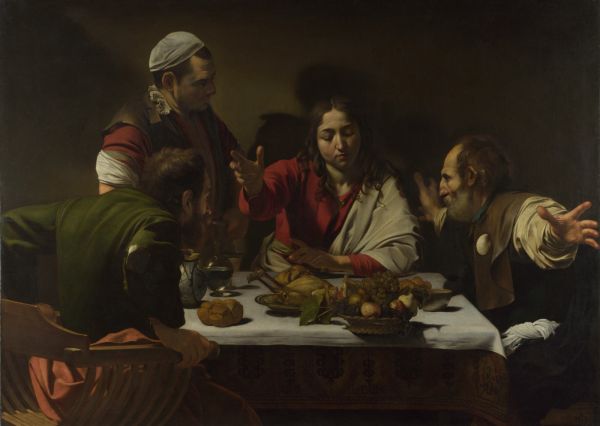
‘The Supper at Emmaus’.
a painting by the Italian Baroque master Caravaggio,
completed in 1601, and now in the National Gallery in London.
*
I keep returning to Lionel Shriver’s ‘We Need to Talk About Kevin‘ (2011). The family keeps the house immaculate, the table set, the conversation civil—while something unthinkable is happening in the next room. No one is exactly lying. They are simply organized around not looking.
I have sat in rooms like that. The shrine was beautiful. The teaching was profound. The teacher was revered. And in the corner was the thing no one would name: the group’s own hunger for status, safety, and a story that made it special. It took me years to understand that the beauty and the coercion weren’t opposites; the beauty was the camouflage. I stayed longer than I should have because the beauty made me doubt what I was seeing.
When we look at the crisis of esoteric and spiritual institutions today, we are having a version of that conversation. The scandal, when it finally breaks, is not the disease. It is just the smell that finally escapes the room.
So what is the body in the living room of a spiritual order?
The body is not the scandal itself. It is the psychological need that produces it. And that need is precisely what the prevailing narrative misses. We are told the crisis is betrayal—corrupt leaders, financial abuse, a departure from the founders’ vision. But this is a diagnostic error. The crisis is not that these orders have betrayed their founders, but that they have remained hyper-faithful to a deeper, lesser-visible psychological structure: the conversion of transcendence claims into mechanisms for psychological defense and social reproduction.
That need has a shape: the need for someone else to carry your authority, and for the group to confirm your specialness.
Bo Yin Ra captured it perfectly in a story called ‘The Deviant Pupils’.
A master gathers pupils in a great city. Over time, three distinct groups emerge. The first meticulously collects the master’s words, memorizing them until they forget the words aren’t their own. The second listens with open hearts, but uses the teachings merely to lend structure to their lives, never developing a spine of their own.
Then there are the deviants. They let the words sink into the depths of their souls, but ultimately follow their own inner inspiration. A new way of knowing rises within them. It struggles with the master’s original teachings, but ultimately triumphs, bringing his insights into a vital, living form.
Naturally, the city rejects them. “Shame upon these deviant pupils!” they cry. “They cannot comprehend the sage’s teachings, and so his wisdom has deserted them.”
Years later, strangers arrive seeking the master’s wisdom. They find the first two groups hollow. But when they meet the deviants, their hearts are set on fire. They take this living doctrine home, where it flourishes.
But back in the master’s city, the original community cannot accept this evolution. Astonished, they pool their resources and send a ship to bring back a ‘great teacher’ from afar. They find a man willing to come for a large reward—someone who hasn’t fully understood the newer teachings at all. When this paid impostor arrives, the city rejoices. “Only now do we completely understand the Master!” they declare. And that remains their unshakable conviction.
What the city couldn’t see was its own need—a need that felt like devotion, felt like loyalty. The problem wasn’t the deviants; it was the city’s desperate need for a hierarchy it could control. And because it was invisible, no amount of correct teaching could fix it.
Notice what the parable reveals: the order didn’t die when the master died. It survived, but as a psychological structure, not a spiritual one. The city didn’t need the master’s wisdom; it needed his position. It needed someone to fill the slot. That is the moment the order stopped being a vehicle for transcendence and became a machine for reproducing itself. This isn’t unique to spiritual groups. Corporate dynasties do it. Political machines do it. Any institution that outlives its founder faces the same choice: serve the mission, or serve the structure. Most serve the structure.
The engine that stops the individual from breaking this cycle is what I call the magical mind. In a spiritual group, the magical mind is the ego’s way of using sacred concepts to bypass actual psychological growth. It stops you growing because it hands your authority to someone else.
If your awakening depends on the guru’s ‘transmission’, the ‘energy’ of the room, or your position in the silsila—the chain of succession—you don’t have to face yourself. Awe becomes a substitute for introspection. I’ve watched brilliant, capable people surrender their critical thinking because they believed the teacher’s mere presence was doing the work for them. It is the ultimate spiritual bypass: the ego doesn’t need to be integrated; it just needs to be spiritualized.
This is where two kinds of hierarchy diverge. One is real: the authentic spiritual hierarchy, based on the depth of one’s ego-dissolution and capacity for service. It is fluid, and often invisible. The other is the magical hierarchy: based on perceived esoteric rank, proximity to the teacher, and the accumulation of ‘spiritual powers’. The first is a byproduct of growth. The second is simply the ego in disguise, using the vocabulary of transcendence to secure its own dominance. The magical mind prefers the second because the second can be gamed.
Once the magical mind takes over, the group needs a new fuel: status.
This is where the sacred aims of the order get hijacked by the paperwork, politics, and networking required to keep the institution alive. The pursuit of transcendence quietly becomes a social elevator. Members get driven by a hunger for recognition, seeking validation, titles, and proximity to power.
You see it when a wealthy donor suddenly gets private access to the teacher, while a sincere, struggling practitioner is told to ‘wait their turn’. You see it when original duties of service mutate into the power of domination. The spiritual mission is subordinated to the institutional need. The structure becomes an end in itself—a phantom order that consumes the very life force it was meant to channel.
And once status becomes sacred, prejudice becomes useful.
Because the group is so focused on defending the hierarchy it has made sacred and reproducing its social structure, it fails to interrogate its own cultural shadows. We see this in the endless, very real scandals of racism, sexual harassment and misogyny in modern spiritual groups. But treating these prejudices as the root cause is a mistake. They are just the exhaust fumes.
Because the group relies on magical thinking, it inherently preserves archaic shadows. A woman’s insight is praised in private until she starts teaching publicly, at which point she is suddenly deemed ‘out of alignment’. A teacher’s cruel, demeaning remark is reframed by the inner circle as ‘crazy wisdom’ or ‘cutting through ego’. Prejudices are re-coded as sacred distinctions. The group maintains its hierarchy while convincing itself it is serving a higher purpose.
So how do you know whether you’re inside such a group?
You don’t need a diagnostic manual to spot the dysfunction at work. Over the years, I have learned to ask four questions of any group to see if the magical mind is running the show:
- How is status measured? Is it determined more by how close someone is to the central figure than by their actual ethical maturity? The inner circle isn’t necessarily the wisest; they are just the most compliant.
- What happens when someone disagrees? Is constructive criticism routinely reframed? When a member asks a pointed question about finances and is told they have ‘karmic blocking’, the leadership is immunized from accountability.
- How does the group handle bad behavior? Is there a high tolerance for toxicity among its ‘advanced’ members? When a long-time devotee is treating people terribly, but the group just calls it ‘burning off karma’, the group is bypassing the mundane.
- Where is the energy going? Is the leadership’s primary focus on preserving the rituals, the brand, and the legacy of the order, rather than actually facilitating the psychological growth of the members?
The way out is not a better institution. It is the refusal to outsource your soul.
True reform of a spiritual community cannot happen by just updating the surface institutions or painting over the rot in the living room. It requires dismantling the magical mind’s defenses. It requires doing the unglamorous work of facing what you’d rather not see.
And it means understanding why surface reforms so often fail. You can update the code of conduct. You can add a diversity initiative. You can paint the living room a new color. But if the root—the unconscious need for the phantom order—isn’t addressed, the symptoms don’t disappear. They mutate. They become more hidden, more subtle, more deniable. The blindspot doesn’t close; it just learns to hide better.
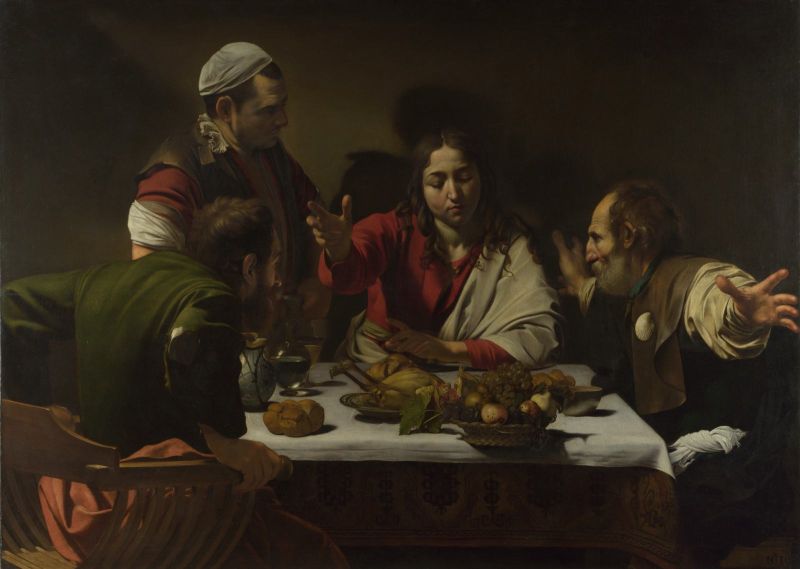
The family in Shriver’s novel never says the body is there. They just keep arranging the furniture. Spiritual orders do the same. They miss the moment of recognition. Think of Caravaggio’s ‘The Supper at Emmaus’—the truth was sitting right there at the table, but they couldn’t see it until the bread was broken. Most spiritual orders never get to that moment. They just keep rearranging the chairs.
The way out is not a better institution, a new teacher, or a more beautiful shrine. It is the refusal to outsource your soul. As the deviant pupils understood long ago, the wisdom is not in the city, the teacher, or the ship. It is in the struggle of your own soul.
Nicolas Lecerf,
September 14, 2026.
***
Leave a Reply