
Circle of Transmission: The Living Loom
A Little Bāyazīd Bisṭāmī Sampler – Part 1: A Contextual Introduction by Abdelwahab Meddeb
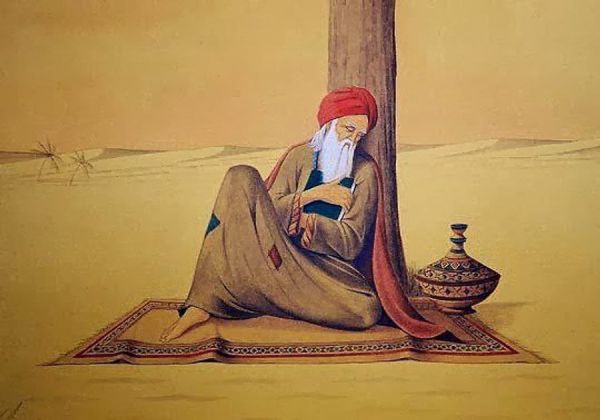
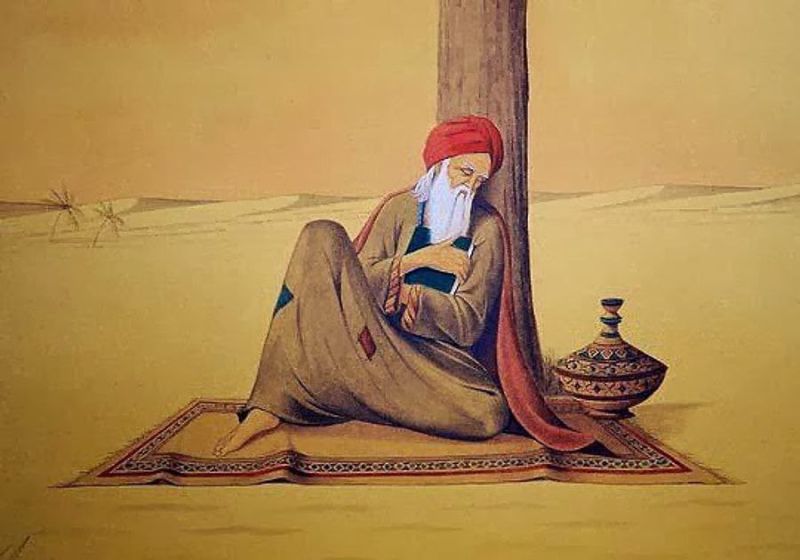
A popular representation
of Bayazid Bistami
*
Today’s sharing from the Blue House of Via-Hygeia is part 1 of a planned series devoted to the memory of Bayazīd Ṭayfūr bin ʿĪsā bin Surūshān al-Bisṭāmī (804 CE-874 CE), commonly called Bāyazīd Bisṭāmī (or Bāyazīd Basṭāmī, in the Iranian world).
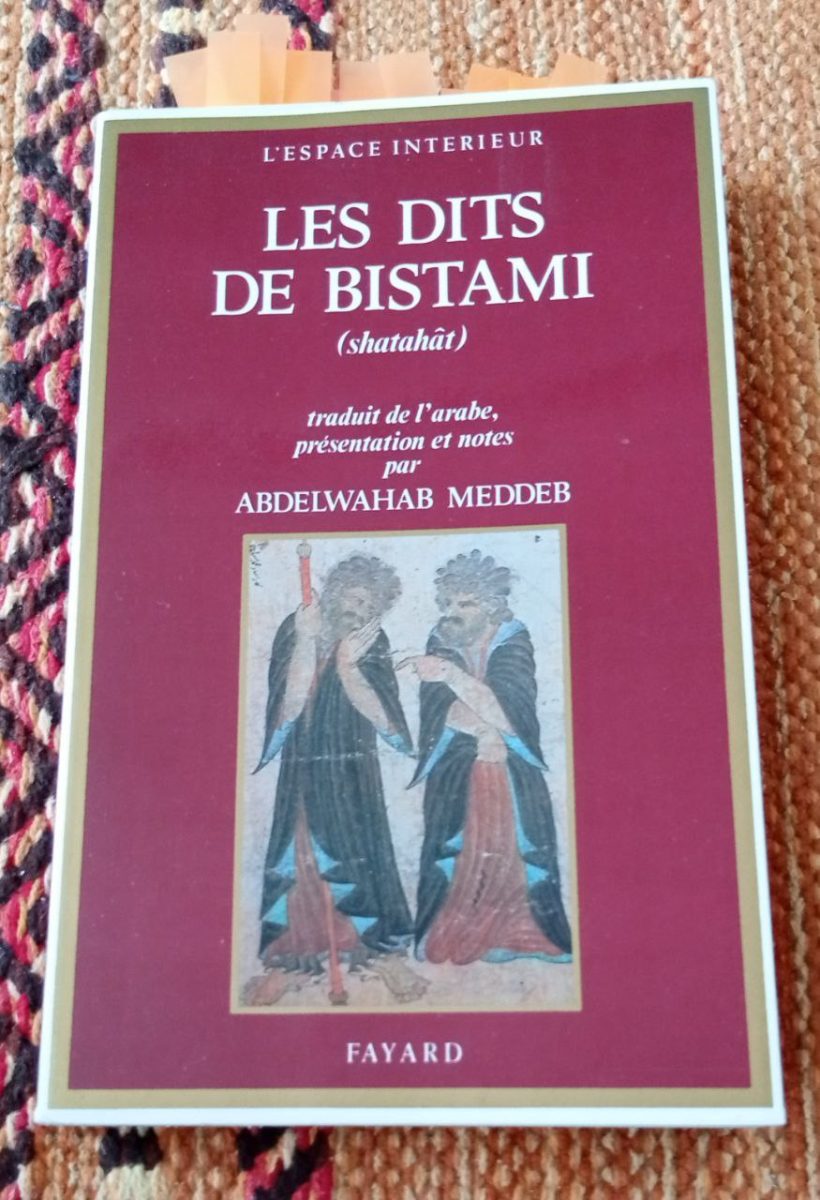
We open this series of posts with the contextual introduction written by Tunisian-French scholar & professor, Abdelwahab Meddeb, for his French edition & translation of the ‘Shatahat‘, or ‘ecstatic utterances’ (شطحات šaṭaḥāt) attributed to Bāyazīd Bisṭāmī published in 1989, by Editions Fayard in Paris, as ‘Les Dits de Bistami‘. A Via-Hygeia English translation from the French. From page 09 to 23. Finally, the below appendix offers a small biographical movie written and directed by İsmet Yazıcı for TRT Nostalji.
In our forthcoming part 2, we will start sharing our selections from the ‘Shatahat‘.
**
‘The Lonely and the Lure’,
by Abdelwahab Meddeb
-In Memoriam-
Bāyazīd Bisṭāmī was born and lived in Bistam, a little city of the province of Qumis. Situated in a huge valley at the feet of the Alborz mountains, Bistam is part of the Tabaristan, south of the Caspian Sea, on the marches of the Khorasan and the Iraqi province of Rayy, at the northern extremity of the Great Desert. Despite a few banishments-seven are counted but we ought to minimize their importance-a pilgrimage to Mecca through Bagdad, and a few travels in the region-of which one led him as far as Balkh and beyond upon the banks of the Oxux river, Bāyazīd Bisṭāmī would have lived the core of his life in Bistam. As a matter of fact, he advocated a sedentary lifestyle and rejected wandering. ‘The initiate does not travel; places, men and things come to him wherever he is to be found‘.
Shahrushan or Surūshān, Bisṭāmī’s grand father-a Zoroastrian by birth-was the first in the family to convert to Islam. His son, Issa, a de facto Muslim by birth, was one of the ruling figures of Bistam. Like all of the cities of Iran at the time, Bistam was divided in quarters, some populated by natives who remained faithful to the religion of the Magi, and some in which Arab & Muslim colonists would gather. Born, educated in the quarters of the Magi, he would eventually move to the Muslim quarters, in which he preferred to frequent a tiny mosque standing not far from the huge cathedral-mosque that was built afterwards. In this tiny mosque, a ‘divine inspiration‘ made his Arab neighbor Wafid offer him to pray in the hayloft. As soon as the tiny mosque was extended, Bisṭāmī built his own hut (cawma’a) for his own retreats.
Though the subject of discussions, the question of his education is not essential. Bisṭāmī developed very early a taste for independence. He was a solitary seeker. A Hanafi Sunnite (a denomination quite spread at that time in the region of Bistam), we still do know that he was initiated to ‘the science of Unity‘ (‘ilm at-tawhid) by his friend Abu Ali Sindi, to whom in exchange he taught the tenets of Islamic Law. His friend’s name, Sindi (Sind: India) displays very well the Indian colors that were blended with Zoroastrism & Islam and into the bilingual usage of Persian & Arabic, showcasing Bistam as a center of this blend of cultures, quite natural, once we penetrate Central Asia.
It is said that Bisṭāmī was illiterate, that his dogmatic training was insufficient and was a contrast to his esoteric mastery. Eventually, he did not leave behind some writings. Though, the popular tradition attributes to his figure some five hundred ‘Shatahat‘, or ‘ecstatic utterances‘ (شطحات šaṭaḥāt). And the monography Sahlaji devoted to him in the tenth century-the main source for our book– uses, by reporting his sayings and deeds, the same genealogy of transmission (isnad) that was invented by the founders of the science of the Hadith (the words and deeds of the Prophet). Even though, mentioned briefly, the reliability criteria are similar: It is asked that the transmitters have a proven, recognized and truthful origin.
It is estimated that the first collection of the sayings of Bisṭāmī, was made by Junayd of Bagdad (died in 911). It was collected through the intermediary of the most privileged transmitter, Abu Musa, the nephew & favored disciple of Bisṭāmī. This Abu Musa would have dictated to Junayd the sentences of his uncle & master in Persian, and Junayd would have translated them into Arabic and commented them.
Beyond the historical and archeological proofs, beyond the doctrinal coherence, these sayings are authentic through their material. In them, are embedded the truth of Bistam, as a place. We meet Magi & Muslims, Arabs & Persians. The quotations in Persian and Iranian atavisms are scattered throughout the text. The occasional wandering of the syntax would denote a second language. This transcribed word brings to the language an astonishing and juvenile freshness. To have blended speech with writing avoids the rhetoric that would be destructive in other contexts. It is moving to find in these ancient saying some poetical and inventive accents of the contemporary illiterates, lively in they talking, words that our mothers and grand mothers, the last witness of an old age our century is erasing.
These texts remain concordant with the common values and references: their adequation to Islamic mythology and its recurrent figures. The audacity and freedom only overflow and deconstruct, but within the perimeter of these references. There is a tendency to forget about this, so I am reminding it here.
By following up the genesis of the images, we meet the paradoxes of the climate and of the place. The surrounding mountain exhibit on it peaks eternal snow. The desert and its heat are neighbors. Winter deploys its roughness, summer its harshness. We go from intense cold with plains filled with snow to the dusty heat and drought. Some times, the wind rushes in the valley as eager to punish, and some other times it would blow as eager for reconciliation. The gardens, in their shimmer, embody an illusion in this hostile environment. The shadows, the trees, the fruits, the rustling of the river or the gutter; so many bucolic signs are seized by Bisṭāmī’s speech, who through the association of the name alone, has entrusted his birth-city to the highest memory. Outside of him, there is no doubt, besides its fertile gardens, who would have mentioned such a place?
Nicknamed the ‘sultan of the initiates‘ (sultan al-arifin), Bisṭāmī is considered as one of the greatest figures of Sufism. The most ancient treatises offer him a place of choice. He is recognized and commented even by those who do not share his opinions. Junayd, who teaches an opposite theory based upon sobriety (çahw) says: ‘Bisṭāmī is among us like Gabriel among the angels.’ His tomb, has always been a popular destination with pilgrims & visitors. A place with a benevolent reputation. Hujwiri (died in 1072) lived there in order to seek to decipher the enigma of a vision that was tormenting him. Having glanced at the mausoleum, and approaching, the Sheykh Abu Sa’id ibn Abi Al-Khayr said: ‘Here you can find everything that you have lost‘, and after having contemplated inside the building: ‘Such is the place of the Pure; even Evil itself cannot enter here.’ The name Bisṭāmī (who is rumored to never have left Iran’s deep belly) continues to watch over many sites. Mausoleums revive his souvenir as far as the valley of the Nile, or the open western ranges of the Maghreb.
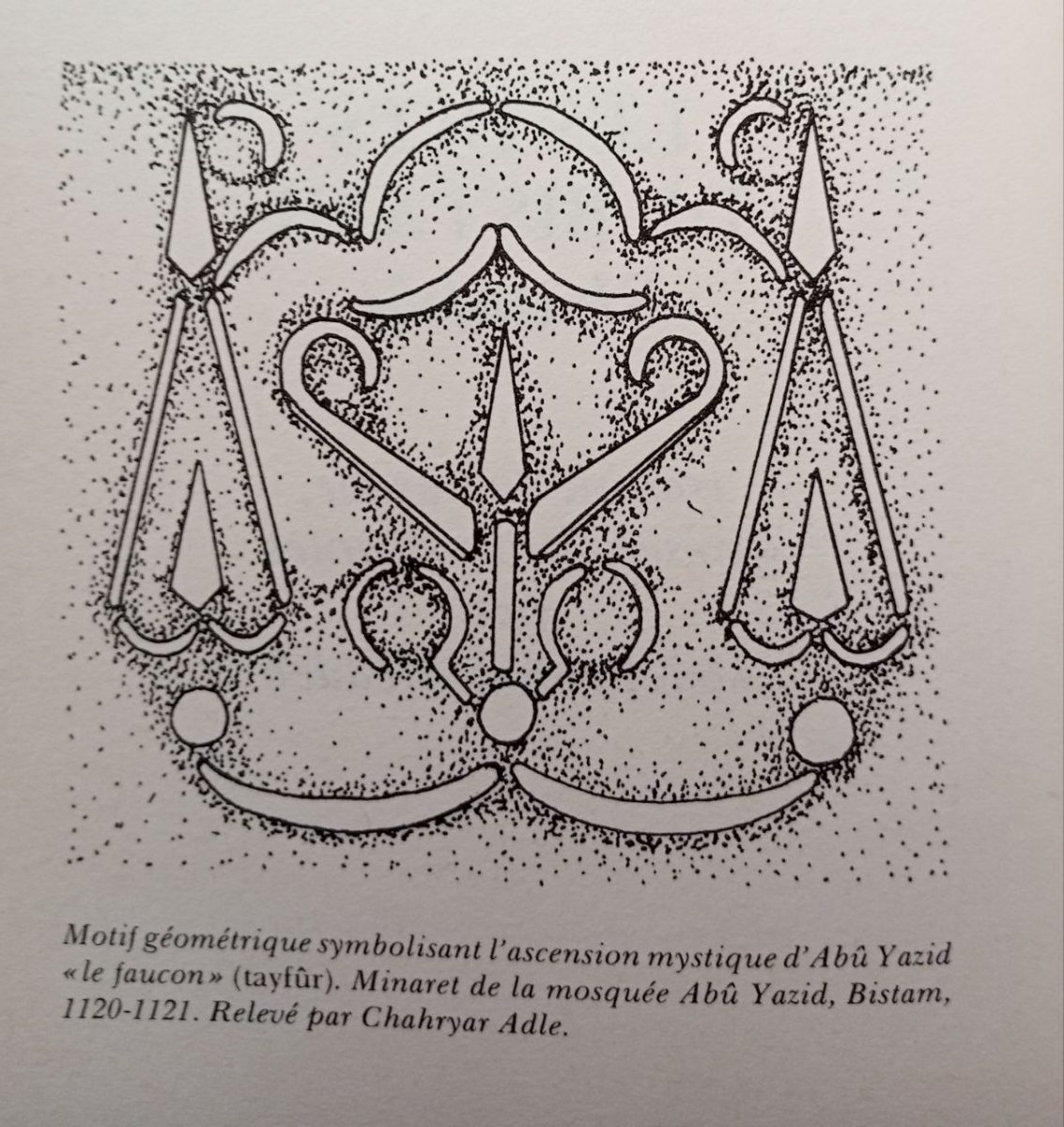
He is the fore-runner of the Malamatis, the ‘people of the blame‘, followers of the school founded by Hamdun ibn Qaççar (died in 885), who affect a scandalous appearance to hide their piety and chase people away. They would hence benefit from the absence of prestige and from solitude. This principle of solitude is recommended by Bisṭāmī to his direct disciples. He asks from them, in fact, to abandon all company and to orientate their lives towards a life of seclusion. These disciples, to whom he taught, are called ‘tayfuris’. a word that comes from one of the names of Bisṭāmī, Tayfur, which in Persian means : Falcon.
In imitating their master, the tayfuris put forwards, intoxication (sukr). Within Sufism, agreat debate is debating the followers of intoxication and the followers of sobriety. Hujwiri’s teacher- who was a disciple of Junayd said: ‘Intoxication is the playground that children frequent, while sobriety is the vast space treaded by men‘. Is there a need to reduce these words uttered in such path to the irresponsibility of children & of Intoxicated man? We ought not to forget that such a path elevates our aspirations towards astonishing heights. Eagerness feeds the energy of the word at the border of blasphemy. The spiritual adventure must be lived to the limits, at the peril of impiety. To the lukewarm, the indolent, the reductionists, the lovers of certitudes is abandoned the adhesion to a tranquil faith, without the bitterness of the issue.
Ibn Taymiyya (died in 1328), even though being the fierce critic of the Sufis-assimilating them as re-incarnationists-ceased the debate about ‘irresponsibility due to intoxication‘ to actually exonerate Bisṭāmī, who is placed respectfully by him into the category of the Perfects (al-açıhha), whose excesses are the fruit of the ‘annihilation of the self‘( fanāʾ ), the absence of oneself to oneself. Extasy, which is a the border of intoxication, does not comply with discernment. According to Ibn Taymiyya, again, such sayings ( as said above, the ‘Shatahat’, or ‘ecstatic utterances’ , شطحات šaṭaḥāt) must be sealed; they cannot be circulated; nobody has the right to transmit, spread or report them. Such a call to circumspection manifests the fear by those who have crossed and dwell on the other bank of the river; those who resonate in echoying words from the outer-world, poetical & metaphysical testimonies of the transfiguration which rises the person, and of which sublime scraps cannot be associated to the stammering of a person who stumble upon the field of the loss of the senses & of consciousness. In the words of those who are not-fooled, there is a tonality which is resembling to the edifying grace of non-knowing, as it may blossom upon the lips of children and saints. But hearing that receives & memory that preserves are of a Man who has reached a cynical maturity, though innocent.
Do we have to remind that the question of intoxication is linked to the phenomenon of the Shath, the utterance (plural Shatahat), of which Bisṭāmī is the founder? Without evoking the diachrony, which like in all the great discoveries, is limpid, will I wander to propose a French equivalent to the word Shath? Not that the task is impossible (our translators’ condition is to flutter from one language to another, at the risk of experiencing vertigo!), but why add to a repertory already thick? Every proposition cease a facet and suggests in its wake an interpretation opening to a perspective. What could be added to Shath, perceived as idiom, a colloquy, an ecstatic, divine or theophanic language, an inspired or a double-meaning saying, paradoxical, excessive, or is it a pious blasphemy, or also an ecstatic divagation & other hybrid sentences?
What about the phenomenon itself? Before becoming a technical term, the word Shath in Arabic meant the movement that produces excess. Two images illustrate this: The grain mill, which by turning, let’s the grinded grain overflow; and the river, of which its narrow bed, cannot contain a bigger capacity of water and overflows upon the banks. Likewise are the ecstatic, in whom the mysteries move intensely and unable to contain themselves in the luminous inner tension, their ecstasy overflows and make their tongue to translate in strange, shocking and paradoxical expressions. If the Shath was an unconscious and obscure speech, it would only represent another Pythic discourse, a supplementary avatar of Enthusiasm.
To declare that such ecstatic sayings escape the command of consciousness diminishes their impact. They would not be the manifestation of the divine in the human being. If it would be so, the relationship would be passive. But, God is a person. The initiate is another. If one wants to speak to the other, the speaker achieves another status. The ambition to be of this subject requires a revalorization of the pronoun. Under the pretext that it is the self that disappears, it dismisses the Other, and we occupy His place. Bisṭāmī would have been the first to cross this threshold and to say ‘I’, in attributing the means of the Great Other. He erases the quotation-marks, he does not quote. He does not sacrifices his signature, and does not content himself to the the recorder. It is him, in person, that emits as creator of the word. This incursion in the field of the Powers of the Other allows to express ‘the pride of oneself‘. Bisṭāmī achieves the desire to be what he could not. This operation is nothing but a challenge that shakes the structure of belief. Of course, such conquest is of a short span. The return to common language and to the human condition is lived as an exile. And the moments of transfiguration are redeployed in the lucidity of irony. The argument of the ravishing & the disappearance of the self is bound to restrain the magnitude of the scandal.
In the relationship of the person with God, the questioning about the pronoun lives on. In the Shath, the appropriation of the first person is unilateral & impermanent. In the intimate dialogs & the confidences (munajat, gentle, whispered prayers that soothe the tired heart), the pronoun is at the heart of the debate. God speaks to the person through the intermediary of the pronoun of the second person, and to the person who is addressing God with the same means. This equivalence troubles the hierarchy. There is no point for God to propose to the person to dwell in the same pronoun. As soon as we are two and that one speaks to the other, the sharing of the pronoun is validated. It seems that the person fore-sees the equality such a sharing implies. In order for the fusion to be achieved, one of the two terms must disappear. The negotiation is bitter. It happens that the person let’s himself be convinced. He would like to agree. At the moment when the agreement is arising, at the moment when one agrees to fuse into the other, the game of the pronoun is resumed. God speaks of Himself using the third person in addressing the person who became Him. Here we have God talking about himself through this third person, as if in the need to confirm the invocation of a third person. It is Him in Person who validates what cannot be decided, in which His entourage had confined Him. The third person is it not the absent one? Is it not legitimate to doubt about its existence? Whatever, the third person renew the solitude of being even though that person would leave empty the space of the first person.
Shifting in turns from the fulgurating conquest of the first person to its reasoned denial, circulating freely between the big Me and the small ordinary me, Bisṭāmī, in his lonely posture in front of the radical Unity, postpones the fusion and maintains the separation and the division at the heart of the doctrine of Union. Such a division inhabits him. Bisṭāmī is split inside his person which is allowing multiple metamorphosis. It is not because of incapacity that he is not delighting in the union. He knows the path and can tread it any time he wants. But, what is acquired is not a lasting thing. From such easiness, he turns away from them. He is heroic in his demands. Re-boot is constant. In this experience of the alterity, the mean used is dual: power & love.
The address from one another is located in the royal stage. The throne and the crown are the accessories which represent Majesty and Magnificence. The relationship is courteous; curtesy regulates the gestures. The etiquette demands that we ought to be considerate in front of the Great-Might-ready-to-act. We admit its arbitrariness, its injustice and tyranny. Without neither troubling the ceremonial, nor tarnish it, the relationship may be familiar. It can be the relationship of the close courtier, of the confident, of the diner guest who shares intimacy, the private table, the pleasures of the Grand Master. One allows oneself even to share critics and to tease; one suggests and argues. The ethic of agreement projects, on both sides, its criteria. The sovereign yes does not abrogate the possibility to say no. We accept to be the subject of His Majesty, without lowering vigilance & control. Constraint & rigor rule the relationships. The swapping of the roles is plausible. Everybody knows this. The game of the pronouns is succeeded by the game of the actors; to grammar, acting and the stage. Everybody retains his role more to honor the rite, than to to allow fate to escape.
The pronouns also, we know this, obey to gender. And the love scene only greet the masculine gender. When it is me and you expressing themselves, the gender is keeping to itself. It is the third person (the absent) who affirms & reveals it. One speaks from masculine to masculine, without excluding the positive & the negative, the active & the passive. The feminine image, as such, does not participate to this desire. Bisṭāmī said that he is as indifferent towards a woman than as towards a wall. It is obvious, here, that the feminine image does not feed the metaphors of love. This specific point aside, Bisṭāmī deeply admires women. He grants them an alterity based upon purity than men cannot reach. And in his entourage, we meet women quite advanced upon the spiritual path. Therefore, the absence of the woman within erotic metaphors does not imply misogyny. But their revocation of the sexual economy is final. And the dramaturgy of the veil, of a female origin also, is abandoned to the sole usage of masculine protagonists. To sum up, the female gender is absorbed by man’s identification in his characteristics. It is as if Bisṭāmī was seeking to use his privilege in the place where female identity is blossoming.
In the Shath & the Munajat, we came closer to Christic notions of incarnation & hypostasis. As soon as God is imagined as a person, the rising of these notions is inevitable. But in this region dwells the Islamic un-thought. It is as a prophet who lived before Islam that the Qur’an uses the figure of Christ. The theory of sainthood in this religion proceed to a sort of ‘recapitulation‘ of all the prophecies. And the Muslim saint may be perceived as ‘Christic‘ within the Muhammadan belief. Such is Bisṭāmī’s case, of whom Ibn Arabi says that he acts upon the ‘Christic scene’ (isawi al-mashhad). Bisṭāmī restores the ‘pride in oneself‘ (Nietzche) in his behavior towards the All-Mighty as much as maintain humility, generosity and mercy in his relationships with others. And Ibn Arabi estimates that humility, a main distinctive feature of Christ, comes from the Mother. Perhaps it is like that with Bisṭāmī who does place his mother in a sort of veneration, often competing with God. Bisṭāmī’s humility spreads, alike Christ’s own, up to intercede in favor of his fellow human, whatever their beliefs or affiliations.
Bisṭāmī’s eagerness to carry the weight of universal guilt, his expiation of everyone’s sins, his strong allergy to evil, all this prompts him to first spot in him his own fault by maintaining a permanent introspection. He is eager to neutralize evil by bringing it forward into accountability and confronting it. Such vigilance leads Bisṭāmī to seek his first souvenir (assimilated to the first forgetting) by enquiring with his mother, Because sin is attached to being since the cradle, and the conscience which detects it watches over even during the earlier intra-uterine stay.
*
Stinginess has no place here. The gift of oneself is as integral as is it’s retrieval. Nothing is taken for granted, everything is but resumptions. The question of the Absolute remains indecisive, such seems to be God’s strategy Bisṭāmī promotes. Therefore, he is defiant of grace, of favors, of benefits, of rewards; he sees there only seduction, trickery, hidden aims, stratagems & deceptions. As glorious conquest may be, it is advised to break the term of the exchange, to refuse the logic of the deal, to strip oneself in order to return to the immutable loneliness without having been deceived or abused. The ‘marvels of the invisible’ may be but a decoy.

*
Source
*
*
Coming soon:
A Little Bāyazīd Bisṭāmī Sampler – Part 2:
Our First Selection from the ‘Shathahat’.
*
Appendix
A short biographic video by TRT Nostalji channel, writen and directed by İsmet Yazıcı.
***

Leave a Reply