
Circle of Transmission: The Living Loom
A Foundational Method for Studying and Translating the Chymica Vannus (1666)
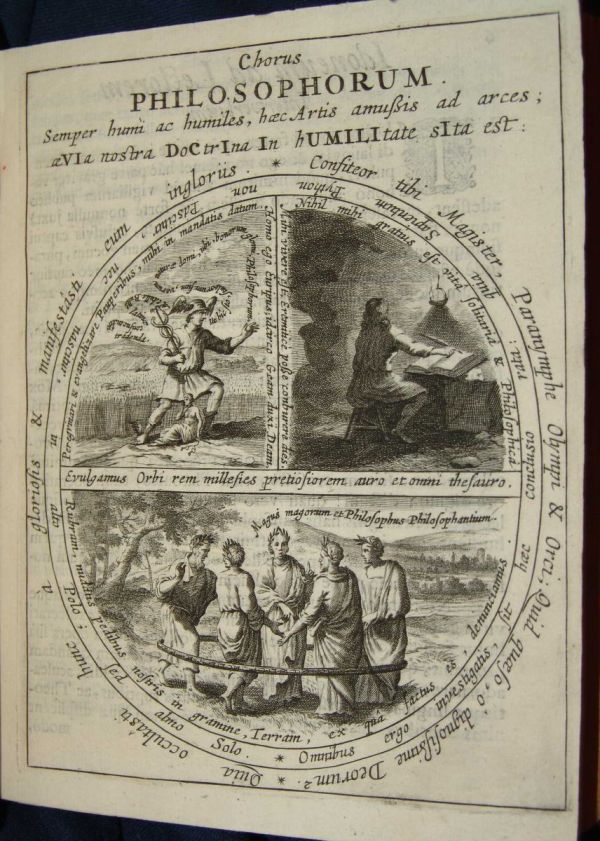
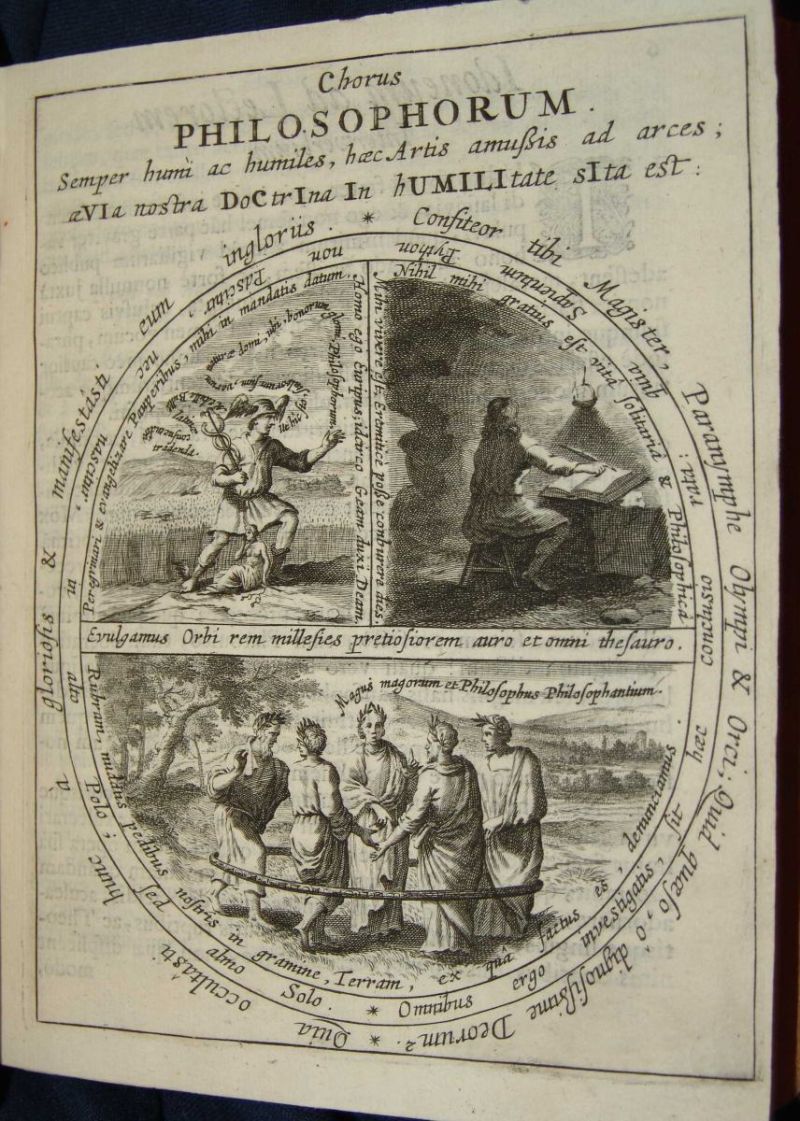
Featured illustration: Chorus Philosophorum (1666). The selectively capitalized inscription, aVIA nostra DoCtrIna In hUMILItate sIta est, yields the publication year, 1666, when the Roman-numeral-bearing capitals are extracted, with U read as V. Both modern Italian editions reproduce the original engraving, but neither preserves the selective capitalization in its translated wording. The numerical operation remains available in the image, while the translated sentence no longer carries the same typographical prompt.
*
Today’s sharing from the Blue House of Via-HYGEIA is our Circle of Transmission article: ‘A Foundational Method for Studying and Translating the Chymica Vannus (1666)’.
The Chymica Vannus—the Chemical Winnowing Fan—takes its name from an agricultural implement used to separate grain from chaff. In ancient Greece, the corresponding basket was known as the liknon. Beyond its practical use, it acquired ritual significance in the cults associated with Dionysus and Demeter. Virgil’s evocative phrase mystica vannus Iacchi (“the mystic winnowing fan of Iacchus”) preserves this sacred association and connects the implement with the religious world of the Eleusinian mysteries. The surviving evidence does not allow us to reconstruct its precise role in the secret rites, but it is clear that the ordinary instrument of agricultural separation could also acquire mistagogic significance. If this offers a model for reading, what is being winnowed when we encounter a difficult text?
This study explores a particular problem in the transmission of esoteric literature: a translation can preserve what a text says while changing what its forms ask the reader to do. A capital letter, an unfamiliar grammatical construction, an unresolved question, or a repeated phrase may require work that disappears when the text is made smoother. Conversely, a translation may preserve an unusual form, retain an open question, or reproduce a visual arrangement without supplying the explanations a reader might expect.
Through a comparison of the 1666 Latin Chymica Vannus with the Italian editions published by Archè and Ibis, this article examines several such points of resistance. The findings are not uniform. Some features survive translation remarkably well; others receive explanatory glosses, change their formal presentation, or demand different kinds of effort from the reader.
The resulting picture is more interesting than a simple opposition between faithful and unfaithful translators. Our governing principle is straightforward: Do not preserve uncertainty that the evidence has resolved, and do not resolve uncertainty that the evidence has not resolved.
**
1. The problem: when a smooth translation silences a question
Modern translations of early modern alchemical texts can preserve propositional meaning while suppressing operations that depend upon typography, visual arrangement, lexical ambiguity, or the manipulation of the signifier itself.
This is not necessarily a fault of the translator. An unfamiliar expression may invite correction; an obscure reference may benefit from a note; a visual feature may seem incidental to the sentence. Such interventions can make a text accessible and may sometimes be indispensable.
The difficulty begins when the intervention becomes invisible. The reader can no longer distinguish what the source presents from what the translator has supplied, resolved, or removed.
The question is therefore not whether translation changes a text. It inevitably does. The question is whether those changes remain accountable to the evidence.
The Chymica Vannus, published in 1666, offers a particularly fruitful setting for this inquiry. Its title evokes an instrument of separation, and its preliminary matter draws attention to the demands placed upon the reader. Its resistance is not reducible to concealment. Some passages invite a demonstrable operation; others sustain ambiguity; still others draw the reader back into a network of images and repetitions.
We must distinguish these phenomena rather than assume that every difficulty conceals a cipher.
The present study is a case-based examination of selected textual nodes, not an exhaustive census of every divergence between the editions. Its purpose is to establish what the page presents, distinguish that evidence from interpretation, and examine what happens when the work passes through successive acts of translation.
The contribution of this study is therefore methodological: it offers a way to examine alchemical texts and their translations that distinguishes the material evidence of the page, the operations it permits, the interpretive questions it raises, and the editorial decisions through which these are transmitted.
*
2. Three modes of readerly labor
Three modes of readerly labor help us describe the encounter with the Vannus.
Labor-as-operation is the physical, visual, or formal manipulation of a text. The reader calculates a chronogram, attends to selective capitalization, or recognizes a pattern embedded in a line of verse. The question is whether a proposed operation can be demonstrated from the printed evidence.
Labor-as-interpretation is the sustained discernment required when a passage presents an ambiguity that cannot immediately be settled. The task may be to keep several readings open rather than rush toward a single explanation.
Imaginal labor is the work of returning to a text as its images and repetitions acquire new significance. It is not a hidden mechanism that can simply be decoded. Its evidence lies in the way a work’s parts call one another back into view.
These modes overlap, but they are not interchangeable. An operation can produce an interpretive question; an ambiguity can send the reader back to the page; a recurring image can transform the significance of an earlier passage.
For the purposes of this study, textual resistance can also be considered under three broad headings:
- Procedural resistance: a feature that may solicit a formal operation.
- Interpretive or affective resistance: a difficulty whose meaning or function requires discernment.
- Transmission resistance: a feature altered, normalized, or otherwise transformed as it passes between textual witnesses or editions. The term is used here for changes in transmission, not as a synonym for every difference between a source text and its translation; the relevant alteration must be identified in the particular case.
These categories describe the problem, not the author’s intention. A formal anomaly does not automatically prove that an operation was deliberately designed. Nor does a reader’s experience of difficulty establish that a secret was intended.
Two further terms will guide the discussion. Decipherment denotes an evidence-backed operation whose result can be demonstrated. Unveiling denotes a participatory process in which meaning develops through sustained attention and return.
The distinction protects us from two opposite errors: treating everything as a cipher, or assuming that whatever cannot be decoded may mean anything at all.
*
3. The author’s own words: ‘Idoneum ad Lectorem Interverbium‘
The strongest historical anchor for this approach lies in the preliminary matter of the 1666 edition, under the heading Idoneum ad Lectorem Interverbium.
The author rebukes readers who readily condemn whatever they do not understand:
Sunt enim aliqui tam scioli, tamque præfracti, ut omnia, quæ ipsi nesciunt, vel non sentiunt, facilè prædamnent…
“For there are some so ignorant and so obstinate that they readily condemn everything they themselves do not know or understand…”
The passage continues by criticizing readers who behave as though they ought already to have encountered everything that may lie hidden in the extensive field of Latin literature.
The author’s position is not that every obscure expression is necessarily meaningful. Rather, unfamiliarity alone is insufficient grounds for condemnation. He also acknowledges the usefulness of glosses, creating a revealing tension between assistance and independent judgment.
The reader is neither abandoned to every difficulty nor entitled to dismiss one merely because it resists immediate comprehension.
This matters because the relationship between unfamiliar language, interpretive judgment, and readerly effort is not simply imposed upon the Vannus by a modern theoretical framework. The author himself makes the reader’s response to difficulty part of the work’s subject.
*
The book as a woven structure
The Argumentum Operis describes the work as a woven web, a telam, formed from three threads, or fila:
- Præludium
- Sortes Sibyllinæ
- Granum Erutum
The metaphor provides a structural counterpart to the winnowing fan. The work is not simply a sequence of statements. Its different textual modes are interwoven, and the reader must move among them.
The Argumentum articulates a paradox of the wrapped and the naked. The Art is described as brief, light, linear, and simple, yet matter presented crudely and nakedly may be held in contempt. The parabolic covering is therefore not merely an obstacle to understanding. It is presented as part of the conditions under which understanding becomes possible.
The author names the labor expected of the reader: accuratissimè omnia perlegeret — to read everything with the utmost care. He invokes Tiresias as a figure of blindness and describes devotional and chymical materials as interwoven so that the eye continually returns to Chymistry.
The structure also has a history of transmission. The 1666 Latin text identifies itself as a rendering from German into Latin. The Latin witness is itself a translation, and its author’s defense of his language belongs to a longer history of linguistic mediation.
We are therefore not dealing with a simple passage from an uncontested original to a series of derivative translations. We are dealing with a relay in which the work’s forms and difficulties have already passed through a linguistic transformation.
This is the conceptual spine of the book. The cases that follow are individual points at which readerly labor is retained, redirected, assisted, or partly displaced.
*
4. The collation: where the work survives translation
The comparison distinguishes the 1666 Latin from two modern Italian branches:
- Archè: Ercole Quadrelli’s Italian translation, associated with the Abraxa–Tikaipos publication tradition.
- Ibis: the Moggia–Verginelli translation, published in 1999, followed by Giovanni Sergio’s 2023 English edition, which derives from the Italian rather than translating directly from the 1666 Latin.
The cases were selected to represent distinct forms of textual resistance encountered during the collation: visual and numerical operations, the relationship between image and explanatory apparatus, the preservation or transformation of verse, lexical and grammatical anomalies, and the retention of unresolved questions and verbal paradoxes. They are not intended as a statistically representative sample or as a ranking of the translators’ fidelity. Their purpose is comparative: to examine how particular editorial decisions redistribute readerly labor across different textual situations.
These branches must not be treated as interchangeable witnesses. Each finding below concerns a particular passage and the editorial choices established in the collation. Page references are supplied where the collation notes establish them; no page number is inferred where it has not been verified. This is a selective comparison, not a page-by-page census, and the page references should be completed from the copies used before a formal scholarly edition is prepared.
*
Case A — The ‘Chorus Philosophorum‘: the chronogram
The Chorus Philosophorum engraving bears the inscription:
aVIA nostra DoCtrIna In hUMILItate sIta est.
The selectively capitalized letters invite attention to characters that also serve as Roman numerals. Reading U as V, the extracted values sum to 1666, the year of publication.
This is a demonstrable operation. It depends on the visual arrangement of the inscription, not simply on its sentence-level meaning.
Yet a distinction remains necessary. The numerical result is demonstrable; the claim that the arrangement was deliberately designed as a chronogram is an interpretation. The former does not, by itself, prove the latter.
Both Archè and Ibis reproduce the original engraving. The visual prompt therefore remains available in both editions. Both also provide Italian renderings of the accompanying words, but neither preserves the selective capitalization in the translated wording.
The result is a precise distinction between image and translation. The reader can still perform the numerical operation by attending to the engraving, but the translated sentence no longer carries the same typographical invitation.
This is a strong example of labor-as-operation. It also shows why the loss of a feature must be described at the correct level: the operation is not erased from the page as a whole; it is absent from the translated wording.
Finding: both editions preserve the visual source, while the chronogram is not reproduced in their Italian sentence-level renderings.
*
Case B — The ‘Emblema degli Adepti‘: the spherical cross
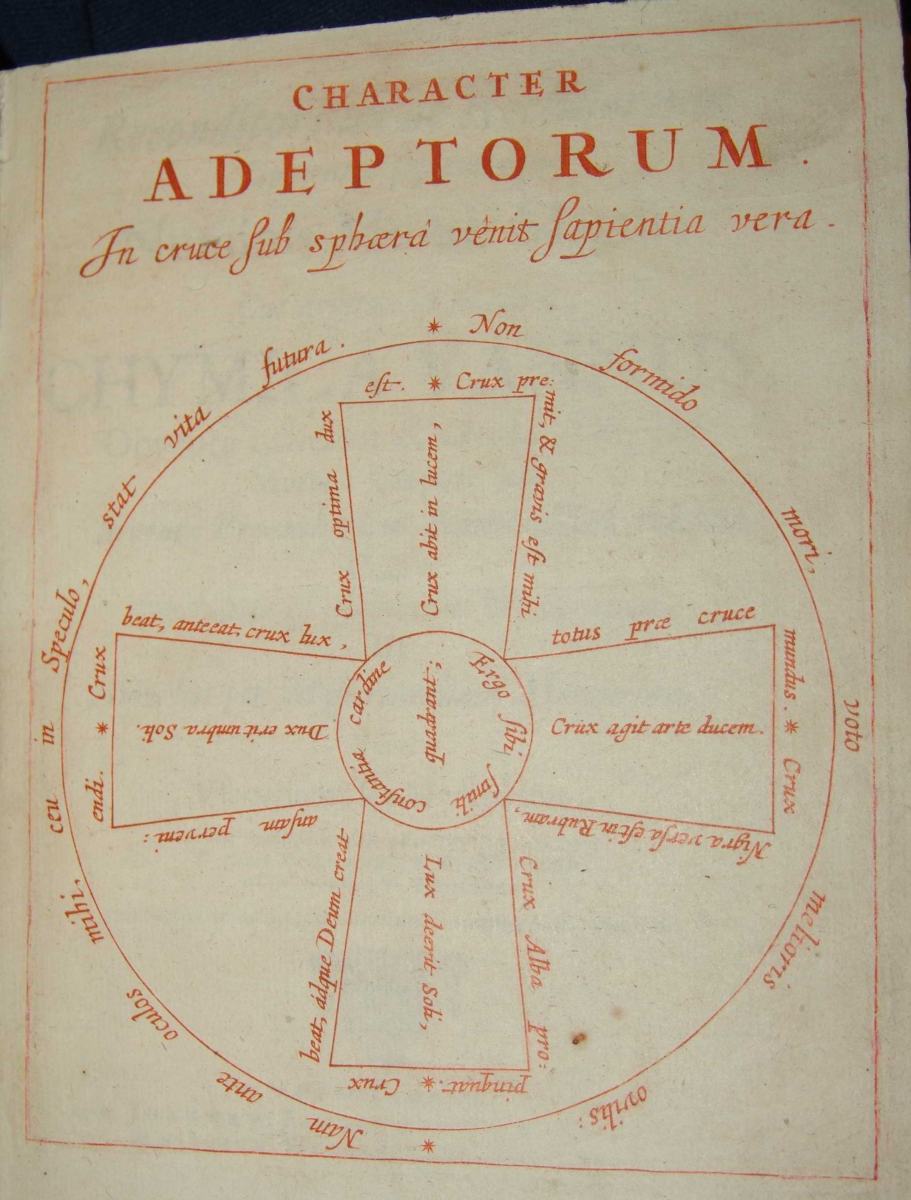
The Character Adeptorum presents a spherical-cross engraving accompanied by Latin inscriptions and explanatory material. Its spatial arrangement is part of the textual evidence: the reader encounters a figure, not merely a verbal description of one.
The Archè edition reproduces the engraving and provides an Italian translation of the accompanying Latin text, including the explanatory sections A–D. The reader can consult the visual arrangement while following a translated account of its parts.
Ibis also reproduces the engraving, preserving the Latin inscriptions in the image, but does not translate the Latin lines into Italian. The reader retains access to the visual and verbal source but must perform the linguistic work independently.
The distinction is not preservation versus loss. Both editions preserve the figure. They differ in the assistance supplied alongside it.
Archè makes part of the linguistic and interpretive work more accessible through translation. Ibis leaves the reader to negotiate the Latin apparatus directly. In both cases the engraving remains available for inspection, but the conditions of access differ.
Finding: Ibis preserves the figure without translating its Latin inscriptions; Archè preserves the figure and translates the accompanying text. The difference concerns the allocation of linguistic labor, not the survival of the image.
*
Case C — The register-shift: verse preserved, difficulty explained
In the Latin couplet on page 7, the text reads:
Nemo pol Antimacho, nec tutior ibit Homero,\
Vellicat & magnas livida Parca Deos.
The couplet combines the oath-particle pol with an allusion to the Parcae. Its form and register contribute to its effect.
Both Italian editions preserve the passage as verse. The earlier suggestion that the couplet had been smoothed into prose does not hold.
Archè nevertheless adds explanatory material. It supplies a bracketed identification of the biting, malicious Athenian poet Theon and expands pol into Pollùce, naming Pollux.
The intervention clarifies the reference and makes the oath-particle more immediately intelligible. It does not erase the verse form.
This is a counter-case to the claim that translation necessarily destroys textual resistance. The formal structure survives, while selected difficulties receive assistance.
Finding: both editions retain the verse; Archè adds explanatory material. This is preservation accompanied by selective clarification, not flattening by loss of form.
*
Case D — The ‘Triumphalia‘: names embedded in the verse
The Triumphalia contains four capitalized names embedded within its lines:
- SICAMBER
- VENLOUS
- GELRIA
- VANNISTÆ
These are not arranged as a vertical margin acrostic. They appear within the lines, where their capitalization interrupts the ordinary flow of reading. The reader’s task is first to notice them.
The last name is particularly suggestive because Vannistæ recalls the title-word Vannus, the winnowing fan itself.
The Archè edition retains the embedded names in its Italian verse as SICAMBRO, VÈNLOO, GÈLRIA, and VANNISTI. Their capitalization remains visible. Archè also adds a footnote to SICAMBRO, offering possible identifications and naming figures associated with its interpretation. The same kind of gloss is not extended to GELRIA or VANNISTI.
The Ibis edition, page 38, takes a different formal approach. It translates the Latin verses into Italian prose, explicitly identifying the passage as a prose translation in its footnote. The numbered narrative sections remain, and the embedded names continue to stand out through capitalization: SIGAMBRA, VENLOA, GELRIA, and VANNISTI.
The comparison reveals two distinct editorial decisions. Both editions preserve the conspicuous names, allowing the reader to detect them. But Ibis changes the formal experience of the passage by converting the verse into prose, while Archè retains the Italian verse form and selectively explains one name.
The operation of recognizing the embedded names survives in both branches. The poetic structure, however, is not treated identically.
Finding: both editions preserve the embedded names; Archè retains verse and adds a selective gloss, whereas Ibis renders the poem in prose.
*
Case E — The ‘Paranesi dell’interprete‘: the Golden Muse
The Parænesis addresses the reader through a sustained criticism of obscure and labyrinthine writing. It challenges the authority of earlier philosophers and alchemical writers, repeatedly questioning whether their readers have genuinely understood what they claim to transmit.
The passage culminates in a repeated formulation:
Aurea muſa data eſt, non ad ſecreta premenda…\
Rebus at utendis Aurea muſa data eſt.
The Golden Muse is given not for concealing secrets, but for the use of things. The repetition turns the phrase back upon itself: the gold of the Muse is not simply a promise of hidden knowledge; it is also associated with use.
The passage invites interpretation because its language can be read against the familiar attractions of secrecy and the golden quest. Its force depends on keeping the two movements in view rather than allowing one to cancel the other.
On Archè page 34, the Italian reads:
Data ci è l’Aurea Musa, non già per enimmi occultare, ma per usar le cose data ci è l’Aurea Musa.
The repetition survives, as does the explicit contrast between concealing enigmas and using things. Archè preserves the central structure of the passage rather than reducing it to a simple declaration about secrecy.
Ibis presents the Paranesi on pages 39–41. Its own footnote explicitly states that the corresponding Latin passage is in verse, while the Italian translation is in prose except for the concluding part. This is a significant editorial disclosure: the change in form is acknowledged rather than concealed.
Despite this formal conversion, Ibis retains the Aurea Musa repetition and its contrast between concealing secrets and using things. It also preserves the embedded names GELRIA and VENLOA in the concluding passage, along with the repeated Qui clauses of the final litany.
The comparison is instructive. Archè preserves the repeated formulation in its Italian rendering; Ibis also preserves its verbal structure while converting most of the surrounding Latin verse into prose. The change of form does not automatically eliminate the interpretive tension.
Finding: both editions preserve the central Aurea Musa formulation. Ibis explicitly acknowledges its prose rendering of the Latin verse, while retaining the repeated phrase, embedded names, and concluding litany.
*
Case F — The ‘Maioraculum‘: ancient wisdom and renewed novelty
The Maioraculum presents a numbered sequence of oracular pronouncements. Its fourth section declares:
Nam novis noviora sunt novella.
The formulation establishes an apparent paradox: the ancient things of the Magi do not grow old, yet they appear ever new to later generations.
Archè page 29 preserves this movement in its rendering of the passage: the world grows old, yet things appear novissime — newest or very new.
Ibis page 37 retains the numbered oracular structure and renders the final thought:
…poiché ai nuovi sono più nuove novelle.
The ancient things of the Magi do not grow old; they remain ever new through the Fathers and Ancestors, appearing new to distant descendants. The final clause preserves the verbal paradox rather than flattening it into a straightforward statement.
The second pronouncement also invokes the thread of wisdom and the twists of Daedalus, covered by a thousand errors and a thousand snares. The labyrinth image remains explicit in Italian, reinforcing the relation between wisdom and the work of overcoming interpretive obstacles.
Here translation does not eliminate the difficulty. Both editions retain the tension between ancient wisdom and renewed novelty, and Ibis preserves the oracular numbering that gives the passage its form.
Finding: both editions preserve the old/new paradox. Ibis also retains the numbered sequence and the labyrinth motif.
*
Case G — ‘Autorità e Maestà‘: questions left open
The Authoritas et Majestas section contains four numbered units, including a series of questions about the initiate, the diploma of Hermes, the table, and the new booklet.
The third unit asks what rare and precious thing the table reveals, describing it as lacking a defender, hope of a name, and a reason of time. The fourth asks what new doctrine the new booklet proclaims.
Ibis preserves the numbered structure and the interrogative form. The questions remain questions rather than being converted into a sequence of declarative answers.
Archè page 27 likewise retains all four numbered interrogatives. Its notes add some clarification, including an explanation concerning the missing publication date, but do not convert the questions into settled assertions.
This distinction matters. A translator can explain a reference without resolving the question that the text asks. The presence of a footnote does not necessarily mean that interpretive labor has been removed.
Both editions preserve the reader’s obligation to consider what is being asked and why it remains unanswered.
Finding: both editions retain the four-part interrogative structure. At this point, the evidence establishes a shared preservation of the open questions rather than a divergence between the translations.
*
Case H — ‘Tetragrammaton‘: a genuine lexical divergence
The Latin Interverbium reads:
O inclinabile Tetragrammaton!
Archè page 16 renders the expression:
o Indeclinabile Tetragrammaton.
The Archè wording preserves the grammatical and conceptual tension rather than replacing the term with a generic expression of astonishment.
The Ibis translation, by contrast, reads:
O incredibile Tetragrammaton!
Here the distinction carried by inclinabile is lost. The Italian substitutes a different characterization, making the phrase easier to understand in a general sense while removing its grammatical peculiarity.
This is a genuine divergence between the two branches. It does not support the claim that one translator is invariably more faithful than the other; it establishes only what happens at this particular node.
Finding: Archè preserves the unusual grammatical formulation through indeclinabile, while Ibis substitutes incredibile. The difference concerns a specific lexical decision, not the general character of either translation.
*
Case I — ‘Inquiens‘: a shared normalization
The Latin presents the form inquiens in a grammatical context where its form is conspicuous within the surrounding construction. Both Archè and Ibis render it as inquieto.
The agreement between the two Italian editions is demonstrable. Its significance, however, requires caution. Without a fuller examination of the Latin construction and its textual history, we cannot determine whether inquiens represents a printing error, a grammatical irregularity, or another feature of the source text. Consequently, the Italian rendering should not automatically be described as the suppression of a meaningful ambiguity.
The case remains useful for the method adopted here. It distinguishes a verified editorial choice from an unresolved question about the source. A responsible collation records the shared normalization without assigning it a significance that the evidence has not yet established.
Finding: both editions use inquieto. The agreement is established; the status of the Latin form remains undetermined.
*
Case J — ‘Veritas sphæralis‘: preserving the elevated register
The Latin expression veritas sphæralis presents an unusual, elevated form. Both Italian editions render it as sferale, rather than normalizing it to the more ordinary sferica.
This is a counter-case to any claim that translation invariably makes unfamiliar language more familiar. Here, both branches preserve the unusual register of the source.
The choice is significant because it leaves the reader with a marked expression rather than replacing it with an ordinary adjective. The difficulty is not necessarily resolved, and the stylistic elevation remains perceptible in Italian.
Finding: Archè and Ibis both use sferale. The unusual register survives in both translations.
*
5. What the collation actually shows
The cases do not support a universal opposition between a translation that removes difficulty and one that adds explanation.
Archè preserves the embedded capitals of the Triumphalia, yet glosses one of the names. It retains the verse of the register-shift couplet, yet expands its oath-particle. It reproduces the Character Adeptorum and translates its Latin apparatus. It preserves the open questions of Autorità e Maestà without closing them. It also carries the paradoxes of the Aurea Musa and novis noviora into Italian.
Ibis reproduces the original Chorus Philosophorum engraving, preserving the visual prompt of the chronogram while omitting the selective capitalization from its translated wording. It reproduces the spherical cross but leaves its Latin inscriptions untranslated. It preserves the Triumphalia names while converting the poem into prose. In the Paranesi, it explicitly acknowledges its prose rendering of the Latin verse, yet retains the Golden Muse formulation, the embedded names, and the concluding litany. It preserves the numbered oracular structure of the Maioraculum and the open questions of Autorità e Maestà. It also retains the unusual sferale.
The Ibis rendering of Tetragrammaton supplies a contrasting example, replacing the Latin’s grammatical peculiarity with a more familiar characterization. Yet at veritas sphæralis, Ibis preserves the elevated form just as Archè does.
The result is case-dependent. A translator may preserve a formal feature in one place, clarify a reference in another, and resolve a difficulty elsewhere. These choices cannot responsibly be reduced to a single rule about a translator’s general fidelity.
The chronogram makes the distinction particularly clear. The original engraving survives in both editions, but the numerical operation is no longer carried by the translated wording. The Emblema offers a different allocation of labor: Ibis leaves the Latin inscriptions untranslated, while Archè supplies an Italian version. The Triumphalia shows that the names can survive even when verse becomes prose. The Paranesi demonstrates that a change in form can coexist with the preservation of verbal repetition and a concluding litany.
The collation therefore yields a more discriminating conclusion than the original hypothesis of systematic flattening. Translation redistributes readerly labor selectively and inconsistently. Sometimes a formal operation remains visible; sometimes a translator performs part of the interpretive work; sometimes the reader must continue to negotiate an unfamiliar form; sometimes a lexical difficulty is replaced by a more familiar expression.
This is why the distinction between observation and interpretation matters. We can demonstrate that a capitalized name survives, that a verse remains lineated, or that a question mark is retained. We must be more cautious when inferring what the author intended these features to accomplish.
The method does not prosecute translators. It maps the redistribution of readerly labor.
*
6. The third gear: imaginal and recursive reading
Not every kind of readerly labor can be scored one passage at a time.
The Vannus contains patterns of return that become visible only when the reader considers its parts together. The devotional band contains a litany of Beata and Beati. The Triumphalia opens with repeated liber clauses, followed by a sequence of Qui clauses. The Argumentum explicitly describes the interweaving that makes the eye return to Chymistry.
The Gnosidian thread is another instance. The Ariadne figure appears in the Maioraculum and returns through the labyrinth language of the Parænesis. Archè’s footnote identifies the Gnosidian woman as Ariadne, making the reference explicit while leaving the broader pattern of recurrence available to the reader.
These features suggest a third dimension of reading: the imaginal, in which meaning develops through recurrence, association, and changed attention.
Two comparisons may help us describe this process, provided we keep them heuristic rather than historical.
In Mevlana’s Mesnevi, the opening image of the reed flute establishes a lament of separation to which the work repeatedly returns. The reader’s understanding of the opening is altered by the journey that follows. The return is not simply repetition; it is repetition after experience.
In Gurdjieff’s Beelzebub’s Tales to His Grandson, unfamiliar terminology resists immediate paraphrase. The reader must remain attentive to the author’s language rather than instantly substituting familiar concepts. This can make the act of reading itself conspicuous.
They are brought together here not as representatives of a single tradition, but because their works offer contrasting ways of considering how recurring images, unfamiliar language, and the disruption of habitual reading can require a reader to return to a text rather than simply extract its propositions. The reed-flute comparison refers to Book I of Mevlana’s Mathnawí, in Reynold A. Nicholson’s translation and commentary.
Neither comparison establishes an influence on the Chymica Vannus, nor do the works share an assumed doctrine. They offer ways to think about texts in which reading involves more than extracting a sequence of propositions.
Here the distinction between decipherment and unveiling becomes essential. A chronogram may yield a determinate numerical result. A recurring image may yield no final solution at all, yet become more meaningful through return.
The first requires demonstrable evidence. The second requires attentiveness to the text’s patterns and to the reader’s changing relation to them. Neither can replace the other.
*
7. Toward a resistant translation
What would a translation faithful to this kind of text look like?
It would not preserve every obscurity indiscriminately. Nor would it assume that fluent prose is always an improvement. Its task would be to distinguish what can be resolved, what remains uncertain, and what changes when a translator resolves a difficulty.
Four principles follow.
Retain significant formal features. Unusual capitalization, lineation, visual arrangement, and conspicuous lexical forms should not be normalized automatically. When normalization is necessary, the source form should remain available to the reader.
Separate observation from conjecture. A sequence of capitalized Roman numerals may support a numerical reading without proving deliberate design. A grammatical irregularity may invite several explanations without compelling any one of them.
Make interventions visible. Emendations, explanatory glosses, and decisions about ambiguous grammar should be documented. The reader should be able to distinguish the source’s evidence from the translator’s judgment.
Leave unresolved questions open. A note should help readers understand the difficulty without necessarily deciding it for them. Clarification is sometimes valuable; premature resolution is not the same thing.
These principles do not demand an intentionally obscure translation. They demand an accountable one: a translation that refuses to mistake readability for completeness.
*
8. An ABC for the ‘sincere’ student
The Chymica Vannus makes visible a problem extending beyond one seventeenth-century book. A text can transmit more than propositions. It can transmit arrangements, procedures, ambiguities, and demands upon the reader. When these are normalized away, a translation may preserve the apparent content while altering the conditions under which the work can be read.
The labor involved is plural. There is the examination that establishes what the page presents, the decipherment that tests whether an operation can be demonstrated, the interpretation that sustains unresolved questions, and the recursive return through which images acquire new significance.
The collation has also corrected its own initial assumptions. The modern translations do not exhibit one consistent pattern of failure. Archè preserves important formal features while selectively explaining them; Ibis sometimes preserves a difficulty and sometimes changes the form through which the reader encounters it. At several nodes, both editions make the same choice. At others, their differences are concrete and demonstrable.
That correction is not a weakness. It is the result of allowing the text to resist our expectations.
The Chymica Vannus may therefore be approached not simply as an obscure treatise awaiting a final decoding, but as a textbook — an alphabet for the sincere student willing to be trained by a difficulty rather than merely informed by an explanation.
Its resistance is neither a defect to be eliminated nor a guarantee that every difficulty conceals a secret. It is a condition to be examined. The translator’s responsibility is to distinguish what the text permits us to know from what it asks us to consider, and to transmit both without confusing one for the other.
The winnowing fan offers a fitting final image. Reading requires separation: evidence from conjecture, decipherment from unveiling, the printed page from the assumptions we bring to it. But the work does not end when the chaff has been removed. What remains must still be read.
*
Original Latin
*
Notes
- The Chorus Philosophorum chronogram is recoverable from the original engraving reproduced in both Archè and Ibis. Neither Italian rendering preserves the selective capitalization in its translated wording. The result of the numerical operation is demonstrable; deliberate authorial intention remains an interpretation.
- In the Character Adeptorum, Ibis reproduces the spherical-cross engraving without translating its Latin inscriptions. Archè reproduces the engraving and translates the accompanying Latin apparatus.
- In the Triumphalia, both editions retain the embedded names. Archè retains the Italian verse form and supplies a selective explanatory gloss; Ibis explicitly renders the Latin poem in Italian prose.
- Ibis explicitly notes that the Latin Parænesis is in verse while its Italian translation is in prose except for the concluding section. The repeated Aurea Musa formulation, the embedded names, and the concluding litany remain present in Italian.
- Both Archè and Ibis preserve the numbered interrogatives of Autorità e Maestà. Both render the Latin inquiens case-slip as inquieto, and both render veritas sphæralis as sferale. The status of the Latin inquiens remains undetermined.
- The comparisons with Mevlana and Gurdjieff are heuristic. No historical influence or doctrinal equivalence is asserted.
*
Bibliography
Primary sources
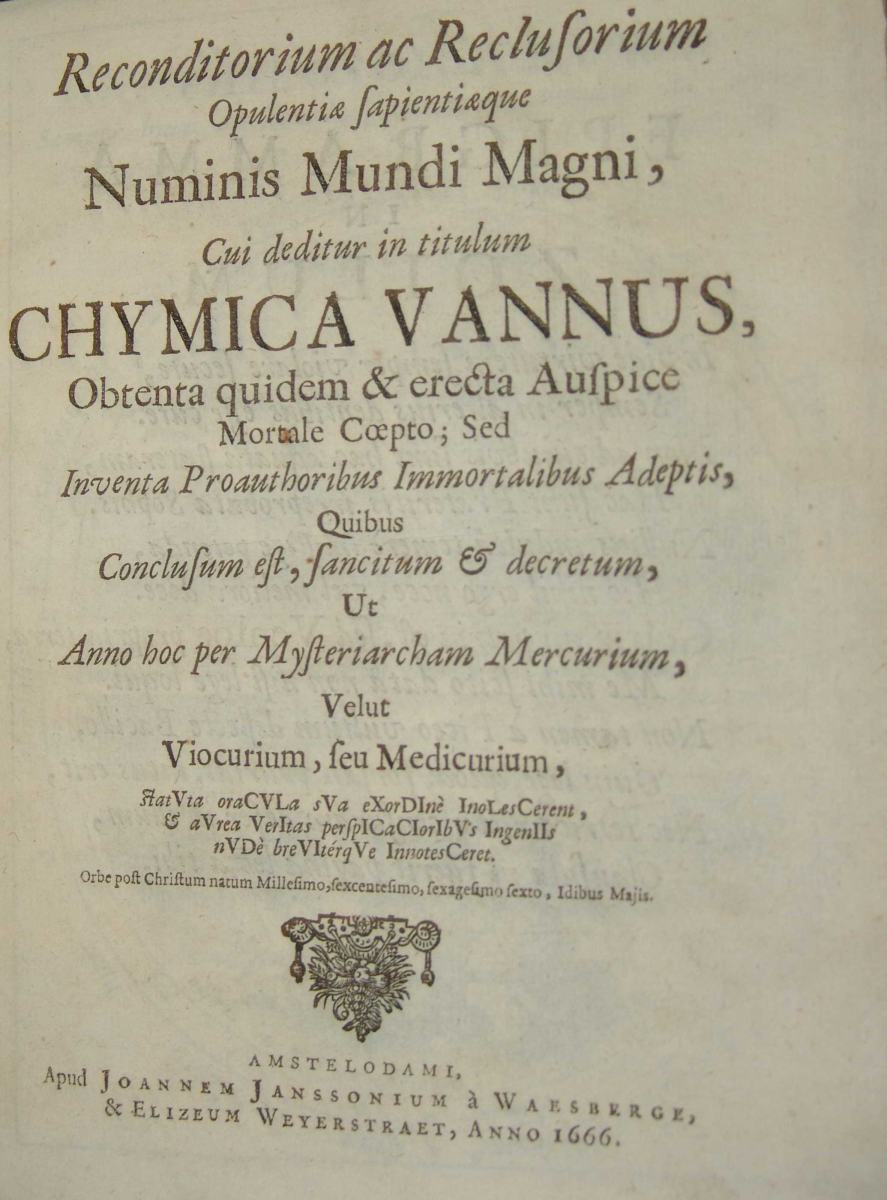
Chymica Vannus. Amsterdam: Janssonius & Weyerstraet, 1666.
Moggia, Girolamo, and Vincenzo Verginelli, trans. Chymica Vannus – Commentatio de pharmaco catholico. Bologna: Ibis, 1999.
Quadrelli, Ercole, trans. Il chimico crivello (Chymica Vannus). Milan: Archè, 1983.
Quadrelli, Ercole, trans. Commentario sul farmaco cattolico. Milan: Archè, 1974.
Sergio, Giovanni, trans. Chymica Vannus and Commentatio de Pharmaco Catholico: Translation and Commentary. Youcanprint, 2023.
Rūmī, Jalāl al-Dīn. The Mathnawí of Jalálu’ddín Rúmí. Edited from the oldest manuscripts available, with critical notes, translation, and commentary by Reynold A. Nicholson. 8 vols. London: Luzac & Co., 1925–1940.
Gurdjieff, G. I. Beelzebub’s Tales to His Grandson. New York: Harcourt, Brace, 1950.
*
Theoretical and critical works
Berman, Antoine. The Experience of the Foreign. Translated by S. Heyvaert. SUNY Press, 1992.
Corbin, Henry. Creative Imagination in the Sufism of Ibn ‘Arabi. Translated by Ralph Manheim. Princeton University Press, 1969.
McKenzie, D. F. Bibliography and the Sociology of Texts. Cambridge University Press, 1999.
Newman, William R. Promethean Ambitions. University of Chicago Press, 2004.
Principe, Lawrence M. The Secrets of Alchemy. University of Chicago Press, 2013.
Shillingsburg, Peter L. Resisting Texts. University of Michigan Press, 1997.
Venuti, Lawrence. The Translator’s Invisibility. Routledge, 1995.
Coming Soon
from the Blue House of Via-HYGEIA — Circle of Transmission:
‘Reading the Images of the Chymica Vannus (1666)’-
The Engraved Language:
(From the Character of the Adepts to the Planetary Orbs‘)
Following our study of the Chymica Vannus and the challenges of reading and translating its alchemical language, we turn now to its remarkable visual world.
Who fashioned its engravings?
How do its emblems, inscriptions, geometrical figures, and planetary orbs communicate with the attentive reader?
And what might these images reveal about the alchemical thought associated with Johannis de Monte-Snyder, author of the appended Commentatio de Pharmaco Catholico and of the enigmatic Metamorphosis of the Planets—a work that also drew the sustained attention of Isaac Newton?
From the Character of the Adepts to the planetary orbs, we shall explore the engraved language of this seventeenth-century work, distinguishing what the images show from what their interpretation may suggest. We will propose an inquiry into the art of seeing, the labour of reading, and the mysteries of the alchemical image.
***
Related Articles

Leave a Reply