
Circle of Transmission: The Living Loom
A Little Marc Semenoff Sampler-Part 1: Marc Semenoff and his Milieu, followed by selections from ‘Introduction à la Vie Secrète’ (1923)
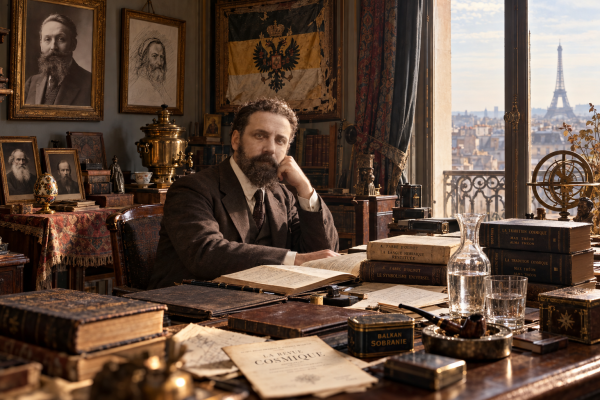
Featured Illustration Legend:This illustration is a symbolic reconstruction and not documentary records of Marc Semenoff’s Paris study, not a historical photograph. It evokes the world of a Russian émigré esotericism in interwar Paris, where the printing workshop, the occult salon, and literary translation belonged to a single social fabric. The volumes on the desk include Fabre d’Olivet’s La Langue Hébraïque Restituée and Max and Alma Théon’s La Tradition Cosmique; the periodical in the foreground is the Revue Cosmique.
*
Today’s sharing from the Blue House of Via-HYGEIA is devoted to Marc Semenoff (1884–1968). A Russian émigré who became one of the great translators of the Russian novel into French — Dostoevsky, Tolstoy, Gogol, Pushkin, Turgenev, Lermontov — Marc Semenoff was also, and perhaps more essentially, a man of the inner path.
He was general secretary of the Cosmic Movement founded by Max Théon and Alma Théon, a familiar of the Thémanlys circle, a contributor to La Tradition Cosmique and the Revue Cosmique, and the author of a small, strange, and largely forgotten manual of initiation: Introduction à la Vie Secrète, published in Paris in 1923 by André Delpeuch, in a limited edition of ten numbered copies on Vergé d’Arches. The volume is dedicated “to Claire and Louis Thémanlys, those who led me toward this Way.”
We present here, for the first time in English, a selection from that 1923 text, together with a critical study of Semenoff’s life and milieu. The selection comprises two movements: a study of Fabre d’Olivet (1767–1825), the philologist and occultist whom Semenoff presents as the true restorer of the cosmogony of Moses; and a meditation on initiation and the Mysteries, in which Semenoff distinguishes the intellectual from the mystical faculty and calls the reader toward what he names the Psycho-Intellectual — the unified being in whom intelligence and love are no longer at war.
Between the Russian émigré printing workshops of Paris and the occult salons of the Thémanlys circle, between the translation of Crime et Châtiment and the interpretation of the Zohar, Semenoff moved through worlds that our age has largely forgotten. Our aim is to recover one of them, and to let his voice be heard again.
With gratitude to Professors Boaz Huss and Michele Olzi, whose combined research has made this sharing possible.
**
A Contextual Introduction:
Marc Semenoff and His Milieu
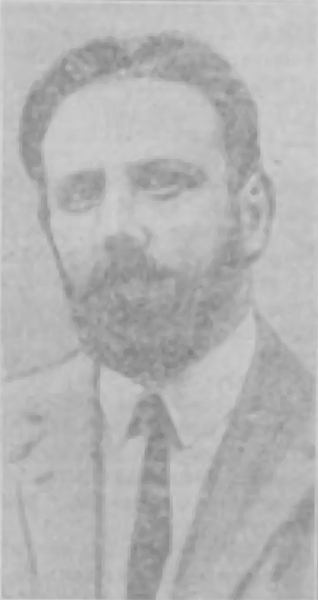
The portrait featured in this article—grainy, almost ghostly, the face of a man with a dark beard, a high forehead, and eyes that seem to look both inward and outward—is the only known photograph of Marc Semenoff (1884–1968) to have surfaced in the archival record. It was provided by Professor Boaz Huss, whose research on the Cosmic Movement has done more than any other to recover the lost world of Max Théon and his circle.
Alongside Huss, the Italian scholar and professor Michele Olzi has produced the most detailed contextual work on Semenoff to date, including the chapter “From Mystical Russia to the Eurasian Homeland: Marc Semenoff and the Cosmic Movement” in The Cosmic Movement: Sources, Contexts, Impact (2020), and the conference paper “From Promised Land to Eurasian Spirituality: Marc Séménoff’s Initiatory Path in the Cosmic Movement,” presented at Ben-Gurion University of the Negev in March 2017.
Both Huss and Olzi have been unfailingly warm and generous in sharing their archival materials and scholarly expertise, and it is a pleasure to acknowledge here the debt this study owes to their work.
That this rare surviving image of Semenoff should be so obscure is fitting: he was a man who lived at the margins of several worlds—Russian and French, Jewish and Christian, literary and occult—and whose life’s work was to bridge them.
*
Family Background and Early Years
Marc Semenoff was born on 4 October 1884 in Rustchuk (today Ruse), Bulgaria, the son of Solomon Zalman Kogan (1861–1944). His father was a remarkable figure in his own right: born in 1861 to Jewish parents in Velikodolinsky, a rural settlement in the Odessa district (today’s Ukraine), he graduated in law from Odessa Mechnikov National University at the age of twenty and soon became a lawyer and member of various pacifist organisations. In 1882, he was arrested on a charge of collaboration with the left-wing group Narodnaya Volya (“People’s Will”). After his release—and possibly after further imprisonment on a different charge—he became secretary of the Israeli propaganda mission in Saint Petersburg before deciding, sometime between 1884 and 1885, to leave Russia.
The father wrote under several pseudonyms, the most frequent being Eugène Semenoff. He began his career as a journalist in Switzerland, collaborating with La Liberté of Fribourg thanks to its editor-in-chief, Jean Mamert Soussens (1871–1903), who was of French-Jewish-Russian origin. Marc’s sister, Anna Semenova (1888–1977), was born in Lausanne in 1888. After Soussens’s death, the family moved from Switzerland to France, where Eugène published Une page de la contre-révolution russe – Les pogroms (1906), prefaced by the Nobel Prize winner Anatole France.
In the early 1910s, Eugène went back to Russia, while Anna and Marc moved back and forth between the two countries. Anna studied in Saint Petersburg between 1910 and 1914, tutored by the sculptor Ilya Gunzburg (1859–1939). In 1917, while the Russian Revolution was brewing, Eugène—then editor-in-chief of Vecherneye Vremya (The Evening Times)—fled with the archives of the newspaper, leaving behind his wife and Anna. In 1918, thanks to Francis Cromie, an Irish captain in the British army, Anna and her mother obtained a diplomatic permit allowing them to flee, first to Denmark, then to Sweden, and finally to Paris.
Their early days in Paris were difficult, and Anna earned a living by giving French and English lessons before pursuing a course in sculpture at the Academy in Montparnasse, where Antoine Bourdelle (1861–1929) came twice a week to correct her work and that of her colleagues. Through these circles, the family also maintained contacts with the broader Parisian artistic milieu, including figures such as the painter Raoul Dufy.
Anna was later commissioned to sculpt busts of the writer Claude Farrère (1876–1957), the philologist Théodor Reinach (1860–1928), Rabindranath Tagore (1861–1941), and Allan Kardec (1804–1868). Her interest in spiritual and esoteric themes revealed itself in pieces focused on female characters connected to ancient Egyptian civilisation—a bust of Hypatia, references to the goddess Isis, and a figure of Lucifer. These sculptures were not mere artistic exercises; they were expressions of an Egyptomania that was popular in nineteenth-century occultism and that ran through the family’s spiritual interests.
*
The Printing Trade and the Russian Émigré Community
The Semenoff family’s connection to the printing trade places them within a vital network of Russian émigré artisans and intellectuals in Paris. Many Russians, as is well known, worked in printing workshops when they were not driving taxis or working in restaurants. The trade required literacy and technical skill, and it allowed émigrés to remain connected to the world of ideas even as they earned their living.
The most famous example of this phenomenon is the Imprimerie Union, founded in Paris between 1909 and 1910 by the Russian émigrés Volf Chalit (1878–1956) and Dimitri Snégaroff (1885–1959). Initially called the Kooperativnaïa tipografia soïouz (Cooperative Typography Union), it was installed at 3, rue Beaunier and later francized as “Imprimerie Union.” In its early years, the enterprise worked essentially for the Parisian Russian community, notably for publishers of literature, linguistics, and political pamphlets.
The printing workshop was more than a workplace; it was a community hub where political tracts were set in type, literary translations were proofread, and news from Russia was discussed. Other Russian printers, such as Zemakh Kantine (who arrived in France in 1923 and later founded the cooperative Étoile with Léon Rotenberg), and Jacques Chapnik (who in 1922 founded the Société nouvelle d’imprimerie et d’édition with Alexandre Kerenski and others), contributed to this infrastructure, specialising in works in Hebrew, Polish, Russian, and Czech.
A particularly telling example of how this printing network sustained the circulation of esoteric ideas is the publication of Serge Marcotoune‘s La Science secrète des initiés et la pratique de la vie (1928), translated from Russian into French by Eugène and Marc Semenoff. The book’s colophon reveals that it was printed by the Imprimerie d’Art Voltaire, directed by O. Zalut, at 34 rue Richet in Paris (9th arrondissement).
This detail is significant because Marcotoune was not merely an author translated by the Semenoffs; he was also a Martinist, a Ukrainian nationalist, and a central figure in the Parisian occult underground. A lawyer and estate agent by profession, Marcotoune served in the early 1920s as president of the Ukrainian National Committee, which aided Ukrainian refugees in France, while simultaneously becoming a prominent member of Ukrainian Freemasonic and Martinist groups.
The fact that his book was produced by a Russian-run printing workshop underscores the way in which the printing trade served as a material infrastructure for the circulation of esoteric ideas. The same workshops that set type for political pamphlets and literary translations also set type for initiatic treatises. This was the world in which Marc Semenoff moved: a world where the printing press and the séance, the proofread page and the magical ceremony, belonged to the same social and economic fabric.
Semenoff’s collaboration with Marcotoune extended beyond this single translation. The French surrealist and journalist Sarane Alexandrian reported that both Semenoff and Marcotoune were regular visitors to the séances of Maria de Naglowska (1883–1936), the Polish-Russian poet and novelist who emigrated to Paris in 1929 and founded a “satanic temple” in 1932. According to Alexandrian, they even acted as Madame de Naglowska’s personal assistants in ceremonies. While there is no evidence that Semenoff was formally initiated into any grade of her circle, his presence at these ceremonies—alongside Marcotoune—confirms the density of the networks that linked the printing workshop, the Martinist lodge, and the magical salon.
*
The Cosmic Movement and the Thémanlys Circle
Marc Semenoff’s entry into the Cosmic Movement (Mouvement Cosmique) came through his marriage, in 1912, to Denise Alice Blot (1886–1962 ), the pianist daughter of the bronze caster and art dealer Louis Eugène Blot (1857–1938). Denise and her sister Claire had received serious musical training, studying under notable musicians such as the pianist and composer Césare Geloso (1867–1960). Claire Blot (1883–1966) was already married to Louis Thémanlys (born Louis Moyse, 1874–1943), who had joined the Cosmic Movement in 1904 following a claimed telepathic experience while walking near a beach in Normandy, and after discovering the Revue Cosmique at the Chacornac library in Paris.
The Cosmic Movement had been founded by Max Théon (1848–1927) and his wife Mary Ware (1839–1908), also known as Una or Alma, around 1900 in Tlemcen, Algeria. Its journal, the Revue Cosmique, was published between 1901 and 1908 (except for a brief suspension between April and June 1901). Its main purpose was the “restoration of a primordial philosophy.” The journal was originally edited by François-Charles Barlet (pseudonym of Albert Faucheux, 1838–1921), a crucial figure in the French occult milieu and other initiatory groups such as the Gnostic Church and Martinism. After Barlet’s resignation, Aia Aziz (i.e., Théon) stepped in as editor, but most of the periodical duties were assigned to Louis. The six volumes of La Tradition Cosmique, the first of which was published in 1903, consisted mainly of revelations produced in a state of trance by Mary Ware. Claire became an active member of the movement and involved her parents and siblings; at the death of Théon, Louis became the second leader of the Cosmic Movement.
According to Pascal Thémanlys (1909–2000), Semenoff was among the “active contributors” of the movement, alongside René Caillié, the typesetter Jacques Janin, the painters Jacques Blot and Louis Bouchet, the architect Louis Berthaud, Maurice Benharoche Baralia, and the Baroness of Eichthal. The wider orbit of sympathisers was extraordinary: Tomáš Masaryk (later first President of Czechoslovakia), the poets Hélène Vacaresco and Anna de Noailles, Dr. Serge Voronoff, the occultist Édouard Schuré, the psychologist Albert von Schrenck-Notzing, the Princess of Rohan, and General Zinovy Peshkov.
When Denise and Marc married, both were therefore active in the Cosmic Movement. Upon returning to France in the 1920s, after having fought in the French army during the First World War, Marc became general secretary. In 1919, members of the movement published a new periodical entitled Art, science et peuple, edited by Salvator Schiff, a poet and stage director who also earned money as a plumber and workman.
*
The Idéal et Réalité Circle
In the 1920s, Semenoff became involved in the activities of the group Idéal et Réalité, originally founded by Louis Thémanlys and the musician and poet Gustave Rouger (1886–1974). The group’s members included prominent scholars, artists, politicians, aristocrats, and occultists. Besides publishing the journal Idéal et Réalité: Littérature, Pensée, Art, the group organised monthly events at the salon of the Thémanlys family—lectures, shows, plays, dances, and concerts. In 1929, the circle opened a school of initiation that involved a series of soirées fédérales (“federative evenings”) supervised by Thémanlys, at which members met to discuss initiation within the Cosmic Tradition, believed to be the source of all human civilisation, and which had shaped humanity through religion, philosophy, science, and the arts.
Among the most active members and followers were regular contributors to the journal: Marc Semenoff; Claire Thémanlys; Serge Marcotoune; the French publisher André Delpeuch (1883–1962), who would publish Introduction à la Vie Secrète; the editor of CAP (Critique, Art, Philosophie), Marcel Hiver; the novelist and poet Maurice Magre (1877–1941); and the astrologer Eudes Picard (1867–1932), a pupil of the occultist François-Charles Barlet.
A second important contact for both Anna and Marc was the art dealer and manager Marcelle Berr de Turique (1894–1991), who would open her own art gallery-library project, “Le Portique,” in 1923. As reported by her cousin Pascal Thémanlys, Marcelle was the granddaughter of Berr Isaac Berr (1744–1828), a renowned member of the Assembly of Notables of Nancy and an active supporter of Jewish emancipation. Her father, Michel Berr de Turique (1781–1843), was a successful translator, German-language teacher, and lawyer. In her memoirs, Marcelle affirmed that other influential individuals from the contemporary French cultural and political world were also influenced by Cosmic Philosophy—including Isabelle de Bouhelier Lepelletier, also known as Isabelle Viviani (1872–1923), wife of the Prime Minister of France, René Viviani.
*
The Author and Translator
Semenoff debuted on the French cultural scene with the publication of Caserne (1911). But this was not his first attempt: the first book he wrote was Les serviteurs du soleil (1909), a novel centred on the figure of Mercury in ancient Egypt. Scholars consider this to have been the first major work in which Marc approached spiritual and esoteric topics through mythological themes and characters. The figures of Mercury and Isis were pivotal, and they were also favourite subjects of Anna’s sculptures.
During the First World War, Marc Semenoff fought in the French army. In the 1920s, in Paris, he was widely respected as a translator, for the most part translating from Russian into French. Among the authors he translated were Alexander Pushkin (Boris Godounof, 1921), Lev Tolstoy (La Guerre et la Paix, Anna Karénine), Fyodor Dostoevsky (Crime et châtiment), and Nikolai Gogol (Le Revizor, 1922; Les Âmes Mortes, 1922). He also translated works belonging to Western esotericism and modern occultism, including books by Helena Blavatsky (Au pays des montagnes bleues, 1926) and, together with his father Eugène, Marcotoune’s La Science secrète des initiés et la pratique de la vie (1928).
Beyond his translations, Semenoff authored several works of his own: Les Serviteurs du Soleil (1909), Caserne (1911), Introduction à la Vie Secrète (1923), De l’Inde mystérieuse à la Russie mystique (1932, published by Paul Leymarie, director of the renowned esoteric bookstore and publishing house Librairie Leymarie), Initiation (in several volumes), Histoire de Russie, La Pensée du Bouddha (1960), and others. His Introduction à la Vie Secrète was reviewed in The Occult Review in October 1925, indicating that his work circulated within Anglophone esoteric readerships as well:

The following review of Introduction à la Vie Secrète appeared in The Occult Review, vol. 42, no. 4 (October 1925), pp. 263–264. It offers a valuable glimpse of how Semenoff’s book was received by the English-speaking occult public.
INTRODUCTION À LA VIE SECRÈTE. By Marc Semenoff. Paris: André Delpeuch. Pp. 210. Price 6 francs.
THESE pages have been written, we are told, in order to help man to penetrate the secrets and mysteries of his own inner being, to remind him “of the Power within him which will enable him to rediscover the veiled steps of the deeper life.” It touches on the Ancient Eastern philosophies, the Communion with Beauty, the educative power of Art, the universal forces, nervous and psychic health-conditions, and many kindred subjects, and closes with some remarks on the science of numbers and letters, and a sketch of the contributions of Fabre d’Olivet to occult philosophy.
Perhaps the French mind would be capable of extracting some definite teaching from this conglomeration; the flowery and elaborate style adopted by the author renders it difficult for the English mind to follow his arguments, or even to take them seriously. Here is a typical sentence:
“Let us know how to meditate, let us learn how to concentrate, and to calculate the effect of our words and gestures, but let us not fear to keep the windows of our house widely opened upon the boundless horizons where roll eternally the free, voluptuous and audacious waves of the vast Ocean of the Life of Love.”
And much more to the same effect. M. Semenoff is not alone in his love of “the flowers of speech.” It seems to be common to the majority of French writers on occultism; and though it rather tends to “put off” the Anglo-Saxon reader, perhaps—as said before—it serves a purpose in attracting those for whom the books are primarily intended. The present writer has both knowledge and enthusiasm, and if he is sometimes carried away by the latter, that is, at any rate, a fault on the right side. The book has one great advantage in being more clearly printed than most of those issued by French firms.
E. M. M.
Commentary: The English Gaze on a French Mystic. This review is a small but telling document in the reception history of Semenoff’s book. It reveals a fundamental cultural and stylistic gap between the French esoteric tradition and the English-speaking occult public.
The reviewer, writing under the initials E. M. M., was almost certainly Eva Margaret Martin (1883–1940), a committed Theosophist and prolific contributor to The Occult Review. She is best known today for her 1915 English translation of Dostoevsky’s The Idiot—a version that, remarkably, remains in print and is widely read more than a century later.¹ Her verdict on Semenoff is politely dismissive: his prose is “flowery and elaborate,” a style that makes it “difficult for the English mind to follow his arguments, or even to take them seriously.”
Yet the review is not entirely hostile. It concedes that Semenoff writes with “both knowledge and enthusiasm,” and that his style, though off-putting to Anglo-Saxon readers, “serves a purpose in attracting those for whom the books are primarily intended.” This is a crucial insight: Semenoff was writing for a French esoteric readership that valued eloquence, poetic vision, and emotional resonance—qualities that the English reviewer associated with “the flowers of speech.”
The review also confirms the structure of the book. It notes that it “closes with some remarks on the science of numbers and letters, and a sketch of the contributions of Fabre d’Olivet to occult philosophy,” which aligns with our own ordering of the two parts. The mention of “nervous and psychic health-conditions” is a reminder that Semenoff’s concerns were not purely speculative but also therapeutic, oriented toward the well-being of the whole person.
Perhaps most valuable is the quotation the reviewer selects. The sentence about keeping “the windows of our house widely opened upon the boundless horizons” is a perfect distillation of Semenoff’s spiritual ethos: a call to receptivity, to openness, to the free circulation of life and love. The reviewer’s condescension notwithstanding, that sentence has survived—and it deserves to be heard again.
¹ Eva Margaret Martin (1883–1940) was a regular contributor to The Occult Review in the 1910s and 1920s. She is best known for her translation of Fyodor Dostoevsky’s The Idiot (London: J. M. Dent & Sons, 1915), which remains in print. She also authored Giordano Bruno: Mystic and Martyr (1921), compiled the anthology The Ring of Return: An Anthology of References to Reincarnation and Spiritual Evolution (London: Phillip Allan & Co., 1927; reprinted as Reincarnation: The Ring of Return, New Hyde Park, NY: University Books, 1963), and translated Édouard Schuré’s From Sphinx to Christ: An Occult History. Her review of Semenoff’s book reflects the perspective of an informed and sympathetic, if stylistically English, reader of French occultism.
*
The Present Volume
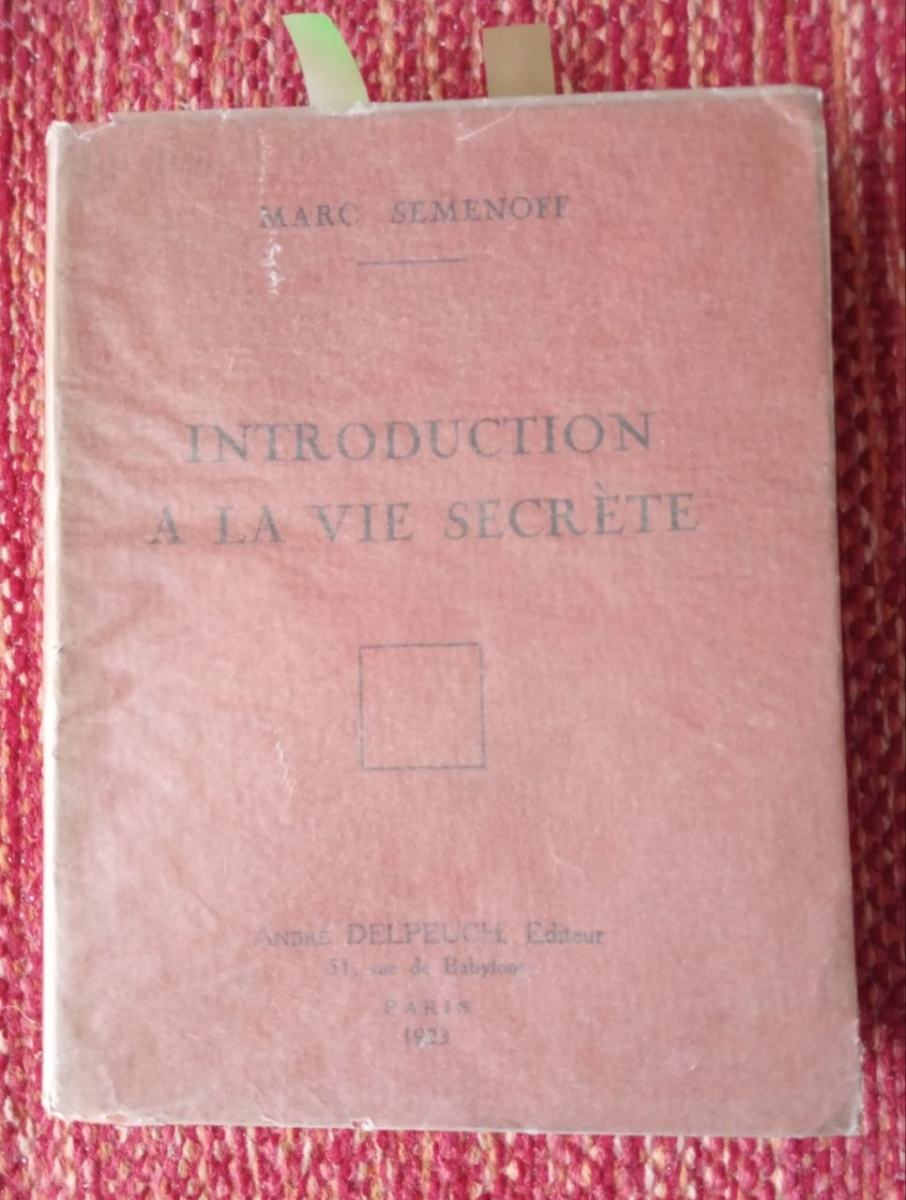
Introduction à la Vie Secrète was published in Paris in 1923 by André Delpeuch, at 51 rue de Babylone. Delpeuch was himself a member of the Idéal et Réalité circle and a publisher of esoteric works. The volume is dedicated “to CLAIRE and LOUIS THEMANLYS, those who led me toward this Way”—a dedication that anchors the book firmly in the Cosmic Movement.
As Olzi observes, Introduction à la Vie Secrète was conceived as a manual whose aim was to grant access to an initiatory state, supposed to occur “when the soul or the superior self of a person can effectively communicate with the soul of the divinity.” A recurrent question in its pages is whether there existed an authentic initiatory path in the West. The work was printed in a limited edition of ten numbered copies on Vergé d’Arches.
Its two movements—the first on initiation and the mysteries (pp. 129–146), and the second on Fabre d’Olivet and the Science of Number (pp. 147–173)—are here presented in English translation. For thematic coherence, the Fabre d’Olivet section is presented first as Part One to establish the historical and philological groundwork, followed by Part Two on Initiation and the Mysteries. The translations preserve the elevated, early twentieth-century esoteric tone of the original while clarifying syntax for the modern reader.
Editorial conventions. The section numbers of the original book have not been preserved in this translation; the text is presented as continuous prose for readability, with page references to the 1923 edition supplied throughout. Where quotations from Plato, Plotinus, Saint Paul, Pascal, and other authors appear in the translation, they are given as they appear in Semenoff’s text; their precise provenance—whether drawn from the original sources or from intermediary works—has not been established, and they should be read as quotations used by Semenoff rather than as independently verified citations.
Two selections from
‘Introduction à la Vie Secrète‘
*
Part One: Antoine Fabre d’Olivet —
Biography and Commentary
(pp. 147–173)
Translation
The modern European who feels the noble and legitimate desire to increase, with his power over himself, his power over the integrity of his environment, must know all the importance that the Ancients accorded to the Science of Number with a view to initiation into the Secret Life.
But before approaching this last study, we believe it useful, for the very clarity of a subject so new to the European mentality, briefly to expose the life and researches of a great Frenchman of the last century, Fabre d’Olivet.
A man who was a powerful thinker, the first great philologist of the contemporary epoch, a writer whose entire work remains a monument where historians, philologists, philosophers, all intellectual researchers can draw when they set themselves the vastest and noblest goal: that of penetrating the most profound causes, the great natural forces that presided over the development of the intellectual and spiritual activity of man in the most distant past and still direct it.
The work of Fabre d’Olivet is that of a philosopher, that is to say, according to the meaning of the Greek words philein, philos, and sophia, of a friend of Wisdom, of a man who seeks and loves Truth, the soph at once science and wisdom, to the exclusion of all parti pris and all party spirit, of every preconceived idea, of every dogmatic ulterior motive, of every search for personal, confessional, or political interest.
Now Philosophy is everywhere. “It remains one, undivided and indivisible, the same in nature though not in manifestation, yesterday, today, and forever.” It hides itself in the proper or figurative acceptation of the terms that most adequately clothe our thoughts; it constitutes the true sense of our gestures, our actions; it inhabits the principle, the goal of all our efforts; it represents the law that presides over the birth of all sciences; it is the science of sciences because it explains each of them, gives it its own signification. Philosophy is the profound source and the highest end of each of the arts. The science and wisdom of the philosopher is to discover the teaching that emerges, the lesson that imposes itself, when the spirit meditates on the origin, development, and decline of things, and particularly the intimate nature of the forces that sustain the effort of man as organizer of a more just and happier life.
Fabre d’Olivet studied these forces, seeking first to situate and determine man in this infinite and eternal Cosmos upon whose evolution he can acquire a growing influence. Audaciously, he projected his intuitive gaze toward the so-called prehistoric ages and armed his synthetic effort—result of examinations of ancient texts, fruit of the will to pierce the mysteries veiled in the most ancient traditions.
Thus, in his Philosophical History of the Human Race, Fabre d’Olivet formulated his conception of man: “power in germ that civilization must develop and that receives the principles of this culture from two powers to which he is bound and amid which he is placed: Destiny and Providence. Man represents the mediating will, the efficient form.” And the historian shows how, in the development of societies and human cultures, nature—the inferior action of Fatality or Instinct—the intermediate action of Will, and the superior action of Providence are each born successively in proportion to human evolution, all three comprised in the One Divinity that envelops them and constitutes with them that Quaternary Truth of the ancients, symbol revealed by Pythagoras, the quaternary which “is all in all and outside of which there is nothing.”
Speaking of this intermediary power that man incarnates, Nietzsche wrote: “I teach you the Superhuman. Man is something that must be overcome. All beings, up to now, have created something above themselves, and you want to be the ebb of this great flood and rather return to the beast than overcome man. Man is a rope stretched between the beast and the superhuman—a rope over the abyss.”
The author of the Philosophical History situates man among the Powers that govern the Cosmos; he gives him this interior, intelligent, and spiritual Faculty, allowing him to triumph over the inferior instinctive forces that diminish him, weaken him, leave him still at the level of the mineral, vegetable, and animal kingdoms, which are the domain of Destiny, and then, by the very action of Will, to become the conscious weapon of Providence, like a Moses, and only then to be able to draw nearer to God by his Conduct, his effort of Realization.
This is the whole profound thought of Fabre d’Olivet. Destiny engenders war, chaos; through Fatality reign the Attilas, the Genghis Khans, the Tamerlanes. Human Will alone creates nothing stable; it gives birth to republics, democracies more or less stormy, ephemeral; it provokes, by bad interpretations of the One Divine Law, religious schisms. Human Will is the origin of struggles of principles. Now, as Pascal said: “All principles are true—those of the Pyrrhonians, the Stoics, the atheists, etc.—but their conclusions are false, because the opposite principles are also true.”
It is uniquely by the awakening to the highest Life, that of Reason, of Providence, that Man organizes what can defy Time, for then only, according to the word of Saint Augustine, “he learns to judge material objects according to ideal and eternal rules.” Regular states, theocracies, monarchies are founded whose grandeur and duration have not been attained by any other form of government. And if Europe has suffered so many vicissitudes, if it did not become earlier the mistress of the world, if it long needed the light of African and Asiatic civilizations and if it must even now have recourse to all the science contained in their traditions and initiations, it is because the white Race, the last to come after the red Race, the yellow Race, the black Race, misunderstood and often persecuted the glorious Sons that Providence sent to guide it in the difficult ways of progressive evolution.
A contemporary of Napoleon, Fabre d’Olivet, in a celebrated interview with the conqueror, certainly showed him how much his reign would be more beautiful, greater, if he knew how to profit from the power of his arms to realize European spiritual unity—so that schisms would become impossible, that wars of nation against nation would no longer have any reason to be, and as he himself writes in his Philosophical History of the Human Race: “that the whole Earth might offer the same spectacle as under Rome, men united under the same cult, under the same laws, and enjoying a felicity as great as their mortal nature can bear, during a long succession of centuries.”
Fabre d’Olivet, contemporary of Napoléon. I have not yet spoken of the man who lived through the revolutionary turmoil of 1789–93, suffered and struggled for his ideas, and died unrecognized, a victim not only of the philosophical and religious prejudices of his epoch but, as we shall see—which is more serious—of a general opinion that still endures, hostile or indifferent to the most profound side of the great philosophical knowledge.
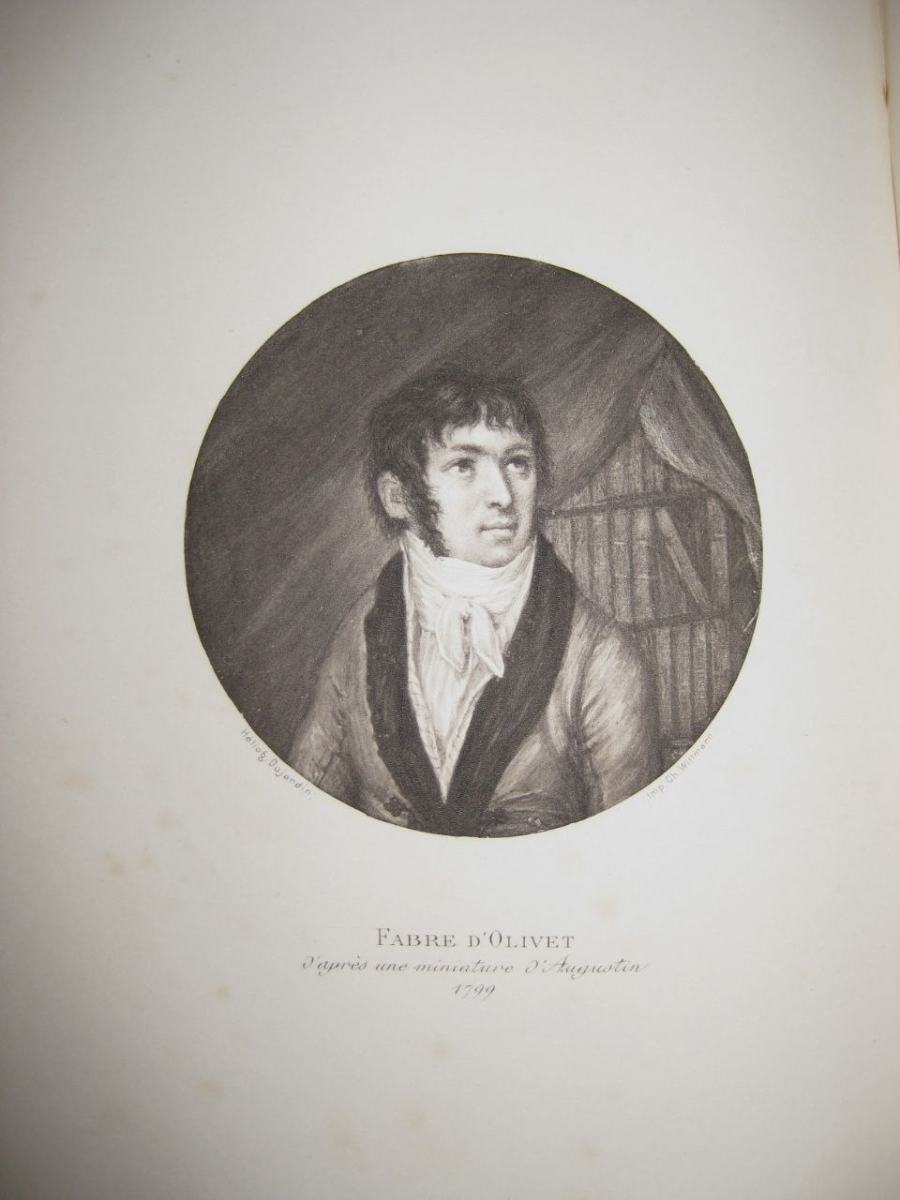
Fabre d’Olivet was born at Ganges, in the Hérault, in 1767. His parents, intending him for commerce, sent him to Paris so that he might pursue studies in that direction. But the young man’s inclinations carried him toward music, medicine, literature, and he quickly created a reputation in the salons thanks to pieces of verse, some of which had the honour of the stage in 1789–91. At that time the Revolution ruined his father, and Fabre d’Olivet found himself obliged to leave for Germany. In that country he was initiated into the Pythagorean doctrine, a profound inner work that would incite him, upon his return to France, “to plunge headlong into philological and philosophical studies despite the terrible whirlwind of revolutionary effort.”
In 1802, Fabre d’Olivet composed a quartet that he dedicated to Pleyel and an Oratorio performed by the artists of the Opera in 1804, in honour of Napoleon’s coronation. In 1805, he married Mademoiselle Warin, a woman of letters, and founded a family in which the most solid virtues were practised.
After this marriage, he devoted himself entirely to the study of Semitic languages and dialects; a Hindu of caste taught him the Aryan languages; he also learned Chinese. In 1813, Fabre d’Olivet published his translation and commentaries of the “Golden Verses” of Pythagoras. The Hebrew Language Restituted saw the light two years later, after many difficulties and thanks to the powerful intervention of an influential friend.
The printing of this work, which constitutes a grandiose attempt to rediscover the true meaning of “Genesis” and which the pope had condemned in 1825, far from giving the writer the facilities he counted on to finish his Philosophical History of the Human Race, delivered him to metaphysical and literary discussions “which turned into dissensions and carried their venom even into the enclosure of his domestic hearth.” His wife, indeed, advised, it is said, by the Church, abandoned her husband, whose ideas formulated in his Philosophical History she did not share and whose deeper, occult researches she disapproved of.
This History finally appeared in 1822, under the title: On the Social State of Man. The second edition, of 1824, bore the definitive title. The following year, Fabre d’Olivet died, aged only 58. His death remained very mysterious. He was found at his home, his chest pierced by a dagger. Suicide or rather an occult drama in this powerful occultist? The problem has not been resolved, but this troubling death raises the eternal question of relations with the beyond, revealing their danger to the imprudent and the ignorant.
We possess no precise testimony concerning the occult works to which Fabre d’Olivet devoted himself. A contemporary of the philosopher, Durozoir, literary critic and historian reputed in his time, but hostile to the philologist, writes on this subject:
“— These painful researches” — (it concerns the study of Semitic, Chinese, and other ancient dialects) — “had heated his imagination, and Fabre d’Olivet, with incontestable science, reaped only the reputation of a visionary and a madman of sober sense. He claimed to have found the key to the hieroglyphs, the means of restoring hearing to the deaf-mute according to a method borrowed from the priests of ancient Egypt and which had some relation to the phenomena of animal magnetism. He attached a so great faith to the power of the will that he asserted he had often made a volume come out of the shelves of his library by placing himself before it and strongly imagining that he had the author in person before his eyes. This, he said, often happened to him with Diderot. In his researches on languages, he rejected everything clear, precise, logical, in order to seek a diverted, mysterious sense and to throw himself into tenebrous regions where he hoped to find unknown revelations. He imagined a new system of etymology and analysis of languages which offers results as bizarre as everything the ancient cabalists have left us most absurd. Everywhere he sees moral allegories and a hidden sense in each word, syllable, letter, or number.”
This judgment, delivered by the illustrious critic of 1825, has remained until our days that of the French intellectual class. But the sceptical word or mocking laugh do not belong to intelligence and do not permit understanding and resolving the problems that presented themselves to Fabre d’Olivet and that the great philosopher of the last century endeavoured to deepen with the patience, desire, and conscience of a thinker.
Let us examine Durozoir’s so harsh critique. “Fabre d’Olivet claimed to have found the means of restoring hearing to the deaf-mute,” he writes. Now, the fact is indisputable, proven. The young Rodolphe Grivel, deaf-mute, was not the only one to whom the powerful occultist restored the faculty of hearing. The Notions on the sense of hearing in general and, in particular, apropos of the cure of Rodolphe Grivel, an opuscule by Fabre d’Olivet which gave rise to an unfavourable report presented to the Ministry of the Interior by Abbé Sicard and M. de Prony in 1819, and, more especially, the Supplement to this opuscule, inform us that Grivel’s case did not remain isolated. Numerous letters, certain passages of which are cited textually, among others those of a member of the Medical Jury of the department of Ardèche and of a pastor, president of the Consistory of Lyon, confirm the reality of the cure of other persons, among them an old maid of fifty, deaf-mute from birth. We read further in the Supplement:
“— Fabre d’Olivet is accused of enveloping his discovery in secrets and mysteries as a mystagogue or thaumaturge of Memphis or Eleusis would do, and that because he strongly rubbed the ears of one of his patients. Now, M. Fabre d’Olivet possesses the means of curing, and this means, he says, known in the ancient Sanctuaries, is…”
Fabre d’Olivet’s will not to vulgarize his knowledge does not astonish us. The handling of certain natural forces studied by the greatest hierographers of all times, and above all Moses, whose Genesis Fabre d’Olivet translated, the so-called occult practices, are dangerous, and their revelation to profane, unprepared minds could become the cause of more evil than good. We know “The Ring of Gyges,” that tale of Fénelon which gives food for reflection on the terrible consequences arising from the use of occult powers by a man enslaved to his passions. And that is why Saint Paul wrote:
“— What is salutary in the hands of enlightened and tested beings may become like a deadly poison in the hands of ignorant or untested people.”
We therefore do not have to unveil the means Fabre d’Olivet used to perform his marvellous cures. This learned occultist was less fortunate, in 1815, than Mesmer in 1784. The Government of Louis XVI had then instituted a commission charged with attending the experiments of the Austrian magnetizer and controlling the phenomena that took place. Men like Lavoisier, Franklin, and Antoine-Laurent de Jussieu were named members of this commission. Alone among the savants of his epoch, Jussieu declared that imitation and imagination had no part in the phenomena: these were indeed due to a magnetic fluid emanating from the being who knew how to direct it according to his will.
The authorities were harsher under Napoléon. The Faculty of Medicine and the police did not cease to pursue Fabre d’Olivet; he protested, demanded, wished to continue his work of good, and finally obtained an audience with the emperor. The unhappy outcome of this conversation obliged him to abandon his cures. But if it is true, according to the word of Homer, that a doctor is worth by himself several…
But what then was the profound, superior meaning of the sacred writings that the occultist philosopher did not cease to study? What was this system of etymology and analysis of languages, so absurd according to Durozoir, and which, according to this critic, Fabre d’Olivet imagined? And can one affirm that this hidden signification in each word, syllable, letter, or number, of which Durozoir also speaks, really exists such as the author of The Hebrew Language Restituted found it again in each of the terms of “Genesis”?
The Hebrew Language Restituted appeared, as we have already said, in 1815. In his “Introduction,” Fabre d’Olivet writes:
“I do not wish to neglect to show at what distance from truth the bad interpretation of the Sépher of Moses (Sépher Bereschit, book of Principles, Genesis) has placed us, and how one found oneself forced, according to this interpretation, to mutilate the history of ancient nations. To restore the language of Moses in its primitive grammar, I shall have to violently shock scientific or religious prejudices, which habit, pride, interest, the rust of the ages, and the respect attached to ancient errors all combine to consecrate, to reaffirm, to wish to keep.”
The grandiose goal of Fabre d’Olivet, the work of his life, was to rediscover the language in which Moses wrote his Sépher. The text we possess of “Genesis” is only the translation of a Greek-language version of the Hebrew writings, a copy full of errors itself, because literal translation, that is to say, conservation of the material forms of the work and ignorance of its spiritual forms. After the Babylonian captivity, the Jews had forgotten their original language, and if they still understood what Esdras read to them while Hebrew was mixed with Chaldean language, they no longer heard those powerful terms, expressions of Moses, in which were veiled anagogical acceptations, addressed uniquely to the most informed Intelligence, to the initiated spirit.
“— Moses proposes to carnal men, by sensible images, pure and intellectual truths,” wrote Bossuet, who was perhaps paraphrasing thus the word of Saint Paul: “Moses covered his face with a veil.” How to lift this veil in the mixed language of Doctor Esdras, and how to divine it, feel it, in the Greek translation made for the use of the Israelites later scattered in Egypt and Greece, when, according to Saint Augustine himself, the Fathers of the Church were ignorant of the existence of the primitive Hebrew text. Fabre d’Olivet attempted this gigantic work.
“— But if upright minds,” he declares, “are astonished that I alone, for more than twenty centuries, have been able to penetrate into the genius of the language of Moses, I shall answer ingenuously that I do not believe that this is so, that I think, on the contrary, that many men have, at various times and among different peoples, possessed the intelligence of the Sepher in the same manner as I possess it, but that some prudently enclosed this knowledge whose vulgarization would then have been dangerous, while others enveloped it in veils thick enough to be difficultly attained.”
Did the author of The Hebrew Language Restituted think of Saint Jerome, who proclaimed “Genesis” the most difficult and obscure of the sacred books, containing as many secrets as words, or of Saint Augustine, who, examining the question of Creation in his book against the Manichaeans, gives to the first two verses of the Sepher the same intellectual sense as he? Perhaps? We believe rather that he evoked certain great Christian mystics: the Spaniard Raymond Lulle, an illuminated savant of the 13th century, who led an apostolic life; the Swiss Paracelsus; the Italian Pico della Mirandola, the greatest Platonist of the Middle Ages; Reuchlin, German savant of the 16th century, the first philologist of modern times, considered the initiator of Hebrew science, and his contemporaries, those other great Germans: Cornelius Agrippa and Jacob Boehme; the Frenchman Guillaume Postel, who learned Hebrew and Greek without a master, and whom Francis I sent to the Orient and then named, on his return, professor of Oriental languages at the Collège de France.
Fabre d’Olivet also appealed to the authority of Spinoza, of Leibniz, who was initiated by Mercury Van Helmont, powerful occultist and son of the famous Van Helmont, physician and alchemist of the 16th century; he recalled to the memory of his contemporaries all the secret religious societies that appeared in the West since the beginning of the Christian era: the Gnostics; the Templars, a name that comes from the Temple of Solomon; the Freemasons, whose order was organized in England, having as its goal to re-manifest Egyptian initiation; the Rosicrucians, who claimed to descend from the Atlanteans; the Martinists, whose founder, Saint Martin, wished to realize the doctrines of Martinez Pascalis and Swedenborg.
We designate only the best-known individualities and the most powerful occultist movements. All these philosophers, these men of action, these doctors, these savants, were adepts of the Kabbalah; all these militant societies had the Kabbalah as the basis of their teaching. And the Kabbalah is that oral law which Moses himself gave to tested beings, charged with transmitting it, from century to century, in the secret of the sanctuaries. This hierograph legislator, this visionary prophet of the future, had foreseen the false interpretations of his writings, and he confided the Holy Truth to sure Initiates, who then, from generation to generation, were to make it known, always to chosen men, until the most distant posterity. But why was it necessary thus to test those who felt capable of becoming the “Elect”? Moses had been initiated in the temples of Egypt, and in the initiatic colleges of that country, as in those of India, Persia, or Tibet, “the mysteries were not lavished, because the mysteries were something; the knowledge of Divinity was not profaned, because this knowledge existed, and to conserve the Truth for several, it was not given vainly to all!”
The word Kabbalah has two meanings according to whether it is written with a coph, an Assyrian and Hebrew letter corresponding to the number 100, or with a caph, a letter corresponding to the number 20. In the first case, the term means “transmission,” “tradition.” In the second case, CABALA means: LA = Power of CA = 20, BA = 2, or 22 letters, of which the first is aleph and the last thao. Cornelius Agrippa writes on this subject:
“— There are twenty-two letters which are the foundation of the world and of all creatures…”
This divine Word, this Language of heaven that the language of earth hides, Fabre d’Olivet seeks in The Hebrew Language Restituted; he ascends to It by giving the mystical sense of each of the words he analyses in the detail of its primitive roots, of the signification of each letter and the symbolic value of each number. These are no longer vague glimpses, contradictory affirmations, puerile accounts. The formidable knowledge reveals itself with all the power of man surrounded by Natural Forces, Formative of the Cosmos, Forces of which he can make himself master to the extent that he knows how to receive them, becomes capable of responding to them, and, according to his spiritual development, of using them.
Speaking of this translation of the first ten chapters of “Genesis,” Schuré says:
“— Son of the past and pregnant with the future, this book, heir to all the science of the Egyptians, still bears the germs of future sciences. What nature has most profound and most mysterious, what the spirit can conceive of marvels, what intelligence has most sublime, it possesses. And the true restorer of the cosmogony of Moses is Fabre d’Olivet, a man of genius today almost forgotten, and to whom France will render justice the day when esoteric science, which is integral and religious science, is re-edified on its indestructible bases.”
In the passage I have just cited, the author of The Great Initiates speaks of esoteric science. Fabre d’Olivet was an esotericist, and that is why The Hebrew Language Restituted has been and remains unrecognized by official philological and philosophical science and condemned by the pope.
One of the greatest philologists of the end of the last century, Gaston Paris, passes this work over in silence in his Linguistic Miscellanies and seems even not to have read it. We cite Gaston Paris, among so many other known savants, because in his Linguistic Miscellanies, the illustrious etymologist studies the Pentateuch, repeats that Saint Jerome and Saint Augustine complained of the too numerous translations of the books of Moses into Greek and from Greek into Latin, and examines the errors of the Greek and Latin versions while speaking of the possible restitution of the Hebrew text. And not a word about Fabre d’Olivet’s work!
Why this silence? Is Fabre d’Olivet personally in question? Do glaring improbabilities, gross errors mark his capital work, The Hebrew Language Restituted, such that it cannot be taken into consideration at all? But Fabre d’Olivet is not an isolated cabbalist, we have shown it, and even if he had completely failed in his attempt to discover the key to the sacred names among all peoples, by examples taken in comparing Hebrew, Arabic, Syriac, Chaldean, and other languages—and we are not competent to take sides—there is, in his work, an indisputable basis, a sure principle, a Truth that is always found One: that which attaches to the Kabbalah. Now, Gaston Paris, and with him all official science, ignores the Kabbalah. However, this oral Law of Moses is not itself an isolated knowledge, of uniquely Egyptian origin. The Egyptian initiates were not alone in knowing that each letter or number corresponded to an arcane, and that every arcane signified an occult power.
The anagogical study of the Vedas and other sacred works of India, of the Kings, of the writings of Zoroaster, of such Ethiopian or Phoenician tradition, of the Popol-Vuh, shows that everywhere, in the Initiate Colleges of the most remote antiquity, American, African, or Asiatic, the One Truth was taught concerning the Origins and Ends of Worlds and Humanities. This Teaching was not to be vulgarized—we have explained why. It remained “interior,” “esoteric,” in the Schools of Initiation; “esoteric” in Man, the student had to discover the Truth in himself; “esoteric” in written traditions, and it was for the neophytes, ancestors of the great Toltec and Aztec, Hindu, Tibetan, and other races, to read this truth in the terms rich in veils that “clothed” profound occult realities.
“Esotericism” is the Philosophical Unity realized by Initiation. The esoteric Truth indicates to the Evolved Man the paths he must follow to acquire Power over himself, and, according to this Power, Power over Natural Forces or Divine Laws. Philosophy, we have already said, is the simultaneous search for Science and Wisdom; it is the will to triumph over impulsive forces and egoistic tendencies, inferior manifestations of human nature. “By your patience, you will possess your souls,” said Saint Paul, citing a philosopher of the distant past. Would it not be to doubt Humanity to believe it incapable of this patient work of self-elevation, of profound comprehension of the principle and goal of each of its efforts? Philosophy, Esoteric Truth, represents the unique possibility of realization, on all spiritual and material planes, of integral Unity—scientific, moral, intellectual, political—because It alone contains this Unity.
Every science, every ethic, every art is useful only insofar as it contributes to the maximum blossoming of human Life. Philosophy is the synthesis of all these utilities; it is the one Utility. It submits to the laws of Spirit and Intelligence all the tendencies, all the contrary, sometimes hostile, intensities of the sciences, ethics, and arts, and unifies them, thus increasing their power to serve the Idea of the Good of the Earth and of Man. Esoteric Truth is the unified Life of Substance and Spirit with a view to Utility.
Exegesis
Semenoff’s treatment of Fabre d’Olivet is not merely biographical. It is a strategic intervention in the intellectual politics of his time. By devoting nearly thirty pages to a largely forgotten philologist and occultist, Semenoff is making a claim: that the authentic tradition of Western esotericism—the “Science of Number,” the Kabbalah, the “interior” reading of sacred texts—survives not in the official academies but in the lineage of marginalised and misunderstood figures. Fabre d’Olivet is Semenoff’s exemplar of the philosophe in the etymological sense: a lover of Wisdom (sophia) who refuses the narrow specialisation of modern scholarship.
The biographical narrative is carefully constructed to highlight three themes: (1) Fabre d’Olivet’s precocious genius and his turn from music and medicine to philology; (2) his persecution by both the Church and the scientific establishment (the condemnation of his La Langue hébraïque restituée by the pope in 1825, the hostile report of Abbé Sicard and M. de Prony); and (3) his mysterious death—found with a dagger in his chest—which Semenoff treats as evidence of the dangerous, “occult” stakes of his research.
That turn toward philology was itself prepared by an earlier encounter. It was through Delisle de Sales that Fabre d’Olivet first met the ambition of a total history. Jean-Baptiste-Claude Delisle de Sales (1741–1816) was a philosopher of the late Enlightenment whose Philosophie de la Nature (1770) had been condemned by the Châtelet, and whose later Histoire philosophique du monde primitif (1795) sought to reconstruct the origins of civilisation through astronomy, mythology, and the comparative study of ancient traditions.
Fabre d’Olivet discovered the Philosophie de la Nature in 1795 and fell under its spell. Under Delisle’s influence, he wrote his own Lettres à Sophie sur l’histoire (1801), a resume of ancient and modern history that already displayed the sweeping, synthetic ambition—the desire to grasp the whole of human history as a single philosophical movement—that would later animate his Histoire philosophique du genre humain and his restoration of the language of Moses. Delisle de Sales was, in this sense, the first master of the grandes fresques historico-philosophiques that Fabre d’Olivet would spend his life attempting to paint.
Critical note. Semenoff presents Fabre d’Olivet’s death as an unresolved occult drama. The historical record does not permit a definitive conclusion. What matters for our purposes is that Semenoff reads the death as evidence of the dangerous stakes of Fabre d’Olivet’s research. Whether the death was suicide, murder, or an accident remains a matter of conjecture.
The exegesis that follows develops the central claim: that La Langue hébraïque restituée is not the work of a madman but of a man who had penetrated the “language of Moses” through the science of letters and numbers that the ancient initiatic colleges preserved. Semenoff quotes Édouard Schuré’s assessment that Fabre d’Olivet is “the true restorer of the cosmogony of Moses,” a man of genius “to whom France will render justice the day when esoteric science, which is integral and religious science, is re-edified on its indestructible bases.”
The philosophical framework is fourfold: Destiny (the domain of Fatality/Instinct), Will (the mediating principle in man), Providence (the superior action of Reason), and the Quaternary Truth that encompasses all three. This is the Kabbalistic tetrad, the Pythagorean tetraktys, applied to the philosophy of history.
Critical note. The exegesis draws on Semenoff’s claim that the Kabbalah underlies all the philosophical and initiatory movements he lists. This is part of Semenoff’s worldview—a theological and historical proposition within the Cosmic Tradition—not an established account of the historical origins of those traditions. It should be read as a claim about the unity of esoteric transmission, not as a neutral description.
Semenoff’s interest in Fabre d’Olivet can also be read within the broader Eurasian framework that Olzi has identified in his thought. Fabre d’Olivet’s project—to restore the “language of Moses”—was an attempt to recover the primordial tradition that links West to East. In Semenoff’s list of “initiates who changed history,” Fabre d’Olivet takes his place alongside Dostoevsky, Blavatsky, Théon, Rudolf Steiner, and Saint-Yves d’Alveydre as one of the figures who kept alive the esoteric core of European civilisation.
Critical note on the race passage. The paragraph in the translation that describes successive red, yellow, black, and white races, with the white race as the last to arrive, reflects a racialised evolutionary framework common in esoteric writings of the period. Semenoff’s universalism—the claim that all humanity shares a single spiritual origin—coexists uneasily with this hierarchy of races. The tension is not incidental; it is part of the intellectual texture of the Cosmic Movement’s milieu. We preserve the passage faithfully as part of the source text, but it should be read critically.
Critical note on the reported cures. The historical record establishes that claims were made and that testimony was collected (including the reports of Rodolphe Grivel and others). It does not establish the mechanism or efficacy of the treatment. Semenoff presents the cures as proven facts; our translation preserves his presentation while noting the distinction.
Index of Key Words and Concepts
| Term | Definition |
|---|---|
| Anagogique | Leading upward; the mystical or spiritual interpretation of scripture. |
| Coph / Caph | Hebrew letters corresponding to 100 and 20 respectively; the two meanings of “Kabbalah” (tradition vs. the 22 letters). |
| Delisle de Sales, Jean-Baptiste-Claude (1741–1816) | French Enlightenment philosopher, author of Philosophie de la Nature; first intellectual master of Fabre d’Olivet, who gave him his passion for history and the great historico-philosophical frescoes. |
| Destin / Providence | The two powers between which man mediates; Destiny = Fatality/Instinct; Providence = the action of Reason. |
| Équilibre cosmique | Cosmic equilibrium; the balance that depends on human realisation. |
| Esotérisme | The “interior” teaching; truth reserved for initiates, not vulgarised. |
| Fabre d’Olivet (1767–1825) | French author, philologist, and occultist; author of La Langue hébraïque restituée and Histoire philosophique du genre humain. |
| Fabrication du lieu | “Fabrication of the place”; the imaginative construction of the mystery in meditation. |
| Hiérographe | Sacred scribe; one who writes in the hieroglyphic or initiatic language. |
| Homeland (spiritual) | Both a physical location and an inner dimension of man; the goal of the initiatory path, linking East and West. |
| Immortalité intégrale | The full realisation of the quaternary being; not survival but integral realisation. |
| Individualisation | The initiatic work of developing each degree of being; the condition of immortality. |
| Kabbale | The oral law transmitted from Moses; the esoteric tradition of Hebrew letters and numbers. |
| Leçon intérieure | “Interior lesson”; the knowledge that arises from within, not from external authority. |
| Mustagogos | “He who initiates into the mysteries”; the priest charged with initiations. |
| Mystique / Mystère | From Greek myeo (to initiate) and myo (to close the eyes, to be silent); the secret, initiatic knowledge. |
| Nucléolinus | The first manifestation of the Impensable (Unthinkable); the Cosmic Philosophy’s term for the primordial emanation. |
| Pathotisme | The supreme force from which the spiritual, intellectual, and vital derive; the force of Love/Affinity. |
| Pathotiseur | One who pathotises; in Théon’s letter to Semenoff, distinguished from the magnetiser, vitaliser, and evolver. |
| Popol-Vuh | The sacred book of the Quiché Maya; cited as evidence of a universal initiatic tradition. |
| Psycho-Intellectuel | The evolved human who has unified the intellectual and mystical faculties. |
| Quaternaire | The tetrad; the Pythagorean tetraktys; the fourfold structure of reality (nervo-physical, nervous, psychic, mental). |
| Sépher Bereschit | The “Book of Principles,” i.e., Genesis; Fabre d’Olivet’s attempt to restore the original Hebrew text. |
| Volonté médiatrice | The mediating will; man as the efficient form between lower and higher powers. |
| Époptaï | The “seers”; the highest grade of initiates in the Eleusinian Mysteries. |
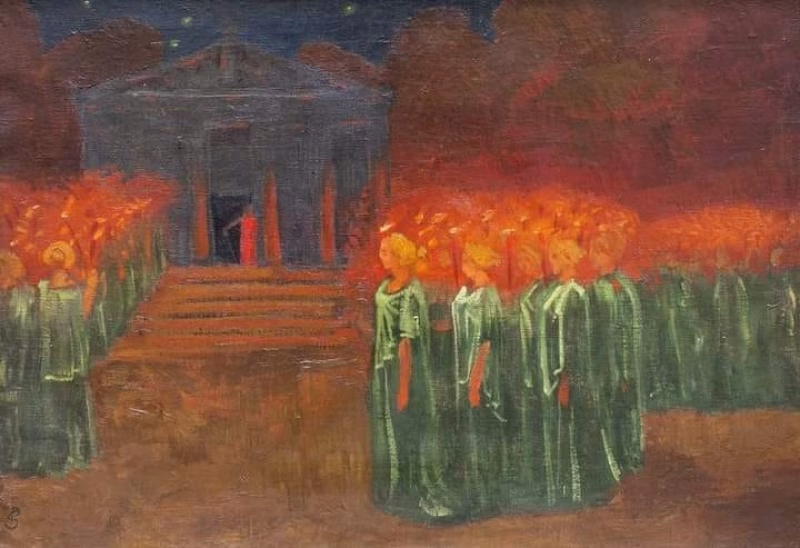
Part Two: Initiation and the Mysteries
(pp. 129–146)
Translation
If we go back to the Greek origin of the words “mystic” and “mystery,” we learn that mustagogos means “he who initiates into the mysteries,” “the priest charged with initiations,” that mustérion means “mystery,” “secret ceremony of a religion,” “secret or incomprehensible dogma”; finally, that the meaning of muticos is “mystical,” “having to do with the mysteries,” and that of mustes, “initiated,” “he who initiates into the mysteries,” is given it by the verb muéo, “to initiate into the mysteries,” “to consecrate,” “to ordain,” and muo, “to close the eyes,” “to be silent.” The Latin terms mystes, mystagogia, mystagogus, and mystagogicus derive naturally from the Greek and possess the same meaning. Let us note that Cicero gave the word mystagogus the sense of “one who shows foreigners the rarities of a temple and its treasure.”
If we then remember the Science taught in the great temples of ancient Greece, of which the Homers, Aeschyluses, Socrateses, Platos, and Pythagorases were the students, neophytes or mystes, and the Masters, we understand that in the acceptation of the three words myste, mystic, and mystery there enters the same sense of something “hidden,” “veiled,” “occult.” The mystic would be the one who, knowing how to be silent, keeps a secret—that is his knowledge—after having initiated himself so as to make conscious in himself a truth not universalized, still occult. Schuré, speaking of the end of the first trials of the “Mysteries of Eleusis,” says very well:
“— The neophytes had become mystes, that is to say, veiled. They were going to return to their habitual occupations, but the great veil of the mysteries had spread over their eyes. Between them and the external world, a cloud had interposed itself. At the same time, an inner eye had opened in their spirit, through which they vaguely perceived another world full of forms moving in gulfs alternately splendid and tenebrous.”
What were these forms? Heraclitus tells us that “nature, in all places, is full of demons.” The Greek word daimon means “genius,” and the “geniuses,” for Thales of Miletus as for Hesiod and Pythagoras, are the excellent souls who lived formerly and of whom the whole air is full. The seers, the epoptai, the initiates set themselves the noblest goal which, according to Plotinus, is “the supreme goal of…”
The mystic is he who lives by developing in himself the religious spirit; he knows the constant link that makes the visible dependent on the invisible and reciprocally; he feels the need to deepen the chain of cause to effect that exists in the manifestations of universal Life, in the densest and most rarefied degrees of Substance; he feels himself a centre where the relations between these manifestations become all the more acute and active the better the conscience or inner sense perceives them, and he adapts himself—that is, becoming himself, he accords his profane acts to the profound sacred action, vocation of his being, and unifies himself by following the gradual stages of an initiatic evolution. Thus, according to the word of Saint Paul, “from this earth, he walks in Heaven.”
This “Heaven” is not, as certain contemporary savants claim, the product of simple hallucinations, of suggestions.
“When one meditates on the Mysteries, there is a point that is not common to all kinds of meditation; it is what some call the fabrication of the place, and others the interior lesson,” writes Saint Francis de Sales. “Now this is nothing other than proposing to one’s imagination the body of the mystery one wishes to meditate, as if it were really happening, and in fact in our presence… By means of this imagination, we enclose our spirit within the mystery we wish to meditate, so that it does not go running here and there…”
The vision, the consciousness, the certainty of a world of Life evolving outside the direct control of the five senses of man—is this the fact of a “fabrication of the place,” can it become an “interior lesson”? We could say that this question belongs to those inexplicable reasons which, according to Leibniz, “consist uniquely in our consciousness or perception, and in an experience of inner feeling…”
But why do so-called materialist theorists declare that all these phenomena, not yet classified and hierarchized by savants in the physiology of the central nervous system, are solely the effects of imagination, illness, madness? They see only the “fabrication of the place”; the “interior lesson” escapes them. People of little faith, they do not proclaim what their master Claude Bernard wrote: “I am persuaded that a day will come when the physiologist, the poet, and the philosopher will speak the same language and all understand one another.” They limit Nature to the bounds of their reason and do not feel the grandeur of the soul placed in contact with the maximum of Life in the subtle immensity.
Their intelligence, localized in the narrow prison that carnal matter has forged for it, does not open to the powerful influxes of Universal Intelligence.
Universal Intelligence! What do we know of this Attribute of the Nucleolinus, first manifestation of what remains Unthinkable for man in his present state, and what can we say of Its union with him who, by his profound evolution, rises to the comprehension of the conceivable manifestations of this Cosmic Force? Sovereign rational Principle presiding, from the Origin, over the involutive or evolutive birth of all forms; Synthesis of all causes, each of which contains the act of past reason and the power of future reason; Formative Number of this Rhythm, Soul, Essence of Movement constituted by the Unity that divides itself and the Diverse that returns to the One Source; Fundamental basis of this Harmony or Balancing of the tendency of Spirit and the desire of Substance; Order according to which is edified the whole organization of macrocosmic systems and microcosmic kingdoms in the infinitely great as in the infinitely small; Logical accord between the innumerable modalities, the states of being of the Whole; Marvellous concordance which only the non-mystics deny when they dissimulate their lack of knowledge or intuition by giving the name of coincidence, of fortuitous circumstance, of event impossible to foresee, to phenomena whose causes are, at the degree of their evolution, occult to them.
But what can Man know of Number, Harmony, Concordance that governs the Cosmos, while the occult still exists for him, when his spiritual eyes have not yet opened to the perception and comprehension of the Order established in the universal Quaternary?
“The eyes of the spirit begin to see sharply,” wrote Plato, “only when the edge of the eyes of the body begins to grow dull.” Is this not that balancing of the tendency of Spirit and the desire of Substance of which we have just spoken? Now, to satisfy the aspirations of Spirit, to realize the life of the Soul, one must first of all admit its existence. Certain contemporary savants explain by imagination, illness, madness, not only real disorders, but regular phenomena taking place in the nervous, psychic, and mental degrees of the human being.
Now, every neophyte knows that the relation with Universal Intelligence can be developed only through these last two degrees and, more especially, through educated Mentality. O men, how can you know and know the Universe and the Gods, what consciousness can you have of the tendencies of your Soul, if you ignore the existence of the psychic and mental forces that inhabit you? It is true to say, as Plotinus wrote, that “those who wish to rise to the most divine knowledges and works, with, according to the proverb, uninitiated mouths and unwashed feet, those very ones will make only imperfect steps; their efforts will be sterile and their paths full of darkness.”
Let us give to the body what belongs to it and render to Spirit what is of Spirit. Then, in this incessant effort toward Equilibrium, the individual, as the Cosmic Tradition says, “naturally tends toward unlimited and eternal perfection, because he is as one with the free and eternal forces that he receives and to which he responds. Equilibrium is the full reception of Intelligence Universal, and of what it veils, by matter whose aptitudes and capacities are evolved so as to be in perfect relation with this Intelligence. The forces localized in matter and the free forces, capable of being universal, have one and the same eternal source, and, in order, infinite. Hence the localized force, in its union with the free force, is apt to evolve perpetually.”
This is the true, the unique “interior lesson.” It depends only on the neophyte, on the constancy of his effort, on the science with which he knows how to command in himself a silence favourable to meditation which, insensibly, is transformed into ever deeper contemplation, then to keep that inner peace which allows him not only to listen to and hierarchize the thoughts of the summits of his being, but to perceive that subtle and boundless field where the free Forces of the Cosmos circulate, to abandon himself to them, to be part of their currents, to participate in their power. Meditation is the first step of this indefinite evolution.
To receive the Divine Forces, to respond to their magical influx, it is necessary, by our life in spirituality, every day, every hour, to have rendered capable the atoms, the molecules, the degrees of being of our Being, of feeling them, understanding them, communing with them. And it is for this that, full of beauty as much as of charity, is the counsel of Saint Paul.
“— All things that are pure, all things that are holy, all things that are in relation with what is good, wherever virtue is found, wherever what is worthy of praise is found, let us think on these things.”
Brothers and sisters, we thus return to what we were saying about the neophyte’s effort to render effective in himself the work of Intelligence, to develop, thanks to the intellectual Faculty, this superior Self which will become his God. The great work of the mystic is to organize Order in the different planes of his being in order to feel and understand the Order according to which is edified the whole organization of macrocosmic systems and microcosmic kingdoms in the infinitely great as in the infinitely small; the great work is the unification of the individuality which consciously submits to the Law of Weight, Number, and Measure, three modes of universal Rhythm, in order to intuit, in the Cosmos, the intimate nature, the essence of Movement constituted by the Unity that divides itself and the Diverse that returns to the One Source; the great work of the neophyte is to become himself, so that, at the maximum of every realizable possibility, he can classify in himself mental phenomena and psychic phenomena, visions and conceptions, determine their chain, put them in harmony with his profound tendencies in order to raise his spirit to immediate knowledge or to the logical comprehension of the marvellous Concordance, of the Accord between the innumerable modalities, the states of being of the infinite and eternal Whole. But is this not likewise the great work of the intellectual?
“Life is sacred because life is the means of the individualization of intelligence,” proclaims an axiom of the Basis of Cosmic Philosophy. Life! Through it is manifested on all the earths of the Cosmos the universal quaternary Force. But the Pathetic element, that by which Love spreads through Substance, is lacking everywhere where the Intellectual Principle has not been evolved to clothe it.
“— Eye has not seen nor ear heard the things that intelligence, as garment of pathotism, prepares for the psycho-intellectual man.” Sublime word and grandiose promise of Intellectual and Mystic, of Psycho-Intellectual.
So that his spiritual eyes may contemplate more numerous marvels of the infinite world of forms, so that his subtle hearing may vibrate to the revealing sounds of certain attributes of the essence of things, the mystic, like the intellectual, seeks to obey the initiatic rule: become yourself, individualize yourself. The mystic permits the Forces manifested of the Formless, by their conscious reception, to realize their aptitudes to be perfected after having permeated successively the ever denser states of Matter; the intellectual classifies these Forces, hierarchizes them, and uses them to form and transform this Matter.
And the man who has developed in himself both the intellectual power and the mystic capacity—is he not this Psycho-Intellectual working, by the equilibration of his nervous degree, toward the full blossoming of the faculties proper to the psychic and mental degrees that his being can clothe in nervo-physical density?
Is he not this psycho-intellectual to whom the Initiate Teaching proposes to show: “That he is of divine origin, that he bears Divinity in himself, that he has the mission to manifest it, that by the direct will of his Divine Formator his role is to use the forces of Nature to transform the actual state of his environment to the measure of his own evolution, that he has this right and can evolve the power of it.”
Become yourself, individualize yourself. Through the Initiate Teaching, the neophyte learns that the individualization of every degree, of every state of being is the condition of its immortality. Only the mystical and intellectual man, the psycho-intellectual, is capable of realizing the unification of his Self, the quaternary unity of his Being, of thus conceiving the possibility of an integral immortality and of working toward that immortality. Life is sacred. What then is our duty, what is our mission in nervo-physical density? To prolong it, to eternalize it!
That is why we tell you to accept the Initiative law of Life and, according to the traditional writing, “to prepare and edify one’s eternal duration.” Without our cooperation, our tireless effort, we would indeed be, in the Cosmos of being, but a little atomic matter assuming for a time a fragile form, composed of an agglomerate of more or less intellectualized molecules.
But become conscious of our sublime role, awakened by meditation in all the possibles of our superior self, we tend to realize according to the divine concept the perfection of Life. It is our right, our grandiose duty.
The shadows are dissipating! We grasp it at last, the problem of problems. Here it is: you have received Life; work to make it forever imperishable; it has been given to you presently mortal so that you may sculpt it immortal. On the immortality of man depends the cosmic equilibrium.
Exegesis
This section, which opens with the etymology of “mystic” and “mystery” and closes with the call to “sculpt immortality,” is the heart of Semenoff’s argument. It is a defence of the mystical faculty as a mode of cognition equal in dignity to the intellectual, and a call to the “Psycho-Intellectual” to unify both.
The philological opening is characteristic of Semenoff’s method. By tracing mystikos and mysterion to Greek roots meaning “to close the eyes” and “to be silent,” he recovers a sense of the mystical as disciplined interiority rather than vague emotionalism. The mystic is not the sentimental dreamer but the one who, having been initiated, “knows how to be silent” and keeps the secret.
The epistemological core of the section is the distinction between logical certainty and intuitive certainty. Semenoff draws on Leibniz, Claude Bernard, Plotinus, and Plato to argue that the “interior lesson” (leçon intérieure) is a form of knowledge that cannot be reduced to the data of the five senses. The vision of a world of Life “evolving outside the direct control of the five senses” is not hallucination but a higher perception, accessible to those who have developed the “psychic and mental” degrees of being.
The anthropology that emerges is quaternary: man is composed of four bodies or degrees—nervo-physical, nervous, psychic, and mental—each of which can be “individualised” through initiatic work. The “Psycho-Intellectual” is the one who has developed both the intellectual power (mental degree) and the mystical capacity (psychic degree), and who works through the equilibration of the nervous degree to manifest the full quaternary unity of his being.
Critical note on immortality. This is the “immortality” that Semenoff proclaims: a conception that cannot be reduced to post-mortem survival, but centres on the progressive realisation of the integral being here and now. Whether the source also leaves open the question of survival after death is a matter the text does not definitively resolve.
As Olzi has shown, the achievement of the secret life was associated in Semenoff’s mind with movement towards a particular physical location—a “spiritual homeland” that was both a place and an inner dimension of man. The neophyte’s comprehension of their own nature would lead them to an ideal spiritual place, where their soul would meet the divine one. This conception explains Théon’s cryptic formula, quoted in his letter to Semenoff, that “nationalities are constellations”: social identity played a role in the spiritual-evolutionary process, and through the initiatory path the candidate would experience the revelation of belonging to a broader context and an ancient tradition from which all civilisations had descended.
The section closes with the call to action: “Become yourself, individualize yourself.” Immortality is not a gift but a task; the “equilibrium of the cosmos” depends on the human realisation of the quaternary life.
Index of Key Words and Concepts
| Term | Definition |
|---|---|
| Époptaï | The “seers”; the highest grade of initiates in the Eleusinian Mysteries. |
| Fabrication du lieu | “Fabrication of the place”; the imaginative construction of the mystery in meditation. |
| Homeland (spiritual) | Both a physical location and an inner dimension of man; the goal of the initiatory path, linking East and West. |
| Immortalité intégrale | The full realisation of the quaternary being; not survival but integral realisation. |
| Individualisation | The initiatic work of developing each degree of being; the condition of immortality. |
| Leçon intérieure | “Interior lesson”; the knowledge that arises from within, not from external authority. |
| Mustagogos | “He who initiates into the mysteries”; the priest charged with initiations. |
| Mystique / Mystère | From Greek myeo (to initiate) and myo (to close the eyes, to be silent); the secret, initiatic knowledge. |
| Nucléolinus | The first manifestation of the Impensable (Unthinkable); the Cosmic Philosophy’s term for the primordial emanation. |
| Pathotisme | The supreme force from which the spiritual, intellectual, and vital derive; the force of Love/Affinity. |
| Pathotiseur | One who pathotises; in Théon’s letter to Semenoff, distinguished from the magnetiser, vitaliser, and evolver. |
| Psycho-Intellectuel | The evolved human who has unified the intellectual and mystical faculties. |
| Quaternaire | The fourfold structure of man and cosmos: nervo-physical, nervous, psychic, mental. |
| Équilibre cosmique | Cosmic equilibrium; the balance that depends on human realisation. |
General Index of Names
| Name | Dates | Role / Significance |
|---|---|---|
| Aeschylus | c. 525–456 BCE | Greek tragedian; mentioned in Part Two translation as one of the students of the ancient temples. |
| Alexandrian, Sarane | 1927–2009 | French surrealist and journalist; source for Semenoff’s attendance at Naglowska’s séances. |
| Anatole France | 1844–1924 | Nobel Prize-winning French writer; prefaced Eugène Semenoff’s Une page de la contre-révolution russe (1906). |
| Barlet, Charles (Albert Facheux) | 1838–1921 | First editor of Revue Cosmique; key figure in French occultism, Gnostic Church, Martinism. |
| Berr, Berr Isaac | 1744–1828 | Member of the Assembly of Notables of Nancy; supporter of Jewish emancipation; grandfather of Marcelle. |
| Berr de Turique, Marcelle | 1894–1991 | Art dealer, manager, memoirist; member of Idéal et Réalité; opened “Le Portique” (1923). |
| Berr de Turique, Michel | 1781–1843 | Translator, German-language teacher, lawyer; father of Marcelle. |
| Blavatsky, Helena | 1831–1891 | Founder of the Theosophical Society; translated by Semenoff (Au Pays des Montagnes Bleues). |
| Blot, Claire | 1883–1966 | Wife of Louis Thémanlys; active member of the Cosmic Movement; dedicatee of Introduction à la Vie Secrète. |
| Blot, Denise Alice | 1886–? | Wife of Marc Semenoff; pianist; daughter of Louis Eugène Blot. |
| Blot, Louis Eugène | 1857–1938 | Bronze caster and art dealer; father of Claire and Denise. |
| Boehme, Jacob | 1575–1624 | German mystic and theologian; mentioned in Part One translation among the Christian mystics in Fabre d’Olivet’s lineage. |
| Bossuet, Jacques-Bénigne | 1627–1704 | French bishop and theologian; quoted in Part One translation on Moses. |
| Bourdelle, Antoine | 1861–1929 | Sculptor; teacher of Anna Semenova at the Academy in Montparnasse. |
| Chapnik, Jacques | — | Russian émigré printer; founded Société nouvelle d’imprimerie et d’édition (1922). |
| Cicero | 106–43 BCE | Roman statesman and author; cited in Part Two translation on the mystagogus. |
| Claude Bernard | 1813–1878 | French physiologist; quoted in Part Two translation on the unity of science and poetry. |
| Cornelius Agrippa | 1486–1535 | German Renaissance occultist; quoted in Part One translation on the twenty-two letters. |
| Delisle de Sales, Jean-Baptiste-Claude | 1741–1816 | French Enlightenment philosopher, author of Philosophie de la Nature; first intellectual master of Fabre d’Olivet. |
| Delpeuch, André | 1883–1962 | Publisher of Introduction à la Vie Secrète; member of Idéal et Réalité. |
| Dostoevsky, Fyodor | 1821–1881 | Russian novelist; translated by Semenoff; cited in Part One exegesis among the “initiates who changed history.” |
| Dufy, Raoul | 1877–1953 | Painter; contact for Anna and Marc Semenoff in the Parisian artistic milieu. |
| Durozoir | fl. 1825 | French literary critic and historian; hostile biographer of Fabre d’Olivet, quoted in Part One translation. |
| Fénelon, François | 1651–1715 | French archbishop and author; author of “The Ring of Gyges,” cited in Part One translation. |
| Franklin, Benjamin | 1706–1790 | American statesman and scientist; member of the 1784 commission on Mesmer, cited in Part One translation. |
| Gaston Paris | 1839–1903 | French philologist; criticized by Semenoff in Part One translation for ignoring Fabre d’Olivet. |
| Geloso, Césare | 1867–1960 | Pianist and composer; teacher of Claire and Denise Blot; father of Jean Geloso. |
| Grivel, Rodolphe | — | Deaf-mute cured by Fabre d’Olivet; subject of the Notions sur le sens de l’ouïe (1819), cited in Part One translation. |
| Gunzburg, Ilya | 1859–1939 | Sculptor; tutor of Anna Semenova in Saint Petersburg (1910–1914). |
| Heraclitus | c. 535–475 BCE | Greek philosopher; quoted in Part Two translation on nature and demons. |
| Hesiod | fl. c. 700 BCE | Greek poet; mentioned in Part Two translation on the “geniuses.” |
| Hiver, Marcel | — | Editor of CAP (Critique, Art, Philosophie); member of Idéal et Réalité circle. |
| Homer | fl. 8th c. BCE | Greek poet; mentioned in Part Two translation and quoted in Part One. |
| Huss, Boaz | — | Scholar of the Cosmic Movement; provided the Semenoff photograph and archival documents. |
| Hypatia | c. 350–415 CE | Alexandrian philosopher and mathematician; subject of a bust by Anna Semenova. |
| Isis | — | Egyptian goddess; theme in Anna Semenova’s sculptures and in Semenoff’s esoteric interests. |
| Jussieu, Antoine-Laurent de | 1748–1836 | French botanist; member of the 1784 commission on Mesmer, cited in Part One translation. |
| Kantine, Zemakh | — | Russian émigré printer; founded cooperative Étoile with Léon Rotenberg (1927). |
| Kardec, Allan (Hippolyte Léon Denizard Rivail) | 1804–1868 | Founder of French Spiritism; subject of a bust by Anna Semenova. |
| Kogan, Solomon Zalman (Eugène Semenoff) | 1861–1944 | Father of Marc Semenoff; lawyer, journalist, revolutionary; translator. |
| Lavoisier, Antoine | 1743–1794 | French chemist; member of the 1784 commission on Mesmer, cited in Part One translation. |
| Leibniz, Gottfried Wilhelm | 1646–1716 | German philosopher and mathematician; quoted in Part Two translation; initiated by Mercury Van Helmont, mentioned in Part One translation. |
| Leymarie, Paul | — | Director of Librairie Leymarie; publisher of De l’Inde mystérieuse à la Russie mystique (1932). |
| Leymarie, Pierre-Gaétan | 1827–1901 | Founder of Librairie Leymarie; disciple of Allan Kardec; friend of Blavatsky. |
| Lucifer | — | Figure in esoteric tradition; subject of a sculpture by Anna Semenova. |
| Magre, Maurice | 1877–1941 | French novelist and poet; member of Idéal et Réalité circle. |
| Marcotoune, Serge | 1890–1963 | Martinist lawyer, Ukrainian nationalist; author of La Science secrète des initiés; collaborator of Semenoff. |
| Martin, Eva Margaret | 1883–1940 | Theosophist, translator, and regular contributor to The Occult Review; reviewed Introduction à la Vie Secrète in 1925 under the initials “E.M.M.” |
| Martinez Pascalis | c. 18th c. | Founder of the Martinezist current of Free-Masonry; mentioned in Part One translation. |
| Mercury Van Helmont | 1614–1698 | Flemish physician and occultist; initiated Leibniz, mentioned in Part One translation. |
| Mesmer, Franz Anton | 1734–1815 | Austrian physician and magnetizer; cited in Part One translation. |
| Naglowska, Maria de | 1883–1936 | Polish-Russian poet and occultist; founded “satanic temple” (1932); Semenoff attended her séances. |
| Napoléon | 1769–1821 | Emperor of the French; Fabre d’Olivet’s contemporary, cited in Part One translation. |
| Nietzsche, Friedrich | 1844–1900 | German philosopher; quoted in Part One translation on the Superhuman. |
| Olzi, Michele | — | Scholar; author of the most detailed study of Semenoff’s place in the Cosmic Movement. |
| Paracelsus | 1493–1541 | Swiss physician and alchemist; mentioned in Part One translation among the Christian mystics. |
| Pascal, Blaise | 1623–1662 | French mathematician and philosopher; quoted in Part One translation on principles. |
| Picard, Eudes | 1867–1932 | French astrologer; pupil of Charles Barlet; member of Idéal et Réalité circle. |
| Pico della Mirandola | 1463–1494 | Italian Renaissance philosopher; mentioned in Part One translation as the greatest Platonist of the Middle Ages. |
| Plato | c. 428–348 BCE | Greek philosopher; quoted in Part Two translation on the eyes of the spirit. |
| Plotinus | c. 204–270 CE | Neoplatonic philosopher; quoted in Part Two translation. |
| Postel, Guillaume | 1510–1581 | French orientalist; mentioned in Part One translation. |
| Pythagoras | c. 570–495 BCE | Greek philosopher and mathematician; central to the Pythagorean doctrine, mentioned in Part One translation. |
| Raymond Lulle | c. 1232–1315 | Spanish mystic and philosopher; mentioned in Part One translation. |
| Reuchlin, Johannes | 1455–1522 | German humanist and Hebraist; mentioned in Part One translation. |
| Rolt-Wheeler, Francis | 1876–1960 | Editor of L’Astrosophie; contributor to De l’Inde mystérieuse à la Russie mystique. |
| Rouger, Gustave | 1886–1974 | Musician and poet; co-founder of Idéal et Réalité with Louis Thémanlys. |
| Saint Augustine | 354–430 CE | Christian theologian; quoted in Part One translation. |
| Saint Francis de Sales | 1567–1622 | French bishop and mystic; quoted in Part Two translation on the meditation on the Mysteries. |
| Saint Jerome | c. 347–420 CE | Christian theologian and translator of the Bible; mentioned in Part One translation. |
| Saint Martin (Louis Claude de Saint-Martin) | 1743–1803 | French mystic and philosopher; Inspirator of the Martinist current, mentioned in Part One translation. |
| Saint Paul | c. 5–67 CE | Christian apostle; quoted in both parts of the translation. |
| Saint-Yves d’Alveydre, Alexandre | 1842–1909 | French occultist; mentioned in Part One exegesis among the “initiates who changed history.” |
| Schiff, Salvator | — | Poet, stage director, plumber; editor of Art, science et peuple; subject of a chapter in De l’Inde mystérieuse. |
| Schuré, Édouard | 1841–1929 | French occultist and author of The Great Initiates; quoted in Part One translation. |
| Semenova, Anna | 1888–1977 | Sister of Marc Semenoff; sculptor; studied under Bourdelle and Gunzburg. |
| Socrates | c. 470–399 BCE | Greek philosopher; mentioned in Part Two translation. |
| Soussens, Mamert | 1871–1903 | Editor-in-chief of La Liberté (Fribourg); early collaborator of Eugène Semenoff. |
| Spinoza, Baruch | 1632–1677 | Dutch philosopher; mentioned in Part One translation. |
| Steiner, Rudolf | 1861–1925 | Austrian philosopher and esotericist; mentioned in Part One exegesis. |
| Swedenborg, Emanuel | 1688–1772 | Swedish scientist and mystic; mentioned in Part One translation. |
| Tagore, Rabindranath | 1861–1941 | Bengali poet and thinker; subject of a bust by Anna Semenova. |
| Thales of Miletus | c. 624–546 BCE | Greek philosopher; mentioned in Part Two translation. |
| Thémanlys, Claire (née Blot) | 1883–1966 | Wife of Louis Thémanlys; active in Cosmic Movement; dedicatee of Introduction à la Vie Secrète. |
| Thémanlys, Louis (Louis Moyse) | 1874–1943 | Second leader of the Cosmic Movement; co-founder of Idéal et Réalité; editor of Revue Cosmique. |
| Thémanlys, Pascal (Pascal Moyse) | 1909–2000 | Son of Louis and Claire; memoirist and source for Semenoff’s biography. |
| Théon, Max (Aia Aziz) | 1848–1927 | Founder of the Cosmic Movement; author of La Tradition Cosmique and Revue Cosmique. |
| Théon, Alma (Mary Ware) | 1839–1908 | Wife of Max Théon; trance medium; source of the revelations in La Tradition Cosmique. |
| Viviani, Isabelle (née de Bouhelier Lepelletier) | 1872–1923 | Wife of Prime Minister René Viviani; influenced by Cosmic Philosophy. |
| Viviani, René | 1863–1925 | Prime Minister of France; husband of Isabelle Viviani. |
| Zalut, O. | — | Director of the Imprimerie d’Art Voltaire, 34 rue Richet, Paris; printer of Marcotoune’s La Science secrète des initiés. |
Bibliography
Primary Source
Semenoff, Marc. Introduction à la Vie Secrète. Paris: André Delpeuch, 1923.
Works by Marc Semenoff
Semenoff, Marc. Caserne. Paris: Figuière & Cie, 1911.
———. De l’Inde mystérieuse à la Russie mystique. Paris: Leymarie, 1932.
———. “Essai synthétique sur l’art égyptien.” L’Art vivant 3, no. 178 (November 1933): 466.
———. Introduction à la vie secrète. Paris: Delpeuch, 1923.
———. Les serviteurs du soleil. Paris: Mercure Universel, 1909.
———. “Mysticisme Russe et Mysticisme Européen.” L’Astrosophie (21 March 1930): 134–137.
———. “Radiations et Mystères de la Vie.” L’Astrosophie (21 December 1930): 175–182.
Translations by Marc Semenoff
Blavatsky, Helena. Au pays des montagnes bleues. Edited by Marc Semenoff. Paris: Éditions du Monde Moderne, 1926.
Dostoevsky, Fyodor. Crime et châtiment. Edited by Marc Semenoff. Paris: Arthème Fayard, 1938.
———. Les nuits blanches. Edited by Marc Semenoff. Paris: Arthème Fayard, 1935.
Gogol, Nikolaj. Le Revizor. Paris: Plon, 1922.
———. Les âmes mortes. Paris: Ollendorff, 1922.
Marcotoune, Serge. La Science secrète des initiés et la pratique de la vie. Translated by Eugène and Marc Semenoff. Paris: Imprimerie d’Art Voltaire (O. Zalut), 1928. New edition, Paris: Simorgh, 2009.
Pouchkine, Alexandre. Boris Godounof. Edited by Marc Semenoff. Paris: Plon-Nourrit, 1921.
Tolstoj, Lev. Anna Karénine. Paris: Fayard, n.d.
———. La Guerre et la Paix. Paris: Fayard, n.d.
Secondary Sources
Alexandrian, Sarane. “Maria de Naglowska prophétesse de la religion du troisième millénaire.” Supérieur Inconnu, no. 8 (1997): 5–24.
Berr de Turique, Marcelle. Une vie de travers. Lyon: Jacques-Marie Laffont et Associés, 1982.
Bibliothèque nationale de France. “Notice de personne: Semenoff, Marc (1884–1968).” Catalogue général. https://catalogue.bnf.fr/ark:/12148/cb12407890t.public.
Chajes, Julie, and Boaz Huss, eds. The Cosmic Movement: Sources, Contexts, Impact. Beer Sheva: Ben-Gurion University of the Negev Press, 2020.
De Gasquet, Sébastien. “La France et les Mouvements Nationaux Ukrainiens.” In Recherches sur la France et le problème des Nationalités pendant la Première Guerre Mondiale, edited by Georges-Henri Soutou, 105–205. Paris: Presses de l’Université Paris-Sorbonne, 1995.
Fontaine, Daniel. Introduction to Serge Marcotoune, La Science secrète des initiés et la pratique de la vie. Paris: Simorgh, 2009.
Huss, Boaz. “Cosmic Philosophy and the Arts: The Cosmic Movement and the Idéal et Réalité Circle.” Nova Religio: The Journal of Alternative and Emergent Religions, no. 4 (2016): 102–118.
———. “Madam Théon, Alta Una, Mother Superior: The Life and Personas of Mary Ware (1839–1908).” Aries 15 (2015): 210–246.
“Imprimerie Union.” Wikipédia. https://fr.wikipedia.org/wiki/Imprimerie_Union.
Olzi, Michele. “Dada 1921: Un’ottima annata. Maria de Naglowska e il milieu dadaista in Italia.” La Biblioteca di Via Senato, no. 1 (2016): 22–25.
———. “From Mystical Russia to the Eurasian Homeland: Marc Semenoff and the Cosmic Movement.” In The Cosmic Movement: Sources, Contexts, Impact, edited by Julie Chajes and Boaz Huss. Beer Sheva: Ben-Gurion University of the Negev Press, 2020.
———. “From Promised Land to Eurasian Spirituality: Marc Séménoff’s Initiatory Path in the Cosmic Movement.” Paper presented at The Cosmic Movement: Sources, Contexts, Impact, Ben-Gurion University of the Negev, Beer-Sheva, 20–22 March 2017.
Source
The French original of Introduction à la Vie Secrète (Paris: André Delpeuch, 1923) is available in PDF format at the Internet Archive:
https://archive.org/details/introductionlavi0000seme
All page references in this article correspond to the printed pagination of the 1923 edition. Readers consulting the Internet Archive facsimile will find the passages discussed here at pp. 129–146 (Initiation and the Mysteries) and pp. 147–173 (Fabre d’Olivet and the Science of Number).
Coming Soon
A Little Marc Semenoff Sampler-Part 2 will be devoted to Marc Semenoff and Aia Aziz (Max Théon): A selection of Semenoff’s own writings on the founder of the Cosmic Movement, and a critical study of their relationship. Publication expected next month.
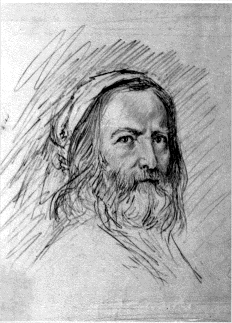
***
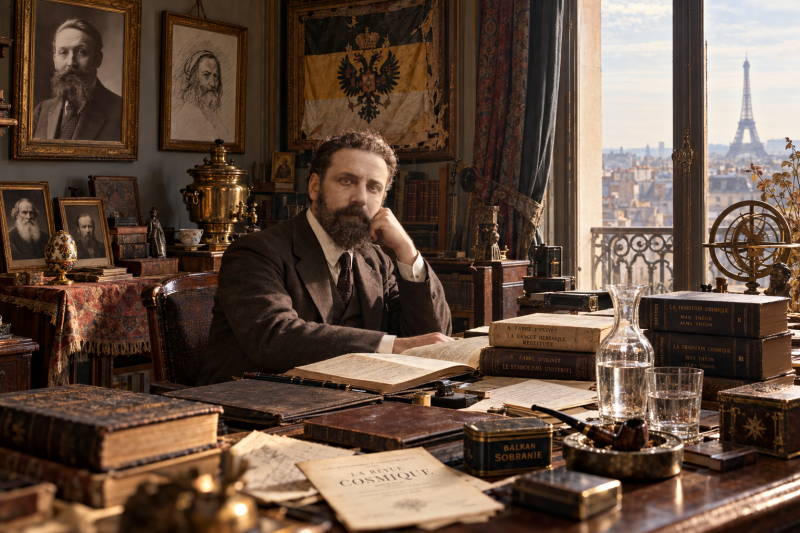
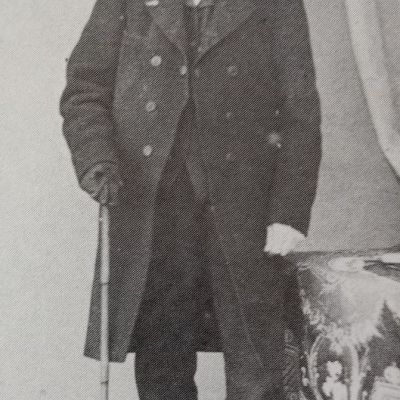
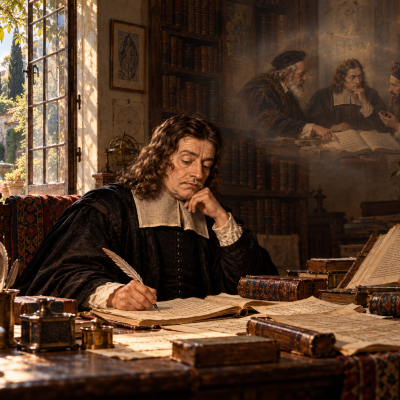
Leave a Reply