
Circle of Transmission: The Living Loom
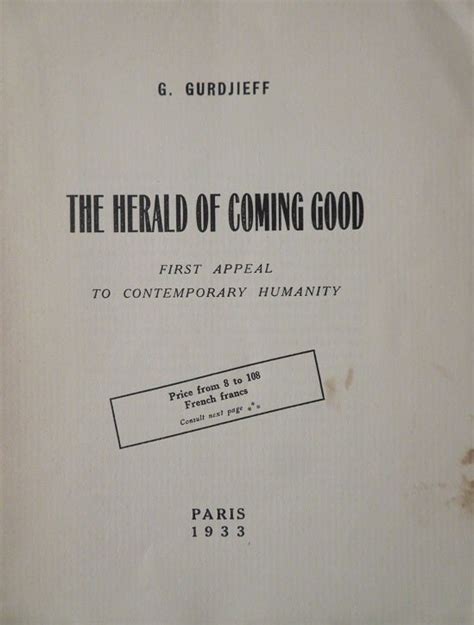
Mister Gurdjieff’s ‘Very Big Plan’: An Annotated Survey of the Underrated 1933 ‘The Herald of Coming Good’

Featured Illustration: A symbolic portrait of Mister Gurdjieff at the Prieuré: The Work of Transmission. Mister Gurdjieff writing at his desk in the Prieuré, with copies of ‘The Herald of Coming Good‘ beside him. On the wall are portraits of his wife and mother; beyond the window, students practice the Movements on the lawn. The scene evokes the living continuum of Mister Gurdjieff’s ‘Very Big Plan‘: the formulation of the teaching in writing, its preservation in books, and its embodiment through the work of successive generations.
*
Today’s sharing from the Blue House of Via-HYGEIA is an annotated survey of G.I. Gurdjieff’s underrated ‘The Herald of Coming Good‘, as we understand it. We have attempted to strip away the dense vegetation-prose to reveal the ‘Very Big Plan‘ hidden within and beneath the text: a strategic blueprint for preserving objective knowledge, filtering students, and transmitting truth throughout future generations.
*
A Contextual Introduction
Among the extensive and often impenetrable corpus of G.I. Gurdjieff, ‘The Herald of Coming Good‘ (1933) occupies a peculiar, often misunderstood niche. Often dismissed by casual readers as a mere promotional prospectus for his Institute, or criticized for its autobiographical digressions and dense, circular syntax, it is rarely treated as a standalone philosophical manifesto. Many students of the ‘Work‘ bypass it entirely, eager to reach the fantastic labyrinth of mythological narratives of ‘Beelzebub’s Tales to his Grandson‘ or the practical instructions of ‘Meetings with Remarkable Men‘.
This density is not a mere stylistic quirk, but a deliberate pedagogical tool. Scholars have long noted that Mister Gurdjieff employed a ‘circular‘ or ‘oriental‘ method of writing, akin to the teaching stories and spiritual poetry of Mevlana Rumi’s ‘Masnavi’. Rather than proceeding in a straight, linear fashion, the text spirals around its core themes, returning to them repeatedly with deepening layers of meaning. This approach was designed to break the reader’s mechanical reading habits, creating the very ‘friction‘ necessary to pierce ordinary waking consciousness.
Consequently, what appears as erratic digression is actually a carefully woven net. The reader is forced to actively participate, connecting disparate autobiographical anecdotes, philosophical deductions, and practical instructions. By demanding this active engagement, Mister Gurdjieff ensures that only those willing to exert the necessary effort will uncover the operational mechanics hidden beneath the surface.
To bypass it, however, is to miss the blueprint.
Beneath the ornate prose, the seemingly erratic biographical anecdotes, and the urgent appeals for funding, lies a meticulously constructed strategic document. This is not merely a book; it is an operational manual. In ‘The Herald‘, Mister Gurdjieff does not just describe his ideas; he reveals the mechanism by which those ideas were intended to survive him. He outlines a ‘Very Big Plan‘—a multi-generational strategy to preserve objective knowledge in a world increasingly hostile to it.
Written in 1933, after Mister Gurdjieff’s near-fatal car accident, the bankruptcy of the original Prieuré, and years of financial struggle, The ‘Herald‘ represents a pivotal moment: a shift from maintaining a physical institute to securing his legacy through written transmission. This context makes the strategic nature of the text even more urgent and deliberate.
This article serves as an annotated survey and commentary on that hidden architecture. By stripping away the stylistic complexities that seem to deliberately obscure Mister Gurdjieff’s intent, we can trace the logical skeleton of his argument: from his diagnosis of the fragmented modern psyche to his radical solution of restricted access and hierarchical transmission. What follows is a synthesis of the text’s core arguments, interwoven with commentary that highlights the strategic genius often overlooked in this ‘underrated‘ first appeal.
(Note: All excerpts are taken from G.I. Gurdjieff,
‘The Herald of Coming Good’, Paris, 1933.)
*
Introduction: The Call to Real Being
“Inspired as I am by a deep conviction, springing from a long line of experimental elucidations and deductions pointing to the conclusion that, if a man desires sincerely and seriously, and out of no mere curiosity, to attain to the knowledge of the way leading to Real Being, and if he fulfils to this end all that is requested of him and begins, in fact, among other things to aid indirectly, and from his very first step, the attainment of this by others, he will, by this act alone, become as it were the forming ground for the real data contributing to the manifestation of objective and actual Good; and animated as I am by the general intention of arriving finally, by means of my literary arguments and public demonstrations proposed for the near future of experimental elucidations, at the instilling into the consciousness of my contemporaries of several such ‘psychic-initiative’ factors, as in my opinion as well as in that of every man capable of a little impartial meditation ought inevitably to act as guiding principles in the consciousness of all creatures presuming to call themselves ‘God-Like’, of such ‘initiative’ factors, namely, as should certainly include the factor inducing men both to react instinctively and, upon reflection, to realize clearly the moral obligation to help one’s neighbor…“
*
Foundational Ground Work: The Criteria for Selection
Mister Gurdjieff begins by establishing that not everyone is ready for this work. He outlines five specific conditions required for a candidate to be considered fit for his ‘Very Big Plan‘:
“Only now, having prepared, in my opinion, by means of everything already set forth in this booklet, a corresponding, so-to-say, ‘ground-work’ for depicting before the inner eye of every reader ‘the vision of the work to be achieved…
I consider it appropriate to state openly here that, from the large amount of data which proved the fitness of these people to me, the principal were the following five:
If I established, after-all round observation, that they had had in their individuality, since preparatory age, certain definite starting points for a more or less meritorious life in responsible age.
If in their being there were not completely atrophied generally inherited predispositions for the developing in the individuality of factors bringing forth the impulses of ‘organic-shame’, ‘religiousness’, ‘patriarchality’, ‘the-awareness-of-one’s-mortality’, etc.
If there was a hereditary predisposition enabling the conscious eradication of previously rooted weaknesses in their individuality, due to abnormal surroundings.
If they already gave evidence of having had suitable, established conditions of ordinary life, and had the acquired possibility to attain, according to certain principles, some definite perspectives for the future.
If there were present a distinct degree of awareness of ‘their own nothingness’, and the possibility to attain the necessary quality of desire for transforming themselves from such nothingness into the definite ‘something’, which they ought to be, even according to their own tranquilly meditated understanding.”
Editor’s Commentary: The Filter of Selection
It is crucial to understand why Mister Gurdjieff lists these five specific criteria. In an era where spiritual movements often prided themselves on being ‘open to all‘, Mister Gurdjieff’s approach was deliberately exclusive. He is not looking for the most intelligent or the wealthiest; he is looking for specific psychological raw material.
Notice the emphasis on ‘organic shame‘ (an instinctive, bodily feeling of wrongness, distinct from social guilt) and ‘awareness of one’s own nothingness‘. These are not moral virtues in the conventional sense; they are indicators of a psyche that has not yet completely calcified. Mister Gurdjieff is arguing that without the capacity to feel shame or the humility to recognize one’s own mechanical nature, no amount of intellectual study can lead to ‘Real Being‘.
This list serves as the first gatekeeper of his ‘Very Big Plan‘. It explains why his Institute was not a university in the traditional sense, but a filtering mechanism designed to identify the few capable of carrying the work forward.
Following these criteria, Mister Gurdjieff identifies the primary obstacle to this transformation: a psychic factor rooted in wrong education:
“Now, subsequent to the above ground-work’, as the master-painter would say, I have drawn the general outlines of the very essence of my appeal, and I wish to share with you, and to communicate to you, one of the many definite deductions which I made during my long, impartial observations, in the course of special studies of the automatic and sometimes relatively conscious manifestations, of people of the most varying social standing, degrees of innate comprehension, education, race and belief, that is, definite deductions regarding a most pernicious and undesirable factor, and both in the general and in the subjective sense, and one sharply manifested in man’s psychic sphere.
The fundamental cause of almost all the misunderstandings arising in the inner world of man, as well as in the process of the communal life of people, is chiefly this psychic factor, which is formed in man’s being during the period of preparatory age exclusively on account of a wrong education, and in the period of responsible age each stimulation of which gives birth in him to the impulses of ‘Vanity’ and ‘Self-Conceit’.
I categorically affirm that the happiness and self-consciousness, which should be in a real man, as well as in a peaceful communal existence between people (leaving aside and not attempting to analyze here the numerous other causes which exist in our lives through no fault of our own), depend in most cases exclusively on the absence in us of the feeling of ‘Vanity’.
For the moment I shall limit myself to mentioning only general information concerning this psychic factor inherent in everyone, which I have verified and elucidated in every possible way, and which amazed me, after appearing to be, at first, relatively insignificant. Later, I shall speak in detail of this factor, as well as of means established by me as a result of my experimental elucidatory methods, which would modify and even destroy completely this undesirable factor with all its consequences.
My most sincere wish in this case is that every man, who strives to justify before Great Nature his destiny as a man, and not merely as an animal, that destiny which is allotted to him among the other Beings on Earth, and is such as it ought to be (as I prove logically in the third series of my writings, and affirm without any possible refutation on anybody’s part), should see afterwards, in his endeavor to discover the sense of my writings and in the new institutions I expect to found, first of all the possibility of finding in them various means of helping him to eradicate from his entirety those data fixed in him, the totality of which gives birth to every variety of the feelings of ‘Vanity’.”
*
The Diagnosis: Modern Man is Split
Mister Gurdjieff argues that the modern human being is not a unified entity but a collection of conflicting parts:
“The general psyche of the modern man is split into three, so to say, completely independent ‘entities’, which bear no relation to each other and which are separate both in their functions and in their manifestations, whereas, according to historical data, these three sources formed, in the majority of people, even in the time of the Babylonian civilization, one indivisible whole, which appeared to be at once a common repository of all their perceptions and the radiating Centre of their manifestations.
Because of this one-sided education of the modern man, upon the attainment of his majority, these three entirely independent sources or centers of his life, that is, firstly, the source of his intellectual life, secondly, the source of his ’emotional’ life, and, thirdly, his instinct or ‘motor’ centre, instead of fusing inwardly in the normal way to produce common outer manifestations, have become, especially of late, quite independent outward functions, and not only the methods of education of those functions, but also the quality of their manifestations, have become dependent on special outer subjective conditions.
According to the deductions based on detailed experiments made by Mr. Gurdjieff himself, as well as those by many other people who have seriously thought about this question, every really conscious perception and manifestation of man can only result from the simultaneous and co-ordinate working of the three aforesaid sources, which make up his general individuality, and each of which must fulfill its role, that is, furnish its own share of associations and experiences.
The complete achievement of the requisite and normal manifestation in each distinct case is possible only upon the co-ordination of the activity of all these three sources.
In the modern man, partly owing to his abnormal education during his preparatory age, and partly owing to influences due to certain causes of the generally established abnormal conditions of modern life, the working of his psychic centers during his responsible age is almost entirely disconnected, therefore his intellectual, emotional and instinctive motor functions do not serve as a natural complement and corrective for one another, but, on the contrary, travel along different roads, which rarely meet and for this reason permit very little leisure for obtaining that, which should in reality be understood by the word ‘consciousness’, wrongly used by modern people today.
As a result of the lack of coordinated activity on the part of these three separately formed and independently educated parts of man’s general psyche, it has come about that a modern man represents three different men in a single individual; the first of whom thinks in complete isolation from the other parts, the second merely feels, and the third acts only automatically, according to established or accidental reflexes of his organic functions.
These three men in one should, in accordance with the foresight of Great Nature, represent, taken together in responsible age, one man as he ought to be: the ‘man-without-inverted-commas’, that is, the real man.
These three, who were deliberately shaped by Great Nature to compose one complete whole, as a consequence of not assuming at the right time the habit of mutual understanding and aid, through the fault of men themselves and of their false education, produce this result that, in the period of responsible manifestations of the modern man, they not only never help one another, but are, on the contrary, automatically compelled to frustrate the plans and intentions of each other; moreover, each of them, by dominating the others in moments of intensive action, appears to be the master of the situation, in this way falsely assuming the responsibilities of the real ‘I’.
This realization of disconnected and conflicting activity of the centers of origin, which ought to represent the psyche of man, and, at the same time, of the complete absence of even a theoretical conception of the indispensability of an education corresponding to these separate, relatively independent parts, setting aside the ignorance of its practical application, must inevitably lead to the conclusion that man is not master even of himself.
He cannot be master of himself, for not only does he not control these centers, which ought to function in complete subordination to his consciousness, but he does not even know which of his centers governs them all.”
Editor’s Commentary: The Diagnosis of Fragmentation
This concept of the ‘three men in one‘ is the cornerstone of Mister Gurdjieff’s entire anthropology, yet in ‘The Herald‘, he presents it with a specific urgency. He is not merely describing a psychological state; he is identifying a systemic failure of modern civilization.
By stating that these three centers (intellectual, emotional, instinctive) ‘travel along different roads’, Mister Gurdjieff invalidates the modern assumption that education alone can fix human problems. If the centers are disconnected, then educating only the intellectual center (as modern schools do) only creates a more efficient machine, not a more conscious human.
This diagnosis justifies the radical nature of his proposed solution: a ‘harmonious development‘ that forces these centers to work together, often through shock or friction, rather than through gentle accumulation of knowledge.
*
The Mechanism: The Forming of Impressions
If man is split, how does he perceive reality? Mister Gurdjieff suggests that what we call ‘thinking‘ is often just a mechanical playback of recorded data:
“The modern man does not think, but something thinks for him; he does not act but something acts through him; he does not create, but something is created through him; he does not achieve, but something is achieved through him.
In a newly-born child these three diverse parts of the general human psyche may be compared to a system of blank gramophone rolls upon which begin to be recorded, from the day of its appearance into the world, the external significance of objects and the subjective understanding of their inner significance, or sense of the result of all actions taking place in the outer world, as well as in the inner world already forming in him; all this is recorded in accordance with the correspondence between the nature of these actions and the nature of those distinct systems which form themselves in man.
All kinds of these recorded results of environing actions remain unchanged on each of these ‘depository-rolls’ for life, in the same sequence and in the same correlation with the impressions previously recorded, in which they are perceived. All the impressions recorded in these three relatively independent parts, composing man’s general psyche, later produce, in the period of responsible age, all kind of associations in diverse combinations.
That which is called ‘reason’ in man. As well as in all other external forms of life, is nothing more than the concentration of the results of impressions of different quality formerly perceived; and the stimulation and repetition of these provokes different kinds of associations in the being. The recorded impressions have three sources of origin, and are subject to three different law-abiding influences.
One category of associations is formed by impressions perceived involuntarily and coming directly from the outer world as well as springing from man’s inner world, as a result of certain previous, constant and automatically repeated associations.
The second category is formed by voluntarily perceived impressions either springing from the external world or crystallizing in man’s inner world by means of deliberate active thinking and verification of reality.
And the third category originates exclusively from the process of so-called ‘transformed-contemplation’, that is, from the confrontation of homogeneous impressions of all origins, which were already fixed, while continuous contact is maintained between their inner and separates centers.
The depositing in man’s entirety of the three distinct categories of impressions, enumerated above, for the subsequent manifestations of man’s general psyche confirms, among other things, the real diversity of the three determinate states of man’s consciousness and defines their quality and importance.”
*
The Illusion: Three States of Consciousness
Building on the theory of impressions, Mister Gurdjieff makes a startling claim about our daily state of awareness:
“One of the three states of consciousness, which, in the objective sense, is considered the highest and most desirable for man, reposes exclusively on associations of previously perceived impressions of the third category only.
The second state of consciousness is made up of the associations of impression of the second order mentioned above, that is, of those voluntarily perceived.
To the third state of human consciousness can be attributed, without any difficulty, the kind of consciousness for which the modern man, in his desire to emphasize its great importance and never doubting the correctness of his denomination, has adopted the expression of ‘waking-state-of-consciousness’.
This state of consciousness, which modern man ranks highest, has, according to scientifically organized and carefully verified experimental elucidations, proved to be the product of constantly repeated, involuntarily and accidentally perceived, as well as of artificially created and ‘learnt by rote’ impressions.
The majority of people today, as a consequence of the continually deteriorating conditions of their normal existence, have become accustomed to give priority to this consciousness, which is attained by the impressions just mentioned, that is, by the ‘learnt by rote’, involuntary perceptions of accidental impressions received from our environment.
In the man who attains his highest degree of consciousness by means of associations, composed of impressions of the first kind, the processes of imaginations, memory, judgment, reasoning and thinking, are no more than an automatic crystallization, resulting from his so-called ‘concentrated efforts’, which process he calls by the high sounding name of ‘attention’, whereas these already crystallized and automatically perceived impressions, in other words all the processes of this man’s inner world are only an automatic reviewing in various combinations of the oft repeated experiences of, so to say, ‘antiquated impressions.’ And this man’s manifestation in ordinary life, all his impulses, thoughts, feelings, words, convictions, beliefs and deeds, are made up exclusively from the material of such impressions in their various combinations, crystallized in his entirety.
And these combinations are formed under the influence of chance shocks which set in motion more or less intensively one or another group of previously perceived impressions, which, in the given case, become the center of associations.
Each new shock, or a shock of a different degree of intensity, evokes yet another association and, consequently, another train of thought, feeling and action, etc., and no center in the possessor of such consciousness can add anything of its own or anything new to the combinations thus formed, nor can the center, even when acting at its moment of greatest intensity, draw on the material formed in other centers.
It follows that, as the world perception of the possessor of such a consciousness is always come by only by one part of him or, in other words, as the possessor of such a three diverse processes of perception, which have but little in common or associate by chance and only partially, each of his judgments, as the product of one part only of his psyche and the expression of a part of the material at his disposal, is invariably one-sided and, as a result, necessarily erroneous.
From what has just been said it must be obvious to every sane-thinking person that the first task necessary for the real education of man is to develop in each separately formed center the natural need to blend simultaneously the functions of one part with the other, in order that the manifestations of these three parts formed separately according to the laws of nature in man’s general psyche, and which inevitably demand a separate education, may be harmoniously united, and may, in the period of responsible life, work together according to their normal capacities.
Only this attitude in the preparing of man for responsible life can bring the different sources composing man’s general psyche to the same level of manifestation, as only then will the three principal wheels of the human machine work smoothly, without hindrance to their mutual work and yield the highest degree of productivity in their separate functioning, as well as in the attainment of that level of consciousness attainable by man but which man never reaches under ordinary conditions.
Taking into consideration that the degree of development in each individual of each part of his whole individuality differs, and that his associations likewise differ, we are forced to the conclusion that the work of educating and re-educating each person must be strictly individual and cannot be otherwise.
All the faults in the functioning of the human machine, due to the conditions of ordinary life, increase with time, and any repair of the machine at work can only obtained by a constant and determined struggle against all the resulting defects.”
Editor’s Commentary: The Illusion of Waking Life
Here, Mister Gurdjieff makes one of his most provocative claims: that what we call ‘waking consciousness‘ is actually a form of sleep. This is not a metaphor for him, but a physiological and psychological observation.
The significance of this section for his ‘Big Plan‘ is profound. If humanity is essentially asleep, driven by ‘accidental shocks‘ and ‘learnt by rote‘ impressions, then a traditional teacher-student relationship is impossible. You cannot teach someone who believes they are already awake. This explains the necessity of the ‘artificial life‘ Mister Gurdjieff describes later—he had to create situations intense enough to pierce this sleep. It also foreshadows why his writings are so difficult; they are designed to be ‘friction‘ against the reader’s automatic thinking, forcing a moment of voluntary attention.
*
The Key: Uniting What is Separated
How does one bridge these splits? Mister Gurdjieff suggests that abstract philosophy is insufficient; the approach must be dramatic and holistic:
“Those psychic factors in particular, which form themselves in people during the period of their preparatory age partly of their own accord under the influence of their environment, and partly by the deliberate action of wise tutors, during responsible life, mechanically react in such a way upon the usual general psyche, that these people can not, even in spite of all their mental desire, behave in relation to others otherwise than in accordance with these psychic factors rooted in them since childhood. I refer to those factors which are in the process of forming, even in the present time, entirely automatically, it is true, in the majority of people living on all continents in places more or less isolated from the influence of so-called contemporary ‘culture’.
It must be added here that these psychic factors may likewise be easily instilled into people living their preparatory age under the conditions of contemporary culture, but to make possible the conservation of these factors unchanged over the whole period of responsible life it is indispensable,—with a view to their fixation, as my experimental elucidations have shown me—to watch over them indefatigably over a period of one or two years following their coming of age, and shield them from specially potent environing influences by exercising a corresponding influence over them.
Of these psychic factors the one that stands out most in relief, and which becomes at once easily obvious, is the factor that may be called ‘scruple-of-conscience’ and which makes it impossible that its possessor act otherwise than frankly in relation to all those who show him full ‘inner confidence, even if his so-called waking-consciousness’ urge him to act in an opposite manner.
I consider it my moral duty to add here that these observations and investigations of mine in the past cannot henceforth serve as the reason why these people, who have served as the objects of my investigation, should now have lost the possibility of entering together with others upon the true path and of attaining—by the help of my detailed and written explanations—to real Being.”
To instill this conscience and unite the centers, Mister Gurdjieff realized he needed a new pedagogical tool. He turned to art and theater, drafting a scenario he called ‘The Three Brothers‘:
“I began to form in my mind the outline of the scenario which I have called ‘The Three Brothers’:
In this scenario three brothers act instead of two, and all their manifestations and inter-relations are compared by me to the manifestations and inter-relations of the three separate, independently formed and relatively educated parts of man’s general entirety, representing, in fact, firstly, the physical, secondly, the astral, and thirdly, the mental body of man; and, in the dialogues of the three characters, in the form of a discussion, that is, affirming and denying, I introduced certain ideas which have come down to us from ancient times, when the science of medicine was very highly developed, ideas of what is useful or harmful, satisfactory or unsatisfactory for one or other of the characters of the scenario in the process of transforming of this or that substance.”
Editor’s Commentary: Art as a Vehicle for Truth
The mention of the ‘Three Brothers‘ scenario highlights Mister Gurdjieff’s belief that truth cannot be conveyed solely through dry exposition. He viewed art, theater, and movement as essential tools for bypassing the intellectual defenses of the ‘sleeping‘ man.
This aligns with his broader strategy: to engage all three centers simultaneously. A lecture engages only the mind; a sacred dance or a dramatic scenario engages the emotions and the body. The ‘Very Big Plan‘ was never just about writing books; it was about creating a total environment (The Institute, the movements, the music, the writings) that could assault the whole human being and force a moment of unity.
*
Setting in Motion the Great Plan: Restricted Access
Finally, Mister Gurdjieff reveals the operational core of his strategy: a tiered system of knowledge dissemination designed to protect the work from dilution.
“This plan, newly formed by, me consists in taking all possible measures to prevent my writings, with the exception of the first series, from becoming at once property ‘accessible-to-everybody’.
In accordance with my decision I resolved to make accessible to the public only three books from the first series of my writings.
With regard to the books of the other two series, I intend to make known their contents in the following way:
The contents of the second series will be made known by means of readings, open to those who have already a thorough knowledge of the contents of the first series. These readings are intended to take place, in the meantime, in so-called circles already existent among many large groups of men which are made up of the followers of my ideas.
For this purpose, these already existing ‘circles’, access to which will be made much easier, will be re-organized and there will be opened clubs ‘of quite a new type, easy of access, and in those places where there are no such ‘circles’ there will be sent specially trained people to arrange readings.
Acquaintance with the contents of the third series of my writings is permitted only to those people who, besides having a thorough knowledge of the ideas exposed in the two previous series, have already begun to manifest themselves and to react to other people’s manifestations in strict accordance with my indications set forth in the previous series of my writings.
The merit and proficiency of these people will be judged by some of those who have already been admitted ‘to the so-called rights-of-initiates’, according to the code established by me, or, as it might be better expressed, in accordance with the regulations modified by me, which have always existed on Earth among people who, in their search for truth, attained a certain definite Being.
Now, after pronouncing such an often materialized here on Earth, Biblical and all-concluding word, it only remains for me to proclaim to all, who have in any way met me on the ground of my ideas up to the time of my activity as a writer, that, after an eight-year break in all relations with all and sundry, I again eagerly renew them as from today.
I renew them in all eagerness, of course, only with those people whose inner world has not yet finally wasted away and fallen under the sway of various representatives of the God of Evil.
Believe me, during the whole period of my relations with you, my inner world never harbored either egotistical or altruistic impulses, and there existed only, always and in everything, the exclusive desire to prepare in all perfection for the ‘future generations the science of the Objective Truth-Of-Reality’.”
Editor’s Commentary: The Strategy of Restricted Access
Far from an elitist power trip, this system of increasing restriction was a safety mechanism based on Mister Gurdjieff’s observations of the human psyche. He understood that high-level truths, when encountered by an unprepared, fragmented mind, are either distorted into dogma or rejected as nonsense. He explicitly warns that reading the later series without preparation could cause ‘undesirable phenomena‘ or even paralyze self-perfection.
His ‘Very Big Plan‘ was to create a self-regulating ecosystem: The First Series (Beelzebub’s Tales to His Grandson) acts as a ‘sieve‘, breaking down old beliefs. Only those who survive this process and demonstrate a change in their being (not just their understanding) are granted access to the Second Series (Meetings with Remarkable Men) and Third Series (Life is Real Only Then, When ‘I Am’). It was a quality control system for spiritual transmission, designed to ensure the knowledge remained pure for future generations.
*
Conclusion: The Relevance of the Plan Today
Mister Gurdjieff’s ‘The Herald of Coming Good‘ closes with a renewal of his mission, a defiant statement that despite accidents, wars, and betrayal, the work continues. But looking back from the 21st century, the true brilliance of his ‘Very Big Plan‘ becomes even more apparent.
In an age of information overload, where ‘spiritual knowledge‘ is commodified and consumed instantly without digestion, Mister Gurdjieff’s insistence on process, struggle, and restricted access feels counter-cultural, yet profoundly necessary. He understood that truth is not a product to be sold, but a state to be achieved through rigorous internal work.
His strategy—to filter students, to break down mechanical thinking, and to protect the core of the teaching from dilution—was not a flaw in his character, but a feature of his design. The ‘text within the text‘ of ‘The Herald‘ reveals a man who was not just a mystic, but a master strategist of the human soul. He laid out a plan not for his own glory, but for the possibility that, generations later, conscious individuals might still find the path to ‘Real Being‘ amidst the noise of a sleeping world.
As we prepare to engage with his works today, ‘The Herald‘ serves not as an obscure footnote, but as the essential key to understanding the lock he intended us to open.

***

Related Articles


Leave a Reply