
Circle of Transmission: The Living Loom
The Ritual of Manuscript 4328 in the Wellcome Library, by Vincent Mercier
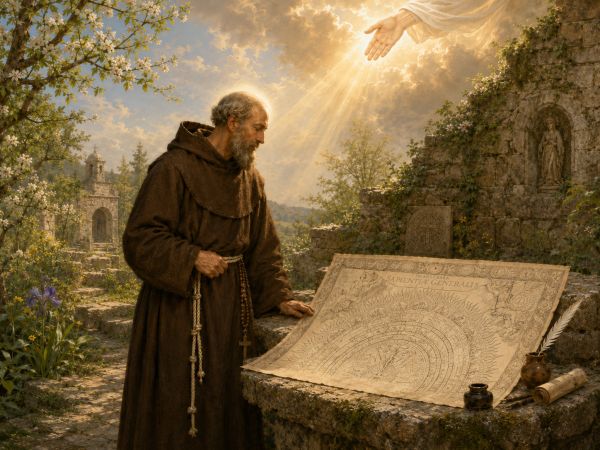
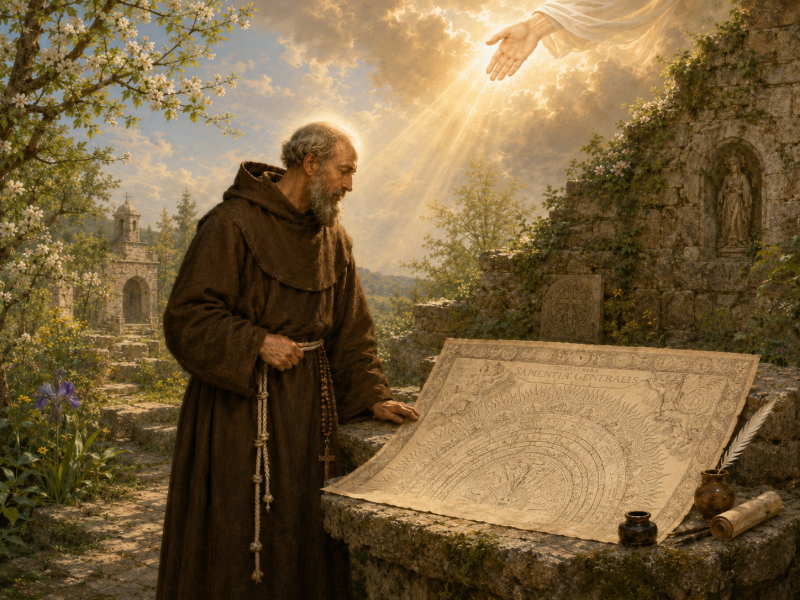
Featured Illustration: Father Esprit Sabbathier contemplates the Umbra idealis Sapientiae Generalis in his monastery garden, the divine hand above symbolizing the grace central to his work with MS. 4328.
*
Today’s sharing from the Blue House of Via-Hygeia presents the second part of Vincent Mercier’s groundbreaking essay on the mysterious Wellcome MS 4328.
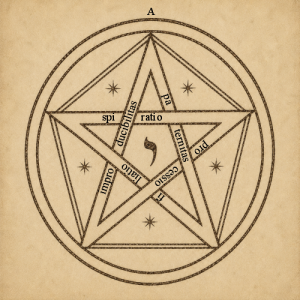
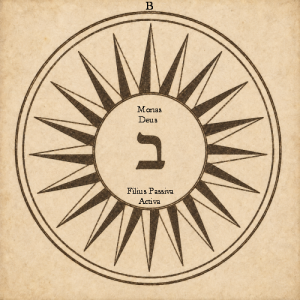
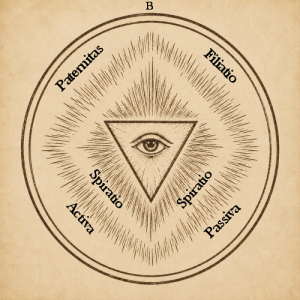
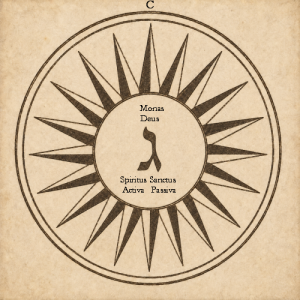
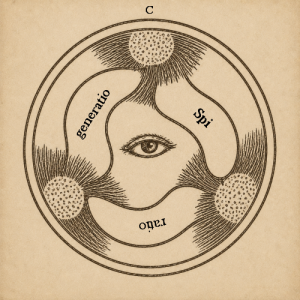
In this installment, Mercier moves beyond the ritual’s doctrinal and moral framework to examine its visual heart: the nine signacula extracted from the circular plate of the Idealis Umbra Sapientiae Generalis. He offers a meticulous iconographic analysis of each seal—the Trinitarian triad of the Father (Aleph / pentagon-pentagram), the Son (Beth / descending eye-triangle), and the Holy Spirit (Gimel / tri-solar eye)—alongside their counter-signs, the preparatory hexagrams, and the culminating figurative Trinity inscribed Intelligentia Patris, Sapientia Filii, Virtus Spiritus Sancti.
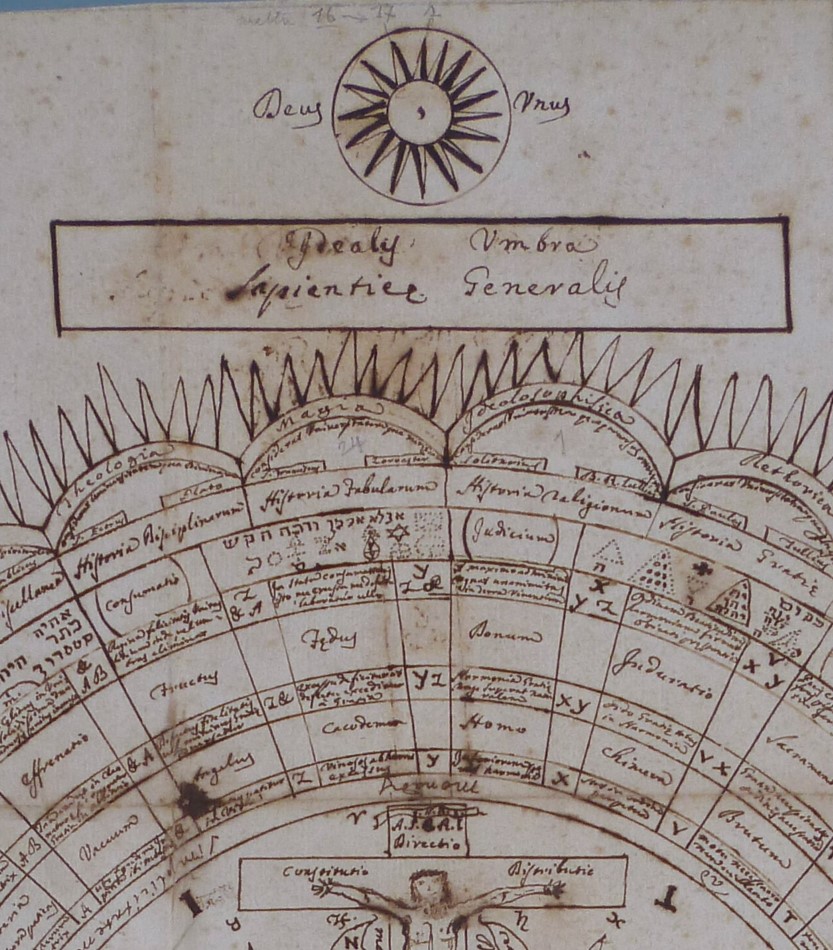
Mercier confronts the manuscript’s inherent puzzles directly: the discrepancy between the plate’s title (Series septem Signaculorum) and its nine visible figures; the tantalizing yet problematic reference to Zephirota (Sephiroth) when only nine signs appear; and the compelling hypothesis that the grand circular diagram of the Umbra idealis itself functions as an elusive tenth signaculum, completing a hidden sephirotic architecture.
The essay concludes with a profound meditation on the manuscript’s necessary resistance to full decipherment, suggesting that its ultimate secret lies not in scholarly analysis alone, but in the operator’s humble disposition to receive.
Vincent Mercier’s work is genuinely trailblazing. Wellcome MS 4328 has long languished in scholarly obscurity, unedited and unstudied as a coherent ritual system. No prior researcher has attempted a synthetic reading that unites its textual program, operative instructions, and graphic apparatus into a single theurgic logic.
By tracing the manuscript’s filiations—not merely to the well-known Ars notoria and Liber Juratus Honorii, but specifically to the Christian-Marian current of Jean de Morigny’s Liber florum—Mercier situates MS 4328 within a hitherto poorly mapped territory of early modern Christian Kabbalah and sapiential theurgy. His willingness to engage the manuscript on its own terms, acknowledging both what can be analytically secured and what must remain veiled, models a scholarly humility perfectly attuned to the material itself.
For the Via-Hygeia Circle of Transmission, this research opens a direct line of lineage: it recovers a complete ritual praxis—prayers, seals, moral discipline, and graphic meditation—rooted in the same confluence of Catholic devotion, Hebrew letters, and sacred geometry that informs our own traditions. Mercier has done more than describe a curiosity from the Wellcome shelves; he has begun to restore a living method for the reception of divine Wisdom.
**
The Ritual of Manuscript 4328
in the Wellcome Library,
by Vincent Mercier
The singularity of MS. 4328 lies above all in the ritual contained in its final part, entitled: “Ideolosophical Explanation, or the Ideal Shadow of General Wisdom, Catholic-Christian and Christian-Kabbalistic, together with the exact method for using it.”
This text presents a theurgic operation oriented toward the reception of divine Intelligence, in connection with the circular figure of the Umbra idealis Sapientiae Generalis. Its foundation rests upon the Name of God, not as a mere symbol, but as an active principle wherein Wisdom, the power of the Word, and the science of signs are concentrated.
From the very opening, the ritual is inscribed within a Trinitarian framework: all true knowledge proceeds from the Father, the Son, and the Holy Spirit, and can only be received by a human intellect previously disposed. It is therefore not a matter of acquiring an external power, but of rendering the spirit capable of receiving a ray of universal Wisdom.
The latter remains luminous in itself; obscurities do not come from God, but from the proper limits of the human intellect. Angelic mediation, notably that of Michael to Solomon, serves here as a model of transmission: God communicates His science through words, signs, and characters, and man becomes wise when he rightly receives these sacred marks.
From this perspective, the hexagon appears as the central sign of universal Intelligence and as a figure of introduction to the mystery. It manifests divine unity, Trinity, eternity, perfection, and immensity, while serving as an operative support for the opening of the intellect.
The ritual thus leads the operator toward the purification of his inner obscurities, participation in an angelic science, and progressive entry into the Wisdom of the divine Name, according to the Solomonic model of the man instructed by revelation and sealed by the sign.
The following section specifies the material and operative dimension of the ritual by establishing a progression between the sign of introduction and the signacula of accomplishment. Two hexagons must first be made, one simple and the other expressing the indivisible Trinity, then impressed in pure gold and worn upon the right arm by a yellow silk cord.
The simple sign, applied against the flesh, acts as a sign of Intelligence, of promise, and of covenant between God and man. Its function remains preparatory: it removes obstacles, disposes the operator’s arm, and renders him apt to form the characters. It thus opens access to a first intelligence of knowable things, still imperfect until the signacula of the Trinitarian Monad have been imposed.
After a period of maturation, variable according to the operators but fixed at fifty days at most, the three signacula of the Father, the Son, and the Holy Spirit come to fulfill the initial promise. Their arrangement upon the right arm expresses at once the distinction of the divine Persons and their essential unity, without superiority, inferiority, or difference of perfection.
The counter-signs associated with them follow the same logic: they do not function as separate marks, but as expressions of the indivisible perfections of the Trinity. Through these signacula, the operator no longer receives merely a preparation for Intelligence, but the Virtue of the Lord, knowledge of divine Wisdom, and an inner orientation toward the good.
The ritual thus aims as much at science as at moral rectitude. It protects against hidden faults, directs operations, maintains humility, defends against perils, and fortifies the will in the good. Intellect, heart, memory, and will are thus ordered toward God, so that knowledge of secret things can never be separated from inner purification.
The text further introduces an essential limit: the signacula open access to the lights of the world and to the book of the Lamb, but only insofar as the seals permit their reading. Where the signaculum is found, science becomes accessible; where there is none, the human intellect must stop.
The ritual thus leads to a knowledge regulated by divine signs, without pretending to abolish the limits imposed upon man. It teaches that true wisdom consists as much in receiving what is shown as in not seeking what God has reserved for His own mystery.
The text then deepens the moral and penitential scope of the ritual. Access to divine Wisdom depends not only upon the correct use of signs, but upon the inner transformation of the operator. If he is marked by sin, the mercy of God acts as a light that raises his intelligence, snatches him from blindness, and leads him to penitence. The ritual therefore aims not solely at the acquisition of a hidden science: it first produces a conversion of the heart, by which the operator learns to hate evil, to recognize the light of grace, and to receive a renewed spirit.
The knowledge granted by the divine Name remains proportioned to the quality of the heart, to the rectitude of the soul, and to the works of him who receives it. This is why the text insistently reminds that the operator must seek the will of God, and not the unfathomable mysteries that exceed the limits fixed for human—and even angelic—intelligence.
True wisdom consists in asking for what can be known, in a humble and upright disposition, so as to become wise in the sciences, firm in adversities, prudent in counsel, chaste in thoughts, just in works, and obedient in will. Conversely, he who turns the operation from its end exposes himself to divine indignation, for the science received cannot be separated from the Spirit of wisdom, of counsel, of strength, of knowledge, and of truth.
The eighth day marks a further confirmation by the most holy seal of the Trinity, engraved in gold and bearing the formulas: Intelligence of the Father, Wisdom of the Son, and Virtue of the Holy Spirit. This sign, accompanied by its hexagonal counterpoise, fixes in the mind of the operator the Word of the Lord and His intelligence. Its imposition demands humility of heart, prayer, and invocation of the Holy Spirit, figured by the hymn of the Cenacle and by the memory of the flames of Pentecost, which fulfill the promise of Christ.
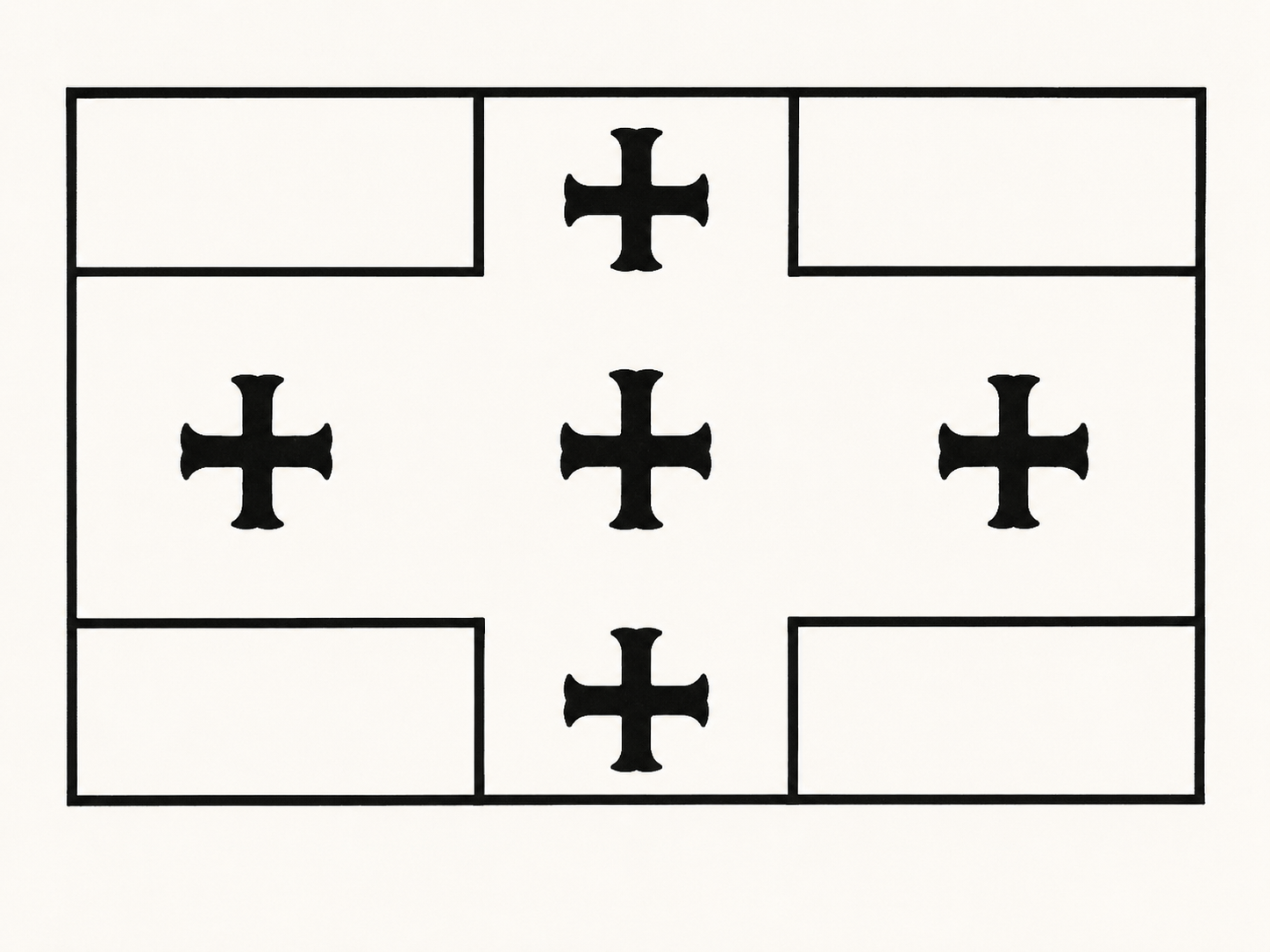
The following section regulates the wearing, deposition, and conservation of the signs. After having confirmed in himself the wisdom of the Lord, the operator may wear them for fifty days, or longer if he wishes, then deposit them only after prayer, confession, penitence, and sincere resolution to sin no more. The signs must then be purified, wrapped, and enclosed in a new, pure, square case, marked with crosses, sealed with white wax, and consecrated to the Lord. This material closure manifests a spiritual closure: the ways of sin must be shut to the operator’s spirit.
The text also fixes the limits of the divinatory or interrogative use of the ritual. Requests must be formulated as humble prayers, never as commands. They must not bear upon the incomprehensible secrets of God, nor upon death, vengeance, the faults of one’s neighbor, the state of departed souls, questions contrary to faith, or harmful things. The ritual thus leads toward a regulated, penitential, and charitable science, whose end is not curiosity, but salvation, rectitude of heart, and ordered participation in the Wisdom of God.
The final part develops the oratorical and preparatory dimension of the whole. Its efficacy rests first upon a word of supplication, of humility, and of purification. The prayers addressed to God constantly establish the source of all intelligence, science, and wisdom in the Trinitarian unity, while the divine Name, invoked as a principle of light and mercy, remains the central mediator of revelation. The operator does not seek to command here, but to ask according to the divine will; he must therefore render himself apt to receive, by the rectitude of his heart, what God shall will to manifest to him.
The successive orations form a progressive inner discipline. They ask for the erasure of ignorance, the purification of sin, the guarding of thoughts, the mastery of the will, the rejection of evil desires, and constant orientation toward salvation. The biblical figures summoned—Adam, Abel, Abraham, Isaac, Jacob, Joseph, Moses, David, Daniel, Solomon, and others—serve as models of deliverance, election, wisdom, justice, or penitence. They inscribe the operation within a sacred continuity wherein each request actualizes a grace already manifested in biblical history.
The daily progression thus leads the operator from a general request for light toward a more complete transformation of his faculties: memory, intelligence, will, heart, speech, senses, and actions must be ordered toward God. The wisdom sought is therefore never separated from virtue; it presupposes faith, hope, charity, patience, humility, prudence, counsel, strength, and obedience.
Toward the end of the series, the invocation concentrates more distinctly upon the three divine Persons: the Father as Intelligence, the Son as Wisdom fulfilling the promise, and the Holy Spirit as Virtue poured forth into the spirit. This part shows that the ritual practice is founded not only upon material signs, but upon a repeated verbal and moral ascesis, destined to render the operator transparent to the light of the Word. It leads toward a science received in grace, not conquered by curiosity, and toward an intelligence capable of discerning the good, of rejecting evil, and of remaining faithful to the divine will.
In sum, the ritual presented here aims to obtain divine Intelligence, Wisdom, and knowledge of things accessible to man, not by constraint exercised upon invisible powers, but by a progressive disposition of the soul, the body, and the intellect. It is practiced by means of sacred signs, principally hexagonal and Trinitarian, engraved in gold and worn upon the right arm. These signs are accompanied by prayers, daily orations, penitence, confession, and strict moral orientation. Its end is therefore not merely cognitive: it is also purificatory, for the operator must become apt to receive what God permits to be known.
The prayers accompanying this ritual follow a coherent progression:
- Prayers 1 to 10 establish the doctrinal framework: God is there invoked as Trinity, Creator, and source of wisdom, while the suppliant asks for the purification of his faculties—spirit, intelligence, memory, and will—in order to receive science, discernment, and obedience.
- Prayers 10 to 24 then draw upon biblical figures of deliverance: Abel, Abraham, Isaac, Jacob, Joseph, Daniel, Noah, Lot, Moses, David, Susanna, Judith, Jonah, and Solomon. Each character serves as a symbolic model: offering, obedience, protection, revelation, purification, penitence, and wisdom.
- Prayers 25 to 39 form a stage of acquisition of virtues. The text asks for humility, strength, charity, patience, peace, consolation, grace, and inner stability. Prayer thus becomes a veritable method of transformation of the soul.
- Finally, prayers 40 to 47 constitute the theological and Trinitarian crowning of the whole: faith, hope, charity, counsel, intelligence, wisdom, and science. The series concludes with the Trinity, with the Father, the Son-Wisdom, and the Holy Spirit, source of science and virtue.
Overall, the ritual attaches itself principally to the tradition of the Ars notoria, the medieval art traditionally attributed to Solomon, aiming at the obtaining of science, memory, intelligence, and wisdom through prayers, signs, and sacred figures. One finds there the great notorian markers: Solomon instructed by angelic revelation, transmission of intelligence through seals, use of the divine Name, and promise of an infused science.
It also presents strong affinities with the Liber florum of Jean de Morigny, a Christian and Marian rewriting of the Ars notoria, wherein prayers, figures, visions, moral purity, and divine grace serve to obtain a supernatural knowledge. The parallel is reinforced by the importance accorded to humility, to confession, to penitence, to the Veni Creator Spiritus, and to submission to God.
Another comparison may be established with the Liber Juratus Honorii, notably through the use of divine names, angels, seals, geometric figures, and the “seal of the living God.” However, the studied ritual appears more prudent and more strictly framed on the moral plane, for it forbids requests touching upon death, vengeance, the crimes of one’s neighbor, or truths contrary to the Catholic faith.
Finally, certain elements evoke Solomonic pentacle magic, in particular the fabrication of signs in gold, their wearing upon the arm, the use of silk, holy water, white linen, the consecrated casket, and white wax. The logic is that of a sacred object prepared, worn, purified, then ritually conserved.
The whole thus forms a Christian sapiential theurgy: a practice that combines Catholic prayer, Christian Kabbalah, sacred geometry, angels, seals, moral purification, and the quest for infused science. This ritual belongs neither to simple devotion nor to ordinary magic; it belongs to a broader tradition wherein one seeks to receive wisdom, intelligence, and science through divine grace, mediated by sacred signs.
*
Appendix: Notes and Reflections
on the Nine Signacula
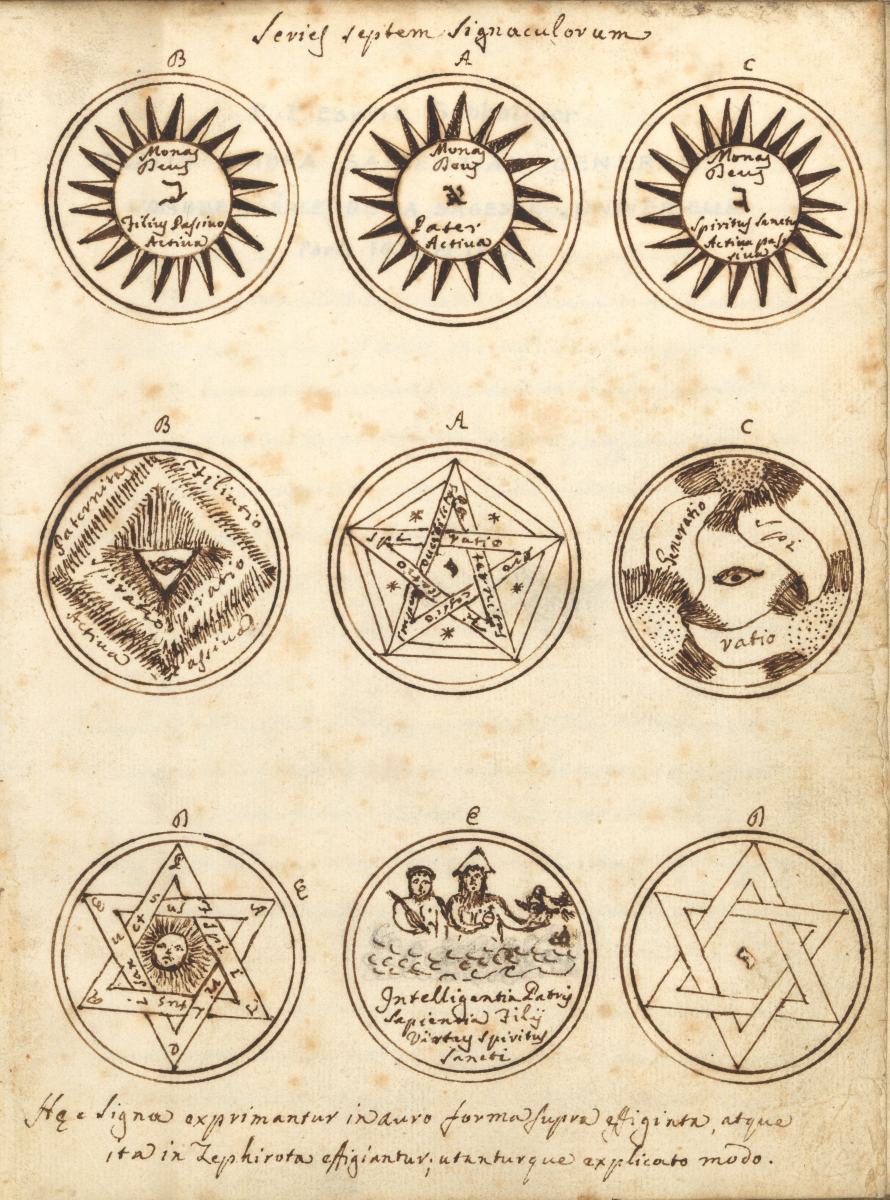
These nine seals are extracted from the great circular chart of The Ideal Shadow of General Wisdom. The manuscript indicates that the three upper figures correspond to the most holy signacula of the Father, the Son, and the Holy Spirit, called “signacula of the fulfillment of the promise.” These must be engraved in very pure gold, then placed and attached to the right arm by means of a yellow silk cord. The text also specifies that each sign possesses its counter-sign; one might, in a more material reading, speak of a recto-verso relationship. The illustrations presented here have been redrawn from the plate of MS. 4328.
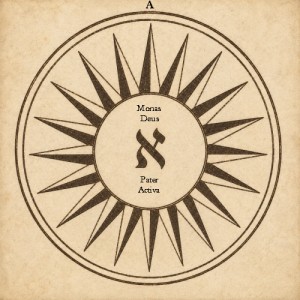
In this arrangement, the sign of the Eternal Father occupies the central position. At the center of a sun with bicolored rays, contained within a double circle, is found the Hebrew letter Aleph. Above it is inscribed Monas Deus, and below it Pater Activa. Its counter-sign, placed in correspondence, is that of the pentagon inscribed in a double circle, itself surrounding a pentagram. This figure forms five spaces in which a small star appears each time. Upon the branches of the pentagram are inscribed the terms Spiratio, Processio, Improducibilitas, Paternitas, and Filiatio. At its center appears the Hebrew letter Yod.
That of the Incarnate Word is situated to the left. At the center of a sun with bicolored rays contained in a double circle is found the Hebrew letter Beth. Above it is inscribed Monas Deus, and below Filius Passivo Activa. Its counter-sign, placed in correspondence, depicts an eye inscribed in a triangle whose point is directed downward. Around this triangle, in what appears to be a radiance, appear the terms Paternitas, Filiatio, Spiratio Activa, and Spiratio Passiva, the whole contained in a double circle.
That of the Proceeding Spirit is situated to the right. At the center of a sun with bicolored rays contained in a double circle is found the Hebrew letter Gimel. Above it is inscribed Monas Deus, and below Spiritus Sanctus Activa Passiva. Its counter-sign, placed in correspondence, depicts an eye surrounded by three suns contained in a double circle, from which emerge tongues of light. Inside each of these forms is inscribed a word: on the right Spi, below Ratio, and on the left Generatio.
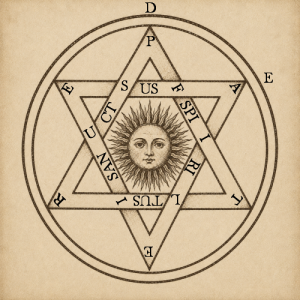
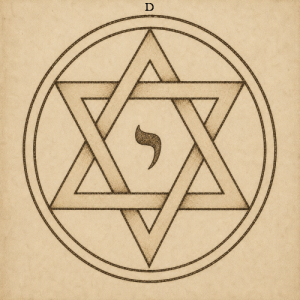
Next, if one follows the attribution and the logic of the letters placed above the nine signacula, in order to identify the corresponding counter-signs, one obtains the hexagram bearing the sun at its center contained in a double circle. Upon the branches of this hexagram is inscribed the formula Pater et Filius et Spiritus Sanctus. Its corresponding counter-sign is the hexagram contained in a double circle presenting, at its center, the Hebrew letter Yod. In the ritual this would be the first sign to be worn.
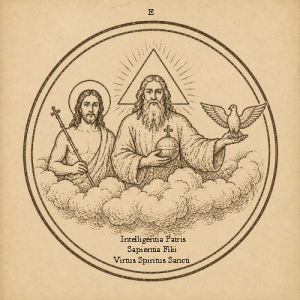
Finally, there remains that of the lower center which represents, contained in a double circle and marked at the summit by the letter E, the Christian Trinity in figurative form. The Son appears to the left, the Father at the center, and the Holy Spirit to the right in the form of a dove. The radiant triangle placed behind the Father reinforces the Trinitarian and celestial dimension of the scene.
At the bottom of the circle, the inscription Intelligentia Patris, Sapientia Filii, Virtus Spiritus Sancti—”Intelligence of the Father, Wisdom of the Son, Virtue of the Holy Spirit”—summarizes the function of the signaculum: to present the Trinity as source of intelligence, wisdom, and spiritual power. In the ritual this signaculum is found associated with the figure to be used before and which bears on the outside the letters D and E. This image serves twice in the ritual.
Here closes the plate of the signacula and their possible correspondences between the images. Several zones remain uncertain, however, for this plate presents nine figures under the Latin title Series septem Signaculorum, which may be translated as: “Series of the seven signacula” or “Suite of the seven seals.”
This mention poses difficulty, since the plate clearly contains nine figures. It is therefore possible that the title does not refer directly to the total number of images represented, but to a more complex internal organization, perhaps linked to seven principal seals to which counter-signs or complementary figures would be associated.
One may also wonder whether an earlier plate, devoted to the seven seals properly speaking, has not disappeared from the manuscript. In this hypothesis, the nine preserved signacula would indeed constitute a suite or a development coming after the preceding seven seals. This possibility would partly explain the discrepancy between the announced title and the actual number of figures visible on the page.
The bottom of the plate also bears the Latin mention: Hae signa exprimantur in auro forma supra effigiata, atque ita in Zephirota effigiantur, utanturque explicato modo, which may be translated thus: “Let these signs be engraved in gold according to the form figured above, and let them be thus represented in the Zephirota; let them be employed according to the explained method.”
The term Zephirota seems to refer to a Latinized form of Sephirota, that is, to the Sephiroth or to a sephirotic arrangement. Now the Sephiroth are ten in number, which creates a new difficulty since the plate presents only nine signacula.
This difficulty might be resolved, however, if the great circular plate entitled Idealis Umbra Sapientiae Generalis belongs, as several indices seem to indicate, to the same ensemble as MS. 4328. Indeed, this great plate contains, in its upper part, a circular figure very close to the signacula represented on the plate of the nine seals.
The latter might then function as a tenth sign, completing the ensemble and permitting one to understand the mention of the Zephirota as a reference to a complete sephirotic structure. From this perspective, the nine signacula would not be isolated, but would form with the upper figure of the great plate an ensemble of ten figures, rendering more coherent their relation to the ten Sephiroth.
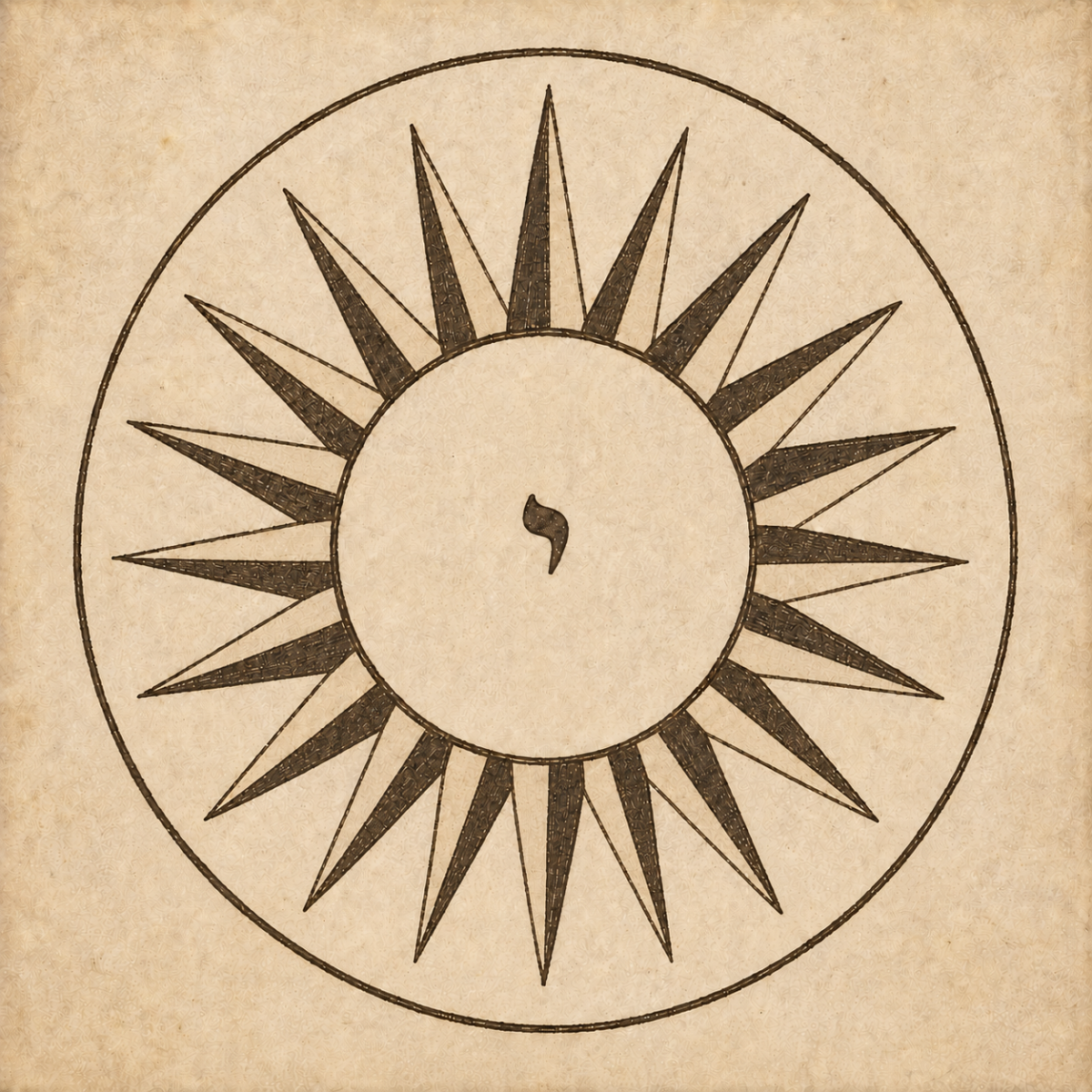
The tenth signaculum then appears as a figure whose center bears the Hebrew letter Yod, inscribed at the heart of a sun with bicolored rays contained in a circle. On either side appear the words Deus Unus. This new signaculum might thus serve for new assemblages and new applications in the ritual; however, certain practical details concerning it remain missing or veiled.
After this first approach to the ritual, I believe that MS. 4328 is still far from having yielded all its secrets. Each sign, each figure, and each formula seems to open upon a vaster order, whose logic remains partly veiled. Perhaps one must accept that this manuscript does not allow itself to be entirely grasped by analysis alone, and that certain of its lights are discovered only by him who inquires with humility.
Thus, the true key to this text perhaps resides less in the possession of a knowledge than in the inner disposition to receive it; and, to be fully enlightened concerning its mystery, one would perhaps have to make the request of God Himself.
Vincent Mercier July 3, 2026
*
Original French
Le rituel du Manuscrit 4328 de la Wellcome library
La singularité du MS. 4328 tient surtout au rituel contenu dans sa dernière partie, intitulée : « Explication idéolosophysique, ou l’Ombre idéale de la Sagesse générale, catholico-chrétienne et christiano-kabbalistique, ainsi que la méthode exacte pour s’en servir ». Ce texte présente une opération théurgique orientée vers la réception de l’Intelligence divine, en lien avec la figure circulaire de l’Umbra idealis Sapientiae Generalis. Son fondement repose sur le Nom de Dieu, non comme simple symbole, mais comme principe actif où se concentrent la Sagesse, la puissance du Verbe et la science des signes.
Dès l’ouverture, le rituel s’inscrit dans un cadre trinitaire : toute connaissance véritable procède du Père, du Fils et du Saint-Esprit, et ne peut être reçue que par un intellect humain préalablement disposé. Il ne s’agit donc pas d’acquérir un pouvoir extérieur, mais de rendre l’esprit capable de recevoir un rayon de la Sagesse universelle. Celle-ci demeure lumineuse en elle-même ; les obscurités ne relèvent pas de Dieu, mais des limites propres à l’intellect humain. La médiation angélique, notamment celle de Michel auprès de Salomon, sert ici de modèle de transmission : Dieu communique sa science par les paroles, les signes et les caractères, et l’homme devient sage lorsqu’il reçoit correctement ces marques sacrées.
Dans cette perspective, l’hexagone apparaît comme le signe central de l’Intelligence universelle et comme figure d’introduction au mystère. Il manifeste l’unité, la Trinité, l’éternité, la perfection et l’immensité divines, tout en servant de support opératif à l’ouverture de l’intellect. Le rituel conduit ainsi l’opérateur vers la purification de ses obscurités intérieures, la participation à une science angélique et l’entrée progressive dans la Sagesse du Nom divin, selon le modèle salomonien de l’homme instruit par révélation et scellé par le signe.
La section suivante précise la dimension matérielle et opérative du rituel en établissant une progression entre le signe d’introduction et les signacules d’accomplissement. Deux hexagones doivent d’abord être réalisés, l’un simple et l’autre exprimant la Trinité indivisible, puis imprimés dans l’or pur et portés au bras droit par un lien de soie jaune. Le signe simple, appliqué contre la chair, agit comme signe d’Intelligence, de promesse et d’alliance entre Dieu et l’homme. Sa fonction demeure préparatoire : il écarte les obstacles, dispose le bras de l’opérateur et le rend apte à former les caractères. Il ouvre ainsi l’accès à une première intelligence des choses connaissables, encore imparfaite tant que les signacules de la Monade trinitaire n’ont pas été imposés.
Après un temps de maturation, variable selon les opérateurs mais fixé au plus à cinquante jours, les trois signacules du Père, du Fils et du Saint-Esprit viennent accomplir la promesse initiale. Leur disposition au bras droit exprime à la fois la distinction des personnes divines et leur unité essentielle, sans supériorité, infériorité ni différence de perfection. Les contre-signes qui leur sont associés relèvent de la même logique : ils ne valent pas comme des marques séparées, mais comme des expressions des perfections indivises de la Trinité. Par ces signacules, l’opérateur ne reçoit plus seulement une préparation à l’Intelligence, mais la Vertu du Seigneur, la connaissance de la Sagesse divine et une orientation intérieure vers le bien.
Le rituel vise donc autant la science que la rectitude morale. Il protège des fautes cachées, dirige les opérations, maintient l’humilité, défend contre les périls et fortifie la volonté dans le bien. L’intellect, le cœur, la mémoire et la volonté sont ainsi ordonnés à Dieu, de sorte que la connaissance des choses secrètes ne peut jamais être séparée d’une purification intérieure.
Le texte introduit en outre une limite essentielle : les signacules ouvrent l’accès aux lumières du monde et au livre de l’Agneau, mais seulement dans la mesure où les sceaux en permettent la lecture. Là où se trouve le signacule, la science devient accessible ; là où il n’y en a pas, l’intellect humain doit s’arrêter. Le rituel mène donc à une connaissance réglée par les signes divins, sans prétendre abolir les limites imposées à l’homme. Il enseigne que la véritable sagesse consiste autant à recevoir ce qui est montré qu’à ne pas chercher ce que Dieu a réservé à son propre mystère.
Le texte approfondit ensuite la portée morale et pénitentielle du rituel. L’accès à la Sagesse divine ne dépend pas seulement de l’usage correct des signes, mais de la transformation intérieure de l’opérateur. Si celui-ci est marqué par le péché, la miséricorde de Dieu agit comme une lumière qui relève son intelligence, l’arrache à l’aveuglement et le conduit à la pénitence. Le rituel ne vise donc pas uniquement l’acquisition d’une science cachée : il produit d’abord une conversion du cœur, par laquelle l’opérateur apprend à haïr le mal, à reconnaître la lumière de la grâce et à recevoir un esprit renouvelé.
La connaissance accordée par le Nom divin demeure proportionnée à la qualité du cœur, à la rectitude de l’âme et aux œuvres de celui qui la reçoit. C’est pourquoi le texte rappelle avec insistance que l’opérateur doit chercher la volonté de Dieu, et non les mystères insondables qui dépassent les limites fixées à l’intelligence humaine, et même angélique.
La vraie sagesse consiste à demander ce qui peut être connu, dans une disposition humble et droite, afin de devenir sage dans les sciences, ferme dans les adversités, prudent dans le conseil, chaste dans les pensées, juste dans les œuvres et obéissant dans la volonté. À l’inverse, celui qui détourne l’opération de sa finalité s’expose à l’indignation divine, car la science reçue ne peut être séparée de l’Esprit de sagesse, de conseil, de force, de science et de vérité.
Le huitième jour marque une confirmation supplémentaire par le sceau très saint de la Trinité, gravé dans l’or et portant les formules : Intelligence du Père, Sagesse du Fils et Vertu de l’Esprit Saint. Ce signe, accompagné de son contreposé hexagonal, fixe dans l’esprit de l’opérateur le Verbe du Seigneur et son intelligence. Son imposition demande l’humilité du cœur, la prière et l’invocation de l’Esprit Saint, figurée par l’hymne du Cénacle et par la mémoire des flammes de la Pentecôte, qui accomplissent la promesse du Christ.
La suite règle le port, la déposition et la conservation des signes. Après avoir confirmé en lui la sagesse du Seigneur, l’opérateur peut les porter pendant cinquante jours, ou davantage s’il le souhaite, puis les déposer seulement après prière, confession, pénitence et résolution sincère de ne plus pécher. Les signes doivent alors être purifiés, enveloppés et enfermés dans un étui neuf, pur, carré, marqué de croix, scellé de cire blanche et consacré au Seigneur. Cette clôture matérielle manifeste une clôture spirituelle : les voies du péché doivent être fermées à l’esprit de l’opérateur.
Le texte fixe également les limites de l’usage divinatoire ou interrogatif du rituel. Les demandes doivent être formulées comme des prières humbles, jamais comme des commandements. Elles ne doivent porter ni sur les secrets incompréhensibles de Dieu, ni sur la mort, la vengeance, les fautes du prochain, l’état des âmes défuntes, les questions contraires à la foi ou les choses nuisibles. Le rituel conduit ainsi vers une science réglée, pénitentielle et charitable, dont la finalité n’est pas la curiosité, mais le salut, la rectitude du cœur et la participation ordonnée à la Sagesse de Dieu.
La dernière partie développe la dimension oratoire et préparatoire de l’ensemble. Son efficacité repose d’abord sur une parole de supplication, d’humilité et de purification. Les prières adressées à Dieu établissent constamment la source de toute intelligence, science et sagesse dans l’unité trinitaire, tandis que le Nom divin, invoqué comme principe de lumière et de miséricorde, demeure le médiateur central de la révélation. L’opérateur ne cherche pas ici à commander, mais à demander selon la volonté divine ; il doit donc se rendre apte à recevoir, par la rectitude du cœur, ce que Dieu voudra lui manifester.
Les oraisons successives forment une discipline intérieure progressive. Elles demandent l’effacement de l’ignorance, la purification du péché, la garde des pensées, la maîtrise de la volonté, le rejet des désirs mauvais et l’orientation constante vers le salut. Les figures bibliques convoquées — Adam, Abel, Abraham, Isaac, Jacob, Joseph, Moïse, David, Daniel, Salomon et d’autres — servent de modèles de délivrance, d’élection, de sagesse, de justice ou de pénitence. Elles inscrivent l’opération dans une continuité sacrée où chaque demande actualise une grâce déjà manifestée dans l’histoire biblique.
La progression journalière conduit ainsi l’opérateur d’une demande générale de lumière vers une transformation plus complète de ses facultés : mémoire, intelligence, volonté, cœur, parole, sens et actions doivent être ordonnés à Dieu. La sagesse recherchée n’est donc jamais séparée de la vertu ; elle suppose foi, espérance, charité, patience, humilité, prudence, conseil, force et obéissance.
Vers la fin de la série, l’invocation se concentre plus nettement sur les trois Personnes divines : le Père comme Intelligence, le Fils comme Sagesse accomplissant la promesse, et l’Esprit Saint comme Vertu répandue dans l’esprit. Cette partie montre que la pratique rituelle n’est pas seulement fondée sur les signes matériels, mais sur une ascèse verbale et morale répétée, destinée à rendre l’opérateur transparent à la lumière du Verbe. Elle mène vers une science reçue dans la grâce, non conquise par curiosité, et vers une intelligence capable de discerner le bien, de rejeter le mal et de demeurer fidèle à la volonté divine.
En somme, le rituel présenté ici vise à obtenir l’Intelligence divine, la Sagesse et la connaissance des choses accessibles à l’homme, non par la contrainte exercée sur des puissances invisibles, mais par une disposition progressive de l’âme, du corps et de l’intellect. Il se pratique au moyen de signes sacrés, principalement hexagonaux et trinitaires, gravés dans l’or et portés au bras droit. Ces signes sont accompagnés de prières, d’oraisons journalières, de pénitence, de confession et d’une stricte orientation morale. Sa finalité n’est donc pas seulement cognitive : elle est aussi purificatrice, car l’opérateur doit devenir apte à recevoir ce que Dieu permet de connaître.
Les prières qui accompagnent ce rituel suivent une progression cohérente:
- Les prières 1 à 10 posent le cadre doctrinal : Dieu y est invoqué comme Trinité, Créateur et source de sagesse, tandis que le priant demande la purification de ses facultés — esprit, intelligence, mémoire et volonté — afin de recevoir science, discernement et obéissance.
- Les prières 10 à 24 s’appuient ensuite sur des figures bibliques de délivrance : Abel, Abraham, Isaac, Jacob, Joseph, Daniel, Noé, Loth, Moïse, David, Suzanne, Judith, Jonas et Salomon. Chaque personnage sert de modèle symbolique : offrande, obéissance, protection, révélation, purification, pénitence et sagesse.
- Les prières 25 à 39 forment une étape d’acquisition des vertus. Le texte demande l’humilité, la force, la charité, la patience, la paix, la consolation, la grâce et la stabilité intérieure. La prière devient alors une véritable méthode de transformation de l’âme.
- Enfin, les prières 40 à 47 constituent le couronnement théologal et trinitaire de l’ensemble : foi, espérance, charité, conseil, intelligence, sagesse et science. La série s’achève sur la Trinité, avec le Père, le Fils-Sagesse et l’Esprit Saint, source de science et de vertu.
Dans l’ensemble, le rituel se rattache principalement à la tradition de l’Ars notoria, art médiéval traditionnellement attribué à Salomon, visant l’obtention de la science, de la mémoire, de l’intelligence et de la sagesse par des prières, des signes et des figures sacrées. On y retrouve les grands marqueurs notoriens : Salomon instruit par révélation angélique, transmission de l’intelligence par des sceaux, usage du Nom divin et promesse d’une science infuse.
Il présente aussi de fortes affinités avec le Liber florum de Jean de Morigny, réécriture chrétienne et mariale de l’Ars notoria, où prières, figures, visions, pureté morale et grâce divine servent à obtenir une connaissance surnaturelle. Le parallèle est renforcé par l’importance accordée à l’humilité, à la confession, à la pénitence, au Veni Creator Spiritus et à la soumission à Dieu.
Un autre rapprochement peut être établi avec le Liber Juratus Honorii, notamment par l’usage des noms divins, des anges, des sceaux, des figures géométriques et du “sceau du Dieu vivant”. Toutefois, le rituel étudié paraît plus prudent et plus strictement encadré sur le plan moral, car il interdit les demandes touchant à la mort, à la vengeance, aux crimes du prochain ou aux vérités contraires à la foi catholique.
Enfin, certains éléments évoquent la magie salomonienne des pentacles, en particulier la fabrication de signes en or, leur port au bras, l’usage de la soie, de l’eau bénite, du linge blanc, du coffret consacré et de la cire blanche. La logique est celle d’un objet sacré préparé, porté, purifié, puis conservé rituellement.
L’ensemble forme donc une théurgie sapientielle chrétienne : une pratique qui combine prière catholique, kabbale chrétienne, géométrie sacrée, anges, sceaux, purification morale et recherche de science infuse. Ce rituel ne relève ni d’une simple dévotion, ni d’une magie ordinaire ; il appartient à une tradition plus large où l’on cherche à recevoir sagesse, intelligence et science par la grâce divine, médiatisée par des signes sacrés.
*
Appendix
Notes et réflexions
sur les neuf signacules
Ces neuf sceaux sont extraits de la grande carte circulaire de L’Ombre idéale de la Sagesse générale. Le manuscrit indique que les trois figures supérieures correspondent aux très saints signacules du Père, du Fils et du Saint-Esprit, appelés « signacules de l’accomplissement de la promesse ». Ceux-ci doivent être gravés dans de l’or très pur, puis posés et attachés au bras droit au moyen d’un lien de soie jaune. Le texte précise également que chaque signe possède son contre-signe ; on pourrait, dans une lecture plus matérielle, parler d’un rapport de recto-verso. Les illustrations présentées ici ont été refaites à partir de la planche du MS. 4328.
Dans cette disposition, le signe du Père éternel occupe la position centrale. Au centre d’un soleil aux rayons bicolores, contenu dans un double cercle, se trouve la lettre hébraïque Aleph. Au-dessus de celle-ci est inscrit Monas Deus, et au-dessous Pater Activa. Son contre-signe, placé en correspondance, est celui du pentagone inscrit dans un double cercle, entourant lui-même un pentagramme. Cette figure forme cinq espaces dans lesquels apparaît chaque fois une petite étoile. Sur les branches du pentagramme sont inscrits les termes Spiratio, Processio, Improducibilitas, Paternitas et Filiatio. En son centre apparaît la lettre hébraïque Yod.
Celui du Verbe incarné se situe à gauche. Au centre d’un soleil aux rayons bicolores contenu dans un double cercle se trouve la lettre hébraïque Beth. Au-dessus de celle-ci est inscrit Monas Deus, et au-dessous Filius Passivo Activa. Son contre-signe, placé en correspondance, figure un œil inscrit dans un triangle dont la pointe est dirigée vers le bas. Autour de ce triangle, dans ce qui semble être un rayonnement, apparaissent les termes Paternitas, Filiatio, Spiratio Activa et Spiratio Passiva le tout contenu dans un double cercle.
Celui de l’Esprit procédant se situe à droite. Au centre d’un soleil aux rayons bicolores contenu dans un double cercle se trouve la lettre hébraïque Gimel . Au-dessus de celle-ci est inscrit Monas Deus, et au-dessous Spiritus Sanctus Activa Passiva. Son contre-signe, placé en correspondance, figure un œil entouré de trois soleils contenu dans un double cercle , d’où émergent des sortes de langues de lumière. À l’intérieur de chacune de ces formes est inscrit un mot : à droite Spi, en bas Ratio, et à gauche Generatio.
Ensuite, si l’on suit l’attribution et la logique des lettres placées au-dessus des neuf signacules, afin d’identifier les contre-signes correspondants, on obtient l’hexagramme portant le soleil en son centre contenu dans un double cercle . Sur les branches de cet hexagramme est inscrite la formule Pater et Filius et Spiritus Sanctus. Son contre-signe correspondant est l’hexagramme contenu dans un double cercle présentant, en son centre, la lettre hébraïque Yod. Dans le rituel celui-ci serait le premier signe à porter.
Pour terminer reste ensuite celui du centre en bas qui représente, contenu dans un double cercle et marqué au sommet par la lettre E, la Trinité chrétienne sous une forme figurative. Le Fils apparaît à gauche, le Père au centre, et l’Esprit Saint à droite sous la forme d’une colombe. Le triangle rayonnant placé derrière le Père renforce la dimension trinitaire et céleste de la scène. En bas du cercle, l’inscription Intelligentia Patris, Sapientia Filii, Virtus Spiritus Sancti — « Intelligence du Père, Sagesse du Fils, Vertu du Saint-Esprit » — résume la fonction du signacule : présenter la Trinité comme source d’intelligence, de sagesse et de puissance spirituelle. Dans le rituel ce signacule se trouve associé avec la figure utiliser avant et qui porte à l’extérieur les lettres D et E. Cettes image servant deux fois dans le rituel.
Ici se clôt la planche des signacules et de leurs possibles correspondances entre les images. Plusieurs zones demeurent toutefois incertaines, car cette planche présente neuf figures sous le titre latin Series septem Signaculorum, que l’on peut traduire par : « Série des sept signacules » ou « Suite des sept sceaux ». Cette mention pose difficulté, puisque la planche comporte visiblement neuf figures. Il est donc possible que le titre ne renvoie pas directement au nombre total d’images représentées, mais à une organisation interne plus complexe, peut-être liée à sept sceaux principaux auxquels seraient associés des contre-signes ou des figures complémentaires.
On peut également se demander si une planche antérieure, consacrée aux sept sceaux proprement dits, n’a pas disparu du manuscrit. Dans cette hypothèse, les neuf signacules conservés constitueraient bien une suite ou un développement venant après les sept sceaux précédents. Cette possibilité expliquerait en partie l’écart entre le titre annoncé et le nombre réel de figures visibles sur la page.
Le bas de la planche porte en outre la mention latine : Hae signa exprimantur in auro forma supra effigiata, atque ita in Zephirota effigiantur, utanturque explicato modo, que l’on peut traduire ainsi : « Que ces signes soient gravés dans l’or selon la forme figurée ci-dessus, et qu’ils soient ainsi représentés dans la Zephirota ; qu’ils soient employés selon le mode expliqué. » Le terme Zephirota semble renvoyer à une forme latinisée de Sephirota, c’est-à-dire aux Séphiroth ou à une disposition séphirotique. Or les Séphiroth sont au nombre de dix, ce qui crée une nouvelle difficulté puisque la planche ne présente que neuf signacules.
Cette difficulté pourrait toutefois être résolue si la grande planche circulaire intitulée Idealis Umbra Sapientiae Generalis appartient bien, comme plusieurs indices semblent l’indiquer, au même ensemble que le MS. 4328. En effet, cette grande planche comporte, dans sa partie supérieure, une figure circulaire très proche des signacules représentés sur la planche des neuf sceaux. Celle-ci pourrait alors fonctionner comme un dixième signe, complétant l’ensemble et permettant de comprendre la mention de la Zephirota comme une référence à une structure séphirotique complète. Dans cette perspective, les neuf signacules ne seraient pas isolés, mais formeraient avec la figure supérieure de la grande planche un ensemble de dix figures, rendant plus cohérente leur mise en relation avec les dix Séphiroth.
Le dixième signacule apparaît alors comme une figure dont le centre porte la lettre hébraïque Yod, inscrite au cœur d’un soleil aux rayons bicolores contenu dans un cercle. De part et d’autre figurent les mots Deus Unus. Ce nouveau signacule pourrait ainsi servir à de nouveaux assemblages et à de nouvelles applications dans le rituel ; toutefois, certaines informations pratiques le concernant demeurent manquantes ou voilées.
Après cette première approche du rituel je pense que Le MS. 4328 est encore loin d’avoir livré tous ses secrets. Chaque signe, chaque figure et chaque formule semble ouvrir sur un ordre plus vaste, dont la logique demeure en partie voilée. Peut-être faut-il accepter que ce manuscrit ne se laisse pas entièrement saisir par l’analyse seule, et que certaines de ses lumières ne se découvrent qu’à celui qui interroge avec humilité.
Ainsi, la véritable clef de ce texte réside peut-être moins dans la possession d’un savoir que dans la disposition intérieure à le recevoir ; et, pour être pleinement éclairé sur son mystère, il faudrait peut-être en faire la demande à Dieu lui-même.
Vincent Mercier, le 3 juillet 2026.
***

Related Articles


Leave a Reply