
Circle of Transmission: The Living Loom
Aspects of Contemporary Alchemy: Jules Mérias – Alchemical Instruction
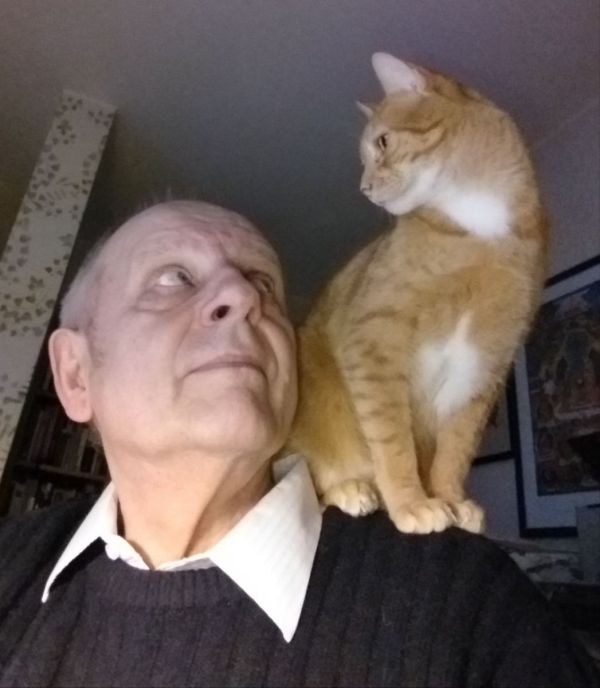
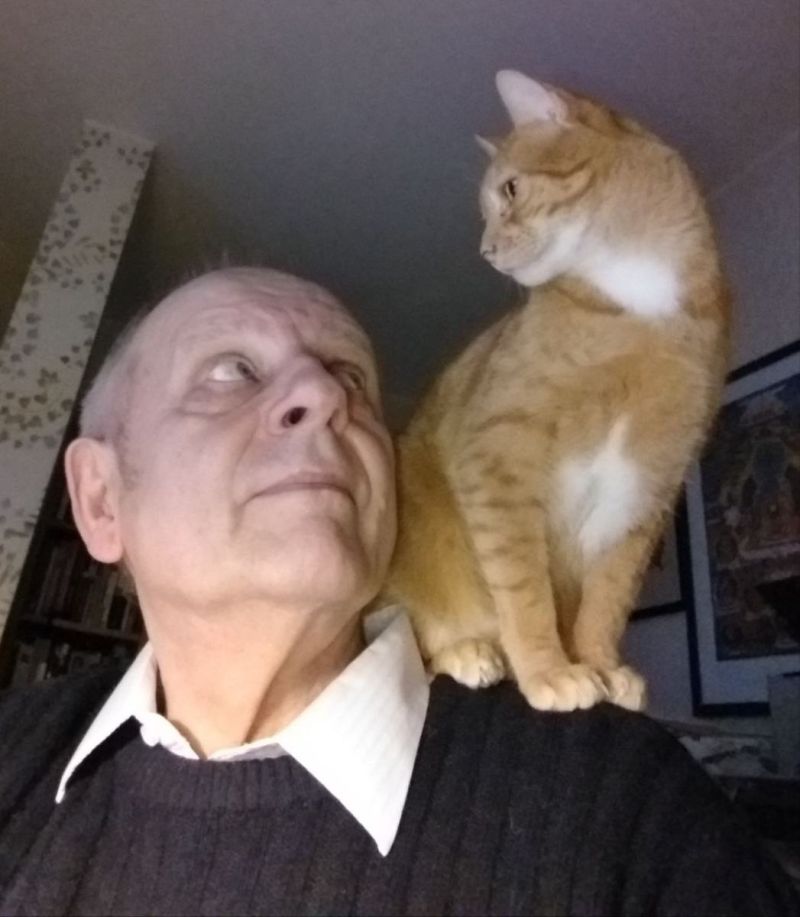
Jules Merias and his famulus, Ragnar.
*
Today’s sharing from the Blue House of Via-HYGEIA inaugurates a new series, Aspects of Contemporary Alchemy, dedicated to voices that reveal the variety of approaches and experiences within the Royal Art.
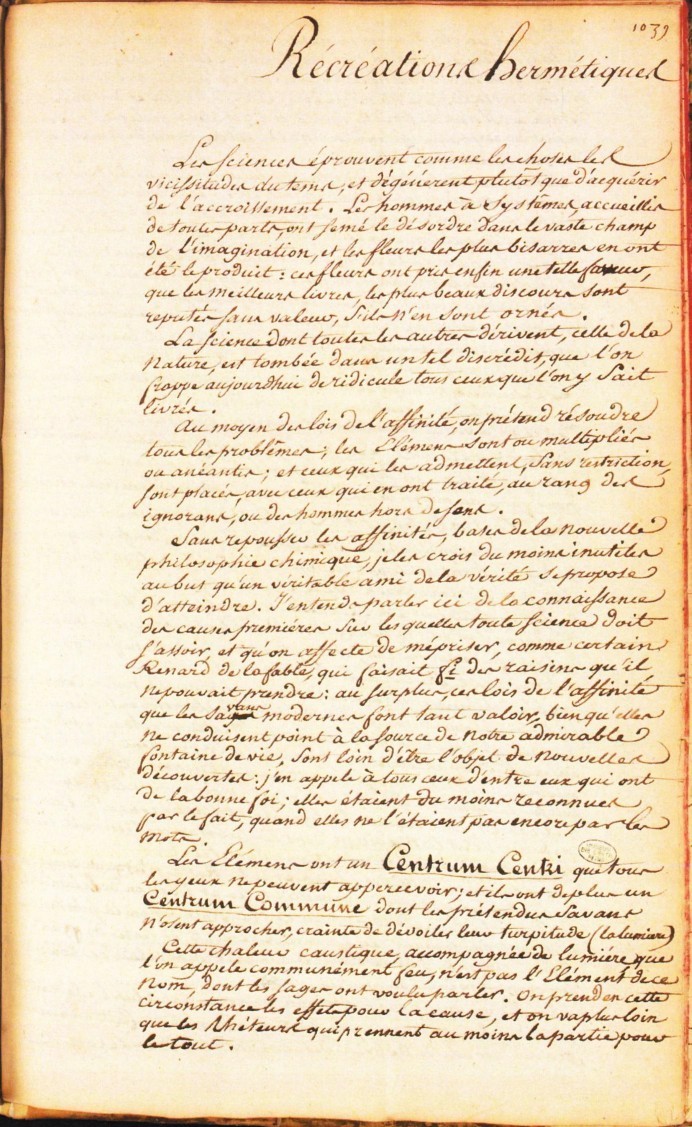
Our first offering comes from Jules Mérias, a humble yet highly competent voice in contemporary alchemy, with an outstanding article inspired by his deep study of the anonymous 1815 manuscript Récréations Hermétiques (Ms. 362, Muséum d’Histoire Naturelle, Paris).
This remarkable exposition illuminates the “Wet Way”—a rare pedagogical path where the chemistry of antimony and the rhythm of the seasons unite to transform matter and soul. The original French follows the English.
**
A Contextual Introduction
Alchemy as Initiation: Matter, Spirit, and the Pedagogy of the Wet Way
The following text is an exposition by Jules Mérias of the Récréations Hermétiques, a nineteenth-century manuscript preserved in the Bibliothèque Centrale of the Muséum d’Histoire Naturelle in Paris.
Mérias’s purpose is not merely to describe a cryptic alchemical recipe, but to demonstrate that alchemy is, at its core, an initiation—an active, deliberate movement toward the divine.
To make this accessible, he selects the “Wet Way,” a path conducted at room temperature whose very slowness renders each phenomenon visible, decomposed, and therefore comprehensible.
In this deliberate deceleration lies the text’s first pedagogical virtue: the Work becomes a meditation rather than a reaction, inviting the operator to observe the interplay of matter and Spirit without the violence of high heat.
The author’s method rests upon a fundamental analogy: the alchemical laboratory is a microcosm, and the operations performed within it are a symbolic imitation of divine Creation.
The prima materia—here, the antimony ore stibnite—is not an inert substance; it is mineral matter that has carried the Spiritus breathed by the Creator into the chaos of Genesis since the origin of the world. Consequently, every physical manipulation is simultaneously a spiritual event.
The initial cooking of stibnite, for instance, is presented without mystification as ordinary metallurgy, yet it is framed by lunar and seasonal timing designed to prevent the escape of the Genesis-Spirit and, through the rhythm of Solve-Coagula, to enrich the matter with an additional influx of astral Spirit.
The operator thus stands in a creative tension: he must be a competent craftsman—attentive to temperatures, crucible design, and chemical saturation—while simultaneously acting as a priest of nature, collecting spring dew “impregnated” by celestial light and enriched with natural saltpeter to serve as the “liquid fire” of the Work.
Several key concepts organize this double vision. The planetary correspondences (Sun-gold, Moon-silver, Earth-antimony) are not poetic ornaments but operational codes that bind the mineral kingdom to the celestial order.
The law of Solve-Coagula—dissolution followed by fixation—governs both the physical imbibition and drying of matter and the metaphysical retention of Spirit within body.
The three chromatic stages—Nigredo (the Work in Black), Albedo (the Work in White), and Rubedo (the Work in Red)—mark progressive integrations of mercury and sulfur, body and soul, until the “philosophical marriage” produces the red stone.
Throughout, the text insists that these stages are achieved neither by mere chemical manipulation nor by contemplation alone, but by the precise coincidence of the two.
This article is important as a pedagogical tool precisely because it refuses the modern tendency to split alchemy into separate, impoverished categories: “primitive chemistry” on one hand and “psychological spiritualism” on the other.
By walking the reader through concrete, step-by-step laboratory operations while never allowing those steps to be severed from their theological and cosmological meanings, the text restores the creative tension that defines alchemy at its most rigorous.
It shows that for the alchemist, there is no such thing as “just” a chemical reaction, just as there is no such thing as a purely interior, disembodied spiritual state.
The crucible is an altar; the dew is a sacrament; the blackening, whitening, and reddening of matter are simultaneously physical events and initiatory passages.
To read this text is to learn that alchemy is a discipline of the whole—a practice in which the hand, the eye, and the soul must work in concert, and in which the transformation of matter is inseparable from the transformation of the operator who dares to imitate the divine act of Creation.
*
And now the Article:
ALCHEMICAL INSTRUCTION,
by Jules Merias.
The Great Alchemical Work according to the Hermetic Recreations [1], a nineteenth-century manuscript.
Alchemy is an initiation which, like every initiation, consists of an active and deliberate movement toward the divine. To understand alchemy, the most convenient method is to study the classic Wet Way. This Way unfolds at room temperature, which is why its phenomena are both slow and clearly distinct, facilitating the general understanding of the Great Work. From this perspective, we shall consult the treatise of the Hermetic Recreations, which describes such a Way. It is a manuscript preserved by the Central Library of the Museum of Natural History in Paris.
The Great Alchemical Work is a both a miniature and symbolic imitation of the Creation of the World, in the four dimensions of space and time. To accomplish this miniature, an alchemist takes a materia prima—that is, a mineral matter which resides as such upon the Earth since the origin. This matter is therefore impregnated with the Spirit breathed by the Creator into the chaos of Genesis. To operate upon the microcosm of his Great Work as God upon the macrocosm of the World, the alchemist must bring divine Spirit to his matter.
According to tradition, gold corresponds to the Sun, silver to the Moon, copper to Venus, iron to Mars, etc. This is why the ancient alchemists said “the Sun” to mean “gold,” “the Moon” to mean “silver,” “Venus” to mean “copper,” “Mars” to mean “iron,” etc. Likewise, antimony corresponded to the World, the planet Earth. This is the reason why the same sign, a circle surmounted by a cross  , designates both the Earth and antimony.
One must further know that what the alchemists called “antimony” is stibnite, the sulfurous antimony ore with a siliceous gangue. In accordance with tradition and by a frequent play on words in alchemical treatises, the author of the Hermetic Recreations called “Earth” the antimony ore which he used as prime matter.
Although the operations of the Hermetic Recreations take place at room temperature, they require as a preamble a cooking to rid the matter of its siliceous gangue. The alchemists call this first phase of the Great Work the “labors of Hercules.” It is an ordinary metallurgical operation carried out under conditions that are not ordinary. The procedure consists in placing crushed stibnite in a crucible whose bottom is pierced with a hole. One covers this pierced crucible, then places a second crucible beneath it as a receiver, and heats the whole in a furnace. At 550 degrees Celsius, the antimony sulfide liquefies, separates from its siliceous gangue, and flows through the hole of the first crucible into the receiver.
The problem is that heating a matter drives out the Spirit it has contained since Genesis, which kills it. To avoid killing its matter by driving out its Spirit through cooking, the alchemist operates in springtime, on a night of the full moon and fine weather. At this moment, Spirit abounds in nature. Then, by a play of communicating vessels, Spirit pours into the matter opened by liquefaction—solve. Next, cooling provokes the crystallization of the matter—Coagula. This Coagula prevents the Spirit that has entered the matter from departing again. Thanks to the application of the law of Solve-Coagula, not only will the operation have failed to drive out the Spirit from the matter, but it will also have caused the enrichment of said matter with an additional dose of Spirit. This enrichment of Spirit brings the prime matter to the state of first matter.
Caution: one must operate under a chimney with a strong draft and without electrical apparatus, so as not to create interference for the Spirit.
The alchemist must then, like God with the chaos of Genesis, macrocosm of the World, bring divine Spirit to the microcosm of his Great Work. One captures Spirit in the spring dew collected on nights of the full moon and fine weather. The author of the Hermetic Recreations calls the dew “Universal Spirit” or “Astral Spirit,” because it is “impregnated” with the light of the Sun, the Moon, and the stars. Psalm XIX tells us how this is possible: “He has set his tabernacle in the Sun.” (Psalm XIX, 5).
For the alchemists, light is the visible phase of the Spirit.
Dew naturally contains niter, the vehicle of Spirit. Niter forms at high altitude, by the fixation of nitrogen under the action of lightning. Dew is therefore a very dilute acid. This is why the alchemists call it “liquid fire that does not burn the hands.” The Spirit carried by the niter of the dew is the secret fire of the Great Work. But it is too dilute an acid. The niter content of dew “impregnated” with the light of the Sun, the Moon, and the stars is too weak to react upon the Earth. Now, according to the ancient chemists and alchemists, saltpeter is similar to the niter of dew. So that it may react with the Earth of his microcosm, the alchemist enriches his dew with natural saltpeter, up to saturation. This saltpeter being natural, it too has contained Spirit since Genesis.
To operate as God who gives his Spirit to the macrocosm of the World, the alchemist must make Astral Spirit rain upon his Earth—that is, with dew saturated with saltpeter. After each imbibition—Solve—one must let the matter dry—Coagula. One imbibition followed by one desiccation counts as one philosophical day. After 50 philosophical days, the Earth blackens and putrefies: this is the Work in Black (Nigredo). One must then leave the matter to its own fire, without further soaking it with Astral Spirit.
The Work in Black passes of itself to whiteness, which the author of the Hermetic Recreations calls “first mercury” or “child mercury.” It is a salt which encloses both mercury and sulfur. From this stage onward, the alchemist extends the Work of the divine macrocosm within his own microcosm.
To extract the mercury and sulfur from the child-mercury salt, the alchemist subjects it to the eagles or sublimations. He no longer contents himself with merely soaking his matter; he dissolves half of it in Astral Spirit and performs an ablution upon the other half, until dissolution—Solve. Then, an earth falls to the bottom of the bath, earth which must be carefully collected with a feather: it is the crude sulfur which separates—Coagula. Next, a cotton-like salt rises to the surface of the bath: it is the mercury which sublimates, and this crystallization is a new Coagula. It is collected in the same manner as the sulfur.
The operation is called “eagle” because it consists in making the mercury fly to the surface of the bath—that is, to the heaven of the Work of this Wet Way. One calls “Mercury” the result of the eagles because it has flown like the god Mercury who has wings upon his head and feet.
The eagles enrich the mercury with contributions of the Astral Spirit. After the ninth eagle, the alchemist has at his disposal the philosophical mercury and a crude sulfur. By soaking it with Astral Spirit—Solve—he calcines this sulfur until it takes a red-brown color and lets it dry—Coagula. Then, he must pour upon it philosophical mercury dissolved “to the height of two or three fingers.” This dissolution—Solve—allows the sulfur to sublimate in its turn, up to the heaven of the Work where it takes a beautiful blood-red color. This sulfur having flown, the author of the Hermetic Recreations calls it “Red Mercury.” One lets the sulfur dry—Coagula.
The sublimation of the sulfur leaves below a damned earth that must be rejected: in addition to enriching it with Astral Spirit, the sublimation purifies the sulfur.
Having obtained the philosophical mercury and the sulfur, the alchemist proceeds to the philosophical marriage. To do this, he divides his sulfur in two and sets half aside. He soaks the other half of the sulfur with mercury dissolved in Astral Spirit—Solve—so that the mixture remains muddy at the bottom of the vessel. He lets this mixture dry—Coagula—before soaking it again—Solve. After 40 days—that is, 40 Solve-Coagula—the matter putrefies and blackens. This is a new Work in Black. The alchemist stops the imbibitions, and the matter arrives of itself at whiteness by drying—Coagula. This is the Work in White, medicinal and transmutational to silver.
The alchemist divides his Work in White in two and sets half aside. He soaks the other half with philosophical mercury dissolved in Astral Spirit. The matter little by little takes a green color which the alchemists call vitriol. By continuing the fire—that is, the imbibitions of Astral Spirit—the alchemist brings his matter to an orange color.
He then takes the second half of the sulfur which he had previously set aside, dissolves it in philosophical mercury itself dissolved in Astral Spirit, and soaks his orange matter with it, until it acquires a beautiful poppy-red purple color. This is the Work in Red, stone at once medicinal and transmutational to gold. For the alchemist, this is the proof that God assents to his Great Work.
One must now multiply the stone. For this, one soaks half of the red stone with the half of the Work in White set in reserve. When the stone has become white, one soaks it with the other half of red stone, until it reddens.
The entirety of this Wet Way may take some twenty years.
Note:
[1] Anonymous, Récréations Hermétiques, Scholies (c. 1815) [Central Library of the Natural History Museum, Ms. 362, pp. 1039–1064]. A clear and detailed explanation of this treatise can be found in: Jules Mérias and Philippe Laurent, Trilogie alchimique: 3 Traités du XIXe siècle expliqués (Récréations Hermétiques, Scholies, Hermès Dévoilé), Aubagne, Éditions de la Tarente, 2025, 330 pp.
*
Alchemical Bibliography
Works classified by order of reading difficulty:
– Sadoul, Jacques, The Treasure of the Alchemists, Paris, Publications Premières, 1970, 344 p. and J’ai Lu, 1971, 384 p. – Husson Bernard, Alchemical Transmutations, Paris, J’ai lu, 1974, 322 p.
– Barbault Armand, The Gold of the Thousandth Morning, Paris, Publications Premières, 1969, 206 p. and J’ai Lu, 1970, 190 p. – Von Bernus Alexander, Medicine and Alchemy, (1948), Paris, Belfond, 212 p.
– Anonymous, Aurea Catena Homeri, or Nature Unveiled, or The Theory of Nature, (1723–1772), Paris, Dervy, 1993, 400 p.
– Glaser Christophle, Treatise on Chymistry, (1668), Paris, Gutenberg Reprints, 1980, 397 p.
– Mérias Jules, An Alchemical Instruction to the Brothers of the Rose-Cross, Paris, Éditions de l’Art Royal, 2024, 98 p.
– Grimaldy Denis de Copponay, Posthumous Works of M. de Grimaldy, (1745), edited by E.J.P.; s. l., circa 1985, 224 p.
– Mérias Jules, The Alchemical Initiation, An Assembly of Chymical Philosophers, Paris, Éditions de l’Art Royal, 2021, 134 p.
– Mérias Jules and Philippe Laurent, Four Treatises of Alchemy Explained by the Chemistry of Their Time, Paris, Dervy, 2018, 226 p.
– Anonymous, Hermetic Recreations, Scholies, (c. 1815), [Central Library of the Museum of Natural History, Ms. 362, pp. 1039–1064], published in Mérias Jules and Philippe Laurent, Alchemical Trilogy, Hermetic Recreations, Scholies, Hermès Dévoilé, Aubagne, Éditions de la Tarente, 330 p.
– Basile Valentin, The Triumphal Chariot of Antimony, (1604), Paris, Retz, 1977, 253 p.
– Douzetemps, The Mystery of the Cross, Afflicting and Consoling, Mortifying and Vivifying, Humiliating and Triumphant, of Jesus Christ and his Members, (1732), (Saint Petersburg or Moscow, 1786), (Lausanne, 1791), London and Edinburgh, 1860, Milano, Archè, 1975, v–xxiii, 308 p.
– Gerbant A. L., Correspondence on the Dissolution of the Metallic Body, La Tourbe des Philosophes review, 1st quarter 1982, No. 18, pp. 40–44.
– D’Espagnet Jean, The Secret Work of the Philosophy of Hermes, (1602), Paris, Denoël, 1972, 208 p.
– Canseliet Eugène, Alchemy Explained upon its Classical Texts, Paris, Jean-Jacques Pauvert, 1972, 312 p.
– Philalèthe Eyrénée, The Open Entrance to the Closed Palace of the King, (1669), Paris, Retz, 1976, 242 p.
– Fulcanelli, The Mystery of the Cathedrals, Paris, Jean-Jacques Pauvert, 1964, 250 p.
*
Original French
Jules Merias-INSTRUCTION ALCHIMIQUE
Le Grand Œuvre alchimique selon les
Récréations Hermétiques [1], un manuscrit du XIXe siècle.
L’alchimie est une initiation qui, comme toute initiation, consiste en un mouvement actif et délibéré vers le divin. Pour comprendre l’alchimie, la méthode la plus commode est d’étudier la voie humide classique. Cette voie se déroule à température ambiante, c’est pourquoi ses phénomènes sont à la fois lents et bien décomposés, ce qui facilite la compréhension générale du Grand Œuvre. Dans cette perspective, nous consulterons le traité des Récréations Hermétiques qui décrit une telle voie. C’est un manuscrit conservé par la Bibliothèque centrale du Museum d’Histoire naturelle de Paris.
Le Grand Œuvre alchimique est une imitation symbolique de la Création du Monde, dans les quatre dimensions de l’espace et du temps. Pour accomplir cette miniature, un alchimiste prend une materia prima, c’est-à-dire une matière minérale qui réside telle quelle sur Terre depuis l’origine. Cette matière est donc imprégnée de l’Esprit insufflé par le Créateur au chaos de la Genèse. Pour opérer sur le microcosme de son Grand Œuvre comme Dieu sur le macrocosme du Monde, l’alchimiste apporte à son tour de l’Esprit divin à sa matière.
Selon la tradition, l’or correspond au Soleil, l’argent à la Lune, le cuivre à Vénus, le fer à Mars, etc. C’est pourquoi les anciens alchimistes disaient « le Soleil » pour dire « l’or », « la Lune » pour « l’argent », « Vénus » pour « le cuivre », « Mars » pour « le fer », etc. De même, l’antimoine correspondait au Monde, la planète Terre. C’est la raison pour laquelle un même signe, un cercle surmonté d’une croix , désigne à la fois la Terre et l’antimoine.
Il faut encore savoir que ce que les alchimistes appelaient « antimoine », c’est la stibine, minerai d’antimoine sulfureux à gangue siliceuse. Conformément à la tradition et par un jeu de mots fréquent dans les traités d’alchimie, l’alchimiste des Récréations Hermétiques appellait « Terre » le minerai d’antimoine qu’il utilisait comme matière première.
Bien que se déroulant à température ambiante, les opérations des Récréations Hermétiques exigent en préambule une cuisson pour débarrasser la matière de sa gangue siliceuse. Les alchimistes appellent « travaux d’Hercule » cette première phase du Grand Œuvre. C’est une opération de métallurgie ordinaire qui s’effectue dans des conditions qui ne sont pas ordinaires. Le procédé consiste à mettre de la stibine concassée dans un creuset dont le fond est percé d’un trou. On couvre ce creuset percé, avant de placer un second creuset dessous comme réceptoire et de chauffer le tout au four. À 550 degrés, le sulfure d’antimoine se liquéfie, se sépare de sa gangue siliceuse et coule par le trou du premier creuset dans le réceptoire.
Le problème est que chauffer une matière chasse l’Esprit qu’elle contient depuis la Genèse, ce qui la tue. Pour éviter de tuer sa matière en chassant son Esprit par la cuisson, l’alchimiste opère au printemps, par une nuit de pleine Lune et de beau temps. À ce moment, l’Esprit surabonde dans la nature. Alors, par un jeu de vases communicants, de l’Esprit se déverse dans la matière ouverte par la liquéfaction – solve. Ensuite, le refroidissement, provoque la cristallisation de la matière – Coagula. Ce Coagula empêche l’Esprit entré dans la matière, d’en repartir. Grâce à l’application de la loi de Solve-Coagula, non seulement l’opération n’aura pas chassé l’Esprit de la matière, mais encore elle aura provoqué l’enrichissement de ladite matière d’une dose d’Esprit supplémentaire. Cet enrichissement d’Esprit fait passer la matière première à l’état de première matière.
Attention : il faut opérer sous une cheminée à fort tirage et sans appareil électrique, pour ne pas faire de parasites à l’Esprit.
L’alchimiste doit ensuite, comme Dieu avec le chaos de la Genèse, macrocosme du Monde, apporter de l’Esprit divin au microcosme de son Grand Œuvre. On capte l’Esprit dans la rosée de printemps récoltée par des nuits de pleine Lune et de beau temps. L’auteur des Récréations Hermétiques nomme la rosée « Esprit universel » ou « Esprit astral », parce qu’elle est « imprégnée » de la lumière du Soleil, de la Lune et des étoiles. Le Psaume XIX nous dit comment c’est possible :
Il a mis son tabernacle dans le Soleil. (Psaume XIX, 5).
Pour les alchimistes, la lumière est la phase visible de l’Esprit.
La rosée contient naturellement du nitre, support de l’Esprit. Le nitre se forme en haute altitude, par fixation de l’azote sous l’action des éclairs. La rosée est donc un acide très dilué. C’est pourquoi les alchimistes l’appellent « feu liquide qui ne brûle pas les mains ». L’Esprit véhiculé par le nitre de la rosée, est le feu secret du Grand Œuvre. Mais c’est un acide trop dilué. La teneur en nitre de la rosée « imprégnée » de la lumière du Soleil, de la Lune et des étoiles, est trop faible pour réagir sur la Terre. Or, selon les anciens chimistes et alchimistes, le salpêtre est semblable au nitre de la rosée. Pour qu’elle réagisse avec la Terre de son microcosme, l’alchimiste enrichit sa rosée de salpêtre naturel, jusqu’à saturation. Ce salpêtre étant naturel, il contient lui aussi de l’Esprit depuis la Genèse.
Pour opérer comme Dieu qui donne son Esprit au macrocosme du Monde, l’alchimiste doit faire pleuvoir sur sa Terre, de l’Esprit astral, c’est-à-dire de la rosée saturée de salpêtre. Après chaque imbibition – Solve – il faut laisser sécher la matière – Coagula. Une imbibition suivie d’une dessication compte pour un jour philosophique. Au bout de 50 jours philosophiques, la Terre noircit et putréfie : c’est l’Œuvre au noir. Il faut alors laisser la matière à son propre feu, sans plus l’imbiber d’Esprit astral.
L’Œuvre au noir passe de lui-même à la blancheur que l’auteur des Récréations Hermétiques appelle « premier mercure » ou « mercure enfant ». C’est un sel qui renferme à la fois le mercure et le soufre. À partir de ce stade, l’alchimiste prolonge dans son microcosme l’Œuvre du macrocosme divin.
Pour extraire le mercure et le soufre du sel–mercure enfant, l’alchimiste lui fait subir les aigles ou sublimations. Il ne se contente plus d’imbiber sa matière ; il en dissout une moitié dans de l’Esprit astral et il en fait une ablution sur l’autre moitié, jusqu’à dissolution – Solve. Alors, une terre tombe au fond du bain, terre qu’il faut recueillir soigneusement avec une plume : c’est le soufre brut qui se sépare – Coagula. Ensuite, un sel cotonneux monte à la surface du bain : c’est le mercure qui se sublime et cette cristallisation est un nouveau Coagula. On le recueille de même que le soufre.
L’opération s’appelle « aigle » parce qu’elle consiste à faire voler le mercure à la surface du bain, c’est-à-dire au ciel de l’Œuvre de cette voie humide. On appelle « Mercure » le résultat des aigles parce qu’il a volé comme le dieu Mercure qui a des ailes à la tête et aux pieds.
Les aigles enrichissent le mercure par des apports d’Esprit astral. Après la neuvième aigle, l’alchimiste dispose du mercure philosophique et d’un soufre brut. En l’imbibant d’Esprit astral – Solve –, il calcine ce soufre jusqu’à ce qu’il prenne une couleur rouge-brun et le laisse sécher – Coagula. Ensuite, il doit verser dessus du mercure philosophique dissout « à la hauteur de deux à trois doigts ». Cette dissolution – Solve – permet au soufre de se sublimer à son tour, jusqu’au ciel de l’Œuvre où il prend une belle couleur rouge sang.
Ce soufre ayant volé, l’auteur des Récréations Hermétiques l’appelle « Mercure rouge ». On laisse sécher le soufre – Coagula.
La sublimation du soufre laisse en bas une terre damnée qu’il faut rejeter : en plus de l’enrichir d’Esprit astral, la sublimation purifie le soufre.
Ayant obtenu le mercure philosophique et le soufre, l’alchimiste procède au mariage philosophique. Pour ce faire, il divise en deux son soufre et en met une moitié de côté. Il imbibe l’autre moitié du soufre avec du mercure dissout dans de l’Esprit astral – Solve –, de sorte que le mélange reste boueux au fond du vaisseau. Il laisse sécher ce mélange – Coagula – avant de l’imbiber de nouveau – Solve. Au bout de 40 jours, c’est-à-dire 40 Solve-Coagula, la matière putréfie et noircit. C’est un nouvel Œuvre au noir. L’alchimiste arrête les imbibitions et la matière arrive d’elle-même à la blancheur en séchant – Coagula. C’est l’Œuvre au blanc, médicinal et transmutatoire à l’argent.
L’alchimiste divise en deux son Œuvre au blanc et en met une moitié de côté. Il imbibe l’autre moitié avec du mercure philosophique dissout dans de l’Esprit astral. La matière prend peu à peu une couleur verte que les alchimistes appellent vitriol. En continuant le feu, c’est-à-dire les imbibitions d’Esprit astral, l’alchimiste fait arriver sa matière à la couleur orangée.
Il prend ensuite la seconde moitié du soufre qu’il avait mise de côté précédemment, la dissout dans du mercure philosophique lui-même dissout dans de l’Esprit astral et en imbibe sa matière orangée, jusqu’à ce qu’elle acquière une belle couleur pourpre de pavot. C’est l’Œuvre au rouge, pierre à la fois médicinale et transmutatoire à l’or. Pour l’alchimiste, c’est la preuve que Dieu acquiesce à son Grand Œuvre.
Il faut encore multiplier la pierre. Pour cela on imbibe une moitié de la pierre rouge avec la moitié d’œuvre au blanc mise en réserve. Quand la pierre est devenue blanche, on l’imbibe avec l’autre moitié de pierre rouge, jusqu’à ce qu’elle rougisse.
La totalité de cette voie humide peut prendre une vingtaine d’années.
Note:
[1] Anonyme, Récréations Hermétiques, Scholies, (c. 1815), [Bibliothèque Centrale du Muséum d’Histoire Naturelle, Ms. 362, pp. 1039-1064]. On trouvera une explication claire et détaillée de ce traité dans : Mérias Jules et Philippe Laurent, Trilogie alchimique, 3 Traités du XIXe siècle expliqués, Récréations Hermétiques, Scholies, Hermès Dévoilé, Aubagne, Éditions de la Tarente, 2025, 330 p.
*
Bibliographie d’alchimie
Ouvrages classés par ordre de difficulté de lecture:
– Sadoul, Jacques, Le Trésor des Alchimistes, Paris, Publications Premières, 1970, 344 p. et J’ai Lu, 1971, 384 p.
– Husson Bernard, Transmutations alchimiques, Paris, J’ai lu, 1974, 322 p.
– Barbault Armand, L’Or du millième Matin, Paris, Publications Premières, 1969, 206 p. et J’ai Lu, 1970, 190 p.
– Von Bernus Alexander, Médecine et Alchimie, (1948), Paris, Belfond, 212 p.
– Anonyme, Aurea Catena Homeri, ou La Nature dévoilée, ou La Théorie de la Nature, (1723-1772), Paris, Dervy, 1993, 400 p.
– Glaser Christophle, Traité de la Chymie, (1668), Paris, Gutenberg Reprints, 1980, 397 p.
– Mérias Jules, Une Instruction alchimique aux Frères de la Rose-Croix, Paris, Éditions de l’Art Royal, 2024, 98 p.
– Grimaldy Denis de Copponay, Œuvres posthumes de M. de Grimaldy, (1745), éditées par E.J.P. ; s. l., circa 1985, 224 p.
– Mérias Jules, L’initiation alchimique, Une Assemblée de Philosophes chymiques, Paris, Éditions de l’Art Royal, 2021, 134 p.
– Mérias Jules et Philippe Laurent, Quatre Traités d’Alchimie expliqués par la Chimie de leur Temps, Paris, Dervy, 2018, 226 p.
– Anonyme, Récréations Hermétiques, Scholies, (c. 1815), [Bibliothèque Centrale du Muséum d’Histoire Naturelle, Ms. 362, pp. 1039-1064], parution in Mérias Jules et Philippe Laurent, Trilogie alchimique, Récréations Hermétiques, Scholies, Hermès Dévoilé, Aubagne, Éditions de la Tarente, 330 p.
– Basile Valentin, Le Char Triomphal de l’Antimoine, (1604), Paris, Retz, 1977, 253 p.
– Douzetemps, Le Mystère de la Croix, affligeante et consolante, mortifiante et vivifiante, humiliante et triomphante, de Jésus-Christ et de ses Membres, (1732), (Saint Pétersbourg ou Moscou, 1786), (Lausanne, 1791), Londres et Edinburgh, 1860, Milano, Archè, 1975, v-xxiii, 308 p.
– Gerbant A. L., Correspondance sur la dissolution du corps métallique, revue La Tourbe des Philosophes, 1er trimestre 1982, No 18, pp. 40-44.
– D’Espagnet Jean, L’Œuvre secret de la Philosophie d’Hermès, (1602), Paris, Denoël, 1972, 208 p.
– Canseliet Eugène, L’Alchimie expliquée sur ses Textes classiques, Paris, Jean-Jacques Pauvert, 1972, 312 p.
– Philalèthe Eyrénée, L’Entrée ouverte au Palais fermé du Roi, (1669), Paris, Retz, 1976, 242 p.
– Fulcanelli, Le Mystère des Cathédrales, Paris, Jean-Jacques Pauvert, 1964, 250 p.
*
The French Edition of the ‘Hermetic Recreations’
*
The English edition and translation
of the ‘Hermetic Recreations’
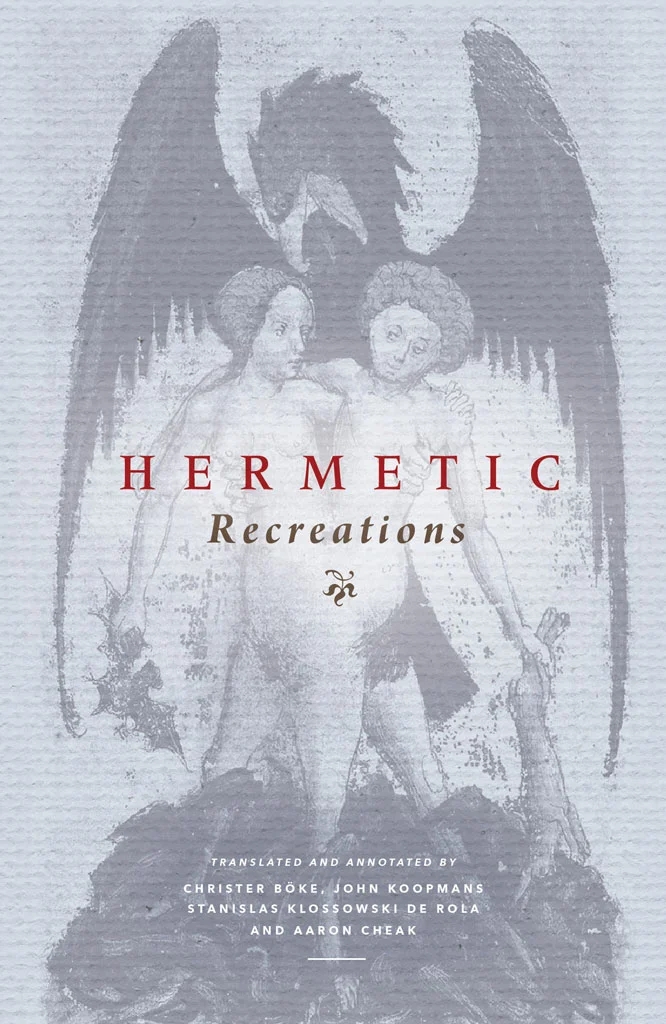
About the English Edition & Translation at Rubedo Press:
TRANSLATED into English for the very first time, the Hermetic Recreations is a uniquely lucid masterwork of French Hermetic philosophy. Set down in an anonymous hand at the turn of the Nineteenth Century, it provides critical insights into the operative arts of the western alchemical tradition. Illuminating both the traditional mediæval practices of which it was the inheritor, and those of the Parisian alchemical revival that would succeed it, this rare text forms an influential bridge between two alchemical epochs.
Although the identity of the author remains a mystery, the text appears to have been composed sometime between the late 18th and early 19th centuries. Preserved in the manuscript collection of Muséum d’Histoire Naturelle in Paris, it was first brought to the attention of Bernard Husson by his friend, Eugène Canseliet (1899–1982), a French alchemist and the only direct student of Fulcanelli.
This eventually resulted in the first publication of Les Récréations hermétiques in 1964. Jules Merias published a corrected edition in 1992, also in French, which included the Scholium or commentary. The text of the Scholium is a particularly revealing addition, for it presents 150 Hermetic “aphorisms” encapsulating the core principles of the alchemical process.
Both texts, which clearly form a single work, are presented here in a handsome dual language edition, in French and in English, with copious scholarly annotations by Christer Böke, John Koopmans, Stanislas Klossowski de Rola, and Aaron Cheak.
***

Related Articles

Leave a Reply