
Circle of Transmission: The Living Loom
J. B. C. de la Monnerie (attr.): The Written Science of the Whole Hermetic Art-A Programme from the London Edition of 1733

Legend for the Featured Illustration: A speculative A.I. reconstruction, based upon documentary and textual evidence, of J.B.C. de la Monnerie in his London study, 1733. The elderly Maître Prieur, translator of Marcel Palingène’s Zodiaque de la Vie Humaine (London, 1733), is shown at work amid the material traces of his double life: the dominant folio of his principal translation; the marginal pamphlet of the Science écrite de tout l’Art hermétique, appended for “the Children of the Art”; the crucifix that marks his public orthodoxy; and the silkworm cocoon that emblematises the self-sealing vessel of the hermetic Work.
Through the window, the dome of St Paul’s anchors the scene in the London of his 1733 edition. The clutter of manuscripts, the broken seal, the stained mug, and the single cheap candle speak of a man who administered an ecclesiastical house by day and translated, in stolen hours, the secrets of a philosophy he could not publicly avow.
*
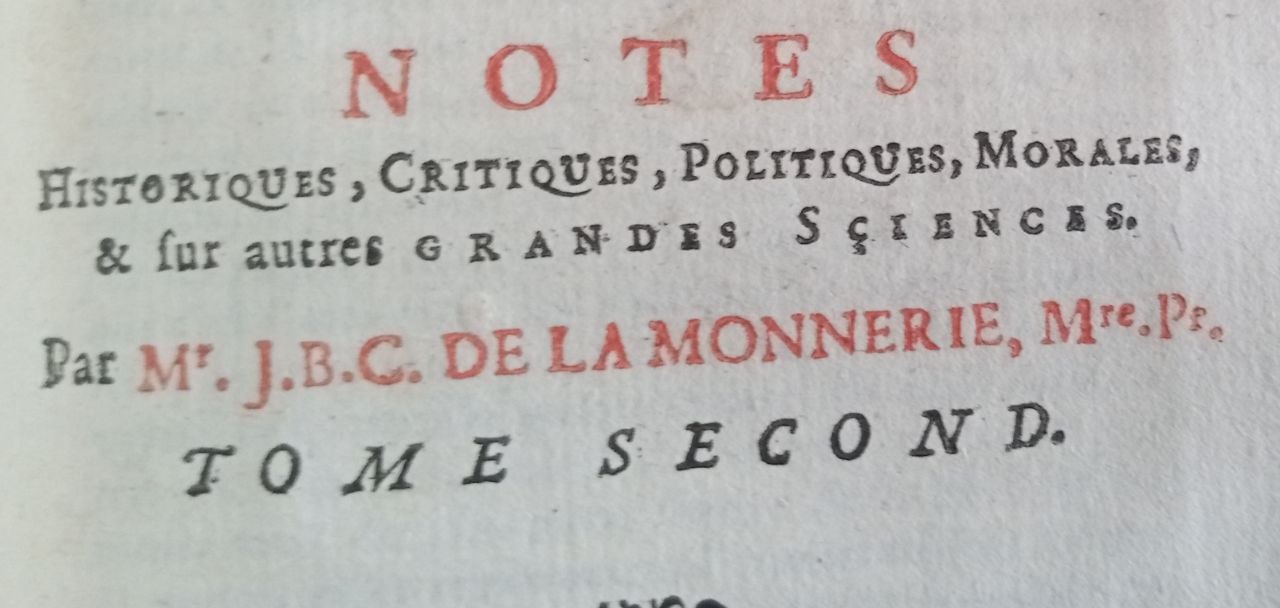
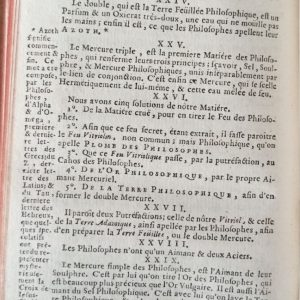
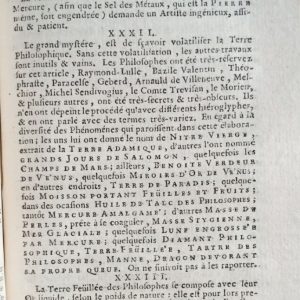
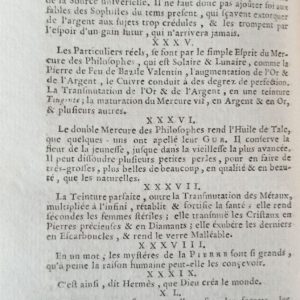
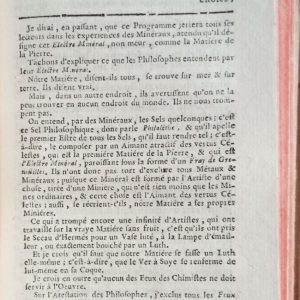
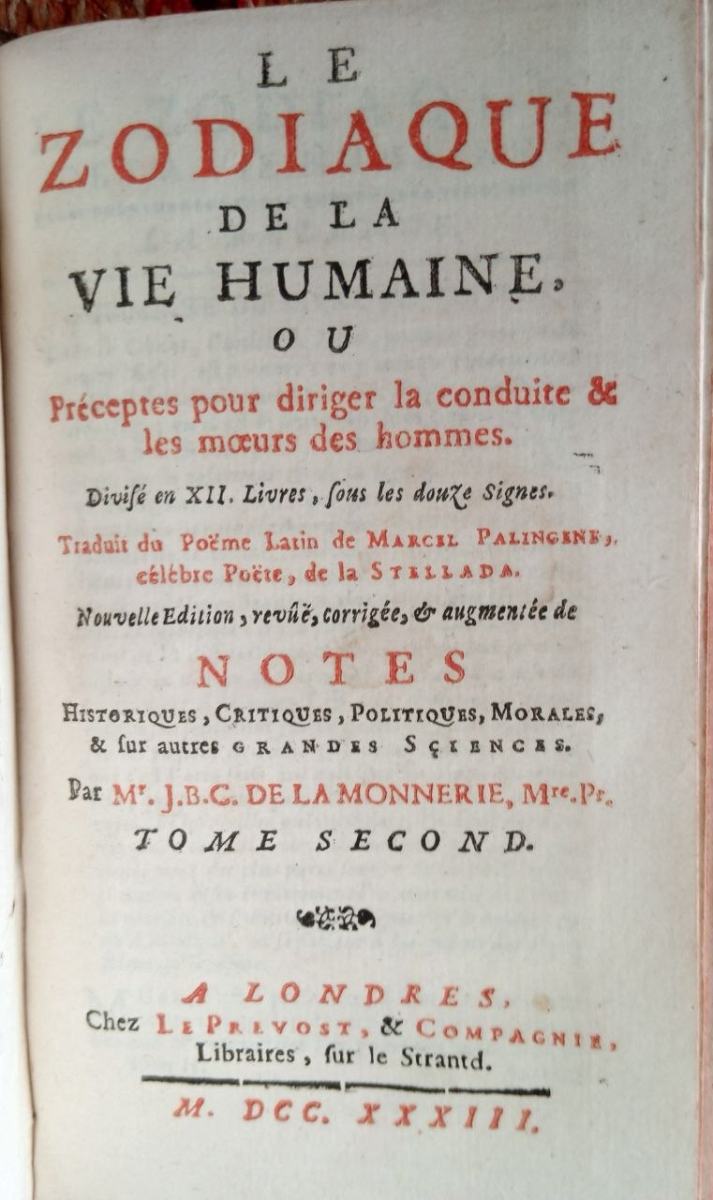
Today’s sharing from the blue House of Via-HYGEIA presents an enigmatic text: the Science écrite de tout l’Art hermétique. Originally published as a supplementary note in J.B.C. de la Monnerie’s 1733 London edition of Marcel Palingène’s Zodiaque de la Vie Humaine (Vol. II, pp. 135–141), this work transcends the status of a mere commentary.
It is a programme—a declaration of principles designed to orient the mind rather than instruct the hands. Through forty aphorisms, it operates on a double register: the surface of technical alchemy and the depth of spiritual initiation, where the “faithful friend” is not a human teacher but Nature itself, and “experience” is not vulgar empiricism but gnosis.
In continuation of this work, the Via-Hygeia Circle of Transmission announces that a dedicated sampler of Marcel Palingène’s poetry will follow shortly.
**
A Contextual Introduction
The Translator: A Man of Double Life
The figure behind this text, J.B.C. de la Monnerie, appears on the title page as “Mre. Pr.”—almost certainly Maître Prieur, an honorific denoting a superior of rank in the regular clergy of eighteenth-century France. [While this expansion is philologically probable and historically coherent, it remains, in the absence of direct archival confirmation, a working hypothesis.] The name itself, “de la Monnerie“, derives from the Old French moinerie (monastery), suggesting that his title was not merely a family name but an ecclesiastical office: the head of a priory. He was, in other words, a French regular cleric of learning and authority, likely from a Benedictine, Augustinian, or Premonstratensian house.
His Avis au Lecteur reveals a man of sensibility and erudition. In late 1729, he travelled to Holland on business—”quelques affaires, dont le récit importe très-peu au Public,” as he modestly puts it—where he remained for some eighteen months. There, a Dutch bookseller showed him the Latin Palingenius, which he read “avec l’avidité qu’on ressent quand on trouve du parfait beau.” He was moved to enthusiasm by the poem’s theology, tranquillised by its Stoic contempt for death. This is not the voice of a vulgar merchant or a mechanical translator, but of a cultivated mind responsive to philosophical beauty.
He translated the first three books in Holland and submitted them to two patrons: Philip Stanhope, 4th Earl of Chesterfield, then British Ambassador Extraordinary to the Dutch Republic (1728–1732), and a certain “Baron de Kreuning” [no certain identification has yet been made; possibly a Frenchification of a Dutch noble name such as Van Kruiningen]. Chesterfield’s approval secured the dedication; the translation was published at The Hague in 1731 by Jean Rousset de Missy, a Huguenot writer and freemason central to the radical Enlightenment publishing network. The first edition sold out completely despite “un nombre infini de fautes grossières,” and a second, corrected edition with notes was issued in London in 1733.
De la Monnerie’s hermetic sensibility is not incidental to his translation. In the dedicatory epistle, he explicitly defends Palingenius against charges of paganism by arguing that the poet’s “gods” are really “very pure Intelligences“—the Neoplatonic celestial hierarchy—and that his apparent polytheism is a veil for secret philosophy.
This is the stance of an initiated reader, someone who understands the tradition of esoteric concealment. The inclusion of the Science écrite—a practical alchemical text “for the Children of the Art“—in his edition is therefore not accidental. It is the work of a man who moved between the Latin classroom and the hermetic lodge, between the public defence of ancient wisdom and the private transmission of operative secrets.
His “occupations“—the administrative duties of a maître prieur—left him little time for the Muses. He had to steal hours from his rest to complete the notes for the second edition. This is the voice of a busy man of affairs, not a professional man of letters, yet one for whom the philosophical life was not a luxury but a necessity.
The Programme and Its Double Register
The Science écrite de tout l’Art hermétique belongs to that curious genre of alchemical literature which presents itself simultaneously as technical manual and spiritual testament—a genre that resists the modern demand to choose between “chemistry” and “mysticism.”
The text calls itself a programme. In the eighteenth century, this was not a casual usage. A programme was a public declaration of principles, a syllabus of study, a chart of the territory to be traversed. It announced what was to be done without necessarily detailing how. The reader was expected to bring preparation, not mere curiosity. To call this text a programme is to make a claim about the nature of alchemical knowledge itself: it is not a set of recipes to be followed blindly, but a field of orientation to be entered with the whole self.
This distinction governs the approach of this translation. The Science écrite operates on a double register. On its surface, it speaks the language of matter and operation: Magnesia, Mercury, Fire, Sulphur, Salt, dissolution, volatilisation, cohobation. It names vessels and processes, distinguishes the “natural” from the “sur-natural” and the “elementary.” But beneath this surface runs another current: the language of transformation, of the soul’s encounter with hidden nature, of gnosis.
The text fuses these registers. The “Matter of the Philosophers” is simultaneously a specific substance and the ground of being; the “Fire” is simultaneously a thermal condition and a mode of attention. To reduce the text to chemistry is to miss its initiatory dimension; to reduce it to mysticism is to miss its demand for concrete, embodied engagement.
The modern reader, trained in the post-Enlightenment separation of subject and object, will find this fusion disorienting. That disorientation is intentional. The text is designed to re-educate perception, to teach the reader to see in two directions at once: toward the literal and toward the symbolic, toward the res and toward the signum. This is what the hermetic tradition calls solve et coagula—dissolve the rigid categories of ordinary thought, and reconstitute them at a higher level of integration.
The Structure of Initiation
The text is composed of forty numbered aphorisms, a form inherited from the ancient Turba Philosophorum and the Emerald Tablet. This structure is initiatory. Each aphorism is a step, a degree of understanding. The text circles, repeats, negates, and affirms.
It tells us what the Matter is not before telling us what it is. It dismisses the astral realm, the elements, the animal and vegetable kingdoms, only to affirm the mineral—then immediately qualifies that affirmation by excluding common minerals.
This is a pedagogy of absence. The reader is trained, by repeated negation, to let go of preconceptions and arrive at a state of receptive attention in which the true Matter can be recognised.
The “faithful friend” of Aphorism II who “demonstrates the Art” is not a human teacher. The “friend” is the Art itself, or Nature, or the inner guide that emerges when the ego’s demand for control is relinquished. The “experience” that justifies the text is not vulgar empiricism but gnosis: a knowing that transforms the knower.
The Paradox of the Stone
Central to the text is the paradox established in Aphorisms III–VII: the Art is “easy and difficult, very precious and vile”. The Stone is “easy” because it follows the way of simple nature; it is “difficult” because the human mind, accustomed to complexity, cannot recognise simplicity. It is “precious” in its effects, “vile” in its origin. The transmutation described is not merely the transformation of base metal into gold; it is the transformation of perception itself.
The text’s catalogue of decknamen—cover names—in Aphorism XXXII (Virgin Earth, Adamical Earth, Great Days of Solomon, Golden Mirrors of Venus, Dragon devouring its own tail, and dozens more) is the fullest expression of this paradox.
The multiplicity of names is a poetics of totality. The Stone is all things because it is the generative principle of all things. The names are exercises in flexible attention, training the mind to move between aspects without fixing on any single one.
The Rejection of Vulgar Chemistry
The commentary appended to the aphorisms makes explicit the rejection of “all the Fires of the Chemists“—bellows, retorts, reverberatories, lamps, horse-dung.
The text distinguishes between the “vulgar” chemist, who works with external fire, and the “philosophical” operator, who works with the “cold fire,” the self-sealing vessel, the “Silkworm [that] encloses itself in its Cocoon”.
The Work is autopoietic—self-making, self-regulating. The philosopher’s role is to establish conditions, not to force outcomes. Genuine change cannot be imposed from without; it must emerge from within.
Note on the Translation
This translation aims to preserve the double register of the original. Where the French is technically precise, the English follows; where it is symbolically resonant, the English does not flatten it into mere allegory. The long, cumulative sentences of the commentary have been kept intact, for their rhythm is part of their meaning. The capitalisations, which carry semantic weight in eighteenth-century alchemical usage, have been preserved.
The reader is advised to approach this text slowly, to read it more than once, and to hold in suspension the question of whether it is “really” about chemistry or “really” about spirituality. It is about both, reflecting the ancient hermetic conviction that these are not two things but one.
Consequently, this document should be understood not as a manual of recipes, but as a formal declaration of the laws, boundaries, and orientation of the Hermetic Art, designed to guide the prepared mind but intentionally withholding the final secrets from the unprepared hand.
The following translation is based on the 1731 text as preserved in the edition of Palingène’s Zodiaque de la vie humaine, with the appended commentary. Paragraphing and capitalisation follow the original. The biographical information on the translator is drawn from the Avis au Lecteur and the dedicatory epistle of the 1731 Hague and 1733 London editions.
*
And now the text:
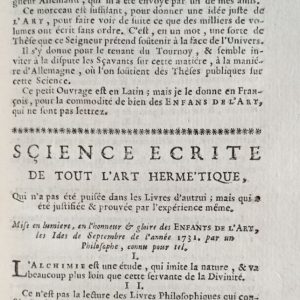
WRITTEN SCIENCE
Of the Whole Hermetic Art
Which has not been drawn from the books of others;
but which has been justified and proved by experience itself.
Brought to light, in honour and glory of the CHILDREN OF THE ART,
on the Ides of September of the year 1731, by a Philosopher, known as such.
I. Alchemy is a study which imitates nature, and goes far beyond that handmaid of the Divinity.
II. It is not the reading of Philosophical Books that constitutes the Philosopher; but rather practice, preceded by the discoveries of a faithful friend, who demonstrates the Art to us.
III. Our Art is easy and difficult, very precious and vile, according to the subject who applies himself to it and attaches himself to it.
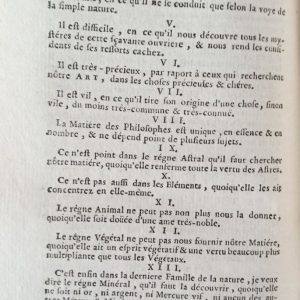
IV. It is easy, in that it conducts itself only according to the way of simple nature.
V. It is difficult, in that it reveals to us all the mysteries of that learned workwoman, and makes us the confidants of her hidden springs.
VI. It is very precious, with respect to those who seek our Art, in precious and dear things.
VII. It is vile, in that it draws its origin from a thing, if not vile, at least very common and very known.
VIII. The Matter of the Philosophers is unique, in essence and in number, and depends not at all upon several subjects.
IX. It is not in the Astral realm that one must seek our matter, although it contains all the virtue of the Stars.
X. It is not likewise in the Elements, although it has concentrated them in itself.
XI. The Animal realm cannot give it to us either, although it is endowed with a very noble soul.
XII. The Vegetable realm cannot furnish us our Matter, although it has a vegetative spirit and a virtue much more multiplying than all Vegetables.
XIII. It is finally in the last Family of nature, I mean the Mineral realm, that one must discover it, although it be neither gold, nor silver, nor living Mercury, nor any of the other Metals and Minerals, major and minor, excepting what the Philosophers call their Mineral Electre, not dead, [1] or their Philosophical Magnesia, which they call their Saturn, which is not at all common, and which cannot be comprehended by the ordinary sense of vulgar Chemists.
XIV. The Matter of the Philosophers must be crude; that is to say, never having passed through the fire.
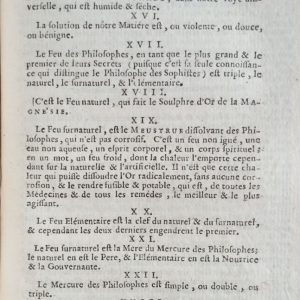
XV. Our Magnesia is the true and unique Matter of the Philosophical Stone, in our universal way, which is humid and dry.
XVI. The dissolution of our Matter is either violent, or gentle, or benign.
XVII. The Fire of the Philosophers, as the greatest and first of their Secrets (since it is the sole knowledge that distinguishes the Philosopher from the Sophist) is triple: the natural, the surnatural, and the elementary.
XVIII. It is the natural fire, which makes the Sulphur of Gold of the Magnesia.
XIX. The surnatural fire is the dissolving Menstruum of the Philosophers, which is not corrosive. It is a non-igneous fire, a non-watery water, a corporal spirit, and a spiritual body: in a word, a cold fire, whose heat nevertheless prevails over the natural and the artificial. It is only this heat that can radically dissolve gold, without any corrosion, and render it fusible and potable, which is, of all Medicines and all remedies, the best and most active.
XX. The Elementary fire is the key of the natural and the surnatural; and yet the two latter engender the first.
XXI. The surnatural fire is the Mother of the Philosophers’ Mercury; the natural is its Father; and the Elementary is its Nurse and Governess.
XXII. The Mercury of the Philosophers is simple, or double, or triple.
XXIII. The simple is the Philosophers’ Sour Fountain, or their Philosophical Vinegar, which is the first dissolvent, and the unique principle of the Stone; it is this which extracts the Sulphurs of Metals, resolves and volatilises their Salts.
XXIV. The double, which is the Philosophical Leafy Earth, is a Perfume and a very sweet Oxycrat, [2] a water which does not wet the hands; finally it is what the Philosophers call their Azoth. [3]
XXV. The triple Mercury is the first Matter of the Philosophers, which contains their three principles; to wit, Salt, Sulphur, and Philosophical Mercury, inseparably united by the bond of conjunction. It is finally this Mercury, which is Hermetically sealed in itself, and this water mingled with fire.
XXVI. We have five solutions of our Matter.
1°. Of the crude Matter, to draw from it the Fire of the Philosophers.
2°. So that this secret fire, being extracted, it may make appear the Vitriolic Fire, not common but Philosophical, which one calls the Lead of the Philosophers.
3°. That this Vitriolic Fire may pass, by putrefaction, into the Chaos of the Philosophers.
4°. Of the Philosophical Gold, by the proper Mercurial Air.
5°. Of the Philosophical Earth, in order to form the double Mercury.
XXVII. There appear two Putrefactions; that of our Vitriol, and that of the Adamical Earth, thus called by the Philosophers, in order to prepare the Leafy Earth, or the double Mercury.
XXVIII. The Philosophers have but one Magnet and two Steels.
XXIX. The simple Mercury of the Philosophers is the Magnet of their Sulphur. It is by it that one draws the Philosophers’ Gold, which is much more precious than vulgar Gold. It is also the Magnet of the Philosophical Salt. [4] It is with it that one washes the Philosophical Earth, and renders it volatile, so that they may exactly join together, and make what one calls the double Mercury.
XXX. The one and the other Steel, as well sulphureous as saline, must be cooked eleven times with the Mercurial Magnet, so that it may acquire by this reiterated cohobation, a regenerated, very noble nature.
XXXI. The volatilisation of the Philosophical Earth, by the Spirit of the Mercury, (so that the Salt of Metals, which is the Stone itself, be engendered) demands an ingenious and patient Artist.
XXXII. The great mystery is to know how to volatilise the Philosophical Earth. Without this volatilisation, the other works are useless and vain. The Philosophers have been very reserved upon this article: Raymond Lulle, Basile Valentin, Théophraste, Paracelsus, Geber, Arnaud de Villeneuve, Melchior, Michel Sendivogius, the Comte Trevisan, Morien, and several others, have been very secret and very obscure. They have depicted the procedure only with different hieroglyphs, and have spoken of it with very varied terms. In regard to the diversity of Phenomena that appear in this elaboration; some have given it the name of Virgin Earth, extract of the Adamical Earth; others have named it the Great Days of Solomon; elsewhere the Fields of Mars; elsewhere, the Blessed Greenness of Venus; sometimes the Golden Mirrors of Venus; in other places, the Earth of Paradise; sometimes the Harvest bearing Leaves and Fruits; sometimes the Oil of Talc of the Philosophers; now the Amalgamated Mercury; others the Mass of Pearls, ready to coagulate, the Stygian Mass, the Icy Sea; sometimes the Moon Impregnated by Mercury; sometimes the Philosophical Diamond, the Leafy Earth, the Tartar of the Philosophers, the Manna, the Dragon devouring its own tail. One would never finish reporting them.
XXXIII. The Leafy Earth of the Philosophers is composed with their liquid Gold, according to the weight of nature: it is then the first Matter, to which, if one proportions the Philosophical Great Fire (which the Philosophers call the Oil of the Sun, or the Seal of Hermes,) it becomes white and red: it is conducted to the Elements, which are Air and Fire, and multiplies to infinity.
XXXIV. There is no particular way that does not emanate from the universal Source. One must therefore not give credence to the fables of the Sophists of the present time, who know how to extort money from too credulous subjects, and deceive them by the hope of a future gain, which will never arrive.
XXXV. The real Particulars are made by the simple Spirit of the Philosophers’ Mercury, which is Solar and Lunar, like the Fire-Stone of Basile Valentin, the augmentation of Gold and Silver, Copper conducted to degrees of perfection, the Transmutation of Gold and Silver into a tinging tint, the maturation of living Mercury into Silver and Gold, and several others.
XXXVI. The double Mercury of the Philosophers renders the Oil of Talc, which some have called their Gur. It preserves the flower of youth, even into the most advanced old age. It can dissolve several small pearls, to make of them very large ones, much more beautiful in quality and in beauty than the natural ones.
XXXVII. The perfect Tincture, besides the Transmutation of Metals, multiplied to infinity, re-establishes and fortifies health; it renders barren women fertile; it transmutes Crystals into precious Stones and Diamonds; it causes the latter to abound as Carbuncles, [5] and renders glass Malleable.
XXXVIII. In a word; the mysteries of the Stone are so great, that human reason can scarcely conceive them.
XXXIX. It is thus, says Hermes, that God created the world.
XL. The Stone contains in itself finally, the secrets, the riches, the miracles, and the forces of the three Kingdoms.
THE WHOLE PROCEEDS FROM A SINGLE THING.
J.B.C. de La Monnerie’s Concluding Comments [6]
Most celebrated physician or chemist, whoever you may be, solve this syllogism for me, if you can and if you please; otherwise, if you provide me the opportunity, I am ready to solve it for you demonstratively.
I will say, in passing, that this Programme will throw all readers into the experiences of Minerals, seeing that it designates this Electre Mineral, not dead, as the Matter of the Stone.
Let us attempt to explain what the Philosophers understand by their Mineral Electre.
Our Matter, they all say, is found upon sea and upon land. They say true.
But, in another place, they warn that one cannot find it in any place in the world. They do not deceive us. One understands, by Minerals, any Salts whatsoever; it is this Philosophical Salt, of which Philalethes speaks, and which he calls the first Electre of all Salts, which one must render such; that is to say, compose it by an attractive Magnet of Celestial virtues, which is the first Matter of the Stone, and which is the Mineral Electre, appearing in the form of a spawn of frogs. They do not therefore exclude all Metals and Minerals; since this Mineral is formed by the Artist from a thing, drawn from a Mine, which is nothing less than ordinary Mines, and this thing is the Magnet of Celestial virtues; also, they recite, our Matter has its own Mines.
That which has deceived an infinity of Artists, who have laboured upon the true Matter without fruit, is that they have taken the Seal of Hermes for a luted vessel, at the Lamp of the enameler, or exactly stopped by a Lute.
And I believe that our Matter must make a Lute itself; that is to say, that the Silkworm encloses itself in its Cocoon.
I believe moreover that none of the Fires of the Chemists must serve for the Work.
Upon the Attestation of the Philosophers, I exclude all the Fires of Bellows, of Retort, of Reverberatory, of Lamp, of Horse-Belly, and would hold to their Fire alone.
*
Notes
[1] “Not dead“: In alchemical usage, “dead” (meur) means inert, fixed, non-volatile. The “Mineral Electre, not dead” is therefore a substance that retains its vital, volatile principle.
[2] Oxycrat: From Greek oxys (sharp, acidic) + kratos (power). A medicinal drink of vinegar and water; here, a metaphor for the sharp, penetrating quality of the Philosophical Leafy Earth.
[3] Azoth signifies beginning and end. This word was composed by the Philosophers from Alpha and Omega, the first and last letters of the Greeks; from Z, the last letter of the Latins; and from Tau, the last letter of the Hebrews, which some claim mysteriously represents the Cross of Jesus Christ.
[4] In the original, “Aimant” (magnet, loadstone) appears here; I have standardised the translation to “Magnet” for consistency, as in XXVIII.
[5] The French: ‘elle exubère les derniers en Escarboucles‘ implies an overflowing abundance. The translation “it causes the latter to abound as Carbuncles” best captures the generative and prolific nature of the tincture described in the original text.
[6] This commentary appears in the original edition as continuous prose following the aphorisms, without separate heading. It is here distinguished for clarity.
*
Bibliographical Note
Editions consulted:
- Le Zodiaque de la Vie, ou Préceptes pour diriger la Conduite & les Mœurs des Hommes. Traduit du Poème Latin de Marcel Palingène… Par Mr. de la Monnerie. The Hague: J. van den Kieboom / J. Swart, 1731. 2 vols.
- Le Zodiaque de la Vie… Nouvelle Édition, revûë, corrigée, & augmentée de Notes… Par Mr. J.B.C. de la Monnerie, Mre. Pr. London: Chez Le Prévost, & Compagnie, 1733. 2 vols.
The Science écrite de tout l’Art hermétique appears as a note in Volume II, pages 135–141, of the 1733 London edition.
*
Original French
*
Source:
***

Leave a Reply