
The Living Vessel: A Commentary on Initiation, Attachment, and the Necessity of Ruin
By Nicolas Lecerf.
Opening Note: This essay serves as a companion piece to ‘The Paraclete in the Age of Chaos’. Where the first article mapped the terrain of the ‘Stone Vessel’ and the ‘Living Vessel’, this commentary explores the psychological and spiritual mechanism required to move from one to the other. Drawing on Fernando Pessoa’s rigorous ‘Essay on Initiation’, we examine why the greatest barrier to the ‘Silent Architect’ is often the initiate’s own attachment to the Inn.
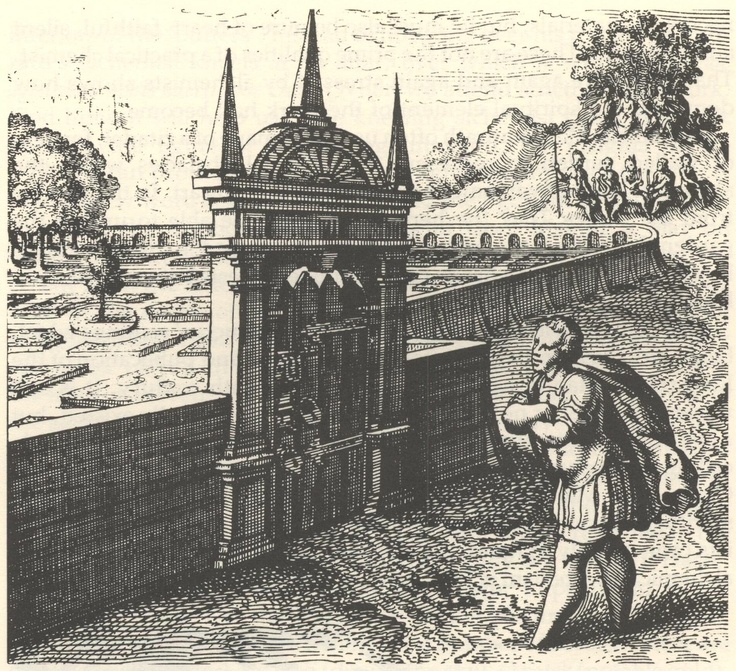
Legend for figure 1: The Departure from the Enclosed Garden. In this 17th-century emblem by Michael Maier, the walled garden represents the ‘Stone Vessel’—a place of order, dogma, and the ‘Error of the Inn’ where many seekers choose to settle. The traveler, bundle on his back, turns away from the safety of the group and the manicured static beauty of the institution. He embodies the Silent Architect who recognizes that the scaffolding must be left behind to find the Living Vessel. His path is solitary and uncertain, yet it is the only way to move from the horizontal comfort of the shard to the vertical reality of the whole.
Introduction: The Error of the Inn
In ‘The Paraclete in the Age of Chaos’, we traced the movement from the Stone Vessel—the external, architectural, and dogmatic structures of tradition, exemplified by Hagia Sophia—to the Living Vessel, the internalized, dynamic realization of the soul as the true temple.
We spoke of the Silent Architect who holds the Vertical Column amidst horizontal chaos. Yet, a question remains, quiet but persistent: How does one make this transition? Why do so many sincere seekers remain trapped in the Stone Vessel, diligently defending its walls rather than inhabiting the light it was meant to hold?
The answer lies in what Fernando Pessoa, in his ‘Essay upon Initiation’, identifies as the ‘Error of the Inn’. It is the subtle mistake of taking the halfway point for the destination. It is the attachment to the recipes of occultism rather than the life of esotericism. It is the refusal to destroy the achieved unity of the self to make way for a higher, dynamic one.
We often seek peace in the structure, in the completion of the ritual, or in the purity of the lineage. But as we shall see, there is no peace in the vessel itself. True peace arrives only at a later stage, when intention and result finally converge through Grace. Until then, we are called to a more difficult task: burning the enclosed garden so that the forest may grow.
The Architecture of Illusion
Pessoa asks us to distinguish the errors of the path, the Inn, and the cave. He warns that it is an error of the Inn to take the halfway mark for the whole journey, and an error of the cave to mistake the basement for the castle. This distinction finds its perfect architectural metaphor in the shift from the Stone Vessel to the Living Vessel described in The Paraclete. The Stone Vessel is the Inn. It is magnificent, necessary, and holy.
Like Hagia Sophia, it is a theurgical machine designed to hold the light, a structure where the traveler learns to hold the fire without burning. It is the Golden Dawn, the rigid Tarot lineage, the dogmatic system that gives us our first foothold on the cliff face.
But the error occurs when the initiate mistakes this Stone Vessel for the final destination. We begin to polish the stone, defend the architecture, and fight over the blueprints, forgetting that the building was only ever meant to teach us how to become the building. As The Paraclete reminds us, the scaffolding is holy only until it is no longer needed; the arch does not despise the wood that held it, but it simply no longer needs to remember the wood. To cling to the Stone Vessel is to commit Pessoa’s Error of the Cave.
We dwell in the basement of external structure and claim it is the castle of internal realization. The freezing of occult syntheses happens precisely when communities refuse to let the scaffolding fall, worshipping the wood instead of the arch, and seeking peace in the permanence of the stone rather than the fluidity of the light.
From Recipes to Life
This stagnation reveals the critical transition from Occultism to Esotericism. Pessoa notes that in vital initiations, the candidate does not merely know; they live what they feel. Occultism, in its common degeneration, is the gathering of eclectic recipes. It is the stage of the Stone Vessel, where one learns to invoke, command, and construct sacred spaces. It is largely symbolic and intellectual.
While The Paraclete acknowledges this stage as holy and necessary to train the imagination, it is also the trap. When one stays here, they become merely a technician of the sacred, mistaking the ritual gesture for the spiritual reality. They operate on a logic of separation: “I, the initiate, call upon Thee, the Divine, to do This, the result.“
Esotericism, by contrast, is the Living Vessel. It corresponds to Pessoa’s vital initiation. It is the moment the initiate realizes that they no longer need to call down the Fire because they have become the wick. The attachment we see in modern communities—the defensive shouting of ‘sacrilege!’ at new syntheses, such as the reactions to Stav Appel’s ‘Torah in the Tarot’—is the panic of the Occultist who fears that without the specific recipe, the magic will stop. They forget that the magic was never in the recipe; it was in the cook.
To move from Occultism to Esotericism is to stop collecting recipes and start eating. It is to realize that the “Ur-Tarot” is not a historical artifact to be preserved in a stone vault, but a living mirror that must be shattered and re-melted in the fire of one’s own experience. If we do not live what we know, we remain curators of a museum, not alchemists of the soul.
The Horizontal Trap and the Vertical Column
Why is this transition so rarely made? Pessoa suggests that mysticism and magic are often confessions of weakness, shortcuts that allow an escape from reality. The Paraclete provides the geometric reason for this weakness: Horizontality. When we cling to a specific dogma, a standard of Tarot, or a lineage, we are operating from a Shard. We take a finite fragment of truth—a horizontal perspective—and elevate it to an absolute.
This is what Pessoa describes as the idle young adolescent guessing at things rather than knowing them. The escape from reality is an escape into the Horizontal, where it is easier to defend a shard (a political party, a magical order, a rigid theory) than to stand in the Vertical.
As The Paraclete advises, we must constantly ask ourselves if our arguments come from a shard of fear and tribal loyalty, or from the Column of universal virtue. The defensive communities trapped in the Horizontal are colliding shards, lacking the Vertical strength to hold the tension of a new synthesis.
They use the might of tradition and the intuition of lineage to avoid the hard work of the Intellect, which is to stand in the Column and see the whole picture. In this state, intention and result are disjointed; we intend to reach the Divine, but our result is only the reinforcement of our own egoic boundaries. There is no peace here, only the noise of fragmentation.
The Catalyst of Failure
So how does the break occur? Pessoa demands that we abandon the system we have built, recognizing that even our own philosophical synthesis is no better than the ones we rejected. The Paraclete explains that this abandonment is often forced upon us by Failure. The ‘world fracturing’ we witness today is the external manifestation of the Breaking of the Vessels (Shevirat ha-Kelim).
Our old systems—the Stone Vessels of the 19th and 20th centuries—are shattering because they can no longer hold the intensity of the current age. When old rituals feel empty, when dogma fails to explain the chaos, when the ‘Ur-Tarot’ falls silent, the vessel breaks.
This is the Tabula Rasa. It is not a choice; it is a necessity. We must be willing to do the quiet work of becoming the new world, gathering the scattered sparks (Tikkun Olam) from the broken shards of our old traditions to build a Living Vessel. We do not destroy the old systems out of hatred. We destroy them because, as The Paraclete notes, you cannot burn a way of seeing. The outer form must burn so the inner vision can survive.
The Golden Dawn as an organization may be a shard, but the light it tried to hold is eternal. We save the light only by letting the vessel go. It is in this surrender, in the acceptance of the broken vessel, that the first glimmer of Grace appears: the moment our intention to let go aligns with the result of being held by something greater.
The Silent Architect and the Convergence of Grace
This brings us to the summit of the path. Pessoa speaks of a time when one must destroy an achieved unity to benefit from a higher one, a transcendent lucid dynamic realization that baffles understanding. This is exactly what The Paraclete calls the Silent Architect. The ‘Enclosed Garden’ Pessoa warns us to destroy is the garden of Specialness—the desire to shine, to possess the correct ritual, to be the guardian of the true tradition. The Master destroys this unity by becoming Ordinary. “The awakened soul does not shine,” writes The Paraclete. “It warms. It does not speak of the Pearl. It is the Pearl, and no one notices.”
This is the dynamic realization. It is not a static state of perfection, but a continuous act of Vertical Presence in a horizontal world. The Master does not build a new Stone Vessel to replace the old one; the Master becomes the Living Vessel. They become the Column in a world of shards, the Silence in a world of noise. This baffles our understanding because the intellect wants to build something visible, to achieve a result that can be measured. But the Master knows that the only thing that matters is the invisible alignment. The destruction of unity is the dissolution of the ego’s need to be the initiate, the master, or the guardian.
It is here, in this ordinariness transfigured, that the long-sought peace finally arrives. It is not the peace of a completed structure, but the peace of convergence. It is the moment when intention and result are no longer at odds, when the will to be Vertical and the actuality of being Vertical meet in a single point of Grace. The work is no longer to defend a tradition, but to hold the space for the new world to form. As The Paraclete concludes, the greatest magic is not the one that shakes the heavens with commands, but the one that heals the earth through quiet, unshakeable being.
The Difficulty of the Task
One may object, as Pessoa anticipates, that this makes Initiation a very difficult task. He answers simply: “I do, as it is so. Why should it be easy?” It is difficult because it demands the death of the Group Ego. It is easy to join a club, to defend a shard, to say “I am a Golden Dawn initiate” or “I am a traditional Tarot reader.” These are horizontal identities that provide comfort, community, and a sense of belonging. It is infinitely harder to be a Silent Architect, to walk the Red Sea path with sober vigilance without a banner, without a headquarters, without a list of members.
Why should it be easy? Because the reconstruction of the world cannot be done by fragments fighting each other. It can only be done by individuals who have destroyed their own inner fragmentation and become a Single Column of Fire. If the task were easy, everyone would do it, and we would have endless clubs and endless wars of shards. The difficulty is the filter. It ensures that only those willing to become the Pearl, rather than just speak of it, will finish the work.
To follow Pessoa and The Paraclete is to accept that the only true initiation is the one that leaves no trace on the horizontal plane, but transforms the Vertical reality of the world. The Master is not the one who knows the answer; the Master is the one who has become the Silence in which the answer can be heard, resting in the peace of a vessel that is finally, fully, alive.
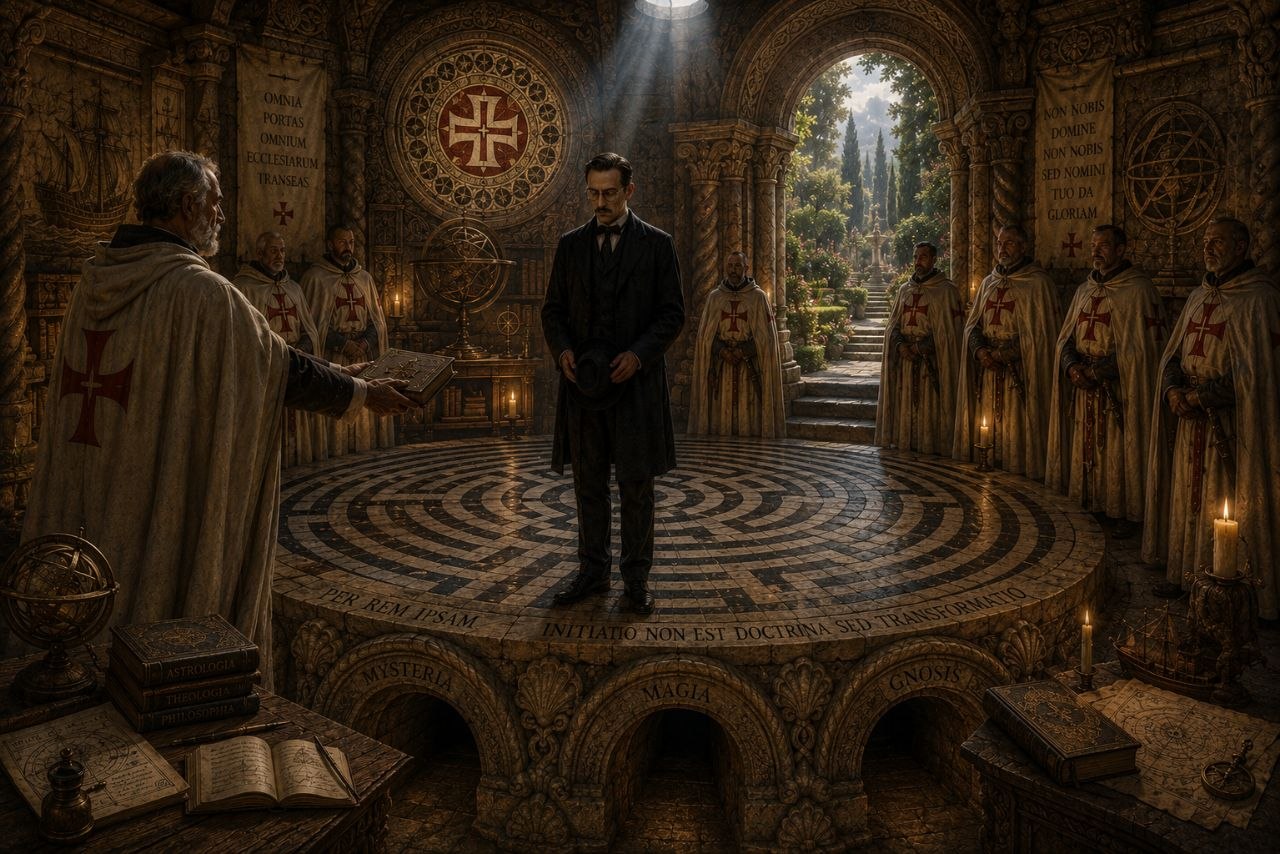
Legend for Figure 2: The Convergence of Grace. The initiate stands at the center of the labyrinth, having traversed the inscribed path: “Initiatio non est doctrina sed transformatio” (Initiation is not doctrine but transformation). To his left, the banner reads “Omnia portas omnium ecclesiarum transeas” (You must pass through the gates of all churches), echoing Pessoa’s demand to cross all dogmas without being bound by them. Below him lie the three paths of Mysteria, Magia, and Gnosis, now integrated rather than opposed. Surrounded by the guardians of tradition (the Stone Vessel), he does not look to them, but to the single beam of Vertical Light descending from above. This is the moment of Tabula Rasa and the convergence of Grace: where intention and result align, the Group Ego dissolves, and the Silent Architect is born, ready to become the Living Vessel.
*
ENDNOTES
[1] Fernando Pessoa, ‘Essay upon Initiation’: The quotes regarding the “Error of the Inn,” the three types of initiation, and the four stages of the Neophyte are drawn from Fernando Pessoa’s esoteric writings, specifically An Essay on Initiation (published in French as Essai sur l’Initiation, Christian Bourgois, 1992). Pessoa (1888–1935), best known as a poet, was also a profound occult thinker who explored the tensions between mysticism, magic, and gnosis. Full text here
[2] The Paraclete in the Age of Chaos: This refers to the author’s previous article published on pansophers.com, which outlines the distinction between the “Stone Vessel” (external tradition) and the “Living Vessel” (internal realization), and introduces the concept of the “Silent Architect.”
[3] Hagia Sophia as a Theurgical Machine: The interpretation of Hagia Sophia not merely as a church but as a “machine” for invoking divine presence through light and geometry is supported by researchers such as Peter Mark Adams (see The Sanctum of Kronos). The historical fires that consumed the first two structures are viewed alchemically as the Nigredo phase, necessary to clear the way for the perfected third structure. Full review here.
[4] Stav Appel, Torah in the Tarot: A contemporary example of a new synthesis that challenges traditional Tarot orthodoxy. The defensive reactions it provoked within certain communities serve as a case study for the “attachment to the Stone Vessel” and the fear of altering established “recipes.” Full review here.
[5] Shevirat ha-Kelim (Breaking of the Vessels): A central concept in Lurianic Kabbalah (16th century) describing a cosmic catastrophe where vessels intended to hold divine light shattered, scattering sparks into matter. The human task of Tikkun Olam (Repairing the World) involves gathering these sparks. This aligns with the Rosicrucian concept of regeneration and the “fracturing” of the modern world described in The Paraclete.
[6] Jacob Boehme and the Morgenröte: Jacob Boehme (1575–1624), the German mystic, described the dawn of divine illumination as the Morgenröte (Morning Redness). This concept parallels the Ishraqi (Illuminationist) tradition of Suhrawardi and Henry Corbin, representing the moment the soul awakens from material slumber to Vertical awareness.
[7] The Four Stages of the Neophyte: Pessoa outlines these stages as Dogma (tying one to others), Science (tying one to Nature), Philosophy (tying one to the mind of others), and Critical Intelligence (tying one to oneself). Crossing all four is required to overcome the “Temptation of the World” and prepare for true initiation.
[8] Latin Inscriptions (Figure 2):
‘Initiatio non est doctrina sed transformatio’: “Initiation is not doctrine but transformation.” This summarizes the shift from Occultism (knowledge) to Esotericism (being).
‘Omnia portas omnium ecclesiarum transeas’: “You must pass through the gates of all churches.” A direct reference to Pessoa’s instruction that the initiate must not enter through the gate of one church, but must cross all gates or none, thereby freeing themselves from dogmatic prejudice.
‘Non nobis, Domine, non nobis, sed Nomini Tuo da gloriam’: “Not to us, O Lord, not to us, but to Your name give glory.” (Psalm 115:1). Historically associated with the Knights Templar, this motto underscores the dissolution of the Group Ego and the attribution of all work to the Divine/Vertical source.
***
Leave a Reply