Circle of Transmission: The Living Loom

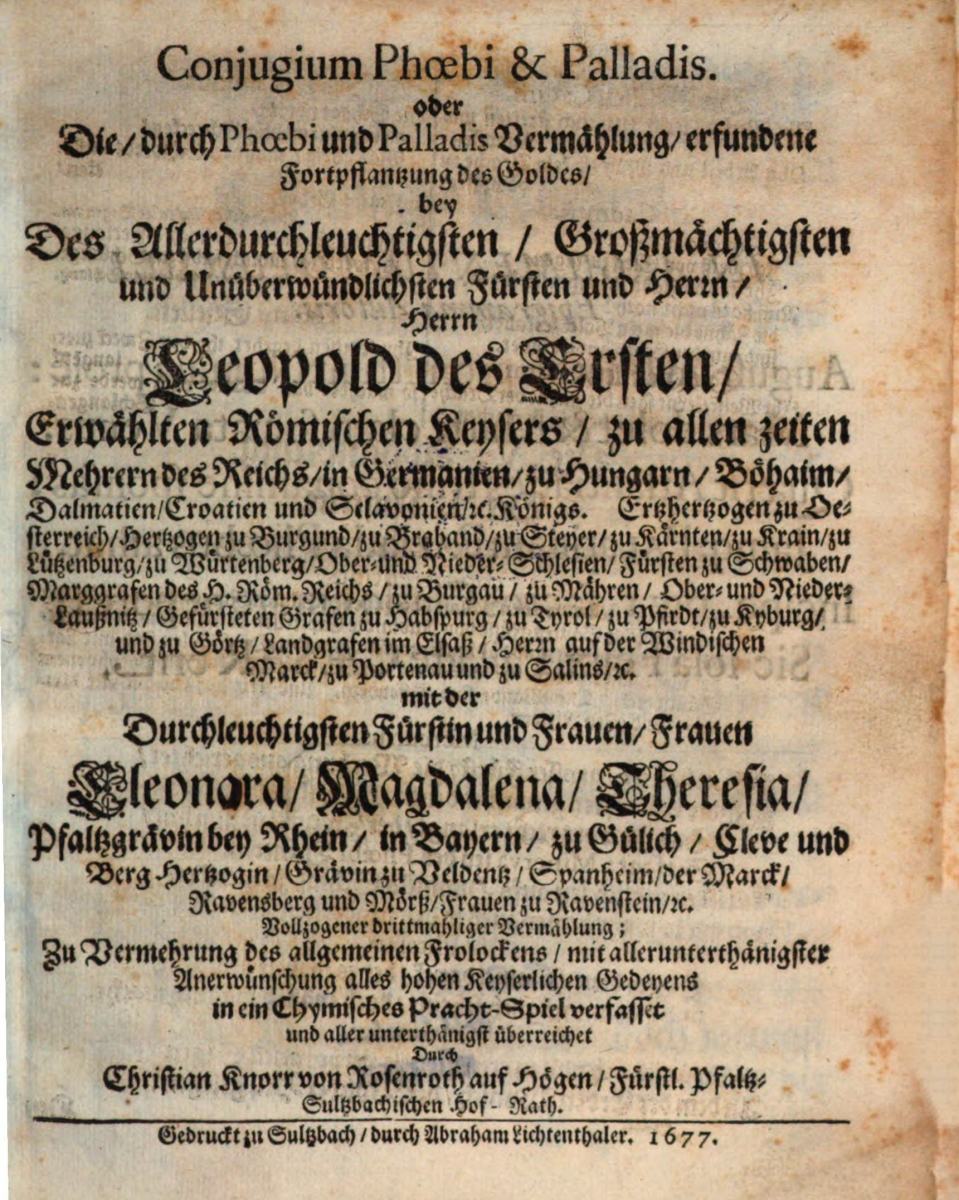
A Christian Knorr von Rosenroth Sampler – Part 1: ‘Conjugium Phoebi et Palladis’ (Sulzbach,1677)

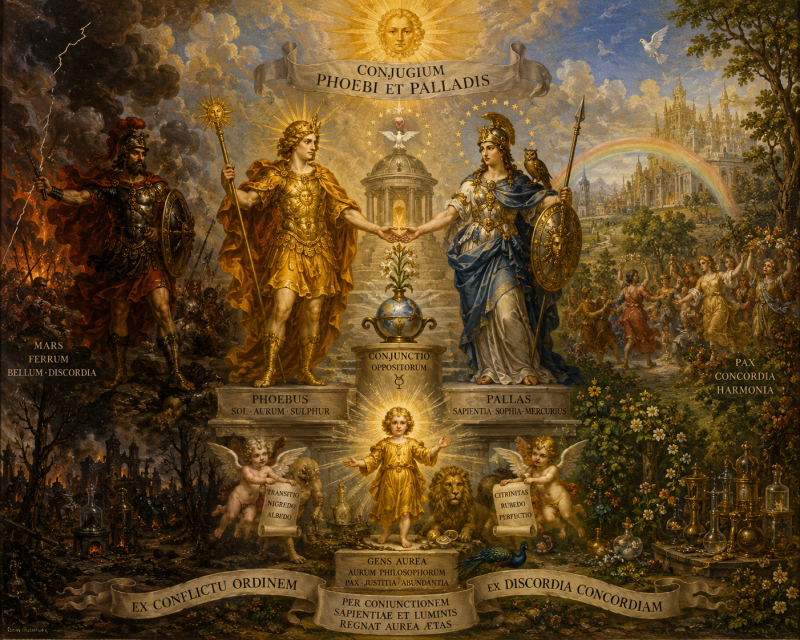
Featured Illustration: The Allegory of the Chemical Marriage. From the conflict of Mars (Iron/War) and the union of Phoebus (Gold/Sulfur) and Pallas (Wisdom/Mercury), the Golden Child (the Philosopher’s Stone) is born, bringing harmony to the cosmos. Note the transition from Nigredo (left) to Rubedo (right)

*

From the Blue House of Via-HYGEIA: We are honored to present the first installment of a new series dedicated to honor the memory of Christian Knorr von Rosenroth. This release explores a lesser-known work that prepared the ground for his monumental Kabbala Denudata: the earlier theatrical allegory, The Marriage of Phoebus and Pallas (Conjugium Phoebi et Palladis, 1677). This play embodies the virtues that made his later masterpiece possible—namely, the sacred union of Solar Light and Mercurial Wisdom, from which a Golden Age of understanding may arise.

Knorr von Rosenroth treats these myths neither as ‘false idols‘, as the strict iconoclasts of his time might, nor as mere fables, as materialists would. Instead, he views them as divine hieroglyphs—ancient codes given to the ancients, secretly containing the same truths later revealed to Christians, and particularly to the Alchemists among them. This approach aligns perfectly with the concept of Prisca Theologia (Ancient Theology), widely held in the Renaissance and Baroque eras: the belief that a single, true theology was granted to the ancients and unveiled progressively, then fully revealed, through the ages.

While Kabbala Denudata has long been accessible to the English-speaking world, his theatrical allegory Conjugium Phoebi et Palladis has remained largely inaccessible, known only through scattered German excerpts and brief academic references. To our knowledge, no complete English translation of the full theatrical text has ever been published.

The present edition, accompanied by a comprehensive contextual introduction, is offered to unlock its operative dynamics for the appreciation of the modern readers of the Via-HYGEIA- Circle of Transmission. Consistent with our mission, our endeavor is to capture the text’s core essence and offer a coherent interpretation, paving the way for a future definitive scholarly edition to reveal its full beauty to the general public.

**

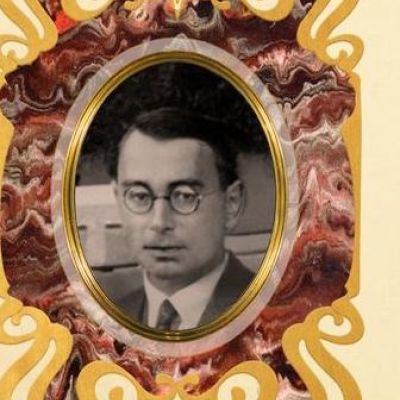
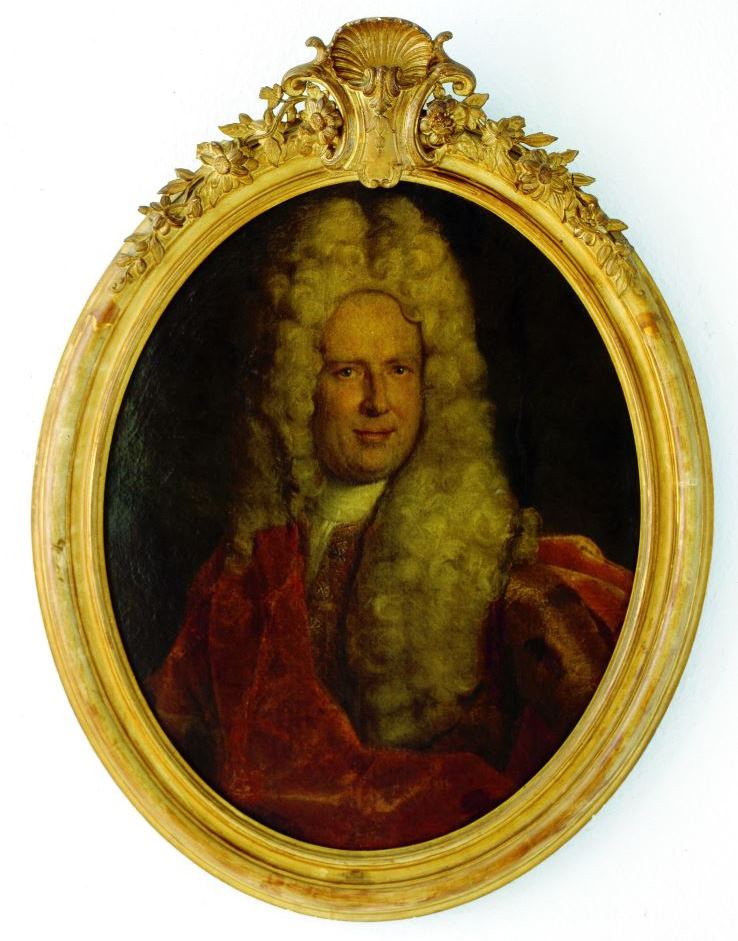
Christian Knorr von Rosenroth (1636–1689). Portrait by Johann Andreas Graff, c. 1677. This image depicts the author at the height of his powers, shortly before the publication of both Kabbala Denudata and the Conjugium Phoebi et Palladis. Picture at Literatur Port-De.

*

A CONTEXTUAL INTRODUCTION

The Author:

Christian Knorr von Rosenroth (1636–1689)

Christian Knorr von Rosenroth stands as one of the most fascinating figures of late seventeenth-century Central European esotericism. A German Christian Kabbalist, alchemist, diplomat, and poet, he is best known to modern scholars for his monumental Latin translation of the Zohar, the Kabbala denudata (1677–1684), which introduced the Jewish mystical tradition to the Christian learned world. Yet his alchemical work, particularly the Conjugium Phoebi et Palladis, reveals a mind equally at home in the laboratory and the theater, in Hebrew metaphysics and Latin verse.

Born in Alt-Randen in Silesia (now Wojnowice, Poland), Knorr von Rosenroth studied at the universities of Leipzig and Wittenberg before entering the service of Count Palatine Christian August of Sulzbach. The Sulzbach court was a remarkable center of alchemical, kabbalistic, and scientific activity in the late seventeenth century, patronized by a ruler whose interests ranged from chymical experiments to Protestant theology. It was here, in 1677, that Knorr von Rosenroth composed the Conjugium Phoebi et Palladis as a Chymisches Pracht-Spiel — a ‘chemical splendor-play‘ — to celebrate the third marriage of Holy Roman Emperor Leopold I to Eleonore Magdalene Therese of Neuburg.

*

The Occasion: An Imperial Wedding

Leopold I (1640–1705) had already buried two wives — Margaret Theresa of Spain and Claudia Felicitas of Austria — when he married Eleonore Magdalene Therese (1655–1720) in 1676. The Emperor’s need for male heirs was not merely dynastic but geopolitical: the Habsburg succession was the great question of Central European politics, and the stability of the Empire depended upon it. The Coniugium Phoebi et Palladis transforms this political necessity into alchemical allegory: the marriage of the Emperor (Phoebus/Sol/gold) and his bride (Pallas/Minerva/philosophical mercury) becomes the conjunctio oppositorum, the alchemical wedding that generates the philosophers’ stone and, by extension, imperial offspring.

The play’s dedication to Leopold and Eleonore is not merely flattery but a sophisticated piece of political theology. The Emperor is identified with the solar principle — the Rex glorieus of alchemical literature — while his bride is the Regina who brings wisdom (Pallas Athena) and fertility (the Palatine princess) to the union. The ‘propagation of gold‘ (Fortpflanzung des Goldes) promised in the title is simultaneously the multiplication of the philosophers’ stone, the birth of Habsburg heirs, and the prosperity of the Empire.

*

The Work: Alchemy as Theater

The Conjugium Phoebi et Palladis belongs to a genre of alchemical drama that flourished in the German-speaking lands during the seventeenth century. Works such as the Aureum Vellus (Golden Fleece) tradition and Andreas Libavius’s Syntagmatis selectorum… had established the theater as a vehicle for alchemical instruction, but Knorr von Rosenroth’s play surpasses its predecessors in both literary sophistication and philosophical depth.

The play is structured into Five Treatises (Acts), which correspond to the major stages of the alchemical magnum opus. Each Act is subdivided into several scenes (Auftritte) that dramatize specific operations:

  • Act I: The Cosmic Conflict and the Divine Decree (De Harmonia Universi).
  • Act II: The Purification of Sulfur and the Failure of Violence (De differentia sulphurum).
  • Act III: The Search for Counsel and the Preparation of Mercury (De naturis passivis / De igne).
  • Act IV: The Conception, the Dream, and the Liberation of Wisdom (De natura acuta materiæ).
  • Act V: The Sacred Marriage, Coronation, and Glorification (De auri præparatione to De augmentatione Lapidis).

The characters are drawn from classical mythology but function as alchemical principles: Phoebus (Apollo/Sun) is gold; Pallas (Athena) is philosophical mercury; Mercurius is common mercury/the mediator; Mars is iron/sulfur; Venus is copper; Luna is silver; Jupiter is tin; Saturnus is lead. The dramatic action — debates, courtships, rejections, marriages, transformations — encodes the chemical operations of dissolution, purification, conjunction, and fixation.

*

The Plot: A Roadmap of the Operation

Before the curtain rises, Knorr von Rosenroth provides a synopsis—a ‘Plan of the Play’—that serves as a key for the reader. This summary outlines the five major movements (Treatises) of the drama, mapping the journey from chaotic conflict to the final glorification of the Colossus.

I. The Peace Negotiation and the Decree: All the Metals come together for a Peace Negotiation; and indeed, upon the proposal made by Mercurius, Phoebus and the White Metals show themselves peaceable, but not so the Red Ones: Mercurius recounts the reasons for this. Thereupon, Mars and Venus are incited to War by Envy and Discord; but Luna and Saturnus are incited to Peace by Neptunus and Thetys; and Jupiter undertakes to mediate the matter. But while Phoebus and Mars quarrel most fiercely, Fortuna appears and makes the decree concerning the Propagation of Phoebus: And the Muses sing of the Slaying of the Dragon Python.

II. The Failure of Violence: Mars, suspecting that Phoebus will undertake his propagation by means of the Golden Apples from the Garden of the Hesperides, seeks with cunning to enter that same garden and to clear tree and fruit out of the way; but is prevented by the Dragon lying before it. Venus seeks to prevent the Golden Bough of Proserpina from being used for this purpose; but also in vain. And while these two are engaging with one another, they are captured by Vulcanus.

III. The Search for Counsel: Mercurius seeks counsel for the aforementioned propagation in the Laboratory of Vulcanus, and next to Hymenaeus by means of the Miners among the Oreades, but on both sides in vain; in that the Oreades seized by Phoebus vanish. But the Argonauts instruct him not to desist, but to proceed in his intention.

IV. The Conception and the Dream: Hymenaeus, meanwhile, finds Pallas among the Virtues, as she settles a sharp-witted dispute that has arisen among them; and resolves to marry her to Phoebus; who, however, is meanwhile captured by Mars. And after he, together with Mercurius, has presented this to PhoebusPhoebus dreams that Griffins are hatched under his bed. But Mercurius also persuades Pallas to this marriage, and leads her by means of an Eagle out of the prison into the Palace of Thetys; where the Adventures of Cadmus are presented to her.

V. The Glorification: Phoebus learns from Mercurius that Pallas is freed and has given her consent; meanwhile she is adorned by Thetys, and after she has been fetched, it is declared by the Fates (Parcae) that she now belongs to the Order of the Planets; and Mercurius abdicates his dominion to her; thereupon she is crowned in the presence of all the Metals with the Crown of Mercurius. And their Weapons, which have been hung up by Honor and the Virtues in the Temple of Honor as a sign of honor, transform themselves into the Colossus of Sol, which has been counted among the Seven Wonders of the World.

This structure reveals the play not as a linear story, but as a spiral ascent: starting with the chaos of the elements (I), moving through the failure of brute force (II) and the confusion of theory (III), arriving at the spiritual conception (IV), and culminating in the physical and cosmic realization of the Stone (V).

*

The Intellectual Landscape:

A Circle of Transmission

The Conjugium Phoebi et Palladis and the subsequent Kabbala Denudata did not emerge in a vacuum; they were born within the extraordinary intellectual ecosystem of the Sulzbach court, a rare sanctuary where alchemy, Kabbalah, and radical philosophy converged. Central to this circle was Francis Mercury van Helmont (1614–1698), the flamboyant son of the famous chemist, whose own kabbalistic theories deeply influenced Knorr von Rosenroth’s interpretation of the Zohar.

It was van Helmont who facilitated the pivotal connection with Lady Anne Conway (1631–1679), the brilliant English philosopher whose metaphysical system—bridging spirit and matter—resonated profoundly with the alchemical themes of the Conjugium. This triad, occasionally joined by figures such as the young Gottfried Wilhelm Leibniz (who visited Sulzbach and engaged with their ideas), formed a unique ‘Circle of Transmission‘.

In this milieu, the play was not merely a courtly entertainment but a coded dialogue among the era’s most advanced thinkers, attempting to synthesize Hebrew mysticism, Hermetic wisdom, and emerging rationalism into a unified vision of cosmic restoration. The Kabbala Denudata, therefore, stands as the monumental published record of this fleeting but luminous convergence of minds.

*

And now the text:

THE MARRIAGE OF PHOEBUS AND PALLAS

A Chemical Splendor-Play (Chymisches Pracht-Spiel)

By Christian Knorr von Rosenroth, Sulzbach, 1677

*

DRAMATIS PERSONAE

The Planets / Metals

  • PHOEBUS (Apollo): Gold (Aurum) / The Solar Principle
  • PALLAS (Athena/Minerva): Philosophical Mercury / Wisdom
  • MERCURIUS: Common Mercury / The Mediator
  • LUNA: Silver (Argentum)
  • SATURNUS: Lead (Plumbum)
  • JUPITER: Tin (Stannum)
  • MARS: Iron (Ferrum)
  • VENUS: Copper (Cuprum)

Divine & Mythological Figures

  • THETYS: Sea-Goddess / The Permanent Water
  • NEPTUNUS: God of the Sea
  • FORTUNA: Divine Providence
  • VULCANUS: God of Fire / The Alchemical Furnace
  • HYMENAEUS: God of Marriage
  • PLUTO: God of the Underworld
  • PROSERPINA: Queen of the Underworld
  • ÆGLE: A Hesperid / Princess of the Golden Forest
  • CLOTHO, LACHESIS, ATROPOS: The Three Fates (Parcae)
  • JASON: Leader of the Argonauts
  • CADMUS: The Sower of the Dragon’s Teeth

Attendants & Choruses

  • The Twelve Knights: Representing Salts and Minerals (The Knight with the Snake, The White Eagle, The Green Dragon, The Wolf, etc.)
  • The Nine Muses: Liberal Arts and Sciences
  • The Six Virtues: Piety, Prudence, Temperance, Justice, Courage, Honor
  • The Nymphs, Oreades, Tritons, Soldiers, Miners, Argonauts, Harpies, Cupids

*

ACT I

*

SCENE 1

On the Harmony of the Universe;

and the Antipathy and Sympathy of Natures

[The stage opens to reveal a grotto. In the back center stands a throne erected of gold steps, upon which PHOEBUS sits. To the right are small side-grottos and lower seats for LUNA, JUPITER, and SATURNUS. To the left are similar seats for MARS and VENUS. In the front, MERCURIUS stands before his own seat.]

[PHOEBUS appears with rays around his head, dressed in golden costume, holding a lyre and a quiver of arrows. LUNA is in silver costume with a crown bearing a half-moon, also carrying a quiver and arrow. JUPITER wears white taffeta with a flashing thunderbolt and a silver star on his crown. SATURNUS wears gray cloth with a scythe and a white star. MARS is armed in a scarlet mantle, bearing a bare sword, with a red-gilded star. VENUS wears green clothing, holding a golden apple, with a copper star. MERCURIUS wears wings on his head and feet, bearing the caduceus, with a silvered star.]

[Above, in a heaven, the seven planets present themselves, each in its sign of the Zodiac. Each casts its rays down upon the grotto and metal allotted to it.]

[The six Knights in white-bordered clothing (representing Salts/Minerals) wait on the right, facing the white metals. The other six Knights in red-bordered clothing wait on the left, facing the red metals. All twelve stand below at PHOEBUS’s throne. In the front of the theater, the Sea appears with raised waves. This indicates an assembly for a peace negotiation.]

MERCURIUS (Prologue) The blessing-laden ray that descends from Heaven’s height, Pouring into the deep abyss of the thick Earth, Marrying this heavy body with that spirit, Creating light where once was only night; Is this not truly a bond of peace to name? Binding the Deep and High, the Far and Near? Shattering all resistance into tender fragments, Yet weaving what cannot hold into a strong design?

This image of unity, binding Wet to Dry, Where Cold meets Warm, and Hard is wound with Soft, Entangling Earth and Air, quenching Fire in Water, Sowing the seed of stars into our lap; Does it not shame us, who with bitter war, Full of blue sulfur’s poison, lie now high, now low? Us, whom cold envy burns with hot blood, Through whom revenge and mad rage tear through bone?

Where PHOEBUS and his Gold, where LUNA’s realm extends, Wherever SATURN’s time touches with golden shine, Wherever metal is soft and boundaries are gentle, MARS breaks in with lightning steel, and VENUS thunders. And when what is peaceful writhes in pain, And a spark of anger glimmers in gentleness itself, A murder-cry arises: “Let the people’s right Be weakened by gross breach of peace and wanton rage!”

Then warm blood must flow like rain-streams; Then the decayed horror of lands must close up the marrow; Then mad fire flames through city, village, and country, And all that is chaste and pious is banished from the world.

Now the steel of swords is almost worn down, And the enraged fist is half-tired and exhausted; With toil and distress, a place of peace was devised, And a broken bond was brought to one spot. Here they wish to fight with right, as before with balls; Here a stumbling mouth shall fall, as once a foot; Here stubbornness and insolence push above, So that Right is not right, nor Fairness fair.

Yet thanks be to Heaven, that the day has appeared On which the dry twig of Rest begins to green: Perhaps the time will come when, after much strife and scorn, We shall see, if not much, yet some fruit of peace. Let everyone be minded to yield to Heaven, To seek peace, not to strive against right, The first to seek fairness, the last to seek hate; Then war will surely yield, and Peace will enter.

PHOEBUS Would that each, as I, bore the laurel branches, Struck through with Art-Gold upon blood-sour toil! And did not stand plastered with blood on robber-gold; Then a fence of peace would go around our borders: For then no greed nor envy would ever mount; The border-tree would bend over in peace; And every river would be compressed with trade, Which is now dammed by a pale wall of cold corpses.

LUNA Thus the quiet rest is always loved by me.

JUPITERI never gnash with anger, unless one grieves me.

SATURNUS My lead smelts upon nothing but what belongs to me.

MERCURIUS This is the greater part, which honors bond and peace.

MARS My great spirit of honor cannot endure disgrace; Whoever hinders my benefit must wager with me. I have not drawn my sword for nothing yet; He who languishes poor in peace, finds luck through war.

VENUS Who has courage settles war, and can also awaken war: And one must stretch one’s arm for both peace and war. Now is the time to consider where Right and Benefit fall.

MERCURIUS So let another time be set for negotiation. (All exit. The stage below remains unchanged; above, the stars vanish.)

*

SCENE 2

On the Difference of Sulfurs in Themselves and in Relation to Mercury

MERCURIUS He to whom Heaven’s favor has given much good Cannot live on this earth without envy; And though the envier consumes his own heart, Yet he laughs that others are burdened.

Look upon PHOEBUS, who partly through the light of the sun, Partly through the brilliance won deep from mountains, Partly through the prize of Arts has ruled the world until now, And still holds the reins by the Highest’s decree.

He, as Prince of Gold, shows the kinds of Gold; With gentle sweetness he easily bends and inclines; When drawn, he extends patience far; And dense, like Gold, is full of true being.

In him, the good of Virtue, like Gold, cannot perish; Mixed with light stuff, he does not let himself be corrupted; Just as heavy Gold does not easily move, So he strikes around himself with rays full of majesty.

The raw MARS has long envied him, From whom VENUS also never willingly parts. And the grim Prince seeks only PHOEBUS’s fall, For then, he says, he would have dominion in Metal.

“To me,” he says, “the greatest power is given by Heaven itself; The magnet alone is drawn to me; There is so much of my kind in this world As all Gold-Metal contains in value.

“I am mankind’s benefit; without me, one cannot live; I must give the foundation of nourishment in land and city; I am the princes’ trust, the sword of authority, That punishes the wicked and frees the pious from fear.

“No brilliance lacks in me; I flash, I bring terror; What is Art, is through Me; without Me, all stands still. I also carry Gold within me; my blood is Golden Fire, Quite suitable for medicine, light, and not dear.

“I bring this preference forward and will rule throughout, And if I cannot now, then lead the scepter later.” This is the whole ground: yet he does not urge this, And seeks always secondary appearances as much as he can find.

I cannot compare myself with him in general, And must always sneak into red metal with Arts: But then I have Her, according to wish, in my hand. Now I seek peace in vain; that is known to me already. (He exits. The stage below remains.)

*

SCENE 3

On the Investigation of the Philosophers’ Sulfur

[MARS enters accompanied by six Soldiers. VENUS, armed, is led in by MARS, accompanied by four Cupids.]

MARSJust as when a deep well, in which no water wells, Or is always pumped out and no more filled, Must finally run dry; so that the dry wheel Lowers the bucket in vain and has nothing to draw;

So will the meager body of the excavated earth Finally be exhausted of Gold once more. Then I alone am Prince: You, Princess, beside me: For white metal is soft, useless, and only for ornament.

Now I must, as I can, have the Gold, already dug, Through cunning and through violence in my power: And when it is suppressed without growth and without purchase! Then it remains away from the world, and lordship ceases. Therefore no peace can be; I must extend my realm, Even if the world goes to fragments and to splinters. One takes not much from me: for Iron must still be; And I devour around me, and remain at last alone.

[ENVY appears on the right side in the clouds. He has hair of serpents, a whip of serpents in his hand, and carries a bleeding heart which he bites. Sad violins play intermittently as he sings:]

ENVY

  1. Shame, that so many step forward To worship a lump; Which yet eternally in deed Has no right use. Better to rule in deed, Than to bear the mere name.

  2. Blind are all human senses Which only win the appearance of light: Since the benefit, which arises, Is set to the sides. Who cannot actually rule, Should also bear no name.

[He remains in the clouds, gnawing at his heart and shaking the serpents, some of which have enthusiasts in their mouths.]

VENUS My Prince, I stand by you; I help with culverins: Trumpet and drum resound, that all must be astonished. The Gold diminishes noticeably; the Steel we maintain. And if we have the power; what asks one after the ornament?

[DISCORD appears on the left side in the clouds, also with serpent-hair, holding a torch in her hands and leading soldiers. She sings with a furious melody, but trippingly:]

DISCORD

  1. War brings all core-soldiers Praise and fame through great deeds. War brings benefit, when one conquers, And gets the arm full of booty. War lets him, who surrenders to it, Live freely after heart’s lusts.

  2. Revenge is among all damages Ever to be seen in front. Revenge is full of bravery: Revenge teaches and leads the strife. Revenge is to him, who surrenders to it, Sweeter than his own life.

MARS, VENUS, ENVY, and DISCORD (Singing all four) Then must under the war-thunderstorms Air, Heaven, Water, and Earth tremble. Then let one grind swords and lances in heaps, And let the lands run with blood: Then thunder the powder, and flash the flames And melt the goods of the earth together. The peoples rage and rave down here: I grasp (MARS to the sword; VENUS to the arrows; ENVY to the serpents; DISCORD to the torch) and part from peace.

[MARS and VENUS exit together; ENVY and DISCORD ride back up.]

*

SCENE 4

On the Passive Natures

[LUNA enters on the right; SATURNUS on the left. She is accompanied by four white Oreades; he by the Knight with the Wolf and four servants.]

LUNA Why has Heaven’s grace, on which I must always think, Chosen to bless me wonderfully before others? I am the Earth’s good, I am Heaven’s ornament, And only my brother PHOEBUS goes before me.

But because MARS, my enemy, does not cease to envy me, I never remain in rest, and must almost always suffer: And my quiet shine now decreases, now increases, And is never untouched, whatever I do.

How, when the strict North wind, thinking to cast a ship That goes on the waves in full sails to the ground, Raises frost and flood, and storms from above, As if goods and people must be drowned at once?

Soon he holds back somewhat, and lets the helmsman believe The storm is over, that he can now catch breath. Until, before one expects it, the sea gushes with roaring, And the mixed play refreshes the fear anew.

Then the brown night closes the covered Heaven With black weather; the thundering tumult That crashes from the clouds, and the enraged Sea Are over people and ship with all forces.

So does MARS with me; my pale silver-casket Lets his grim spirit not rest and not cease. And were the Highest’s hand not mighty over me, And mostly against him; how strangely would we stand! Now it shall go to peace. But how can on earth, If MARS remains so, a right peace become?

[A beautiful large shell, the color of red mother-of-pearl, studded with coral points and set with gemstones, appears in the sea. It is carried by four dolphins and drawn by four Tritons. NEPTUNUS sits therein with the three-pronged fork, and THETYS; behind them swim several Nymphs and Sirens.]

NEPTUNUS (Singing)

  1. Where one sees peace glimmer, One should immediately harmonize: Lest, if one resists, Even the spark goes out. Peace is one of the gifts That one should dig out of rocks.

  2. Peace alone is joy and life; Peace can lift to Heaven: Peace alone is he who keeps The world in a desired state. Where peace is lost, One is only half-born.

SATURNUS If my golden time would come again on earth, Then peace could easily become between us: Then no avenger was needed, for everyone lived simply, And did without constraint what was laudable, good, and right.

Then one did not need to protect one’s village with ramparts; Neither shield, nor sword, nor powder would flash. The cannon’s thunder-knock, the houses’ bright fire, The people’s murder and robbery would be banished from the world.

Now it goes differently; one must act differently now; SATURNUS was despised; now he must transform himself. What was formerly my wealth, VENUS now introduces, Who cannot be without MARS, as he without Her.

Therefore I will sharpen my scythe most sharply. And where violence will not grasp around me with prudence— He cannot do wrong who seeks what is his own, And thinks on the same, and busies himself with it.

THETYS (Singing)

  1. Unity maintains the crowns: Unity lets one dwell safely: That alone makes great and rich; That names also the crooked equal. United, united must one live, When one will strive after riches.

  2. To deal lovingly also with enemies Can turn the curse into blessing: Not to revenge, when one can, Shows nothing but magnanimity. To seek peace, to restrain oneself, Is the best in all things.

[The shell drives off; LUNA and SATURNUS also go in.]

*

SCENE 5

On Median and Indifferent Natures; and Neuters

[JUPITER enters, accompanied by the Knight with the unripe Apple and four servants.]

JUPITER Just as when at evening time, when now the Sun’s wagon Is carried into the sea with red purple-ornament, A black weather places itself opposite to Her, And great thunder-fright befalls the nearby land;

A rainbow tends to place itself in the middle, Richly adorned with colors, for everyone’s delight; So that the Sun is not overtaken by Night, And the thunderstorm divides itself into gentle drops.

So I see now before me PHOEBUS brown-red, Because the grim of the Murder-Planet stands against him. What can arise from this but lightning and weather-crash, And whole lands’ fear, and great realms’ fall?

I will, as Iris does, place myself in the middle here; Perhaps the whole world’s contentment arises from it. Who gives himself between enemies purely from drive for peace! He is beloved here on earth, and in the Height.

*

SCENE 6

On Common and Philosophical Gold, and on the Multiplicability of Gold

[The Princes come together again with the full attendance, namely PHOEBUS, LUNA, JUPITER, SATURNUS, MARS, VENUS, MERCURIUS.]

PHOEBUS Now, I think, it is time to undertake the deal, And to accommodate oneself to the Right, where there is error.

MARS Not error, it is insolence, when one stretches further Than one’s power allows, and sets one’s boundaries.

PHOEBUS The boundaries give the Right of the Peoples to us all.

MARS The Right of the Peoples is blind in the nucleus of metals.

PHOEBUS Benefit, esteem, and permanence lay the preference with me.

MARS Benefit, Hardness, and Sharpness show that I am the strongest.

PHOEBUS From me flows all power: I am the ornament of crowns.

MARS I am the crowns’ protection; and piece at their thrones.

PHOEBUS The throne is poorly pieced, where there is lack of Gold.

MARS An arm, that bears Iron, seeks for itself through booty pay.

PHOEBUS Where Gold is, Steel finds itself, to ward off robbery.

MARS With Gold is seldom courage to turn the breast to Steel.

PHOEBUS Gold gives majesty, before which the enemy trembles.

MARS Sword, armor, spear and shield give terror when… (he glances)

PHOEBUS Heaven’s mildness rules with gentle paths.

MARS That was laughed at by the world; could He not boast with a glance.

PHOEBUS The heavy thunder’s wrath crackles only to the evil.

MARS The most, over whom I rule: you jest for few.

PHOEBUS Experience knows how much: also Time knows the length.

MARS Therefore the Gold now decreases: and Art makes Steel the multitude.

PHOEBUS What is rare, is honored: what is abundant, is despised.

MARS What dies off, sinks into the grave: what is useful, is made great.

PHOEBUS Yet is my realm not weak: nor am I yet for the bier.

MARS Yet know, that I yield to you not in the least.

PHOEBUS I seek nothing but Right, according to all peoples’ usage.

MARS Usage draws me forth: Upon this Right I also urge.

[Suddenly FORTUNA comes down in the clouds upon a sphere, stands up and says, turned toward MARS and VENUS:]

FORTUNA Heaven wills the precious gifts, Which its favor has set into Gold, And which the world before excellently values; To have them constantly preferred.

And though no mine brought forth More Gold to the light of day, Yet shall PHOEBUS marry himself, And, richly endowed, count many heirs.

[FORTUNA rides again upon the sphere up into the clouds. The Princes together with the attendance exit. The stage changes on the right side into a devastated land, full of collapsing houses. Its perspective is a uniform village, before which lies the dragon PYTHON, recently killed as it were by PHOEBUS. On the left side PARNASSUS is presented with its springs: the MUSES come down from there, concluding this treatise with a ballet, and singing:]

*

SCENE 7

That Through Volatile Gold the Fixed Should Be Made

CALLIOPE, CLIO, ERATO Now we hear of the terrible vapors Which PYTHON has hitherto burst forth; After the Prince of the highly-praised Arts Shortened his grip for him through his arrow.

ALL MUSES Apollo has with courage, and Art and Power Brought the image of the evil kind, the PYTHON, to death.

THALIA, MELPOMENE, TERPSICHORE Who also feels in himself such an animal That spits gall and poison, and bad nature from itself; Let him bring it to death, before he loses the time, So is his spirit free from punishment and guilt.

ALL MUSES As PHOEBUS did, so will, through Heaven’s Power, Also this evil animal in man be brought to death.

URANIA, EUTERPE, POLYHYMNIA Now PYTHON also rages in the kingdoms; And brings only poison and bad nature into the world. The Prince, who still exercises himself in such tricks! Should look eagerly to it, that he be overthrown.

ALL MUSES So we praise with all our power, That PHOEBUS has brought this animal to death fully three times.

*

ACT II

On the Difference of Sulfurs

[The side of the theater with the devastated landscape remains; but the side with PARNASSUS transforms into the front side of a great palace, with a gallery of Doric columns, on which victory signs and war ornaments hang alternately. In the entablature, trumpets, horns, drums, swords, shields, spears, etc., woven through one another, are depicted. Inside the gallery, in the picture niches, statues of MARS, JUNO, BELLONA, CYGNUS, and the like are presented; and many culverins stand orderly between the columns, indicating that this is the Palace of MARS.]

*

SCENE 1

On Subordinate Sulfurs

[MARS appears on a wagon drawn by wolves, in the clouds, and drives down. GREED springs out of the clouds, in the form of a woman hung with many money-bags, constantly counting money from one hand into the other, with dragon wings. Also CUNNING, as a woman hung all around with masks, the masks alternating before her face; wearing a fox-skin with the head still attached over her own head. Also ROBBERY, as a woman with bird claws instead of hands, and armed.]

MARS Shall PHOEBUS increase his lineage through love and marriage? That is a wonder to hear of in this world. Gold is not like a tree, which hangs under roots, And leads stem and branches, and bears fruit above.

Also no field is found on earth On which Gold’s seed and sperm are to be hoped. And no Art has yet been devised in schools Through which Gold’s body was ever made fruitful.

Yet the Garden of the Hesperides is not unknown, Where Gold grows on trees, in different kinds. Who knows if PHOEBUS does not marry ÆGLE, And grafts such twigs? And truly torments us!!

MARS That is worth considering. He is of sharp senses, And master of many arts; and might well begin it. How does one find counsel, that this does not happen: And though he tries it, that the work does not subsist?

CUNNING Let it be said that MARS himself is in love with ÆGLE, And speak of marriage. Who knows what happens?

ROBBERY If the garden opens for us; then one takes tree and fruit, So easily to cut down: And takes to flight.

MARS Well then! Let it be ventured. It is not to be called Right. Yet, because it will be recognized everywhere as Prudence, So let the plan go forward. What is useful, is also right. He who lacks prudence is the prudent man’s servant.

(They drive back up into the height.)

*

SCENE 2

On Subordinate Mercuries

[VENUS is carried down from above by four flying Love-Children, who fly back up into the height again with several art-flights. The stage remains.]

VENUS What will Luck say in its oracle? That PHOEBUS should still plague the world with heirs? Whether also the Fates’ decree extends to that twig Which stands before PROSERPINA, and is dedicated to her?

If it comes into PHOEBUS’s hand, he will plant it, And so with fairness deem it to be fruitful. Then he breaks off as much as he himself means, And gathers treasure and good, and boasts to friend and foe.

If this whole tree were to be rooted out of the world, Then the Gold-Lineage would be properly mocked. Who knows what PLUTO does? If he falls in love with me, Then I make him give the tree to me.

If it comes into my power, nothing shall preserve it; I must split stem and branch down to the roots. And if my son has already brought one to PLUTO, His arrow hits even more. He defies all power.

(The Cupids come again, and carry VENUS back up into the height.)

*

SCENE 3

On Unfit Sulfurs

[The Theater transforms itself. On one side is the Hesperian Garden, consisting of beautiful walks of citron-trees, between which stand golden statues in large basins held by Tritons, and strong water-jets spray therein; on their heads they hold all kinds of beautiful flower-vessels. In the back, in the other part of the Theater, one sees great archworks woven of foliage, adorned with flowers and fruit-garlands, and the entrance to another walk, at whose outermost perspective the gold-bearing trees peer forth. At the entrance of this gallery lies the Dragon who guards these golden apples. On the other side one sees a thick wood of cypresses mixed with oaks, dedicated to PROSERPINA and PLUTO. MARS leads ÆGLE out, accompanied by several soldiers, among whom ROBBERY and CUNNING occasionally peek forth and hide themselves again. Several Nymphs wait upon ÆGLE.]

MARS Long Mauritania’s masterpiece of beauty, Receive me, your guest, who bows before you, And hear, how the Prince, who strikes wounds on others, By your ornament pierced through, himself bears wounds.

Pardon, O ÆGLE, me, that I so presume, And serve you still unknown in presence. MARS gives himself over, because you are so excellent, And your beauty’s kind is not in all the world.

He loves not superficially; He did not want to send messengers. So that your eye-beam might refresh him himself. Also he seeks nothing but Honor and mere the bond of Honor, Whereby his great stem henceforth through you may stand.

If it can be, then grant me, O most beautiful of this earth, That all Virtue’s seat may become known with you. Open a garden, and hear from me alone The pain of my torment, and my love’s agony.

ÆGLE Pardon me, great Prince, that I do not receive you According to your worthiness, and as I myself desire: Your great fame makes me so full of wonder That I almost myself do not know how I should honor you.

Who am I, your maid? How can I hear this, That you choose me to honor with love? I go where you will, and hear you willingly. Forgive, if I cannot arrange myself into luck!

Yet when a stranger will be in the garden, He must first overcome the Dragon here. He indeed lets me in: yet, it has this conclusion, That he who is not worthy, must not step therein.

Will now my Prince go with me to other rooms? Or does he choose to stand here for the combat?

MARS The combat, O most beautiful image, the combat a hero chooses. How easily is this worm felled by MARS’s fist.

[MARS fights with the Dragon in the gallery, into which the Dragon has withdrawn. The soldiers also step forward with bare weapons; but the Dragon spits fire, whereby they all fall down as dead. MARS, however, continues in the fight.]

ÆGLE I fear it will not go: The Dragon is not to be killed! Nor do I see the sword redden with blood. For whom Heaven is not favorable before all others, The animal does not let enter to my Apples’ Gold.

(She withdraws.)

MARS (Weary and angry) So strike then thunder here with thousand-fold crashing! And flash upon the monster, that can make me weary. My people are gone: I weary; my plan does not succeed. What is MARS now then, who also cannot do so much?

I know well what I do; I will shake the land And at the Serpent’s head with powder-tempests; And though it cost my realm, and all I have and can. What will not through a sword, go with culverins!

(The back part of the Theater is covered, and MARS with the dead and the Dragon become invisible thereby. Instead, the Castle of PLUTO is presented with the infernal rivers Styx, Lethe, Cocytus, and CERBERUS lying before it, also the Oak tree with the golden branch.)

*

SCENE 4

On Unfit Mercuries

[VENUS runs out of the wood, and PLUTO, wounded by Cupid, runs after her; and she in and out again.]

PLUTO Princess, flee not, look yet on my arms! Ah stay! Ah will you not have mercy on me! I swear! I feel it too, that Styx burns me quite through, And that Phlegethon runs through marrow and veins.

How is it that I saw you, and must love at once? What has driven you, Goddess, into this wood? Ah let my prayers not be quite in vain! And grant me in this night a sunshine.

VENUS Prince of the Under-World, you are still well to be loved: It grieves me that earnestness should always sadden you. Put off the majesty that frightens everyone: I know that graciousness enough is hidden in you.

(He throws his crown and scepter from him at VENUS’s feet.)

VENUS Yet, if it is your earnestness, that I should remain something, And in solitude pass your time for yourself, Then hear me first, and accept my prayer; I wish and seek nothing that can harm you greatly.

There stands a tree here with a yellow branch, Which is what I beg for, and bow before you for.

PLUTO Not only the golden tree, O worthy dwelling, I give that willingly; take the whole wood.

[VENUS examines the branch, and will break it off. PROSERPINA comes and speaks alone, full of jealousy:]

PROSERPINA Has this lewd woman not room enough on earth, Shall the Under-Realm also be disturbed by Her? And does she strive after my treasure? No; no. That shall not go so! Disappear at once, O Tree, before she breaks the branch.

(She vanishes; the Tree also vanishes.)

VENUS How? Is it not sorcery? Where has the tree remained? So, PLUTO, one loves so? Shall I be so driven about? No; that is not for me. I am so grimly mad, That the sorcery-jest shall surely repent you.

(She runs off angrily. PLUTO, however, stands stunned with fright, and also exits.)

*

SCENE 5

On the Activity of Sulfurs

[The wood remains; but on the other side and in the back, the devastated landscape is presented again. MERCURIUS comes flying down.]

MERCURIUS Is it not always damage and eternally to be lamented: MARS raged again with all his plagues. One robs the villages, one sets the towns on fire, One slaughters and rages as fiercely as ever an enemy did.

That makes Luck’s saying, which has embittered MARS, So that he still trembles and shivers before grim rage. Indeed PHOEBUS has sent his people against it: In the meantime the land is doubly heavily pressed.

As when at one time from opposite corners Two winds awaken themselves with uncommon storm; So that here northwestwards the air rushes with hail; And from southeast the whole Heaven pours down.

Then the wanderer, swallowed by the whirlwind, Is often driven far from the road into the marsh; Then the fruit of the trees falls, both ripe and unripe; Many a ship finds an unexpected grave in the sea:

The trees tear out and break in the forests; And whatever has life must forth from all fields: Until Heaven’s wrath, which strikes everything down, And breaks from the ground, finally stills and lays itself.

When will Heaven awaken to the world’s benefit? Meanwhile MARS will now also make himself merry, And is gone to Cypris. Yet VULCAN knows it already, And has a net at hand: that is their right reward.

*

SCENE 6

On the Loves of MARS and VENUS

[MARS and four Harpies; and VENUS with four Love-Children hold a dance, and sing. But on the devastated side MARS comes forth with his people: and the wood transforms itself into a meadow surrounded with rocks and myrtles, full of roses, and flowed through by brooks, representing the dwelling-place of VULCAN, which ends in a garden adorned with rose-walks and a beautiful spring-brunnen standing in the middle, from where VENUS comes forth.]

CHORUS [MARS, singing, carries a torch, sword, and golden chains.] Let us praise War and Weapons, Which through Fire, and Steel, and Band, (He swings the torch, the sword, and the chains.) In the midst of the greatest raging Rules over Sea and Land.

War is among all damages To be compared to no benefit.

THE HARPIES We praise the robbing: we shame the loving. In robbing counts benefit; in loving, deception.

[VENUS carries a burning heart, an arrow, and her girdle; and answers in amorous dispute-rhymes.] Let us praise Love and Weapons; So through Fire and Arrow and Band Remains elevated above all, And conquers the whole land.

Love and War joined with damages, Which are to be looked at after the treasures.

THE LOVE-CHILDREN We hate the robbing: we praise the loving; Loving brings benefit; robbing grieves.

MARS This torch’s strict flames, (Swings the torch.) Melt Gold and Goods in. When the booties now together, Can the war-man joyful be; And tired from the swarming Himself by foreign coals warm.

THE HARPIES We praise the burning: we shame the loving: Such burning brings benefit; the loving grieves.

VENUS These strict and mild flames (Shows the burning heart, the arrow, and points to the girdle.) Melt Goods and Hearts in: When now Courage and Goods together, Can the pleasure perfect be: And when others raging swarm, Gently in rich lap warm themselves.

THE LOVE-CHILDREN Away with the burning of robbing: come burning of loving. Air-flames delight; the others grieve.

MARS This sharp-ground iron, (Swings the sword.) Presses through the Riches through the marrow. Who otherwise is wont to praise the miser, Remains before me quite seldom stingy. For before this key must Little locks close themselves.

THE HARPIES We praise such pressing: we shame the loving. The pressing brings benefit; the loving grieves.

VENUS This War- and Love-Iron, (Shows the arrow.) Wounds and yet lays not in coffin: This can prove wonder-works, Penetrates through Good and Heart and Marrow. Murder-Steel closes with death-rips; I know lovingly also to close.

THE LOVE-CHILDREN Away with the pressing of robbing: We press with loving. Such pressing brings benefit; Money-pressing grieves.

MARS (With greater vehemence) I teach the thighs with iron to fasten; (Swings the chain.) What is hard, must break: what is high, is bowed.

VENUS (Singing simultaneously with him) I teach the hearts with love to fasten; (Loosens her girdle and swings it forth.) What is hard, softens: what is rough, is made fit.

MARS I rob the freedom, and take the strengths; So are the goods tied together.

VENUS (Singing simultaneously) I rob the freedom, and leave with strengths: So are the minds tied together.

MARS Yet VENUS holds me, my sole longing, Also herself as slave in love captured.

VENUS (Singing simultaneously) Yet you remain, MARS, still my sole longing, You will I with arms of the heart embrace.

(They embrace one another and sit down on the grass in the walk.)

THE HARPIES Chains of War: We hope for the loving; Such catching brings benefit; the loving grieves.

THE LOVE-CHILDREN (Singing simultaneously with these) Away Chains of War: We praise the loving; Embracing brings joy; Imprisonment grieves.

[VULCANUS throws a net over the two lovers; thereupon a laughter arises behind the scenes; and the Harpies and Love-Children fly from fright into the height.]

(The stage transforms itself immediately into…)

*

ACT III

On the Common and Philosophical Fire

[The stage transforms into the Smithy of VULCAN, standing between the previous rocks; its perspective ends with a furnace and anvil. Simultaneously, it presents a Laboratory with ovens and glasses set orderly on both sides. MERCURIUS and VULCANUS come out together.]

*

SCENE 1

On Common and Philosophical Fire

MERCURIUS O Master over Fire, Head-Artist in Metals, And Prince of Alchemy; pray, let it please you, And help with your art, where it can help anything; PHOEBUS’s fame concerns you also somewhat.

Heaven, to lift the strife in the Mining-Realm, Ordained that Gold should give itself to marriage, And beget heirs. How must this happen? You know what Art can do: Have you ever cut it?

VULCANUS That I still seek, MERCURIUS: this is the wise plotting On which the clever world is wont to lay much work. Look at my workshop, there sticks much art and diligence; And perhaps a great treasure, which I myself do not yet know.

And to attain the right goal unfailingly, I have begun many means at one time. For where I myself cannot, another stands by me. You do not believe how full of artists my house is.

[Twelve Laborants step forth.]

Everyone sets his work on special grounds. And if it pleases you, then one tells you quickly On what the art consists.

MERCURIUS Well then! I accept it.

VULCANUS Who knows if I cannot reach the goal here? Come here, my CHRYSOPHRON, and speak of the matter.

CHRYSOPHRON My Lord, it is the Gold, with which I make fruitful What otherwise is not fruitful. That is the right conclusion: Gold’s marriage-mate is Gold-Mercurius.

VULCANUS MOLYBDOS, how think you?

MOLYBDOS My work has Lead for ground; That becomes Gold’s Wife: that stands with him in bond.

VULCANUS Now say you others forth, each one after the row.

THE THIRD LABORANT I mean, the Steel-Mercury is Gold’s water.

THE FOURTH One must burn Cinnabar ore to thin water.

THE FIFTH I know to separate Vitriol into running ore.

THE SIXTH I take the Mercury that runs from Tartar.

THE SEVENTH Search the hut-smoke, until you find its water.

THE EIGHTH Saltpeter from the air brings Gold into the first being.

THE NINTH I know that Sal Ammoniac is chosen for this.

THE TENTH The great THETYS’s Salt is our Gold’s Bath.

THE ELEVENTH Well to him who has Vitriol from ore of Antimony.

THE TWELFTH LABORANT (Pointing to a glass, and holding it over one of the ovens, in which a glowing pan is hidden, with which Sol marries himself.) Here is the Green Lady.

MERCURIUS Stop! I have counted myself weary enough already. Who is among you who has completed this work? For otherwise I shall not be made clever here.

(The glass springs and cracks, and everything runs away. The stage remains.)

(End of Scene 1)

*
SCENE 2

On the Necessity of Amalgamations

MERCURIUS Truly, the Choir of the Wise, which has revealed so much to me, Has frightened me from the way with this crash. The Art is too high for me, the grip unknown. I fear I shall not so soon be a Laborant.

Where shall I seek now? At what place and ends? Where shall I turn my mind, where direct my foot? How, if the black night stretches itself before Heaven, And thick darkness covers the North Star;

A sailor, to whom the storm has already smashed the needle, In anxiety begins in vain to ask for way and path: And, when he knows no more, trusts only to Heaven. So am I also bewildered, and see no bride yet.

[HYMENAEUS appears, carrying a wreath of roses, and a long staff wound with roses and lilies instead of a spear; on his left arm a shield, in which are two turtledoves.]

HYMENAEUS MERCURIUS, you are busy: I am so also laden. What if one could be with the beautiful Oreades? The Mountain-People know the way to their dance and rest: Where silver breaks and gold, they go much to and fro.

PHOEBUS must find himself there with us; Who knows if love should not kindle him?

MERCURIUS That were a better way, if PHOEBUS recognizes it, And will only follow us, and not separate himself from us. Busy yourself with him; I will discover the place.

HYMENAEUS Often two have found the way, when one erred.

(They exit.)

*

SCENE 3

On the Exaltation of Gold through Amalgamations

[The stage changes into the pleasant Vale of TEMPE, and has on one side PARNASSUS: but in front is presented the River PENEUS.]

PHOEBUS (Singing alone to the lute) O base earth-people, you, What seek you after the rest Which the Under-World does not give you? Who always bows deep down, Never looks up to the Height, Has sought and loved rest in vain.

  1. The sweet chorus of strings Lifts into the Height: It orders and delights the senses. Here anger is divided, Envy, pain and fear healed. And one can win away bad nature by the lust.

[HYMENAEUS sings on the other side to the lute, the following dispute-rhymes:]

HYMENAEUS Love shows the gate Up from distress, Also over that which comes, to climb. To him who hastens after lust, Scarce the half is shared Of life, which lust, paired with benefit, can show.

PHOEBUS Whom do I hear? What resounds? From a better being?

HYMENAEUS That has Heaven chosen for you, my PHOEBUS: In spite of the enemies’ swarm; and to you, O great Prince! For a blessing, when you yourself once will marry.

PHOEBUS Indeed I have received consolation from Luck recently, That I should still obtain heirs in marriage connected. Yet nothing fits itself.

HYMENAEUS My Prince, so follow me! I know already end and place: your fortune blooms here-toward.

PHOEBUS Well then so follow I then! Who with reason something wagers, He needs not, that he always anxiously after all asks.

(They exit. The stage remains.)

*

SCENE 4

On the Use of Common Mercury

MERCURIUS A friend, one says of you, you are, from many years, Much mountain and valley known: Pray! Can I not learn, Where anywhere in the world many Oreades are? Be it wood or valley: Pray! Lead me therein.

THE MINER Alone, and remarkably nothing; yet when we Mountain-People sing, So sees one often them far dancing springing. There are to me Silver-Mountain and Gold-Mountain also known, Where they by us danced, and merrily ran around.

MERCURIUS So make, that I can the Silver-Kind behold.

THE MINER I fetch only my people. You, wait in yonder meadow.

(They exit.)

*

SCENE 5

On Imperfect Works

[The side, where TEMPE is presented, transforms itself also into a mountain-range; MERCURIUS, PHOEBUS, and HYMENAEUS, come from one side; the Miners from the other side.]

[The Miners sing a Mountain-Round with several cithers.]

THE MINERS

  1. We must we from above, And the Most High praise: That ground to reason brought, And not to stone and ore made.

  2. Then can we sing of ores and stones, Because our tunnels full of blessing appear.

[Here come 8 Oreades clad in Silver forth, and dance.]

  1. We have not to complain, That we the life wager; The earth covers us late and early; She rewards also richly our toil. We find of the silvers and golds the multitude; Heaven has blessed us our tunnels.

[PHOEBUS grasps one of the Oreades by the breast; she vanishes, and leaves him her counter-image in hands. The others run off. MERCURIUS, HYMENAEUS, and PHOEBUS are astonished, and perceive that the counter-image is crowned with a Silver Crown.]

THE MINER (Addressing MERCURIUS) Here is also Gold-Mine, and of the kind Oreades: If it pleases you, also these to invite here, So sings one further on.

MERCURIUS Well then! It can happen. What is beautiful, and without danger, is still well to behold.

[The Miners sing further.]

  1. Not has Hell us as property, That we so deep descend. Also below in the Earth-Realm Is something, that to the stars is equal. Therefore seek we below in peace the Heaven; After others snaps above the Hell-Swarm.

[Here come 8 Oreades clad in Gold forth and dance.]

  1. Here by the sharpest vapors, Seeks one the ground to arts. What above upon the earth dwells, Is from the Miner’s hand rewarded.

Therefore one should with artistic ways The Mining-Work, to the Creator’s honor, sing and praise.

[PHOEBUS grasps again one of these Oreades, who also vanishes, and the others run off. The Miners also exit.]

PHOEBUS What melancholy falls upon me!

HYMENAEUS To whom shall I compare this?

MERCURIUS So hardly lets a hunter the cold night pass, Stands up, and sets and catches: And suddenly it becomes night; And a storm breaks in, that earth and Heaven cracks.

The hunter, dogs and nets, confused by flood and winds, Frightened by lightning and crash, scattered on mountain and grounds, Lose game and track: Then he sits or kneels, And is neither man nor stone, until the storm subsides.

HYMENAEUS That he may recover, let one present to him the round Of the Argonauts, how they rejoicing dance, And JASON leaps joyfully, as through MEDEA’s poison He obtains PHRYXUS’s fleece, and joyfully ships home.

*

SCENE 6

On the Qualities Necessarily Required in the Philosopher

[The Chorus of the Argonauts. PARNASSUS transforms itself into the above-described wood, in which on one of the highest trees the golden fleece hangs. The perspective ends with the River PHASIS, upon which the ship ARGO is to be seen, so completely ready for departure. Before the tree however lies the Dragon dead. JASON takes the golden fleece down; with him are the Argonauts. ORPHEUS, TELAMON, CASTOR, POLLUX, HERCULES, THESEUS, ZETES and CALAIS, which both latter are winged, and have all battle-maces, and ORPHEUS has a cither after the old manner hanging on himself; HERCULES and THESEUS however have lion-skins over the head.]

JASON Now is the golden fleece wrestled-for: Now lies the poison-flecked Dragon, And thousand other discomforts, So we hitherto struck suffered. Whom such booty can delight, Him needs the heavy strife not to rue.

ALL ARGONAUTS So strive also another after fleeces of the Arts; So rules one over CLOTHO’s spun-thread.

JASON 2. Who honor and after-fame will obtain, Must as a bold-ensouled hero, Whom never his fear befalls, Himself of great things undertake: And with reason his work to rule, So finds he way, it to carry out.

ALL ARGONAUTS So strive also another after COLCHIS medicines, And kill the dragon, that fire can spit-out.

JASON 3. Now travel I far from MEDEA; For, who now the goal beholds, Must not bewitched and unskillful Always by the means remain standing. A wise one thinks also never of own: Only further on: much fame, much silence.

ALL ARGONAUTS So teach also another the ways of the Wise: So are we in the image, he in the work to praise.

*

ACT IV

*

SCENE 1

On the Nature and Acute Matter of Philosophical Mercury

[The stage presents the great court of the Temple of PALLAS, which has on both sides great column-walks, whose columns are all wound with olive branches. At the end presents itself the portal of the main building with a gallery of 8 columns. Here walks PALLAS with the Virtues EUSEBIE, PHRONESIS, THEMIS, ANDRIA, and SOPHROSYNE. HYMENAEUS however goes from afar, and listens.]

PALLAS After you, O Virtues, have begun the lusty strife; Who among you shall obtain the fame of the First; So come, and place yourselves here; and let each bring forth, Why and on what ground she is to be highly raised.

EUSEBIE We strive not for place and precedence of vain honor; Only this we ask, who belongs in front, When a human spirit shall through us be raised, And after the earth’s time in better state stand.

If I might speak only for myself: First must man recognize, What properly the goal is, after which he runs, to name: Is it honor and great fame? Is it great good and money? Is it eating, love, drink, and other lust of the world?

Ah no! The goal is GOD. If that is the goal in teaching, So must He beside me also belong in front. For I see only on Him, Him I set only before me; When to Him nothing belongs, it belongs also not to me.

PHRONESIS Prudence is named Regent in the morals. What rules, is not the last, also not merely in the middle: A field-marshal in the battle, a head, a prince, a shepherd, Is always the first word, when something is ordered.

THEMIS When in Justice the rest is resolved; So is the first place by Right enjoyed by me. The rampart, the wall, a fence, skin, rind, box and chest, Is always before that, which is contained therein.

ANDRIA What covers and protects others is always pushed forward; How should one not praise me for the very first? Also the enemy always attacks the weak first; That yields and goes back: Courage must immediately be there.

SOPHROSYNE If anyone will teach others to virtue, And teaches them not beforehand the measure in drink and food, In anger, in love and fear, he builds on weak sand. Therefore, I pray, let the precedence be granted to me.

PALLAS After you have chosen me to carry out the strife-matter; So will I first ask you something together also. Because wisely, that the blood goes through the whole body, And always runs in a circle, and never stands still:

So say to me: Which is the first blood to name? Since each must run through all limbs. So it goes with rivers, which run into the sea, And well through the sand from thence back again.

Which river goes now before? Which nail in the wheel? What for a ball-point? Which star in Heaven’s path?

EUSEBIE This is worth considering.

HYMENAEUS (Aside, alone) Let that be a judgment! Is that not PALLAS herself? How come I here? This is the first time, that I hear the Goddess: Whom I now properly highly honor before all others.

For where honor does not seek, there I never come. Blessed is the time in which I have come. How well the helmet with its Medusa-image stands on her! How the Medusa-head frightens in her blank shield! Prudence radiates to her from both eyes: So wisely speaks her mouth, as if it were PHOEBUS.

O if it were possible to bind the two! Where was on this world an equal pair to find? I go, and bring it on. Who only, what is light, seeks, And lets the heavy stand, seeks often without all fruit.

(He exits.)

*

SCENE 2

On the Preparation of the Matter of Philosophical Mercury

[MARS with 6 Soldiers.] Fall in! Burn! Storm! Push to! Spare no one! Take prisoners!

[PALLAS steps back into a corner; and the Virtues behind her.]

PALLAS How will it be? Can I not come to counter-defense? (She holds her Medusa-shield before her, so all soldiers turn to stone.)

MARS How stand you? Forward! Fall to! (He strikes, and finds that they have turned to stone, each in a special posture.) How becomes it? What shall this be? Here is no life more, it is a pure stone. Well! Well! Goes it so? Is PALLAS here to be found? No! Princess; MARS is here: He is not so to be bound. She must be captured.

PALLAS Will PALLAS not be spared?

MARS We need also understanding. She is accustomed to steel. Only forward: she will recognize her luck once more than now. What brings benefit and advantage, let no one call misfortune.

PALLAS Let one swear, that one will not harm me.

MARS Let it be! (He swears with outstretched fingers.) If she is set in scorn, so be I never free. Lead her away with the Virtues, that follow her.

*

SCENE 3

On the Sympathy of Gold with the Matter of Philosophical Mercury,

and on the Qualities of Both Looking at Each Other

[The stage changes into a Library, in which always the book-shelves stand alternated with Musical and Mathematical Instruments. The other side presents a Chamber of Rarities of rare and foreign natural things, also Antiquities, coins and the like. And thereby is presented PHOEBUS’s Cabinet. At its end a chimney, and small Laboratory, with medicine-glasses and boxes. Against one corner however in the back stands a bed, on which are the World and Heaven-globes. In this room finds himself MERCURIUS; HYMENAEUS however comes in.]

HYMENAEUS He who knows something joyful, cannot keep it secret. Therefore I come, to you, MERCURIUS, to show the proposal, How PHOEBUS and the World, and we, and everyone Can be set into a better state.

Luck led me to recognize PALLAS.

MERCURIUS Enough, I mark it already; you have nothing more to name. And it was well said, that this is from Luck. But how brings one to Her the lust to marriage?

HYMENAEUS Only first, if PHOEBUS will?

MERCURIUS He will not defend himself much, They are from one stem.

HYMENAEUS So must you apply diligence.

[PHOEBUS steps into the Cabinet.]

PHOEBUS Where goes your plan? What do you deliberate?

MERCURIUS HYMENAEUS proposes the Princess PALLAS.

PHOEBUS For me?

MERCURIUS (Turned aside, to himself) It is enough! Here needs nothing more to steer.

PHOEBUS Who carries it forth?

MERCURIUS I will think on means.

[PHOEBUS goes around and considers the matter. Meanwhile HYMENAEUS takes a lute from the wall and plays; thereupon on both sides four Love-Children spring in and dance.]

HYMENAEUS (Singing)

  1. Prudence with Understanding bound Presents an image of uncommon honor. For Prudence is found in doing; And Understanding rises thinking into the Height. Over-blessed are the times, When these Two step together.

  2. As the eagle swings to the sun, So sees also the Understanding upward. The lion finds below lust and delight, To doing and work he steps forth. Over-blessed are the times, When both realms into one to lead.

[PHOEBUS lays himself on the bed, and falls asleep. The Cupids hide behind the bed, and come jokingly forth again.]

  1. Understanding looks in Prudence’s mirror: What radiates forth? Excellence. Presses He therein the wax his seal, What forms itself? Perfection. Over-blessed are the times, When the birth will break forth.

(The Cupids hide themselves. The Cupids spring forth again transformed into four Griffins and fly into the height. HYMENAEUS exits.)

PHOEBUS (Waking) What has Heaven before? Scarcely do I sleep somewhat in, So will MORPHEUS soon be busy with me. Just now it seemed to me, that under my bed As a Griffin-kind had hatched itself: These jumped well-formed half lion, half eagle forth. Yet! Who thinks on dreams, makes himself a work only hard.

(He thinks something after.)

*

SCENE 4

On the Mercurification of Philosophical Matter, and Exaltation

[The stage changes into MARS’s Cabinet, on whose one side are nothing but weapons, with hanging therein all kinds of old and new war-play, as horns, trumpets, field-pipes, drums, kettledrums, etc. On the other nothing but armors and clothing, as harness, panzers, helmet, shields, feather-bushes, scarves, collars, boots, horse-ornaments, etc. full of brilliance and precious stones, also flags and standards. In the back stand nothing but War-Inventions, of firework-instruments, models of powder-mills, water-arts, field-measuring, copper ships, etc. Therein is PALLAS with the Virtues. MERCURIUS however comes flying down from above to her.]

MERCURIUS O has the grim MARS you now in his hands, O Princess, who you otherwise at all places and ends So highly honored are? Does he lock you now in? Shall you in his power so always captured be?

PHRONESIS He speaks: because everyone says much bad of him; So he shows thereby also, that he asks after virtue. And because of Prudence’s ray, the first virtue-light, So be it now with him and with no other not.

Then, says he, one must so understand Prudence, If one can through it go prudently on one’s best. There it counts now equally much, how this is attained. If only the whole work in the brilliance of Prudence shines. Therefore is PALLAS now, and we with her captured. Who gives us means, the freedom to attain?

PALLAS That say I nevermore, that I captured be. Free is Wisdom always: a fool in slavery.

MERCURIUS Dare I undertake to propose means to you, How this Wisdom’s kind almost better to bear? I know, that you have chosen solitude for yourself; And laugh, when he and those of love are tortured: I know of ERICHTHON and of VULCANUS’s drive: And know, that you are far removed from love.

Therefore is also the world of true wisdom empty, And boasts instead much false being forth. How excellent would it be, if one would say That true Wisdom itself soon will bear fruit.

(PALLAS makes a sour face.)

MERCURIUS Yet look not sour thereon, I speak not of me: Heaven itself brings another work forth.

PALLAS Wisdom bears fruit, like trees on their branches.

MERCURIUS The step is too deep: the fruit must higher rise.

PALLAS Also finds one pearl-fruit, and yet without honor.

MERCURIUS Also that is still too slight, for such Wisdom’s Height.

PALLAS Does Fire-Art not bring much fruit, as everyone himself will choose?

MERCURIUS She it is, who now thinks to marry Gold: Therefore will the Gold’s Prince, PHOEBUS, be wedded: And sends me here to you, and woos for you alone. His realm is well known; his doing is to love Wisdom; And to do good where he can, and exercise himself in Arts.

His life, sense and purpose is quite equal to yours: If you marry yourself with him, so it gives a new realm.

PALLAS Is this PHOEBUS’s earnest? Should he after me something ask? I live his maid! What can one deny him? So let then my shield, helmet, lance and panzer here; These PHOEBUS needs not, and demands other ornament.

Embrace me MERCURIUS, lift me with you from hence, Since the great Prince has won love.

MERCURIUS No, Princess, this not, that were for me too heavy. PHOEBUS sends us already the Father’s eagle here. (He strikes with his staff on the earth seven times.) He can through his flight us two with seven swing, From hence through the air, into THETYS’s realm bring; Where you can adorn yourself, since you the ornament leave, THETYS adorns you already gladly for the honor-feast.

PALLAS The eagle comes down. Well then! The eagle comes: I go with you with joy. So can I highly contented from MARS’s house depart.

(They fly away. The Virtues also get wings, and fly after her.)

*

SCENE 5

On the Remainders After Mercurification Made

[MARS alone comes into his Cabinet.]

MARS I have not for nothing brought PALLAS hither: Her counsel, so worth following, has often made me clever. Now I come again here to consult with her. Where Her Wisdom is, great deeds happen.

How? Is the room empty? And PALLAS no more here? And Her weapons there, together with all other ornament? How is to me? Is it a dream? How is she come from me? Through whose counsel and deed has she this undertaken?

There I ask properly after. And swear by STYX’s pool That I will revenge myself, and let it cost realm and throne.

*

SCENE 6

On the Volatilization of the Philosophical Fixed

[The stage changes into THETYS’s Palace, whose columns of drop-stone with coral branches are wound around, everywhere most beautifully set with shells. And in the back one sees the Sea. Here is PALLAS with the Virtues. And comes to them HYMENAEUS.]

HYMENAEUS Now, Princess, dare I well come before your eyes, Since you have accepted a state so much. Now you are lonely here. If lust pleases you, So let CADMUS be seen, who, as well known to you, On your prudent counsel from the strangled Dragon Took the seed of the teeth to make companions therefrom.

PALLAS I accept it willingly; for CADMUS is my friend, His image holds more in itself than it seems from outside.

[Thereupon presents itself CADMUS with his lance, and lies there the by him killed Dragon, together with those companions, whom he tore apart. As also on the other side, those companions, who grew out of the earth, and killed each other themselves. And the 5 remaining companions dance with him, with bare swords.]

CADMUS

  1. My people is dead; But I am in life. In deepest need, The snake, which my people swallowed, Has my fist and spear conquered. So can Heaven give rescue.

THE COMPANIONS OF CADMUS You Wise, learn to fight and battle knightly: Without work and toil no Dragon is to dampen.

CADMUS 2. The snake is dead! I know of victory to say. The teeth are knocked out. Now it has no need! The teeth which my people chewed, Are now to the earth entrusted.

THE COMPANIONS OF CADMUS 3. The troop is dead, My second fright! What remains, must the sword stick in, On my command. (The companions sheathe the swords.) What helps me, that I this attain, Now will I finally myself become a snake.

(He transforms himself into a snake.)

THE COMPANIONS OF CADMUS You Wise, desire you the goal to attain, You Wise, learn to sow the Dragon’s teeth, So make, that CADMUS becomes to you a snake.

*

ACT V

*

SCENE 1

On the Preparation of Gold and the Natures Concurrent from Both Sides

[The stage presents the Palace of PHOEBUS, whose columns are of Roman order of Gold; the column bases of Ruby; the capitals of Carbuncle; the architrave of Sapphire; and the moulding gilded. The columns are wound with Laurel; the perspective presents a beautiful Basilica with Porphyry column-work. The walls are of Ivory. And PHOEBUS enters with MERCURIUS, and all the Knights.]

MERCURIUS Now have I, great Prince, the wooing accomplished, PALLAS freed, MARS’s cunning annihilated: The yes-word rightly obtained, the doubt is now gone, She says: MINERVA be PHOEBUS’s servant. Is it finally time to mark Heaven’s decree, And how true it is even in the heaviest works.

PHOEBUS So be to Heaven thanks, that has so far brought it, And what impossible seems, yet finally makes possible.

MERCURIUS And wish I now at first the deeply hidden blessing, On which the earth’s wish, the peoples’ welfare is laid: The influence from the stars and progress from the height, And what one can wish to this wonder-honor.

That Fire must to your service with gentle warmth burn: The Air must all vapor, that mischief brings, disperse; The Water wash away, what anyhow harm can; The Earth separate itself, and what is given to it. I will, as I have done, me also yet always bind, And in the humility path as servant let find.

PHOEBUS I thank indeed MERCURIUS. But what is word gain, When I the whole work, and more to you owe.

THE KNIGHT WITH THE HOUSE-SNAKE I can, great Prince, me here not much dare, Yet will I, if not you, the Princess’s bath serve. If I am Wisdom’s image, so remain I also her servant. MERCURY knows what I can, and hold me not too bad.

THE KNIGHT WITH THE WHITE EAGLE I wish pure salvation on all these paths, And what the heaven shows. Is what by me laid, Although I otherwise served, so wait I only for the time; And am the Princess also to serve always ready.

THE KNIGHT WITH THE GREEN DRAGON I will my green garment, also when it blue, with joy Away to the side do, and me in Purple clothe, On this joy feast. The Most High give rest, And look from his height us with pleasure to.

THE KNIGHT WITH THE WOLF I will the Prince’s bath, as I am wont, heat, From beginning to the end; and me not anymore so strut. Have I hitherto not so quite rightly done, Forgive me, great Prince, I begin I otherwise.

ALL THE OTHERS As it blessing’s salvation wishing bountifully grant, So are we also ready, where we what serve can.

*

SCENE 2

On the Further Purging and Preparation of Philosophical Mercury

[The stage transforms itself into the above-described Palace of THETYS; therein a table with ladies’ ornaments. From the Sea comes the above-described shell, wherein PALLAS and THETYS sit, and the former is carried forth by the Nymphs; sets herself down, and is adorned by THETYS: HYMENAEUS however also comes, and holds the mirror. The Virtues and Nymphs bring ornaments.]

THETYS (Singing)

  1. Assemble yourselves, Nymphs, the Princess to adorn, The PALLAS to the bridegroom home to lead. Seek all manner of means; use all manner of art, Procure the favor.

NYMPHS (Singing) The ornament from within is higher to esteem, Than all, what THETYS from without can give.

HYMENAEUS (Singing) I hold the mirror, O beautiful face; One need not adorn you, you need it not.

THETYS 2. Go, seek in the ground of the deepest waters After costly pearls, the purer the better. Break the shells, bore holes, draw in. Double the shine.

NYMPHS What need we pearls? For breasts and hands, And teeth and necks are pearls to shame.

HYMENAEUS How sparkle the eyes! How smiles the mouth! You adorn from without, I praise in the ground.

THETYS 3. Take all Corals from our wagon; Bring costly branches from the depth carried: Wind around the arms, adorn the garment. Hold stonework ready.

NYMPHS We might the ornament of Corals well leave, Here gleam the lips, Corals grow pale.

HYMENAEUS When PHOEBUS adorns himself, as PALLAS adorns herself, So has one on earth nothing more beautiful beheld.

*

SCENE 3

On the Amalgamation

[The stage transforms itself into the above-described Palace of PHOEBUS; therein are PHOEBUS and MERCURIUS, together with the Knights and Muses.]

PHOEBUS MERCURY, now is it time the Princess to lead in: Let all the Muses’ art, the sound of lyres stir. You Knights, wait upon; MERCURY fetch thou her in. I will meanwhile follow thee also upon the way.

[MERCURIUS goes off with half the Knights.]

THE MUSES (Singing)

  1. Make above, ye Heavens, a joy-tumult: Begin from afar, the dance, ye stars.

THE MUSES (Continuing) 2. Wherein the blessing may ever stir, Must under the steps be frequently shaken. Let water stir, and earth and height, Let spread thee, PHOEBUS, the heaven to thine honor, With multitude of earth full of fruitfulness out.

[PHOEBUS follows with the other Knights.]

*

SCENE 4

That None but the Philosophers’ Mercury is Worthy of the Name of Mercury.

On the Beginning of the Work under the First State.

[PHOEBUS leads PALLAS in, with MERCURIUS, and all Knights and Muses wait upon, as also THETYS together with the Virtues and Nymphs; no less HYMENAEUS. In the room is a table.]

PHOEBUS Be MINERVA then a thousand times welcome, Who hath taken my heart and nature, and freedom from me. O blessed day of joy! She gives herself to me alone, And I myself to her alone; so must it be eternal!

PALLAS I come, O great Prince, to serve thee most dutifully: And shall my palm-branch green for thy laurel. The weapons have I also most willingly put off, Because thy great glory can adorn me to honor.

PHOEBUS O acceptable lust, my sole delight! Who will not with thee feel himself fully happy?

HYMENAEUS Gives her the hand. So uncommon the bond and knot of this marriage, So may PHOEBUS also ascend through PALLAS into the height.

[The Earth opens itself, and come up the three FATES; CLOTHO, LACHESIS and ATROPOS, each with her proper sign; and speaks CLOTHO.]

CLOTHO Because PALLAS now steps into the order of metals, And in the earth-star a new planet is become, So shows the Heaven, and spins the Fates’ wheel, That she now above also has planetary dominion.

MERCURIUS That in yonder height, nothing new need occur, I step the place off to her, and will without dominion stand. Can, in the Wise Ones’ realm, she be the very Heaven, So is but one star, without this too small for her.

(Therewith lays he his crown off upon the table.)

*

SCENE 5

On the Progress of the Work under the Saturnine, Jovial,

Lunar, Venusian, Martial & Solar States

[The stage transforms itself into the Metals Grotto, which is a hall of the great assembly, wherein appear PHOEBUS at his place, next to him on the Left PALLAS, on the Right LUNA, JUPITER and SATURNUS, on the Left further off, an Ambassador from MARS, and an Ambassador from VENUS; MERCURIUS however stands and holds his crown upon a velvet cushion, with the attendance.]

SATURNUS That PHOEBUS a spouse after his wish found! So be the day full of salvation, full of happiness these hours! Now looks the hope hither from my golden time, And will the whole world from distress freed.

JUPITER Who can the Highest’s decree, in realms and in lands, And so also in metal diminish or change? If PALLAS now henceforth in our upper-realm, So wish I, that she more, than we, in blessing be.

LUNA The Heaven knows well aright, what worthy to choose, And finds, as he seeks, an incomparable being. Steps PALLAS among us, so are we also rejoiced; Because PHOEBUS and his realm, and all renews itself.

AMBASSADOR OF VENUS Me sends VENUS off, and grants a thousand times To PALLAS this happiness, and this crown’s rays. Has her the Heaven this to honor assigned, Step each under her and give her upper-hand.

AMBASSADOR OF MARS Also me has MARS sent, who PALLAS honors and loves: And reports, that this work him is no more troubled. He will PHOEBUS’s realm now peacefully let stand: And thinks with both soon a treaty to enter.

[MERCURIUS gives the cushion to two Knights, and crowns PALLAS with his crown.]

MERCURIUS So be PALLAS then crowned with my crown; She sit henceforth also ever next to PHOEBUS’s throne; So grow PHOEBUS’s stem, so spread itself his realm;

ALL May more itself this pair, that wish we together.

*

SCENE 6

On the Augmentation of the Stone

[The stage changes into the Temple of Honor, in which at the back, at a beautiful portal of honor, the portraits of Their Imperial Majesties on both sides are crowned with flying victory-images among the column-work after the manner of antiquity; HONOR together with the Virtues brings the weapons of PALLAS carried in, and hang them up in this Temple of Honor, with a graceful ballet, all six singing therein.]

CHORUS OF HONOR AND THE VIRTUES We bring the weapons of PALLAS carried here, Under which Virtue shields and adorns herself. The weapon that PALLAS so gloriously bore, What PALLAS has carried is eternally to be valued, The weapons that drive out both vice and enemies: And worthy to be seen in Temple of Honor.

[EUSEBIE carries the hewn branch from an olive tree, on which still many green twigs with olives; otherwise prepared as a scaffold, to hang the weapons of PALLAS upon; this she sets down.]

[PHRONESIS carries the breastplate and coat of armor, hangs it now upon the scaffold, and sings alone:] Here hangs the breastplate, the taming of the airs.

[SOPHROSYNE carries the weapons-belt, and girds it around the Panther; and sings alone:] Here winds the belt, the binding of the fiery passion.

ALL We build a Virtue- and Honor-Scaffold: HONOR carries the helmet with the Sphinx; on which a bouquet of feathers of colors of an owl, as symbol of nocturnal sitting, and consulting also studying; this she sets on the scaffold, with a wax-modelled face of PALLAS; and sings alone: Here gleams the helmet with the image of Art.

[THEMIS carries the Medusa-shield; and ANDRIA the lance, these hang both together upon the scaffold, and sing together with one another:] We honor the shield, and the lance; no other: ALL Whoever does not honor this, let him be turned to stone.

[Now they dance, and in the changes of the ballet they turn their backs together; this scaffold of honor is transformed into the great COLOSSUS, which was erected in honor of PHOEBUS on the island of RHODES, and counted among the seven wonders of the world; it has rays around the head, in one hand the cithara, in the other an arrow, on the back a quiver, but otherwise is clothed only with an old-fashioned apron, otherwise naked; all of gold. Meanwhile the entire ceiling lifts away, and above appears the heaven, so that the head of the COLOSSUS reaches to the stars. After HONOR and the Virtues now turn back around; they all sing.]

ALL What wonder? The COLOSSUS of PHOEBUS appears; Who would have thought it? Heaven from Above, gives both their share. Now must, as far as one will hear of PHOEBUS, The honor of PHOEBUS through PALLAS be increased.

THEMIS (Alone) The shield becomes the cithara.

ANDRIA (Alone) The helmet becomes rayed.

HONOR (Alone) The lance becomes the arrow.

(A pleasant music gives to all this the END).

FINIS

*

Source

Here

The play’s primary source is the Bayerische Staatsbibliothek copy, call number Res/4 Bavar. 2170, I, 1/7 #Beibd.1, with URN urn:nbn:de:bvb:12-bsb10885805-9 and VD17 number 12:128134F. Printed by Abraham Lichtenthaler at Sulzbach in 1677, this quarto edition contains the complete text of the play along with the title page, author’s epigram, and opening allegorical narrative.

*

A Live Performance

of Christian Knorr von Rosenroth’s Play:

‘Conjugium Phoebi et Palladis’

Since 2007, the Knorr von Rosenroth Castle Festival

takes place in the courtyard of Sulzbach-Rosenberg Castle, Germany.

***

More about Christian Knorr von Rosenroth: https://en.wikipedia.org/wiki/Christian_Knorr_von_Rosenroth
A Christian Knorr von Rosenroth Sampler – Part 1:  ‘Conjugium Phoebi et Palladis’ (Sulzbach,1677)

Leave a Reply

Your email address will not be published. Required fields are marked *

This site is protected by reCAPTCHA and the Google Privacy Policy and Terms of Service apply.

The reCAPTCHA verification period has expired. Please reload the page.

All rights reserved by Via Hygeia 2022.